Norbert Preining: In memoriam of Areeb Jamal
 We lost one of our friends and core developers of the FOSSASIA community. An extremely sad day.
We miss you.
We lost one of our friends and core developers of the FOSSASIA community. An extremely sad day.
We miss you.
 A new version 0.3.11 of Rblpapi is now arriving at CRAN. It comes two years after the release of version Rblpapit 0.3.10 and brings a few updates and extensions.
Rblpapi provides a direct interface between R and the Bloomberg Terminal via the C++ API provided by Bloomberg (but note that a valid Bloomberg license and installation is required).
This is the eleventh release since the package first appeared on CRAN in 2016. Changes are detailed below. Special thanks to James, Maxime and Michael for sending us pull requests.
Courtesy of my CRANberries, there is also a diffstat report for the this release. As always, more detailed information is on the Rblpapi page. Questions, comments etc should go to the issue tickets system at the GitHub repo. If you like this or other open-source work I do, you can now sponsor me at GitHub.Changes in Rblpapi version 0.3.11 (2021-04-20)
- Support blpAutoAuthenticate and B-PIPE access, refactor and generalise authentication (James Bell in #285)
- Deprecate
excludeterm(John in #306)- Correct example in README.md (Maxime Legrand in #314)
- Correct
bdsman page (and code) (Michael Kerber, and John, in #320)- Add GitHub Actions continuous integration (Dirk in #323)
- Remove bashisms detected by R CMD check (Dirk #324)
- Switch vignette to minidown (Dirk in #331)
- Switch unit tests framework to tinytest (Dirk in #332)
This post by Dirk Eddelbuettel originated on his Thinking inside the box blog. Please report excessive re-aggregation in third-party for-profit settings.

I wrote this blog post with Kaylea Champion and a version of this post was originally posted on the Community Data Science Collective blog. Critical software we all rely on can silently crumble away beneath us. Unfortunately, we often don t find out software infrastructure is in poor condition until it is too late. Over the last year or so, I have been supporting Kaylea Champion on a project my group announced earlier to measure software underproduction a term we use to describe software that is low in quality but high in importance. Underproduction reflects an important type of risk in widely used free/libre open source software (FLOSS) because participants often choose their own projects and tasks. Because FLOSS contributors work as volunteers and choose what they work on, important projects aren t always the ones to which FLOSS developers devote the most attention. Even when developers want to work on important projects, relative neglect among important projects is often difficult for FLOSS contributors to see. Given all this, what can we do to detect problems in FLOSS infrastructure before major failures occur? Kaylea Champion and I recently published a paper laying out our new method for measuring underproduction at the IEEE International Conference on Software Analysis, Evolution and Reengineering (SANER) 2021 that we believe provides one important answer to this question.
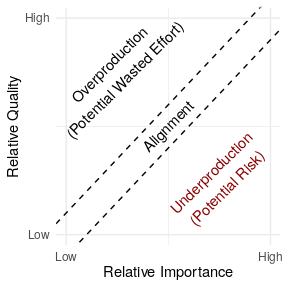 Conceptual diagram showing how our conception of underproduction relates to quality and importance of software.
 These 30 packages have the highest level of underproduction in Debian according to our analysis.
For more details, check out the full paper which is available as a freely accessible preprint.
This project was supported by the Ford/Sloan Digital Infrastructure Initiative. Wm Salt Hale of the Community Data Science Collective and Debian Developers Paul Wise and Don Armstrong provided valuable assistance in accessing and interpreting Debian bug data. Ren Just generously provided insight and feedback on the manuscript.
Paper Citation: Kaylea Champion and Benjamin Mako Hill. 2021. Underproduction: An Approach for Measuring Risk in Open Source Software. In Proceedings of the IEEE International Conference on Software Analysis, Evolution and Reengineering (SANER 2021). IEEE.
Contact Kaylea Champion (kaylea@uw.edu) with any questions or if you are interested in following up.
I served as a director and as a voting member of the Free Software Foundation for more than a decade. I left both positions over the last 18 months and currently have no formal authority in the organization.
So although it is now just my personal opinion, I will publicly add my voice to the chorus of people who are expressing their strong opposition to Richard Stallman s return to leadership in the FSF and to his continued leadership in the free software movement. The current situation makes me unbelievably sad.
I stuck around the FSF for a long time (maybe too long) and worked hard (I regret I didn t accomplish more) to try and make the FSF better because I believe that it is important to have voices advocating for social justice inside our movement s most important institutions. I believe this is especially true when one is unhappy with the existing state of affairs. I am frustrated and sad that I concluded that I could no longer be part of any process of organizational growth and transformation at FSF.
I have nothing but compassion, empathy, and gratitude for those who are still at the FSF especially the staff who are continuing to work silently toward making the FSF better under intense public pressure. I still hope that the FSF will emerge from this as a better organization.
debtree --build-dep rust-coreutils dot -Tsvg > coreutils.svg (should be around 1M).
Since it isn't production ready, the rust-coreutils is installable in parallel with coreutils. This package does NOT replace the GNU/coreutils files (yet?), the new files are installed in /usr/lib/cargo/bin/.
They can be used with:
export PATH=/usr/lib/cargo/bin/:$PATH
Or, uglier, overriding the files with the new ones.
build_qemu_debian_image.sh
A second script to boot on the newly created image: boot.sh
Then, building and installing coreutils on the system (yeah, it is ugly - don t do that at home):
apt install rust-coreutils

cd /usr/lib/cargo/bin/

for f in *; do

     cp -f $f /usr/bin/

done
First surprise, unlike the old init.d init system, as systemd is not relying on a series of scripts (it is mostly written in C), replacing the coreutils did not have an impact. Therefore, I didn't experience any issue during the boot process
/var/lib/dpkg/info/*) to finalize and configure packages. They are (almost?) all using /bin/sh (or /bin/bash) to perform these actions. They intensively call coreutils applications.
For example, in /var/lib/dpkg/info/exim4-base.postinst, we can find:
install -d -oDebian-exim -gadm -m2750 /var/log/exim4
With an ugly script, we can test the installations of the 1000 most popular packages one by one.
Running this, some classes of issues in Rust/coreutils could be easily identified.
update-initramfs: Generating /boot/initrd.img-4.19.0-12-amd64

ln: error: Unrecognized option: 'r'cp: error: Option 'archive' not yet implemented.cp: error: Option 'dereference' not yet implemented.sync -fs: https://github.com/uutils/coreutils/pull/1639install --owner & --group: https://github.com/uutils/coreutils/pull/1641mktemp -t https://github.com/uutils/coreutils/pull/1677Setting up libreoffice-common (1:6.1.5-3+deb10u6) ...
install: error: install: cannot install /dev/null to /etc/apparmor.d/local/usr.lib.libreoffice.program.oosplash : the source path is not an existing regular file A limitation of rust itself https://github.com/rust-lang/rust/issues/79390 mkdir --parent is sometime used (instead of --parents) - https://github.com/uutils/coreutils/commit/dbc716546b352c8b81af1952915137049ed12239 install: error: target bar.txt is not a directoryinstall -d won't fail if a directory already exists - https://github.com/uutils/coreutils/pull/1643ls non-existing-file wasn't returning an error code. "if ls" was used by some scripts - https://github.com/uutils/coreutils/pull/1654install -d /tmp/foo could not be executed twice (while the second run with the gnu version wouldn't trigger an error if already existing) - https://github.com/uutils/coreutils/pull/1641ln -fsn ../../x86/boot/bzImage ./arch/x86_64/boot/bzImage
ln: error: Unrecognized option: 'n'
 # TOTAL: 611

 # PASS:  144

 # SKIP:  86

 # XFAIL: 0

 # FAIL:  342

 # XPASS: 0

 # ERROR: 39
exec startx so after rebooting, I ran
exec sway and to my astonishment sway started. Hooray!
However, I found that ssh-agent wasn't running so I couldn't ssh into
any servers. That's kinda a problem.
Launching ssh-agent under openbox was buried deep in
/etc/X11/Xsession.d/90x11-common_ssh-agent and clearly was not going to
happen via wayland.
Since programs using ssh-agent depend on the environment variables
SSH_AUTH_SOCK and SSH_AGENT_PID being globally available I thought I could
simply run $(eval ssh-agent) via my tty terminal before running exec sway.
And, that would have worked. Except... I like to add my keys via ssh-add -c
so that everytime my key is being used I get a ssh-askpass prompt to confirm
the use.
It seems that since ssh-add is started before a window manager is running, it
can't run the prompt.
Ok, we can fix this. After searching the web, I came upon a solution of running
ssh-agent via systemctl --user:
# This service myst be started manually after sway
# starts.
[Unit]
Description=OpenSSH private key agent
IgnoreOnIsolate=true
[Service]
Type=forking
Environment=SSH_AUTH_SOCK=%t/ssh-agent.socket
ExecStart=/usr/bin/ssh-agent -a $SSH_AUTH_SOCK
~/.bashrc file I have:
if [ -n WAYLAND_DISPLAY ]; then
  export SSH_AUTH_SOCK=/run/user/1000/ssh-agent.socket
fi
$SSH_AGENT_PID is only used by ssh-agent to kill itself. Now that
is running via systemd - killing it should be do-able without a global
environment variable.
Done? Hardly.
I've been using impass (nee assword) happily for years but alas it is
tightly integrated with xdo and xclip.
So... I've switched to keepassxc which works out of the box with wayland.
My next challenge was the status bar. Farewell faithful
tint2. One of the reasons I failed on my
first two attempts to switch to Sway was the difficulty of getting the swaybar
to work how I wanted, particularly with nm-applet. Two things allowed me to move forward:
nmtui. Sigh.xclip with
wl-clipboard was a little tedious
but really not that difficult.
Getting my screen shot and screen recorder functionality was a bit harder. I
did a lot of searching before I finally found and compiled both swappy, screen
shot and
wf-recorder.
In the course of all my adventures, I came across the following helpful tips:
libreoffice-gtk3 to ensure libre office runs under waylandMOZ_ENABLE_WAYLAND to ensure firefox works properly.ssh-add command to ensure I am prompted for each use of my key seems to cause sway to crash intermittently.export XDG_CURRENT_DESKTOP=sway and export XDG_SESSION_TYPE=wayland to my .bashrc, and after hours of frustration, realize that I needed to configured firejail to allow it so that I can share my entire screen in Firefox. It doesn't yet support sharing a specific window, so I still have to keep chromium around for that (and Chromium can only share xwayland windows). Sigh. Oh, one more thing about Firefox: the option to choose what to share doesn't have "Entire Screen" as an option, you are just supposed to know that you should choose "Use operating system settings".~/.config/sway/config file I have: bindsym Mod4+e exec wtype " ". I have repeated that line for the main accent marks I need.about:config in the Firefox location window, searching for privacy.webrtc.legacyGlobalIndicator and setting it to False. The reddit thread also suggested finding privacy.webrtc.hideGlobalIndicator and setting it to True, but that setting doesn't seem to be available and setting the first one alone seems to do the trick.GDK_BACKEND=wayland,x11. First I just set it to wayland to get gtk3 apps to use wayland (like gajim). But that broke electron apps (like signal) which notice that variable but don't have a way to display via wayland (at least not yet). Setting it to "wayland,x11" shows the priority. Thank you ubuntu community.~/.config/sway/env. That seems like an official sway place to put them, but sway doesn't pay any attention to them. So I start sway via my own bash script which sources that file via [ -f "$HOME/.config/sway/env" ] && . "$HOME/.config/sway/env" before exec'ing sway. I won't reveal precisely how many books I read in 2020, but it was definitely an improvement on 74 in 2019, 53 in 2018 and 50 in 2017. But not only did I read more in a quantitative sense, the quality seemed higher as well. There were certainly fewer disappointments: given its cultural resonance, I was nonplussed by Nick Hornby's Fever Pitch and whilst Ian Fleming's The Man with the Golden Gun was a little thin (again, given the obvious influence of the Bond franchise) the booked lacked 'thinness' in a way that made it interesting to critique. The weakest novel I read this year was probably J. M. Berger's Optimal, but even this hybrid of Ready Player One late-period Black Mirror wasn't that cringeworthy, all things considered. Alas, graphic novels continue to not quite be my thing, I'm afraid.
I perhaps experienced more disappointments in the non-fiction section. Paul Bloom's Against Empathy was frustrating, particularly in that it expended unnecessary energy battling its misleading title and accepted terminology, and it could so easily have been an 20-minute video essay instead). (Elsewhere in the social sciences, David and Goliath will likely be the last Malcolm Gladwell book I voluntarily read.) After so many positive citations, I was also more than a little underwhelmed by Shoshana Zuboff's The Age of Surveillance Capitalism, and after Ryan Holiday's many engaging reboots of Stoic philosophy, his Conspiracy (on Peter Thiel and Hulk Hogan taking on Gawker) was slightly wide of the mark for me.
Anyway, here follows a selection of my favourites from 2020, in no particular order:
The disease stiffened and carried off three or four patients who were expected to recover. These were the unfortunates of the plague, those whom it killed when hope was highIt somehow captured the nostalgic yearning for high-definition videos of cities and public transport; one character even visits the completely deserted railway station in Oman simply to read the timetables on the wall.
Small, podgy, and at best middle-aged, Smiley was by appearance one of London's meek who do not inherit the earth. His legs were short, his gait anything but agile, his dress costly, ill-fitting, and extremely wet.Almost a direct rebuttal to Ian Fleming's 007, Tinker, Tailor has broken-down cars, bad clothes, women with their own internal and external lives (!), pathetically primitive gadgets, and (contra Mad Men) hangovers that significantly longer than ten minutes. In fact, the main aspect that the mostly excellent 2011 film adaption doesn't really capture is the smoggy and run-down nature of 1970s London this is not your proto-Cool Britannia of Austin Powers or GTA:1969, the city is truly 'gritty' in the sense there is a thin film of dirt and grime on every surface imaginable. Another angle that the film cannot capture well is just how purposefully the novel does not mention the United States. Despite the US obviously being the dominant power, the British vacillate between pretending it doesn't exist or implying its irrelevance to the matter at hand. This is no mistake on Le Carr 's part, as careful readers are rewarded by finding this denial of US hegemony in metaphor throughout --pace Ian Fleming, there is no obvious Felix Leiter to loudly throw money at the problem or a Sheriff Pepper to serve as cartoon racist for the Brits to feel superior about. By contrast, I recall that a clever allusion to "dusty teabags" is subtly mirrored a few paragraphs later with a reference to the installation of a coffee machine in the office, likely symbolic of the omnipresent and unavoidable influence of America. (The officer class convince themselves that coffee is a European import.) Indeed, Le Carr communicates a feeling of being surrounded on all sides by the peeling wallpaper of Empire. Oftentimes, the writing style matches the graceless and inelegance of the world it depicts. The sentences are dense and you find your brain performing a fair amount of mid-flight sentence reconstruction, reparsing clauses, commas and conjunctions to interpret Le Carr 's intended meaning. In fact, in his eulogy-cum-analysis of Le Carr 's writing style, William Boyd, himself a ventrioquilist of Ian Fleming, named this intentional technique 'staccato'. Like the musical term, I suspect the effect of this literary staccato is as much about the impact it makes on a sentence as the imperceptible space it generates after it. Lastly, the large cast in this sprawling novel is completely believable, all the way from the Russian spymaster Karla to minor schoolboy Roach the latter possibly a stand-in for Le Carr himself. I got through the 500-odd pages in just a few days, somehow managing to hold the almost-absurdly complicated plot in my head. This is one of those classic books of the genre that made me wonder why I had not got around to it before.
Perhaps his life might have veered elsewhere if the US government had opened the country to colored advancement like they opened the army. But it was one thing to allow someone to kill for you and another to let him live next door.Sardonic aper us of this kind are pretty relentless throughout the book, but it never tips its hand too far into on nihilism, especially when some of the visual metaphors are often first-rate: "An American flag sighed on a pole" is one I can easily recall from memory. In general though, The Nickel Boys is not only more world-weary in tenor than his previous novel, the United States it describes seems almost too beaten down to have the energy conjure up the Swiftian magical realism that prevented The Underground Railroad from being overly lachrymose. Indeed, even we Whitehead transports us a present-day New York City, we can't indulge in another kind of fantasy, the one where America has solved its problems:
The Daily News review described the [Manhattan restaurant] as nouveau Southern, "down-home plates with a twist." What was the twist that it was soul food made by white people?It might be overly reductionist to connect Whitehead's tonal downshift with the racial justice movements of the past few years, but whatever the reason, we've ended up with a hard-hitting, crushing and frankly excellent book.
"Earlier tonight I gave some thought to stealing a kiss from you, though you are very young, and sick and unattractive to boot, but now I am of a mind to give you five or six good licks with my belt." "One would be as unpleasant as the other."Perhaps this should be unsurprising. Maddie, a fourteen-year-old girl from Yell County, Arkansas, can barely fire her father's heavy pistol, so she can only has words to wield as her weapon. Anyway, it's not just me who treasures this book. In her encomium that presages most modern editions, Donna Tartt of The Secret History fame traces the novels origins through Huckleberry Finn, praising its elegance and economy: "The plot of True Grit is uncomplicated and as pure in its way as one of the Canterbury Tales". I've read any Chaucer, but I am inclined to agree. Tartt also recalls that True Grit vanished almost entirely from the public eye after the release of John Wayne's flimsy cinematic vehicle in 1969 this earlier film was, Tartt believes, "good enough, but doesn't do the book justice". As it happens, reading a book with its big screen adaptation as a chaser has been a minor theme of my 2020, including P. D. James' The Children of Men, Kazuo Ishiguro's Never Let Me Go, Patricia Highsmith's Strangers on a Train, James Ellroy's The Black Dahlia, John Green's The Fault in Our Stars, John le Carr 's Tinker, Tailor Soldier, Spy and even a staged production of Charles Dicken's A Christmas Carol streamed from The Old Vic. For an autodidact with no academic background in literature or cinema, I've been finding this an effective and enjoyable means of getting closer to these fine books and films it is precisely where they deviate (or perhaps where they are deficient) that offers a means by which one can see how they were constructed. I've also found that adaptations can also tell you a lot about the culture in which they were made: take the 'straightwashing' in the film version of Strangers on a Train (1951) compared to the original novel, for example. It is certainly true that adaptions rarely (as Tartt put it) "do the book justice", but she might be also right to alight on a legal metaphor, for as the saying goes, to judge a movie in comparison to the book is to do both a disservice.
We're accustomed to worrying about AI systems being built that will either "go rogue" and attack us, or succeed us in a bizarre evolution of, um, evolution what we didn't reckon on is the sheer inscrutability of these manufactured minds. And minds is not a misnomer. How else should we think about the neural network Google has built so its translator can model the interrelation of all words in all languages, in a kind of three-dimensional "semantic space"?New Dark Age also turns its attention to the weird, algorithmically-derived products offered for sale on Amazon as well as the disturbing and abusive videos that are automatically uploaded by bots to YouTube. It should, by rights, be a mess of disparate ideas and concerns, but Bridle has a flair for introducing topics which reveals he comes to computer science from another discipline altogether; indeed, on a four-part series he made for Radio 4, he's primarily referred to as "an artist". Whilst New Dark Age has rather abstract section topics, Adam Greenfield's Radical Technologies is a rather different book altogether. Each chapter dissects one of the so-called 'radical' technologies that condition the choices available to us, asking how do they work, what challenges do they present to us and who ultimately benefits from their adoption. Greenfield takes his scalpel to smartphones, machine learning, cryptocurrencies, artificial intelligence, etc., and I don't think it would be unfair to say that starts and ends with a cynical point of view. He is no reactionary Luddite, though, and this is both informed and extremely well-explained, and it also lacks the lazy, affected and Private Eye-like cynicism of, say, Attack of the 50 Foot Blockchain. The books aren't a natural pair, for Bridle's writing contains quite a bit of air in places, ironically mimics the very 'clouds' he inveighs against. Greenfield's book, by contrast, as little air and much lower pH value. Still, it was more than refreshing to read two technology books that do not limit themselves to platitudinal booleans, be those dangerously naive (e.g. Kevin Kelly's The Inevitable) or relentlessly nihilistic (Shoshana Zuboff's The Age of Surveillance Capitalism). Sure, they are both anti-technology screeds, but they tend to make arguments about systems of power rather than specific companies and avoid being too anti-'Big Tech' through a narrower, Silicon Valley obsessed lens for that (dipping into some other 2020 reading of mine) I might suggest Wendy Liu's Abolish Silicon Valley or Scott Galloway's The Four. Still, both books are superlatively written. In fact, Adam Greenfield has some of the best non-fiction writing around, both in terms of how he can explain complicated concepts (particularly the smart contract mechanism of the Ethereum cryptocurrency) as well as in the extremely finely-crafted sentences I often felt that the writing style almost had no need to be that poetic, and I particularly enjoyed his fictional scenarios at the end of the book.
A better proxy for your life isn't your first home, but your last. Where you draw your last breath is more meaningful, as it's a reflection of your success and, more important, the number of people who care about your well-being. Your first house signals the meaningful your future and possibility. Your last home signals the profound the people who love you. Where you die, and who is around you at the end, is a strong signal of your success or failure in life.Nir Eyal's Indistractable, however, is a totally different kind of 'self-help' book. The important background story is that Eyal was the author of the widely-read Hooked which turned into a secular Bible of so-called 'addictive design'. (If you've ever been cornered by a techbro wielding a Wikipedia-thin knowledge of B. F. Skinner's behaviourist psychology and how it can get you to click 'Like' more often, it ultimately came from Hooked.) However, Eyal's latest effort is actually an extended mea culpa for his previous sin and he offers both high and low-level palliative advice on how to avoid falling for the tricks he so studiously espoused before. I suppose we should be thankful to capitalism for selling both cause and cure. Speaking of markets, there appears to be a growing appetite for books in this 'anti-distraction' category, and whilst I cannot claim to have done an exhausting study of this nascent field, Indistractable argues its points well without relying on accurate-but-dry "studies show..." or, worse, Gladwellian gotchas. My main criticism, however, would be that Eyal doesn't acknowledge the limits of a self-help approach to this problem; it seems that many of the issues he outlines are an inescapable part of the alienation in modern Western society, and the only way one can really avoid distraction is to move up the income ladder or move out to a 500-acre ranch.
 The Rcpp team is proud to announce release 1.0.6 of Rcpp which arrived at CRAN earlier today, and has been uploaded to Debian too. Windows and macOS builds should appear at CRAN in the next few days. This marks the first release on the new six-months cycle announced with release 1.0.5 in July. As reminder, interim dev or rc releases will often be available in the Rcpp drat repo; this cycle there were four.
Rcpp has become the most popular way of enhancing R with C or C++ code. As of today, 2174 packages on CRAN depend on Rcpp for making analytical code go faster and further (which is an 8.5% increase just since the last release), along with 207 in BioConductor.
This release features six different pull requests from five different contributors, mostly fixing fairly small corner cases, plus some minor polish on documentation and continuous integration. Before releasing we once again made numerous reverse dependency checks none of which revealed any issues. So the passage at CRAN was pretty quick despite the large dependency footprint, and we are once again grateful for all the work the CRAN maintainers do.
Thanks to my CRANberries, you can also look at a diff to the previous release. Questions, comments etc should go to the rcpp-devel mailing list off the R-Forge page. Bugs reports are welcome at the GitHub issue tracker as well (where one can also search among open or closed issues); questions are also welcome underChanges in Rcpp patch release version 1.0.6 (2021-01-14)
- Changes in Rcpp API:
- Replace remaining few uses of
EXTPTR_PTRwithR_ExternalPtrAddr(Kevin in #1098 fixing #1097).- Add
push_backandpush_frontforDataFrame(Walter Somerville in #1099 fixing #1094).- Remove a misleading-to-wrong comment (Mattias Ellert in #1109 cleaning up after #1049).
- Address a sanitizer report by initializing two private
boolvariables (Benjamin Christoffersen in #1113).- External pointer finalizer toggle default values were corrected to true (Dirk in #1115).
- Changes in Rcpp Documentation:
- Several URLs were updated to https and/or new addresses (Dirk).
- Changes in Rcpp Deployment:
- Added GitHub Actions CI using the same container-based setup used previously, and also carried code coverage over (Dirk in #1128).
- Changes in Rcpp support functions:
Rcpp.package.skeleton()avoids warning from R. (Dirk)
rcpp tag at StackOverflow which also allows searching among the (currently) 2616 previous questions.
If you like this or other open-source work I do, you can sponsor me at GitHub. My sincere thanks to my current sponsors for me keeping me caffeinated.
This post by Dirk Eddelbuettel originated on his Thinking inside the box blog. Please report excessive re-aggregation in third-party for-profit settings.
#!/bin/sh
#
# Usage: $0
#
# Send  to , create local jami account if
# missing.
#
# License: GPL v2 or later at your choice
# Author: Petter Reinholdtsen
if [ -z "$HOME" ] ; then
    echo "error: missing \$HOME, required for dbus to work"
    exit 1
fi
# First, get dbus running if not already running
DBUSLAUNCH=/usr/bin/dbus-launch
PIDFILE=/run/asterisk/dbus-session.pid
if [ -e $PIDFILE ] ; then
    . $PIDFILE
    if ! kill -0 $DBUS_SESSION_BUS_PID 2>/dev/null ; then
        unset DBUS_SESSION_BUS_ADDRESS
    fi
fi
if [ -z "$DBUS_SESSION_BUS_ADDRESS" ] && [ -x "$DBUSLAUNCH" ]; then
    DBUS_SESSION_BUS_ADDRESS="unix:path=$HOME/.dbus"
    dbus-daemon --session --address="$DBUS_SESSION_BUS_ADDRESS" --nofork --nopidfile --syslog-only < /dev/null > /dev/null 2>&1 3>&1 &
    DBUS_SESSION_BUS_PID=$!
    (
        echo DBUS_SESSION_BUS_PID=$DBUS_SESSION_BUS_PID
        echo DBUS_SESSION_BUS_ADDRESS=\""$DBUS_SESSION_BUS_ADDRESS"\"
        echo export DBUS_SESSION_BUS_ADDRESS
    ) > $PIDFILE
    . $PIDFILE
fi &
dringop()
    part="$1"; shift
    op="$1"; shift
    dbus-send --session \
        --dest="cx.ring.Ring" /cx/ring/Ring/$part cx.ring.Ring.$part.$op $*

dringopreply()
    part="$1"; shift
    op="$1"; shift
    dbus-send --session --print-reply \
        --dest="cx.ring.Ring" /cx/ring/Ring/$part cx.ring.Ring.$part.$op $*

firstaccount()
    dringopreply ConfigurationManager getAccountList   \
      grep string   awk -F'"' ' print $2 '   head -n 1

account=$(firstaccount)
if [ -z "$account" ] ; then
    echo "Missing local account, trying to create it"
    dringop ConfigurationManager addAccount \
      dict:string:string:"Account.type","RING","Account.videoEnabled","false"
    account=$(firstaccount)
    if [ -z "$account" ] ; then
        echo "unable to create local account"
        exit 1
    fi
fi
# Not using dringopreply to ensure $2 can contain spaces
dbus-send --print-reply --session \
  --dest=cx.ring.Ring \
  /cx/ring/Ring/ConfigurationManager \
  cx.ring.Ring.ConfigurationManager.sendTextMessage \
  string:"$account" string:"$1" \
  dict:string:string:"text/plain","$2"
If you want to check it out yourself, visit the
the Jami system project page to learn
more, and install the latest Jami client from Debian Unstable or
Testing.
As usual, if you use Bitcoin and want to show your support of my
activities, please send Bitcoin donations to my address
15oWEoG9dUPovwmUL9KWAnYRtNJEkP1u1b.

golang-github-gorilla-css for Fedrico.
RuboCop::Packaging to v0.5.RuboCop::Packaging to v0.5.RuboCop::Packaging.faraday and faraday_middleware.RuboCop::Packaging to v0.5.RuboCop::Packaging amongst other used extensions.:wq for today.
| Publisher: | Tor |
| Copyright: | March 2020 |
| ISBN: | 1-250-21732-6 |
| Format: | Kindle |
| Pages: | 398 |
 TL;DR: CPS-conversion and defunctionalization can help you to come up with a constant-stack algorithm.
Update: Turns out I inadvertedly plagiarized the talk The Best Refactoring You ve Never Heard Of by James Koppel. Please consider this a form of sincere flattery.
map function:
data T a = L a   B (T a) (T a)
map1 :: (a -> b) -> T a -> T b
map1 f (L x) = L (f x)
map1 f (B t1 t2) = B (map1 f t1) (map1 f t2)map function is using the program stack as it traverses the tree. Our goal is now to come up with a map function that does not use the stack!
Why? Good question! In Haskell, there wouldn t be a strong need for this, as the Haskell stack is allocated on the heap, just like your normal data, so there is plenty of stack space. But in other languages or environments, the stack space may have a hard limit, and it may be advised to not use unbounded stack space.
That aside, it s a fun exercise, and that s sufficient reason for me.
(In the following, I assume that tail-calls, i.e. those where a function end with another function call, but without modifying its result, do not actually use stack space. Once all recursive function calls are tail calls, the code is equivalent to an imperative loop, as we will see.)
map1, and rewrite it, in several, mechanical, steps into a stack-less, tail-recursive solution.
map function using a local go helper, as follows:
map2 :: forall a b. (a -> b) -> T a -> T b
map2 f t = go t
  where
    go :: T a -> T b
    go (L x) = L (f x)
go (B t1 t2) = B (go t1) (go t2)f around all the time, and that when we copy the function, I only have to change the top-level name, but not the names of the inner functions.
Also, I find it more aesthetically pleasing.
-> t, we turn it into a function of type -> (t -> r) -> r, where r is the type of the result we want at the very end. This means the function now receives an extra argument, often named k for continuation, and instead of returning some x, the function calls k x.
We can apply this to our go function. Here, both t and r happen to be T b; the type of finished trees:
map3 :: forall a b. (a -> b) -> T a -> T b
map3 f t = go t (\r -> r)
  where
    go :: T a -> (T b -> T b) -> T b
    go (L x) k  = k (L (f x))
go (B t1 t2) k = go t1 (\r1 -> go t2 (\r2 -> k (B r1 r2)))go, we pass the identity function (\r -> r) as the initial continuation.
Alas, suddenly all function calls are in tail position, and this codes does not use stack space! Technically, we are done, although it is not quite satisfying; all these lambdas floating around obscure the meaning of the code, are maybe a bit slow to execute, and also, we didn t really learn much yet. This is certainly not the code we would have writing after thinking hard .
(T b -> T b), but we certainly don t mean the full type (T b -> T b). Instead, only very specific values of that type occur in our program, So let us replace (T b -> T b) with a data type that contains representatives of just the values we actually use.
(T b -> T b). These are:
(\r -> r)(\r1 -> go t2 (\r2 -> k (B r1 r2)))(\r2 -> k (B r1 r2)) data K = I K1 K2K back into a (T b -> T b):
eval :: K -> (T b -> T b)
eval = (* TBD *)go, instead of taking a parameter of type (T b -> T b), we take a K. And when we actually use the continuation, we have to turn the K back to the function using eval:
go :: T a -> K a b -> T b
go (L x) k  = eval k (L (f x))
go (B t1 t2) k = go t1 K1(\r -> r)(\r1 -> go t2 K2)(\r2 -> eval k (B r1 r2))eval function: For each constructor, we simply map it to the corresponding lambda from step 1:
eval :: K -> (T b -> T b)
eval I = (\r -> r)
eval K1 = (\r1 -> go t2 K2)
eval K2 = (\r2 -> eval k (B r1 r2))t2, r1, k). So let s add them to the constructors K1 and K2 as needed. This also changes the type K itself; it now needs to take type parameters.data K a b
= I
K1 (T a) (K a b)
K2 (T b) (K a b)
map4 :: forall a b. (a -> b) -> T a -> T b
map4 f t = go t I
where
go :: T a -> K a b -> T b
go (L x) k = eval k (L (f x))
go (B t1 t2) k = go t1 (K1 t2 k)
eval :: K a b -> (T b -> T b)
eval I = (\r -> r)
eval (K1 t2 k) = (\r1 -> go t2 (K2 r1 k))
eval (K2 r1 k) = (\r2 -> eval k (B r1 r2))K data type really is just a list of values, where the values are either T a or T b. We do not need a custom data type for this! Instead of our K, we can just use the following, built from standard data types:
type K' a b = [Either (T a) (T b)]I with [], K1 t2 k with Left t2 : k and K2 r1 k with Right r1 : k. I also, very suggestively, rename go to down and eval to up:
map5 :: forall a b. (a -> b) -> T a -> T b
map5 f t = down t []
  where
    down :: T a -> K' a b -> T b
    down (L x) k  = up k (L (f x))
    down (B t1 t2) k  = down t1 (Left t2 : k)
    up :: K' a b -> T b -> T b
    up [] r = r
    up (Left  t2 : k) r1 = down t2 (Right r1 : k)
up (Right r1 : k) r2 = up k (B r1 r2)As we traverse the tree, we have to remember for all parent nodes, whether there is still somethingQuite neat!Leftto do when we come back to it (so we remember aT a), or if we are done with that (so we have aT b). This is the listK' a b. We begin to godownthe left of the tree (noting that the right siblings are still left to do), until we hit a leaf. We transform the leaf, and then goup. If we goupand hit the root, we are done. Else, if we goupand there is somethingLeftto do, we remember the subtree that we just processed (as that is already in theRightform), and godownthe other subtree. But if we goupand there is nothingLeftto do, we put the two subtrees together and continue going up.
a -> r and b -> r that have the same return type (which they necessarily have here, since we CPS-converted them further up), then those two functions are equivalent to a single function taking a or b , i.e. Either a b -> r. This really nothing else than the high-school level algebra rule of ra rb = ra + b.
So (after reordering the arguments of down to put T b first) we can rewrite the code as
map6 :: forall a b. (a -> b) -> T a -> T b
map6 f t = go (Left t) []
  where
    go :: Either (T a) (T b) -> K' a b -> T b
    go (Left (L x))     k        = go (Right (L (f x))) k
    go (Left (B t1 t2)) k        = go (Left t1) (Left t2 : k)
    go (Right r)  []             = r
    go (Right r1) (Left  t2 : k) = go (Left t2) (Right r1 : k)
go (Right r2) (Right r1 : k) = go (Right (B r1 r2)) kmapLoop :: forall a b. (a -> b) -> T a -> T b
mapLoop f t
var node = Left t;
var parents = [];
while (true)
switch (node)
Left (L x) -> node := Right (L (f x))
Left (B t1 t2) -> node := Left t1; parents.push(Left t2)
Right r1 ->
if (parents.len() == 0)
return r1;
else
switch (parents.pop())
Left t2 -> node := Left t2; parents.push(Right r1);
Right r2 -> node := Right (B r1 r2)
isOrderedTree, which I have presented at MuniHac 2019 and Haskell Love 2020.
 A new maintenance release, now at version 0.0.18, of RcppAnnoy is now on CRAN. RcppAnnoy is the Rcpp-based R integration of the nifty Annoy library by Erik Bernhardsson. Annoy is a small and lightweight C++ template header library for very fast approximate nearest neighbours originally developed to drive the famous Spotify music discovery algorithm.
This release is follow-up to release 0.0.17 which was made four weeks ago, and which brought the new upstream release 1.17 of Annoy. We now have an updated upstream with a PR by Aaron aiming for improved control of RNG seeding to ensure better reproducibility, along with extended tests and new helpers for RcppAnnoy and Annoy version numbers. The release was once again coordinated with Annoy and James whose BiocNeighbors and uwot packages both consume the Annoy header library shipped here.
Detailed changes follow below.
Courtesy of my CRANberries, there is also a diffstat report for this release. If you like this or other open-source work I do, you can sponsor me at GitHub.Changes in version 0.0.18 (2020-12-15)
- Small tweaks to threading policy header defines (Dirk closing #65)
- Vignette code is again compiled during testing (Aaron Lum and Dirk in #66 addressing #64)
- Upstream code (with Aaron's PR) was synchronized once more (Dirk in #67)
- A new helper function was added to report the Annoy version (Aaron in #68)
This post by Dirk Eddelbuettel originated on his Thinking inside the box blog. Please report excessive re-aggregation in third-party for-profit settings.
 In some ways it is sad and interesting to see how personal liberty is viewed in India. And how it differs from those having the highest fame and power can get a different kind of justice then the rest cannot.
 Justice Chandrachud If you don t like a channel then don t watch it. 11th November 2020 .
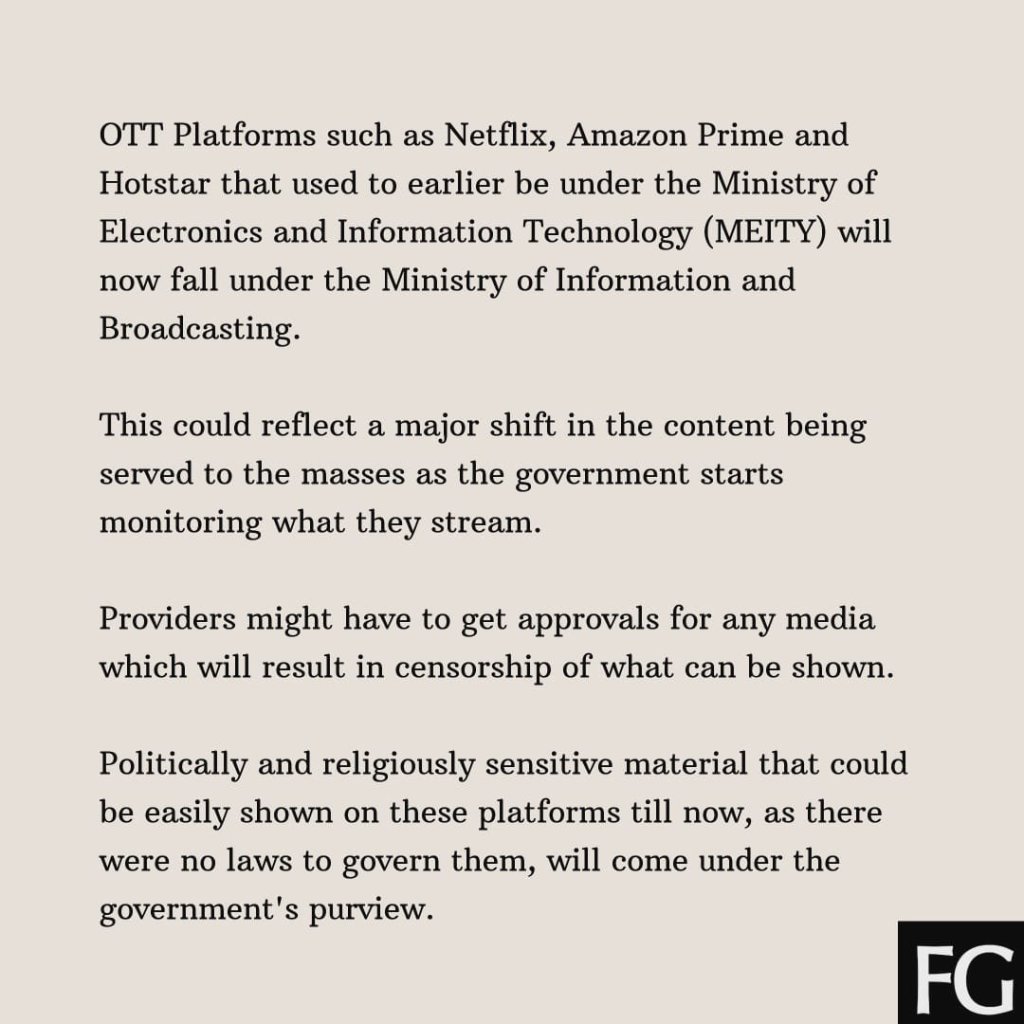 Information and Broadcasting Ministry bringing OTT services as well as news within its ambit.
A new release 0.0.17 of RcppAnnoy is now on CRAN. RcppAnnoy is the Rcpp-based R integration of the nifty Annoy library by Erik Bernhardsson. Annoy is a small and lightweight C++ template header library for very fast approximate nearest neighbours originally developed to drive the famous Spotify music discovery algorithm.
This release brings a new upstream version 1.17, released a few weeks ago, which adds multithreaded index building. This changes the API by adding a new threading policy parameter requiring code using the main Annoy header to update. For this reason we waited a little for the dust to settle on the BioConductor 3.12 release before bringing the changes to BiocNeighbors via this commit and to uwot via this simple PR. Aaron and James updated their packages accordingly so by the time I uploaded RcppAnnoy it made for very smooth sailing as we all had done our homework with proper conditional builds, and the package had no other issue preventing automated processing at CRAN. Yay. I also added a (somewhat overdue one may argue) header file RcppAnnoy.h regrouping defines and includes which should help going forward.
Detailed changes follow below.
Courtesy of my CRANberries, there is also a diffstat report for this release. If you like this or other open-source work I do, you can now sponsor me at GitHub. For the first year, GitHub will match your contributions.Changes in version 0.0.17 (2020-11-15)
- Upgrade to Annoy 1.17, but default to serial use.
- Add new header file to regroup includes and defines.
- Upgrade CI script to use R with bspm on focal.
This post by Dirk Eddelbuettel originated on his Thinking inside the box blog. Please report excessive re-aggregation in third-party for-profit settings.
Next.