2026-07-24 15:43:17 status triggers-pending wordpress:all 7.0+dfsg1-1 2026-07-24 15:43:19 upgrade wordpress:all 7.0+dfsg1-1 7.0.2+dfsg1-1Above are the relevant sections of my dpkg log showing the WordPress versions in use. I was running version 7.0+dfsg1-1 at the time the account was apparently created. I am confident in the accuracy of the dpkg logs and believe that they did not compromise the OS, I am not sure whether they ran hostile SQL code to change fields in the MySQL database so had to consider the possibility that the account creation time could have been set to a deliberately misleading value. I checked backups of the MySQL database stored off-site and found that the account in question was not in the 2026-07-21 backup (which was done before 16:43) but in the 2026-07-22 backup. The WordPress release history [2] has version 7.0.1 released on 2026-07-09 and version 7.0.2 released on 2026-07-17. So presumably the attacker diffed the code on those releases, found an exploitable bug, and used it to create an account on my blog with admin privs. Then they waited a few weeks to see if I would notice and published a blog post when I didn t notice. WordPress Deficiencies
select $TABLE_PREFIXusers.user_login, $TABLE_PREFIXusers.user_pass, $TABLE_PREFIXusermeta.meta_value from $TABLE_PREFIXusers join $TABLE_PREFIXusermeta on $TABLE_PREFIXusers.id = $TABLE_PREFIXusermeta.user_id and meta_key='$TABLE_PREFIXcapabilities' and meta_value != 'a:1: s:10:"subscriber";b:1; ';
2026-08-09T23:03:06.004792+10:00 xev kernel: amdgpu 0000:02:00.0: GPU fault detected: 147 0x00024802 2026-08-09T23:03:06.004792+10:00 xev kernel: amdgpu 0000:02:00.0: Process kscreenlocker_g pid 42037 thread kscreenloc:cs0 pid 42044 2026-08-09T23:03:06.004793+10:00 xev kernel: amdgpu 0000:02:00.0: VM_CONTEXT1_PROTECTION_FAULT_ADDR 0x00000800 2026-08-09T23:03:06.004794+10:00 xev kernel: amdgpu 0000:02:00.0: VM_CONTEXT1_PROTECTION_FAULT_STATUS 0x0F048002 2026-08-09T23:03:06.004795+10:00 xev kernel: amdgpu 0000:02:00.0: VM fault (0x02, vmid 7, pasid 130) at page 2048, write from 'TC0' (0x54433000) (72) 2026-08-09T23:03:06.008762+10:00 xev kernel: amdgpu 0000:02:00.0: GPU fault detected: 147 0x00004802 2026-08-09T23:03:06.008768+10:00 xev kernel: amdgpu 0000:02:00.0: Process kscreenlocker_g pid 42037 thread kscreenloc:cs0 pid 42044
2026-08-04T01:13:37.505839+10:00 xev kernel: ------------[ cut here ]------------ 2026-08-04T01:13:37.505859+10:00 xev kernel: amdgpu 0000:02:00.0: [drm] drm_WARN_ON_ONCE(cur_vblank != vblank->last) 2026-08-04T01:13:37.505862+10:00 xev kernel: WARNING: CPU: 6 PID: 210534 at drivers/gpu/drm/drm_vblank.c:362 drm_update_vblank_count+0x2f1/0x3c0 [drm] 2026-08-04T01:13:37.505866+10:00 xev kernel: snd_intel_dspcfg wmi_bmof rc_core snd_intel_sdw_acpi drm_ttm_helper uas realtek snd_usbmidi_lib snd_hda_codec ttm mdio_devres snd_hda_core snd_seq_midi drm_kms_helper usb_storage mc snd_hwdep libphy snd_seq_midi_event intel_uncore snd_pcm_oss i2c_algo_bit serio_raw snd_rawmidi pcspkr snd_mixer_oss i2c_i801 video snd_seq snd_pcm i2c_smbus lpc_ich snd_seq_device mei_me e1000e snd_timer mei snd tpm_infineon soundcore joydev bnx2 wmi button nfsd auth_rpcgss nfs_acl lockd grace sunrpc coretemp br_netfilter bridge stp llc sg ghash_clmulni_intel loop msr i2c_dev drm efi_pstore configfs nfnetlink ip_tables x_tables autofs4 btrfs blake2b_generic dm_crypt dm_mod raid10 raid456 async_raid6_recov async_memcpy async_pq async_xor async_tx libcrc32c xor raid6_pq raid1 raid0 md_mod ext4 crc16 mbcache jbd2 crc32c_generic virtio_blk evdev hid_generic usbhid hid sd_mod xhci_pci xhci_hcd ahci ehci_pci ehci_hcd libahci crc32c_intel libata usbcore aesni_intel nvme psmouse scsi_mod gf128mul crypto_simd nvme_core cryptd 2026-08-04T01:13:37.505879+10:00 xev kernel: nvme_auth scsi_common usb_common efivarfs 2026-08-04T01:13:37.505880+10:00 xev kernel: CPU: 6 UID: 1008 PID: 210534 Comm: sshd-session Tainted: G D 6.12.88+deb13-amd64 #1 Debian 6.12.88-1 2026-08-04T01:13:37.505881+10:00 xev kernel: Tainted: [D]=DIE 2026-08-04T01:13:37.505883+10:00 xev kernel: Hardware name: Hewlett-Packard HP Z640 Workstation/212A, BIOS M60 v02.61 03/23/2023 2026-08-04T01:13:37.505884+10:00 xev kernel: RIP: 0010:drm_update_vblank_count+0x2f1/0x3c0 [drm] 2026-08-04T01:13:37.505885+10:00 xev kernel: Code: 48 8b 5f 50 48 85 db 75 03 48 8b 1f e8 68 eb 2b cf 48 c7 c1 70 3e cb c0 48 89 da 48 c7 c7 f9 6f cb c0 48 89 c6 e8 af d7 a6 ce <0f> 0b e9 4b fe ff ff 48 8b 4c 24 18 e9 31 fe ff ff 31 f6 48 85 db 2026-08-04T01:13:37.505887+10:00 xev kernel: RSP: 0000:ffffd3cc8681fca0 EFLAGS: 00010082 2026-08-04T01:13:37.505888+10:00 xev kernel: RAX: 0000000000000000 RBX: ffff8c6b42b13710 RCX: 0000000000000027 2026-08-04T01:13:37.505889+10:00 xev kernel: RDX: ffff8c89ef521788 RSI: 0000000000000001 RDI: ffff8c89ef521780 2026-08-04T01:13:37.505890+10:00 xev kernel: RBP: 0000000000000000 R08: 0000000000000000 R09: ffffd3cc8681fb20 2026-08-04T01:13:37.505891+10:00 xev kernel: R10: ffff8c8a6fef3628 R11: 0000000000000003 R12: 0000000000000000 2026-08-04T01:13:37.505892+10:00 xev kernel: R13: ffff8c6c07853828 R14: 0000000000000003 R15: 0000000000000000 2026-08-04T01:13:37.505893+10:00 xev kernel: FS: 00007ffaf2fd5880(0000) GS:ffff8c89ef500000(0000) knlGS:0000000000000000 2026-08-04T01:13:37.505895+10:00 xev kernel: CS: 0010 DS: 0000 ES: 0000 CR0: 0000000080050033 2026-08-04T01:13:37.505896+10:00 xev kernel: CR2: 00007fb1718c8000 CR3: 000000074521a004 CR4: 00000000003706f0 2026-08-04T01:13:37.505897+10:00 xev kernel: Call Trace: 2026-08-04T01:13:37.505898+10:00 xev kernel: 2026-08-04T01:13:37.505899+10:00 xev kernel: drm_crtc_accurate_vblank_count+0x41/0xc0 [drm] 2026-08-04T01:13:37.505900+10:00 xev kernel: dm_pflip_high_irq+0x155/0x330 [amdgpu] 2026-08-04T01:13:37.505901+10:00 xev kernel: amdgpu_dm_irq_handler+0x85/0x1f0 [amdgpu] 2026-08-04T01:13:37.505902+10:00 xev kernel: amdgpu_irq_dispatch+0xd2/0x230 [amdgpu] 2026-08-04T01:13:37.505903+10:00 xev kernel: amdgpu_ih_process+0x84/0x100 [amdgpu] 2026-08-04T01:13:37.505904+10:00 xev kernel: amdgpu_irq_handler+0x23/0x60 [amdgpu] 2026-08-04T01:13:37.505905+10:00 xev kernel: __handle_irq_event_percpu+0x4a/0x190 2026-08-04T01:13:37.505907+10:00 xev kernel: handle_irq_event+0x38/0x80 2026-08-04T01:13:37.505908+10:00 xev kernel: handle_edge_irq+0x8b/0x230 2026-08-04T01:13:37.505909+10:00 xev kernel: __common_interrupt+0x45/0xe0 2026-08-04T01:13:37.505910+10:00 xev kernel: common_interrupt+0x42/0xa0 2026-08-04T01:13:37.505911+10:00 xev kernel: asm_common_interrupt+0x26/0x40 2026-08-04T01:13:37.505912+10:00 xev kernel: RIP: 0033:0x7ffaf3c5fd7b 2026-08-04T01:13:37.505913+10:00 xev kernel: Code: 70 c7 00 66 0f 6e f8 c1 ef 02 66 0f 70 f7 e0 83 c7 01 66 0f ef ff 66 0f fa f2 0f 1f 44 00 00 f3 0f 7e 01 66 0f 6f ce 83 c6 01 <48> 83 e9 08 f2 0f 70 c0 1b 66 0f 6f e0 66 0f 6f e8 66 41 0f f9 c0 2026-08-04T01:13:37.505915+10:00 xev kernel: RSP: 002b:00007fff86a5e0e0 EFLAGS: 00000202 2026-08-04T01:13:37.505916+10:00 xev kernel: RAX: 0000000000008000 RBX: 0000562614a04050 RCX: 0000562614982ed8 2026-08-04T01:13:37.505946+10:00 xev kernel: RDX: 0000000000007fe2 RSI: 0000000000000fad RDI: 0000000000002000 2026-08-04T01:13:37.505948+10:00 xev kernel: RBP: 0000000000000000 R08: 000056261498ac40 R09: 0000000000008000 2026-08-04T01:13:37.505949+10:00 xev kernel: R10: 0000000000000066 R11: 0000000000007fe1 R12: 0000000000007efa 2026-08-04T01:13:37.505950+10:00 xev kernel: R13: 0000000000008000 R14: 0000000000008000 R15: 000000000000ffe0 2026-08-04T01:13:37.505951+10:00 xev kernel: 2026-08-04T01:13:37.505953+10:00 xev kernel: ---[ end trace 0000000000000000 ]--- 2026-08-04T01:55:40.844110+10:00 xev kernel: pcieport 0000:00:03.3: AER: Multiple Correctable error message received from 0000:00:03.3 2026-08-04T01:55:40.844130+10:00 xev kernel: pcieport 0000:00:03.3: PCIe Bus Error: severity=Correctable, type=Data Link Layer, (Receiver ID) 2026-08-04T01:55:40.844132+10:00 xev kernel: pcieport 0000:00:03.3: device [8086:6f0b] error status/mask=00000040/00002000 2026-08-04T01:55:40.844134+10:00 xev kernel: pcieport 0000:00:03.3: [ 6] BadTLP
2026-08-11T09:33:33.473855+10:00 xev kernel: amdgpu 0000:02:00.0: GPU fault detected: 147 0x00024802 2026-08-11T09:33:33.473871+10:00 xev kernel: amdgpu 0000:02:00.0: Process kscreenlocker_g pid 150905 thread kscreenloc:cs0 pid 150912 2026-08-11T09:33:33.473871+10:00 xev kernel: amdgpu 0000:02:00.0: VM_CONTEXT1_PROTECTION_FAULT_ADDR 0x00000800 2026-08-11T09:33:33.473873+10:00 xev kernel: amdgpu 0000:02:00.0: VM_CONTEXT1_PROTECTION_FAULT_STATUS 0x0F048002 2026-08-11T09:33:33.473873+10:00 xev kernel: amdgpu 0000:02:00.0: VM fault (0x02, vmid 7, pasid 63) at page 2048, write from 'TC0' (0x54433000) (72) 2026-08-11T09:33:33.473874+10:00 xev kernel: amdgpu 0000:02:00.0: GPU fault detected: 147 0x00004802 2026-08-11T09:33:33.473874+10:00 xev kernel: amdgpu 0000:02:00.0: Process kscreenlocker_g pid 150905 thread kscreenloc:cs0 pid 150912 2026-08-11T09:33:33.473875+10:00 xev kernel: amdgpu 0000:02:00.0: VM_CONTEXT1_PROTECTION_FAULT_ADDR 0x00000800 2026-08-11T09:33:33.473876+10:00 xev kernel: amdgpu 0000:02:00.0: VM_CONTEXT1_PROTECTION_FAULT_STATUS 0x0E048002 2026-08-11T09:33:33.473876+10:00 xev kernel: amdgpu 0000:02:00.0: VM fault (0x02, vmid 7, pasid 63) at page 2048, read from 'TC0' (0x54433000) (72) 2026-08-11T09:33:35.481863+10:00 xev kernel: amdgpu 0000:02:00.0: Dumping IP State 2026-08-11T09:33:35.481875+10:00 xev kernel: amdgpu 0000:02:00.0: Dumping IP State Completed 2026-08-11T09:33:35.481875+10:00 xev kernel: amdgpu 0000:02:00.0: [drm] AMDGPU device coredump file has been created 2026-08-11T09:33:35.481876+10:00 xev kernel: amdgpu 0000:02:00.0: [drm] Check your /sys/class/drm/card0/device/devcoredump/data 2026-08-11T09:33:35.481877+10:00 xev kernel: amdgpu 0000:02:00.0: GPU fault detected: 146 0x0110040c 2026-08-11T09:33:35.481877+10:00 xev kernel: amdgpu 0000:02:00.0: Process kscreenlocker_g pid 150905 thread kscreenloc:cs0 pid 150912 2026-08-11T09:33:35.481878+10:00 xev kernel: amdgpu 0000:02:00.0: VM_CONTEXT1_PROTECTION_FAULT_ADDR 0x00000022 2026-08-11T09:33:35.481879+10:00 xev kernel: amdgpu 0000:02:00.0: VM_CONTEXT1_PROTECTION_FAULT_STATUS 0x0E00400C 2026-08-11T09:33:35.481879+10:00 xev kernel: amdgpu 0000:02:00.0: VM fault (0x0c, vmid 7, pasid 63) at page 34, read from 'TC3' (0x54433300) (4) 2026-08-11T09:33:35.489845+10:00 xev kernel: amdgpu 0000:02:00.0: ring gfx timeout, signaled seq=5123619, emitted seq=5123621 2026-08-11T09:33:35.489853+10:00 xev kernel: amdgpu 0000:02:00.0: Process kscreenlocker_g pid 150905 thread kscreenloc:cs0 pid 150912 2026-08-11T09:33:35.489854+10:00 xev kernel: amdgpu 0000:02:00.0: GPU reset begin!. Source: 1 2026-08-11T09:33:35.493839+10:00 xev kernel: amdgpu 0000:02:00.0: [drm] ERROR Failed to initialize parser -125! 2026-08-11T09:33:35.737848+10:00 xev kernel: amdgpu: cp is busy, skip halt cp 2026-08-11T09:33:35.897842+10:00 xev kernel: amdgpu: rlc is busy, skip halt rlc 2026-08-11T09:33:35.897852+10:00 xev kernel: amdgpu 0000:02:00.0: BACO reset 2026-08-11T09:33:36.485849+10:00 xev kernel: amdgpu 0000:02:00.0: GPU reset succeeded, trying to resume 2026-08-11T09:33:36.485859+10:00 xev kernel: amdgpu 0000:02:00.0: [drm] PCIE GART of 256M enabled (table at 0x000000F402000000). 2026-08-11T09:33:36.485860+10:00 xev kernel: amdgpu 0000:02:00.0: VRAM is lost due to GPU reset!Errors on Battlemage
Aug 11 17:01:47 ami kernel: ------------[ cut here ]------------ Aug 11 17:01:47 ami kernel: xe 0000:23:00.0: [drm] DMC 1 mmio[0]/0x5f074 incorrect (expected 0x96fc0, current 0x0) Aug 11 17:01:47 ami kernel: WARNING: drivers/gpu/drm/i915/display/intel_dmc.c:696 at assert_dmc_loaded+0x275/0x430 [xe], CPU#0: kworker/0:3/215 Aug 11 17:01:47 ami kernel: Modules linked in: intel_rapl_msr intel_rapl_common intel_uncore_frequency intel_uncore_frequency_common xe(+) skx_edac snd_h> Aug 11 17:01:47 ami kernel: msr i2c_dev configfs efi_pstore efivarfs autofs4 btrfs libblake2b raid6_pq xor mpt3sas raid_class scsi_transport_sas megarai> Aug 11 17:01:47 ami kernel: CPU: 0 UID: 0 PID: 215 Comm: kworker/0:3 Not tainted 7.1.7+deb14-amd64 #1 PREEMPT(lazy) Debian 7.1.7-1 Aug 11 17:01:47 ami kernel: Hardware name: HP HP Z4 G4 Workstation/81C5, BIOS P61 v03.00 04/15/2026 Aug 11 17:01:47 ami kernel: Workqueue: sync_wq local_pci_probe_callback Aug 11 17:01:47 ami kernel: RIP: 0010:assert_dmc_loaded+0x291/0x430 [xe] Aug 11 17:01:47 ami kernel: Code: 24 10 e8 f2 e5 a3 ce 48 8d 3d bb 85 0d 00 8b 54 24 0c 45 89 e9 45 89 e0 48 89 c6 52 8b 4c 24 2c 51 8b 4c 24 30 48 8b 54> Aug 11 17:01:47 ami kernel: RSP: 0018:ffffd27ac0b87b80 EFLAGS: 00010282 Aug 11 17:01:47 ami kernel: RAX: ffffffffc1743dfd RBX: ffff8c5b80e54000 RCX: 0000000000000001 Aug 11 17:01:47 ami kernel: RDX: ffff8c5b81df5a10 RSI: ffffffffc1743dfd RDI: ffffffffc1605860 Aug 11 17:01:47 ami kernel: RBP: ffff8c5b86955000 R08: 0000000000000000 R09: 000000000005f074 Aug 11 17:01:47 ami kernel: R10: 0000000000000000 R11: 0000000000091050 R12: 0000000000000000 Aug 11 17:01:47 ami kernel: R13: 000000000005f074 R14: 0000000000000001 R15: 0000000000000000 Aug 11 17:01:47 ami kernel: FS: 0000000000000000(0000) GS:ffff8c673e172000(0000) knlGS:0000000000000000 Aug 11 17:01:47 ami kernel: CS: 0010 DS: 0000 ES: 0000 CR0: 0000000080050033 Aug 11 17:01:47 ami kernel: CR2: 00007ffed1fdcd00 CR3: 0000000ae942a003 CR4: 00000000003706f0 Aug 11 17:01:47 ami kernel: Call Trace: Aug 11 17:01:47 ami kernel: Aug 11 17:01:47 ami kernel: intel_dmc_enable_pipe+0xe4/0x290 [xe] Aug 11 17:01:47 ami kernel: ? drm_crtc_vblank_reset+0x4d/0x120 [drm] Aug 11 17:01:47 ami kernel: intel_modeset_setup_hw_state+0xb50/0x1e10 [xe] Aug 11 17:01:47 ami kernel: ? intel_display_driver_probe_nogem+0x138/0x1a0 [xe] Aug 11 17:01:47 ami kernel: intel_display_driver_probe_nogem+0x138/0x1a0 [xe] Aug 11 17:01:47 ami kernel: xe_display_init_early+0xb2/0x140 [xe] Aug 11 17:01:47 ami kernel: xe_device_probe+0x3c8/0xb50 [xe] Aug 11 17:01:47 ami kernel: ? xe_pm_init_early+0x152/0x160 [xe] Aug 11 17:01:47 ami kernel: xe_pci_probe+0xc26/0x1150 [xe] Aug 11 17:01:47 ami kernel: local_pci_probe+0x3e/0x90 Aug 11 17:01:47 ami kernel: local_pci_probe_callback+0x16/0x20 Aug 11 17:01:47 ami kernel: process_one_work+0x19d/0x3a0 Aug 11 17:01:47 ami kernel: worker_thread+0x1af/0x320 Aug 11 17:01:47 ami kernel: ? __pfx_worker_thread+0x10/0x10 Aug 11 17:01:47 ami kernel: kthread+0xe3/0x120 Aug 11 17:01:47 ami kernel: ? __pfx_kthread+0x10/0x10 Aug 11 17:01:47 ami kernel: ret_from_fork+0x2b2/0x340 Aug 11 17:01:47 ami kernel: ? __pfx_kthread+0x10/0x10 Aug 11 17:01:47 ami kernel: ret_from_fork_asm+0x1a/0x30 Aug 11 17:01:47 ami kernel: Aug 11 17:01:47 ami kernel: ---[ end trace 0000000000000000 ]---
328. This version includes the following changes:
[ Chris Lamb ]
* Don't require python3-guestfs in the autopkgtests on 32-bit architectures.
(Closes: #1144372)
[ Jochen Sprickerhof ]
* Use the XML comparators for SVG vector image files. (Closes: #1144242)
Ohai,
I have some pending, encrypted mails to answer. And some of my answers for
the next few days (particularly to what pertains to the current
in-discussion vote on LLM usage in
Debian) will be unsigned, even
though I d like otherwise.
My desktop system at work is showing some data corruption, and I m slowly
backing up my data. Fortunately, it seems I haven t lost any data, but
still, given I m letting rsync run until it starts spewing I/O errors,
then power down and let the machine cool a bit, and start again it is a
potentially long process.
And yes, this makes me somewhat angry. Why angry? Because I m working on a
brand-new computer (well, have used it for slightly over six months),
custom-built to specs requested by my workplace. Specs that I don t really
need, this machine is an utter luxury (i.e. an AMD Ryzen 9 9950X processor
with 16 real cores / 32 threads; 128GB RAM in this day and age of RAM
shortage, quite recent 32GB GPU, and lots of shiny lights seen in its huge
fishbowl cabinet, liquid-based cooling ). The specs came not from me, but
from people who had no idea what we would use them for. And yes, I expect
the little fortune spent on this machine to be good for my use for probably
a decade, as my previous computer was, but the amount paid
was exorbitant.
But still, what I learned recently is that the 4TB nVME SSD it has (a
T-Force TM8FFJX34T) is a very cheap brand, bought because it was close
to half the price of other offerings similar in capacity. According to
smartctl s output, th SSD operates with a Warning Comp. Temp. Threshold:
90 Celsius and Critical Comp. Temp. Threshold: 110 Celsius, which sounds
sensible, even too high for my standards (my last two laptops have been
fanless yes, an ARM system is very different from a high-end gaming
machine). I m right now typing from my laptop, which shows 78 C and 82 C
for warning/critical thresholds.
And as expected, under heavy sustained reads (backing up to my NFS server),
the desktop s smartctl shows Temperature: 83 Celsius and, further down,
Temperature Sensor 1: 107 Celsius and Temperature Sensor 2: 82 Celsius
(don t know which of these would make the threshold jump). The SSD has
sustained Media and Data Integrity Errors: 20 and Warning
Comp. Temperature Time: 21 (although Critical Comp. Temperature Time: 0). At least one of my colleagues have shrugged and installed a SATA SSD,
laying the huge nVME basically to waste.
Anyway I also learned I am not the first, but the fourth person to
notice this kind of issues in this system (out of ten similar purchased
systems AIUI). It is completely unacceptable, and I ll be pushing our
Institute s authorities to demand the provider to provide either good
component quality for this very expensive system that has many luxury
items, or to fix the system s build in a way the nVME does not heat as much
as it currently does.
Anyway, sigh, I only wanted to say, please excuse me for not using my
cryptographic keys for a couple of days
PS- I m also currently not connected to IRC and Jabber (and some similar
technologies), as my bouncer runs from my usual workstation.
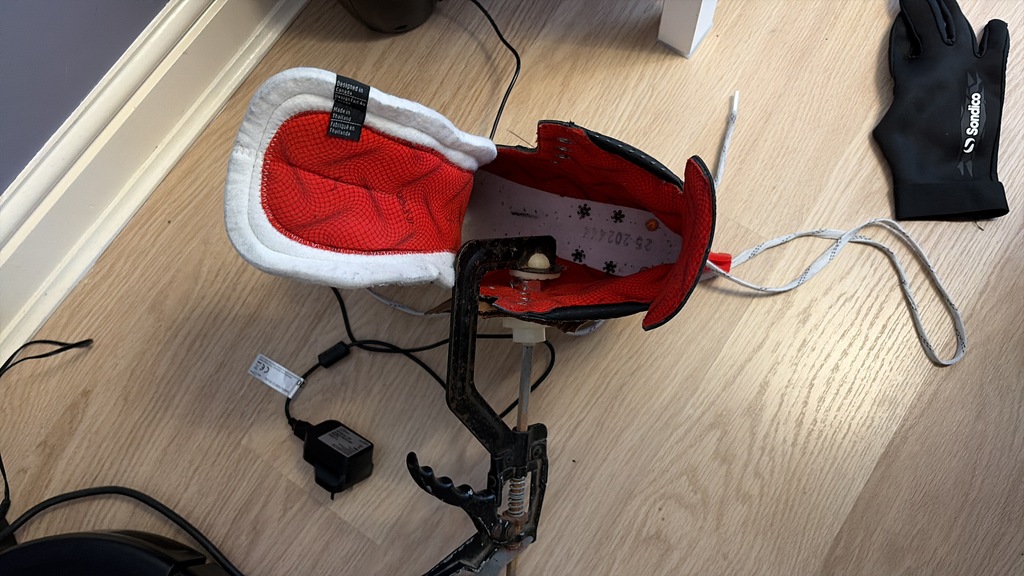
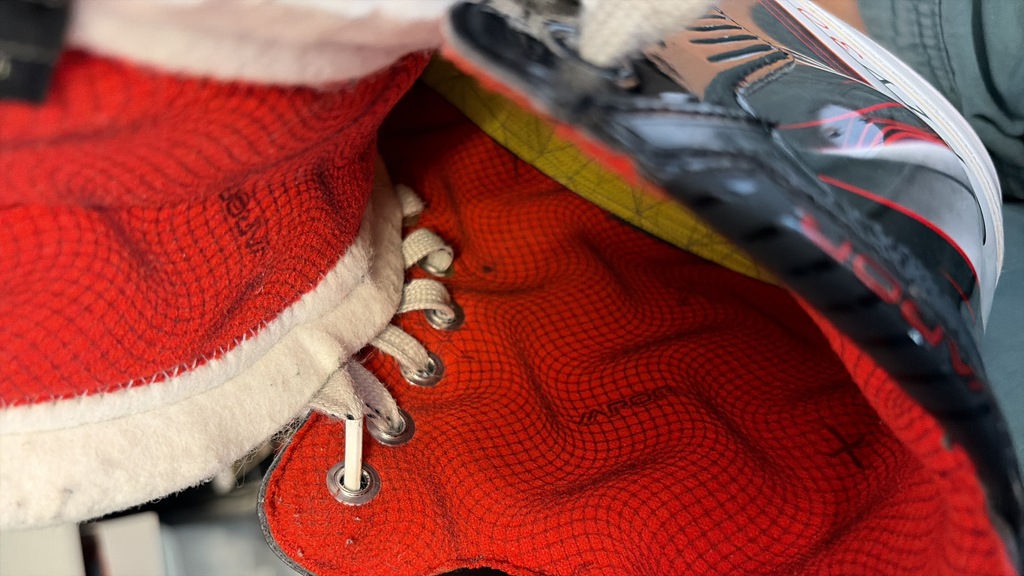
Since I wrote about my fly30 ice skates, I'd continued to battle pain
around the navicular bone in my feet. The action that seems to have finally
fixed it was to perform a "punch out": a very localized remoulding of the
area of the boot that presses against the sore area.
I basically followed the process from this helpful YouTube
video.
I narrowed down the exact spot by borrowing some lipstick and transferring it
from my navicular bone to the boot lining, then making that more permanent with
a sharpie.
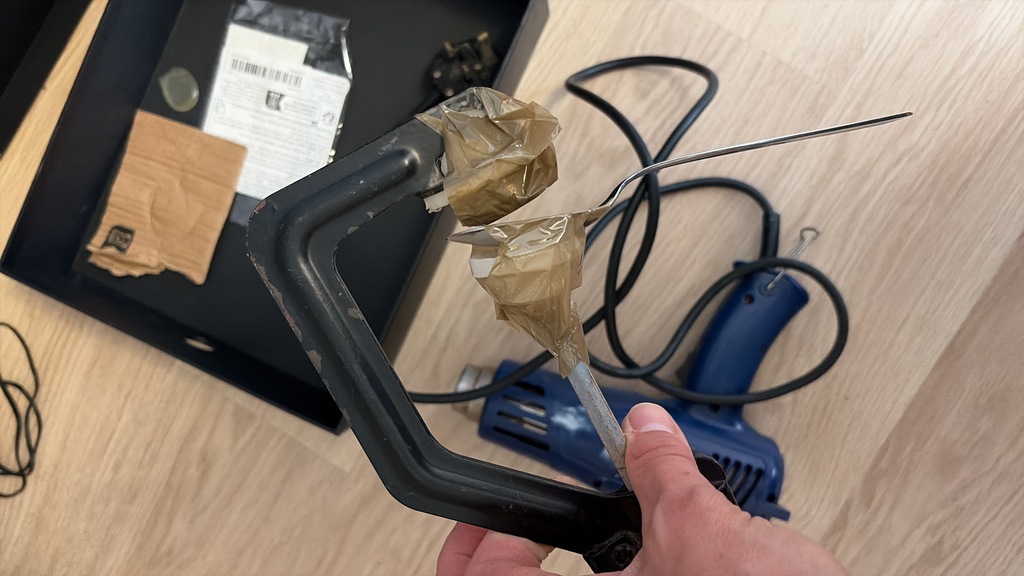
My punch was a spare part from a radiator valve which I packed with US cents
(I couldn't fit any UK coins in). For the receiving-end, I tried another part
from the radiator valve but I think it wasn't sufficiently larger than the punch
to work well, so I swapped that out for a spoon.
I didn't have a temperature sensor I could use and I used a heat gun rather than
a hairdryer, so I YOLO'd it a little. Some of the wrap on one of my boots is now
distorted from where I didn't move the heat gun enough. It only took a minute or
two to get the boot hot enough to be flexible. I set a 15 minute timer once the
clamp was in place.
I've only skated one session since I did this but the pain seems to have gone!
It's remarkably freeing to be skating without constantly trying to manage pain.
Now I can focus on technique.
This event is happening soon see below for registration instructions!
We are extremely pleased to announce the upcoming Reproducible Builds summit, which will take place from September 22nd 24th 2026 in the city of Gothenburg, Sweden. This year, we are thrilled to host the tenth edition of this exciting event, following the success of previous summits in various iconic locations around the world, including Vienna (2025), Hamburg (2023 2024), Venice (2022), Marrakesh (2019), Paris (2018), Berlin (2017), Berlin (2016) and Athens (2015). If you re excited about joining us this year, please make sure to read the event page which has more details about the event and location. As in previous years, we will be sending invitations to all those who attended our previous summit events or expressed interest to do so. However, even if you do not receive a personal invitation, please do email the organizers and we will find a way to accommodate you.
About 95% of my Debian contributions this month were sponsored by Freexian.
You can also support my work directly via Liberapay or GitHub Sponsors.
OpenSSH
Now that Ubuntu 26.04 LTS has been released, I ve been getting back to the GSS-API key exchange package split in our OpenSSH packaging. Once I started testing my draft openssh-gssapi source package, I realized that I needed to make some changes in the main openssh source package first in order to support it. The dependency from openssh-server to openssh-client was awkward, as was the (related) fact that openssh-client contained shared documentation for other OpenSSH binary packages. After some thought, I created a new openssh-common binary package, moved shared documentation and the ssh-keygen program to that, and dropped dependencies on openssh-client which were no longer necessary (fixing #699473 and #1070098 in the process).
This caused a couple of regressions (#1141420 and #1141550) that I had to fix, and more subtly it also caused a number of autopkgtest regressions in other packages because openssh-client is no longer in base images as a result of a dependency from openssh-server. I believe I have fixes for all of these either pending review or merged (one of which I did in August rather than July):
I upgraded from 10.3p1 to 10.4p1, and in the process contributed a GSS-API option handling fix upstream.
I made openssh-ssh1 s package description more accurately describe the package, thanks to suggestions from Matthias Lang.
Installer team
With support from a Freexian customer, I reviewed, tested, edited, and merged a patch to add VLAN support. I described the details of what I did in a comment.
This has been vaguely on my to-do list since, er, about 2014, so it was very satisfying to get it sorted out.
Python packaging
New upstream versions:
markers configuration option
On Saturday 25 July 2026, the annual Debian Developers and Contributors
Conference came to a close. The Debian Press
team would now like to share this personal and beautiful message from the Santa Fe
Local Team.
Words from DC26 Local Team
DebConf26 is over, and those of us who were part of the Local Team are trying
to return to normality , if such a thing exists after organizing a DebConf.
This event changed our lives and would not have been possible without the help
of many great people.
We would especially like to thank everyone who became part of our extended
local team. Our endless thanks go to Gunnar who also instigated this whole
adventure , Santiago, Nattie, Stefano, and Olasd. Thank you for supporting and
guiding us, sharing your experience, and helping us find solutions throughout
the entire process.
It was also made possible thanks to the great work, strong support and patience
of international teams: Fundraising, Bursaries, Content, Video, Treasury, Visa,
Website, Accommodation, Front Desk, Cheese and Wine, Publicity as well as all
the other teams and individuals who contributed. We apologize if we have
forgotten to mention anyone; many people helped make this event possible.
Our deepest thanks also go to everyone who joined us in working on the event,
especially Fer, Jos , and Juli n, who showed great commitment and took
responsibility for several important tasks.
We would also like to extend our gratitude to FICH, the Universidad Nacional
del Litoral, the institutions, organizations, sponsors, suppliers, and everyone
who contributed in one way or another to welcoming the Debian community to
Santa Fe.
And finally, a very special thank you to our families, to whom we dedicated
little time these past few weeks, who supported us on this adventure, enduring
the exhaustion, the calls and messages at all hours, and the occasional
stressful situation. Always giving us that much-needed, encouraging hug with so
much love.
These were very intense weeks, during which we tried to give our best so that
everyone could enjoy their stay and so that the Debian community had the
necessary conditions to meet, work, share knowledge, and continue creating the
magic that characterizes community life and the development of Debian.
As happens at every DebConf, there were difficulties, unexpected situations,
and challenges that required us to improvise, learn, and perform a few juggling
acts. There were also moments that will certainly remain as memorable
anecdotes: the antisocial room , some gas heaters worthy of a museum, and
newly unlocked powers for negotiating with suppliers.
We have no evidence, but also no doubt, that for many people the Conference
Dinner was one of the best moments of the event.
A few ingredients we had hoped would happen naturally were missing, such as
more wine nights and at least one in-person football match.
During the two weeks of DebConf, we experienced every kind of weather and a
wide range of emotions. Above all, however, we saw people enjoying themselves
and building friendships, which fills us with pride.
Thank you very much to everyone who came and helped DebConf26 leave such a
beautiful mark on our hearts.
We hope our paths cross again somewhere in life.
Best regards,
Leonardo, Emmanuel, Mariano, Pablo, and Mart n
DebConf26 Local Team
About Debian
The Debian Project was founded in 1993 by Ian Murdock to be a truly free
community project. Since then the project has grown to be one of the
largest and most influential Open Source projects. Thousands of
volunteers from all over the world work together to create and maintain
Debian software. Available in 70 languages, and supporting a huge range
of computer types, Debian calls itself the universal operating system.
About DebConf
DebConf is the Debian Project's developer conference. In addition to a
full schedule of technical, social and policy talks, DebConf provides an
opportunity for developers, contributors and other interested people to
meet in person and work together more closely. It has taken place
annually since 2000 in locations as varied as Scotland, Bosnia and Herzegovina,
India, Korea, France. More information about DebConf is available from
https://debconf.org/.
Contact Information
For further information, please visit the DebConf26 web page at
https://debconf26.debconf.org/ or send
mail to press@debian.org.
I enjoy reading The Guardian's monthly round-up of new SF novels, which can be
found in their Science Fiction
Books section, and can also
be read via feed.
Since the round-up is of new books, at the time the round-up is published
they're usually only available in hardback.
When it comes to choosing a book to read, these days I am tending towards
paperbacks: I've largely ran out of room for hardbacks. So I decided to apply
a time delay to their feed. Six months is roughly enough that a
book mentioned in a round-up should be shortly available in paperback.
The first obstacle was that The Guardian only publish roughly the
last six months of articles in their feed, and so the posts I want have
disappeared. However, my Feed Reader
(FreshRSS) had older copies stored in
its database, and I am able to re-publish those
using User Queries.
(This also gives me an opportunity to filter out non-roundup articles
from the Guardian's feed).
It's then a nice short piece of scripting (this time, using Ruby) to filter the
republished feed on the publication date. To make the most recent articles appear new, I
also modify the metadata for filtered entries to appear 6 months newer than they are.
#!/usr/bin/ruby
require 'rss'
# replace with the user query feed URI
uri = 'https://www.theguardian.com/books/science-fiction/rss'
now = Time.now
sixMonths = 6 * 30 * 24 * 60 * 60
feed = RSS::Parser.parse(uri)
feed.items.select! do item
item.date + sixMonths < now
end
feed.items.collect! do item
item.date += sixMonths
item
end
puts "Content-Type: text/xml\r\n\r"
puts feed
I stuck that up on my private web server, subscribed to it in my FreshRSS
and voila, a time-delayed list of books to read, most likely available in
paperback.
python3 -m venv ~/.venv/my-virtualenv
.venv folder in my home directory, but you can pick whatever location you
like.
To use the virtualenv, you must activate it:
source ~/.venv/my-virtualenv/bin/activate
source runs this script in your current shell session to set it
up. You will notice that this adds (my-virtualenv) to the beginning of your
shell prompt, reminding you that the "my-virtualenv" virtualenv is active. Now
when you pip install amazing-package, the software will only be available in
this virtual environment.
When you're done, you can deactivate it like so:
deactivate
$ ls ~/.venv/
my-virtualenv cool-project snakes-ahoy
source ~/.venv/my-virtualenv/bin/activate every
time I use the virtualenv, because it gets very repetitive only the name
of the venv is really needed.
But luckily, we can write a little bit of bash to make managing this less
annoying. (Or you can use one of many Python developer tools that are designed
to manage this, like pipx, but when I merely want to consume Python
software, I might not have a development environment set up. So that's beyond
the scope of this post!)
If you add the following shell function to your ~/.bashrc or
~/.bash_aliases file, it will nicely wrap our activation command:
setup-venv()
source "$HOME/.venv/$1/bin/activate"
setup-venv my-virtualenv
apt install bash-completion
/etc/bash_completion.d/venv, with the following contents:
_list_venvs()
local cur prev opts
COMPREPLY=()
cur="$ COMP_WORDS[COMP_CWORD] "
prev="$ COMP_WORDS[COMP_CWORD-1] "
opts=$(find $HOME/.venv/ -mindepth 1 -maxdepth 1 -type d -printf "%f ")
COMPREPLY=( $(compgen -W "$ opts " -- $ cur ) )
return 0
complete -F _list_venvs setup-venv
setup-venv function.
$opts is where we define the options for our function. We generate it with a
find command looking at the .venv folder in the current user's home
directory, then only including child folders (excluding the current directory
itself, .venv, in our results) by using the min/max depth and type arguments,
and printing just the individual directory names, deliminated by spaces using
our print formatter.
Everything else is the standard scaffolding required to use bash completions.
Once you save this file and reload your shell, you'll see that you are able to use completions as expected!
setup-venv <tab>
my-virtualenv cool-project snakes-ahoy
setup-venv s<tab>
setup-venv snakes-ahoy
Welcome to the July 2026 report from the Reproducible Builds project!
In our reports, we try to outline the most important things that we have been up to over the past month. As a quick recap about what problem our project intends to solve, whilst anyone may inspect the source code of free software for malicious flaws, almost all software is distributed to end users as pre-compiled binaries. The motivation behind the reproducible builds effort is to ensure no flaws have been introduced during this compilation process by promising identical results are always generated from a given source, thus allowing multiple third-parties to come to a consensus on whether a build was compromised or not.
If you are interested in contributing to the project, please visit the Contribute page on our website.
In this month s report, we cover:
diffoscope is our in-depth and content-aware diff utility that can locate and diagnose reproducibility issues. This month, Chris Lamb made the following changes, including preparing and uploading versions 324, 325 and 326 to Debian:
zipdetails 4.0008. (#1141359)pedump binary to use the mono package under GNU Guix. [ ]
ctime as returned by the lstat(2) syscall. [ ], which Chris Lamb uploaded whilst bumping the Standards-Version to version 4.7.4 [ ]. Bernhard Wiedemann also updated disorderfs to version 0.7.0 in openSUSE.
Yet again, there were a number of improvements made to our website this month as well. For example, Chris Lamb, by request of Digital Ocean, changed the target of a referral link so that they can manage incoming referrers [ ] and pushed a number of changes to the Tools page [ ].
In Debian this month, 32 reviews of Debian packages were added, 26 were updated and a total of 21 were removed this month, adding to our extensive knowledge about identified issues.
A number of issue types were added by Chris Lamb, including:
python_towncrier_build_date [ ][ ]log_files_installed_in_package [ ]fontforge_varies_by_timezone [ ][ ]build_date_in_manpage_generated_by_spf13_cobra issue. [ ]
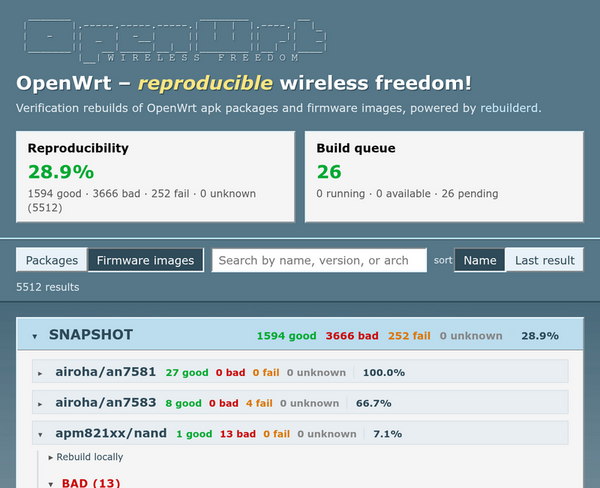
In addition, there is a new page showing verification rebuilds of OpenWrt APK packages and firmware images, powered by rebuilderd:
Yan Li, Nan Jiang, Qihang Zhou, Shaowen Xu, Yamin Xie and Xiaoqi Jia of the Chinese Academy of Sciences published a paper titled VCAligner: Aligning Source Distribution Versions with Upstream Git Commits to Secure Supply Chain:
We present VCAligner, a content-based alignment methodology that constructs inverted indexes over VCS histories to precisely map released artifacts to their originating commits, independent of fragile version tags. We evaluated VCAligner on a dataset of 2,984 verifiable PyPI packages derived from the 4,000 most-downloaded projects linked to public GitHub upstreams. Our results reveal a critical weakness in conventional tag-based heuristics: while they appear effective on 85% of the dataset, the residual 15% failure rate generates a catastrophic downstream audit workload of over 10.3 million commits. In contrast, VCAligner reduces this burden by two orders of magnitude ( 158 ), bounding the total workload to under 65,000 commits. Furthermore, we provide the large-scale characterization of Packaging Noise, classifying artifact divergence into structural additions (Path Phantoms) and content mutations (Blob Phantoms), thereby isolating the distinct attack surfaces of malicious injection and code tampering.
Jens Dietrich and Spencer Sun from the Victoria University of Wellington together with Tim W. White and Behnaz Hassanshahi from Oracle Inc pre-published their paper No Snake Oil: Verifying Python Package Builds (PDF):
Python has become the default language for interacting with AI, with packages being distributed through registries like the Python Package Index (PyPI). This creates a need to analyse supply chains comprising such packages. One such analysis is to rebuild packages in order to identify compromised builds injecting malware. Independent rebuilds in hardened environments have the added advantage that they can generate and record provenance in order to increase the trustworthiness of packages. Two tools that are designed to automate such rebuilds and run them at scale are macaron and oss-rebuild. We study 12,180 popular releases from PyPI and find that the byte-for-byte equivalence rate is generally low. We analyse the reasons why they produce different wheels, and find that equivalence between the original and rebuilt wheels can often still be established, preserving most of the guarantees users expect from rebuildable releases. We present and evaluate daleq4py, a tool to establish the equivalence of Python wheels through the kernel of a normalisation function that is based on provenance-preserving datalog rules. Experimental results show that daleq4py substantially expands the set of rebuilds that can be accepted as equivalent. Although only 15.4% of macaron rebuilds and 19.1% of oss-rebuild rebuilds are byte-for-byte identical to the published PyPI wheels, daleq4py establishes wheel equivalence for 60.2% and 78.9% of source-equivalent rebuilds, respectively.
Denise Nanni, Julien Malka, Stefano Zacchiroli and Th o Zimmermann from T l com Paris together with Gabriele D Angelo from the University of Bologna pre-published their paper Understanding Build Reproducibility in the F-Droid Ecosystem (PDF), which was accepted at the 2026 ACM Conference on Reproducibility and Replicability:
The security of open source applications benefits considerably from the possibility of rebuilding their source and verifying the output. F-Droid, a prominent distribution for open source Android applications, systematically rebuilds them from source and tests their bitwise reproducibility at app publishing time. However, F-Droid offers no guarantee that app reproducibility will continue to hold in the future. As software ecosystems evolve, reproducibility may degrade, with potential negative consequences for software preservation and security. We present the first empirical study of build reproducibility in the F-Droid app ecosystem. Analyzing historical reproducibility logs, we find that the overall bitwise reproducibility rate has been steadily increasing over time (as new versions of apps are published). We then evaluate how reproducibility holds in time for fixed app versions, by attempting to rebuild 18 904 app versions that F-Droid had previously confirmed bitwise reproducible, published between September 2018 and February 2026, achieving an 83% rebuild success rate, and identify missing dependencies as the dominant cause of failure, accounting for 76% of non-rebuildable cases. Among successfully rebuilt apps, 94% are also bitwise reproducible-i.e., they still yield bitwise identical artifacts upon rebuild. Together, these results show that while bitwise reproducibility largely holds for apps that can be rebuilt, rebuildability itself is highly sensitive to temporal decay.
golang-github-tidwall-wal.lightproof.libslow5lib.siso.grout.libpsl.node-grunt-contrib-internal.fontforge.spopt.go-dlib.towncrier.python-sphinx-chango.gasnet.yubihsm-connector.dh-fortran.watcher.rakudo.kf6-breeze-icons.oxygen-icons.gnu-apl.barvinok.ecbuild.Reproducible builds remove trust in the builder: anyone re-derives the same artifact from the same source, byte for byte. The same shape applies one layer over, to a retained record. Most record-keeping regimes (the EU AI Act s Article 12 logging is the current example) require that events be recorded and logs retained, but not that a retained log be verifiable, by a party who was not present, as unaltered and existing when claimed. That leaves an integrity obligation resting on trusting the party being audited.(Full thread)
#reproducible-builds on irc.oftc.net.
rb-general@lists.reproducible-builds.org
327. This version includes the following changes:
[ Colin Watson ]
* Handle missing openssh-client binaries in autopkgtests.
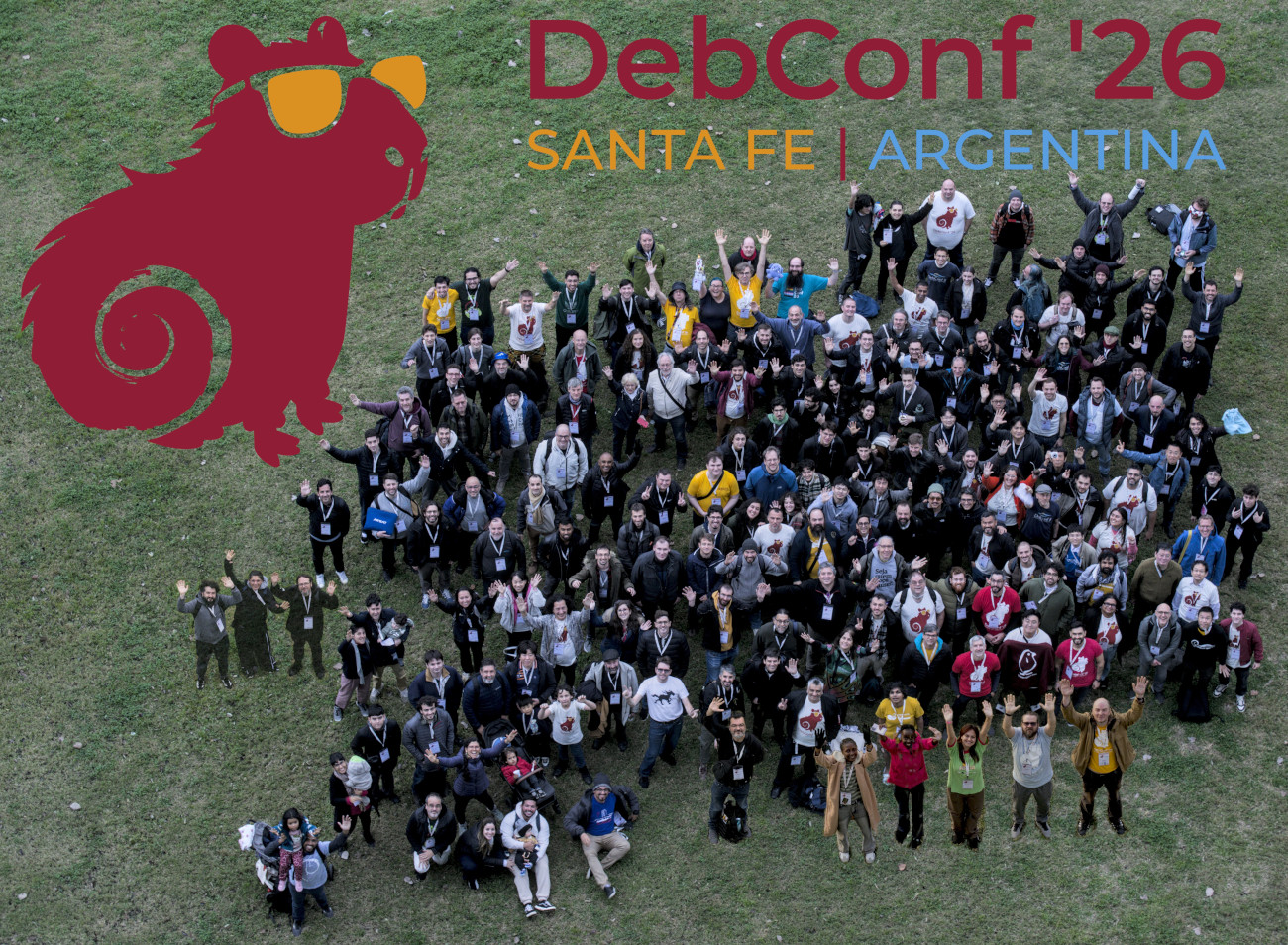
On Saturday 25 July 2026, the annual Debian Developers and Contributors
Conference came to a close.
Over 270 attendees representing 35 countries from around the world came
together for a combined 90 events (including some which took place during
the DebCamp) including more than 27 Talks, 21 Short Talks,
29 Birds of a Feather sessions ("BoF" informal meeting between developers
and users), 8 workshops, and activities in support of furthering our
distribution and free software, learning from our mentors and peers, building
our community, and having a bit of fun.
The conference was preceded by the annual
DebCamp hacking session held 13
through 19 July where Debian Developers and Contributors convened to
focus on their individual Debian-related projects or work in team sprints
geared toward in-person collaboration in developing Debian.
As has been the case for several years, a special effort has been made to
welcome newcomers and help them become familiar with Debian and DebConf
by organizing a sprint "New Contributors Onboarding" every day of Debcamp,
followed more informally by mentorship during DebConf. Half a dozen new
contributors joined the sessions and learned about Debian, free software,
packaging and much more.
This year, a week-long DebCamp session was dedicated to auditing,
patching, and modernizing the Go ecosystem in Debian and enable the
transition triggered by the recent upload of dh-golang enabling GO111MODULE=on
by default in Experimental.
In order to make the conference more accessible for local participants,
a local language track was included in the schedule for talks in Spanish,
as was done at DebConf19 in Brazil.
The actual Debian Developers Conference started on Monday 20 July 2026.
In addition to the traditional "Bits from the DPL" talk, the continuous
key-signing party, lightning talks, and the announcement of next year's
DebConf27, there were several update sessions shared by internal projects
and teams.
Many of the hosted discussion sessions were presented by our technical
core teams with the usual and useful "Meet the Technical Committee", three
talks about Linux Kernel, early boot and improving Debian s kernel and
installer support for Chromebooks, and about twenty BoFs and talks about
Debian packaging policy, Debian infrastructure, security and privacy.
This year, and echoing ongoing discussions within the Free Software community,
Artificial Intelligence and Age Verification have been the subject of
several talks. The Python, Perl, Ruby, Go, and Rust programming
language teams also shared updates on their work and efforts.
More than 17 BoFs and talks about community, diversity, and local outreach
highlighted the work of various teams involved in not just the technical but
also the social aspect of our community
The schedule
was updated each day with planned and ad hoc activities introduced by
attendees over the course of the conference. Several traditional activities
took place: a poetry performance, the traditional Cheese and Wine party, the
Group Photos, and the Day Trip.
For those who were not able to attend, most of the talks and sessions were
broadcasted live and recorded. One can find the seventy hours of recorded
videos available via the conference
schedule,
or alternatively through this
link.
Almost all of the sessions facilitated remote participation via IRC and Matrix
messaging apps or online collaborative text documents which allowed remote
attendees to "be in the room" and ask questions or share comments with the
speaker or assembled audience. DebConf26 saw over 341 T-shirts, a day trip,
and up to 130 meals planned per day.
All of these events, activities, conversations, and streams coupled with our
love, interest, and participation in Debian and F/OSS certainly made this
conference an overall success both here in Santa Fe, Argentina and online
around the world.
The DebConf26 website
will remain active for archival purposes and will continue to offer
links to the presentations and videos of talks and events.
Next year, DebConf27 will be held
in Asahikawa, Hokkaido, Japan, from Sunday September 5th to Saturday
September 11th, 2027. As tradition follows before the next DebConf the
local organizers in Japan will start the conference activities with DebCamp
with a particular focus on individual and team work towards improving the
distribution.
DebConf is committed to a safe and welcome environment for all
participants. See the
web page about the Code of Conduct on the DebConf26 website
for more details on this.
Debian thanks the commitment of numerous
sponsors
to support DebConf26, particularly our Platinum Sponsors:
Infomaniak, and
Proxmox,
and our Gold Sponsors : Freexian, and
Viridien.
We also wish to thank our Video and Infrastructure teams, the DebConf26
and DebConf committees, our host nation of Argentina, and each and every
person who helped contribute to this event and to Debian overall.
Thank you all for your work in helping Debian continue to be "The Universal
Operating System".
See you next year!
About Debian
The Debian Project was founded in 1993 by Ian Murdock to be a truly free
community project. Since then the project has grown to be one of the
largest and most influential Open Source projects. Thousands of
volunteers from all over the world work together to create and maintain
Debian software. Available in 70 languages, and supporting a huge range
of computer types, Debian calls itself the universal operating system.
About DebConf
DebConf is the Debian Project's developer conference. In addition to a
full schedule of technical, social and policy talks, DebConf provides an
opportunity for developers, contributors and other interested people to
meet in person and work together more closely. It has taken place
annually since 2000 in locations as varied as Scotland, Bosnia and Herzegovina,
India, Korea, France. More information about DebConf is available from
https://debconf.org/.
About Infomaniak
Infomaniak is an independent, employee-owned
Swiss technology company that designs, develops, and operates its own cloud
infrastructure and digital services entirely in Switzerland. With over
300 employees more than 70% engineers and developers the company reinvests
all profits into R&D. Its public cloud is built on OpenStack, with managed
Kubernetes, Database as a Service, object storage, and sovereign AI services
accessible via OpenAI-compatible APIs, all running on its own Swiss
infrastructure. Infomaniak also develops a sovereign collaborative suite
messaging, email, storage, online office tools, videoconferencing, and a
built-in AI assistant developed in-house and as a privacy-respecting
solution to proprietary platforms. Open source is central to how Infomaniak
operates. Its latest data center (D4) runs on 100% renewable energy and uses
no traditional cooling: all the heat generated by its servers is captured and
fed into Geneva's district heating network, supplying up to 6,000 homes in
winter and hot water year-round. The entire project has been documented and
open-sourced at d4project.org.
About Proxmox
Proxmox develops powerful, yet easy-to-use
open-source server solutions. The comprehensive open-source ecosystem is
designed to manage divers IT landscapes, from single servers to large-scale
distributed data centers. Our unified platform integrates server
virtualization, easy backup, and rock-solid email security ensuring seamless
interoperability across the entire portfolio. With the Proxmox Datacenter
Manager, the ecosystem also offers a "single pane of glass" for centralized
management across different locations. Since 2005, all Proxmox solutions have
been built on the rock-solid Debian platform. We are proud to return to
DebConf26 as a sponsor because the Debian community provides the foundation
that makes our work possible. We believe in keeping IT simple, open, and under
your control.
Contact Information
For further information, please visit the DebConf26 web page at
https://debconf26.debconf.org/ or send
mail to press@debian.org.
This post is an unpublished review for Subscription Bombing Email under AttackOne of the most important inputs one can have when designing a response strategy against a security attack is a good characterization. This article describes a relatively newly described attack mode (subscription bombing), hypothetizes on the motivations that can lie behind it, and presents some countermeasures that can be taken by different actors to reduce its impact. At its core, suscription bombing is a classical reflection attack: it uses a third party service so that the answer to a relatively simple request is amplified and results in a distributed denial of service (DDoS) for the victim. And, as with most DDoS attacks, its effectivity lies in that there is not much a person can do against traffic coming from seemingly random different providers all around the world. The core differentiatof for subscription bombing is that the attack s victim is not a network port, but an individual s e-mail address. The attacker builds a database of service providers that allow interested users to sign up for newsletter on their activities, or a mailing list, or even just to create a new account on a given Web system. This action will generate a (seemingly legitimate) confirmation mail sent to the victim. But the attacker scripts together hundreds of thousands of such request, creating a deluge of confirmation mails sent to the unsuspecting victim. The authors explain the goals an attacker might pursue by performing this kind of attack. They suppose this can be due to harassment (a disgruntled employee being denied a salary raise, a political adversary, or even a romantic ex-partner wanting to inconvenience the victim s use of their e-mail). More worryingly, the attack can be used as a distraction: by sending a high volume of mails in a controlled timeframe, the attacker can reduce the probability of the victim noticing a specific attack warning them of, i.e., financial fraud, unwanted purchases, or break-in attempts into their accounts. Attacks targetting mailboxes at private mail servers can also lead to overloading an account s limit, causing it to reject mails after the attack is delivered and before the folder is cleaned. And it can also pave the way for follow-up, targetted deception attacks, where the attackers call the victim pretending to be the company s IT department, and get them to install a remote desktop monitoring and management tool, with which they can effectively seize control of the victim s data. To do this, they present a study they made over 24 cases of victims, from which 47,970 total e-mails were received between October and December 2024, with individual attacks receiving between 81 and 3,387 e-mails per hour, from where they presented several descriptive analysis. The authors explored cyber criminal s offers on underground websites, comparing flooding services and pricing schemes. Finally, mitigation strategies are discussed. Mitigation is quite problematic, as none of the mail servers is acting in either a hostile way or lacking permissions they are performing just the task they should. The authors suggest four mitigation strategies for mail server operators to reduce the burden on their users, although none of them is easily automatizab (rate-limit the number of emails a given inbox can receive from previously unseen senders; educate users about this kind of attacks; group similar newsletter or account reset mails during active attacks; and automatically unsubscribe or bounce newsletter messages when a surge is detected). They also recommend newsletter providers and services accepting the unrestricted creation of user accounts to provide some hardening to increase the effort wrongdoers need to spend to abuse their services, such as requiring CAPTCHAs or requiring users to take several steps before requesting a subscription, although they recognize this adds friction to the process providers are most interested in providing; filtering and triaging known-good and known-bad domains, although this is hard to implement on a preemptive fashion, and adhering to easy unsubscription standards, such as easily identifiable headers with which mass unsubscription could be performed more easily victims, instead of hunting for the right places to click, potentially even in mails written in an unknown language. The described problem is interesting, and properly tackling it can be a game changer for many users who will suffer this kind of abuse, and the article is easy to read and soundly supports its claims.
Next.