As promised, on this post I m going to explain how I ve configured this blog
using hugo, asciidoctor and the papermod theme, how I publish it using
nginx, how I ve integrated the remark42 comment system and how I ve
automated its publication using gitea and json2file-go.
It is a long post, but I hope that at least parts of it can be interesting for
some, feel free to ignore it if that is not your case
Hugo Configuration
Theme settingsThe site is using the PaperMod theme and as I m
using asciidoctor to publish my content I ve adjusted
the settings to improve how things are shown with it.
The current config.yml file is the one shown below (probably some of the
settings are not required nor being used right now, but I m including the
current file, so this post will have always the latest version of it):
config.yml
disableHLJS and assets.disableHLJS are set to true; we plan to use
rouge on adoc and the inclusion of the hljs assets adds styles that
collide with the ones used by rouge.
ShowToc is set to true and the TocOpen setting is set to false to
make the ToC appear collapsed initially. My plan was to use the asciidoctor
ToC, but after trying I believe that the theme one looks nice and I don t
need to adjust styles, although it has some issues with the html5s
processor (the admonition titles use <h6> and they are shown on the ToC,
which is weird), to fix it I ve copied the layouts/partial/toc.html to my
site repository and replaced the range of headings to end at 5 instead of
6 (in fact 5 still seems a lot, but as I don t think I ll use that heading
level on the posts it doesn t really matter).
params.profileMode values are adjusted, but for now I ve left it disabled
setting params.profileMode.enabled to false and I ve set the
homeInfoParams to show more or less the same content with the latest posts
under it (I ve added some styles to my custom.css style sheet to center the
text and image of the first post to match the look and feel of the profile).
On the asciidocExt section I ve adjusted the backend to use html5s,
I ve added the asciidoctor-html5s and asciidoctor-diagram extensions to
asciidoctor and adjusted the workingFolderCurrent to true to make
asciidoctor-diagram work right (haven t tested it yet).
Theme customisationsTo write in asciidoctor using the html5s processor I ve added some files to
the assets/css/extended directory:
As said before, I ve added the file assets/css/extended/custom.css to
make the homeInfoParams look like the profile page and I ve also changed a
little bit some theme styles to make things look better with the html5s
output:custom.css
/* Fix first entry alignment to make it look like the profile */.first-entrytext-align:center;.first-entryimgdisplay:inline;/**
* Remove margin for .post-content code and reduce padding to make it look
* better with the asciidoctor html5s output.
**/.post-contentcodemargin:auto0;padding:4px;
I ve also added the file assets/css/extended/adoc.css with some styles
taken from the asciidoctor-default.css, see this
blog
post about the original file; mine is the same after formatting it with
css-beautify and editing it to use variables for
the colors to support light and dark themes:adoc.css
The previous file uses variables from a partial copy of the theme-vars.css
file that changes the highlighted code background color and adds the color
definitions used by the admonitions:theme-vars.css
The previous styles use font-awesome, so I ve downloaded its resources for
version 4.7.0 (the one used by asciidoctor) storing the
font-awesome.css into on the assets/css/extended dir (that way it is
merged with the rest of .css files) and copying the fonts to the
static/assets/fonts/ dir (will be served directly):
FA_BASE_URL="https://cdnjs.cloudflare.com/ajax/libs/font-awesome/4.7.0"
curl "$FA_BASE_URL/css/font-awesome.css"\> assets/css/extended/font-awesome.css
for f in FontAwesome.otf fontawesome-webfont.eot \
fontawesome-webfont.svg fontawesome-webfont.ttf \
fontawesome-webfont.woff fontawesome-webfont.woff2;do
curl "$FA_BASE_URL/fonts/$f">"static/assets/fonts/$f"done
As already said the default highlighter is disabled (it provided a css
compatible with rouge) so we need a css to do the highlight styling; as
rouge provides a way to export them, I ve created the
assets/css/extended/rouge.css file with the thankful_eyes theme:
To support the use of the html5s backend with admonitions I ve added a
variation of the example found on this
blog
post to assets/js/adoc-admonitions.js:adoc-admonitions.js
// replace the default admonitions block with a table that uses a format// similar to the standard asciidoctor ... as we are using fa-icons here there// is no need to add the icons: font entry on the document.window.addEventListener('load',function()constadmonitions=document.getElementsByClassName('admonition-block')for(leti=admonitions.length-1;i>=0;i--)constelm=admonitions[i]consttype=elm.classList[1]consttitle=elm.getElementsByClassName('block-title')[0];constlabel=title.getElementsByClassName('title-label')[0].innerHTML.slice(0,-1);elm.removeChild(elm.getElementsByClassName('block-title')[0]);consttext=elm.innerHTMLconstparent=elm.parentNodeconsttempDiv=document.createElement('div')tempDiv.innerHTML= <div class="admonitionblock $ type">
<table>
<tbody>
<tr>
<td class="icon">
<i class="fa icon-$ type" title="$ label"></i>
</td>
<td class="content">
$ text
</td>
</tr>
</tbody>
</table>
</div> constinput=tempDiv.childNodes[0]parent.replaceChild(input,elm) )
and enabled its minified use on the layouts/partials/extend_footer.html file
adding the following lines to it:
Remark42 configurationTo integrate Remark42 with the PaperMod theme I ve
created the file layouts/partials/comments.html with the following content
based on the remark42
documentation, including extra code to sync the dark/light setting with the
one set on the site:
comments.html
<divid="remark42"></div><script>varremark_config=host:.Site.Params.remark42Url ,site_id:.Site.Params.remark42SiteID ,url:.Permalink ,locale:.Site.Language.Lang ;(function(c)/* Adjust the theme using the local-storage pref-theme if set */if(localStorage.getItem("pref-theme")==="dark")remark_config.theme="dark";elseif(localStorage.getItem("pref-theme")==="light")remark_config.theme="light";/* Add remark42 widget */for(vari=0;i<c.length;i++) vard=document,s=d.createElement('script');s.src=remark_config.host+'/web/'+c[i]+'.js';s.defer=true;(d.headd.body).appendChild(s); )(remark_config.components['embed']);</script>
In development I use it with anonymous comments enabled, but to avoid SPAM
the production site uses social logins (for now I ve only enabled Github
& Google, if someone requests additional services I ll check them, but those
were the easy ones for me initially).
To support theme switching with remark42 I ve also added the following inside
the layouts/partials/extend_footer.html file:
- if (not site.Params.disableThemeToggle)
<script>/* Function to change theme when the toggle button is pressed */document.getElementById("theme-toggle").addEventListener("click",()=>if(typeofwindow.REMARK42!="undefined")if(document.body.className.includes('dark'))window.REMARK42.changeTheme('light');elsewindow.REMARK42.changeTheme('dark'); );</script>
- end
With this code if the theme-toggle button is pressed we change the remark42
theme before the PaperMod one (that s needed here only, on page loads the
remark42 theme is synced with the main one using the code from the
layouts/partials/comments.html shown earlier).
Development setupTo preview the site on my laptop I m using docker-compose with the following
configuration:
docker-compose.yaml
To run it properly we have to create the .env file with the current user ID
and GID on the variables APP_UID and APP_GID (if we don t do it the files
can end up being owned by a user that is not the same as the one running the
services):
$echo"APP_UID=$(id-u)\nAPP_GID=$(id-g)"> .env
The Dockerfile used to generate the sto/hugo-adoc is:
Dockerfile
FROM asciidoctor/docker-asciidoctor:latestRUN gem install--no-document asciidoctor-html5s &&\
apk update && apk add --no-cache curl libc6-compat &&\
repo_path="gohugoio/hugo"&&\
api_url="https://api.github.com/repos/$repo_path/releases/latest"&&\
download_url="$(\
curl -sL"$api_url"\
sed-n"s/^.*download_url\": \"\\(.*.extended.*Linux-64bit.tar.gz\)\"/\1/p"\
)"&&\
curl -sL"$download_url"-o /tmp/hugo.tgz &&\
tar xf /tmp/hugo.tgz hugo &&\
install hugo /usr/bin/ &&\
rm-f hugo /tmp/hugo.tgz &&\
/usr/bin/hugo version &&\
apk del curl &&rm-rf /var/cache/apk/*# Expose port for live serverEXPOSE 1313ENTRYPOINT ["/usr/bin/hugo"]CMD [""]
If you review it you will see that I m using the
docker-asciidoctor image as
the base; the idea is that this image has all I need to work with asciidoctor
and to use hugo I only need to download the binary from their latest release
at github (as we are using an
image based on alpine we also need to install the
libc6-compat package, but once that is done things are working fine for me so
far).
The image does not launch the server by default because I don t want it to; in
fact I use the same docker-compose.yml file to publish the site in production
simply calling the container without the arguments passed on the
docker-compose.yml file (see later).
When running the containers with docker-compose up (or docker compose up if
you have the docker-compose-plugin package installed) we also launch a nginx
container and the remark42 service so we can test everything together.
The Dockerfile for the remark42 image is the original one with an updated
version of the init.sh script:
Dockerfile
FROM umputun/remark42:latestCOPY init.sh /init.sh
The updated init.sh is similar to the original, but allows us to use an
APP_GID variable and updates the /etc/group file of the container so the
files get the right user and group (with the original script the group is
always 1001):
init.sh
#!/sbin/dinit /bin/shuid="$(id-u)"if["$ uid"-eq"0"];then
echo"init container"# set container's time zonecp"/usr/share/zoneinfo/$ TIME_ZONE" /etc/localtime
echo"$ TIME_ZONE">/etc/timezone
echo"set timezone $ TIME_ZONE ($(date))"# set UID & GID for the appif["$ APP_UID"]["$ APP_GID"];then["$ APP_UID"]APP_UID="1001"["$ APP_GID"]APP_GID="$ APP_UID"echo"set custom APP_UID=$ APP_UID & APP_GID=$ APP_GID"sed-i"s/^app:x:1001:1001:/app:x:$ APP_UID:$ APP_GID:/" /etc/passwd
sed-i"s/^app:x:1001:/app:x:$ APP_GID:/" /etc/group
else
echo"custom APP_UID and/or APP_GID not defined, using 1001:1001"fi
chown-R app:app /srv /home/app
fi
echo"prepare environment"# replace % REMARK_URL % by content of REMARK_URL variable
find /srv -regex'.*\.\(html\ js\ mjs\)$'-print\-execsed-i"s % REMARK_URL % $ REMARK_URL g"\;if[-n"$ SITE_ID"];then#replace "site_id: 'remark'" by SITE_IDsed-i"s 'remark' '$ SITE_ID' g" /srv/web/*.html
fi
echo"execute \"$*\""if["$ uid"-eq"0"];then
exec su-exec app "$@"else
exec"$@"fi
The environment file used with remark42 for development is quite minimal:
env.dev
Production setupThe VM where I m publishing the blog runs Debian GNU/Linux
and uses binaries from local packages and applications packaged inside
containers.
To run the containers I m using
docker-ce (I could have used
podman instead, but I already had it installed on the
machine, so I stayed with it).
The binaries used on this project are included on the following packages from
the main Debian repository:
git to clone & pull the repository,
jq to parse json files from shell scripts,
json2file-go to save the webhook messages to files,
inotify-tools to detect when new files are stored by json2file-go and
launch scripts to process them,
nginx to publish the site using HTTPS and work as proxy for
json2file-go and remark42 (I run it using a container),
task-spool to queue the scripts that update the deployment.
And I m using docker and docker compose from the debian packages on the
docker repository:
docker-ce to run the containers,
docker-compose-plugin to run docker compose (it is a plugin, so no - in
the name).
Repository checkoutTo manage the git repository I ve created a deploy key, added it to gitea
and cloned the project on the /srv/blogops PATH (that route is owned by a
regular user that has permissions to run docker, as I said before).
Compiling the site with hugoTo compile the site we are using the docker-compose.yml file seen before, to
be able to run it first we build the container images and once we have them we
launch hugo using docker compose run:
$cd /srv/blogops
$git pull
$docker compose build
$if[-d"./public"];then rm-rf ./public;fi$docker compose run hugo --
The compilation leaves the static HTML on /srv/blogops/public (we remove the
directory first because hugo does not clean the destination folder as
jekyll does).
The deploy script re-generates the site as described and moves the public
directory to its final place for publishing.
Running remark42 with dockerOn the /srv/blogops/remark42 folder I have the following docker-compose.yml:
docker-compose.yml
The ../.env file is loaded to get the APP_UID and APP_GID variables that
are used by my version of the init.sh script to adjust file permissions and
the env.prod file contains the rest of the settings for remark42, including
the social network tokens (see the
remark42 documentation for
the available parameters, I don t include my configuration here because some of
them are secrets).
Nginx configurationThe nginx configuration for the blogops.mixinet.net site is as simple as:
On this configuration the certificates are managed by
certbot and the server root directory is on
/srv/blogops/nginx/public_html and not on /srv/blogops/public; the reason
for that is that I want to be able to compile without affecting the running
site, the deployment script generates the site on /srv/blogops/public and if
all works well we rename folders to do the switch, making the change feel almost
atomic.
json2file-go configurationAs I have a working WireGuard VPN between the
machine running gitea at my home and the VM where the blog is served, I m
going to configure the json2file-go to listen for connections on a high port
using a self signed certificate and listening on IP addresses only reachable
through the VPN.
To do it we create a systemd socket to run json2file-go and adjust its
configuration to listen on a private IP (we use the FreeBind option on its
definition to be able to launch the service even when the IP is not available,
that is, when the VPN is down).
The following script can be used to set up the json2file-go configuration:
setup-json2file.sh
#!/bin/shset-e# ---------# VARIABLES# ---------BASE_DIR="/srv/blogops/webhook"J2F_DIR="$BASE_DIR/json2file"TLS_DIR="$BASE_DIR/tls"J2F_SERVICE_NAME="json2file-go"J2F_SERVICE_DIR="/etc/systemd/system/json2file-go.service.d"J2F_SERVICE_OVERRIDE="$J2F_SERVICE_DIR/override.conf"J2F_SOCKET_DIR="/etc/systemd/system/json2file-go.socket.d"J2F_SOCKET_OVERRIDE="$J2F_SOCKET_DIR/override.conf"J2F_BASEDIR_FILE="/etc/json2file-go/basedir"J2F_DIRLIST_FILE="/etc/json2file-go/dirlist"J2F_CRT_FILE="/etc/json2file-go/certfile"J2F_KEY_FILE="/etc/json2file-go/keyfile"J2F_CRT_PATH="$TLS_DIR/crt.pem"J2F_KEY_PATH="$TLS_DIR/key.pem"# ----# MAIN# ----# Install packages used with json2file for the blogops sitesudo apt update
sudo apt install-y json2file-go uuid
if[-z"$(type mkcert)"];then
sudo apt install-y mkcert
fi
sudo apt clean
# Configuration file valuesJ2F_USER="$(id-u)"J2F_GROUP="$(id-g)"J2F_DIRLIST="blogops:$(uuid)"J2F_LISTEN_STREAM="172.31.31.1:4443"# Configure json2file[-d"$J2F_DIR"]mkdir"$J2F_DIR"sudo sh -c"echo '$J2F_DIR' >'$J2F_BASEDIR_FILE'"[-d"$TLS_DIR"]mkdir"$TLS_DIR"if[!-f"$J2F_CRT_PATH"][!-f"$J2F_KEY_PATH"];then
mkcert -cert-file"$J2F_CRT_PATH"-key-file"$J2F_KEY_PATH""$(hostname-f)"fi
sudo sh -c"echo '$J2F_CRT_PATH' >'$J2F_CRT_FILE'"sudo sh -c"echo '$J2F_KEY_PATH' >'$J2F_KEY_FILE'"sudo sh -c"cat >'$J2F_DIRLIST_FILE'"<<EOF$(echo"$J2F_DIRLIST"tr';''\n')EOF
# Service override[-d"$J2F_SERVICE_DIR"]sudo mkdir"$J2F_SERVICE_DIR"sudo sh -c"cat >'$J2F_SERVICE_OVERRIDE'"<<EOF
[Service]
User=$J2F_USER
Group=$J2F_GROUPEOF
# Socket override[-d"$J2F_SOCKET_DIR"]sudo mkdir"$J2F_SOCKET_DIR"sudo sh -c"cat >'$J2F_SOCKET_OVERRIDE'"<<EOF
[Socket]
# Set FreeBind to listen on missing addresses (the VPN can be down sometimes)
FreeBind=true
# Set ListenStream to nothing to clear its value and add the new value later
ListenStream=
ListenStream=$J2F_LISTEN_STREAMEOF
# Restart and enable servicesudo systemctl daemon-reload
sudo systemctl stop "$J2F_SERVICE_NAME"sudo systemctl start "$J2F_SERVICE_NAME"sudo systemctl enable"$J2F_SERVICE_NAME"# ----# vim: ts=2:sw=2:et:ai:sts=2
Warning: The script uses mkcert to create the temporary certificates, to install the
package on bullseye the backports repository must be available.
Gitea configurationTo make gitea use our json2file-go server we go to the project and enter into
the hooks/gitea/new page, once there we create a new webhook of type gitea
and set the target URL to https://172.31.31.1:4443/blogops and on the secret
field we put the token generated with uuid by the setup script:
sed-n-e's/blogops://p' /etc/json2file-go/dirlist
The rest of the settings can be left as they are:
Trigger on: Push events
Branch filter: *
Warning: We are using an internal IP and a self signed certificate, that means that we
have to review that the webhook section of the app.ini of our gitea
server allows us to call the IP and skips the TLS verification (you can see the
available options on the
gitea
documentation).
The [webhook] section of my server looks like this:
Once we have the webhook configured we can try it and if it works our
json2file server will store the file on the
/srv/blogops/webhook/json2file/blogops/ folder.
The json2file spooler scriptWith the previous configuration our system is ready to receive webhook calls
from gitea and store the messages on files, but we have to do something to
process those files once they are saved in our machine.
An option could be to use a cronjob to look for new files, but we can do
better on Linux using inotify we will use the inotifywait command from
inotify-tools to watch the json2file output directory and execute a script
each time a new file is moved inside it or closed after writing
(IN_CLOSE_WRITE and IN_MOVED_TO events).
To avoid concurrency problems we are going to use task-spooler to launch the
scripts that process the webhooks using a queue of length 1, so they are
executed one by one in a FIFO queue.
The spooler script is this:
blogops-spooler.sh
#!/bin/shset-e# ---------# VARIABLES# ---------BASE_DIR="/srv/blogops/webhook"BIN_DIR="$BASE_DIR/bin"TSP_DIR="$BASE_DIR/tsp"WEBHOOK_COMMAND="$BIN_DIR/blogops-webhook.sh"# ---------# FUNCTIONS# ---------
queue_job()echo"Queuing job to process file '$1'"TMPDIR="$TSP_DIR"TS_SLOTS="1"TS_MAXFINISHED="10"\
tsp -n"$WEBHOOK_COMMAND""$1"# ----# MAIN# ----INPUT_DIR="$1"if[!-d"$INPUT_DIR"];then
echo"Input directory '$INPUT_DIR' does not exist, aborting!"exit 1
fi[-d"$TSP_DIR"]mkdir"$TSP_DIR"echo"Processing existing files under '$INPUT_DIR'"
find "$INPUT_DIR"-type f sortwhile read-r _filename;do
queue_job "$_filename"done# Use inotifywatch to process new filesecho"Watching for new files under '$INPUT_DIR'"
inotifywait -q-m-e close_write,moved_to --format"%w%f"-r"$INPUT_DIR"while read-r _filename;do
queue_job "$_filename"done# ----# vim: ts=2:sw=2:et:ai:sts=2
To run it as a daemon we install it as a systemd service using the following
script:
setup-spooler.sh
#!/bin/shset-e# ---------# VARIABLES# ---------BASE_DIR="/srv/blogops/webhook"BIN_DIR="$BASE_DIR/bin"J2F_DIR="$BASE_DIR/json2file"SPOOLER_COMMAND="$BIN_DIR/blogops-spooler.sh '$J2F_DIR'"SPOOLER_SERVICE_NAME="blogops-j2f-spooler"SPOOLER_SERVICE_FILE="/etc/systemd/system/$SPOOLER_SERVICE_NAME.service"# Configuration file valuesJ2F_USER="$(id-u)"J2F_GROUP="$(id-g)"# ----# MAIN# ----# Install packages used with the webhook processorsudo apt update
sudo apt install-y inotify-tools jq task-spooler
sudo apt clean
# Configure process servicesudo sh -c"cat > $SPOOLER_SERVICE_FILE"<<EOF
[Install]
WantedBy=multi-user.target
[Unit]
Description=json2file processor for $J2F_USER
After=docker.service
[Service]
Type=simple
User=$J2F_USER
Group=$J2F_GROUP
ExecStart=$SPOOLER_COMMANDEOF
# Restart and enable servicesudo systemctl daemon-reload
sudo systemctl stop "$SPOOLER_SERVICE_NAME"true
sudo systemctl start "$SPOOLER_SERVICE_NAME"sudo systemctl enable"$SPOOLER_SERVICE_NAME"# ----# vim: ts=2:sw=2:et:ai:sts=2
The gitea webhook processorFinally, the script that processes the JSON files does the following:
First, it checks if the repository and branch are right,
Then, it fetches and checks out the commit referenced on the JSON file,
Once the files are updated, compiles the site using hugo with docker
compose,
If the compilation succeeds the script renames directories to swap the old
version of the site by the new one.
If there is a failure the script aborts but before doing it or if the swap
succeeded the system sends an email to the configured address and/or the user
that pushed updates to the repository with a log of what happened.
The current script is this one:
blogops-webhook.sh
#!/bin/shset-e# ---------# VARIABLES# ---------# ValuesREPO_REF="refs/heads/main"REPO_CLONE_URL="https://gitea.mixinet.net/mixinet/blogops.git"MAIL_PREFIX="[BLOGOPS-WEBHOOK] "# Address that gets all messages, leave it empty if not wantedMAIL_TO_ADDR="blogops@mixinet.net"# If the following variable is set to 'true' the pusher gets mail on failuresMAIL_ERRFILE="false"# If the following variable is set to 'true' the pusher gets mail on successMAIL_LOGFILE="false"# gitea's conf/app.ini value of NO_REPLY_ADDRESS, it is used for email domains# when the KeepEmailPrivate option is enabled for a userNO_REPLY_ADDRESS="noreply.example.org"# DirectoriesBASE_DIR="/srv/blogops"PUBLIC_DIR="$BASE_DIR/public"NGINX_BASE_DIR="$BASE_DIR/nginx"PUBLIC_HTML_DIR="$NGINX_BASE_DIR/public_html"WEBHOOK_BASE_DIR="$BASE_DIR/webhook"WEBHOOK_SPOOL_DIR="$WEBHOOK_BASE_DIR/spool"WEBHOOK_ACCEPTED="$WEBHOOK_SPOOL_DIR/accepted"WEBHOOK_DEPLOYED="$WEBHOOK_SPOOL_DIR/deployed"WEBHOOK_REJECTED="$WEBHOOK_SPOOL_DIR/rejected"WEBHOOK_TROUBLED="$WEBHOOK_SPOOL_DIR/troubled"WEBHOOK_LOG_DIR="$WEBHOOK_SPOOL_DIR/log"# FilesTODAY="$(date +%Y%m%d)"OUTPUT_BASENAME="$(date +%Y%m%d-%H%M%S.%N)"WEBHOOK_LOGFILE_PATH="$WEBHOOK_LOG_DIR/$OUTPUT_BASENAME.log"WEBHOOK_ACCEPTED_JSON="$WEBHOOK_ACCEPTED/$OUTPUT_BASENAME.json"WEBHOOK_ACCEPTED_LOGF="$WEBHOOK_ACCEPTED/$OUTPUT_BASENAME.log"WEBHOOK_REJECTED_TODAY="$WEBHOOK_REJECTED/$TODAY"WEBHOOK_REJECTED_JSON="$WEBHOOK_REJECTED_TODAY/$OUTPUT_BASENAME.json"WEBHOOK_REJECTED_LOGF="$WEBHOOK_REJECTED_TODAY/$OUTPUT_BASENAME.log"WEBHOOK_DEPLOYED_TODAY="$WEBHOOK_DEPLOYED/$TODAY"WEBHOOK_DEPLOYED_JSON="$WEBHOOK_DEPLOYED_TODAY/$OUTPUT_BASENAME.json"WEBHOOK_DEPLOYED_LOGF="$WEBHOOK_DEPLOYED_TODAY/$OUTPUT_BASENAME.log"WEBHOOK_TROUBLED_TODAY="$WEBHOOK_TROUBLED/$TODAY"WEBHOOK_TROUBLED_JSON="$WEBHOOK_TROUBLED_TODAY/$OUTPUT_BASENAME.json"WEBHOOK_TROUBLED_LOGF="$WEBHOOK_TROUBLED_TODAY/$OUTPUT_BASENAME.log"# Query to get variables from a gitea webhook jsonENV_VARS_QUERY="$(printf"%s"\'(. @sh "gt_ref=\(.ref);"),'\'(. @sh "gt_after=\(.after);"),'\'(.repository @sh "gt_repo_clone_url=\(.clone_url);"),'\'(.repository @sh "gt_repo_name=\(.name);"),'\'(.pusher @sh "gt_pusher_full_name=\(.full_name);"),'\'(.pusher @sh "gt_pusher_email=\(.email);")')"# ---------# Functions# ---------
webhook_log()echo"$(date-R)$*">>"$WEBHOOK_LOGFILE_PATH"
webhook_check_directories()for _d in"$WEBHOOK_SPOOL_DIR""$WEBHOOK_ACCEPTED""$WEBHOOK_DEPLOYED"\"$WEBHOOK_REJECTED""$WEBHOOK_TROUBLED""$WEBHOOK_LOG_DIR";do[-d"$_d"]mkdir"$_d"done
webhook_clean_directories()# Try to remove empty dirsfor _d in"$WEBHOOK_ACCEPTED""$WEBHOOK_DEPLOYED""$WEBHOOK_REJECTED"\"$WEBHOOK_TROUBLED""$WEBHOOK_LOG_DIR""$WEBHOOK_SPOOL_DIR";do
if[-d"$_d"];then
rmdir"$_d" 2>/dev/null true
fi
done
webhook_accept()
webhook_log "Accepted: $*"mv"$WEBHOOK_JSON_INPUT_FILE""$WEBHOOK_ACCEPTED_JSON"mv"$WEBHOOK_LOGFILE_PATH""$WEBHOOK_ACCEPTED_LOGF"WEBHOOK_LOGFILE_PATH="$WEBHOOK_ACCEPTED_LOGF"
webhook_reject()[-d"$WEBHOOK_REJECTED_TODAY"]mkdir"$WEBHOOK_REJECTED_TODAY"
webhook_log "Rejected: $*"if[-f"$WEBHOOK_JSON_INPUT_FILE"];then
mv"$WEBHOOK_JSON_INPUT_FILE""$WEBHOOK_REJECTED_JSON"fi
mv"$WEBHOOK_LOGFILE_PATH""$WEBHOOK_REJECTED_LOGF"exit 0
webhook_deployed()[-d"$WEBHOOK_DEPLOYED_TODAY"]mkdir"$WEBHOOK_DEPLOYED_TODAY"
webhook_log "Deployed: $*"mv"$WEBHOOK_ACCEPTED_JSON""$WEBHOOK_DEPLOYED_JSON"mv"$WEBHOOK_ACCEPTED_LOGF""$WEBHOOK_DEPLOYED_LOGF"WEBHOOK_LOGFILE_PATH="$WEBHOOK_DEPLOYED_LOGF"
webhook_troubled()[-d"$WEBHOOK_TROUBLED_TODAY"]mkdir"$WEBHOOK_TROUBLED_TODAY"
webhook_log "Troubled: $*"mv"$WEBHOOK_ACCEPTED_JSON""$WEBHOOK_TROUBLED_JSON"mv"$WEBHOOK_ACCEPTED_LOGF""$WEBHOOK_TROUBLED_LOGF"WEBHOOK_LOGFILE_PATH="$WEBHOOK_TROUBLED_LOGF"
print_mailto()_addr="$1"_user_email=""# Add the pusher email address unless it is from the domain NO_REPLY_ADDRESS,# which should match the value of that variable on the gitea 'app.ini' (it# is the domain used for emails when the user hides it).# shellcheck disable=SC2154if[-n"$ gt_pusher_email##*@"$ NO_REPLY_ADDRESS""]&&[-z"$ gt_pusher_email##*@*"];then
_user_email="\"$gt_pusher_full_name <$gt_pusher_email>\""fi
if["$_addr"]&&["$_user_email"];then
echo"$_addr,$_user_email"elif["$_user_email"];then
echo"$_user_email"elif["$_addr"];then
echo"$_addr"fi
mail_success()to_addr="$MAIL_TO_ADDR"if["$MAIL_LOGFILE"="true"];then
to_addr="$(print_mailto "$to_addr")"fi
if["$to_addr"];then# shellcheck disable=SC2154subject="OK - $gt_repo_name updated to commit '$gt_after'"
mail -s"$ MAIL_PREFIX $ subject""$to_addr"\
<"$WEBHOOK_LOGFILE_PATH"fi
mail_failure()to_addr="$MAIL_TO_ADDR"if["$MAIL_ERRFILE"=true];then
to_addr="$(print_mailto "$to_addr")"fi
if["$to_addr"];then# shellcheck disable=SC2154subject="KO - $gt_repo_name update FAILED for commit '$gt_after'"
mail -s"$ MAIL_PREFIX $ subject""$to_addr"\
<"$WEBHOOK_LOGFILE_PATH"fi# ----# MAIN# ----# Check directories
webhook_check_directories
# Go to the base directorycd"$BASE_DIR"# Check if the file existsWEBHOOK_JSON_INPUT_FILE="$1"if[!-f"$WEBHOOK_JSON_INPUT_FILE"];then
webhook_reject "Input arg '$1' is not a file, aborting"fi# Parse the file
webhook_log "Processing file '$WEBHOOK_JSON_INPUT_FILE'"eval"$(jq -r"$ENV_VARS_QUERY""$WEBHOOK_JSON_INPUT_FILE")"# Check that the repository clone url is right# shellcheck disable=SC2154if["$gt_repo_clone_url"!="$REPO_CLONE_URL"];then
webhook_reject "Wrong repository: '$gt_clone_url'"fi# Check that the branch is the right one# shellcheck disable=SC2154if["$gt_ref"!="$REPO_REF"];then
webhook_reject "Wrong repository ref: '$gt_ref'"fi# Accept the file# shellcheck disable=SC2154
webhook_accept "Processing '$gt_repo_name'"# Update the checkoutret="0"
git fetch >>"$WEBHOOK_LOGFILE_PATH" 2>&1 ret="$?"if["$ret"-ne"0"];then
webhook_troubled "Repository fetch failed"
mail_failure
fi# shellcheck disable=SC2154
git checkout "$gt_after">>"$WEBHOOK_LOGFILE_PATH" 2>&1 ret="$?"if["$ret"-ne"0"];then
webhook_troubled "Repository checkout failed"
mail_failure
fi# Remove the build dir if presentif[-d"$PUBLIC_DIR"];then
rm-rf"$PUBLIC_DIR"fi# Build site
docker compose run hugo -->>"$WEBHOOK_LOGFILE_PATH" 2>&1 ret="$?"# go back to the main branch
git switch main && git pull
# Fail if public dir was missingif["$ret"-ne"0"][!-d"$PUBLIC_DIR"];then
webhook_troubled "Site build failed"
mail_failure
fi# Remove old public_html copies
webhook_log 'Removing old site versions, if present'
find $NGINX_BASE_DIR-mindepth 1 -maxdepth 1 -name'public_html-*'-type d \-execrm-rf\;>>"$WEBHOOK_LOGFILE_PATH" 2>&1 ret="$?"if["$ret"-ne"0"];then
webhook_troubled "Removal of old site versions failed"
mail_failure
fi# Switch site directoryTS="$(date +%Y%m%d-%H%M%S)"if[-d"$PUBLIC_HTML_DIR"];then
webhook_log "Moving '$PUBLIC_HTML_DIR' to '$PUBLIC_HTML_DIR-$TS'"mv"$PUBLIC_HTML_DIR""$PUBLIC_HTML_DIR-$TS">>"$WEBHOOK_LOGFILE_PATH" 2>&1 ret="$?"fi
if["$ret"-eq"0"];then
webhook_log "Moving '$PUBLIC_DIR' to '$PUBLIC_HTML_DIR'"mv"$PUBLIC_DIR""$PUBLIC_HTML_DIR">>"$WEBHOOK_LOGFILE_PATH" 2>&1 ret="$?"fi
if["$ret"-ne"0"];then
webhook_troubled "Site switch failed"
mail_failure
else
webhook_deployed "Site deployed successfully"
mail_success
fi# ----# vim: ts=2:sw=2:et:ai:sts=2
Welcome to my new Blog for Technical Stuff.
For a long time I was planning to start publishing technical articles again but
to do it I wanted to replace my old blog
based on ikiwiki by something more modern.
I ve used Jekyll with GitLabPages to build the Intranet of
the ITI and to generate internal documentation sites on
Agile Content, but, as happened with ikiwiki,
I felt that things were kind of slow and not as easy to maintain as I would
like.
So on Kyso (the Company I work for right now) I switched to
Hugo as the Static Site Generator (I still use GitLab
Pages to automate the deployment, though), but the contents are written using
the Markdown format, while my
personal preference is the Asciidoc format.
One thing I liked about Jekyll was that it was possible to use
Asciidoctor to generate the HTML simply by using the
Jekyll Asciidoc plugin (I even
configured my site to generate PDF documents from .adoc files using the
Asciidoctor PDF converter)
and, luckily for me, that is also possible with Hugo, so that is what I plan
to use on this blog, in fact this post is written in .adoc.
My plan is to start publishing articles about things I m working on to keep
them documented for myself and maybe be useful to someone else.
The general intention is to write about Container Orchestration (mainly
Kubernetes), CI/CD tools (currently I m using GitLab CE for that), System
Administration (with Debian GNU/Linux as my preferred OS) and that sort of
things.
My next post will be about how I build, publish and update the Blog, but
probably I will not finish it until next week, once the site is fully
operational and the publishing system is tested.
Spoiler Alert: This is a personal site, so I m using Gitea to host the
code instead of GitLab.
To handle the deployment I ve configured
json2file-go to save the data sent
by the hook calls and process it asynchronously using
inotify-tools.
When a new file is detected a script parses the JSON file using
jq and builds and updates the site if
appropriate.
The internet, it s that thing that acts up all the time, right?
As said in my first post, I abandoned the idea to interview children
younger than 9 years because it seems they are not necessarily aware
that they are using the internet. But it turns out that some do have
heard about the internet. My friend Anna, who has 9 younger siblings,
tried to win some of her brothers and sisters for an interview with me.
At the dinner table, this turned into a discussion and she sent me an
incredibly funny video where two of her brothers and sisters, aged 5 and
6, discuss with her about the internet. I won t share the video for
privacy reasons besides, the kids speak in the wondrous
dialect of Vorarlberg, a region in western Austria, close to the border
with Liechtenstein.
Here s a transcription of the dinner table discussion:
Anna: what is the internet?
both children: (shouting as if it was a game of who gets it first) photo! mobile! device! camera!
Anna: But one can have a camera without the internet
M.: Internet is the mobile phone charger! Mobile phone full!
J.: Internet is internet is
M.: I know! Internet is where you can charge something, the mobile phone and
Anna: You mean electricity?
M.: Yeah, that is the internet, electricity!
Anna: (laughs), Yes, the internet works a bit similarly, true.
J.: It s the electricity of the house!
Anna: The electricity of the house
(everyone is talking at the same time now.)
Anna: And what s WiFi?
M.: WiFi it s the TV!
Anna (laughs)
M.: WiFi is there so it doesn t act up!
Anna (laughs harder)
J. (repeats what M. just said): WiFi is there so it doesn t act up!
Anna: So that what doesn t act up?
M.: (moves her finger wildly drawing a small circle in the air) So that it doesn t spin!
Anna: Ah?
M.: When one wants to watch something on Youtube, well then that the thing doesn t spin like that!
Anna: Ahhh! so when you use Youtube, you need the internet, right?
J.: Yes, so that one can watch things.
I really like how the kids associate the internet with a thing that
works all the time, except for when it doesn t work. Then they notice:
The internet is acting up! Probably, when that happens, parents or
older siblings say: the internet is acting up or let me check why the
internet acts up again and maybe they get up from the sofa, switch a
home router on and off again, which creates this association with
electricity.
(Just for the sake of clarity for fellow multilingualist readers, the
kids used the German word spinnen , which I translated to acting up .
In French that would be d conner .)
WiFi for everyone!
I interviewed another of Anna s siblings, a 10 year old boy. He told me
that he does not really use the internet by himself yet, and does not
own any internet capable device. He watches when older family members
look up stuff on Google, or put on a video on Youtube, Netflix, or
Amazon he knew all these brand names though. In the living room,
there s Alexa, he told me, and he uses the internet by asking Alexa to
play music.
Then I say: Alexa, play this song!
Interestingly, he knew that, in order to listen to a CD, the internet
was not needed.
When asked how a drawing would look like that explains the internet, he
drew a scheme of the living room at home, with the TV, Alexa, and some
kind of WiFi dongle, maybe a repeater. (Unfortunately I did not manage to get his
drawing.)
If he could ask a wise and friendly dragon one thing about the internet
that he always wanted to know, he would ask How much internet can one
have and what are all the things one can do with the internet?
If he could change the internet for the better for everyone, he would
build a gigantic building which would provide the entire world with
WiFi.
Cut out the stupid stuff from the internet
His slightly older sister does own a laptop and a smartphone. She uses
the internet to watch movies, or series, to talk with her friends, or to
listen to music.
When asked how she would explain the internet to an alien, she said that
one can do a lot of things on the internet, but on the internet there
can be stupid things, but also good things, one can learn stuff on the
internet, for example how to do crochet.
Most importantly, she noticed that
one needs the internet nowadays.
Her drawing shows how she uses the internet: calls using WhatsApp,
watching movies online, and a laptop with open windows on the screen.
She would ask the dragon that can explain one thing she always wanted to know about
the internet:
What is the internet? How does it work at all? How does it function?
What she would change has to do with her earlier remark about stupid
things:
I would make it so that there are less stupid things. It would be good
to use the internet for better things, but not for useless things,
that one doesn t actually need.
When I asked her what she meant by stupid things , she replied:
Useless videos where one talks about nonsense. And one can also google
stupid things, for example how long will i be alive? and stuff like
that.
Patterns
From the interviews I made until now, there seems to be a cut between
then age where kids don t own a device and use the internet to watch
movies, series or listen to music and the age where they start owning a
device and then they start talking to their friends, and create accounts
on social media. This seems to happen roughly at ages 9-10.
I m still surprised at the amount of ideas that kids have, when asked
what they would change on the internet if they could. I m sure
there s more if one goes looking for it.
Thanks
Thanks to my friends who made all these interviews possible either by
allowing me to meet their children, or their younger siblings: Anna,
Christa, Aline, Cindy, and Martina.
Welcome to the April 2022 report from the Reproducible Builds project! In these reports, we try to summarise the most important things that we have been up to over the past month. If you are interested in contributing to the project, please take a few moments to visit our Contribute page on our website.
News
Cory Doctorow published an interesting article this month about the possibility of Undetectable backdoors for machine learning models. Given that machine learning models can provide unpredictably incorrect results, Doctorow recounts that there exists another category of adversarial examples that comprise a gimmicked machine-learning input that, to the human eye, seems totally normal but which causes the ML system to misfire dramatically that permit the possibility of planting undetectable back doors into any machine learning system at training time .
Chris Lamb published two supporter spotlights on our blog: the first about Amateur Radio Digital Communications (ARDC) and the second about the Google Open Source Security Team (GOSST).
Piergiorgio Ladisa, Henrik Plate, Matias Martinez and Olivier Barais published a new academic paper titled A Taxonomy of Attacks on Open-Source Software Supply Chains (PDF):
This work proposes a general taxonomy for attacks on open-source supply chains, independent of specific programming languages or ecosystems, and covering all supply chain stages
from code contributions to package distribution. Taking the form of an attack tree, it covers 107 unique vectors, linked to 94 real-world incidents, and mapped to 33 mitigating safeguards.
This dissertation starts from the first link in the software supply chain, developers . Since many developers do not update their vulnerable software libraries, thus exposing the user of their code to security risks. To understand how they choose, manage and update the libraries, packages, and other Open-Source Software (OSS) that become the building blocks of companies completed products consumed by end-users, twenty-five semi-structured interviews were conducted with developers of both large and small-medium enterprises in nine countries. All interviews were transcribed, coded, and analyzed according to applied thematic analysis
Upstream news
Filippo Valsorda published an informative blog post recently called How Go Mitigates Supply Chain Attacks outlining the high-level features of the Go ecosystem that helps prevent various supply-chain attacks.
There was new/further activity on a pull request filed against openssl by Sebastian Andrzej Siewior in order to prevent saved CFLAGS (which may contain the -fdebug-prefix-map=<PATH> flag that is used to strip an arbitrary the build path from the debug info if this information remains recorded then the binary is no longer reproducible if the build
directory changes.
Events
The Linux Foundation s SupplyChainSecurityCon, will take place June 21st 24th 2022, both virtually and in Austin, Texas. Long-time Reproducible Builds and openSUSE contributor Bernhard M. Wiedemann learned that he had his talk accepted, and will speak on Reproducible Builds: Unexpected Benefits and Problems on June 21st.
There will be an in-person Debian Reunion in Hamburg, Germany later this year, taking place from 23 30 May. Although this is a Debian event, there will be some folks from the broader Reproducible Builds community and, of course, everyone is welcome. Please see the event page on the Debian wiki for more information. 41 people have registered so far, and there s approx 10 on-site beds still left.
The minutes and logs from our April 2022 IRC meeting have been published. In case you missed this one, our next IRC meeting will take place on May 31st at 15:00 UTC on #reproducible-builds on the OFTC network.
Debian
Roland Clobus wrote another in-depth status update about the status of live Debian images, summarising the current situation that all major desktops build reproducibly with bullseye, bookworm and sid, including the Cinnamon desktop on bookworm and sid, but at a small functionality cost: 14 words will be incorrectly abbreviated . This work incorporated:
Reporting an issue about unnecessarily modified timestamps in the daily Debian installer images. []
Reporting a bug against the debian-installer: in order to use a suitable kernel version. (#1006800)
Reporting a bug in: texlive-binaries regarding the unreproducible content of .fmt files. (#1009196)
Adding hacks to make the Cinnamon desktop image reproducible in bookworm and sid. []
Added a script to rebuild a live-build ISO image from a given timestamp. [
Upstream patches
The Reproducible Builds project detects, dissects and attempts to fix as many currently-unreproducible packages as possible. We endeavour to send all of our patches upstream where appropriate. This month, we wrote a large number of such patches, including:
diffoscopediffoscope is our in-depth and content-aware diff utility. Not only can it locate and diagnose reproducibility issues, it can provide human-readable diffs from many kinds of binary formats. This month, Chris Lamb prepared and uploaded versions 210 and 211 to Debian unstable, as well as noticed that some Python .pyc files are reported as data, so we should support .pyc as a fallback filename extension [].
In addition, Mattia Rizzolo disabled the Gnumeric tests in Debian as the package is not currently available [] and dropped mplayer from Build-Depends too []. In addition, Mattia fixed an issue to ensure that the PATH environment variable is properly modified for all actions, not just when running the comparator. []
Testing framework
The Reproducible Builds project runs a significant testing framework at tests.reproducible-builds.org, to check packages and other artifacts for reproducibility. This month, the following changes were made:
Daniel Golle:
Prefer a different solution to avoid building all OpenWrt packages; skip packages from optional community feeds. []
Holger Levsen:
Detect Python deprecation warnings in the node health check. []
Detect failure to build the Debian Installer. []
Mattia Rizzolo:
Install disorderfs for building OpenWrt packages. []
Don t build all packages whilst the core packages are not yet reproducible. []
Add a missing RUN directive to node_cleanup. []
Be less verbose during a toolchain build. []
Use disorderfs for rebuilds and update the documentation to match. [][][]
Roland Clobus:
Publish the last reproducible Debian ISO image. []
Use the rebuild.sh script from the live-build package. []
Lastly, node maintenance was also performed by Holger Levsen [][].
If you are interested in contributing to the Reproducible Builds project, please visit our Contribute page on our website. However, you can get in touch with us via:
Interesting Times is the seventeenth Discworld novel and certainly
not the place to start. At the least, you will probably want to read
The Colour of Magic and
The Light Fantastic before this book,
since it's a sequel to those (although Rincewind has had some intervening
adventures).
Lord Vetinari has received a message from the Counterweight Continent, the
first in ten years, cryptically demanding the Great Wizzard be sent
immediately.
The Agatean Empire is one of the most powerful states on the Disc.
Thankfully for everyone else, it normally suits its rulers to believe that
the lands outside their walls are inhabited only by ghosts. No one is
inclined to try to change their minds or otherwise draw their attention.
Accordingly, the Great Wizard must be sent, a task that Vetinari
efficiently delegates to the Archchancellor. There is only the small
matter of determining who the Great Wizzard is, and why it was spelled
with two z's.
Discworld readers with a better memory than I will recall Rincewind's hat.
Why the Counterweight Continent would demanding a wizard notorious for his
near-total inability to perform magic is a puzzle for other people.
Rincewind is promptly located by a magical computer, and nearly as
promptly transported across the Disc, swapping him for an unnecessarily
exciting object of roughly equivalent mass and hurling him into an
unexpected rescue of Cohen the Barbarian. Rincewind predictably reacts by
running away, although not fast or far enough to keep him from being
entangled in a glorious popular uprising. Or, well, something that has
aspirations of being glorious, and popular, and an uprising.
I hate to say this, because Pratchett is an ethically thoughtful writer to
whom I am willing to give the benefit of many doubts, but this book was
kind of racist.
The Agatean Empire is modeled after China, and the Rincewind books tend to
be the broadest and most obvious parodies, so that was already a recipe
for some trouble. Some of the social parody is not too objectionable,
albeit not my thing. I find ethnic stereotypes and making fun of
funny-sounding names in other languages (like a city named Hunghung) to be
in poor taste, but Pratchett makes fun of everyone's names and cultures
rather equally. (Also, I admit that some of the water buffalo jokes,
despite the stereotypes, were pretty good.) If it had stopped there, it
would have prompted some eye-rolling but not much comment.
Unfortunately, a significant portion of the plot depends on the idea that
the population of the Agatean Empire has been so brainwashed into
obedience that they have a hard time even imagining resistance, and even
their revolutionaries are so polite that the best they can manage for
slogans are things like "Timely Demise to All Enemies!" What they need
are a bunch of outsiders, such as Rincewind or Cohen and his gang. More
details would be spoilers, but there are several deliberate uses of
Ankh-Morpork as a revolutionary inspiration and a great deal of narrative
hand-wringing over how awful it is to so completely convince people they
are slaves that you don't need chains.
There is a depressingly tedious tendency of western writers, even
otherwise thoughtful and well-meaning ones like Pratchett, to adopt a
simplistic ranking of political systems on a crude measure of freedom.
That analysis immediately encounters the problem that lots of people who
live within systems that rate poorly on this one-dimensional scale seem
inadequately upset about circumstances that are "obviously" horrific
oppression. This should raise questions about the validity of the
assumptions, but those assumptions are so unquestionable that the writer
instead decides the people who are insufficiently upset about their lack
of freedom must be defective. The more racist writers attribute that
defectiveness to racial characteristics. The less racist writers, like
Pratchett, attribute that defectiveness to brainwashing and systemic evil,
which is not quite as bad as overt racism but still rests on a foundation
of smug cultural superiority.
Krister Stendahl, a bishop of the Church of Sweden, coined three famous
rules for understanding other religions:
When you are trying to understand another religion, you should ask the
adherents of that religion and not its enemies.
Don't compare your best to their worst.
Leave room for "holy envy."
This is excellent advice that should also be applied to politics. Most
systems exist for some reason. The differences from your preferred system
are easy to see, particularly those that strike you as horrible. But
often there are countervailing advantages that are less obvious, and those
are more psychologically difficult to understand and objectively analyze.
You might find they have something that you wish your system had, which
causes discomfort if you're convinced you have the best political system
in the world, or are making yourself feel better about the abuses of your
local politics by assuring yourself that at least you're better than those
people.
I was particularly irritated to see this sort of simplistic stereotyping
in Discworld given that Ankh-Morpork, the setting of most of the Discworld
novels, is an authoritarian dictatorship. Vetinari quite capably
maintains his hold on power, and yet this is not taken as a sign that the
city's inhabitants have been brainwashed into considering themselves
slaves. Instead, he's shown as adept at maintaining the stability of a
precarious system with a lot of competing forces and a high potential for
destructive chaos. Vetinari is an awful person, but he may be better than
anyone who would replace him. Hmm.
This sort of complexity is permitted in the "local" city, but as soon as
we end up in an analog of China, the rulers are evil, the system lacks any
justification, and the peasants only don't revolt because they've been
trained to believe they can't. Gah.
I was muttering about this all the way through Interesting Times,
which is a shame because, outside of the ham-handed political plot, it has
some great Pratchett moments. Rincewind's approach to any and all danger
is a running (sorry) gag that keeps working, and Cohen and his gang of
absurdly competent decrepit barbarians are both funnier here than they
have been in any previous book and the rare highly-positive portrayal of
old people in fantasy adventures who are not wizards or crones. Pretty
Butterfly is a great character who deserved to be in a better plot. And I
loved the trouble that Rincewind had with the Agatean tonal language,
which is an excuse for Pratchett to write dialog full of frustrated
non-sequiturs when Rincewind mispronounces a word.
I do have to grumble about the Luggage, though. From a world-building
perspective its subplot makes sense, but the Luggage was always the best
character in the Rincewind stories, and the way it lost all of its
specialness here was oddly sad and depressing. Pratchett also failed to
convince me of the drastic retcon of The Colour of Magic and
The Light Fantastic that he does here (and which I can't talk about
in detail due to spoilers), in part because it's entangled in the
orientalism of the plot.
I'm not sure Pratchett could write a bad book, and I still enjoyed reading
Interesting Times, but I don't think he gave the politics his
normal care, attention, and thoughtful humanism. I hope later books in
this part of the Disc add more nuance, and are less confident and
judgmental. I can't really recommend this one, even though it has some
merits.
Also, just for the record, "may you live in interesting times" is
not
a Chinese curse. It's an English saying that likely was attributed to
China to make it sound exotic, which is the sort of landmine that
good-natured parody of other people's cultures needs to be wary of.
Followed in publication order by Maskerade, and in Rincewind's
personal timeline by The Last Continent.
Rating: 6 out of 10
We are very pleased to announce that
ITP - Innovation and Training Park Prizren
has committed to supporting DebConf22 as a
Platinum sponsor. Also, ITP Prizren will host the Conference for all 15
days!
The ITP Prizren intends to be a changing and
boosting element in the area of ICT, agro-food and creatives industries, through
the creation and management of a favourable environment and efficient services
for SMEs, exploiting different kinds of innovations that can contribute to
Kosovo to improve its level of development in industry and research, bringing
benefits to the economy and society of the country as a whole.
ITP Prizren is a focal point in the Balkan region for innovation, business and
skills development, and a source of innovative and successful ideas.
With this commitment as Platinum Sponsor, ITP Prizren is contributing to make
possible our annual conference, and directly supporting the progress of Debian
and Free Software, helping to strengthen the community that continues to
collaborate on Debian projects throughout the rest of the year.
Thank you very much ITP Prizren, for your support of DebConf22!
Become a sponsor too!
DebConf22 will take place from July 17th to
24th, 2022 at the Innovation and Training Park (ITP)
in Prizren, Kosovo, and will be preceded by DebCamp, from July 10th to 16th.
And DebConf22 is still accepting sponsors!
Interested companies and organizations may contact the DebConf team
through sponsors@debconf.org, and
visit the DebConf22 website at
https://debconf22.debconf.org/sponsors/become-a-sponsor.
After listening to an episode of the 2.5 admins podcast, I
realized there was some sort of low-hanging fruit I could pick to
better tune my WiFi at home. You see, I'm kind of a fraud in WiFi: I
only started a WiFi mesh in Montreal (now defunct), I don't
really know how any of that stuff works. So I was surprised to hear
one of the podcast host say "it's all about airtime" and "you want to
reduce the power on your access points" (APs). It seemed like sound
advice: better bandwidth means less time on air, means less
collisions, less latency, and less power also means less
collisions. Worth a try, right?
Frequency
So the first thing I looked at was WifiAnalyzer to see if I had
any optimisation I could do there. Normally, I try to avoid having
nearby APs on the same frequency to avoid collisions, but who knows,
maybe I had messed that up. And turns out I did! Both APs were on
"auto" for 5GHz, which typically means "do nothing or worse".
5GHz is really interesting, because, in theory, there are LOTS of
channels to pick from, it goes up to 196!! And both my APs were on
36, what gives?
So the first thing I did was to set it to channel 100, as there was
that long gap in WifiAnalyzer where no other AP was. But that just
broke 5GHz on the AP. The OpenWRT GUI (luci) would just say "wireless
not associated" and the ESSID wouldn't show up in a scan anymore.
At first, I thought this was a problem with OpenWRT or my hardware,
but I could reproduce the problem with both my APs: a TP-Link Archer
A7 v5 and a Turris Omnia (see also my review).
As it turns out, that's because that range of the WiFi band interferes
with trivial things like satellites and radar, which make the actually
very useful radar maps look like useless christmas trees. So those
channels require DFS to operate. DFS works by first listening on
the frequency for a certain amount of time (1-2 minute, but could be
as high as 10) to see if there's something else transmitting at all.
So typically, that means they just don't operate at all in those
bands, especially if you're near any major city which generally means
you are near a weather radar that will transmit on that band.
In the system logs, if you have such a problem, you might see this:
Sat Apr  9 18:05:03 2022 daemon.notice hostapd: Channel 100 (primary) not allowed for AP mode, flags: 0x10095b NO-IR RADAR
Sat Apr  9 18:05:03 2022 daemon.warn hostapd: wlan0: IEEE 802.11 Configured channel (100) not found from the channel list of current mode (2) IEEE 802.11a
Sat Apr  9 18:05:03 2022 daemon.warn hostapd: wlan0: IEEE 802.11 Hardware does not support configured channel
Here, it clearly says RADAR (in all caps too, which means it's
really important). NO-IR is also important, I'm not sure what it
means but it could be that you're not allowed to transmit in that band
because of other local regulations.
There might be a way to workaround those by changing the "region" in
the Luci GUI, but I didn't mess with that, because I figured that
other devices will have that already configured. So using a
forbidden channel might make it more difficult for clients to connect
(although it's possible this is enforced only on the AP side).
In any case, 5GHz is promising, but in reality, you only get from
channel 36 (5.170GHz) to 48 (5.250GHz), inclusively. Fast counters
will notice that is exactly 80MHz, which means that if an AP is
configured for that hungry, all-powerful 80MHz, it will effectively
take up all 5GHz channels at once.
This, in other words, is as bad as 2.4GHz, where you also have only
two 40MHz channels. (Really, what did you expect: this is an
unregulated frequency controlled by commercial interests...)
So the first thing I did was to switch to 40MHz. This gives me two
distinct channels in 5GHz at no noticeable bandwidth cost. (In fact, I
couldn't find hard data on what the bandwidth ends up being on those
frequencies, but I could still get 400Mbps which is fine for my use
case.)
Power
The next thing I did was to fiddle with power. By default, both radios
were configured to transmit as much power as they needed to reach
clients, which means that if a client gets farther away, it would
boost its transmit power which, in turns, would mean the client would
still connect to instead of failing and properly roaming to the
other AP.
The higher power also means more interference with neighbors and other
APs, although that matters less if they are on different channels.
On 5GHz, power was about 20dBm (100 mW) -- and more on the Turris! --
when I first looked, so I tried to lower it drastically to 5dBm (3mW)
just for kicks. That didn't work so well, so I bumped it back up to 14
dBm (25 mW) and that seems to work well: clients hit about -80dBm when
they get far enough from the AP, which gets close to the noise floor
(and where the neighbor APs are), which is exactly what I want.
On 2.4GHz, I lowered it down even further, to 10 dBm (10mW) since it's
better at going through wells, I figured it would need less power. And
anyways, I rather people use the 5GHz APs, so maybe that will act as
an encouragement to switch. I was still able to connect correctly to
the APs at that power as well.
Other tweaks
I disabled the "Allow legacy 802.11b rates" setting in the 5GHz
configuration. According to this discussion:
Checking the "Allow b rates" affects what the AP will transmit. In
particular it will send most overhead packets including beacons,
probe responses, and authentication / authorization as the slow,
noisy, 1 Mb DSSS signal. That is bad for you and your neighbors. Do
not check that box. The default really should be unchecked.
This, in particular, "will make the AP unusable to distant clients,
which again is a good thing for public wifi in general". So I just
unchecked that box and I feel happier now. I didn't make tests to see
the effect separately however, so this is mostly just a guess.
TL;DR: procmail is a security liability and has been abandoned
upstream for the last two decades. If you are still using it, you
should probably drop everything and at least remove its SUID
flag. There are plenty of alternatives to chose from, and conversion
is a one-time, acceptable trade-off.
Procmail is unmaintained
procmail is unmaintained. The "Final release", according to
Wikipedia, dates back to September 10, 2001 (3.22). That release
was shipped in Debian since then, all the way back from Debian 3.0
"woody", twenty years ago.
Debian also ships 25 uploads on top of this, with 3.22-21 shipping the
"3.23pre" release that has been rumored since at least the November
2001, according to debian/changelog at least:
procmail (3.22-1) unstable; urgency=low
  * New upstream release, which uses the  standard' format for Maildir
    filenames and retries on name collision. It also contains some
    bug fixes from the 3.23pre snapshot dated 2001-09-13.
  * Removed  sendmail' from the Recommends field, since we already
    have  exim' (the default Debian MTA) and  mail-transport-agent'.
  * Removed suidmanager support. Conflicts: suidmanager (<< 0.50).
  * Added support for DEB_BUILD_OPTIONS in the source package.
  * README.Maildir: Do not use locking on the example recipe,
    since it's wrong to do so in this case.
 -- Santiago Vila <sanvila@debian.org>  Wed, 21 Nov 2001 09:40:20 +0100
All Debian suites from buster onwards ship the 3.22-26 release,
although the maintainer just pushed a 3.22-27 release to fix a seven
year old null pointer dereference, after this article was drafted.
Procmail is also shipped in all major distributions: Fedora
and its derivatives, Debian derivatives, Gentoo, Arch,
FreeBSD, OpenBSD. We all seem to be ignoring this problem.
The upstream website (http://procmail.org/) has been down since
about 2015, according to Debian bug #805864, with no change
since.
In effect, every distribution is currently maintaining its fork of
this dead program.
Note that, after filing a bug to keep Debian from shipping
procmail in a stable release again, I was told that the
Debian maintainer is apparently in contact with the upstream. And,
surprise! they still plan to release that fabled 3.23 release, which
has been now in "pre-release" for all those twenty years.
In fact, it turns out that 3.23 is considered released already, and
that the procmail author actually pushed a 3.24 release, codenamed
"Two decades of fixes". That amounts to 25 commits since 3.23pre
some of which address serious security issues, but none of which
address fundamental issues with the code base.
Procmail is insecure
By default, procmail is installed SUIDroot:mail in
Debian. There's no debconf or pre-seed setting that can change
this. There has been two bug reports against the Debian to make this
configurable (298058, 264011), but both were closed to say
that, basically, you should use dpkg-statoverride to change the
permissions on the binary.
So if anything, you should immediately run this command on any host
that you have procmail installed on:
Note that this might break email delivery. It might also not work at
all, thanks to usrmerge. Not sure. Yes, everything is on
fire. This is fine.
In my opinion, even assuming we keep procmail in Debian, that default
should be reversed. It should be up to people installing procmail to
assign it those dangerous permissions, after careful consideration of
the risk involved.
The last maintainer of procmail explicitly advised us (in that null
pointer dereference bug) and other projects (e.g. OpenBSD, in [2])
to stop shipping it, back in 2014. Quote:
Executive summary: delete the procmail port; the code is not safe
and should not be used as a basis for any further work.
I just read some of the code again this morning, after the original
author claimed that procmail was active again. It's still littered
with bizarre macros like:
... from regexp.c, line 66 (yes, that's a custom regex
engine). Or this one:
#define jj (aleps.au.sopc)
It uses insecure functions like strcpyextensively. malloc()
is thrown around gotos like it's 1984 all over again. (To be fair,
it has been feeling like 1984 a lot lately, but that's another matter
entirely.)
That null pointer deref bug? It's fixed upstream now, in this
commit merged a few hours ago, which I presume might be in response
to my request to remove procmail from Debian.
So while that's nice, this is the just tip of the iceberg. I speculate
that one could easily find an exploitable crash in procmail if only by
running it through a fuzzer. But I don't need to speculate: procmail
had, for years, serious security issues that could possibly lead to
root privilege escalation, remotely exploitable if procmail is (as
it's designed to do) exposed to the network.
Maybe I'm overreacting. Maybe the procmail author will go through the
code base and do a proper rewrite. But I don't think that's what is in
the cards right now. What I expect will happen next is that people
will start fuzzing procmail, throw an uncountable number of bug
reports at it which will get fixed in a trickle while never fixing the
underlying, serious design flaws behind procmail.
Procmail has better alternatives
The reason this is so frustrating is that there are plenty of modern
alternatives to procmail which do not suffer from those problems.
Alternatives to procmail(1) itself are typically part of mail
servers. For example, Dovecot has its own LDA which implements
the standard Sieve language (RFC 5228). (Interestingly, Sieve
was published as RFC 3028 in 2001, before procmail was formally
abandoned.)
Courier also has "maildrop" which has its own filtering mechanism,
and there is fdm (2007) which is a fetchmail and procmail
replacement. Update: there's also mailprocessing, which is not
an LDA, but processing an existing folder. It was, however,
specifically designed to replace complex Procmail rules.
But procmail, of course, doesn't just ship procmail; that would just
be too easy. It ships mailstat(1) which we could probably ignore
because it only parses procmail log files. But more importantly, it
also ships:
lockfile(1) - conditional semaphore-file creator
formail(1) - mail (re)formatter
lockfile(1) already has a somewhat acceptable replacement in the form of
flock(1), part of util-linux (which is Essential, so installed on
any normal Debian system). It might not be a direct drop-in
replacement, but it should be close enough.
formail(1) is similar: the courier maildrop package ships
reformail(1) which is, presumably, a rewrite of formail. It's
unclear if it's a drop-in replacement, but it should probably possible
to port uses of formail to it easily.
Update: the maildrop package ships a SUID root binary (two,
even). So if you want only reformail(1), you might want to disable
that with:
It would be perhaps better to have reformail(1) as a separate
package, see bug 1006903 for that discussion.
The real challenge is, of course, migrating those old .procmailrc
recipes to Sieve (basically). I added a few examples in the appendix
below. You might notice the Sieve examples are easier to read, which
is a nice added bonus.
Conclusion
There is really, absolutely, no reason to keep procmail in Debian, nor
should it be used anywhere at this point.
It's a great part of our computing history. May it be kept forever in
our museums and historical archives, but not in Debian, and certainly not
in actual release.
It's just a bomb waiting to go off. It is irresponsible for
distributions to keep shipping obsolete and insecure software like
this for unsuspecting users.
Note that I am grateful to the author, I really am: I used procmail
for decades and it served me well. But now, it's time to move, not
bring it back from the dead.
Appendix
Previous work
It's really weird to have to write this blog post. Back in 2016, I
rebuilt my mail setup at home and, to
my horror, discovered that procmail had been abandoned for 15 years at
that point, thanks to that LWN article from 2010. I would have
thought that I was the only weirdo still running procmail after all
those years and felt kind of embarrassed to only "now" switch to the
more modern (and, honestly, awesome) Sieve language.
But no. Since then, Debian shipped three major releases (stretch,
buster, and bullseye), all with the same vulnerable procmail
release.
Then, in early 2022, I found that, at work, we actually had procmail
installed everywhere, possibly because userdir-ldap was using
it for lockfile until 2019. I sent a patch to fix that and scrambled
to remove get rid of procmail everywhere. That took about a day.
But many other sites are now in that situation, possibly not imagining
they have this glaring security hole in their infrastructure.
Procmail to Sieve recipes
I'll collect a few Sieve equivalents to procmail recipes here. If you
have any additions, do contact me.
All Sieve examples below assume you drop the file in ~/.dovecot.sieve.
deliver mail to "plus" extension folder
Say you want to deliver user+foo@example.com to the folder
foo. You might write something like this in procmail:
MAILDIR=$HOME/Maildir/
DEFAULT=$MAILDIR
LOGFILE=$HOME/.procmail.log
VERBOSE=off
EXTENSION=$1            # Need to rename it - ?? does not like $1 nor 1
:0
* EXTENSION ?? [a-zA-Z0-9]+
        .$EXTENSION/
That, in sieve language, would be:
require ["variables", "envelope", "fileinto", "subaddress"];
########################################################################
# wildcard +extension
# https://doc.dovecot.org/configuration_manual/sieve/examples/#plus-addressed-mail-filtering
if envelope :matches :detail "to" "*"
  # Save name in $ name  in all lowercase
  set :lower "name" "$ 1 ";
  fileinto "$ name ";
  stop;
Subject into folder
This would file all mails with a Subject: line having FreshPorts
in it into the freshports folder, and mails from alternc.org
mailing lists into the alternc folder:
:0
## mailing list freshports
* ^Subject.*FreshPorts.*
.freshports/
:0
## mailing list alternc
* ^List-Post.*mailto:.*@alternc.org.*
.alternc/
Automated script
There is a procmail2sieve.pl script floating around, and
mentioned in the dovecot documentation. It didn't work very well
for me: I could use it for small things, but I mostly wrote the sieve
file from scratch.
Progressive migration
Enrico Zini has progressively migrated his procmail setup to Sieve
using a clever way: he hooked procmail inside sieve so that he could
deliver to the Dovecot LDA and progressively migrate rules one by
one, without having a "flag day".
See this explanatory blog post for the details, which also shows
how to configure Dovecot as an LMTP server with Postfix.
Other examples
The Dovecot sieve examples are numerous and also quite useful. At
the time of writing, they include virus scanning and spam filtering,
vacation auto-replies, includes, archival, and flags.
Harmful considered harmful
I am aware that the "considered harmful" title has a long and
controversial history, being considered harmful in itself (by some
people who are obviously not afraid of contradictions).
I have nevertheless deliberately chosen that title, partly to make
sure this article gets maximum visibility, but more specifically
because I do not have doubts at this moment that procmail is, clearly,
a bad idea at this moment in history.
Developing story
I must also add that, incredibly, this story has changed while writing
it. This article is derived from this bug I filed in Debian to,
quite frankly, kick procmail out of Debian. But filing the bug had the
interesting effect of pushing the upstream into action: as mentioned
above, they have apparently made a new release and merged a bunch of
patches in a new git repository.
This doesn't change much of the above, at this moment. If anything
significant comes out of this effort, I will try to update this
article to reflect the situation. I am actually happy to retract the
claims in this article if it turns out that procmail is a stellar
example of defensive programming and survives fuzzing attacks. But at
this moment, I'm pretty confident that will not happen, at least not
in scope of the next Debian release cycle.
(It's a shame that a lot of people will be reading this novella on a
black-and-white ebook reader, since
the Emmanuel Shiu cover is absolutely spectacular. There's a larger
image without the words at the bottom of that article.)
When reports arrive at the court about demons deep in the forest that are
taking over animals and humans and bending them to their will, the queen
doesn't care. It's probably some unknown animal, and regardless, the
forest kingdom is a rival anyway. Lynesse Fourth Daughter disagrees
vehemently, but she has no power at court. Even apart from her lack of
seniority, her love of stories and daring and adventures is a source of
endless frustration to her mother. That is why this novella opens with
her climbing the mountain path to the Tower of Nyrgoth Elder, the last of
the ancient wizards, to seek his help.
Nyr Illim Tevitch is an anthropologist second class of Earth's Explorer
Corps, part of the second wave of Earth's outward expansion through the
galaxy. In the first wave, colonies were seeded on habitable planets,
only to be left stranded when Earth's civilization collapsed in an
ecological crisis. Nyr was a member of a team of four, sent to make
careful and limited contact with one of those lost colonies as part of
Earth's second flourishing with more advanced technology. When the team
lost contact with Earth, the other three went back while Nyr stayed to
keep their field observations going. It's now 291 years of intermittent
suspended animation later. Nyr's colleagues never came back, and there
have been no messages from Earth.
Elder Race is a Prime Directive anthropology story, a subgenre so
long-standing that it has its own conventions and variations. Variations
of the theme have been written by everyone from Eleanor Arnason to Iain M. Banks (linking to the book I have in mind is
arguably a spoiler). Per the dedication, Tchaikovsky's take is based on
Gene Wolfe's story "Trip, Trap," which I have not read but whose plot
looks very similar.
To that story structure, Tchaikovsky brings two major twists. First, Nyr
is cut off from his advanced civilization, and has considerable reason to
believe that civilization no longer exists. Do noninterference rules
still have any meaning if Nyr is stranded and the civilization that made
the rules is gone? Second, Nyr has already broken those rules rather
spectacularly. More than a hundred years previously, he had ridden with
Astresse Regent, a warrior queen and Lynesse's ancestor, to defeat a local
warlord who had found control codes for abandoned advanced machinery and
was using it as weaponry. In the process, he fell in love and made a rash
promise to come to the aid of any of her descendants if he were needed.
Lynesse has come to collect on the promise.
Elder Race is told in alternating chapters between Nyr and
Lynesse's viewpoints: first person for Nyr and tight third person for
Lynesse. The core of the story is this doubled perspective, one from a
young woman who wants to live in a fantasy novel and one from a deeply
depressed anthropologist torn between wanting human contact, wanting to
follow the rules of his profession, and wanting to explain to Lynesse that
he is not a wizard. Nyr talks himself into helping with another misuse of
advanced technology using the same logic he used a hundred years earlier:
he's protecting Lynesse's pre-industrial society from interference rather
than causing it. But the demons Lynesse wants him to fight are something
entirely unexpected.
This parallel understanding is a great story structure. What worked less
for me was Tchaikovsky's reliance on linguistic barriers to prevent shared
understanding. Whenever Nyr tries to explain something, Lynesse hears it
in terms of magic and high fantasy, and often exactly backwards from how
Nyr intended it. This is where my suspension of disbelief failed me, even
though I normally don't have suspension of disbelief problems in SF
stories. I was unable to map Lynesse's misunderstandings to any realistic
linguistic model.
Lynesse's language is highly complex (a realistic development within an
isolated population), and Nyr complains about his inability to speak it
properly given it's blizzard of complex modifiers. This is entirely
believable. What is far less believable is that Lynesse perceives him as
fluent in her language, but often saying the precise opposite of what he's
trying to say. One chapter in the middle of the book gives Nyr's intended
story side-by-side with Lynesse's understanding. This is a brilliant way
to show the divide, but I found the translation errors unbelievable. If
Nyr is failing that profoundly to communicate his meaning, he should be
making more egregious sentence-level errors, occasionally saying something
bizarre or entirely nonsensical, referring to a person as an animal or a
baby, or otherwise not fluently telling a coherent story that's
fundamentally different than the one he thinks he's telling.
If you can put that aside, though, this is a fun story. Nyr has serious
anxiety and depression made worse by his isolation, and copes by using an
implanted device called a Dissociative Cognition System that lets him
temporarily turn off his emotions at the cost of letting them snowball.
He has a wealth of other augments and implants, including horns, which
Lynesse sees as evidence that he's a different species of magical being
and which he sees as occasionally irritating field equipment with annoying
visual menus. The key to writing a story like this is for both
perspectives to be correct given their own assumptions, and to offer
insight that the other perspective is missing. I thought the linguistic
part of that was unsuccessful, but the rest of it works.
One of the best parts of novellas is that they don't wear out their
welcome. This is a fun spin on well-trodden ground that tells a complete
story in under 200 pages. I wish the ending had been a bit more
satisfying and the linguistics had been more believable, but I enjoyed the
time I spent in this world.
Content warning for some body horror.
Rating: 7 out of 10
This is the eleventh book in the October Daye urban fantasy series, not
counting various novellas and side stories. You really cannot start here,
particularly given how many ties this book has to the rest of the series.
I would like to claim there's some sort of plan or strategy in how I read
long series, but there are just a lot of books to read and then I get
distracted and three years have gone by. The advantage of those pauses,
at least for writing reviews, is that I return to the series with fresh
eyes and more points of comparison. My first thought this time around was
"oh, these books aren't that well written, are they," followed shortly
thereafter by staying up past midnight reading just one more chapter.
Plot summaries are essentially impossible this deep into a series, when
even the names of the involved characters can be a bit of a spoiler. What
I can say is that we finally get the long-awaited confrontation between
Toby and her mother, although it comes in an unexpected (and unsatisfying)
form. This fills in a few of the gaps in Toby's childhood, although
there's not much there we didn't already know. It fills in considerably
more details about the rest of Toby's family, most notably her pure-blood
sister.
The writing is indeed not great. This series is showing some of the signs
I've seen in other authors (Mercedes Lackey, for instance) who wrote too
many books per year to do each of them justice. I have complained before
about McGuire's tendency to reuse the same basic plot structure, and this
instance seemed particularly egregious. The book opens with Toby enjoying
herself and her found family, feeling like they can finally relax. Then
something horrible happens to people she cares about, forcing her to go
solve the problem. This in theory requires her to work out some sort of
puzzle, but in practice is fairly linear and obvious because, although I
love Toby as a character, she can't puzzle her way out of a wet sack.
Everything is (mostly) fixed in the end, but there's a high cost to pay,
and everyone ends the book with more trauma.
The best books of this series are the ones where McGuire manages to break
with this formula. This is not one of them. The plot is literally on
magical rails, since The Brightest Fell skips even pretending that
Toby is an actual detective (although it establishes that she's apparently
still working as one in the human world, a detail that I find baffling)
and gives her a plot compass that tells her where to go. I don't really
mind this since I read this series for emotional catharsis rather than
Toby's ingenuity, but alas that's mostly missing here as well. There is a
resolution of sorts, but it's the partial and conditional kind that
doesn't include awful people getting their just deserts.
This is also not a good series entry for world-building. McGuire has
apparently been dropping hints for this plot back at least as far as
Ashes of Honor. I like that sort of
long-term texture to series like this, but the unfortunate impact on this
book is a lot of revisiting of previous settings and very little in the
way of new world-building. The bit with the pixies was very good; I
wanted more of that, not the trip to an Ashes of Honor setting to
pick up a loose end, or yet another significant scene in Borderland
Books.
As an aside, I wish authors would not put real people into their books as
characters, even when it's with permission as I'm sure it was here. It's
understandable to write a prominent local business into a story as part of
the local color (although even then I would rather it not be a significant
setting in the story), but having the actual owner and staff show up, even
in brief cameos, feels creepy and weird to me. It also comes with some
serious risks because real people are not characters under the author's
control. (All the content warnings for that link, which is a news story
from three years after this book was published.)
So, with all those complaints, why did I stay up late reading just one
more chapter? Part of the answer is that McGuire writes very grabby
books, at least for me. Toby is a full-speed-ahead character who is
constantly making things happen, and although the writing in this book had
more than the usual amount of throat-clearing and rehashing of the same
internal monologue, the plot still moved along at a reasonable clip.
Another part of the answer is that I am all-in on these characters: I like
them, I want them to be happy, and I want to know what's going to happen
next. It helps that McGuire has slowly added characters over the course
of a long series and given most of them a chance to shine. It helps even
more that I like all of them as people, and I like the style of banter
that McGuire writes. Also, significant screen time for the Luidaeg is
never a bad thing.
I think this was the weakest entry in the series in a while. It wrapped
up some loose ends that I wasn't that interested in wrapping up,
introduced a new conflict that it doesn't resolve, spent a bunch of time
with a highly unpleasant character I didn't enjoy reading about, didn't
break much new world-building ground, and needed way more faerie court
politics. But some of the banter was excellent, the pixies and the
Luidaeg were great, and I still care a lot about these characters. I am
definitely still reading.
Followed by Nights and Silences.
Continuing a pattern from Once Broken
Faith, the ebook version of The Brightest Fell includes a bonus
novella. (I'm not sure if it's also present in the print version.)
"Of Things Unknown": As is usual for the short fiction in this
series, this is a side story from the perspective of someone other than
Toby. In this case, that's April O'Leary, first introduced all the way
back in A Local Habitation, and the
novella focuses on loose ends from that novel. Loose ends are apparently
the theme of this book.
This was... fine. I like April, I enjoyed reading a story from her
perspective, and I'm always curious to see how Toby looks from the
outside. I thought the plot was strained and the resolution a bit too
easy and painless, and I was not entirely convinced by April's internal
thought processes. It felt like McGuire left some potential for greater
plot complications on the table here, and I found it hard to shake the
impression that this story was patching an error that McGuire felt she'd
made in the much earlier novel. But it was nice to have an unambiguously
happy ending after the more conditional ending of the main story. (6)
Rating: 6 out of 10
Redemptor is the second half of a duology that started with
Raybearer. You could read the first
book without the second, but reading the second without the first will not
make much sense. I'm going to be a bit elliptical in my plot description
since there's a lot of potential for spoilers for the first book.
Tarisai has reached a point of stability and power, but she's also
committed herself to a goal, one that will right a great historical and
ongoing injustice. She's also now in a position to both notice and
potentially correct numerous other injustices in the structure of her
society, and plans to start by defending those closest to her. But in the
midst of her opening gambit to save someone she believes is unjustly
imprisoned, the first murderous undead child appears, attacking both
Tarisai's fragile sense of security and her self-esteem and self-worth.
Before long, she's drowning in feelings of inadequacy and isolation, and
her grand plans for reordering the world have turned into an anxiety loop
of self-flagellating burnout.
I so much wanted to like this book. Argh.
I think I see what Ifueko was aiming for, and it's a worthy topic for a
novel. In Raybearer, Tarisai got the sort of life that she
previously could only imagine, but she's also the sort of person who
shoulders massive obligations. Imposter syndrome, anxiety, overwork, and
burnout are realistic risks, and are also important topics to write about.
There are some nicely subtle touches buried in this story, such as the
desire of her chosen family to have her present and happy without entirely
understanding why she isn't, and without seeing the urgency that she sees
in the world's injustice. The balancing act of being effective without
overwhelming oneself is nearly impossible, and Tarisai has very little
preparation or knowledgeable support.
But this story is told with the subtlety of a sledgehammer, and in a way
that felt forced rather than arising naturally from the characters. If
the point of emphasis had been a disagreement with her closest circle over
when and how much the world should be changed, I think this would be a
better book. In the places where this drives the plot, it is a
better book. But Ifueko instead externalizes anxiety and depression in
the form of obviously manipulative demonic undead children who (mostly)
only Tarisai can see, and it's just way too much. Her reactions are
manipulated and sometimes externally imposed in a way that turns what
should have been a character vs. self plot into a character vs. character
plot in which the protagonist is very obviously making bad decisions and
the antagonist is an uninteresting cliche.
The largest problem I had with this book is that I found it thuddingly
obvious, in part because the plot felt like it was on narrowly constrained
rails to ensure it hit all of the required stops. When the characters
didn't want the plot to go somewhere, they're sidelined, written out of
the story, or otherwise forcibly overridden. Tarisai has to feel
isolated, so all the people who, according to the events of the previous
book and the established world-building rules, would not let her be
isolated are pushed out of her life. When this breaks the rules of magic
in this world, those rules are off-handedly altered. Characters that
could have had their own growth arcs after Raybearer become static
and less interesting, since there's no room for them in the plot.
Instead, we get all new characters, which gives Redemptor a bit of
a cast size problem.
Underneath this, there is an occasional flash of great writing. Ifueko
chooses to introduce a dozen mostly-new characters to an already large
cast and I was still able to mostly keep them straight, which shows real
authorial skill. She is very good with short bursts of characterization
to make new characters feel fresh and interesting. Even the most
irritating of the new characters (Crocodile, whose surprise twist I
thought was obvious and predictable) is an interesting archetype to
explore in a book about activism and activist burnout. I can see some
pieces of a better book here. But I desperately wanted something to
surprise me, for Tarisai or one of the other characters to take the plot
in some totally unexpected direction the way that Raybearer did.
It never happened.
That leads directly to another complaint: I liked Raybearer in part
because of the freshness of a different mythological system and a
different storytelling tradition than what we typically get in fantasy
novels. I was hoping for more of the same in Redemptor, which
meant I was disappointed when I got a mix of Christianity and Greek
mythology.
As advertised by Raybearer, the central mythological crisis of
Redemptor concerns the Underworld. This doesn't happen until about
80% into the book (which is also a bit of a problem; the ending felt
rushed given how central it was to the plot), so I can't talk about it in
detail without spoiling it. But what I think I can say is that
unfortunately the religious connotations of the title are not an accident.
Rather than something novel that builds on the excellent idea of the
emi-ehran spirit animal, there is a lot of Christ
symbolism mixed with an underworld that could have come from an Orpheus
retelling. There's nothing inherently wrong with this (although the
Christian bits landed poorly for me), but it wasn't what I was hoping for
from the mythology of this world.
I rarely talk much about the authors in fiction reviews. I prefer to let
books stand on their own without trying too hard to divine the author's
original intentions. But here, I think it's worth acknowledging Ifueko's
afterword in which she says that writing Redemptor in the middle of
a pandemic, major depression, and the George Floyd protests was the most
difficult thing she'd ever done. I've seen authors write similar things
in afterwords when the effect on the book was minimal or invisible, but I
don't think that was the case here. Redemptor is furious, anxious,
depressed, and at points despairing, and while it's okay for novels to be
all of those things when it's under the author's control, here they felt
like emotions that were imposed on the story from outside.
Raybearer was an adventure story about found family and ethics that
happened to involve a lot of politics. Redemptor is a story about
political activism and governance, but written in a universe whose bones
are set up for an adventure story. The mismatch bothered me throughout;
not only did these not feel like the right characters to tell this story
with, but the politics were too simple, too morally clear-cut, and too
amenable to easy solutions for a good political fantasy. Raybearer
focused its political attention on colonialism. That's a deep enough
topic by itself to support a duology (or more), but Redemptor adds
in property rights, land reform, economic and social disparity, unfair
magical systems, and a grab bag of other issues, and it overwhelms the
plot. There isn't space and time to support solutions with sufficient
complexity to satisfyingly address the problems. Ifueko falls back on
benevolent dictator solutions, and I understand why, but that's not the
path to a satisfying resolution in an overtly political fantasy.
This is the sort of sequel that leaves me wondering if I can recommend
reading the first book and not the second, and that makes me sad.
Redemptor is not without its occasional flashes of brilliance, but
I did not have fun reading this book and I can't recommend the experience.
That said, I think this is a book problem, not an author problem; I will
happily read Ifueko's next novel, and I suspect it will be much better.
Rating: 5 out of 10
In my three most recent posts, I went over the memoirs and biographies, the non-fiction and fiction I enjoyed in 2021. But in the last of my 2021 book-related posts, however, I'll be going over my favourite classics.
Of course, the difference between regular fiction and a 'classic' is an ambiguous, arbitrary and often-meaningless distinction: after all, what does it matter if Hemingway's The Old Man and the Sea (from 1951) is a classic or not? The term also smuggles in some of the ethnocentric gatekeeping encapsulated in the term 'Western canon' too. Nevertheless, the label of 'classic' has some utility for me in that it splits up the vast amount of non-fiction I read in two...
Books that just missed the cut here include: Oscar Wilde's The Picture of Dorian Gray (moody and hilarious, but I cannot bring myself to include it due to the egregious antisemitism); Tolstoy's The Kreutzer Sonata (so angry! so funny!); and finally Notes from Underground by Fyodor Dostoevsky. Of significant note, though, would be the ghostly The Turn of the Screw by Henry James.
Heart of Darkness (1899)
Joseph ConradHeart of Darkness tells the story of Charles Marlow, a sailor who accepts an assignment from a Belgian trading company as a ferry-boat captain in the African interior, and the novella is widely regarded as a critique of European colonial rule in Africa. Loosely remade by Francis Ford Coppola as Apocalypse Now (1979), I started this book with the distinct possibility that this superb film adaptation would, for a rare treat, be 'better than the book'. However, Conrad demolished this idea of mine within two chapters, yet also elevated the film to a new level as well.
This was chiefly due to how observant Conrad was of the universals that make up human nature. Some of his insight pertains to the barbarism of the colonialists, of course, but Conrad applies his shrewd acuity to the at the smaller level as well. Some of these quotes are justly famous: Ah! but it was something to have at least a choice of nightmares, for example, as well as the reference to a fastidiously turned-out colonial administrator who, with unimaginable horrors occurring mere yards from his tent, we learn he was devoted to his books, which were in applepie order . (It seems to me to be deliberately unclear whether his devotion arises from gross inhumanity, utter denial or some combination of the two.) Oh, and there's a favourite moment of mine when a character remarks that It was very fine for a time, but after a bit I did get tired of resting.
Tired of resting! Yes, it's difficult to now say something original about a many-layered classic such as this, especially one that has analysed from so many angles already; from a literary perspective at first, of course, but much later from a critical postcolonial perspective, such as in Chinua Achebe's noted 1975 lecture, An Image of Africa. Indeed, the history of criticism in the twentieth century of Heart of Darkness must surely parallel the social and political developments in the Western world. (On a highly related note, the much-cited non-fiction book King Leopold's Ghost is on my reading list for 2022.)
I will therefore limit myself to saying that the boat physically falling apart as it journeys deeper into the Congo may be intended to represent that our idea of 'Western civilisation' ceases to function, both morally as well as physically, in this remote environment. And, whilst I'm probably not the first to notice the potential ambiguity, when Marlow lies to Kurtz's 'Intended [wife]' in the closing section in order to save her from being exposed to the truth about Kurtz (surely a metaphor about the ignorance of the West whilst also possibly incorporating some comment on gender?), the Intended replies: I knew it. For me, though, it is not beyond doubt that what the Intended 'knows' is that she knew that Marlow would lie to her: in other words, that the alleged ignorance of everyday folk in the colonial homeland is studied and deliberate. Compact and fairly easy-to-read, it is clear that Heart of Darkness rewards even the most rudimentary analysis.
Rebecca (1938)
Daphne du Maurier
Daphne du Maurier creates in Rebecca a credible and suffocating atmosphere in the shape of Manderley, a grand English mansion owned by aristocratic widower Maxim de Winter. Our unnamed narrator (a young woman seemingly na ve in the ways of the world) meets Max in Monte Carlo, and she soon becomes the second Mrs. de Winter. The tale takes a turn to the 'gothic', though, when it becomes apparent that the unemotional Max, as well as potentially Manderley itself, appears to be haunted by the memory of his late first wife, the titular Rebecca.
Still, Rebecca is less of a story about supernatural ghosts than one about the things that can haunt our minds. For Max, this might be something around guilt; for our narrator, the class-centered fear that she will never fit in. Besides, Rebecca doesn't need an actual ghost when you have Manderley's overbearing housekeeper, Mrs Danvers, surely one of the creepiest characters in all of fiction. Either way, the conflict of a kind between the fears of the protagonists means that they never really connect with each other.
The most obvious criticism of Rebecca is that the main character is unreasonably weak and cannot quite think or function on her own. (Isn't it curious that the trait of the male 'everyman' is a kind of physical clumsiness yet the female equivalent is shorthanded by being slightly slow?) But the na vete of Rebecca's narrator makes her easier to relate to in a way, and it also makes the reader far more capable of empathising with her embarrassment. This is demonstrated best whilst she, in one of the best evocations of this particular anxiety I have yet come across, is gingerly creeping around Manderlay and trying to avoid running into the butler.
A surprise of sorts comes in the latter stages of the book, and this particular twist brings us into contact with a female character who is anything but 'credulous'. This revelation might even change your idea of who the main character of this book really is too. (Speaking of amateur literary criticism, I have many fan theories about Rebecca, including that Maxim de Winter's estate manager, Frank Crawley, is actually having an affair with Max, and also that Maxim may have a lot more involvement in Mrs Danvers final act that he lets on.)
An easily accessible novel (with a great-but-not-perfect 1940 adaptation by Alfred Hitchcock, Rebecca is a real indulgence.
A Clockwork Orange (1962)
Anthony Burgess
One of Stanley Kubrick's most prominent tricks was to use different visual languages in order to prevent the audience from immediately grasping the underlying story. In his 1975 Barry Lyndon, for instance, the intentionally sluggish pacing and elusive characters require significant digestion to fathom and appreciate, and the luminous and quasi-Renaissance splendour of the cinematography does its part to constantly distract the viewer from the film's greater meaning.
This is very much the case in Kubrick's A Clockwork Orange as well whilst it ostensibly appears to be about a Saturnalia of violence, the 'greater meaning' of A Clockwork Orange pertains to the Christian conception of free will; admittedly, a much drier idea to bother making a film around. This is all made much clearer when reading Anthony Burgess' 1962 original novel. Alex became a 'true Christian' through the experimental rehabilitation process, and even offers to literally turn the other cheek at one point. But as Alex had no choice to do so (and can no longer choose to commit violence), he is incapable of making a free moral choice. Thus, is he really a Man?
Yet whilst the book's central concern is our conception of free will in modern societies, it also appears to be a repudiation of two conservative principles. Firstly, A Clockwork Orange demolishes the idea that 'high art' leads to morally virtuous citizens. After all, if you can do a bit of the old ultra-violence whilst listening to the glorious 9th by old Ludvig van, then so much for the oft-repeated claims that culture makes you better as a person. (This, at least, I already knew from personal experience.)
The other repudiation in A Clockwork Orange is in regard to the pervasive idea that the countryside is a refuge from crime and sin. By contrast, we see the gang commit their most horrific violence in rural areas, and, later, Alex is taken to the countryside by his former droogs for a savage beating. Although this doesn't seem to quite fit the novel, this was actually an important point for Burgess to include: otherwise his book could easily be read as a commentary on the corrupting influence of urban spaces, rather than of modernity itself.
The language of this book cannot escape comment here. Alex narrates most of the book in a language called Nadsat, a fractured slang constructed by Burgess based on Russian and Cockney rhyming slang. (The language is strange for only a few pages, I promise. And note that 'Alex' is a very common Russian name.) Using Nadsat has the effect of making the book feel distinctly alien, but it also prevents it from prematurely aging too. Indeed, it comes as bit of a shock to realise that A Clockwork Orange was published 1962, the same year as The Beatles' released their first single, Love Me Do.
I could probably say a whole lot more about this thoroughly engrossing book and its movie adaptation (eg. the meta-textual line in Kubrick's version: It's funny how the colours of the real world only seem really real when you watch them on a screen... appears verbatim in the textual original), but I'll leave it there. The book of A Clockwork Orange is not only worth the investment in the language, but is, again, somehow better than the film.
The Great Gatsby (1925)
F. Scott Fitzgerald
I'm actually being a little deceitful by including this book here: I cannot really say that The Great Gatsby was a 'favourite' read of the year, but its literary merit is so undeniable (and my respect for Fitzgerald's achievement is deep enough) that the experience was one of those pleasures you feel at seeing anything done well.
Here you have a book so rich in symbolic meaning that you could easily confuse the experience with drinking Coke syrup undiluted. And a text that has made the difficulty and complexity of reading character a prominent theme of the novel, as well as a technical concern of the book itself. Yet at all times you have in your mind that The Great Gatsby is first and foremost a book about a man writing a book, and, therefore, about the construction of stories and myths.
What is the myth being constructed in Gatsby? The usual answer today is that the book is really about the moral virtues of America. Or, rather, the lack thereof. Indeed, as James Boice wrote in 2016:
Could Wilson have killed Gatsby any other way? Could he have ran him over, or poisoned him, or attacked him with a knife? Not at all this an American story, the quintessential one, so Gatsby could have only died the quintessential American death.
The quintessential American death is, of course, being killed with a gun.
Whatever your own analysis, The Great Gatsby is not only magnificently written, but it is captivating to the point where references intrude many months later. For instance, when reading something about Disney's 'princess culture', I was reminded of when Daisy says of her daughter: I hope she'll be a fool that's the best thing of a girl can be in this world, a beautiful little fool . Or the billboard with the eyes of 'Doctor T. J. Eckleburg'. Or the fact that the books in Gatsby's library have never been read (so what is 'Owl Eyes' doing there during the party?!). And the only plain room in Gatsby's great house is his bedroom... Okay, fine, I must have been deluding myself: I love this novel.
In my two most recent posts, I listed the memoirs and biographies and followed this up with the non-fiction I enjoyed the most in 2021. I'll leave my roundup of 'classic' fiction until tomorrow, but today I'll be going over my favourite fiction.
Books that just miss the cut here include Kingsley Amis' comic Lucky Jim, Cormac McCarthy's The Road (although see below for McCarthy's Blood Meridian) and the Complete Adventures of Tintin by Herg , the latter forming an inadvertently incisive portrait of the first half of the 20th century.
Like ever, there were a handful of books that didn't live up to prior expectations. Despite all of the hype, Emily St. John Mandel's post-pandemic dystopia Station Eleven didn't match her superb The Glass Hotel (one of my favourite books of 2020). The same could be said of John le Carr 's The Spy Who Came in from the Cold, which felt significantly shallower compared to Tinker, Tailor, Soldier, Spy again, a favourite of last year. The strangest book (and most difficult to classify at all) was undoubtedly Patrick S skind's Perfume: The Story of a Murderer, and the non-fiction book I disliked the most was almost-certainly Beartown by Fredrik Bachman.
Two other mild disappointments were actually film adaptions. Specifically, the original source for Vertigo by Pierre Boileau and Thomas Narcejac didn't match Alfred Hitchock's 1958 masterpiece, as did James Sallis' Drive which was made into a superb 2011 neon-noir directed by Nicolas Winding Refn. These two films thus defy the usual trend and are 'better than the book', but that's a post for another day.
A Wizard of Earthsea (1971)
Ursula K. Le Guin
How did it come to be that Harry Potter is the publishing sensation of the century, yet Ursula K. Le Guin's Earthsea is only a popular cult novel? Indeed, the comparisons and unintentional intertextuality with Harry Potter are entirely unavoidable when reading this book, and, in almost every respect, Ursula K. Le Guin's universe comes out the victor.
In particular, the wizarding world that Le Guin portrays feels a lot more generous and humble than the class-ridden world of Hogwarts School of Witchcraft and Wizardry. Just to take one example from many, in Earthsea, magic turns out to be nurtured in a bottom-up manner within small village communities, in almost complete contrast to J. K. Rowling's concept of benevolent government departments and NGOs-like institutions, which now seems a far too New Labour for me. Indeed, imagine an entire world imbued with the kindly benevolence of Dumbledore, and you've got some of the moral palette of Earthsea.
The gently moralising tone that runs through A Wizard of Earthsea may put some people off:
Vetch had been three years at the School and soon would be made Sorcerer; he thought no more of performing the lesser arts of magic than a bird thinks of flying. Yet a greater, unlearned skill he possessed, which was the art of kindness.
Still, these parables aimed directly at the reader are fairly rare, and, for me, remain on the right side of being mawkish or hectoring. I'm thus looking forward to reading the next two books in the series soon.
Blood Meridian (1985)
Cormac McCarthyBlood Meridian follows a band of American bounty hunters who are roaming the Mexican-American borderlands in the late 1840s. Far from being remotely swashbuckling, though, the group are collecting scalps for money and killing anyone who crosses their path. It is the most unsparing treatment of American genocide and moral depravity I have ever come across, an anti-Western that flouts every convention of the genre. Blood Meridian thus has a family resemblance to that other great anti-Western, Once Upon a Time in the West: after making a number of gun-toting films that venerate the American West (ie. his Dollars Trilogy), Sergio Leone turned his cynical eye to the western.
Yet my previous paragraph actually euphemises just how violent Blood Meridian is. Indeed, I would need to be a much better writer (indeed, perhaps McCarthy himself) to adequately 0utline the tone of this book. In a certain sense, it's less than you read this book in a conventional sense, but rather that you are forced to witness successive chapters of grotesque violence... all occurring for no obvious reason. It is often said that books 'subvert' a genre and, indeed, I implied as such above. But the term subvert implies a kind of Puck-like mischievousness, or brings to mind court jesters licensed to poke fun at the courtiers. By contrast, however, Blood Meridian isn't funny in the slightest. There isn't animal cruelty per se, but rather wanton negligence of another kind entirely. In fact, recalling a particular passage involving an injured horse makes me feel physically ill.
McCarthy's prose is at once both baroque in its language and thrifty in its presentation. As Philip Connors wrote back in 2007, McCarthy has spent forty years writing as if he were trying to expand the Old Testament, and learning that McCarthy grew up around the Church therefore came as no real surprise. As an example of his textual frugality, I often looked for greater precision in the text, finding myself asking whether who a particular 'he' is, or to which side of a fight some two men belonged to. Yet we must always remember that there is no precision to found in a gunfight, so this infidelity is turned into a virtue. It's not that these are fair fights anyway, or even 'murder': Blood Meridian is just slaughter; pure butchery. Murder is a gross understatement for what this book is, and at many points we are grateful that McCarthy spares us precision.
At others, however, we can be thankful for his exactitude. There is no ambiguity regarding the morality of the puppy-drowning Judge, for example: a Colonel Kurtz who has been given free license over the entire American south. There is, thank God, no danger of Hollywood mythologising him into a badass hero. Indeed, we must all be thankful that it is impossible to film this ultra-violent book... Indeed, the broader idea of 'adapting' anything to this world is, beyond sick.
An absolutely brutal read; I cannot recommend it highly enough.
Bodies of Light (2014)
Sarah MossBodies of Light is a 2014 book by Glasgow-born Sarah Moss on the stirrings of women's suffrage within an arty clique in nineteenth-century England. Set in the intellectually smoggy cities of Manchester and London, this poignant book follows the studiously intelligent Alethia 'Ally' Moberly who is struggling to gain the acceptance of herself, her mother and the General Medical Council. You can read my full review from July.
House of Leaves (2000)
Mark Z. DanielewskiHouse of Leaves is a remarkably difficult book to explain. Although the plot refers to a fictional documentary about a family whose house is somehow larger on the inside than the outside, this quotidian horror premise doesn't explain the complex meta-commentary that Danielewski adds on top. For instance, the book contains a large number of pseudo-academic footnotes (many of which contain footnotes themselves), with references to scholarly papers, books, films and other articles. Most of these references are obviously fictional, but it's the kind of book where the joke is that some of them are not. The format, structure and typography of the book is highly unconventional too, with extremely unusual page layouts and styles.
It's the sort of book and idea that should be a tired gimmick but somehow isn't. This is particularly so when you realise it seems specifically designed to create a fandom around it and to manufacturer its own 'cult' status, something that should be extremely tedious. But not only does this not happen, House of Leaves seems to have survived through two exhausting decades of found footage: The Blair Witch Project and Paranormal Activity are, to an admittedly lesser degree, doing much of the same thing as House of Leaves.
House of Leaves might have its origins in Nabokov's Pale Fire or even Derrida's Glas, but it seems to have more in common with the claustrophobic horror of Cube (1997). And like all of these works, House of Leaves book has an extremely strange effect on the reader or viewer, something quite unlike reading a conventional book. It wasn't so much what I got out of the book itself, but how it added a glow to everything else I read, watched or saw at the time. An experience.
Milkman (2018)
Anna Burns
This quietly dazzling novel from Irish author Anna Burns is full of intellectual whimsy and oddball incident. Incongruously set in 1970s Belfast during The Irish Troubles, Milkman's 18-year-old narrator (known only as middle sister ), is the kind of dreamer who walks down the street with a Victorian-era novel in her hand.
It's usually an error for a book that specifically mention other books, if only because inviting comparisons to great novels is grossly ill-advised. But it is a credit to Burns' writing that the references here actually add to the text and don't feel like they are a kind of literary paint by numbers. Our humble narrator has a boyfriend of sorts, but the figure who looms the largest in her life is a creepy milkman an older, married man who's deeply integrated in the paramilitary tribalism. And when gossip about the narrator and the milkman surfaces, the milkman beings to invade her life to a suffocating degree.
Yet this milkman is not even a milkman at all. Indeed, it's precisely this kind of oblique irony that runs through this daring but darkly compelling book.
The First Fifteen Lives of Harry August (2014)
Claire North
Harry August is born, lives a relatively unremarkable life and finally dies a relatively unremarkable death. Not worth writing a novel about, I suppose. But then Harry finds himself born again in the very same circumstances, and as he grows from infancy into childhood again, he starts to remember his previous lives. This loop naturally drives Harry insane at first, but after finding that suicide doesn't stop the quasi-reincarnation, he becomes somewhat acclimatised to his fate. He prospers much better at school the next time around and is ultimately able to make better decisions about his life, especially when he just happens to know how to stay out of trouble during the Second World War.
Yet what caught my attention in this 'soft' sci-fi book was not necessarily the book's core idea but rather the way its connotations were so intelligently thought through. Just like in a musical theme and varations, the success of any concept-driven book is far more a product of how the implications of the key idea are played out than how clever the central idea was to begin with. Otherwise, you just have another neat Borges short story: satisfying, to be sure, but in a narrower way.
From her relatively simple premise, for example, North has divined that if there was a community of people who could remember their past lives, this would actually allow messages and knowledge to be passed backwards and forwards in time. Ah, of course! Indeed, this very mechanism drives the plot: news comes back from the future that the progress of history is being interfered with, and, because of this, the end of the world is slowly coming. Through the lives that follow, Harry sets out to find out who is passing on technology before its time, and work out how to stop them.
With its gently-moralising romp through the salient historical touchpoints of the twentieth century, I sometimes got a whiff of Forrest Gump. But it must be stressed that this book is far less certain of its 'right-on' liberal credentials than Robert Zemeckis' badly-aged film. And whilst we're on the topic of other media, if you liked the underlying conceit behind Stuart Turton's The Seven Deaths of Evelyn Hardcastle yet didn't enjoy the 'variations' of that particular tale, then I'd definitely give The First Fifteen Lives a try. At the very least, 15 is bigger than 7.
More seriously, though, The First Fifteen Lives appears to reflect anxieties about technology, particularly around modern technological accelerationism. At no point does it seriously suggest that if we could somehow possess the technology from a decade in the future then our lives would be improved in any meaningful way. Indeed, precisely the opposite is invariably implied. To me, at least, homo sapiens often seems to be merely marking time until we can blow each other up and destroying the climate whilst sleepwalking into some crisis that might precipitate a thermonuclear genocide sometimes seems to be built into our DNA. In an era of cli-fi fiction and our non-fiction newspaper headlines, to label North's insight as 'prescience' might perhaps be overstating it, but perhaps that is the point: this destructive and negative streak is universal to all periods of our violent, insecure species.
The Goldfinch (2013)
Donna Tartt
After Breaking Bad, the second biggest runaway success of 2014 was probably Donna Tartt's doorstop of a novel, The Goldfinch. Yet upon its release and popular reception, it got a significant number of bad reviews in the literary press with, of course, an equal number of predictable think pieces claiming this was sour grapes on the part of the cognoscenti. Ah, to be in 2014 again, when our arguments were so much more trivial.
For the uninitiated, The Goldfinch is a sprawling bildungsroman that centres on Theo Decker, a 13-year-old whose world is turned upside down when a terrorist bomb goes off whilst visiting the Metropolitan Museum of Art, killing his mother among other bystanders. Perhaps more importantly, he makes off with a painting in order to fulfil a promise to a dying old man: Carel Fabritius' 1654 masterpiece The Goldfinch. For the next 14 years (and almost 800 pages), the painting becomes the only connection to his lost mother as he's flung, almost entirely rudderless, around the Western world, encountering an array of eccentric characters.
Whatever the critics claimed, Tartt's near-perfect evocation of scenes, from the everyday to the unimaginable, is difficult to summarise. I wouldn't label it 'cinematic' due to her evocation of the interiority of the characters. Take, for example: Even the suggestion that my father had close friends conveyed a misunderstanding of his personality that I didn't know how to respond it's precisely this kind of relatable inner subjectivity that cannot be easily conveyed by film, likely is one of the main reasons why the 2019 film adaptation was such a damp squib. Tartt's writing is definitely not 'impressionistic' either: there are many near-perfect evocations of scenes, even ones we hope we cannot recognise from real life. In particular, some of the drug-taking scenes feel so credibly authentic that I sometimes worried about the author herself.
Almost eight months on from first reading this novel, what I remember most was what a joy this was to read. I do worry that it won't stand up to a more critical re-reading (the character named Xandra even sounds like the pharmaceuticals she is taking), but I think I'll always treasure the first days I spent with this often-beautiful novel.
Beyond Black (2005)
Hilary Mantel
Published about five years before the hyperfamous Wolf Hall (2004), Hilary Mantel's Beyond Black is a deeply disturbing book about spiritualism and the nature of Hell, somewhat incongruously set in modern-day England. Alison Harte is a middle-aged physic medium who works in the various towns of the London orbital motorway. She is accompanied by her stuffy assistant, Colette, and her spirit guide, Morris, who is invisible to everyone but Alison.
However, this is no gentle and musk-smelling world of the clairvoyant and mystic, for Alison is plagued by spirits from her past who infiltrate her physical world, becoming stronger and nastier every day. Alison's smiling and rotund persona thus conceals a truly desperate woman: she knows beyond doubt the terrors of the next life, yet must studiously conceal them from her credulous clients.
Beyond Black would be worth reading for its dark atmosphere alone, but it offers much more than a chilling and creepy tale. Indeed, it is extraordinarily observant as well as unsettlingly funny about a particular tranche of British middle-class life. Still, the book's unnerving nature that sticks in the mind, and reading it noticeably changed my mood for days afterwards, and not necessarily for the best.
The Wall (2019)
John LanchesterThe Wall tells the story of a young man called Kavanagh, one of the thousands of Defenders standing guard around a solid fortress that envelopes the British Isles. A national service of sorts, it is Kavanagh's job to stop the so-called Others getting in. Lanchester is frank about what his wall provides to those who stand guard: the Defenders of the Wall are conscripted for two years on the Wall, with no exceptions, giving everyone in society a life plan and a story.
But whilst The Wall is ostensibly about a physical wall, it works even better as a story about the walls in our mind. In fact, the book blends together of some of the most important issues of our time: climate change, increasing isolation, Brexit and other widening societal divisions. If you liked P. D. James' The Children of Men you'll undoubtedly recognise much of the same intellectual atmosphere, although the sterility of John Lanchester's dystopia is definitely figurative and textual rather than literal.
Despite the final chapters perhaps not living up to the world-building of the opening, The Wall features a taut and engrossing narrative, and it undoubtedly warrants even the most cursory glance at its symbolism. I've yet to read something by Lanchester I haven't enjoyed (even his short essay on cheating in sports, for example) and will be definitely reading more from him in 2022.
The Only Story (2018)
Julian BarnesThe Only Story is the story of Paul, a 19-year-old boy who falls in love with 42-year-old Susan, a married woman with two daughters who are about Paul's age. The book begins with how Paul meets Susan in happy (albeit complicated) circumstances, but as the story unfolds, the novel becomes significantly more tragic and moving.
Whilst the story begins from the first-person perspective, midway through the book it shifts into the second person, and, later, into the third as well. Both of these narrative changes suggested to me an attempt on the part of Paul the narrator (if not Barnes himself), to distance himself emotionally from the events taking place. This effect is a lot more subtle than it sounds, however: far more prominent and devastating is the underlying and deeply moving story about the relationship ends up. Throughout this touching book, Barnes uses his mastery of language and observation to avoid the saccharine and the maudlin, and ends up with a heart-wrenching and emotive narrative. Without a doubt, this is the saddest book I read this year.
Review: The Space Between Worlds, by Micaiah Johnson
Publisher:
Del Rey
Copyright:
2020
ISBN:
0-593-13506-7
Format:
Kindle
Pages:
327
Cara is valuable because, in most places, she's dead.
In the world of Earth Zero, as the employees of the Eldridge Institute call
it, a scientific genius named Adam Bosch developed the ability to travel
between parallel worlds. This ability is not limitless, however. One
restriction is that the parallel world has to be very close; large
divergences of history render them unreachable. The other restriction is
that anyone who attempts to travel to a world in which the local version
of themselves is still alive is rejected: physically mangled in ways that
result in a very short remaining lifespan.
Earth Zero has not found a way to send information between worlds without
sending people there physically to collect it. Those people are
traversers, and their value lies in how many of their parallel selves have
died. Each death in one of the 380 worlds Earth Zero can reach means
another world that person can traverse to. They are the transportation
system for a network of information-gathering nodes, whose collected
contents are mined for stock tips, political cautions, and other
information of value. Cara is dead on 372 worlds, and thus provides
valuable savings on employee salaries.
These related worlds are not so much post-apocalyptic as a continuation of
current wealth disparity trends, although it's also clear that the climate
has gotten worse. The Eldridge Institute, which controls traversing, is
based in Wiley City, a walled, climate-controlled arcology of skyscrapers
with a dome that filters out the dangerous sun. Its citizens are rich,
with the best social support that money can buy. They are not interested
in immigrants, unless they are extremely valuable.
Cara is not from Wiley City. She is from Ashtown, the encampment in the
desert outside of Wiley City's walls. That's part of the explanation for
her death rate; in Ashtown, there are only a few ways to survive,
particularly if one is not from the stiflingly religious Rurals, and most
of them are dependent on being in the good graces of the local warlord and
his Mad-Max-style enforcers. Being a traverser gets Cara out of Ashtown
and into Wiley City, but not as a citizen, although that's dangled vaguely
as a possible future prize. She's simply an employee, on a work permit,
who enjoys the comforts of Wiley City for exactly as long as she's useful.
Meanwhile, she juggles the demands of her job, her attraction to her
watcher Dell, and her family in Ashtown. She is profoundly, aggressively
cynical.
Cara is also not precisely who people think she is.
The Space Between Worlds pulls off a beautifully elegant
combination of two science fiction subgenres: parallel universes and time
travel. Both have been part of science fiction for decades, but normally
parallel universes are substantially different from each other. Major
historical events go differently, Nazis win World War II, Spock has a
goatee, etc. Minor deviations are more often the subject of time travel
stories, as travelers attempt to tweak the past and influence the future.
Johnson instead provides the minor variations and small divergences of
time travel stories in a parallel world framework, with no actual time
travel involved or possible. The resulting story shows the same ripple
effect of small differences, but the future remains unwritten and
unconstrained, which avoids the stiflingly closed feeling of most time
travel plots.
Against that backdrop is set a story of corporate and personal intrigue,
but one with a far deeper understanding of class and place than almost all
of science fiction. Cara is not from Ashtown in the normal sense of
science fiction novels written by comfortably middle-class white authors
about protagonists from the wrong side of the tracks, who show their merit
and then never look back. Cara is from Ashtown in a way that means she
misses the taste of its dirt and understands its people and feels seen
there. Wiley City knows very well that she's from Ashtown, and doesn't
let her forget it.
This type of ambiguous relationship with place and wealth, and deep
connection to where one comes from, is so rare in science fiction, and
it's beautifully written here. Cara wants to be in Wiley City over the
alternative; the potential loss of her job is a real threat. But at the
same time she is not at home there, because she is not visible there.
Everything is slightly off, she has no one she can really talk to, and her
reactions don't quite fit. No one understands her the way that her family
in Ashtown does. And yet, by living in Wiley City, she is becoming less
at home in Ashtown as well. She is becoming an outsider.
It takes about 70 pages for the story in The Space Between Worlds
to really get started. Those first 70 pages is very important background
information that the rest of the story builds on, but they weren't that
engrossing. Once the story kicks into gear, though, it's a tense,
complicated story that I had a hard time predicting and an even harder
time putting down. It's not perfect (more on that in a moment), but
Johnson weaves together Cara's sense of place, her family connections, her
sense of self, and her internal moral compass to create a memorable
protagonist in a page-turning plot with a satisfying payoff. She uses our
ability to look in on several versions of each character to give them
additional satisfying heft and depth. Esther, Cara's highly religious
sister, is the most delightful character in this book, and that's saying a
lot coming from someone who usually doesn't like highly religious
characters.
I do have some world-building quibbles, and came up with more when I
mulled over the book after finishing it, so you may need to strengthen
your suspension of disbelief. The passive information gathering via
traversing made a lot of sense; the bulk import of raw materials via the
industrial hatch makes less sense given the constraints of the world.
(Who is loading those materials into the other side? Or are they somehow
traversing them directly out of the ground? Wouldn't someone notice?)
The plot also partly hinges on a bit of lost technology that is extremely
difficult to square with the rest of the setting, and felt like a
transparent justification for introducing Mad Max elements into the
setting.
The quibble I noticed the most may be unavoidable given the setting:
alternate worlds with slightly different versions of the same characters
creates a potential explosion in cast size, which Johnson deals with by
focusing on the cross-world variations of a small number of characters. I
like all of those characters, but it does give the story a bit of an
incestuous feel. The politics of every world revolve around the same ten
people, and no one else seems to matter (or usually even has a name).
That said, a small cast is a better problem to have than a confusing cast.
Johnson does a great job helping the reader keep all the characters and
relationships straight across their alternate world variations. I didn't
realize until after I finished the book how difficult that probably was,
which is the sign of a job well done.
I do also have to complain about how completely dense Cara is when it
comes to Dell, but I won't say any more than that to avoid spoilers.
There are some things I figured out way before Cara did, though,
and that made her behavior rather frustrating.
This is an extremely impressive first novel that does some lovely things
with genre and even more impressive things with social class and mobility.
It's a little rough in places, you have to bear with the first 70 pages,
and the ending, while a fitting conclusion to the emotional arc, seemed
wildly unbelievable to me given the events of the plot. But it's very
much worth reading despite those flaws. Johnson respects her characters
and their culture and their world, and it shows.
This was one of the best science fiction novels I read in 2021.
(Content warning for physical and emotional partner abuse.)
Rating: 8 out of 10
As a follow-up to yesterday's post listing my favourite memoirs and biographies I read in 2021, today I'll be outlining my favourite works of non-fiction.
Books that just missed the cut include: The Unusual Suspect by Ben Machell for its thrilleresque narrative of a modern-day Robin Hood (and if you get to the end, a completely unexpected twist); Paul Fussell's Class: A Guide to the American Status System as an amusing chaser of sorts to Kate Fox's Watching the English; John Carey's Little History of Poetry for its exhilarating summation of almost four millennia of verse; David Graeber's Debt: The First 5000 Years for numerous historical insights, not least its rejoinder to our dangerously misleading view of ancient barter systems; and, although I didn't treasure everything about it, I won't hesitate to gift Pen Vogler's Scoff to a number of friends over the next year. The weakest book of non-fiction I read this year was undoubtedly Roger Scruton's How to Be a Conservative: I much preferred The Decadent Society for Ross Douthat for my yearly ration of the 'intellectual right'.
I also very much enjoyed reading a number of classic texts from academic sociology, but they are difficult to recommend or even summarise. These included One-Dimensional Man by Herbert Marcuse, Postmodernism: Or, the Cultural Logic of Late Capitalism by Frederic Jameson and The Protestant Ethic and the Spirit of Capitalism by Max Weber. 'These are heavy books', remarks John Proctor in Arthur Miller's The Crucible...
All round-up posts for 2021: Memoir/biography, Non-fiction (this post) & Fiction (coming soon).
Hidden Valley Road (2020)
Robert Kolker
A compelling and disturbing account of the Galvin family six of whom were diagnosed with schizophrenia which details a journey through the study and misunderstanding of the condition. The story of the Galvin family offers a parallel history of the science of schizophrenia itself, from the era of institutionalisation, lobotomies and the 'schizo mother', to the contemporary search for genetic markers for the disease... all amidst fundamental disagreements about the nature of schizophrenia and, indeed, of all illnesses of the mind. Samples of the Galvins' DNA informed decades of research which, curiously, continues to this day, potentially offering paths to treatment, prediction and even eradication of the disease, although on this last point I fancy that I detect a kind of neo-Victorian hubris that we alone will be the ones to find a cure. Either way, a gentle yet ultimately tragic view of a curiously 'American' family, where the inherent lack of narrative satisfaction brings a frustration and sadness of its own.
Islands of Abandonment: Life in the Post-Human Landscape (2021)
Cat Flyn
In this disarmingly lyrical book, Cat Flyn addresses the twin questions of what happens after humans are gone and how far can our damage to nature be undone. From the forbidden areas of post-war France to the mining regions of Scotland, Islands of Abandonment explores the extraordinary places where humans no longer live in an attempt to give us a glimpse into what happens when mankind's impact on nature is, for one reason or another, forced to stop. Needless to say, if anxieties in this area are not curdling away in your subconscious mind, you are probably in some kind of denial.
Through a journey into desolate, eerie and ravaged areas in the world, this artfully-written study offers profound insights into human nature, eschewing the usual dry sawdust of Wikipedia trivia. Indeed, I summed it up to a close friend remarking that, through some kind of hilarious administrative error, the book's publisher accidentally dispatched a poet instead of a scientist to write this book. With glimmers of hope within the (mostly) tragic travelogue, Islands of Abandonment is not only a compelling read, but also a fascinating insight into the relationship between Nature and Man.
The Anatomy of Fascism (2004)
Robert O. Paxton
Everyone is absolutely sure they know what fascism is... or at least they feel confident choosing from a buffet of features to suit the political mood. To be sure, this is not a new phenomenon: even as 'early' as 1946, George Orwell complained in Politics and the English Language that the word Fascism has now no meaning except in so far as it signifies something not desirable . Still, it has proved uncommonly hard to define the core nature of fascism and what differentiates it from related political movements. This is still of great significance in the twenty-first century, for the definition ultimately determines where the powerful label of 'fascist' can be applied today.
Part of the enjoyment of reading this book was having my own cosy definition thoroughly dismantled and replaced with a robust system of abstractions and common themes. This is achieved through a study of the intellectual origins of fascism and how it played out in the streets of Berlin, Rome and Paris. Moreover, unlike Strongmen (see above), fascisms that failed to gain meaningful power are analysed too, including Oswald Mosley's British Union of Fascists. Curiously enough, Paxton's own definition of fascism is left to the final chapter, and by the time you reach it, you get an anti-climatic feeling of it being redundant. Indeed, whatever it actually is, fascism is really not quite like any other 'isms' at all, so to try and classify it like one might be a mistake.
In his introduction, Paxton warns that many of those infamous images associated with fascism (eg. Hitler in Triumph of the Will, Mussolini speaking from a balcony, etc.) have the ability to induce facile errors about the fascist leader and the apparent compliance of the crowd. (Contemporary accounts often record how sceptical the common man was of the leader's political message, even if they were transfixed by their oratorical bombast.) As it happens, I thus believe I had something of an advantage of reading this via an audiobook, and completely avoided re-absorbing these iconic images. To me, this was an implicit reminder that, however you choose to reduce it to a definition, fascism is undoubtedly the most visual of all political forms, presenting itself to us in vivid and iconic primary images: ranks of disciplined marching youths, coloured-shirted militants beating up members of demonised minorities; the post-war pictures from the concentration camps...
Still, regardless of you choose to read it, The Anatomy of Fascism is a powerful book that can teach a great deal about fascism in particular and history in general.
What Good are the Arts? (2005)
John CareyWhat Good are the Arts? takes a delightfully sceptical look at the nature of art, and cuts through the sanctimony and cant that inevitably surrounds them. It begins by revealing the flaws in lofty aesthetic theories and, along the way, debunks the claims that art makes us better people. They may certainly bring joy into your life, but by no means do the fine arts make you automatically virtuous. Carey also rejects the entire enterprise of separating things into things that are art and things that are not, making a thoroughly convincing case that there is no transcendental category containing so-called 'true' works of art.
But what is perhaps equally important to what Carey is claiming is the way he does all this. As in, this is an extremely enjoyable book to read, with not only a fine sense of pace and language, but a devilish sense of humour as well. To be clear, What Good are the Arts? it is no crotchety monograph: Leo Tolstoy's *What Is Art? (1897) is hilarious to read in similar ways, but you can't avoid feeling its cantankerous tone holds Tolstoy's argument back. By contrast, Carey makes his argument in a playful sort of manner, in a way that made me slightly sad to read other polemics throughout the year. It's definitely not that modern genre of boomer jeremiad about the young, political correctness or, heaven forbid, 'cancel culture'... which, incidentally, made Carey's 2014 memoir, The Unexpected Professor something of a disappointing follow-up.
Just for fun, Carey later undermines his own argument by arguing at length for the value of one art in particular. Literature, Carey asserts, is the only art capable of reasoning and the only art with the ability to criticise. Perhaps so, and Carey spends a chapter or so contending that fiction has the exclusive power to inspire the mind and move the heart towards practical ends... or at least far better than any work of conceptual art.
Whilst reading this book I found myself taking down innumerable quotations and laughing at the jokes far more than I disagreed. And the sustained and intellectual style of polemic makes this a pretty strong candidate for my favourite overall book of the year.
Just as I did for 2020, I won't publically disclose exactly how many books I read in 2021, but they evidently provoked enough thoughts that felt it worth splitting my yearly writeup into separate posts. I will reveal, however, that I got through more books than the previous year, and, like before, I enjoyed the books I read this year even more in comparison as well.
How much of this is due to refining my own preferences over time, and how much can be ascribed to feeling less pressure to read particular books? It s impossible to say, and the question is complicated further by the fact I found many of the classics I read well worth of their entry into the dreaded canon.
But enough of the throat-clearing. In today's post I'll be looking at my favourite books filed under memoir and biography, in no particular order.
Books that just missed the cut here include: Bernard Crick's celebrated 1980 biography of George Orwell, if nothing else because it was a pleasure to read; Hilary Mantel's exhilaratingly bitter early memoir, Giving up the Ghost (2003); and Patricia Lockwood's hilarious Priestdaddy (2017). I also had a soft spot for Tim Kreider's We Learn Nothing (2012) as well, despite not knowing anything about the author in advance, likely a sign of good writing. The strangest book in this category I read was definitely Michelle Zauner's Crying in H Mart. Based on a highly-recommended 2018 essay in the New Yorker, its rich broth of genuine yearning for a departed mother made my eyebrows raise numerous times when I encountered inadvertent extra details about Zauner's relationships.
Beethoven: A Life in Nine Pieces (2020)
Laura Tunbridge
Whilst it might immediately present itself as a clickbait conceit, organising an overarching narrative around just nine compositions by Beethoven turns out to be an elegant way of saying something fresh about this grizzled old bear. Some of Beethoven's most famous compositions are naturally included in the nine (eg. the Eroica and the Hammerklavier piano sonata), but the book raises itself above conventional Beethoven fare when it highlights, for instance, his Septet, Op. 20, an early work that is virtually nobody's favourite Beethoven piece today. The insight here is that it was widely popular in its time, played again and again around Vienna for the rest of his life. No doubt many contemporary authors can relate to this inability to escape being artistically haunted by an earlier runaway
success.
The easiest way to say something interesting about Beethoven in the twenty-first century is to talk about the myth of Beethoven instead. Or, as Tunbridge implies, perhaps that should really be 'Beethoven' in leaden quotation marks, given so much about what we think we know about the man is a quasi-fictional construction. Take Anton Schindler, Beethoven's first biographer and occasional amanuensis, who destroyed and fabricated details about Beethoven's life, casting himself in a favourable light and exaggerating his influence with the composer. Only a few decades later, the idea of a 'heroic' German was to be politically useful as well; the Anglosphere often need reminding that Germany did not exist as a nation-state prior to 1871, so it should be unsurprising to us that the late nineteenth-century saw a determined attempt to create a uniquely 'German' culture ex nihilo. (And the less we say about Immortal Beloved the better, even though I treasure that film.) Nevertheless, Tunbridge cuts through Beethoven's substantial legacy using surgical precision that not only avoids feeling like it is settling a score, but it also does so in a way that is unlikely to completely alienate anyone emotionally dedicated to some already-established idea of the man to bring forth the tediously predictable sentiment that Beethoven has 'gone woke'.
With Alex Ross on the cult of Wagner, it seems that books about the 'myth of X' are somewhat in vogue right now. And this pattern within classical music might fit into some broader trend of deconstruction in popular non-fiction too, especially when we consider the numerous contemporary books on the long hangover of the Civil Rights era (Robin DiAngelo's White Fragility, etc.), the multifarious ghosts of Empire (Akala's Natives, Sathnam Sanghera's Empireland, etc.) or even the 'transmogrification' of George Orwell into myth.
But regardless of its place in some wider canon, A Life in Nine Pieces is beautifully printed in hardback form (worth acquiring for that very reason alone), and it is one of the rare good books about classical music that can be recommended to both the connoisseur and the layperson alike.
Sea State (2021)
Tabitha Lasley
In her mid-30s and jerking herself out of a terrible relationship, Tabitha Lasley left London and put all her savings into a six-month lease on a flat within a questionable neighbourhood in Aberdeen, Scotland. She left to make good on a lukewarm idea for a book about oil rigs and the kinds of men who work on them: I wanted to see what men were like with no women around, she claims. The result is Sea State, a forthright examination of the life of North Sea oil riggers, and an unsparing portrayal of loneliness, masculinity, female desire and the decline of industry in Britain. (It might almost be said that Sea State is an update of a sort to George Orwell's visit to the mines in the North of England.)
As bracing as the North Sea air, Sea State spoke to me on multiple levels but I found it additionally interesting to compare and contrast with Julian Barnes' The Man with Red Coat (see below). Women writers are rarely thought to be using fiction for higher purposes: it is assumed that, unlike men, whatever women commit to paper is confessional without any hint of artfulness. Indeed, it seems to me that the reaction against the decades-old genre of autofiction only really took hold when it became the domain of millennial women. (By contrast, as a 75-year-old male writer with a firmly established reputation in the literary establishment, Julian Barnes is allowed wide latitude in what he does with his sources and his writing can be imbued with supremely confident airs as a result.) Furthermore, women are rarely allowed metaphor or exaggeration for dramatic effect, and they certainly aren t permitted to emphasise darker parts in order to explore them... hence some of the transgressive gratification of reading Sea State.
Sea State is admittedly not a work of autofiction, but the sense that you are reading about an author writing a book is pleasantly unavoidable throughout. It frequently returns to the topic of oil workers who live multiple lives, and Lasley admits to living two lives herself: she may be in love but she's also on assignment, and a lot of the pleasure in this candid and remarkably accessible book lies in the way these states become slowly inseparable.
Twilight of Democracy (2020)
Anne Applebaum
For the uninitiated, Anne Applebaum is a staff writer for The Atlantic magazine who won a Pulitzer-prize for her 2004 book on the Soviet Gulag system. Her latest book, however, Twilight of Democracy is part memoir and part political analysis and discusses the democratic decline and the rise of right-wing populism. This, according to Applebaum, displays distinctly authoritarian tendencies, and who am I to disagree? Applebaum does this through three main case studies (Poland, the United Kingdom and the United States), but the book also touches on Hungary as well.
The strongest feature of this engaging book is that Appelbaum's analysis focuses on the intellectual classes and how they provide significant justification for a descent into authoritarianism. This is always an important point to be remembered, especially as much of the folk understanding of the rise of authoritarian regimes tends to place exaggerated responsibility on the ordinary and everyday citizen: the blame placed on the working-class in the Weimar Republic or the scorn heaped upon 'white trash' of the contemporary Rust Belt, for example.
Applebaum is uniquely poised to discuss these intellectuals because, well, she actually knows a lot of them personally. Or at least, she used to know them. Indeed, the narrative of the book revolves around two parties she hosted, both in the same house in northwest Poland. The first party, on 31 December 1999, was attended by friends from around the Western world, but most of the guests were Poles from the broad anti-communist alliance. They all agreed about democracy, the rule of law and the route to prosperity whilst toasting in the new millennium. (I found it amusing to realise that War and Peace also starts with a party.) But nearly two decades later, many of the attendees have ended up as supporters of the problematic 'Law and Justice' party which currently governs the country. Applebaum would now cross the road to avoid them, and they would do the same to her, let alone behave themselves at a cordial reception. The result of this autobiographical detail is that by personalising the argument, Applebaum avoids the trap of making too much of high-minded abstract argument for 'democracy', and additionally makes her book compellingly spicy too.
Yet the strongest part of this book is also its weakest. By individualising the argument, it often feels that Applebaum is settling a number of personal scores. She might be very well justified in doing this, but at times it feels like the reader has walked in halfway through some personal argument and is being asked to judge who is in the right. Furthermore, Applebaum's account of contemporary British politics sometimes deviates into the cartoonish: nothing was egregiously incorrect in any of her summations, but her explanation of the Brexit referendum result didn't read as completely sound.
Nevertheless, this lively and entertaining book that can be read with profit, even if you disagree with significant portions of it, and its highly-personal approach makes it a refreshing change from similar contemporary political analysis (eg. David Runciman's How Democracy Ends) which reaches for that more 'objective' line.
The Man in the Red Coat (2019)
Julian Barnes
As rich as the eponymous red coat that adorns his cover, Julian Barnes quasi-biography of French gynaecologist Samuel-Jean Pozzi (1846 1918) is at once illuminating, perplexing and downright hilarious. Yet even that short description is rather misleading, for this book evades classification all manner number of ways.
For instance, it is unclear that, with the biographer's narrative voice so obviously manifest, it is even a biography in the useful sense of the word. After all, doesn't the implied pact between author and reader require the biographer to at least pretend that they are hiding from the reader? Perhaps this is just what happens when an author of very fine fiction turns his hand to non-fiction history, and, if so, it represents a deeper incursion into enemy territory after his 1984 metafictional Flaubert's Parrot. Indeed, upon encountering an intriguing mystery in Pozzi's life crying out for a solution, Barnes baldly turns to the reader, winks and states: These matters could, of course, be solved in a novel. Well, quite.
Perhaps Barnes' broader point is that, given that's impossible for the author to completely melt into air, why not simply put down your cards and have a bit of fun whilst you're at it? If there's any biography that makes the case for a rambling and lightly polemical treatment, then it is this one.
Speaking of having fun, however, two qualities you do not expect in a typical biography is simply how witty they can be, as well as it having something of the whiff of the thriller about it. A bullet might be mentioned in an early chapter, but given the name and history of Monsieur Pozzi is not widely known, one is unlikely to learn how he lived his final years until the closing chapters. (Or what happened to that turtle.) Humour is primarily incorporated into the book in two main ways: first, by explicitly citing the various wits of the day ( What is a vice? Merely a taste you don t share. etc.), but perhaps more powerful is the gentle ironies, bon mots and observations in Barnes' entirely unflappable prose style, along with the satire implicit in him writing this moreish pseudo-biography to begin with.
The opening page, with its steadfast refusal to even choose where to begin, is somewhat characteristic of Barnes' method, so if you don't enjoy the first few pages then you are unlikely to like the rest. (Indeed, the whole enterprise may be something of an acquired taste. Like Campari.) For me, though, I was left wryly grinning and often couldn't wait to turn the page. Indeed, at times it reminded me of a being at a dinner party with an extremely charming guest at the very peak of his form as a wit and raconteur, delighting the party with his rambling yet well-informed discursive on his topic de jour. A significant book, and a book of significance.
Tarisai was raised alone in Bhekina House by an array of servants and
tutors who were not allowed to touch her. Glimpses of the world were
fleeting and sometimes ended by nailed-shut windows. Her life revolved
around her rarely-seen mother, The Lady, who treats her with deep
affection but rarely offers a word of praise, instead only pushing her to
study harder. The servants whispered behind her back (but still in her
hearing) that she was not human.
At the age of seven, in a child's attempt to locate her absent mother by
sneaking out of the house, she finds her father and is told a piece of the
truth: she is the daughter of the Lady and a captive ehru, a djinn. At
the age of eleven she's sent with two guardians to Oluwan City, the
capital of Aritsar, to enter a competition she knows nothing about, for
reasons no one has ever explained.
Raybearer is a young adult fantasy novel, the first of a duology.
Like a lot of young adult novels, it is a coming of age story that follows
Tarisai from the end of her highly manipulated childhood through her
introduction to a world she was carefully never taught about. Like a lot
of young adult fantasy novels, Tarisai has some unusual abilities. What
those are, and why she has them, is perhaps less obvious than it may
appear at first.
Unlike a lot of young adult fantasy novels, Raybearer is not set in
a facsimile of Western Europe, the structure of gods and religion is not
obviously derived from Christianity or Greek or Norse mythology, and
neither Tarisai nor most of the characters of this story are white. Some
of the characters are; Ifueko draws from a grab bag of cultures that does
include European as well as African, Middle Eastern, and Asian. But the
food, the physical descriptions, the landscape, and the hair and hair
styles feel primarily African not in the sense of specific identifiable
regions, but in the same way that most fantasy feels European even if the
map isn't recognizable.
That gives this story a freshness that I found delightful. The mythology
of this world shares some similarities to standard fantasy tropes,
including a bargain with the underworld that plays a similar role to fae
bargains in some European fantasy, but it also goes in different
directions and finds atypical balances, which gave the story room to catch
me by surprise.
The magical center of this book (and series), which Tarisai is carefully
not told about until the story starts, is a system for anointing and
protecting the emperor: selection of people who swear loyalty to him and
each other and become his innermost circle, and thereby grant him magical
protection. The emperor himself is the Raybearer, possessing an artifact
that makes him invulnerable to one form of death for each member of his
council he anoints. At eleven council members, he becomes invulnerable to
anything but old age, or an attack from one of the council themselves.
As the reader learns early in the book, that last part is important.
Tarisai is an assassin; her mother's goal is for her to be selected as a
member of the council for the prince, who will become the next emperor.
But there is rather more to this system of magic than it may first appear,
in a way that adds good depth to the mythology. And there is quite a bit
more to Tarisai herself than anyone expects.
Tarisai as a protagonist follows a more typical young adult pattern, but
it's a formula that works for me. Her upbringing isolated from any other
children has left her craving connection, but it also made her
self-reliant, stubborn, and good at keeping her own counsel. One of the
things that I loved about this book is that she's not thrown into a nest
of vipers and cynical politics. Some of that is happening in the
background, but the first step of her mother's plan is for her to earn the
trust of the prince in a competition with other potential council members,
all of whom are, well, kids. They fight (some), but they also make
friends, helped along by the goal and requirement that they join a
cooperative council or be sent home. That gives the plot a more
collaborative and social feel than one would otherwise expect from the
setup. Ifueko does a great job juggling a challenging cast size by
focusing on a few kids with whom Tarisai strikes up a friendship but
giving the others distinct-enough personalities that their presence is
still felt in the story.
There are two character dynamics that stand out: Tarisai's relationship
with Prince Ekundayo, and her friendship with Sanjeet. The first carries
much of the weight of the plot, of course; Tarisai is supposed to gain his
trust and then kill him, and the reader will be unsurprised that this
takes twists and turns no one expected. But Ifueko, refreshingly, does
not reach for the stock plot development of a romance to complicate
matters, even though many of the characters expect that. To the contrary,
this is a rare story that at least hints at an acknowledgment that some
people are not interested in romance at all, and there are other forms
that mutual respect can take.
Tarisai's relationship with Sanjeet is a different type of depth: two kids
with very different histories finding a common understanding in the ways
that they were both abused, and create space for each other. It's a great
friendship that includes some deeply touching moments.
It took me a bit to get into this book, but once Tarisai starts finding
her feet and navigating her new relationships, I was engrossed. The story
takes a sharp and nasty turn that was hard to read, but Ifueko chooses to
turn it into a story of resiliency rather than survival, which makes it
much easier to read than it could have been. She also pulls off the kind
of plot that complicates and deepens the motives of the obvious villains
in a way that gives the story much greater heft, but without disregarding
the damage that they have done. I think the plot did fall apart a bit at
the end of the book, with too much quick travel and world-building
revelations at the cost of development of the relationships that were
otherwise at the center of the book, but I'm hoping the sequel will pull
those threads back together.
And it's so refreshing to read a fantasy novel of this type with a
different setting. It's not perfect: Ifueko falls back on
Planet of
the Hats regional characterization in a few places, and Songland is so
obviously Korea that it felt jarring and out of place. Christianity also
snuck its nose into the world-building tent near the end in ways that
bugged me a bit, although it was subtle enough that I think most readers
won't notice. But compared to most fantasy settings, it feels original
and fresh. More of this!
Ifueko starts this book with a wonderfully memorable dedication:
For the kid scanning fairy tales for a hero with a face like theirs.
And for the girls whose stories we compressed into pities and wonders,
triumphs and cautions, without asking, even once, for their names.
I think she was successful on both parts of that promise, and it makes for
some great reading. Recommended.
Followed by Redemptor.
Rating: 8 out of 10
As a follow on to a previous blog entry of mine, Free and Open, I feel it
worthwhile to do my bit to dismantle the pseudo-science and over
simplification in the idea that gender is binary at a biological level.
TL;DR: Science simply does not support binary sexes or binary genders.
Truth is a bit more complicated.
There is certainty and there are binary answers in mathematics. Things
get less definitive in physics, certainly as soon as quantum is
broached. Processes become more of an equilibrium between states in
chemistry, never wholly one or the other. Yes, there is the oddity of
absolute zero but no experiment has yet achieved that fully. It is
accurate to describe physics as a development of applied mathematics
and to view chemistry as applied physics. Biology, at the biochemical
level, is applied chemistry. The sciences build on each other, "on the
shoulders of giants", but at each level, some certainty is lost, some
amount of uncertainty is expanded and measurements become
probabilities, proportions and percentages.
Biology is dependent on biochemistry - chemistry is how a biological
change results in a different organism. Physics is how that chemical
change occurs - temperature, pressure and physical states are inherent
to all chemical changes.
Outside laboratory constraints, few chemical reactions, especially in
organic chemistry, produce one and only one result from two or more
known reagents.
In biology, everyone is familiar with genetic mutations but a genetic
mutation only happens because a biochemical reaction (hydrogen bonding
of nucleobases) does not always produce the expected result. Every cell
division, every viral infection, there is a finite probability that a
change will occur. It might be a small number but it is never zero and
can never be dismissed. This is obvious in the current Covid pandemic -
genetic mutations result in new variants. Some variants are inviable,
some variants produce no net change in the way that the viral particles
infect adjacent cells. Sometimes, a mutation happens that changes
everything. These mutations are not mistakes - these are simply changes
with undetermined outcomes. Genetic changes are the foundation of
biodiversity and variety is what allows lifeforms of all kinds to
survive changes in environmental factors and/or changes in prevalent
diseases.
It is precisely the same in humans, particularly in one of the
principle spheres of human life that involves replicating genetic
material - the creation of gametes for sexual reproduction. Every
single time any DNA is copied, there is a finite chance that a
different base will be put in place compared to the original. Copying
genetic material is therefore non-binary. Given precisely the same
initial conditions, the result is not always predictable and the range
of how the results vary from one to another increases with every
iteration.
Let me stress that - at the molecular level, no genetic operation in
any biological lifeform has a truly binary result. Repeat that
operation sufficiently often and an unexpected result WILL inevitably
occur. It is a mathematical certainty that genetic changes will arise
by attempting precisely the same genetic operation enough times.
Genetic changes are fundamental to how lifeforms survive changing
conditions. Life would likely have died out a long time ago on this
planet if every genetic operation was perfect. Diversity is life.
Similarity leads to extinction.
Viral load is interesting at this point. Someone can be infected with a
virus, including coronavirus, by encountering a small number of viral
particles. Some viruses, it may be a few hundred, some viruses may need
a few thousand particles to infect a vulnerable host. But here's the
thing, for that host to be at risk of infecting another host, the virus
needs the host to produce billions upon billions of copies of the virus
by taking over the genetic machinery within a huge number of cells in
the host. This, as is accepted with Covid, is before the virus has been
copied enough times to produce symptoms in the host. Before those
symptoms become serious, billions more copies will be made. The numbers
become unimaginable - and that is within a single host, let alone the
265 million (and counting) hosts in the current Covid19 pandemic. It's
also no wonder that viral infections cause tiredness, the infection is
diverting huge resources to propagating itself - before even
considering the activity of the immune system.
It is idiocy of the highest order to expect all those copies to be
identical. The rise of variants is inevitable - indeed essential - in
all spheres of biology. A single viral particle is absolutely no threat
of any kind - it must first get inside and then copy the genetic
information in a host cell. This is where the complexity lies in the
definition of life itself. A virus can be considered a lifeform but it
is only able to reproduce using another, more complex, lifeform. In
truth, a viral particle does not and cannot mutate. The infected host
mutates the virus. The longer it takes that host to clear the
infection, the more mutations that host will create and then
potentially spread to others.
Now apply this to the creation of gametes in humans. With seven billion
humans, the amount of copying of genetic material is not as large as
the pandemic but it is still easy for everyone to understand that
children do not merely combine the DNA of both parents. Changes happen.
Human sexual reproduction is not as simple as 1 + 1 = 2. Sometimes, the
copying of the genetic material produces an unexpected result. Sexual
reproduction itself is non-binary. Sexual reproduction is not easy or
simple for lifeforms to adopt - the diversity which results from the
non-binary operations are exactly why so many lifeforms invest so much
energy in reproducing in this way.
Whilst many genetic changes in humans will be benign or beneficial, I d
like to take an example of a genetic disorder that results from the
non-binary nature of sex. Humans can be born with the XY phenotype -
i.e. at a genetic level, the individual has the same combination of
chromosomes as another XY individual but there are changes within the
genes in those chromosomes. We accept this, some children of blonde
parents do not have blonde hair, etc. There are also genetic changes
where an XY phenotype is not binary. Some people, who at a genetic
level would be almost identical to another person who is genetically
male, have a genetic mutation which makes it impossible for the cells
of that individual to respond to androgens (testosterone). (See
Androgen insensitivity syndrome). Genetically, that individual has an X
and a Y chromosome, just like many other individuals. However, due to a
change in how the genes on those chromosomes were copied, that
individual is biologically incapable of constructing the secondary
sexual characteristics of a male. At a genetic level, the individual
has the XY phenotype of a male. At the physical level, the individual
has all the sexual characteristics of a female and none of the sexual
characteristics of a male. The gender of that individual is not binary.
Treatment is centred on supporting the individual and minimising some
risks from the inactive genes on the Y chromosome.
Human sexual reproduction is non-binary. The results of any sexual
reproduction in humans will not always produce the binary option of
male or female. It is a lie to claim that human gender is binary. The
science is in plain view and cannot be ignored.
Identifying as non-binary is not a "cop out" - it can be a biological,
genetic, scientific fact.
Human sexuality and gender are malleable. Where genetic changes result
in symptoms, these can be ameliorated by treatment with human sex
hormones, like oestrogen and testosterone. There are valid medical uses
for anabolic steroids and hormone replacement therapies to help
individuals who, at a genetic level, have non-binary gender. These
treatments can help align the physical outer signs with the personality
and identity of the individual, whether with or without surgery. It is
unacceptable to abandon such people to suffer life long discrimination
and harassment by imposing a binary definition that has no basis in
science.
When a human being has an XY phenotype, that human being is not
necessarily male. That individual will be on a spectrum from female
(left unaffected by sex hormones in the womb, the foetus will be
female, even with an X and a Y chromosome), to various degrees of male.
So, at a genetic, biological level, it is a scientific fact that human
beings do not have binary gender. There is no evidence that this is new
to the modern era, there is no scientific basis for thinking that
copying of genetic material was somehow perfectly reliable in earlier
history, or that such mutations are specific to homo sapiens. Changes
in genetic material provide the diversity to fight infections and adapt
to changing environmental factors. Species have and will continue to go
extinct if this diversity is absent.
With that out of the way, it is no longer a stretch to encompass other
aspects of human non-binary genders beyond the known genetic syndromes
based on changes in the XY phenotype. Science has not uncovered all of
the ways that genes affect personality, behaviour, or identity.
How other, less studied, genetic changes affect the much more subtle
human facets, especially anything to do with consciousness, identity,
personality, sexuality and behaviour, is guesswork. All of these facets
can and likely are being affected by genetic factors as well as
environmental factors in an endless range of permutations. Personality
traits are a beautiful and largely unknowable blend of genes and
environment. Genetic information has a finite probability of changes at
each and every iteration. Environmental factors are more akin to chaos
theory. The idea that the results will fit into binary constructs is
laughable.
Human society puts huge emphasis on societal norms. Individuals who do
not fit into those norms suffer discrimination. The norms themselves
have evolved over time as a response to various influences on human
civilisation but most are not based on science. It is up to all humans
in that society to call out discrimination, to call for changes in the
accepted norms and support those who are marginalised. It is a
precarious balance, one that humans rarely get right, but it must be
based on an acceptance that variation is the natural state. Artificial
constraints, like binary genders, must be dismantled because human
beings and human sexual reproduction are not binary.
To those who think, "well it is for 99%", think again about Covid. 99%
(or closer to 98%) of infected humans recover without notable after
effects. That has still crippled the nations of the globe and humbled
all those who tried to deny it. Five million human beings are dead
because "most infected people recover".
Just because something only affects a proportion of human beings does
not invalidate the suffering of those humans and the discrimination
that those humans will face.
Societal norms are not necessarily correct. Religious and other
influences typically obscure and ignore scientific fact and undermine
human kindness.
The scientific truth of life on this planet is that gender is not
binary.
The more complex the lifeform, the more factors will affect where on
the spectrum any one individual will appear.
Just because we do not yet fully understand how genes affect human
personality and sexuality, does not invalidate the science that
variation is the natural order.
My previous blog about diversity is not just about male vs female, one
nationality vs another, one ethnicity compared to another. Diversity is
diverse. Diversity requires accepting that every facet of humanity is
subject to variation. That leads to tension at times, it is inevitable.
Tension against societal norms, tension against discrimination, tension
around those individuals who would abuse the tolerance of others for
their own gratification or from their own ignorance.
None of us are perfect, none of us have any of this fully sorted and
all of us will make mistakes. Personally, I try to respect those around
me. I will use whatever pronouns and other conventions that the person
requests, from their perspective and not mine. To do otherwise is to
deny the natural order and to deny the science.
Celebrate all diversity, it is the very stuff of life.
Final comments:
The discussions around (typically female) bathroom facilities often
miss the point. The concern is not about individuals who describe
themselves as non-binary. The concern is about individuals who are
fully certain of their own sexuality and who act as sexual predators
for their own gratification. These people are acting out a lie for
their own ends. The problem people are the predators, so stop blaming
the victims who are just as at risk as anyone else who identifies as
female. Maybe the best people to spot such predators are those who are
non-binary, who have had to pretend to fit into societal norms. Just as
travel can be a good antidote to racism, openness and discussion can be
a tool to undermine the lies of sexual predators and reassure those who
are justifiably fearful. There can never be a biological binary test of
gender, there can never be any scientific justification for binary
division of facilities.
Humanity itself is not binary, even life itself has blurry borders
around comas, suspended animation and locked-in syndrome. Legal
definitions of human death vary around the world.
The only common thread I have ever found is: Be kind to each other.
If you find anything above objectionable, then I can only suggest that
you reconsider the science and learn to be kind to your fellow humans.
None of us are getting out of this alive.
My degree is in pharmaceutical sciences and I practised community and
hospital pharmacy for 20 years before moving into programming. I have
direct experience of supporting people who were prescribed hormones to
transition their physical characteristics to match their personal
identity. I had a Christian upbringing but my work showed me that those
religious norms were incompatible with being kind to others, so I
rejected religion and I now consider myself a secular humanist.
Review: A Psalm for the Wild-Built, by Becky Chambers
Series:
Monk & Robot #1
Publisher:
Tordotcom
Copyright:
July 2021
ISBN:
1-250-23622-3
Format:
Kindle
Pages:
160
At the start of the story, Sibling Dex is a monk in a monastery in Panga's
only City. They have spent their entire life there, love the buildings,
know the hidden corners of the parks, and find the architecture beautiful.
They're also heartily sick of it and desperate for the sound of crickets.
Sometimes, a person reaches a point in their life when it becomes
absolutely essential to get the fuck out of the city.
Sibling Dex therefore decides to upend their life and travel the outlying
villages doing tea service. And they do. They commission an ox-bike
wagon, throw themselves into learning cultivation and herbs, experiment
with different teas, and practice. It's a lot to learn, and they don't
get it right from the start, but Sibling Dex is the sort of person who
puts in the work to do something well. Before long, they have a new life
as a traveling tea monk.
It's better than living in the City. But it still isn't enough.
We don't find out much about the moon of Panga in this story. Humans live
there and it has a human-friendly biosphere with recognizable species, but
it is clearly not Earth. The story does not reveal how humans came to
live there. Dex's civilization is quite advanced and appears to be at
least partly post-scarcity: people work and have professions, but money is
rarely mentioned, poverty doesn't appear to be a problem, and Dex, despite
being a monk with no obvious source of income, is able to commission the
construction of a wagon home without any difficulty. They follow a
religion that has no obvious Earth analogue.
The most fascinating thing about Panga is an event in its history. It
previously had an economy based on robot factories, but the robots became
sentient. Since this is a Becky Chambers story, the humans reaction was
to ask the robots what they wanted to do and respect their decision. The
robots, not very happy about having their whole existence limited to human
design, decided to leave, walking off into the wild. Humans respected
their agreement, rebuilt their infrastructure without using robots or
artificial intelligence, and left the robots alone. Nothing has been
heard from them in centuries.
As you might expect, Sibling Dex meets a robot. Its name is Mosscap, and
it was selected to check in with humans. Their attempts to understand
each other is much of the story. The rest is Dex's attempt to find what
still seems to be missing from life, starting with an attempt to reach a
ruined monastery out in the wild.
As with Chambers's other books, A Psalm for the Wild-Built contains
a lot of earnest and well-meaning people having thoughtful conversations.
Unlike her other books, there is almost no plot apart from those
conversations of self-discovery and a profile of Sibling Dex as a
character. That plus the earnestness of two naturally introspective
characters who want to put their thoughts into words gave this story an
oddly didactic tone for me. There are moments that felt like the moral of
a Saturday morning cartoon show (I am probably dating myself), although
the morals are more sophisticated and conditional. Saying I disliked the
tone would be going too far, but it didn't flow as well for me as
Chambers's other novels.
I liked the handling of religion, and I loved Sibling Dex's efforts to
describe or act on an almost impossible to describe sense that their life
isn't quite what they want. There are some lovely bits of description,
including the abandoned monastery. The role of a tea monk in this
imagined society is a neat, if small, bit of world-building: a bit like a
counselor and a bit like a priest, but not truly like either because of
the different focus on acceptance, listening, and a hot cup of tea. And
Dex's interaction with Mosscap over offering and accepting food is a
beautiful bit of characterization.
That said, the story as a whole didn't entirely gel for me, partly because
of the didactic tone and partly because I didn't find Mosscap or the
described culture of the robots as interesting as I was hoping that I
would. But I'm still invested enough that I would read the sequel.
A Psalm for the Wild-Built feels like a prelude or character
introduction more than a complete story. When we leave the characters,
they're just getting started. You know more about the robots (and Sibling
Dex) at the end than you did at the beginning, but don't expect much in
the way of resolution.
Followed by A Prayer for the Crown-Shy, scheduled for 2022.
Rating: 7 out of 10
 As promised, on this post I m going to explain how I ve configured this blog
using
 I promised a follow up to my
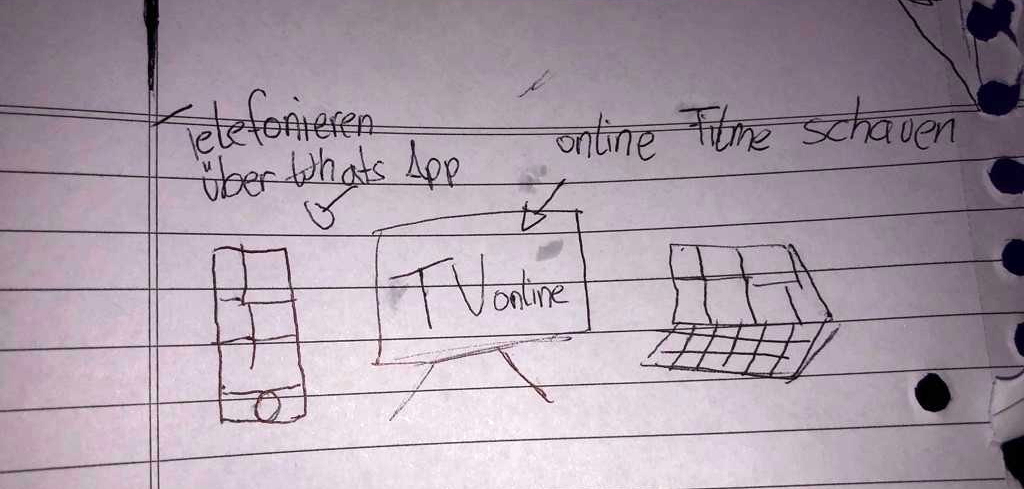 Her drawing shows how she uses the internet: calls using WhatsApp,
watching movies online, and a laptop with open windows on the screen.
She would ask the dragon that can explain one thing she always wanted to know about
the internet:










 In my three most recent posts, I went over the
 As a follow on to a previous blog entry of mine,