Search Results: "georg"

5 April 2007

Adam Rosi-Kessel: Bad Bicycle News

I used to be a hardcore daily bike commuter. (By “hardcore,” I mean I commuted 20-30 miles roundtrip every day in Chicago in January.) Lately, I’ve gotten lazy, especially since I now live about thirty seconds by foot from a train station that takes me to a spot about thirty seconds by foot from my job. Also, since I’m now supporting two people (including my nearly two-year-old daughter), I’m a little more reluctant to get myself killed. I was reminded of the perils of biking in Boston this afternoon when a 22-year old bicyclist was killed by a dump truck in an area where I used to ride daily:
The bicyclist, a 22-year-old man from Halifax, was riding between two lanes of traffic on Huntington Avenue when he was clipped by a taxicab near Northeastern University at about 2:30 p.m., police said. After being clipped by the cab, the bicyclist was run over by a McCauley and Sons Co. dump truck, police said.
When I was a bike commuter, I was fairly cavalier about this sort of incident. I realize it’s still fairly rare and biking may not be any more dangerous than driving. But we still see these events in Boston fairly regularly. I don’t think it can be fixed fully by better driver education/behavior (or better bicyclist education/behavior). There are just too many streets that are poorly designed and naturally hazardous. On a related note, Nat mentioned this nasty run-in during a recent Critical Mass in San Francisco (the article is obviously from the driver’s point of view — there may be another angle on this):
Susan Ferrando, her husband, their two children and three preteens had come to San Francisco from Redwood City to celebrate the birthday of Ferrando’s 11-year-old daughter. They went to Japantown, where they enjoyed shopping and taking in the blooming cherry blossoms. Things took a turn for the worse at about 9 p.m., when the family was leaving Japantown — just as the party of about 3,000 bikers was winding down its monthly red-lights-be-damned ride through the city. Suddenly, Ferrando said, her car was surrounded by hundreds of cyclists. Not being from San Francisco, Ferrando thought she might have inadvertently crossed paths with a bicycle race and couldn’t figure out why the police, who she had just passed, hadn’t warned her. Confusion, however, quickly turned to terror, she said, when the swarming cyclists began wildly circling around and then running into the sides of her Toyota van. Filled with panic, Ferrando said, she started inching forward until coming to a stop at Post and Gough streets, where she was surrounded by bikers on all sides. A biker in front blocked her as another biker began pounding on the windshield. Another was pounding on her window. Another pounded the other side. “It seemed like they were using their bikes as weapons,” Ferrando said. One of the bikers then threw his bike — shattering the rear window and terrifying the young girls inside. All the while, Ferrando was screaming, “There are children in this car! There are children in this car!” …
Update 4/5/2007: the 22-year-old bicyclist had a myspace page.
20 February 2007

Benjamin Mako Hill: Overprice Tags

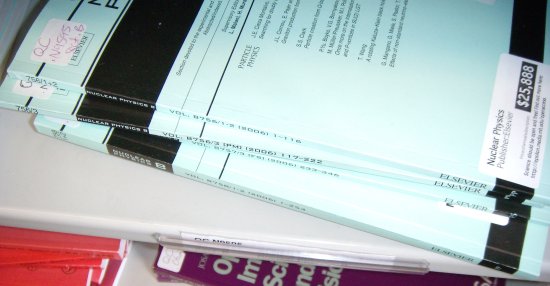
Last Thursday (February 15, 2007) was declared National Day of Action for Open Access. To help raise awareness of the movement for open access in scholarly publications at MIT, I got together with a number of other MIT students and placed price tags -- we called them overprice tags -- onto the 100 journals that MIT subscribes to at a cost of more than $5,000 USD per annum.
/copyrighteous/images/overpricetagged_journal.jpg
The project, inspired by a similar project called Seeing Red carried out by a Brown librarian a few years back, was a huge success. You can find information about the project, motivation and experience, see pictures, and find out how you might run a similar event at your institution on the Overprice Tags homepage.

2 February 2007

MJ Ray: Bad Tech Links for 2007-02-02

"Guidelines for the Secure Operation of the Internet" (RFC1281)
Read it and weep.
Techblogging: DoSing spammers
I've done this in the past, by having a CGI rabbit-hole in a semi-hidden link near the start of the page which just generated 1000s of invalid email addresses. For bonus points, use addresses with MX servers which will never be online again, or maybe with a MX that tarpits and rejects all mail eventually. Get enough points and the spammer will either stop scanning your site or waste a lot of time on you.
Google scanned by spammers [Techblogging]
I don't use pingomatic, but a few of my pages are ranked high enough to attract spammers every time I update them. I think blog spammers probably are using subscription tools to find the most active/most syndicated sites to spam. Can we redesign the tools to defeat them?
BBC News Technology UK Edition: Ads help Google profits triple
But hey, why should Google care about spammers when their externalisation to date is making Google rich?
Techblogging: Web 2.0 security issues incoming
I dislike Web 2.0 so far because it is often inaccessible - this suggests it's often insecure too.
Software Patents Petition
Need more brains... come on, sign the petition, even if it has a bit of hyperbole/invective and a typo or two. Last I heard, it's behind adopting Spandau Ballet's Gold as national anthem, for crying out loud!
The Irascible Professor-commentary of the day 06-07-06. Calculator dependence.
Parents, don't let your children grow up to be calculator junkies!
Zugschlusbeobachtungen: Which kind of software suspend?
I think I heard Matthew Garrett give an interview somewhere (LUG Radio?) which summarised the suspend situation as something like "it works well except when it doesn't." My computer usually software-suspends, but sometimes it crashes and sometimes is often enough to deter me from suspending it often. I really ought to debug it, but it's not a priority yet.
'Cheap and tacky' wedding email that went global - 19 Nov 2006 - National
"The marquee company's CEO, Klaus Jorgensen, said he had sacked the employee responsible - who turned out to be his wife"
NoDaddy.Com - Exposing the Many Reasons Not to Trust GoDaddy with Your Domain Names
"They didn't give me a chance to dispute or resolve the problem -- just a voicemail saying my domain was scheduled for suspension , followed up by a Domain Suspension Notice exactly 52 seconds later. Note that neither of these included a phone number for the abuse department or a reason for the shutdown."
The 'Ow' starts now / freedom bits / greve / Fellows / The Fellowship - Fellowship of FSFE
FSFE's Georg Greve won't be upgrading to Vista, which I saw called "Windows Fista" on the BBC's site - disgruntled journo, over-aggressive MS PR or typo?
BBC NEWS Have Your Say Will you be getting Microsoft Vista?
Nearly 2000 comments, most "No" AFAIS
Microsoft files for patent on "modular operating system"
Microsoft patents Linux?
Hacking gadflies: Marechal, A dystopian future''
Another comment on the MS patent.
BBC NEWS Technology Triple threat targets Word users
While I'm boggling at Microsoft, I hope all their customers saw this little Christmas present from 20 December.
BBC News Technology UK Edition: Sony CD compensation agreed
No Christmas for Sony, remember? They pay out a year or so late.
BBC Trust - On-demand Services' consultation
A remarkable consultation that includes a question "How important is it that the proposed seven-day catch-up service over the internet is available to consumers who are not using Microsoft software?", but the questionnaire doesn't work in all browsers. Do you think this biases the responses? Yes, yes or yes?
Digg - Pressure the BBC to embrace open standards, not just Microsoft technology!
Digg is the new slashdot. Just add hot grits.
BBC News Technology UK Edition: Vista has speech recognition hole
"for the flaw to be exploited the speech recognition feature would need to be activated and configured and both microphone and speakers would have to be switched on." Well, my speakers are embedded in the screen, my microphone doesn't have an on/off switch and I leave it switched on in the mixer so that I can answer the softphone quickly... I doubt I'm the only one who doesn't switch the mic off after every use. Are Microsoft living in the real world any more?

29 January 2007

Ian Murdock: Yet more on the importance of backward compatibility

David Berlind: “With barely five days to go before long-anticipated January 30 launch of Vista is history, a familiar problem and the linchpin to adoption of any major operating system upgrade (Windows Vista qualifies) is crashing the party: backwards compatibility. Intuit, developer of one of the world’s most popular accounting applications used in small, medium and large businesses (Quickbooks), has notified its customers by email that Windows Vista is incompatible with some of the features of Quickbooks 2006.” Mary Jo Foley: “Is it Intuit’s fault that its older products don’t work on Vista? Or Microsoft’s fault for changing the operating system in a way that it breaks them?” George Ou: “As it turns out, it isn’t QuickBooks 2006 itself that has the problem with Vista but all the Intuit and third party add-on software that communicates with QuickBooks 2006 that’s the problem. More to the point, it’s the intercommunication between all those applications and the fact that they’re using forbidden techniques that have been banned since 2001 with Windows XP certification requirements that’s the issue. Intuit admitted to me that they declined to seek Windows XP certification for all these years and they’re just now making the necessary modifications for QuickBooks 2007. The reason this is relevant is because most software that is certified for Windows XP will automatically be compatible with Windows Vista.” David Berlind: “So, while Microsoft’s response doesn’t point the finger directly at Intuit as the culprit in this situation, it makes it clear that its certification programs programs that Intuit has apparently eschewed since 2001 are the centerpiece of its efforts to guarantee backwards compatibility.” Interesting discussion. Whose fault is it? It doesn’t really matter, as the end result is the same—Microsoft potentially loses customers (those who won’t upgrade to Vista because QuickBooks will break), and Intuit potentially loses customers (those who won’t upgrade to QuickBooks 2007 but rather will move to an on demand solution like NetSuite—customers tend to dislike forced upgrades). David Berlind’s observation is interesting though, namely that Microsoft has been using its certification programs to limit the scope of the backward compatibility problem to a well defined subset around which it can presumably do thorough compatibility testing. Note that Red Hat too only guarantees backward compatibility for a subset of its platform, and that the LSB doesn’t cover the entire Linux platform either, just the subset that’s import for application portability. What are the lessons here, from my point of view? First of all, and not surprisingly, backward compatibility matters, and it matters (or should matter) to both sides. Second, to achieve that backward compatibility, both sides have to work at it, and because a typical platform has so many moving parts, limiting the scope is key to understanding the “contract” between OS and application. Finally, some formal way of stating “I am following the contract”, such as a certification program, can make compatibility a lot easier to articulate to mutual customers. Related: On the importance of backward compatibility, More on the importance of backward compatibility

10 January 2007

Erich Schubert: Linux distributions to be illegal in Germany?

The biggest party in Bavaria and part of the current german government, CSU, has announced that they want to make the "production and distribution of killer-games" illegal in germany. They claim it's because of a recent highschool shooting (no fatalities except the shooter; there was one other highschool shooting in germany a few years ago with 16 fatalities. Yes, that is 17 fatalities in over 40 years, the 42 years old amok runner back then didn't play killer games, I guess, although he used a flame thrower...). This would make the production and distribution in Germany unlawful, since we include games such as overkill, tremulous and openarena. Other distributions such as SuSE probably include some games that classify as "killer games" as well. Also note that "distribution" is a rather wide term. Does it apply to web sites? ISPs? If there is an online killer game, is the ISP "distributing" it? Polticians (especially those from CSU/CDU/SPD) are such a bunch of idiots. Please do NOT ever again vote for CSU. Software patents, killer games, "Problemfrauen & Schadbären", surveillance cameras and other surveillance, military inside germany (note that in desaster cases such as the flooding some years ago we could already deploy soldats without extra laws), shooting down of civilian airplanes, transrapid, reducing math and natural sciences in highschools, "google earth threatens worldcup security", police installing trojans on home PCs (because criminals don't install virus scanners?), kicking "irritating" students out of school, study fees, ... Often they make George W. Bush look like a genius, don't they? They don't do any important stuff, but just say whatever a majority people might want to hear. They waste our money (Transrapid). They destroy our biggest resource (changes in school system and university system, which will reduce average knowledge in germany a lot). They do lots of stupid things, which heavily invade privacy or public safety (military, surveillance) with no benefits in safety and many of which even where only stopped because they violated our constitution. Do not vote for them! [Updates: Daniel, sorry for posting a non-english post to planet. I again put it into the wrong category; I intended to do a longer post (this one) in english later on. For clarification: CSU is the sister party of CDU, these parties have an arrangement not to compete by region and are closely affiliated. On the nation-wide level they have a joint list, which often is called CDUCSU. So they're not just an "affiliate", but a strong part of the ruling party. Holger Levsen pointed out we are likely going to violate some laws much earlier by distributing ("hacker-") tools such as nmap, ettercap or whireshark.]

19 December 2006

Daniel Baumann: Mozilla Locales Packaging

Mozilla Firefox Locales In 2004, we had for every individual localization a dedicated source package in the Debian archive, such as: mozilla-firefox-locale-ar, mozila-firefox-locale-ca, etc. This is a mess from every point of view. First, it creates much overhead on the archive infrastructure side as well as on the maintainers one, and second, since it often results in localization packages out of sync with the browser, it is a major pain in the ass for the users. Mozilla Firefox Locales All In January 2005, Cesar Martinez Izquierdo introduced the common source package mozilla-firefox-locale-all which included most of the available localizations. That was the inital step to clean up the mess. Later, David Moreno Garza and Luk Claes took the package over and accompanied it through the Mozilla Firefox to Firefox transition. Iceweasel l10n In September 2006, I jumped in as the new maintainer. Since then, the package did continue to evolve: Additionally, iceweasel-l10n as of 2.0+debian.1-1 supports 43 languages in total. That is more than any other distribution (yes, including Ubuntu :) contains. Icelizard Currently, the locale packages for iceape and icedove are not unified. This September, I was writing to the some of the maintainers but they seemed not interested to fix it for Etch. I will try it again in 2007, my aim is to have proper unified localization packages for all icelizard applications in Lenny. Update: iceweasel-l10n 2.0.0.1+debian-1 adds Valencian localization, so supporting 44 languages now.

14 December 2006

Isaac Clerencia: Freedom of speech and UC Berkeley rocks

My workmate Javier Uruen has just pointed me to Banned for George Bush T-shirt, a story about a guy that was banned from an airplane because he was wearing a “George W. Bush is world’s #1 terrorist” t-shirt. He argued it was his right to express his opinion, while the airline said the t-shirt was offensive and he wouldn’t be able to flight unless he took it off. I can’t see how that shirt can be offensive for anyone besides George W. Bush and I guess nobody would have prevented a person from flying because of an “I love George W. Bush” t-shirt, and that is offensive. Freedom of speech seems to be in danger. In brighter news, I’ve discovered that UC Berkeley freely offers video and audio for some lectures. I’ve been listening to some lectures from the Undergraduate Colloquium on Political Science and they rock. Allan Ross, the lecturer is awesome, I wish I would have had somebody like him in my university.

12 December 2006

Ian Murdock: VMware as operating system?

Now this is interesting: BEA is coming out with a version of its application server that runs directly atop VMware. With this move, VMware takes another step toward becoming a full fledged operating system in its own right. VMware is already promoting the distribution of applications as virtual machine images, and operating systems are first and foremost application platforms. If VMware is an application platform, why not cut out the middle man entirely, particularly given that the middle man adds a few hundred megabytes of largely invisible baggage to the application, not to mention an enormous amount of maintenance burden for the ISVs that make or break an application platform? For me, the real question is: Why BEA and not VMware? A JavaOS makes a lot of sense, since it builds on one of the world’s largest developer communities—it’s a well known environment among developers, and there are a huge stable of applications that could take advantage of the new platform with minimal porting. Furthermore, applications are increasingly server based, with the browser providing the UI, so this matches well with industry trends and nicely addresses the problem that VMware would have a very hard time building any sort of graphical user interface into its platform, just given the nature of what it is. That said, VMware should really want to provide the JavaOS directly. With Xen and Virtual Server moving aggressively to bundle their products with widely deployed operating systems, the game’s already afoot, and if virtualization becomes just another operating system feature, VMware is at a distinct disadvantage, as it owns no operating system to bundle its product with. Finally, what about standards? New kind of operating system or operating system feature, there are going to be multiple application platforms if history is any indication (and it usually is), so how do applications take advantage of the new platforms without the inevitable fragmentation? It’s going to be an interesting space to watch, that’s for sure.

MJ Ray: Software Patents: Bad Companies: Novell's Trojan Horse Attacks OpenOffice

I guess it was only a matter of time before Novell did something that seems likely to harm other free software, after their little deal with Microsoft. I'm surprised it came so soon: they have offered to add Office OXML support to OpenOffice. As Georg Greve writes:
"Bob Sutor, IBM's Vice President of Standards and Open Source has written a good analysis why the specification is more akin to a denial of service attack than an Open Standard."
There's more discussion in Georg Greve's wrap-up. See the top of this article on my site for boycott Novell links and so on.

11 December 2006

Sam Hocevar: The Etch release stress-o-meter

The Etch release stress-o-meter Phew, that was close, but everything is going on quite well now. Apologies to George Orwell.

30 November 2006

Jorge Salamero Sanz: Blog Voyage

Blog Voyage is a game begun by bashflyng with the following rules: you have to travel along the world and along the blogs. You choose a place: a city, a town, a building, a river, a mountain ... The only clue is a picture of the place from Google Earth. The first person to guess the answer gets to choose the following voyage in his blog. This is the current roadmap: Well, here we go: blog voyage UPDATE: george wins. It's New Zealand, the Mount Ruapehu.

16 November 2006

Gon ri Le Bouder: Debian Lenny?!

Like a lot of people who read Of Mice and Men. ‘’Lenny'’ call me up the famous character of the book: “Lennie Small”. This is his description from Wikipedia :
Lennie Small Travels with George. He is a giant of a man who is unaware of his own strength. His mental deficiency culminates in an obsession to stroke ’soft’ materials: this can be understood to represent his need for human contact, which is shown in his obsession with rabbits. George and Lennie are the only characters with both first and last names. There is irony in his last name, as it is “Small” while he is a very big man physically. Lennie is killed by George with a gun.
Please don’t call the next Debian, Lenny! This sux!

6 November 2006

Russell Coker: the death penalty

I have just read the news about Saddam finally receiving the death penalty (it did not seem likely that his case would have any other outcome) and have been thinking about the death penalty in general.

Firstly I think that in a jury based system every jury member should have a hand in the execution. If they vote for the death penalty (if you use a jury then it should decide whether the death penalty is acceptable) then they should all be involved in carrying out the sentence. It would be quite easy to fit a room with a dozen switches that control an electric chair. If the jury members are unable to pull the switch then that should result in the sentence being commuted. I am against people voting for actions which they lack the courage to perform themselves.

One problem I have with the death penalty is the poor quality of justice in most courts. The US is a good example of this where poor people are the ones who get the death sentence. A pre-requisite of having penalties such as the death penalty should be that there is a reasonable chance of convicting the person who committed the crime!

In the case of someone like Saddam Hussein there is an additional problem of creating a martyr. I think that a solution to this would be to give him a life sentence and put him on TV on shows based on the Jerry Springer Show. Show him for what he is and let the audience pass judgement on him, I'm sure that he would not do well on such a show.

Another possibility is to have a glass prison where the lights are always on and web-cams show everything he does (including the toilet and shower). That might fall into the category of cruel and unusual punishment, but really the cruel and unusual stuff is what happens in Abu Ghraib (under the command of Saddam Hussein and more recently under the command of George Bush).

20 September 2006

Andree Leidenfrost: Bending the DFSG a little...

...is what Mike Connor appears to be suggesting here. As far as I can tell, this has already happened - the way I interpret #8 of the DFSG, it is not just about Debian and derivatives but absolutely everyone including Osama Bin Laden and George Walker Bush and even John Howard. ;-)

Seriously, though, I perfectly understand that Mozilla needs to protect its brand and they certainly have every right to do so. And we have every right to change the name and modify the code without asking anyone for approval. A right that we will have to exercise by the looks of it. How about 'freefox' (probably too close) or the 'browser otherwise known as firefox', short 'bokaf' (anyone?).

I believe that Mozilla is doing the free software movement a disservice when they are as hard-nosed about their brand as it appears they are. They certainly need to put mechanisms in place to protect themselves from the Dr. Evils of the world. Debian most definitely does not belong into this category (neither do Redhat nor Suse nor any other Linux distribution I can think of). So why not just let sleeping dogs lie?

Eric Dorland and Steve Langasek are my heroes for remaining calm and on topic in the discussion.

4 September 2006

Branden Robinson: The Defense of Private First Class Lynndie England

Via FindLaw: Defense lawyers sought leniency for Pfc. Lynndie England at a hearing Tuesday to determine her punishment in the Abu Ghraib prison abuse scandal, with a psychologist testifying that the reservist was oxygen-deprived at birth, speech impaired and had trouble learning to read. The most persuasive indication of her mental incapacity, the defense expert continued, was that England volunteered for the U.S. Army in 2001, after George W. Bush assumed the Presidency.

Branden Robinson: Original Intent

Courtesy of FindLaw Legal News: WASHINGTON-President George W. Bush said Wednesday that Harriet Miers' religious beliefs figured into her nomination to the Supreme Court as a top-ranking Democrat warned against any "wink and a nod" campaign for confirmation. "People are interested to know why I picked Harriet Miers," Bush told reporters at the White House. "They want to know Harriet Miers' background. They want to know as much as they possibly can before they form opinions. And part of Harriet Miers' life is her religion." Courtesy of the United States Constitution, Article VI: ...all executive and judicial Officers, both of the United States and of the several States, shall be bound by Oath or Affirmation, to support this Constitution; but no religious Test shall ever be required as a Qualification to any Office or public Trust under the United States. Oh, well, just so long as it's a criterion, not a test. I mean, it's only essential, not a qualification or something, right?

Benjamin Mako Hill: Reference Librarian

Mika and I applied for membership at the Boston Athen um today. In addition to paying the USD $160 yearly fee, were each asked to provide three references who can attest to care for books. That's right; three references to get a library card. This is a very good library. We'll hopefully hear back about our application within two weeks. If we are accepted, we'll be able to take guests into the library with us. The Athen um has, among other things, a copy of Narrative of the life of James Allen, alias George Walton, alias Jonas Pierce, alias James H. York, alias Burley Grove, the highwayman. Being his death-bed confession, to the warden of the Massachusetts state prison. It is bound in the authors skin. Apparently, while rare, this is not entirely uncommon. The Harvard Law Library has another example of anthropodermic bibliopegy and just a couple months ago, someone found a book bound in human skin in the middle of the street in Leeds.

31 August 2006

Ross Burton: qmail Author Considered Dangerous

Thanks to LWN I was reminded of the, erm, interesting license and security guarantee of qmail. Specifically:
In March 1997, I offered $500 to the first person to publish a verifiable security hole in the latest version of qmail: for example, a way for a user to exploit qmail to take over another account. My offer still stands. Nobody has found any security holes in qmail. [...] In May 2005, Georgi Guninski claimed that some potential 64-bit portability problems allowed a remote exploit in qmail-smtpd.'' This claim is denied. Nobody gives gigabytes of memory to each qmail-smtpd process, so there is no problem with qmail's assumption that allocated array lengths fit comfortably into 32 bits.
Erm. Well. I'm not sure what to say. Assuming that array lengths (size_t, IIRC) is a 32-bit type even on 64-bit architectures is wrong. Defending it is insanity. NP: Layered, Antibreak

26 August 2006

Evan Prodromou: 9 Fructidor CCXIV

We're still in wt:Copenhagen today, but we head out this afternoon for our tour of the Baltic Sea. We've had a great time in the city so far, mostly due to staying with longtime Wikitraveller wt:User:Elgaard, who generously offered us the extra room in his apartment for the time we're here. There's something about staying in an actual human being's home while you're travelling to really recharge the batteries. After a week in hotels and restaurants, a little time in a real house can make you feel a lot more human. We took our time getting to Copenhagen from wt:Odense at the end of the Wikisym conference, mostly because I was really hung over. I'd spent the last night of the event drinking at the Irish pub in the pedestrian area, and I probably had 1-5 pints too many. Paul Yount calls Irish pubs "the first Open Source franchise", and it's true: you can expect certain things at a pub no matter where it is in the world. Although we started out with about 30 people, the crowd thinned through the night. I had a good time talking with Brion Vibber and Chuck Smith about the state of Esperanto-language wikis on the Web -- in a mish-mash of English and Esperanto, of course. (In case you were wondering: the state is "fine".) I also chatted Wikimedia Foundation politics with Angela Beesley; we both think Erik Moeller is going to make a good addition to the WMF board. After the pub shut down, I headed to the deathly silent casino in the sub-basement of the Radisson of Odense. The bar was eerily silent, and the gaming tables were intense and serious; I don't think people could have been more somber if they were organ harvesters gambling for body parts. The last hangers-on were Andrea Forte of Georgia Tech, Alex Schroeder of CommunityWiki, Sunir Shah of MeatballWiki, and Eugene Eric Kim, of Blue Oxen and HyperCore. In other words, some of the smartest people in the wiki world today -- we talked wiki politics and theory until the wee hours of the morning. They all switched to mineral water while I was still slugging down pints of Carlsberg Special, which is probably where I went wrong. Wikisym, for me, was one of the best conferences I've been to this year, and I've been to a lot. It capped off a long summer of conference-going, and this fall should be relatively tranquil. Which is great: I have a lot of work to do, based on the ideas I've picked up this season. tags:

sterbro All of which is to say that I was feeling pretty crufty the next morning as we got on the train. Kindly Maj got us a late checkout and let me sleep in late, which helped a lot; a falafel sandwich around 11AM also cleared my head a bit. The train ride from Odense to Copenhagen was great, and by the time we got to Niels Elgaard Larsen's house in sterbro (a neighborhood of Copenhagen) I was pretty refreshed. Niels took us out to an early dinner at a restaurant called Pixie in a square by his house. Copenhagen has some pretty strict traffic laws, and the number of cars on the street is possibly the least I've ever seen for a major metropolis, leaving a lot of room for sidewalks, bike paths, and open parks and plazas. We got to chat with Niels over a fresh pasta dinner, and thence home to his house for beers and more talk. One great thing about visiting Wikitravellers is that they tend to be a) very smart, b) well-travelled, and c) interested in Free Software and Free Culture. Niels is no exception; he's active in the Danish and European Free Software and information freedom communities, and he's extremely interesting to talk to on the subject. We shared travel stories and talked about Open Source and Open Content later than I would have thought, based on my earlier-morning hangover. Probably the high point of the evening, for me, was when Niels shared a brilliant idea for a way to distribute Wikitravel guides in digital form for a very wide array of users. We've had a hard time settling on a mobile document format for Wikitravel guides, since mobile devices like PDAs and cell phones support standards so poorly. It's one of the most requested features for Wikitravel, but it's going to take a huge amount of work to cover even a fraction of the mobile device owner community. Except Niels had a genius idea for how to distribute guides in a simple, standard format that works on a mobile digital device many if not most travellers carry with them every time they travel. The idea: make guides that are downloadable JPEG images which can be copied to a SD card or Compact Flash or Memory stick or whatever, then stuck into a digital camera. If the camera supports zooming on images, and has a decent screen for review, the guides might be useful and readable. I'm going to try to do some experiments with the idea -- I think it could be a real winner. Adding 30-40 images to a camera today is pretty cheap, and if they're just text I think some aggressive compression can work well. tag:

Copenhagen on foot Yesterday we did a big tour of the city on our own. In the morning, we had some breakfast at the Laundromat Cafe right next door to Niels's house, and I took the opportunity to clean a week's worth of dirty laundry. Nothing like a stack of clean clothes to make you feel more like a decent citizen. I was down to a bathing suit and the ICANNWiki t-shirt Ray King gave me at Wikisym. Then we headed out on the town to do some sight-seeing. First we hit the Kastellet, a fortress in northeast Copenhagen that's the oldest operational military base in Europe. It's got the distinctive star-shaped outline typical of old fortifications, and is surrounded by a lovely park with ducks and swans. We had lunch at a nearby caf , with large beers. (Gee, I'm getting worried about the pattern here.) After lunch we made an unscheduled stop at den lille havfrue -- the famous Litle Mermaid statue in the harbour. It was miniscule and surrounded by perhaps 100 onlookers, crammed into a tiny swatch of sidewalk. We stopped about half a mile away, took some pictures of the crowd, and moved on. We then hoofed it down through the harbour and across Nyhavn and a bridge to Christianhavn and Christiania. We'd both heard about the city-within-a-city run on anarchist principles -- kind of like a giant squat -- but neither of us had been there before. It was an interesting place -- packed with people, lots of food cooking a beer-drinking, caf s and restaurants all over the place, interspersed with art installations and little gardens. But it had the unkempt scumminess of a big squat, too -- especially on the main drag -- and there were a few too many pitbulls and gutterpunks for my tastes. Overall a good experience but I don't know if I'll go back. After our long walk we took the metro back to Niels's, where we napped until he and wife Chiquita got home. Chiquita is an investment banker from wt:Toronto who does a lot of business in Europe, where she met Niels a few years ago. They were married last year and have had a long-distance relationship -- visiting each other a week or so out of each month -- for the whole time. She's moving here this year, which I think will be nice for both of them. We had a good dinner at a place called Thomas's -- a buffet, which seems to be very popular here -- and then back home for a nightcap and bed. Amita June was overtired by the time we got her to bed, and she let us know that we'd pushed her too hard with a quarter-hour of heavy crying. But we all got to sleep pretty well afterwards, and at least the parents know that we should take it easy in the future. tags:

14 August 2006

Thom May: MLP-tastic

Both of these come via Newshog; the first is a very interesting article from NBC talking about the ”unprecedented cooperation and coordination” between US and UK officials; unprecedented in this case appears to mean ”arguing all the way to the police station”, but this is just according to one unnamed UK official, so possibly a pinch of salt required. The article goes on to mention in passing the arrest of the ringleader, Rashid Rauf, in Pakistan, apparently causing another disagreement between the US and the UK over choice of jurisdiction - which some are linking to the possibility of torture. There are some fantastic quotes in the NBC article, regarding the timing and actual preparedness of the “attack”, especially that ”the suspects in Britain had obtained at least some of the materials for the explosive but had not yet actually prepared or mixed it.” and that ”the suspects had not yet purchased any airline tickets. In fact, some did not even have passports.”. All this added up begins to bring serious doubt as to the actual danger represented by the terrorists, and also raises the question of what a more “hands-off” - not arresting the suspects, but allowing them to continue their preparations longer - approach to monitoring and intelligence gathering would have resulted in. The second is interesting in its own right - Max Hastings - friend of Lady Thatcher, dyed in the wool Conservatist - writing for the Guardian - left/liberal and proud of the fact - leads his article with “George Bush sometimes sounds more like the Mahdi, preaching jihad against infidels, than the leader of a western democracy” (edited to link to Wikipedia’s conservative party page.)

Next.

Previous.