Search Results: "edd"

30 March 2025

Dirk Eddelbuettel: RcppSpdlog 0.0.21 on CRAN: New Upstream

Version 0.0.21 of RcppSpdlog arrived on CRAN today and has been uploaded to Debian. RcppSpdlog bundles spdlog, a wonderful header-only C++ logging library with all the bells and whistles you would want that was written by Gabi Melman, and also includes fmt by Victor Zverovich. You can learn more at the nice package documention site. This release updates the code to the version 1.15.2 of spdlog which was released this weekend as well. The NEWS entry for this release follows.

Changes in RcppSpdlog version 0.0.21 (2025-03-30)
  • Upgraded to upstream release spdlog 1.15.2 (including fmt 11.1.4)

Courtesy of my CRANberries, there is also a diffstat report. More detailed information is on the RcppSpdlog page, or the package documention site.

This post by Dirk Eddelbuettel originated on his Thinking inside the box blog. If you like this or other open-source work I do, you can sponsor me at GitHub.
Dirk Eddelbuettel: RcppZiggurat 0.1.8 on CRAN: Build Refinements

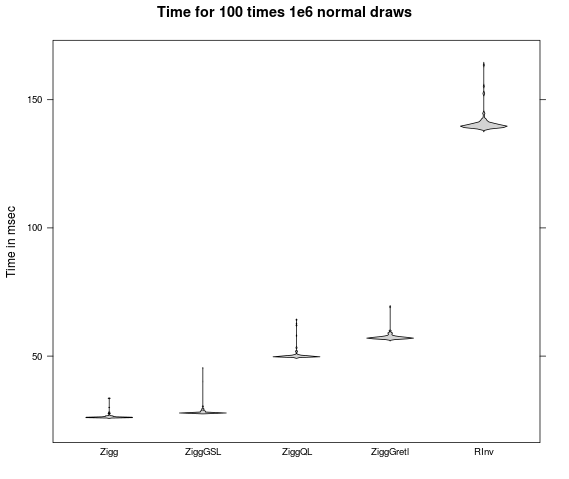
ziggurats A new release 0.1.8 of RcppZiggurat is now on the CRAN network for R, following up on the 0.1.7 release last week which was the first release in four and a half years. The RcppZiggurat package updates the code for the Ziggurat generator by Marsaglia and others which provides very fast draws from a Normal (or Exponential) distribution. The package provides a simple C++ wrapper class for the generator improving on the very basic macros, and permits comparison among several existing Ziggurat implementations. This can be seen in the figure where Ziggurat from this package dominates accessing the implementations from the GSL, QuantLib and Gretl all of which are still way faster than the default Normal generator in R (which is of course of higher code complexity). This release switches the vignette to the standard trick of premaking it as a pdf and including it in a short Sweave document that imports it via pdfpages; this minimizes build-time dependencies on other TeXLive components. It also incorporates a change contributed by Tomas to rely on the system build of the GSL on Windows as well if Rtools 42 or later is found. No other changes. The NEWS file entry below lists all changes.

Changes in version 0.1.8 (2025-03-30)
  • The vignette is now premade and rendered as Rnw via pdfpage to minimize the need for TeXLive package at build / install time (Dirk)
  • Windows builds now use the GNU GSL when Rtools is 42 or later (Tomas Kalibera in #25)

Courtesy of my CRANberries, there is a diffstat report relative to previous release. More detailed information is on the Rcppziggurat page or the GitHub repository.

This post by Dirk Eddelbuettel originated on his Thinking inside the box blog. If you like this or other open-source work I do, you can sponsor me at GitHub.

29 March 2025

Dirk Eddelbuettel: tinythemes 0.0.3 at CRAN: Nags

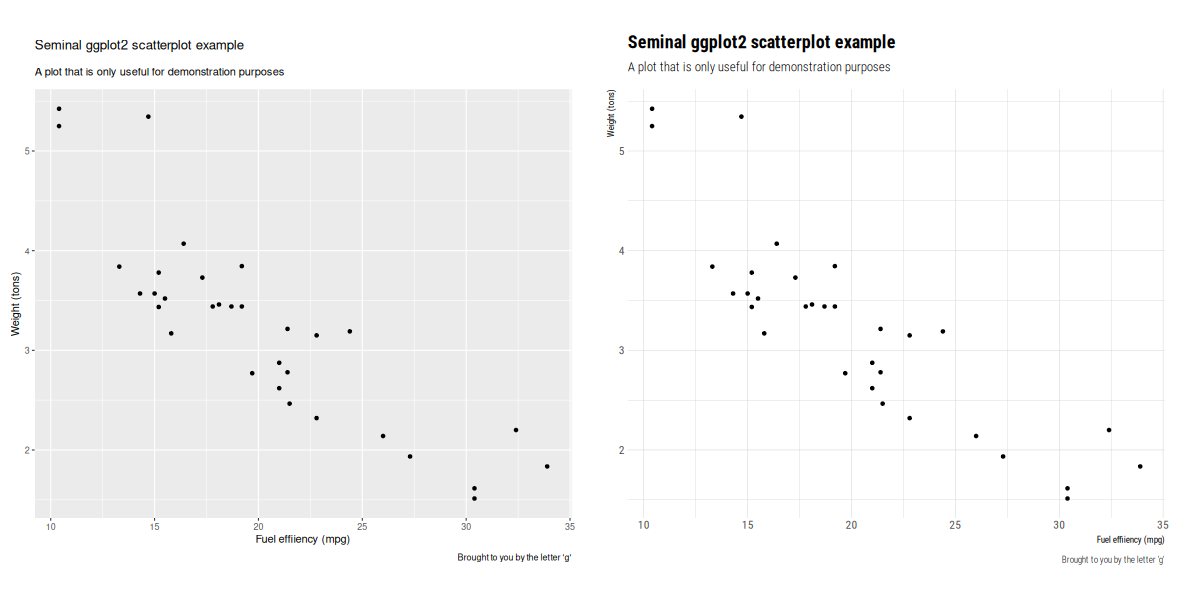
tinythemes demo A second maintenance release of our still young-ish package tinythemes arrived on CRAN today. tinythemes provides the theme_ipsum_rc() function from hrbrthemes by Bob Rudis in a zero (added) dependency way. A simple example is (also available as a demo inside the package) contrasts the default style (on the left) with the one added by this package (on the right): This version responds solely to things CRAN now nags about. As these are all package quality improvement we generally oblige happily (and generally fix in the respective package repo when we notice). I am currently on a quest to get most/all of my nags down so new releases are sometimes the way to go even when not under a deadline gun (as with other releases this week). The full set of changes since the last release (a little over a year ago) follows.

Changes in tinythemes version 0.0.3 (2025-03-29)
  • Updated a badge URL in README.md
  • Updated manual pages with proper anchor links
  • Rewrote one example without pipe to not require minimum R version

Courtesy of my CRANberries, there is a diffstat report relative to previous release. More detailed information is on the repo where comments and suggestions are welcome.

This post by Dirk Eddelbuettel originated on his Thinking inside the box blog. If you like this or other open-source work I do, you can sponsor me at GitHub.

28 March 2025

Dirk Eddelbuettel: RcppArmadillo 14.4.1-1 on CRAN: Small Upstream Fix

armadillo image Armadillo is a powerful and expressive C++ template library for linear algebra and scientific computing. It aims towards a good balance between speed and ease of use, has a syntax deliberately close to Matlab, and is useful for algorithm development directly in C++, or quick conversion of research code into production environments. RcppArmadillo integrates this library with the R environment and language and is widely used by (currently) 1236 other packages on CRAN, downloaded 39 million times (per the partial logs from the cloud mirrors of CRAN), and the CSDA paper (preprint / vignette) by Conrad and myself has been cited 620 times according to Google Scholar. This release brings a small upstream bug fix to the two FFTW3-interfacing functions, something not likely to hit many CRAN packages. The changes since the last and fairly recent CRAN release are summarised below.

Changes in RcppArmadillo version 14.4.1-1 (2025-03-27)
  • Upgraded to Armadillo release 14.4.1 (Filtered Espresso)
    • Fix for fft() and ifft() when using FFTW3 in multi-threaded contexts (such as OpenMP)

Courtesy of my CRANberries, there is a diffstat report relative to previous release. More detailed information is on the RcppArmadillo page. Questions, comments etc should go to the rcpp-devel mailing list off the Rcpp R-Forge page.

This post by Dirk Eddelbuettel originated on his Thinking inside the box blog. If you like this or other open-source work I do, you can sponsor me at GitHub.

Dirk Eddelbuettel: tint 0.1.5 on CRAN: Maintenance

A new version 0.1.5 of the tint package arrived at CRAN today. tint provides a style not unlike Tufte for use in html and pdf documents created from markdown. The github repo shows several examples in its README, more as usual in the package documentation. This is the first release in one and a half years and contains only routine maintenance. As CRAN now bags about missing anchors in the common \code \link use, I added these today. Otherwise the usual mix of updates to continuous integration, to badges and URLs and other small packaging details but nothing user-facing.

Changes in tint version 0.1.5 (2025-03-27)
  • Standard package maintenance for continuous integration, URL updates, and packaging conventions
  • Correct two minor nags in the Rd file

Courtesy of my CRANberries, there is a diffstat report relative to previous release. More information is on the tint page. For questions or comments use the issue tracker off the GitHub repo.

This post by Dirk Eddelbuettel originated on his Thinking inside the box blog. If you like this or other open-source work I do, you can sponsor me at GitHub.

27 March 2025

Scarlett Gately Moore: KDE Snap updates, Kubuntu Beta testing, Life updates!

Help us Beta test Kubuntu Plucky Puffin!
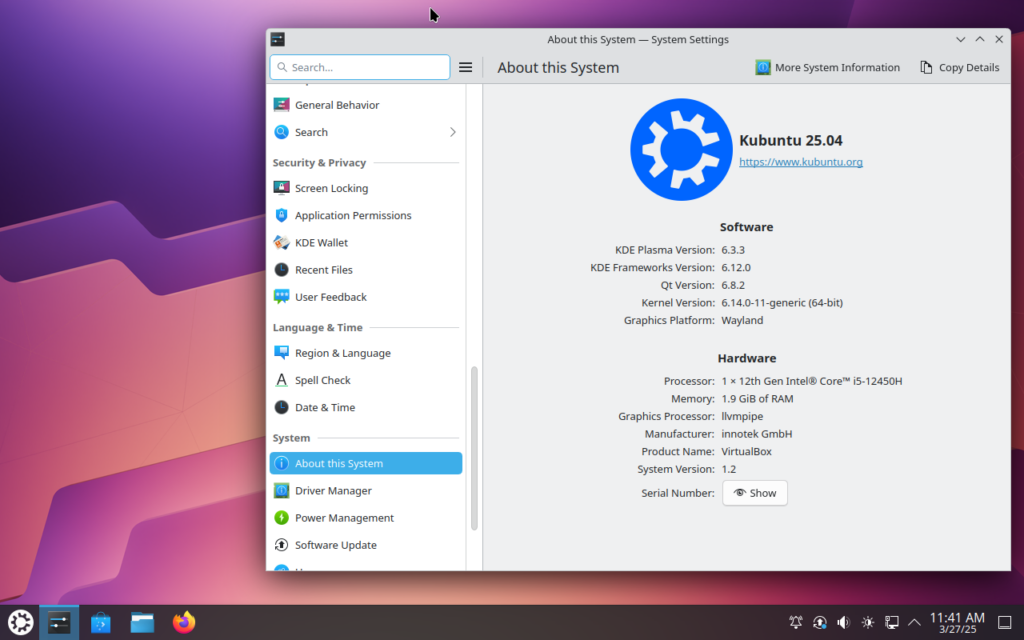
Kubuntu work: Fixed an issue in apparmor preventing QT6 webengine applications from starting. Beta testing! KDE Snaps: Updated Qt6 to 6.8.2 Updated Kf6 6.11.0 Rolling out 25.04 RC applications! You can find them in the candidate channel! Life: I have decided to strike out on my own. I can t take any more rejections! Honestly, I don t blame them, I wouldn t want a one armed engineer either. However, I have persevered and accomplished quite a bit with my one arm! So I have decided to take a leap of faith and with your support for open source work and a resurrected side gig of web development I will survive. If you can help sponsor my work, anything at all, even a dollar! I would be eternally grateful. I have several methods to do so: If you want your cool application packaged in a variety of formats please contact me! If you want focused help with an annoying bug, please contact me! Contact me for any and all kinds of help, if I can t do it, I will say so. Do you need web work? Someone to maintain your website? I can do that too! Portfolio Thank you all for your support in this new adventure!

26 March 2025

Dirk Eddelbuettel: RcppRedis 0.2.5 on CRAN: Fix Bashism in Configure, Maintenance

A new minor release 0.2.5 of our RcppRedis package arrived on CRAN today. RcppRedis is one of several packages connecting R to the fabulous Redis in-memory datastructure store (and much more). RcppRedis does not pretend to be feature complete, but it may do some things faster than the other interfaces, and also offers an optional coupling with MessagePack binary (de)serialization via RcppMsgPack. The package has been deployed in production as a risk / monitoring tool on a trading floor for several years. It also supports pub/sub dissemination of streaming market data as per this earlier example. Given the changes around Redis, it is worth stressing that the package works just as well with valkey and uses only hiredis which remains proper open source. This update is again somewhat mechanical as a few maintenance things bubbled up in since the last release in the summer of 2023. As with other packages, continuous integration was updated a few times as were URLs and badges, and we update the use of our RApiSerialize. And, just as we did today and yesterday with littler, RQuantLib and RDieHarder, this addresses a nag from CRAN about implicit bash dependency in configure.ac (which we fixed in January as for the other packages but are under deadline now). Last but not least the newly-added extension of forbidden symbols in static libraries revealed that yes indeed I had forgotten to set -DNDEBUG when building the embedded hiredis in fallback mode and I now also converted its four uses of sprintf to snprintf so we are clean there too. The detailed changes list follows.

Changes in version 0.2.5 (2025-03-26)
  • The continuous integration setup was updated several times
  • Badges and URLs in README.md have been updated
  • An updated interface from RApiSerialize is now used, and a versioned dependency on version 0.1.4 or later has been added
  • The DESCRIPTION file now uses Authors@R
  • Two possible bashisms have been converted in configure.ac
  • The (fallback if needed) build of libhiredis.a now sets -DNDEBUG, four uses of sprintf converted to snprintf

Courtesy of my CRANberries, there is also a diffstat report for this this release. More information is on the RcppRedis page and at the repository and its issue tracker.

This post by Dirk Eddelbuettel originated on his Thinking inside the box blog. If you like this or other open-source work I do, you can sponsor me at GitHub.

Dirk Eddelbuettel: RDieHarder 0.2.7 on CRAN: Fix Bashism in Configure, Maintenance

An new version 0.2.7 of the random-number generator tester RDieHarder (based on the DieHarder suite developed / maintained by Robert Brown with contributions by David Bauer and myself along with other contributors) is now on CRAN. This release contains only internal maintenance changes: continuous integration was updated as was a badge URL, and a bashism issue in configure.ac was addressed (months ago) but as CRAN now sends NOTEs it triggered this update (just like littler and RQuantLib yesterday). Thanks to CRANberries, you can also look at the most recent diff to the previous release. If you like this or other open-source work I do, you can now sponsor me at GitHub.

This post by Dirk Eddelbuettel originated on his Thinking inside the box blog. Please report excessive re-aggregation in third-party for-profit settings.

Dirk Eddelbuettel: crc32c 0.0.3 on CRAN: Accommodate Unreleased (!!) cmake Version

A third release of the crc32c package is now on CRAN. The package bring the Google library crc32c to R and offers cyclical checksums with parity in hardware-accelerated form on (recent enough) intel cpus as well as on arm64. This release is one hundred percent maintenance. Brian Ripley reached out as he already tests the (still very much unreleased) cmake 4.0.0 release, currently at rc5. And that version is now picky about minimum cmake version statements in CMakeLists.txt. As we copied the upstream one here, with its setting of the jurassic 3.1 version, our build conked out. A simple switch to 3.5..4.0, declaring a from .. to scheme with a minimally supported version (here 3.5, released in 2016) up to a tested version works. No other changes, really, besides an earlier helping hand from Jeroen concerning cross-compilation support he needed or encountered (and that happened right after the 0.0.2 release). The NEWS entry for this (as well the initial release) follows.

Changes in version 0.0.3 (2025-03-25)
  • Support cross-compilation by setting CC and CXX in Makevars.in (Jeroen Ooms in #1)
  • Support pre-release 4.0.0 of cmake by moving the minimum stated version from 3.1 to 3.5 per CRAN request, also sent PR upstream

My CRANberries service provides a comparison to the previous release. The code is available via the GitHub repo, and of course also from its CRAN page and via install.packages("crc32c"). Comments and suggestions are welcome at the GitHub repo.

This post by Dirk Eddelbuettel originated on his Thinking inside the box blog. If you like this or other open-source work I do, you can sponsor me at GitHub.

25 March 2025

Dirk Eddelbuettel: littler 0.3.21 on CRAN: Lots Moar Features!

max-heap image The twentysecond release of littler as a CRAN package landed on CRAN just now, following in the now nineteen year history (!!) as a (initially non-CRAN) package started by Jeff in 2006, and joined by me a few weeks later. littler is the first command-line interface for R as it predates Rscript. It allows for piping as well for shebang scripting via #!, uses command-line arguments more consistently and still starts faster. It also always loaded the methods package which Rscript only began to do in recent years. littler lives on Linux and Unix, has its difficulties on macOS due to some-braindeadedness there (who ever thought case-insensitive filesystems as a default were a good idea?) and simply does not exist on Windows (yet the build system could be extended see RInside for an existence proof, and volunteers are welcome!). See the FAQ vignette on how to add it to your PATH. A few examples are highlighted at the Github repo:, as well as in the examples vignette. This release, the first is almost exactly one year, brings enhancements to six scripts as well as three new ones. The new ones crup.r offers CRan UPloads from the command-line, deadliners.r lists CRAN package by CRAN deadline, and wb.r uploads to win-builder (replacing an older shell script of mine). Among the updated ones, kitten.r now creates more complete DESCRIPTION files in the packages it makes, and several scripts support additional options. A number of changes were made to packaging as well, some of which were contributed by Jon and Michael which is of course always greatly appreciated. The trigger for the release was, just like for RQuantLib earlier today, a CRAN nag on bashisms half of which actually false here it was in a comment only. Oh well. The full change description follows.

Changes in littler version 0.3.21 (2025-03-24)
  • Changes in examples scripts
    • Usage text for ciw.r is improved, new options were added (Dirk)
    • The noble release is supported by r2u.r (Dirk)
    • The installRub.r script has additional options (Dirk)
    • The ttlt.r script has a new load_package argument (Dirk)
    • A new script deadliners.r showing CRAN packages 'under deadline' has been added, and then refined (Dirk)
    • The kitten.r script can now use whoami and argument githubuser on the different *kitten helpers it calls (Dirk)
    • A new script wb.r can upload to win-builder (Dirk)
    • A new script crup.r can upload a CRAN submission (Dirk)
    • In rcc.r, the return from rcmdcheck is now explicitly printed (Dirk)
    • In r2u.r the dry-run option is passed to the build command (Dirk)
  • Changes in package
    • Regular updates to badges, continuous integration, DESCRIPTION and configure.ac (Dirk)
    • Errant osVersion return value are handled more robustly (Michael Chirico in #121)
    • The current run-time path is available via variable LITTLER_SCRIPT_PATH (Jon Clayden in #122)
    • The cleanup script remove macOS debug symbols (Jon Clayden in #123)

My CRANberries service provides a comparison to the previous release. Full details for the littler release are provided as usual at the ChangeLog page, and also on the package docs website. The code is available via the GitHub repo, from tarballs and now of course also from its CRAN page and via install.packages("littler"). Binary packages are available directly in Debian as well as (in a day or two) Ubuntu binaries at CRAN thanks to the tireless Michael Rutter. Comments and suggestions are welcome at the GitHub repo.

This post by Dirk Eddelbuettel originated on his Thinking inside the box blog. If you like this or other open-source work I do, you can sponsor me at GitHub.

Dirk Eddelbuettel: RQuantLib 0.4.25 on CRAN: Fix Bashism in Configure

A new minor release 0.4.25 of RQuantLib arrived on CRAN this morning, and has just now been uploaded to Debian too. QuantLib is a rather comprehensice free/open-source library for quantitative finance. RQuantLib connects (some parts of) it to the R environment and language, and has been part of CRAN for nearly twenty-two years (!!) as it was one of the first packages I uploaded to CRAN. This release of RQuantLib is tickled by a request to remove bashisms in shell scripts, or, as in my case here, configure.ac where I used the non-portable form of string comparison. That has of course been there for umpteen years and not bitten anyone as the default shell for most is in fact bash but the change has the right idea. And is of course now mandatory affecting quite a few packages is I tooted yesterday. It also contains an improvement to the macOS 14 build kindly contributed by Jeroen.

Changes in RQuantLib version 0.4.25 (2025-03-24)
  • Support macOS 14 with a new compiler flag (Jeroen in #190)
  • Correct two bashisms in configure.ac

One more note, though: This may however be the last release I make with Windows support. CRAN now also checks for forbidden symbols (such as assert or (s)printf or ) in static libraries, and this release tickled one such warning from the Windows side (which only uses static libraries). I have no desire to get involved in also maintaing QuantLib (no R here) for Windows and may simply turn the package back to OS_type: unix to avoid the hassle. To avoid that, it would be fabulous if someone relying on RQuantLib on Windows could step up and lend a hand looking after that library build. Courtesy of my CRANberries, there is also a diffstat report for the this release. As always, more detailed information is on the RQuantLib page. Questions, comments etc should go to the rquantlib-devel mailing list. Issue tickets can be filed at the GitHub repo. If you like this or other open-source work I do, you can now sponsor me at GitHub.

This post by Dirk Eddelbuettel originated on his Thinking inside the box blog. Please report excessive re-aggregation in third-party for-profit settings.

24 March 2025

Simon Josefsson: Reproducible Software Releases

Around a year ago I discussed two concerns with software release archives (tarball artifacts) that could be improved to increase confidence in the supply-chain security of software releases. Repeating the goals for simplicity: While implementing these ideas for a small project was accomplished within weeks see my announcement of Libntlm version 1.8 adressing this in complex projects uncovered concerns with tools that had to be addressed, and things stalled for many months pending that work. I had the notion that these two goals were easy and shouldn t be hard to accomplish. I still believe that, but have had to realize that improving tooling to support these goals takes time. It seems clear that these concepts are not universally agreed on and implemented generally. I m now happy to recap some of the work that led to releases of libtasn1 v4.20.0, inetutils v2.6, libidn2 v2.3.8, libidn v1.43. These releases all achieve these goals. I am working on a bunch of more projects to support these ideas too. What have the obstacles so far been to make this happen? It may help others who are in the same process of addressing these concerns to have a high-level introduction to the issues I encountered. Source code for projects above are available and anyone can look at the solutions to learn how the problems are addressed. First let s look at the problems we need to solve to make git-archive style tarballs usable:

Version Handling To build usable binaries from a minimal tarballs, it need to know which version number it is. Traditionally this information was stored inside configure.ac in git. However I use gnulib s git-version-gen to infer the version number from the git tag or git commit instead. The git tag information is not available in a git-archive tarball. My solution to this was to make use of the export-subst feature of the .gitattributes file. I store the file .tarball-version-git in git containing the magic cookie like this:
$Format:%(describe)$
With this, git-archive will replace with a useful version identifier on export, see the libtasn1 patch to achieve this. To make use of this information, the git-version-gen script was enhanced to read this information, see the gnulib patch. This is invoked by ./configure to figure out which version number the package is for.

Translations We want translations to be included in the minimal source tarball for it to be buildable. Traditionally these files are retrieved by the maintainer from the Translation project when running ./bootstrap, however there are two problems with this. The first one is that there is no strong authentication or versioning information on this data, the tools just download and place whatever wget downloaded into your source tree (printf-style injection attack anyone?). We could improve this (e.g., publish GnuPG signed translations messages with clear versioning), however I did not work on that further. The reason is that I want to support offline builds of packages. Downloading random things from the Internet during builds does not work when building a Debian package, for example. The translation project could solve this by making a monthly tarball with their translations available, for distributors to pick up and provide as a separate package that could be used as a build dependency. However that is not how these tools and projects are designed. Instead I reverted back to storing translations in git, something that I did for most projects back when I was using CVS 20 years ago. Hooking this into ./bootstrap and gettext workflow can be tricky (ideas for improvement most welcome!), but I used a simple approach to store all directly downloaded po/*.po files directly as po/*.po.in and make the ./bootstrap tool move them in place, see the libidn2 commit followed by the actual make update-po commit with all the translations where one essential step is:
# Prime po/*.po from fall-back copy stored in git.
for poin in po/*.po.in; do
    po=$(echo $poin   sed 's/.in//')
    test -f $po   cp -v $poin $po
done
ls po/*.po   sed 's .*/ ; s \.po$ ' > po/LINGUAS

Fetching vendor files like gnulib Most build dependencies are in the shape of You need a C compiler . However some come in the shape of source-code files intended to be vendored , and gnulib is a huge repository of such files. The latter is a problem when building from a minimal git archive. It is possible to consider translation files as a class of vendor files, since they need to be copied verbatim into the project build directory for things to work. The same goes for *.m4 macros from the GNU Autoconf Archive. However I m not confident that the solution for all vendor files must be the same. For translation files and for Autoconf Archive macros, I have decided to put these files into git and merge them manually occasionally. For gnulib files, in some projects like OATH Toolkit I also store all gnulib files in git which effectively resolve this concern. (Incidentally, the reason for doing so was originally that running ./bootstrap took forever since there is five gnulib instances used, which is no longer the case since gnulib-tool was rewritten in Python.) For most projects, however, I rely on ./bootstrap to fetch a gnulib git clone when building. I like this model, however it doesn t work offline. One way to resolve this is to make the gnulib git repository available for offline use, and I ve made some effort to make this happen via a Gnulib Git Bundle and have explained how to implement this approach for Debian packaging. I don t think that is sufficient as a generic solution though, it is mostly applicable to building old releases that uses old gnulib files. It won t work when building from CI/CD pipelines, for example, where I have settled to use a crude way of fetching and unpacking a particular gnulib snapshot, see this Libntlm patch. This is much faster than working with git submodules and cloning gnulib during ./bootstrap. Essentially this is doing:
GNULIB_REVISION=$(. bootstrap.conf >&2; echo $GNULIB_REVISION)
wget -nv https://gitlab.com/libidn/gnulib-mirror/-/archive/$GNULIB_REVISION/gnulib-mirror-$GNULIB_REVISION.tar.gz
gzip -cd gnulib-mirror-$GNULIB_REVISION.tar.gz   tar xf -
rm -fv gnulib-mirror-$GNULIB_REVISION.tar.gz
export GNULIB_SRCDIR=$PWD/gnulib-mirror-$GNULIB_REVISION
./bootstrap --no-git
./configure
make

Test the git-archive tarball This goes without saying, but if you don t test that building from a git-archive style tarball works, you are likely to regress at some point. Use CI/CD techniques to continuously test that a minimal git-archive tarball leads to a usable build.

Mission Accomplished So that wasn t hard, was it? You should now be able to publish a minimal git-archive tarball and users should be able to build your project from it. I recommend naming these archives as PROJECT-vX.Y.Z-src.tar.gz replacing PROJECT with your project name and X.Y.Z with your version number. The archive should have only one sub-directory named PROJECT-vX.Y.Z/ containing all the source-code files. This differentiate it against traditional PROJECT-X.Y.Z.tar.gz tarballs in that it embeds the git tag (which typically starts with v) and contains a wildcard-friendly -src substring. Alas there is no consistency around this naming pattern, and GitLab, GitHub, Codeberg etc all seem to use their own slightly incompatible variant. Let s go on to see what is needed to achieve reproducible make dist source tarballs. This is the release artifact that most users use, and they often contain lots of generated files and vendor files. These files are included to make it easy to build for the user. What are the challenges to make these reproducible?

Build dependencies causing different generated content The first part is to realize that if you use tool X with version A to generate a file that goes into the tarball, version B of that tool may produce different outputs. This is a generic concern and it cannot be solved. We want our build tools to evolve and produce better outputs over time. What can be addressed is to avoid needless differences. For example, many tools store timestamps and versioning information in the generated files. This causes needless differences, which makes audits harder. I have worked on some of these, like Autoconf Archive timestamps but solving all of these examples will take a long time, and some upstream are reluctant to incorporate these changes. My approach meanwhile is to build things using similar environments, and compare the outputs for differences. I ve found that the various closely related forks of GNU/Linux distributions are useful for this. Trisquel 11 is based on Ubuntu 22.04, and building my projects using both and comparing the differences only give me the relevant differences to improve. This can be extended to compare AlmaLinux with RockyLinux (for both versions 8 and 9), Devuan 5 against Debian 12, PureOS 10 with Debian 11, and so on.

Timestamps Sometimes tools store timestamps in files in a way that is harder to fix. Two notable examples of this are *.po translation files and Texinfo manuals. For translation files, I have resolved this by making sure the files use a predictable POT-Creation-Date timestamp, and I set it to the modification timestamps of the NEWS file in the repository (which I set to the git commit of the latest commit elsewhere) like this:
dist-hook: po-CreationDate-to-mtime-NEWS
.PHONY: po-CreationDate-to-mtime-NEWS
po-CreationDate-to-mtime-NEWS: mtime-NEWS-to-git-HEAD
  $(AM_V_GEN)for p in $(distdir)/po/*.po $(distdir)/po/$(PACKAGE).pot; do \
    if test -f "$$p"; then \
      $(SED) -e 's,POT-Creation-Date: .*\\n",POT-Creation-Date: '"$$(env LC_ALL=C TZ=UTC0 stat --format=%y $(srcdir)/NEWS   cut -c1-16,31-)"'\\n",' < $$p > $$p.tmp && \
      if cmp $$p $$p.tmp > /dev/null; then \
        rm -f $$p.tmp; \
      else \
        mv $$p.tmp $$p; \
      fi \
    fi \
  done
Similarily, I set a predictable modification time of the texinfo source file like this:
dist-hook: mtime-NEWS-to-git-HEAD
.PHONY: mtime-NEWS-to-git-HEAD
mtime-NEWS-to-git-HEAD:
  $(AM_V_GEN)if test -e $(srcdir)/.git \
                && command -v git > /dev/null; then \
    touch -m -t "$$(git log -1 --format=%cd \
      --date=format-local:%Y%m%d%H%M.%S)" $(srcdir)/NEWS; \
  fi
However I ve realized that this needs to happen earlier and probably has to be run during ./configure time, because the doc/version.texi file is generated on first build before running make dist and for some reason the file is not rebuilt at release time. The Automake texinfo integration is a bit inflexible about providing hooks to extend the dependency tracking. The method to address these differences isn t really important, and they change over time depending on preferences. What is important is that the differences are eliminated.

ChangeLog Traditionally ChangeLog files were manually prepared, and still is for some projects. I maintain git2cl but recently I ve settled with gnulib s gitlog-to-changelog because doing so avoids another build dependency (although the output formatting is different and arguable worse for my git commit style). So the ChangeLog files are generated from git history. This means a shallow clone will not produce the same ChangeLog file depending on how deep it was cloned. For Libntlm I simply disabled use of generated ChangeLog because I wanted to support an even more extreme form of reproducibility: I wanted to be able to reproduce the full make dist source archives from a minimal git-archive source archive. However for other projects I ve settled with a middle ground. I realized that for git describe to produce reproducible outputs, the shallow clone needs to include the last release tag. So it felt acceptable to assume that the clone is not minimal, but instead has some but not all of the history. I settled with the following recipe to produce ChangeLog's covering all changes since the last release.
dist-hook: gen-ChangeLog
.PHONY: gen-ChangeLog
gen-ChangeLog:
  $(AM_V_GEN)if test -e $(srcdir)/.git; then			\
    LC_ALL=en_US.UTF-8 TZ=UTC0					\
    $(top_srcdir)/build-aux/gitlog-to-changelog			\
       --srcdir=$(srcdir) --					\
       v$(PREV_VERSION)~.. > $(distdir)/cl-t &&			\
         printf '\n\nSee the source repo for older entries\n'	\
         >> $(distdir)/cl-t &&					\
         rm -f $(distdir)/ChangeLog &&				\
         mv $(distdir)/cl-t $(distdir)/ChangeLog;  		\
  fi
I m undecided about the usefulness of generated ChangeLog files within make dist archives. Before we have stable and secure archival of git repositories widely implemented, I can see some utility of this in case we lose all copies of the upstream git repositories. I can sympathize with the concept of ChangeLog files died when we started to generate them from git logs: the files no longer serve any purpose, and we can ask people to go look at the git log instead of reading these generated non-source files.

Long-term reproducible trusted build environment Distributions comes and goes, and old releases of them goes out of support and often stops working. Which build environment should I chose to build the official release archives? To my knowledge only Guix offers a reliable way to re-create an older build environment (guix gime-machine) that have bootstrappable properties for additional confidence. However I had two difficult problems here. The first one was that I needed Guix container images that were usable in GitLab CI/CD Pipelines, and this side-tracked me for a while. The second one delayed my effort for many months, and I was inclined to give up. Libidn distribute a C# implementation. Some of the C# source code files included in the release tarball are generated. By what? You guess it, by a C# program, with the source code included in the distribution. This means nobody could reproduce the source tarball of Libidn without trusting someone elses C# compiler binaries, which were built from binaries of earlier releases, chaining back into something that nobody ever attempts to build any more and likely fail to build due to bit-rot. I had two basic choices, either remove the C# implementation from Libidn (which may be a good idea for other reasons, since the C and C# are unrelated implementations) or build the source tarball on some binary-only distribution like Trisquel. Neither felt appealing to me, but a late christmas gift of a reproducible Mono came to Guix that resolve this.

Embedded images in Texinfo manual For Libidn one section of the manual has an image illustrating some concepts. The PNG, PDF and EPS outputs were generated via fig2dev from a *.fig file (hello 1985!) that I had stored in git. Over time, I had also started to store the generated outputs because of build issues. At some point, it was possible to post-process the PDF outputs with grep to remove some timestamps, however with compression this is no longer possible and actually the grep command I used resulted in a 0-byte output file. So my embedded binaries in git was no longer reproducible. I first set out to fix this by post-processing things properly, however I then realized that the *.fig file is not really easy to work with in a modern world. I wanted to create an image from some text-file description of the image. Eventually, via the Guix manual on guix graph, I came to re-discover the graphviz language and tool called dot (hello 1993!). All well then? Oh no, the PDF output embeds timestamps. Binary editing of PDF s no longer work through simple grep, remember? I was back where I started, and after some (soul- and web-) searching I discovered that Ghostscript (hello 1988!) pdfmarks could be used to modify things here. Cooperating with automake s texinfo rules related to make dist proved once again a worthy challenge, and eventually I ended up with a Makefile.am snippet to build images that could be condensed into:
info_TEXINFOS = libidn.texi
libidn_TEXINFOS += libidn-components.png
imagesdir = $(infodir)
images_DATA = libidn-components.png
EXTRA_DIST += components.dot
DISTCLEANFILES = \
  libidn-components.eps libidn-components.png libidn-components.pdf
libidn-components.eps: $(srcdir)/components.dot
  $(AM_V_GEN)$(DOT) -Nfontsize=9 -Teps < $< > $@.tmp
  $(AM_V_at)! grep %%CreationDate $@.tmp
  $(AM_V_at)mv $@.tmp $@
libidn-components.pdf: $(srcdir)/components.dot
  $(AM_V_GEN)$(DOT) -Nfontsize=9 -Tpdf < $< > $@.tmp
# A simple sed on CreationDate is no longer possible due to compression.
# 'exiftool -CreateDate' is alternative to 'gs', but adds ~4kb to file.
# Ghostscript add <1kb.  Why can't 'dot' avoid setting CreationDate?
  $(AM_V_at)printf '[ /ModDate ()\n  /CreationDate ()\n  /DOCINFO pdfmark\n' > pdfmarks
  $(AM_V_at)$(GS) -q -dBATCH -dNOPAUSE -sDEVICE=pdfwrite -sOutputFile=$@.tmp2 $@.tmp pdfmarks
  $(AM_V_at)rm -f $@.tmp pdfmarks
  $(AM_V_at)mv $@.tmp2 $@
libidn-components.png: $(srcdir)/components.dot
  $(AM_V_GEN)$(DOT) -Nfontsize=9 -Tpng < $< > $@.tmp
  $(AM_V_at)mv $@.tmp $@
pdf-recursive: libidn-components.pdf
dvi-recursive: libidn-components.eps
ps-recursive: libidn-components.eps
info-recursive: $(top_srcdir)/.version libidn-components.png
Surely this can be improved, but I m not yet certain in what way is the best one forward. I like having a text representation as the source of the image. I m sad that the new image size is ~48kb compared to the old image size of ~1kb. I tried using exiftool -CreateDate as an alternative to GhostScript, but using it to remove the timestamp added ~4kb to the file size and naturally I was appalled by this ignorance of impending doom.

Test reproducibility of tarball Again, you need to continuously test the properties you desire. This means building your project twice using different environments and comparing the results. I ve settled with a small GitLab CI/CD pipeline job that perform bit-by-bit comparison of generated make dist archives. It also perform bit-by-bit comparison of generated git-archive artifacts. See the Libidn2 .gitlab-ci.yml 0-compare job which essentially is:
0-compare:
  image: alpine:latest
  stage: repro
  needs: [ B-AlmaLinux8, B-AlmaLinux9, B-RockyLinux8, B-RockyLinux9, B-Trisquel11, B-Ubuntu2204, B-PureOS10, B-Debian11, B-Devuan5, B-Debian12, B-gcc, B-clang, B-Guix, R-Guix, R-Debian12, R-Ubuntu2404, S-Trisquel10, S-Ubuntu2004 ]
  script:
  - cd out
  - sha256sum */*.tar.* */*/*.tar.*   sort   grep    -- -src.tar.
  - sha256sum */*.tar.* */*/*.tar.*   sort   grep -v -- -src.tar.
  - sha256sum */*.tar.* */*/*.tar.*   sort   uniq -c -w64   sort -rn
  - sha256sum */*.tar.* */*/*.tar.*   grep    -- -src.tar.   sort   uniq -c -w64   grep -v '^      1 '
  - sha256sum */*.tar.* */*/*.tar.*   grep -v -- -src.tar.   sort   uniq -c -w64   grep -v '^      1 '
# Confirm modern git-archive tarball reproducibility
  - cmp b-almalinux8/src/*.tar.gz b-almalinux9/src/*.tar.gz
  - cmp b-almalinux8/src/*.tar.gz b-rockylinux8/src/*.tar.gz
  - cmp b-almalinux8/src/*.tar.gz b-rockylinux9/src/*.tar.gz
  - cmp b-almalinux8/src/*.tar.gz b-debian12/src/*.tar.gz
  - cmp b-almalinux8/src/*.tar.gz b-devuan5/src/*.tar.gz
  - cmp b-almalinux8/src/*.tar.gz r-guix/src/*.tar.gz
  - cmp b-almalinux8/src/*.tar.gz r-debian12/src/*.tar.gz
  - cmp b-almalinux8/src/*.tar.gz r-ubuntu2404/src/*v2.*.tar.gz
# Confirm old git-archive (export-subst but long git describe) tarball reproducibility
  - cmp b-trisquel11/src/*.tar.gz b-ubuntu2204/src/*.tar.gz
# Confirm really old git-archive (no export-subst) tarball reproducibility
  - cmp b-debian11/src/*.tar.gz b-pureos10/src/*.tar.gz
# Confirm 'make dist' generated tarball reproducibility
  - cmp b-almalinux8/*.tar.gz b-rockylinux8/*.tar.gz
  - cmp b-almalinux9/*.tar.gz b-rockylinux9/*.tar.gz
  - cmp b-pureos10/*.tar.gz b-debian11/*.tar.gz
  - cmp b-devuan5/*.tar.gz b-debian12/*.tar.gz
  - cmp b-trisquel11/*.tar.gz b-ubuntu2204/*.tar.gz
  - cmp b-guix/*.tar.gz r-guix/*.tar.gz
# Confirm 'make dist' from git-archive tarball reproducibility
  - cmp s-trisquel10/*.tar.gz s-ubuntu2004/*.tar.gz
Notice that I discovered that git archive outputs differ over time too, which is natural but a bit of a nuisance. The output of the job is illuminating in the way that all SHA256 checksums of generated tarballs are included, for example the libidn2 v2.3.8 job log:
$ sha256sum */*.tar.* */*/*.tar.*   sort   grep -v -- -src.tar.
368488b6cc8697a0a937b9eb307a014396dd17d3feba3881e6911d549732a293  b-trisquel11/libidn2-2.3.8.tar.gz
368488b6cc8697a0a937b9eb307a014396dd17d3feba3881e6911d549732a293  b-ubuntu2204/libidn2-2.3.8.tar.gz
59db2d045fdc5639c98592d236403daa24d33d7c8db0986686b2a3056dfe0ded  b-debian11/libidn2-2.3.8.tar.gz
59db2d045fdc5639c98592d236403daa24d33d7c8db0986686b2a3056dfe0ded  b-pureos10/libidn2-2.3.8.tar.gz
5bd521d5ecd75f4b0ab0fc6d95d444944ef44a84cad859c9fb01363d3ce48bb8  s-trisquel10/libidn2-2.3.8.tar.gz
5bd521d5ecd75f4b0ab0fc6d95d444944ef44a84cad859c9fb01363d3ce48bb8  s-ubuntu2004/libidn2-2.3.8.tar.gz
7f1dcdea3772a34b7a9f22d6ae6361cdcbe5513e3b6485d40100b8565c9b961a  b-almalinux8/libidn2-2.3.8.tar.gz
7f1dcdea3772a34b7a9f22d6ae6361cdcbe5513e3b6485d40100b8565c9b961a  b-rockylinux8/libidn2-2.3.8.tar.gz
8031278157ce43b5813f36cf8dd6baf0d9a7f88324ced796765dcd5cd96ccc06  b-clang/libidn2-2.3.8.tar.gz
8031278157ce43b5813f36cf8dd6baf0d9a7f88324ced796765dcd5cd96ccc06  b-debian12/libidn2-2.3.8.tar.gz
8031278157ce43b5813f36cf8dd6baf0d9a7f88324ced796765dcd5cd96ccc06  b-devuan5/libidn2-2.3.8.tar.gz
8031278157ce43b5813f36cf8dd6baf0d9a7f88324ced796765dcd5cd96ccc06  b-gcc/libidn2-2.3.8.tar.gz
8031278157ce43b5813f36cf8dd6baf0d9a7f88324ced796765dcd5cd96ccc06  r-debian12/libidn2-2.3.8.tar.gz
acf5cbb295e0693e4394a56c71600421059f9c9bf45ccf8a7e305c995630b32b  r-ubuntu2404/libidn2-2.3.8.tar.gz
cbdb75c38100e9267670b916f41878b6dbc35f9c6cbe60d50f458b40df64fcf1  b-almalinux9/libidn2-2.3.8.tar.gz
cbdb75c38100e9267670b916f41878b6dbc35f9c6cbe60d50f458b40df64fcf1  b-rockylinux9/libidn2-2.3.8.tar.gz
f557911bf6171621e1f72ff35f5b1825bb35b52ed45325dcdee931e5d3c0787a  b-guix/libidn2-2.3.8.tar.gz
f557911bf6171621e1f72ff35f5b1825bb35b52ed45325dcdee931e5d3c0787a  r-guix/libidn2-2.3.8.tar.gz
I m sure I have forgotten or suppressed some challenges (sprinkling LANG=C TZ=UTC0 helps) related to these goals, but my hope is that this discussion of solutions will inspire you to implement these concepts for your software project too. Please share your thoughts and additional insights in a comment below. Enjoy Happy Hacking in the course of practicing this!

22 March 2025

Dirk Eddelbuettel: RcppZiggurat 0.1.7 on CRAN: New Generators, Many Updates

ziggurats A new release 0.1.7 of RcppZiggurat is now on the CRAN network for R. This marks the first release in four and a half years. The RcppZiggurat package updates the code for the Ziggurat generator by Marsaglia and others which provides very fast draws from a Normal distribution. The package provides a simple C++ wrapper class for the generator improving on the very basic macros, and permits comparison among several existing Ziggurat implementations. This can be seen in the figure where Ziggurat from this package dominates accessing the implementations from the GSL, QuantLib and Gretl all of which are still way faster than the default Normal generator in R (which is of course of higher code complexity). This release brings a number of changes. Notably, based on the work we did with the new package zigg (more on that in a second), we now also expose the Exponential generator, and the underlying Uniform generator. Otherwise many aspects of the package have been refreshed: updated builds, updated links, updated CI processes, more use of DOIs and more. The other big news is zigg which should now be the preference for deployment of Ziggurat due to its much lighter-weight and zero-dependency setup. The NEWS file entry below lists all changes.

Changes in version 0.1.7 (2025-03-22)
  • The CI setup was updated to use run.sh from r-ci (Dirk).
  • The windows build was updated to GSL 2.7, and UCRT support was added (Jeroen in #16).
  • Manual pages now use JSS DOIs for references per CRAN request
  • README.md links and badges have been updated
  • Continuous integration actions have been updated several times
  • The DESCRIPTION file now uses Authors@R as mandated
  • Use of multiple cores is eased via a new helper function reflecting option mc.core or architecture defaults, used in tests
  • An inline function has been added to avoid a compiler nag
  • Support for exponential RNG draws zrexp has been added, the internal uniform generator is now also exposed via zruni
  • The vignette bibliography has been updated, and switched to DOIs
  • New package zigg is now mentioned in DESCRIPTION and vignette

Courtesy of my CRANberries, there is a diffstat report relative to previous release. More detailed information is on the Rcppziggurat page or the GitHub repository.

This post by Dirk Eddelbuettel originated on his Thinking inside the box blog. If you like this or other open-source work I do, you can sponsor me at GitHub.

18 March 2025

Dirk Eddelbuettel: RcppArmadillo 14.4.0-1 on CRAN: New Upstream

armadillo image Armadillo is a powerful and expressive C++ template library for linear algebra and scientific computing. It aims towards a good balance between speed and ease of use, has a syntax deliberately close to Matlab, and is useful for algorithm development directly in C++, or quick conversion of research code into production environments. RcppArmadillo integrates this library with the R environment and language and is widely used by (currently) 1234 other packages on CRAN, downloaded 38.8 million times (per the partial logs from the cloud mirrors of CRAN), and the CSDA paper (preprint / vignette) by Conrad and myself has been cited 617 times according to Google Scholar. Conrad released a new minor version 14.4.0 last month. That was preceding by several extensive rounds of reverse-dependency checks covering the 1200+ packages at CRAN. We eventually narrowed the impact down to just eight packages, and I opened issue #462 to manage the transition along with GitHub-only release 14.4.0-0 of RcppArmadillo. Several maintainers responded very promptly and updated within days this is truly appreciated. Yesterday the last package updated at CRAN coinciding nicely with our planned / intended upload to CRAN one month after the release. So this new release, at version -1, is now on CRAN. It brings the usual number of small improvements to Armadillo itself as well as updates to packaging. The changes since the last CRAN release are summarised below.

Changes in RcppArmadillo version 14.4.0-1 (2025-03-17)
  • CRAN release having given a few packages time to catch-up to small upstream change as discussed and managed in #462
  • Updated bibliography, and small edits to sparse matrix vignette
  • Switched continuous integration action to r-ci with implicit bootstrap

Changes in RcppArmadillo version 14.4.0-0 (2025-02-17) (GitHub Only)
  • Upgraded to Armadillo release 14.4.0 (Filtered Espresso)
    • Faster handling of pow() and square() within accu() and sum() expressions
    • Faster sort() and sort_index() for complex matrices
    • Expanded the field class with .reshape() and .resize() member functions
    • More efficient handling of compound expressions by sum(), reshape(), trans()
    • Better detection of vector expressions by pow(), imag(), conj()
  • The package generator helper function now supports additional DESCRIPTIONs
  • This release revealed a need for very minor changes for a handful reverse-dependency packages which will be organized via GitHub issue tracking

Courtesy of my CRANberries, there is a diffstat report relative to previous release. More detailed information is on the RcppArmadillo page. Questions, comments etc should go to the rcpp-devel mailing list off the Rcpp R-Forge page.

This post by Dirk Eddelbuettel originated on his Thinking inside the box blog. If you like this or other open-source work I do, you can sponsor me at GitHub.

17 March 2025

Dirk Eddelbuettel: RcppExamples 0.1.10: New factor Example, Other Updates

A new version 0.1.10 of the RcppExamples package is now on CRAN, and marks the first release in five and half years. RcppExamples provides a handful of short examples detailing by concrete working examples how to set up basic R data structures in C++. It also provides a simple example for packaging with Rcpp. The package provides (generally fairly) simple examples, more (and generally longer) examples are at the Rcpp Gallery. This releases brings a bi-directorial example of factor conversion, updates the Date example, removes the explicitly stated C++ compilation standard (which CRAN now nags about) and brings a number of small fixes and maintenance that accrued since the last release. The NEWS extract follows:

Changes in RcppExamples version 0.1.10 (2025-03-17)
  • Simplified DateExample by removing unused API code
  • Added a new FactorExample with conversion to and from character vectors
  • Updated and modernised continuous integrations multiple times
  • Updated a few documentation links
  • Updated build configuration
  • Updated README.md badges and URLs
  • No longer need to set a C++ compilation standard

Courtesy of my CRANberries, there is also a diffstat report for this release. For questions, suggestions, or issues please use the issue tracker at the GitHub repo.

This post by Dirk Eddelbuettel originated on his Thinking inside the box blog. If you like this or other open-source work I do, you can now sponsor me at GitHub.

16 March 2025

Russell Coker: Article Recommendations via FOSS

Google tracking everything we read is bad, particularly since Google abandoned the don t be evil plan and are presumably open to being somewhat evil. The article recommendations on Chrome on Android are useful and I d like to be able to get the same quality of recommendations without Google knowing about everything I read. Ideally without anything other than the device I use knowing what interests me. A ML system to map between sources of news that are of interest should be easy to develop and run on end user devices. The model could be published and when given inputs of articles you like give an output of sites that contain other articles you like. Then an agent on the end user system could spider the sites in question and run a local model to determine which articles to present to the user. Mapping for hate following is possible for such a system (Google doesn t do that), the user could have 2 separate model runs for regular reading and hate-following and determine how much of each content to recommend. It could also give negative weight to entries that match the hate criteria. Some sites with articles (like Medium) give an estimate of reading time. An article recommendation system should have a fixed limit of articles (both in articles and in reading time) to support the I spend half an hour reading during lunch model not doom scrolling. For getting news using only FOSS it seems that the best option at the moment is to use the Lemmy FOSS social network which is like Reddit [1] to recommend articles etc. The Lemoa client for Lemmy uses GTK [2] but it s no longer maintained. The Lemonade client for Lemmy is written in Rust [3]. It would be good if one of those was packaged for Debian, preferably one that s maintained.

9 March 2025

Dirk Eddelbuettel: RcppNLoptExample 0.0.2: Minor Updates

An update to our package RcppNLoptExample arrived on CRAN earlier today marking the first update since the intial release more than four year ago. The nloptr package, created by Jelmer Ypma, has long been providing an excellent R interface to NLopt, a very comprehensive library for nonlinear optimization. In particular, Jelmer carefully exposed the API entry points such that other R packages can rely on NLopt without having to explicitly link to it (as one can rely on R providing sufficient function calling and registration to make this possible by referring back to nloptr which naturally has the linking information and resolution). This package demonstrates this in a simple-to-use Rcpp example package that can serve as a stanza. More recent NLopt versions appear to have changed behaviour a little so that an example we relied upon in simple unit test now converges to a marginally different numerical value, so we adjusted a convergence treshold. Other than that we did a number of the usual small updates to package metadata, to the README.md file, and to continuous integration. The (very short) NEWS entry follows:

Changes in version 0.0.2 (2025-03-09)
  • Updated tolerance in simple test as newer upstream nlopt change behaviour ever so slightly leading to an other spurious failure
  • Numerous small and standard updates to DESCRIPTION, README.md, badges, and continuous integration setup

Courtesy of my CRANberries, there is also a diffstat report for this release. For questions, suggestions, or issues please use the issue tracker at the GitHub repo.

This post by Dirk Eddelbuettel originated on his Thinking inside the box blog. If you like this or other open-source work I do, you can now sponsor me at GitHub.

Lisandro Dami n Nicanor P rez Meyer: Bah a Blanca floods - Mother nature says: no Nuremberg for you today

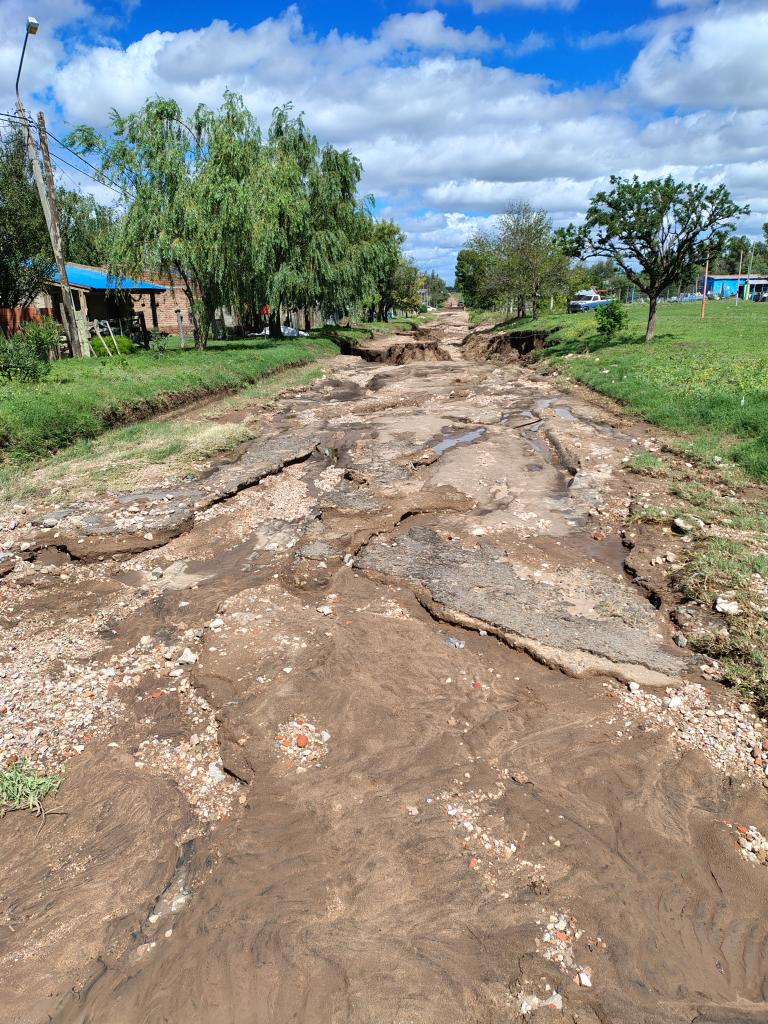
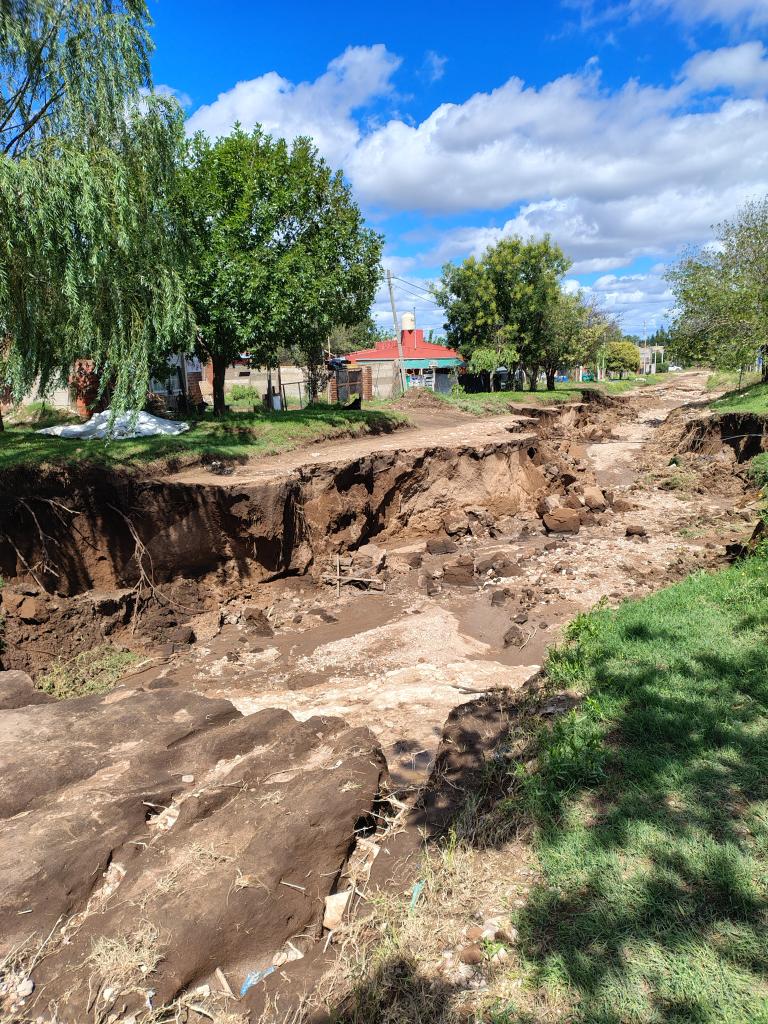
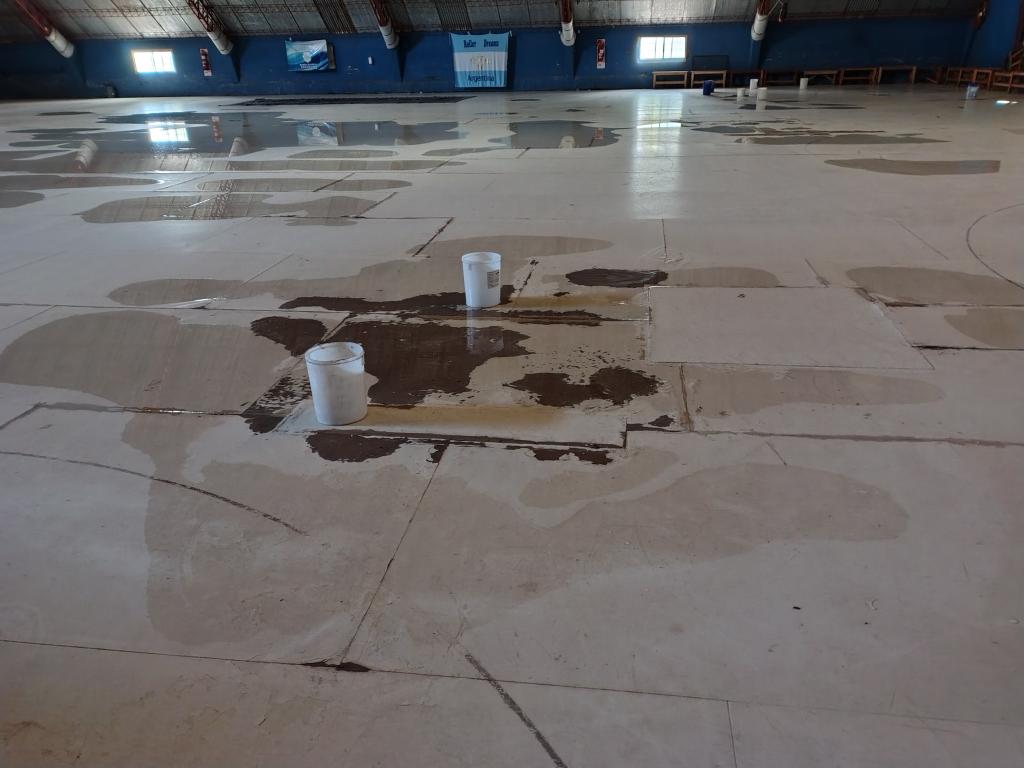
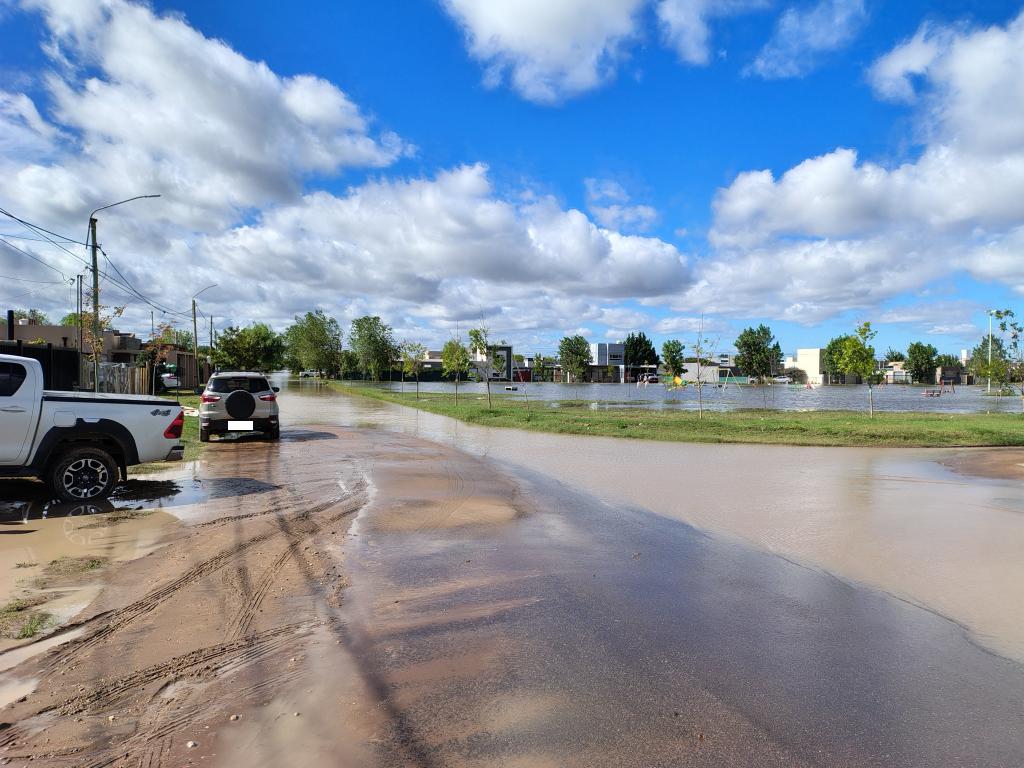
Update 20250309 13:20-03:00 - How to help A friend of mine living in the USA sent me this link to help the flood victims: Support Bah a Blanca (Argentina) Flood Victims Original blog post These are not good news. In fact, much the contrary. Compared to the real issue, the fact that I'm not able to attend Embedded World at Nuremberg is, well, a detail. Or at least that's what I'm forcing myself to believe, as I REALLY wanted to be there. But mother nature said otherwise. Plaza Dr. Alberto Martinelli - Barrio Parque Las Ca itas Park "D. Alberto Martinelli", Las Ca itas, Bah a Blanca (Google Maps) Bah a Blanca , the city I live, has received a lot on rainfall. Really, a lot. Let me introduce the number like this: the previous highest recorded measurement was 170mm (6.69 inch)... in a month. Yesterday Friday 07 we had more than 400mm (15.75 inch) in 9 hours. But those are just numbers. Some things are better seen in images. I'll start with some soft ones. Streetk sink 1 Streetk sink 2 Sink in Fournier street near Cambaceres (Google Maps) I also happen to do figure skating in the same school of the 4 times world champions (where "world" means the whole world) Roller Dreams precision skating team - Instagram, from Club El Nacional. Our skating rink got severely damaged with the hail we had like 3 weeks ago (yes, we had hail too!!!). Now it's just impossible: Roller Dreams CEN skating rink The "real" thing Let's get to the heavy, heartbreaker part. I did go to downtown Bah a Blanca, but during night, so let me share some links, most of them in Spanish, but images are images: My alma matter, Universidad Nacional del Sur, lost its main library, great part of the Physics department and a lot of labs :-( A nearby town, General Cerri, had even worst luck. In Bah a Blanca, a city of 300k+ people, has around 400 evacuated people. General Cerri, a town of 3000? people, had at least 800. Bah a Blanca, devil's land Every place has its legends. We do too. This land was called "Huecuv Map ", something like "Devil's land" by the original inhabitants of the zone, due to its harsh climate: string winters and hot summers, couple with fierce wind. But back in 1855 the Cacique (chief) Jos Mar a Bulnes Yanquetruz had a peace agreement with commander Nicanor Otamendi. But a battle ensued, which Yanquetruz won. At this point history defers depending upon who tells it. Some say Yanquetruz was assigned a military grade as Captain of the indigenous auxiliary forces and provided a military suit, some say he stole it, some say this was a setup of another chief wanting to disrupt peace. But what is known is that Yanquetruz was killed, and his wife, the "machi" (sorceress), issued a curse over the land that would last 1000 years, and the curse was on the climate. Aftermath No, we are not there yet. This has just happened. The third violent climate occurrence in 15 months. The city needs to mourn and start healing itself. Time will say.
8 March 2025

Dirk Eddelbuettel: RcppTOML 0.2.3 on CRAN: Compiler Nag, Small Updates

A new (mostly maintenance) release 0.2.3 of RcppTOML is now on CRAN. TOMLis a file format that is most suitable for configurations, as it is meant to be edited by humans but read by computers. It emphasizes strong readability for humans while at the same time supporting strong typing as well as immediate and clear error reports. On small typos you get parse errors, rather than silently corrupted garbage. Much preferable to any and all of XML, JSON or YAML though sadly these may be too ubiquitous now. TOML is frequently being used with the projects such as the Hugo static blog compiler, or the Cargo system of Crates (aka packages ) for the Rust language. This release was tickled by another CRAN request: just like yesterday s and the RcppDate release two days ago, it responds to the esoteric whitespace in literal operator depreceation warning. We alerted upstream too. The short summary of changes follows.

Changes in version 0.2.3 (2025-03-08)
  • Correct the minimum version of Rcpp to 1.0.8 (Walter Somerville)
  • The package now uses Authors@R as mandated by CRAN
  • Updated 'whitespace in literal' issue upsetting clang++-20
  • Continuous integration updates including simpler r-ci setup

Courtesy of my CRANberries, there is also a diffstat report for this release. For questions, suggestions, or issues please use the issue tracker at the GitHub repo.

This post by Dirk Eddelbuettel originated on his Thinking inside the box blog. If you like this or other open-source work I do, you can now sponsor me at GitHub.

7 March 2025

Dirk Eddelbuettel: RcppSimdJson 0.1.13 on CRAN: Compiler Nag, New Upsteam

A new release 0.1.13 of the RcppSimdJson package is now on CRAN. RcppSimdJson wraps the fantastic and genuinely impressive simdjson library by Daniel Lemire and collaborators. Via very clever algorithmic engineering to obtain largely branch-free code, coupled with modern C++ and newer compiler instructions, it results in parsing gigabytes of JSON parsed per second which is quite mindboggling. The best-case performance is faster than CPU speed as use of parallel SIMD instructions and careful branch avoidance can lead to less than one cpu cycle per byte parsed; see the video of the talk by Daniel Lemire at QCon. This release was tickled by another CRAN request: just like yesterday s RcppDate release, it responds to the esoteric whitespace in literal operator depreceation warning. Turns out that upstream simdjson had this fixed a few months ago as the node bindings package ran into it. Other changes include a bit of earlier polish by Daniel, another CRAN mandated update, CI improvements, and a move of two demos to examples/ to avoid having to add half a dozen packages to Suggests: for no real usage gain in the package. The short NEWS entry for this release follows.

Changes in version 0.1.13 (2025-03-07)
  • A call to std::string::erase is now guarded (Daniel)
  • The package now uses Authors@R as mandated by CRAN (Dirk)
  • simdjson was upgraded to version 3.12.2 (Dirk)
  • Continuous integration updated to more compilers and simpler setup
  • Two demos are now in inst/examples to not inflate Suggests

Courtesy of my CRANberries, there is also a diffstat report for this release. For questions, suggestions, or issues please use the issue tracker at the GitHub repo.

This post by Dirk Eddelbuettel originated on his Thinking inside the box blog. If you like this or other open-source work I do, you can now sponsor me at GitHub.

Next.

Previous.