Search Results: "ean"

11 January 2026

Russell Coker: Terminal Emulator Security

I just read this informative article on ANSI terminal security [1]. The author has written a tool named vt-houdini for testing for these issues [2]. They used to host an instance on their server but appear to have stopped it. When you run that tool you can ssh to the system in question and without needing a password you are connected and the server probes your terminal emulator for vulnerabilities. The versions of Kitty and Konsole in Debian/Trixie have just passed those tests on my system. This will always be a potential security problem due to the purpose of a terminal emulator. A terminal emulator will often display untrusted data and often data which is known to come from hostile sources (EG logs of attempted attacks). So what could be done in this regard? Memory Protection Due to the complexity of terminal emulation there is the possibility of buffer overflows and other memory management issues that could be used to compromise the emulator. The Fil-C compiler is an interesting project [3], it compiles existing C/C++ code with memory checks. It is reported to have no noticeable impact on the performance of the bash shell which sounds like a useful option to address some of these issues as shell security issues are connected to terminal security issues. The performance impact on a terminal emulator would be likely to be more noticeable. Also note that Fil-C compilation apparently requires compiling all libraries with it, this isn t a problem for bash as the only libraries it uses nowadays are libtinfo and libc. The kitty terminal emulator doesn t have many libraries but libpython is one of them, it s an essential part of Kitty and it is a complex library to compile in a different way. Konsole has about 160 libraries and it isn t plausible to recompile so many libraries at this time. Choosing a terminal emulator that has a simpler design might help in this regard. Emulators that call libraries for 3D effects etc and native support for displaying in-line graphics have a much greater attack surface. Access Control A terminal emulator could be run in a container to prevent it from doing any damage if it is compromised. But the terminal emulator will have full control over the shell it runs and if the shell has access needed to allow commands like scp/rsync to do what is expected of them then that means that no useful level of containment is possible. It would be possible to run a terminal emulator in a container for the purpose of connecting to an insecure or hostile system and not allow scp/rsync to/from any directory other than /tmp (or other directories to use for sharing files). You could run exec ssh $SERVER so the terminal emulator session ends when the ssh connection ends. Conclusion There aren t good solutions to the problems of terminal emulation security. But testing every terminal emulator with vt-houdini and fuzzing the popular ones would be a good start. Qubes level isolation will help things in some situations, but if you need to connect to a server with privileged access to read log files containing potentially hostile data (which is a common sysadmin use case) then there aren t good options.

Otto Kek l inen: Stop using MySQL in 2026, it is not true open source

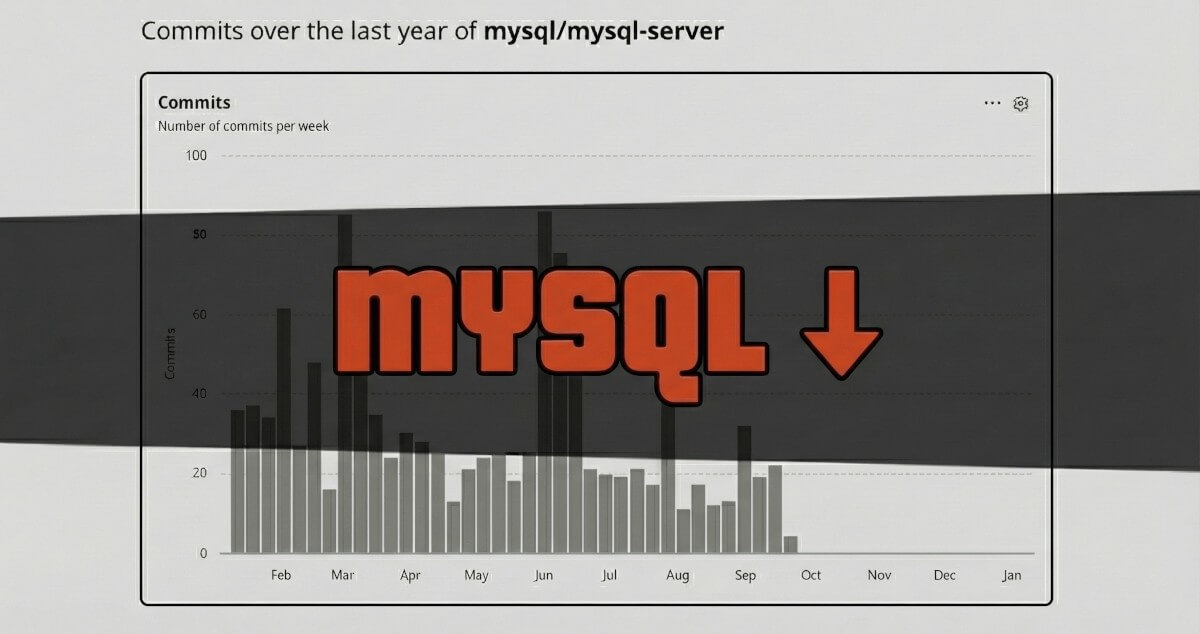
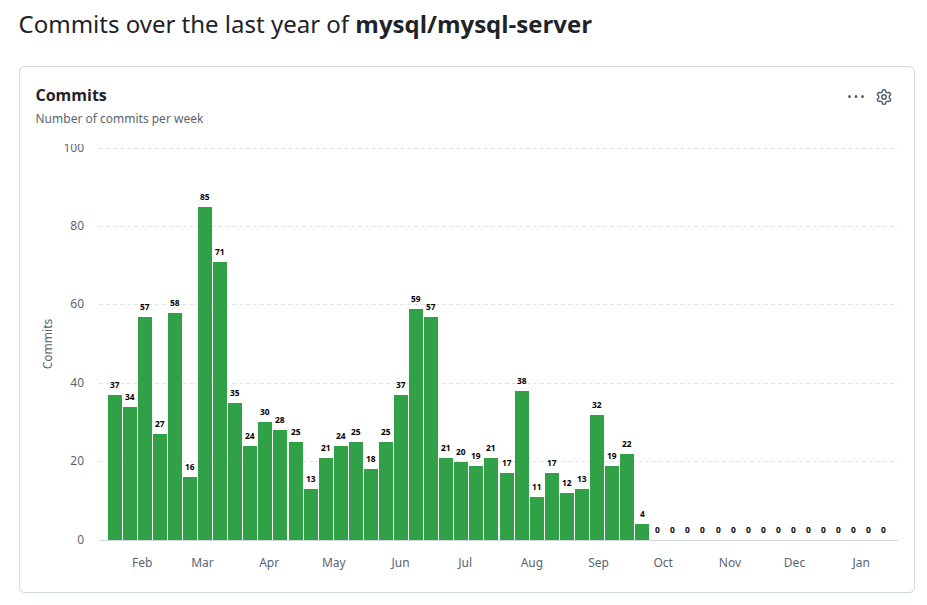
Featured image of post Stop using MySQL in 2026, it is not true open sourceIf you care about supporting open source software, and still use MySQL in 2026, you should switch to MariaDB like so many others have already done. The number of git commits on github.com/mysql/mysql-server has been significantly declining in 2025. The screenshot below shows the state of git commits as of writing this in January 2026, and the picture should be alarming to anyone who cares about software being open source. MySQL GitHub commit activity decreasing drastically

This is not surprising Oracle should not be trusted as the steward for open source projects When Oracle acquired Sun Microsystems and MySQL along with it back in 2009, the European Commission almost blocked the deal due to concerns that Oracle s goal was just to stifle competition. The deal went through as Oracle made a commitment to keep MySQL going and not kill it, but (to nobody s surprise) Oracle has not been a good steward of MySQL as an open source project and the community around it has been withering away for years now. All development is done behind closed doors. The publicly visible bug tracker is not the real one Oracle staff actually uses for MySQL development, and the few people who try to contribute to MySQL just see their Pull Requests and patch submissions marked as received with mostly no feedback and then those changes may or may not be in the next MySQL release, often rewritten, and with only Oracle staff in the git author/committer fields. The real author only gets a small mention in a blog post. When I was the engineering manager for the core team working on RDS MySQL and RDS MariaDB at Amazon Web Services, I oversaw my engineers contributions to both MySQL and MariaDB (the latter being a fork of MySQL by the original MySQL author, Michael Widenius). All the software developers in my org disliked submitting code to MySQL due to how bad the reception by Oracle was to their contributions. MariaDB is the stark opposite with all development taking place in real-time on github.com/mariadb/server, anyone being able to submit a Pull Request and get a review, all bugs being openly discussed at jira.mariadb.org and so forth, just like one would expect from a true open source project. MySQL is open source only by license (GPL v2), but not as a project.

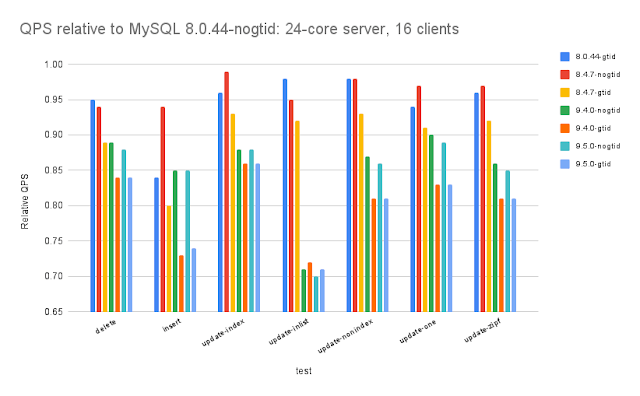
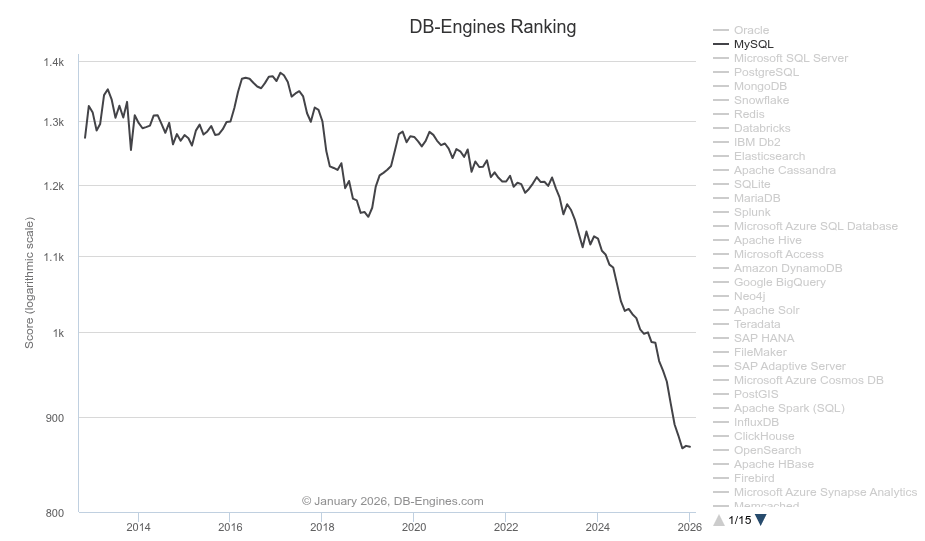
MySQL s technical decline in recent years Despite not being a good open source steward, Oracle should be given credit that it did keep the MySQL organization alive and allowed it to exist fairly independently and continue developing and releasing new MySQL versions well over a decade after the acquisition. I have no insight into how many customers they had, but I assume the MySQL business was fairly profitable and financially useful to Oracle, at least as long as it didn t gain too many features to threaten Oracle s own main database business. I don t know why, perhaps because too many talented people had left the organization, but it seems that from a technical point of view MySQL clearly started to deteriorate from 2022 onward. When MySQL 8.0.29 was released with the default ALTER TABLE method switched to run in-place, it had a lot of corner cases that didn t work, causing the database to crash and data to corrupt for many users. The issue wasn t fully fixed until a year later in MySQL 8.0.32. To many users annoyance Oracle announced the 8.0 series as evergreen and introduced features and changes in the minor releases, instead of just doing bugfixes and security fixes like users historically had learnt to expect from these x.y.Z maintenance releases. There was no new major MySQL version for six years. After MySQL 8.0 in 2018 it wasn t until 2023 when MySQL 8.1 was released, and it was just a short-term preview release. The first actual new major release MySQL 8.4 LTS was released in 2024. Even though it was a new major release, many users got disappointed as it had barely any new features. Many also reported degraded performance with newer MySQL versions, for example the benchmark by famous MySQL performance expert Mark Callaghan below shows that on write-heavy workloads MySQL 9.5 throughput is typically 15% less than in 8.0. Benchmark showing new MySQL versions being slower than the old Due to newer MySQL versions deprecating many features, a lot of users also complained about significant struggles regarding both MySQL 5.7->8.0 and 8.0->8.4 upgrades. With few new features and heavy focus on code base cleanup and feature deprecation, it became obvious to many that Oracle had decided to just keep MySQL barely alive, and put all new relevant features (e.g. vector search) into Heatwave, Oracle s closed-source and cloud-only service for MySQL customers. As it was evident that Oracle isn t investing in MySQL, Percona s Peter Zaitsev wrote Is Oracle Finally Killing MySQL in June 2024. At this time MySQL s popularity as ranked by DB-Engines had also started to tank hard, a trend that likely accelerates in 2026. MySQL dropping significantly in DB-Engines ranking In September 2025 news reported that Oracle was reducing its workforce and that the MySQL staff was getting heavily reduced. Obviously this does not bode well for MySQL s future, and Peter Zaitsev posted already in November stats showing that the latest MySQL maintenance release contained fewer bug fixes than before.

Open source is more than ideology: it has very real effects on software security and sovereignty Some say they don t care if MySQL is truly open source or not, or that they don t care if it has a future in coming years, as long as it still works now. I am afraid people thinking so are taking a huge risk. The database is often the most critical part of a software application stack, and any flaw or problem in operations, let alone a security issue, will have immediate consequences, and not caring will eventually get people fired or sued. In open source problems are discussed openly, and the bigger the problem, the more people and companies will contribute to fixing it. Open source as a development methodology is similar to the scientific method with free flow of ideas that are constantly contested and only the ones with the most compelling evidence win. Not being open means more obscurity, more risk and more just trust us bro attitude. This open vs. closed is very visible for example in how Oracle handles security issues. We can see that in 2025 alone MySQL published 123 CVEs about security issues, while MariaDB had 8. There were 117 CVEs that only affected MySQL and not MariaDB in 2025. I haven t read them all, but typically the CVEs hardly contain any real details. As an example, the most recent one CVE-2025-53067 states Easily exploitable vulnerability allows high privileged attacker with network access via multiple protocols to compromise MySQL Server. There is no information a security researcher or auditor could use to verify if any original issue actually existed, or if it was fixed, or if the fix was sufficient and fully mitigating the issue or not. MySQL users just have to take the word of Oracle that it is all good now. Handling security issues like this is in stark contrast to other open source projects, where all security issues and their code fixes are open for full scrutiny after the initial embargo is over and CVE made public. There is also various forms of enshittification going on one would not see in a true open source project, and everything about MySQL as a software, documentation and website is pushing users to stop using the open source version and move to the closed MySQL versions, and in particular to Heatwave, which is not only closed-source but also results in Oracle fully controlling customer s databases contents. Of course, some could say this is how Oracle makes money and is able to provide a better product. But stories on Reddit and elsewhere suggest that what is going on is more like Oracle milking hard the last remaining MySQL customers who are forced to pay more and more for getting less and less.

There are options and migrating is easy, just do it A large part of MySQL users switched to MariaDB already in the mid-2010s, in particular everyone who had cared deeply about their database software staying truly open source. That included large installations such as Wikipedia, and Linux distributions such as Fedora and Debian. Because it s open source and there is no centralized machine collecting statistics, nobody knows what the exact market shares look like. There are however some application specific stats, such as that 57% of WordPress sites around the world run MariaDB, while the share for MySQL is 42%. For anyone running a classic LAMP stack application such as WordPress, Drupal, Mediawiki, Nextcloud, or Magento, switching the old MySQL database to MariaDB is be straightforward. As MariaDB is a fork of MySQL and mostly backwards compatible with it, swapping out MySQL for MariaDB can be done without changing any of the existing connectors or database clients, as they will continue to work with MariaDB as if it was MySQL. For those running custom applications and who have the freedom to make changes to how and what database is used, there are tens of mature and well-functioning open source databases to choose from, with PostgreSQL being the most popular general database. If your application was built from the start for MySQL, switching to PostgreSQL may however require a lot of work, and the MySQL/MariaDB architecture and storage engine InnoDB may still offer an edge in e.g. online services where high performance, scalability and solid replication features are of highest priority. For a quick and easy migration MariaDB is probably the best option. Switching from MySQL to the Percona Server is also very easy, as it closely tracks all changes in MySQL and deviates from it only by a small number of improvements done by Percona. However, also precisely because of it being basically just a customized version of the MySQL Server, it s not a viable long-term solution for those trying to fully ditch the dependency on Oracle. There are also several open source databases that have no common ancestry with MySQL, but strive to be MySQL-compatible. Thus most apps built for MySQL can simply switch to using them without needing SQL statements to be rewritten. One such database is TiDB, which has been designed from scratch specifically for highly scalable and large systems, and is so good that even Amazon s latest database solution DSQL was built borrowing many ideas from TiDB. However, TiDB only really shines with larger distributed setups, so for the vast majority of regular small- and mid-scale applications currently using MySQL, the most practical solution is probably to just switch to MariaDB, which on most Linux distributions can simply be installed by running apt/dnf/brew install mariadb-server. Whatever you end up choosing, as long as it is not Oracle, you will be better off.

9 January 2026

Simon Josefsson: Debian Taco Towards a GitSecDevOps Debian

One of my holiday projects was to understand and gain more trust in how Debian binaries are built, and as the holidays are coming to an end, I d like to introduce a new research project called Debian Taco. I apparently need more holidays, because there are still more work to be done here, so at the end I ll summarize some pending work. Debian Taco, or TacOS, is a GitSecDevOps rebuild of Debian GNU/Linux. The Debian Taco project publish rebuilt binary packages, package repository metadata (InRelease, Packages, etc), container images, cloud images and live images. All packages are built from pristine source packages in the Debian archive. Debian Taco does not modify any Debian source code nor add or remove any packages found in Debian. No servers are involved! Everything is built in GitLab pipelines and results are published through modern GitDevOps mechanism like GitLab Pages and S3 object storage. You can fork the individual projects below on GitLab.com and you will have your own Debian-derived OS available for tweaking. (Of course, at some level, servers are always involved, so this claim is a bit of hyperbole.)

Goals The goal of TacOS is to be bit-by-bit identical with official Debian GNU/Linux, and until that has been completed, publish diffoscope output with differences. The idea is to further categorize all artifact differences into one of the following categories: 1) An obvious bug in Debian. For example, if a package does not build reproducible. 2) An obvious bug in TacOS. For example, if our build environment does not manage to build a package. 3) Something else. This would be input for further research and consideration. This category also include things where it isn t obvious if it is a bug in Debian or in TacOS. Known examples: 3A) Packages in TacOS are rebuilt the latest available source code, not the (potentially) older package that were used to build the Debian packages. This could lead to differences in the packages. These differences may be useful to analyze to identify supply-chain attacks. See some discussion about idempotent rebuilds. Our packages are all built from source code, unless we have not yet managed to build something. In the latter situation, Debian Taco falls back and uses the official Debian artifact. This allows an incremental publication of Debian Taco that still is 100% complete without requiring that everything is rebuilt instantly. The goal is that everything should be rebuilt, and until that has been completed, publish a list of artifacts that we use verbatim from Debian.

Debian Taco Archive The Debian Taco Archive project generate and publish the package archive (dists/tacos-trixie/InRelease, dists/tacos-trixie/main/binary-amd64/Packages.gz, pool/* etc), similar to what is published at https://deb.debian.org/debian/. The output of the Debian Taco Archive is available from https://debdistutils.gitlab.io/tacos/archive/.

Debian Taco Container Images The Debian Taco Container Images project provide container images of Debian Taco for trixie, forky and sid on the amd64, arm64, ppc64el and riscv64 architectures. These images allow quick and simple use of Debian Taco interactively, but makes it easy to deploy for container orchestration frameworks.

Debian Taco Cloud Images The Debian Taco Cloud Images project provide cloud images of Debian Taco for trixie, forky and sid on the amd64, arm64, ppc64el and riscv64 architectures. Launch and install Debian Taco for your cloud environment!

Debian Taco Live Images The Debian Taco Live Images project provide live images of Debian Taco for trixie, forky and sid on the amd64 and arm64 architectures. These images allows running Debian Taco on physical hardware (or virtual machines), and even installation for permanent use.

Debian Taco Build Images and Packages Packages are built using debdistbuild, which was introduced in a blog about Build Debian in a GitLab Pipeline. The first step is to prepare build images, which is done by the Debian Taco Build Images project. They are similar to the Debian Taco containers but have build-essential and debdistbuild installed on them. Debdistbuild is launched in a per-architecture per-suite CI/CD project. Currently only trixie-amd64 is available. That project has built some essential early packages like base-files, debian-archive-keyring and hostname. They are stored in Git LFS backed by a S3 object storage. These packages were all built reproducibly. So this means Debian Taco is still 100% bit-by-bit identical to Debian, except for the renaming. I ve yet to launch a more massive wide-scale package rebuild until some outstanding issues have been resolved. I earlier rebuilt around 7000 packages from Trixie on amd64, so I know that the method easily scales.

Remaining work Where is the diffoscope package outputs and list of package differences? For another holiday! Clearly this is an important remaining work item. Another important outstanding issue is how to orchestrate launching the build of all packages. Clearly a list of packages is needed, and some trigger mechanism to understand when new packages are added to Debian. One goal was to build packages from the tag2upload browse.dgit.debian.org archive, before checking the Debian Archive. This ought to be really simple to implement, but other matters came first.

GitLab or Codeberg? Everything is written using basic POSIX /bin/sh shell scripts. Debian Taco uses the GitLab CI/CD Pipeline mechanism together with a Hetzner S3 object storage to serve packages. The scripts have only weak reliance on GitLab-specific principles, and were designed with the intention to support other platforms. I believe reliance on a particular CI/CD platform is a limitation, so I d like to explore shipping Debian Taco through a Forgejo-based architecture, possibly via Codeberg as soon as I manage to deploy reliable Forgejo runners. The important aspects that are required are: 1) Pipelines that can build and publish web sites similar to GitLab Pages. Codeberg has a pipeline mechanism. I ve successfully used Codeberg Pages to publish the OATH Toolkit homepage homepage. Glueing this together seems feasible. 2) Container Registry. It seems Forgejo supports a Container Registry but I ve not worked with it at Codeberg to understand if there are any limitations. 3) Package Registry. The Deban Taco live images are uploaded into a package registry, because they are too big for being served through GitLab Pages. It may be converted to using a Pages mechanism, or possibly through Release Artifacts if multi-GB artifacts are supported on other platforms. I hope to continue this work and explaining more details in a series of posts, stay tuned!

8 January 2026

Dima Kogan: Meshroom packaged for Debian

Like the title says, I just packaged Meshroom (and all the adjacent dependencies) for Debian! This is a fancy photogrammetry toolkit that uses modern software development methods. "Modern" meaning that it has a multitude of dependencies that come from lots of disparate places, which make it impossible for a mere mortal to build the thing. The Linux "installer" is 13GB and probably is some sort of container, or something. But now, if you have a Debian/sid box with the non-free repos enabled, you can
sudo apt install meshroom
And then you can generate and 3D-print a life-size, geometrically-accurate statue of your cat. The colmap package does a similar thing, and has been in Debian for a while. I think it can't do as many things, but it's good to have both tools easily available. These packages are all in contrib, because they depend on a number of non-free things, most notably CUDA. This is currently in Debian/sid, but should be picked up by the downstream distros as they're released. The next noteworthy one is Ubuntu 26.04. Testing and feedback welcome.

5 January 2026

Hellen Chemtai: Starting out on Open source: Try the OpenQA Debian Image Testing Project

Hello world  . I am an intern at Outreachy and contributing to the Debian Images Testing project since October 2025. This project is Open Source and everyone can contribute to it in any way. The project uses Open QA to automatically install Operating System Images and test them . We have a community here of contributors that is always ready to help out. The mentors and project maintainers are very open to contributions. They listen to any innovative ideas and point out what they have been doing so far. So far contributions have been in terms of: Contributing to this project requires some knowledge of Linux commands and Operating Systems. What we will learn later as we go on will be :
Preparation
Before any contribution begins, we would want to first try out the project and run a couple of tests. Get to understand what we are doing first. Let s say you are starting out as a Windows or MacOS user and you want to start contributing. I would recommend dual partitioning your device first. Do enough research and prepare the resources. The network install image just needs at-least 4 GB USB flash drive for dual booting. You will use Debian as the second operating system. Give enough space to Debian, I recommend around 150 GB or more. Also assign at-least 1 GB space to the /boot/efi directory to prevent the low space warnings after a while.This will be a way good way to learn about image installation which is part of the work . I do not recommend Virtual Box because it will hinder full use of system resources. This process will take a day or two.
Set Up and Testing
After dual booting. We log into our Debian System . The next step of instructions will take you through how we set up and run our tests. These instructions have many Linux commands. You will be learning if you are a newbie as you go through the steps. Try to understand these commands and do not blindly copy and paste. You can start your contributions here if you have a suggestion to add to the install docs. Run some tests then log in the Web UI as per the instructions to view your tests progress. Green means they ve passed. Blue means its still running. Red means failed.
Trying Out Ideas
Kudos if you have reached this point. The community of contributors will help if you are stuck. We get to try out our own variations of tests using variables. We will also rely on documentation to understand the configurations / test commands like these
openqa-cli api -X POST isos ISO=debian-13.1.0-amd64-netinst.iso DISTRI=debian VERSION=stable FLAVOR=netinst-iso ARCH=x86_64 BUILD=1310 #This is the test you will run on the guide
openqa-cli api -X POST isos ISO=debian-13.1.0-amd64-netinst.iso DISTRI=debian VERSION=stable FLAVOR=netinst-iso ARCH=x86_64 BUILD=1310 TEST=cinnamon #I have added a TEST variable that runs only cinnamon test suite
You can check specific test suites from the WebUI :
We get some failures at times. Here are some failed tests from a build I was working on.
Here we find the cinnamon test failed at locale module. Click on any module above and it will lead us to needles and point to the where the test failed. You can check the error or try to add a needle if its needle failure.
Try editing a test module and test your changes. Try out some ideas. Read the documentation folder and write some pseudo code. Interact with the community. Try working on some tasks from the community . Create your tests and add them to the configuration. There is a lot of stuff that can you can work on in this community. It may seem hard to grasp at first as a newbie to Open Source. The community will help you through out even if the problem seems small. We are very friendly and the code maintainers have extensive knowledge. Get to sit with us during one of our meetings and you will learn so much about the project. Learning , networking and communicating is part of contributing to the broader community.

Colin Watson: Free software activity in December 2025

About 95% of my Debian contributions this month were sponsored by Freexian. You can also support my work directly via Liberapay or GitHub Sponsors. Python packaging I upgraded these packages to new upstream versions: Python 3.14 is now a supported version in unstable, and we re working to get that into testing. As usual this is a pretty arduous effort because it requires going round and fixing lots of odds and ends across the whole ecosystem. We can deal with a fair number of problems by keeping up with upstream (see above), but there tends to be a long tail of packages whose upstreams are less active and where we need to chase them, or where problems only show up in Debian for one reason or another. I spent a lot of time working on this: Fixes for pytest 9: I filed lintian: Report Python egg-info files/directories to help us track the migration to pybuild-plugin-pyproject. I did some work on dh-python: Normalize names in pydist lookups and pyproject plugin: Support headers (the latter of which allowed converting python-persistent and zope.proxy to pybuild-plugin-pyproject, although it needed a follow-up fix). I fixed or helped to fix several other build/test failures: Other bugs: Other bits and pieces Code reviews

Vincent Bernat: Using eBPF to load-balance traffic across UDP sockets with Go

Akvorado collects sFlow and IPFIX flows over UDP. Because UDP does not retransmit lost packets, it needs to process them quickly. Akvorado runs several workers listening to the same port. The kernel should load-balance received packets fairly between these workers. However, this does not work as expected. A couple of workers exhibit high packet loss:
$ curl -s 127.0.0.1:8080/api/v0/inlet/metrics \
>   sed -n s/akvorado_inlet_flow_input_udp_in_dropped//p
packets_total listener="0.0.0.0:2055",worker="0"  0
packets_total listener="0.0.0.0:2055",worker="1"  0
packets_total listener="0.0.0.0:2055",worker="2"  0
packets_total listener="0.0.0.0:2055",worker="3"  1.614933572278264e+15
packets_total listener="0.0.0.0:2055",worker="4"  0
packets_total listener="0.0.0.0:2055",worker="5"  0
packets_total listener="0.0.0.0:2055",worker="6"  9.59964121598348e+14
packets_total listener="0.0.0.0:2055",worker="7"  0
eBPF can help by implementing an alternate balancing algorithm.

Options for load-balancing There are three methods to load-balance UDP packets across workers:
  1. One worker receives the packets and dispatches them to the other workers.
  2. All workers share the same socket.
  3. Each worker has its own socket, listening to the same port, with the SO_REUSEPORT socket option.

SO_REUSEPORT option Tom Hebert added the SO_REUSEPORT socket option in Linux 3.9. The cover letter for his patch series explains why this new option is better than the two existing ones from a performance point of view:
SO_REUSEPORT allows multiple listener sockets to be bound to the same port. [ ] Received packets are distributed to multiple sockets bound to the same port using a 4-tuple hash. The motivating case for SO_RESUSEPORT in TCP would be something like a web server binding to port 80 running with multiple threads, where each thread might have it s own listener socket. This could be done as an alternative to other models:
  1. have one listener thread which dispatches completed connections to workers, or
  2. accept on a single listener socket from multiple threads.
In case #1, the listener thread can easily become the bottleneck with high connection turn-over rate. In case #2, the proportion of connections accepted per thread tends to be uneven under high connection load. [ ] We have seen the disproportion to be as high as 3:1 ratio between thread accepting most connections and the one accepting the fewest. With SO_REUSEPORT the distribution is uniform. The motivating case for SO_REUSEPORT in UDP would be something like a DNS server. An alternative would be to receive on the same socket from multiple threads. As in the case of TCP, the load across these threads tends to be disproportionate and we also see a lot of contection on the socket lock.
Akvorado uses the SO_REUSEPORT option to dispatch the packets across the workers. However, because the distribution uses a 4-tuple hash, a single socket handles all the flows from one exporter.

SO_ATTACH_REUSEPORT_EBPF option In Linux 4.5, Craig Gallek added the SO_ATTACH_REUSEPORT_EBPF option to attach an eBPF program to select the target UDP socket. In Linux 4.6, he extended it to support TCP. The socket(7) manual page documents this mechanism:1
The BPF program must return an index between 0 and N-1 representing the socket which should receive the packet (where N is the number of sockets in the group). If the BPF program returns an invalid index, socket selection will fall back to the plain SO_REUSEPORT mechanism.
In Linux 4.19, Martin KaFai Lau added the BPF_PROG_TYPE_SK_REUSEPORT program type. Such an eBPF program selects the socket from a BPF_MAP_TYPE_REUSEPORT_ARRAY map instead. This new approach is more reliable when switching target sockets from one instance to another for example, when upgrading, a new instance can add its sockets and remove the old ones.

Load-balancing with eBPF and Go Altering the load-balancing algorithm for a group of sockets requires two steps:
  1. write and compile an eBPF program in C,2 and
  2. load it and attach it in Go.

eBPF program in C A simple load-balancing algorithm is to randomly choose the destination socket. The kernel provides the bpf_get_prandom_u32() helper function to get a pseudo-random number.
volatile const __u32 num_sockets; //  
struct  
    __uint(type, BPF_MAP_TYPE_REUSEPORT_SOCKARRAY);
    __type(key, __u32);
    __type(value, __u64);
    __uint(max_entries, 256);
  socket_map SEC(".maps"); //  
SEC("sk_reuseport")
int reuseport_balance_prog(struct sk_reuseport_md *reuse_md)
 
    __u32 index = bpf_get_prandom_u32() % num_sockets; //  
    bpf_sk_select_reuseport(reuse_md, &socket_map, &index, 0); //  
    return SK_PASS; //  
 
char _license[] SEC("license") = "GPL";
In , we declare a volatile constant for the number of sockets in the group. We will initialize this constant before loading the eBPF program into the kernel. In , we define the socket map. We will populate it with the socket file descriptors. In , we randomly select the index of the target socket.3 In , we invoke the bpf_sk_select_reuseport() helper to record our decision. Finally, in , we accept the packet.

Header files If you compile the C source with clang, you get errors due to missing headers. The recommended way to solve this is to generate a vmlinux.h file with bpftool:
$ bpftool btf dump file /sys/kernel/btf/vmlinux format c > vmlinux.h
Then, include the following headers:4
#include "vmlinux.h"
#include <bpf/bpf_helpers.h>
For my 6.17 kernel, the generated vmlinux.h is quite big: 2.7 MiB. Moreover, bpf/bpf_helpers.h is shipped with libbpf. This adds another dependency for users. As the eBPF program is quite small, I prefer to put the strict minimum in vmlinux.h by cherry-picking the definitions I need.

Compilation The eBPF Library for Go ships bpf2go, a tool to compile eBPF programs and to generate some scaffolding code. We create a gen.go file with the following content:
package main
//go:generate go tool bpf2go -tags linux reuseport reuseport_kern.c
After running go generate ./..., we can inspect the resulting objects with readelf and llvm-objdump:
$ readelf -S reuseport_bpfeb.o
There are 14 section headers, starting at offset 0x840:
  [Nr] Name              Type             Address           Offset
[ ]
  [ 3] sk_reuseport      PROGBITS         0000000000000000  00000040
  [ 6] .maps             PROGBITS         0000000000000000  000000c8
  [ 7] license           PROGBITS         0000000000000000  000000e8
[ ]
$ llvm-objdump -S reuseport_bpfeb.o
reuseport_bpfeb.o:  file format elf64-bpf
Disassembly of section sk_reuseport:
0000000000000000 <reuseport_balance_prog>:
;  
       0:   bf 61 00 00 00 00 00 00     r6 = r1
;     __u32 index = bpf_get_prandom_u32() % num_sockets;
       1:   85 00 00 00 00 00 00 07     call 0x7
[ ]

Usage from Go Let s set up 10 workers listening to the same port.5 Each socket enables the SO_REUSEPORT option before binding:6
var (
    err error
    fds []uintptr
    conns []*net.UDPConn
)
workers := 10
listenAddr := "127.0.0.1:0"
listenConfig := net.ListenConfig 
    Control: func(_, _ string, c syscall.RawConn) error  
        c.Control(func(fd uintptr)  
            err = unix.SetsockoptInt(int(fd), unix.SOL_SOCKET, unix.SO_REUSEPORT, 1)
            fds = append(fds, fd)
         )
        return err
     ,
 
for range workers  
    pconn, err := listenConfig.ListenPacket(t.Context(), "udp", listenAddr)
    if err != nil  
        t.Fatalf("ListenPacket() error:\n%+v", err)
     
    udpConn := pconn.(*net.UDPConn)
    listenAddr = udpConn.LocalAddr().String()
    conns = append(conns, udpConn)
 
The second step is to load the eBPF program, initialize the num_sockets variable, populate the socket map, and attach the program to the first socket.7
// Load the eBPF collection.
spec, err := loadReuseport()
if err != nil  
    t.Fatalf("loadVariables() error:\n%+v", err)
 
// Set "num_sockets" global variable to the number of file descriptors we will register
if err := spec.Variables["num_sockets"].Set(uint32(len(fds))); err != nil  
    t.Fatalf("NumSockets.Set() error:\n%+v", err)
 
// Load the map and the program into the kernel.
var objs reuseportObjects
if err := spec.LoadAndAssign(&objs, nil); err != nil  
    t.Fatalf("loadReuseportObjects() error:\n%+v", err)
 
t.Cleanup(func()   objs.Close()  )
// Assign the file descriptors to the socket map.
for worker, fd := range fds  
    if err := objs.reuseportMaps.SocketMap.Put(uint32(worker), uint64(fd)); err != nil  
        t.Fatalf("SocketMap.Put() error:\n%+v", err)
     
 
// Attach the eBPF program to the first socket.
socketFD := int(fds[0])
progFD := objs.reuseportPrograms.ReuseportBalanceProg.FD()
if err := unix.SetsockoptInt(socketFD, unix.SOL_SOCKET, unix.SO_ATTACH_REUSEPORT_EBPF, progFD); err != nil  
    t.Fatalf("SetsockoptInt() error:\n%+v", err)
 
We are now ready to process incoming packets. Each worker is a Go routine incrementing a counter for each received packet:8
var wg sync.WaitGroup
receivedPackets := make([]int, workers)
for worker := range workers  
    conn := conns[worker]
    packets := &receivedPackets[worker]
    wg.Go(func()  
        payload := make([]byte, 9000)
        for  
            if _, err := conn.Read(payload); err != nil  
                if errors.Is(err, net.ErrClosed)  
                    return
                 
                t.Logf("Read() error:\n%+v", err)
             
            *packets++
         
     )
 
Let s send 1000 packets:
sentPackets := 1000
conn, err := net.Dial("udp", conns[0].LocalAddr().String())
if err != nil  
    t.Fatalf("Dial() error:\n%+v", err)
 
defer conn.Close()
for range sentPackets  
    if _, err := conn.Write([]byte("hello world!")); err != nil  
        t.Fatalf("Write() error:\n%+v", err)
     
 
If we print the content of the receivedPackets array, we can check the balancing works as expected, with each worker getting about 100 packets:
=== RUN   TestUDPWorkerBalancing
    balancing_test.go:84: receivedPackets[0] = 107
    balancing_test.go:84: receivedPackets[1] = 92
    balancing_test.go:84: receivedPackets[2] = 99
    balancing_test.go:84: receivedPackets[3] = 105
    balancing_test.go:84: receivedPackets[4] = 107
    balancing_test.go:84: receivedPackets[5] = 96
    balancing_test.go:84: receivedPackets[6] = 102
    balancing_test.go:84: receivedPackets[7] = 105
    balancing_test.go:84: receivedPackets[8] = 99
    balancing_test.go:84: receivedPackets[9] = 88
    balancing_test.go:91: receivedPackets = 1000
    balancing_test.go:92: sentPackets     = 1000

Graceful restart You can also use SO_ATTACH_REUSEPORT_EBPF to gracefully restart an application. A new instance of the application binds to the same address and prepare its own version of the socket map. Once it attaches the eBPF program to the first socket, the kernel steers incoming packets to this new instance. The old instance needs to drain the already received packets before shutting down. To check we are not losing any packet, we spawn a Go routine to send as many packets as possible:
sentPackets := 0
notSentPackets := 0
done := make(chan bool)
conn, err := net.Dial("udp", conns1[0].LocalAddr().String())
if err != nil  
    t.Fatalf("Dial() error:\n%+v", err)
 
defer conn.Close()
go func()  
    for  
        if _, err := conn.Write([]byte("hello world!")); err != nil  
            notSentPackets++
          else  
            sentPackets++
         
        select  
        case <-done:
            return
        default:
         
     
 ()
Then, while the Go routine runs, we start the second set of workers. Once they are running, they start receiving packets. If we gracefully stop the initial set of workers, not a single packet is lost!9
=== RUN   TestGracefulRestart
    graceful_test.go:135: receivedPackets1[0] = 165
    graceful_test.go:135: receivedPackets1[1] = 195
    graceful_test.go:135: receivedPackets1[2] = 194
    graceful_test.go:135: receivedPackets1[3] = 190
    graceful_test.go:135: receivedPackets1[4] = 213
    graceful_test.go:135: receivedPackets1[5] = 187
    graceful_test.go:135: receivedPackets1[6] = 170
    graceful_test.go:135: receivedPackets1[7] = 190
    graceful_test.go:135: receivedPackets1[8] = 194
    graceful_test.go:135: receivedPackets1[9] = 155
    graceful_test.go:139: receivedPackets2[0] = 1631
    graceful_test.go:139: receivedPackets2[1] = 1582
    graceful_test.go:139: receivedPackets2[2] = 1594
    graceful_test.go:139: receivedPackets2[3] = 1611
    graceful_test.go:139: receivedPackets2[4] = 1571
    graceful_test.go:139: receivedPackets2[5] = 1660
    graceful_test.go:139: receivedPackets2[6] = 1587
    graceful_test.go:139: receivedPackets2[7] = 1605
    graceful_test.go:139: receivedPackets2[8] = 1631
    graceful_test.go:139: receivedPackets2[9] = 1689
    graceful_test.go:147: receivedPackets = 18014
    graceful_test.go:148: sentPackets     = 18014
Unfortunately, gracefully shutting down a UDP socket is not trivial in Go.10 Previously, we were terminating workers by closing their sockets. However, if we close them too soon, the application loses packets that were assigned to them but not yet processed. Before stopping, a worker needs to call conn.Read() until there are no more packets. A solution is to set a deadline for conn.Read() and check if we should stop the Go routine when the deadline is exceeded:
payload := make([]byte, 9000)
for  
    conn.SetReadDeadline(time.Now().Add(50 * time.Millisecond))
    if _, err := conn.Read(payload); err != nil  
        if errors.Is(err, os.ErrDeadlineExceeded)  
            select  
            case <-done:
                return
            default:
                continue
             
         
        t.Logf("Read() error:\n%+v", err)
     
    *packets++
 
With TCP, this aspect is simpler: after enabling the net.ipv4.tcp_migrate_req sysctl, the kernel automatically migrates waiting connections to a random socket in the same group. Alternatively, eBPF can also control this migration. Both features are available since Linux 5.14.

Addendum After implementing this strategy in Akvorado, all workers now drop packets!
$ curl -s 127.0.0.1:8080/api/v0/inlet/metrics \
>   sed -n s/akvorado_inlet_flow_input_udp_in_dropped//p
packets_total listener="0.0.0.0:2055",worker="0"  838673
packets_total listener="0.0.0.0:2055",worker="1"  843675
packets_total listener="0.0.0.0:2055",worker="2"  837922
packets_total listener="0.0.0.0:2055",worker="3"  841443
packets_total listener="0.0.0.0:2055",worker="4"  840668
packets_total listener="0.0.0.0:2055",worker="5"  850274
packets_total listener="0.0.0.0:2055",worker="6"  835488
packets_total listener="0.0.0.0:2055",worker="7"  834479
The root cause is the default limit of 32 records for Kafka batch sizes. This limit is too low because the brokers have a large overhead when handling each batch: they need to ensure they persist correctly before acknowledging them. Increasing the limit to 4096 records fixes this issue. While load-balancing incoming flows with eBPF remains useful, it did not solve the main issue. At least the even distribution of dropped packets helped identify the real bottleneck.

  1. The current version of the manual page is incomplete and does not cover the evolution introduced in Linux 4.19. There is a pending patch about this.
  2. Rust is another option. However, the program we use is so trivial that it does not make sense to use Rust.
  3. As bpf_get_prandom_u32() returns a pseudo-random 32-bit unsigned value, this method exhibits a very slight bias towards the first indexes. This is unlikely to be worth fixing.
  4. Some examples include <linux/bpf.h> instead of "vmlinux.h". This makes your eBPF program dependent on the installed kernel headers.
  5. listenAddr is initially set to 127.0.0.1:0 to allocate a random port. After the first iteration, it is updated with the allocated port.
  6. This is the setupSockets() function in fixtures_test.go.
  7. This is the setupEBPF() function in fixtures_test.go.
  8. The complete code is in balancing_test.go
  9. The complete code is in graceful_test.go
  10. In C, we would poll() both the socket and a pipe used to signal for shutdown. When the second condition is triggered, we drain the socket by executing a series of non-blocking read() until we get EWOULDBLOCK.

Jonathan McDowell: Free Software Activities for 2025

Given we ve entered a new year it s time for my annual recap of my Free Software activities for the previous calendar year. For previous years see 2019, 2020, 2021, 2022, 2023 + 2024.

Conferences My first conference of the year was FOSDEM. I d submitted a talk proposal about system attestation in production environments for the attestation devroom, but they had a lot of good submissions and mine was a bit more this is how we do it rather than here s some neat Free Software that does it . I m still trying to work out how to make some of the bits we do more open, but the problem is a lot of the neat stuff is about taking internal knowledge about what should be running and making sure that s the case, and what you end up with if you abstract that is a toolkit that still needs a lot of work to get something useful. I d more luck at DebConf25 where I gave a talk (Don t fear the TPM) trying to explain how TPMs could be useful in a Debian context. Naturally the comments section descended into a discussion about UEFI Secure Boot, which is a separate, if related, thing. DebConf also featured the usual catch up with fellow team members, hanging out with folk I hadn t seen in ages, and generally feeling a bit more invigorated about Debian. Other conferences I considered, but couldn t justify, were All Systems Go! and the Linux Plumbers Conference. I ve no doubt both would have had a bunch of interesting and relevant talks + discussions, but not enough this year. I m going to have to miss FOSDEM this year, due to travel later in the month, and I m uncertain if I m going to make DebConf (for a variety of reasons). That means I don t have a Free Software conference planned for 2026. Ironically FOSSY moving away from Portland makes it a less appealing option (I have Portland friends it would be good to visit). Other than potential Debian MiniConfs, anything else European I should consider?

Debian I continue to try and keep RetroArch in shape, with 1.22.2+dfsg-1 (and, shortly after, 1.22.2+dfsg-2 - git-buildpackage in trixie seems more strict about Build-Depends existing in the outside environment, and I keep forgetting I need Build-Depends-Arch and Build-Depends-Indep to be pretty much the same with a minimal Build-Depends that just has enough for the clean target) getting uploaded in December, and 1.20.0+dfsg-1, 1.20+dfsg-2 + 1.20+dfsg-3 all being uploaded earlier in the year. retroarch-assets had 1.20.0+dfsg-1 uploaded back in April. I need to find some time to get 1.22.0 packaged. libretro-snes9x got updated to 1.63+dfsg-1. sdcc saw 4.5.0+dfsg-1, 4.5.0+dfsg-2, 4.5.0+dfsg-3 (I love major GCC upgrades) and 4.5.0-dfsg-4 uploads. There s an outstanding bug around a LaTeX error building the manual, but this turns out to be a bug in the 2.5 RC for LyX. Huge credit to Tobias Quathamer for engaging with this, and Pavel Sanda + J rgen Spitzm ller from the LyX upstream for figuring out the issue + a fix. Pulseview saw 0.4.2-4 uploaded to fix issues with the GCC 15 + CMake upgrades. I should probably chase the sigrok upstream about new releases; I think there are a bunch of devices that have gained support in git without seeing a tagged release yet. I did an Electronics Team upload for gputils 1.5.2-2 to fix compilation with GCC 15. While I don t do a lot with storage devices these days if I can help it I still pay a little bit of attention to sg3-utils. That resulted in 1.48-2 and 1.48-3 uploads in 2025. libcli got a 1.10.7-3 upload to deal with the libcrypt-dev split out. Finally I got more up-to-date versions of libtorrent (0.15.7-1) and rtorrent (also 0.15.7-1) uploaded to experimental. There s a ppc64el build failure in libtorrent, but having asked on debian-powerpc this looks like a flaky test/code and I should probably go ahead and upload to unstable. I sponsored some uploads for Michel Lind - the initial uploads of plymouth-theme-hot-dog, and the separated out pykdumpfile package. Recognising the fact I wasn t contributing in a useful fashion to the Data Protection Team I set about trying to resign in an orderly fashion - see Andreas call for volunteers that went out in the last week. Shout out to Enrico for pointing out in the past that we should gracefully step down from things we re not actually managing to do, to avoid the perception it s all fine and no one else needs to step up. Took me too long to act on it. The Debian keyring team continues to operate smoothly, maintaining our monthly release cadence with a 3 month rotation ensuring all team members stay familiar with the process, and ensure their setups are still operational (especially important after Debian releases). I handled the 2025.03.23, 2025.06.24, 2025.06.27, 2025.09.18, 2025.12.08 + 2025.12.26 pushes.

Linux TPM related fixes were the theme of my kernel contributions in 2025, all within a work context. Some were just cleanups, but several fixed real issues that were causing us issues. I ve also tried to be more proactive about reviewing diffs in the TPM subsystem; it feels like a useful way to contribute, as well as making me more actively pay attention to what s going on there.

Personal projects I did some work on onak, my OpenPGP keyserver. That resulted in a 0.6.4 release, mainly driven by fixes for building with more recent CMake + GCC versions in Debian. I ve got a set of changes that should add RFC9580 (v6) support, but there s not a lot of test keys out there at present for making sure I m handling things properly. Equally there s a plan to remove Berkeley DB from Debian, which I m completely down with, but that means I need a new primary backend. I ve got a draft of LMDB support to replace that, but I need to go back and confirm I ve got all the important bits implemented before publishing it and committing to a DB layout. I d also like to add sqlite support as an option, but that needs some thought about trying to take proper advantage of its features, rather than just treating it as a key-value store. (I know everyone likes to hate on OpenPGP these days, but I continue to be interested by the whole web-of-trust piece of it, which nothing else I m aware of offers.) That about wraps up 2025. Nothing particularly earth shaking in there, more a case of continuing to tread water on the various things I m involved. I highly doubt 2026 will be much different, but I think that s ok. I scratch my own itches, and if that helps out other folk too then that s lovely, but not the primary goal.

Russell Coker: Phone Charging Speeds With Debian/Trixie

One of the problems I encountered with the PinePhone Pro (PPP) when I tried using it as a daily driver [1] was the charge speed, both slow charging and a bad ratio of charge speed to discharge speed. I also tried using a One Plus 6 (OP6) which had a better charge speed and battery life but I never got VoLTE to work [2] and VoLTE is a requirement for use in Australia and an increasing number of other countries. In my tests with the Librem 5 from Purism I had similar issues with charge speed [3]. What I want to do is get an acceptable ratio of charge time to use time for a free software phone. I don t necessarily object to a phone that can t last an 8 hour day on a charge, but I can t use a phone that needs to be on charge for 4 hours during the day. For this part I m testing the charge speed and will test the discharge speed when I have solved some issues with excessive CPU use. I tested with a cheap USB power monitoring device that is inline between the power cable and the phone. The device has no method of export so I just watched it and when the numbers fluctuated I tried to estimate the average. I only give the results to two significant digits which is about all the accuracy that is available, as I copied the numbers separately the V*A might not exactly equal the W. I idly considered rounding off Voltages to the nearest Volt and current to the half amp but the way the PC USB ports have voltage drop at higher currents is interesting. This post should be useful for people who want to try out FOSS phones but don t want to buy the range of phones and chargers that I have bought. Phones Tested I have seen claims about improvements with charging speed on the Librem 5 with recent updates so I decided to compare a number of phones running Debian/Trixie as well as some Android phones. I m comparing an old Samsung phone (which I tried running Droidian on but is now on Android) and a couple of Pixel phones with the three phones that I currently have running Debian for charging. Chargers Tested HP Z640 The Librem 5 had problems with charging on a port on the HP ML110 Gen9 I was using as a workstation. I have sold the ML110 and can t repeat that exact test but I tested on the HP z640 that I use now. The z640 is a much better workstation (quieter and better support for audio and other desktop features) and is also sold as a workstation. The z640 documentation says that of the front USB ports the top one can do fast charge (up to 1.5A) with USB Battery Charging Specification 1.2 . The only phone that would draw 1.5A on that port was the Librem 5 but the computer would only supply 4.4V at that current which is poor. For every phone I tested the bottom port on the front (which apparently doesn t have USB-BC or USB-PD) charged at least as fast as the top port and every phone other than the OP6 charged faster on the bottom port. The Librem 5 also had the fastest charge rate on the bottom port. So the rumours about the Librem 5 being updated to address the charge speed on PC ports seem to be correct. The Wikipedia page about USB Hardware says that the only way to get more than 1.5A from a USB port while operating within specifications is via USB-PD so as USB 3.0 ports the bottom 3 ports should be limited to 5V at 0.9A for 4.5W. The Librem 5 takes 2.0A and the voltage drops to 4.6V so that gives 9.2W. This shows that the z640 doesn t correctly limit power output and the Librem 5 will also take considerably more power than the specs allow. It would be really interesting to get a powerful PSU and see how much power a Librem 5 will take without negotiating USB-PD and it would also be interesting to see what happens when you short circuit a USB port in a HP z640. But I recommend not doing such tests on hardware you plan to keep using! Of the phones I tested the only one that was within specifications on the bottom port of the z640 was the OP6. I think that is more about it just charging slowly in every test than conforming to specs. Monitor The next test target is my 5120*2160 Kogan monitor with a USB-C port [4]. This worked quite well and apart from being a few percent slower on the PPP it outperformed the PC ports for every device due to using USB-PD (the only way to get more than 5V) and due to just having a more powerful PSU that doesn t have a voltage drop when more than 1A is drawn. Ali Charger The Ali Charger is a device that I bought from AliExpress is a 240W GaN charger supporting multiple USB-PD devices. I tested with the top USB-C port that can supply 100W to laptops. The Librem 5 has charging going off repeatedly on the Ali charger and doesn t charge properly. It s also the only charger for which the Librem 5 requests a higher voltage than 5V, so it seems that the Librem 5 has some issues with USB-PD. It would be interesting to know why this problem happens, but I expect that a USB signal debugger is needed to find that out. On AliExpress USB 2.0 sniffers go for about $50 each and with a quick search I couldn t see a USB 3.x or USB-C sniffer. So I m not going to spend my own money on a sniffer, but if anyone in Melbourne Australia owns a sniffer and wants to visit me and try it out then let me know. I ll also bring it to Everything Open 2026. Generally the Ali charger was about the best charger from my collection apart from the case of the Librem 5. Dell Dock I got a number of free Dell WD15 (aka K17A) USB-C powered docks as they are obsolete. They have VGA ports among other connections and for the HDMI and DisplayPort ports it doesn t support resolutions higher than FullHD if both ports are in use or 4K if a single port is in use. The resolutions aren t directly relevant to the charging but it does indicate the age of the design. The Dell dock seems to not support any voltages other than 5V for phones and 19V (20V requested) for laptops. Certainly not the 9V requested by the Pixel 7 Pro and Pixel 8 phones. I wonder if not supporting most fast charging speeds for phones was part of the reason why other people didn t want those docks and I got some for free. I hope that the newer Dell docks support 9V, a phone running Samsung Dex will display 4K output on a Dell dock and can productively use a keyboard and mouse. Getting equivalent functionality to Dex working properly on Debian phones is something I m interested in. Battery The Battery I tested with is a Chinese battery for charging phones and laptops, it s allegedly capable of 67W USB-PD supply but so far all I ve seen it supply is 20V 2.5A for my laptop. I bought the 67W battery just in case I need it for other laptops in future, the Thinkpad X1 Carbon I m using now will charge from a 30W battery. There seems to be an overall trend of the most shonky devices giving the best charging speeds. Dell and HP make quality gear although my tests show that some HP ports exceed specs. Kogan doesn t make monitors, they just put their brand on something cheap. Buying one of the cheapest chargers from AliExpress and one of the cheaper batteries from China I don t expect the highest quality and I am slightly relieved to have done enough tests with both of those that a fire now seems extremely unlikely. But it seems that the battery is one of the fastest charging devices I own and with the exception of the Librem 5 (which charges slowly on all ports and unreliably on several ports) the Ali charger is also one of the fastest ones. The Kogan monitor isn t far behind. Conclusion Voltage and Age The Samsung Galaxy Note 9 was released in 2018 as was the OP6. The PPP was first released in 2022 and the Librem 5 was first released in 2020, but I think they are both at a similar technology level to the Note 9 and OP6 as the companies that specialise in phones have a pipeline for bringing new features to market. The Pixel phones are newer and support USB-PD voltage selection while the other phones either don t support USB-PD or support it but only want 5V. Apart from the Librem 5 which wants a higher voltage but runs it at a low current and repeatedly disconnects. Idle Power One of the major problems I had in the past which prevented me from using a Debian phone as my daily driver is the ratio of idle power use to charging power. Now that the phones seem to charge faster if I can get the idle power use under control then it will be usable. Currently the Librem 5 running Trixie is using 6% CPU time (24% of a core) while idle and the screen is off (but Caffeine mode is enabled so no deep sleep). On the PPP the CPU use varies from about 2% and 20% (12% to 120% of one core), this was mainly plasmashell and kwin_wayland. The OP6 has idle CPU use a bit under 1% CPU time which means a bit under 8% of one core. The Librem 5 and PPP seem to have configuration issues with KDE Mobile and Pipewire that result in needless CPU use. With those issues addressed I might be able to make a Librem 5 or PPP a usable phone if I have a battery to charge it. The OP6 is an interesting point of comparison as a Debian phone but is not a viable option as a daily driver due to problems with VoLTE and also some instability it sometimes crashes or drops off Wifi. The Librem 5 charges at 9.2W from a a PC that doesn t obey specs and 10W from a battery. That s a reasonable charge rate and the fact that it can request 12V (unsuccessfully) opens the possibility to potential higher charge rates in future. That could allow a reasonable ratio of charge time to use time. The PPP has lower charging speeds then the Librem 5 but works more consistently as there was no charger I found that wouldn t work well with it. This is useful for the common case of charging from a random device in the office. But the fact that the Librem 5 takes 10W from the battery while the PPP only takes 6.3W would be an issue if using the phone while charging. Now I know the charge rates for different scenarios I can work on getting the phones to use significantly less power than that on average. Specifics for a Usable Phone The 57W battery or something equivalent is something I think I will always need to have around when using a PPP or Librem 5 as a daily driver. The ability to charge fast while at a desk is also an important criteria. The charge speed of my home PC is good in that regard and the charge speed of my monitor is even better. Getting something equivalent at a desktop of an office I work in is a possibility. Improving the Debian distribution for phones is necessary. That s something I plan to work on although the code is complex and in many cases I ll have to just file upstream bug reports. I have also ordered a FuriLabs FLX1s [5] which I believe will be better in some ways. I will blog about it when it arrives.
Phone Top z640 Bottom Z640 Monitor Ali Charger Dell Dock Battery Best Worst
Note9 4.8V 1.0A 5.2W 4.8V 1.6A 7.5W 4.9V 2.0A 9.5W 5.1V 1.9A 9.7W 4.8V 2.1A 10W 5.1V 2.1A 10W 5.1V 2.1A 10W 4.8V 1.0A 5.2W
Pixel 7 pro 4.9V 0.80A 4.2W 4.8V 1.2A 5.9W 9.1V 1.3A 12W 9.1V 1.2A 11W 4.9V 1.8A 8.7W 9.0V 1.3A 12W 9.1V 1.3A 12W 4.9V 0.80A 4.2W
Pixel 8 4.7V 1.2A 5.4W 4.7V 1.5A 7.2W 8.9V 2.1A 19W 9.1V 2.7A 24W 4.8V 2.3A 11.0W 9.1V 2.6A 24W 9.1V 2.7A 24W 4.7V 1.2A 5.4W
PPP 4.7V 1.2A 6.0W 4.8V 1.3A 6.8W 4.9V 1.4A 6.6W 5.0V 1.2A 5.8W 4.9V 1.4A 5.9W 5.1V 1.2A 6.3W 4.8V 1.3A 6.8W 5.0V 1.2A 5.8W
Librem 5 4.4V 1.5A 6.7W 4.6V 2.0A 9.2W 4.8V 2.4A 11.2W 12V 0.48A 5.8W 5.0V 0.56A 2.7W 5.1V 2.0A 10W 4.8V 2.4A 11.2W 5.0V 0.56A 2.7W
OnePlus6 5.0V 0.51A 2.5W 5.0V 0.50A 2.5W 5.0V 0.81A 4.0W 5.0V 0.75A 3.7W 5.0V 0.77A 3.7W 5.0V 0.77A 3.9W 5.0V 0.81A 4.0W 5.0V 0.50A 2.5W
Best 4.4V 1.5A 6.7W 4.6V 2.0A 9.2W 8.9V 2.1A 19W 9.1V 2.7A 24W 4.8V 2.3A 11.0W 9.1V 2.6A 24W

4 January 2026

Matthew Garrett: What is a PC compatible?

Wikipedia says An IBM PC compatible is any personal computer that is hardware- and software-compatible with the IBM Personal Computer (IBM PC) and its subsequent models . But what does this actually mean? The obvious literal interpretation is for a device to be PC compatible, all software originally written for the IBM 5150 must run on it. Is this a reasonable definition? Is it one that any modern hardware can meet? Before we dig into that, let s go back to the early days of the x86 industry. IBM had launched the PC built almost entirely around off-the-shelf Intel components, and shipped full schematics in the IBM PC Technical Reference Manual. Anyone could buy the same parts from Intel and build a compatible board. They d still need an operating system, but Microsoft was happy to sell MS-DOS to anyone who d turn up with money. The only thing stopping people from cloning the entire board was the BIOS, the component that sat between the raw hardware and much of the software running on it. The concept of a BIOS originated in CP/M, an operating system originally written in the 70s for systems based on the Intel 8080. At that point in time there was no meaningful standardisation - systems might use the same CPU but otherwise have entirely different hardware, and any software that made assumptions about the underlying hardware wouldn t run elsewhere. CP/M s BIOS was effectively an abstraction layer, a set of code that could be modified to suit the specific underlying hardware without needing to modify the rest of the OS. As long as applications only called BIOS functions, they didn t need to care about the underlying hardware and would run on all systems that had a working CP/M port. By 1979, boards based on the 8086, Intel s successor to the 8080, were hitting the market. The 8086 wasn t machine code compatible with the 8080, but 8080 assembly code could be assembled to 8086 instructions to simplify porting old code. Despite this, the 8086 version of CP/M was taking some time to appear, and a company called Seattle Computer Products started producing a new OS closely modelled on CP/M and using the same BIOS abstraction layer concept. When IBM started looking for an OS for their upcoming 8088 (an 8086 with an 8-bit data bus rather than a 16-bit one) based PC, a complicated chain of events resulted in Microsoft paying a one-off fee to Seattle Computer Products, porting their OS to IBM s hardware, and the rest is history. But one key part of this was that despite what was now MS-DOS existing only to support IBM s hardware, the BIOS abstraction remained, and the BIOS was owned by the hardware vendor - in this case, IBM. One key difference, though, was that while CP/M systems typically included the BIOS on boot media, IBM integrated it into ROM. This meant that MS-DOS floppies didn t include all the code needed to run on a PC - you needed IBM s BIOS. To begin with this wasn t obviously a problem in the US market since, in a way that seems extremely odd from where we are now in history, it wasn t clear that machine code was actually copyrightable. In 1982 Williams v. Artic determined that it could be even if fixed in ROM - this ended up having broader industry impact in Apple v. Franklin and it became clear that clone machines making use of the original vendor s ROM code wasn t going to fly. Anyone wanting to make hardware compatible with the PC was going to have to find another way. And here s where things diverge somewhat. Compaq famously performed clean-room reverse engineering of the IBM BIOS to produce a functionally equivalent implementation without violating copyright. Other vendors, well, were less fastidious - they came up with BIOS implementations that either implemented a subset of IBM s functionality, or didn t implement all the same behavioural quirks, and compatibility was restricted. In this era several vendors shipped customised versions of MS-DOS that supported different hardware (which you d think wouldn t be necessary given that s what the BIOS was for, but still), and the set of PC software that would run on their hardware varied wildly. This was the era where vendors even shipped systems based on the Intel 80186, an improved 8086 that was both faster than the 8086 at the same clock speed and was also available at higher clock speeds. Clone vendors saw an opportunity to ship hardware that outperformed the PC, and some of them went for it. You d think that IBM would have immediately jumped on this as well, but no - the 80186 integrated many components that were separate chips on 8086 (and 8088) based platforms, but crucially didn t maintain compatibility. As long as everything went via the BIOS this shouldn t have mattered, but there were many cases where going via the BIOS introduced performance overhead or simply didn t offer the functionality that people wanted, and since this was the era of single-user operating systems with no memory protection, there was nothing stopping developers from just hitting the hardware directly to get what they wanted. Changing the underlying hardware would break them. And that s what happened. IBM was the biggest player, so people targeted IBM s platform. When BIOS interfaces weren t sufficient they hit the hardware directly - and even if they weren t doing that, they d end up depending on behavioural quirks of IBM s BIOS implementation. The market for DOS-compatible but not PC-compatible mostly vanished, although there were notable exceptions - in Japan the PC-98 platform achieved significant success, largely as a result of the Japanese market being pretty distinct from the rest of the world at that point in time, but also because it actually handled Japanese at a point where the PC platform was basically restricted to ASCII or minor variants thereof. So, things remained fairly stable for some time. Underlying hardware changed - the 80286 introduced the ability to access more than a megabyte of address space and would promptly have broken a bunch of things except IBM came up with an utterly terrifying hack that bit me back in 2009, and which ended up sufficiently codified into Intel design that it was one mechanism for breaking the original XBox security. The first 286 PC even introduced a new keyboard controller that supported better keyboards but which remained backwards compatible with the original PC to avoid breaking software. Even when IBM launched the PS/2, the first significant rearchitecture of the PC platform with a brand new expansion bus and associated patents to prevent people cloning it without paying off IBM, they made sure that all the hardware was backwards compatible. For decades, PC compatibility meant not only supporting the officially supported interfaces, it meant supporting the underlying hardware. This is what made it possible to ship install media that was expected to work on any PC, even if you d need some additional media for hardware-specific drivers. It s something that still distinguishes the PC market from the ARM desktop market. But it s not as true as it used to be, and it s interesting to think about whether it ever was as true as people thought. Let s take an extreme case. If I buy a modern laptop, can I run 1981-era DOS on it? The answer is clearly no. First, modern systems largely don t implement the legacy BIOS. The entire abstraction layer that DOS relies on isn t there, having been replaced with UEFI. When UEFI first appeared it generally shipped with a Compatibility Services Module, a layer that would translate BIOS interrupts into UEFI calls, allowing vendors to ship hardware with more modern firmware and drivers without having to duplicate them to support older operating systems1. Is this system PC compatible? By the strictest of definitions, no. Ok. But the hardware is broadly the same, right? There s projects like CSMWrap that allow a CSM to be implemented on top of stock UEFI, so everything that hits BIOS should work just fine. And well yes, assuming they implement the BIOS interfaces fully, anything using the BIOS interfaces will be happy. But what about stuff that doesn t? Old software is going to expect that my Sound Blaster is going to be on a limited set of IRQs and is going to assume that it s going to be able to install its own interrupt handler and ACK those on the interrupt controller itself and that s really not going to work when you have a PCI card that s been mapped onto some APIC vector, and also if your keyboard is attached via USB or SPI then reading it via the CSM will work (because it s calling into UEFI to get the actual data) but trying to read the keyboard controller directly won t2, so you re still actually relying on the firmware to do the right thing but it s not, because the average person who wants to run DOS on a modern computer owns three fursuits and some knee length socks and while you are important and vital and I love you all you re not enough to actually convince a transglobal megacorp to flip the bit in the chipset that makes all this old stuff work. But imagine you are, or imagine you re the sort of person who (like me) thinks writing their own firmware for their weird Chinese Thinkpad knockoff motherboard is a good and sensible use of their time - can you make this work fully? Haha no of course not. Yes, you can probably make sure that the PCI Sound Blaster that s plugged into a Thunderbolt dock has interrupt routing to something that is absolutely no longer an 8259 but is pretending to be so you can just handle IRQ 5 yourself, and you can probably still even write some SMM code that will make your keyboard work, but what about the corner cases? What if you re trying to run something built with IBM Pascal 1.0? There s a risk that it ll assume that trying to access an address just over 1MB will give it the data stored just above 0, and now it ll break. It d work fine on an actual PC, and it won t work here, so are we PC compatible? That s a very interesting abstract question and I m going to entirely ignore it. Let s talk about PC graphics3. The original PC shipped with two different optional graphics cards - the Monochrome Display Adapter and the Color Graphics Adapter. If you wanted to run games you were doing it on CGA, because MDA had no mechanism to address individual pixels so you could only render full characters. So, even on the original PC, there was software that would run on some hardware but not on other hardware. Things got worse from there. CGA was, to put it mildly, shit. Even IBM knew this - in 1984 they launched the PCjr, intended to make the PC platform more attractive to home users. As well as maybe the worst keyboard ever to be associated with the IBM brand, IBM added some new video modes that allowed displaying more than 4 colours on screen at once4, and software that depended on that wouldn t display correctly on an original PC. Of course, because the PCjr was a complete commercial failure, it wouldn t display correctly on any future PCs either. This is going to become a theme. There s never been a properly specified PC graphics platform. BIOS support for advanced graphics modes5 ended up specified by VESA rather than IBM, and even then getting good performance involved hitting hardware directly. It wasn t until Microsoft specced DirectX that anything was broadly usable even if you limited yourself to Microsoft platforms, and this was an OS-level API rather than a hardware one. If you stick to BIOS interfaces then CGA-era code will work fine on graphics hardware produced up until the 20-teens, but if you were trying to hit CGA hardware registers directly then you re going to have a bad time. This isn t even a new thing - even if we restrict ourselves to the authentic IBM PC range (and ignore the PCjr), by the time we get to the Enhanced Graphics Adapter we re not entirely CGA compatible. Is an IBM PC/AT with EGA PC compatible? You d likely say yes , but there s software written for the original PC that won t work there. And, well, let s go even more basic. The original PC had a well defined CPU frequency and a well defined CPU that would take a well defined number of cycles to execute any given instruction. People could write software that depended on that. When CPUs got faster, some software broke. This resulted in systems with a Turbo Button - a button that would drop the clock rate to something approximating the original PC so stuff would stop breaking. It s fine, we d later end up with Windows crashing on fast machines because hardware details will absolutely bleed through. So, what s a PC compatible? No modern PC will run the DOS that the original PC ran. If you try hard enough you can get it into a state where it ll run most old software, as long as it doesn t have assumptions about memory segmentation or your CPU or want to talk to your GPU directly. And even then it ll potentially be unusable or crash because time is hard. The truth is that there s no way we can technically describe a PC Compatible now - or, honestly, ever. If you sent a modern PC back to 1981 the media would be amazed and also point out that it didn t run Flight Simulator. PC Compatible is a socially defined construct, just like Woman . We can get hung up on the details or we can just chill.

  1. Windows 7 is entirely happy to boot on UEFI systems except that it relies on being able to use a BIOS call to set the video mode during boot, which has resulted in things like UEFISeven to make that work on modern systems that don t provide BIOS compatibility
  2. Back in the 90s and early 2000s operating systems didn t necessarily have native drivers for USB input devices, so there was hardware support for trapping OS accesses to the keyboard controller and redirecting that into System Management Mode where some software that was invisible to the OS would speak to the USB controller and then fake a response anyway that s how I made a laptop that could boot unmodified MacOS X
  3. (my name will not be Wolfwings Shadowflight)
  4. Yes yes ok 8088 MPH demonstrates that if you really want to you can do better than that on CGA
  5. and by advanced we re still talking about the 90s, don t get excited

Valhalla's Things: And now for something completely different

Posted on January 4, 2026
Tags: topic:walking
Warning
mention of bodies being bodies and minds being minds, and not in the perfectly working sense.
One side of Porto Ceresio along the lake: there is a small strip of houses, and the hills behind them are covered in woods. A boat is parked around the middle of the picture. A lot of the youtube channels I follow tend to involve somebody making things, so of course one of the videos my SO and I watched a few days ago was about walking around San Francisco Bay, and that recalled my desire to go to places by foot. Now, for health-related reasons doing it properly would be problematic, and thus I ve never trained for that, but during this Christmas holiday-heavy time I suggested my very patient SO the next best thing: instead of our usual 1.5 hours uphill walk in the woods, a 2 hours and a bit mostly flat walk on paved streets, plus some train, to a nearby town: Porto Ceresio, on the Italian side of Lake Lugano. I started to prepare for it on the day before, by deciding it was a good time to upgrade my PinePhone, and wait, I m still on Trixie? I could try Forky, what could possibly go wrong? And well, the phone was no longer able to boot, and reinstalling from the latest weekly had a system where the on-screen keyboard didn t appear, and I didn t want to bother finding out why, so re-installed another time from the 13.0 image, and between that, and distracting myself with widelands while waiting for the downloads and uploads and reboots etc., well, all of the afternoon and the best part of the evening disappeared. So, in a hurry, between the evening and the next morning I prepared a nice healthy lunch, full of all the important nutrients such as sugar, salt, mercury and arsenic. Tuna (mercury) soboro (sugar and salt) on rice and since I was in a hurry I didn t prepare any vegetables, but used pickles (more salt) and shio kombu (arsenic and various heavy metals, sugar and salt). Plus a green tea mochi for dessert, in case we felt low on sugar. :D Then on the day of the walk we woke up a bit later than usual, and then my body decided it was a good day for my belly to not exactly hurt, but not not-hurt either, and there I took an executive decision to wear a corset, because if something feels like it wants to burst open, wrapping it in a steel reinforced cage will make it stop. (I m not joking. It does. At least in those specific circumstances.) This was followed by hurrying through the things I had to do before leaving the house, having a brief anxiety attack and feeling feverish (it wasn t fever), and finally being able to leave the house just half an hour late. A stream running on rocks with the woods to both sides. And then, 10 minutes after we had left, realizing that I had written down the password for the train website, since it was no longer saved on the phone, but i had forgotten the bit of paper at home. We could have gone back to take it, but decided not to bother, as we could also hopefully buy paper-ish tickets at the train station (we could). Later on, I also realized I had also forgotten my GPS tracker, so I have no record of where we went exactly (but it s not hard to recognize it on a map) nor on what the temperature was. It s a shame, but by that point it was way too late to go back. Anyway, that probably was when Murphy felt we had paid our respects, and from then on everything went lovingly well! Routing had been done on the OpenStreetMap website, with OSRM, and it looked pretty easy to follow, but we also had access to an Android phone, so we used OSMAnd to check that we were still on track. It tried to lead us to the Statale (i.e. most important and most trafficked road) a few times, but we ignored it, and after a few turns and a few changes of the precise destination point we managed to get it to cooperate. At one point a helpful person asked us if we needed help, having seen us looking at the phone, and gave us indication for the next fork (that way to Cuasso al Piano, that way to Porto Ceresio), but it was pretty easy, since the way was clearly marked also for cars. Then we started to notice red and white markings on poles and other places, and on the next fork there was a signpost for hiking routes with our destination and we decided to follow it instead of the sign for cars. I knew that from our starting point to or destination there was also a hiking route, uphill both ways :) , through the hills, about 5 or 6 hours instead of two, but the sign was pointing downhill and we were past the point where we would expect too long of a detour. A wide and flat unpaved track passing through a flat grassy area with trees to the sides and rolling hills in the background. And indeed, after a short while the paved road ended, but the path continued on a wide and flat track, and was a welcome detour through what looked like water works to prevent flood damage from a stream. In a warmer season, with longer grass and ticks maybe the fact that I was wearing a long skirt may have been an issue, but in winter it was just fine. And soon afterwards, we were in Porto Ceresio. I think I have been there as a child, but I had no memory of it. On the other hand, it was about as I expected: a tiny town with a lakeside street full of houses built in the early 1900s when the area was an important tourism destination, with older buildings a bit higher up on the hills (because streams in this area will flood). And of course, getting there by foot rather than by train we also saw the parts where real people live (but not work: that s cross-border commuters country). Dried winter grass with two strips of frost, exactly under the shade of a fence. Soon after arriving in Porto Ceresio we stopped to eat our lunch on a bench at the lakeside; up to then we had been pretty comfortable in the clothing we had decided to wear: there was plenty of frost on the ground, in the shade, but the sun was warm and the temperatures were cleanly above freezing. Removing the gloves to eat, however, resulted in quite cold hands, and we didn t want to stay still for longer than strictly necessary. So we spent another hour and a bit walking around Porto Ceresio like proper tourists and taking pictures. There was an exhibition of nativity scenes all around the streets, but to get a map one had to go to either facebook or instagram, or wait for the opening hours of an office that were later than the train we planned to get to go back home, so we only saw maybe half of them, as we walked around: some were quite nice, some were nativity scenes, and some showed that the school children must have had some fun making them. three gnome adjacent creatures made of branches of evergreen trees, with a pointy hat made of moss, big white moustaches and red Christmas tree balls at the end of the hat and as a nose. They are wrapped in LED strings, and the lake can be seen in the background. Another Christmas decoration were groups of creatures made of evergreen branches that dotted the sidewalks around the lake: I took pictures of the first couple of groups, and then after seeing a few more something clicked in my brain, and I noticed that they were wrapped in green LED strings, like chains, and they had a red ball that was supposed to be the nose, but could just be around the mouth area, and suddenly I felt the need to play a certain chord to release them, but sadly I didn t have a weaponized guitar on me :D A bench in the shape of an open book, half of the pages folded in a reversed U to make the seat and half of the pages standing straight to form the backrest. It has the title page and beginning of the Constitution of the Italian Republic. Another thing that we noticed were some benches in the shape of books, with book quotations on them; most were on reading-related topics, but the one with the Constitution felt worth taking a picture of, especially these days. And then, our train was waiting at the station, and we had to go back home for the afternoon; it was a nice outing, if a bit brief, and we agreed to do it again, possibly with a bit of a detour to make the walk a bit longer. And then maybe one day we ll train to do the whole 5-6 hour thing through the hills.

3 January 2026

Louis-Philippe V ronneau: 2025 A Musical Retrospective

2026 already! The winter weather here has really been beautiful and I always enjoy this time of year. Writing this yearly musical retrospective has now become a beloved tradition of mine1 and I enjoy retracing the year's various events through albums I listened to and concerts I went to. Albums In 2025, I added 141 new albums to my collection, around 60% more than last year's haul. I think this might have been too much? I feel like I didn't have time to properly enjoy all of them and as such, I decided to slow down my acquisition spree sometimes in early December, around the time I normally do the complete opposite. This year again, I bought the vast majority of my music on Bandcamp. Most of the other albums I bought as CDs and ripped them. Concerts In 2025, I went to the following 25 (!!) concerts: Although I haven't touched metalfinder's code in a good while, my instance still works very well and I get the occasional match when a big-name artist in my collection comes in town. Most the venues that advertise on Bandsintown are tied to Ticketmaster though, which means most underground artists (i.e. most of the music I listen to) end up playing elsewhere. As such, shout out again to the Gancio project and to the folks running the Montreal instance. It continues to be a smash hit and most of the interesting concerts end up being advertised there. See you all in 2026!

  1. see the 2022, 2023 and 2024 entries

2 January 2026

Joachim Breitner: Seemingly impossible programs in Lean

In 2007, Martin Escardo wrote a often-read blog post about Seemingly impossible functional programs . One such seemingly impossible function is find, which takes a predicate on infinite sequences of bits, and returns an infinite sequence for which that predicate hold (unless the predicate is just always false, in which case it returns some arbitrary sequence). Inspired by conversations with and experiments by Massin Guerdi at the dinner of LeaningIn 2025 in Berlin (yes, this blog post has been in my pipeline for far too long), I wanted to play around these concepts in Lean. Let s represent infinite sequences of bits as functions from Nat to Bit, and give them a nice name, and some basic functionality, including a binary operator for consing an element to the front:
import Mathlib.Data.Nat.Find
abbrev Bit := Bool
def Cantor : Type := Nat   Bit
def Cantor.head (a : Cantor) : Bit := a 0
def Cantor.tail (a : Cantor) : Cantor := fun i => a (i + 1)
@[simp, grind] def Cantor.cons (x : Bit) (a : Cantor) : Cantor
    0 => x
    i+1 => a i
infix:60 " # " => Cantor.cons
With this in place, we can write Escardo s function in Lean. His blog post discusses a few variants; I ll focus on just one of them:
mutual
  partial def forsome (p : Cantor   Bool) : Bool :=
    p (find p)
  partial def find (p : Cantor   Bool) : Cantor :=
    have b := forsome (fun a => p (true # a))
    (b # find (fun a => p (b # a)))
end
We define find together with forsome, which checks if the predicate p holds for any sequence. Using that find sets the first element of the result to true if there exists a squence starting with true, else to false, and then tries to find the rest of the sequence. It is a bit of a brian twiter that this code works, but it does:
def fifth_false : Cantor   Bool := fun a => not (a 5)
/-- info: [true, true, true, true, true, false, true, true, true, true] -/
#guard_msgs in
#eval List.ofFn (fun (i : Fin 10) => find fifth_false i)
Of course, in Lean we don t just want to define these functions, but we want to prove that they do what we expect them to do. Above we defined them as partial functions, even though we hope that they are not actually partial: The partial keyword means that we don t have to do a termination proof, but also that we cannot prove anything about these functions. So can we convince Lean that these functions are total after all? We can, but it s a bit of a puzzle, and we have to adjust the definitions. First of all, these seemingly impossible functions are only possible because we assume that the predicate we pass to it, p, is computable and total. This is where the whole magic comes from, and I recommend to read Escardo s blog posts and papers for more on this fascinating topic. In particular, you will learn that a predicate on Cantor that is computable and total necessarily only looks at some initial fragment of the sequence. The length of that prefix is called the modulus . So if we hope to prove termination of find and forsome, we have to restrict their argument p to only such computable predicates. To that end I introduce HasModulus and the subtype of predicates on Cantor that have such a modulus:
-- Extensional (!) modulus of uniform continuity
def HasModulus (p : Cantor    ) :=   n,   a b : Cantor, (  i < n, a i = b i)   p a = p b
@[ext] structure CantorPred where
  pred : Cantor   Bool
  hasModulus : HasModulus pred
The modulus of such a predicate is now the least prefix lenght that determines the predicate. In particular, if the modulus is zero, the predicate is constant:
namespace CantorPred
variable (p : CantorPred)
noncomputable def modulus : Nat :=
  open Classical in Nat.find p.hasModulus
theorem eq_of_modulus :  a b : Cantor, (  i < p.modulus, a i = b i)   p a = p b := by
  open Classical in
  unfold modulus
  exact Nat.find_spec p.hasModulus
theorem eq_of_modulus_eq_0 (hm : p.modulus = 0) :   a b, p a = p b := by
  intro a b
  apply p.eq_of_modulus
  simp [hm]
Because we want to work with CantorPred and not Cantor Bool I have to define some operations on that new type; in particular the cons element before predicate operation that we saw above in find:
def comp_cons (b : Bit) : CantorPred where
  pred := fun a => p (b # a)
  hasModulus := by
    obtain  n, h_n  := p.hasModulus
    cases n with
      zero => exists 0; grind
      succ m =>
      exists m
      intro a b heq
      simp
      apply h_n
      intro i hi
      cases i
        rfl
        grind
@[simp, grind =] theorem comp_cons_pred (x : Bit) (a : Cantor) :
  (p.comp_cons x) a = p (x # a) := rfl
For this operation we know that the modulus decreases (if it wasn t already zero):
theorem comp_cons_modulus (x : Bit) :
    (p.comp_cons x).modulus   p.modulus - 1 := by
  open Classical in
  apply Nat.find_le
  intro a b hab
  apply p.eq_of_modulus
  cases hh : p.modulus
    simp
    intro i hi
    cases i
      grind
      grind
grind_pattern comp_cons_modulus => (p.comp_cons x).modulus
We can rewrite the find function above to use these operations:
mutual
  partial def forsome (p : CantorPred) : Bool := p (find p)
  partial def find (p : CantorPred) : Cantor := fun i =>
    have b := forsome (p.comp_cons true)
    (b # find (p.comp_cons b)) i
end
I have also eta-expanded the Cantor function returned by find; there is now a fun i => i around the body. We ll shortly see why that is needed. Now have everything in place to attempt a termination proof. Before we do that proof, we could step back and try to come up with an informal termination argument. We can express all this reasoning as a termination measure in the form of a lexicographic triple. The 0 and 1 in the middle component mean that for zero modulus, we can call forsome from find for free .
mutual
  def forsome (p : CantorPred) : Bool := p (find p)
  termination_by (p.modulus, if p.modulus = 0 then 0 else 1, 0)
  decreasing_by grind
  def find (p : CantorPred) : Cantor := fun i =>
    have b := forsome (p.comp_cons true)
    (b # find (p.comp_cons b)) i
  termination_by i => (p.modulus, if p.modulus = 0 then 1 else 0, i)
  decreasing_by all_goals grind
end
The termination proof doesn t go through just yet: Lean is not able to see that (_ # p) i will call p with i - 1, and it does not see that p (find p) only uses find p if the modulus of p is non-zero. We can use the wf_preprocess feature to tell it about that: The following theorem replaces a call to p f, where p is a function parameter, with the slightly more complex but provably equivalent expression on the right, where the call to f is no in the else branch of an if-then-else and thus has p.modulus = 0 in scope:
@[wf_preprocess]
theorem coe_wf (p : CantorPred) :
    (wfParam p) f = p (if _ : p.modulus = 0 then fun _ => false else f) := by
  split
  next h => apply p.eq_of_modulus_eq_0 h
  next => rfl
And similarly we replace (_ # p) i with a variant that extend the context with information on how p is called:
def cantor_cons' (x : Bit) (i : Nat) (a :   j, j + 1 = i   Bit) : Bit :=
  match i with
    0 => x
    j + 1 => a j (by grind)
@[wf_preprocess] theorem cantor_cons_congr (b : Bit) (a : Cantor) (i : Nat) :
  (b # a) i = cantor_cons' b i (fun j _ => a j) := by cases i <;> rfl
After these declarations, the above definition of forsome and find goes through! It remains to now prove that they do what they should, by a simple induction on the modulus of p:
@[simp, grind =] theorem tail_cons_eq (a : Cantor) : (x # a).tail = a := by
  funext i; simp [Cantor.tail, Cantor.cons]
@[simp, grind =] theorem head_cons_tail_eq (a : Cantor) : a.head # a.tail = a := by
  funext i; cases i <;> rfl
theorem find_correct (p : CantorPred) (h_exists :   a, p a) : p (find p) := by
  by_cases h0 : p.modulus = 0
    obtain  a, h_a  := h_exists
    rw [  h_a]
    apply p.eq_of_modulus_eq_0 h0
    rw [find.eq_unfold, forsome.eq_unfold]
    dsimp -zeta
    extract_lets b
    change p (_ # _)
    by_cases htrue :   a, p (true # a)
    next =>
      have := find_correct (p.comp_cons true) htrue
      grind
    next =>
      have : b = false := by grind
      clear_value b; subst b
      have hfalse :   a, p (false # a) := by
        obtain  a, h_a  := h_exists
        cases h : a.head
          exists Cantor.tail a
          grind
          exfalso
          apply htrue
          exists Cantor.tail a
          grind
      clear h_exists
      exact find_correct (p.comp_cons false) hfalse
termination_by p.modulus
decreasing_by all_goals grind
theorem forsome_correct (p : CantorPred) :
    forsome p   (  a, p a) where
  mp hfind := by unfold forsome at hfind; exists find p
  mpr hex := by unfold forsome; exact find_correct p hex
This is pretty nice! However there is more to do. For example, Escardo has a massively faster variant of find that we can implement as a partial function in Lean:
def findBit (p : Bit   Bool) : Bit :=
  if p false then false else true
def branch (x : Bit) (l r : Cantor) : Cantor :=
  fun n =>
    if n = 0      then x
    else if 2   n then r ((n - 2) / 2)
                  else l ((n - 1) / 2)
mutual
  partial def forsome (p : Cantor -> Bool) : Bool :=
    p (find p)
  partial def find (p : Cantor -> Bool) : Cantor :=
    let x := findBit (fun x => forsome (fun l => forsome (fun r => p (branch x l r))))
    let l := find (fun l => forsome (fun r => p (branch x l r)))
    let r := find (fun r => p (branch x l r))
    branch x l r
end
But can we get this past Lean s termination checker? In order to prove that the modulus of p is decreasing, we d have to know that, for example, find (fun r => p (branch x l r)) is behaving nicely. Unforunately, it is rather hard to do termination proof for a function that relies on the behaviour of the function itself. So I ll leave this open as a future exercise. I have dumped the code for this post at https://github.com/nomeata/lean-cantor.

1 January 2026

Dima Kogan: Using libpython3 without linking it in; and old Python, g++ compatibility patches

I just released mrcal 2.5; much more about that in a future post. Here, I'd like to talk about some implementation details.

libpython3 and linking
mrcal is a C library and a Python library. Much of mrcal itself interfaces the C and Python libraries. And it is common for external libraries to want to pass Python mrcal.cameramodel objects to their C code. The obvious way to do this is in a converter function in an O& argument to PyArg_ParseTupleAndKeywords(). I wrote this mrcal_cameramodel_converter() function, which opened a whole can of worms when thinking about the compiling and linking and distribution of this thing. mrcal_cameramodel_converter() is meant to be called by code that implements Python-wrapping of C code. This function will be called by the PyArg_ParseTupleAndKeywords() Python library function, and it uses the Python C API itself. Since it uses the Python C API, it would normally link against libpython. However:
  • The natural place to distribute this is in libmrcal.so, but this library doesn't touch Python, and I'd rather not pull in all of libpython for this utility function, even in the 99% case when that function won't even be called
  • In some cases linking to libpython actually breaks things, so I never do that anymore anyway. This is fine: since this code will only ever be called by libpython itself, we're guaranteed that libpython will already be loaded, and we don't need to ask for it.
OK, let's not link to libpython then. But if we do that, we're going to have unresolved references to our libpython calls, and the loader will complain when loading libmrcal.so, even if we're not actually calling those functions. This has an obvious solution: the references to the libpython calls should be marked weak. That won't generate unresolved-reference errors, and everything will be great. OK, how do we mark things weak? There're two usual methods:
  1. We mark the declaration (or definition?) or the relevant functions with __attribute__((weak))
  2. We weaken the symbols after the compile with objcopy --weaken.
Method 1 is more work: I don't want to keep track of what Python API calls I'm actually making. This is non-trivial, because some of the Py_...() invocations in my code are actually macros that call functions internally that I must weaken. Furthermore, all the functions are declared in Python.h that I don't control. I can re-declare stuff with __attribute__((weak)), but then I have to match the prototypes. And I have to hope that re-declaring these will make __attribute__((weak)) actually work. So clearly I want method 2. I implemented it:
python-cameramodel-converter.o: %.o:%.c
        $(c_build_rule); mv $@ _$@
        $(OBJCOPY) --wildcard --weaken-symbol='Py*' --weaken-symbol='_Py*' _$@ $@
Works great on my machine! But doesn't work on other people's machines. Because only the most recent objcopy tool actually works to weaken references. Apparently the older tools only weaken definitions, which isn't useful to me, and the tool only started handling references very recently. Well that sucks. I guess I will need to mark the symbols with __attribute__((weak)) after all. I use the nm tool to find the symbols that should be weakened, and I apply the attribute with this macro:
#define WEAKEN(f) extern __typeof__(f) f __attribute__((weak));
The prototypes are handled by __typeof__. So are we done? With gcc, we are done. With clang we are not done. Apparently this macro does not weaken symbols generated by inline function calls if using clang I have no idea if this is a bug. The Python internal machinery has some of these, so this doesn't weaken all the symbols. I give up on the people that both have a too-old objcopy and are using clang, and declare victory. So the logic ends up being:
  1. Compile
  2. objcopy --weaken
  3. nm to find the non-weak Python references
  4. If there aren't any, our objcopy call worked and we're done!
  5. Otherwise, compile again, but explicitly asking to weaken those symbols
  6. nm again to see if the compiler didn't do it
  7. If any non-weak references still remain, complain and give up.
Whew. This logic appears here and here. There were even more things to deal with here: calling nm and objcopy needed special attention and build-system support in case we were cross-building. I took care of it in mrbuild. This worked for a while. Until the converter code started to fail. Because .

Supporting old Python
. I was using PyTuple_GET_ITEM(). This is a macro to access PyTupleObject data. So the layout of PyTupleObject ended up encoded in libmrcal.so. But apparently this wasn't stable, and changed between Python3.13 and Python3.14. As described above, I'm not linking to libpython, so there's no NEEDED tag to make sure we pull in the right version. The solution was to call the PyTuple_GetItem() function instead. This is unsatisfying, and means that in theory other stuff here might stop working in some Python 3.future, but I'm ready to move on for now. There were other annoying gymnastics that had to be performed to make this work with old-but-not-super old tooling. The Python people deprecated PyModule_AddObject(), and added PyModule_Add() as a replacement. I want to support Pythons before and after this happened, so I needed some if statements. Today the old function still works, but eventually it will stop, and I will have needed to do this typing sooner or later.

Supporting old C++ compilers
mrcal is a C project, but it is common for people to want to #include the headers from C++. I widely use C99 designated initializers (27-years old in C!), which causes issues with not-very-old C++ compilers. I worked around this initialization in one spot, and disabled it a feature for a too-old compiler in another spot. Fortunately, semi-recent tooling supports my usages, so this is becoming a non-issue as time goes on.

Russ Allbery: 2025 Book Reading in Review

In 2025, I finished and reviewed 32 books, not counting another five books I've finished but not yet reviewed and which will therefore roll over to 2026. This was not a great reading year, although not my worst reading year since I started keeping track. I'm not entirely sure why, although part of the explanation was that I hit a bad stretch of books in spring of 2025 and got into a bit of a reading slump. Mostly, though, I shifted a lot of reading this year to short non-fiction (newsletters and doom-scrolling) and spent rather more time than I intended watching YouTube videos, and sadly each hour in the day can only be allocated one way. This year felt a bit like a holding pattern. I have some hopes of being more proactive and intentional in 2026. I'm still working on finding a good balance between all of my hobbies and the enjoyment of mindless entertainment. The best book I read this year was also the last book I reviewed (and yes, I snuck the review under the wire for that reason): Bethany Jacobs's This Brutal Moon, the conclusion of the Kindom Trilogy that started with These Burning Stars. I thought the first two books of the series were interesting but flawed, but the conclusion blew me away and improved the entire trilogy in retrospect. Like all books I rate 10 out of 10, I'm sure a large part of my reaction is idiosyncratic, but two friends of mine also loved the conclusion so it's not just me. The stand-out non-fiction book of the year was Rory Stewart's Politics on the Edge. I have a lot of disagreements with Stewart's political positions (the more I listen to him, the more disagreements I find), but he is an excellent memoirist who skewers the banality, superficiality, and contempt for competence that has become so prevailing in centrist and right-wing politics. It's hard not to read this book and despair of electoralism and the current structures of governments, but it's bracing to know that even some people I disagree with believe in the value of expertise. I also finished Suzanne Palmer's excellent Finder Chronicles series, reading The Scavenger Door and Ghostdrift. This series is some of the best science fiction I've read in a long time and I'm sad it is over (at least for now). Palmer has a new, unrelated book coming in 2026 (Ode to the Half-Broken), and I'm looking forward to reading that. This year, I experimented with re-reading books I had already reviewed for the first time since I started writing reviews. After my reading slump, I felt like revisiting something I knew I liked, and therefore re-read C.J. Cherryh's Cyteen and Regenesis. Cyteen mostly held up, but Regenesis was worse than I had remembered. I experimented with a way to add on to my previous reviews, but I didn't like the results and the whole process of re-reading and re-reviewing annoyed me. I'm counting this as a failed experiment, which means I've still not solved the problem of how to revisit series that I read long enough ago that I want to re-read them before picking up the new book. (You may have noticed that I've not read the new Jacqueline Carey Kushiel novel, for example.) You may have also noticed that I didn't start a new series re-read, or continue my semi-in-progress re-reads of Mercedes Lackey or David Eddings. I have tentative plans to kick off a new series re-read in 2026, but I'm not ready to commit to that yet. As always, I have no firm numeric goals for the next year, but I hope to avoid another reading slump and drag my reading attention back from lower-quality and mostly-depressing material in 2026. The full analysis includes some additional personal reading statistics, probably only of interest to me.

Daniel Baumann: P r ch storage (in Western Europe)

The majority of P r ch ( ) is stored in Asia (predominantly China, some in Malaysia and Taiwan) because of its climatic conditions:
  • warm (~30 C)
  • humid (~75% RH)
  • stable (comparatively small day to day, day to night, and seasonal differences)
These are ideal for ageing and allow efficient storage in simple storehouses, usually without the need for any air conditioning. The climate in Western European countries is significantly colder, drier, and more variable. However, residential houses offers throughout the year a warm (~20 C), humid (~50% RH), and stable baseline to start with. High quality, long term storage and ageing is possible too with some of the Asian procedures slightly adjusted for the local conditions. Nevertheless, fast accelerated ageing still doesn t work here (even with massive climate control). Personally I prefer the balanced, natural storage over the classical wet or dry , or the mixed traditional storage (of course all storage types are not that meaningful as they are all relative terms anyway). Also I don t like strong fermentation either (P r is not my favourite tea, I only drink it in the 3 months of winter). Therefore, my intention is primarily to preserve the tea while it continues to age normally, keep it in optimal drinking condition and don t rush its fermentation. The value of correct storage is of great importance and has a big effect on P r, and is often overlooked and underrated. Here s a short summary on how to store P r ch (in Western Europe).


P ' r ch  storage (in Western Europe) Image: some D y P r ch stored at home
1. Location
1.1 No light Choose a location with neither direct nor indirect sunlight (= ultraviolet radiation) exposure:
  • direct sunlight damages organic material ( bleeching )
  • indirect sunlight by heating up the containers inbalances the microclimate ( suppression )
1.2 No odors Choose a location with neither direct nor indirect odor exposure:
  • direct odor immissions (like incense, food, air polution, etc.) makes the tea undrinkable
  • indirect odor immissions (especially other teas stored next to it) taint the taste and dilute the flavours
Always use individual containers for each tea, store only identical tea of the same year and batch in the same container. Idealy never store one cake, brick or tuo on its own, buy multiples and store them together for better ageing.
2. Climate
2.1 Consistent temperature Use a location with no interference from any devices or structures next to it:
  • use an regular indoor location for mild temperature curves (i.e. no attics with large day/night temperature differences)
  • aim for >= 20 C average temperature for natural storage (i.e. no cold basements)
  • don t use a place next to any heat dissipating devices (like radiators, computers, etc.)
  • don t use a place next to an outside facing wall
  • always leave 5 to 10cm distance to a wall for air to circulate (generally prevents mold on the wall but also isolates the containers further from possible immissions)
As consistent temperature as possible allows even and steady fermentation. However, neither air conditioning or filtering is needed. Regular day to day, day to night, and season to season fluctuations are balanced out fine with otherwise correct indoor storage. Also humidity control is much more important for storage and ageing, and much less forgiving than temperature control.

2.2 Consistent humidity Use humidity control packs to ensure a stable humidity level:
  • aim for ~65% RH
Lower than 60% RH will (completely) dry out the tea, higher than 70% RH increases chances for mold.
3. Equipment
3.1 Proper containers Use containers that are long term available and that are easily stackable, both in form and dimensions as well as load-bearing capacity. They should be inexpensive, otherwise it s most likely scam (there are people selling snake-oil containers specifically for tea storage). For long term storage and ageing:
  • never use plastic: they leak chemicals over time (no tupperdors , mylar and zip lock bags, etc.)
  • never use cardboard or bamboo: they let to much air in, absorb too much humity and dry to slow
  • never use wood: they emit odors (no humidors)
  • never use clay: they absorb all humidity and dry out the tea (glazed or porcelain urns are acceptable for short term storage)
Always use sealed but not air tight, cleaned steal cans (i.e. with no oil residues from manufacturing; such as these).
3.2 Proper humidity control Use two-way humidity control packs to either absorb or add moisture depending on the needs:
  • use humidity control pack(s) in every container
  • use one 60g pack (such as these) per 500g of tea

3.3 Proper labels Put labels on the outside of the containers to not need to open them to know what is inside and disturbe the ageing:

  • write at least manufacturer and name, pressing year, and batch number on the label (such as these)
  • if desired and not otherwise kept track already elsewhere, add additional information such as the amount of items, weights, previous storage location/type, date of purchase, vendor, or price, etc.
3.4 Proper monitoring Measuring and checking temperature and humidity regularly prevents storage parameters turning bad going unnoticed:
  • put temperature and humidity measurement sensors (such as these) inside some of the containers (e.g. at least one in every different size/type of container)
  • keep at least one temperature and humidity measurement sensor next to the containers on the outside to monitor the storage location
4. Storage
4.1 Continued maintenance Before beginning to initially store a new tea, let it acclimatize for 2h after unpacking from transport (or longer if temperature differences between indoors and outdoors are high, i.e. in winter). Then continuesly:
  • once a month briefly air all containers for a minute or two
  • once a month check for mold, just to be safe
  • every 3 to 6 months check all humidity control packs for need of replacement
  • monitor battery life of temperature and humidity measurement sensors
Humidity control packs can be recharged (usually voiding any warranty) by submerging them for 2 days in distilled water and 4 hours drying on paper towl afterwards. Check with a weight scale after recharging, they should regain their original weight (e.g. 60g plus ~2 to 5g for the packaging).
Finally With a correct P r ch storage:
  • beginn to drink Sh ng P r ( ) roughly after about 10-15 years, or later
  • beginn to drink Sh u P r ( ) roughly after about 3-5 years, or later
Prepare the tea by breaking it into, or breaking off from it, ~5 to 10g pieces about 1 to 3 months ahead of drinking and consider increase humidity to 70% RH during that time. 2026

31 December 2025

Chris Lamb: Favourites of 2025

Here are my favourite books and movies that I read and watched throughout 2025.

Books

Eliza Clark: Boy Parts (2020)Rachel Cusk: The Outline Trilogy (2014 2018)Edith Wharton: The House of Mirth (1905)Michael Finkel: The Art Thief (2023)Tony Judt: When the Facts Change: Essays 1995-2010 (2010)Jennette McCurdy: I'm Glad My Mom Died (2022)Joan Didion: The Year of Magical Thinking (2005)Jill Lepore: These Truths: A History of the United States (2018)

Films Recent releases

Disappointments this year included 28 Years Later (Danny Boyle, 2025), Cover-Up (Laura Poitras & Mark Obenhaus, 2025), Bugonia (Yorgos Lanthimos, 2025) and Caught Stealing (Darren Aronofsky, 2025).
Older releases ie. Films released before 2024, and not including rewatches from previous years. Distinctly unenjoyable watches included War of the Worlds (Rich Lee, 2025), Highest 2 Lowest (Spike Lee, 2025), Elizabethtown (Cameron Crowe, 2005), Crazy Rich Asians (Jon M. Chu, 2018) and Spinal Tap II: The End Continues (Rob Reiner, 2025). On the other hand, unforgettable cinema experiences this year included big-screen rewatches of Chinatown (Roman Polanski, 1974), Koyaanisqatsi (Godfrey Reggio, 1982), Heat (Michael Mann, 1995) and Night of the Hunter (Charles Laughton, 1955).

Freexian Collaborators: How files are stored by Debusine (by Stefano Rivera)

Debusine is a tool designed for Debian developers and Operating System developers in general. This post describes how Debusine stores and manages files. Debusine has been designed to run a network of workers that can perform various tasks that consume and produce artifacts . The artifact itself is a collection of files structured into an ontology of artifact types. This generic architecture should be suited to many sorts of build & CI problems. We have implemented artifacts to support building a Debian-like distribution, but the foundations of Debusine aim to be more general than that. For example a package build task takes a debian:source-package as input and produces some debian:binary-packages and a debian:package-build-log as output. This generalized approach is quite different to traditional Debian APT archive implementations, which typically required having the archive contents on the filesystem. Traditionally, most Debian distribution management tasks happen within bespoke applications that cannot share much common infrastructure.

File Stores Debusine s files themselves are stored by the File Store layer. There can be multiple file stores configured, with different policies. Local storage is useful as the initial destination for uploads to Debusine, but it has to be backed up manually and might not scale to sufficiently large volumes of data. Remote storage such as S3 is also available. It is possible to serve a file from any store, with policies for which one to prefer for downloads and uploads. Administrators can set policies for which file stores to use at the scope level, as well as policies for populating and draining stores of files.

Artifacts As mentioned above, files are collected into Artifacts. They combine:
  • a set of files with names (including potentially parent directories)
  • a category, e.g. debian:source-package
  • key-value data in a schema specified by the category and stored as a JSON-encoded dictionary.
Within the stores, files are content-addressed: a file with a given SHA-256 digest is only stored once in any given store, and may be retrieved by that digest. When a new artifact is created, its files are uploaded to Debusine as needed. Some of the files may already be present in the Debusine instance. In that case, if the file is already part of the artifact s workspace, then the client will not need to re-upload the file. But if not, it must be reuploaded to avoid users obtaining unauthorized access to existing file contents in another private workspace or multi-tenant scope. Because the content-addressing makes storing duplicates cheap, it s common to have artifacts that overlap files. For example a debian:upload will contain some of the same files as the related debian:source-package as well as the .changes file. Looking at the debusine.debian.net instance that we run, we can see a content-addressing savings of 629 GiB across our (currently) 2 TiB file store. This is somewhat inflated by the Debian Archive import, that did not need to bother to share artifacts between suites. But it still shows reasonable real-world savings.

APT Repository Representation Unlike a traditional Debian APT repository management tool, the source package and binary packages are not stored directly in the pool of an APT repository on disk on the debusine server. Instead we abstract the repository into a debian:suite collection within the Debusine database. The collection contains the artifacts that make up the APT repository. To ensure that it can be safely represented as a valid URL structure (or files on disk) the suite collection maintains an index of the pool filenames of its artifacts. Suite collections can combine into a debian:archive collection that shares a common file pool. Debusine collections can keep an historical record of when things were added and removed. This, combined with the database-backed collection-driven repository representation makes it very easy to provide APT-consumable snapshot views to every point in a repository s history.

Expiry While a published distribution probably wants to keep the full history of all its package builds, we don t need to retain all of the output of all QA tasks that were run. Artifacts can have an expiration delay or inherit one from their workspace. Once this delay has expired, artifacts which are not being held in any collection are eligible to be automatically cleaned up. QA work that is done in a workspace that has automatic artifact expiry, and isn t publishing the results to an APT suite, will safely automatically expire.

Daily Vacuum A daily vacuum task handles all of the file periodic maintenance for file stores. It does some cleanup of working areas, a scan for unreferenced & missing files, and enforces file store policies. The policy work could be copying files for backup or moving files between stores to keep them within size limits (e.g. from a local upload store into a general cloud store).

In Conclusion Debusine provides abstractions for low-level file storage and object collections. This allows storage to be scalable beyond a single filesystem and highly available. Using content-addressed storage minimizes data duplication within a Debusine instance. For Debian distributions, storing the archive metadata entirely in a database made providing built-in snapshot support easy in Debusine.

kpcyrd: 2025 wrapped

Same as last year, this is a summary of what I ve been up to throughout the year. See also the recap/retrospection published by my friends (antiz, jvoisin, orhun). Thanks to everybody who has been part of my human experience, past or present. Especially those who ve been closest.

25 December 2025

Russ Allbery: Review: Machine

Review: Machine, by Elizabeth Bear
Series: White Space #2
Publisher: Saga Press
Copyright: October 2020
ISBN: 1-5344-0303-5
Format: Kindle
Pages: 485
Machine is a far-future space opera. It is a loose sequel to Ancestral Night, but you do not have to remember the first book to enjoy this book and they have only a couple of secondary characters in common. There are passing spoilers for Ancestral Night in the story, though, if you care. Dr. Brookllyn Jens is a rescue paramedic on Synarche Medical Vessel I Race To Seek the Living. That means she goes into dangerous situations to get you out of them, patches you up enough to not die, and brings you to doctors who can do the slower and more time-consuming work. She was previously a cop (well, Judiciary, which in this universe is mostly the same thing) and then found that medicine, and specifically the flagship Synarche hospital Core General, was the institution in all the universe that she believed in the most. As Machine opens, Jens is boarding the Big Rock Candy Mountain, a generation ship launched from Earth during the bad era before right-minding and joining the Synarche, back when it looked like humanity on Earth wouldn't survive. Big Rock Candy Mountain was discovered by accident in the wrong place, going faster than it was supposed to be going and not responding to hails. The Synarche ship that first discovered and docked with it is also mysteriously silent. It's the job of Jens and her colleagues to get on board, see if anyone is still alive, and rescue them if possible. What they find is a corpse and a disturbingly servile early AI guarding a whole lot of people frozen in primitive cryobeds, along with odd artificial machinery that seems to be controlled by the AI. Or possibly controlling the AI. Jens assumes her job will be complete once she gets the cryobeds and the AI back to Core General where both the humans and the AI can be treated by appropriate doctors. Jens is very wrong. Machine is Elizabeth Bear's version of a James White Sector General novel. If one reads this book without any prior knowledge, the way that I did, you may not realize this until the characters make it to Core General, but then it becomes obvious to anyone who has read White's series. Most of the standard Sector General elements are here: A vast space station with rings at different gravity levels and atmospheres, a baffling array of species, and the ability to load other people's personalities into your head to treat other species at the cost of discomfort and body dysmorphia. There's a gruff supervisor, a fragile alien doctor, and a whole lot of idealistic and well-meaning people working around complex interspecies differences. Sadly, Bear does drop White's entertainingly oversimplified species classification codes; this is the correct call for suspension of disbelief, but I kind of missed them. I thoroughly enjoy the idea of the Sector General series, so I was delighted by an updated version that drops the sexism and the doctor/nurse hierarchy and adds AIs, doctors for AIs, and a more complicated political structure. The hospital is even run by a sentient tree, which is an inspired choice. Bear, of course, doesn't settle for a relatively simple James White problem-solving plot. There are interlocking, layered problems here, medical and political, immediate and structural, that unwind in ways that I found satisfyingly twisty. As with Ancestral Night, Bear has some complex points to make about morality. I think that aspect of the story was a bit less convincing than Ancestral Night, in part because some of the characters use rather bizarre tactics (although I will grant they are the sort of bizarre tactics that I could imagine would be used by well-meaning people using who didn't think through all of the possible consequences). I enjoyed the ethical dilemmas here, but they didn't grab me the way that Ancestral Night did. The setting, though, is even better: An interspecies hospital was a brilliant setting when James White used it, and it continues to be a brilliant setting in Bear's hands. It's also worth mentioning that Jens has a chronic inflammatory disease and uses an exoskeleton for mobility, and (as much as I can judge while not being disabled myself) everything about this aspect of the character was excellent. It's rare to see characters with meaningful disabilities in far-future science fiction. When present at all, they're usually treated like Geordi's sight: something little different than the differential abilities of the various aliens, or even a backdoor advantage. Jens has a true, meaningful disability that she has to manage and that causes a constant cognitive drain, and the treatment of her assistive device is complex and nuanced in a way that I found thoughtful and satisfying. The one structural complaint that I will make is that Jens is an astonishingly talkative first-person protagonist, particularly for an Elizabeth Bear novel. This is still better than being inscrutable, but she is prone to such extended philosophical digressions or infodumps in the middle of a scene that I found myself wishing she'd get on with it already in a few places. This provides good characterization, in the sense that the reader certainly gets inside Jens's head, but I think Bear didn't get the balance quite right. That complaint aside, this was very fun, and I am certainly going to keep reading this series. Recommended, particularly if you like James White, or want to see why other people do.
The most important thing in the universe is not, it turns out, a single, objective truth. It's not a hospital whose ideals you love, that treats all comers. It's not a lover; it's not a job. It's not friends and teammates. It's not even a child that rarely writes me back, and to be honest I probably earned that. I could have been there for her. I didn't know how to be there for anybody, though. Not even for me. The most important thing in the universe, it turns out, is a complex of subjective and individual approximations. Of tries and fails. Of ideals, and things we do to try to get close to those ideals. It's who we are when nobody is looking.
Followed by The Folded Sky. Rating: 8 out of 10

Next.

Previous.