After attending the 2024 LibreOffice conference in Luxembourg, I visited Paris in October 2024.
If you are wondering whether I needed another visa to cross the border into France I didn t! Further, they are both also EU members, which means you don t need to go through customs either. Thus, crossing the Luxembourg-France border is no different from crossing Indian state borders - like going from Rajasthan to Uttar Pradesh.
I took a TGV train from Luxembourg Central Station, which was within walking distance from my hostel. The train took only 2 hours and 20 minutes to cover the 300 km distance to Paris. It departed from Luxembourg at 10:00 AM and reached Paris at 12:20 PM. The ride was smooth and comfortable, arriving on time. It gave me an opportunity to see the countryside of France. I booked the train ticket online a couple of days prior through the Omio website.
TGV train I rode from Luxembourg to Paris
I planned the first day with my friend Joenio, whom I met upon arriving in Paris Gare de l Est station, along with his wife Mari. We went to my hostel (which was within walking distance from the station) to store my luggage, but we were informed that we needed to wait for a couple of hours before I could check in. Consequently, we went to an Italian restaurant nearby for lunch, where I ordered pasta. My hostel was unbelievably cheap by French standards (25 euros per night) that Joenio was shocked when he learned about it.
Pasta I had in Paris
Walking in the city, I noticed it had separate cycling tracks and wide footpaths, just like Luxembourg. The traffic was also organized. For instance, there were traffic lights even for pedestrian crossings, unlike India, where crossing roads can be a nightmare. Car drivers stopping for pedestrians is a big improvement over what I am used to in India. The weather was also pleasant. It was a bit on the cooler side - around 15 degrees Celsius - and I had to wear a jacket.
A cycling track in Paris
After lunch, we returned to my hostel for my check-in at around 3 o clock. Then, we went to the Luxembourg Museum (Mus e du Luxembourg in French) as Joenio had booked tickets for an exhibition of paintings by the Brazilian painter Tarsila do Amaral. To reach there, we took a subway train from Gare du Nord station. The Paris subway charges 2.15 euros irrespective of the distance (or number of stations) traveled, as opposed to other metro systems I have used.
We reached the museum at around 4 o clock. I found the paintings beautiful, but I would have appreciated them much more if the descriptions were in English.
Luxembourg Museum
Afterward, we went to a beautiful garden just behind the museum. It served as a great spot to relax and take pictures. Following this, we walked to the Pantheon - a well-known attraction in the city. It is a church built a couple of centuries ago. It has a dome-shaped structure at the top, recognizable from far away.
A shot of the park near to the Luxembourg Museum
Pantheon, one of the attractions of Paris.
Then we went to Notre Dame after having evening snacks and coffee at a nearby bakery. The Notre Dame was just over a kilometer from the Pantheon, so we took a walk. We also crossed the beautiful Seine river. On the way, I sampled a cr pe, a signature dish of France. The shop was named Cr perie and had many varieties of Cr pe. I took the one with eggs and Emmental cheese. It was savory and delicious.
Photo with Joenio and Mari
Notre Dame, another tourist attraction of Paris.
By the time we reached Notre Dame, it was 07:30 PM. I learned from Joenio that Notre Dame was closed and being renovated due to a fire a couple of years ago, so we just sat around and clicked photos. It is a catholic cathedral built in French Gothic architecture (I read that on Wikipedia ;)). I read on Wikipedia that it is located on an island named le de la Cit and I didn t even realize we are on an island.
At night, we visited the most well-known attraction of Paris, The Eiffel Tower. We again took the subway, alighting at the Bir-Hakeim station, followed by a short walk. We reached the Eiffel Tower at 9 o clock. It was lit bright yellow. There was not much to do there, so we just clicked photos and hung out. After that, I came back to my hostel.
My photo with Eiffel Tower in the background
Next day, I roamed around the city by walking mostly. France is known for its bakeries, so I checked out a couple of local bakeries. I had espresso a couple of times and sampled croissant, pain au chocolat and lemon meringue tartlet.
Items at a bakery in Paris. Items from left to right are: Chocolate Twist, Sugar briochette, Pain au Chocolat, Croissant with almonds, Croissant, Croissant with chocolate hazlenut filling.
Here are some random shots:
The Paris subway
Inside a Paris subway
A random building and road in Paris
A shot near Seine river
A view of Seine river
On the third day, I had my flight for India. Thus, I checked out of the hostel early in the morning, took an RR train from Gare du Nord station to reach the airport. It costs 11.8 euros.
I heard some of my friends had bad experiences in France. Thus, I had the impression that I would not feel welcomed. Furthermore, I have encountered language problems in my previous Europe trip to Albania and Kosovo. Likewise, I learned a couple of French words, like how to say thank you and good morning, which went a long way.
However, I didn t have bad experiences in Paris, except for one instance in which I asked my hostel s reception about my misplaced watch and the person at the reception asked me to be polite by being rude. She said, Excuse me! You don t know how to say Good Morning?
Overall, I enjoyed my time in Paris and would like to thank Joenio and Mari for joining me. I would also like to thank Sophie, who gave me a map of Paris.
Let s end this post here. I ll meet you in the next one!
Credits: Thanks to contrapunctus for reviewing this post before publishing
About 90% of my Debian contributions this month were
sponsored by Freexian.
You can also support my work directly via
Liberapay.
Request for OpenSSH debugging help
Following the OpenSSH work described below, I have an open
report about the sshd server sometimes
crashing when clients try to connect to it. I can t reproduce this myself,
and arm s-length debugging is very difficult, but three different users have
reported it. For the time being I can t pass it upstream, as it s entirely
possible it s due to a Debian patch.
Is there anyone reading this who can reproduce this bug and is capable of
doing some independent debugging work, most likely involving bisecting
changes to OpenSSH? I d suggest first seeing whether a build of the
unmodified upstream 10.0p2 release exhibits the same bug. If it does, then
bisect between 9.9p2 and 10.0p2; if not, then bisect the list of Debian
patches. This would be extremely helpful, since at the moment it s a bit
like trying to look for a needle in a haystack from the next field over by
sending instructions to somebody with a magnifying glass.
OpenSSH
I upgraded the Debian packaging to OpenSSH
10.0p1 (now designated
10.0p2
by upstream due to a mistake in the release process, but they re the same
thing), fixing CVE-2025-32728. This also
involved a diffoscope bug report due to
the version number change.
I enabled the new --with-linux-memlock-onfault configure option to protect
sshd against being swapped out, but this turned out to cause test failures
on riscv64, so I disabled it again there. Debugging this took some time
since I needed to do it under emulation, and in the process of setting up a
testbed I added riscv64 support to
vmdb2.
In coordination with the wtmpdb
maintainer, I enabled the new Y2038-safe native wtmpdb support in OpenSSH,
so wtmpdb last now reports the correct tty.
I fixed a couple of packaging bugs:
dput-ng
Since we added dput-ng integration to
Debusine
recently, I wanted to make sure that it was in good condition in trixie, so
I fixed dput-ng: will FTBFS during trixie support
period. Previously a similar bug had been
fixed by just using different Ubuntu release names in tests; this time I
made the tests independent of the current supported release data returned by
distro_info, so this shouldn t come up again.
We also ran into dput-ng: override doesn t override profile
parameters, which needed somewhat more
extensive changes since it turned out that that option had never worked. I
fixed this after some discussion with Paul Tagliamonte to make sure I
understood the background properly.
man-db
I released man-db
2.13.1. This just
included various small fixes and a number of translation updates, but I
wanted to get it into trixie in order to include a contribution to increase
the MAX_NAME constant,
since that was now causing problems for some pathological cases of manual
pages in the wild that documented a very large number of terms.
debmirror
I fixed one security bug: debmirror prints credentials with
progress.
Python team
I upgraded these packages to new upstream versions:
I dropped a stale build-dependency from
python-aiohttp-security that kept it out
of testing (though unfortunately too late for the trixie freeze).
I fixed or helped to fix various other build/test failures:
I packaged python-typing-inspection,
needed for a new upstream version of pydantic.
I
documented
the architecture field in debian/tests/autopkgtest-pkg-pybuild.conf
files.
I fixed other odds and ends of bugs:
The subtitle of Paper Soldiers is "How the Weaponization of the
Dollar Changed the World Order," which may give you the impression that
this book is about US use of the dollar system for political purposes such
as sanctions. Do not be fooled like I was; this subtitle is, at best,
deceptive. Coverage of the weaponization of the dollar is superficial and
limited to a few chapters. This book is, instead, a history of the strong
dollar policy told via a collection of hagiographies of US Treasury
Secretaries and written with all of the skeptical cynicism of a poleaxed
fawn.
There is going to be some grumbling about the state of journalism in this
review.
Per the author's note, Saleha Mohsin is the Bloomberg News beat reporter
for the US Department of the Treasury. That is, sadly, exactly what this
book reads like: routine beat reporting. Mohsin asked current and former
Treasury officials what they were thinking at various points in history
and then wrote down their answers without, so far as I can tell,
considering any contradictory evidence or wondering whether they were
telling the truth. Paper Soldiers does contain extensive notes
(those plus the index fill about forty pages), so I guess you could do the
cross-checking yourself, although apparently most of the interviews for
this book were "on background" and are therefore unattributed. (Is this
weird? I feel like this is weird.) Mohsin adds a bit of utterly
conventional and uncritical economic framing and casts the whole project
in the sort of slightly breathless and dramatized prose style that infests
routine news stories in the US.
I find this style of book unbelievably frustrating because it represents
such a wasted opportunity. To me, the point of book-length journalism is
precisely to not write in this style. When you're trying to crank
out two or three articles a week covering current events, I understand why
there isn't always space or time to go deep into background, skepticism,
and contrary opinions. But when you expand that material into a book,
surely the whole point is to take the time to do some real reporting. Dig
into what people told you, see if they're lying, talk to the people who
disagree with them, question the conventional assumptions, and show your
work on the page so that the reader is smarter after finishing your book
than they were before they started. International political economics is
not a sequence of objective facts. It's a set of decisions made in pursuit
of economic and political theories that are disputed and arguable, and I
think you owe the reader some sense of the argument and, ideally, some
defensible position on the merits that is more than a transcription of
your interviews.
This is... not that.
It's a power loop that the United States still enjoys today: trust in
America's dollar (and its democratic government) allows for cheap debt
financing, which buys health care built on the most advanced research
and development and inventions like airplanes and the iPhone. All of
this is propelled by free market innovation and the superpowered
strength to keep the nation safe from foreign threats. That investment
boosts the nation's economic, military, and technological prowess,
making its economy (and the dollar) even more attractive.
Let me be precise about my criticism. I am not saying that every
contention in the above excerpt is wrong. Some of them are probably
correct; more of them are at least arguable. This book is strictly about
the era after Bretton Woods, so using airplanes as an example invention is
a bizarre choice, but sure, whatever, I get the point. My criticism is
that paragraphs like this, as written in this book, are not introductions
to deeper discussions that question or defend that model of economic and
political power. They are simple assertions that stand entirely
unsupported. Mohsin routinely writes paragraphs like the above as if they
are self-evident, and then immediately moves on to the next anecdote about
Treasury dollar policy.
Take, for example, the role of the US dollar as the world's reserve
currency, which roughly means that most international transactions are
conducted in dollars and numerous countries and organizations around the
world hold large deposits in dollars instead of in their native currency.
The conventional wisdom holds that this is a great boon to the US economy,
but there are also substantive critiques and questions about that
conventional wisdom. You would never know that from this book; Mohsin
asserts the conventional wisdom about reserve currencies without so much
as a hint that anyone might disagree.
For example, one common argument, repeated several times by Mohsin, is
that the US can only get away with the amount of deficit spending and
cheap borrowing that it does because the dollar is the world's reserve
currency. Consider two other countries whose currencies are clearly not
the international reserve currency: Japan and the United Kingdom. The
current US debt to GDP ratio is about 125% and the current interest rate
on US 10-year bonds is about 4.2%. The current Japanese debt to GDP ratio
is about 260% and the current interest rate on Japanese 10-year bonds is
about 1.2%. The current UK debt to GDP ratio is 160% and the current
interest rate on UK 10-year bonds is 4.5%. Are you seeing the dramatic
effects of the role of the dollar as reserve currency? Me either.
Again, I am not saying that this is a decisive counter-argument. I am not
an economist; I'm just some random guy on the Internet who finds
macroeconomics interesting and reads a few newsletters. I know the
Japanese bond market is unusual in ways I'm not accounting for. There may
well be compelling arguments for why reserve currency status matters
immensely for US borrowing capacity. My point is not that Mohsin is wrong;
my point is that you have to convince me and she doesn't even try.
Nowhere in this book is a serious effort to view conventional wisdom with
skepticism or confront it with opposing arguments. Instead, this book is
full of blithe assertions that happen to support the narrative the author
was fed by a bunch of former Treasury officials and does not appear to
question in any way. I want books like this to increase my understanding
of the world. To do that, they need to show me multiple sides of debates
and teach me how to evaluate evidence, not simply reinforce a superficial
conventional wisdom.
It doesn't help that whatever fact-checking process this book went through
left some glaring errors. For example, on the
Plaza Accord:
With their central banks working in concert, enough dollars were
purchased on the open market to weaken the currency, making American
goods more affordable for foreign buyers.
I don't know what happened after the Plaza Accord (I read books like this
to find out!), but clearly it wasn't that. This is utter nonsense. Buying
dollars on the open market would increase the value of the dollar,
not weaken it; this is basic supply and demand that you learn in the first
week of a college economics class. This is the type of error that makes me
question all the other claims in the book that I can't easily check.
Mohsin does offer a more credible explanation of the importance of a
reserve currency late in the book, although it's not clear to me that she
realizes it: The widespread use of the US dollar gives US government
sanctions vast international reach, allowing the US to punish and coerce
its enemies through the threat of denying them access to the international
financial system. Now we're getting somewhere! This is a more believable
argument than a small and possibly imaginary effect on government
borrowing costs. It is clear why a bellicose US government, particularly
one led by advocates of a unitary executive theory that elevates the US
president to a status of near-emperor, want to turn the dollar into a
weapon of international control. It's much less obvious how comfortable
the rest of the world should be with that concentration of power.
This would be a fascinating topic for a journalistic non-fiction book.
Some reporter should dive deep into the mechanics of sanctions and ask
serious questions about the moral, practical, and diplomatic consequences
of this aggressive wielding of US power. One could give it a title like
Paper Soldiers that reflected the use of banks and paper currency
as foot soldiers enforcing imperious dictates on the rest of the world.
Alas, apart from a brief section in which the US scared other countries
away from questioning the dollar, Mohsin does not tug at this thread.
Maybe someone should write that book someday.
As you will have gathered by now, I think this is a bad book and I do not
recommend that you read it. Its worst flaw is one that it shares with far
too much mainstream US print and TV journalism: the utter credulity of the
author. I have the old-fashioned belief that a journalist should be more
than a transcriptionist for powerful people. They should be skeptical,
they should assume public figures may be lying, they should look for
ulterior motives, and they should try to bring the reader closer to some
objective truths about the world, wherever they may lie.
I have no solution for this degradation of journalism. I'm not even sure
that it's a change. There were always reporters eager to transcribe the
voice of power into the newspaper, and if we remember the history of
journalism differently, that may be because we have elevated the rare
exceptions and forgotten the average. But after watching too many
journalists I once respected start parroting every piece of nonsense
someone tells them, from NFTs to UFOs to the existential threat of AI,
I've concluded that the least I can do as a reader is to stop rewarding
reporters who cannot approach powerful subjects with skepticism,
suspicion, and critical research.
I failed in this case, but perhaps I can serve as a warning to others.
Rating: 3 out of 10
Team Cancel:  3019 signers from 1415 individual commit authors
Team Support: 6853 signers from 5418 individual commit authors
Git shortlog (Top 10):
rms_cancel.git (Last update: 2021-08-16 00:11:15 (UTC))
  1230  Neil McGovern
   251  Joan Touzet
    99  Elana Hashman
    73  Molly de Blanc
    36  Shauna
    19  Juke
    18  Stefano Zacchiroli
    17  Alexey Mirages
    16  Devin Halladay
    14  Nader Jafari
rms_support.git (Last update: 2021-09-29 07:14:39 (UTC))
  1821  shenlebantongying
  1585  nukeop
  1560  Ivanq
  1057  Victor
   880  Job Bautista
   123  nekonee
   101  Victor Gridnevsky
    41  Patrick Spek
    25  Borys Kabakov
    17  KIM Taeyeob
(data as of 2021-10-01)
Technical info:
Signers are counted from their "Signed / Individuals" sections. Commits are counted with git shortlog -s.
Team Cancel also has organizational signatures with Mozilla, Suse and X.Org being among the notable signatories.
The 16 original signers of the Cancel petition are added in their count.
Neil McGovern, Juke and shenlebantongying need .mailmap support as they have committed with different names.
Further reading:
18.04.2021 Debian General Resolution
The Debian General Resolution (GR) vote of the developers has concluded to not issue a public statement at all, see
https://www.debian.org/vote/2021/vote_002#outcome for the results.
It is better to keep quiet and seem ignorant than to speak up and remove all doubt.
See Quote Investigator for the many people that rephrased these words over the centuries.
They still need to be recalled more often as too many people in the FLOSS community have forgotten about that wisdom...
01.10.2021 Final stats
It seems enough dust has settled on this unfortunate episode of mob activity now. Hence I stopped the cronjob that updated the stats above regularly. Team Support has kept adding signature all the time while Team Cancel gave up very soon after the FSF decided to stand with Mr. Stallman. So this battle was decided within two months. The stamina of the accused and determined support from some dissenting web devs trumped the orchestrated outrage of well known community figures and their publicity power this time. But history teaches us that does not mean the war is over. There will a the next opportunity to call for arms. And people will call. Unfortunately.
01.11.2024 Team Cancel is opening a new round; Team Support responds with exposing the author of "The Stallman report"
I hate to be right. Three years later than the above:
An anonymous member of team Cancel has published https://stallman-report.org/[local pdf mirror, 504kB] to "justify our unqualified condemnation of Richard Stallman". It contains a detailed collection of quotes that are used to allege supporting (sexual) misconduct. The demand is again that Mr. Stallman "step[s] down from all positions at the FSF and the GNU project". Addressing him: "the scope and extent of your misconduct disqualifies you from formal positions of power within our community indefinitely".
Team Support has not issues a rebuttal (yet?) but has instead identified the anonymous author as Drew "sircmpwn" DeVault, a gifted software developer, but also a vocal and controversial figure in the Open Source / Free Software space. Ironically quite similar to Richard "rms" Stallman. Their piece is published at https://dmpwn.info/[local pdf mirror, 929kB]. They also allege a proximity of Mr. DeVault to questionable "Lolita" anime preferences and societal positions to disqualify him.
I've long said that the main tools in the Open Source security space, OpenSSL and GnuPG (gpg), are broken and only a complete re-write will solve this. And that is still pending as nobody came forward with the funding. It's not a sexy topic, so it has to get really bad before it'll get better.
Gpg has a UI that is close to useless.
That won't substantially change with more bolted-on improvements.
Now Robert J. Hansen and Daniel Kahn Gillmor had somebody add ~50k signatures (read 1, 2, 3, 4 for the g l ory details) to their keys and - oops - they say that breaks gpg.
But does it?
I downloaded Robert J. Hansen's key off the SKS-Keyserver network.
It's a nice 45MB file when de-ascii-armored (gpg --dearmor broken_key.asc ; mv broken_key.asc.gpg broken_key.gpg).
Now a friendly:
$ /usr/bin/time-v gpg --no-default-keyring--keyring ./broken_key.gpg --batch--quiet--edit-key 0x1DCBDC01B44427C7 clean save quit
pub rsa3072/0x1DCBDC01B44427C7 erzeugt: 2015-07-16 verf llt: niemals Nutzung: SC Vertrauen: unbekannt G ltigkeit: unbekannt sub ed25519/0xA83CAE94D3DC3873 erzeugt: 2017-04-05 verf llt: niemals Nutzung: S sub cv25519/0xAA24CC81B8AED08B erzeugt: 2017-04-05 verf llt: niemals Nutzung: E sub rsa3072/0xDC0F82625FA6AADE erzeugt: 2015-07-16 verf llt: niemals Nutzung: E [ unbekannt ](1). Robert J. Hansen <rjh@sixdemonbag.org> [ unbekannt ](2) Robert J. Hansen <rob@enigmail.net> [ unbekannt ](3) Robert J. Hansen <rob@hansen.engineering>
User-ID "Robert J. Hansen <rjh@sixdemonbag.org>": 49705 Signaturen entfernt User-ID "Robert J. Hansen <rob@enigmail.net>": 49704 Signaturen entfernt User-ID "Robert J. Hansen <rob@hansen.engineering>": 49701 Signaturen entfernt
pub rsa3072/0x1DCBDC01B44427C7 erzeugt: 2015-07-16 verf llt: niemals Nutzung: SC Vertrauen: unbekannt G ltigkeit: unbekannt sub ed25519/0xA83CAE94D3DC3873 erzeugt: 2017-04-05 verf llt: niemals Nutzung: S sub cv25519/0xAA24CC81B8AED08B erzeugt: 2017-04-05 verf llt: niemals Nutzung: E sub rsa3072/0xDC0F82625FA6AADE erzeugt: 2015-07-16 verf llt: niemals Nutzung: E [ unbekannt ](1). Robert J. Hansen <rjh@sixdemonbag.org> [ unbekannt ](2) Robert J. Hansen <rob@enigmail.net> [ unbekannt ](3) Robert J. Hansen <rob@hansen.engineering>
Command being timed: "gpg --no-default-keyring --keyring ./broken_key.gpg --batch --quiet --edit-key 0x1DCBDC01B44427C7 clean save quit" User time(seconds): 3911.14 System time(seconds): 2442.87 Percent of CPU this job got: 99% Elapsed (wall clock)time(h:mm:ss or m:ss): 1:45:56 Average shared text size(kbytes): 0 Average unshared data size(kbytes): 0 Average stack size(kbytes): 0 Average total size(kbytes): 0 Maximum resident setsize(kbytes): 107660 Average resident setsize(kbytes): 0 Major (requiring I/O) page faults: 1 Minor (reclaiming a frame) page faults: 26630 Voluntary context switches: 43 Involuntary context switches: 59439 Swaps: 0 File system inputs: 112 File system outputs: 48 Socket messages sent: 0 Socket messages received: 0 Signals delivered: 0 Page size(bytes): 4096 Exit status: 0
And the result is a nicely useable 3835 byte file of the clean public key.
If you supply a keyring instead of --no-default-keyring it will also keep the non-self signatures that are useful for you (as you apparently know the signing party).
So it does not break gpg. It does break things that call gpg at runtime and not asynchronously. I heard Enigmail is affected, quelle surprise.
Now the main problem here is the runtime. 1h45min is just ridiculous. As Filippo Valsorda puts it:
Someone added a few thousand entries to a list that lets anyone append to it.
GnuPG, software supposed to defeat state actors, suddenly takes minutes to process entries.
How big is that list you ask? 17 MiB. Not GiB, 17 MiB. Like a large picture.
https://dev.gnupg.org/T4592
If I were a gpg / SKS keyserver developer, I'd
speed this up so the edit-key run above completes in less than 10 s (just getting rid of the lseek/read dance and deferring all time-based decisions should get close)
(ideally) make the drop-sig import-filter syntax useful (date-ranges, non-reciprocal signatures, ...)
clean affected keys on the SKS keyservers (needs coordination of sysops, drop servers from unreachable people)
only accept new keys and new signatures on keys extending the strong set (rather small change to the existing codebase)
That way another key can only be added to the keyserver network if it contains at least one signature from a previously known strong-set key.
Attacking the keyserver network would become at least non-trivial. And the web-of-trust thing may make sense again.
Updates
09.07.2019
GnuPG 2.2.17 has been released with another set of quickly bolted together fixes:
   gpg: Ignore all key-signatures received from keyservers.  This
    change is required to mitigate a DoS due to keys flooded with
    faked key-signatures.  The old behaviour can be achieved by adding
    keyserver-options no-self-sigs-only,no-import-clean
    to your gpg.conf.  [#4607]
   gpg: If an imported keyblocks is too large to be stored in the
    keybox (pubring.kbx) do not error out but fallback to an import
    using the options "self-sigs-only,import-clean".  [#4591]
   gpg: New command --locate-external-key which can be used to
    refresh keys from the Web Key Directory or via other methods
    configured with --auto-key-locate.
   gpg: New import option "self-sigs-only".
   gpg: In --auto-key-retrieve prefer WKD over keyservers.  [#4595]
   dirmngr: Support the "openpgpkey" subdomain feature from
    draft-koch-openpgp-webkey-service-07. [#4590].
   dirmngr: Add an exception for the "openpgpkey" subdomain to the
    CSRF protection.  [#4603]
   dirmngr: Fix endless loop due to http errors 503 and 504.  [#4600]
   dirmngr: Fix TLS bug during redirection of HKP requests.  [#4566]
   gpgconf: Fix a race condition when killing components.  [#4577]
Bug T4607 shows that these changes are all but well thought-out.
They introduce artificial limits, like 64kB for WKD-distributed keys or 5MB for local signature imports (Bug T4591) which weaken the web-of-trust further.
I recommend to not run gpg 2.2.17 in production environments without extensive testing as these limits and the unverified network traffic may bite you. Do validate your upgrade with valid and broken keys that have segments (packet groups) surpassing the above mentioned limits. You may be surprised what gpg does. On the upside: you can now refresh keys (sans signatures) via WKD. So if your buddies still believe in limiting their subkey validities, you can more easily update them bypassing the SKS keyserver network. NB: I have not tested that functionality. So test before deploying.
10.08.2019
Christopher Wellons (skeeto) has released his pgp-poisoner tool. It is a go program that can add thousands of malicious signatures to a GNUpg key per second. He comments "[pgp-poisoner is] proof that such attacks are very easy to pull off. It doesn't take a nation-state actor to break the PGP ecosystem, just one person and couple evenings studying RFC 4880. This system is not robust." He also hints at the next likely attack vector, public subkeys can be bound to a primary key of choice.
There is a thread of opinion in some Free Software communities, that we shouldn t be doing politics , and instead should just focus on technology.
But that s impossible. This approach is naive, harmful, and, ultimately, self-defeating, even on its own narrow terms.
Today I m talking about small-p politics
In this article I m using politics in the very wide sense: us humans managing our disagreements with each other.
I m not going to talk about culture wars, woke, racism, trans rights, and so on. I am not going to talk about how Free Software has always had explicitly political goals; or how it s impossible to be neutral because choosing not to take a stand is itself to take a stand.
Those issues are all are important and Free Software definitely must engage with them. Many of the points I make are applicable there too. But those are not my focus today.
Today I m talking in more general terms about politics, power, and governance.
Many people working together always entails politics
Computers are incredibly complicated nowadays. Making software is a joint enterprise. Even if an individual program has only a single maintainer, it fits into an ecosystem of other software, maintained by countless other developers. Larger projects can have thousands of maintainers and hundreds of thousands of contributors.
Humans don t always agree about everything. This is natural. Indeed, it s healthy: to write the best code, we need a wide range of knowledge and experience.
When we can t come to agreement, we need a way to deal with that: a way that lets us still make progress, but also leaves us able to work together afterwards. A way that feels OK for everyone.
Providing a framework for disagreement is the job of a governance system. The rules say which people make which decisions, who must be consulted, how the decisions are made, and, how, if any, they can be reviewed.
This is all politics.
Consensus is great but always requiring it is harmful
Ideally a discussion will converge to a synthesis that satisfies everyone, or at least a consensus.
When consensus can t be achieved, we can hope for compromise: something everyone can live with. Compromise is achieved through negotiation.
If every decision requires consensus, then the proponents of any wide-ranging improvement have an almost insurmountable hurdle: those who are favoured by the status quo and find it convenient can always object. So there will never be consensus for change. If there is any objection at all, no matter how ill-founded, the status quo will always win.
This is where governance comes in.
Governance is like backups: we need to practice it
Governance processes are the backstop for when discussions, and then negotiations, fail, and people still don t see eye to eye.
In a healthy community, everyone needs to know how the governance works and what the rules are. The participants need to accept the system s legitimacy. Everyone, including the losing side, must be prepared to accept and implement (or, at least not obstruct) whatever the decision is, and hopefully live with it and stay around.
That means we need to practice our governance processes. We can t just leave them for the day we have a huge and controversial decision to make. If we do that, then when it comes to the crunch we ll have toxic rows where no-one can agree the rules; where determined people bend the rules to fit their outcome; and where afterwards people feel like the whole thing was horrible and unfair.
So our decisionmaking bodies and roles need to be making decisions, as a matter of routine, and we need to get used to that.
First-line decisionmaking bodies should be making decisions frequently. Last-line appeal mechanisms (large-scale votes, for example) are naturally going to be exercised more rarely, but they must happen, be seen as legitimate, and their outcomes must be implemented in full.
Governance should usually be routine and boring
When governance is working well it s quite boring.
People offer their input, and are heard. Angles are debated, and concerns are addressed. If agreement still isn t reached, the committee, or elected leader, makes a decision.
Hopefully everyone thinks the leadership is legitimate, and that it properly considered and heard their arguments, and made the decision for good reasons.
Hopefully the losing side can still get their work done (and make their own computer work the way they want); so while they will be disappointed, they can live with the outcome.
Many human institutions manage this most of the time. It does take some knowledge about principles of governance, and ideally some experience.
Governance means deciding, not just mediating
By making decisions I mean exercising their authority to rule on an actual disagreement: one that wasn t resolved by debate or negotiation. Governance processes by definition involve deciding, not just mediating. It s not governance if we re advising or cajoling: in that case, we re back to demanding consensus. Governance is necessary precisely when consensus is not achieved.
If the governance systems are to mean anything, they must be able to (over)rule; that means (over)ruling must be normal and accepted.
Otherwise, when the we need to overrule, we ll find that we can t, because we lack the collective practice.
To be legitimate (and seen as legitimate) decisions must usually be made based on the merits, not on participants status, and not only on process questions.
On the autonomy of the programmer
Many programmers seem to find the very concept of governance, and binding decisionmaking, deeply uncomfortable.
Ultimately, it means sometimes overruling someone s technical decision. As programmers and maintainers we naturally see how this erodes our autonomy.
But we have all seen projects where the maintainers are unpleasant, obstinate, or destructive. We have all found this frustrating. Software is all interconnected, and one programmer s bad decisions can cause problems for many of the rest of us. We exasperate, why won t they just do the right thing . This is futile. People have never just ed and they re not going to start just ing now. So often the boot is on the other foot.
More broadly, as software developers, we have a responsibility to our users, and a duty to write code that does good rather than ill in the world. We ought to be accountable. (And not just to capitalist bosses!)
Governance mechanisms are the answer.
(No, forking anything but the smallest project is very rarely a practical answer.)
Mitigate the consequences of decisions retain flexibility
In software, it is often possible to soften the bad social effects of a controversial decision, by retaining flexibility. With a bit of extra work, we can often provide hooks, non-default configuration options, or plugin arrangements.
If we can convert the question from how will the software always behave into merely what should the default be , we can often save ourselves a lot of drama.
So it is often worth keeping even suboptimal or untidy features or options, if people want to use them and are willing to maintain them.
There is a tradeoff here, of course. But Free Software projects often significantly under-value the social benefits of keeping everyone happy. Wrestling software even crusty or buggy software is a lot more fun than having unpleasant arguments.
But don t do decisionmaking like a corporation
Many programmers experience of formal decisionmaking is from their boss at work. But corporations are often a very bad example.
They typically don t have as much trouble actually making decisions, but the actual decisions are often terrible, and not just because corporations goals are often bad.
You get to be a decisionmaker in a corporation by spouting plausible nonsense, sounding confident, buttering up the even-more-vacuous people further up the chain, and sometimes by sabotaging your rivals. Corporate senior managers are hardly ever held accountable typically the effects of their tenure are only properly felt well after they ve left to mess up somewhere else.
We should select our leaders more wisely, and base decisions on substance.
If you won t do politics, politics will do you
As a participant in a project, or a society, you can of course opt out of getting involved in politics.
You can opt out of learning how to do politics generally, and opt out of understanding your project s governance structures. You can opt out of making judgements about disputed questions, and tell yourself there s merit on both sides .
You can hate politicians indiscriminately, and criticise anyone you see doing politics.
If you do this, then you are abdicating your decisionmaking authority, to those who are the most effective manipulators, or the most committed to getting their way. You re tacitly supporting the existing power bases. You re ceding power to the best liars, to those with the least scruples, and to the people who are most motivated by dominance. This is precisely the opposite of what you wanted.
If enough people won t do politics, and hate anyone who does, your discussion spaces will be reduced to a battleground of only the hardiest and the most toxic.
If you don t see the politics, it s still happening
If your governance systems don t work, then there is no effective redress against bad or even malicious decisions. Your roleholders and subteams are unaccountable power centres.
Power radically distorts every human relationship, and it takes great strength of character for an unaccountable power centre not to eventually become an unaccountable toxic cabal.
So if you have a reasonable sized community, but don t see your formal governance systems working people debating things, votes, leadership making explicit decisions that doesn t mean everything is fine, and all the decisions are great, and there s no politics happening.
It just means that most of your community have given up on the official process. It also probably means that some parts of your project have formed toxic and unaccountable cabals. Those who won t put up with that will leave.
The same is true if the only governance actions that ever happen are massive drama. That means that only the most determined victim of a bad decision, will even consider using such a process.
Conclusions
Respect and support the people who are trying to fix things with politics.
Be informed, and, where appropriate, involved.
If you are in a position of authority, be willing to exercise that authority. Do more than just mediating to try to get consensus.
Having setup an ATOM Echo Voice Satellite and hooked it up to Home Assistant we now need to actually do something with the captured audio. Home Assistant largely deals with voice assistants using the Wyoming Protocol, which describes itself as essentially JSONL + PCM audio. It works nicely in terms of meaning everything can exist as separate modules that then just communicate over network sockets, and there are a whole bunch of Python implementations of the pieces necessary.
The first bit I looked at was speech to text; how do I get what I say to the voice satellite into something that Home Assistant can try and parse? There is a nice self contained speech recognition tool called whisper.cpp, which is a low dependency implementation of inference using OpenAI s Whisper model. This is wrapped up for Wyoming as part of wyoming-whisper-cpp. Here we get into something that unfortunately seems common in this space; the repo contains a forked copy of whisper.cpp with enough differences that I couldn t trivially make it work with regular whisper.cpp. That means missing out on new development, and potential improvements (the fork appears to be at v1.5.4, upstream is up to v1.7.5 at the time of writing). However it was possible to get up and running easily enough.
[I note there is a Wyoming Whisper API client that can use the whisper.cpp server, and that might be a cleaner way to go in the future, especially if whisper.cpp ends up in Debian.]
I stated previously I wanted all of this to be as clean an installed on Debian stable as possible. Given most of this isn t packaged, that s meant I ve packaged things up as I go. I m not at the stage anything is suitable for upload to Debian proper, but equally I ve tried to make them a reasonable starting point. No pre-built binaries available, just Salsa git repos. https://salsa.debian.org/noodles/wyoming-whisper-cpp in this case. You need python3-wyoming from trixie if you re building for bookworm, but it doesn t need rebuilt.
You need a Whisper model that s been converts to ggml format; they can be found on Hugging Face. I ve ended up using the base.en model. I found small.en gave more accurate results, but took a little longer, when doing random testing, but it doesn t seem to make much of a difference for voice control rather than plain transcribing.
[One of the open questions about uploading this to Debian is around the use of a prebuilt AI model. I don t know what the right answer is here, and whether the voice infrastructure could ever be part of Debian proper, but the current discussion on the interpretation of the DFSG on AI models is very relevant.]
I run this in the same container as my Home Assistant install, using a systemd unit file dropped in /etc/systemd/system/wyoming-whisper-cpp.service:
It needs the Wyoming Protocol integration enabled in Home Assistant; you can Add Entry and enter localhost + 10030 for host + port and it ll get added. Then in the Voice Assistant configuration there ll be a whisper.cpp option available.
Text to speech turns out to be weirdly harder. The right answer is something like Wyoming Piper, but that turns out to be hard on bookworm. I ll come back to that in a future post. For now I took the easy option and used the built in Google Translate option in Home Assistant. That needed an extra stanza in configuration.yaml that wasn t entirely obvious:
media_source:
With this, and the ATOM voice satellite, I could now do basic voice control of my Home Assistant setup, with everything except the text-to-speech piece happening locally! Things such as Hey Jarvis, turn on the study light work out of the box. I haven t yet got into defining my own phrases, partly because I know some of the things I want ( What time is it? ) are already added in later Home Assistant versions than the one I m running.
Overall I found this initially complicated to setup given my self-imposed constraints about actually understanding the building blocks and compiling them myself, but I ve been pretty impressed with the work that s gone into it all. Next step, running a voice satellite on a Debian box.
After thinking about multi-stage Debian rebuilds I wanted to implement the idea. Recall my illustration:
Earlier I rebuilt all packages that make up the difference between Ubuntu and Trisquel. It turned out to be a 42% bit-by-bit identical similarity. To check the generality of my approach, I rebuilt the difference between Debian and Devuan too. That was the debdistreproduce project. It only had to orchestrate building up to around 500 packages for each distribution and per architecture.
Differential reproducible rebuilds doesn t give you the full picture: it ignore the shared package between the distribution, which make up over 90% of the packages. So I felt a desire to do full archive rebuilds. The motivation is that in order to trust Trisquel binary packages, I need to trust Ubuntu binary packages (because that make up 90% of the Trisquel packages), and many of those Ubuntu binaries are derived from Debian source packages. How to approach all of this? Last year I created the debdistrebuild project, and did top-50 popcon package rebuilds of Debian bullseye, bookworm, trixie, and Ubuntu noble and jammy, on a mix of amd64 and arm64. The amount of reproducibility was lower. Primarily the differences were caused by using different build inputs.
Last year I spent (too much) time creating a mirror of snapshot.debian.org, to be able to have older packages available for use as build inputs. I have two copies hosted at different datacentres for reliability and archival safety. At the time, snapshot.d.o had serious rate-limiting making it pretty unusable for massive rebuild usage or even basic downloads. Watching the multi-month download complete last year had a meditating effect. The completion of my snapshot download co-incided with me realizing something about the nature of rebuilding packages. Let me below give a recap of the idempotent rebuilds idea, because it motivate my work to build all of Debian from a GitLab pipeline.
One purpose for my effort is to be able to trust the binaries that I use on my laptop. I believe that without building binaries from source code, there is no practically feasible way to trust binaries. To trust any binary you receive, you can de-assemble the bits and audit the assembler instructions for the CPU you will execute it on. Doing that on a OS-wide level this is unpractical. A more practical approach is to audit the source code, and then confirm that the binary is 100% bit-by-bit identical to one that you can build yourself (from the same source) on your own trusted toolchain. This is similar to a reproducible build.
My initial goal with debdistrebuild was to get to 100% bit-by-bit identical rebuilds, and then I would have trustworthy binaries. Or so I thought. This also appears to be the goal of reproduce.debian.net. They want to reproduce the official Debian binaries. That is a worthy and important goal. They achieve this by building packages using the build inputs that were used to build the binaries. The build inputs are earlier versions of Debian packages (not necessarily from any public Debian release), archived at snapshot.debian.org.
I realized that these rebuilds would be not be sufficient for me: it doesn t solve the problem of how to trust the toolchain. Let s assume the reproduce.debian.net effort succeeds and is able to 100% bit-by-bit identically reproduce the official Debian binaries. Which appears to be within reach. To have trusted binaries we would only have to audit the source code for the latest version of the packages AND audit the tool chain used. There is no escaping from auditing all the source code that s what I think we all would prefer to focus on, to be able to improve upstream source code.
The trouble is about auditing the tool chain. With the Reproduce.debian.net approach, that is a recursive problem back to really ancient Debian packages, some of them which may no longer build or work, or even be legally distributable. Auditing all those old packages is a LARGER effort than auditing all current packages! Doing auditing of old packages is of less use to making contributions: those releases are old, and chances are any improvements have already been implemented and released. Or that improvements are no longer applicable because the projects evolved since the earlier version.
See where this is going now? I reached the conclusion that reproducing official binaries using the same build inputs is not what I m interested in. I want to be able to build the binaries that I use from source using a toolchain that I can also build from source. And preferably that all of this is using latest version of all packages, so that I can contribute and send patches for them, to improve matters.
The toolchain that Reproduce.Debian.Net is using is not trustworthy unless all those ancient packages are audited or rebuilt bit-by-bit identically, and I don t see any practical way forward to achieve that goal. Nor have I seen anyone working on that problem. It is possible to do, though, but I think there are simpler ways to achieve the same goal.
My approach to reach trusted binaries on my laptop appears to be a three-step effort:
Encourage an idempotently rebuildable Debian archive, i.e., a Debian archive that can be 100% bit-by-bit identically rebuilt using Debian itself.
Construct a smaller number of binary *.deb packages based on Guix binaries that when used as build inputs (potentially iteratively) leads to 100% bit-by-bit identical packages as in step 1.
How to go about achieving this? Today s Debian build architecture is something that lack transparency and end-user control. The build environment and signing keys are managed by, or influenced by, unidentified people following undocumented (or at least not public) security procedures, under unknown legal jurisdictions. I always wondered why none of the Debian-derivates have adopted a modern GitDevOps-style approach as a method to improve binary build transparency, maybe I missed some project?
If you want to contribute to some GitHub or GitLab project, you click the Fork button and get a CI/CD pipeline running which rebuild artifacts for the project. This makes it easy for people to contribute, and you get good QA control because the entire chain up until its artifact release are produced and tested. At least in theory. Many projects are behind on this, but it seems like this is a useful goal for all projects. This is also liberating: all users are able to reproduce artifacts. There is no longer any magic involved in preparing release artifacts. As we ve seen with many software supply-chain security incidents for the past years, where the magic is involved is a good place to introduce malicious code.
To allow me to continue with my experiment, I thought the simplest way forward was to setup a GitDevOps-centric and user-controllable way to build the entire Debian archive. Let me introduce the debdistbuild project.
Debdistbuild is a re-usable GitLab CI/CD pipeline, similar to the Salsa CI pipeline. It provide one build job definition and one deploy job definition. The pipeline can run on GitLab.org Shared Runners or you can set up your own runners, like my GitLab riscv64 runner setup. I have concerns about relying on GitLab (both as software and as a service), but my ideas are easy to transfer to some other GitDevSecOps setup such as Codeberg.org. Self-hosting GitLab, including self-hosted runners, is common today, and Debian rely increasingly on Salsa for this. All of the build infrastructure could be hosted on Salsa eventually.
The build job is simple. From within an official Debian container image build packages using dpkg-buildpackage essentially by invoking the following commands.
sed -i 's/ deb$/ deb deb-src/' /etc/apt/sources.list.d/*.sources
apt-get -o Acquire::Check-Valid-Until=false update
apt-get dist-upgrade -q -y
apt-get install -q -y --no-install-recommends build-essential fakeroot
env DEBIAN_FRONTEND=noninteractive \
    apt-get build-dep -y --only-source $PACKAGE=$VERSION
useradd -m build
DDB_BUILDDIR=/build/reproducible-path
chgrp build $DDB_BUILDDIR
chmod g+w $DDB_BUILDDIR
su build -c "apt-get source --only-source $PACKAGE=$VERSION" > ../$PACKAGE_$VERSION.build
cd $DDB_BUILDDIR
su build -c "dpkg-buildpackage"
cd ..
mkdir out
mv -v $(find $DDB_BUILDDIR -maxdepth 1 -type f) out/
The deploy job is also simple. It commit artifacts to a Git project using Git-LFS to handle large objects, essentially something like this:
if ! grep -q '^pool/**' .gitattributes; then
    git lfs track 'pool/**'
    git add .gitattributes
    git commit -m"Track pool/* with Git-LFS." .gitattributes
fi
POOLDIR=$(if test "$(echo "$PACKAGE"   cut -c1-3)" = "lib"; then C=4; else C=1; fi; echo "$DDB_PACKAGE"   cut -c1-$C)
mkdir -pv pool/main/$POOLDIR/
rm -rfv pool/main/$POOLDIR/$PACKAGE
mv -v out pool/main/$POOLDIR/$PACKAGE
git add pool
git commit -m"Add $PACKAGE." -m "$CI_JOB_URL" -m "$VERSION" -a
if test "$ DDB_GIT_TOKEN:- " = ""; then
    echo "SKIP: Skipping git push due to missing DDB_GIT_TOKEN (see README)."
else
    git push -o ci.skip
fi
That s it! The actual implementation is a bit longer, but the major difference is for log and error handling.
You may review the source code of the base Debdistbuild pipeline definition, the base Debdistbuild script and the rc.d/-style scripts implementing the build.d/ process and the deploy.d/ commands.
There was one complication related to artifact size. GitLab.org job artifacts are limited to 1GB. Several packages in Debian produce artifacts larger than this. What to do? GitLab supports up to 5GB for files stored in its package registry, but this limit is too close for my comfort, having seen some multi-GB artifacts already. I made the build job optionally upload artifacts to a S3 bucket using SHA256 hashed file hierarchy. I m using Hetzner Object Storage but there are many S3 providers around, including self-hosting options. This hierarchy is compatible with the Git-LFS .git/lfs/object/ hierarchy, and it is easy to setup a separate Git-LFS object URL to allow Git-LFS object downloads from the S3 bucket. In this mode, only Git-LFS stubs are pushed to the git repository. It should have no trouble handling the large number of files, since I have earlier experience with Apt mirrors in Git-LFS.
To speed up job execution, and to guarantee a stable build environment, instead of installing build-essential packages on every build job execution, I prepare some build container images. The project responsible for this is tentatively called stage-N-containers. Right now it create containers suitable for rolling builds of trixie on amd64, arm64, and riscv64, and a container intended for as use the stage-0 based on the 20250407 docker images of bookworm on amd64 and arm64 using the snapshot.d.o 20250407 archive. Or actually, I m using snapshot-cloudflare.d.o because of download speed and reliability. I would have prefered to use my own snapshot mirror with Hetzner bandwidth, alas the Debian snapshot team have concerns about me publishing the list of (SHA1 hash) filenames publicly and I haven t been bothered to set up non-public access.
Debdistbuild has built around 2.500 packages for bookworm on amd64 and bookworm on arm64. To confirm the generality of my approach, it also build trixie on amd64, trixie on arm64 and trixie on riscv64. The riscv64 builds are all on my own hosted runners. For amd64 and arm64 my own runners are only used for large packages where the GitLab.com shared runners run into the 3 hour time limit.
What s next in this venture? Some ideas include:
Optimize the stage-N build process by identifying the transitive closure of build dependencies from some initial set of packages.
Create a build orchestrator that launches pipelines based on the previous list of packages, as necessary to fill the archive with necessary packages. Currently I m using a basic /bin/sh for loop around curl to trigger GitLab CI/CD pipelines with names derived from https://popcon.debian.org/.
Create and publish a dists/ sub-directory, so that it is possible to use the newly built packages in the stage-1 build phase.
Produce diffoscope-style differences of built packages, both stage0 against official binaries and between stage0 and stage1.
Create the stage-1 build containers and stage-1 archive.
Review build failures. On amd64 and arm64 the list is small (below 10 out of ~5000 builds), but on riscv64 there is some icache-related problem that affects Java JVM that triggers build failures.
Provide GitLab pipeline based builds of the Debian docker container images, cloud-images, debian-live CD and debian-installer ISO s.
Provide integration with Sigstore and Sigsum for signing of Debian binaries with transparency-safe properties.
Implement a simple replacement for dpkg and apt using /bin/sh for use during bootstrapping when neither packaging tools are available.
For a long time I ve been wanting to try GitOps tools, but I haven t had the chance to try them for real on the projects
I was working on.
As now I have some spare time I ve decided I m going to play a little with Argo CD,
Flux and Kluctl to test them and be able to use one of them in a real project
in the future if it looks appropriate.
On this post I will use Argo-CD Autopilot to install argocd on a
k3d local cluster installed using OpenTofu to test the autopilot approach of
managing argocd and test the tool (as it manages argocd using a git repository it can be used to test argocd as
well).
Installing tools locally with arkadeRecently I ve been using the arkade tool to install kubernetes related
applications on Linux servers and containers, I usually get the applications with it and install them on the
/usr/local/bin folder.
For this post I ve created a simple script that checks if the tools I ll be using are available and installs them on the
$HOME/.arkade/bin folder if missing (I m assuming that docker is already available, as it is not installable with
arkade):
#!/bin/sh# TOOLS LISTARKADE_APPS="argocd argocd-autopilot k3d kubectl sops tofu"# Add the arkade binary directory to the path if missingcase":$ PATH:"in*:"$ HOME/.arkade/bin":*);;*)export PATH="$ PATH:$ HOME/.arkade/bin";;esac# Install or update arkadeif command-v arkade >/dev/null;then
echo"Trying to update the arkade application"sudo arkade update
else
echo"Installing the arkade application"
curl -sLS https://get.arkade.dev sudo sh
fi
echo""echo"Installing tools with arkade"echo""for app in$ARKADE_APPS;do
app_path="$(command-v$app)"true
if["$app_path"];then
echo"The application '$app' already available on '$app_path'"else
arkade get "$app"fi
done
cat<<EOF
Add the ~/.arkade/bin directory to your PATH if tools have been installed there
EOF
The rest of scripts will add the binary directory to the PATH if missing to make sure things work if something was
installed there.
Creating a k3d cluster with opentofuAlthough using k3d directly will be a good choice for the creation of the cluster, I m using tofu to do it because
that will probably be the tool used to do it if we were working with Cloud Platforms like AWS or Google.
The main.tf file is as follows:
The k3d configuration is quite simple, as I plan to use the default traefik ingress controller with TLS I publish
the 443 port on the hosts 8443 port, I ll explain how I add a valid certificate on the next step.
I ve prepared the following script to initialize and apply the changes:
#!/bin/shset-e# VARIABLES# Default token for the argocd clusterK3D_CLUSTER_TOKEN="argocdToken"# Relative PATH to install the k3d cluster using terr-iaformK3D_TF_RELPATH="k3d-tf"# Secrets yaml fileSECRETS_YAML="secrets.yaml"# Relative PATH to the workdir from the script directoryWORK_DIR_RELPATH=".."# Compute WORKDIRSCRIPT="$(readlink-f"$0")"SCRIPT_DIR="$(dirname"$SCRIPT")"WORK_DIR="$(readlink-f"$SCRIPT_DIR/$WORK_DIR_RELPATH")"# Update the PATH to add the arkade bin directory# Add the arkade binary directory to the path if missingcase":$ PATH:"in*:"$ HOME/.arkade/bin":*);;*)export PATH="$ PATH:$ HOME/.arkade/bin";;esac# Go to the k3d-tf dircd"$WORK_DIR/$K3D_TF_RELPATH"exit 1
# Create secrets.yaml file and encode it with sops if missingif[!-f"$SECRETS_YAML"];then
echo"token: $K3D_CLUSTER_TOKEN">"$SECRETS_YAML"
sops encrypt -i"$SECRETS_YAML"fi# Initialize terraform
tofu init
# Apply the configuration
tofu apply
Adding a wildcard certificate to the k3d ingressAs an optional step, after creating the k3d cluster I m going to add a default wildcard certificate for the traefik
ingress server to be able to use everything with HTTPS without certificate issues.
As I manage my own DNS domain I ve created the lo.mixinet.net and *.lo.mixinet.net DNS entries on my public and
private DNS servers (both return 127.0.0.1 and ::1) and I ve created a TLS certificate for both entries using
Let s Encrypt with Certbot.
The certificate is updated automatically on one of my servers and when I need it I copy the contents of the
fullchain.pem and privkey.pem files from the /etc/letsencrypt/live/lo.mixinet.net server directory to the local
files lo.mixinet.net.crt and lo.mixinet.net.key.
After copying the files I run the following file to install or update the certificate and configure it as the default
for traefik:
#!/bin/sh# Script to update thesecret="lo-mixinet-net-ingress-cert"cert="$ 1:-lo.mixinet.net.crt"key="$ 2:-lo.mixinet.net.key"if[-f"$cert"]&&[-f"$key"];then
kubectl -n kube-system create secret tls $secret\--key=$key\--cert=$cert\--dry-run=client --save-config-o yaml kubectl apply -f -
kubectl apply -f - <<EOF
apiVersion: traefik.containo.us/v1alpha1
kind: TLSStore
metadata:
name: default
namespace: kube-system
spec:
defaultCertificate:
secretName: $secretEOF
else
cat<<EOF
To add or update the traefik TLS certificate the following files are needed:
- cert: '$cert'
- key: '$key'
Note: you can pass the paths as arguments to this script.
EOF
fi
Creating a repository and a token for autopilotI ll be using a project on my forgejo instance to manage argocd, the repository I ve created is on the URL
https://forgejo.mixinet.net/blogops/argocd and I ve created a private user named argocd that only has write access to
that repository.
Logging as the argocd user on forgejo I ve created a token with permission to read and write repositories that I ve
saved on my pass password store on the mixinet.net/argocd@forgejo/repository-write
entry.
Bootstrapping the installationTo bootstrap the installation I ve used the following script (it uses the previous GIT_REPO and GIT_TOKEN values):
#!/bin/shset-e# VARIABLES# Relative PATH to the workdir from the script directoryWORK_DIR_RELPATH=".."# Compute WORKDIRSCRIPT="$(readlink-f"$0")"SCRIPT_DIR="$(dirname"$SCRIPT")"WORK_DIR="$(readlink-f"$SCRIPT_DIR/$WORK_DIR_RELPATH")"# Update the PATH to add the arkade bin directory# Add the arkade binary directory to the path if missingcase":$ PATH:"in*:"$ HOME/.arkade/bin":*);;*)export PATH="$ PATH:$ HOME/.arkade/bin";;esac# Go to the working directorycd"$WORK_DIR"exit 1
# Set GIT variablesif[-z"$GIT_REPO"];then
export GIT_REPO="https://forgejo.mixinet.net/blogops/argocd.git"fi
if[-z"$GIT_TOKEN"];then
GIT_TOKEN="$(pass mixinet.net/argocd@forgejo/repository-write)"export GIT_TOKEN
fi
argocd-autopilot repo bootstrap --provider gitea
The output of the execution is as follows:
  bin/argocd-bootstrap.sh
INFO cloning repo: https://forgejo.mixinet.net/blogops/argocd.git
INFO empty repository, initializing a new one with specified remote
INFO using revision: "", installation path: ""
INFO using context: "k3d-argocd", namespace: "argocd"
INFO applying bootstrap manifests to cluster...
namespace/argocd created
customresourcedefinition.apiextensions.k8s.io/applications.argoproj.io created
customresourcedefinition.apiextensions.k8s.io/applicationsets.argoproj.io created
customresourcedefinition.apiextensions.k8s.io/appprojects.argoproj.io created
serviceaccount/argocd-application-controller created
serviceaccount/argocd-applicationset-controller created
serviceaccount/argocd-dex-server created
serviceaccount/argocd-notifications-controller created
serviceaccount/argocd-redis created
serviceaccount/argocd-repo-server created
serviceaccount/argocd-server created
role.rbac.authorization.k8s.io/argocd-application-controller created
role.rbac.authorization.k8s.io/argocd-applicationset-controller created
role.rbac.authorization.k8s.io/argocd-dex-server created
role.rbac.authorization.k8s.io/argocd-notifications-controller created
role.rbac.authorization.k8s.io/argocd-redis created
role.rbac.authorization.k8s.io/argocd-server created
clusterrole.rbac.authorization.k8s.io/argocd-application-controller created
clusterrole.rbac.authorization.k8s.io/argocd-applicationset-controller created
clusterrole.rbac.authorization.k8s.io/argocd-server created
rolebinding.rbac.authorization.k8s.io/argocd-application-controller created
rolebinding.rbac.authorization.k8s.io/argocd-applicationset-controller created
rolebinding.rbac.authorization.k8s.io/argocd-dex-server created
rolebinding.rbac.authorization.k8s.io/argocd-notifications-controller created
rolebinding.rbac.authorization.k8s.io/argocd-redis created
rolebinding.rbac.authorization.k8s.io/argocd-server created
clusterrolebinding.rbac.authorization.k8s.io/argocd-application-controller created
clusterrolebinding.rbac.authorization.k8s.io/argocd-applicationset-controller created
clusterrolebinding.rbac.authorization.k8s.io/argocd-server created
configmap/argocd-cm created
configmap/argocd-cmd-params-cm created
configmap/argocd-gpg-keys-cm created
configmap/argocd-notifications-cm created
configmap/argocd-rbac-cm created
configmap/argocd-ssh-known-hosts-cm created
configmap/argocd-tls-certs-cm created
secret/argocd-notifications-secret created
secret/argocd-secret created
service/argocd-applicationset-controller created
service/argocd-dex-server created
service/argocd-metrics created
service/argocd-notifications-controller-metrics created
service/argocd-redis created
service/argocd-repo-server created
service/argocd-server created
service/argocd-server-metrics created
deployment.apps/argocd-applicationset-controller created
deployment.apps/argocd-dex-server created
deployment.apps/argocd-notifications-controller created
deployment.apps/argocd-redis created
deployment.apps/argocd-repo-server created
deployment.apps/argocd-server created
statefulset.apps/argocd-application-controller created
networkpolicy.networking.k8s.io/argocd-application-controller-network-policy created
networkpolicy.networking.k8s.io/argocd-applicationset-controller-network-policy created
networkpolicy.networking.k8s.io/argocd-dex-server-network-policy created
networkpolicy.networking.k8s.io/argocd-notifications-controller-network-policy created
networkpolicy.networking.k8s.io/argocd-redis-network-policy created
networkpolicy.networking.k8s.io/argocd-repo-server-network-policy created
networkpolicy.networking.k8s.io/argocd-server-network-policy created
secret/autopilot-secret created
INFO pushing bootstrap manifests to repo
INFO applying argo-cd bootstrap application
INFO pushing bootstrap manifests to repo
INFO applying argo-cd bootstrap application
application.argoproj.io/autopilot-bootstrap created
INFO running argocd login to initialize argocd config
Context 'autopilot' updated
INFO argocd initialized. password: XXXXXXX-XXXXXXXX
INFO run:
    kubectl port-forward -n argocd svc/argocd-server 8080:80
Now we have the argocd installed and running, it can be checked using the port-forward and connecting to
https://localhost:8080/ (the certificate will be wrong, we are going to fix that in the next step).
Updating the argocd installation in gitNow that we have the application deployed we can clone the argocd repository and edit the deployment to disable TLS
for the argocd server (we are going to use TLS termination with traefik and that needs the server running as insecure,
see the Argo CD documentation)
  ssh clone ssh://git@forgejo.mixinet.net/blogops/argocd.git
  cd argocd
  edit bootstrap/argo-cd/kustomization.yaml
  git commit -m 'Disable TLS for the argocd-server'
The changes made to the kustomization.yaml file are the following:
As this simply changes the ConfigMap we have to restart the argocd-server to read it again, to do it we delete the
server pods so they are re-created using the updated resource:
After doing this the port-forward command is killed automatically, if we run it again the connection to get to the
argocd-server has to be done using HTTP instead of HTTPS.
Instead of testing that we are going to add an ingress definition to be able to connect to the server using HTTPS and
GRPC against the address argocd.lo.mixinet.net using the wildcard TLS certificate we installed earlier.
To do it we to edit the bootstrap/argo-cd/kustomization.yaml file to add the ingress_route.yaml file to the
deployment:
After pushing the changes and waiting a little bit the change is applied and we can access the server using HTTPS and
GRPC, the first way can be tested from a browser and the GRPC using the command line interface:
  argocd --grpc-web login argocd.lo.mixinet.net:8443
Username: admin
Password:
'admin:login' logged in successfully
Context 'argocd.lo.mixinet.net:8443' updated
  argocd app list -o name
argocd/argo-cd
argocd/autopilot-bootstrap
argocd/cluster-resources-in-cluster
argocd/root
So things are working fine and that is all on this post, folks!
Posted on April 28, 2025
Tags: madeof:atoms, craft:sewing
Years ago I made myself a quick dressing gown from a white fleece IKEA
throw and often wore it in the morning between waking up and changing
into day clothes.
One day I want to make myself a fancy victorian wrapper, to use in its
place, but that s still in the early planning stage, and will require
quite some work.
Then last autumn I discovered that the taxes I owed to the local lord (who
provides protection from mice and other small animals) included not just
a certain amount of kibbles, but also some warm textiles, and the
dressing gown (which at this time was definitely no longer pristine) had
to go.
For a while I had to do without a dressing gown, but then in the second
half of this winter I had some time for a quick machine sewing
project. I could not tackle the big victorian thing, but I still had a
second POLARVIDE throw from IKEA (this time in a more sensible dark
grey) I had bought with sewing intents.
The fabric in a throw isn t that much, so I needed something pretty
efficient, and rather than winging it as I had done the first time I
decided I wanted to try the Modular Jacket from A Year of Zero Waste
Sewing (which
I had bought in the zine instalments: the jacket is in the March
issue).
After some measuring and decision taking, I found that I could fit most
of the pieces and get a decent length, but I had no room for the collar,
and probably not for the belt nor the pockets, but I cut all of the main
pieces. I had a possible idea for a contrasting collar, but I decided to
start sewing the main pieces and decide later, before committing to
cutting the other fabric.
As I was assembling the jacket I decided that as a dressing gown I could
do without the collar, and noticed that with the fraying-free plastic
fleece I didn t really need the front facings, so I cut those in half
lengthwise, pieced them together, and used them as binding to finish the
front end.
Since I didn t have enough fabric for the belt I also skipped the belt
loops, but I have been wearing this with random belts and I don t feel
the need for them anyway. I ve also been thinking about adding a button
just above the bust and use that to keep it closed, but I m still not
100% sure about it.
Another thing I still need to do is to go through the few scraps of
fleece that are left and see if I can piece together a serviceable
pocket or two.
Because of the size of the fabric, I ended up having quite long sleeves:
I m happy with them because they mean that I can cover my hands when
it s cold, or fold them back to make a nice cuff.
If I ll make a real jacket with this patter I ll have to take this in
consideration, and either make the sleeves shorter or finish the seam in
a way that looks nice when folded back.
Will I make a real jacket? I m not sure, it s not really my style of
outer garment, but as a dressing gown it has already been used quite a
bit (as in, almost every morning since I ve made it :) ) and will
continue to be used until too worn to be useful, and that s a good
thing.
Evolution of the situation
In March, we have released 31 DLAs.
Notable security updates:
linux-6.1 (12)and linux, prepared by Ben Hutchings, fixed an extensive list of vulnerabilities
firefox-esr, prepared by Emilio Pozuelo Monfort, fixed a variety of vulnerabilities
intel-microcode, prepared by Tobias Frost, fixed
several local privilege escalation, denial of service, and information disclosure vulnerabilities
vim, prepared by Sean Whitton, fixed a multitude of vulnerabilities, including many application crashes, buffer overflows, and out-of-bounds reads
The recent trend of contributions from contributors external to the formal LTS team has continued. LTS contributor Sylvain Beucler reviewed and facilitated an update to openvpn proposed by Aquila Macedo, resulting in the publication of DLA 4079-1. Thanks a lot to Aquila for preparing the update.
The LTS Team continues to make contributions to the current stable Debian release, Debian 12 (codename bookworm ). LTS contributor Bastien Roucari s prepared a stable upload of krb5 to ensure that fixes made in the LTS release, Debian 11 (codename bullseye ) were also made available to stable users. Additional stable updates, for tomcat10 and jetty9, were prepared by LTS contributor Markus Koschany. And, finally, LTS contributor Utkarsh Gupta prepared stable updates for rails and ruby-rack.
LTS contributor Emilio Pozuelo Monfort has continued his ongoing improvements to the Debian security tracker and its associated tooling, making the data contained in the tracker more reliable and easing interaction with it.
The ckeditor3 package, which has been EOL by upstream for some time, is still depended upon by the PHP Horde packages in Debian. Sylvain, along with Bastien, did monumental work in coordinating with maintainers, security team fellows, and other Debian teams, to formally declare the EOL of the ckeditor3 package in Debian 11 and in Debian 12. Additionally, as a result of this work Sylvain has worked towards the removal of ckeditor3 as a dependency by other packages in order to facilitate the complete removal of ckeditor3 from all future Debian releases.
Thanks to our sponsors
Sponsors that joined recently are in bold.
The Internet is an amazing place, and occasionally you can find things on the web that have somehow lingered online for decades longer than you might expect.
Today I ll take you on a tour of some parts of the early Internet.
The Internet, of course, is a network of networks and part of its early (and continuing) promise was to provide a common protocol that all sorts of networks can use to interoperate with each other. In the early days, UUCP was one of the main ways universities linked with each other, and eventually UUCP and the Internet sort of merged (but that s a long story).
Let s start with some Usenet maps, which were an early way to document the UUCP modem links between universities. Start with this PDF. The first page is a Usenet map (which at the time mostly flowed over UUCP) from April of 1981. Notice that ucbvax, a VAX system at Berkeley, was central to the map.
ucbvax continued to be a central node for UUCP for more than a decade; on page 5 of that PDF, you ll see that it asks for a Path from a major node (eg, ucbvax, devcax, harpo, duke) . Pre-Internet email addresses used a path; eg, mark@ucbvax was duke!decvax!ucbvax!mark to someone. You had to specify the route from your system to the recipient on your email To line. If you gave out your email address on a business card, you would start it from a major node like ucbvax, and the assumption was that everyone would know how to get from their system to the major node.
On August 19, 1994, ucbvax was finally turned off. TCP/IP had driven UUCP into more obscurity; by then, it was mostly used by people without a dedicated Internet connection to get on the Internet, rather than an entire communication network of its own. A few days later, Cliff Frost posted a memoir of ucbvax; an obscurbe bit of Internet lore that is fun to read.
UUCP was ad-hoc, and by 1984 there was an effort to make a machine-parsable map to help automate routing on UUCP. This was called the pathalias project, and there was a paper about it. The Linux network administration guide even includes a section on pathalias.
Because UUCP mainly flowed over phone lines, long distance fees made it quite expensive. In 1985, the Stargate Project was formed, with the idea of distributing Usenet by satellite. The satellite link was short-lived, but the effort eventually morphed into UUNET. It was initially a non-profit, but eventually became a commercial backbone provider, and later ISP. Over a long series of acquisitions, UUNET is now part of Verizon. An article in ;login: is another description of this history.
IAPS has an Internet in 1990 article, which includes both pathalias data and an interesting map of domain names to UUCP paths.
As I was pondering what interesting things a person could do with NNCPNET Internet email, I stumbled across a page on getting FTP files via e-mail. Yes, that used to be a thing! I remember ftpmail@decwrl.dec.com.
It turns out that page is from a copy of EFF s (Extended) Guide to the Internet from 1994. Wow, what a treasure! It has entries such as A Slice of Life in my Virtual Community, libraries with telnet access, Gopher, A Statement of Principle by Bruce Sterling, and I could go on. You can also get it as a PDF from Internet Archive.
UUCP is still included with modern Linux and BSD distributions. It was part of how I experienced the PC and Internet revolution in rural America. It lacks modern security, but NNCP is to UUCP what ssh is to telnet.
A few days ago, I announced NNCPNET, the email network based atop NNCP. NNCPNET lets anyone run a real mail server on a network that supports all sorts of topologies for transport, from Internet to USB drives. And verification is done at the NNCP protocol level, so a whole host of Internet email bolt-ons (SPF, DMARC, DKIM, etc.) are unnecessary.
Shortly after announcing NNCPNET, I added an Internet bridge. This lets you get your own DOMAIN.nncpnet.org domain, and from there route email to and from the Internet using a gateway node. Simple, effective, and a way to get real email to and from your laptop or Raspberry Pi without having to have a static IP, SPF, DMARC, DKIM, etc.
It s a volunteer-run, free, service. Give it a try!
Back when I setup my home automation I ended up with one piece that used an external service: Amazon Alexa. I d rather not have done this, but voice control is extremely convenient, both for us, and guests. Since then Home Assistant has done a lot of work in developing the capability of a local voice assistant - 2023 was their Year of Voice. I ve had brief looks at this in the past, but never quite had the time to dig into setting it up, and was put off by the fact a lot of the setup instructions were just Download our prebuilt components . While I admire the efforts to get Home Assistant fully packaged for Debian I accept that s a tricky proposition, and settle for running it in a venv on a Debian stable container. Voice requires a lot more binary components, and I want to have voice satellites in more than one location, so I set about trying to understand a bit better what I was deploying, and actually building the binary bits myself.
This is the start of a write-up of that. I ll break it into a bunch of posts, trying to cover one bit in each, because otherwise this will get massive. Let s start with some requirements:
All local processing; no call-outs to external services
Ability to have multiple voice satellites in the house
A desire to do wake word detection on the satellites, to avoid lots of network audio traffic all the time
As clean an install on a Debian stable based system as possible
Binaries built locally
No need for a GPU
My house server is an AMD Ryzen 7 5700G, so my expectation was that I d have enough local processing power to be able to do this. That turned out to be a valid assumption - speech to text really has come a long way in recent years. I m still running Home Assistant 2024.3.3 - the last one that supports (but complains about) Python 3.11. Trixie has started the freeze process, so once it releases I ll look at updating the HA install. For now what I have has turned out to be Good Enough, but I know there have been improvements upstream I m missing.
Finally, before I get into the details, I should point out that if you just want to get started with a voice assistant on Home Assistant and don t care about what s under the hood, there are a bunch of more user friendly details on Home Assistant s site itself, and they have pre-built images you can just deploy.
My first step was sorting out a voice satellite . This is the device that actually has a microphone and speaker and communicates with the main Home Assistant setup. I d seen the post about a $13 voice assistant, and as a result had an ATOM Echo sitting on my desk I hadn t got around to setting up.
Here, we ignore a bit about delving into exactly what s going on under the hood, even if we re compiling locally. This is a constrained embedded device and while I m familiar with the ESP32 IDF build system I just accepted that using ESPHome and letting it do it s thing was the quickest way to get up and running. It is possible to do this all via the web with a pre-built image, but I wanted to change the wake word to Hey Jarvis rather than the default Okay Nabu , and that was a good reason to bother doing a local build. We ll get into actually building a voice satellite on Debian in later posts.
I started with the default upstream assistant config and tweaked it a little for my setup:
diff of my configuration tweaks
(I note that the current upstream config has moved on a bit since I first did this, but I double checked the above instructions still work at the time of writing. I end up pinning ESPHome to the right version below due to that.)
It turns out to be fairly easy to setup ESPHome in a venv and get it to build + flash the image for you:
Instructions for building + flashing ESPHome to ATOM Echo
noodles@sevai:~$ python3 -m venv esphome-atom-echo
noodles@sevai:~$ . esphome-atom-echo/bin/activate
(esphome-atom-echo) noodles@sevai:~$ cd esphome-atom-echo/
(esphome-atom-echo) noodles@sevai:~/esphome-atom-echo$  pip install esphome==2024.12.4
Collecting esphome==2024.12.4
  Using cached esphome-2024.12.4-py3-none-any.whl (4.1 MB)

Successfully installed FontTools-4.57.0 PyYAML-6.0.2 appdirs-1.4.4 attrs-25.3.0 bottle-0.13.2 defcon-0.12.1 esphome-2024.12.4 esphome-dashboard-20241217.1 freetype-py-2.5.1 fs-2.4.16 gflanguages-0.7.3 glyphsLib-6.10.1 glyphsets-1.0.0 openstep-plist-0.5.0 pillow-10.4.0 platformio-6.1.16 protobuf-3.20.3 puremagic-1.27 ufoLib2-0.17.1 unicodedata2-16.0.0
(esphome-atom-echo) noodles@sevai:~/esphome-atom-echo$ esphome compile assistant.yaml
INFO ESPHome 2024.12.4
INFO Reading configuration assistant.yaml...
INFO Updating https://github.com/esphome/esphome.git@pull/5230/head
INFO Updating https://github.com/jesserockz/esphome-components.git@None

Linking .pioenvs/study-atom-echo/firmware.elf
/home/noodles/.platformio/packages/toolchain-xtensa-esp32@8.4.0+2021r2-patch5/bin/../lib/gcc/xtensa-esp32-elf/8.4.0/../../../../xtensa-esp32-elf/bin/ld: missing --end-group; added as last command line option
RAM:   [=         ]  10.6% (used 34632 bytes from 327680 bytes)
Flash: [========  ]  79.8% (used 1463813 bytes from 1835008 bytes)
Building .pioenvs/study-atom-echo/firmware.bin
Creating esp32 image...
Successfully created esp32 image.
esp32_create_combined_bin([".pioenvs/study-atom-echo/firmware.bin"], [".pioenvs/study-atom-echo/firmware.elf"])
Wrote 0x176fb0 bytes to file /home/noodles/esphome-atom-echo/.esphome/build/study-atom-echo/.pioenvs/study-atom-echo/firmware.factory.bin, ready to flash to offset 0x0
esp32_copy_ota_bin([".pioenvs/study-atom-echo/firmware.bin"], [".pioenvs/study-atom-echo/firmware.elf"])
==================================================================================== [SUCCESS] Took 130.57 seconds ====================================================================================
INFO Successfully compiled program.
(esphome-atom-echo) noodles@sevai:~/esphome-atom-echo$ esphome upload --device /dev/serial/by-id/usb-Hades2001_M5stack_9552AF8367-if00-port0 assistant.yaml
INFO ESPHome 2024.12.4
INFO Reading configuration assistant.yaml...
INFO Updating https://github.com/esphome/esphome.git@pull/5230/head
INFO Updating https://github.com/jesserockz/esphome-components.git@None

INFO Upload with baud rate 460800 failed. Trying again with baud rate 115200.
esptool.py v4.7.0
Serial port /dev/serial/by-id/usb-Hades2001_M5stack_9552AF8367-if00-port0
Connecting....
Chip is ESP32-PICO-D4 (revision v1.1)
Features: WiFi, BT, Dual Core, 240MHz, Embedded Flash, VRef calibration in efuse, Coding Scheme None
Crystal is 40MHz
MAC: 64:b7:08:8a:1b:c0
Uploading stub...
Running stub...
Stub running...
Configuring flash size...
Auto-detected Flash size: 4MB
Flash will be erased from 0x00010000 to 0x00176fff...
Flash will be erased from 0x00001000 to 0x00007fff...
Flash will be erased from 0x00008000 to 0x00008fff...
Flash will be erased from 0x00009000 to 0x0000afff...
Compressed 1470384 bytes to 914252...
Wrote 1470384 bytes (914252 compressed) at 0x00010000 in 82.0 seconds (effective 143.5 kbit/s)...
Hash of data verified.
Compressed 25632 bytes to 16088...
Wrote 25632 bytes (16088 compressed) at 0x00001000 in 1.8 seconds (effective 113.1 kbit/s)...
Hash of data verified.
Compressed 3072 bytes to 134...
Wrote 3072 bytes (134 compressed) at 0x00008000 in 0.1 seconds (effective 383.7 kbit/s)...
Hash of data verified.
Compressed 8192 bytes to 31...
Wrote 8192 bytes (31 compressed) at 0x00009000 in 0.1 seconds (effective 813.5 kbit/s)...
Hash of data verified.
Leaving...
Hard resetting via RTS pin...
INFO Successfully uploaded program.
And then you can watch it boot (this is mine already configured up in Home Assistant):
Watching the ATOM Echo boot
$ picocom --quiet --imap lfcrlf --baud 115200 /dev/serial/by-id/usb-Hades2001_M5stack_9552AF8367-if00-port0
I (29) boot: ESP-IDF 4.4.8 2nd stage bootloader
I (29) boot: compile time 17:31:08
I (29) boot: Multicore bootloader
I (32) boot: chip revision: v1.1
I (36) boot.esp32: SPI Speed      : 40MHz
I (40) boot.esp32: SPI Mode       : DIO
I (45) boot.esp32: SPI Flash Size : 4MB
I (49) boot: Enabling RNG early entropy source...
I (55) boot: Partition Table:
I (58) boot: ## Label            Usage          Type ST Offset   Length
I (66) boot:  0 otadata          OTA data         01 00 00009000 00002000
I (73) boot:  1 phy_init         RF data          01 01 0000b000 00001000
I (81) boot:  2 app0             OTA app          00 10 00010000 001c0000
I (88) boot:  3 app1             OTA app          00 11 001d0000 001c0000
I (96) boot:  4 nvs              WiFi data        01 02 00390000 0006d000
I (103) boot: End of partition table
I (107) esp_image: segment 0: paddr=00010020 vaddr=3f400020 size=58974h (362868) map
I (247) esp_image: segment 1: paddr=0006899c vaddr=3ffb0000 size=03400h ( 13312) load
I (253) esp_image: segment 2: paddr=0006bda4 vaddr=40080000 size=04274h ( 17012) load
I (260) esp_image: segment 3: paddr=00070020 vaddr=400d0020 size=f5cb8h (1006776) map
I (626) esp_image: segment 4: paddr=00165ce0 vaddr=40084274 size=112ach ( 70316) load
I (665) boot: Loaded app from partition at offset 0x10000
I (665) boot: Disabling RNG early entropy source...
I (677) cpu_start: Multicore app
I (677) cpu_start: Pro cpu up.
I (677) cpu_start: Starting app cpu, entry point is 0x400825c8
I (0) cpu_start: App cpu up.
I (695) cpu_start: Pro cpu start user code
I (695) cpu_start: cpu freq: 160000000
I (695) cpu_start: Application information:
I (700) cpu_start: Project name:     study-atom-echo
I (705) cpu_start: App version:      2024.12.4
I (710) cpu_start: Compile time:     Apr 18 2025 17:29:39
I (716) cpu_start: ELF file SHA256:  1db4989a56c6c930...
I (722) cpu_start: ESP-IDF:          4.4.8
I (727) cpu_start: Min chip rev:     v0.0
I (732) cpu_start: Max chip rev:     v3.99
I (737) cpu_start: Chip rev:         v1.1
I (742) heap_init: Initializing. RAM available for dynamic allocation:
I (749) heap_init: At 3FFAE6E0 len 00001920 (6 KiB): DRAM
I (755) heap_init: At 3FFB8748 len 000278B8 (158 KiB): DRAM
I (761) heap_init: At 3FFE0440 len 00003AE0 (14 KiB): D/IRAM
I (767) heap_init: At 3FFE4350 len 0001BCB0 (111 KiB): D/IRAM
I (774) heap_init: At 40095520 len 0000AAE0 (42 KiB): IRAM
I (781) spi_flash: detected chip: gd
I (784) spi_flash: flash io: dio
I (790) cpu_start: Starting scheduler on PRO CPU.
I (0) cpu_start: Starting scheduler on APP CPU.
[I][logger:171]: Log initialized
[C][safe_mode:079]: There have been 0 suspected unsuccessful boot attempts
[D][esp32.preferences:114]: Saving 1 preferences to flash...
[D][esp32.preferences:143]: Saving 1 preferences to flash: 0 cached, 1 written, 0 failed
[I][app:029]: Running through setup()...
[C][esp32_rmt_led_strip:021]: Setting up ESP32 LED Strip...
[D][template.select:014]: Setting up Template Select
[D][template.select:023]: State from initial (could not load stored index): On device
[D][select:015]: 'Wake word engine location': Sending state On device (index 1)
[D][esp-idf:000]: I (100) gpio: GPIO[39]  InputEn: 1  OutputEn: 0  OpenDrain: 0  Pullup: 0  Pulldown: 0  Intr:0
[D][binary_sensor:034]: 'Button': Sending initial state OFF
[C][light:021]: Setting up light 'M5Stack Atom Echo 8a1bc0'...
[D][light:036]: 'M5Stack Atom Echo 8a1bc0' Setting:
[D][light:041]:   Color mode: RGB
[D][template.switch:046]:   Restored state ON
[D][switch:012]: 'Use listen light' Turning ON.
[D][switch:055]: 'Use listen light': Sending state ON
[D][light:036]: 'M5Stack Atom Echo 8a1bc0' Setting:
[D][light:047]:   State: ON
[D][light:051]:   Brightness: 60%
[D][light:059]:   Red: 100%, Green: 89%, Blue: 71%
[D][template.switch:046]:   Restored state OFF
[D][switch:016]: 'timer_ringing' Turning OFF.
[D][switch:055]: 'timer_ringing': Sending state OFF
[C][i2s_audio:028]: Setting up I2S Audio...
[C][i2s_audio.microphone:018]: Setting up I2S Audio Microphone...
[C][i2s_audio.speaker:096]: Setting up I2S Audio Speaker...
[C][wifi:048]: Setting up WiFi...
[D][esp-idf:000]: I (206) wifi:
[D][esp-idf:000]: wifi driver task: 3ffc8544, prio:23, stack:6656, core=0
[D][esp-idf:000]:
[D][esp-idf:000][wifi]: I (1238) system_api: Base MAC address is not set
[D][esp-idf:000][wifi]: I (1239) system_api: read default base MAC address from EFUSE
[D][esp-idf:000][wifi]: I (1274) wifi:
[D][esp-idf:000][wifi]: wifi firmware version: ff661c3
[D][esp-idf:000][wifi]:
[D][esp-idf:000][wifi]: I (1274) wifi:
[D][esp-idf:000][wifi]: wifi certification version: v7.0
[D][esp-idf:000][wifi]:
[D][esp-idf:000][wifi]: I (1286) wifi:
[D][esp-idf:000][wifi]: config NVS flash: enabled
[D][esp-idf:000][wifi]:
[D][esp-idf:000][wifi]: I (1297) wifi:
[D][esp-idf:000][wifi]: config nano formating: disabled
[D][esp-idf:000][wifi]:
[D][esp-idf:000][wifi]: I (1317) wifi:
[D][esp-idf:000][wifi]: Init data frame dynamic rx buffer num: 32
[D][esp-idf:000][wifi]:
[D][esp-idf:000][wifi]: I (1338) wifi:
[D][esp-idf:000][wifi]: Init static rx mgmt buffer num: 5
[D][esp-idf:000][wifi]:
[D][esp-idf:000][wifi]: I (1348) wifi:
[D][esp-idf:000][wifi]: Init management short buffer num: 32
[D][esp-idf:000][wifi]:
[D][esp-idf:000][wifi]: I (1368) wifi:
[D][esp-idf:000][wifi]: Init dynamic tx buffer num: 32
[D][esp-idf:000][wifi]:
[D][esp-idf:000][wifi]: I (1389) wifi:
[D][esp-idf:000][wifi]: Init static rx buffer size: 1600
[D][esp-idf:000][wifi]:
[D][esp-idf:000][wifi]: I (1399) wifi:
[D][esp-idf:000][wifi]: Init static rx buffer num: 10
[D][esp-idf:000][wifi]:
[D][esp-idf:000][wifi]: I (1419) wifi:
[D][esp-idf:000][wifi]: Init dynamic rx buffer num: 32
[D][esp-idf:000][wifi]:
[D][esp-idf:000]: I (1441) wifi_init: rx ba win: 6
[D][esp-idf:000]: I (1441) wifi_init: tcpip mbox: 32
[D][esp-idf:000]: I (1450) wifi_init: udp mbox: 6
[D][esp-idf:000]: I (1450) wifi_init: tcp mbox: 6
[D][esp-idf:000]: I (1460) wifi_init: tcp tx win: 5760
[D][esp-idf:000]: I (1471) wifi_init: tcp rx win: 5760
[D][esp-idf:000]: I (1481) wifi_init: tcp mss: 1440
[D][esp-idf:000]: I (1481) wifi_init: WiFi IRAM OP enabled
[D][esp-idf:000]: I (1491) wifi_init: WiFi RX IRAM OP enabled
[C][wifi:061]: Starting WiFi...
[C][wifi:062]:   Local MAC: 64:B7:08:8A:1B:C0
[D][esp-idf:000][wifi]: I (1513) phy_init: phy_version 4791,2c4672b,Dec 20 2023,16:06:06
[D][esp-idf:000][wifi]: I (1599) wifi:
[D][esp-idf:000][wifi]: mode : sta (64:b7:08:8a:1b:c0)
[D][esp-idf:000][wifi]:
[D][esp-idf:000][wifi]: I (1600) wifi:
[D][esp-idf:000][wifi]: enable tsf
[D][esp-idf:000][wifi]:
[D][esp-idf:000][wifi]: I (1605) wifi:
[D][esp-idf:000][wifi]: Set ps type: 1
[D][esp-idf:000][wifi]:
[D][wifi:482]: Starting scan...
[D][esp32.preferences:114]: Saving 1 preferences to flash...
[D][esp32.preferences:143]: Saving 1 preferences to flash: 1 cached, 0 written, 0 failed
[W][micro_wake_word:151]: Wake word detection can't start as the component hasn't been setup yet
[D][esp-idf:000][wifi]: I (1646) wifi:
[D][esp-idf:000][wifi]: Set ps type: 1
[D][esp-idf:000][wifi]:
[W][component:157]: Component wifi set Warning flag: scanning for networks

[I][wifi:617]: WiFi Connected!

[D][wifi:626]: Disabling AP...
[C][api:026]: Setting up Home Assistant API server...
[C][micro_wake_word:062]: Setting up microWakeWord...
[C][micro_wake_word:069]: Micro Wake Word initialized
[I][app:062]: setup() finished successfully!
[W][component:170]: Component wifi cleared Warning flag
[W][component:157]: Component api set Warning flag: unspecified
[I][app:100]: ESPHome version 2024.12.4 compiled on Apr 18 2025, 17:29:39

[C][logger:185]: Logger:
[C][logger:186]:   Level: DEBUG
[C][logger:188]:   Log Baud Rate: 115200
[C][logger:189]:   Hardware UART: UART0
[C][esp32_rmt_led_strip:187]: ESP32 RMT LED Strip:
[C][esp32_rmt_led_strip:188]:   Pin: 27
[C][esp32_rmt_led_strip:189]:   Channel: 0
[C][esp32_rmt_led_strip:214]:   RGB Order: GRB
[C][esp32_rmt_led_strip:215]:   Max refresh rate: 0
[C][esp32_rmt_led_strip:216]:   Number of LEDs: 1
[C][template.select:065]: Template Select 'Wake word engine location'
[C][template.select:066]:   Update Interval: 60.0s
[C][template.select:069]:   Optimistic: YES
[C][template.select:070]:   Initial Option: On device
[C][template.select:071]:   Restore Value: YES
[C][gpio.binary_sensor:015]: GPIO Binary Sensor 'Button'
[C][gpio.binary_sensor:016]:   Pin: GPIO39
[C][light:092]: Light 'M5Stack Atom Echo 8a1bc0'
[C][light:094]:   Default Transition Length: 0.0s
[C][light:095]:   Gamma Correct: 2.80
[C][template.switch:068]: Template Switch 'Use listen light'
[C][template.switch:091]:   Restore Mode: restore defaults to ON
[C][template.switch:057]:   Optimistic: YES
[C][template.switch:068]: Template Switch 'timer_ringing'
[C][template.switch:091]:   Restore Mode: always OFF
[C][template.switch:057]:   Optimistic: YES
[C][factory_reset.button:011]: Factory Reset Button 'Factory reset'
[C][factory_reset.button:011]:   Icon: 'mdi:restart-alert'
[C][captive_portal:089]: Captive Portal:
[C][mdns:116]: mDNS:
[C][mdns:117]:   Hostname: study-atom-echo-8a1bc0
[C][esphome.ota:073]: Over-The-Air updates:
[C][esphome.ota:074]:   Address: study-atom-echo.local:3232
[C][esphome.ota:075]:   Version: 2
[C][esphome.ota:078]:   Password configured
[C][safe_mode:018]: Safe Mode:
[C][safe_mode:020]:   Boot considered successful after 60 seconds
[C][safe_mode:021]:   Invoke after 10 boot attempts
[C][safe_mode:023]:   Remain in safe mode for 300 seconds
[C][api:140]: API Server:
[C][api:141]:   Address: study-atom-echo.local:6053
[C][api:143]:   Using noise encryption: YES
[C][micro_wake_word:051]: microWakeWord:
[C][micro_wake_word:052]:   models:
[C][micro_wake_word:015]:     - Wake Word: Hey Jarvis
[C][micro_wake_word:016]:       Probability cutoff: 0.970
[C][micro_wake_word:017]:       Sliding window size: 5
[C][micro_wake_word:021]:     - VAD Model
[C][micro_wake_word:022]:       Probability cutoff: 0.500
[C][micro_wake_word:023]:       Sliding window size: 5
[D][api:103]: Accepted 192.168.39.6
[W][component:170]: Component api cleared Warning flag
[W][component:237]: Component api took a long time for an operation (58 ms).
[W][component:238]: Components should block for at most 30 ms.
[D][api.connection:1446]: Home Assistant 2024.3.3 (192.168.39.6): Connected successfully
[D][ring_buffer:034]: Created ring buffer with size 2048
[D][micro_wake_word:399]: Resetting buffers and probabilities
[D][micro_wake_word:195]: State changed from IDLE to START_MICROPHONE
[D][micro_wake_word:107]: Starting Microphone
[D][micro_wake_word:195]: State changed from START_MICROPHONE to STARTING_MICROPHONE
[D][esp-idf:000]: I (11279) I2S: DMA Malloc info, datalen=blocksize=1024, dma_buf_count=4
[D][micro_wake_word:195]: State changed from STARTING_MICROPHONE to DETECTING_WAKE_WORD
That s enough to get a voice satellite that can be configured up in Home Assistant; you ll need the ESPHome Integration added, then for the noise_psk key you use the same string as I have under api/encryption/key in my diff above (obviously do your own, I used dd if=/dev/urandom bs=32 count=1 base64 to generate mine).
If you re like me and a compulsive VLANer and firewaller even within your own network then you need to allow Home Assistant to connect on TCP port 6053 to the ATOM Echo, and also allow access to/from UDP port 6055 on the Echo (it ll send audio from that port to Home Assistant, then receive back audio to the same port).
At this point you can now shout Hey Jarvis, what time is it? at the Echo, and the white light will turn flashing blue (indicating it s heard the wake word). Which means we re ready to teach Home Assistant how to do something with the incoming audio.
2025 was my first year at FOSDEM, and I can say it was an incredible experience
where I met many colleagues from Igalia who live around
the world, and also many friends from the Linux display stack who are part of
my daily work and contributions to DRM/KMS. In addition, I met new faces and
recognized others with whom I had interacted on some online forums and we had
good and long conversations.
During FOSDEM 2025 I had the opportunity to present
about kworkflow in the kernel devroom. Kworkflow is a
set of tools that help kernel developers with their routine tasks and it is the
tool I use for my development tasks. In short, every contribution I make to the
Linux kernel is assisted by kworkflow.
The goal of my presentation was to spread the word about kworkflow. I aimed to
show how the suite consolidates good practices and recommendations of the
kernel workflow in short commands. These commands are easily configurable and
memorized for your current work setup, or for your multiple setups.
For me, Kworkflow is a tool that accommodates the needs of different agents in
the Linux kernel community. Active developers and maintainers are the main
target audience for kworkflow, but it is also inviting for users and user-space
developers who just want to report a problem and validate a solution without
needing to know every detail of the kernel development workflow.
Something I didn t emphasize during the presentation but would like to correct
this flaw here is that the main author and developer of kworkflow is my
colleague at Igalia, Rodrigo Siqueira. Being honest,
my contributions are mostly on requesting and validating new features, fixing
bugs, and sharing scripts to increase feature coverage.
So, the video and slide deck of my FOSDEM presentation are available for
download
here.
And, as usual, you will find in this blog post the script of this presentation
and more detailed explanation of the demo presented there.
Kworkflow at FOSDEM 2025: Speaker Notes and Demo
Hi, I m Melissa, a GPU kernel driver developer at Igalia and today I ll be
giving a very inclusive talk to not let your motivation go by saving time with
kworkflow.
So, you re a kernel developer, or you want to be a kernel developer, or you
don t want to be a kernel developer. But you re all united by a single need:
you need to validate a custom kernel with just one change, and you need to
verify that it fixes or improves something in the kernel.
And that s a given change for a given distribution, or for a given device, or
for a given subsystem
Look to this diagram and try to figure out the number of subsystems and related
work trees you can handle in the kernel.
So, whether you are a kernel developer or not, at some point you may come
across this type of situation:
There is a userspace developer who wants to report a kernel issue and says:
Oh, there is a problem in your driver that can only be reproduced by running this specific distribution.
And the kernel developer asks:
Oh, have you checked if this issue is still present in the latest kernel version of this branch?
But the userspace developer has never compiled and installed a custom kernel
before. So they have to read a lot of tutorials and kernel documentation to
create a kernel compilation and deployment script. Finally, the reporter
managed to compile and deploy a custom kernel and reports:
Sorry for the delay, this is the first time I have installed a custom kernel.
I am not sure if I did it right, but the issue is still present in the kernel
of the branch you pointed out.
And then, the kernel developer needs to reproduce this issue on their side, but
they have never worked with this distribution, so they just created a new
script, but the same script created by the reporter.
What s the problem of this situation? The problem is that you keep creating new
scripts!
Every time you change distribution, change architecture, change hardware,
change project - even in the same company - the development setup may change
when you switch to a different project, you create another script for your new
kernel development workflow!
You know, you have a lot of babies, you have a collection of my precious
scripts , like Sm agol (Lord of the Rings) with the precious ring.
Instead of creating and accumulating scripts, save yourself time with
kworkflow. Here is a typical script that many of you may have. This is a
Raspberry Pi 4 script and contains everything you need to memorize to compile
and deploy a kernel on your Raspberry Pi 4.
With kworkflow, you only need to memorize two commands, and those commands are
not specific to Raspberry Pi. They are the same commands to different
architecture, kernel configuration, target device.
What is kworkflow?
Kworkflow is a collection of tools and software combined to:
Optimize Linux kernel development workflow.
Reduce time spent on repetitive tasks, since we are spending our lives
compiling kernels.
Standardize best practices.
Ensure reliable data exchange across kernel workflow. For example: two people
describe the same setup, but they are not seeing the same thing, kworkflow
can ensure both are actually with the same kernel, modules and options enabled.
I don t know if you will get this analogy, but kworkflow is for me a megazord
of scripts. You are combining all of your scripts to create a very powerful
tool.
What is the main feature of kworflow?
There are many, but these are the most important for me:
Build & deploy custom kernels across devices & distros.
Handle cross-compilation seamlessly.
Manage multiple architecture, settings and target devices in the same work tree.
Organize kernel configuration files.
Facilitate remote debugging & code inspection.
Standardize Linux kernel patch submission guidelines. You don t need to
double check documentantion neither Greg needs to tell you that you are not
following Linux kernel guidelines.
Upcoming: Interface to bookmark, apply and reviewed-by patches from
mailing lists (lore.kernel.org).
This is the list of commands you can run with kworkflow.
The first subset is to configure your tool for various situations you may face
in your daily tasks.
We have some tools to manage and interact with target machines.
# Manage and interact with target machines
kw ssh (s)          - SSH support
kw remote (r)       - Manage machines available via ssh
kw vm               - QEMU support
To inspect and debug a kernel.
# Inspect and debug
kw device           - Show basic hardware information
kw explore (e)      - Explore string patterns in the work tree and git logs
kw debug            - Linux kernel debug utilities
kw drm              - Set of commands to work with DRM drivers
To automatize best practices for patch submission like codestyle, maintainers
and the correct list of recipients and mailing lists of this change, to ensure
we are sending the patch to who is interested in it.
# Automatize best practices for patch submission
kw codestyle (c)    - Check code style
kw maintainers (m)  - Get maintainers/mailing list
kw send-patch       - Send patches via email
And the last one, the upcoming patch hub.
# Upcoming
kw patch-hub        - Interact with patches (lore.kernel.org)
How can you save time with Kworkflow?
So how can you save time building and deploying a custom kernel?
First, you need a .config file.
Without kworkflow: You may be manually extracting and managing .config
files from different targets and saving them with different suffixes to link
the kernel to the target device or distribution, or any descriptive suffix to
help identify which is which. Or even copying and pasting from somewhere.
With kworkflow: you can use the kernel-config-manager command, or simply
kw k, to store, describe and retrieve a specific .config file very easily,
according to your current needs.
Then you want to build the kernel:
Without kworkflow: You are probably now memorizing a combination of
commands and options.
With kworkflow: you just need kw b (kw build) to build the kernel with
the correct settings for cross-compilation, compilation warnings, cflags,
etc. It also shows some information about the kernel, like number of modules.
Finally, to deploy the kernel in a target machine.
Without kworkflow: You might be doing things like: SSH connecting to the
remote machine, copying and removing files according to distributions and
architecture, and manually updating the bootloader for the target distribution.
With kworkflow: you just need kw d which does a lot of things for you,
like: deploying the kernel, preparing the target machine for the new
installation, listing available kernels and uninstall them, creating a tarball,
rebooting the machine after deploying the kernel, etc.
You can also save time on debugging kernels locally or remotely.
Without kworkflow: you do: ssh, manual setup and traces enablement,
copy&paste logs.
With kworkflow: more straighforward access to debug utilities: events,
trace, dmesg.
You can save time on managing multiple kernel images in the same work tree.
Without kworkflow: now you can be cloning multiple times the same
repository so you don t lose compiled files when changing kernel
configuration or compilation options and manually managing build and deployment
scripts.
With kworkflow: you can use kw env to isolate multiple contexts in the
same worktree as environments, so you can keep different configurations in
the same worktree and switch between them easily without losing anything from
the last time you worked in a specific context.
Finally, you can save time when submitting kernel patches. In kworkflow, you
can find everything you need to wrap your changes in patch format and submit
them to the right list of recipients, those who can review, comment on, and
accept your changes.
This is a demo that the lead developer of the kw patch-hub feature sent me.
With this feature, you will be able to check out a series on a specific mailing
list, bookmark those patches in the kernel for validation, and when you are
satisfied with the proposed changes, you can automatically submit a reviewed-by
for that whole series to the mailing list.
Demo
Now a demo of how to use kw environment to deal with different devices,
architectures and distributions in the same work tree without losing compiled
files, build and deploy settings, .config file, remote access configuration and
other settings specific for those three devices that I have.
Setup
Three devices:
laptop (debian
x86
intel
local)
SteamDeck (steamos
x86
amd
remote)
RaspberryPi 4 (raspbian
arm64
broadcomm
remote)
Goal: To validate a change on DRM/VKMS using a single kernel tree.
Kworkflow commands:
kw env
kw d
kw bd
kw device
kw debug
kw drm
Demo script
In the same terminal and worktree.
First target device: Laptop (debian x86 intel local)
$ kw env --list # list environments available in this work tree
$ kw env --use LOCAL # select the environment of local machine (laptop) to use: loading pre-compiled files, kernel and kworkflow settings.
$ kw device # show device information
$ sudo modinfo vkms # show VKMS module information before applying kernel changes.
$ <open VKMS file and change module info>
$ kw bd # compile and install kernel with the given change
$ sudo modinfo vkms # show VKMS module information after kernel changes.
$ git checkout -- drivers
Second target device: RaspberryPi 4 (raspbian arm64 broadcomm remote)
$ kw env --use RPI_64 # move to the environment for a different target device.
$ kw device # show device information and kernel image name
$ kw drm --gui-off-after-reboot # set the system to not load graphical layer after reboot
$ kw b # build the kernel with the VKMS change
$ kw d --reboot # deploy the custom kernel in a Raspberry Pi 4 with Raspbian 64, and reboot
$ kw s # connect with the target machine via ssh and check the kernel image name
$ exit
Third target device: SteamDeck (steamos x86 amd remote)
$ kw env --use STEAMDECK # move to the environment for a different target device
$ kw device # show device information
$ kw debug --dmesg --follow --history --cmd="modprobe vkms" # run a command and show the related dmesg output
$ kw debug --dmesg --follow --history --cmd="modprobe -r vkms" # run a command and show the related dmesg output
$ <add a printk with a random msg to appear on dmesg log>
$ kw bd # deploy and install custom kernel to the target device
$ kw debug --dmesg --follow --history --cmd="modprobe vkms" # run a command and show the related dmesg output after build and deploy the kernel change
Q&A
Most of the questions raised at the end of the presentation were actually
suggestions and additions of new features to kworkflow.
The first participant, that is also a kernel maintainer, asked about two
features: (1) automatize getting patches from patchwork (or lore) and
triggering the process of building, deploying and validating them using the
existing workflow, (2) bisecting support. They are both very interesting
features. The first one fits well the patch-hub subproject, that is
under-development, and I ve actually made a similar
request a couple of weeks
before the talk. The second is an already existing
request in kworkflow github
project.
Another request was to use kexec and avoid rebooting the kernel for testing.
Reviewing my presentation I realized I wasn t very clear that kworkflow doesn t
support kexec. As I replied, what it does is to install the modules and you can
load/unload them for validations, but for built-in parts, you need to reboot
the kernel.
Another two questions: one about Android Debug Bridge (ADB) support instead of
SSH and another about support to alternative ways of booting when the custom
kernel ended up broken but you only have one kernel image there. Kworkflow
doesn t manage it yet, but I agree this is a very useful feature for embedded
devices. On Raspberry Pi 4, kworkflow mitigates this issue by preserving the
distro kernel image and using config.txt file to set a custom kernel for
booting. For ADB, there is no support too, and as I don t see currently users
of KW working with Android, I don t think we will have this support any time
soon, except if we find new volunteers and increase the pool of contributors.
The last two questions were regarding the status of b4 integration, that is
under development, and other debugging features that the tool doesn t support
yet.
Finally, when Andrea and I were changing turn on the stage, he suggested to add
support for virtme-ng to kworkflow. So I
opened an issue for
tracking this feature request in the project github.
With all these questions and requests, I could see the general need for a tool
that integrates the variety of kernel developer workflows, as proposed by
kworflow. Also, there are still many cases to be covered by kworkflow.
Despite the high demand, this is a completely voluntary project and it is
unlikely that we will be able to meet these needs given the limited resources.
We will keep trying our best in the hope we can increase the pool of users and
contributors too.
Up the Down Staircase is a novel (in an unconventional format,
which I'll describe in a moment) about the experiences of a new teacher in
a fictional New York City high school. It was a massive best-seller in the
1960s, including a 1967 movie, but seems to have dropped out of the public
discussion. I read it from the library sometime in the late 1980s or early
1990s and have thought about it periodically ever since. It was Bel
Kaufman's first novel.
Sylvia Barrett is a new graduate with a master's degree in English, where
she specialized in Chaucer. As Up the Down Staircase opens, it is
her first day as an English teacher in Calvin Coolidge High School. As she
says in a letter to a college friend:
What I really had in mind was to do a little teaching. "And gladly
wolde he lerne, and gladly teche" like Chaucer's Clerke of Oxenford.
I had come eager to share all I know and feel; to imbue the young with
a love for their language and literature; to instruct and to inspire.
What happened in real life (when I had asked why they were taking
English, a boy said: "To help us in real life") was something else
again, and even if I could describe it, you would think I am
exaggerating.
She instead encounters chaos and bureaucracy, broken windows and mindless
regulations, a librarian who is so protective of her books that she
doesn't let any students touch them, a school guidance counselor who
thinks she's Freud, and a principal whose sole interaction with the school
is to occasionally float through on a cushion of cliches, dispensing
utterly useless wisdom only to vanish again.
I want to take this opportunity to extend a warm welcome to all
faculty and staff, and the sincere hope that you have returned from a
healthful and fruitful summer vacation with renewed vim and vigor,
ready to gird your loins and tackle the many important and vital tasks
that lie ahead undaunted. Thank you for your help and cooperation in
the past and future.
Maxwell E. Clarke
Principal
In practice, the school is run by James J. McHare, Clarke's administrative
assistant, who signs his messages JJ McH, Adm. Asst. and who Sylvia
immediately starts calling Admiral Ass. McHare is a micro-managing control
freak who spends the book desperately attempting to impose order over
school procedures, the teachers, and the students, with very little
success. The title of the book comes from one of his detention slips:
Please admit bearer to class
Detained by me for going Up the Down staircase and subsequent
insolence.
JJ McH
The conceit of this book is that, except for the first and last chapters,
it consists only of memos, letters, notes, circulars, and other paper
detritus, often said to come from Sylvia's wastepaper basket. Sylvia
serves as the first-person narrator through her long letters to her
college friend, and through shorter but more frequent exchanges via
intraschool memo with Beatrice Schachter, another English teacher at the
same school, but much of the book lies outside her narration. The reader
has to piece together what's happening from the discarded paper of a
dysfunctional institution.
Amid the bureaucratic and personal communications, there are frequent
chapters with notes from the students, usually from the suggestion box
that Sylvia establishes early in the book. These start as chaotic glimpses
of often-misspelled wariness or open hostility, but over the course of
Up the Down Staircase, some of the students become characters with
fragmentary but still visible story arcs. This remains confusing
throughout the novel there are too many students to keep them entirely
straight, and several of them use pseudonyms for the suggestion box but
it's the sort of confusion that feels like an intentional authorial
choice. It mirrors the difficulty a teacher has in piecing together and
remembering the stories of individual students in overstuffed classrooms,
even if (like Sylvia and unlike several of her colleagues) the teacher is
trying to pay attention.
At the start, Up the Down Staircase reads as mostly-disconnected
humor. There is a strong "kids say the darnedest things" vibe, which didn't
entirely work for me, but the send-up of chaotic bureaucracy is both more
sophisticated and more entertaining. It has the "laugh so that you don't
cry" absurdity of a system with insufficient resources, entirely absent
management, and colleagues who have let their quirks take over their
personalities. Sylvia alternates between incredulity and stubbornness, and
I think this book is at its best when it shows the small acts of practical
defiance that one uses to carve out space and coherence from mismanaged
bureaucracy.
But this book is not just a collection of humorous anecdotes about
teaching high school. Sylvia is sincere in her desire to teach, which
crystallizes around, but is not limited to, a quixotic attempt to reach one
delinquent that everyone else in the school has written off. She slowly
finds her footing, she has a few breakthroughs in reaching her students,
and the book slowly turns into an earnest portrayal of an attempt to make
the system work despite its obvious unfitness for purpose. This part of
the book is hard to review. Parts of it worked brilliantly; I could feel
myself both adjusting my expectations alongside Sylvia to something less
idealistic and also celebrating the rare breakthrough with her. Parts of
it were weirdly uncomfortable in ways that I'm not sure I enjoyed. That
includes Sylvia's climactic conversation with the boy she's been trying to
reach, which was weirdly charged and ambiguous in a way that felt like the
author's reach exceeding their grasp.
One thing that didn't help my enjoyment is Sylvia's relationship with Paul
Barringer, another of the English teachers and a frustrated novelist and
poet. Everyone who works at the school has found their own way to cope
with the stress and chaos, and many of the ways that seem humorous turn
out to have a deeper logic and even heroism. Paul's, however, is to
retreat into indifference and alcohol. He is a believable character who
works with Kaufman's themes, but he's also entirely unlikable. I never
understood why Sylvia tolerated that creepy asshole, let alone kept having
lunch with him. It is clear from the plot of the book that Kaufman at
least partially understands Paul's deficiencies, but that did not help me
enjoy reading about him.
This is a great example of a book that tried to do something unusual and
risky and didn't entirely pull it off. I like books that take a risk, and
sometimes Up the Down Staircase is very funny or suddenly
insightful in a way that I'm not sure Kaufman could have reached with a
more traditional novel. It takes a hard look at what it means to try to
make a system work when it's clearly broken and you can't change it, and
the way all of the characters arrive at different answers that are much
deeper than their initial impressions was subtle and effective. It's the
sort of book that sticks in your head, as shown by the fact I bought it on
a whim to re-read some 35 years after I first read it. But it's not
consistently great. Some parts of it drag, the characters are
frustratingly hard to keep track of, and the emotional climax points are
odd and unsatisfying, at least to me.
I'm not sure whether to recommend it or not, but it's certainly unusual.
I'm glad I read it again, but I probably won't re-read it for another 35
years, at least.
If you are considering getting this book, be aware that it has a lot of
drawings and several hand-written letters. The publisher of the edition I
read did a reasonably good job formatting this for an ebook, but some of
the pages, particularly the hand-written letters, were extremely hard to
read on a Kindle. Consider paper, or at least reading on a tablet or
computer screen, if you don't want to have to puzzle over low-resolution
images.
The 1991 trade paperback had a new introduction by the author, reproduced
in the edition I read as an afterward (which is a better choice than an
introduction). It is a long and fascinating essay from Kaufman about her
experience with the reaction to this book, culminating in a passionate
plea for supporting public schools and public school teachers. Kaufman's
personal account adds a lot of depth to the story; I highly recommend it.
Content note: Self-harm, plus several scenes that are closely adjacent to
student-teacher relationships. Kaufman deals frankly with the problems of
mostly-poor high school kids, including sexuality, so be warned that this
is not the humorous romp that it might appear on first glance. A couple of
the scenes made me uncomfortable; there isn't anything explicit, but the
emotional overtones can be pretty disturbing.
Rating: 7 out of 10
Fun with -fsanitize=undefined and Picolibc
Both GCC and Clang support the -fsanitize=undefined flag which
instruments the generated code to detect places where the program
wanders into parts of the C language specification which are either
undefined or implementation defined. Many of these are also common
programming errors. It would be great if there were sanitizers for
other easily detected bugs, but for now, at least the undefined
sanitizer does catch several useful problems.
Supporting the sanitizer
The sanitizer can be built to either trap on any error or call
handlers. In both modes, the same problems are identified, but when
trap mode is enabled, the compiler inserts a trap instruction and
doesn't expect the program to continue running. When handlers are in
use, each identified issue is tagged with a bunch of useful data and
then a specific sanitizer handling function is called.
The specific functions are not all that well documented, nor are the
parameters they receive. Maybe this is because both compilers provide
an implementation of all of the functions they use and don't really
expect external implementations to exist? However, to make these useful in an
embedded environment, picolibc needs to provide a complete set of
handlers that support all versions both gcc and clang as the
compiler-provided versions depend upon specific C (and C++) libraries.
Of course, programs can be built in trap-on-error mode, but that makes
it much more difficult to figure out what went wrong.
Fixing Sanitizer Issues
Once the sanitizer handlers were implemented, picolibc could be
built with them enabled and all of the picolibc tests run to uncover
issues within the library.
As with the static analyzer adventure from last year, the vast bulk of
sanitizer complaints came from invoking undefined or
implementation-defined behavior in harmless ways:
Computing pointers past &array[size+1]. I found no cases where the
resulting pointers were actually used, but the mere computation is
still undefined behavior. These were fixed by adjusting the code to
avoid computing pointers like this. The result was clearer code,
which is good.
Signed arithmetic overflow in PRNG code. There are several linear
congruential PRNGs in the library which used signed integer
arithmetic. The rand48 generator carefully used unsigned short
values. Of course, in C, the arithmetic performed on them is done
with signed ints if int is wider than short. C specifies signed
overflow as undefined, but both gcc and clang generate the expected
code anyways. The fixes here were simple; just switch the
computations to unsigned arithmetic, adjusting types and inserting
casts as required.
Passing pointers to the middle of a data structure. For example,
free takes a pointer to the start of an allocation. The management
structure appears just before that in memory; computing the address
of which appears to be undefined behavior to the compiler. The only
fix I could do here was to disable the sanitizer in functions doing
these computations -- the sanitizer was mis-detecting correct code
and it doesn't provide a way to skip checks on a per-operator
basis.
Null pointer plus or minus zero. C says that any arithmetic with
the NULL pointer is undefined, even when the value being added or
subtracted is zero. The fix here was to create a macro, enabled
only when the sanitizer is enabled, which checks for this case and
skips the arithmetic.
Discarded computations which overflow. A couple of places computed
a value, then checked if that would have overflowed and discard the
result. Even though the program doesn't depend upon the
computation, its mere presence is undefined behavior. These were
fixed by moving the computation into an else clause in the
overflow check. This inserts an extra branch instruction, which is
annoying.
Signed integer overflow in math code. There's a common pattern
in various functions that want to compare against 1.0. Instead of
using the floating point equality operator, they do the computation
using the two 32-bit halves with ((hi - 0x3ff00000) lo)
== 0. It's efficient, but because most of these functions store the
'hi' piece in a signed integer (to make checking the sign bit
fast), the result is undefined when hi is a large negative
value. These were fixed by inserting casts to unsigned types as the
results were always tested for equality.
Signed integer shifts
This is one area where the C language spec is just wrong.
For left shift, before C99, it worked on signed integers as a bit-wise
operator, equivalent to the operator on unsigned integers. After that,
left shift of negative integers became undefined. Fortunately, it's
straightforward (if tedious) to work around this issue by just casting
the operand to unsigned, performing the shift and casting it back to
the original type. Picolibc now has an internal macro, lsl, which
does this:
Right shift is significantly more complicated to implement. What we
want is an arithmetic shift with the sign bit being replicated as the
value is shifted rightwards. C defines no such operator. Instead,
right shift of negative integers is implementation
defined. Fortunately, both gcc and clang define the >> operator on
signed integers as arithmetic shift. Also fortunately, C hasn't made
this undefined, so the program itself doesn't end up undefined.
The trouble with arithmetic right shift is that it is not equivalent
to right shift of unsigned values. Here's what Per Vognsen came up
with using standard C operators:
    int
    __asr_int(int x, int s)
        return x < 0 ? ~(~x >> s) : x >> s;
When the value is negative, we invert all of the bits (making it
positive), shift right, then flip all of the bits back. Both GCC and
Clang seem to compile this to a single asr instruction. This function
is replicated for each of the five standard integer types and then the
set of them wrapped in another sizeof-selecting macro:
The lsl and asr macros use sizeof instead of the type-generic
mechanism to remain compatible with compilers that lack type-generic
support.
Once these macros were written, they needed to be applied where
required. To preserve the benefits of detecting programming errors,
they were only applied where required, not blindly across the whole
codebase.
There are a couple of common patterns in the math code using shift
operators. One is when computing the exponent value for subnormal
numbers.
for (ix = -1022, i = hx << 11; i > 0; i <<= 1)
    ix -= 1;
This code computes the exponent by shifting the significand left by 11
bits (the width of the exponent field) and then incrementally shifting
it one bit at a time until the sign flips, which indicates that the
most-significant bit is set. Use of the pre-C99 definition of the left
shift operator is intentional here; so both shifts are replaced with
our lsl operator.
In the implementation of pow, the final exponent is computed as the
sum of the two exponents, both of which are in the allowed range. The
resulting sum is then tested to see if it is zero or negative to see
if the final value is sub-normal:
hx += n << 20;
if (hx >> 20 <= 0)
    /* do sub-normal things */
In this case, the exponent adjustment, n, is a signed value and so
that shift is replaced with the lsl macro. The test value needs to
compute the correct the sign bit, so we replace this with the asr
macro.
Because the right shift operation is not undefined, we only use our
fancy macro above when the undefined behavior sanitizer is enabled. On
the other hand, the lsl macro should have zero cost and covers
undefined behavior, so it is always used.
Actual Bugs Found!
The goal of this little adventure was both to make using the undefined
behavior sanitizer with picolibc possible as well as to use the
sanitizer to identify bugs in the library code. I fully expected that
most of the effort would be spent masking harmless undefined behavior
instances, but was hopeful that the effort would also uncover real
bugs in the code. I was not disappointed. Through this work, I found
(and fixed) eight bugs in the code:
setlocale/newlocale didn't check for NULL locale names
qsort was using uintptr_t to swap data around. On MSP430 in
'large' mode, that's a 20-bit type inside a 32-bit representation.
random() was returning values in int range rather than long.
m68k assembly for memcpy was broken for sizes > 64kB.
freopen returned NULL, even on success
The optimized version of memrchr was always performing unaligned
accesses.
String to float conversion had a table missing four values. This
caused an array access overflow which resulted in imprecise values
in some cases.
vfwscanf mis-parsed floating point values by assuming that
wchar_t was unsigned.
Sanitizer Wishes
While it's great to have a way to detect places in your C code which
evoke undefined and implementation defined behaviors, it seems like
this tooling could easily be extended to detect other common
programming mistakes, even where the code is well defined according to
the language spec. An obvious example is in unsigned arithmetic. How
many bugs come from this seemingly innocuous line of code?
p = malloc(sizeof(*p) * c);
Because sizeof returns an unsigned value, the resulting computation
never results in undefined behavior, even when the multiplication
wraps around, so even with the undefined behavior sanitizer enabled,
this bug will not be caught. Clang seems to have an unsigned integer
overflow sanitizer which should do this, but I couldn't find anything
like this in gcc.
Summary
The undefined behavior sanitizers present in clang and gcc both
provide useful diagnostics which uncover some common programming
errors. In most cases, replacing undefined behavior with defined
behavior is straightforward, although the lack of an arithmetic right
shift operator in standard C is irksome. I recommend anyone using C to
give it a try.
Nextcloud is an open-source software suite that
enables you to set up and manage your own cloud storage and collaboration
platform. It offers a range of features similar to popular cloud services
like Google Drive or Dropbox but with the added benefit of complete control
over your data and the server where it s hosted.
I wanted to have a look at Nextcloud and the steps to setup a own instance
with a PostgreSQL based database together with NGinx as the webserver to
serve the WebUI. Before doing a full productive setup I wanted to play
around locally with all the needed steps and worked out all the steps within
KVM machine.
While doing this I wrote down some notes to mostly document for myself what
I need to do to get a Nextcloud installation running and usable. So this
manual describes how to setup a Nextcloud installation on Debian 12 Bookworm
based on NGinx and PostgreSQL.
Nextcloud Installation
Install PHP and PHP extensions for Nextcloud
Nextcloud is basically a PHP application so we need to install PHP packages
to get it working in the end. The following steps are based on the upstream
documentation about how to install a own
Nextcloud instance.
Installing the virtual package package php on a Debian Bookworm system
would pull in the depending meta package php8.2. This package itself would
then pull also the package libapache2-mod-php8.2 as an dependency which
then would pull in also the apache2 webserver as a depending package. This
is something I don t wanted to have as I want to use NGinx that is already
installed on the system instead.
To get this we need to explicitly exclude the package libapache2-mod-php8.2
from the list of packages which we want to install, to achieve this we have
to append a hyphen - at the end of the package name, so we need to use
libapache2-mod-php8.2- within the package list that is telling apt to
ignore this package as an dependency. I ended up with this call to get all
needed dependencies installed.
To make these settings effective, restart the php-fpm service
$ sudo systemctl restart php8.2-fpm
Install PostgreSQL, Create a database and user
This manual assumes we will use a PostgreSQL server on localhost, if you
have a server instance on some remote site you can skip the installation
step here.
$ sudo apt install postgresql postgresql-contrib postgresql-client
Check version after installation (optinal step):
$ sudo -i -u postgres$ psql -version
This output will be seen:
psql (15.12 (Debian 15.12-0+deb12u2))
Exit the PSQL shell by using the command \q.
postgres=# \q
Exit the CLI of the postgres user:
postgres@host:~$ exit
Create a PostgreSQL Database and User:
Create a new PostgreSQL user (Use a strong password!):
$ sudo -u postgres psql -c "CREATE USER nextcloud_user PASSWORD '1234';"
Create new database and grant access:
$ sudo -u postgres psql -c "CREATE DATABASE nextcloud_db WITH OWNER nextcloud_user ENCODING=UTF8;"
(Optional) Check if we now can connect to the database server and the
database in detail (you will get a question about the password for the database
user!). If this is not working it makes no sense to proceed further! We need to
fix first the access then!
$ psql -h localhost -U nextcloud_user -d nextcloud_db
or
$ psql -h 127.0.0.1 -U nextcloud_user -d nextcloud_db
Log out from postgres shell using the command \q.
Download and install Nextcloud
Use the following command to download the latest version of Nextcloud:
$ wget https://download.nextcloud.com/server/releases/latest.zip
Extract file into the folder /var/www/html with the following command:
$ sudo unzip latest.zip -d /var/www/html
Change ownership of the /var/www/html/nextcloud directory to www-data.
$ sudo chown -R www-data:www-data /var/www/html/nextcloud
Configure NGinx for Nextcloud to use a certificate
In case you want to use self signed certificate, e.g. if you play around to
setup Nextcloud locally for testing purposes you can do the following steps.
If you want or need to use the service of Let s Encrypt (or similar) drop
the step above and create your required key data by using this command:
$ sudo certbot --nginx -d nextcloud.your-domain.com
You will need to adjust the path to the key and certificate in the next
step!
Change the NGinx configuration:
$ sudo vi /etc/nginx/sites-available/nextcloud.conf
Add the following snippet into the file and save it.
# /etc/nginx/sites-available/nextcloud.conf
upstreamphp-handler#server 127.0.0.1:9000;
serverunix:/run/php/php8.2-fpm.sock;
# Set the immutable cache control options only for assets with a cache
# busting v argument
map $arg_v $asset_immutable
"""";
default",immutable";
serverlisten80;
listen[::]:80;
# Adjust this to the correct server name!
server_namenextcloud.local;
# Prevent NGinx HTTP Server Detection
server_tokensoff;
# Enforce HTTPS
return301https://$server_name$request_uri;
serverlisten443sslhttp2;
listen[::]:443sslhttp2;
# Adjust this to the correct server name!
server_namenextcloud.local;
# Path to the root of your installation
root/var/www/html/nextcloud;
# Use Mozilla's guidelines for SSL/TLS settings
# https://mozilla.github.io/server-side-tls/ssl-config-generator/
# Adjust the usage and paths of the correct key data! E.g. it you want to use Let's Encrypt key material!
ssl_certificate/etc/ssl/certs/nextcloud.crt;
ssl_certificate_key/etc/ssl/private/nextcloud.key;
# ssl_certificate /etc/letsencrypt/live/nextcloud.your-domain.com/fullchain.pem;
# ssl_certificate_key /etc/letsencrypt/live/nextcloud.your-domain.com/privkey.pem;
# Prevent NGinx HTTP Server Detection
server_tokensoff;
# HSTS settings
# WARNING: Only add the preload option once you read about
# the consequences in https://hstspreload.org/. This option
# will add the domain to a hardcoded list that is shipped
# in all major browsers and getting removed from this list
# could take several months.
#add_header Strict-Transport-Security "max-age=15768000; includeSubDomains; preload" always;
# set max upload size and increase upload timeout:
client_max_body_size512M;
client_body_timeout300s;
fastcgi_buffers644K;
# Enable gzip but do not remove ETag headers
gzipon;
gzip_varyon;
gzip_comp_level4;
gzip_min_length256;
gzip_proxiedexpiredno-cacheno-storeprivateno_last_modifiedno_etagauth;
gzip_typesapplication/atom+xmltext/javascriptapplication/javascriptapplication/jsonapplication/ld+jsonapplication/manifest+jsonapplication/rss+xmlapplication/vnd.geo+jsonapplication/vnd.ms-fontobjectapplication/wasmapplication/x-font-ttfapplication/x-web-app-manifest+jsonapplication/xhtml+xmlapplication/xmlfont/opentypeimage/bmpimage/svg+xmlimage/x-icontext/cache-manifesttext/csstext/plaintext/vcardtext/vnd.rim.location.xloctext/vtttext/x-componenttext/x-cross-domain-policy;
# Pagespeed is not supported by Nextcloud, so if your server is built
# with the ngx_pagespeed module, uncomment this line to disable it.
#pagespeed off;
# The settings allows you to optimize the HTTP2 bandwidth.
# See https://blog.cloudflare.com/delivering-http-2-upload-speed-improvements/
# for tuning hints
client_body_buffer_size512k;
# HTTP response headers borrowed from Nextcloud .htaccess
add_headerReferrer-Policy"no-referrer"always;
add_headerX-Content-Type-Options"nosniff"always;
add_headerX-Frame-Options"SAMEORIGIN"always;
add_headerX-Permitted-Cross-Domain-Policies"none"always;
add_headerX-Robots-Tag"noindex,nofollow"always;
add_headerX-XSS-Protection"1; mode=block"always;
# Remove X-Powered-By, which is an information leak
fastcgi_hide_headerX-Powered-By;
# Set .mjs and .wasm MIME types
# Either include it in the default mime.types list
# and include that list explicitly or add the file extension
# only for Nextcloud like below:
includemime.types;
typestext/javascriptjsmjs;
application/wasmwasm;
# Specify how to handle directories -- specifying /index.php$request_uri
# here as the fallback means that NGinx always exhibits the desired behaviour
# when a client requests a path that corresponds to a directory that exists
# on the server. In particular, if that directory contains an index.php file,
# that file is correctly served; if it doesn't, then the request is passed to
# the front-end controller. This consistent behaviour means that we don't need
# to specify custom rules for certain paths (e.g. images and other assets,
# /updater , /ocs-provider ), and thus
# try_files $uri $uri/ /index.php$request_uri
# always provides the desired behaviour.
indexindex.phpindex.html/index.php$request_uri;
# Rule borrowed from .htaccess to handle Microsoft DAV clients
location = /if( $http_user_agent ~ ^DavClnt)return302/remote.php/webdav/$is_args$args;
location = /robots.txtallowall;
log_not_foundoff;
access_logoff;
# Make a regex exception for /.well-known so that clients can still
# access it despite the existence of the regex rule
# location ~ /(\. autotest ...) which would otherwise handle requests
# for /.well-known .
location^~/.well-known# The rules in this block are an adaptation of the rules
# in .htaccess that concern /.well-known .
location = /.well-known/carddavreturn301/remote.php/dav/;
location = /.well-known/caldavreturn301/remote.php/dav/;
location/.well-known/acme-challengetry_files $uri $uri/ =404;
location/.well-known/pki-validationtry_files $uri $uri/ =404;
# Let Nextcloud's API for /.well-known URIs handle all other
# requests by passing them to the front-end controller.
return301/index.php$request_uri;
# Rules borrowed from .htaccess to hide certain paths from clients
location ~ ^/(?:build tests config lib 3rdparty templates data)(?:$ /)return404;
location ~ ^/(?:\. autotest occ issue indie db_ console)return404;
# Ensure this block, which passes PHP files to the PHP process, is above the blocks
# which handle static assets (as seen below). If this block is not declared first,
# then NGinx will encounter an infinite rewriting loop when it prepend /index.php
# to the URI, resulting in a HTTP 500 error response.
location ~ \.php(?:$ /)# Required for legacy support
rewrite^/(?!index remote public cron core\/ajax\/update status ocs\/v[12] updater\/.+ ocs-provider\/.+ .+\/richdocumentscode(_arm64)?\/proxy)/index.php$request_uri;
fastcgi_split_path_info^(.+?\.php)(/.*)$;
set $path_info $fastcgi_path_info;
try_files $fastcgi_script_name =404;
includefastcgi_params;
fastcgi_paramSCRIPT_FILENAME $document_root$fastcgi_script_name;
fastcgi_paramPATH_INFO $path_info;
fastcgi_paramHTTPSon;
fastcgi_parammodHeadersAvailabletrue; # Avoid sending the security headers twice
fastcgi_paramfront_controller_activetrue; # Enable pretty urls
fastcgi_passphp-handler;
fastcgi_intercept_errorson;
fastcgi_request_bufferingoff;
fastcgi_max_temp_file_size0;
# Serve static files
location ~ \.(?:css js mjs svg gif png jpg ico wasm tflite map ogg flac)$try_files $uri /index.php$request_uri;
# HTTP response headers borrowed from Nextcloud .htaccess
add_headerCache-Control"public,max-age=15778463$asset_immutable";
add_headerReferrer-Policy"no-referrer"always;
add_headerX-Content-Type-Options"nosniff"always;
add_headerX-Frame-Options"SAMEORIGIN"always;
add_headerX-Permitted-Cross-Domain-Policies"none"always;
add_headerX-Robots-Tag"noindex,nofollow"always;
add_headerX-XSS-Protection"1; mode=block"always;
access_logoff; # Optional: Don't log access to assets
location ~ \.woff2?$try_files $uri /index.php$request_uri;
expires7d; # Cache-Control policy borrowed from .htaccess
access_logoff; # Optional: Don't log access to assets
# Rule borrowed from .htaccess
location/remotereturn301/remote.php$request_uri;
location/try_files $uri $uri/ /index.php$request_uri;
Symlink configuration site available to site enabled.
$ ln -s /etc/nginx/sites-available/nextcloud.conf /etc/nginx/sites-enabled/
Restart NGinx and access the URI in the browser.
Go through the installation of Nextcloud.
The user data on the installation dialog should point e.g to
administrator or similar, that user will become administrative access
rights in Nextcloud!
To adjust the database connection detail you have to edit the file
$install_folder/config/config.php.
Means here in the example within this post you would need to modify
/var/www/html/nextcloud/config/config.php to control or change the
database connection.
---%<---'dbname'=>'nextcloud_db',
'dbhost'=>'localhost', #(Or your remote PostgreSQL server address if you have.)
'dbport'=>'',
'dbtableprefix'=>'oc_',
'dbuser'=>'nextcloud_user',
'dbpassword'=>'1234', #(The password you set for database user.)
--->%---
After the installation and setup of the Nextcloud PHP application there are
more steps to be done. Have a look into the WebUI what you will need to do
as additional steps like create a cronjob or tuning of some more PHP
configurations.
If you ve done all things correct you should see a login page similar to
this:
Optional other steps for more enhanced configuration modifications
Move the data folder to somewhere else
The data folder is the root folder for all user content. By default it is
located in $install_folder/data, so in our case here it is in
/var/www/html/nextcloud/data.
Move the data directory outside the web server document root.
$ sudo mv /var/www/html/nextcloud/data /var/nextcloud_data
Ensure access permissions, mostly not needed if you move the folder.
$ sudo chown -R www-data:www-data /var/nextcloud_data$ sudo chown -R www-data:www-data /var/www/html/nextcloud/
Update the Nextcloud configuration:
Open the config/config.php file of your Nextcloud installation.
$ sudo vi /var/www/html/nextcloud/config/config.php
Update the datadirectory parameter to point to the new location of your data directory.
Make the installation available for multiple FQDNs on the same server
Adjust the Nextcloud configuration to listen and accept requests for
different domain names. Configure and adjust the key trusted_domains
accordingly.
$ sudo vi /var/www/html/nextcloud/config/config.php
Create and adjust the needed site configurations for the webserver.
Restart the NGinx unit.
An error message about .ocdata might occur
.ocdata is not found inside the data directory
Create file using touch and set necessary permissions.
$ sudo touch /var/nextcloud_data/.ocdata$ sudo chown -R www-data:www-data /var/nextcloud_data/
The password for the administrator user is unknown
Log in to your server:
SSH into the server where your PostgreSQL database is hosted.
Switch to the PostgreSQL user:
$ sudo -i -u postgres
Access the PostgreSQL command line
psql
List the databases: (If you re unsure which database is being used by Nextcloud, you can list all the databases by the list command.)
\l
Switch to the Nextcloud database:
Switch to the specific database that Nextcloud is using.
\c nextclouddb
Reset the password for the Nextcloud database user:
ALTER USER nextcloud_user WITH PASSWORD 'new_password';
Exit the PostgreSQL command line:
\q
Verify Database Configuration:
Check the database connection details in the config.php file to ensure they are correct.
sudo vi /var/www/html/nextcloud/config/config.php
Replace nextcloud_db, nextcloud_user, and your_password with your actual database name, user, and password.
---%<---'dbname'=>'nextcloud_db',
'dbhost'=>'localhost', #(or your PostgreSQL server address)
'dbport'=>'',
'dbtableprefix'=>'oc_',
'dbuser'=>'nextcloud_user',
'dbpassword'=>'1234', #(The password you set for nextcloud_user.)
--->%---
Restart NGinx and access the UI through the browser.
Dear Debian community,
this is bits from DPL for March (sorry for the delay, I was waiting
for some additional input).
Conferences
In March, I attended two conferences, each with a distinct motivation.
I joined FOSSASIA to address the imbalance in geographical developer
representation. Encouraging more developers from Asia to contribute to
Free Software is an important goal for me, and FOSSASIA provided a
valuable opportunity to work towards this.
I also attended Chemnitzer Linux-Tage, a conference I have been part of
for over 20 years. To me, it remains a key gathering for the German Free
Software community a place where contributors meet, collaborate, and
exchange ideas.
I have a remark about submitting an event proposal to both FOSDEM and
FOSSASIA:
Cross distribution experience exchange
As Debian Project Leader, I have often reflected on how other Free
Software distributions address challenges we all face. I am interested
in discussing how we can learn from each other to improve our work and
better serve our users. Recognizing my limited understanding of other
distributions, I aim to bridge this gap through open knowledge exchange.
My hope is to foster a constructive dialogue that benefits the
broader Free Software ecosystem. Representatives of other distributions
are encouraged to participate in this BoF whether as contributors or
official co-speakers. My intention is not to drive the discussion from a
Debian-centric perspective but to ensure that all distributions have an
equal voice in the conversation.
This event proposal was part of my commitment from my 2024 DPL platform,
specifically under the section "Reaching Out to Learn". Had it been
accepted, I would have also attended FOSDEM. However, both FOSDEM and
FOSSASIA rejected the proposal.
In hindsight, reaching out to other distribution contributors beforehand
might have improved its chances. I may take this approach in the future
if a similar opportunity arises. That said, rejecting an
interdistribution discussion without any feedback is, in my view, a
missed opportunity for collaboration.
FOSSASIA Summit
The 14th FOSSASIA Summit took place in Bangkok. As a leading
open-source technology conference in Asia, it brings together
developers, startups, and tech enthusiasts to collaborate on projects in
AI, cloud computing, IoT, and more.
With a strong focus on open innovation, the event features hands-on
workshops, keynote speeches, and community-driven discussions,
emphasizing open-source software, hardware, and digital freedom. It
fosters a diverse, inclusive environment and highlights Asia's growing
role in the global FOSS ecosystem.
I presented a talk on Debian as a Global Project and led a
packaging workshop. Additionally, to further support attendees
interested in packaging, I hosted an extra self-organized workshop at a
hacker caf , initiated by participants eager to deepen their skills.
There was another Debian related talk given by Ananthu titled
"The Herculean Task of OS Maintenance - The Debian Way!"
To further my goal of increasing diversity within Debian particularly
by encouraging more non-male contributors I actively engaged with
attendees, seeking opportunities to involve new people in the project.
Whether through discussions, mentoring, or hands-on sessions, I aimed to
make Debian more approachable for those who might not yet see themselves
as contributors. I was fortunate to have the support of Debian
enthusiasts from India and China, who ran the Debian booth and helped
create a welcoming environment for these conversations. Strengthening
diversity in Free Software is a collective effort, and I hope these
interactions will inspire more people to get involved.
Chemnitzer Linuxtage
The Chemnitzer Linux-Tage (CLT) is one of Germany's largest and
longest-running community-driven Linux and open-source conferences, held
annually in Chemnitz since 2000. It has been my favorite conference in
Germany, and I have tried to attend every year.
Focusing on Free Software, Linux, and digital sovereignty, CLT offers a
mix of expert talks, workshops, and exhibitions, attracting hobbyists,
professionals, and businesses alike. With a strong grassroots ethos, it
emphasizes hands-on learning, privacy, and open-source advocacy while
fostering a welcoming environment for both newcomers and experienced
Linux users.
Despite my appreciation for the diverse and high-quality talks at CLT,
my main focus was on connecting with people who share the goal of
attracting more newcomers to Debian. Engaging with both longtime
contributors and potential new participants remains one of the most
valuable aspects of the event for me.
I was fortunate to be joined by Debian enthusiasts staffing the Debian
booth, where I found myself among both experienced booth volunteers who
have attended many previous CLT events and young newcomers. This was
particularly reassuring, as I certainly can't answer every detailed
question at the booth. I greatly appreciate the knowledgeable people who
represent Debian at this event and help make it more accessible to
visitors.
As a small point of comparison while FOSSASIA and CLT are fundamentally
different events the gender ratio stood out. FOSSASIA had a noticeably
higher proportion of women compared to Chemnitz. This contrast
highlighted the ongoing need to foster more diversity within Free
Software communities in Europe.
At CLT, I gave a talk titled "Tausend Freiwillige, ein Ziel" (Thousand
Volunteers, One Goal), which was video recorded. It took
place in the grand auditorium and attracted a mix of long-term
contributors and newcomers, making for an engaging and rewarding
experience.
Kind regards
Andreas.
 TGV train I rode from Luxembourg to Paris
 Pasta I had in Paris
 A cycling track in Paris
 Luxembourg Museum
 A shot of the park near to the Luxembourg Museum
 Pantheon, one of the attractions of Paris.
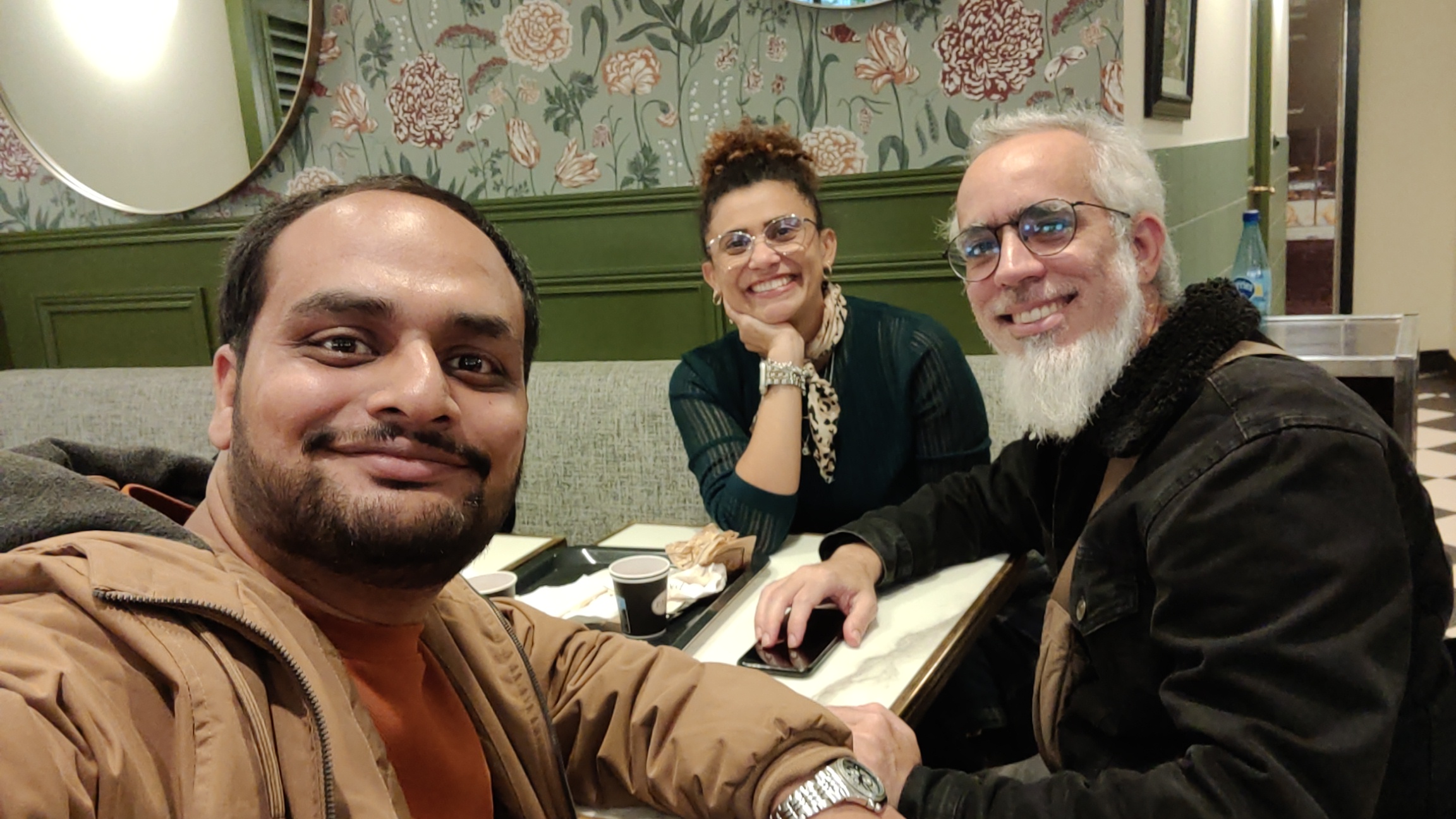 Photo with Joenio and Mari
 Notre Dame, another tourist attraction of Paris.
 My photo with Eiffel Tower in the background
 Items at a bakery in Paris. Items from left to right are: Chocolate Twist, Sugar briochette, Pain au Chocolat, Croissant with almonds, Croissant, Croissant with chocolate hazlenut filling.
 The Paris subway
 Inside a Paris subway
 A random building and road in Paris
 A shot near Seine river
 A view of Seine river
 About 90% of my Debian contributions this month were
 So, 2021 isn't bad enough yet, but don't despair, people are working to fix that:
 Spending my Golden Week in boredom. That's nice.
 Having setup an
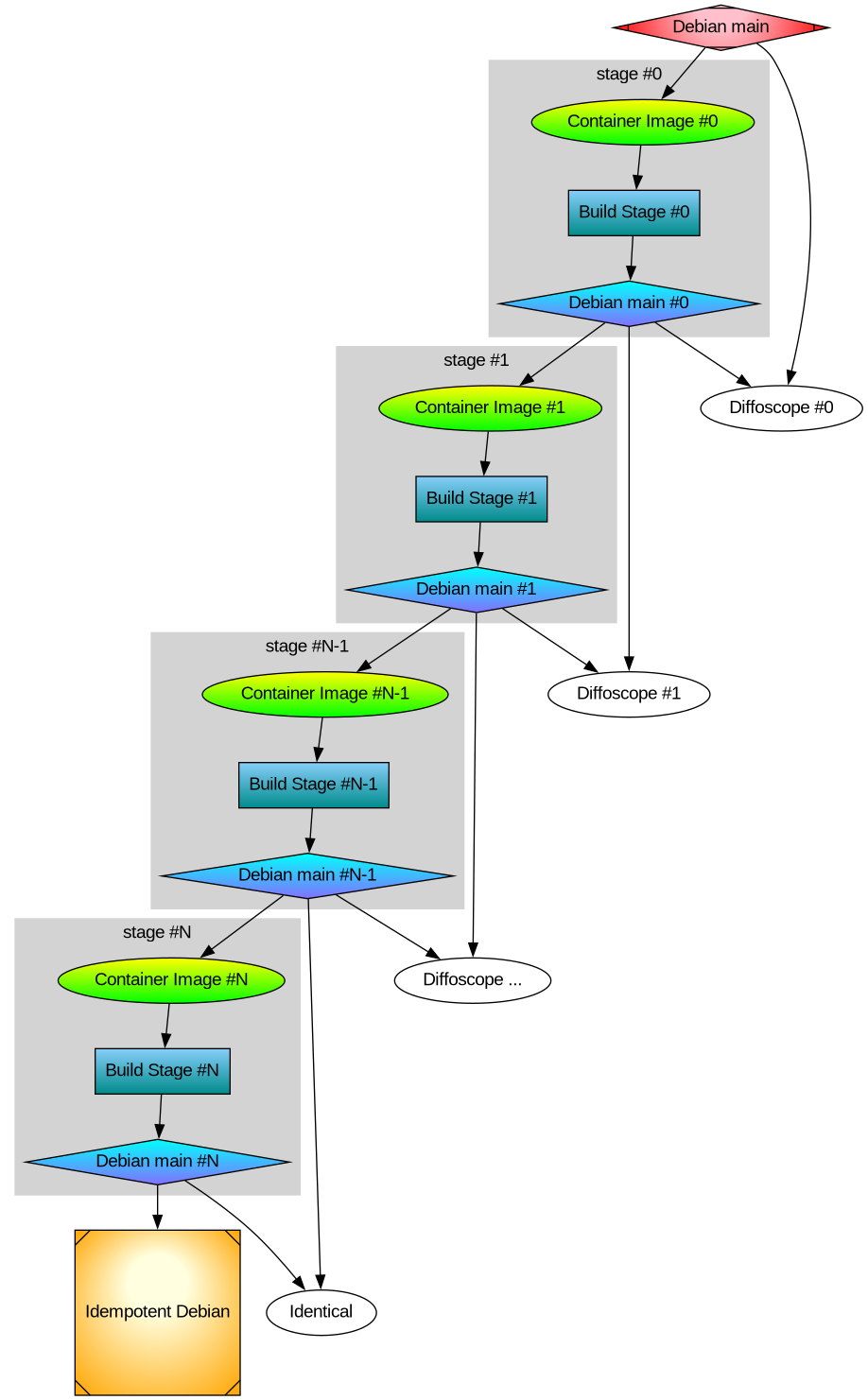
 For a long time I ve been wanting to try GitOps tools, but I haven t had the chance to try them for real on the projects
I was working on.
As now I have some spare time I ve decided I m going to play a little with
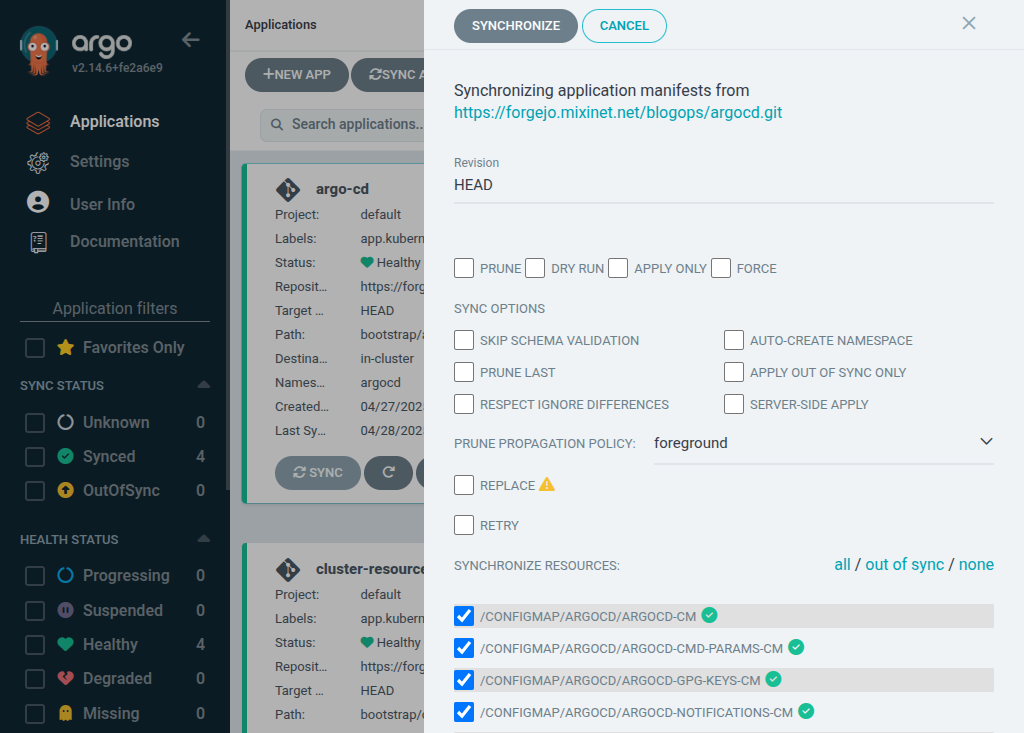
 Years ago I made myself a quick dressing gown from a white fleece IKEA
throw and often wore it in the morning between waking up and changing
into day clothes.
One day I want to make myself a fancy victorian wrapper, to use in its
place, but that s still in the early planning stage, and will require
quite some work.
 Then last autumn I discovered that the taxes I owed to the local lord (who
provides protection from mice and other small animals) included not just
a certain amount of kibbles, but also some warm textiles, and the
dressing gown (which at this time was definitely no longer pristine) had
to go.
For a while I had to do without a dressing gown, but then in the second
half of this winter I had some time for a quick machine sewing
project. I could not tackle the big victorian thing, but I still had a
second POLARVIDE throw from IKEA (this time in a more sensible dark
grey) I had bought with sewing intents.
The fabric in a throw isn t that much, so I needed something pretty
efficient, and rather than winging it as I had done the first time I
decided I wanted to try the Modular Jacket from
 Since I didn t have enough fabric for the belt I also skipped the belt
loops, but I have been wearing this with random belts and I don t feel
the need for them anyway. I ve also been thinking about adding a button
just above the bust and use that to keep it closed, but I m still not
100% sure about it.
Another thing I still need to do is to go through the few scraps of
fleece that are left and see if I can piece together a serviceable
pocket or two.
 Because of the size of the fabric, I ended up having quite long sleeves:
I m happy with them because they mean that I can cover my hands when
it s cold, or fold them back to make a nice cuff.
If I ll make a real jacket with this patter I ll have to take this in
consideration, and either make the sleeves shorter or finish the seam in
a way that looks nice when folded back.
Will I make a real jacket? I m not sure, it s not really my style of
outer garment, but as a dressing gown it has already been used quite a
bit (as in, almost every morning since I ve made it :) ) and will
continue to be used until too worn to be useful, and that s a good
thing.

 Like each month, have a look at the work funded by
 Hi, I m Melissa, a GPU kernel driver developer at Igalia and today I ll be
giving a very inclusive talk to not let your motivation go by saving time with
kworkflow.
 So, you re a kernel developer, or you want to be a kernel developer, or you
don t want to be a kernel developer. But you re all united by a single need:
you need to validate a custom kernel with just one change, and you need to
verify that it fixes or improves something in the kernel.

 And that s a given change for a given distribution, or for a given device, or
for a given subsystem
 Look to this diagram and try to figure out the number of subsystems and related
work trees you can handle in the kernel.
 So, whether you are a kernel developer or not, at some point you may come
across this type of situation:
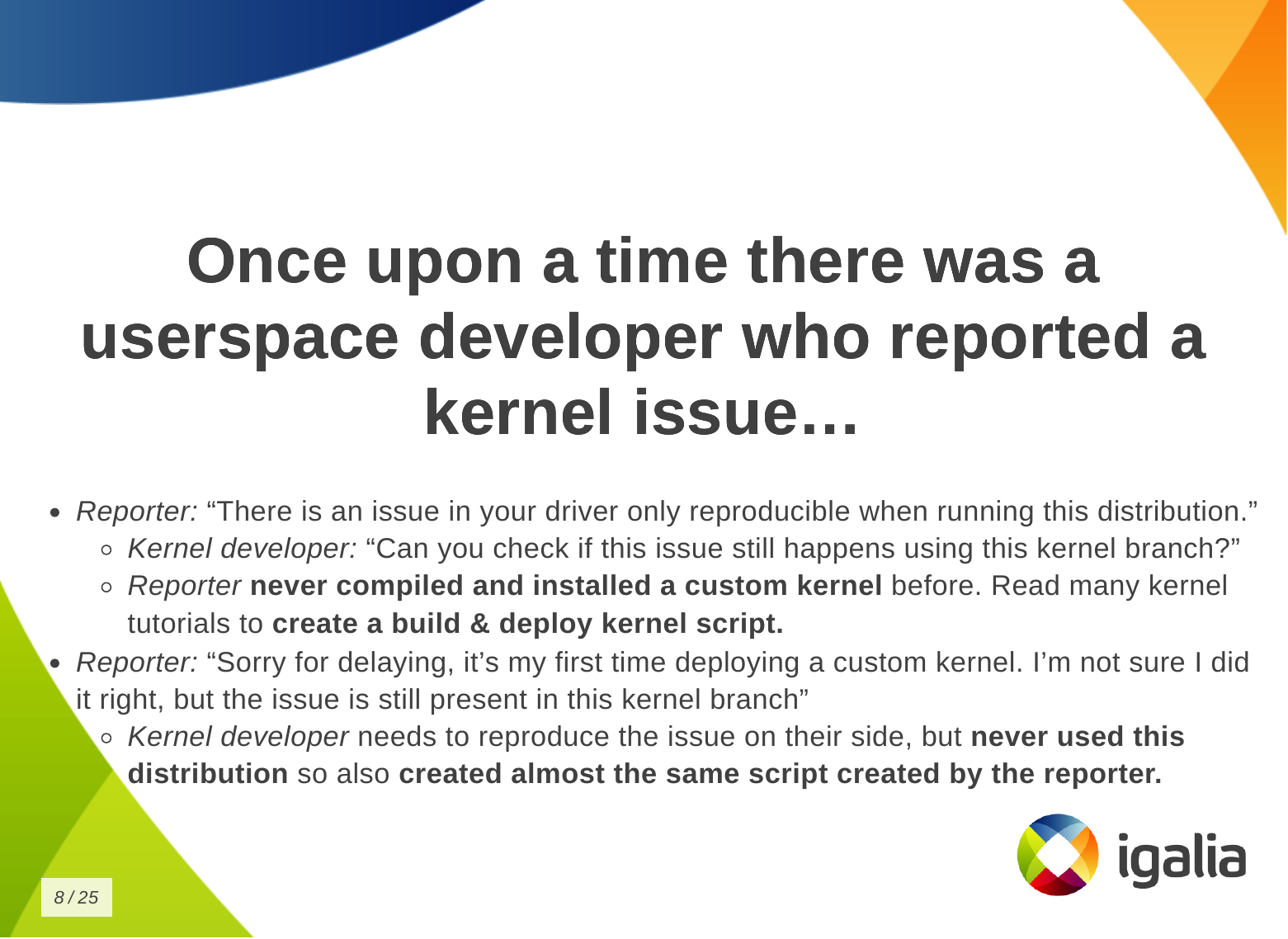 There is a userspace developer who wants to report a kernel issue and says:
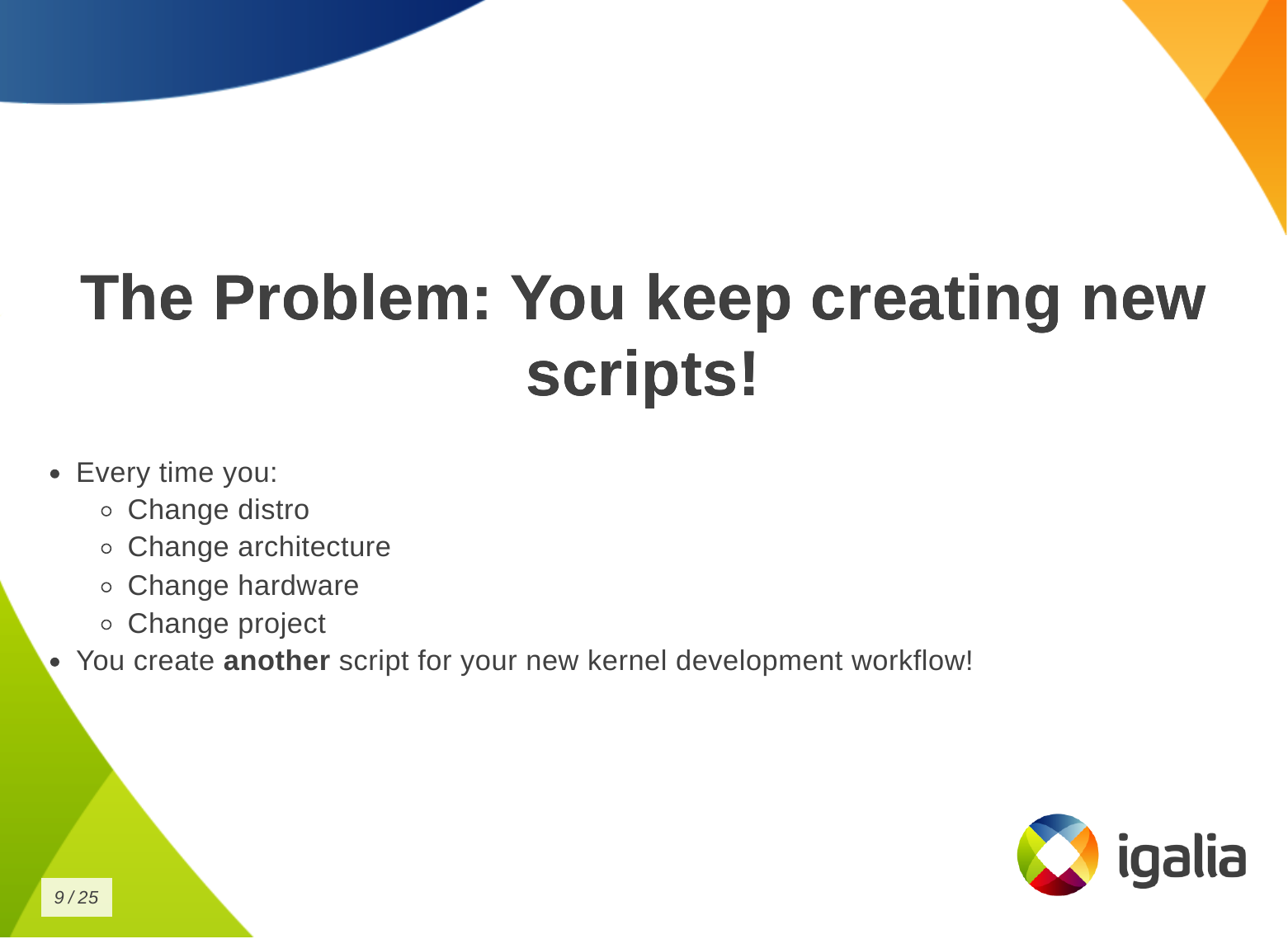 What s the problem of this situation? The problem is that you keep creating new
scripts!
Every time you change distribution, change architecture, change hardware,
change project - even in the same company - the development setup may change
when you switch to a different project, you create another script for your new
kernel development workflow!
 You know, you have a lot of babies, you have a collection of my precious
scripts , like Sm agol (Lord of the Rings) with the precious ring.
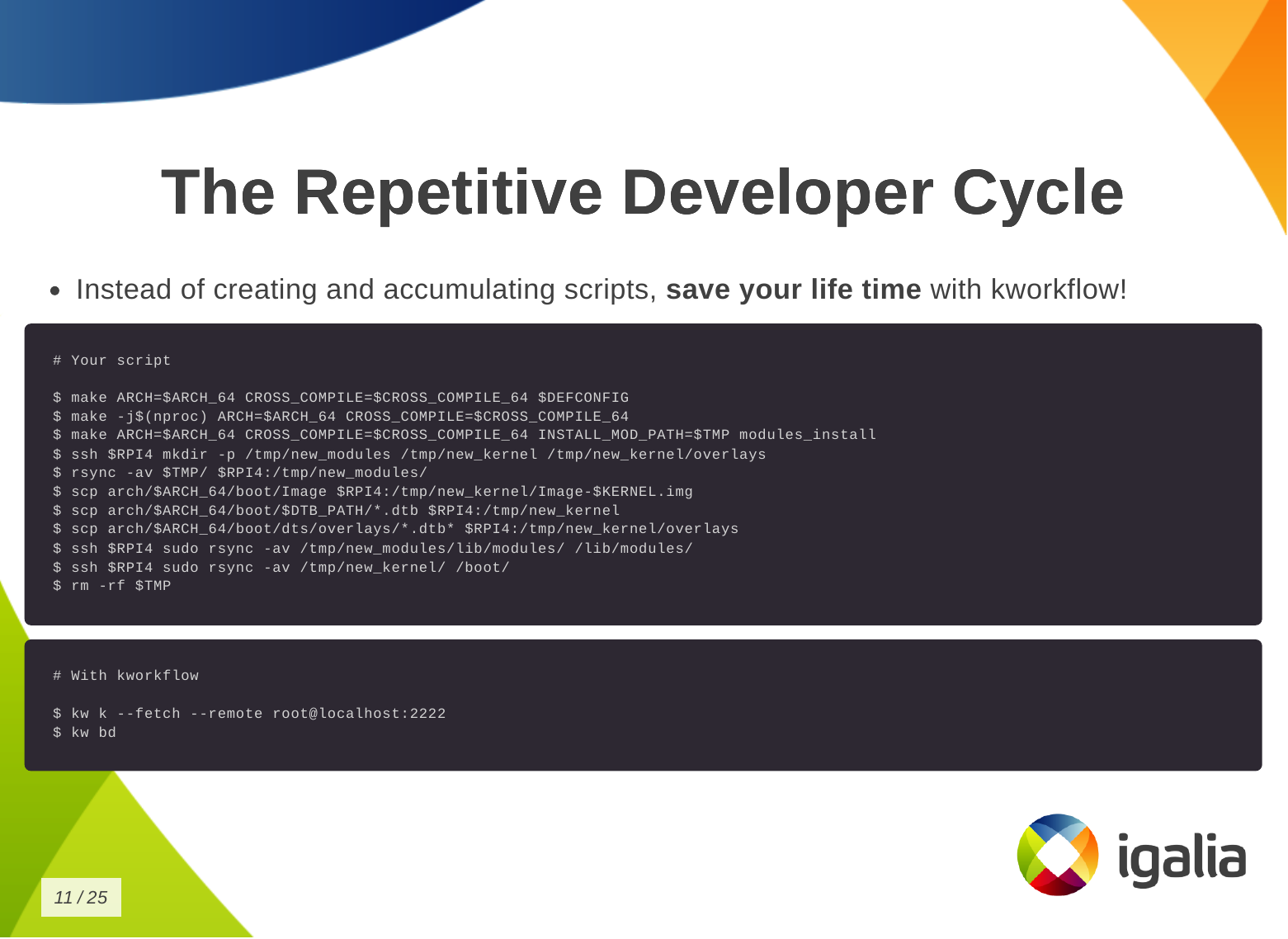 Instead of creating and accumulating scripts, save yourself time with
kworkflow. Here is a typical script that many of you may have. This is a
Raspberry Pi 4 script and contains everything you need to memorize to compile
and deploy a kernel on your Raspberry Pi 4.
With kworkflow, you only need to memorize two commands, and those commands are
not specific to Raspberry Pi. They are the same commands to different
architecture, kernel configuration, target device.
 I don t know if you will get this analogy, but kworkflow is for me a megazord
of scripts. You are combining all of your scripts to create a very powerful
tool.
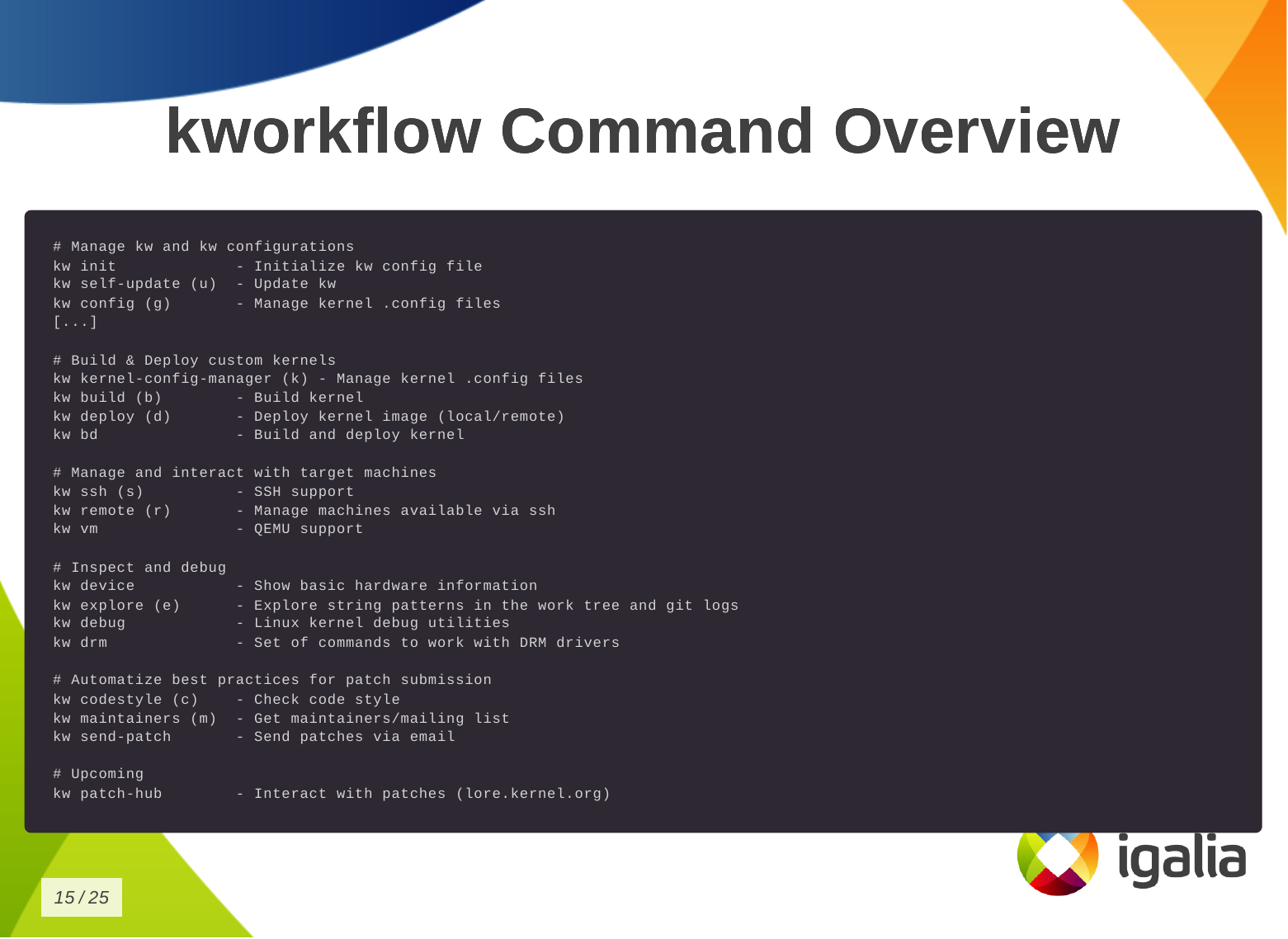 This is the list of commands you can run with kworkflow.
The first subset is to configure your tool for various situations you may face
in your daily tasks.
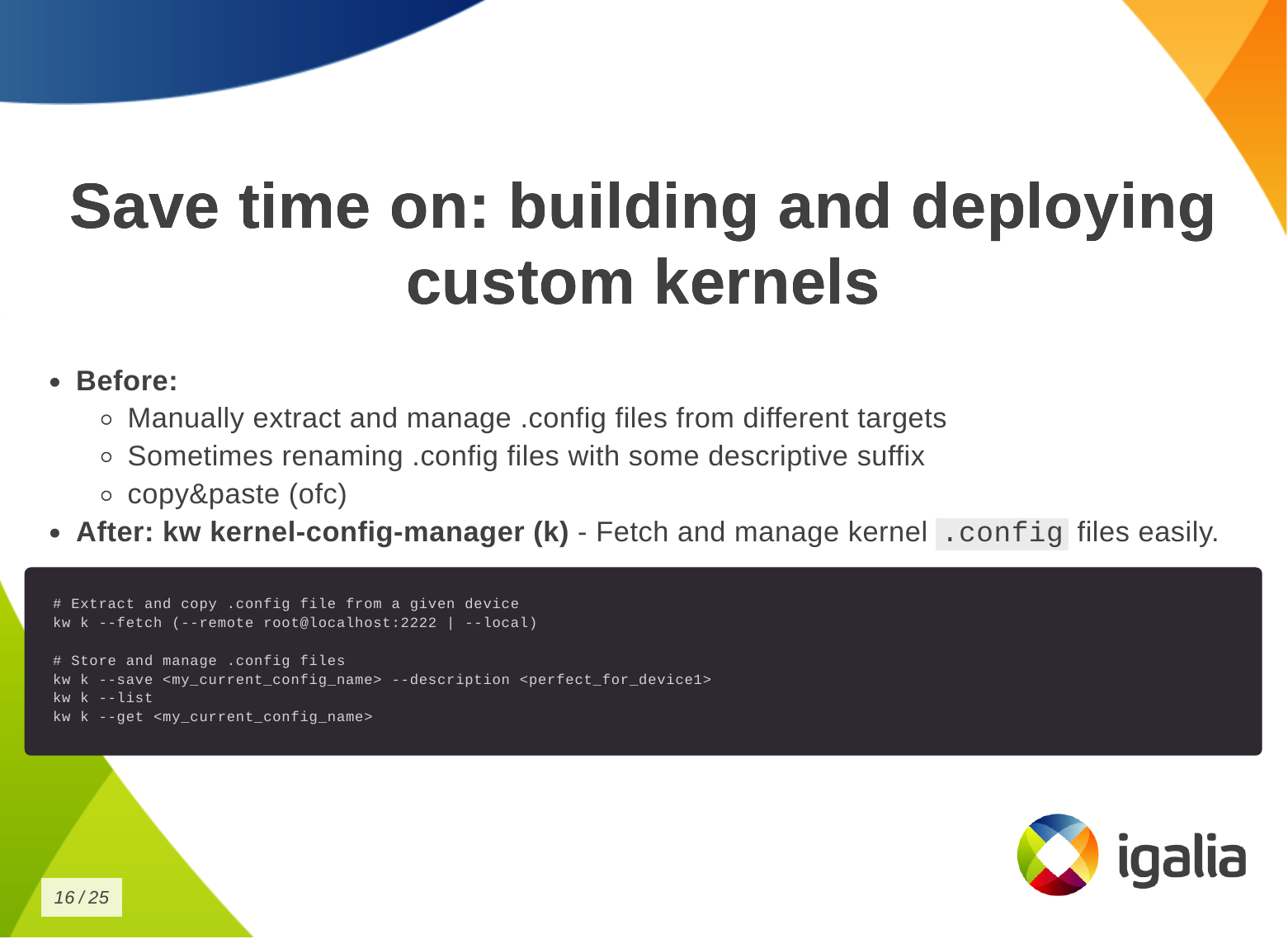 So how can you save time building and deploying a custom kernel?
First, you need a .config file.
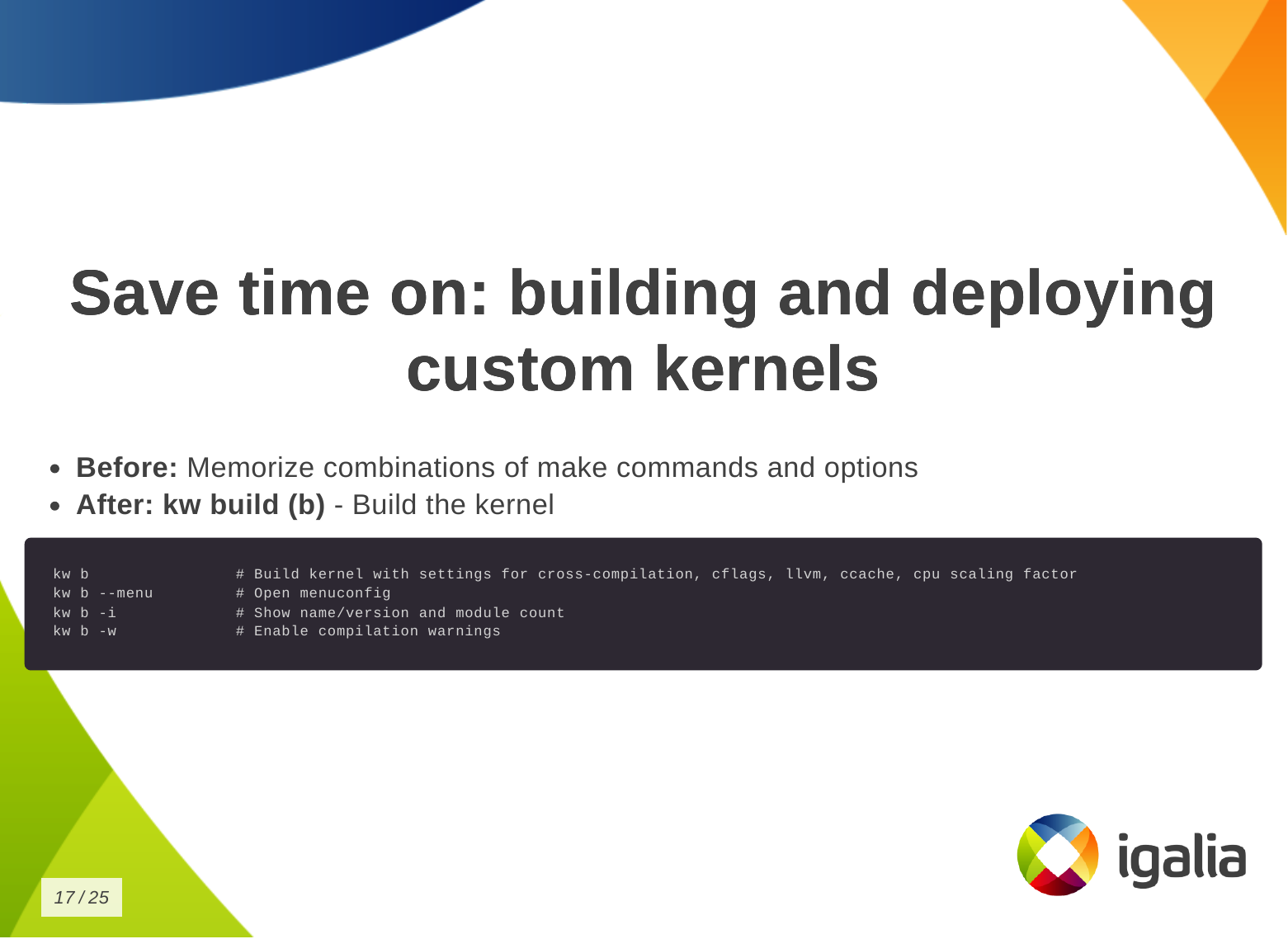 Then you want to build the kernel:
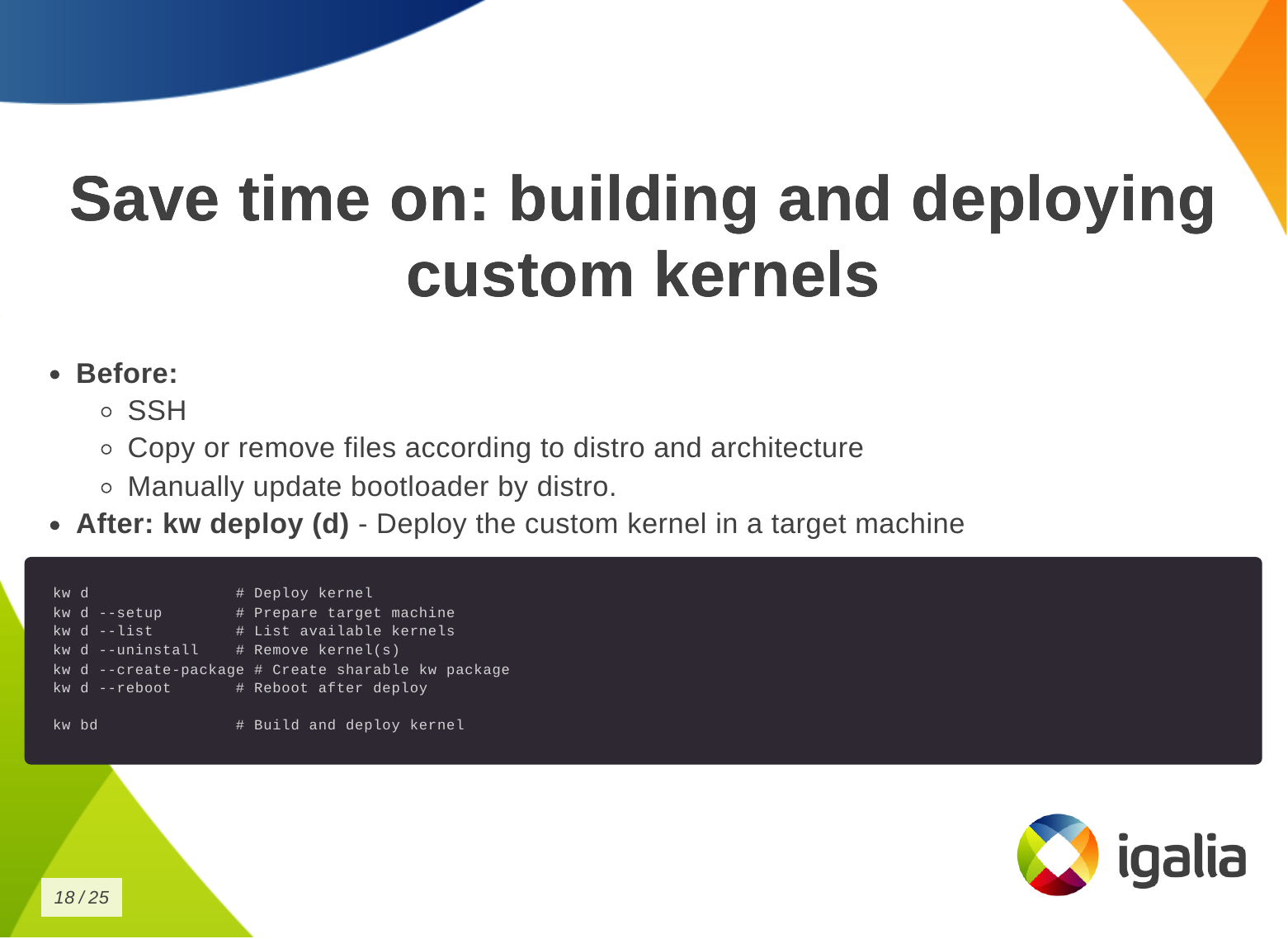 Finally, to deploy the kernel in a target machine.
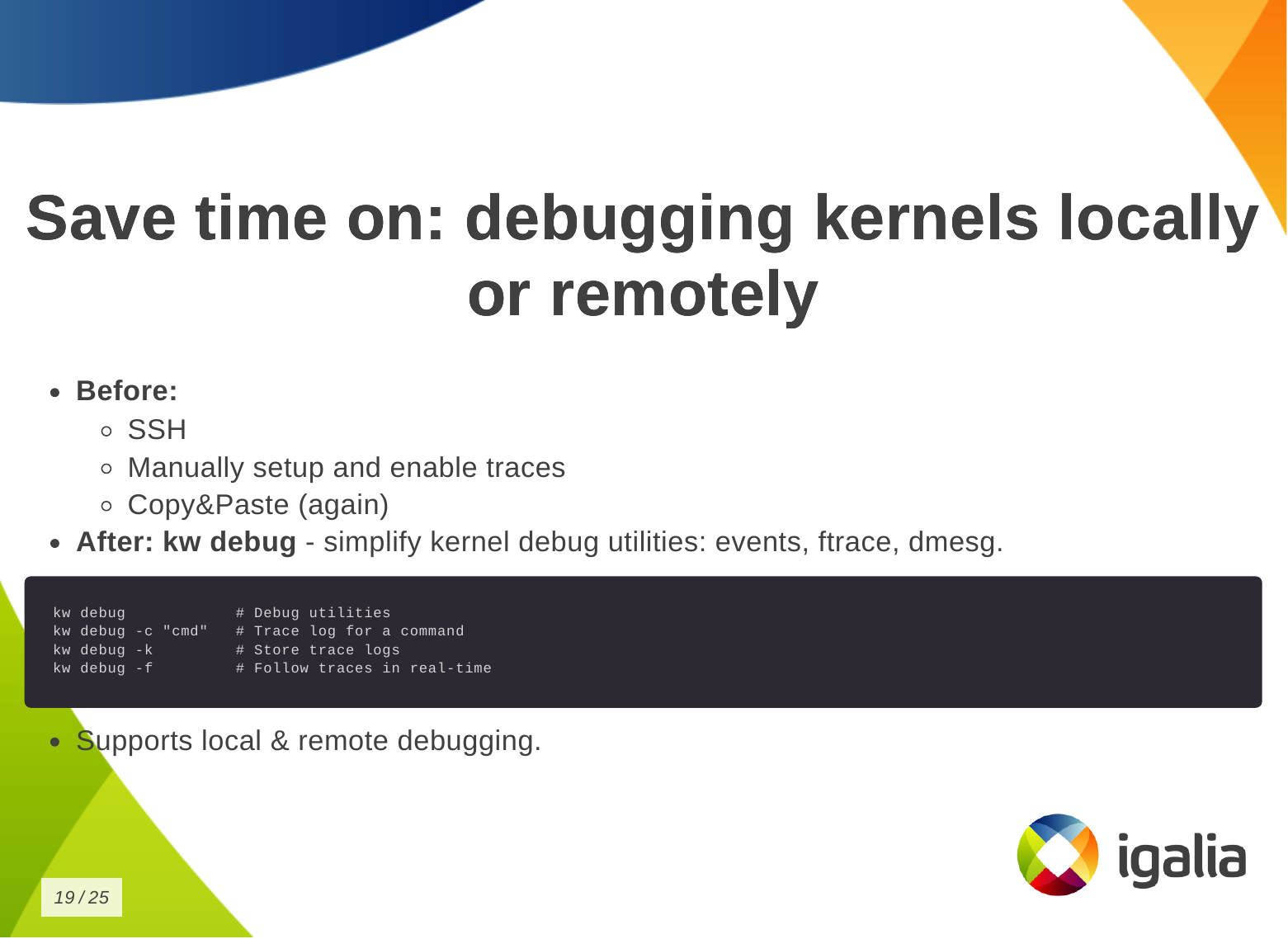 You can also save time on debugging kernels locally or remotely.
 You can save time on managing multiple kernel images in the same work tree.
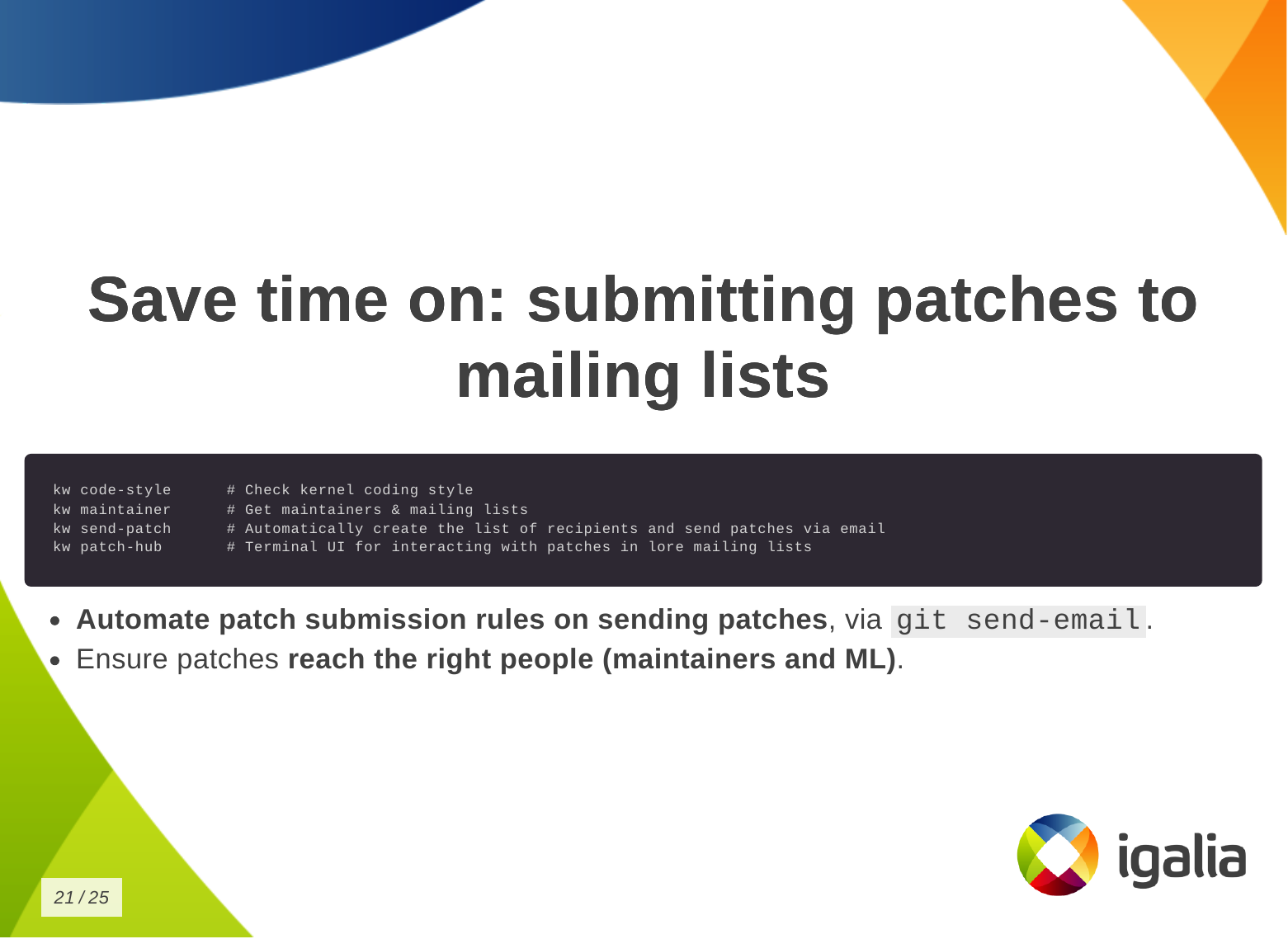 Finally, you can save time when submitting kernel patches. In kworkflow, you
can find everything you need to wrap your changes in patch format and submit
them to the right list of recipients, those who can review, comment on, and
accept your changes.
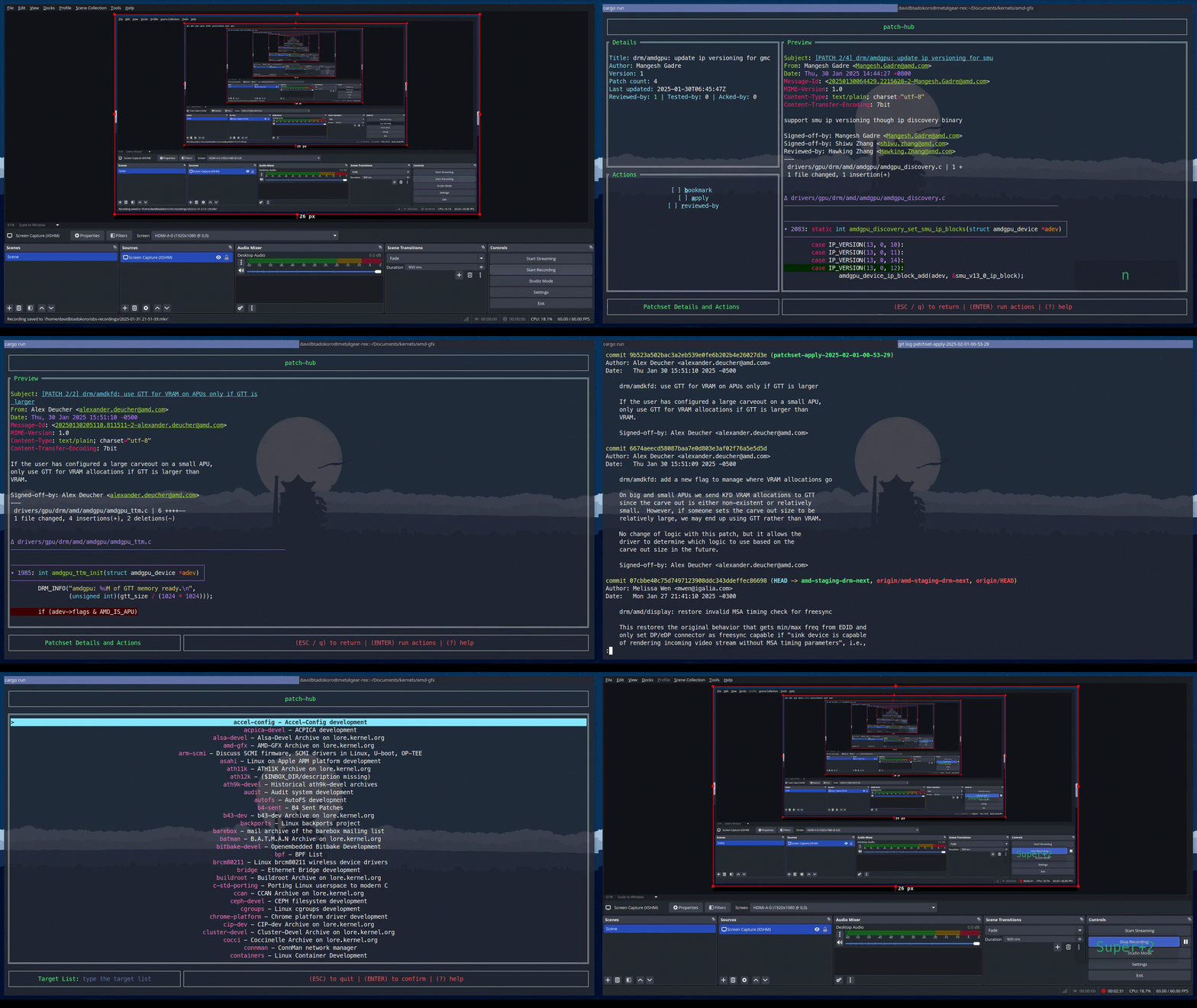 This is a demo that the lead developer of the kw patch-hub feature sent me.
With this feature, you will be able to check out a series on a specific mailing
list, bookmark those patches in the kernel for validation, and when you are
satisfied with the proposed changes, you can automatically submit a reviewed-by
for that whole series to the mailing list.
 Fun with -fsanitize=undefined and Picolibc
Both GCC and Clang support the -fsanitize=undefined flag which
instruments the generated code to detect places where the program
wanders into parts of the C language specification which are either
undefined or implementation defined. Many of these are also common
programming errors. It would be great if there were sanitizers for
other easily detected bugs, but for now, at least the undefined
sanitizer does catch several useful problems.
Supporting the sanitizer
The sanitizer can be built to either trap on any error or call
handlers. In both modes, the same problems are identified, but when
trap mode is enabled, the compiler inserts a trap instruction and
doesn't expect the program to continue running. When handlers are in
use, each identified issue is tagged with a bunch of useful data and
then a specific sanitizer handling function is called.
The specific functions are not all that well documented, nor are the
parameters they receive. Maybe this is because both compilers provide
an implementation of all of the functions they use and don't really
expect external implementations to exist? However, to make these useful in an
embedded environment, picolibc needs to provide a complete set of
handlers that support all versions both gcc and clang as the
compiler-provided versions depend upon specific C (and C++) libraries.
Of course, programs can be built in trap-on-error mode, but that makes
it much more difficult to figure out what went wrong.
Fixing Sanitizer Issues
Once the sanitizer handlers were implemented, picolibc could be
built with them enabled and all of the picolibc tests run to uncover
issues within the library.
As with the static analyzer adventure from last year, the vast bulk of
sanitizer complaints came from invoking undefined or
implementation-defined behavior in harmless ways:


 Dear Debian community,
this is bits from DPL for March (sorry for the delay, I was waiting
for some additional input).
Conferences
In March, I attended two conferences, each with a distinct motivation.
I joined FOSSASIA to address the imbalance in geographical developer
representation. Encouraging more developers from Asia to contribute to
Free Software is an important goal for me, and FOSSASIA provided a
valuable opportunity to work towards this.
I also attended Chemnitzer Linux-Tage, a conference I have been part of
for over 20 years. To me, it remains a key gathering for the German Free
Software community a place where contributors meet, collaborate, and
exchange ideas.
I have a remark about submitting an event proposal to both FOSDEM and
FOSSASIA:
Cross distribution experience exchange