Search Results: "daniel"

17 October 2017

Russ Allbery: Bundle haul

Confession time: I started making these posts (eons ago) because a close friend did as well, and I enjoyed reading them. But the main reason why I continue is because the primary way I have to keep track of the books I've bought and avoid duplicates is, well, grep on these posts. I should come up with a non-bullshit way of doing this, but time to do more elegant things is in short supply, and, well, it's my blog. So I'm boring all of you who read this in various places with my internal bookkeeping. I do try to at least add a bit of commentary. This one will be more tedious than most since it includes five separate Humble Bundles, which increases the volume a lot. (I just realized I'd forgotten to record those purchases from the past several months.) First, the individual books I bought directly: Ilona Andrews Sweep in Peace (sff)
Ilona Andrews One Fell Sweep (sff)
Steven Brust Vallista (sff)
Nicky Drayden The Prey of Gods (sff)
Meg Elison The Book of the Unnamed Midwife (sff)
Pat Green Night Moves (nonfiction)
Ann Leckie Provenance (sff)
Seanan McGuire Once Broken Faith (sff)
Seanan McGuire The Brightest Fell (sff)
K. Arsenault Rivera The Tiger's Daughter (sff)
Matthew Walker Why We Sleep (nonfiction)
Some new books by favorite authors, a few new releases I heard good things about, and two (Night Moves and Why We Sleep) from references in on-line articles that impressed me. The books from security bundles (this is mostly work reading, assuming I'll get to any of it), including a blockchain bundle: Wil Allsop Unauthorised Access (nonfiction)
Ross Anderson Security Engineering (nonfiction)
Chris Anley, et al. The Shellcoder's Handbook (nonfiction)
Conrad Barsky & Chris Wilmer Bitcoin for the Befuddled (nonfiction)
Imran Bashir Mastering Blockchain (nonfiction)
Richard Bejtlich The Practice of Network Security (nonfiction)
Kariappa Bheemaiah The Blockchain Alternative (nonfiction)
Violet Blue Smart Girl's Guide to Privacy (nonfiction)
Richard Caetano Learning Bitcoin (nonfiction)
Nick Cano Game Hacking (nonfiction)
Bruce Dang, et al. Practical Reverse Engineering (nonfiction)
Chris Dannen Introducing Ethereum and Solidity (nonfiction)
Daniel Drescher Blockchain Basics (nonfiction)
Chris Eagle The IDA Pro Book, 2nd Edition (nonfiction)
Nikolay Elenkov Android Security Internals (nonfiction)
Jon Erickson Hacking, 2nd Edition (nonfiction)
Pedro Franco Understanding Bitcoin (nonfiction)
Christopher Hadnagy Social Engineering (nonfiction)
Peter N.M. Hansteen The Book of PF (nonfiction)
Brian Kelly The Bitcoin Big Bang (nonfiction)
David Kennedy, et al. Metasploit (nonfiction)
Manul Laphroaig (ed.) PoC GTFO (nonfiction)
Michael Hale Ligh, et al. The Art of Memory Forensics (nonfiction)
Michael Hale Ligh, et al. Malware Analyst's Cookbook (nonfiction)
Michael W. Lucas Absolute OpenBSD, 2nd Edition (nonfiction)
Bruce Nikkel Practical Forensic Imaging (nonfiction)
Sean-Philip Oriyano CEHv9 (nonfiction)
Kevin D. Mitnick The Art of Deception (nonfiction)
Narayan Prusty Building Blockchain Projects (nonfiction)
Prypto Bitcoin for Dummies (nonfiction)
Chris Sanders Practical Packet Analysis, 3rd Edition (nonfiction)
Bruce Schneier Applied Cryptography (nonfiction)
Adam Shostack Threat Modeling (nonfiction)
Craig Smith The Car Hacker's Handbook (nonfiction)
Dafydd Stuttard & Marcus Pinto The Web Application Hacker's Handbook (nonfiction)
Albert Szmigielski Bitcoin Essentials (nonfiction)
David Thiel iOS Application Security (nonfiction)
Georgia Weidman Penetration Testing (nonfiction)
Finally, the two SF bundles: Buzz Aldrin & John Barnes Encounter with Tiber (sff)
Poul Anderson Orion Shall Rise (sff)
Greg Bear The Forge of God (sff)
Octavia E. Butler Dawn (sff)
William C. Dietz Steelheart (sff)
J.L. Doty A Choice of Treasons (sff)
Harlan Ellison The City on the Edge of Forever (sff)
Toh Enjoe Self-Reference ENGINE (sff)
David Feintuch Midshipman's Hope (sff)
Alan Dean Foster Icerigger (sff)
Alan Dean Foster Mission to Moulokin (sff)
Alan Dean Foster The Deluge Drivers (sff)
Taiyo Fujii Orbital Cloud (sff)
Hideo Furukawa Belka, Why Don't You Bark? (sff)
Haikasoru (ed.) Saiensu Fikushon 2016 (sff anthology)
Joe Haldeman All My Sins Remembered (sff)
Jyouji Hayashi The Ouroboros Wave (sff)
Sergei Lukyanenko The Genome (sff)
Chohei Kambayashi Good Luck, Yukikaze (sff)
Chohei Kambayashi Yukikaze (sff)
Sakyo Komatsu Virus (sff)
Miyuki Miyabe The Book of Heroes (sff)
Kazuki Sakuraba Red Girls (sff)
Robert Silverberg Across a Billion Years (sff)
Allen Steele Orbital Decay (sff)
Bruce Sterling Schismatrix Plus (sff)
Michael Swanwick Vacuum Flowers (sff)
Yoshiki Tanaka Legend of the Galactic Heroes, Volume 1: Dawn (sff)
Yoshiki Tanaka Legend of the Galactic Heroes, Volume 2: Ambition (sff)
Yoshiki Tanaka Legend of the Galactic Heroes, Volume 3: Endurance (sff)
Tow Ubukata Mardock Scramble (sff)
Sayuri Ueda The Cage of Zeus (sff)
Sean Williams & Shane Dix Echoes of Earth (sff)
Hiroshi Yamamoto MM9 (sff)
Timothy Zahn Blackcollar (sff)
Phew. Okay, all caught up, and hopefully won't have to dump something like this again in the near future. Also, more books than I have any actual time to read, but what else is new.

12 October 2017

Joachim Breitner: Isabelle functions: Always total, sometimes undefined

Often, when I mention how things work in the interactive theorem prover [Isabelle/HOL] (in the following just Isabelle 1) to people with a strong background in functional programming (whether that means Haskell or Coq or something else), I cause confusion, especially around the issue of what is a function, are function total and what is the business with undefined. In this blog post, I want to explain some these issues, aimed at functional programmers or type theoreticians. Note that this is not meant to be a tutorial; I will not explain how to do these things, and will focus on what they mean.

HOL is a logic of total functions If I have a Isabelle function f :: a b between two types a and b (the function arrow in Isabelle is , not ), then by definition of what it means to be a function in HOL whenever I have a value x :: a, then the expression f x (i.e. f applied to x) is a value of type b. Therefore, and without exception, every Isabelle function is total. In particular, it cannot be that f x does not exist for some x :: a. This is a first difference from Haskell, which does have partial functions like
spin :: Maybe Integer -> Bool
spin (Just n) = spin (Just (n+1))
Here, neither the expression spin Nothing nor the expression spin (Just 42) produce a value of type Bool: The former raises an exception ( incomplete pattern match ), the latter does not terminate. Confusingly, though, both expressions have type Bool. Because every function is total, this confusion cannot arise in Isabelle: If an expression e has type t, then it is a value of type t. This trait is shared with other total systems, including Coq. Did you notice the emphasis I put on the word is here, and how I deliberately did not write evaluates to or returns ? This is because of another big source for confusion:

Isabelle functions do not compute We (i.e., functional programmers) stole the word function from mathematics and repurposed it2. But the word function , in the context of Isabelle, refers to the mathematical concept of a function, and it helps to keep that in mind. What is the difference?
  • A function a b in functional programming is an algorithm that, given a value of type a, calculates (returns, evaluates to) a value of type b.
  • A function a b in math (or Isabelle) associates with each value of type a a value of type b.
For example, the following is a perfectly valid function definition in math (and HOL), but could not be a function in the programming sense:
definition foo :: "(nat   real)   real" where
  "foo seq = (if convergent seq then lim seq else 0)"
This assigns a real number to every sequence, but it does not compute it in any useful sense. From this it follows that

Isabelle functions are specified, not defined Consider this function definition:
fun plus :: "nat   nat   nat"  where
   "plus 0       m = m"
   "plus (Suc n) m = Suc (plus n m)"
To a functional programmer, this reads
plus is a function that analyses its first argument. If that is 0, then it returns the second argument. Otherwise, it calls itself with the predecessor of the first argument and increases the result by one.
which is clearly a description of a computation. But to Isabelle, the above reads
plus is a binary function on natural numbers, and it satisfies the following two equations:
And in fact, it is not so much Isabelle that reads it this way, but rather the fun command, which is external to the Isabelle logic. The fun command analyses the given equations, constructs a non-recursive definition of plus under the hood, passes that to Isabelle and then proves that the given equations hold for plus. One interesting consequence of this is that different specifications can lead to the same functions. In fact, if we would define plus' by recursing on the second argument, we d obtain the the same function (i.e. plus = plus' is a theorem, and there would be no way of telling the two apart).

Termination is a property of specifications, not functions Because a function does not evaluate, it does not make sense to ask if it terminates. The question of termination arises before the function is defined: The fun command can only construct plus in a way that the equations hold if it passes a termination check very much like Fixpoint in Coq. But while the termination check of Fixpoint in Coq is a deep part of the basic logic, in Isabelle it is simply something that this particular command requires for its internal machinery to go through. At no point does a termination proof of the function exist as a theorem inside the logic. And other commands may have other means of defining a function that do not even require such a termination argument! For example, a function specification that is tail-recursive can be turned in to a function, even without a termination proof: The following definition describes a higher-order function that iterates its first argument f on the second argument x until it finds a fixpoint. It is completely polymorphic (the single quote in 'a indicates that this is a type variable):
partial_function (tailrec)
  fixpoint :: "('a   'a)   'a   'a"
where
  "fixpoint f x = (if f x = x then x else fixpoint f (f x))"
We can work with this definition just fine. For example, if we instantiate f with ( x. x-1), we can prove that it will always return 0:
lemma "fixpoint (  n . n - 1) (n::nat) = 0"
  by (induction n) (auto simp add: fixpoint.simps)
Similarly, if we have a function that works within the option monad (i.e. Maybe in Haskell), its specification can always be turned into a function without an explicit termination proof here one that calculates the Collatz sequence:
partial_function (option) collatz :: "nat   nat list option"
 where "collatz n =
        (if n = 1 then Some [n]
         else if even n
           then do   ns <- collatz (n div 2);    Some (n # ns)  
           else do   ns <- collatz (3 * n + 1);  Some (n # ns) )"
Note that lists in Isabelle are finite (like in Coq, unlike in Haskell), so this function returns a list only if the collatz sequence eventually reaches 1. I expect these definitions to make a Coq user very uneasy. How can fixpoint be a total function? What is fixpoint ( n. n+1)? What if we run collatz n for a n where the Collatz sequence does not reach 1?3 We will come back to that question after a little detour

HOL is a logic of non-empty types Another big difference between Isabelle and Coq is that in Isabelle, every type is inhabited. Just like the totality of functions, this is a very fundamental fact about what HOL defines to be a type. Isabelle gets away with that design because in Isabelle, we do not use types for propositions (like we do in Coq), so we do not need empty types to denote false propositions. This design has an important consequence: It allows the existence of a polymorphic expression that inhabits any type, namely
undefined :: 'a
The naming of this term alone has caused a great deal of confusion for Isabelle beginners, or in communication with users of different systems, so I implore you to not read too much into the name. In fact, you will have a better time if you think of it as arbitrary or, even better, unknown. Since undefined can be instantiated at any type, we can instantiate it for example at bool, and we can observe an important fact: undefined is not an extra value besides the usual ones . It is simply some value of that type, which is demonstrated in the following lemma:
lemma "undefined = True   undefined = False" by auto
In fact, if the type has only one value (such as the unit type), then we know the value of undefined for sure:
lemma "undefined = ()" by auto
It is very handy to be able to produce an expression of any type, as we will see as follows

Partial functions are just underspecified functions For example, it allows us to translate incomplete function specifications. Consider this definition, Isabelle s equivalent of Haskell s partial fromJust function:
fun fromSome :: "'a option   'a" where
  "fromSome (Some x) = x"
This definition is accepted by fun (albeit with a warning), and the generated function fromSome behaves exactly as specified: when applied to Some x, it is x. The term fromSome None is also a value of type 'a, we just do not know which one it is, as the specification does not address that. So fromSome None behaves just like undefined above, i.e. we can prove
lemma "fromSome None = False   fromSome None = True" by auto
Here is a small exercise for you: Can you come up with an explanation for the following lemma:
fun constOrId :: "bool   bool" where
  "constOrId True = True"
lemma "constOrId = ( _.True)   constOrId = ( x. x)"
  by (metis (full_types) constOrId.simps)
Overall, this behavior makes sense if we remember that function definitions in Isabelle are not really definitions, but rather specifications. And a partial function definition is simply a underspecification. The resulting function is simply any function hat fulfills the specification, and the two lemmas above underline that observation.

Nonterminating functions are also just underspecified Let us return to the puzzle posed by fixpoint above. Clearly, the function seen as a functional program is not total: When passed the argument ( n. n + 1) or ( b. b) it will loop forever trying to find a fixed point. But Isabelle functions are not functional programs, and the definitions are just specifications. What does the specification say about the case when f has no fixed-point? It states that the equation fixpoint f x = fixpoint f (f x) holds. And this equation has a solution, for example fixpoint f _ = undefined. Or more concretely: The specification of the fixpoint function states that fixpoint ( b. b) True = fixpoint ( b. b) False has to hold, but it does not specify which particular value (True or False) it should denote any is fine.

Not all function specifications are ok At this point you might wonder: Can I just specify any equations for a function f and get a function out of that? But rest assured: That is not the case. For example, no Isabelle command allows you define a function bogus :: () nat with the equation bogus () = Suc (bogus ()), because this equation does not have a solution. We can actually prove that such a function cannot exist:
lemma no_bogus: "  bogus. bogus () = Suc (bogus ())" by simp
(Of course, not_bogus () = not_bogus () is just fine )

You cannot reason about partiality in Isabelle We have seen that there are many ways to define functions that one might consider partial . Given a function, can we prove that it is not partial in that sense? Unfortunately, but unavoidably, no: Since undefined is not a separate, recognizable value, but rather simply an unknown one, there is no way of stating that A function result is not specified . Here is an example that demonstrates this: Two partial functions (one with not all cases specified, the other one with a self-referential specification) are indistinguishable from the total variant:
fun partial1 :: "bool   unit" where
  "partial1 True = ()"
partial_function (tailrec) partial2 :: "bool   unit" where
  "partial2 b = partial2 b"
fun total :: "bool   unit" where
  "total True = ()"
  "total False = ()"
lemma "partial1 = total   partial2 = total" by auto
If you really do want to reason about partiality of functional programs in Isabelle, you should consider implementing them not as plain HOL functions, but rather use HOLCF, where you can give equational specifications of functional programs and obtain continuous functions between domains. In that setting, () and partial2 = total. We have done that to verify some of HLint s equations.

You can still compute with Isabelle functions I hope by this point, I have not scared away anyone who wants to use Isabelle for functional programming, and in fact, you can use it for that. If the equations that you pass to fun are a reasonable definition for a function (in the programming sense), then these equations, used as rewriting rules, will allow you to compute that function quite like you would in Coq or Haskell. Moreover, Isabelle supports code extraction: You can take the equations of your Isabelle functions and have them expored into Ocaml, Haskell, Scala or Standard ML. See Concon for a conference management system with confidentially verified in Isabelle. While these usually are the equations you defined the function with, they don't have to: You can declare other proved equations to be used for code extraction, e.g. to refine your elegant definitions to performant ones. Like with code extraction from Coq to, say, Haskell, the adequacy of the translations rests on a moral reasoning foundation. Unlike extraction from Coq, where you have an (unformalized) guarantee that the resulting Haskell code is terminating, you do not get that guarantee from Isabelle. Conversely, this allows you do reason about and extract non-terminating programs, like fixpoint, which is not possible in Coq. There is currently ongoing work about verified code generation, where the code equations are reflected into a deep embedding of HOL in Isabelle that would allow explicit termination proofs.

Conclusion We have seen how in Isabelle, every function is total. Function declarations have equations, but these do not define the function in an computational sense, but rather specify them. Because in HOL, there are no empty types, many specifications that appear partial (incomplete patterns, non-terminating recursion) have solutions in the space of total functions. Partiality in the specification is no longer visible in the final product.

PS: Axiom undefined in Coq This section is speculative, and an invitation for discussion. Coq already distinguishes between types used in programs (Set) and types used in proofs Prop. Could Coq ensure that every t : Set is non-empty? I imagine this would require additional checks in the Inductive command, similar to the checks that the Isabelle command datatype has to perform4, and it would disallow Empty_set. If so, then it would be sound to add the following axiom
Axiom undefined : forall (a : Set), a.
wouldn't it? This axiom does not have any computational meaning, but that seems to be ok for optional Coq axioms, like classical reasoning or function extensionality. With this in place, how much of what I describe above about function definitions in Isabelle could now be done soundly in Coq. Certainly pattern matches would not have to be complete and could sport an implicit case _ undefined. Would it help with non-obviously terminating functions? Would it allow a Coq command Tailrecursive that accepts any tailrecursive function without a termination check?

  1. Isabelle is a metalogical framework, and other logics, e.g. Isabelle/ZF, behave differently. For the purpose of this blog post, I always mean Isabelle/HOL.
  2. Isabelle is a metalogical framework, and other logics, e.g. Isabelle/ZF, behave differently. For the purpose of this blog post, I always mean Isabelle/HOL.
  3. Let me know if you find such an n. Besides n = 0.
  4. Like fun, the constructions by datatype are not part of the logic, but create a type definition from more primitive notions that is isomorphic to the specified data type.

8 October 2017

Daniel Pocock: A step change in managing your calendar, without social media

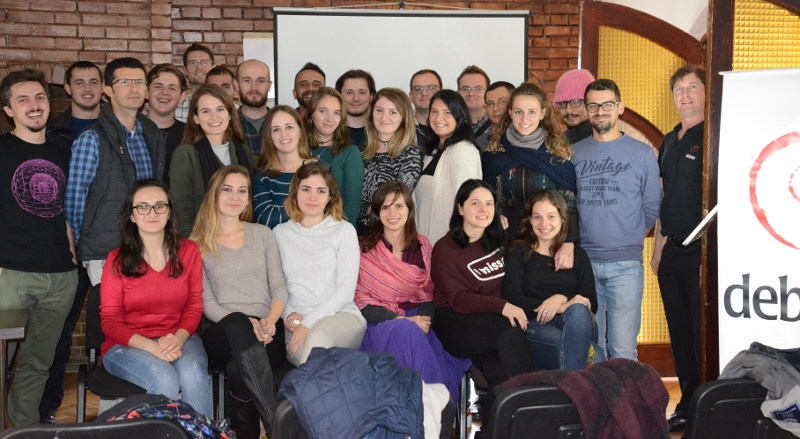
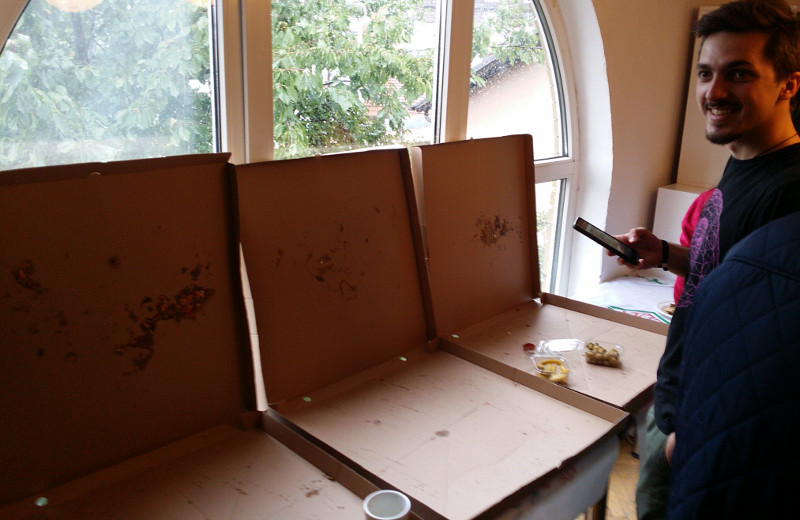
Have you been to an event recently involving free software or a related topic? How did you find it? Are you organizing an event and don't want to fall into the trap of using Facebook or Meetup or other services that compete for a share of your community's attention? Are you keen to find events in foreign destinations related to your interest areas to coincide with other travel intentions? Have you been concerned when your GSoC or Outreachy interns lost a week of their project going through the bureaucracy to get a visa for your community's event? Would you like to make it easier for them to find the best events in the countries that welcome and respect visitors? In many recent discussions about free software activism, people have struggled to break out of the illusion that social media is the way to cultivate new contacts. Wouldn't it be great to make more meaningful contacts by attending more a more diverse range of events rather than losing time on social media? Making it happen There are already a number of tools (for example, Drupal plugins and Wordpress plugins) for promoting your events on the web and in iCalendar format. There are also a number of sites like Agenda du Libre and GriCal who aggregate events from multiple communities where people can browse them. How can we take these concepts further and make a convenient, compelling and global solution? Can we harvest event data from a wide range of sources and compile it into a large database using something like PostgreSQL or a NoSQL solution or even a distributed solution like OpenDHT? Can we use big data techniques to mine these datasources and help match people to events without compromising on privacy? Why not build an automated iCalendar "to-do" list of deadlines for events you want to be reminded about, so you never miss the deadlines for travel sponsorship or submitting a talk proposal? I've started documenting an architecture for this on the Debian wiki and proposed it as an Outreachy project. It will also be offered as part of GSoC in 2018. Ways to get involved If you would like to help this project, please consider introducing yourself on the debian-outreach mailing list and helping to mentor or refer interns for the project. You can also help contribute ideas for the specification through the mailing list or wiki. Mini DebConf Prishtina 2017 This weekend I've been at the MiniDebConf in Prishtina, Kosovo. It has been hosted by the amazing Prishtina hackerspace community. Watch out for future events in Prishtina, the pizzas are huge, but that didn't stop them disappearing before we finished the photos:

7 October 2017

Chris Lamb: python-gfshare: Secret sharing in Python

I've just released python-gfshare, a Python library that implements Shamir s method for secret sharing, a technique to split a "secret" into multiple parts. An arbitrary number of those parts are then needed to recover the original file but any smaller combination of parts are useless to an attacker. For instance, you might split a GPG key into a 3-of-5 share, putting one share on each of three computers and two shares on a USB memory stick. You can then use the GPG key on any of those three computers using the memory stick. If the memory stick is lost you can ultimately recover the key by bringing the three computers back together again. For example:
$ pip install gfshare
>>> import gfshare
>>> shares = gfshare.split(3, 5, b"secret")
>>> shares
 104: b'1\x9cQ\xd8\xd3\xaf',
 164: b'\x15\xa4\xcf7R\xd2',
 171: b'>\xf5*\xce\xa2\xe2',
 173: b'd\xd1\xaaR\xa5\x1d',
 183: b'\x0c\xb4Y\x8apC' 
>>> gfshare.combine(shares)
b"secret"
After removing two "shares" we can still reconstruct the secret as we have 3 out of the 5 originals:
>>> del shares['104']
>>> del shares['171']
>>> gfshare.combine(shares)
b"secret"
Under the hood it uses Daniel Silverstone s libgfshare library. The source code is available on GitHub as is the documentation. Patches welcome.

4 October 2017

Daniel Silverstone: F/LOSS (in)activity, September 2017

In the interests of keeping myself "honest" regarding F/LOSS activity, here's a report, sadly it's not very good.
Unfortunately, September was a poor month for me in terms of motivation and energy for F/LOSS work. I did some amount of Gitano work, merging a patch from Richard Ipsum for help text of the config command. I also submitted another patch to the STM32F103xx Rust repository, though it wasn't a particularly big thing. Otherwise I've been relatively quiet on the Rust/USB stuff and have otherwise kept away from projects. Sometimes one needs to take a step away from things in order to recuperate and care for oneself rather than the various demands on ones time. This is something I had been feeling I needed for a while, and with a lack of motivation toward the start of the month I gave myself permission to take a short break. Next weekend is the next Gitano developer day and I hope to pick up my activity again then, so I should have more to report for October.

3 October 2017

Reproducible builds folks: Reproducible Builds: Weekly report #127

Here's what happened in the Reproducible Builds effort between Sunday September 24 and Saturday September 30 2017: Development and fixes in key packages Kai Harries did an initial packaging of the Nix package manager for Debian. You can track his progress in #877019. Uploads in Debian: Packages reviewed and fixed, and bugs filed Patches sent upstream: Reproducible bugs (with patches) filed in Debian: QA bugs filed in Debian: Reviews of unreproducible packages 103 package reviews have been added, 153 have been updated and 78 have been removed in this week, adding to our knowledge about identified issues. Weekly QA work During our reproducibility testing, FTBFS bugs have been detected and reported by: diffoscope development Mattia Rizzolo uploaded version 87 to stretch-backports. strip-nondeterminism development reprotest development tests.reproducible-builds.org reproducible-website development Misc. This week's edition was written by Ximin Luo, Bernhard M. Wiedemann, Holger Levsen and Chris Lamb & reviewed by a bunch of Reproducible Builds folks on IRC & the mailing lists.

2 October 2017

Antoine Beaupr : Strategies for offline PGP key storage

While the adoption of OpenPGP by the general population is marginal at best, it is a critical component for the security community and particularly for Linux distributions. For example, every package uploaded into Debian is verified by the central repository using the maintainer's OpenPGP keys and the repository itself is, in turn, signed using a separate key. If upstream packages also use such signatures, this creates a complete trust path from the original upstream developer to users. Beyond that, pull requests for the Linux kernel are verified using signatures as well. Therefore, the stakes are high: a compromise of the release key, or even of a single maintainer's key, could enable devastating attacks against many machines. That has led the Debian community to develop a good grasp of best practices for cryptographic signatures (which are typically handled using GNU Privacy Guard, also known as GnuPG or GPG). For example, weak (less than 2048 bits) and vulnerable PGPv3 keys were removed from the keyring in 2015, and there is a strong culture of cross-signing keys between Debian members at in-person meetings. Yet even Debian developers (DDs) do not seem to have established practices on how to actually store critical private key material, as we can see in this discussion on the debian-project mailing list. That email boiled down to a simple request: can I have a "key dongles for dummies" tutorial? Key dongles, or keycards as we'll call them here, are small devices that allow users to store keys on an offline device and provide one possible solution for protecting private key material. In this article, I hope to use my experience in this domain to clarify the issue of how to store those precious private keys that, if compromised, could enable arbitrary code execution on millions of machines all over the world.

Why store keys offline? Before we go into details about storing keys offline, it may be useful to do a small reminder of how the OpenPGP standard works. OpenPGP keys are made of a main public/private key pair, the certification key, used to sign user identifiers and subkeys. My public key, shown below, has the usual main certification/signature key (marked SC) but also an encryption subkey (marked E), a separate signature key (S), and two authentication keys (marked A) which I use as RSA keys to log into servers using SSH, thanks to the Monkeysphere project.
    pub   rsa4096/792152527B75921E 2009-05-29 [SC] [expires: 2018-04-19]
      8DC901CE64146C048AD50FBB792152527B75921E
    uid                 [ultimate] Antoine Beaupr  <anarcat@anarc.at>
    uid                 [ultimate] Antoine Beaupr  <anarcat@koumbit.org>
    uid                 [ultimate] Antoine Beaupr  <anarcat@orangeseeds.org>
    uid                 [ultimate] Antoine Beaupr  <anarcat@debian.org>
    sub   rsa2048/B7F648FED2DF2587 2012-07-18 [A]
    sub   rsa2048/604E4B3EEE02855A 2012-07-20 [A]
    sub   rsa4096/A51D5B109C5A5581 2009-05-29 [E]
    sub   rsa2048/3EA1DDDDB261D97B 2017-08-23 [S]
All the subkeys (sub) and identities (uid) are bound by the main certification key using cryptographic self-signatures. So while an attacker stealing a private subkey can spoof signatures in my name or authenticate to other servers, that key can always be revoked by the main certification key. But if the certification key gets stolen, all bets are off: the attacker can create or revoke identities or subkeys as they wish. In a catastrophic scenario, an attacker could even steal the key and remove your copies, taking complete control of the key, without any possibility of recovery. Incidentally, this is why it is so important to generate a revocation certificate and store it offline. So by moving the certification key offline, we reduce the attack surface on the OpenPGP trust chain: day-to-day keys (e.g. email encryption or signature) can stay online but if they get stolen, the certification key can revoke those keys without having to revoke the main certification key as well. Note that a stolen encryption key is a different problem: even if we revoke the encryption subkey, this will only affect future encrypted messages. Previous messages will be readable by the attacker with the stolen subkey even if that subkey gets revoked, so the benefits of revoking encryption certificates are more limited.

Common strategies for offline key storage Considering the security tradeoffs, some propose storing those critical keys offline to reduce those threats. But where exactly? In an attempt to answer that question, Jonathan McDowell, a member of the Debian keyring maintenance team, said that there are three options: use an external LUKS-encrypted volume, an air-gapped system, or a keycard. Full-disk encryption like LUKS adds an extra layer of security by hiding the content of the key from an attacker. Even though private keyrings are usually protected by a passphrase, they are easily identifiable as a keyring. But when a volume is fully encrypted, it's not immediately obvious to an attacker there is private key material on the device. According to Sean Whitton, another advantage of LUKS over plain GnuPG keyring encryption is that you can pass the --iter-time argument when creating a LUKS partition to increase key-derivation delay, which makes brute-forcing much harder. Indeed, GnuPG 2.x doesn't have a run-time option to configure the key-derivation algorithm, although a patch was introduced recently to make the delay configurable at compile time in gpg-agent, which is now responsible for all secret key operations. The downside of external volumes is complexity: GnuPG makes it difficult to extract secrets out of its keyring, which makes the first setup tricky and error-prone. This is easier in the 2.x series thanks to the new storage system and the associated keygrip files, but it still requires arcane knowledge of GPG internals. It is also inconvenient to use secret keys stored outside your main keyring when you actually do need to use them, as GPG doesn't know where to find those keys anymore. Another option is to set up a separate air-gapped system to perform certification operations. An example is the PGP clean room project, which is a live system based on Debian and designed by DD Daniel Pocock to operate an OpenPGP and X.509 certificate authority using commodity hardware. The basic principle is to store the secrets on a different machine that is never connected to the network and, therefore, not exposed to attacks, at least in theory. I have personally discarded that approach because I feel air-gapped systems provide a false sense of security: data eventually does need to come in and out of the system, somehow, even if only to propagate signatures out of the system, which exposes the system to attacks. System updates are similarly problematic: to keep the system secure, timely security updates need to be deployed to the air-gapped system. A common use pattern is to share data through USB keys, which introduce a vulnerability where attacks like BadUSB can infect the air-gapped system. From there, there is a multitude of exotic ways of exfiltrating the data using LEDs, infrared cameras, or the good old TEMPEST attack. I therefore concluded the complexity tradeoffs of an air-gapped system are not worth it. Furthermore, the workflow for air-gapped systems is complex: even though PGP clean room went a long way, it's still lacking even simple scripts that allow signing or transferring keys, which is a problem shared by the external LUKS storage approach.

Keycard advantages The approach I have chosen is to use a cryptographic keycard: an external device, usually connected through the USB port, that stores the private key material and performs critical cryptographic operations on the behalf of the host. For example, the FST-01 keycard can perform RSA and ECC public-key decryption without ever exposing the private key material to the host. In effect, a keycard is a miniature computer that performs restricted computations for another host. Keycards usually support multiple "slots" to store subkeys. The OpenPGP standard specifies there are three subkeys available by default: for signature, authentication, and encryption. Finally, keycards can have an actual physical keypad to enter passwords so a potential keylogger cannot capture them, although the keycards I have access to do not feature such a keypad. We could easily draw a parallel between keycards and an air-gapped system; in effect, a keycard is a miniaturized air-gapped computer and suffers from similar problems. An attacker can intercept data on the host system and attack the device in the same way, if not more easily, because a keycard is actually "online" (i.e. clearly not air-gapped) when connected. The advantage over a fully-fledged air-gapped computer, however, is that the keycard implements only a restricted set of operations. So it is easier to create an open hardware and software design that is audited and verified, which is much harder to accomplish for a general-purpose computer. Like air-gapped systems, keycards address the scenario where an attacker wants to get the private key material. While an attacker could fool the keycard into signing or decrypting some data, this is possible only while the key is physically connected, and the keycard software will prompt the user for a password before doing the operation, though the keycard can cache the password for some time. In effect, it thwarts offline attacks: to brute-force the key's password, the attacker needs to be on the target system and try to guess the keycard's password, which will lock itself after a limited number of tries. It also provides for a clean and standard interface to store keys offline: a single GnuPG command moves private key material to a keycard (the keytocard command in the --edit-key interface), whereas moving private key material to a LUKS-encrypted device or air-gapped computer is more complex. Keycards are also useful if you operate on multiple computers. A common problem when using GnuPG on multiple machines is how to safely copy and synchronize private key material among different devices, which introduces new security problems. Indeed, a "good rule of thumb in a forensics lab", according to Robert J. Hansen on the GnuPG mailing list, is to "store the minimum personal data possible on your systems". Keycards provide the best of both worlds here: you can use your private key on multiple computers without actually storing it in multiple places. In fact, Mike Gerwitz went as far as saying:
For users that need their GPG key on multiple boxes, I consider a smartcard to be essential. Otherwise, the user is just furthering her risk of compromise.

Keycard tradeoffs As Gerwitz hinted, there are multiple downsides to using a keycard, however. Another DD, Wouter Verhelst clearly expressed the tradeoffs:
Smartcards are useful. They ensure that the private half of your key is never on any hard disk or other general storage device, and therefore that it cannot possibly be stolen (because there's only one possible copy of it). Smartcards are a pain in the ass. They ensure that the private half of your key is never on any hard disk or other general storage device but instead sits in your wallet, so whenever you need to access it, you need to grab your wallet to be able to do so, which takes more effort than just firing up GnuPG. If your laptop doesn't have a builtin cardreader, you also need to fish the reader from your backpack or wherever, etc.
"Smartcards" here refer to older OpenPGP cards that relied on the IEC 7816 smartcard connectors and therefore needed a specially-built smartcard reader. Newer keycards simply use a standard USB connector. In any case, it's true that having an external device introduces new issues: attackers can steal your keycard, you can simply lose it, or wash it with your dirty laundry. A laptop or a computer can also be lost, of course, but it is much easier to lose a small USB keycard than a full laptop and I have yet to hear of someone shoving a full laptop into a washing machine. When you lose your keycard, unless a separate revocation certificate is available somewhere, you lose complete control of the key, which is catastrophic. But, even if you revoke the lost key, you need to create a new one, which involves rebuilding the web of trust for the key a rather expensive operation as it usually requires meeting other OpenPGP users in person to exchange fingerprints. You should therefore think about how to back up the certification key, which is a problem that already exists for online keys; of course, everyone has a revocation certificates and backups of their OpenPGP keys... right? In the keycard scenario, backups may be multiple keycards distributed geographically. Note that, contrary to an air-gapped system, a key generated on a keycard cannot be backed up, by design. For subkeys, this is not a problem as they do not need to be backed up (except encryption keys). But, for a certification key, this means users need to generate the key on the host and transfer it to the keycard, which means the host is expected to have enough entropy to generate cryptographic-strength random numbers, for example. Also consider the possibility of combining different approaches: you could, for example, use a keycard for day-to-day operation, but keep a backup of the certification key on a LUKS-encrypted offline volume. Keycards introduce a new element into the trust chain: you need to trust the keycard manufacturer to not have any hostile code in the key's firmware or hardware. In addition, you need to trust that the implementation is correct. Keycards are harder to update: the firmware may be deliberately inaccessible to the host for security reasons or may require special software to manipulate. Keycards may be slower than the CPU in performing certain operations because they are small embedded microcontrollers with limited computing power. Finally, keycards may encourage users to trust multiple machines with their secrets, which works against the "minimum personal data" principle. A completely different approach called the trusted physical console (TPC) does the opposite: instead of trying to get private key material onto all of those machines, just have them on a single machine that is used for everything. Unlike a keycard, the TPC is an actual computer, say a laptop, which has the advantage of needing no special procedure to manage keys. The downside is, of course, that you actually need to carry that laptop everywhere you go, which may be problematic, especially in some corporate environments that restrict bringing your own devices.

Quick keycard "howto" Getting keys onto a keycard is easy enough:
  1. Start with a temporary key to test the procedure:
        export GNUPGHOME=$(mktemp -d)
        gpg --generate-key
    
  2. Edit the key using its user ID (UID):
        gpg --edit-key UID
    
  3. Use the key command to select the first subkey, then copy it to the keycard (you can also use the addcardkey command to just generate a new subkey directly on the keycard):
        gpg> key 1
        gpg> keytocard
    
  4. If you want to move the subkey, use the save command, which will remove the local copy of the private key, so the keycard will be the only copy of the secret key. Otherwise use the quit command to save the key on the keycard, but keep the secret key in your normal keyring; answer "n" to "save changes?" and "y" to "quit without saving?" . This way the keycard is a backup of your secret key.
  5. Once you are satisfied with the results, repeat steps 1 through 4 with your normal keyring (unset $GNUPGHOME)
When a key is moved to a keycard, --list-secret-keys will show it as sec> (or ssb> for subkeys) instead of the usual sec keyword. If the key is completely missing (for example, if you moved it to a LUKS container), the # sign is used instead. If you need to use a key from a keycard backup, you simply do gpg --card-edit with the key plugged in, then type the fetch command at the prompt to fetch the public key that corresponds to the private key on the keycard (which stays on the keycard). This is the same procedure as the one to use the secret key on another computer.

Conclusion There are already informal OpenPGP best-practices guides out there and some recommend storing keys offline, but they rarely explain what exactly that means. Storing your primary secret key offline is important in dealing with possible compromises and we examined the main ways of doing so: either with an air-gapped system, LUKS-encrypted keyring, or by using keycards. Each approach has its own tradeoffs, but I recommend getting familiar with keycards if you use multiple computers and want a standardized interface with minimal configuration trouble. And of course, those approaches can be combined. This tutorial, for example, uses a keycard on an air-gapped computer, which neatly resolves the question of how to transmit signatures between the air-gapped system and the world. It is definitely not for the faint of heart, however. Once one has decided to use a keycard, the next order of business is to choose a specific device. That choice will be addressed in a followup article, where I will look at performance, physical design, and other considerations.
This article first appeared in the Linux Weekly News.

19 September 2017

Reproducible builds folks: Reproducible Builds: Weekly report #125

Here's what happened in the Reproducible Builds effort between Sunday September 10 and Saturday September 16 2017: Upcoming events Reproduciblity work in Debian devscripts/2.17.10 was uploaded to unstable, fixing #872514. This adds a script to report on reproducibility status of installed packages written by Chris Lamb. #876055 was opened against Debian Policy to decide the precise requirements we should have on a build's environment variables. Bugs filed: Non-maintainer uploads: Reproduciblity work in other projects Patches sent upstream: Reviews of unreproducible packages 16 package reviews have been added, 99 have been updated and 92 have been removed in this week, adding to our knowledge about identified issues. 1 issue type has been updated: diffoscope development reprotest development trydiffoscope development Version 65 was uploaded to unstable by Chris Lamb including these contributions: Reproducible websites development tests.reproducible-builds.org Misc. This week's edition was written by Ximin Luo, Bernhard M. Wiedemann, Chris Lamb, Holger Levsen and Daniel Shahaf & reviewed by a bunch of Reproducible Builds folks on IRC & the mailing lists.

18 September 2017

Russ Allbery: Consolidation haul

My parents are less fond than I am of filling every available wall in their house with bookshelves and did a pruning of their books. A lot of them duplicated other things that I had, or didn't sound interesting, but I still ended up with two boxes of books (and now have to decide which of my books to prune, since I'm out of shelf space). Also included is the regular accumulation of new ebook purchases. Mitch Albom Tuesdays with Morrie (nonfiction)
Ilona Andrews Clean Sweep (sff)
Catherine Asaro Charmed Sphere (sff)
Isaac Asimov The Caves of Steel (sff)
Isaac Asimov The Naked Sun (sff)
Marie Brennan Dice Tales (nonfiction)
Captain Eric "Winkle" Brown Wings on My Sleeve (nonfiction)
Brian Christian & Tom Griffiths Algorithms to Live By (nonfiction)
Tom Clancy The Cardinal of the Kremlin (thriller)
Tom Clancy The Hunt for the Red October (thriller)
Tom Clancy Red Storm Rising (thriller)
April Daniels Sovereign (sff)
Tom Flynn Galactic Rapture (sff)
Neil Gaiman American Gods (sff)
Gary J. Hudson They Had to Go Out (nonfiction)
Catherine Ryan Hyde Pay It Forward (mainstream)
John Irving A Prayer for Owen Meany (mainstream)
John Irving The Cider House Rules (mainstream)
John Irving The Hotel New Hampshire (mainstream)
Lawrence M. Krauss Beyond Star Trek (nonfiction)
Lawrence M. Krauss The Physics of Star Trek (nonfiction)
Ursula K. Le Guin Four Ways to Forgiveness (sff collection)
Ursula K. Le Guin Words Are My Matter (nonfiction)
Richard Matheson Somewhere in Time (sff)
Larry Niven Limits (sff collection)
Larry Niven The Long ARM of Gil Hamilton (sff collection)
Larry Niven The Magic Goes Away (sff)
Larry Niven Protector (sff)
Larry Niven World of Ptavvs (sff)
Larry Niven & Jerry Pournelle The Gripping Hand (sff)
Larry Niven & Jerry Pournelle Inferno (sff)
Larry Niven & Jerry Pournelle The Mote in God's Eye (sff)
Flann O'Brien The Best of Myles (nonfiction)
Jerry Pournelle Exiles to Glory (sff)
Jerry Pournelle The Mercenary (sff)
Jerry Pournelle Prince of Mercenaries (sff)
Jerry Pournelle West of Honor (sff)
Jerry Pournelle (ed.) Codominium: Revolt on War World (sff anthology)
Jerry Pournelle & S.M. Stirling Go Tell the Spartans (sff)
J.D. Salinger The Catcher in the Rye (mainstream)
Jessica Amanda Salmonson The Swordswoman (sff)
Stanley Schmidt Aliens and Alien Societies (nonfiction)
Cecilia Tan (ed.) Sextopia (sff anthology)
Lavie Tidhar Central Station (sff)
Catherynne Valente Chicks Dig Gaming (nonfiction)
J.E. Zimmerman Dictionary of Classical Mythology (nonfiction) This is an interesting tour of a lot of stuff I read as a teenager (Asimov, Niven, Clancy, and Pournelle, mostly in combination with Niven but sometimes his solo work). I suspect I will no longer consider many of these books to be very good, and some of them will probably go back into used bookstores after I've re-read them for memory's sake, or when I run low on space again. But all those mass market SF novels were a big part of my teenage years, and a few (like Mote In God's Eye) I definitely want to read again. Also included is a random collection of stuff my parents picked up over the years. I don't know what to expect from a lot of it, which makes it fun to anticipate. Fall vacation is coming up, and with it a large amount of uninterrupted reading time.

8 September 2017

Vincent Fourmond: Extract many attachement from many mails in one go using ripmime

I was recently looking for a way to extract many attachments from a series of emails. I first had a look at the AttachmentExtractor thunderbird plugin, but it seems very old and not maintained anymore. So I've come up with another very simple solution that also works with any other mail client.Just copy all the mails you want to extract attachments from to a single (temporary) mail folder, find out which file holds the mail folder and use ripmime on that file (ripmime is packaged for Debian). For my case, it looked like:
~ ripmime -i .icedove/XXXXXXX.default/Mail/pop.xxxx/tmp -d target-directory
Simple solution, but it saved me quite some time. Hope it helps !

5 September 2017

Kees Cook: security things in Linux v4.13

Previously: v4.12. Here s a short summary of some of interesting security things in Sunday s v4.13 release of the Linux kernel: security documentation ReSTification
The kernel has been switching to formatting documentation with ReST, and I noticed that none of the Documentation/security/ tree had been converted yet. I took the opportunity to take a few passes at formatting the existing documentation and, at Jon Corbet s recommendation, split it up between end-user documentation (which is mainly how to use LSMs) and developer documentation (which is mainly how to use various internal APIs). A bunch of these docs need some updating, so maybe with the improved visibility, they ll get some extra attention. CONFIG_REFCOUNT_FULL
Since Peter Zijlstra implemented the refcount_t API in v4.11, Elena Reshetova (with Hans Liljestrand and David Windsor) has been systematically replacing atomic_t reference counters with refcount_t. As of v4.13, there are now close to 125 conversions with many more to come. However, there were concerns over the performance characteristics of the refcount_t implementation from the maintainers of the net, mm, and block subsystems. In order to assuage these concerns and help the conversion progress continue, I added an unchecked refcount_t implementation (identical to the earlier atomic_t implementation) as the default, with the fully checked implementation now available under CONFIG_REFCOUNT_FULL. The plan is that for v4.14 and beyond, the kernel can grow per-architecture implementations of refcount_t that have performance characteristics on par with atomic_t (as done in grsecurity s PAX_REFCOUNT). CONFIG_FORTIFY_SOURCE
Daniel Micay created a version of glibc s FORTIFY_SOURCE compile-time and run-time protection for finding overflows in the common string (e.g. strcpy, strcmp) and memory (e.g. memcpy, memcmp) functions. The idea is that since the compiler already knows the size of many of the buffer arguments used by these functions, it can already build in checks for buffer overflows. When all the sizes are known at compile time, this can actually allow the compiler to fail the build instead of continuing with a proven overflow. When only some of the sizes are known (e.g. destination size is known at compile-time, but source size is only known at run-time) run-time checks are added to catch any cases where an overflow might happen. Adding this found several places where minor leaks were happening, and Daniel and I chased down fixes for them. One interesting note about this protection is that is only examines the size of the whole object for its size (via __builtin_object_size(..., 0)). If you have a string within a structure, CONFIG_FORTIFY_SOURCE as currently implemented will make sure only that you can t copy beyond the structure (but therefore, you can still overflow the string within the structure). The next step in enhancing this protection is to switch from 0 (above) to 1, which will use the closest surrounding subobject (e.g. the string). However, there are a lot of cases where the kernel intentionally copies across multiple structure fields, which means more fixes before this higher level can be enabled. NULL-prefixed stack canary
Rik van Riel and Daniel Micay changed how the stack canary is defined on 64-bit systems to always make sure that the leading byte is zero. This provides a deterministic defense against overflowing string functions (e.g. strcpy), since they will either stop an overflowing read at the NULL byte, or be unable to write a NULL byte, thereby always triggering the canary check. This does reduce the entropy from 64 bits to 56 bits for overflow cases where NULL bytes can be written (e.g. memcpy), but the trade-off is worth it. (Besdies, x86_64 s canary was 32-bits until recently.) IPC refactoring
Partially in support of allowing IPC structure layouts to be randomized by the randstruct plugin, Manfred Spraul and I reorganized the internal layout of how IPC is tracked in the kernel. The resulting allocations are smaller and much easier to deal with, even if I initially missed a few needed container_of() uses. randstruct gcc plugin
I ported grsecurity s clever randstruct gcc plugin to upstream. This plugin allows structure layouts to be randomized on a per-build basis, providing a probabilistic defense against attacks that need to know the location of sensitive structure fields in kernel memory (which is most attacks). By moving things around in this fashion, attackers need to perform much more work to determine the resulting layout before they can mount a reliable attack. Unfortunately, due to the timing of the development cycle, only the manual mode of randstruct landed in upstream (i.e. marking structures with __randomize_layout). v4.14 will also have the automatic mode enabled, which randomizes all structures that contain only function pointers. A large number of fixes to support randstruct have been landing from v4.10 through v4.13, most of which were already identified and fixed by grsecurity, but many were novel, either in newly added drivers, as whitelisted cross-structure casts, refactorings (like IPC noted above), or in a corner case on ARM found during upstream testing. lower ELF_ET_DYN_BASE
One of the issues identified from the Stack Clash set of vulnerabilities was that it was possible to collide stack memory with the highest portion of a PIE program s text memory since the default ELF_ET_DYN_BASE (the lowest possible random position of a PIE executable in memory) was already so high in the memory layout (specifically, 2/3rds of the way through the address space). Fixing this required teaching the ELF loader how to load interpreters as shared objects in the mmap region instead of as a PIE executable (to avoid potentially colliding with the binary it was loading). As a result, the PIE default could be moved down to ET_EXEC (0x400000) on 32-bit, entirely avoiding the subset of Stack Clash attacks. 64-bit could be moved to just above the 32-bit address space (0x100000000), leaving the entire 32-bit region open for VMs to do 32-bit addressing, but late in the cycle it was discovered that Address Sanitizer couldn t handle it moving. With most of the Stack Clash risk only applicable to 32-bit, fixing 64-bit has been deferred until there is a way to teach Address Sanitizer how to load itself as a shared object instead of as a PIE binary. early device randomness
I noticed that early device randomness wasn t actually getting added to the kernel entropy pools, so I fixed that to improve the effectiveness of the latent_entropy gcc plugin. That s it for now; please let me know if I missed anything. As a side note, I was rather alarmed to discover that due to all my trivial ReSTification formatting, and tiny FORTIFY_SOURCE and randstruct fixes, I made it into the most active 4.13 developers list (by patch count) at LWN with 76 patches: a whopping 0.6% of the cycle s patches. ;) Anyway, the v4.14 merge window is open!

2017, Kees Cook. This work is licensed under a Creative Commons Attribution-ShareAlike 3.0 License.
Creative Commons License

4 September 2017

Daniel Pocock: Spyware Dolls and Intel's vPro

Back in February, it was reported that a "smart" doll with wireless capabilities could be used to remotely spy on children and was banned for breaching German laws on surveillance devices disguised as another object. Would you trust this doll? For a number of years now there has been growing concern that the management technologies in recent Intel CPUs (ME, AMT and vPro) also conceal capabilities for spying, either due to design flaws (no software is perfect) or backdoors deliberately installed for US spy agencies, as revealed by Edward Snowden. In a 2014 interview, Intel's CEO offered to answer any question, except this one. The LibreBoot project provides a more comprehensive and technical analysis of the issue, summarized in the statement "the libreboot project recommends avoiding all modern Intel hardware. If you have an Intel based system affected by the problems described below, then you should get rid of it as soon as possible" - eerily similar to the official advice German authorities are giving to victims of Cayla the doll. All those amateur psychiatrists suggesting LibreBoot developers suffer from symptoms of schizophrenia have had to shut their mouths since May when Intel confirmed a design flaw (or NSA backdoor) in every modern CPU had become known to hackers. Bill Gates famously started out with the mission to put a computer on every desk and in every home. With more than 80% of new laptops based on an Intel CPU with these hidden capabilities, can you imagine the NSA would not have wanted to come along for the ride? Four questions everybody should be asking
  • If existing laws can already be applied to Cayla the doll, why haven't they been used to alert owners of devices containing Intel's vPro?
  • Are exploits of these backdoors (either Cayla or vPro) only feasible on a targeted basis, or do the intelligence agencies harvest data from these backdoors on a wholesale level, keeping a mirror image of every laptop owner's hard disk in one of their data centers, just as they already do with phone and Internet records?
  • How long will it be before every fast food or coffee chain with a "free" wifi service starts dipping in to the data exposed by these vulnerabilities as part of their customer profiling initiatives?
  • Since Intel's admissions in May, has anybody seen any evidence that anything is changing though, either in what vendors are offering or in terms of how companies and governments outside the US buy technology?
Share your thoughts This issue was recently raised on the LibrePlanet mailing list. Please feel free to join the list and click here to reply on the thread.

3 September 2017

Lior Kaplan: FOSScamp Syros 2017 day 1

During Debconf17 I was asked by Daniel Pocock if I can attend FOSScamp Syros to help with Debian s l10n in the Balkans. I said I would be happy to, although my visit would be short (2.5 days) due to previous plans. The main idea of camp is to have FOSS people meet for about 1 week near a beach. So it s sun, water and free software. This year it takes place in Syros, Greece. After take the morning ferry, I met with the guys at noon. I didn t know how would it be, as it s my first time with this group/meeting, but they were very nice and welcoming. 10 minutes after my arrival I found myself setting with two of the female attendees starting to work on Albanian (sq) translation of Debian Installer. It took my a few minutes to find my where to check out the current level1 files, as I thought they aren t in SVN anymore, but ended up learning the PO files is the only part of the installer still on SVN. As the girls were quick with the assinged levle1 sublevels, I started to look for the level2 and level3 files, and it was annoying to have the POT files very accessible, but no links to the relevant git repositories. I do want to have all the relevant links in one central place, so people who want to help with translation could do that. While some of the team member just used a text editor to edit the files, I suggested to them using either poedit or granslator, both I used a few years ago. Yaron Shahrabani also recommended virtaal to me, but after trying it for a while I didn t like it (expect it s great feature showing the diff with fuzzy messages). For the few people who also have Windows on their machine, both poedit and Virtaal have windows binaries for download. So you don t have to have Linux in order to help with translations. In parallel, I used the free time to work on the Hebrew translation for level1, as it s been a while since either me or Omer Zak worked on it. Quite soon the guys started to send me the files for review, and I did find some errors using diff. Especially when not everyone use a PO editor. I also missed a few strings during the review, which got fixed later on by Christian Perrier. Team work indeed (: I found it interesting to see the reactions and problems for the team to work with the PO files, and most projects now use some system (e.g. Pootle) for online web translation. Which saves some of the head ace, but also prevents from making some review and quality check before submitting the files. It s a good idea to explore this option for Debian as well. A tip for those who do want to work with PO files, either use git s diff features or use colordiff to check your changes (notice less will require -R parameter to keep the color). Although I met the guys only at noon, the day was very fruitful for Debian Installer l10n: Some files are still work in progress and will be completed tomorrow. My goal is to have Albanian at 100% during the camp and ready for the next d-i alpha. I must admit that I remember d-i to have many more strings as part of the 3 levels, especially levels 2+3 which were huge (e.g. the iso codes). Except all the work and FOSS related conversations, I found a great group who welcomed me quickly, made me feel comfortable and taught me a thing or two about Greece and the Syros specifically. TIP: try the dark chocolate with red hot chili pepper in the icecream shop.
Filed under: Debian GNU/Linux, i18n & l10n

2 September 2017

Daniel Silverstone: F/LOSS activity, August 2017

Shockingly enough, my focus started out on Gitano once more. We managed a 1.1 release of Gitano during the Debian conference's "camp" which occurs in the week before the conference. This was a joint effort of myself, Richard Maw, and Richard Ipsum. I have to take my hat off to Richard Maw, because without his dedication to features, 1.1 would lack some stuff which Richard Ipsum proposed around ruleset support for basic readers/writers and frankly 1.1 would be a weaker release without it. Because of the debconf situation, we didn't have a Gitano developer day which, while sad, didn't slow us down much...

Not Gitano Of course, not everything I did in August was Gitano related. In fact once I had completed the 1.1 release and uploaded everything to Debian I decided that I was going to take a break from Gitano until the next developer day. (In fact there's even some patch series still unread on the mailing list which I will get to when I start the developer day.) I have long been interested in STM32 microcontrollers, using them in a variety of projects including the Entropy Key which some of you may remember. Jorge Aparicio was working on Cortex-M3 support (among other microcontrollers) in Rust and he then extended that to include a realtime framework called RTFM and from there I got interested in what I might be able to do with Rust on STM32. I noticed that there weren't any pure Rust implementations of the USB device stack which would be necessary in order to make a device, programmed in Rust, appear on a USB port for a computer to control/use. This tweaked my interest. As many of my readers are aware, I am very bad at doing things without some external motivation. As such, I then immediately offered to give a talk at a conference which should be happening in November, just so that I'd be forced to get on with learning and implementing the stack. I have been chronicling my work in this blog, and you're encouraged to go back and read them if you have similar interests. I'm sure that as my work progresses, I'll be doing more and more of that and less of Gitano, for at least the next two months. To bring that into context as F/LOSS work, I did end up submitting some patches to Jorge's STM32F103xx repository to support a couple more clock configuration entries so that USB and ADCs can be set up cleanly. So at least there's that.

30 August 2017

Daniel Silverstone: STM32 USB and Rust - Packet Memory Area

In this, our next exciting installment of STM32 and Rust for USB device drivers, we're going to look at what the STM32 calls the 'packet memory area'. If you've been reading along with the course, including reading up on the datasheet content then you'll be aware that as well as the STM32's normal SRAM, there's a 512 byte SRAM dedicated to the USB peripheral. This SRAM is called the 'packet memory area' and is shared between the main bus and the USB peripheral core. Its purpose is, simply, to store packets in transit. Both those IN to the host (so stored queued for transmission) or OUT from the host (so stored, queued for the application to extract and consume). It's time to actually put hand to keyboard on some Rust code, and the PMA is the perfect starting point, since it involves two basic structures. Packets are the obvious first structure, and they are contiguous sets of bytes which for the purpose of our work we shall assume are one to sixty-four bytes long. The second is what the STM32 datasheet refers to as the BTABLE or Buffer Descriptor Table. Let's consider the BTABLE first.

The Buffer Descriptor Table The BTABLE is arranged in quads of 16bit words. For "normal" endpoints this is a pair of descriptors, each consisting of two words, one for transmission, and one for reception. The STM32 also has a concept of double buffered endpoints, but we're not going to consider those in our proof-of-concept work. The STM32 allows for up to eight endpoints (EP0 through EP7) in internal register naming, though they support endpoints numbered from zero to fifteen in the sense of the endpoint address numbering. As such there're eight descriptors each four 16bit words long (eight bytes) making for a buffer descriptor table which is 64 bytes in size at most.
Buffer Descriptor Table
Byte offset in PMA Field name Description
(EPn * 8) + 0 USB_ADDRn_TX The address (inside the PMA) of the TX buffer for EPn
(EPn * 8) + 2 USB_COUNTn_TX The number of bytes present in the TX buffer for EPn
(EPn * 8) + 4 USB_ADDRn_RX The address (inside the PMA) of the RX buffer for EPn
(EPn * 8) + 6 USB_COUNTn_RX The number of bytes of space available for the RX buffer for EPn (and once received, the number of bytes received)
The TX entries are trivial to comprehend. To transmit a packet, part of the process involves writing the packet into the PMA, putting the address into the appropriate USB_ADDRn_TX entry, and the length into the corresponding USB_COUNTn_TX entry, before marking the endpoint as ready to transmit. To receive a packet though is slightly more complex. The application must allocate some space in the PMA, setting the address into the USB_ADDRn_RX entry of the BTABLE before filling out the top half of the USB_COUNTn_RX entry. For ease of bit sizing, the STM32 only supports space allocations of two to sixty-two bytes in steps of two bytes at a time, or thirty-two to five-hundred-twelve bytes in steps of thirty-two bytes at a time. Once the packet is received, the USB peripheral will fill out the lower bits of the USB_COUNTn_RX entry with the actual number of bytes filled out in the buffer.

Packets themselves Since packets are, typically, a maximum of 64 bytes long (for USB 2.0) and are simply sequences of bytes with no useful structure to them (as far as the USB peripheral itself is concerned) the PMA simply requires that they be present and contiguous in PMA memory space. Addresses of packets are relative to the base of the PMA and are byte-addressed, however they cannot start on an odd byte, so essentially they are 16bit addressed. Since the BTABLE can be anywhere within the PMA, as can the packets, the application will have to do some memory management (either statically, or dynamically) to manage the packets in the PMA.

Accessing the PMA The PMA is accessed in 16bit word sections. It's not possible to access single bytes of the PMA, nor is it conveniently structured as far as the CPU is concerned. Instead the PMA's 16bit words are spread on 32bit word boundaries as far as the CPU knows. This is done for convenience and simplicity of hardware, but it means that we need to ensure our library code knows how to deal with this. First up, to convert an address in the PMA into something which the CPU can use we need to know where in the CPU's address space the PMA is. Fortunately this is fixed at 0x4000_6000. Secondly we need to know what address in the PMA we wish to access, so we can determine which 16bit word that is, and thus what the address is as far as the CPU is concerned. If we assume we only ever want to access 16bit entries, we can just multiply the PMA offset by two before adding it to the PMA base address. So, to access the 16bit word at byte-offset 8 in the PMA, we'd look for the 16bit word at 0x4000_6000 + (0x08 * 2) => 0x4000_6010.

Bundling the PMA into something we can use I said we'd do some Rust, and so we shall
    // Thanks to the work by Jorge Aparicio, we have a convenient wrapper
    // for peripherals which means we can declare a PMA peripheral:
    pub const PMA: Peripheral<PMA> = unsafe   Peripheral::new(0x4000_6000)  ;
    // The PMA struct type which the peripheral will return a ref to
    pub struct PMA  
        pma_area: PMA_Area,
     
    // And the way we turn that ref into something we can put a useful impl on
    impl Deref for PMA  
        type Target = PMA_Area;
        fn deref(&self) -> &PMA_Area  
            &self.pma_area
         
     
    // This is the actual representation of the peripheral, we use the C repr
    // in order to ensure it ends up packed nicely together
    #[repr(C)]
    pub struct PMA_Area  
        // The PMA consists of 256 u16 words separated by u16 gaps, so lets
        // represent that as 512 u16 words which we'll only use every other of.
        words: [VolatileCell<u16>; 512],
     
That block of code gives us three important things. Firstly a peripheral object which we will be able to (later) manage nicely as part of the set of peripherals which RTFM will look after for us. Secondly we get a convenient packed array of u16s which will be considered volatile (the compiler won't optimise around the ordering of writes etc). Finally we get a struct on which we can hang an implementation to give our PMA more complex functionality. A useful first pair of functions would be to simply let us get and put u16s in and out of that word array, since we're only using every other word
    impl PMA_Area  
        pub fn get_u16(&self, offset: usize) -> u16  
            assert!((offset & 0x01) == 0);
            self.words[offset].get()
         
        pub fn set_u16(&self, offset: usize, val: u16)  
            assert!((offset & 0x01) == 0);
            self.words[offset].set(val);
         
     
These two functions take an offset in the PMA and return the u16 word at that offset. They only work on u16 boundaries and as such they assert that the bottom bit of the offset is unset. In a release build, that will go away, but during debugging this might be essential. Since we're only using 16bit boundaries, this means that the first word in the PMA will be at offset zero, and the second at offset two, then four, then six, etc. Since we allocated our words array to expect to use every other entry, this automatically converts into the addresses we desire. If we pop (and please don't worry about the unsafe stuff for now):
    unsafe   (&*usb::pma::PMA.get()).set_u16(4, 64);  
into our main function somewhere, and then build and objdump our test binary we can see the following set of instructions added:
 80001e4:   f246 0008   movw    r0, #24584  ; 0x6008
 80001e8:   2140        movs    r1, #64 ; 0x40
 80001ea:   f2c4 0000   movt    r0, #16384  ; 0x4000
 80001ee:   8001        strh    r1, [r0, #0]
This boils down to a u16 write of 0x0040 (64) to the address 0x4006008 which is the third 32 bit word in the CPU's view of the PMA memory space (where offset 4 is the third 16bit word) which is exactly what we'd expect to see. We can, from here, build up some functions for manipulating a BTABLE, though the most useful ones for us to take a look at are the RX counter functions:
    pub fn get_rxcount(&self, ep: usize) -> u16  
        self.get_u16(BTABLE + (ep * 8) + 6) & 0x3ff
     
    pub fn set_rxcount(&self, ep: usize, val: u16)  
        assert!(val <= 1024);
        let rval: u16 =  
            if val > 62  
                assert!((val & 0x1f) == 0);
                (((val >> 5) - 1) << 10)   0x8000
              else  
                assert!((val & 1) == 0);
                (val >> 1) << 10
             
         ;
        self.set_u16(BTABLE + (ep * 8) + 6, rval)
     
The getter is fairly clean and clear, we need the BTABLE base in the PMA, add the address of the USB_COUNTn_RX entry to that, retrieve the u16 and then mask off the bottom ten bits since that's the size of the relevant field. The setter is a little more complex, since it has to deal with the two possible cases, this isn't pretty and we might be able to write some better peripheral structs in the future, but for now, if the length we're setting is 62 or less, and is divisible by two, then we put a zero in the top bit, and the number of 2-byte lumps in at bits 14:10, and if it's 64 or more, we mask off the bottom to check it's divisible by 32, and then put the count (minus one) of those blocks in, instead, and set the top bit to mark it as such. Fortunately, when we set constants, Rust's compiler manages to optimise all this very quickly. For a BTABLE at the bottom of the PMA, and an initialisation statement of:
    unsafe   (&*usb::pma::PMA.get()).set_rxcount(1, 64);  
then we end up with the simple instruction sequence:
80001e4:    f246 001c   movw    r0, #24604  ; 0x601c
80001e8:    f44f 4104   mov.w   r1, #33792  ; 0x8400
80001ec:    f2c4 0000   movt    r0, #16384  ; 0x4000
80001f0:    8001        strh    r1, [r0, #0]
We can decompose that into a C like *((u16*)0x4000601c) = 0x8400 and from there we can see that it's writing to the u16 at 0x1c bytes into the CPU's view of the PMA, which is 14 bytes into the PMA itself. Since we know we set the BTABLE at the start of the PMA, it's 14 bytes into the BTABLE which is firmly in the EP1 entries. Specifically it's USB_COUNT1_RX which is what we were hoping for. To confirm this, check out page 651 of the datasheet. The value set was 0x8400 which we can decompose into 0x8000 and 0x0400. The first is the top bit and tells us that BL_SIZE is one, and thus the blocks are 32 bytes long. Next the 0x4000 if we shift it right ten places, we get the value 2 for the field NUM_BLOCK and multiplying 2 by 32 we get the 64 bytes we asked it to set as the size of the RX buffer. It has done exactly what we hoped it would, but the compiler managed to optimise it into a single 16 bit store of a constant value to a constant location. Nice and efficient. Finally, let's look at what happens if we want to write a packet into the PMA. For now, let's assume packets come as slices of u16s because that'll make our life a little simpler:
    pub fn write_buffer(&self, base: usize, buf: &[u16])  
        for (ofs, v) in buf.iter().enumerate()  
            self.set_u16(base + (ofs * 2), *v);
         
     
Yes, even though we're deep in no_std territory, we can still get an iterator over the slice, and enumerate it, getting a nice iterator of (index, value) though in this case, the value is a ref to the content of the slice, so we end up with *v to deref it. I am sure I could get that automatically happening but for now it's there. Amazingly, despite using iterators, enumerators, high level for loops, function calls, etc, if we pop:
    unsafe   (&*usb::pma::PMA.get()).write_buffer(0, &[0x1000, 0x2000, 0x3000]);  
into our main function and compile it, we end up with the instruction sequence:
80001e4:    f246 0000   movw    r0, #24576  ; 0x6000
80001e8:    f44f 5180   mov.w   r1, #4096   ; 0x1000
80001ec:    f2c4 0000   movt    r0, #16384  ; 0x4000
80001f0:    8001        strh    r1, [r0, #0]
80001f2:    f44f 5100   mov.w   r1, #8192   ; 0x2000
80001f6:    8081        strh    r1, [r0, #4]
80001f8:    f44f 5140   mov.w   r1, #12288  ; 0x3000
80001fc:    8101        strh    r1, [r0, #8]
which, as you can see, ends up being three sequential halfword stores directly to the right locations in the CPU's view of the PMA. You have to love seriously aggressive compile-time optimisation :-) Hopefully, by next time, we'll have layered some more pleasant routines on our PMA code, and begun a foray into the setup necessary before we can begin handling interrupts and start turning up on a USB port.

24 August 2017

Urvika Gola: Much awaited.. DebConf 17 in Montreal.

On 5th August I got a chance to attend, speak and experience DebConf 2017 at Montreal, Canada. The conference was stretch ed from 6 August to 12 August .

debconf_picture1Seasons of Debian Summer of Code & Winter of Outreachy
Pretty late for me to document my DebConf fun-learning-experiences, thanks to my delaying tactics.. I need to overcome.
But better late than ever, I had amazing time at DebConf. I got to meet and learn from my Outreachy Mentor, Daniel Pocock!
img_5634-e1503506917678.jpgPicture of Daniel and me captured by : Dorina Mosku
One thing about DebConf I loved was the amount of Diversity in Debian family! As a beginner, I got to get a big picture of what all projects are there. Daniel helped me a lot in getting started with packaging in Debian. I really appreciate the time he took out to guide me @DebConf and Pranav, remotely. One specific line I liked about Daniel s talk on Open Day, 5th August Free Communications with Free Software and Debian while talking about free RTC (Real Time Communication) is that, ..Instead of communication controlling the user, the user can control the communcation.. I talked about free RTC, my Project Lumicall and about my journey being an Outreachy Intern with Debian. I also covered my co-speaker s project work on Lumicall being a GSoC 2016 student.
IMG_0796Picture captured by Aigars Mahinovs
debconf_picture2Managing Debian s RTC services Daniel Pocock
Meeting the Outreachy family feels amaazzing! Karen Sandler, executive director of the Software Freedom Conservancy gave a talk on the Significance and Impact of Outreachy and Debian s support for the programme.
DG58B_gXUAA2GsAwith Karen Sandler and Outreachy alumini
DebConf 2017 has been a wonderful conference with the community being very welcoming and helpful

23 August 2017

Antoine Beaupr : The supposed decline of copyleft

At DebConf17, John Sullivan, the executive director of the FSF, gave a talk on the supposed decline of the use of copyleft licenses use free-software projects. In his presentation, Sullivan questioned the notion that permissive licenses, like the BSD or MIT licenses, are gaining ground at the expense of the traditionally dominant copyleft licenses from the FSF. While there does seem to be a rise in the use of permissive licenses, in general, there are several possible explanations for the phenomenon.

When the rumor mill starts Sullivan gave a recent example of the claim of the decline of copyleft in an article on Opensource.com by Jono Bacon from February 2017 that showed a histogram of license usage between 2010 and 2017 (seen below).
[Black Duck   histogram]
From that, Bacon elaborates possible reasons for the apparent decline of the GPL. The graphic used in the article was actually generated by Stephen O'Grady in a January article, The State Of Open Source Licensing, which said:
In Black Duck's sample, the most popular variant of the GPL version 2 is less than half as popular as it was (46% to 19%). Over the same span, the permissive MIT has gone from 8% share to 29%, while its permissive cousin the Apache License 2.0 jumped from 5% to 15%.
Sullivan, however, argued that the methodology used to create both articles was problematic. Neither contains original research: the graphs actually come from the Black Duck Software "KnowledgeBase" data, which was partly created from the old Ohloh web site now known as Open Hub. To show one problem with the data, Sullivan mentioned two free-software projects, GNU Bash and GNU Emacs, that had been showcased on the front page of Ohloh.net in 2012. On the site, Bash was (and still is) listed as GPLv2+, whereas it changed to GPLv3 in 2011. He also claimed that "Emacs was listed as licensed under GPLv3-only, which is a license Emacs has never had in its history", although I wasn't able to verify that information from the Internet archive. Basically, according to Sullivan, "the two projects featured on the front page of a site that was using [the Black Duck] data set were wrong". This, in turn, seriously brings into question the quality of the data:
I reported this problem and we'll continue to do that but when someone is not sharing the data set that they're using for other people to evaluate it and we see glimpses of it which are incorrect, that should give us a lot of hesitation about accepting any conclusion that comes out of it.
Reproducible observations are necessary to the establishment of solid theories in science. Sullivan didn't try to contact Black Duck to get access to the database, because he assumed (rightly, as it turned out) that he would need to "pay for the data under terms that forbid you to share that information with anybody else". So I wrote Black Duck myself to confirm this information. In an email interview, Patrick Carey from Black Duck confirmed its data set is proprietary. He believes, however, that through a "combination of human and automated techniques", Black Duck is "highly confident at the accuracy and completeness of the data in the KnowledgeBase". He did point out, however, that "the way we track the data may not necessarily be optimal for answering the question on license use trend" as "that would entail examination of new open source projects coming into existence each year and the licenses used by them". In other words, even according to Black Duck, its database may not be useful to establish the conclusions drawn by those articles. Carey did agree with those conclusions intuitively, however, saying that "there seems to be a shift toward Apache and MIT licenses in new projects, though I don't have data to back that up". He suggested that "an effective way to answer the trend question would be to analyze the new projects on GitHub over the last 5-10 years." Carey also suggested that "GitHub has become so dominant over the recent years that just looking at projects on GitHub would give you a reasonable sampling from which to draw conclusions".
[GitHub   graph]
Indeed, GitHub published a report in 2015 that also seems to confirm MIT's popularity (45%), surpassing copyleft licenses (24%). The data is, however, not without its own limitations. For example, in the above graph going back to the inception of GitHub in 2008, we see a rather abnormal spike in 2013, which seems to correlate with the launch of the choosealicense.com site, described by GitHub as "our first pass at making open source licensing on GitHub easier". In his talk, Sullivan was critical of the initial version of the site which he described as biased toward permissive licenses. Because the GitHub project creation page links to the site, Sullivan explained that the site's bias could have actually influenced GitHub users' license choices. Following a talk from Sullivan at FOSDEM 2016, GitHub addressed the problem later that year by rewording parts of the front page to be more accurate, but that any change in license choice obviously doesn't show in the report produced in 2015 and won't affect choices users have already made. Therefore, there can be reasonable doubts that GitHub's subset of software projects may not actually be that representative of the larger free-software community.

In search of solid evidence So it seems we are missing good, reproducible results to confirm or dispel these claims. Sullivan explained that it is a difficult problem, if only in the way you select which projects to analyze: the impact of a MIT-licensed personal wiki will obviously be vastly different from, say, a GPL-licensed C compiler or kernel. We may want to distinguish between active and inactive projects. Then there is the problem of code duplication, both across publication platforms (a project may be published on GitHub and SourceForge for example) but also across projects (code may be copy-pasted between projects). We should think about how to evaluate the license of a given project: different files in the same code base regularly have different licenses often none at all. This is why having a clear, documented and publicly available data set and methodology is critical. Without this, the assumptions made are not clear and it is unreasonable to draw certain conclusions from the results. It turns out that some researchers did that kind of open research in 2016 in a paper called "The Debsources Dataset: Two Decades of Free and Open Source Software" [PDF] by Matthieu Caneill, Daniel M. Germ n, and Stefano Zacchiroli. The Debsources data set is the complete Debian source code that covers a large history of the Debian project and therefore includes thousands of free-software projects of different origins. According to the paper:
The long history of Debian creates a perfect subject to evaluate how FOSS licenses use has evolved over time, and the popularity of licenses currently in use.
Sullivan argued that the Debsources data set is interesting because of its quality: every package in Debian has been reviewed by multiple humans, including the original packager, but also by the FTP masters to ensure that the distribution can legally redistribute the software. The existence of a package in Debian provides a minimal "proof of use": unmaintained packages get removed from Debian on a regular basis and the mere fact that a piece of software gets packaged in Debian means at least some users found it important enough to work on packaging it. Debian packagers make specific efforts to avoid code duplication between packages in order to ease security maintenance. The data set covers a period longer than Black Duck's or GitHub's, as it goes all the way back to the Hamm 2.0 release in 1998. The data and how to reproduce it are freely available under a CC BY-SA 4.0 license.
[Debsource   graph]
Sullivan presented the above graph from the research paper that showed the evolution of software license use in the Debian archive. Whereas previous graphs showed statistics in percentages, this one showed actual absolute numbers, where we can't actually distinguish a decline in copyleft licenses. To quote the paper again:
The top license is, once again, GPL-2.0+, followed by: Artistic-1.0/GPL dual-licensing (the licensing choice of Perl and most Perl libraries), GPL-3.0+, and Apache-2.0.
Indeed, looking at the graph, at most do we see a rise of the Apache and MIT licenses and no decline of the GPL per se, although its adoption does seem to slow down in recent years. We should also mention the possibility that Debian's data set has the opposite bias: toward GPL software. The Debian project is culturally quite different from the GitHub community and even the larger free-software ecosystem, naturally, which could explain the disparity in the results. We can only hope a similar analysis can be performed on the much larger Software Heritage data set eventually, which may give more representative results. The paper acknowledges this problem:
Debian is likely representative of enterprise use of FOSS as a base operating system, where stable, long-term and seldomly updated software products are desirable. Conversely Debian is unlikely representative of more dynamic FOSS environments (e.g., modern Web-development with micro libraries) where users, who are usually developers themselves, expect to receive library updates on a daily basis.
The Debsources research also shares methodology limitations with Black Duck: while Debian packages are reviewed before uploading and we can rely on the copyright information provided by Debian maintainers, the research also relies on automated tools (specifically FOSSology) to retrieve license information. Sullivan also warned against "ascribing reason to numbers": people may have different reasons for choosing a particular license. Developers may choose the MIT license because it has fewer words, for compatibility reasons, or simply because "their lawyers told them to". It may not imply an actual deliberate philosophical or ideological choice. Finally, he brought up the theory that the rise of non-copyleft licenses isn't necessarily at the detriment of the GPL. He explained that, even if there is an actual decline, it may not be much of a problem if there is an overall growth of free software to the detriment of proprietary software. He reminded the audience that non-copyleft licenses are still free software, according to the FSF and the Debian Free Software Guidelines, so their rise is still a positive outcome. Even if the GPL is a better tool to accomplish the goal of a free-software world, we can all acknowledge that the conversion of proprietary software to more permissive and certainly simpler licenses is definitely heading in the right direction.
[I would like to thank the DebConf organizers for providing meals for me during the conference.] Note: this article first appeared in the Linux Weekly News.

22 August 2017

Daniel Silverstone: Building a USB descriptor table set

In order to proceed further on our USB/STM32 oddessy, we need to start to build a USB descriptor set for our first prototype piece of code. For this piece, we're going to put together a USB device which is vendor-specific class-wise and has a single configuration with a interface with a single endpoint which we're not going to actually implement anything of. What we're after is just to get the information presented to the computer so that lsusb can see it. To get these built, let's refer to information we discovered and recorded in a previous post about how descriptors go together.

Device descriptor Remembering that values which are > 1 byte in length are always stored little-endian, we can construct our device descriptor as:
Our device descriptor
Field Name Value Bytes
bLength 18 0x12
bDescriptorType DEVICE 0x01
bcdUSB USB 2.0 0x00 0x02
bDeviceClass 0 0x00
bDeviceSubClass 0 0x00
bDeviceProtocol 0 0x00
bMaxPacketSize 64 0x40
idVendor TEST 0xff 0xff
idProduct TEST 0xff 0xff
bcdDevice 0.0.1 0x01 0x00
iManufacturer 1 0x01
iProduct 2 0x02
iSerialNumber 3 0x03
bNumConfigurations 1 0x01
We're using the vendor ID and product id 0xffff because at this point we don't have any useful values for this (it costs $5,000 to register a vendor ID). This gives us a final byte array of:
0x12 0x01 0x00 0x02 0x00 0x00 0x00 0x40 (Early descriptor) 0xff 0xff 0xff 0xff 0x01 0x00 0x01 0x02 0x03 0x01 (and the rest)
We're reserving string ids 1, 2, and 3, for the manufacturer string, product name string, and serial number string respectively. I'm deliberately including them all so that we can see it all come out later in lsusb. If you feed the above hex sequence into a USB descriptor decoder then you can check my working.

Endpoint Descriptor We want a single configuration, which covers our one interface, with one endpoint in it. Let's start with the endpoint...
Our bulk IN endpoint
Field Name Value Bytes
bLength 7 0x07
bDescriptorType ENDPOINT 0x05
bEndpointAddress EP2IN 0x82
bmAttributes BULK 0x02
wMaxPacketSize 64 0x40 0x00
bInterval IGNORED 0x00
We're giving a single bulk IN endpoint, since that's the simplest thing to describe at this time. This endpoint will never be ready and so nothing will ever be read into the host. All that gives us:
0x07 0x05 0x82 0x02 0x40 0x00 0x00

Interface Descriptor The interface descriptor prefaces the endpoint set, and thanks to our simple single endpoint, and no plans for alternate interfaces, we can construct the interface simply as:
Our single simple interface
Field Name Value Bytes
bLength 9 0x09
bDescriptorType INTERFACE 0x04
bInterfaceNumber 1 0x01
bAlternateSetting 1 0x01
bNumEndpoints 1 0x01
bInterfaceClass 0 0x00
bInterfaceSubClass 0 0x00
bInterfaceProtocol 0 0x00
iInterface 5 0x05
All that gives us:
0x09 0x04 0x01 0x01 0x01 0x00 0x00 0x00 0x05

Configuration descriptor Finally we can put it all together and get the configuration descriptor...
Our sole configuration, encapsulating the interface and endpoint above
Field Name Value Bytes
bLength 9 0x09
bDescriptorType CONFIG 0x02
wTotalLength 9+9+7 0x19 0x00
bNumInterfaces 1 0x01
bConfigurationValue 1 0x01
iConfiguration 4 0x04
bmAttributes Bus powered, no wake 0x80
bMaxPower 500mA 0xfa
The wTotalLength field is interesting. It contains the configuration length, the interface length, and the endpoint length, hence 9 plus 9 plus 7 is 25. This gives:
0x09 0x02 0x19 0x00 0x01 0x01 0x04 0x80 0xfa

String descriptors We allowed ourselves a total of five strings, they were iManufacturer, iProduct, iSerial (from the device descriptor), iConfiguration (from the configuration descriptor), and iInterface (from the interface descriptor) respectively. Our string descriptors will therefore be:
String descriptor zero, en_GB only
Field Name Value Bytes
bLength 4 0x04
bDescriptorType STRING 0x03
wLangID[0] en_GB 0x09 0x08
0x04 0x03 0x09 0x08
...and...
String descriptor one, iManufacturer
Field Name Value Bytes
bLength 38 0x26
bDescriptorType STRING 0x03
bString "Rusty Manufacturer" ...
0x26 0x03 0x52 0x00 0x75 0x00 0x73 0x00 0x74 0x00 0x79 0x00 0x20 0x00 0x4d 0x00 0x61 0x00 0x6e 0x00 0x75 0x00 0x66 0x00 0x61 0x00 0x63 0x00 0x74 0x00 0x75 0x00 0x72 0x00 0x65 0x00 0x72 0x00
(You get the idea, there's no point me breaking down the rest of the string descriptors here, suffice it to say that the other strings are appropriate for the values they represent - namely product, serial, configuration, and interface.)

Putting it all together Given all the above, we have a device descriptor which is standalone, then a configuration descriptor which encompasses the interface and endpoint descriptors too. Finally we have a string descriptor table with six entries, the first is the language sets available, and the rest are our strings. In total we have:
    // Device descriptor
    const DEV_DESC: [u8; 18] =  
        0x12, 0x01, 0x00, 0x02, 0x00, 0x00, 0x00, 0x40,
        0xff, 0xff, 0xff, 0xff, 0x01, 0x00, 0x01, 0x02,
        0x03, 0x01
     ;
    // Configuration descriptor
    const CONF_DESC: [u8; 25] =  
        0x09, 0x02, 0x19, 0x00, 0x01, 0x01, 0x04, 0x80, 0xfa,
        0x09, 0x04, 0x01, 0x01, 0x01, 0x00, 0x00, 0x00, 0x05,
        0x07, 0x05, 0x82, 0x02, 0x40, 0x00, 0x00
     ;
    // String Descriptor zero
    const STR_DESC_0: [u8; 4] =  0x04, 0x03, 0x09, 0x08 ;
    // String Descriptor 1, "Rusty Manufacturer"
    const STR_DESC_1: [u8; 38] =  
        0x26, 0x03, 0x52, 0x00, 0x75, 0x00, 0x73, 0x00,
        0x74, 0x00, 0x79, 0x00, 0x20, 0x00, 0x4d, 0x00,
        0x61, 0x00, 0x6e, 0x00, 0x75, 0x00, 0x66, 0x00,
        0x61, 0x00, 0x63, 0x00, 0x74, 0x00, 0x75, 0x00,
        0x72, 0x00, 0x65, 0x00, 0x72, 0x00
     ;
    // String Descriptor 2, "Rusty Product"
    const STR_DESC_2: [u8; 28] =  
        0x1c, 0x03, 0x52, 0x00, 0x75, 0x00, 0x73, 0x00,
        0x74, 0x00, 0x79, 0x00, 0x20, 0x00, 0x50, 0x00,
        0x72, 0x00, 0x6f, 0x00, 0x64, 0x00, 0x75, 0x00,
        0x63, 0x00, 0x74, 0x00
     ;
    // String Descriptor 3, "123ABC"
    const STR_DESC_3: [u8; 14] =  
        0x0e, 0x03, 0x31, 0x00, 0x32, 0x00, 0x33, 0x00,
        0x41, 0x00, 0x42, 0x00, 0x43, 0x00
     ;
    // String Descriptor 4, "Rusty Configuration"
    const STR_DESC_4: [u8; 40] =  
        0x28, 0x03, 0x52, 0x00, 0x75, 0x00, 0x73, 0x00,
        0x74, 0x00, 0x79, 0x00, 0x20, 0x00, 0x43, 0x00,
        0x6f, 0x00, 0x6e, 0x00, 0x66, 0x00, 0x69, 0x00,
        0x67, 0x00, 0x75, 0x00, 0x72, 0x00, 0x61, 0x00,
        0x74, 0x00, 0x69, 0x00, 0x6f, 0x00, 0x6e, 0x00
     ;
    // String Descriptor 5, "Rusty Interface"
    const STR_DESC_5: [u8; 32] =  
        0x20, 0x03, 0x52, 0x00, 0x75, 0x00, 0x73, 0x00,
        0x74, 0x00, 0x79, 0x00, 0x20, 0x00, 0x49, 0x00,
        0x6e, 0x00, 0x74, 0x00, 0x65, 0x00, 0x72, 0x00,
        0x66, 0x00, 0x61, 0x00, 0x63, 0x00, 0x65, 0x00
     ;
With the above, we're a step closer to our first prototype which will hopefully be enumerable. Next time we'll look at beginning our prototype low level USB device stack mock-up.

18 August 2017

Sean Whitton: The knowledge that one has an unread message is equivalent to a 10 point drop in one's IQ

According to Daniel Pocock s talk at DebConf17 s Open Day, hearing a ping from your messaging or e-mail app or seeing a visual notification of a new unread message has an equivalent effect on your ability to concentrate as This effect is probably at least somewhat mitigated by reading the message, but that is a context switch, and we all know what those do to your concentration. So if you want to get anything done, be sure to turn off notifications.

Next.

Previous.