Search Results: "ah"

14 February 2025

Freexian Collaborators: Monthly report about Debian Long Term Support, January 2025 (by Roberto C. S nchez)


Like each month, have a look at the work funded by Freexian s Debian LTS offering.

Debian LTS contributors In January, 20 contributors have been paid to work on Debian LTS, their reports are available:
  • Abhijith PA did 8.0h (out of 14.0h assigned), thus carrying over 6.0h to the next month.
  • Adrian Bunk did 36.5h (out of 47.75h assigned and 52.25h from previous period), thus carrying over 63.5h to the next month.
  • Andrej Shadura did 11.0h (out of 11.0h assigned and 4.0h from previous period), thus carrying over 4.0h to the next month.
  • Arturo Borrero Gonzalez did 9.0h (out of 10.0h assigned), thus carrying over 1.0h to the next month.
  • Bastien Roucari s did 22.0h (out of 22.0h assigned).
  • Ben Hutchings did 8.0h (out of 21.0h assigned and 3.0h from previous period), thus carrying over 16.0h to the next month.
  • Chris Lamb did 18.0h (out of 18.0h assigned).
  • Daniel Leidert did 20.0h (out of 23.0h assigned and 3.0h from previous period), thus carrying over 6.0h to the next month.
  • Emilio Pozuelo Monfort did 34.0h (out of 7.0h assigned and 27.75h from previous period), thus carrying over 0.75h to the next month.
  • Guilhem Moulin did 3.25h (out of 20.0h assigned), thus carrying over 16.75h to the next month.
  • Jochen Sprickerhof did 23.0h (out of 15.0h assigned and 8.0h from previous period).
  • Lee Garrett did 15.75h (out of 8.5h assigned and 51.5h from previous period), thus carrying over 44.25h to the next month.
  • Lucas Kanashiro did 8.0h (out of 32.0h assigned and 32.0h from previous period), thus carrying over 56.0h to the next month.
  • Markus Koschany did 40.0h (out of 40.0h assigned).
  • Roberto C. S nchez did 14.75h (out of 13.5h assigned and 10.5h from previous period), thus carrying over 9.25h to the next month.
  • Santiago Ruano Rinc n did 21.75h (out of 18.75h assigned and 6.25h from previous period), thus carrying over 3.25h to the next month.
  • Sean Whitton did 8.5h (out of 8.5h assigned).
  • Sylvain Beucler did 10.5h (out of 0.0h assigned and 49.5h from previous period), thus carrying over 39.0h to the next month.
  • Thorsten Alteholz did 11.0h (out of 11.0h assigned).
  • Tobias Frost did 12.0h (out of 12.0h assigned).

Evolution of the situation In January, we have released 33 DLAs. There were numerous security and non-security updates to Debian 11 (codename bullseye ) during January.
  • Notable security updates:
    • rsync, prepared by Thorsten Alteholz, fixed several CVEs (including information leak and path traversal vulnerabilities)
    • tomcat9, prepared by Markus Koschany, fixed several CVEs (including denial of service and information disclosure vulnerabilities)
    • ruby2.7, prepared by Bastien Roucari s, fixed several CVEs (including denial of service vulnerabilities)
    • tiff, prepared by Adrian Bunk, fixed several CVEs (including NULL ptr, buffer overflow, use-after-free, and segfault vulnerabilities)
  • Notable non-security updates:
    • linux-6.1, prepared by Ben Hutchings, has been packaged for bullseye (this was done specifically to provide a supported upgrade path for systems that currently use kernel packages from the bullseye-backports suite)
    • debian-security-support, prepared by Santiago Ruano Rinc n, which formalized the EOL of intel-mediasdk and node-matrix-js-sdk
In addition to the security and non-security updates targeting bullseye , various LTS contributors have prepared uploads targeting Debian 12 (codename bookworm ) with fixes for a variety of vulnerabilities. Abhijith PA prepared an upload of puma; Bastien Roucari s prepared an upload of node-postcss with fixes for data processing and denial of service vulnerabilities; Daniel Leidert prepared updates for setuptools, python-asyncssh, and python-tornado; Lee Garrett prepared an upload of ansible-core; and Guilhem Moulin prepared updates for python-urllib3, sqlparse, and opensc. Santiago Ruano Rinc n also worked on tracking and filing some issues about packages that need an update in recent releases to avoid regressions on upgrade. This relates to CVEs that were fixed in buster or bullseye, but remain open in bookworm. These updates, along with Santiago s work on identifying and tracking similar issues, underscore the LTS Team s commitment to ensuring that the work we do as part of LTS also benefits the current Debian stable release. LTS contributor Sean Whitton also prepared an upload of jinja2 and Santiago Ruano Rinc n prepared an upload of openjpeg2 for Debian unstable (codename sid ), as part of the LTS Team effort to assist with package uploads to unstable.

Thanks to our sponsors Sponsors that joined recently are in bold.

12 February 2025

Jonathan Dowland: FOSDEM 2025

I'm going to FOSDEM 2025! As usual, I'll be in the Java Devroom for most of that day, which this time around is Saturday. Please recommend me any talks! This is my shortlist so far:

9 February 2025

Dave Hibberd: Radio Activity 10-16 Feb 2025

It s been quite the week of radio related nonsense for me, where I ve been channelling my time and brainspace for radio into activity on air and system refinements, not working on Debian.

POTA, Antennas and why do my toys not work? Having had my interest piqued by Ian at mastodon.radio, I looked online and spotted a couple of parks within stumbling distance of my house, that s good news! It looks like the list has been refactored and expanded since I last looked at it, so there are now more entities to activate and explore. My concerns about antennas noted last week rumbled on. There was a second strand to this concern too, my end fed 64:1 (or 49:1?!) transformer from MM0OPX sits in my mind as not having worked very well in Spain last year, and I want to get to the bottom of why. As with most things in my life, it s probably a me problem. I came up with a cunning plan - firstly, buy a new mast to replace the one I broke a few weeks back on Cat Law. Secondly, buy a couple of new connectors and some heatshrink to reterminate my cable that I m sure is broken. Spending more money on a problem never hurt anyone, right? Come Wednesday, the new toys arrived and I figured combining everything into one convenient night time walk and radio was a good plan. So I walk out to the nearest park with my LoRa APRS doofer going and see what happens: APRS-Map After circling a bit to find somewhere suitable (there appear to be construction works in the park!) I set up my gear in 2C with frost on the ground, called CQ, spotted and got nothing on either the end fed half wave or the cheap vertical. As it was too late for 20m, I tried 40 and a bit of 80 using the inbuilt tuner, but wasn t heard by stations I called or when calling independently. I packed everything up and lora-doofered my way home, mildly deflated.
Try it at home It still didn t sit with me that the end fed wasn t working, so come Friday night I set it up in the back garden/woods behind the house to try and diagnose why it wasn t working. Up it went, I worked some Irish stations pretty effortlessly, and down everything came. No complaints - the only things I did differently was have the feedpoint a little higher and check my power, limiting it to 10W. The G90 can do 20W, I wonder if running at that was saturating the core in the 64:1. At some point in the evening I stepped in some dog s shit too, and spent some time cleaning my boots outside to avoid further tramping the smell through the house. Win some, lose some.

Take it to the Hills On Friday, some of the other GM-ES Sota-ists had been out for an activity day. On account of me being busy in work, I couldn t go outside to play, but I figured a weekend of activity was on the books.

Saturday - A day above the clouds On Saturday I took myself up Tap O Noth, a favourite of mine for some reason, and Lord Arthur s Hill. Before I hit the hills, I took myself to the hackerspace and printed myself a K6ARK Winder and a guy ring for the mast, cut string, tied it together and wound the string on to the winder. I also took time to buzz out my wonky coax and it showed great continuity. Hmm, that can be continued later. I didn t quite get to crimping the radial network of the Aliexpress whip with a 12mm stud crimp, that can also be put on the TODO list.

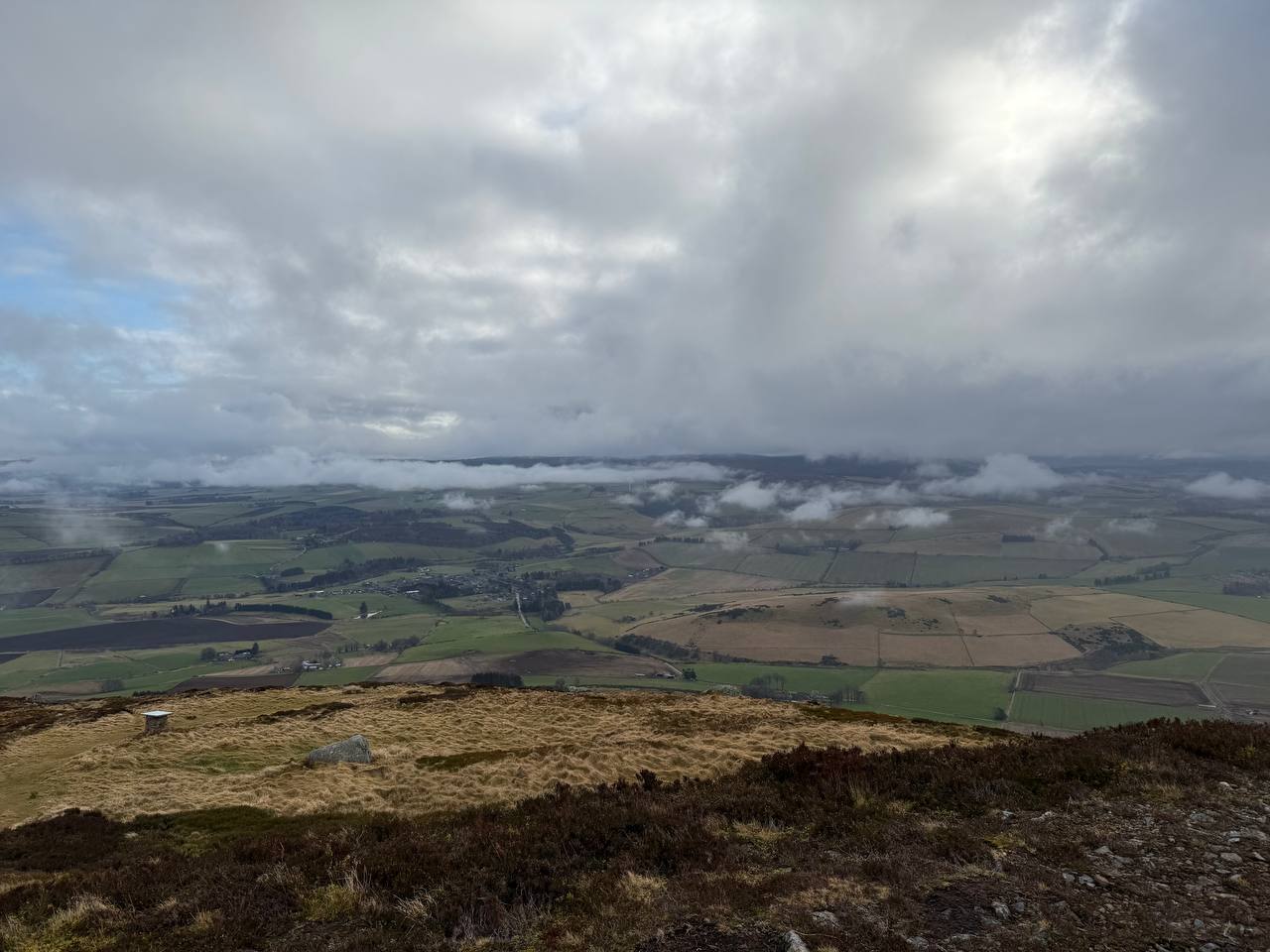
Tap O Noth Once finally out, the weather was a bit cloudy with passing snow showers, but in between the showers I was above the clouds and the air was clear: After a mild struggle on 2m, I set up the end fed the first hill and got to work from the old hill fort: The end fed worked flawlessly. Exactly as promised, switching between 7MHz, 14MHz, 21MHz and 28MHz without a tuner was perfect, I chased hills on all the bands, and had a great time. Apart from 40m, where there was absolutely no space due to a contest. That wasn t such a fun time! My fingers were bitterly cold, so on went the big gloves for the descent and I felt like I was warm by the time I made it back to the car. It worked so well, in fact, I took the 1/4 wave cheap vertical out my bag and decided to brave it on the next activation.
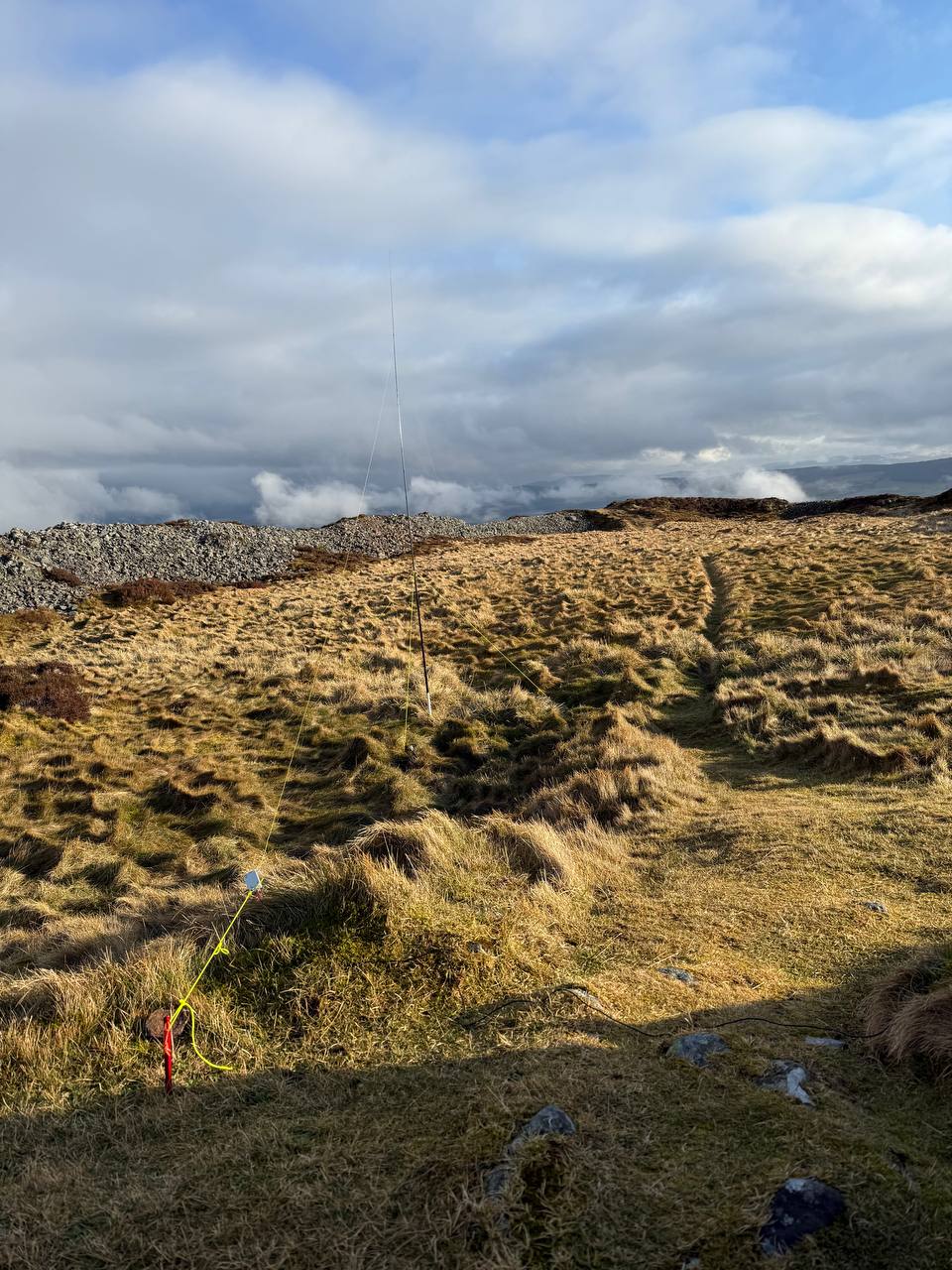
Lord Arthur s Hill GM5ALX has posted a .gpx to sotlas which is shorter than the other ascent, but much sharper - I figured this would be a fun new way to try up the hill! It takes you right through the heart of the Littlewood Park estate, and I felt a bit uncomfortable walking straight past the estate cottages, especially when there were vehicles moving and active work happening. Presumably this is where Lord Arthur lived, at the foot of his hill. I cut through the woods to the west of the cottages, disturbing some deer and many, many pheasants, but I met the path fairly quickly. From there it was a 2km walk, 300m vertical ascent. Short and sharp! At the top, I was treated to a view of the hill I had activated only an hour or so before, which is a view that always makes me smile: To get some height for the feedpoint, I wrapped the coax around my winder a couple of turns and trapped it with the elastic while draping the coax over the trig. This bought me some more height and I felt clever because of it. Maybe a pole would be easier? From here, I worked inter-G on 40m and had a wee pile up, eventually working 15 or so European stations on 20m. Pleased with that! I had been considering a third hill, but home was the call in the failing light. Back to the car I walked to find my key didn t have any battery, so out came the Audi App and I used the Internet of Things to unlock my car. The modern world is bizarre.
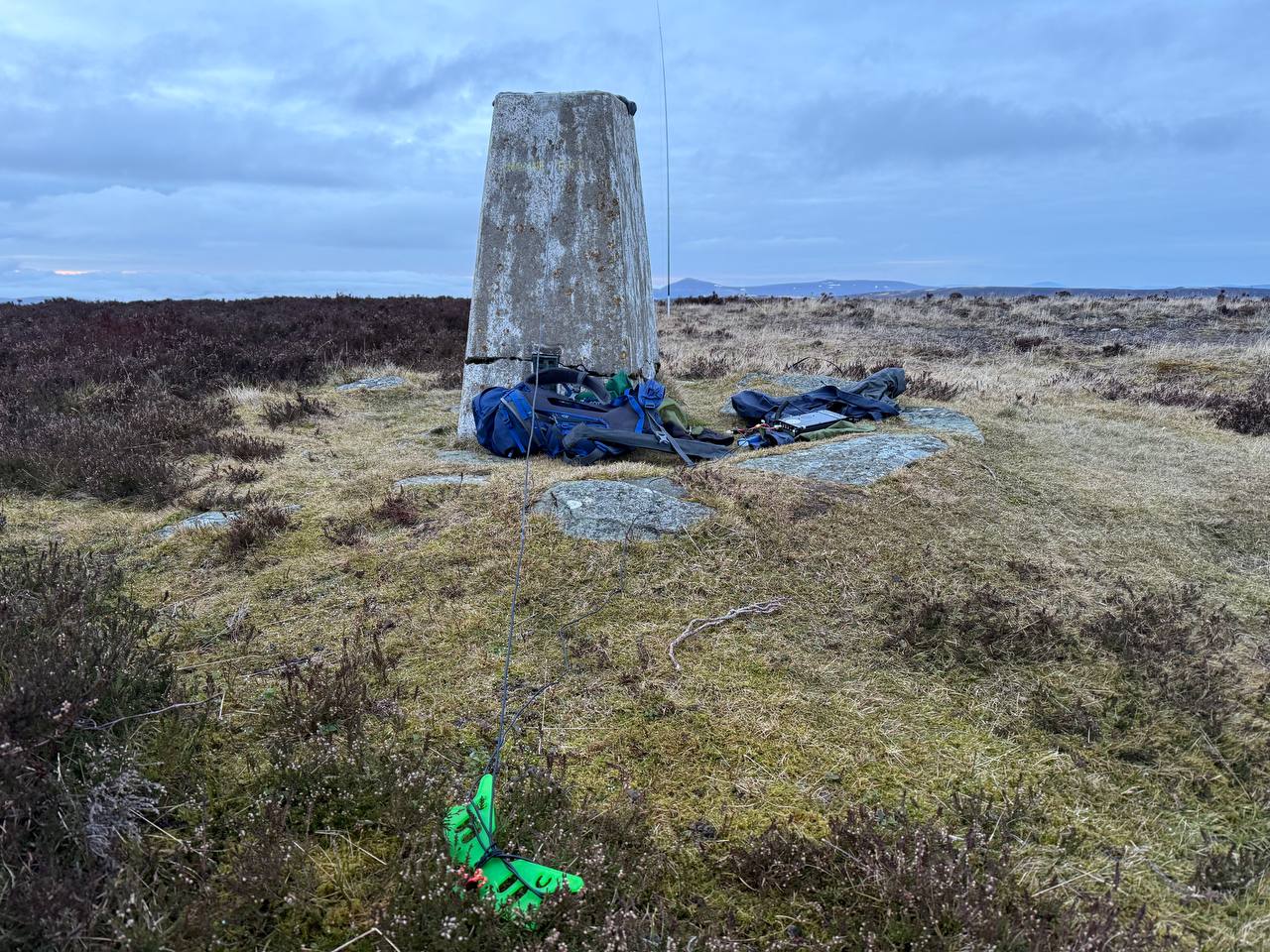
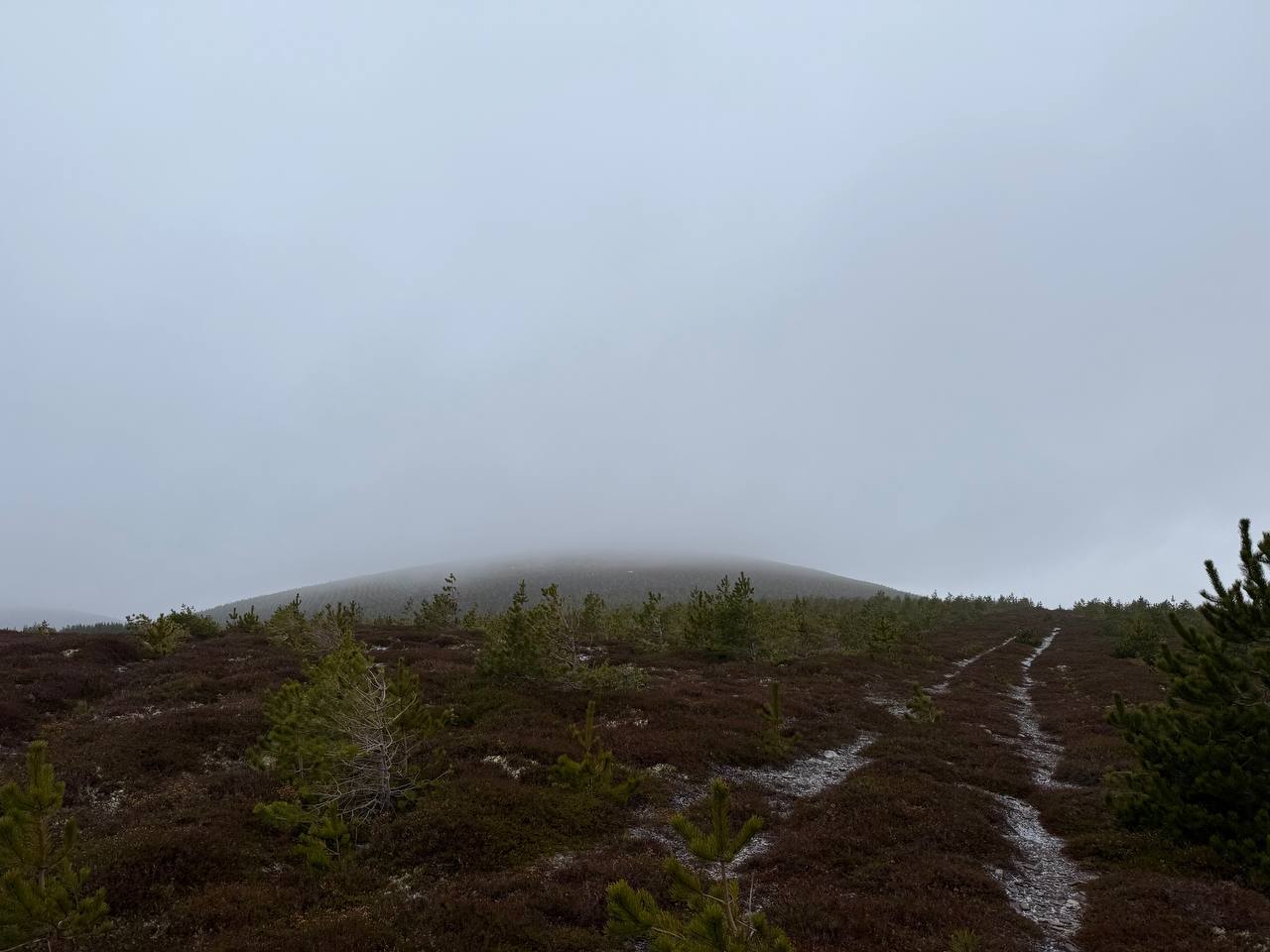
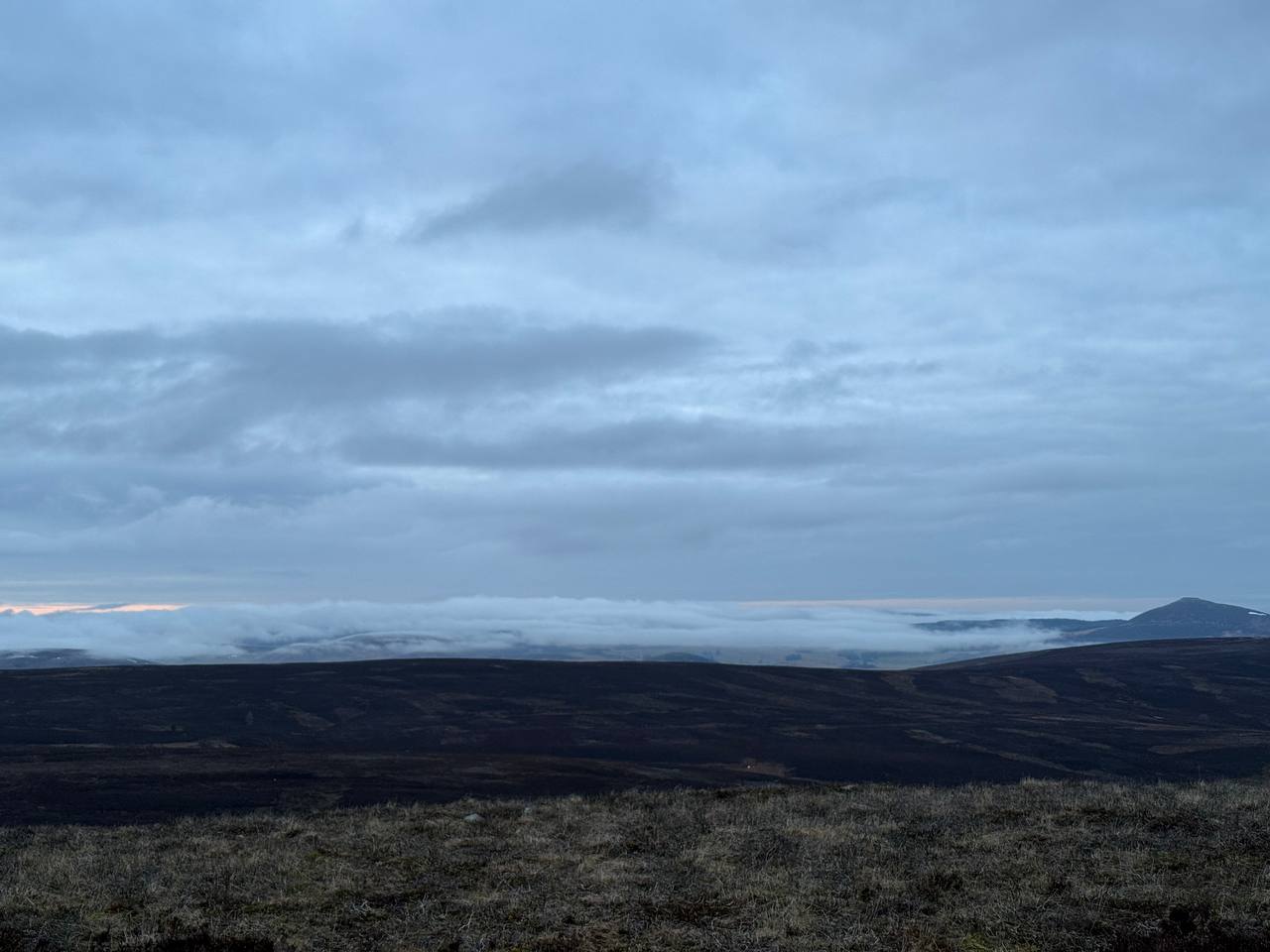
Sunday - Cloudy Head // Head in the Clouds Sunday started off migraney, so I stayed within the confines of my house until I felt safe driving! After some back and forth in my cloudy head, I opted for the easier option of Ladylea Hill as I wasn t feeling up for major physical exertion. It was a long drive, after which I felt more wonky, but I hit the path eventually - I run to Hibby Standard Time, a few hours to a few days behind the rest of GM/ES. I was ready to bail if my head didn t improve, but it turns out, fresh cold air, silence and bloodflow helped. Ladylea Hill was incredibly quiet, a feature I really appreciated. It feels incredibly remote, with a long winding drive down Glenbuchat, which still has ice on the surface of the lochs and standing water. A brooding summit crowned with grey cloud in fantastic scenery that only revealed itself upon the clouds blowing through: I set up at the cairn and picked up 30 contacts overall, split between 40m and 20m, with some inter-g on 40 and a couple of continental surprises. 20 had longer skip today, so I saw Spain, Finland, Slovenia, Poland. On teardown, I managed to snap the top segment of my brand new mast with my cold, clumsy fingers, but thankfully sotabeams stock replacements. More money at the problem, again. Back to the car, no app needed, and homeward bound as the light faded. At the end of the weekend, I find myself finally over 100 activator points and over 400 chaser points. Somehow I ve collected more points this year already than last year, the winter bonuses really do stack up!
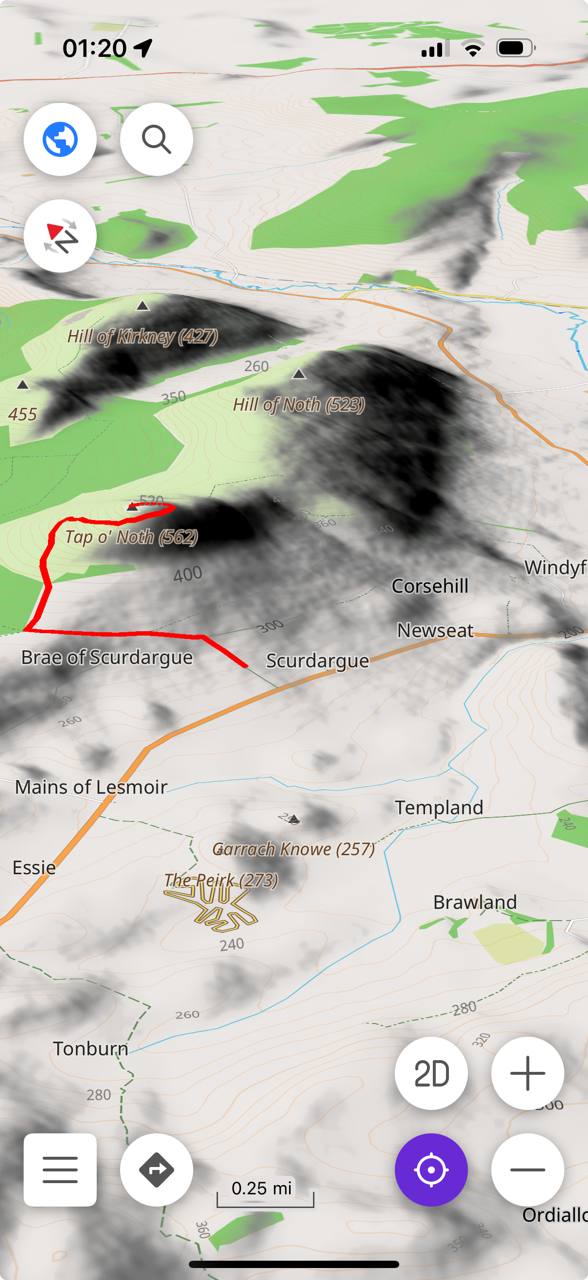
Addendum - OSMAnd & Open Street Map I ve been using OSMAnd on my iPhone quite extensively recently, I think offline mapping is super important if you re going out to get mildly lost in the hills. On more than one occasion, I have confidently set off in the wrong direction in the mist, and maps have saved my bacon! As you can download .gpx files, it s great to have them on the device and available for guidance in case you get lost, coupled with an offline map. Plus, as I drive around I love to have the dark red of a hill I ve walked appear on the map in my car dash or in my hand: This weekend I discovered it s possible to have height maps for nice 3d maps and contours marked on the map - you just need to download some additions for the maps. This is a really nice feature, it makes maps more pretty and more useful when you re in the middle of nowhere. Open Street Map also has designators for SOTA summits here and similar for POTA here GM5ALX has set to adding the summits around Scotland here. While the benefits aren t immediately obvious, it allows developers of mapping applications access to more data at no extra cost, really. It helps add depth to an already rich set of information, and allows us as radio amateurs to do more interesting things with maps and not be shackled to Apple/Google. Because it s open data, we can also fix things we find wrong as users. I like to fix road surfaces after I ve been cycling as that will feed forward to route planning through Komoot and data on my wahoo too, which can be modified with osm maps. In the future, it s possible to have an OSMAnd plugin highlighting local SOTA summits or mimicking features of sotl.as but offline. It s cool to be able to put open technologies to use like this in the field and really is the convergence point of all my favourite things!

Antoine Beaupr : A slow blogging year

Well, 2024 will be remembered, won't it? I guess 2025 already wants to make its mark too, but let's not worry about that right now, and instead let's talk about me. A little over a year ago, I was gloating over how I had such a great blogging year in 2022, and was considering 2023 to be average, then went on to gather more stats and traffic analysis... Then I said, and I quote:
I hope to write more next year. I've been thinking about a few posts I could write for work, about how things work behind the scenes at Tor, that could be informative for many people. We run a rather old setup, but things hold up pretty well for what we throw at it, and it's worth sharing that with the world...
What a load of bollocks.

A bad year for this blog 2024 was the second worst year ever in my blogging history, tied with 2009 at a measly 6 posts for the year:
anarcat@angela:anarc.at$ curl -sSL https://anarc.at/blog/   grep 'href="\./'   grep -o 20[0-9][0-9]   sort   uniq -c   sort -nr   grep -v 2025   tail -3
      6 2024
      6 2009
      3 2014
I did write about my work though, detailing the migration from Gitolite to GitLab we completed that year. But after August, total radio silence until now.

Loads of drafts It's not that I have nothing to say: I have no less than five drafts in my working tree here, not counting three actual drafts recorded in the Git repository here:
anarcat@angela:anarc.at$ git s blog
## main...origin/main
?? blog/bell-bot.md
?? blog/fish.md
?? blog/kensington.md
?? blog/nixos.md
?? blog/tmux.md
anarcat@angela:anarc.at$ git grep -l '\!tag draft'
blog/mobile-massive-gallery.md
blog/on-dying.mdwn
blog/secrets-recovery.md
I just don't have time to wrap those things up. I think part of me is disgusted by seeing my work stolen by large corporations to build proprietary large language models while my idols have been pushed to suicide for trying to share science with the world. Another part of me wants to make those things just right. The "tagged drafts" above are nothing more than a huge pile of chaotic links, far from being useful for anyone else than me, and even then. The on-dying article, in particular, is becoming my nemesis. I've been wanting to write that article for over 6 years now, I think. It's just too hard.

Writing elsewhere There's also the fact that I write for work already. A lot. Here are the top-10 contributors to our team's wiki:
anarcat@angela:help.torproject.org$ git shortlog --numbered --summary --group="format:%al"   head -10
  4272  anarcat
   423  jerome
   117  zen
   116  lelutin
   104  peter
    58  kez
    45  irl
    43  hiro
    18  gaba
    17  groente
... but that's a bit unfair, since I've been there half a decade. Here's the last year:
anarcat@angela:help.torproject.org$ git shortlog --since=2024-01-01 --numbered --summary --group="format:%al"   head -10
   827  anarcat
   117  zen
   116  lelutin
    91  jerome
    17  groente
    10  gaba
     8  micah
     7  kez
     5  jnewsome
     4  stephen.swift
So I still write the most commits! But to truly get a sense of the amount I wrote in there, we should count actual changes. Here it is by number of lines (from commandlinefu.com):
anarcat@angela:help.torproject.org$ git ls-files   xargs -n1 git blame --line-porcelain   sed -n 's/^author //p'   sort -f   uniq -ic   sort -nr   head -10
  99046 Antoine Beaupr 
   6900 Zen Fu
   4784 J r me Charaoui
   1446 Gabriel Filion
   1146 Jerome Charaoui
    837 groente
    705 kez
    569 Gaba
    381 Matt Traudt
    237 Stephen Swift
That, of course, is the entire history of the git repo, again. We should take only the last year into account, and probably ignore the tails directory, as sneaky Zen Fu imported the entire docs from another wiki there...
anarcat@angela:help.torproject.org$ find [d-s]* -type f -mtime -365   xargs -n1 git blame --line-porcelain 2>/dev/null   sed -n 's/^author //p'   sort -f   uniq -ic   sort -nr   head -10
  75037 Antoine Beaupr 
   2932 J r me Charaoui
   1442 Gabriel Filion
   1400 Zen Fu
    929 Jerome Charaoui
    837 groente
    702 kez
    569 Gaba
    381 Matt Traudt
    237 Stephen Swift
Pretty good! 75k lines. But those are the files that were modified in the last year. If we go a little more nuts, we find that:
anarcat@angela:help.torproject.org$ $ git-count-words-range.py    sort -k6 -nr   head -10
parsing commits for words changes from command: git log '--since=1 year ago' '--format=%H %al'
anarcat 126116 - 36932 = 89184
zen 31774 - 5749 = 26025
groente 9732 - 607 = 9125
lelutin 10768 - 2578 = 8190
jerome 6236 - 2586 = 3650
gaba 3164 - 491 = 2673
stephen.swift 2443 - 673 = 1770
kez 1034 - 74 = 960
micah 772 - 250 = 522
weasel 410 - 0 = 410
I wrote 126,116 words in that wiki, only in the last year. I also deleted 37k words, so the final total is more like 89k words, but still: that's about forty (40!) articles of the average size (~2k) I wrote in 2022. (And yes, I did go nuts and write a new log parser, essentially from scratch, to figure out those word diffs. I did get the courage only after asking GPT-4o for an example first, I must admit.) Let's celebrate that again: I wrote 90 thousand words in that wiki in 2024. According to Wikipedia, a "novella" is 17,500 to 40,000 words, which would mean I wrote about a novella and a novel, in the past year. But interestingly, if I look at the repository analytics. I certainly didn't write that much more in the past year. So that alone cannot explain the lull in my production here.

Arguments Another part of me is just tired of the bickering and arguing on the internet. I have at least two articles in there that I suspect is going to get me a lot of push-back (NixOS and Fish). I know how to deal with this: you need to write well, consider the controversy, spell it out, and defuse things before they happen. But that's hard work and, frankly, I don't really care that much about what people think anymore. I'm not writing here to convince people. I have stop evangelizing a long time ago. Now, I'm more into documenting, and teaching. And, while teaching, there's a two-way interaction: when you give out a speech or workshop, people can ask questions, or respond, and you all learn something. When you document, you quickly get told "where is this? I couldn't find it" or "I don't understand this" or "I tried that and it didn't work" or "wait, really? shouldn't we do X instead", and you learn. Here, it's static. It's my little soapbox where I scream in the void. The only thing people can do is scream back.

Collaboration So. Let's see if we can work together here. If you don't like something I say, disagree, or find something wrong or to be improved, instead of screaming on social media or ignoring me, try contributing back. This site here is backed by a git repository and I promise to read everything you send there, whether it is an issue or a merge request. I will, of course, still read comments sent by email or IRC or social media, but please, be kind. You can also, of course, follow the latest changes on the TPA wiki. If you want to catch up with the last year, some of the "novellas" I wrote include: (Well, no, you can't actually follow changes on a GitLab wiki. But we have a wiki-replica git repository where you can see the latest commits, and subscribe to the RSS feed.) See you there!

8 February 2025

Erich Schubert: Azul s State-of-Java report is nonsense

Azul s State-of-Java report is full of nonsense, and no worth looking at. The report claims various stuff about the adoption of AI in the Java ecosystem. But its results do not make any sense when looked at in detail. For example (in the AI section): I can only guess that people picked some random plausible answer, but were not actually using any of that. Probably because of bad incentives:

Participants were offered token compensation for their participation.
Seems like Dimensional Research, the company who did that survey, screwed up badly.

5 February 2025

Reproducible Builds: Reproducible Builds in January 2025

Welcome to the first report in 2025 from the Reproducible Builds project! Our monthly reports outline what we ve been up to over the past month and highlight items of news from elsewhere in the world of software supply-chain security when relevant. As usual, though, if you are interested in contributing to the Reproducible Builds project, please visit our Contribute page on our website. Table of contents:
  1. reproduce.debian.net
  2. Two new academic papers
  3. Distribution work
  4. On our mailing list
  5. Upstream patches
  6. diffoscope
  7. Website updates
  8. Reproducibility testing framework

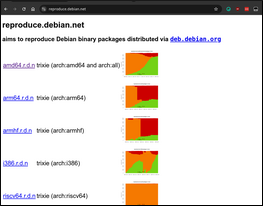
reproduce.debian.net The last few months saw the introduction of reproduce.debian.net. Announced at the recent Debian MiniDebConf in Toulouse, reproduce.debian.net is an instance of rebuilderd operated by the Reproducible Builds project. Powering that is rebuilderd, our server designed monitor the official package repositories of Linux distributions and attempt to reproduce the observed results there. This month, however, we are pleased to announce that in addition to the existing amd64.reproduce.debian.net and i386.reproduce.debian.net architecture-specific pages, we now build for a three more architectures (for a total of five) arm64 armhf and riscv64.

Two new academic papers Giacomo Benedetti, Oreofe Solarin, Courtney Miller, Greg Tystahl, William Enck, Christian K stner, Alexandros Kapravelos, Alessio Merlo and Luca Verderame published an interesting article recently. Titled An Empirical Study on Reproducible Packaging in Open-Source Ecosystem, the abstract outlines its optimistic findings:
[We] identified that with relatively straightforward infrastructure configuration and patching of build tools, we can achieve very high rates of reproducible builds in all studied ecosystems. We conclude that if the ecosystems adopt our suggestions, the build process of published packages can be independently confirmed for nearly all packages without individual developer actions, and doing so will prevent significant future software supply chain attacks.
The entire PDF is available online to view.
In addition, Julien Malka, Stefano Zacchiroli and Th o Zimmermann of T l com Paris in-house research laboratory, the Information Processing and Communications Laboratory (LTCI) published an article asking the question: Does Functional Package Management Enable Reproducible Builds at Scale?. Answering strongly in the affirmative, the article s abstract reads as follows:
In this work, we perform the first large-scale study of bitwise reproducibility, in the context of the Nix functional package manager, rebuilding 709,816 packages from historical snapshots of the nixpkgs repository[. We] obtain very high bitwise reproducibility rates, between 69 and 91% with an upward trend, and even higher rebuildability rates, over 99%. We investigate unreproducibility causes, showing that about 15% of failures are due to embedded build dates. We release a novel dataset with all build statuses, logs, as well as full diffoscopes: recursive diffs of where unreproducible build artifacts differ.
As above, the entire PDF of the article is available to view online.

Distribution work There as been the usual work in various distributions this month, such as:
  • 10+ reviews of Debian packages were added, 11 were updated and 10 were removed this month adding to our knowledge about identified issues. A number of issue types were updated also.
  • The FreeBSD Foundation announced that a planned project to deliver zero-trust builds has begun in January 2025 . Supported by the Sovereign Tech Agency, this project is centered on the various build processes, and that the primary goal of this work is to enable the entire release process to run without requiring root access, and that build artifacts build reproducibly that is, that a third party can build bit-for-bit identical artifacts. The full announcement can be found online, which includes an estimated schedule and other details.

On our mailing list On our mailing list this month:
  • Following-up to a substantial amount of previous work pertaining the Sphinx documentation generator, James Addison asked a question pertaining to the relationship between SOURCE_DATE_EPOCH environment variable and testing that generated a number of replies.
  • Adithya Balakumar of Toshiba asked a question about whether it is possible to make ext4 filesystem images reproducible. Adithya s issue is that even the smallest amount of post-processing of the filesystem results in the modification of the Last mount and Last write timestamps.
  • James Addison also investigated an interesting issue surrounding our disorderfs filesystem. In particular:
    FUSE (Filesystem in USErspace) filesystems such as disorderfs do not delete files from the underlying filesystem when they are deleted from the overlay. This can cause seemingly straightforward tests for example, cases that expect directory contents to be empty after deletion is requested for all files listed within them to fail.

Upstream patches The Reproducible Builds project detects, dissects and attempts to fix as many currently-unreproducible packages as possible. We endeavour to send all of our patches upstream where appropriate. This month, we wrote a large number of such patches, including:

diffoscope diffoscope is our in-depth and content-aware diff utility that can locate and diagnose reproducibility issues. This month, Chris Lamb made the following changes, including preparing and uploading versions 285, 286 and 287 to Debian:
  • Security fixes:
    • Validate the --css command-line argument to prevent a potential Cross-site scripting (XSS) attack. Thanks to Daniel Schmidt from SRLabs for the report. [ ]
    • Prevent XML entity expansion attacks. Thanks to Florian Wilkens from SRLabs for the report.. [ ][ ]
    • Print a warning if we have disabled XML comparisons due to a potentially vulnerable version of pyexpat. [ ]
  • Bug fixes:
    • Correctly identify changes to only the line-endings of files; don t mark them as Ordering differences only. [ ]
    • When passing files on the command line, don t call specialize( ) before we ve checked that the files are identical or not. [ ]
    • Do not exit with a traceback if paths are inaccessible, either directly, via symbolic links or within a directory. [ ]
    • Don t cause a traceback if cbfstool extraction failed.. [ ]
    • Use the surrogateescape mechanism to avoid a UnicodeDecodeError and crash when any decoding zipinfo output that is not UTF-8 compliant. [ ]
  • Testsuite improvements:
    • Don t mangle newlines when opening test fixtures; we want them untouched. [ ]
    • Move to assert_diff in test_text.py. [ ]
  • Misc improvements:
    • Drop unused subprocess imports. [ ][ ]
    • Drop an unused function in iso9600.py. [ ]
    • Inline a call and check of Config().force_details; no need for an additional variable in this particular method. [ ]
    • Remove an unnecessary return value from the Difference.check_for_ordering_differences method. [ ]
    • Remove unused logging facility from a few comparators. [ ]
    • Update copyright years. [ ][ ]
In addition, fridtjof added support for the ASAR .tar-like archive format. [ ][ ][ ][ ] and lastly, Vagrant Cascadian updated diffoscope in GNU Guix to version 285 [ ][ ] and 286 [ ][ ].
strip-nondeterminism is our sister tool to remove specific non-deterministic results from a completed build. This month version 1.14.1-1 was uploaded to Debian unstable by Chris Lamb, making the following the changes:
  • Clarify the --verbose and non --verbose output of bin/strip-nondeterminism so we don t imply we are normalizing files that we are not. [ ]
  • Bump Standards-Version to 4.7.0. [ ]

Website updates There were a large number of improvements made to our website this month, including:

Reproducibility testing framework The Reproducible Builds project operates a comprehensive testing framework running primarily at tests.reproducible-builds.org in order to check packages and other artifacts for reproducibility. In January, a number of changes were made by Holger Levsen, including:
  • reproduce.debian.net-related:
    • Add support for rebuilding the armhf architecture. [ ][ ]
    • Add support for rebuilding the arm64 architecture. [ ][ ][ ][ ]
    • Add support for rebuilding the riscv64 architecture. [ ][ ]
    • Move the i386 builder to the osuosl5 node. [ ][ ][ ][ ]
    • Don t run our rebuilders on a public port. [ ][ ]
    • Add database backups on all builders and add links. [ ][ ]
    • Rework and dramatically improve the statistics collection and generation. [ ][ ][ ][ ][ ][ ]
    • Add contact info to the main page [ ], thumbnails [ ] as well as the new, missing architectures. [ ]
    • Move the amd64 worker to the osuosl4 and node. [ ]
    • Run the underlying debrebuild script under nice. [ ]
    • Try to use TMPDIR when calling debrebuild. [ ][ ]
  • buildinfos.debian.net-related:
    • Stop creating buildinfo-pool_$ suite _$ arch .list files. [ ]
    • Temporarily disable automatic updates of pool links. [ ]
  • FreeBSD-related:
    • Fix the sudoers to actually permit builds. [ ]
    • Disable debug output for FreeBSD rebuilding jobs. [ ]
    • Upgrade to FreeBSD 14.2 [ ] and document that bmake was installed on the underlying FreeBSD virtual machine image [ ].
  • Misc:
    • Update the real year to 2025. [ ]
    • Don t try to install a Debian bookworm kernel from backports on the infom08 node which is running Debian trixie. [ ]
    • Don t warn about system updates for systems running Debian testing. [ ]
    • Fix a typo in the ZOMBIES definition. [ ][ ]
In addition:
  • Ed Maste modified the FreeBSD build system to the clean the object directory before commencing a build. [ ]
  • Gioele Barabucci updated the rebuilder stats to first add a category for network errors [ ] as well as to categorise failures without a diffoscope log [ ].
  • Jessica Clarke also made some FreeBSD-related changes, including:
    • Ensuring we clean up the object directory for second build as well. [ ][ ]
    • Updating the sudoers for the relevant rm -rf command. [ ]
    • Update the cleanup_tmpdirs method to to match other removals. [ ]
  • Jochen Sprickerhof:
  • Roland Clobus:
    • Update the reproducible_debstrap job to call Debian s debootstrap with the full path [ ] and to use eatmydata as well [ ][ ].
    • Make some changes to deduce the CPU load in the debian_live_build job. [ ]
Lastly, both Holger Levsen [ ] and Vagrant Cascadian [ ] performed some node maintenance.
If you are interested in contributing to the Reproducible Builds project, please visit our Contribute page on our website. However, you can get in touch with us via:

2 February 2025

Anuradha Weeraman: DeepSeek-R1, at the cusp of an open revolution

DeepSeek-R1, at the cusp of an open revolutionDeepSeek R1, the new entrant to the Large Language Model wars has created quite a splash over the last few weeks. Its entrance into a space dominated by the Big Corps, while pursuing asymmetric and novel strategies has been a refreshing eye-opener.GPT AI improvement was starting to show signs of slowing down, and has been observed to be reaching a point of diminishing returns as it runs out of data and compute required to train, fine-tune increasingly large models. This has turned the focus towards building "reasoning" models that are post-trained through reinforcement learning, techniques such as inference-time and test-time scaling and search algorithms to make the models appear to think and reason better. OpenAI&aposs o1-series models were the first to achieve this successfully with its inference-time scaling and Chain-of-Thought reasoning.
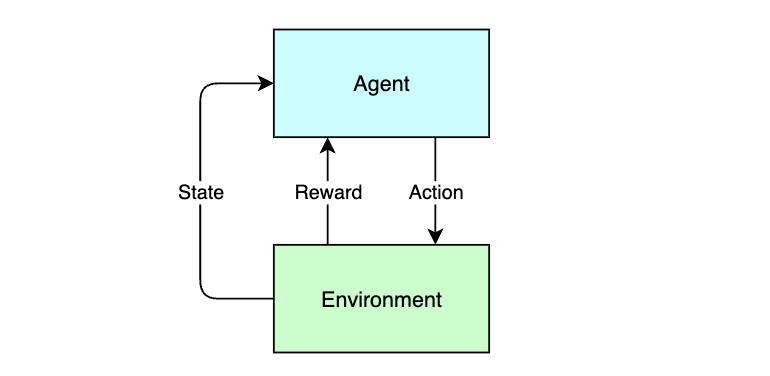
Intelligence as an emergent property of Reinforcement Learning (RL)Reinforcement Learning (RL) has been successfully used in the past by Google&aposs DeepMind team to build highly intelligent and specialized systems where intelligence is observed as an emergent property through rewards-based training approach that yielded achievements like AlphaGo (see my post on it here - AlphaGo: a journey to machine intuition).DeepMind went on to build a series of Alpha* projects that achieved many notable feats using RL:
  • AlphaGo, defeated the world champion Lee Seedol in the game of Go
  • AlphaZero, a generalized system that learned to play games such as Chess, Shogi and Go without human input
  • AlphaStar, achieved high performance in the complex real-time strategy game StarCraft II.
  • AlphaFold, a tool for predicting protein structures which significantly advanced computational biology.
  • AlphaCode, a model designed to generate computer programs, performing competitively in coding challenges.
  • AlphaDev, a system developed to discover novel algorithms, notably optimizing sorting algorithms beyond human-derived methods.
All of these systems achieved mastery in its own area through self-training/self-play and by optimizing and maximizing the cumulative reward over time by interacting with its environment where intelligence was observed as an emergent property of the system.
DeepSeek-R1, at the cusp of an open revolutionThe RL feedback loop
RL mimics the process through which a baby would learn to walk, through trial, error and first principles.

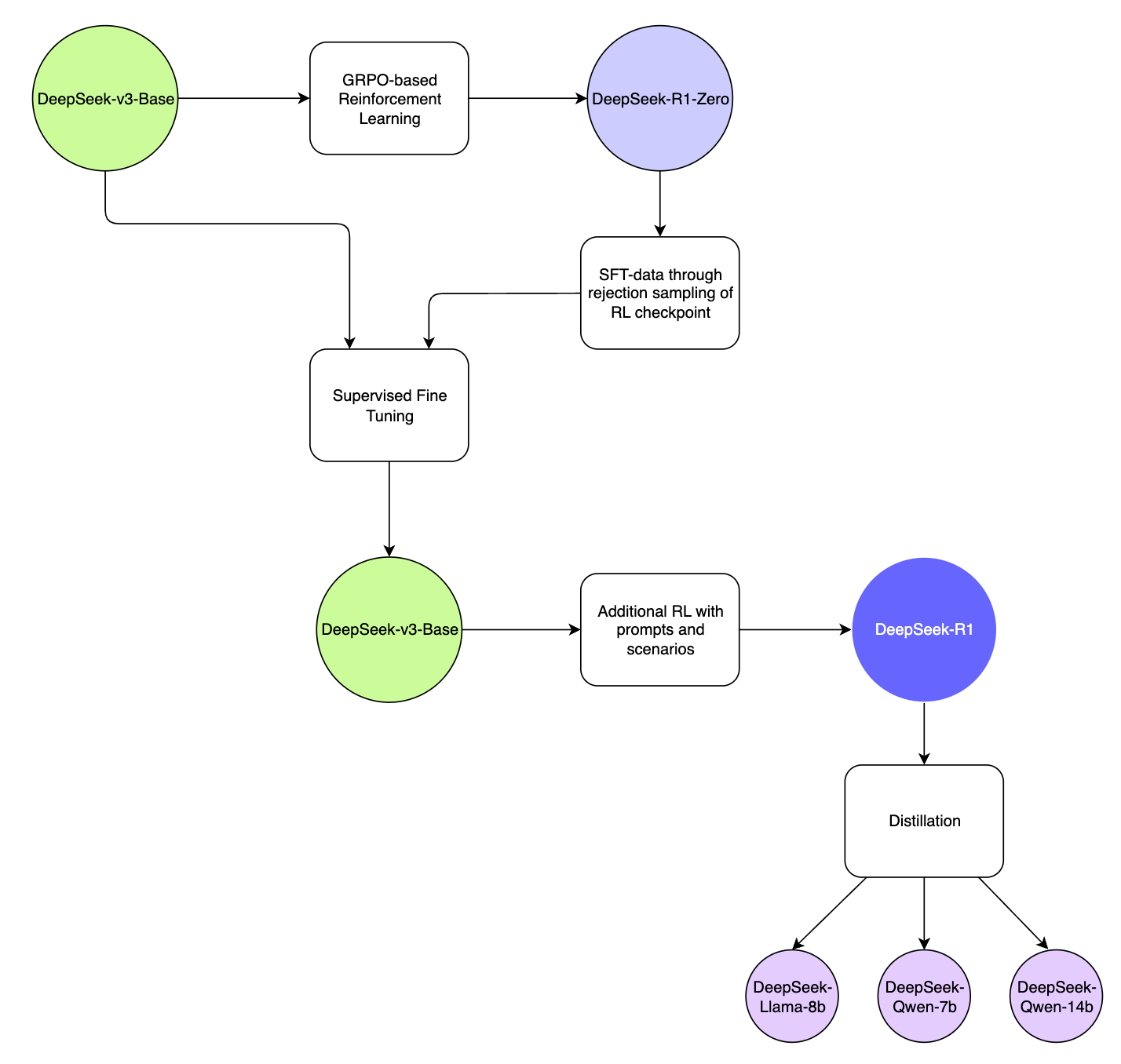
R1 model training pipelineAt a technical level, DeepSeek-R1 leverages a combination of Reinforcement Learning (RL) and Supervised Fine-Tuning (SFT) for its training pipeline:
DeepSeek-R1, at the cusp of an open revolutionDeepSeek-R1 Model Training Pipeline
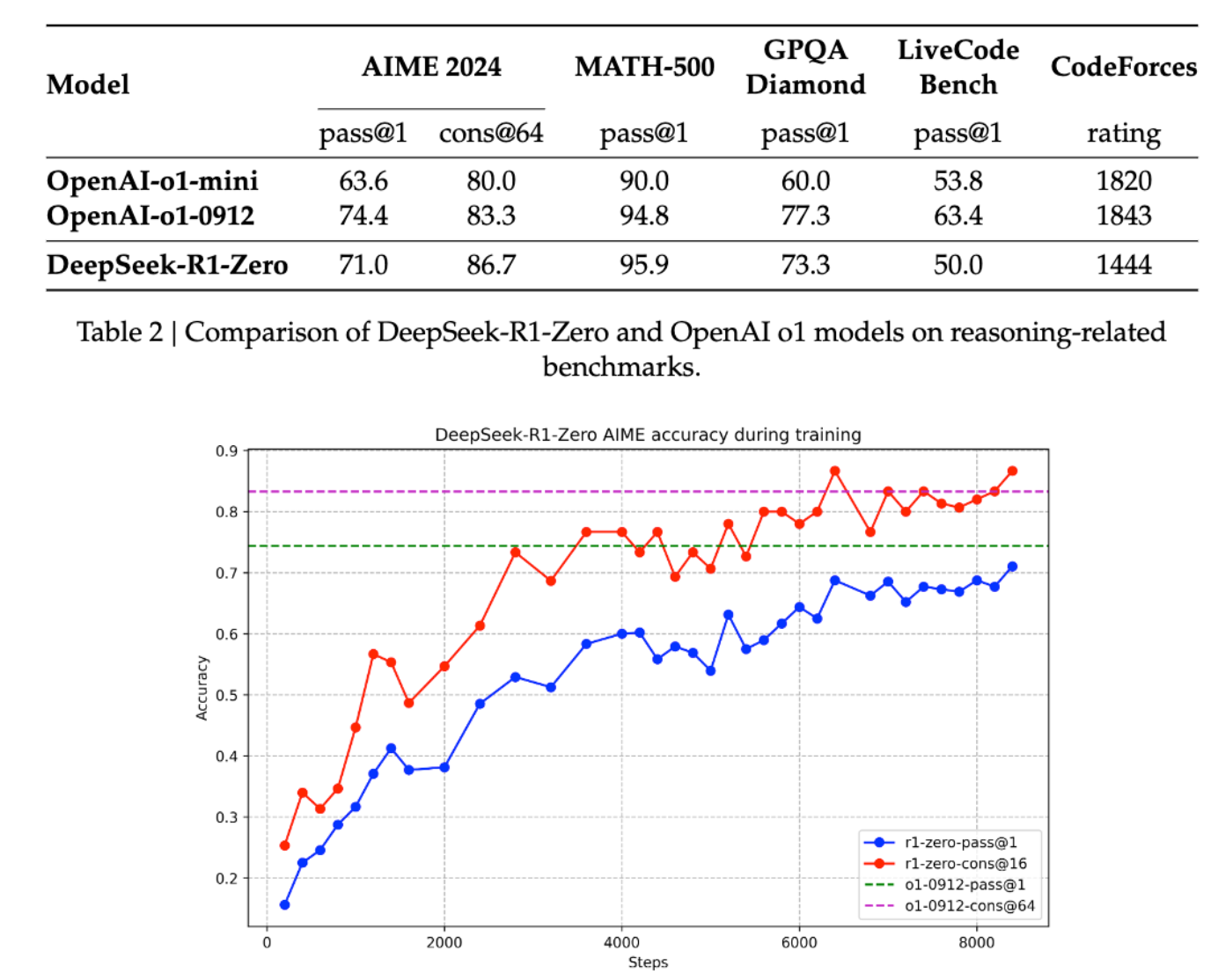
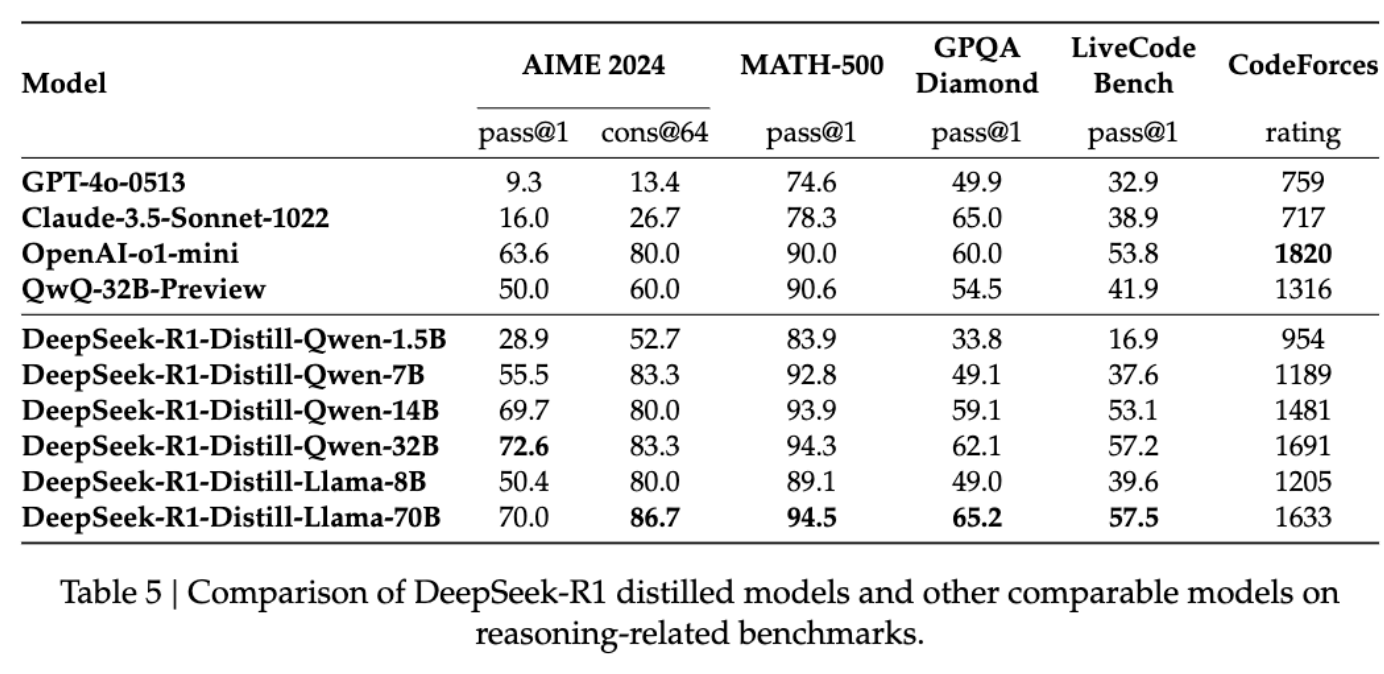
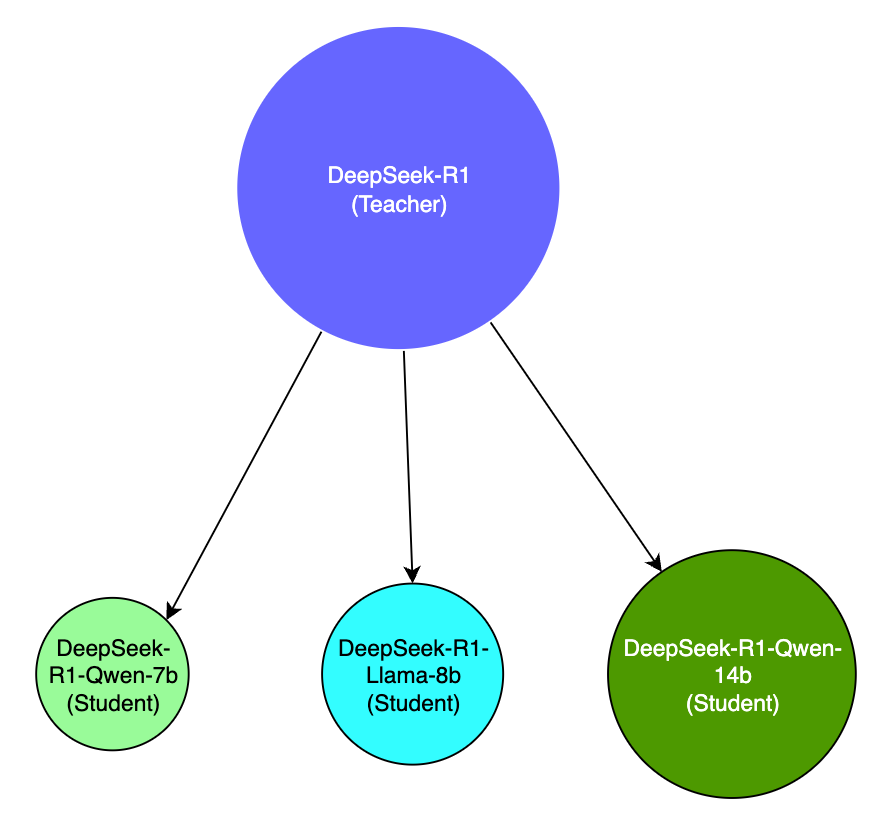
Using RL and DeepSeek-v3, an interim reasoning model was built, called DeepSeek-R1-Zero, purely based on RL without relying on SFT, which demonstrated superior reasoning capabilities that matched the performance of OpenAI&aposs o1 in certain benchmarks such as AIME 2024.The model was however affected by poor readability and language-mixing and is only an interim-reasoning model built on RL principles and self-evolution.DeepSeek-R1-Zero was then used to generate SFT data, which was combined with supervised data from DeepSeek-v3 to re-train the DeepSeek-v3-Base model.The new DeepSeek-v3-Base model then underwent additional RL with prompts and scenarios to come up with the DeepSeek-R1 model.The R1-model was then used to distill a number of smaller open source models such as Llama-8b, Qwen-7b, 14b which outperformed bigger models by a large margin, effectively making the smaller models more accessible and usable.

Key contributions of DeepSeek-R1
  1. RL without the need for SFT for emergent reasoning capabilities
R1 was the first open research project to validate the efficacy of RL directly on the base model without relying on SFT as a first step, which resulted in the model developing advanced reasoning capabilities purely through self-reflection and self-verification.Although, it did degrade in its language capabilities during the process, its Chain-of-Thought (CoT) capabilities for solving complex problems was later used for further RL on the DeepSeek-v3-Base model which became R1. This is a significant contribution back to the research community.The below analysis of DeepSeek-R1-Zero and OpenAI o1-0912 shows that it is viable to attain robust reasoning capabilities purely through RL alone, which can be further augmented with other techniques to deliver even better reasoning performance.
DeepSeek-R1, at the cusp of an open revolutionSource: https://github.com/deepseek-ai/DeepSeek-R1
Its quite interesting, that the application of RL gives rise to seemingly human capabilities of "reflection", and arriving at "aha" moments, causing it to pause, ponder and focus on a specific aspect of the problem, resulting in emergent capabilities to problem-solve as humans do.
  1. Model distillation
DeepSeek-R1 also demonstrated that larger models can be distilled into smaller models which makes advanced capabilities accessible to resource-constrained environments, such as your laptop. While its not possible to run a 671b model on a stock laptop, you can still run a distilled 14b model that is distilled from the larger model which still performs better than most publicly available models out there. This enables intelligence to be brought closer to the edge, to allow faster inference at the point of experience (such as on a smartphone, or on a Raspberry Pi), which paves way for more use cases and possibilities for innovation.
DeepSeek-R1, at the cusp of an open revolutionSource: https://github.com/deepseek-ai/DeepSeek-R1
Distilled models are very different to R1, which is a massive model with a completely different model architecture than the distilled variants, and so are not directly comparable in terms of capability, but are instead built to be more smaller and efficient for more constrained environments. This technique of being able to distill a larger model&aposs capabilities down to a smaller model for portability, accessibility, speed, and cost will bring about a lot of possibilities for applying artificial intelligence in places where it would have otherwise not been possible. This is another key contribution of this technology from DeepSeek, which I believe has even further potential for democratization and accessibility of AI.
DeepSeek-R1, at the cusp of an open revolution

Why is this moment so significant?DeepSeek-R1 was a pivotal contribution in many ways.
  1. The contributions to the state-of-the-art and the open research helps move the field forward where everybody benefits, not just a few highly funded AI labs building the next billion dollar model.
  2. Open-sourcing and making the model freely available follows an asymmetric strategy to the prevailing closed nature of much of the model-sphere of the larger players. DeepSeek should be commended for making their contributions free and open.
  3. It reminds us that its not just a one-horse race, and it incentivizes competition, which has already resulted in OpenAI o3-mini a cost-effective reasoning model which now shows the Chain-of-Thought reasoning. Competition is a good thing.
  4. We stand at the cusp of an explosion of small-models that are hyper-specialized, and optimized for a specific use case that can be trained and deployed cheaply for solving problems at the edge. It raises a lot of exciting possibilities and is why DeepSeek-R1 is one of the most pivotal moments of tech history.
Truly exciting times. What will you build?

31 January 2025

Gunnar Wolf: ChatGPT is bullshit

This post is an unpublished review for ChatGPT is bullshit
As people around the world understand how LLMs behave, more and more people wonder as to why these models hallucinate, and what can be done about to reduce it. This provocatively named article by Michael Townsen Hicks, James Humphries and Joe Slater bring is an excellent primer to better understanding how LLMs work and what to expect from them. As humans carrying out our relations using our language as the main tool, we are easily at awe with the apparent ease with which ChatGPT (the first widely available, and to this day probably the best known, LLM-based automated chatbot) simulates human-like understanding and how it helps us to easily carry out even daunting data aggregation tasks. It is common that people ask ChatGPT for an answer and, if it gets part of the answer wrong, they justify it by stating that it s just a hallucination. Townsen et al. invite us to switch from that characterization to a more correct one: LLMs are bullshitting. This term is formally presented by Frankfurt [1]. To Bullshit is not the same as to lie, because lying requires to know (and want to cover) the truth. A bullshitter not necessarily knows the truth, they just have to provide a compelling description, regardless of what is really aligned with truth. After introducing Frankfurt s ideas, the authors explain the fundamental ideas behind LLM-based chatbots such as ChatGPT; a Generative Pre-trained Transformer (GPT) s have as their only goal to produce human-like text, and it is carried out mainly by presenting output that matches the input s high-dimensional abstract vector representation, and probabilistically outputs the next token (word) iteratively with the text produced so far. Clearly, a GPT s ask is not to seek truth or to convey useful information they are built to provide a normal-seeming response to the prompts provided by their user. Core data are not queried to find optimal solutions for the user s requests, but are generated on the requested topic, attempting to mimic the style of document set it was trained with. Erroneous data emitted by a LLM is, thus, not equiparable with what a person could hallucinate with, but appears because the model has no understanding of truth; in a way, this is very fitting with the current state of the world, a time often termed as the age of post-truth [2]. Requesting an LLM to provide truth in its answers is basically impossible, given the difference between intelligence and consciousness: Following Harari s definitions [3], LLM systems, or any AI-based system, can be seen as intelligent, as they have the ability to attain goals in various, flexible ways, but they cannot be seen as conscious, as they have no ability to experience subjectivity. This is, the LLM is, by definition, bullshitting its way towards an answer: their goal is to provide an answer, not to interpret the world in a trustworthy way. The authors close their article with a plea for literature on the topic to adopt the more correct bullshit term instead of the vacuous, anthropomorphizing hallucination . Of course, being the word already loaded with a negative meaning, it is an unlikely request. This is a great article that mixes together Computer Science and Philosophy, and can shed some light on a topic that is hard to grasp for many users. [1] Frankfurt, Harry (2005). On Bullshit. Princeton University Press. [2] Zoglauer, Thomas (2023). Constructed truths: truth and knowledge in a post-truth world. Springer. [3] Harari, Yuval Noah (2023. Nexus: A Brief History of Information Networks From the Stone Age to AI. Random House.

Divine Attah-Ohiemi: Seeking Opportunities: Building a Career in Software Engineering and Beyond

My journey in CS has always been driven by curiosity, determination, and a deep love for understanding software solutions at its tiniest, most complex levels. Taking ALX Africa Software Engineer track after High school was where it all started for me. During the 1-year intensive bootcamp, I delved into the intricacies of Linux programming and low-level programming with C, which solidified my foundational knowledge. This experience not only enhanced my technical skills but also taught me the importance of adaptability and self-directed learning. I discovered how to approach challenges with curiosity, igniting a passion for exploring software solutions in their most intricate forms. Each module pushed me to think critically and creatively, transforming my understanding of technology and its capabilities. Let s just say that I have always been drawn to asking, How does this happen?" And I just go on and on until I find an answer eventually and sometimes I don t but that s okay. That curiosity, combined with a deep commitment to learning, has guided my journey. Debian Webmaster My drive has led me to get involved in open-source contributions, where I can put my knowledge to the test while helping my community. Engaging with real-world experts and learning from my mistakes has been invaluable. One of the highlights of this journey was joining the Debian Webmasters team as an intern through Outreachy. Here, I have the honor of working on redesigning and migrating the old Debian webpages to make them more user-friendly. This experience not only allows me to apply my skills in a practical setting but also deepens my understanding of collaborative software development. Building My Skills: The Foundation of My Experience Throughout my academic and professional journey, I have taken on many roles that have shaped my skills and prepared me for what s ahead I believe. I am definitely not a one-trick pony, and maybe not completely a jack of all trade either but I am a bit diverse I d like to think. Here are the key roles that have defined my journey so far: Volunteer Developer at Yoris Africa (June 2022 - August 2023) I began my career by volunteering at Yoris, where I collaborated with a talented team to design and build the frontend for a mobile app. My contributions extended beyond just the frontend; I also worked on backend solutions and microservices, gaining hands-on experience in full-stack development. This role was instrumental in shaping my understanding of software architecture, allowing me to contribute meaningfully to projects while learning from experienced developers in a dynamic environment. Freelance Academics Software Developer (September 2023 - October 2024) I freelanced as an academic software developer, where I pitched and developed software solutions for universities in my community. One of my most notable projects was creating a Computer-Based Testing (CBT) software for a medical school, which featured a unique questionnaire and scoring system tailored to their specific needs. This experience not only allowed me to apply my technical skills in a real-world setting but also deepened my understanding of educational software requirements and user experience, ultimately enhancing the learning process for students. Open Source Intern at Debian Webmaster Team (November 2024 -) Perhaps the most transformative experience has been my role as an intern at Debian Webmasters. This opportunity allowed me to delve into the fascinating world of open source. As an intern, I have the chance to work on a project where we are redesigning and migrating the Debian webpages to utilize a new and faster technology: Go templates with Hugo. For a detailed look at the work and progress I made during my internship, as well as information on this project and how to get involved, you can check out the wiki. My ultimate goal with this role is to build a vibrant community for Debian in Africa and, if given the chance, to host a debian-cd mirror for faster installations in my region. You can connect with me through LinkedIn, or X (formerly Twitter), or reach out via email.

24 January 2025

Scarlett Gately Moore: KDE: Snaps bug fixes and Kubuntu: Noble updates

Fixed a major crash bug in our apps that use webengine, I also went ahead and updated these to core24 https://bugs.launchpad.net/snapd/+bug/2095418 andhttps://bugs.kde.org/show_bug.cgi?id=498663 Fixed okular
Can t import certificates to digitally sign in Okular https://bugs.kde.org/show_bug.cgi?id=498558 Can t open files https://bugs.kde.org/show_bug.cgi?id=421987 and https://bugs.kde.org/show_bug.cgi?id=415711 Skanpage won t launch https://bugs.kde.org/show_bug.cgi?id=493847 in edge please help test. Ghostwriter https://bugs.kde.org/show_bug.cgi?id=481258
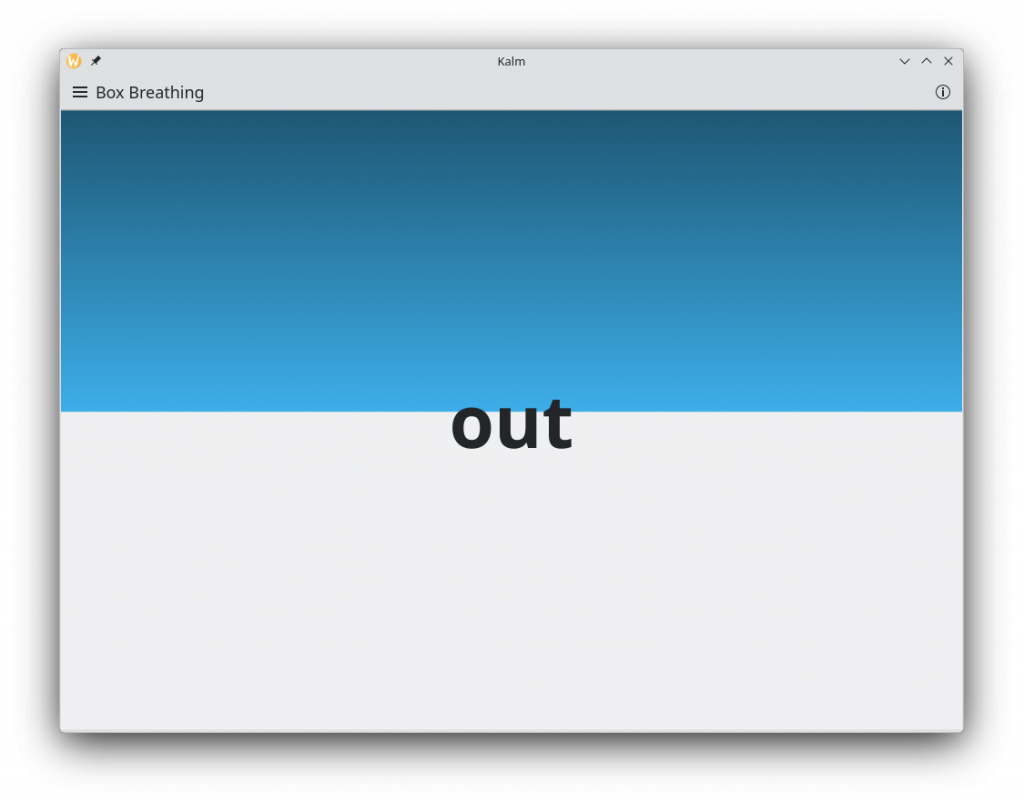
Kalm - Breathing techniques
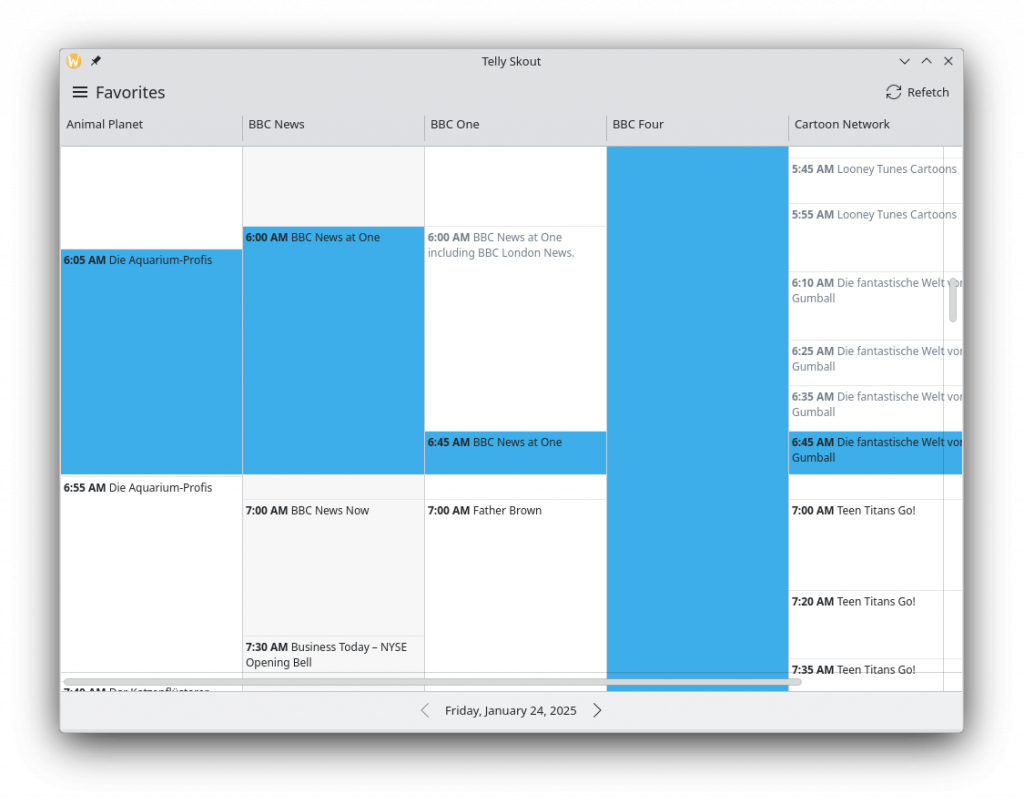
New KDE Snaps! Kalm Breathing techniques
Telly-skout Display TV guides Kubuntu: Plasma 5.27.12 has been uploaded to archive proposed and should make the .2 release! I hate asking but I am unemployable with this broken arm fiasco. If you could spare anything it would be appreciated! https://gofund.me/573cc38e

20 January 2025

Divine Attah-Ohiemi: Progress Report: First Half of My Outreachy Internship

Hello everyone!, I m excited to share a progress report on my Outreachy internship with the Debian community. As I reach the halfway point of this journey, I want to reflect on what I ve accomplished so far and outline my modified goals for the second half of the internship. In truth, there wasn t a strict timeline for my project migrating Debian webpage content to Hugo because the original repository contained thousands of pages. The initial goal was to develop a proof of concept for: Thanks to our daily standups, where we brainstorm and revise contributions, we ve made significant progress. The wiki documentation discussing the technical decisions taken to meet these goals is currently in progress here. During the first half of my internship, I have improved and refined my skills in several areas. I learned new Markdown syntaxes, studied and utilized Apache's mod_rewrite, and halfway studied GNU Make to use Perl scripts for processing data for dynamic content. I recommend Managing Projects with GNU Make by Robert Mecklenburg it's a great book for beginners! While I didn t get stuck on any particular goal, the most challenging aspect was adding Hugo aliases to help with Apache's multilingual content negotiation. The way the webwml repository generates multilingual content differs from debianhugo. For instance, in webwml, the structure looks like this: english/index.wml -> /index.en.html (with a symlink from index.html to index.en.html) and french/index.wml -> /index.fr.html. In contrast, debianhugo uses en/_index.md -> /index.html and fr/_index.md -> /fr/index.html. Apache's multilingual content negotiation checks for index.<user preferred lang code>.html in the current directory, which works well with webwml since all related translations are generated in the same directory. However, with debianhugo using subdirectories for languages other than English, we had to set up aliases for every other language page to be generated in the frontmatter. For example, in fr/_index.md, we added this to the front matter:
...
aliases:
  - /index.fr.html
...
This setup allows Hugo to generate multilingual HTML files in the initial home directory solely for the purpose of setting up a 301 redirect to the same page in the language subdirectory. However, if the client sets their preferred language to English, Apache content negotiation tries to find /index.en.html. If it doesn t find it, it defaults to any other language-suffixed file, which can lead to unexpected behavior. For example, if English is set as the preferred language, accessing the site may serve /index.fr.html, which then redirects to /fr/index.html. This was a significant challenge, and you can see a demo of this hosted here. If I were to start the project over, I would document every decision as I make them in the wiki, no matter how rough the documentation turns out. Waiting until the midpoint of the project to document was not a good idea. As I move into the second half of my internship, the goals we ve set include improving our project wiki documentation and continuing the migration process while enhancing the user experience of complicated sections. I m looking forward to making even more progress and sharing my journey with you all. Happy coding!

19 January 2025

Petter Reinholdtsen: 121 packages in Debian mapped to hardware for automatic recommendation

For some years now, I have been working on a automatic hardware based package recommendation system for Debian and other Linux distributions. The isenkram system I started on back in 2013 now consist of two subsystems, one locating firmware files using the information provided by apt-file, and one matching hardware to packages using information provided by AppStream. The former is very similar to the mechanism implemented in debian-installer to pick the right firmware packages to install. This post is about the latter system. Thanks to steady progress and good help from both other Debian and upstream developers, I am happy to report that the Isenkram system now are able to recommend 121 packages using information provided via AppStream. The mapping is done using modalias information provided by the kernel, the same information used by udev when creating device files, and the kernel when deciding which kernel modules to load. To get all the modalias identifiers relevant for your machine, you can run the following command on the command line:
find /sys/devices -name modalias -print0   xargs -0 sort -u
The modalias identifiers can look something like this:
acpi:PNP0000
cpu:type:x86,ven0000fam0006mod003F:feature:,0000,0001,0002,0003,0004,0005,0006,0007,0008,0009,000B,000C,000D,000E,000F,0010,0011,0013,0015,0016,0017,0018,0019,001A,001B,001C,001D,001F,002B,0034,003A,003B,003D,0068,006B,006C,006D,006F,0070,0072,0074,0075,0076,0078,0079,007C,0080,0081,0082,0083,0084,0085,0086,0087,0088,0089,008B,008C,008D,008E,008F,0091,0092,0093,0094,0095,0096,0097,0098,0099,009A,009B,009C,009D,009E,00C0,00C5,00E1,00E3,00EB,00ED,00F0,00F1,00F3,00F5,00F6,00F9,00FA,00FB,00FD,00FF,0100,0101,0102,0103,0111,0120,0121,0123,0125,0127,0128,0129,012A,012C,012D,0140,0160,0161,0165,016C,017B,01C0,01C1,01C2,01C4,01C5,01C6,01F9,024A,025A,025B,025C,025F,0282
dmi:bvnDellInc.:bvr2.18.1:bd08/14/2023:br2.18:svnDellInc.:pnPowerEdgeR730:pvr:rvnDellInc.:rn0H21J3:rvrA09:cvnDellInc.:ct23:cvr:skuSKU=NotProvided
pci:v00008086d00008D3Bsv00001028sd00000600bc07sc80i00
platform:serial8250
scsi:t-0x05
usb:v413CpA001d0000dc09dsc00dp00ic09isc00ip00in00
The entries above are a selection of the complete set available on a Dell PowerEdge R730 machine I have access to, to give an idea about the various styles of hardware identifiers presented in the modalias format. When looking up relevant packages in a Debian Testing installation on the same R730, I get this list of packages proposed:
% sudo isenkram-lookup
firmware-bnx2x
firmware-nvidia-graphics
firmware-qlogic
megactl
wsl
%
The list consist of firmware packages requested by kernel modules, as well packages with program to get the status from the RAID controller and to maintain the LAN console. When the edac-utils package providing tools to check the ECC RAM status will enter testing in a few days, it will also show up as a proposal from isenkram. In addition, once the mfiutil package we uploaded in October get past the NEW processing, it will also propose a tool to configure the RAID controller. Another example is the trusty old Lenovo Thinkpad X230, which have hardware handled by several packages in the archive. This is running on Debian Stable:
% isenkram-lookup 
beignet-opencl-icd
bluez
cheese
ethtool
firmware-iwlwifi
firmware-misc-nonfree
fprintd
fprintd-demo
gkrellm-thinkbat
hdapsd
libpam-fprintd
pidgin-blinklight
thinkfan
tlp
tp-smapi-dkms
tpb
%
Here there proposal consist of software to handle the camera, bluetooth, network card, wifi card, GPU, fan, fingerprint reader and acceleration sensor on the machine. Here is the complete set of packages currently providing hardware mapping via AppStream in Debian Unstable: air-quality-sensor, alsa-firmware-loaders, antpm, array-info, avarice, avrdude, bmusb-v4l2proxy, brltty, calibre, colorhug-client, concordance-common, consolekit, dahdi-firmware-nonfree, dahdi-linux, edac-utils, eegdev-plugins-free, ekeyd, elogind, firmware-amd-graphics, firmware-ath9k-htc, firmware-atheros, firmware-b43-installer, firmware-b43legacy-installer, firmware-bnx2, firmware-bnx2x, firmware-brcm80211, firmware-carl9170, firmware-cavium, firmware-intel-graphics, firmware-intel-misc, firmware-ipw2x00, firmware-ivtv, firmware-iwlwifi, firmware-libertas, firmware-linux-free, firmware-mediatek, firmware-misc-nonfree, firmware-myricom, firmware-netronome, firmware-netxen, firmware-nvidia-graphics, firmware-qcom-soc, firmware-qlogic, firmware-realtek, firmware-ti-connectivity, fpga-icestorm, g810-led, galileo, garmin-forerunner-tools, gkrellm-thinkbat, goldencheetah, gpsman, gpstrans, gqrx-sdr, i8kutils, imsprog, ledger-wallets-udev, libairspy0, libam7xxx0.1, libbladerf2, libgphoto2-6t64, libhamlib-utils, libm2k0.9.0, libmirisdr4, libnxt, libopenxr1-monado, libosmosdr0, librem5-flash-image, librtlsdr0, libticables2-8, libx52pro0, libykpers-1-1, libyubikey-udev, limesuite, linuxcnc-uspace, lomoco, madwimax, media-player-info, megactl, mixxx, mkgmap, msi-keyboard, mu-editor, mustang-plug, nbc, nitrokey-app, nqc, ola, openfpgaloader, openocd, openrazer-driver-dkms, pcmciautils, pcscd, pidgin-blinklight, ponyprog, printer-driver-splix, python-yubico-tools, python3-btchip, qlcplus, rosegarden, scdaemon, sispmctl, solaar, spectools, sunxi-tools, t2n, thinkfan, tlp, tp-smapi-dkms, trezor, tucnak, ubertooth, usbrelay, uuu, viking, w1retap, wsl, xawtv, xinput-calibrator, xserver-xorg-input-wacom and xtrx-dkms. In addition to these, there are several with patches pending in the Debian bug tracking system, and even more where no-one wrote patches yet. Good candiates for the latter are packages with udev rules but no AppStream hardware information. The isenkram system consist of two packages, isenkram-cli with the command line tools, and isenkram with a GUI background process. The latter will listen for dbus events from udev emitted when new hardware become available (like when inserting a USB dongle or discovering a new bluetooth device), look up the modalias entry for this piece of hardware in AppStream (and a hard coded list of mappings from isenkram - currently working hard to move this list to AppStream), and pop up a dialog proposing to install any not already installed packages supporting this hardware. It work very well today when inserting the LEGO Mindstorms RCX, NXT and EV3 controllers. :) If you want to make sure more hardware related packages get recommended, please help out fixing the remaining packages in Debian to provide AppStream metadata with hardware mappings. As usual, if you use Bitcoin and want to show your support of my activities, please send Bitcoin donations to my address 15oWEoG9dUPovwmUL9KWAnYRtNJEkP1u1b.

13 January 2025

Freexian Collaborators: Monthly report about Debian Long Term Support, December 2024 (by Roberto C. S nchez)

Like each month, have a look at the work funded by Freexian s Debian LTS offering.

Debian LTS contributors In December, 19 contributors have been paid to work on Debian LTS, their reports are available:
  • Abhijith PA did 14.0h (out of 14.0h assigned).
  • Adrian Bunk did 47.75h (out of 53.0h assigned and 47.0h from previous period), thus carrying over 52.25h to the next month.
  • Andrej Shadura did 6.0h (out of 17.0h assigned and -7.0h from previous period after hours given back), thus carrying over 4.0h to the next month.
  • Bastien Roucari s did 22.0h (out of 22.0h assigned).
  • Ben Hutchings did 15.0h (out of 0.0h assigned and 18.0h from previous period), thus carrying over 3.0h to the next month.
  • Chris Lamb did 18.0h (out of 18.0h assigned).
  • Daniel Leidert did 23.0h (out of 17.0h assigned and 9.0h from previous period), thus carrying over 3.0h to the next month.
  • Emilio Pozuelo Monfort did 32.25h (out of 40.5h assigned and 19.5h from previous period), thus carrying over 27.75h to the next month.
  • Guilhem Moulin did 22.5h (out of 9.75h assigned and 12.75h from previous period).
  • Jochen Sprickerhof did 2.0h (out of 3.5h assigned and 6.5h from previous period), thus carrying over 8.0h to the next month.
  • Lee Garrett did 8.5h (out of 14.75h assigned and 45.25h from previous period), thus carrying over 51.5h to the next month.
  • Lucas Kanashiro did 32.0h (out of 10.0h assigned and 54.0h from previous period), thus carrying over 32.0h to the next month.
  • Markus Koschany did 40.0h (out of 20.0h assigned and 20.0h from previous period).
  • Roberto C. S nchez did 13.5h (out of 6.75h assigned and 17.25h from previous period), thus carrying over 10.5h to the next month.
  • Santiago Ruano Rinc n did 18.75h (out of 24.75h assigned and 0.25h from previous period), thus carrying over 6.25h to the next month.
  • Sean Whitton did 6.0h (out of 2.0h assigned and 4.0h from previous period).
  • Sylvain Beucler did 10.5h (out of 21.5h assigned and 38.5h from previous period), thus carrying over 49.5h to the next month.
  • Thorsten Alteholz did 11.0h (out of 11.0h assigned).
  • Tobias Frost did 12.0h (out of 12.0h assigned).

Evolution of the situation In December, we have released 29 DLAs. The LTS Team has published updates to several notable packages. Contributor Guilhem Moulin published an update of php7.4, a widely-used open source general purpose scripting language, which addressed denial of service, authorization bypass, and information disclosure vulnerabilities. Contributor Lucas Kanashiro published an update of clamav, an antivirus toolkit for Unix and Linux, which addressed denial of service and authorization bypass vulnerabilities. Finally, contributor Tobias Frost published an update of intel-microcode, the microcode for Intel microprocessors, which well help to ensure that processor hardware is protected against several local privilege escalation and local denial of service vulnerabilities. Beyond our customary LTS package updates, the LTS Team has made contributions to Debian s stable bookworm release and its experimental section. Notably, contributor Lee Garrett published a stable update of dnsmasq. The LTS update was previously published in November and in December Lee continued working to bring the same fixes (addressing the high profile KeyTrap and NSEC3 vulnerabilities) to the dnsmasq package in Debian bookworm. This package was accepted for inclusion in the Debian 12.9 point release scheduled for January 2025. Addititionally, contributor Sean Whitton provided assistance, via upload sponsorships, to the Debian maintainers of xen. This assistance resulted in two uploads of xen into Debian s experimental section, which will contribute to the next Debian stable release having a version of xen with better longterm support from the upstream development team.

Thanks to our sponsors Sponsors that joined recently are in bold.

12 January 2025

Divine Attah-Ohiemi: My 30-Day Outreachy Experience with the Debian Community

Hey everyone! It s Divine Attah-Ohiemi here, and I m excited to share what I ve been up to in my internship with the Debian community. It s been a month since I began this journey, and if you re thinking about applying for Outreachy, let me give you a glimpse into my project and the amazing people I get to work with. So, what s it like in the Debian community? It s a fantastic mix of folks from all walks of life seasoned developers, curious newbies, and everyone in between. What really stands out is how welcoming everyone is. I m especially thankful to my mentors, Thomas Lange, Carsten Schoenert, and Subin Siby, for their guidance and for always clocking in whenever I have questions. It feels like a big family where you can share your ideas and learn from each other. The commitment to diversity and merit is palpable, making it a great place for anyone eager to jump in and contribute. Now, onto the project! We re working on improving the Debian website by switching from WML (Web Meta Language) to Hugo, a modern static site generator. This change doesn t just make the site faster; it significantly reduces the time it takes to build compared to WML. Plus, it makes it way easier for non-developers to contribute and add pages since the content is built from Markdown files. It s all about enhancing the experience for both new and existing users. My role involves developing a proof of concept for this transition. I m migrating existing pages while ensuring that old links still work, so users won t run into dead ends. It s a bit of a juggling act, but knowing that my work is helping to make Debian more accessible is incredibly rewarding. What gets me most excited is the chance to contribute to a project that s been around for over 20 years! It s an honor to be part of something so significant and to help shape its future. How cool is it to know that what I m doing will impact users around the globe? In the past month, I ve learned a bunch of new things. For instance, I ve been diving into Apache's mod_rewrite to automatically map old multilingual URLs to new ones. This is important since Hugo handles localization differently than WML. I ve also been figuring out how to set up 301 redirects to prevent dead links, which is crucial for a smooth user experience. One of the more confusing parts has been using GNU Make to manage Perl scripts for dynamic pages. It s a bit of a learning curve, but I m tackling it head-on. Each challenge is a chance to grow, and I m here for it! If you re considering applying to the Debian community through Outreachy, I say go for it! There s so much to learn and experience, and you ll be welcomed with open arms. Happy coding, everyone!

Sahil Dhiman: Prosody Certificate Management With Nginx and Certbot

I have a self-hosted XMPP chat server through Prosody. Earlier, I struggled with certificate renewal and generation for Prosody because I have Nginx (and a bunch of other services) running on the same server which binds to Port 80. Due to this, Certbot wasn t able to auto-renew (through HTTP validation) for domains managed by Prosody. Now, I have cobbled together a solution to keep both Nginx and Prosody happy. This is how I did it:
server  
      listen 80;
      listen [::]:80;
      server_name PROSODY.DOMAIN;
      root <ANY_NGINX_WRITABLE_LOCATION>;
      location ~ /.well-known/acme-challenge  
         allow all;
       
 
0 0 * * * prosodyctl --root cert import /etc/letsencrypt/live/PROSODY.DOMAIN
Explanation from Prosody docs:
Certificates and their keys are copied to /etc/prosody/certs (can be changed with the certificates option) and then it signals Prosody to reload itself. root lets prosodyctl write to paths that may not be writable by the prosody user, as is common with /etc/prosody.

7 January 2025

Enrico Zini: Debugging printing to a remote printer

I upgraded to Debian testing/trixie, and my network printer stopped appearing in print dialogs. These are notes from the debugging session. Check firewall configuration I tried out kde, which installed plasma-firewall, which installed firewalld, which closed by default the ports used for printing. For extra fun, appindicators are not working in Gnome and so firewall-applet is currently useless, although one can run firewall-config manually, or use the command line that might be more user friendly than the UI. Step 1: change the zone for the home wifi to "Home":
firewall-cmd  --zone home --list-interfaces
firewall-cmd  --zone home --add-interface wlp1s0
Step 2: make sure the home zone can print:
firewall-cmd --zone home --list-services
firewall-cmd --zone home --add-service=ipp
firewall-cmd --zone home --add-service=ipp-client
firewall-cmd --zone home --add-service=mdns
I searched and searched but I could not find out whether ipp is needed, ipp-client is needed, or both are needed. Check if avahi can see the printer Is the printer advertised correctly over mdns? When it didn't work:
$ avahi-browse -avrt
= wlp1s0 IPv6 Brother HL-2030 series @ server                UNIX Printer         local
   hostname = [server.local]
   address = [...ipv6 address...]
   port = [0]
   txt = []
= wlp1s0 IPv4 Brother HL-2030 series @ server                UNIX Printer         local
   hostname = [server.local]
   address = [...ipv4 address...]
   port = [0]
   txt = []
$ avahi-browse -rt _ipp._tcp
[empty]
When it works:
$ avahi-browse -avrt
= wlp1s0 IPv6 Brother HL-2030 series @ server                Secure Internet Printer local
   hostname = [server.local]
   address = [...ipv6 address...]
   port = [631]
   txt = ["printer-type=0x1046" "printer-state=3" "Copies=T" "TLS=1.2" "UUID= " "URF=DM3" "pdl=application/octet-stream,application/pdf,application/postscript,image/jpeg,image/png,image/pwg-raster,image/urf" "product=(HL-2030 series)" "priority=0" "note=" "adminurl=https://server.local.:631/printers/Brother_HL-2030_series" "ty=Brother HL-2030 series, using brlaser v6" "rp=printers/Brother_HL-2030_series" "qtotal=1" "txtvers=1"]
= wlp1s0 IPv6 Brother HL-2030 series @ server                UNIX Printer         local
   hostname = [server.local]
   address = [...ipv6 address...]
   port = [0]
   txt = []
= wlp1s0 IPv4 Brother HL-2030 series @ server                Secure Internet Printer local
   hostname = [server.local]
   address = [...ipv4 address...]
   port = [631]
   txt = ["printer-type=0x1046" "printer-state=3" "Copies=T" "TLS=1.2" "UUID= " "URF=DM3" "pdl=application/octet-stream,application/pdf,application/postscript,image/jpeg,image/png,image/pwg-raster,image/urf" "product=(HL-2030 series)" "priority=0" "note=" "adminurl=https://server.local.:631/printers/Brother_HL-2030_series" "ty=Brother HL-2030 series, using brlaser v6" "rp=printers/Brother_HL-2030_series" "qtotal=1" "txtvers=1"]
= wlp1s0 IPv4 Brother HL-2030 series @ server                UNIX Printer         local
   hostname = [server.local]
   address = [...ipv4 address...]
   port = [0]
   txt = []
$ avahi-browse -rt _ipp._tcp
+ wlp1s0 IPv6 Brother HL-2030 series @ server                Internet Printer     local
+ wlp1s0 IPv4 Brother HL-2030 series @ server                Internet Printer     local
= wlp1s0 IPv4 Brother HL-2030 series @ server                Internet Printer     local
   hostname = [server.local]
   address = [...ipv4 address...]
   port = [631]
   txt = ["printer-type=0x1046" "printer-state=3" "Copies=T" "TLS=1.2" "UUID= " "URF=DM3" "pdl=application/octet-stream,application/pdf,application/postscript,image/jpeg,image/png,image/pwg-raster,image/urf" "product=(HL-2030 series)" "priority=0" "note=" "adminurl=https://server.local.:631/printers/Brother_HL-2030_series" "ty=Brother HL-2030 series, using brlaser v6" "rp=printers/Brother_HL-2030_series" "qtotal=1" "txtvers=1"]
= wlp1s0 IPv6 Brother HL-2030 series @ server                Internet Printer     local
   hostname = [server.local]https://bugs.debian.org/cgi-bin/bugreport.cgi?bug=1092109
   address = [...ipv6 address...]
   port = [631]
   txt = ["printer-type=0x1046" "printer-state=3" "Copies=T" "TLS=1.2" "UUID= " "URF=DM3" "pdl=application/octet-stream,application/pdf,application/postscript,image/jpeg,image/png,image/pwg-raster,image/urf" "product=(HL-2030 series)" "priority=0" "note=" "adminurl=https://server.local.:631/printers/Brother_HL-2030_series" "ty=Brother HL-2030 series, using brlaser v6" "rp=printers/Brother_HL-2030_series" "qtotal=1" "txtvers=1"]
Check if cups can see the printer From CUPS' Using Network Printers:
$ /usr/sbin/lpinfo --include-schemes dnssd -v
network dnssd://Brother%20HL-2030%20series%20%40%20server._ipp._tcp.local/cups?uuid= 
Debugging session interrupted At this point, the printer appeared. It could be that: In the end, debugging failed successfully, and this log now remains as a reference for possible further issues.

2 January 2025

Colin Watson: Free software activity in December 2024

Most of my Debian contributions this month were sponsored by Freexian, as well as one direct donation via Liberapay (thanks!). OpenSSH I issued a bookworm update with a number of fixes that had accumulated over the last year, especially fixing GSS-API key exchange which was quite broken in bookworm. base-passwd A few months ago, the adduser maintainer started a discussion with me (as the base-passwd maintainer) and the shadow maintainer about bringing all three source packages under one team, since they often need to cooperate on things like user and group names. I agreed, but hadn t got round to doing anything about it until recently. I ve now officially moved it under team maintenance. debconf Gioele Barabucci has been working on eliminating duplicated code between debconf and cdebconf, ultimately with the goal of migrating to cdebconf (which I m not sure I m convinced of as a goal, but if we can make improvements to both packages as part of working towards it then there s no harm in that). I finally got round to reviewing and merging confmodule changes in each of debconf and cdebconf. This caused an installer regression due to a weirdness in cdebconf-udeb s packaging, which I fixed - sorry about that! I ve also been dealing with a few patch submissions that had been in my queue for a long time, but more on that next month if all goes well. CI issues I noticed and fixed a problem with Restrictions: needs-sudo in autopkgtest. I fixed broken aptly images in the Salsa CI pipeline. Python team Last month, I mentioned some progress on sorting out the multipart vs. python-multipart name conflict in Debian (#1085728), and said that I thought we d be able to finish it soon. I was right! We got it all done this month: The Python 3.13 transition continues, and last month we were able to add it to the supported Python versions in testing. (The next step will be to make it the default.) I fixed lots of problems in aid of this, including: Sphinx 8.0 removed some old intersphinx_mapping syntax which turned out to still be in use by many packages in Debian. The fixes for this were individually trivial, but there were a lot of them: I found that twisted 24.11.0 broke tests in buildbot and wokkel, and fixed those. I packaged python-flatdict, needed for a new upstream version of python-semantic-release. I tracked down a test failure in vdirsyncer (which I ve been using for some years, but had never previously needed to modify) and contributed a fix upstream. I fixed some packages to tolerate future versions of dh-python that will drop their dependency on python3-setuptools: I fixed django-cte to remove a build-dependency on the obsolete python3-nose package. I added Django 5.1 support to django-polymorphic. (There are a number of other packages that still need work here.) I fixed various other build/test failures: I upgraded these packages to new upstream versions: I updated the team s library style guide to remove material related to Python 2 and early versions of Python 3, which is no longer relevant to any current Python packaging work. Other Python upstream work I happened to notice a Twisted upstream issue requesting the removal of the deprecated twisted.internet.defer.returnValue, realized it was still used in many places in Debian, and went on a PR-filing spree informed by codesearch to try to reduce the future impact of such a change on Debian: Other small fixes Santiago Vila has been building the archive with make --shuffle (also see its author s explanation). I fixed associated bugs in cccc (contributed upstream), groff, and spectemu. I backported an upstream patch to putty to fix undefined behaviour that affected use of the small keypad . I removed groff s Recommends: libpaper1 (#1091375, #1091376), since it isn t currently all that useful and was getting in the way of a transition to libpaper2. I filed an upstream bug suggesting better integration in this area.

1 January 2025

Russ Allbery: 2024 Book Reading in Review

In 2024, I finished and reviewed 46 books, not counting another three books I've finished but not yet reviewed and which will therefore roll over to 2025. This is slightly fewer books than the last couple of years, but more books than 2021. Reading was particularly spotty this year, with much of the year's reading packed into late November and December. This was a year in which I figured out I was trying to do too much, but did not finish figuring out what to do about it. Reading and particularly reviewing reflected that, with long silent periods and then attempts to catch up. One of the goals for next year is to find a more sustainable balance for the hobbies in my life, including reading. My favorite books I read this year were Ashley Herring Blake's Bright Falls sapphic romance trilogy: Delilah Green Doesn't Care, Astrid Parker Doesn't Fail, and Iris Kelly Doesn't Date. These are not perfect books, but they made me laugh, made me cry, and were impossible to put down. My thanks to a video from BookTuber Georgia Marie for the recommendation. I Shall Wear Midnight was the best of the remaining Pratchett novels. It's the penultimate Tiffany Aching book and, in my opinion, the best. All of the elements of the previous books come together in snarky competence porn that was a delight to read. The best book I read last year was Mark Lawrence's The Book That Wouldn't Burn, which much to my surprise did not make a single award list for its publication year of 2023. It was a tour de force of world-building that surprised me multiple times. Unfortunately, the sequel was not as good and I fear the series may be heading in the wrong direction. I am attempting to stay hopeful about the upcoming third and concluding book. I didn't read much non-fiction this year, but the best of what I did read was Zeke Faux's Number Go Up about the cryptocurrency bubble. This book will not change anyone's mind, but it's a readable and entertaining summary of some of the more obvious cryptocurrency scams. I also had enough quibbles with it to write an extended review, which is a compliment of sorts. The Discworld read-through is done, so I may either start or return to another series re-read in 2025. I have a huge backlog of all sorts of books, though, so we will see how the year goes. As always, I have no specific numeric goals, just a hope that I can make time for regular and varied reading and maintain a rhythm with writing reviews. The full analysis includes some additional personal reading statistics, probably only of interest to me.

31 December 2024

Chris Lamb: Favourites of 2024

Here are my favourite books and movies that I read and watched throughout 2024. It wasn't quite the stellar year for books as previous years: few of those books that make you want to recommend and/or buy them for all your friends. In subconscious compensation, perhaps, I reread a few classics (e.g. True Grit, Solaris), and I'm almost finished my second read of War and Peace.

Books

Elif Batuman: Either/Or (2022) Stella Gibbons: Cold Comfort Farm (1932) Michel Faber: Under The Skin (2000) Wallace Stegner: Crossing to Safety (1987) Gustave Flaubert: Madame Bovary (1857) Rachel Cusk: Outline (2014) Sara Gran: The Book of the Most Precious Substance (2022) Anonymous: The Railway Traveller s Handy Book (1862) Natalie Hodges: Uncommon Measure: A Journey Through Music, Performance, and the Science of Time (2022)Gary K. Wolf: Who Censored Roger Rabbit? (1981)

Films Recent releases

Seen at a 2023 festival. Disappointments this year included Blitz (Steve McQueen), Love Lies Bleeding (Rose Glass), The Room Next Door (Pedro Almod var) and Emilia P rez (Jacques Audiard), whilst the worst new film this year was likely The Substance (Coralie Fargeat), followed by Megalopolis (Francis Ford Coppola), Unfrosted (Jerry Seinfeld) and Joker: Folie Deux (Todd Phillips).
Older releases ie. Films released before 2023, and not including rewatches from previous years. Distinctly unenjoyable watches included The Island of Dr. Moreau (John Frankenheimer, 1996), Southland Tales (Richard Kelly, 2006), Any Given Sunday (Oliver Stone, 1999) & The Hairdresser s Husband (Patrice Leconte, 19990). On the other hand, unforgettable cinema experiences this year included big-screen rewatches of Solaris (Andrei Tarkovsky, 1972), Blade Runner (Ridley Scott, 1982), Apocalypse Now (Francis Ford Coppola, 1979) and Die Hard (John McTiernan, 1988).

29 December 2024

Emmanuel Kasper: Accessing Atari ST disk images on Linux

This post leverages support for Atari Hard Disk Interface Partition (AHDI) partition tables in the Linux kernel, activated by default in Debian, and in the parted partition editor. Accessing the content of a partition using a user mounted loop device This is the easiest procedure and should be tried to first. Depending if your Linux kernel has support for AHDI partition tables, and the size of the FAT system on the partition, this procedure might not work. In that case, try the procedure using mtools further below. Attach a disk image called hd80mb.image to a loop device:
$ udisksctl loop-setup --file hd80mb.image
Mapped file hd80mb.image as /dev/loop0
Notice how the kernel detected the partition table:
$ dmesg   grep loop0
[160892.151941] loop0: detected capacity change from 0 to 164138
[160892.171061]  loop0: AHDI p1 p2 p3 p4
Inspect the block devices created for each partition:
$ lsblk   grep loop0
If the partitions are not already mounted by udisks2 under /media/, mount them manually:
$ sudo mount /dev/loop0p1 /mnt/
$ ls /mnt/
SHDRIVER.SYS
When you are finished copying data, unmount the partition, and detach the loop device.
$ sudo umount /mnt
$ udisksctl loop-delete --block-device /dev/loop0
Accessing the content of a partition using mtools and parted This procedure uses the mtools package and the support for the AHDI partition scheme in the parted partition editor. Display the partition table, with partitions offsets in bytes:
$ parted st_mint-1.5.img -- unit B print
...
Partition Table: atari
Disk Flags: 
Number  Start       End         Size        Type     File system  Flags
 1      1024B       133170175B  133169152B  primary               boot
 2      133170176B  266339327B  133169152B  primary
 3      266339328B  399508479B  133169152B  primary
 4      399508480B  532676607B  133168128B  primary
Set some Atari-friendly mtools options:
$ export MTOOLS_SKIP_CHECK=1
$ export MTOOLS_NO_VFAT=1
List the content of the partition, passing as parameter the offset in bytes of the partition: For instance here we are interested in the second partition, and the parted output above indicates that this partition starts at byte offset 133170176 in the disk image.
$ mdir -s -i st_mint-1.5.img@@133170176
 Volume in drive : has no label
Directory for ::/
demodata          2024-08-27  11:43 
        1 file                    0 bytes
Directory for ::/demodata
We can also use the command mcopy with a similar syntax to copy data from and to the disk image. For instance we copy a file named file.zip to the root directory of the second partition:
$ mcopy -s -i st_mint-1.5.img@@133170176 file.zip ::
Recompiling mtools to access large partitions With disk images having large AHDI partitions (well considered large in 1992 ), you might encounter the error
mdir -s -i cecile-falcon-singlepart-1GB.img@@1024
init: sector size too big
Cannot initialize '::'
This error is caused by the non-standard large logical sectors that the TOS uses for large FAT partitions (see the Atari Hard Disk Filesystem reference on page 41, TOS partitions size) We can inspect the logical sector size using fsck tools:
$ udiskctl loop-setup --file cecile-falcon-singlepart-1GB.img
$ sudo fsck.fat -Anv /dev/loop0p1
fsck.fat 4.2 (2021-01-31)
...
Media byte 0xf8 (hard disk)
16384 bytes per logical sector
To access the partition, you need to patch mtools, so that it supports a logical sector size of 16384 bytes. For this you need to change the MAX_SECTOR macro from 8192 to 16384 in msdos.h in the mtools distribution and recompile. A rebuilt mtools is then able to access the partition:
$ /usr/local/bin/mdir -s -i cecile-falcon-singlepart-1GB.img@@1024
 Volume in drive : has no label
Directory for ::/
CECILE   SYS      8462 1998-03-27  22:42 
NEWDESK  INF       804 2024-09-09   9:23 
        2 files               9 266 bytes
                      1 072 463 872 bytes free

Next.

Previous.