Search Results: "Stefano Zacchiroli"

13 September 2009

Stefano Zacchiroli: RC bugs of the week - week 2

RCBW - week #2 The RC squashing game has apparently worked fine for me also this week, and it has been as fun as the first :-) . This week summary follows. PS the horrible acronym in the title stands for "Release Critical Bugs of the Week"; it is part of my shameless marketing campaign to make the initiative spread.

6 September 2009

Stefano Zacchiroli: rc bug of the day - again

8 RC bugs in 8 days I got back from vacation about 10 days ago. For the first time in recent years, I've spent 2 weeks of vacation mostly without email (excluding 2 "breaks" of 10 minutes each in an internet point, just to verify that my electronic world was not collapsing). The net result is that I feel very recharged and more productive both at work and for other tasks. Including Debian. Hence, during last week, I've tried an experiment. When during the day I feel bored about a given task, instead of reloading compulsively the page of an online newspaper, instead of checking (once more) my email, instead of checking (once more) my feeds, I try to fix an RC bug. For the first week, the result has been encouraging: one RC bug fixed per day (on the average, some day I haven't fixed any, some other 2 or 3): In some sense, this try to be kudos to the amazing initiative of Sesse, a few releases ago (or was it Lenny? my memory still sucks, no matter how recharged I feel). He has been fixing one RC bug a day for several months. I'm quite sure I won't be able to deliver the same result, but maybe this post will motivate other people, so that collectively we can fix a handful of RC bugs per day. Of course in the beginning it's easy, because there are a lot of "simple" bugs to fix and also because (as you can notice in the list above) "clusters" of similar RC bugs, that require similar fixes, can be identified. But the effort is useful nevertheless, since it cleans up RC bug list enabling more capable people to fix more resistent bugs. I'm gonna tag RC reports like this one with "rc" and "debian". If people follow up with similar initiatives we can rinse out of planet a feed of pretty good news for the Debian development community :-) In the interest of sharing best practices, here is my RC bug squashing workflow:
  1. go to http://bts.turmzimmer.net/details.php, choose "both" (i.e. squeeze + sid) as distribution and sort by "bugnr" (so that you can avoid most recent reports, which are not yet NMU material)
  2. choose an inspiring bug form the list which is at least 1 week old (better at least 2 or 3), study its log; for the moment, I tend to prefer neglected bug logs, where the maintainer has been unresponsive
  3. apt-get source package , sudo cowbuilder --build package_1.2-3.dsc , install the result and check for bug reproducibility
  4. fix the bug ! (yes, this is the easy step :-) ), taking care of not changing anything else
  5. dch --nmu
  6. dpkg-source -b package-1.2/ , sudo cowbuilder --build package_1.2-3.1.dsc , check if the bug is fixed and the package otherwise working
  7. lintian package_1.2-3.1.changes , check that there are no regressions in lintian errors wrt latest uploaded version
  8. interdiff -z package_1.2-3.diff.gz package_1.2-3.1.diff.gz , check that no unexpected changes have slipped in
  9. debsign package_1.2-3.1*changes , dput -e 2 package_1.2-3.1*changes (as allowed by devref 5.11.1)
  10. nmudiff --delay 2 , in the text: briefly describe in what the patch consists, and mention devref 5.11.1
I welcome suggestions on how to improve the above workflow in order to be both more effective and more polite with maintainers (FWIW, all the maintainer feedback I've received thus far for the above NMUs has been totally positive: you rock guys.).

Stefano Zacchiroli: on copyright notices

(... and the BSD license) Two comments about Romain's recent REJECT.
  1. The specific case concerns a BSD-licensed source file. With respect to copyright notices BSD is rather peculiar, as can be read in the license text, at its second point
    Redistributions in binary form must reproduce the above
    copyright notice, this list of conditions and the following
    disclaimer in the documentation and/or other materials
    provided with the distribution.
    
    
    So, the requirement of mentioning in debian/copyright authors (or, more precisely, all copyright owners appearing in a given source package) has nothing to do with DFSG, it is a requirement imposed by the license itself.
  2. I actually don't think that there is no will to do a move on this issue , quite the contrary. The last time the issue was raised (remember the giantic thread on copyright authors of several months ago?), I got the impression that there is a widespread will of getting rid of the burden of maintaining copyright lists up to date. What is not clear is whether, for licenses other than BSD, it is actually legally acceptable to do that. This issue is one of the pending questions that has been posed (by the DPL) to the SPI lawyer. AFAIK, no answer has been received yet. I "just" lack a bit more of visibility on these issues (e.g. a wiki page with pending queries to SPI lawyer) so that we avoid running in circles, as we are doing here.

5 June 2009

Stefano Zacchiroli: turbogears 2 packaging - take 3

TurboGears 2 packaging - (another) status update Brief status update on TG2 packaging. As expected, this week has been very busy and I'm writing the update offline on a train, but nevertheless I've good news to share: ... the last item above would theoretically mean that TG2 is already usable, but it is not the case due to the infamous #507909 which breaks both TG2 and TG1 in unstable (the latter was working in Lenny, and I had to resort to a Lenny chroot for a recent course I've taught about web development). In short, turbojson is in unstable, in spite of the lack of several of its dependencies, making impossible any import of it. ..., stay tuned, keep faith, bear with me, almost there, ... etc.

31 May 2009

Stefano Zacchiroli: turbogears 2 packaging - take 2

TurboGears 2 packaging - status update Brief status update about my TurboGears 2 packaging efforts, after some evening work of today: Here is my ex-virgin /usr/local/lib/python2.5/site-packages/ as it looks now:
    zack@usha:~$ ls /usr/local/lib/python2.5/site-packages/ -1
    AddOns-0.6-py2.5.egg
    BytecodeAssembler-0.3-py2.5.egg
    Catwalk-2.0.2-py2.5.egg
    easy-install.pth
    Extremes-1.1-py2.5.egg
    PEAK_Rules-0.5a1.dev_r2582-py2.5.egg
    prioritized_methods-0.2.1-py2.5.egg
    sprox-0.5.5-py2.5.egg
    SymbolType-1.0-py2.5.egg
    tg.devtools-2.0-py2.5.egg
    tgext.admin-0.2.4-py2.5.egg
    tgext.crud-0.2.4-py2.5.egg
    TurboGears2-2.0-py2.5.egg
    tw.forms-0.9.3-py2.5.egg
    zope.sqlalchemy-0.4-py2.5.egg

At this point, it should be already possible to install the 2 main eggs composing TurboGears 2 (tg.devtools and TurboGears2 itself) relying only on Debian-package dependencies. ... modulo some "details": This evening's motto: ci siamo quasi. Next week I'll be pretty busy, but I guess some night work (or some of you, fellow readers :-) ) will come to the rescue.

30 May 2009

Stefano Zacchiroli: kick-starting turbogears 2 packaging

TurboGears 2 in debian ... soon ! After a long incubation, a few days ago TurboGears 2 has been released. Historically, I've been preferring TurboGears over Django for being closer to the open source philosophy of reusing existing components. Since the long 2.0 release was marking a gap with Django, I was eager to test the 2.0, and I was delighted to find it in Debian. Unfortunately, it doesn't seem to be in good shape yet. In particular it lacks several dependencies before it can even be used to quickstart a project, in spite of its presence in unstable. To give an idea of the needed work, after having installed it manually (via easy_install), my virgin /usr/local/lib/python2.5/site-packages/ has been polluted by 26 egg-thingies. I decided to spend some week-end time to start closing the gap, because we cannot lack such an important web framework in Debian (and ... erm, yes, also because I need it :-) ). Here is the current status of what has been ITP-ed / packaged already (by yours truly): Where to Considering, foolishly, the last package as being already done, the way to go is still long:
    zack@usha:~$ ls /usr/local/lib/python2.5/site-packages/ grep -v repoze.what
    AddOns-0.6-py2.5.egg
    BytecodeAssembler-0.3-py2.5.egg
    Catwalk-2.0.2-py2.5.egg
    easy-install.pth
    Extremes-1.1-py2.5.egg
    PEAK_Rules-0.5a1.dev_r2582-py2.5.egg
    prioritized_methods-0.2.1-py2.5.egg
    sprox-0.5.5-py2.5.egg
    sqlalchemy_migrate-0.5.2-py2.5.egg
    SymbolType-1.0-py2.5.egg
    tg.devtools-2.0-py2.5.egg
    tgext.admin-0.2.4-py2.5.egg
    tgext.crud-0.2.4-py2.5.egg
    TurboGears2-2.0-py2.5.egg
    tw.forms-0.9.3-py2.5.egg
    WebFlash-0.1a9-py2.5.egg
    zope.sqlalchemy-0.4-py2.5.egg

Possibly, some of them are already in Debian hidden somewhere, but sure there is still work to be done. If you want to help, you are more then welcome. The rules are simple: all packages will be maintained under the umbrella of the Python Modules Team, but you should be willing to take responsibility as the primary maintainer. Please get in touch with if you are interested, as I'm in turn already in touch with some other very kind volunteers (thanks Enrico and Federico2!) to coordinate who-is-doing-what. Preview packages available What has already been packaged, including a temporary workaround for python-transaction, will be available in experimental after NEW processing. The idea is that nothing will go to unstable until TurboGears 2 will be (proven to be) fully functional. In the meantime, packages are available from my personal APT repository (signed by my key), here are the friendly /etc/apt/sources.list :
    deb http://people.debian.org/~zack/debian zack-unstable/
    deb-src http://people.debian.org/~zack/debian zack-unstable/

Versions are tilde-friendly and shouldn't get in your way when the official packages will hit unstable. Packaging multiple-egg / multiple-upstream packages In all this, I've faced an interesting problem with the python-repoze. who,what -plugins packages. They correspond to a handful of plugins, each of which is about 20/30 Kb. I didn't consider appropriate to prepare 5 different packages, due to archive bloat potential. Hence, you get the usual problems of multiple-upstream packages. To counter some of them, as well as some egg-specific packaging annoyances with multiple upstream, I wrote a couple of very simple helpers: I'm no Python-packaging-guru so, lazyweb, if you spot in this choice something I utterly overlooked, or if you have improvements to suggest, please let me know. Repacking eggs An interesting problem will be faced in trying to integrate the above approach with Python modules that are shipped only as .egg files (i.e., no tarballs, ... yes there are such horrifying things out there). To preserve uniformity, we would need uscan to support --repack ing of .egg files as they were simple .zip archives. Since eggs are .zip archives ... why not?

28 May 2009

Stefano Zacchiroli: command of the day: buthead

looking for head -v? enjoy buthead Been looking for buthead for a while, package buthead (eh), thanks Adrian. Too bad he has a package of its own instead of being part of, say, moreutils, or head itself, ... Update ... it is integrated in plain old tail though, and it's even in POSIX. Amazing how things like that can stay unknown for a while. More info in comments.

24 April 2009

Stefano Zacchiroli: howto: uploading to people.d.o using dput

dput + mini-dinstall to ease people.d.o uploads As DDs we often want to offer unofficial packages, but still preserving a bit of "authoritativeness". A widespread solution is to upload somewhere under http://people.debian.org/~LOGIN as an APT repository. I've been using that solution too since ... ever, but I've never been happy about how to advertise the packages, probably just because I've never liked dpkg-scan packages,sources and hackish scripts built on top of them. My goal, as simple as it can be, is to work as I do to prepare "real" packages to be uploaded to the Debian archive, and just upload to people.d.o as the final step. Thanks to DSA which satisfied a request of mine by installing a while ago mini-dinstall on ravel, today I've finally set up a work-flow that enabled me to reach my goal. This post is a quick howto to implement that setup. If you have suggestions about where (wiki.d.o? devref?) to paste these info so that other DDs can more easily find them in the future, please let me know, via comments or mailing me. Step 1: configure mini-dinstall on people.debian.org On people.debian.org, create a ~/.mini-dinstall.conf file containing something like the following:
    [DEFAULT]
    mail_to = zack
    incoming_permissions = 0750
    architectures = all, i386, amd64
    archive_style = flat
    dynamic_reindex = 1
    archivedir = /home/zack/public_html/debian/
    generate_release = 1
    release_origin = Zack
    release_label = Zack
    release_description = Unofficial Debian packages maintained by Stefano Zacchiroli
    [zack-unstable]
    release_suite = zack-unstable

Highlights of that conf: The resulting repository will be accessible using the following /etc/apt/sources.list lines:
    deb http://people.debian.org/~zack/debian zack-unstable/
    deb-src http://people.debian.org/~zack/debian zack-unstable/

Step 2: configure dput The default incoming dir of mini-dinstall, relative to the configured archivedir, is mini-dinstall/incoming. The following entry for your ~/.dput.cf (on the machine you upload from) will therefore setup your dput for uploads:
    [people.debian.org]
    fqdn = people.debian.org
    method = scp
    login = *
    incoming = /home/zack/public_html/debian/mini-dinstall/incoming
    post_upload_command = ssh people.debian.org mini-dinstall -b

The only interesting detail here is the post upload command, which will run a "pulse" of mini-dinstall on people.d.o just after the upload, to process the uploaded file. Alternatively, you can leave mini-dinstall running on people.d.o, but I consider it unnecessary (because usually you are the only one able to upload to your home dir), unelegant, and complicated (because you then need to verify mini-dinstall is running). Step 3: enjoy (i.e., upload) Now you can prepare your packages as you always do (which means using cowbuilder!) and, when you are done with your foo_1.0-1_amd64.changes, upload it doing:
    $ dput people.debian.org foo_1.0-1_amd64.changes

Signing the Release file The above setup does not sign Release files, which means your APT users will receive complaints from the secure APT machinery. To fix that you must sign the Release file with some key and distribute the key to your users to be processed by apt-key add. You have a couple of ways to sign the release file automatically:
  1. (/me doesn't like this) use a GPG key created for the occasion, store that key (including the private part) on people.d.o, and use the mini-dinstall contrib script sign-release.sh by adding something like the following to your mini-dinstall.conf:
      release_signscript = ~/bin/sign-release.sh
    
    
  2. (/me likes this) use some script to sign the Release file remotely and send the resulting deatched signature back to people.d.o just after the mini-dinstall pulse; that way you can sign with your own private key, which will be reasonably felt as more trustworthy, being part of the Debian keyring. To achieve that, the most elegant way would be to fix debsign wishlist #465240 (volunteers? :-) ). As I'm lazy, I'm using my own sign-remote script, which is a bit more generic. Remote signing should be attached to dput upload hook as well. All in all, here is my actual ~/.dput.cf stanza:
      [people.debian.org]
      fqdn = people.debian.org
      method = scp
      login = *
      incoming = /home/zack/public_html/debian/mini-dinstall/incoming
      post_upload_command = ssh people.debian.org "mini-dinstall --batch" && sign-remote people.debian.org:~/public_html/debian/zack-unstable/Release
    
    
Enjoy! Update: do both mini-dinstall run and signing in post_upload_command, following gregoa's suggestion via comment

16 April 2009

Stefano Zacchiroli: happy term Steve

DPL candidacy woes Well, time to face it publicly: I lost and Steve/Luk won, it is as simple as that :-) This post is to: All in all, standing for DPL has been worth and interesting no matter the result. Time to get back to my usual Debian duties now ...

15 April 2009

Stefano Zacchiroli: xmonad + gnome on Debian

... finally I'm tiling too! Short story: I've just switched to xmonad as my window manager of choice within a Gnome desktop environment; I give some tips on how to achieve that quickly on a current Debian/unstable machine. /me and tiling window managers I switched to Gnome a long time ago. The benefit of that over good old window managers is enjoying an integrated environment and a workplace that you can find on other machines (e.g., the netbook you installed for your mother, the office desktop, the student lab machines, ...). Still, I've never been particularly happy about Gnome's default window manager: metacity. The feature I was missing the most is the ability to configure windows programmatically so that they appear where and how I want by default; sadly enough, the Gnome session mechanism is not yet able to do that properly. Hence, I've tried various time switching to a tiling window manager, imposing the extra requirement that it should integrate with Gnome. The coolest guy on the block of that area seems to be awesome and I gave it a try some months ago. I liked most of its (sometime revolutionary) principles, like window tagging, but I equally hated various aspects of it: People nowadays tell me that awesome works fine with Gnome, so maybe I've just been unlucky back then, but sometime the first impression does count. I've never considered seriously xmonad, thinking (with no sound reason, apparently) that it was a project of the series: "I'm a fan of programming language $LANG, all my apps should be written in $LANG, my window manager is no exception", with LANG=haskell. Then two things happened:
  1. a couple of weeks ago I stumbled upon the xmonad wiki and documentation, and I was impressed by the average quality of the information shipped there. It is not something you usually find in "language showcase" projects.
  2. Patrick blogged about its switch to xmonad + Gnome, with enthusiastic feedback. If that's not a sign I don't know what it can be :-)
Getting started with xmonad + Gnome on Debian There is a page explaining how to use xmonad with Gnome in the xmonad wiki, but a handful of additional tips will help you get started in Debian, even if you know (almost) nothing about Haskell (yet). The (crazy) way in which xmonad works is that you create your config file as ~/.xmonad/xmonad.hs. That file is a full fledged Haskell program, which gets compiled to obtain your own xmonad executable which you run as your own window manager. /usr/bin/xmonad is the executable you initially run, but is just a wrapper around the compilation + run mechanism The modMask setting means that ALT will get delivered to applications, while all xmonad commands are delivered via the infamous windows key: no more conflicts between apps and WM \o/. The default Gnome configuration is quite nice: you can retain your Nautilus desktop (in spite of what is written on the wiki), mod-p will get you a gnome-run dialog box, and appropriate padding for the (upper!) Gnome panel. The only glitch is that you will get 9 desktops which can clutter your workspace switched. My solution is to have the appler show workspaces on 2 rows but beware of bug 524065, which is really annoying. The above example will make the pidgin buddy list and run application dialog box float by default. The commented line is an example of how to deliver specific windows to arbitrary workspaces. To find out window properties on which match in your xmonad.hs, my magic command is xprop egrep "CLASS NAME". Note that you don't need to care about panel placement because it is already taken care of by the default gnome config. Still beware of not using myManageHook as your only management hook, you should update the default one using the <+> monad as I did above. xmonad rant So, what's wrong with xmonad + Gnome in Debian? Well, the fact that it will take about 200 Mb of disk space on amd64 by default. o_O Why so? Because xmonad is affected by the static linking hell which seems to be shared by modern statically typed functional languages, including in the category both Haskell and my beloved OCaml. In short, applications written for those language link statically code written in the implementation language in most cases; they rely on legacy shared libraries only for bindings to C libraries. For xmonad that means that if you are fine with the default configuration you will get a cheap 2 Mb binary package. If you are not, you will need to write your conffile ... which is a Haskell program ... using several contrib libraries ... and needing ghc6 to be compiled and run as your own window manager executable. This is plainly dumb and induces all the usual problems of static linking, like disk consumption due to non-shared (Haskell) code, and worries about staying up to date with the latest library release in case of fixes (including security fixes) need to be propagated to user executables. Truth to be said, /usr/bin/xmonad does a wonderful job in hiding all this to the final user, but still the design choice is an unpleasant one.
6 April 2009

Stefano Zacchiroli: ocaml 3.11 in testing

OCaml 3.11 has migrated to testing Quoting from Dato:
* St phane Glondu [Sat, 04 Apr 2009 14:01:35 +0200]:
> Adeodato Sim  a  crit :
> >> Please schedule the attached requests for the OCaml 3.11.0 transition.
> > Scheduled, with the glitches noted below. Please get back to us with the
> > needed wanna-build actions.
> All packages that needed recompilation or sourceful uploads for the
> OCaml 3.11.0 transition are now compiled and available in unstable.
> I guess migrating ocaml to testing can now be considered...
This is now done:
ocaml    3.11.0-5   testing
ocaml    3.11.0-5   unstable
Congratulations for making of this transition one of the less painful
I ve ever had to deal with, though I guess being a quite self-contained
set of packages and not having ties to other ongoing
transitions really
helped. ;-)
Thanks!,

IOW OCaml 3.11 has just migrated to Debian testing YAY \o/ Congrats and thanks to all the people who contributed. Special kudos go to the (not so) newbies of the Debian OCaml Task Force, and in particular to Stephane Glondu and Mehdi Dogguy: they have contributed work to a lot of packages and have also developed new tools which helped monitoring the transition effectively. Keep up the good work.

3 April 2009

Stefano Zacchiroli: ocaml batteries in Debian unstable

batteries approaching Beta 1: now in unstable It's been a while, but work on OCaml batteries included has continued steadily in the past months. We are now approaching the first Beta release, which is due in a few days. In the meantime, a couple of days ago I've uploaded the Debian ocaml-batteries package to the unstable archive for the first time (it was only available from experimental thus far). It is an almost Beta release which you are encouraged to test both for packaging aspects and for having a feeling of what batteries will look like in its final shape. To get started just do the following:
# aptitude install ocaml-batteries-included
$ ledit ocaml-batteries

1 April 2009

Stefano Zacchiroli: ocaml autoconf 1.0

1st release of ocaml-autoconf A couple of months ago, I joined an effort by Richard Jones to give a decent shape to autoconf macros for OCaml. The situation was a tad annoying before, because we had unofficial ocaml.m4 files floating around, which have diverged one from another, with unclear licensing terms, incompatible features, ecc. So we started a project on the ocamlforge to coordinate all this, injected the best we could find around, add docs, polish features, and contacted copyright owner to uniform licensing terms (to a 3-clause BSD). Yesterday we finally released ocaml-autoconf 1.0. Rich's blog post on the subject contains a nice how to to kick start your OCaml project using autotools up to automake. A brief feature overview is in order: Enjoy, and give us feedback (bug reports, feature requests, ...) using our tracker.

28 March 2009

Stefano Zacchiroli: post DPL campaign

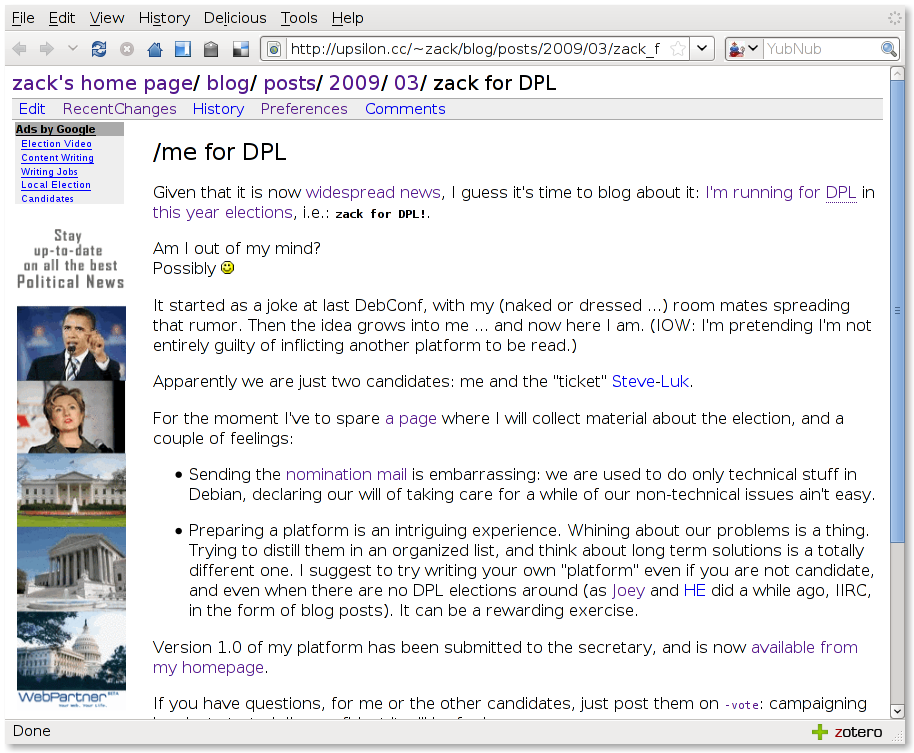
DPL campaign woes DPL campaigning is going to end today, and the draft ballot has apparead already. The latest bits of news I've to offer are that my rebuttals have been published a couple of days ago (also in the platform from www.d.o, of course, which is just lacking a direct anchor). Also, I've summarized campaigning discussions at my candidacy page. You can find there pointers to all topics raised on -vote, as direct or indirect questions to the candidates. Please let me know if I forgot something. All in all I was expecting more discussions between the candidates for a campaign, but I presume the volume is meant to remain low having just two candidates. That notwithstanding, some very inspiring and unexpected questions have been posed; it has been intriguing to think about them. As a campaign-concluding fun bit, I cannot resist posting a screenshot of my candidacy post, as it appeared to me about 10 minutes ago: zack for DPL post screenshot ... I mean, having fellow DDs making fun of me for this DPL thingy on IRC is fine, but ads stepping in is kind of too much ... :-)

26 March 2009

Stefano Zacchiroli: enabling comments with style

Enabling ikiwiki comment with a bit of CSS I've finally spent some time to understand why the amazing comments ikiwiki plugin was not working for me. Obviously the reason were page templates which I had customized and hence were missing the needed template variables that expand to comments links and content. That made me wonder about keeping my ~/.ikiwiki/templates directory as a Git repository (which actually already is, even though for different reasons) which tracks Joey's ikiwiki repo for better merging future changes to upstream templates. Looks like a good idea, but I didn't have the time to testdrive it yet. Still, I've updated my ikiwiki CSS (also available from ikiwiki's CSS market) for fancier rendering of comments and I'm quite happy about the result. So, to the nice guy who once wrote the following in the discussion page of an old blog post of mine: p.s. this is the dumbest comment method I've ever used You were totally right!, the issue is fixed now, big up to Simon McVittie for the plugin. /me now only dreams of an automatic conversions of old discussion pages to comment series, knowing that it is impossible in the general case due to the lack of structure :-( ...

18 March 2009

Stefano Zacchiroli: ocaml-http is looking for a new maintainer

OCaml-HTTP is looking for a maintainer I've been maintainer the OCaml-HTTP library for quite a while now. It is an OCaml library for implementing simple HTTP servers and client. It is way simpler and way less capable than the well-known ocamlnet; its simplicity is its main strength. Given that I've lost enthusiasm in the project, and that my free software activities are mainly elsewhere, I'm looking for a new maintainer of the software. Patches have been accumulating in my mailbox for months, which is bad. Also, the project can use being moved to the OCaml forge and a bit of clean up would be needed to. If you are interested in taking over maintenance, please mail me. If nobody is interested in taking over the maintenance I'll declare the project as abandoned (which would be a pity, since I'm aware of several users).

12 March 2009

Stefano Zacchiroli: topgit brain explosion

Don't make mistakes with TopGit. Ever. TopGit is super-cool. I really feel I've found the proper tool for my Debian packaging work-flow. But beware, the tool is young and rarely allows for mistakes.
If you do make them, it has been observed that undesired side effects can happen to your brain. Especially if your git-fu is not black belt.
thanks to godog for linking topgit with today's strip

8 March 2009

Stefano Zacchiroli: zack for DPL

/me for DPL Given that it is now widespread news, I guess it's time to blog about it: I'm running for DPL in this year elections, i.e.: zack for DPL!. Am I out of my mind?
Possibly :-) It started as a joke at last DebConf, with my (naked or dressed ...) room mates spreading that rumor. Then the idea grows into me ... and now here I am. (IOW: I'm pretending I'm not entirely guilty of inflicting another platform to be read.) Apparently we are just two candidates: me and the "ticket" Steve-Luk. For the moment I've to spare a page where I will collect material about the election, and a couple of feelings: Version 1.0 of my platform has been submitted to the secretary, and is now available from my homepage. If you have questions, for me or the other candidates, just post them on -vote: campaigning has just started, I'm confident it will be fun! Update the platform is now available from the vote page

25 February 2009

Stefano Zacchiroli: standardization process

ROTFL quote (especially for geeks emigrated to France, like yours truly): normaliser unix c'est comme pasteuriser le camembert Found at the bottom of a pleasant announcement.

24 February 2009

Stefano Zacchiroli: gps geeks there is a package for you

orphaning gpscorrelate, any taker? As nobody stepped in to maintainer gpscorrelate, I've just orphaned it. If you are using it for some GPS hacking, please consider adopting it: it is a really good software, it's a pity not having it properly maintained in Debian. The only reason I'm orphaning it is that I'm not using it anymore. For more info, see the O bug. Update: package has been adopted, yay! more details in the bug log.

Next.

Previous.