Search Results: "Martin"

1 June 2014

Antonio Terceiro: An introduction to the Debian Continuous Integration project

Debian is a big system. At the time of writing, looking at my local package list caches tells me that the unstable suite contains 21306 source packages, and 42867 binary packages on amd64. Between these 42867 binary packages, there is an unthinkable number of inter-package dependencies. For example the dependency graph of the ruby packages contains other 20-something packages. A new version of any of these packages can potentially break some functionality in the ruby package. And that dependency graph is very small. Looking at the dependency graph for, say, the rails package will make your eyes bleed. I tried it here, and GraphViz needed a PNG image with 7653 10003 pixels to draw it. It ain t pretty. Installing rails on a clean Debian system will pull in another 109 packages as part of the dependency chain. Again, as new versions of those packages are uploaded the archive, there is a probability that a backwards-incompatible change, or even a bug fix which was being worked around, might make some funcionality in rails stop working. Even if that probability is low for each package in the dependency chain, with enough packages the probability of any of them causing problems for rails is quite high. And still the rails dependency chain is not that big. libreoffice will pull in another 264 packages. gnome will pull in 1311 dependencies, and kde-full 1320 (!). With a system this big, problems will arrive, and that s a fact of life. As developers, what we can do is try to spot these problems as early as possible, and fixing them in time to make a solid release with the high quality Debian is known for. While automated testing is not the proverbial Silver Bullet of Software Engineering, it is an effective way of finding regressions. Back in 2006, Ian Jackson started the development of autopkgtest as a tool to test Debian packages in their installed form (as opposed to testing packages using their source tree). In 2011, the autopkgtest test suite format was proposed as a standard for the Debian project, in what we now know as the DEP-8 specification. Since then, some maintainers such as myself started experimenting with DEP-8 tests in their packages. There was an expectation in the air that someday, someone would run those tests for the entire archive, and that would be a precious source of QA information. Durign the holiday break last year, I decided to give it a shot. I initially called the codebase dep8. Later I renamed it to debci, since it could potentially also run other other types of test suites in the future. Since early January, ci.debian.net run an instance of debci for the Debian Project. The Debian continuous Integration will trigger tests at most 4 times a day, 3 hours after each dinstall run. It will update a local APT cache and look for packages that declare a DEP-8 test suite. Each package with a test suite will then have its test suite executed if there was any change in its dependency chain since the last test run. Existing test results are published at ci.debian.net every hour, and at the end of each batch a global status is updated. Maintainers can subscribe to a per package Atom feed to keep up with their package test results. People interested in the overall status can subscribe to a global Atom feed of events. Since the introduction of Debian CI in mid-January 2014, we have seen an amazing increase in the number of packages with test suites. We had little less than 200 packages with test suites back then, against around 350 now (early June 2014). The ratio of packages passing passing their test suite has also improved a lot, going from less than 50% to more than 75%. There is documentation available, including a FAQ for package maintainers with further information about how the system works, how to declare test suites in their packages and how to reproduce test runs locally. Also available is development information about debci itself, to those inclined to help improve the system. This is just the beginning. debci is under a good rate of development, and you can expect to see a constant flux of improvements. In special, I would like to mention a few people who are giving amazing contributions to the project:

29 May 2014

Russell Coker: Links May 2014

Charmian Gooch gave an interesting TED talk about her efforts to fight organised crime and corruption by prohibiting anonymous companies [1]. The idea of a company is to protect the owner from unlimited liability not to protect them from law enforcement. Dr Nerdlove has an insightful article about sexual harassment in geek culture [2]. Rebecca Rose wrote an insightful article for Jezebel about the worse bullying advice ever, her summary is that it should be called Ways We Can Get You Goddamn Kids to Act So We Never Have to Deal With Your Problems Ever [3]. In the wake of the Heardbleed bug Imperial Violet wrote an informative article explaining why revocation checks isn t the solution [4]. Martin Lukacs and Shiri Pasternak wrote an insightful article about the Canadian government s attempts to stop Canadian aboriginies from exercising their legal rights [5]. I bet that the Australian government is doing the same things. Nelson Groom wrote an interesting interview with Norrie May Welby, the first recognised agender person in Australia [6]. Marriage equality is bound to happen soon in Australia, now that the government officially recognises non-binary gender people it can t refuse them the right to get married and therefore the straight/gay marriage distinction isn t relevant. BDA Technology has an interesting article on choosing fonts to make text more readable for dyslexic people [7]. Eamon Waterford wrote an informative article for the ABC about how early-intervention social policies save significant amounts of tax money [8]. Conservatives claim to want to save money and try to cut such programs which costs everyone in the long term. Greta Christina wrote an insightful article for Salon about why religious people want atheists to lie and pretend to believe [9]. Chris Mooney wrote an informative URL about a machine to test whether someone is liberal or conservative [10]. Paul Rosenberg wrote an informative article on the link between conservatism, evil, and psychopathy [11]. The next logical step is to treat conservatism as a mental health problem. Sociological Images has an interesting article by Jay Livingston about the hypocrisy of conservative tax policies [12]. Scientific American reprinted an article from The Conversation by Elaine McKewon about the climate deniers who intimidated a journal into retracting an article about their belief in conspiracy theories [13]. It seems obvious that the climate deniers are the ones who conspire. Ben Caldecott wrote an interesting article for the ABC about the fossil fuel divestment campaign [14]. It seems that this is getting some success already, as renewable energy will soon be cheaper than coal power this could kill off coal. Mark Taylor wrote an interesting blog post titled Observations of an Internet Middleman about the operations of Level3 and Internet peering [15]. He explains how monopoly Telcos throttle their customers Internet access. Matt Savoy wrote an informative and disturbing article about the fact that US cops are twice as likely to beat their wives as the general population [16]. Apparently the police hierarchy aren t interested in prosecuting such crimes. Paul Rosenberg wrote an insightful article about mythos vs logos and the conservative approach to relity [17]. One interesting point he makes is that white men (and members of privileged groups generally) fear a loss of status more than more realistic concerns (such as global warming). Nick wrote an interesting blog post about using GPG encrypted email on an Android phone [18]. I should get this going on my phone.

23 May 2014

Junichi Uekawa: I was talking about scripting languages at a table at linuxcon.

I was talking about scripting languages at a table at linuxcon. I was probably too negative about perl and too in love with C++ for scripting tasks. Martin Pauley at the table was very much for perl but then he has his affiliation and experience with perl. I too am too affiliated with scripting with C++. I wrote binfmtc, although I don't know if anybody other than me is using it seriously.

10 May 2014

DebConf team: DebConf15 organisation kicked off in Heidelberg (Posted by Martin Krafft)

The lobby of the youth hostel Heidelberg (by Richard Hartmann) The DC15 team met Saturday at the Heidelberg International Youth Hostel to kick off the organisation of DebConf15. While a handful of team members unfortunately had to excuse themselves, 18 people showed up, and the spirit level was high. Self-contained in beautiful surroundings The youth hostel Heidelberg from the outside view (by Richard Hartmann) The youth hostel is the expected venue for DebConf15, which is slated to take place in August 2015. It sleeps more than 400 people, and it features two large conference rooms. Several smaller rooms can be used for team meetings and impromptu birds-of-a-feather sessions. A panoramic view of the city of Heidelberg (by Michael Banck) The venue is located a little bit outside of Heidelberg s centre, right on the side of the Neckar river, north of the Heidelberg Zoo, west of a university campus, and south of a sports field. Fantastic, child-friendly DebConf venue The courtyard of the youth hostel, used for eating and socialising (by Richard Hartmann) The large cafeteria and the plentiful outside space usable for eating, working, chatting and playing make it a fantastic venue for DebConf. And far away from traffic, with a play area, space to run around, and the zoo next door, it s very suitable to families with children, too. Become part of the team! If you are interested in being part of the organisation of our conference, we welcome you on our mailing list and look forward to your contributions! There is also the #debconf15-germany IRC channel on irc.debian.org, and we have a list of DC15 sub-teams to give you an overview. Feel free to add yourself, or just help out and someone will add you. (Photos by Michael Banck and Richard Hartmann, used under the terms of the CC by-sa licence 3.0)

28 April 2014

Martin Pitt: Booting Ubuntu with systemd: Now in Utopic

Hot on the heels of my previous annoucement of my systemd PPA for trusty, I m now happy to announce that the latest systemd 204-10ubuntu1 just landed in Utopic, after sorting out enough of the current uninstallability in -proposed. The other fixes (bluez, resolvconf, lightdm, etc.) already landed a few days ago. Compared to the PPA these have a lot of other fixes and cleanups, due to the excellent hackfest that we held last weekend. So, upgrade today and let us know about problems in bugs tagged systemd-boot . I think systemd in current utopic works well enough to not break a developer s day to day workflow, so we can now start parallelizing the work of identifying packages which only have upstart jobs and provide corresponding systemd units (or SysV script). Also, this hasn t yet been tested on the phone at all, I m sure that it ll require quite some work (e. g. lxc-android-config has a lot of upstart jobs). To clarify, there is nofixed date/plan/deadline when this will be done, in particular it might well last more than one release cycle. So we ll release (i. e. switch to it as a default) when it s ready :-)

24 April 2014

Martin Pitt: Booting Ubuntu with systemd: Test packages available

On the last UDS we talked about migrating from upstart to systemd to boot Ubuntu, after Mark announced that Ubuntu will follow Debian in that regard. There s a lot of work to do, but it parallelizes well once developers can run systemd on their workstations or in VMs easily and the system boots up enough to still be able to work with it. So today I merged our systemd package with Debian again, dropped the systemd-services split (which wasn t accepted by Debian and will be unnecessary now), and put it into my systemd PPA. Quite surprisingly, this booted a fresh 14.04 VM pretty much right away (of course there s no Plymouth prettiness). The main two things which were missing were NetworkManager and lightdm, as these don t have an init.d script at all (NM) or it isn t enabled (lightdm). Thus the PPA also contains updated packages for these two which provide a proper systemd unit. With that, the desktop is pretty much fully working, except for some details like cron not running. I didn t go through /etc/init/*.conf with a small comb yet to check which upstart jobs need to be ported, that s now part of the TODO list. So, if you want to help with that, or just test and tell us what s wrong, take the plunge. In a 14.04 VM (or real machine if you feel adventurous), do
  sudo add-apt-repository ppa:pitti/systemd
  sudo apt-get update
  sudo apt-get dist-upgrade
This will replace systemd-services with systemd, update network-manager and lightdm, and a few libraries. Up to now, when you reboot you ll still get good old upstart. To actually boot with systemd, press Shift during boot to get the grub menu, edit the Ubuntu stanza, and append this to the linux line: init=/lib/systemd/systemd. For the record, if pressing shift doesn t work for you (too fast, VM, or similar), enable the grub menu with
  sudo sed -i '/GRUB_HIDDEN_TIMEOUT/ s/^/#/' /etc/default/grub
  sudo update-grub
Once you are satisfied that your system boots well enough, you can make this permanent by adding the init= option to /etc/default/grub (and possibly remove the comment sign from the GRUB_HIDDEN_TIMEOUT lines) and run sudo update-grub again. To go back to upstart, just edit the file again, remove the init=sudo update-grub again. I ll be on the Debian systemd/GNOME sprint next weekend, so I feel reasonably well prepared now. :-) Update: As the comments pointed out, this bricked /etc/resolv.conf. I now uploaded a resolvconf package to the PPA which provides the missing unit (counterpart to the /etc/init/resolvconf.conf upstart job) and this now works fine. If you are in that situation, please boot with upstart, and do the following to clean up:
  sudo rm /etc/resolv.conf
  sudo ln -s ../run/resolvconf/resolv.conf /etc/resolv.conf
Then you can boot back to systemd. Update 2: If you want to help testing, please file bugs with a systemd-boot tag. See the list of known bugs when booting with systemd.

22 April 2014

Axel Beckert: GNU Screen 4.2.0 in Debian Experimental

About a month ago, on 20th of March, GNU Screen had its 27th anniversary. A few days ago, Amadeusz S awi ski, GNU Screen s new primary upstream maintainer, released the status quo of Screen development as version 4.2.0 (probably to distinguish it from all those 4.1.0 labeled development snapshots floating around in most Linux distributions nowadays). I did something similar and uploaded the status quo of Debian s screen package in git as 4.1.0~20120320gitdb59704-10 to Debian Sid shortly afterwards. That upload should hit Jessie soon, too, resolving the following two issues also in Testing: That way I could decouple these packaging fixes/features from the new upstream release which I uploaded to Debian Experimental for now. Testers for the 4.2.0-1 package are very welcome! Oh, and by the way, that upstream comment (or ArchLinux s according announcement) about broken backwards compatibility with attaching to running sessions started with older Screen releases doesn t affected Debian since that has been fixed in Debian already with the package which is in Wheezy. (Thanks again Julien Cristau for the patch back then!) While there are bigger long-term plans at upstream, Amadeusz is already working on the next 4.x release (probably named 4.2.1) which will likely incorporate some of the patches floating around in the Linux distributions packages. At least SuSE and Debian offered their patches explicitly for upstream inclusion. So far already two patches found in the Debian packages have been obsoleted by upstream git commits after the 4.2.0 release. Yay!

25 March 2014

Sylvain Le Gall: Release of OASIS 0.4.3

I am happy to announce the release of OASIS v0.4.3. Logo OASIS small OASIS is a tool to help OCaml developers to integrate configure, build and install systems in their projects. It should help to create standard entry points in the source code build system, allowing external tools to analyse projects easily. This tool is freely inspired by Cabal which is the same kind of tool for Haskell. You can find the new release here and the changelog here. More information about OASIS in general on the OASIS website. Here is a quick summary of the important changes: Features: This new version closes 4 bugs, mostly related to parsing of _oasis. It also includes a lot of refactoring to improve the overall quality of OASIS code base. The big project for the next release will be to setup a Windows host for regular build and test on this platform. I plan to use WODI for this setup. I would like to thanks again the contributor for this release: David Allsopp, Martin Keegan and Jacques-Pascal Deplaix. Their help is greatly appreciated.

23 March 2014

Gregor Herrmann: RC bugs 2013/49 - 2014/12

since people keep talking to me about my RC bug fixing activities, I thought it might be time again for a short report. to be honest, I mostly stopped my almost daily work at some point in december, partly because the overall number of RC bugs affecting both testing & unstable is quite low (& therefore the number of easy-to-fix bugs), due to the auto-removal policy of the release team (kudos!). but I still kept track about RC bugs I worked on, & here's the list; as you can see, mostly pkg-perl bugs ps: the how-can-i-help package is a nice tool for finding RC bugs in packages you care about. install it if you haven't so far!

28 February 2014

Russell Coker: Links February 2014

The Economist has an interesting and informative article about the lack of reproducability of scientific papers and the implications for scientific research [1]. Regina Dugan gave an interesting TED talk about some of the amazing DARPA projects [2]. Chris Anderson interviewed Elon Musk about the Tesla cars, SpaceX, and his new venture Solar City [3]. Elon has a lot of great ideas for improving humanity while also making money. Smart Planet has an interesting article about Bhutan s switch to electric vehicles [4]. Paul Piff gave an insightful and well researched TED talk about the ways that money makes people mean [5]. Maryn McKenna wrote an interesting article for Wired about what happens when the current anti-biotics stop working [6]. Unfortunately she lists increasing food prices as a consequence, really the unreasonably low price of meat is due to the misuse of anti-biotics that is causing this problem. Linda Walther Tirado wrote an interesting article about being poor titled Why I Make Terrible Decisions, or, Poverty Thoughts [7]. It gives a real insight into the situation of people who are trapped in poverty. When someone who is as obviously intelligent as Linda feels that it s impossible to escape poverty there is a real problem in the system. While Australia doesn t suck nearly as badly as the US in this regard (higher minimum wage and better health care) we still need to improve things, I know people in Australia who s experience bears some similarity to Linda s. Maxwell Neely-Cohen wrote an interesting article about peer pressure [8]. Some of the conclusions are dubious, but the ideas on the way the Internet changes peer relationships in high school are interesting. An English pediatrician wrote an article for The Daily Beast about why he won t accept anti-vac clients [9]. There are some decent people in the Liberal Party, Liberal MP Warren Entsch attacks Cory Bernardi on gay obsession [10]. AFAIK we haven t yet had a gay sex scandal involving a homophobic Australian politician

22 February 2014

Sylvestre Ledru: Some updates on llvm.org/apt/

I made some changes on http://llvm.org/apt/ for the last 2 months.

20 February 2014

Clint Adams: For Richi

I vote for Martinique.

17 February 2014

Martin Zobel-Helas: Have YOU registered Services at Debian Services Census?

Enrico and me have just started a census on Debian Services floating around, and we want YOU to participate!

The Debian Services Census is an attempt to gather detailed information about software services for the Debian community. It doesn't matter where these services live or who provides them. For now we are only interested in their existence.

Services can be anything from the mail forwarding service for @debian.org addresses that lives on master.debian.org operated by DSA, web applications, email bots, command line scripts you can run on debian.org machines, automated package checkers that report bugs to people, Debian-related services that people run on their own infrastructure like screenshots.debian.net and son on. Have a look at https://wiki.debian.org/Services for more examples.

If you think it's a service, then we think it's a service too and we want to know about it. Feel free to contribute data whether you are the maintainer of that service or not.

Here is how to let us know about the service:
  • please visit https://wiki.debian.org/Services and verify if the service is already listed there
  • if the service you had in mind is *not* listed, please create an entry for it using the "Add a new service" button.
If you are the maintainer of a service, we also encourage you to subscribe to the debian-services-admin@lists.debian.org mailing list, which is a low-traffic list and should be the contact point for inter-service communication and coordination.

Update: Up to now, 51 services have been registered (most of them within 24 hours after the d-d-a mail, WOW), but we are sure that there are a lot of more services, that still need to be registered. Help us to get a complete list!

12 February 2014

Dirk Eddelbuettel: RInside 0.2.11

A new release 0.2.11 of RInside is now on CRAN. RInside provides a set of convenience classes which facilitate embedding of R inside of C++ applications and programs, using the classes and functions provided by the Rcpp R and C++ integration package. This release, the first in fourteen months, fixes one important initialization issue created by the recent Rcpp 0.11.0 release, adds a few other changes related to that release and improves a number of small points such as new or improved examples. The NEWS extract below has more details.
Changes in RInside version 0.2.11 (2014-02-11)
  • Updated for Rcpp 0.11.0:
    • Updated initialization by assigning global environment via pointer only after R itself has been initialized with special thanks to Kevin Ushey for the fix
    • Updated DESCRIPTION with Imports: instead of Depends:
    • Added correspondiing importFrom(Rcpp, evalCpp) to NAMESPACE
    • Noted in all inst/examples/*/Makefile that Rcpp no longer requires a library argument, but left code for backwards compatibility in case 0.11.0 is not yet installed.
  • Added --vanilla --slave to default arguments for R initialization
  • Added a few more explicit #include statements in the qt example which Qt 5.1 now appears to require with thanks to Spencer Behling for the patch
  • Added new MPI example with worker functions and RInside instance, kindly contributed by Nicholas Pezolano and Martin Morgan
CRANberries also provides a short report with changes from the previous release. More information is on the RInside page. Questions, comments etc should go to the rcpp-devel mailing list off the Rcpp R-Forge page.

This post by Dirk Eddelbuettel originated on his Thinking inside the box blog. Please report excessive re-aggregation in third-party for-profit settings.

10 February 2014

Mario Lang: Neurofunkcasts

I have always loved Drum and Bass. In 2013 I rediscovered my love for Darkstep and Neurofunk, and found that these genres have developed quite a lot in the recent years. Some labels like Black Sun Empire and Evol Intent produce mixes/sets on a regular basis as podcasts these days. This article aggregates some neurofunk podcasts I like a lot, most recent first. Enjoy 33 hours and 57 minutes of fun with dark and energizing beats. Thanks to BSE Contrax and Evol Intent for providing such high quality sets. You can also see the Python source for the program that was used to generate this page.

29 January 2014

Petter Reinholdtsen: A fist full of non-anonymous Bitcoins

Bitcoin is a incredible use of peer to peer communication and encryption, allowing direct and immediate money transfer without any central control. It is sometimes claimed to be ideal for illegal activity, which I believe is quite a long way from the truth. At least I would not conduct illegal money transfers using a system where the details of every transaction are kept forever. This point is investigated in USENIX ;login: from December 2013, in the article "A Fistful of Bitcoins - Characterizing Payments Among Men with No Names" by Sarah Meiklejohn, Marjori Pomarole,Grant Jordan, Kirill Levchenko, Damon McCoy, Geoffrey M. Voelker, and Stefan Savage. They analyse the transaction log in the Bitcoin system, using it to find addresses belong to individuals and organisations and follow the flow of money from both Bitcoin theft and trades on Silk Road to where the money end up. This is how they wrap up their article:
"To demonstrate the usefulness of this type of analysis, we turned our attention to criminal activity. In the Bitcoin economy, criminal activity can appear in a number of forms, such as dealing drugs on Silk Road or simply stealing someone else s bitcoins. We followed the flow of bitcoins out of Silk Road (in particular, from one notorious address) and from a number of highly publicized thefts to see whether we could track the bitcoins to known services. Although some of the thieves attempted to use sophisticated mixing techniques (or possibly mix services) to obscure the flow of bitcoins, for the most part tracking the bitcoins was quite straightforward, and we ultimately saw large quantities of bitcoins flow to a variety of exchanges directly from the point of theft (or the withdrawal from Silk Road). As acknowledged above, following stolen bitcoins to the point at which they are deposited into an exchange does not in itself identify the thief; however, it does enable further de-anonymization in the case in which certain agencies can determine (through, for example, subpoena power) the real-world owner of the account into which the stolen bitcoins were deposited. Because such exchanges seem to serve as chokepoints into and out of the Bitcoin economy (i.e., there are few alternative ways to cash out), we conclude that using Bitcoin for money laundering or other illicit purposes does not (at least at present) seem to be particularly attractive."
These researches are not the first to analyse the Bitcoin transaction log. The 2011 paper "An Analysis of Anonymity in the Bitcoin System" by Fergal Reid and Martin Harrigan is summarized like this:
"Anonymity in Bitcoin, a peer-to-peer electronic currency system, is a complicated issue. Within the system, users are identified by public-keys only. An attacker wishing to de-anonymize its users will attempt to construct the one-to-many mapping between users and public-keys and associate information external to the system with the users. Bitcoin tries to prevent this attack by storing the mapping of a user to his or her public-keys on that user's node only and by allowing each user to generate as many public-keys as required. In this chapter we consider the topological structure of two networks derived from Bitcoin's public transaction history. We show that the two networks have a non-trivial topological structure, provide complementary views of the Bitcoin system and have implications for anonymity. We combine these structures with external information and techniques such as context discovery and flow analysis to investigate an alleged theft of Bitcoins, which, at the time of the theft, had a market value of approximately half a million U.S. dollars."
I hope these references can help kill the urban myth that Bitcoin is anonymous. It isn't really a good fit for illegal activites. Use cash if you need to stay anonymous, at least until regular DNA sampling of notes and coins become the norm. :) As usual, if you use Bitcoin and want to show your support of my activities, please send Bitcoin donations to my address 15oWEoG9dUPovwmUL9KWAnYRtNJEkP1u1b.

25 January 2014

Russell Coker: Links January 2014

Fast Coexist has an interesting article about the art that Simon Beck creates by walking in snow [1]. If you are an artist you can create art in any way, even by walking in patterns in the snow. Russ Altman gave an interesting TED talk about using DNA testing before prescribing drugs [2]. I was surprised by the amount of variation in effects of codeine based on genetics, presumably many other drugs have a similar range. Helen Epstein wrote an interesting article about Dr. Sara Josephine Baker who revolutionised child care and saved the lives of a huge number of children [3]. Her tenacity is inspiring. Also it s interesting to note that the US Republican party was awful even before the Southern Strategy . The part about some doctors opposing child care because it s the will of God for children to die and keep them in employment is chilling. Jonathan Weiler wrote an insightful article about the problems with American journalism in defending the government [4]. He criticises the media for paying more attention to policing decorum than to content. Tobias Buckell wrote an interesting post about the so-called socialised health-care in the US [5]. He suggests that Ronald Reagan socialised health-care by preventing hospitals from dumping dying people on the street. I guess if doing nothing for people until they have a medical emergency counts as socialised health-care then the US has it. Kelvin Thomson MP made some insightful comments about climate change, the recent heat-wave in Australia, and renewable energy [6]. Iwan Baan gave an interesting TED talk about ways that people have built cheap homes in unexpected places [7], lots of good pictures. Racialicious has an interesting article by Arturo R. Garc a about research into the effects of concussion and the way the NFL in the US tried to prevent Dr. Bennet Omalu publicising the results of his research [8]. Stani (Jan Schmidt) wrote an interesting post about how they won a competition to design a commemerative Dutch 5 Euro coin [9]. The coin design is really good (a candidate for the geekiest coin ever), I want one! Seriously if anyone knows how to get one at a reasonable price (IE close to face value for circulated or not unreasonably expensive for uncirculated) then please let me know. When writing about Edward Snowden, Nathan says Imagine how great a country would be if if it were governed entirely by people who Dick Cheney would call Traitor [10]. That s so right, that might make the US a country I d be prepared to live in. Andrew Solomon gave an interesting TED talk Love No Matter What about raising different children [11]. Aditi Shankardass gave an interesting TED talk about using an ECG to analyse people diagnosed wit severe Autism and other developmental disorders [12]. Apparently some severe cases of Autism have a root cause that can be treated with anti-seizure medication. George Monbiot wrote an insightful article about the way that Bono and Bob Geldoff promote G8 government intervention in Africa and steal air-time that might be given to allow Africans to represent themselves in public debates [13]. Daniel Pocock wrote an informative article about racism in Australian politics and how it is bad for job-seekers and the economy (in addition to being horribly wrong) [14]. Aeon Magazine has an interesting article by Anne Buchanan about the difference between scientists and farmers [15]. She has some interesting points about the way that the lack of general knowledge impacts research, but misses the point that in most fields of study there is a huge problem of people not knowing about recent developments in their own field. I don t think it s a pipe dream to be well educated in humanities and science, but I guess that depends on the definition of well educated . Brian Cox gave an interesting TED talk titled Why We Need the Explorers about the benefits of scientific research [16]. Yupu Zhang, Abhishek Rajimwale, Andrea C. Arpaci-Dusseau, and Remzi H. Arpaci-Dusseau from the University of Wisconsin-Madison wrote an interesting paper about ZFS corruption in the face of disk and memory errors [17]. One thing to note is that turning off atime can reduce the probability of a memory error leading to corrupt data being written to disk, run zfs set atime=off tank to fix this. The comedian Solomon Georgio celebrated Martin Luther King day by tweeting I love you to racists [18]. It s an interesting approach and appears to have worked well.

8 January 2014

Gunnar Wolf: Meeting with Chilean sysadmins

Meeting with Chilean sysadmins
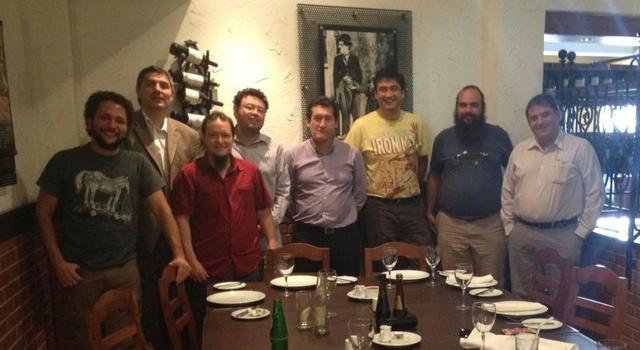
Ok, so I'm back in Mexico! This year, the best fare I found for travelling to spend the Winter^WSummer season with Regina's family had an oddity: I usually have a layover at either Santiago de Chile or Lima (Per ) of between 45 minutes and 2 hours, clearly less than enough to do anything. But this time, I had a massive 10 hours layover in Santiago. And spending 10 hours in an airport is far from fun. Specially when you have a good group of friends in town! I visited Chile in 2004 for Encuentro Linux (still before the time I had a digital camera: Those photos are all taken by Martin Michlmayr), and I have stayed in touch with a group of systems administrators since then. So, I mailed the list, and we managed to get eight people to have lunch together. In the order we appear in the photo: Some of them, even living in the same city, had never met in person before So, of course, we had a table reserved at the restaurant to the name of Dennis Ritchie. And having had nice, fun, sometimes-technical talks... Well, a tiny bit of his spirit was there. Of course, we can only trust he was there, as no Ouija boards were used and no null pointers were dereferenced (just to make sure not to disturb him). Victor Hugo and lvaro took me for a short Santiago city trip before lunch, we had a very nice time. Thanks! :-)

1 January 2014

Debian Sysadmin Team: Martin Zobel-Helas: Howto mess up the Debian Project homepage

I recently blogged about the GeoDNS setup we plan for security.debian.org. Even though all DSA team members agree that the GeoDNS setup for security.debian.org should come alive as soon as possible, we still fear to break an important service like security.d.o. Yesterday I decided without further ado to float a trial balloon and converted DNS entries for the Debian Project homepage to our GeoDNS setup. While doing so, we found out that some part of our automatic deployment scripts still need to be adjusted to serve more than one subdomain of the project. That setup is live for about eighteen hours now, and the project homepage now resolves it IPs via GeoDNS. For now, we are using senfl.d.o for Northern America, www.de.debian.org and www.debian.at for Europe and klecker.d.o for the rest of the world. From what I can see from GeoDNS logs, it seems to work fine, and the load stays reasonably low, so after a short test period we might add additional services like security.debian.org to GeoDNS.

Debian Sysadmin Team: Martin Zobel-Helas: raff.debian.org about to be shut down

We are re-purposing raff.debian.org as a new security mirror to be shipped to South America. The raff.debian.org most of you have used as buildd.debian.org in the past will cease to exist in the near future. raff.debian.org will cease acting as a dns server for the debian.org zone in a few days, therfore we will add two new hosts, senfl.d.o and ravel.d.o. All other services formerly hosted on raff.d.o should have been already moved by now, we just want to encourage those of you who had a login on raff, to backup your home directory if you care of the data stored there, as we will not move that. Current plan is to shut down current raff by end of the year (so in about 7 days).

Next.

Previous.