Search Results: "Lucas Nussbaum"

30 April 2008

Lucas Nussbaum: Dear IRC user

Please consider switching to screen+irssi, or bip+xchat, or irssi_proxy+irssi or xchat, etc. (This post and its comments has more details). It is very annoying when you ask me something while I’m away, then disconnect, and then when I finally answer you, you are not connected anymore. If I’m away and you are going to disconnect, please send your question by mail or jabber.

25 April 2008

Lucas Nussbaum: Various stuff

New QA website I modified qa.debian.org’s stylesheet/template, using the PTS’s stylesheet as a basis. It looks a bit better. The content was also updated, so we should stop receiving totally outdated answers to the “What does the QA team do?” question in NM. Now, who is going to do the same thing with www.debian.org? :-) Closing bugs in removed packages When packages are removed from unstable and testing, their bugs are not necessarly marked as closed, so they can’t be archived. A few days ago, there was about 3300 open bugs filed against removed packages. Thanks to the work of Barry deFreese, Marco Rodrigues and Raphael Geissert, we are now down to ~2500 bugs. If you want to help, just drop in #debian-qa and ask about our scripts/process. (There are some tricky details) DEP #1: NMUs With Bas Wijnen, we finally announced the DEP about NMUs we have been working on. Please join the (currently very quiet) discussion!

18 April 2008

Lucas Nussbaum: 19 new Debian Developers! \o/

I am very happy that 19 contributors who were waiting for their accounts, sometimes for a very long time, became Debian Developers today. This is great news for them, and for the project as a whole. Many thanks to all people involved for making this possible, including Joerg Jaspert, Steve McIntyre and James Troup. And congratulations to (using their account names) kibi, plessy, gregoa, goneri, tincho, akumar, filipe, miriam and the others I haven’t had the chance to work with yet. It also seems that the various pending issues (updating keys that expired, etc.) have been resolved, which is great news for several of our current DDs. But this doesn’t solve the DAM problem on a permanent basis. Something interesting about today’s events is that the account manager asked the system administrators to create the accounts, which is a nice way to offload part of the process. But the keyring maintainance is still a SPOF. A tool has been developed to allow multiple people to collaboratively edit the same keyring (and it’s used to maintain the Debian Maintainers keyring), but I’ve heard that some people weren’t satisfied with it, unfortunately. Let’s hope that this is solved soon, so the next ones to go through NM won’t have to wait that long!

16 April 2008

Patrick Winnertz: Demotivaton of new prospective Developers

I'm writing this blog entry as a reaction of Lucas Nussbaums one. More or less one year ago I also was a New Maintainer who completed the process after 3 months (Started in February and ended in May). My Intention was to become as fast as possible a Developer and I was very motivated. (I helped Lucas with filling the build twice in a row bugs in this time). The FD approves me quite fast... (I'll guess I was only waiting for two weeks?) but the next to steps (Approval of DAM and creation of the account) took very long. After waiting for 3 months I was quite demotivated and doing only necessary things in order to update my packages... it was very frustrating. But now I'm finally a DD, since 6 months. For those who doesn't want to calculate: I was waiting for DAM about 4 months. When I saw that I was again highly motivated and started again to work on Debian a bit more, because I thought that the account creation can't took long...this was an error: I was approved by DAM in the middle of October... and got my account in Dezember... again waiting for a simple action. I can really understand New Maintainer who are directly MIA after being a DD. Waiting a half year for account creation is much too long. In my eyes there is only one possible solution for this issue: Since DAM and the Account Manager have also many other tasks which consumes there time, I would suggest to give them assistants...every manager needs at least one assistant ;-). This would speed up the process and people who are doing actually a great job doesn't get frustrated by waiting, but can actively work on Debian. I hope that the new DPL will find a solution for this really big issue during his time.

15 April 2008

Sylvain Le Gall: Debian accounts and keyring

Even if i don't like talking about this in public, Lucas Nussbaum blog entry decides me to write this, because I, too, agree that the Debian accounts and keyring situation is severely hurting Debian, and that a solution needs to be found RSN. I wish to be more clear on some of my positions concerning this. First of all, I am actually being hit by a "GPG key expired" status that prevents me to vote and upload packages. It is a little bit my fault because 1) i set an expiration date on my GPG and 2) i only update this expiration date in keyring.debian.org less than 1 month before it expires -- but it was more than 3 months ago... I have pinged different people since then to get the keyring updated without success. I have reuploaded my key without expiration date, and now i know that things can take a long time inside Debian (2nd rank after waiting for my own Debian account creation). Another point is concerning DM (Debian Maintainer). I was against the proposal when it was voted, because i was thinking it will create a "sub" status of Debian Developper (i.e people which are in between debian users and debian developers). I have changed my mind concerning this point the DM process is lightweight and everything seems to be faster with it. This is a really good points for DM (and jetring). I am also considering to sponsor myself to apply to DM, in order to have a non-expired GPG key somewhere. Last but not least, i met several French NM at DebConf 7 (Kibi, Goneri...). At that time, i didn't know them. Since DC7, I have seen them working on different parts of Debian. I think it is a shame to make them wait so long. It is really the best way to make their motivations disappear. Looking back at my own situation, i realize that i was more active before my account creation. This is probably because it takes a long time to process, and i loose hope in a possible account creation. I am now more active in Debian, but still not doing as much as i want to. I don't know the best solution to solve this problem. I tend to think that some key people should delegate their work to other DD (within a team ?). Last year at DC7, Sam Hocevar was already discussing this problem with the people involved in Account Creation. I don't know what was the result of this discussion... Hope, this post will help to show that this problem is important.

Lucas Nussbaum: 4 months and 10 days without any new Debian developer. Is Debian dying?

It has now been more than 4 months since the last Debian developer account was created. 18 contributors have been through all steps, and are simply waiting for this simple administrative task to be done. We are sending a terrible message to potential contributors. We have strong requirements on the technical level of our developers. During the new maintainer process, we ask them to answer about 80 questions about Debian. We ask them to do grunt work. We review their reports twice (New Maintainers’ Front Desk, then Debian Account Manager). But even after we are totally satisfied about what they did, even after they became more qualified than many of our current DDs, we ask them to wait for months, so that the only person allowed to create accounts can finally do his “job”. It discourages the contributors currently in the NM process. I’ve seen several signs of frustration, or even depression. Some of them reduce their involvement in Debian, so we lose them before they even became Debian developers. Some of them consider resigning from the NM process. We should all feel guilty about that. But it also discourages people from joining Debian. Instead, they go to other more welcoming projects, which is totally understandable. Debian isn’t the only distribution with developers from the community those days. There’s Gentoo, Ubuntu, Fedora, openSUSE. Some of those have nice programs for new contributors, like “school” sessions. Sure, Debian is the “biggest” distribution without a company behind it. But is independance worth all the trouble? Of course, we have Debian Maintainers. DM is great for people who want to work on their packages. But, when we are trying to release lenny, we need more: people who are going to go through RC bugs, submitting patches. Who are going to do QA work. In short: people who care more about the whole distribution. Can we afford not recruiting anybody? Can we run Debian with the current manpower? I don’t think so. There are more than 550 RC bugs in lenny, many packages are currently blocked from migrating to lenny because they are RC-buggy, and many packages are orphaned or neglected. There are also a lot of bugs which haven’t been filed yet (I asked for help with running piuparts, which would probably result in 100-200 new RC bugs, but nobody had time to help). Most of the work that needs to be done is not rocket science. We could use a lot more manpower. Currently, the same small set of developers is doing most of the grunt work. They will get tired too. So, what can we do, as simple developers? There’s no magic solution, but we can try a few things.
  1. It seems that some people disagree that there’s a problem. Let’s prove them wrong: we could start a blog meme with “I, too, agree that the Debian accounts and keyring situation is severely hurting Debian, and that a solution needs to be found RSN.” It’s not going to solve the problem by itself, but it will at least show that we consider it very important. Pressure could help.
  2. We could start discussing solutions together. Our newly elected DPL said that he would talk with the problematic teams to determine how the situation could be improved. Unfortunately, this has been tried in the past (and failed). It might work this time, of course, but we could prepare a backup plan. So let’s find one or two good plans, and vote on them. (I liked the idea of giving accounts creation/management to DSA. After all, it’s only an sysadmin task once the report has been approved by FD and DAM.)
  3. We could push forward Josip Rodin’s proposal about infrastructure teams. It might not solve the DAM problem immediately, but would probably help avoid similar problems in the future.
Notes:
1. Maybe the 18 waiting accounts will be created today or tomorrow. Even if that happens, it won’t solve anything. Waiting 4 months for a simple administrative task is not acceptable, and we need to fix that problem anyway.
2. Account creation is not the only problem. Some people have been unable to upload packages or to vote for the DPL election, because their PGP key expired, and nobody updated it even if they have been asking for more than 4 months.

2 April 2008

Lucas Nussbaum: Things you should know before buying an Asus EEE PC

I’ve been using an EEE PC since december, and people keep asking me if they should buy one. So here are some things you should know before making a decision. Screen The screen is small, but that’s OK. I couldn’t find many applications that didn’t work in 800×480. And for the remaining ones, you can usually use hacks such as running the app in a larger virtual desktop. Not ideal, but it works. Regarding usability, it’s not a too big problem. Jut expect to use many apps maximized, and use scrolling and virtual desktops a lot. (Important note: Xmoto doesn’t work!!) Keyboard The keyboard is probably a bigger problem than the screen (I hadn’t expected it to be a so big problem before buying the laptop). Every other keyboard seems to have HUGE keys after typing on the EEE PC keyboard. But with some training, you can type quite fast, even if probably not as fast as with a full size keyboard. The layout of the “special” keys is quite good (esp. the PgUp/Down, Home and End keys on the arrows. I should remap my other keyboard like that). Battery, power consumption One big problem with the EEE PC is that it consumes a lot of power while sleeping (using suspend to RAM). If you leave it sleeping for more than a few hours, expect the battery to be empty. That really sucks, especially since suspend to disk isn’t really a good option on such a device. Another problem related to power is that charging the battery is quite slow. SDHC card reader If you want to expand the storage capacity of your EEE PC with the SDHC port, choose your SDHC card carefully. There are only a few cards that work. The other ones will cause write error (they will work in read-only mode, so I’m using an external card reader to write, which sucks). A list of supported cards is available in the EEE PC manual. Random Q&A Q: I don’t have a laptop. Should I buy it? A: If you want to do a lot of real work on it, it’s probably not a very good idea. There are faster (but bigger) laptops at around 450-500 EUR. They are probably a much better option. The EEE PC is perfect as a the second laptop you only bring to places where you want to stay connected, read email and surf on the web (like conferences and meetings). Q: Does the VGA output works well? A: Yes. And it uses an Intel video card which works like a charm with xrandr. I already gave several presentations and classes using it. The laptop can output 1280×1024 (maybe 1600×1200, not sure). The only problem is that you will only have the top-left part of your slides on the laptop’s screen, because of the smaller resolution there. Annoying if you plan to read your slides.

Conclusion So, should you buy one? If you can’t wait, go ahead. If you can wait, it might be a good idea to wait until Asus fixes some of the problems (the SDHC card reader and the power consumption while sleeping are the most annoying ones).

31 March 2008

Lucas Nussbaum: Jabber clients and OS usage stats (4)

After 2005, 2006 and 2007, I did it again. Here are my yearly stats about Jabber clients! 1244 users were online on the Apinc Jabber server when I ran the poll, and 1163 clients answered. Telepathy doesn’t seem to answer to jabber:iq:version, and it seems that a bug prevents Gajim from answering in some obscure cases (even when the “send info about OS” option is enabled). Systems: Clients:

21 March 2008

Lucas Nussbaum: Tele2 sucks (or QoS for dummies )

I just discovered that, since I enabled the TV over DSL option, Tele2 limited my downstream bandwidth to 8mbps (instead of 20 mbps). All the time. Even when I don’t use the TV. Because allowing 20 mbps could have affected the quality of TV reception (when the TV is off?). They proudly advertise that offer as: It seems that they forgot the “OR” in between.

3 March 2008

Lucas Nussbaum: PTS as a great tool for upstream developers

I recently realized how nice the Packages Tracking System is for upstream developers who want to follow the status of their software in Debian. By subscribing, they can easily monitor (and reply to) bug reports, and the general status of their software in Debian. I’m trying to help with coreutils maintainance, and it’s great to see upstream developers answer directly to bug reporters on Debian. So, maintainers, tell your upstreams about the PTS! ;) It might be a good idea to actually mention that use case on obvious places (not sure what the obvious places are, though).

1 March 2008

Lucas Nussbaum: mailing list for cross-distributions collaboration

A few months ago, I asked a set of questions on development mailing lists of a few GNU/Linux distributions. This resulted in very interesting discussions. As promised back then, all the answers from all distros I contacted can be read on the web or as an mbox file. Also, Freedesktop.org kindly agreed to host a mailing list to ease discussions between distributions, and act as a central point of contact. You can subscribe, and post to distributions at lists dot freedesktop dot org. This mailing list is for people involved (or interested) in the development of distributions. Questions that are on-topic are both technical and social/organizational issues, like: Off-topic stuff obviously include trolling about which distribution is the best one, or user support. Don’t hesitate to forward this announcement to all interested parties. Let’s make this mailing list something useful together! Also, I really apologize for procastinating announcing this list for sooo long. I’m really good at procastinating interesting stuff, it seems.

28 February 2008

Lucas Nussbaum: Google Summer of Code s real goals?

There’s an interesting discussion about Google Summer of Code going on debian-devel@. The question can be summarized as “Should we allow current Debian contributors to be students in GSOC?“? The GSOC FAQ says:
Google Summer of Code has several goals:
  • Get more open source code created and released for the benefit of all;
  • Inspire young developers to begin participating in open source development;
  • Help open source projects identify and bring in new developers and committers;
  • Provide students in Computer Science and related fields the opportunity to do work related to their academic pursuits during the summer (think “flip bits, not burgers”);
  • Give students more exposure to real-world software development scenarios (e.g., distributed development, software licensing questions, mailing-list etiquette).
The problem is that those goals are clearly conflicting: Another problem is that in the past, some students that were also debian contributors had problems organizing themselves: they used some of their GSOC time to work on their usual Debian tasks, leading to results that were a bit disappointing. But it’s possible that this is mainly a management problem (however, mentoring people takes a lot of time, and only students are paid, not their mentors). How do you deal with that in your project?

25 February 2008

Lucas Nussbaum: back from FOSDEM

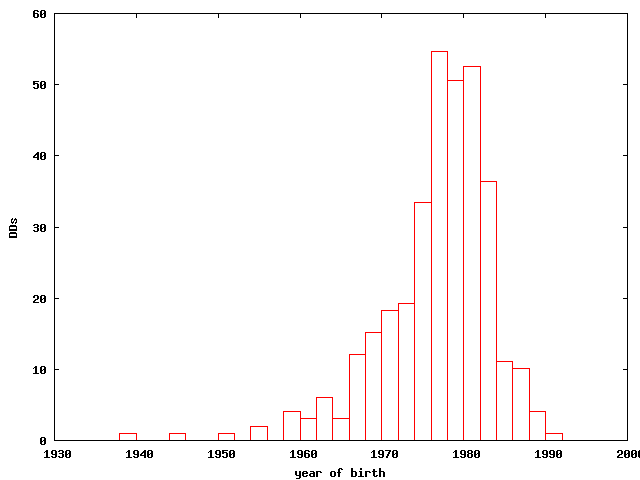
I was at FOSDEM last week-end. As usual there, I spent an excellent week-end. It was really nice to see all those friends again (and even meet some friends for the first time, hi gaston/carxwol/atmaniak!) Only problem is, FOSDEM is definitely too short ;-) To make this post a bit more interesting, I did some homework. The opening talk about FreeBSD had those stats about developers’ age, so I made the same ones for Debian (using the birthDate LDAP field, which was filled in by 340 DDs). Here is the graph. It would be interesting to compare that with other communities, which are sometimes perceived as “younger”. DD years of birth

8 February 2008

Lucas Nussbaum: dd + /dev/random fun

From Adrien Lebre, who seems to be having fun working on kDFS:
$ dd if=/dev/random of=file bs=1024 count=2
0+2 records in
0+2 records out
256 bytes (256 B) copied, 0.000705717 s, 363 kB/s
$ ls -l file
-rw-r--r-- 1 lucas lucas 256 2008-02-08 17:53 file
Can be easily explained using strace:
open("/dev/random", O_RDONLY O_LARGEFILE) = 0
[..]
open("file", O_WRONLY O_CREAT O_TRUNC O_LARGEFILE, 0666) = 1
[..]
read(0, "p(361241,360-330~M245y10=274U201c207v336a273"..., 1024) = 128
write(1, "p(361241,360-330~M245y10=274U201c207v336a273"..., 128) = 128
read(0, "362,LW5l.?2422225222320637510326335316374372"..., 1024) = 128
write(1, "362,LW5l.?2422225222320637510326335316374372"..., 128) = 128
close(0)                                = 0
close(1)                                = 0

2 February 2008

Lucas Nussbaum: Human deadlocks

Given three groups of groups of people A, B, C, responsible for 3 queues Qa, Qb, Qc ; and an elements e which have to go through Qa, then Qb, then Qc. Possible solution: A, B, C, please prove your point! Now, let’s find a practical example to apply that … Any suggestions? :-)

28 January 2008

Russell Coker: LCA 2008 Security Miniconf

Today I gave a talk about Debian security at the security mini-conf of LCA. Before I started the talk I asked for suggestions as to how to get more entries in my security blogging contest [0]. During the talk I asked for suggestions as to how to get more people involved in security development. One suggestion was to offer incentives. I’m experimenting with that with my blogging contest and may do future variations of the same thing. I started with describing some of the history of security in Debian (primarily things that involved me in some way): In 2003 I suggested that exec-shield be a standard feature in Debian kernel images [1]. I created a kernel-patch-exec-shield package in 2003 and Marcus Better took it over in 2004. We are hoping to get it included in Lenny. AMD64 architecture doesn’t need exec-shield as the CPU has separate write and execute bits in the page table, but it would be nice to get exec-shield included before the last P4 machine gets decommissioned. A presentation at the security miniconf at LCA 2005 on the topic of stack smashing is interesting [2]. At the time Adamantix was a distribution based on Debian which used PaX (similar to exec-shield). Adamantix has gone away. Hardened Gentoo has been available with Pax for all this time (but is not widely used). RHEL and Fedora have been available for all this time with exec-shield… In mid 2002 I demonstrated the first SE Linux Play machine at a conference in Germany. It was fully operational with root as the guest user. At that time SE Linux support in Debian was essentially complete. Since that time the scope of the SE Linuc project has increased slightly (EG controlling DBUS access) so the amount of work required for full support is greater. Most of that support is in Debian and Etch is basically working with SE Linux (although not quite as well as it was in 2002 due to lack of support for the strict policy). The aim is to have Lenny SE Linux become as functional as SE Linux in Fedora Core 5. While FC5 has more SE Linux features than the SE Linux project supported in 2002 it’s still a great disappointment that it’s taken so long. FC5 had pam_namespace to polyinstantiate directories such as /tmp. Lenny will hopefully have it. I described the current status: The hardening-wrapper package in unstable allows environment variables starting with DEB_BUILD_HARDENING_ to be used to control execution of GCC. Documented on the Debian Hardening Wikipedia page [3]. It’s still a little experimental and may change in the near future, but it works. Lucas Nussbaum is working on automatically building Debian packages with warnings for security related issues. The aim is to build all packages and maintain a central location for the logs to allow DDs to find and fix the problems in their packages. The Alioth Hardening project [4] will hopefully get some action soon (the people involved are busy doing work but not updating the project). The current plan is to base the Debian Hardening work around it. SE Linux in Debian is something that I want to get working correctly. There are still some significant issues that make strict policy unusable (such as correct labelling of /etc/passwd) as of last time I tested it. Finally I described the future plans. There were many questions about usability features for SE Linux, I mentioned in concept the features that Red Hat and Tresys people are developing (which I often don’t use as I prefer vi for policy editing). There were some questions about how SE Linux works. More than half the audience indicated that they had used it so I assumed some basic knowledge of SE Linux when describing how SE Linux works in regard to minimum privilege and the benefits of MAC in terms of limiting the scope of attack. I noted that every program has bugs and every program which performs security related tasks (which includes serving data to the net without being owned) should be assumed to inevitably have security related bugs (see the The Inevitability of Failure paper []). Based on the Twilight of the Books [5] article I decided to give this talk with no slides as an experiment. I talked from notes that I wrote and advised the delegates to read my blog for the details. Not presenting any slides meant that the room lights were all left on, which made things much easier when answering the many questions (I prefer an interactive format to my talks and have more questions than most speakers). It will be interesting to get some feedback from delegates about how they regarded this.

25 January 2008

Lucas Nussbaum: Re: a problem with tools

Joey has a problem with tools used over dpkg-dev’s core tools to help maintainers maintain their debian packages. I was wondering about the adoption of those tools, so I simply grepped the logs from my last rebuild for “^Setting up $TOOL “, which is more accurate than looking at build-deps, since someteam-pkg-tools could depend on cdbs, and hide cdbs usage. Results, with lists of packages “affected”:
Tool Packages
debhelper 11434 (95.8%)
cdbs 2665 (22.3%)
dpatch 1714 (14.4%)
quilt 935 (7.8%)
dbs 57 (0.47%)
yada 32 (0.27%)
debmake 2 (0.017%)
(if you want me to check the logs for another tool, just tell me) My personal opinion on this is that tools that make sense are slowly getting adopted (that probably includes debhelper, cdbs, dpatch and quilt). The main difference between debhelper and the other tools is that the other tools don’t try to solve a problem for everybody. cdbs perfectly makes sense for some packages: the simple ones, where you only have to modify 4-5 lines in the output from dh_make to build properly. Patch systems are also a good way to track changes made to upstream source, and probably encourage giving back patches to upstream. Note that my stats don’t include packages using cdbs’ simple-patchsys, so there are probably really close to 1/4 or 1/3 of our packages using some sort of patch system. How course, having simple-patchsys, dpatch and quilt sounds a bit stupid. But last time I checked, nobody took the time to blog a comparison of those tools, saying why quilt,dpatch is better than simple-patchsys,dpatch,quilt . Also, simple-patchsys probably makes a good-enough job for its users, so they don’t see the point in changing. Of course, it’s easier to bury your head in the sand, and ignore the fact that those tools solve real problems for so many people and packages, and make their lives easier. :-)

20 January 2008

Lucas Nussbaum: Fixing build failures with dash is cool.

The bad thing with fixing build failures with dash is that there are still a lot of open bugs. (Remember, the 0-day NMU policy applies to those, so it’s a good opportunity to improve your NMU karma. And I will sponsor your NMUs if you can’t upload!). The good thing is that you sometimes run into funny code, like:
clean:
    dh_testdir
    dh_testroot
    pushd docs ; $(MAKE) distclean true ; popd
Since pushd/popd is a bashism, the Ubuntu patch changed this to:
clean:
    dh_testdir
    dh_testroot
    cd docs ; $(MAKE) distclean true ; cd $(CURDIR)
Which works, but is … interesting? :-)

16 January 2008

Lucas Nussbaum: Help us get rid of dash build failures in Debian!

Following my rebuild of all packages using /bin/dash as /bin/sh, we now have a nice list of bugs. Those bugs are cool: So, if you want to get involved in Debian development, try to submit NMU patches for those bugs. If you want me to sponsor the upload, please Cc me when you submit the patch. And even if you don’t care about Debian, but only about Ubuntu (which is fondamentally wrong, as everybody knows that Ubuntu is based on Debian), fixing these bugs also helps Ubuntu a lot: all those bugs hurt Ubuntu, since Ubuntu uses dash as /bin/sh by default, and, even if the packages in Ubuntu have been patched, it’s still causing additional work every time a new package is uploaded to Debian, and has to imported in Ubuntu. If you have questions with the process, please ask them using the comments below. Notes:
I use the following process on those bugs, and it’s probably a good idea that you do the same if you intent to submit patches: If you submit NMU patches, please also have a look at the other bugs in the package, or at the lintian output. I don’t mind sponsoring small fixes for non-cosmetic/non-wishlist stuff at the same time.

4 January 2008

Lucas Nussbaum: Rebuilding the archive with dash as /bin/sh

I rebuilt all Debian packages twice. The first time with bash as /bin/sh, and the second time with dash as /bin/sh. About 120 packages built fine with bash, but failed to build with dash. I filed all the bugs that weren’t filed already. Then I debdiff’d the resulting binary packages, and found about 40 packages that built fine with bash and dash, but produced different binary packages (mostly files missing/being added)! All the bugs (including those that were already filed) have been usertagged. Most of those bugs are quite easy to reproduce and fix, so, if you are bored, send patches! I was a bit surprised by the high number of problems I found, since Ubuntu has been using dash as /bin/sh for more than a year, even on their buildds. Some packages have been fixed in Ubuntu, but the Debian maintainers didn’t include the fix. But many packages were simply broken in Ubuntu. Now I’ll try to find time to work on the Build Daemon From Hell idea, and on rebuilds inside qemu.

Next.

Previous.