Search Results: "Dirk Eddelbuettel"

20 March 2024

Dirk Eddelbuettel: ciw 0.0.2 on CRAN: Updates

A first revision of the still only one-week old (at CRAN) package ciw has been released to CRAN! It provides is a single (efficient) function incoming() (now along with an alias ciw()) which summarises the state of the incoming directories at CRAN. I happen to like having these things at my (shell) fingertips, so it goes along with (still draft) wrapper ciw.r that will be part of the next littler release. For example, when I do this right now as I type this, I see (typically less than one second later)
edd@rob:~$ ciw.r 
    Folder                     Name                Time   Size         Age
    <char>                   <char>              <POSc> <char>  <difftime>
1: pretest instantiate_0.2.2.tar.gz 2024-03-20 13:29:00    17K  0.07 hours
2: recheck   tinytable_0.2.0.tar.gz 2024-03-20 12:50:00   565K  0.72 hours
3: pending      Matrix_1.7-0.tar.gz 2024-03-20 12:05:00   2.3M  1.47 hours
4: recheck      survey_4.4-2.tar.gz 2024-03-20 02:02:00   2.2M 11.52 hours
5: waiting   equateIRT_2.4.0.tar.gz 2024-03-19 17:00:00   895K 20.55 hours
6: pending   ravetools_0.1.5.tar.gz 2024-03-19 12:06:00   1.0M 25.45 hours
7: waiting     glmmTMB_1.1.9.tar.gz 2024-03-18 16:04:00   4.2M 45.48 hours
edd@rob:~$ 
See ciw.r --help or ciw.r --usage for more. Alternatively, in your R session, you can call ciw::incoming() (or now ciw::ciw()) for the same result (and/or load the package first). This release adds some packaging touches, brings the new alias ciw() as well as a state variable with all (known) folder names and some internal improvements for dealing with error conditions. The NEWS entry follows.

Changes in version 0.0.2 (2024-03-20)
  • The package README and DESCRIPTION have been expanded
  • An alias ciw can now be used for incoming
  • Network error handling is now more robist
  • A state variable known_folders lists all CRAN folders below incoming

Courtesy of my CRANberries, there is also a diffstat report for this release. If you like this or other open-source work I do, you can sponsor me at GitHub.

This post by Dirk Eddelbuettel originated on his Thinking inside the box blog. Please report excessive re-aggregation in third-party for-profit settings.

14 March 2024

Dirk Eddelbuettel: ciw 0.0.1 on CRAN: New Package!

Happy to share that ciw is now on CRAN! I had tooted a little bit about it, e.g., here. What it provides is a single (efficient) function incoming() which summarises the state of the incoming directories at CRAN. I happen to like having these things at my (shell) fingertips, so it goes along with (still draft) wrapper ciw.r that will be part of the next littler release. For example, when I do this right now as I type this, I see
edd@rob:~$ ciw.r
    Folder                   Name                Time   Size          Age
    <char>                 <char>              <POSc> <char>   <difftime>
1: waiting   maximin_1.0-5.tar.gz 2024-03-13 22:22:00    20K   2.48 hours
2: inspect    GofCens_0.97.tar.gz 2024-03-13 21:12:00    29K   3.65 hours
3: inspect verbalisr_0.5.2.tar.gz 2024-03-13 20:09:00    79K   4.70 hours
4: waiting    rnames_1.0.1.tar.gz 2024-03-12 15:04:00   2.7K  33.78 hours
5: waiting  PCMBase_1.2.14.tar.gz 2024-03-10 12:32:00   406K  84.32 hours
6: pending        MPCR_1.1.tar.gz 2024-02-22 11:07:00   903K 493.73 hours
edd@rob:~$ 
which is rather compact as CRAN kept busy! This call runs in about (or just over) one second, which includes launching r. Good enough for me. From a well-connected EC2 instance it is about 800ms on the command-line. When I do I from here inside an R session it is maybe 700ms. And doing it over in Europe is faster still. (I am using ping=FALSE for these to omit the default sanity check of can I haz networking? to speed things up. The check adds another 200ms or so.) The function (and the wrapper) offer a ton of options too this is ridiculously easy to do thanks to the docopt package:
edd@rob:~$ ciw.r -x
Usage: ciw.r [-h] [-x] [-a] [-m] [-i] [-t] [-p] [-w] [-r] [-s] [-n] [-u] [-l rows] [-z] [ARG...]

-m --mega           use 'mega' mode of all folders (see --usage)
-i --inspect        visit 'inspect' folder
-t --pretest        visit 'pretest' folder
-p --pending        visit 'pending' folder
-w --waiting        visit 'waiting' folder
-r --recheck        visit 'waiting' folder
-a --archive        visit 'archive' folder
-n --newbies        visit 'newbies' folder
-u --publish        visit 'publish' folder
-s --skipsort       skip sorting of aggregate results by age
-l --lines rows     print top 'rows' of the result object [default: 50]
-z --ping           run the connectivity check first
-h --help           show this help text
-x --usage          show help and short example usage 

where ARG... can be one or more file name, or directories or package names.

Examples:
  ciw.r -ip                            # run in 'inspect' and 'pending' mode
  ciw.r -a                             # run with mode 'auto' resolved in incoming()
  ciw.r                                # run with defaults, same as '-itpwr'

When no argument is given, 'auto' is selected which corresponds to 'inspect', 'waiting',
'pending', 'pretest', and 'recheck'. Selecting '-m' or '--mega' are select as default.

Folder selecting arguments are cumulative; but 'mega' is a single selections of all folders
(i.e. 'inspect', 'waiting', 'pending', 'pretest', 'recheck', 'archive', 'newbies', 'publish').

ciw.r is part of littler which brings 'r' to the command-line.
See https://dirk.eddelbuettel.com/code/littler.html for more information.
edd@rob:~$ 
The README at the git repo and the CRAN page offer a screenshot movie showing some of the options in action. I have been using the little tools quite a bit over the last two or three weeks since I first put it together and find it quite handy. With that again a big Thank You! of appcreciation for all that CRAN does which this week included letting this past the newbies desk in under 24 hours. If you like this or other open-source work I do, you can sponsor me at GitHub.

This post by Dirk Eddelbuettel originated on his Thinking inside the box blog. Please report excessive re-aggregation in third-party for-profit settings.

11 March 2024

Dirk Eddelbuettel: digest 0.6.35 on CRAN: New xxhash code

Release 0.6.35 of the digest package arrived at CRAN today and has also been uploaded to Debian already. digest creates hash digests of arbitrary R objects. It can use a number different hashing algorithms (md5, sha-1, sha-256, sha-512, crc32, xxhash32, xxhash64, murmur32, spookyhash, blake3,crc32c and now also xxh3_64 and xxh3_128), and enables easy comparison of (potentially large and nested) R language objects as it relies on the native serialization in R. It is a mature and widely-used package (with 65.8 million downloads just on the partial cloud mirrors of CRAN which keep logs) as many tasks may involve caching of objects for which it provides convenient general-purpose hash key generation to quickly identify the various objects. This release updates the included xxHash version to the current verion 0.8.2 updating the existing xxhash32 and xxhash64 hash functions and also adding the newer xxh3_64 and xxh3_128 ones. We have a project at work using xxh3_128 from Python which made me realize having it from R would be nice too, and given the existing infrastructure in the package actually doing so was fairly quick and straightforward. My CRANberries provides a summary of changes to the previous version. For questions or comments use the issue tracker off the GitHub repo. For documentation (including the changelog) see the documentation site. If you like this or other open-source work I do, you can now sponsor me at GitHub.

This post by Dirk Eddelbuettel originated on his Thinking inside the box blog. Please report excessive re-aggregation in third-party for-profit settings.

7 March 2024

Dirk Eddelbuettel: prrd 0.0.6 at CRAN: Several Improvements

Thrilled to share that a new version of prrd arrived at CRAN yesterday in a first update in two and a half years. prrd facilitates the parallel running [of] reverse dependency [checks] when preparing R packages. It is used extensively for releases I make of Rcpp, RcppArmadillo, RcppEigen, BH, and others. prrd screenshot image The key idea of prrd is simple, and described in some more detail on its webpage and its GitHub repo. Reverse dependency checks are an important part of package development that is easily done in a (serial) loop. But these checks are also generally embarassingly parallel as there is no or little interdependency between them (besides maybe shared build depedencies). See the (dated) screenshot (running six parallel workers, arranged in a split byobu session). This release, the first since 2021, brings a number of enhancments. In particular, the summary function is now improved in several ways. Josh also put in a nice PR that generalizes some setup defaults and values. The release is summarised in the NEWS entry:

Changes in prrd version 0.0.6 (2024-03-06)
  • The summary function has received several enhancements:
    • Extended summary is only running when failures are seen.
    • The summariseQueue function now displays an anticipated completion time and remaining duration.
    • The use of optional package foghorn has been refined, and refactored, when running summaries.
  • The dequeueJobs.r scripts can receive a date argument, the date can be parse via anydate if anytime ins present.
  • The enqueeJobs.r now considers skipped package when running 'addfailed' while ensuring selecting packages are still on CRAN.
  • The CI setup has been updated (twice),
  • Enqueing and dequing functions and scripts now support relative directories, updated documentation (#18 by Joshua Ulrich).

Courtesy of my CRANberries, there is also a diffstat report for this release. If you like this or other open-source work I do, you can sponsor me at GitHub.

This post by Dirk Eddelbuettel originated on his Thinking inside the box blog. Please report excessive re-aggregation in third-party for-profit settings.

4 March 2024

Dirk Eddelbuettel: tinythemes 0.0.2 at CRAN: Maintenance

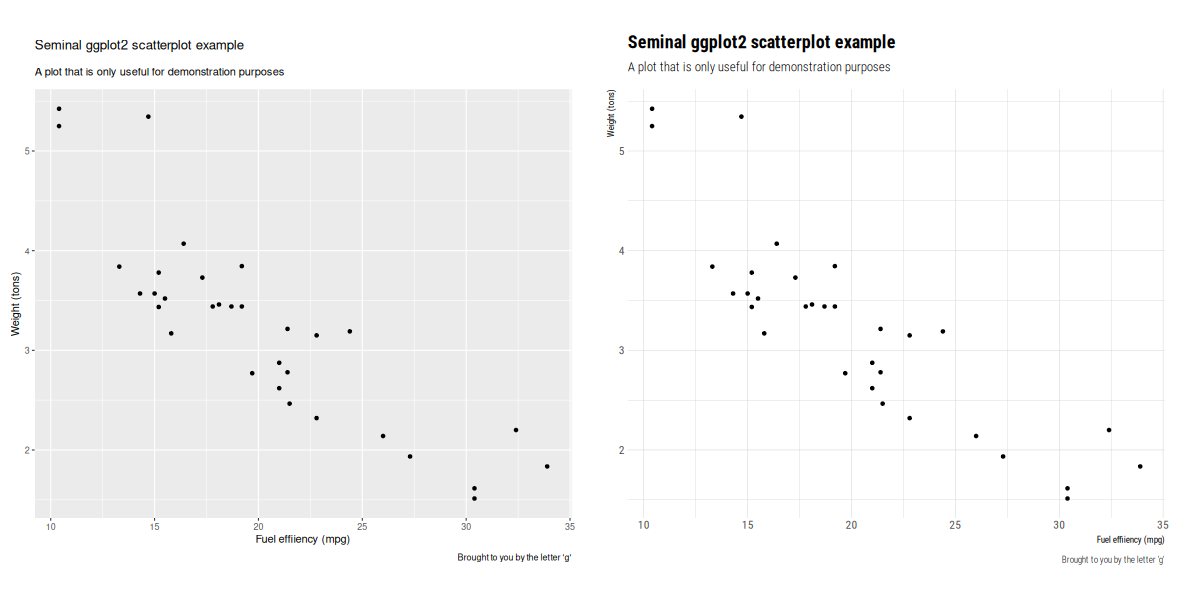
A first maintenance of the still fairly new package tinythemes arrived on CRAN today. tinythemes provides the theme_ipsum_rc() function from hrbrthemes by Bob Rudis in a zero (added) dependency way. A simple example is (also available as a demo inside the package) contrasts the default style (on left) with the one added by this package (on the right): This version mostly just updates to the newest releases of ggplot2 as one must, and takes advantage of Bob s update to hrbrthemes yesterday. The full set of changes since the initial CRAN release follows.

Changes in spdl version 0.0.2 (2024-03-04)
  • Added continuous integrations action based on r2u
  • Added demo/ directory and a READNE.md
  • Minor edits to help page content
  • Synchronised with ggplot2 3.5.0 via hrbrthemes

Courtesy of my CRANberries, there is a diffstat report relative to previous release. More detailed information is on the repo where comments and suggestions are welcome. If you like this or other open-source work I do, you can sponsor me at GitHub.

This post by Dirk Eddelbuettel originated on his Thinking inside the box blog. Please report excessive re-aggregation in third-party for-profit settings.

3 March 2024

Dirk Eddelbuettel: RcppArmadillo 0.12.8.1.0 on CRAN: Upstream Fix, Interface Polish

armadillo image Armadillo is a powerful and expressive C++ template library for linear algebra and scientific computing. It aims towards a good balance between speed and ease of use, has a syntax deliberately close to Matlab, and is useful for algorithm development directly in C++, or quick conversion of research code into production environments. RcppArmadillo integrates this library with the R environment and language and is widely used by (currently) 1130 other packages on CRAN, downloaded 32.8 million times (per the partial logs from the cloud mirrors of CRAN), and the CSDA paper (preprint / vignette) by Conrad and myself has been cited 578 times according to Google Scholar. This release brings a new upstream bugfix release Armadillo 12.8.1 prepared by Conrad yesterday. It was delayed for a few hours as CRAN noticed an error in one package which we all concluded was spurious as it could be reproduced outside of the one run there. Following from the previous release, we also use the slighty faster Lighter header in the examples. And once it got to CRAN I also updated the Debian package. The set of changes since the last CRAN release follows.

Changes in RcppArmadillo version 0.12.8.1.0 (2024-03-02)
  • Upgraded to Armadillo release 12.8.1 (Cortisol Injector)
    • Workaround in norm() for yet another bug in macOS accelerate framework
  • Update README for RcppArmadillo usage counts
  • Update examples to use '#include <RcppArmadillo/Lighter>' for faster compilation excluding unused Rcpp features

Courtesy of my CRANberries, there is a diffstat report relative to previous release. More detailed information is on the RcppArmadillo page. Questions, comments etc should go to the rcpp-devel mailing list off the Rcpp R-Forge page. If you like this or other open-source work I do, you can sponsor me at GitHub.

This post by Dirk Eddelbuettel originated on his Thinking inside the box blog. Please report excessive re-aggregation in third-party for-profit settings.

28 February 2024

Dirk Eddelbuettel: RcppEigen 0.3.4.0.0 on CRAN: New Upstream, At Last

We are thrilled to share that RcppEigen has now upgraded to Eigen release 3.4.0! The new release 0.3.4.0.0 arrived on CRAN earlier today, and has been shipped to Debian as well. Eigen is a C++ template library for linear algebra: matrices, vectors, numerical solvers, and related algorithms. This update has been in the works for a full two and a half years! It all started with a PR #102 by Yixuan bringing the package-local changes for R integration forward to usptream release 3.4.0. We opened issue #103 to steer possible changes from reverse-dependency checking through. Lo and behold, this just stalled because a few substantial changes were needed and not coming. But after a long wait, and like a bolt out of a perfectly blue sky, Andrew revived it in January with a reverse depends run of his own along with a set of PRs. That was the push that was needed, and I steered it along with a number of reverse dependency checks, and occassional emails to maintainers. We managed to bring it down to only three packages having a hickup, and all three had received PRs thanks to Andrew and even merged them. So the plan became to release today following a final fourteen day window. And CRAN was convinced by our arguments that we followed due process. So there it is! Big big thanks to all who helped it along, especially Yixuan and Andrew but also Mikael who updated another patch set he had prepared for the previous release series. The complete NEWS file entry follows.

Changes in RcppEigen version 0.3.4.0.0 (2024-02-28)
  • The Eigen version has been upgrade to release 3.4.0 (Yixuan)
  • Extensive reverse-dependency checks ensure only three out of over 400 packages at CRAN are affected; PRs and patches helped other packages
  • The long-running branch also contains substantial contributions from Mikael Jagan (for the lme4 interface) and Andrew Johnson (revdep PRs)

Courtesy of CRANberries, there is also a diffstat report for the most recent release. If you like this or other open-source work I do, you can sponsor me at GitHub.

This post by Dirk Eddelbuettel originated on his Thinking inside the box blog. Please report excessive re-aggregation in third-party for-profit settings.

8 February 2024

Dirk Eddelbuettel: RcppArmadillo 0.12.8.0.0 on CRAN: New Upstream, Interface Polish

armadillo image Armadillo is a powerful and expressive C++ template library for linear algebra and scientific computing. It aims towards a good balance between speed and ease of use, has a syntax deliberately close to Matlab, and is useful for algorithm development directly in C++, or quick conversion of research code into production environments. RcppArmadillo integrates this library with the R environment and language and is widely used by (currently) 1119 other packages on CRAN, downloaded 32.5 million times (per the partial logs from the cloud mirrors of CRAN), and the CSDA paper (preprint / vignette) by Conrad and myself has been cited 575 times according to Google Scholar. This release brings a new (stable) upstream (minor) release Armadillo 12.8.0 prepared by Conrad two days ago. We, as usual, prepared a release candidate which we tested against the over 1100 CRAN packages using RcppArmadillo. This found no issues, which was confirmed by CRAN once we uploaded and so it arrived as a new release today in a fully automated fashion. We also made a small change that had been prepared by GitHub issue #400: a few internal header files that were cluttering the top-level of the include directory have been moved to internal directories. The standard header is of course unaffected, and the set of full / light / lighter / lightest headers (matching we did a while back in Rcpp) also continue to work as one expects. This change was also tested in a full reverse-dependency check in January but had not been released to CRAN yet. The set of changes since the last CRAN release follows.

Changes in RcppArmadillo version 0.12.8.0.0 (2024-02-06)
  • Upgraded to Armadillo release 12.8.0 (Cortisol Injector)
    • Faster detection of symmetric expressions by pinv() and rank()
    • Expanded shift() to handle sparse matrices
    • Expanded conv_to for more flexible conversions between sparse and dense matrices
    • Added cbrt()
    • More compact representation of integers when saving matrices in CSV format
  • Five non-user facing top-level include files have been removed (#432 closing #400 and building on #395 and #396)

Courtesy of my CRANberries, there is a diffstat report relative to previous release. More detailed information is on the RcppArmadillo page. Questions, comments etc should go to the rcpp-devel mailing list off the Rcpp R-Forge page. If you like this or other open-source work I do, you can sponsor me at GitHub.

This post by Dirk Eddelbuettel originated on his Thinking inside the box blog. Please report excessive re-aggregation in third-party for-profit settings.

2 February 2024

Dirk Eddelbuettel: RQuantLib 0.4.21 on CRAN: Maintenance

A new minor release 0.4.21 of RQuantLib arrived at CRAN this afternoon, and has already been uploaded to Debian as well. QuantLib is a rather comprehensice free/open-source library for quantitative finance. RQuantLib connects (some parts of) it to the R environment and language, and has been part of CRAN for more than twenty years (!!) as it was one of the first packages I uploaded there. This release of RQuantLib benefits from some kind attention that Jeroen has been paying to how we build (especially at CRAN) on both macOS and Windows. So the build processes are a little better now, and no internal code changed. QuantLib 1.33 built unchanged.

Changes in RQuantLib version 0.4.21 (2024-02-01)
  • Generalize macOS build to universal build (Jeroen in #179)
  • Generalize Windows build to arm64 (Jeroen in #181)
  • Generalize version string use to support cmake use (Jeroen in #181 fixing #180)
  • Minor update to 'ci.yaml' github action (Dirk)

Courtesy of my CRANberries, there is also a diffstat report for the this release. As always, more detailed information is on the RQuantLib page. Questions, comments etc should go to the rquantlib-devel mailing list. Issue tickets can be filed at the GitHub repo. If you like this or other open-source work I do, you can now sponsor me at GitHub.

This post by Dirk Eddelbuettel originated on his Thinking inside the box blog. Please report excessive re-aggregation in third-party for-profit settings.

31 January 2024

Dirk Eddelbuettel: dtts 0.1.2 on CRAN: Maintenance

Leonardo and I are happy to announce the release of a very minor maintenance release 0.1.2 of our dtts package which has been on CRAN for a little under two years now. dtts builds upon our nanotime package as well as the beloved data.table to bring high-performance and high-resolution indexing at the nanosecond level to data frames. dtts aims to offers the time-series indexing versatility of xts (and zoo) to the immense power of data.table while supporting highest nanosecond resolution. This release follows yesterday s long-awaited release of data.table version 1.5.0 which had been some time in the making as the first new major.minor release since Matt drifted into being less active and the forefront. The release also renamed the one C-level API accessor to data.table (which was added, if memory serves, by Leonardo with our use in mind). So we have to catch up to the renamed identifier; this release does that, and adds a versioned imports statement on data.table. The short list of changes follows.

Changes in version 0.1.2 (2024-01-31)
  • Update the one exported C-level identifier from data.table following its 1.5.0 release and a renaming
  • Routine continuous integration updates

Courtesy of my CRANberries, there is also a report with diffstat for this release. Questions, comments, issue tickets can be brought to the GitHub repo. If you like this or other open-source work I do, you can now sponsor me at GitHub.

This post by Dirk Eddelbuettel originated on his Thinking inside the box blog. Please report excessive re-aggregation in third-party for-profit settings.

25 January 2024

Dirk Eddelbuettel: qlcal 0.0.10 on CRAN: Calendar Updates

The tenth release of the qlcal package arrivied at CRAN today. qlcal delivers the calendaring parts of QuantLib. It is provided (for the R package) as a set of included files, so the package is self-contained and does not depend on an external QuantLib library (which can be demanding to build). qlcal covers over sixty country / market calendars and can compute holiday lists, its complement (i.e. business day lists) and much more. Examples are in the README at the repository, the package page, and course at the CRAN package page. This releases synchronizes qlcal with the QuantLib release 1.33 and its updates to 2024 calendars.

Changes in version 0.0.10 (2024-01-24)
  • Synchronized with QuantLib 1.33

Courtesy of my CRANberries, there is a diffstat report for this release. See the project page and package documentation for more details, and more examples. If you like this or other open-source work I do, you can now sponsor me at GitHub.

This post by Dirk Eddelbuettel originated on his Thinking inside the box blog. Please report excessive re-aggregation in third-party for-profit settings.

24 January 2024

Dirk Eddelbuettel: RApiDatetime 0.0.9 on CRAN: Maintenance

A new maintenance release of our RApiDatetime package is now on CRAN RApiDatetime provides a number of entry points for C-level functions of the R API for Date and Datetime calculations. The functions asPOSIXlt and asPOSIXct convert between long and compact datetime representation, formatPOSIXlt and Rstrptime convert to and from character strings, and POSIXlt2D and D2POSIXlt convert between Date and POSIXlt datetime. Lastly, asDatePOSIXct converts to a date type. All these functions are rather useful, but were not previously exported by R for C-level use by other packages. Which this package aims to change. This release responds to a CRAN request to clean up empty macros and sections in Rd files. Moreover, because the windows portion of the corresponding R-internal code underwent some changes, our (#ifdef conditional) coverage here is a little behind and created a warning under the newer UCRT setup. So starting with this release we are back to OS_type: unix meaning there will not be any Windows builds at CRAN. If you would like that to change, and ideally can work in the Windows portion, do not hesitate to get in touch. Details of the release follow based on the NEWS file.

Changes in RApiDatetime version 0.0.9 (2024-01-23)
  • Replace auto-generated stale RApitDatetime-package.Rd with macro-filled stanza to satisfy CRAN request.

Courtesy of my CRANberries, there is also a diffstat report for this release. If you like this or other open-source work I do, you can sponsor me at GitHub.

This post by Dirk Eddelbuettel originated on his Thinking inside the box blog. Please report excessive re-aggregation in third-party for-profit settings.

Dirk Eddelbuettel: RcppAnnoy 0.0.22 on CRAN: Maintenance

annoy image A very minor maintenance release, now at version 0.0.22, of RcppAnnoy has arrived on CRAN. RcppAnnoy is the Rcpp-based R integration of the nifty Annoy library by Erik Bernhardsson. Annoy is a small and lightweight C++ template header library for very fast approximate nearest neighbours originally developed to drive the Spotify music discovery algorithm. It had all the buzzwords already a decade ago: it is one of the algorithms behind (drum roll ) vector search as it finds approximate matches very quickly and also allows to persist the data. This release responds to a CRAN request to clean up empty macros and sections in Rd files. Details of the release follow based on the NEWS file.

Changes in version 0.0.22 (2024-01-23)
  • Replace empty examples macro to satisfy CRAN request.

Courtesy of my CRANberries, there is also a diffstat report for this release. If you like this or other open-source work I do, you can sponsor me at GitHub.

This post by Dirk Eddelbuettel originated on his Thinking inside the box blog. Please report excessive re-aggregation in third-party for-profit settings.

22 January 2024

Dirk Eddelbuettel: x13binary 1.1.60 on CRAN: Upstream Update, Updated Build

The x13binary team is thrilled to share the availability of Release 1.1.60-1 of the x13binary package providing the X-13ARIMA-SEATS program by the US Census Bureau which arrived on CRAN earlier today. This release brings the package up to speed with the most current release by the Census Bureau. More importantly, we finally made good on an old promise to ourselves and now install the binary by compiling from its Fortran sources! No more pre-made binaries. This required some work by Kirill, Michael, and Jeroen to finalize matter because, as we all know, the CRAN build processes and tool chains can be a little byzantine in their details. Use on platforms not covered by binaries from CRAN (or r-universe) should just work too as the demands on the (Fortran) compiler are fairly standard. All in all the build is fairly lightweight and quick even when rebuilding from source. Courtesy of my CRANberries, there is also a diffstat report for this release showing changes to the previous release. If you like this or other open-source work I do, you can sponsor me at GitHub.

This post by Dirk Eddelbuettel originated on his Thinking inside the box blog. Please report excessive re-aggregation in third-party for-profit settings.

Dirk Eddelbuettel: RProtoBuf 0.4.22 on CRAN: Updated Windows Support!

A new maintenance release 0.4.22 of RProtoBuf arrived on CRAN earlier today. RProtoBuf provides R with bindings for the Google Protocol Buffers ( ProtoBuf ) data encoding and serialization library used and released by Google, and deployed very widely in numerous projects as a language and operating-system agnostic protocol. This release matches the recent 0.4.21 release which enabled use of the package with newer ProtoBuf releases. Tomas has been updating the Windows / rtools side of things, and supplied us with simple PR that will enable building with those updated versions once finalised. The following section from the NEWS.Rd file has full details.

Changes in RProtoBuf version 0.4.22 (2022-12-13)
  • Apply patch by Tomas Kalibera to support updated rtools to build with newer ProtoBuf releases on windows

Thanks to my CRANberries, there is a diff to the previous release. The RProtoBuf page has copies of the (older) package vignette, the quick overview vignette, and the pre-print of our JSS paper. Questions, comments etc should go to the GitHub issue tracker off the GitHub repo. If you like this or other open-source work I do, you can sponsor me at GitHub.

This post by Dirk Eddelbuettel originated on his Thinking inside the box blog. Please report excessive re-aggregation in third-party for-profit settings.

12 January 2024

Dirk Eddelbuettel: RcppSpdlog 0.0.16 on CRAN: New Upstream

Version 0.0.16 of RcppSpdlog is now on CRAN and will be uploaded to Debian. RcppSpdlog bundles spdlog, a wonderful header-only C++ logging library with all the bells and whistles you would want that was written by Gabi Melman, and also includes fmt by Victor Zverovich. You can learn more at the nice package documention site. This releases updates the code to the version 1.13 of spdlog which was release this morning. The NEWS entry for this release follows.

Changes in RcppSpdlog version 0.0.16 (2024-01-12)
  • Upgraded to upstream releases spdlog 1.13.0

Courtesy of my CRANberries, there is also a diffstat report. More detailed information is on the RcppSpdlog page, or the package documention site. If you like this or other open-source work I do, you can sponsor me at GitHub.

This post by Dirk Eddelbuettel originated on his Thinking inside the box blog. Please report excessive re-aggregation in third-party for-profit settings.

Dirk Eddelbuettel: RDieHarder 0.2.6 on CRAN: Maintenance

An new version 0.2.6 of the random-number generator tester RDieHarder (based on the DieHarder suite developed / maintained by Robert Brown with contributions by David Bauer and myself along with other contributors) is now on CRAN (and to the day year after the previous release). This release contains changes to printf format strings to avoid new warnings on Windows. No functional changes have been made. Thanks to CRANberries, you can also look at the most recent diff to the previous release. If you like this or other open-source work I do, you can now sponsor me at GitHub.

This post by Dirk Eddelbuettel originated on his Thinking inside the box blog. Please report excessive re-aggregation in third-party for-profit settings.

Dirk Eddelbuettel: digest 0.6.34 on CRAN: Maintanance

Release 0.6.34 of the digest package arrived at CRAN today and has also been uploaded to Debian already. digest creates hash digests of arbitrary R objects. It can use a number different hashing algorithms (md5, sha-1, sha-256, sha-512, crc32, xxhash32, xxhash64, murmur32, spookyhash, blake3, and crc32c), and ebales easy comparison of (potentially large and nested) R language objects as it relies on the native serialization in R. It is a mature and widely-used package (with 63.8 million downloads just on the partial cloud mirrors of CRAN which keep logs) as many tasks may involve caching of objects for which it provides convenient general-purpose hash key generation to quickly identify the various objects. (Oh and we also just passed the 20th anniversary of the initial CRAN upload. Time flies, as they say.) This release contains small (build-focussed) enhancements contributed by Michael Chirico, and another set of fixed for printf format warnings this time on Windows. My CRANberries provides a summary of changes to the previous version. For questions or comments use the issue tracker off the GitHub repo. If you like this or other open-source work I do, you can now sponsor me at GitHub.

This post by Dirk Eddelbuettel originated on his Thinking inside the box blog. Please report excessive re-aggregation in third-party for-profit settings.

10 January 2024

Dirk Eddelbuettel: BH 1.84.0-1 on CRAN: New Upstream

Boost Boost is a very large and comprehensive set of (peer-reviewed) libraries for the C++ programming language, containing well over one hundred individual libraries. The BH package provides a sizeable subset of header-only libraries for (easier, no linking required) use by R. It is fairly widely used: the (partial) CRAN mirror logs (aggregated from the cloud mirrors) show over 35.7 million package downloads. Version 1.84.0 of Boost was released in December following the regular Boost release schedule of April, August and December releases. As the commits and changelog show, we packaged it almost immediately and started testing following our annual update cycle which strives to balance being close enough to upstream and not stressing CRAN and the user base too much. The reverse depends check revealed five packages requiring changes or adjustments which is a pretty good outcome given the over three hundred direct reverse dependencies. So we opened issue #100 to coordinate the issue over the winter break during which CRAN also closes (just as we did in previous years). Our sincere thanks to the two packages that already updated before, and to the one that updated today within hours (!!) of the BH uploaded it needed. There are very few actual changes. We honoured one request (in issue #97) to add Boost QVM bringing quarternion support to R. No other new changes needed to be made. A number of changes I have to make each time in BH, and it is worth mentioning them. Because CRAN cares about backwards compatibility and the ability to be used on minimal or older systems, we still adjust the filenames of a few files to fit a jurassic constraints of just over a 100 characters per filepath present in some long-outdated versions of tar. Not a big deal. We also, and that is more controversial, silence a number of #pragma diagnostic messages for g++ and clang++ because CRAN insists on it. I have no choice in that matter. One warning we suppressed last year, but no longer do, concerns the C++14 standard that some Boost libraries now default to. Packages setting C++11 explicitly will likely get a note from CRAN changing this; in most cases that should be trivial to remove as we only had to opt into (then) newer standards under old compilers. These days newer defaults help; R itself now defaults to C++17.

Changes in version 1.84.0-0 (2024-01-09)

Via my CRANberries, there is a diffstat report relative to the previous release. Comments and suggestions about BH are welcome via the issue tracker at the GitHub repo. If you like this or other open-source work I do, you can now sponsor me at GitHub.

This post by Dirk Eddelbuettel originated on his Thinking inside the box blog. Please report excessive re-aggregation in third-party for-profit settings.

Dirk Eddelbuettel: Rcpp 1.0.12 on CRAN: New Maintenance / Update Release

rcpp logo The Rcpp Core Team is once again thrilled to announce a new release 1.0.12 of the Rcpp package. It arrived on CRAN early today, and has since been uploaded to Debian as well. Windows and macOS builds should appear at CRAN in the next few days, as will builds in different Linux distribution and of course at r2u should catch up tomorrow. The release was uploaded yesterday, and run its reverse dependencies overnight. Rcpp always gets flagged nomatter what because the grandfathered .Call(symbol) but we had not single change to worse among over 2700 reverse dependencies! This release continues with the six-months January-July cycle started with release 1.0.5 in July 2020. As a reminder, we do of course make interim snapshot dev or rc releases available via the Rcpp drat repo and strongly encourage their use and testing I run my systems with these versions which tend to work just as well, and are also fully tested against all reverse-dependencies. Rcpp has long established itself as the most popular way of enhancing R with C or C++ code. Right now, 2791 packages on CRAN depend on Rcpp for making analytical code go faster and further, along with 254 in BioConductor. On CRAN, 13.8% of all packages depend (directly) on Rcpp, and 59.9% of all compiled packages do. From the cloud mirror of CRAN (which is but a subset of all CRAN downloads), Rcpp has been downloaded 78.1 million times. The two published papers (also included in the package as preprint vignettes) have, respectively, 1766 (JSS, 2011) and 292 (TAS, 2018) citations, while the the book (Springer useR!, 2013) has another 617. This release is incremental as usual, generally preserving existing capabilities faithfully while smoothing our corners and / or extending slightly, sometimes in response to changing and tightened demands from CRAN or R standards. The full list below details all changes, their respective PRs and, if applicable, issue tickets. Big thanks from all of us to all contributors!

Changes in Rcpp release version 1.0.12 (2024-01-08)
  • Changes in Rcpp API:
    • Missing header includes as spotted by some recent tools were added in two places (Michael Chirico in #1272 closing #1271).
    • Casts to avoid integer overflow in matrix row/col selections have neem added (Aaron Lun #1281).
    • Three print format correction uncovered by R-devel were applied with thanks to Tomas Kalibera (Dirk in #1285).
    • Correct a print format correction in the RcppExports glue code (Dirk in #1288 fixing #1287).
    • The upcoming OBJSXP addition to R 4.4.0 is supported in the type2name mapper (Dirk and I aki in #1293).
  • Changes in Rcpp Attributes:
    • Generated interface code from base R that fails under LTO is now corrected (I aki in #1274 fixing a StackOverflow issue).
  • Changes in Rcpp Documentation:
    • The caption for third figure in the introductory vignette has been corrected (Dirk in #1277 fixing #1276).
    • A small formatting issue was correct in an Rd file as noticed by R-devel (Dirk in #1282).
    • The Rcpp FAQ vignette has been updated (Dirk in #1284).
    • The Rcpp.bib file has been refreshed to current package versions.
  • Changes in Rcpp Deployment:
    • The RcppExports file for an included test package has been updated (Dirk in #1289).

Thanks to my CRANberries, you can also look at a diff to the previous release Questions, comments etc should go to the rcpp-devel mailing list off the R-Forge page. Bugs reports are welcome at the GitHub issue tracker as well (where one can also search among open or closed issues). If you like this or other open-source work I do, you can sponsor me at GitHub.

This post by Dirk Eddelbuettel originated on his Thinking inside the box blog. Please report excessive re-aggregation in third-party for-profit settings.

Next.

Previous.