Search Results: "Benjamin Mako Hill"

4 March 2008

Benjamin Mako Hill: Comment, No Comment

There are many blogs called No Comment. Most of them allow comments, but not all. Unavailable for Comment is in fact available for comments, although it seems that few have taken advantage of the fact. Most blogs called Comment also allow comments although the blog Daily Comment (which is not daily) does not. The blog Leaveacomment.com does not seem to have the domain leaveacomment.com but allows its visitors to leave comments.

3 March 2008

Benjamin Mako Hill: Zones of Emergency

It's very short notice but I'm giving a talk tonight (2008-03-03) at the Joan Jonas Performance Hall at the MIT Visual Arts Program. It's rather last minute. I'll be talking along with Mark Tribe as part of a series called Zones of Emergency. I'll be speaking a bit about free and open source software and why it's particularly important in the context of emergencies. Think Sahana. There's more information about the talk online here.

Benjamin Mako Hill: Ending Software Patents

Last week, the Free Software Foundation announced an important new initiative called End Software Patents whose goals are pretty evident from the project's name. So far, the initiative is backed by the FSF, the Public Patent Foundation, and the Software Freedom Law Center. There are several organizations who are taking on specific bad patents but ESP is unique in that it is activitely working toward the abolition of software patents in the United States. While the organization is focused on work in the US, it's deeply important globally -- much of the world's patent law is "exported" from the US. The FSF is stretching extremely limited resources in backing ESP to help it get off the ground because we believe two things: Please read the new ESP report on the state of software patents written by the ESP Executive Director Ben Klemens to understand why we are optimistic. And please, support ESP financially in this fight. ESP's continued work is not ensured past the immediate future. Your support will help endow a bright future for the next generation of software developers and users.

25 February 2008

Benjamin Mako Hill: Still Seeing Yellow

Recently, the EFF reported that the European commission had responded to a request by European Parliament member Satu Hassi about tracking dots in printers. European Commissioner Franco Frattini replied that tracking dots may constitute a human rights violation saying that:
"..to the extent that individuals may be identified through material printed or copied using certain equipment, such processing may give rise to the violation of fundamental human rights, namely the right to privacy and private life. It also might violate the right to protection of personal data."
Intriguingly, the request text includes a mention to and link to the Seeing Yellow project I started last year as an example of the fact that consumers have complained to printer manufacturers and that these complaints have fallen upon deaf ears. Everyone who called their printer manufacturer in response to Seeing Yellow deserves come credit for the raised visibility to the issue that we've created and the set of actions that have brought the issue this far. Please, keep it up! If you've not complained to your printer manufacturer, visit Seeing Yellow and call today.

Benjamin Mako Hill: My Spring

I'm going to be traveling and giving talks quite a bit this spring. Here's what my schedule looks like now. I don't think much will be added to it: I'll be giving at least one talk at the FSF Members Meeting, the Renaissance Panel, Lugradio Live, Penguicon, and Community One. Matt's wedding is private. To join the FSF members meeting you must become an FSF Associate Member if you are not already. All of the other conferences require some sort of registration. Penguicon, Lugradio Live, and ROFLCon are each cheap and each promises to be a lot of fun. The talk at Hampshire should be free and open to the public. I'll be posting more about each of these as things get closer including details about what is that I'll be talking about. If you'd like me to talk to another group or at another event while I'm town for any of the events above, now would be a good time to ask. If you just want to meet up for a beverage of your choice, that's good too. In either case, get in contact.

24 February 2008

Benjamin Mako Hill: Still Seeing Yellow

Recently, the EFF reported that the European commission had responded to a request by European Parliament member Satu Hassi about tracking dots in printers. European Commissioner Franco Frattini replied that tracking dots may constitute a human rights violation saying that:
"..to the extent that individuals may be identified through material printed or copied using certain equipment, such processing may give rise to the violation of fundamental human rights, namely the right to privacy and private life. It also might violate the right to protection of personal data."
Intriguingly, the request text includes a mention to and link to the Seeing Yellow project I started last year as an example of the fact that consumers have complained to printer manufacturers and that these complaints have fallen upon deaf ears. Everyone who called their printer manufacturer in response to Seeing Yellow deserves come credit for the raised visibility to the issue that we've created and the set of actions that have brought the issue this far. Please, keep it up! If you've not complained to your printer manufacturer, visit Seeing Yellow and call today.

22 February 2008

Benjamin Mako Hill: Credit Card Numbers

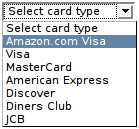
Every since I found out that the first digits of any credit card denote the issuer identifier (i.e., folks can tell who issued a credit card and what type it is just from the first digit or two) I've been annoyed almost each time I have to input credit card information on the web. Any decent credit card system knows that if a sixteen digit credit card number starts with 4, it's a Visa. And yet, each time anyone buys anything on the web, they must select "Visa" from the drop-down box. On a certain level we all know this; People in stores and restaurants never have to select the type of card before swiping. /copyrighteous/images/amazon_cc_selectbox.png When I'm feeling generous, I imagine this is so that the credit card companies can give an extra reminder that they only accept certain credit cards -- not being able to select a card type in an "essential" input field constrained to multiple choices is a pretty strong reminder. When I'm feeling less generous, I suspect it might be so that the companies can subtly remind us that they have their own brand credit cards that we might like to acquire.

21 February 2008

Benjamin Mako Hill: Creative Commons and the Freedom Definition

Creative Common Seal for Free Cultural Works Yesterday witnessed the most important step forward for the Definition of Free Cultural Works (DFCW) since its adoption and endorsement by the Wikimedia Foundation a year ago. Although I might have wished things otherwise, Creative Commons is not a social movement fighting for essential freedom or the essential freedoms at the core of the DFCW in particular. From the movement's perspective, CC is more like a law and advocacy firm that works for us -- a very sympathetic one. CC writes, hosts, and supports a variety of licenses. Some are free. Some are not. Last year they took steps to explicitly limit the extent of restrictions they are willing to tolerate in their licenses. Yet, while CC has resisted taking a stand in favor of the Definition of Free Cultural Works, they continue to produce some of the best free licenses, tools, and metadata available and they seem honestly interested in helping users interested in social movements based around these definitions organize more effectively. In perhaps its most important move to date in this area, Creative Commons announced yesterday that it was placing a seal on each of its licenses that provide the essential freedoms laid out in the Definition of Free Cultural Works. The seal links to the definition over at freedomdefined.org. In Creative Commons' words:
This seal and approval signals an important delineation between less and more restrictive licenses, one that creators and users of content should be aware of. A very practical reason users should be aware of these distinctions is that some important projects accept only freely (as defined) licensed or public domain content, in particular Wikipedia and Wikimedia sites, which use the Definition of Free Cultural Works in their licensing guidelines.
The seal is currently on two CC licenses that provide for essential freedom (Attribution and Attribution-ShareAlike) and their public domain dedication. Thanks go to Erik Moeller at the Wikimedia Foundation and everyone at Creative Commons to helped make this happen.

15 February 2008

Benjamin Mako Hill: Free Culture Elections

Recently, Students for Free Culture -- a non-profit organization dear to my heart -- elected its new board. Several months ago, the group voted to hold its elections using the same preferential election method system that Debian uses. To help make their election easier I agreed to support them with a new set of features in Selectricity aimed at more structured organizational decision-making. Currently Selectricity is more geared toward more informal QuickVotes. From a democratic and voting technology perspective, the election was a huge success. With 16 voters and 13 candidates, a traditional plurality or "first past the post" election would have been a poor match for their group -- the 16 first-place votes were very split among the candidates. The results also show one very polarizing candidate who won the plurality but was in the bottom third of most preferential rankings! The use of Selectricity helped SFC select a board who better represented the preference of their group than they would have otherwise. Exciting stuff! You can read more on the Free Culture website or on the Selectricity blog. Thanks are due both to the previous SFC board who took the risk on the technology and to all of the candidates and voters! I'm currently integrating feedback and improvements based on the SFC election and will open the feature up the public in the next couple weeks. If you want hear about this when it happens, you should subscribe to the Selectricity Blog or drop an email to team@selectricity.org.

10 February 2008

Benjamin Mako Hill: Goodbye AUB

Today, I orphaned AUB -- my very first Debian package and the first free software project whose maintenance I took over. I had been helping and doing work in Debian and the free software community for some time but AUB was the first package I uploaded into Debian with my own name in the maintainer field and with my key in the Debian keyring. AUB is a program for working with Usenet binaries. As late as 2002 perhaps, it was a pretty useful tool for a variety of things. Today, however, it doesn't seem to be useful for much more than indiscriminately downloading large amounts of porn and spam. The software is crusty and written in Perl 4 which, today, seems almost unforgivable. Like Usenet, AUB's day has come and gone. During my maintenance of the package, I ended up taking over upstream development and writing and integrating quite a few new features and patches. In fact, there still seem to be a few users! Unfortunately, I am not one them and I officially gave up on upstream maintenance a few months ago and contacted the submitters of all pending bug reports. Today I'm orphaning the Debian package and completely letting go. None of this is particularly noteworthy, I suppose. If AUB was ever important, it hasn't been for a long time. I think its worth mentioning because it's symbolic of the completion of the life cycle of a free software project that was important in my own growth. Languages, the world, and even I have moved on. In the process, I've grown hugely as a developer, programmer, and free software activist and advocate. Minor as it be, AUB played an important role in this whole process. If you are interested in taking over AUB, please let me know. Otherwise, I'm just as happy to let it disappear.

8 February 2008

Benjamin Mako Hill: Protest DRM at the Boston Public Library

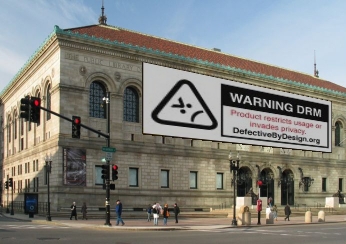
/copyrighteous/images/bpl_drm.jpg On Saturday February 9th, at 13:00, I'm going to be joining free software and anti-DRM activists to protest the use of DRM by the Boston Public Library on parts of its electronic collection. Those of us protesting are unhappy because the BPL has launched a new service powered by a company called OverDrive. The system gives BPL patrons access to books, music, and movies online -- but only if they use a Microsoft DRM system. There are lots of problems with the introduction of this system: it bars access to users of GNU/Linux and MacOS and creates a dependence on a single technology vendor for access. These are important issues, certainly. The worst problem, however, is much more fundamental. By adopting a DRM system for library content, the BPL is giving OverDrive, copyright holders, and Microsoft the ability to decide what, when, and how its patrons can and cannot read, listen, and watch these parts of the BPL collection. They are giving these companies veto power over the BPL's own ability to access this data -- both now and in the future. Cryptographically, BPL is quite literally handing over the keys to their collection. In the process, they are not only providing a disservice to their patrons. They are providing a disservice to themselves. The first-sale doctrine says that libraries can do essentially whatever they like with copies of books they purchase short of duplication, modification, or performance. Of course, copyright holders would prefer to charge a toll every time someone checks out a book. Public libraries were possible in spite of this desire because they were able to exploit power over the possession and control of their books in the interests of their patrons. With DRM, libraries will reduced to powerlessness. Of course, times have changed. As media and the ways we interact with it is increasingly digital, libraries have changed and will need to change more. But if public libraries are to succeed at their fundamental mission of spreading knowledge and serving communities, this change can't be at the expense of patrons' ability to control their own technology and libraries' ability to control their own collections. I've supported my academic library, MIT Libraries, as they took a risk and stood up to DRM when other institutions did not. And they won. BPL is the largest municipal library in the US and the third largest US library overall. It is the first library to be supported publicly, to be open to the public in the US, and to allow patrons to take home books to read and use them. BPL has an opportunity now to continue this history of leadership, of access, and of patron empowerment. If BPL stands up against DRM and in favor of its patrons' freedom and its own control of its technical destiny and collection, it may set an important precedent. If you're in or near Boston, please join me in Copley Square on Saturday to help make this happen. If you're not near Boston, please help put pressure on similar efforts in your own communities.
5 February 2008

Benjamin Mako Hill: Unintentionally Offensive Product Names

I don't think I've been this amused since Reebok accidentally named a shoe after a demon that sexually assaults women. Want to contribute to my list of unintentionally offensive product names?

29 January 2008

Benjamin Mako Hill: Chama o Bombeiro!

In Brazilian Portuguese, "bombeiro" is the word for both a fireman and a plumber. If someone asks you to call a "bombeiro," their statement is usually unambiguous due to context. Usually. /copyrighteous/images/chama_o_bombeiro.png Both SVG source and t-shirts are available at cost.

28 January 2008

Benjamin Mako Hill: Computing in the Cloud Recordings

As I mentioned I would a month or so ago, I attended a workshop on Computing in the Cloud organized by Ed Felton's Center for Information Technology Policy at Princeton University. The conference aimed to discuss the policy issues that are raised by the shift from computing on machines we own and have direct control over to computing on servers owned by others. Think Google, Facebook, MySpace, and that lot. I talked about what all this might mean for free software and for open source and our communities, a bit about the AGPL, and discussed some ideas of how might proceed as a community. Princeton has been organized enough to post audio and video of the whole conference, including recordings of my talk, in a variety of formats and qualities (although unfortunately not in Vorbis and Theora). As I said in my FSF membership appeal last month, I think complications raised by "cloud computing" are one of the most important sets of challenges facing free software this year.

25 January 2008

Benjamin Mako Hill: Planet Debian Searching

In the "bits from the Planet Debian maintainer" department... Steve Kemp has been running a little index and search script for Planet Debian for a couple years now that lets you search for old entries that have showed up on Planet Debian. He was going to take his system offline but, since it was in use by a variety of people, he opted to move it into the default Planet Debian instead. You should be able to see and use the search box in the sidebar on Planet Debian now. Feedback is welcome, I'm sure. Thanks to Steve for the fantastic addition to our aggregator.

4 January 2008

Benjamin Mako Hill: Laptop Liberation in Nara

I'm going to be giving a reprise of the Laptop Liberation talk I gave at Cornell University in November at the Nara Institute of Science and Technology in the Kansai region of Japan on January 7th. If you around, please feel free to show up. If you are in Osaka, Kyoto or Nara and would like to have lunch or dinner, please email me and we can try to arrange something. Details on the talk is online here in English and Japanese (thanks Mika!) although the talk itself will be in English.

27 December 2007

Benjamin Mako Hill: Japan Trip

I'm going to be visiting Mika's family in Tokyo for the next two and half a weeks. We're planning a trip to Kansai at some point as well. Currently, I've got no free software related plans or meetings lined up but if folks in Kyoto, Osaka, or the greater Tokyo area would like to meet up for drinks, that would be great. Additionally, I'd be happy to put together something more organized (e.g., a short talk, workshop, etc). If you'll be around and are interested in either, contact me and let's figure something out.

23 December 2007

Benjamin Mako Hill: Computing in the Cloud

On January 15th, I'm going to be giving a talk on a panel at the Computing in the Cloud conference held by Ed Felton's Center for Information Technology Policy at Princeton University. The conference description says:
Computing in the cloud is one name for services that run in a Web browser and store information in a provider s data center ranging from adaptations of familiar tools such as email and personal finance to new offerings such as virtual worlds and social networks. This workshop will bring together experts from computer science, law, politics and industry to explore the social and policy implications of this trend.
I'm going to talk about the AGPL 3.0, why it's important that we put effort into figuring out what freedom for different technologies means, and what the components of freedom for web services might be. Registration is free and bags you a name-tag and lunch. Worth noting perhaps, the conference is sponsored by Microsoft.

22 December 2007

Benjamin Mako Hill: Interview

Sun's Barton George just published an audio interview he did with me a few months ago at FOSSCamp. We talked mostly about my joining the FSF this past year, what it means for myself and the organization, and how I got there. Check it out!

15 December 2007

Benjamin Mako Hill: Annual Free Software Foundation Fundraiser

It's an end of year tradition for non-profit organizations to do big fund-raising and membership pushes. As I mentioned several days ago, I am personally giving to two organizations this year: the Wikimedia Foundation and the Free Software Foundation. The FSF has a goal of 500 associate members by year-end and it's an important goal that will sustain the foundation's activities. While membership dues keep the lights on, the fact that the foundation has a robust and growing membership is equally, if not more, important. FSF executive director Peter Brown put an appeal online in both video and text versions. In it, he lays out some of the most important issues for the next year. You should watch the video version in OGG Theora or this YouTube version (requires Gnash or non-free Flash). The appeal briefly lays out the FSF's plans for next year. My partner Mika Matsuzaki and my friend Oliver Day shot and edited the video. Please pass the link around to those you feel might be interested. Here's my appeal:
Now is the time to join and give to Free Software Foundation. 2008 is going to be extraordinarily important year for free software. Eben Moglen likes to quote Gandhi's "first they ignore you, then they laugh at you, then they fight you, then you win" progression when describing the free software movement. As I pointed out when I joined the FSF board, we're beginning to see powerful interests fighting free software. It's going to increase in the next few years. Things will probably get a lot uglier for free software before they get better. We can win but things are far from settled. The FSF is the front-line organization in this fight and we need a robust and proactive foundation, and an active and involved membership, if we're going to win. Here are the issues that I'm going to pushing the FSF to pursue in the next year. Expanding activism outside our traditional technologist communities: In part through the work of projects like Defective By Design, we've seen the tide turn for DRM on music in what what may be the FSF's greatest success last year. I'm going to push the FSF to continue the campaign to attack DRM for video, eBooks, and the other places it is cropping up. The most remarkable thing to me about Defective By Design is that its participants and supporters are not, for the most part, people who develop or use GNU/Linux or even know what GNU is! If advocacy for software freedom involves a conversation we can only have with people who understand what POSIX is and how one uses it, we've already lost. Through DbD, BadVista, and other projects, the FSF has made major strides in the last year. It need to do much more and needs your support to do so. Get proactive about software patents: As a community, we've had our head in the sand about software patents for far too long. There are companies and patent trolls sitting on massive, growing piles of software patents. They are not our friends and they do not mean us well. One cannot write non-trivial software today without running a serious risk of infringing patents. The software patents minefield we've found ourselves in is a very fundamental threat to the success of free software and we've already begun to see the first casualties and costs. We must eliminate software patents. Now. The US is very important in this fight (much patent law is "exported" from the US) and almost no organization is working on software patent elimination there. Not enough people are thinking and acting strategically on this issue. The FSF is planning to make major steps in this fight in the coming year and we need your support to do so. Web services and the changing face of software: This last year, I worked to help launch the new version the AGPLv3. The license addresses the role of copyleft for software like web-services which, due to the legal particulars of the GPL, did not extend to the purveyors of web services. Of course, access to source code does not make the users of all web-services free (e.g., the GMails and the Facebooks). Nobody seems to know what freedom for webserver entails. There might not even be good answers. In the next year, I'm going to push the FSF to help start several conversation and to begin to follow up on what I think was an important first step with the AGPLv3. While this is not a major organizational priority yet, it's a major action item that I will be pursuing through the FSF. If you feel strongly about this issue, whatever your position, become a member, stay involved as these projects develop, and have your voice be heard. We don't know the answers yet and we need your input as much as we need your action.
Please, support the FSF in the efforts listed above, and in others, by giving generously. If you're not a member, please join the FSF as an associate member. If you are already a member, please consider making a tax-deductible donation. The FSF is a very lean, very humble organization of passionate and dedicated individuals working tirelessly for software freedom. Every little bit helps. Members pays USD $120 ($10/month) and student members pay half that. FSF has members across the world -- where a weak dollar often makes it even cheaper. Member support and participation builds capacity and credibility for the foundation and keep the organization responsible, responsive, and in tune with our community.

Next.

Previous.