Search Results: "sten"

11 July 2010

Thorsten Glaser: Back home

Bordeaux was very nice (and towards the end much cooler it s actually hotter here at more than 50 north too warm to think, or do anything) but the LSM/RMLL was very french. They ll be in Stra burg and L ttich the next two years so we can probably be expected to attend. I don t think I can eat duck (which, in south-west france, is a vegetable) or like all that classic french multi-course food so much, but I had enough Couscous Merguez and Th la menthe fra che and similar good stuff. Many people spoke English and actually asked me whether I do (probably they couldn t bear me trying to spea^W^W^Wbutchering the language of the Grande Nation) and in general were a friendly bunch. I did see some people with machine guns in the city on the last day, though. No idea what/why didn t dare asking Just another reason to boycott flying: Mario Lang (one of the speakers) was apparently held on the airport and treated as a terrorist due to his Braille line they thought it was a bomb or somesuch thing.

Read on for more

10 July 2010

John Goerzen: Radios

Those of you that follow me on twitter or identi.ca know that I ve been working on my amateur radio license. This started a few weeks ago when Jacob got excited about radios, and must have infected me too. I ve been studying and learning a bit. I had called a local ham (amateur radio operator) I know from church. He gave me one of his apparently newer radios, a 1981 2m Icom IC-22U 10W unit. That was great and got me all the more interested. Then last Friday, a couple of local hams came over to check out that radio and see what repeaters I could hit with it. They discovered a handheld 5W unit could hit at least one local repeater, and this 10W unit could too. One of them also had an HF rig in his pickup, and it was fun to stand out in the driveway and listen to conversations in Michigan and Utah. That evening erased any doubt in my mind about whether or not I would become a ham and it s a bit hard to believe it was only a week ago. I had been studying for the Technician-class amateur radio license, the lowest of three levels of licensing. One of the guys that came over Friday gave me a book to study for the General license, the intermediate level. It warned me to allow a month to prepare, and here I was planning to take the exams Tuesday. I picked it up Sunday, so really got 2 days of studying in. Tuesday I drove to Independence, KS, about 2.5 hours away for the exams. I went so far primarily because the Wichita exams weren t going to be offered until mid-August and I didn t want to wait that long. I found a fun group of people in Independence. I hadn t expected to have fun taking exams, but really, I did. We visited before the exams, and they wanted to know where I was from, of course. When it was time to take the exams, I guess I sort of surprised them by already having my FRN (FCC registration number) and photo copies of my IDs with me. One of them said, You re going to have no trouble with this, are you? I took the Technician exam, checked my work carefully, and turned it in to be graded. They checked it twice and had two people looking over it before they announced I passed with all 35 questions correct. I should note at this point that I was the only person taking the exams that night. Anyhow, on to the General exam. Same drill. It was harder, of course, and I turned it in to be graded. One of them looked at the test, looked at me, put on a grave face and said, Uh oh, not one right. I knew he was joking and they announced I passed THAT one with 100% correct as well. I hadn t expected that, and neither had they. That was what I planned to do, but they said that nobody had ever walked in, taken two tests, and had a score like that and pretty much insisted I try taking the Amateur Extra exam as well. I said I haven t studied for it at all and really doubt I could pass, but eventually went ahead and took that one too. I didn t pass, but I don t think they d have wanted to let me leave without trying. After the paperwork was done, they invited me to hang around and chat with their group that was meeting next door for a bit. I did, and drove home. Then was the frustrating part of the week: waiting for my license. I can t transmit until the FCC issues my license, even though I had passed the exam. My handheld radio arrived later in the week, and of course I still couldn t do much with it. Finally the FCC posted my license late yesterday so I was able to talk to people. It s been fun and I look forward to doing more. I was able to talk to people 55 miles away while driving, and with suitable equipment at home should be able to do much more than that. Several of the people I talked to were offering me tips. I ve never seen a group of people so eager to help out someone new. It s an amazing community and I think Jacob and Oliver will enjoy it one day too.

8 July 2010

Torsten Landschoff: How to run a single unit test/unit test module with py.test

Note to self: It is actually possible to select a single test module or a single test function in py.test. But passing the file name as argument to a py.test invocation selects only the doctest from that file (wtf!?). Instead, you need to call it like this:
1
2
$ py.test -k test_module # to run the tests from test_module.py
$ py.test -k test_func # to run tests having the function name test_func
This is documented in the section advanced test selection and running modes of the py.test documentation, although I fail to see how this is advanced.

7 July 2010

Marco Túlio Gontijo e Silva: Immix on GHC Summer of Code weekly report #9

My project. This post assumes that the reader has read my last post. I m posting this weekly report earlier this week because there are too many things to tell already. I ve found the reason behind the segfault I m looking for so much time. The last problem, which is the only I know exactly when was fixed, because the programs started working, was related to allocating two times in the same region of memory. This happened because in each major GC the list of free line groups is generated again, but my old code was still allocating in the same line group of the last generation. So the last part of the line group, which was not yet used, would be a part of a line group in generated in the new collection, and it will be used for allocation two times: one in the allocation of the current line group, and another when this new line group starts being allocated. The implementation of the allocation of memory in lines is not very complicated, but it has some details that should be paid attention, and that were the cause of most trouble last weeks, and still need improvement. Initially I was allocating one object per line, just to see if it would work. As it didn t, I kept on improving the approach until I could find the problem. The next attempt was by setting ws->todo_free and ws->todo_lim in alloc_for_copy() in rts/sm/Evac.c. I think this is not ideal, because I didn t want the code to become too inconsistent with the way memory was allocated using these pointers before my changes. So I created new variables, line_free and line_lim, at first in the gen_workspace ws, the same place that todo_free and todo_lim are, but because of the last problem I described in the previous paragraph I changed it to generation. I m still not sure about where to place these pointers, this is something that can be improved. Another problem that I took a long time to understand is that the object need to be scavenged after being allocated. When it was allocated in todo_free, it was being scavenged by scavenge_block() in rts/sm/Scav.c, because the block in which it s in, todo_bd, is scavenged by this function. As I didn t wanted to the whole block where the free line group is to get scavenged again, I didn t want to send it to this function. So I thought about creating a way to scavenge only part of a block, that is, the space in the free line group that was allocated. This is still a valid idea, but I noticed that it was easier to use the mark stack. So I mark the object that is allocated in the line and push it in the mark stack. The main problem with this approach it s only possible to allocate in lines during major GCs, since only in this kind of GCs the mark stack is active. This is certainly the place where I can make more improvement. The patch of these changes and another one for the sanity checking explained in the last post. I m now benchmarking these changes with nofib, to see how much it affects the performance.

6 July 2010

Matt Zimmerman: We ve packaged all of the free software what now?

Today, virtually all of the free software available can be found in packaged form in distributions like Debian and Ubuntu. Users of these distributions have access to a library of thousands of applications, ranging from trivial to highly sophisticated software systems. Developers can find a vast array of programming languages, tools and libraries for constructing new applications. This is possible because we have a mature system for turning free software components into standardized modules (packages). Some software is more difficult to package and maintain, and I m occasionally surprised to find something very useful which isn t packaged yet, but in general, the software I want is packaged and ready before I realize I need it. Even the long tail of niche software is generally packaged very effectively. Thanks to coherent standards, sophisticated management tools, and the principles of software freedom, these packages can be mixed and matched to create complete software stacks for a wide range of devices, from netbooks to supercomputing clusters. These stacks are tightly integrated, and can be tested, released, maintained and upgraded as a unit. The Debian system is unparalleled for this purpose, which is why Ubuntu is based on it. The vision, for a free software operating system which is highly modular and customizable, has been achieved. Rough edges This is a momentous achievement, and the Debian packaging system fulfills its intended purpose very well. However, there are a number of areas where it introduces friction, because the package model doesn t quite fit some new problems. Most of these are becoming more common over time as technology evolves and changes shape. Why are we stuck?
I suppose it is tempting, if the only tool you have is a hammer, to treat everything as if it were a nail.
Abraham Maslow
The packaging ecosystem is very strong. Not only do we have powerful tools for working with packages, we also benefit from packages being a well-understood concept, and having established processes for developing, exchanging and talking about them. Once something is packaged, we know what it is and how to work with it, and it fits into everything else. So, it is tempting to package everything in sight, as we already know how to make sense of packages. However, this may not always be the right tool for the job. Various attempts have been made to extend the packaging concept to make it more general, for example: Other package managers aim to solve a specific problem, such as providing lightweight package management for embedded systems, or lazy dependency installation, or fixing the filesystem hierarchy. There is a long list of package managers of various levels which solve different problems. Most of these systems suffer from an important fundamental tradeoff: they are designed to manage the entire system, from the kernel through applications, and so they must be used wholesale in order to reap their full benefit. In other words, in their world, everything is a package, and anything which is not a package is out of scope. Therefore, each of these systems requires a separate collection of packages, and each time we invent a new one, its adherents set about packaging everything in the new format. It takes a very long time to do this, and most of them lose momentum before a mature ecosystem can form around them. This lock-in effect makes it difficult for new packaging technologies to succeed. Divide and Conquer No single package management framework is flexible enough to accommodate all of the needs we have today. Even more importantly, a generic solution won t account for the needs we will have tomorrow. I propose that in order to move forward, we must make it possible to solve packaging problems separately, rather than attempting to solve them all within a single system. But I like things how they are! We don t have a choice. The world is changing around us, and distributions need to evolve with it. If we don t adapt, we will eventually give way to systems which do solve these problems. Take, for example, modern web browsers like Firefox and Chromium. Arguably the most vital application for users, the browser is coming under increasing pressure to keep up with the breakneck pace of innovation on the web. The next wave of real-time collaboration and multimedia applications relies on the rapid development of new capabilities in web browsers. Browser makers are responding by accelerating deployment in the field: both aggressively push new releases to their users. A report from Google found that Chrome upgrades 97% of their users within 21 days of a new release, and Firefox 85% (both impressive numbers). Mozilla recently changed their maintenance policies, discontinuing maintenance of stable releases and forcing Ubuntu to ship new upstream releases to users. These applications are just the leading edge of the curve, and the pressure will only increase. Equally powerful trends are pressing server applications, embedded systems, and data to adapt as well. The ideas I ve presented here are only one possible way forward, and I m sure there are more and better ideas brewing in distribution communities. I m sure that I m not the only one thinking about these problems. Whatever it looks like in the end, I have no doubt that change is ahead.

5 July 2010

Thorsten Glaser: LSM/RMLL; mksh R40, R41 plans

The current version of mksh had use of arc4random(3) removed, including set -o arc4random , to speed it up (on some architectures, a lot) this will break some existing scripts (such as /etc/rc *cough* on MirBSD ). Hence I decided to publish the next version of mksh(1) as R40 based upon current development, and defer plans for associative arrays (and multidimensional arrays) for mksh R41. There s also already the change to Build.sh arguments, so this suits me quite fine. (Read: if running MirBSD, don t upgrade mksh at the moment.) There will be a new MirBSD snapshot once this is fixed, maybe a few more changes to the shell for better POSuX compliance, and the recently mentioned patent on LFNs (long filename) in FAT will be taken into account with a patch to msdosfs. I ll travel to LSM/RMLL 2010, the Libre Software Meeting (Rencontres Mondiales du Logiciel Libre) tomorrow until the weekend, to hack some on FusionForge (this is worktime for me), visit XTaran, Uriel, and maybe a couple of other usual people . Thundersday, between 10:00 UTC and 12:00 UTC, eurynome will be shut down by gecko2@ due to power supply maintenance on the host system data centre. We have a new mirror in the Americas, thanks a lot to Mike 'Fuzzy' Partin! Benny will mention it on the webpages once it s working.

4 July 2010

Torsten Landschoff: Postprocessing conference videos

I was planning to attend DebConf New York this year, but for a number of reasons I decided not to go. Fortunately, Ferdinand Thommes organized a MiniDebConf in Berlin at LinuxTag and I managed to attend. Thanks, Ferdinand! There were a number of interesting Talks. I especially liked the talk of our DPL, and those about piuparts and git-buildpackage. In contrast to the other LinuxTag talks, we had a livestream of our talks and recorded (most) of them. The kudos for setting this up goes to Alexander Wirt, who spent quite a few hours to get it up and running. I have to apologize for being late in bringing my Notebook, which was intended to do the theora encoding of the livestream. This was a misunderstanding on my part, I should have known that this is not going to be setup in the night before show time So to compensate the extra hours he had to put in for me, I offered to do the post processing of the videos. Basic approach for post processing The main goal of post processing the videos was (of course) to compress them to a usable size from the original 143 GB. I also wanted to have a title on each video, and show the sponsors at the end of the video. My basic idea to implement that consisted of the following steps:
  1. Create a title animation template.
  2. Generate title animations from template for all talks.
  3. Use a video editor to create a playlist of the parts title talk epilogue.
  4. Run the video editor in batch mode to generate the combined video.
  5. Encode the resulting video as ogg theora.
As always with technology, it turned out that the original plan needed a few modifications. Title animations
<video controls="controls" height="288" src="http://www.landschoff.net/blog/uploads/2010/07/mdc2010_title_anim1.ogv" width="360 "></video>
Originally I wanted to use Blender for the title animation, but I knew it is quite a complicated bit of software. So I looked for something simpler, and stumbled across an article that pointed me towards Synfig Studio for 2D animation. This is also in Debian, so I gave it a try. I was delighted that Synfig Studio has a command line renderer which is just called synfig and that the file format is XML, which would make it simple to batch-create the title animations. My title template can be found in this git repository. Batch creation of title animations I used a combination of make and a simple python script to replace the author name and the title of the talk into the synfig XML file. The data for all talks is another XML file talks.xml. Basically, I used a simple XPath expression to find the relevant text node and change the data using the ElementTree API of lxml python module. The same could be done using XSLT of course (for a constant replacement, see this file) but I found it easier to combine two XML files in python. Note that I create PNG files with synfig and use ffmpeg to generate a DV file from those. Originally, I had synfig create DV files directly but those turned out quite gray for some reason. I am now unable to reproduce this problem. Combining the title animation with the talk For joining the title animation with the talk, I originally went with OpenShot, which somebody of the video team had running at the conference. My idea was to mix a single video manually and just replace the underlying data files for each talk. I expected that this would be easy using the openshot-render command, which renders the output video from the input clips and the OpenShot project file. However, OpenShot stores the video lengths in the project file and will take those literally, so this did not work for talks of different play times I considered working with Kino or Kdenlive but they did not look more appropriate for this use case. I noticed that OpenShot and Kdenlive both use the Media Lovin Toolkit under the hood, and OpenShot actually serializes the MLT configuration to $HOME/.openshot/sequence.xml when rendering. I first tried to read that XML file from python (using the mlt python bindings from the python-mlt2 package) but did not find an API function to do that. So I just hard coded the video sequence in python. I ran into a few gotchas on the way: Things to improve While the results look quite okay for me now, there is a lot of room for improvement. Availability

Torsten Werner: Monday, 19th July: Debian bug squashing party in Berlin

A bug squashing party with take place on monday, 19th july, in the rooms of B ro 2.0 in Berlin Neuk lln. Please check the Wiki page for more information and please register yourself there if you plan to attend. Please don't forget that you have to organize your accomodation by yourself if you do not live in Berlin.

1 July 2010

Kees Cook: reporting all execs

I recently learned about the process event connector, and went looking for an example program that could report all the exec()s that happen on my system to help with debugging things like AC plug/unplug scripts, etc. After cleaning it up and adding some features to do a simple best-effort cmdline reporting, I ve now got a tool that will report every program run on a system:
$ sudo ./cn_proc
sending proc connector: PROC_CN_MCAST_LISTEN... sent
Reading process events from proc connector.
Hit Ctrl-C to exit
event: exec 17514 17514: ls -AF --color=auto (unconfined)
event: exec 17516 17516: date +%H:%M (unconfined)
event: exec 17518 17518: whoami (unconfined)
Change the values show_event, show_seq, show_cpu, show_security_context to set the reporting defaults. Or, if someone is feeling bored, it would rock to add getopt support instead. It seems strange to me that only CAP_NET_ADMIN is needed to get access to this information.

Petter Reinholdtsen: Caching password, user and group on a roaming Debian laptop

For a laptop, centralized user directories and password checking is a bit troubling. Laptops are typically used also when not connected to the network, and it is vital for a user to be able to log in or unlock the screen saver also when a central server is unavailable. This is possible by caching passwords and directory information (user and group attributes) locally, and the packages to do so are available in Debian. Here follow two recipes to set this up in Debian/Squeeze. It is also possible to set up in Debian/Lenny, but require more manual setup there because pam-auth-update is missing in Lenny. LDAP/Kerberos + nscd + libpam-ccreds + libpam-mklocaluser/pam_mkhomedir This is the traditional method with a twist. The password caching is provided by libpam-ccreds (version 10-4 or later is needed on Squeeze), and the directory caching is done by nscd. The directory lookup and password checking is done using LDAP. If one want to use Kerberos for password checking the libpam-ldapd package can be replaced with libpam-krb5 or libpam-heimdal. If one is happy having a local home directory with the path listed in LDAP, one can use the pam_mkhomedir module from pam-modules to make this happen instead of using libpam-mklocaluser. A setup for pam-auth-update to enable pam_mkhomedir will have to be written until a fix for bug #568577 is in the archive. Because I believe it is a bad idea to have local home directories using misleading paths like /site/server/partition/, I prefer to create a local user with the home directory in /home/. This is done using the libpam-mklocaluser package. These packages need to be installed and configured
libnss-ldapd libpam-ldapd nscd libpam-ccreds libpam-mklocaluser
The ldapd packages will ask for LDAP connection information, and one have to fill in the values that fits ones own site. Make sure the PAM part uses encrypted connections, to make sure the password is not sent in clear text to the LDAP server. I've been unable to get TLS certificate checking for a self signed certificate working, which make LDAP authentication unsafe for Debian Edu (nslcd is not checking if it is talking to the correct LDAP server), and very much welcome feedback on how to get this working. Because nscd do not have a default configuration fit for offline caching until bug #485282 is fixed, this configuration should be used instead of the one currently in /etc/nscd.conf. The changes are in the fields reload-count and positive-time-to-live, and is based on the instructions I found in the LDAP for Mobile Laptops instructions by Flyn Computing.
	debug-level		0
	reload-count		unlimited
	paranoia		no
	enable-cache		passwd		yes
	positive-time-to-live	passwd		2592000
	negative-time-to-live	passwd		20
	suggested-size		passwd		211
	check-files		passwd		yes
	persistent		passwd		yes
	shared			passwd		yes
	max-db-size		passwd		33554432
	auto-propagate		passwd		yes
	enable-cache		group		yes
	positive-time-to-live	group		2592000
	negative-time-to-live	group		20
	suggested-size		group		211
	check-files		group		yes
	persistent		group		yes
	shared			group		yes
	max-db-size		group		33554432
	auto-propagate		group		yes
	enable-cache		hosts		no
	positive-time-to-live	hosts		2592000
	negative-time-to-live	hosts		20
	suggested-size		hosts		211
	check-files		hosts		yes
	persistent		hosts		yes
	shared			hosts		yes
	max-db-size		hosts		33554432
	enable-cache		services	yes
	positive-time-to-live	services	2592000
	negative-time-to-live	services	20
	suggested-size		services	211
	check-files		services	yes
	persistent		services	yes
	shared			services	yes
	max-db-size		services	33554432
While we wait for a mechanism to update /etc/nsswitch.conf automatically like the one provided in bug #496915, the file content need to be manually replaced to ensure LDAP is used as the directory service on the machine. /etc/nsswitch.conf should normally look like this:
passwd:         files ldap
group:          files ldap
shadow:         files ldap
hosts:          files mdns4_minimal [NOTFOUND=return] dns mdns4
networks:       files
protocols:      files
services:       files
ethers:         files
rpc:            files
netgroup:       files ldap
The important parts are that ldap is listed last for passwd, group, shadow and netgroup. With these changes in place, any user in LDAP will be able to log in locally on the machine using for example kdm, get a local home directory created and have the password as well as user and group attributes cached. LDAP/Kerberos + nss-updatedb + libpam-ccreds + libpam-mklocaluser/pam_mkhomedir Because nscd have had its share of problems, and seem to have problems doing proper caching, I've seen suggestions and recipes to use nss-updatedb to copy parts of the LDAP database locally when the LDAP database is available. I have not tested such setup, because I discovered sssd. LDAP/Kerberos + sssd + libpam-mklocaluser A more flexible and robust setup than the nscd combination mentioned earlier that has shown up recently, is the sssd package from Redhat. It is part of the FreeIPA project to provide a Active Directory like directory service for Linux machines. The sssd system combines the caching of passwords and user information into one package, and remove the need for nscd and libpam-ccreds. It support LDAP and Kerberos, but not NIS. Version 1.2 do not support netgroups, but it is said that it will support this in version 1.5 expected to show up later in 2010. Because the sssd package was missing in Debian, I ended up co-maintaining it with Werner, and version 1.2 is now in testing. These packages need to be installed and configured to get the roaming setup I want
libpam-sss libnss-sss libpam-mklocaluser
The complete setup of sssd is done by editing/creating /etc/sssd/sssd.conf.
[sssd]
config_file_version = 2
reconnection_retries = 3
sbus_timeout = 30
services = nss, pam
domains = INTERN
[nss]
filter_groups = root
filter_users = root
reconnection_retries = 3
[pam]
reconnection_retries = 3
[domain/INTERN]
enumerate = false
cache_credentials = true
id_provider = ldap
auth_provider = ldap
chpass_provider = ldap
ldap_uri = ldap://ldap
ldap_search_base = dc=skole,dc=skolelinux,dc=no
ldap_tls_reqcert = never
ldap_tls_cacert = /etc/ssl/certs/ca-certificates.crt
I got the same problem here with certificate checking. Had to set "ldap_tls_reqcert = never" to get it working. With the libnss-sss package in testing at the moment, the nsswitch.conf file is update automatically, so there is no need to modify it manually. If you want to help out with implementing this for Debian Edu, please contact us on debian-edu@lists.debian.org.

29 June 2010

Russell Coker: Play Machine Online Again with Xen 4.0

My SE Linux Play Machine [1] has been offline for almost a month (it went offline late May 30 and has just gone online again). It s the sort of downtime that can happen when you use Debian/Unstable. For a while I ve been using a HP E-PC (a SFF desktop system with 256M of RAM and a P3-800 CPU) to run my SE Linux Play Machine. I run it under Xen to make it easier for me to watch what happens. I ve had some problems with increased memory use in the Xen Dom0 in Squeeze [2]. The latest installment of the memory problems is when I discovered that I can t run two copies of tcpdump (for tracing separate interfaces) at once on a Xen Dom0 that has ~110M of RAM this seems unreasonable, I m sure that back when a big server had 128M of RAM I could have done such things! So now I m using a Thinkpad T20 with 512M of RAM for my new SE Linux Play Machine, it uses less power than most systems (probably even less than the HP E-PC) and is very quiet. I was forced to install on a new system when I broke my GRUB configuration. GRUB-2 in Debian currently has no support for generating a configuration that will boot a Xen Dom0. You can manually edit the GRUB configuration to get this working, but if you get it wrong then you can make GRUB not even display a prompt and force a reinstall (as I did). As an aside it would be really handy if someone would create a CD or USB bootable image that does nothing but install GRUB. Such an image would ideally allow replacing the configuration of an existing GRUB, overwriting an existing GRUB installation (all files in /boot/grub get replaced), or formatting a spare partition (default swap space) and installing GRUB there. My current solution to the GRUB problems is to use the old version of GRUB in the grub-legacy package. The old version of GRUB has always done everything I want so I don t seem to be missing anything by not using the new version. I m happy to refrain from using Ext4 for /boot and have no desire to have /boot on an LVM volume. Most of the month of down-time for my Play Machine was caused by bugs in the SE Linux policy I m developing for Squeeze, while they weren t difficult bugs I haven t had much time to work on them consistently. I m still running the Play Machine on Lenny, but the Dom0 is running Unstable.

26 June 2010

John Goerzen: Perfect use for broken technology: Give it to a 3-year-old

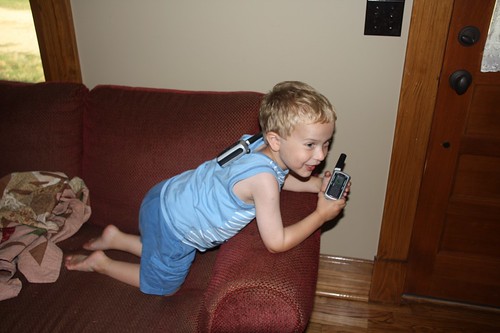
I last wrote about Jacob s new computer back in April. He has had fun with it, but is still a little young to appreciate it a whole lot. It s a fun thing, but not yet a favorite. Yesterday, though, I introduced Jacob to several bits of technology that really got him excited. We have a pair of FRS radios. These are low-power Family Radio Service devices, with a maximum practical range of maybe a mile, and are about as cheap a radio as you can buy that still has any sort of practical use. Anyhow, the receive circuit on one broke. I ordered a pair of TriSquare digital radios to replace them, which are incompatible. So, I have two radios, one with a broken receive circuit. What to do? GIVE THEM TO JACOB! I explained that one radio is the talking radio (the broken one) and the other is the listening radio. Then I demonstrated how I could use the talking radio and he could hear me on the listening radio. That was great fun. I encouraged him to go to the kitchen and see if he could still hear me in the next room. Cackles of laughter gave me the answer. Then he discovered the call button would make the other radio sound like a telephone, which was all the more exciting. He and I took turns with the talking and listening radios. Then I used the belt clip and attached the listening radio to the back of his shirt. I pointed out to him that this was sort of like a loudspeaker. Anything he said into the talking radio while holding town the transmit button would sound louder because it would also come out the radio on his back. Much cackling followed, and he ran around the house yelling MEOW! at the top of his lungs into the radio, then saying, Dad, did you hear THAT? It was VERY loud! He has spent hours listening to himself, listening to me, and generally enjoying life with radios. IMG_4218.JPG Jacob s second discovery was a cassette tape player. Awhile back, Terah rescued an old cassette tape player that was being thrown out, and bought a few 15-cent tapes for Jacob at a thrift store. The idea is that we can just let him play, and not care if he smashes it to bits. He enjoys it, but like the computer, didn t really get excited about it. Until yesterday, when we had this conversation: Me: Jacob, would you like to record your own voice on a tape? Jacob: (excited) Sure! Me: OK, bring me your tape recorder. Jacob: (exasperated) Dad, it s not a tape RECORDER. It s a tape PLAYER. Me: Jacob, it is a tape player, but it s also a tape recorder too. Jacob: (paused for about 5 seconds, then ) Ooooo! That is silly! (scampers off to find it) He found it, and I helped him put some tape over the write-protect tab on a cassette he had. Then he recorded his voice. He eventually figured out the stop, rewind, play, and record buttons with my help. But he s still confused: while he s recording, why doesn t he hear anything? Our first recording had me asking him some questions, and then telling him to press the stop button when he was done. He listened to it dozens of times, and each time my recorded voice asked a question, he answered it a little before his recorded voice did. And each time my recorded voice told him to press the stop button, he would say, I don t want to while his recorded voice asked is this it? He pretty well understands what the radios are about, but doesn t really get the tape recorder yet. Nevertheless, it has just become a far more exciting device in his eyes. Terah has been rolling her eyes at me today as I ve been trying to think up what other broken or old bits of technology we might have that Jacob would enjoy. My latest plan involves adapting his broken old batte
ry-operated fan into some sort of lego-related car. I think he d have fun working on it with me too. All this reminds me of things I did as a kid. My dad worked with a semi-retired man (Herb Miller) that loved to build weird contraptions. One of my favorites was a ball shooter made out of an old vacuum cleaner with a cardboard tube attached to the output spot. I also remember building a motorized car out of an erector set that sort of bent the rules at a school science class project. The idea was to launch a vehicle down a ramp and person whose vehicle went the farthest got a prize. There were no rules against using batteries and a scavenged motor to get that extra little edge over gravity. My car was the only one to manage to crash into the wall on the far side of the gymnasium. The science teacher, in a bit of fast thinking perhaps, announced my car the winner of the electric division. For some reason, I seem to be poised to encourage this sort of thinking in Jacob

25 June 2010

Thibaut Girka: Third GSoC report

Hi again! Sorry for the non-existent post of last week, but I didn't really have anything exciting to say. The project is still alive, and I'm still making (rather slow) progress. Since the last report, I've been reading, cleaning, and fixing the drivers for the Smedia Glamo (the multi-function device that does SD card access, display handling, and coffee), in order to submit them upstream and eventually backport them in Debian. Hopefully it'll soon be suitable for upstream and I'll be back to d-i itself! By the way, the git repositories are updated with a cleaner patchset and with framebuffer support!

23 June 2010

Matt Zimmerman: Habit forming

I find that habits are best made and broken in sets. If I want to form a new habit, I ll try to get rid of an old one at the same time. I don t know why this works, but it seems to. Perhaps I only have room in my head for a certain number of habits, so if I want a new one, then an old one has to go. I m sure some combinations are better than others. I m currently working on changing some habits, including: I m thinking of adding a reading habit to the set, but it s going well so far and I don t want to overdo it. I feel good, and am forming a new routine. The flossing is definitely the hardest of the three. I hate pretty much everything about flossing. It also unbalances the set, so that I have a net gain of one habit. Maybe that s the real reason, and if I broke another habit, it would get easier. Does anyone else have this experience? What sort of tricks do you employ to help you change your behavior?

21 June 2010

Matt Zimmerman: Finishing books

Having invested in some introspection into my reading habits, I made up my mind to dial down my consumption of bite-sized nuggets of online information, and finish a few books. That s where my bottleneck has been for the past year or so. Not in selecting books, not in acquiring books, and not in starting books either. I identify promising books, I buy them, I start reading them, and at some point, I put them down and never pick them back up again. Until now. Over the weekend, I finished two books. I started reading both in 2009, and they each required my sustained attention for a period measured in hours in order to finish them. Taking a tip from Dustin, I decided to try alternating between fiction and non-fiction. Jitterbug Perfume by Tom Robbins This was the first book I had read by Tom Robbins, and I am in no hurry to read any more. It certainly wasn t without merit: its themes were clever and artfully interwoven, and the prose elicited a silent chuckle now and again. It was mainly the characters which failed to earn my devotion. They spoke and behaved in ways I found awkward at best, and problematic at worst. Race, gender, sexuality and culture each endured some abuse on the wrong end of a pervasive white male heteronormative American gaze. I really wanted to like Priscilla, who showed early promise as a smart, self-reliant individual, whose haplessness was balanced by a strong will and sense of adventure. Unfortunately, by the later chapters, she was revealed as yet another vacant vessel yearning to be filled by a man. She s even the steward of a symbolic, nearly empty perfume bottle throughout the book. Yes, really. Managing Humans by Michael Lopp Of the books I ve read on management, this one is perhaps the most outrageously reductionist. Many management books are like this, to a degree. They take the impossibly complex problem domain of getting people to work together, break it down into manageable problems with tidy labels, and prescribe methods for solving them (which are hopefully appropriate for at least some of the reader s circumstances). Managing Humans takes this approach to a new level, drawing neat boxes around such gestalts as companies, roles, teams and people, and assigning them Proper Nouns. Many of these bear a similarity to concepts which have been defined, used and tested elsewhere, such as psychological types, but the text makes no effort to link them to his own. Despite being a self-described collection of tales , it s structured like a textbook, ostensibly imparting nuggets of managerial wisdom acquired through lessons learned in the Real World (so pay attention!). However, as far as I can tell, the author s experience is limited to a string of companies of a very specific type: Silicon Valley software startups in the dot com era. Lopp (also known as Rands) does have substantial insight into this problem domain, though, and does an entertaining job of illustrating the patterns which have worked for him. If you can disregard the oracular tone, grit your teeth through the gender stereotyping, and add an implicit preface that this is (sometimes highly) context-sensitive advice, this book can be appreciated for what it actually is: a coherent, witty and thorough exposition of how one particular manager does their job. I got some good ideas out of this book, and would recommend it to someone working in certain circumstances, but as with Robbins, I m not planning to track down further work by the same author.

19 June 2010

Torsten Werner: Results from the Debian Community Poll

I have announced the Debian Community Poll in my former blog post. I have closed the poll today and I will start publishing its results now.
What is the codename of the current stable release?This is the only compulsory question with the intention to block spammers. The correct codename is Lenny but I have accepted almost any answer that is somehow related to Debian. Version numbers, names from Sarge to Experimental, even well known codenames and version numbers from Ubuntu have been counted as correct. 22 partipants answered wrongly and their submissions got removed from the result set. A whopping number of 3258 submissions have been accepted and get analyzed now. Thanks to all participants!
How long have you been using Debian?

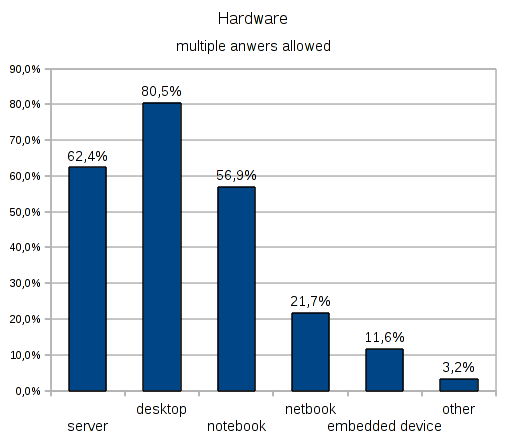
On what kind of hardware are you using Debian?
Multiple answers are allowed for this question and that is why the values do not sum up to 100%.
  • 80.5% are using Debian on the desktop
  • 62.4% on the server
  • 56.9% on the notebook
  • 21.7% on the netbook
  • 11.6% on embedded device(s)
  • 3.2% on other device(s)
The following other devices have been mentioned: smartphone, virtual machine, nettop, NAS, HTPC, workstation, pendrive, live cd, cluster, thin client, router, rocket flight computer, ibm mainframe, and automatic bar tender.

Do you contribute to Debian?
  • 50.0% choose answer #5: I don't contribute on a regular base.
  • 31.2% choose answer #4: I'm regularly helping other Debian users.
  • 8.0% choose other (see below) or simply did not answer
  • 4.9% choose answer #3: I'm regularly contributing to Debian packages without uploading them by myself.
  • 4.5% choose answer #1: I'm a Debian developer.
  • 1.4% choose answer #2: I'm a Debian maintainer.
The following other answers have been provided:
  • upstream developer or contributor
  • translator
  • bug reporter
  • advocator
  • former DD or DM
  • prospective DD or DM
  • mirror maintainer
  • package/installer tester
  • documentation writer
  • donator or debconf sponsor
  • debconf organizer or helper

How do you think about the Debian Free Software Guidelines (DFSG)?
  • 46.0% choose answer #2: I like the DFSG but it is not the most important reason for using Debian.
  • 36.6% choose answer #1: The DFSG is very important to me. I could live with many changes in Debian but I would be very upset if Debian would allow non-free software into its main component in the future.
  • 10.1% choose answer #3: I don't know.
  • 4.9% choose answer #4: I don't care.
  • 2.4% did not answer.

Are you using Debian derived distributions, too?
Multiple answers are allowed for this question and that is why the values do not sum up to 100%. There were a lot of different answers but the most frequent are:
  • 47.1%: Ubuntu (Kubuntu, Lubuntu, Xubuntu)
  • 40.8%: no answer; this was the only way to say that someone does not use a derived distribution
  • 11.0%: other (see below)
  • 7.0%: damn small linux
  • 4.8%: Sidux
  • 4.3%: grml (juxlala)
  • 2.2%: Knoppix
  • 1.6%: ELive
  • 1.4%: Maemo
The other answer includes the following distributions: 64studio, ALT Linux, arch linux, ArtistX, BackTrack, BRLix, Canaima GNU/Linux, catix, cdlinux.pl, CloneZilla, CrunchBang, Custom, ddwrt, debian arm userspace for zipit z2, DebXO (?), DreamLinux, Easy Peasy, eb4, eeebuntu, EMC2 Ubuntu (linuxcnc.org), Emdebian, Estrella Roja, Fedora, Finnix, Gentoo, gNewSense, Hackable:1, Kanotix, Kuliax, LFS and CLFS, LinEx, Linux Mint, live CDs, live-helper, Mepis antix, Musix, My own LiveCD, Mythbuntu, OpenInkpot, openwrt, paipix gnu, Parsix, Peppermint, personal debian derived, proxmox, Puppy, PureOS, qtopia, SHR, simplyMEPIS, Skolelinux, slackware, SymphonyOS, Toutou, Trisquel, tty GNU/Linux, UHU Linux, Univention Corporate Server, vinux, Voyage, Vyatta, whiite, Xandros, Xarnoppix. Not all of them are derived from Debian.

- to be continued -

17 June 2010

Steve Kemp: That friend promises his undying friendship if you would do him a small favour.

Perl & Apache?
Once upon a time, within the past year, I saw mention of a simpler version of mod_perl - an apache module which let you write code to run within the context of a persistent perl process. However my DuckDuckGofu is weak, and I'm struggling to find this project. Did I dream it, or could somebody tell me where it lives?
Dynamic Picture Frames
So I've been taking pictures recently. Lots of pictures. Many times many images have been printed and hung upon my walls, and the price of frames is starting to become onerous. I'd love to see some kind of "dynamic" picture wall - but the two alternatives I considered fail:
Metal & Magnets
Place a huge sheet of metal upon your wall. Then put wee magnets inside your frames.
Corkboard
Imagine a full wall that was paneled with what is essentially a large notice-board..
Both of these would look ugly; the metal one perhaps less so. But the idea of having a wall which could have pictures mounted upon it, without having big nail holes if you rearranged and which could cope with dynamic repositioning and sizes is nice .. Invent it for me? I'll buy one. Probably even two...
ObFilm: The Godfather

14 June 2010

Gunnar Wolf: What Mexico feels like

I have been recently approached by several friends, from different countries. Mexico and the violence seems to be a frequent news topic all over the world. I live in Mexico City, as ~25% of the country's population does. This is not an easy city, of course, and I won't deny it has tons of problems of its own. However, Mexico City (and even more so the approximately of it that is politically located in Distrito Federal, the formal country capital) is very lucky in this regard. Still, in most of the country, the violence is mostly in the news, mostly a worrying perception that is every day more insistent. My parents live in Cuernavaca, Morelos, ~80Km south from us. Morelos has been known for decades for being the druglords' getaway and safe haven, so it remained a mostly peaceful state for most of this time. This has changed, and at some points during this year, militarization feels quite creepy... Fortunately, just for a couple of weeks, and then back to what seems like normal. The real problems in Morelos is the undeniable corruption of its successive governments, the lack of regard for the population, the inexistent urban planning... However, I know from several friends living in the North of the country (and all along the very long border - The most drug-related violent states nowadays are Chihuahua, Durango, Sinaloa, Tamaulipas and Nuevo Le n, with only two states in the South Michoac n and Guerrero) that violence is really felt by local population on the streets. Some friends say they have grown used to hearing shootings (Durango), others say that it is now usual that the cartels openly strangle the city's vial system with the express purpose of showing off their strength (Monterrey, Nuevo Le n, one of Mexico's most important cities and taken in the past as a token of industrialization and first-world-like life conditions... Just don't look towards the poor areas). About Chihuahua, I'd rather not even talk, as by all accounts (official even) it rivals Iraq in the lack of control the government has of its territory. Still, with all that as background... I am afraid of what I read today in the news. I know a single declaration is not enough to worry about (as said in El Quijote, una golondrina sola no hace verano , a single swallow does not mean it's summer), but those things always start small... Until they explode. La Jornada reports that The retired general Luis Garfias Maga a recommends suspending constitutional guarantees in the country to be able to properly fight violence. The last century we had a sad and long history of cases where the military took over civilian power and suspended the constitutional rights in basically every nation in Latin America Except for Mexico. Not one of those cases was overall successful. Not one of them went by without raging abuses, without terrible consequences. I don't see imminent we will go over to a military rule nor anything close to it, but the environment is getting each time closer to how it was like before said rights suspension. We should learn that it is just not the way, it leads nowhere. I am convinced, and will keep insisting on it at every ocassion, that the only possible way to fight violence is by reducing the social distance, and that should be achieved most importantly by reducing poverty, but also by making it harder to become incredibly rich. Mexico's percentage of poor people has grown over the last decades, but at the same time, the amount of wealth concentrated in very few hands has grown much faster. A society with terribly rich and terribly poor people leads to hatred, leads to desperation, leads to violence. A flatter society, even if the overall standard was to be somewhat lower, tends to a better equilibrium. And yes, I know the original problem with drugs is that Mexico is a great transit area for drugs to reach the USA (and I could also rant about drug legalization I won't, it's late and I must go to work), but the main fuel for young people to leave everything behind and take the risk of starting a life of open ilegality is the lack of future they face all life long. That leads many to risk their lives attempting to cross the border to the USA (Mexico "exports" 500,000 people every year), but also lures them to jobs where they will have easy money... In exchange for their lifes, ultimately. Anyway... Just to repeat and round off: The answer to this problem is not repression, is not policial or military strength. Our only way out is through social justice.

10 June 2010

Torsten Werner: Debian Community Poll

I have prepared a poll for users of the Debian operating system at http://tinyurl.com/3y33ska. We had the idea for the poll during the preparation of the MiniDebConf that is currently taking place in Berlin. Please spread the link and fill out the form yourself. Visitors of the MiniDebConf have the option to fill out the form on paper.

8 June 2010

Jelmer Vernooij: Proof of concept OpenChange server working

Seeing this makes me very happy. It's taken us a couple of years to get to this point but we've finally made it, mostly thanks to the dedication and persistence of Julien and Brad.

Next.

Previous.