Julian Andres Klode: APT 1.5 is out
Filed under: Debian, Ubuntu
Last night I installed updates on my FreeNAS box and rebooted it. As expected my network died, but then it never came back, which I hadn t expected.
My FreeNAS box provides backup storage space, a local Debian mirror and a mirror of talks from recent conferences. It also runs a couple of virtual machines and one of these provides my local DNS resolver.
I hooked up the VNC console to the virtual machine and the problem looked to be that it was booting from the Debian installer CD.
man systemd.unit),
and each unit is described by a configuration in ini-style format.
For example, this unit continuously plays an alarm sound when the system is in emergency or rescue mode:
[Unit] Description=Beeps when in emergency or rescue mode DefaultDependencies=false StopWhenUnneeded=true [Install] WantedBy=emergency.target rescue.target [Service] Type=simple ExecStart=/bin/sh -ec 'while true; do /usr/bin/aplay -q /tmp/beep.wav; sleep 2; done'
.service: daemons.socket: communication sockets.device: hardware devices.mount: mount points.automount: automounting.swap: swap files or partitions.target: only dependencies, like Debian metapackages.path: inotify monitoring of paths.timer: cron-like activation.slice: group processes for common resource management.scope: group processes for common resource management/lib/systemd/system/: for units provided by packaged software/run/systemd/system/: runtime-generated units/etc/systemd/system/: for units provided by systemd administrators/etc/ override unit files in /lib/. Note that while Debian
uses /lib/, other distributions may use /usr/lib/ instead.
If there is a directory with the same name as the unit file plus a .d suffix,
any file *.conf it contains is parsed after the unit, and can be used to add
or override configuration options.
For example:
/lib/systemd/system/beep.service.d/foo.conf can be used to tweak
the contents of /lib/systemd/system/beep.service, so it is possible for a
package to distribute a tweak to the configuration of another package./etc/systemd/system/beep.service.d/foo.conf can be used to tweak the
contents of /lib/systemd/system/beep.service, so it is possible a system
administrator to extend a packaged unit without needing to replace it
entirely.unitname.wants/ or unitname.requires/ directory can be used to
extend Wants= and Requires= dependencies on other units, by placing
symlinks to other units in them.
See also:
Hi friends,
~3hr ago, we just had a big earthquake, quite close to Mexico City. Fortunately, we are fine, as are (at least) most of our friends and family. Hopefully, all of them. But there are many (as in, tens) damaged or destroyed buildings; there have been over 50 deceased people, and numbers will surely rise until a good understanding of the event's strength are evaluated.
Mainly in these early hours after the quake, many people need to get in touch with their families and friends. There is a little help we can all provide: Provide communication.
Open up your wireless network. Set it up unencrypted, for anybody to use.
Refrain from over-sharing graphical content Your social network groups don't need to see every video and every photo of the shaking moments and of broken buildings. Download of all those images takes up valuable time-space for the saturated cellular networks.
This advice might be slow to flow... The important moment to act is two or three hours ago, even now... But we are likely to have replicas; we are likely to have panic moments again. Do a little bit to help others in need!
Many voices arise now and then against risks linked to the Github use by Free Software projects. Yet the infatuation for the collaborative forge of the Octocat Californian start-ups doesn t seem to fade away.

These recent years, Github and its services take an important role in software engineering as they are seen as easy to use, efficient for a daily workload with interesting functions in enterprise collaborative workflow or amid a Free Software project. What are the arguments against using its services and are they valid? We will list them first, then we ll examine their validity.
The Github application belongs to a single entity, Github Inc, a US company which manage it alone. So, a unique company under US legislation manages the access to most of Free Software application code sources, which may be a problem with groups using it when a code source is no longer available, for political or technical reason.

This centralization leads to another trouble: as it obtained critical mass, it becomes more and more difficult not having a Github account. People who don t use Github, by choice or not, are becoming a silent minority. It is now fashionable to use Github, and not doing so is seen as out of date . The same phenomenon is a classic, and even the norm, for proprietary social networks (Facebook, Twitter, Instagram).
When you interact with Github, you are using a proprietary software, with no access to its source code and which may not work the way you think it is. It is a problem at different levels. First, ideologically, but foremost in practice. In the Github case, we send them code we can control outside of their interface. We also send them personal information (profile, Github interactions). And mostly, Github forces any project which goes through the US platform to use a crucial proprietary tools: its bug tracking system.

Windows, the epitome of proprietary software, even if others took the same path
Working with Github interface seems easy and intuitive to most. Lots of companies now use it as a source repository, and many developers leaving a company find the same Github working environment in the next one. This pervasive presence of Github in free software development environment is a part of the uniformization of said developers working space.

Uniforms always bring Army in my mind, here the Clone army
As said above, nowadays, Github is the main repository of Free Software source code. As such it is a favorite target for cyberattacks. DDOS hit it in March and August 2015. On December 15, 2015, an outage led to the inaccessibility of 5% of the repositories. The same occurred on November 15. And these are only the incident reported by Github itself. One can imagine that the mean outage rate of the platform is underestimated.
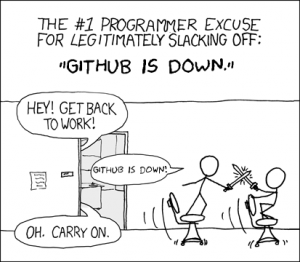
Today many dependency maintenance tools, as npm for javascript, Bundler for Ruby or even pip for Python can access an application source code directly from Github. Free Software projects getting more and more linked and codependents, if one component is down, all the developing process stop.
One of the best examples is the npmgate. Any company could legally demand that Github take down some source code from its repository, which could create a chain reaction and blocking the development of many Free Software projects, as suffered the Node.js community from the decisions of Npm, Inc, the company managing npm.
Github didn t appear out of the blue. In his time, its predecessor, SourceForge, was also extremely popular.
Heavily centralized, based on strong interaction with the community, SourceForge is now seen as an aging SAAS (Software As A Service) and sees most of its customers fleeing to Github. Which creates lots of hurdles for those who stayed. The Gimp project suffered from spams and terrible advertising, which led to the departure of the VLC project, then from installers corrupted with adwares instead of the official Gimp installer for Windows. And finally, the Project Gimp s SourceForge account was hacked by SourceForge team itself!
These are very recent examples of what can do a commercial entity when it is under its stakeholders pressure. It is vital to really understand what it means to trust them with data and exchange centralization, where it could have tremendous repercussion on the day-to-day life and the habits of the Free Software and open source community.
Mostly based on ideology, this point deals with the definition every member of the community gives to Free Software and open source. Mostly about one thing: is it viral or not? Or GPL vs MIT/BSD.

Those on the side of the viral Free Software will have trouble to use a proprietary software as this last one shouldn t even exist. It must be assimilated, to quote Star Trek, as it is a connected black box, endangering privacy, corrupting for profit our uses and restrain our freedom to use as we re pleased what we own, etc.

Those on the side of complete freedom have no qualms using proprietary software as their very existence is a consequence of freedom without restriction. They even agree that code they developed may be a part of proprietary software, which is quite a common occurrence. This part of the Free Software community has no qualm using Github, which is well within their ideology parameters. Just take a look at the Janson amphitheater during Fosdem and check how many Apple laptops running on macOS are around.

Even without ideological consideration, and just focusing on Github infrastructure, the bug tracking system is a major problem by itself.
Bug report builds the memory of Free Software projects. It is the entrance point for new contributors, the place to find bug reporting, requests for new functions, etc. The project history can t be limited only to the code. It s very common to find bug reports when you copy and paste an error message in a search engine. Not their historical importance is precious for the project itself, but also for its present and future users.
Github gives the ability to extract bug reports through its API. What would happen if Github is down or if the platform doesn t support this feature anymore? In my opinion, not that many projects ever thought of this outcome. How could they move all the data generated by Github into a new bug tracking system? One old example now is Astrid, a TODO list bought by Yahoo a few years ago. Very popular, it grew fast until it was closed overnight, with only a few weeks for its users to extract their data. It was only a to-do list. The same situation with Github would be tremendously difficult to manage for several projects if they even have the ability to deal with it. Code would still be available and could still live somewhere else, but the project memory would be lost. A project like Debian has today more than 800,000 bug reports, which are a data treasure trove about problems solved, function requests and where the development stand on each. The developers of the Cpython project have anticipated the problem and decided not to use Github bug tracking systems.

Issues, the Github proprietary bug tracking system
Another thing we could lose if Github suddenly disappear: all the work currently done regarding the push requests (aka PRs). This Github function gives the ability to clone one project s Github repository, to modify it to fit your needs, then to offer your own modification to the original repository. The original repository s owner will then review said modification, and if he or she agrees with them will fuse them into the original repository. As such, it s one of the main advantages of Github, since it can be done easily through its graphic interface.
However reviewing all the PRs may be quite long, and most of the successful projects have several ongoing PRs. And this PRs and/or the proprietary bug tracking system are commonly used as a platform for comment and discussion between developers.
Code itself is not lost if Github is down (except one specific situation as seen below), but the peer review works materialized in the PRs and the bug tracking system is lost. Let s remember than the PR mechanism let you clone and modify projects and then generate PRs directly from its proprietary web interface without downloading a single code line on your computer. In this particular case, if Github is down, all the code and the work in progress is lost. Some also use Github as a bookmark place. They follow their favorite projects activity through the Watch function. This technological watch style of data collection would also be lost if Github is down.

Debian, one of the main Free Software projects with at least a thousand official contributors
The Free Software community is walking a thigh rope between normalization needed for an easier interoperability between its products and an attraction for novelty led by a strong need for differentiation from what is already there.
Github popularized the use of Git, a great tool now used through various sectors far away from its original programming field. Step by step, Git is now so prominent it s almost impossible to even think to another source control manager, even if awesome alternate solutions, unfortunately not as popular, exist as Mercurial.

A new Free Software project is now a Git repository on Github with README.md added as a quick description. All the other solutions are ostracized? How? None or very few potential contributors would notice said projects. It seems very difficult now to encourage potential contributors into learning a new source control manager AND a new forge for every project they want to contribute. Which was a basic requirement a few years ago. It s quite sad because Github, offering an original experience to its users, cut them out of a whole possibility realm. Maybe Github is one of the best web versioning control systems. But being the main one doesn t let room for a new competitor to grow. And it let Github initiate development newcomers into a narrow function set, totally unrelated to the strength of the Git tool itself.
Fight against centralization is a main part of the Free Software ideology as centralization strengthens the power of those who manage it and who through it control those who are managed by it. Uniformization allergies born against main software companies and their wishes to impose a closed commercial software world was for a long time the main fuel for innovation thirst and intelligent alternative development. As we said above, part of the Free Software community was built as a reaction to proprietary software and their threat. The other part, without hoping for their disappearance, still chose a development model opposite to proprietary software, at least in the beginning, as now there s more and more bridges between the two.
The Github effect is a morbid one because of its consequences: at least centralization, uniformization, proprietary software usage as their bug tracking system. But some years ago the Dear Github buzz showed one more side effect, one I ve never thought about: laziness. For those who don t know what it is about, this letter is a complaint from several spokespersons from several Free Software projects which demand to Github team to finally implement, after years of polite asking, new functions. Since when Free Software project facing a roadblock request for clemency and don t build themselves the path they need? When Torvalds was involved in the Bitkeeper problem and the Linux kernel development team couldn t use anymore their revision control software, he developed Git. The mere fact of not being able to use one tool or functions lacking is the main motivation to seek alternative solutions and, as such, of the Free Software movement. Every Free Software community member able to code should have this reflex. You don t like what Github offers? Switch to Gitlab. You don t like it Gitlab? Improve it or make your own solution.

The Gitlab logo
Let s be crystal clear. I ve never said that every Free Software developers blocked should code his or her own alternative. We all have our own priorities, and some of us even like their beauty sleep, including me. But, to see that this open letter to Github has 1340 names attached to it, among them some spokespersons for major Free Software project showed me that need, willpower and strength to code a replacement are here. Maybe said replacement will be born from this letter, it would be the best outcome of this buzz.
In the end, Github usage is just another example of Internet usage massification. As Internet users are bound to go to massively centralized social network as Facebook or Twitter, developers are following the same path with Github. Even if a large fraction of developers realize the threat linked this centralized and proprietary organization, the whole community is following this centralization and uniformization trend. Github service is useful, free or with a reasonable price (depending on the functions you need) easy to use and up most of the time. Why would we try something else? Maybe because others are using us while we are savoring the convenience? The Free Software community seems to be quite sleepy to me.

The lion enjoying the hearth warm
A rather boring and otherwise uneventful release 0.9.7 of RcppClassic is now at CRAN. This package provides a maintained version of the otherwise deprecated first Rcpp API; no new projects should use it.
Once again no changes in user-facing code. But this makes it the first package to use the very new and shiny pinp package as the backend for its vignette, now converted to Markdown---see here for this new version. We also updated three sources files for tabs versus spaces as the current g++ version complained (correctly !!) about misleading indents. Otherwise a file src/init.c was added for dynamic registration, the Travis CI runner script was updated to using run.sh from our r-travis fork, and we now strip the library after they have been built. Again, no user code changes.
And no iterate: nobody should use this package. Rcpp is so much better in so many ways---this one is simply available as we (quite strongly) believe that APIs are contracts, and as such we hold up our end of the deal.
Courtesy of CRANberries, there are changes relative to the previous release.
Questions, comments etc should go to the rcpp-devel mailing list off the R-Forge page.
This post by Dirk Eddelbuettel originated on his Thinking inside the box blog. Please report excessive re-aggregation in third-party for-profit settings.
Like each month, here comes a report about the work of paid contributors to Debian LTS.
Individual reports
In August, about 189 work hours have been dispatched among 12 paid contributors. Their reports are available:
No comment Liked this article? Click here. My blog is Flattr-enabled.
Whilst anyone can inspect the source code of free software for malicious flaws, most software is distributed pre-compiled to end users. The motivation behind the Reproducible Builds effort is to allow verification that no flaws have been introduced either maliciously or accidentally during this compilation process.
As part of this project I wrote a script to determine which packages installed on your system are "reproducible" or not:
$ apt install devscripts [ ] $ reproducible-check [ ] W: subversion (1.9.7-2) is unreproducible (libsvn-perl, libsvn1, subversion) <https://tests.reproducible-builds.org/debian/subversion> W: taglib (1.11.1+dfsg.1-0.1) is unreproducible (libtag1v5, libtag1v5-vanilla) <https://tests.reproducible-builds.org/debian/taglib> W: tcltk-defaults (8.6.0+9) is unreproducible (tcl, tk) <https://tests.reproducible-builds.org/debian/tcltk-defaults> W: tk8.6 (8.6.7-1) is unreproducible (libtk8.6, tk8.6) <https://tests.reproducible-builds.org/debian/tk8.6> W: valgrind (1:3.13.0-1) is unreproducible <https://tests.reproducible-builds.org/debian/valgrind> W: wavpack (5.1.0-2) is unreproducible (libwavpack1) <https://tests.reproducible-builds.org/debian/wavpack> W: x265 (2.5-2) is unreproducible (libx265-130) <https://tests.reproducible-builds.org/debian/x265> W: xen (4.8.1-1+deb9u1) is unreproducible (libxen-4.8, libxenstore3.0) <https://tests.reproducible-builds.org/debian/xen> W: xmlstarlet (1.6.1-2) is unreproducible <https://tests.reproducible-builds.org/debian/xmlstarlet> W: xorg-server (2:1.19.3-2) is unreproducible (xserver-xephyr, xserver-xorg-core) <https://tests.reproducible-builds.org/debian/xorg-server> 282/4494 (6.28%) of installed binary packages are unreproducible.
$ reproducible-check --raw dd-list --stdin Alec Leamas <leamas.alec@gmail.com> lirc (U) Alessandro Ghedini <ghedo@debian.org> valgrind Alessio Treglia <alessio@debian.org> fluidsynth (U) libsoxr (U) [ ]
A new and much enhanced version of RcppMsgPack arrived on CRAN a couple of days ago. It came together following this email to the r-package-devel list which made it apparent that Travers Ching had been working on MessagePack converters for R which required the very headers I had for use from, inter alia, the RcppRedis package.
So we joined our packages. I updated the headers in RcppMsgPack to the current upstream version 2.1.5 of MessagePack, and Travers added his helper functions allow direct packing / unpacking of MessagePack objects at the R level, as well as tests and a draft vignette. Very exciting, and great to have a coauthor!
So now RcppMspPack provides R with both MessagePack header files for use via C++ (or C, if you must) packages such as RcppRedis --- and direct conversion routines at the R prompt.
MessagePack itself is an efficient binary serialization format. It lets you exchange data among multiple languages like JSON. But it is faster and smaller. Small integers are encoded into a single byte, and typical short strings require only one extra byte in addition to the strings themselves.
Courtesy of CRANberries, there is also a diffstat report for this release. More information is on the RcppRedis page. More information may be on the RcppMsgPack page. Issues and bugreports should go to the GitHub issue tracker.Changes in version 0.2.0 (2017-09-07)
- Added support for building on Windows
- Upgraded to MsgPack 2.1.5 (#3)
- New R functions to manipulate MsgPack objects: msgpack_format, msgpack_map, msgpack_pack, msgpack_simplify, mgspack_unpack (#4)
- New R functions also available as msgpackFormat, msgpackMap, msgpackPack, msgpackSimplify, mgspackUnpack (#4)
- New vignette (#4)
- New tests (#4)
This post by Dirk Eddelbuettel originated on his Thinking inside the box blog. Please report excessive re-aggregation in third-party for-profit settings.
This would be a longish piece so please bear and play with tea, coffee, beer or anything stronger that you desire while reading below
I had bought an Android phone, a Samsung J5 just before going to debconf 2016. It was more for being in-trend rather than really using it. The one which I shared is the upgraded version (recentish) the one I have is 2 GB for which I had paid around double of what the list price was. The only reason I bought the model is that it had removable battery at the price point I was willing to pay. I did see that Samsung has the same ham-handed issues with audio as previous Nokia devices use to, the speakers and microphone probably the cheapest you can get on the market. Nokia was same too, at least on the lower-end of the market, while Oppo has loud ringtones and loud music, perfect for those who are a bit hard of hearing (as yours truly is).
I had been pleasantly surprised by the quality of photos Samsung J5 was churning even though I m less than average shooter, never been really into it so was a sort of wake-up call for where camera sensor technology is advancing. And of course with newer phones the kind of detail it can capture is mesmerizing to say the least, although wide-angle shots still would take some time to get right I guess.
If memory serves me right, sometime back Laura Arjona Reina (who handles part of debian-publicity and part of debian-women among other responsibilities) shared a blog post on p.d.o. where she had shared the troubles she had while exporting data from the phone. While she shared that and I lack the time or the energy to try and find it ( the entry is really bookmarkable, at least that specific blog post).
What was interesting though that I had gone few years ago to Bangalore, there is an organization which I like and admire CIS great for researchers. Anyways they had done a project getting between 10-20 phones from the market made of Chinese origin (almost all mobiles sold in India, the fabrication of CPU and APU etc. are done in China/Taiwan and then assembled here). Here what is done at the most is assembly which for all political purposes is called manufacturing . All the mobiles kept quite a bit of info. on the device even after you wiped them clean/put some other ROM on them. The CIS site is more than a bit cluttered otherwise would have shared the direct link. I do hope to send an e-mail to CIS and hopefully they will respond with the report and will share that here as and when. It would be interesting to know if after people flash a custom rom if the status quo is the same as it was before. I do suspect it would be the former as flashing ROMs on phones is still a bit of specialized subject at least here in India with even an average phone costing a month or two s salary or more and the idea of bricking the phone scares most people (including yours truly).
Anyways, for a long time I was on bed and had the phone. I used 2 games from the android marketplace which both mum and I enjoy and enjoyed. Those are Real jigsaw and Jigsaw puzzle HD . The permissions dialog which Real jigsaw among other games has is horrible and part of me freaks that all such apps. have unrestricted access to my storage area. Ideally, what Android should have done is either partition or give functionality to the user to have private space for their photos and whatever media they have and the rest of the area is like a public park. If anybody has any thoughts on partitioning on Android phone would like to hear that.
One game though which really hooked mumma and me is The Island Experiment . It reminded me of my younger days when gaming addiction was not treated as a disease but thankfully now is . I would call myself somewhat of a functional addict as in do my every day things, work etc. but do dream about the game as to what it will show me next. A part of it is the game is web-based (which means it needs constant internet connection) and web access is somewhat pricey, although with Reliance Jio an upcoming data network operator having bundles of money and promising the moon, network issues at least on low-bandwidth game which I and mum are playing hopefully will not have any issues. I haven t used tshark or any such tool to analyze the traffic but I guess it probably just sends short messages of number of clicks in a time period and things like that, all the rest (I guess) is happening on the mobile itself. I know at sometime I probably will try to put a custom rom on it but which one is the question as there are so many and also which is most compatible with my device. It seems I would have to do lot of homework before I can make any choices.
Couple of months back, a friend of mine Akshat who has been using Android for few years enabled Developer Options which I didn t know about till he shared that info. with me. I do hope people do check Akshat s repo. as he has made/has quite a few useful scripts, especially if you are into digital photography. I have shared with him gimp scripting few days back so along with imagemagick you might see him doing some rough scripts in it. Of course, if people use it and give feedback he might clean the scripts a bit so it gives useful error messages and gives statement like gimp is not installed on your system, please install it or ask for specific version but as it works in free software it is somewhat directly proportional to the number of users, bugs and users behind it.
A good example of what I mean is youtube-dl . I filed 873853 where I shared the upstream ticket. Apparently YouTube again changed few days back and while upstream has fixed it, the youtube-dl maintainer probably needs to find time and get the new version up. Apparently the issues lies in
[$] dpkg -L youtube-dl grep youtube.py
/usr/lib/python3/dist-packages/youtube_dl/extractor/youtube.py
Hopefully somebody does the needful.
Btw, I find f-droid extremely useful and especially osmand but sadly both of them are not shared or talked about by people
The reason I shared about Developer Options in Android is that few days back I noticed that the phone wonks off and has unpredictable behaviour such as not letting me browse the web, do additions or deletions using the google play store and alike . Things came to a head when few days back I saw a fibre-optic splicing operation being carried by some workers near my home by the state operator which elated me and wanted to shoot the video for it but the battery died/there was no power even though I hadn t used it much. I have deliberately shared the hindi version which tells how that knowledge is now coming to the masses. I had seen fibre-optic splicing more than a decade and a half back at some net conference where it was going to be in your neighbourhood soonish, hopefully it will happen soon
I had my suspicions for quite sometime all the issues with the phone were not due to proper charging. During course of my investigation, found out that in Developer Options there is an option called USB Configuration and changing that from the default MTP (Media Transfer Protocol) (which is basically used to put or take movies, music or any file from the phone to the computer or vice-versa improved much better behaviour on my android phone. But this caused an unexpected side-effect, I got pretty aggressive polling of the phone by the computer even after saying I do not want to share the phone details with the computer. This I filed as 874216 . The phone and I am guessing most Samsung phones today come with an adaptor with a USB male socket which goes in to the phone s usb port. There is the classical port for electricity but like most people heavily rely on usb charging even for deep fully powered down phone for full charging.
One interesting project which I saw which came in Debian some days back is dummydroid. I did file a bug about it . I do hope that either the maintainer gives some more documentation. I am sure many people might use and add to the resource if the documentation was/is there. I did take a look at the package and the profile seems to be like an xml pair kind of database. Having more profiles shouldn t be hard if we knew what info. needs to be added and how do we find that info.
Lastly, I am slowly transferring all the above knowledge to my mum as well, although in small doses. She, just like me has and had problems coming from resistive touchscreen to capacitive touchscreen. You can call me wrong but resistive touchscreen seemed to be superior and not as error-prone or liable to commit mistakes as is possible in capacitive touchscreens. There may be a setting to higher/lower the threshold for touching which I have not been able to find as of yet.
Hope somebody finds something useful in there. I do hope that Debian does become a replacement to be used on such mobiles but then they would have to duplicate/also have some sort of mainstream content with editors to help people find stuff, something that Debian is not so good at currently. Also I m not sure Synaptic is good fit as a mobile store.
A common way to establish an IPsec tunnel on Linux is to use an IKE daemon, like
the one from the strongSwan project, with a minimal
configuration1:
conn V2-1 left = 2001:db8:1::1 leftsubnet = 2001:db8:a1::/64 right = 2001:db8:2::1 rightsubnet = 2001:db8:a2::/64 authby = psk auto = route
2001:db8: 1::1 and 2001:db8: 2::1. The protected subnets are
2001:db8: a1::/64 and 2001:db8: a2::/64. As a result, strongSwan
configures the following policies in the kernel:
$ ip xfrm policy src 2001:db8:a1::/64 dst 2001:db8:a2::/64 dir out priority 399999 ptype main tmpl src 2001:db8:1::1 dst 2001:db8:2::1 proto esp reqid 4 mode tunnel src 2001:db8:a2::/64 dst 2001:db8:a1::/64 dir fwd priority 399999 ptype main tmpl src 2001:db8:2::1 dst 2001:db8:1::1 proto esp reqid 4 mode tunnel src 2001:db8:a2::/64 dst 2001:db8:a1::/64 dir in priority 399999 ptype main tmpl src 2001:db8:2::1 dst 2001:db8:1::1 proto esp reqid 4 mode tunnel [ ]
out, in or fwd2),transport or tunnel),esp or ah), andreqid and the endpoint source and destination
addresses):
$ ip xfrm state src 2001:db8:1::1 dst 2001:db8:2::1 proto esp spi 0xc1890b6e reqid 4 mode tunnel replay-window 0 flag af-unspec auth-trunc hmac(sha256) 0x5b68[ ]8ba2904 128 enc cbc(aes) 0x8e0e377ad8fd91e8553648340ff0fa06 anti-replay context: seq 0x0, oseq 0x0, bitmap 0x00000000 [ ]
$ tcpdump -pni eth0 -c2 -s0 esp 13:07:30.871150 IP6 2001:db8:1::1 > 2001:db8:2::1: ESP(spi=0xc1890b6e,seq=0x222) 13:07:30.872297 IP6 2001:db8:2::1 > 2001:db8:1::1: ESP(spi=0xcf2426b6,seq=0x204)
V1-1 and V2-1 could be:
conn V1-1-to-V2-1 left = 2001:db8:1::1 leftsubnet = 2001:db8:a1::/64,2001:db8:a6::cc:1/128,2001:db8:a6::cc:5/128 right = 2001:db8:2::1 rightsubnet = 2001:db8:a2::/64,2001:db8:a6::/64,2001:db8:a8::/64 authby = psk keyexchange = ikev2 auto = route
2001:db8: a6::/64 on one
side and 2001:db8: a6::cc:1/128 at the other) can also be problematic.
The alternative is to use route-based VPNs: any packet traversing a
pseudo-interface will be encapsulated using a security policy bound to the
interface. This brings two features:
V3-2 to V1-1. First, we
need to configure the tunnel interface and bind it to the private routing
instance containing only internal routes (with IPv4, they would have been RFC 1918 routes):
interfaces st0 unit 1 family inet6 address 2001:db8:ff::7/127; routing-instances private instance-type virtual-router; interface st0.1;
security /* Phase 1 configuration */ ike proposal IKE-P1 authentication-method pre-shared-keys; dh-group group20; encryption-algorithm aes-256-gcm; policy IKE-V1-1 mode main; proposals IKE-P1; pre-shared-key ascii-text "d8bdRxaY22oH1j89Z2nATeYyrXfP9ga6xC5mi0RG1uc"; gateway GW-V1-1 ike-policy IKE-V1-1; address 2001:db8:1::1; external-interface lo0.1; general-ikeid; version v2-only; /* Phase 2 configuration */ ipsec proposal ESP-P2 protocol esp; encryption-algorithm aes-256-gcm; policy IPSEC-V1-1 perfect-forward-secrecy keys group20; proposals ESP-P2; vpn VPN-V1-1 bind-interface st0.1; df-bit copy; ike gateway GW-V1-1; ipsec-policy IPSEC-V1-1; establish-tunnels on-traffic;
st0.1 interface to the
VPN-V1-1 VPN. Once the VPN is up, any packet entering st0.1 will be
encapsulated and sent to the 2001:db8: 1::1 endpoint.
The last step is to configure BGP in the private routing instance to exchange
routes with the remote site:
routing-instances private routing-options router-id 1.0.3.2; maximum-paths 16; protocols bgp preference 140; log-updown; group v4-VPN type external; local-as 65003; hold-time 6; neighbor 2001:db8:ff::6 peer-as 65001; multipath; export [ NEXT-HOP-SELF OUR-ROUTES NOTHING ];
OUR-ROUTES needs to select the routes to be advertised to
the other peers. For example:
policy-options policy-statement OUR-ROUTES term 10 from protocol ospf3; route-type internal; then metric 0; accept;
2001:db8: a1::/64:
> show route 2001:db8:a1::/64 protocol bgp table private.inet6.0 best-path private.inet6.0: 15 destinations, 19 routes (15 active, 0 holddown, 0 hidden) + = Active Route, - = Last Active, * = Both 2001:db8:a1::/64 *[BGP/140] 01:12:32, localpref 100, from 2001:db8:ff::6 AS path: 65001 I, validation-state: unverified to 2001:db8:ff::6 via st0.1 > to 2001:db8:ff::14 via st0.2
V1-1 (through st0.1) and V1-2 (through
st0.2). The route is part of the private routing instance but encapsulated
packets are sent/received in the public routing instance. No route-leaking is
needed for this configuration. The VPN cannot be used as a gateway from internal
hosts to external hosts (or vice-versa). This could also have been done with
JunOS security policies (stateful firewall rules) but doing the separation with
routing instances also ensure routes from different domains are not mixed and a
simple policy misconfiguration won t lead to a disaster.
# ip netns add private # ip netns exec private sysctl -qw net.ipv6.conf.all.forwarding=1
# ip link set netns private dev eth1 # ip link set netns private dev eth2 # ip netns exec private ip link set up dev eth1 # ip netns exec private ip link set up dev eth2
vti6, a tunnel interface (similar to st0.1 in the JunOS
example):
# ip tunnel add vti6 \ mode vti6 \ local 2001:db8:1::1 \ remote 2001:db8:3::2 \ key 6 # ip link set netns private dev vti6 # ip netns exec private ip addr add 2001:db8:ff::6/127 dev vti6 # ip netns exec private sysctl -qw net.ipv4.conf.vti6.disable_policy=1 # ip netns exec private sysctl -qw net.ipv4.conf.vti6.disable_xfrm=1 # ip netns exec private ip link set vti6 mtu 1500 # ip netns exec private ip link set vti6 up
conn V3-2 left = 2001:db8:1::1 leftsubnet = ::/0 right = 2001:db8:3::2 rightsubnet = ::/0 authby = psk mark = 6 auto = route keyexchange = ikev2 keyingtries = %forever ike = aes256gcm16-prfsha384-ecp384! esp = aes256gcm16-prfsha384-ecp384! mobike = no
$ ip xfrm policy src ::/0 dst ::/0 dir out priority 399999 ptype main mark 0x6/0xffffffff tmpl src 2001:db8:1::1 dst 2001:db8:3::2 proto esp reqid 1 mode tunnel src ::/0 dst ::/0 dir fwd priority 399999 ptype main mark 0x6/0xffffffff tmpl src 2001:db8:3::2 dst 2001:db8:1::1 proto esp reqid 1 mode tunnel src ::/0 dst ::/0 dir in priority 399999 ptype main mark 0x6/0xffffffff tmpl src 2001:db8:3::2 dst 2001:db8:1::1 proto esp reqid 1 mode tunnel [ ]
router id 1.0.1.1; protocol device scan time 10; protocol kernel persist; learn; import all; export all; merge paths yes; protocol bgp IBGP_V3_2 local 2001:db8:ff::6 as 65001; neighbor 2001:db8:ff::7 as 65003; import all; export where ifname ~ "eth*"; preference 160; hold time 6;
$ ip netns exec private ip -6 route show 2001:db8:a3::/64 2001:db8:a3::/64 proto bird metric 1024 nexthop via 2001:db8:ff::5 dev vti5 weight 1 nexthop via 2001:db8:ff::7 dev vti6 weight 1
V3-1 (through vti5) and V3-2 (through
vti6). Like for the JunOS version, there is no route-leaking between the
private namespace and the initial one. The VPN cannot be used as a gateway
between the two namespaces, only for encapsulation. This also prevent a
misconfiguration (for example, IKE daemon not running) from allowing packets to
leave the private network.
As a bonus, unencrypted traffic can be observed with tcpdump on the tunnel
interface:
$ ip netns exec private tcpdump -pni vti6 icmp6 tcpdump: verbose output suppressed, use -v or -vv for full protocol decode listening on vti6, link-type LINUX_SLL (Linux cooked), capture size 262144 bytes 20:51:15.258708 IP6 2001:db8:a1::1 > 2001:db8:a3::1: ICMP6, echo request, seq 69 20:51:15.260874 IP6 2001:db8:a3::1 > 2001:db8:a1::1: ICMP6, echo reply, seq 69
fwd is for incoming packets on non-local addresses. It only makes
sense in transport mode and is a Linux-only particularity.
I ve been using IRC since late 1990 s, and I continue to do so to this day due to it (still) being one of the driving development forces in various open source communities. Especially in Linux development and some of my acquintances I can only get in touch with via IRC :)
My Setup
On my Synology NAS I run ZNC (IRC bouncer/proxy) to which I connect using various IRC clients (irssi/XChat Azure/AndChat) from various platforms (Linux/Mac/Android). In this case ZNC serves as a gateway and no matter which device/client I connect from, I m always connected to same IRC servers/chat rooms/settings when I left off.
This is all fine and dandy, but connecting from external networks to ZNC means you will hand in your ZNC credentials in plain text. Which is a problem for me, even thought we re only talking about IRC bouncer/proxy.
With that said, how do we encrypt external traffic to our ZNC?
HowTo: Chat securely with ZNC on Synology using Let s Encrypt SSL certificate
For reference or more thorough explanation of some of the steps/topics please refer to: Secure (HTTPS) public access to Synology NAS using Let s Encrypt (free) SSL certificate
Requirements:
DSM: Control Panel > Security > Certificates > AddFollowed by:
Add a new certificate > Get a certificate from Let's EncryptFollowed by adding domain name A record was created for in Step 1, i.e:
After certificate is created, don t forget to configure newly created certificate to point to correct domain name, i.e:
3: Install ZNC
In case you already have ZNC installed, I suggest you remove it and do a clean install. Mainly due to some problems with package in past, where ZNC wouldn t start automatically on boot which lead to creating projects like: synology-znc-autostart. In latest version, all of these problems have been fixed and couple of new features have been added.
ZNC can be installed using Synology s Package Center, if community package sources are enabled. Which can simply be done by adding new package sources:
Name: SynoCommunity Location: http://packages.synocommunity.com
To successfuly authenticate newly added source, under General tab, Trust Level should be set to Any publisher
As part of installation process, ZNC config will be run with most sane/useful options and admin user will be created allowing you access to ZNC webadmin.
4: Secure access to ZNC webadmin
Now we want to bind our sub/domain created in Step 1 to ZNC webadmin, and secure external access to it. This can be done by creating a reverse proxy.
As part of this, you need to know which port has been allocated for SSL in ZNC Webadmin, i.e:
In this case, we can see it s 8251.
Reverse Proxy can be created in:
DSM: Control Panel > Application Portal > Reverse Proxy > CreateWhere sub/domain created in Step 1 needs to be point to ZNC SSL port on localhost, i.e:
ZNC Webadmin is now available via HTTPS on external network for the sub/domain you setup as part of Step 1, or in my case:
As part of this step, in ZNC webadmin I d advise you to create IRC servers and chatrooms you would like to connect to later.
Step 5: Create .pem file from LetsEncrpyt certificate for ZNC to use
On Synology, Let s Encrypt certificates are stored and located on:
/usr/syno/etc/certificate/_archive/
In case you have multiple certificates, based on date your certificate was created, you can determine in which directory is your newly generated certificated stored, i.e:
drwx------ 2 root root 4096 Sep 10 12:57 JeRh3YOnce it s determined which certifiate is the one we want use, generate .pem by running following:
sudo cat /usr/syno/etc/certificate/_archive/JeRh3Y/ privkey,cert,chain .pem > /usr/local/znc/var/znc.pem
After this restart ZNC:
sudo /var/packages/znc/scripts/start-stop-status stop && sudo /var/packages/znc/scripts/start-stop-status start
6: Configure IRC client
In this example I ll use XChat Azure on MacOS, and same procedure should be identical for HexChat/XChat clients on any other platform.
Altough all information is picked up from ZNC itself, user details will need to be filled in.
In my setup I automatically connect to freenode and oftc networks, so I created two for local network and two for external network usage, later is the one we re concentrating on.
On General tab of our newly created server, hostname for our server should be the sub/domain we ve setup as part of Step 1 , and port number should be the one we defined in Step 4 , SSL checkbox must be checked.
On Connecting tab Server password field needs to be filled in following format:
johndoe/freenode:password
Where, johndoe is ZNC username. freenode is ZNC network name, and password is ZNC password.
freenode in this case must first be created as part of ZNC webadmin configuration, mentioned in step 4 . Same case is for oftc network configuration.
As part of establishing the connection, information about our Let s Encrypt certificate will be displayed, after which connection will be established and you ll be automatically logged into all chatrooms.
Happy hacking!
sudo apt install \
git \
rake \
libvirt-daemon-system \
dnsmasq-base \
ebtables \
qemu-system-x86 \
qemu-utils \
vagrant \
vagrant-libvirt \
vmdebootstrap && \
sudo systemctl restart libvirtd
for group in kvm libvirt libvirt-qemu ; do
sudo adduser "$(whoami)" "$group"
done
git clone https://git-tails.immerda.ch/tails && \
cd tails && \
git checkout 3.2-alpha2 && \
git submodule update --init && \
rake build
Send us feedback!
No matter how your build attempt turned out we are interested in your
feedback.
Gather system information
To gather the information we need about your system, run the following
commands in the terminal where you've run rake build:
sudo apt install apt-show-versions && \
(
for f in /etc/issue /proc/cpuinfo
do
echo "--- File: $ f ---"
cat "$ f "
echo
done
for c in free locale env 'uname -a' '/usr/sbin/libvirtd --version' \
'qemu-system-x86_64 --version' 'vagrant --version'
do
echo "--- Command: $ c ---"
eval "$ c "
echo
done
echo '--- APT package versions ---'
apt-show-versions qemu:amd64 linux-image-amd64:amd64 vagrant \
libvirt0:amd64
) bzip2 > system-info.txt.bz2
Then check that the generated file doesn't contain any sensitive
information you do not want to leak:
bzless system-info.txt.bz2
Next, please follow the instructions below that match your situation!
If the build failed
Sorry about that. Please help us fix it by
opening a ticket:
rake build;system-info.txt.bz2 (this will publish that file).sha512sum tails-amd64-3.2~alpha2.iso
Compare your checksum with ours:
9b4e9e7ee7b2ab6a3fb959d4e4a2db346ae322f9db5409be4d5460156fa1101c23d834a1886c0ce6bef2ed6fe378a7e76f03394c7f651cc4c9a44ba608dda0bc
If the checksums match: success, congrats for reproducing Tails
3.2~alpha2! Please send an email to tails-dev@boum.org (public) or
tails@boum.org (private) with the subject "Reproduction of Tails
3.2~alpha2 successful" and system-info.txt.bz2 attached. Thanks in
advance! Then you can stop reading here.
Else, if the checksums differ: too bad, but really it's good news as
the whole point of the exercise is precisely to identify such
problems :) Now you are in a great position to help improve the
reproducibility of Tails ISO images by following these instructions:
diffoscope version 83 or higher and all the packages it
recommends. For example, if you're using Debian Stretch:
sudo apt remove diffoscope && \
echo 'deb http://ftp.debian.org/debian stretch-backports main' \
sudo tee /etc/apt/sources.list.d/stretch-backports.list && \
sudo apt update && \
sudo apt -o APT::Install-Recommends="true" \
install diffoscope/stretch-backports
diffoscope \
--text diffoscope.txt \
--html diffoscope.html \
--max-report-size 262144000 \
--max-diff-block-lines 10000 \
--max-diff-input-lines 10000000 \
path/to/official/tails-amd64-3.2~alpha2.iso \
path/to/your/own/tails-amd64-3.2~alpha2.iso
bzip2 diffoscope. txt,html
system-info.txt.bz2;diffoscope.txt.bz2 and
diffoscope.html.bz2, except if they are larger than 100 KiB, in
which case better upload the file somewhere (e.g.
share.riseup.net and share the link
in your email.
Yesterday, at the Haskell Implementers Workshop 2017 in Oxford, I gave a lightning talk titled syntactic musings , where I presented three possibly useful syntactic features that one might want to add to a language like Haskell.
The talked caused quite some heated discussions, and since the Internet likes heated discussion, I will happily share these ideas with you
analyseExpr and analyseAlt, like these:
analyseExpr :: Expr -> Expr
analyseExpr (Var v) = change v
analyseExpr (App e1 e2) =
App (analyseExpr e1) (analyseExpr e2)
analyseExpr (Lam v e) = Lam v (analyseExpr flag e)
analyseExpr (Case scrut alts) =
Case (analyseExpr scrut) (analyseAlt <$> alts)
analyseAlt :: Alt -> Alt
analyseAlt (dc, pats, e) = (dc, pats, analyseExpr e)
You have written them, but now you notice that you need to make them configurable, e.g. to do different things in the Var case. You thus add a parameter to all these functions, and hence an argument to every call:
type Flag = Bool
analyseExpr :: Flag -> Expr -> Expr
analyseExpr flag (Var v) = if flag then change1 v else change2 v
analyseExpr flag (App e1 e2) =
App (analyseExpr flag e1) (analyseExpr flag e2)
analyseExpr flag (Lam v e) = Lam v (analyseExpr (not flag) e)
analyseExpr flag (Case scrut alts) =
Case (analyseExpr flag scrut) (analyseAlt flag <$> alts)
analyseAlt :: Flag -> Alt -> Alt
analyseAlt flag (dc, pats, e) = (dc, pats, analyseExpr flag e)
I find this code problematic. The intention was: flag is a parameter that an external caller can use to change the behaviour of this code, but when reading and reasoning about this code, flag should be considered constant.
But this intention is neither easily visible nor enforced. And in fact, in the above code, flag does change , as analyseExpr passes something else in the Lam case. The idiom is indistinguishable from the environment idiom, where a locally changing environment (such as variables in scope ) is passed around.
So we are facing exactly the same problem as when reasoning about a loop in an imperative program with mutable variables. And we (pure functional programmers) should know better: We cherish immutability! We want to bind our variables once and have them scope over everything we need to scope over!
The solution I d like to see in Haskell is common in other languages (Gallina, Idris, Agda, Isar), and this is what it would look like here:
type Flag = Bool
section (flag :: Flag) where
analyseExpr :: Expr -> Expr
analyseExpr (Var v) = if flag then change1 v else change2v
analyseExpr (App e1 e2) =
App (analyseExpr e1) (analyseExpr e2)
analyseExpr (Lam v e) = Lam v (analyseExpr e)
analyseExpr (Case scrut alts) =
Case (analyseExpr scrut) (analyseAlt <$> alts)
analyseAlt :: Alt -> Alt
analyseAlt (dc, pats, e) = (dc, pats, analyseExpr e)
Now the intention is clear: Within a clearly marked block, flag is fixed and when reasoning about this code I do not have to worry that it might change. Either all variables will be passed to change1, or all to change2. An important distinction!
Therefore, inside the section, the type of analyseExpr does not mention Flag, whereas outside its type is Flag -> Expr -> Expr. This is a bit unusual, but not completely: You see precisely the same effect in a class declaration, where the type signature of the methods do not mention the class constraint, but outside the declaration they do.
Note that idioms like implicit parameters or the Reader monad do not give the guarantee that the parameter is (locally) constant.
More details can be found in the GHC proposal that I prepared, and I invite you to raise concern or voice support there.
Curiously, this problem must have bothered me for longer than I remember: I discovered that seven years ago, I wrote a Template Haskell based implementation of this idea in the seal-module package!
$ operator to separate a function from a complex argument without parentheses, but it does not help when there are multiple complex arguments.
For that case I propose to steal an idea from the surprisingly successful markup language markdown, and use bulleted lists to indicate multiple arguments:
foo :: Baz
foo = bracket
some complicated code
that is evaluated first
other complicated code for later
even more complicated code
I find this very easy to visually parse and navigate.
It is actually possible to do this now, if one defines ( ) = id with infixl 0 . A dedicated syntax extension (-XArgumentBullets) is preferable:
$ inside these complex arguments, and multiple operators of precedence 0 do not mix. (infixl -1 would help).(++) :: [a] -> [a] -> [a]
[] ++ ys = ys
(x:xs) ++ ys = x : (xs++ys)
Imagine you were explaining the last line to someone orally. How would you speak it? One common way to do so is to not read the parentheses out aloud, but rather speak parenthesised expression more quickly and add pauses otherwise.
We can do the same in syntax!
(++) :: [a] -> [a] -> [a]
[] ++ ys = ys
x:xs ++ ys = x : xs++ys
The rule is simple: A sequence of tokens without any space is implicitly parenthesised.
The reaction I got in Oxford was horror and disgust. And that is understandable we are very used to ignore spacing when parsing expressions (unless it is indentation, of course. Then we are no longer horrified, as our non-Haskell colleagues are when they see our code).
But I am convinced that once you let the rule sink in, you will have no problem parsing such code with ease, and soon even with greater ease than the parenthesised version. It is a very natural thing to look at the general structure, identify compact chunks of characters , mentally group them, and then go and separately parse the internals of the chunks and how the chunks relate to each other. More natural than first scanning everything for ( and ), matching them up, building a mental tree, and then digging deeper.
Incidentally, there was a non-programmer present during my presentation, and while she did not openly contradict the dismissive groan of the audience, I later learned that she found this variant quite obvious to understand and more easily to read than the parenthesised code.
Some FAQs about this:
a * b+c == a * (b+c).(Succ a)+b * c parses as ((Succ a)+b) * c, otherwise it should probably simply be illegal.
I came across a folder with the most unexpected treasure trove: The text for my first ever public speech! (and some related materials)
I add to this very old stuff about Gunnar the four pages describing my game, Evitamono ("Avoid the monkey", approximately). I still remember the game quite vividly, including traumatic issues which were quite common back then; I wrote that the sprites were accidentally deleted twice and the game once . I remember several of my peers telling about such experiences. Well, that is good if you account for the second system syndrome!
I also found the amazing course material for how to program sound and graphics in the C64 BASIC. That was a course taken by ten year old kids. Kids that understood that you had to write [255,129,165,244,219,165,0,102] (see pages 3-5) into a memory location starting at 53248 to redefine a character so it looked as the graphic element you wanted. Of course, it was done with a set of POKEs, as everything in C64. Or that you could program sound by setting the seven SID registers for each of the three voices containing low frequency, high frequency, low pulse, high pulse, wave control, wave length, wave amplitude in memory locations 54272 through 54292... And so on and on and on...
And as a proof that I did take the course:
...I don't think I could make most of my current BSc students make sense out of what is in the manual. But, being a kid in the 1980s, that was the only way to get a computer to do what you wanted. Yay for primitivity! :-D
| Attachment | Size |
|---|---|
| Speech for "Evitamono" | 1.29 MB |
| Coursee material for sound and graphics programming in C64 BASIC | 15.82 MB |
| Proof that I was there! | 4.86 MB |
Previously: v4.12.
Here s a short summary of some of interesting security things in Sunday s v4.13 release of the Linux kernel:
security documentation ReSTificationDocumentation/security/ tree had been converted yet. I took the opportunity to take a few passes at formatting the existing documentation and, at Jon Corbet s recommendation, split it up between end-user documentation (which is mainly how to use LSMs) and developer documentation (which is mainly how to use various internal APIs). A bunch of these docs need some updating, so maybe with the improved visibility, they ll get some extra attention.
CONFIG_REFCOUNT_FULLrefcount_t API in v4.11, Elena Reshetova (with Hans Liljestrand and David Windsor) has been systematically replacing atomic_t reference counters with refcount_t. As of v4.13, there are now close to 125 conversions with many more to come. However, there were concerns over the performance characteristics of the refcount_t implementation from the maintainers of the net, mm, and block subsystems. In order to assuage these concerns and help the conversion progress continue, I added an unchecked refcount_t implementation (identical to the earlier atomic_t implementation) as the default, with the fully checked implementation now available under CONFIG_REFCOUNT_FULL. The plan is that for v4.14 and beyond, the kernel can grow per-architecture implementations of refcount_t that have performance characteristics on par with atomic_t (as done in grsecurity s PAX_REFCOUNT).
CONFIG_FORTIFY_SOURCEFORTIFY_SOURCE compile-time and run-time protection for finding overflows in the common string (e.g. strcpy, strcmp) and memory (e.g. memcpy, memcmp) functions. The idea is that since the compiler already knows the size of many of the buffer arguments used by these functions, it can already build in checks for buffer overflows. When all the sizes are known at compile time, this can actually allow the compiler to fail the build instead of continuing with a proven overflow. When only some of the sizes are known (e.g. destination size is known at compile-time, but source size is only known at run-time) run-time checks are added to catch any cases where an overflow might happen. Adding this found several places where minor leaks were happening, and Daniel and I chased down fixes for them.
One interesting note about this protection is that is only examines the size of the whole object for its size (via __builtin_object_size(..., 0)). If you have a string within a structure, CONFIG_FORTIFY_SOURCE as currently implemented will make sure only that you can t copy beyond the structure (but therefore, you can still overflow the string within the structure). The next step in enhancing this protection is to switch from 0 (above) to 1, which will use the closest surrounding subobject (e.g. the string). However, there are a lot of cases where the kernel intentionally copies across multiple structure fields, which means more fixes before this higher level can be enabled.
NULL-prefixed stack canarystrcpy), since they will either stop an overflowing read at the NULL byte, or be unable to write a NULL byte, thereby always triggering the canary check. This does reduce the entropy from 64 bits to 56 bits for overflow cases where NULL bytes can be written (e.g. memcpy), but the trade-off is worth it. (Besdies, x86_64 s canary was 32-bits until recently.)
IPC refactoring__randomize_layout). v4.14 will also have the automatic mode enabled, which randomizes all structures that contain only function pointers.
A large number of fixes to support randstruct have been landing from v4.10 through v4.13, most of which were already identified and fixed by grsecurity, but many were novel, either in newly added drivers, as whitelisted cross-structure casts, refactorings (like IPC noted above), or in a corner case on ARM found during upstream testing.
lower ELF_ET_DYN_BASEELF_ET_DYN_BASE (the lowest possible random position of a PIE executable in memory) was already so high in the memory layout (specifically, 2/3rds of the way through the address space). Fixing this required teaching the ELF loader how to load interpreters as shared objects in the mmap region instead of as a PIE executable (to avoid potentially colliding with the binary it was loading). As a result, the PIE default could be moved down to ET_EXEC (0x400000) on 32-bit, entirely avoiding the subset of Stack Clash attacks. 64-bit could be moved to just above the 32-bit address space (0x100000000), leaving the entire 32-bit region open for VMs to do 32-bit addressing, but late in the cycle it was discovered that Address Sanitizer couldn t handle it moving. With most of the Stack Clash risk only applicable to 32-bit, fixing 64-bit has been deferred until there is a way to teach Address Sanitizer how to load itself as a shared object instead of as a PIE binary.
early device randomness 2017, Kees Cook. This work is licensed under a Creative Commons Attribution-ShareAlike 3.0 License.
An image speaks for a thousand words...

Next.