Search Results: "sf"

2 December 2013

Roland Mas: Rsyncing a BackupPC storage pool, efficiently

BackupPC is a pretty good backup system. Its configuration is rather flexible, it has nice expiry policies, and it can store duplicated file contents only once (for files that are shared across hosts or don't change in time) within a compressed pool of data. However, it doesn't do much to help pushing the data to off-site storage, or at least not very efficiently. So if you have a BackupPC instance running on a Raspberry Pi or a plug computer at home, it's a bit tricky to protect your data against loss due to burglary or home fire. The obvious solution would be to rsync the storage pool to a remote site. However, the current pooling system relies heavily on hardlinks, and rsync is notoriously inefficient with those. In the home backup server scenario, this means that even if the computer is more powerful than a Pi and can handle the memory requirements of rsync, you'll often end up transferring way too much data. So, since the obvious solution doesn't work straight away, what do we do? Why, we fix it, of course. With a little look into the storage pool, we notice that the bulk of the data is stored in files with an abstract name (related to the contents) within a $prefix/pool directory; the files with concrete names looking much like their original are stored within $prefix/pc, and they're actually the same files because they're hardlinks. Knowing this (that rsync doesn't), we can make a smarter replication tool, by
  1. pushing only the pool with standard rsync;
  2. storing locally, and recreating remotely, the structure of hardlinks;
  3. pushing everything again with standard rsync.
Steps 1 and 3 are simple invocations of rsync -aH; step 2 can be implemented using the following two scripts. Run store-hardlinks.pl locally, push the links file, then run restore-hardlinks.pl on the remote server. This will ensure that files already present in the pool are also hardlinked in their natural location. store-hardlinks.pl:
#! /usr/bin/perl -w
use strict;
use Storable qw(nstore);
use File::Find;
use vars qw/$prefix $poolpath $pcpath %i2cpool %todo $store/;
$prefix = '/var/lib/backuppc';
$poolpath = '$prefix/cpool';
$pcpath = '$prefix/pc';
$store = '$prefix/links';
# for the convenience of &wanted calls, including -eval statements:
use vars qw/*name *dir *prune/;
*name   = *File::Find::name;
*dir    = *File::Find::dir;
*prune  = *File::Find::prune;
# Scan pool
File::Find::find( wanted => \&wanted_pool , $poolpath);
# Scan PC dirs
File::Find::find( wanted => \&wanted_pc , $pcpath);
nstore \%todo, $store;
exit;
sub wanted_pc  
    my ($dev,$ino,$mode,$nlink,$uid,$gid);
    (($dev,$ino,$mode,$nlink,$uid,$gid) = lstat($_)) &&
      -f _ &&
      ($nlink > 1) &&
      do  
      $name =~ s,$pcpath/,,;
      if (defined $i2cpool $ino )  
      $todo $name  = $i2cpool $ino ;


sub wanted_pool  
    my ($dev,$ino,$mode,$nlink,$uid,$gid);
    (($dev,$ino,$mode,$nlink,$uid,$gid) = lstat($_)) &&
      -f _ &&
      ($nlink > 1) &&
      do  
      $name =~ s,$poolpath/,,;
      $i2cpool $ino  = $name;
     
 
restore-hardlinks.pl:
#! /usr/bin/perl -w
use strict;
use Storable;
use File::Path qw/make_path/;
use vars qw/$prefix $poolpath $pcpath %todo $store/;
$prefix = '/srv/backuppc-mirror';
$poolpath = "$prefix/cpool";
$pcpath = "$prefix/pc";
$store = "$prefix/links";
%todo = % retrieve ($store) ;
my ($dev,$ino,$mode,$nlink,$uid,$gid);
foreach my $src (keys %todo)  
    my $inode;
    my $dest = $todo $src ;
    my $dpath = "$poolpath/$dest";
    my $spath = "$pcpath/$src";
    my $sdir = $spath;
    $sdir =~ s,/[^/]*?$,,;
    make_path ($sdir);
    next unless -e $dpath;
    if (! -e $spath)  
      link $dpath, $spath;
      next;
     
    (($dev,$ino,$mode,$nlink,$uid,$gid) = lstat($spath));
    $inode = $ino;
    (($dev,$ino,$mode,$nlink,$uid,$gid) = lstat($dpath));
    if ($ino != $inode)  
      unlink $spath;
      link $dpath, $spath;
     
 
The initial transfer can still take forever if the pool is large (and if you're pushing it through the small end of an ADSL link ), but at least the files are only transferred once. Note: This is only useful for current versions of BackupPC. Apparently BackupPC 4 will have a different pooling system without hardlinks, and the following hack will no longer be required. For now, though, here it is.

30 November 2013

Lars Wirzenius: Obnam 1.6.1 (backup software) and larch 1.20131130 (B-tree) releases: serious bug fixes

Backups are fun and exciting! Restores are exciting, in a terrifying and stressful way. Fixing serious bugs is gratifying, in a depressing way. I am glad to announce two software releases: Obnam version 1.6.1 and larch version 1.20131130. Obnam is my backup application, larch is a Python copy-on-write B-tree implementation that Obnam uses. I've uploaded the new versions to Debian unstable and to my own apt repository at [code.liw.fi] (also for wheezy). (I don't have the energy to upload to Debian backports: help is welcome there.) These are mainly bug fix releases, and minor improvements. The larch release fixes serious problems, and everyone should be upgrading. NEWS for larch: NEWS for Obnam (combining versions 1.6 and 1.6.1, both released today): Bug fixes:

Petter Reinholdtsen: Dugnadsnett for alle, a wireless community network in Oslo, take shape

If you want the ability to electronically communicate directly with your neighbors and friends using a network controlled by your peers in stead of centrally controlled by a few corporations, or would like to experiment with interesting network technology, the Dugnasnett for alle i Oslo might be project for you. 39 mesh nodes are currently being planned, in the freshly started initiative from NUUG and Hackeriet to create a wireless community network. The work is inspired by Freifunk, Athens Wireless Metropolitan Network, Roofnet and other successful mesh networks around the globe. Two days ago we held a workshop to try to get people started on setting up their own mesh node, and there we decided to create a new mailing list dugnadsnett (at) nuug.no and IRC channel #dugnadsnett.no to coordinate the work. See also the NUUG blog post announcing the mailing list and IRC channel.

Russell Coker: Links November 2013

Shanley wrote an insightful article about microagressions and management [1]. It s interesting to read that and think of past work experiences, even the best managers do it. Bill Stone gave an inspiring TED talk about exploring huge caves, autonamous probes to explore underground lakes (which can be used on Europa) and building a refuelling station on the Moon [2]. Simon Lewis gave an interesting TED talk about consciousness and the technology needed to help him recover from injuries sustained in a serious car crash [3]. Paul Wayper wrote an interesting article about reforming the patent system [4]. He also notes that the patent system is claimed to be protecting the mythical home inventor when it s really about patent trolls (and ex-inventors who work for them). This is similar to the way that ex-musicians work for organisations that promote extreme copyright legislation. Amanda Palmer gave an interesting TED talk about asking for donations/assistance, and the interactions between musicians and the audience [5]. Some part of this are NSFW. Hans Rakers wrote a useful post about how to solve a Dovecot problem with too many files open [6]. His solution was for a Red Hat based system, for Debian you can do the same but by editing /etc/init.d/dovecot. The use of the /proc/N/limits file was interesting, I ve never had a cause to deliberately use that file before. Krebs on Security has an interesting article about Android malware being used to defeat SMS systems to prevent bank fraud [7]. Apparently an infected PC will instruct the user to install an Android app to complete the process. Rick Falkvinge wrote an interesting article about how to apply basic economics terminology to so-called Intellectual Property [8]. Matthew Garrett wrote an interesting post about the way that Ubuntu gets a better result than Debian and Fedora because it has clear fixed goals [9]. He states that many people regard Fedora as a playground to produce a range of niche derivatives , probably a large portion of the Fedora and Debian developers consider this a feature not a bug. Ming Thein wrote an interesting article about the demise of the DSLR [10]. Bruce Schneier wrote an interesting post on the detention of David Miranda by the British authorities [11]. It s mostly speculation as to why they would do such a thing (which seems to go against their own best interests) and whether the NSA even knows which documents Edward Snowden copied. Jaclyn Friedman wrote an interesting article on Mens Rights Movements (MRAs) and how they are bad for MEN as well as for women [12]. Rodney S. Tucker wrote an insightful article for the IEEE about the NBN [13]. Basically the Liberal party are going to spend most of the tax money needed for a full NBN but get a significantly less than the full benefit. Lauren Drell wrote an interesting article for Mashable about TellSpec, a portable spectrometer that communicates with an Android phone to analyse food for allergens [14]. I guess this will stop schools from banning phones. Katie McDonough wrote an interesting article for Salon about the Pope s statements about the problems with unchecked capitalism [15]. His ideas are really nothing new to anyone who has read the Bible and read the news. It seems to me that the most newsworthy part of this is that most Christian leaders don t make similar statements. Daniel Leidert wrote an interesting post about power saving when running Debian on a HP Microserver [16]. Most of it is relevant to other AMD64 hardware too, I ll have to investigate the PCIE ASPM and spin down options on some of my systems that are mostly idle.

29 November 2013

Axel Beckert: PDiffs are still useful

probably just not as default. I do agree with Richi and with Michael that disabling PDiffs by default gives the big majority of Debian Testing or Unstable users a speedier package list update. I m though not sure, if disabling PDiffs by default would Additionally I want to remind you that PDiffs per se are nothing bad and should be continued to be supported: So yes, disabling PDiffs by default is probably ok, but the feature must be kept available for those who haven t 100 MBit/s fibre connection into their homes or are sitting just one hop away from the next Debian mirror (like me at work :-). Oh, and btw., for the very same reasons I m also a big fan of debdelta which is approximately the same as PDiffs, just not for package lists but for binary packages. Using debdelta I was able to speed up my download rates over EDGE to up to virtual 100 kB/s, i.e. by factor four (depending on the packages). Just imagine a LibreOffice minor update at 15 kB/s average download rate. ;-) And all these experiences were not made with a high-performance CPU but with the approximately 5 year old Intel Atom processor of my ASUS EeePC 900A. So I used PDiffs and debdelta even despite having a slight performance penalty on applying the diffs and deltas.

26 November 2013

Axel Beckert: Showing packages newer than in archive with aptitude

I happens quite often that I install a manually built, newer version of some package on a machine. Occassionally I forget to remove it or to downgrade it to the version in the APT repo.
$ apt-show-versions   fgrep newer
easily finds those packages. But usually when doing such a check, I want this list of packages in my aptitude TUI to have a look at the other versions of that package and to take actions. And I don t want to manually search for each of the package manually. This can be done with the following one-liner :
# aptitude -o "Aptitude::Pkg-Display-Limit=(  apt-show-versions   fgrep newer   awk -F '[ :]' ' printf "~n ^"$1"$   " '   sed -e 's/  *$//'  )"
It uses apt-show-version s output, searches for the right packages, takes the first column and transforms it into an aptitude search pattern matching all packages whose name is exactly one of the listed packages. But this solution is quite ugly and slow. So I wondered if this is also doable with pure aptitude search patterns which likely would also be faster. And after some playing around I found the following working aptitude search term:
~i ?any-version(!~O.) !~U !~o
This matches all packages which which are installed and which have a version which has no origin, i.e. no associated APT repository. Since this also matches all hold packages as well as all packages not available in any archive, I use !~U !~o to exclude those packages from that list again. Since nobody can remember that nor wants to type that everytime needed, I added the following alias to my setup:
alias aptitude-newer-than-in-archive='aptitude -o "Aptitude::Pkg-Display-Limit=~i ?any-version(!~O.) !~U !~o"'
Only caveat so far: It seems to also match packages from APT repos which haven t set an Origin . This should not happen with any Debian or Ubuntu APT repository, but seems to happen occasionally with privately run APT repositories. And using ~A instead of ~O, i.e. ~i ?any-version(!~A.), does not work for this case either, despite it matches installed packages of which versions not in any available archive exist. But unfortunately aptitude seems to remember in some way if a package was in some archive in the past, so this only shows packages installed with dpkg -i, but not packages removed from e.g. unstable but with older versions still being available in stable.

Daniel Pocock: The free software country?

Loch Ness Monster, Scotland There is big news in Europe right now, especially the UK, about the Scottish nation's manifesto for independence. I thought this was really amazing, a country that is going to move to free software and protect its citizens from horrors like DRM. I couldn't wait to find out more, for example, will they use Linux or *BSD? After all, how many nations today can really consider themselves independent when they are trapped in the use of complex and opaque systems that require ongoing royalty payments to a foreign corporation, much like ancient villages paying their tithes to Rome? Today it is actually worse: these independent nations are not just sacrificing their cash - the new Rome is also using those same secret, proprietary systems to raid their subjects' privacy. So I went to the manifesto's web site to get the details. I couldn't even find the words "software" or "technology" listed in the policy index on the front page - and software doesn't even appear in the search results. A section on Culture, Communications and Digital only really looks at the issues for the media (BBC after independence). They don't even make any comment about the British Telecom (BT) pension crisis and whether Scotland will abandon BT's services, leaving only those customers south of the border to continue subsidising the deficit through higher phone bills. There is some hope, with the dot scot (.scot) top level domain coming in 2015 regardless of the referendum outcome. Does this mean an independent Scotland is going to be run without technology at all then? That could be an interesting way to avoid the type of infiltration of communications technology that has been taking place in Brussels. Or do the people calling the shots simply fail to realise the impact of software and communications technology on a modern day concept of independence? Party date set For those who just care about gatecrashing the post-independence party, start booking your leave for March 2016.

25 November 2013

Steve McIntyre: Mini-Debconf in Cambridge, November 14-17 2013

Phew, we did it! We successfuly ran our mini-conf last weekend. We welcomed roughly 60 people to the ARM offices in Cambridge over the 4 days. We started off with two days of sprint time, set aside for focussed hacking. We had a selection of ARM development boards on hand that people were playing with, plus a number of other people working on various other projects. The sprint sessions also saw some lively discussions on a couple of topics: the status of the ARM ports in Debian and automated system testing. Saturday and Sunday saw us move over to the more traditional style of conference session. Two full days of talks covered a wide range of topics: system testing to git tools, Debian ftp team work to bootstrapping the new arm64 port, improving ways of tracking and crediting Debian contributions to dealing with the new world of UEFI. Several volunteers from the DebConf video team were on hand too, so our talks were streamed live and recorded too - look out for them online soon! The mini-conf went well and feedback from attendees was universally positive, so we're already planning to run another similar event next year and maybe even apply to host a full DebConf in Cambridge soon too. :-) Many more details about the conference are in the debconf wiki at https://wiki.debconf.org/wiki/Miniconf-UK/2013 . Thanks to the sponsors who helped to make it all happen: ARM, Boston, Open@Citrix/Xen and Codethink/Baserock. 2013-11-25 UPDATE: Videos are now online at http://meetings-archive.debian.net/pub/debian-meetings/2013/mini-debconf-cambridge/ in various formats.

23 November 2013

Steve Kemp: Things have settled down nicely

I've now completed all my KVM migrations. Moving my personal virtual machines from one host to another. There were a few niggles, for example I didn't have a working IPv6 allocation at the time I moved things so I had to set that up post-migration. I've also joined each of the hosts into a VPN which makes cross-guest communication secure and simple. Finally I've overhauled my firewalls and service lists. I installed a couple of extra guests, using libvirt and booting from the Debian ISO. The Debian installer continues to impress, though it did make me think I should overhaul my PXE setup at home. It wouldn't be hard to have a Raspberry PI running as a TFTP + DHCP server. You could plug it into a network, reboot your desktop, and then have it boot into the imager. At the moment I run DHCP + TFTPD + etc on my main desktop, and that allows me to reimage any of the hosts in the flat easily, except itself obviously. The last time I reinstalled this system I had to reconfigure DHCP + PXE + TFTP on another host. I think the next time I need to reinstall any system I'll "waste" an SD-card on an image-server host. Finally I've recently read the Rick Cook Wizardy Series: Fun idea. Horrible puns. Some of the books were too long, or left plot elements dangling, but on average they were more good than bad. Albeit a little predictable and "simple".

22 November 2013

Joey Hess: 2013 git-annex user survey

Similar to the yearly git user survey, I am doing a 2013 git-annex user survey. If you use git-annex, please take a few minutes to answer my questions!
Since this blog post is too short, let me also announce a minor spinoff project from git-annex that I have recently released. git-repair is a complement to git fsck that can fix up arbitrarily damaged git repositories. As well as avoiding the need to rm -rf a damaged repository and re-clone, using git-repair can help rescue commits you've made to the damaged repository and not yet pushed out. I've been testing git-repair with evil code that damages git repositories in random ways. It has now successfully repaired tens of thousands of damaged repositories. In the process, I have found some bugs in git itself.

Vincent Sanders: Error analysis is the sweet spot for improvement

Although Don Norman was discussing designers attitude to user errors I assert the same is true for programmers when we use static program analysis tools.

The errors, or rather defects in the jargon, that a static analysis tools produce can be considered low cost well formed bug reports available very early in the development process.

When I say low cost it is because they can be found by a machine without a user or fellow developer wasting their time finding them. Well formed comes because the machine can describe exactly how it came to the logical deduction leading to the defect.
IntroductionStatic analysis is in general terms using the computer to examine a program for logic errors beyond those of pure syntax before it is executed. Examining a running program for defects is known as dynamic program analysis and while a powerful tool in its own right is not the topic of discussion.

This analysis has historically been confined to compiled languages as their compilers already had the Abstract Syntax Tree (AST) of the code available for analysis. As an example the C language (released in 1972) had the lint tool (released in 1979) based on the PCC compiler.

Practical early compilers (I am generalising here as the 19070s were a time of white hot innovation in computing and examples of just about any innovation in the field could probably be found) were pretty primitive and produced executables which were less good than hand written assembler output. Due to practical constraints the progress of optimising compilers was not as rapid as might be desired so static analysis was largely used as an external process.

Before progressing I ought to explain why I just mixed the concept of an optimising compiler and static analysis. The act of optimisation within those compilers requires program analysis, from which they can generate defect reports which we all know and love as compiler warnings, also explaining why many warnings only appear at higher optimisation levels where deeper analysis is required.

The attentive reader may now enquire as to why we would need external analysis tools when our compilers already perform the task. The answer stems from the issue that a compiler is trying to reconcile many desirable traits including:
The slow progress in creating optimising compilers initially centred around the problem of getting the compiled output in a reasonable time to allow for a practical edit-compile-run-debug cycle although the issues more recently have moved more towards the compiler implementation costs.

Because the output generation time is still a significant factor compilers limit the level of static analysis performed to that strictly required to produce good output. In standard operation optimising compilers do not do the extended analysis necessary to find all the defects that might be detectable.

An example: compiling one 200,000 line C program with the clang (v3.3) compiler producing x86 instruction binaries at optimisation level 2 takes 70 seconds but using the clang based scan-build static analysis tool took 517 seconds or more than seven times as long.
Using static analysis
As already described warnings are a by-product of an optimising compilers analysis and most good programmers will endeavour to remove all warnings from a project. Thus almost all programmers are already using static analysis to some degree.

The external analysis tools available can produce many more defect reports than the compiler alone as long as the developer is prepared to wait for the output. Because of this delay static analysis is often done outside the usual developers cycle and often integrated into a projects Continuous Integration (CI) system.

The resulting defects are usually presented as annotated source code with a numbered list of logical steps which shows how the defect can present. For example the steps might highlight where a line of code allocates memory from the heap and then an exit path where no reference to the allocated memory is kept resulting in a resource leak.

Once the analysis has been performed and a list of defects generated the main problem with this technology rears its ugly head, that of so called "false positives". The analysis is fundamentally an undecidable problem (it is a variation of the halting problem) and relies on algorithms to generate approximate solutions. Because of this some of the identified defects are erroneous.

The level of erroneous defect reports varies depending on the codebase being analysed and how good the analysis tool being used is. It is not uncommon to see false positive rates, even with the best tools, in excess of 10%

Good tools allow for this and provide ways to supply additional context through model files or hints in the source code to suppress the incorrect defect reports. This is analogous to using asserts to explicitly constrain variable values or a type cast to suppress a type warning.

Even once the false positives have been dealt with there comes the problem of defects which while they may be theoretically possible take so many steps to achieve that their probability is remote at best. These defects are often better categorized as a missing constraint and the better analysis tools generate fewer than the more naive implementations.

An issue with some defect reports is that often defects will appear in a small number of modules within programs, generally where the developers already know the code is of poor quality, thus not adding useful knowledge about a project.

As with all code quality tools static analysis can be helpful but is not a panacea code may be completely defect free but still fail to function correctly.
Defect DensityA term that is often used as a metric for code quality is the defect density. This is nothing more than the ratio of defect to thousands of lines of code e.g. a defect density of 0.9 means that there is approximately one defect found in every 1100 lines of code.

The often quoted industry average defect density value is 1, as with all software metrics this can be a useful indicator but should not be used without understanding.

The value will be affected by improvements in the tool as well as how lines of code are counted so is exceptionally susceptible to gaming and long term trends must be treated with scepticism.
Practical examplesI have integrated two distinct static analysis tools into the development workflow for the NetSurf project which I shall present as case studies. These examples show a good open source solution and a commercial offering highlighting the issues with each.

Several other solutions, both open source and commercial, exist many of which have been examined and discarded as either impractical or proving less useful than those selected. However the investigation was not comprehensive and only considered what was practical for the project at the time.
clangThe clang project is a frontend to the LLVM project providing an optimising compiler for the C, C++ and objective C languages. As part of this project the compiler has been enhanced to run a collection of "checkers" which implement various methods of analysis on the code being compiled.

The "scan-build" tool is provided to make the using these features straightforward. This tool generates defect reports as a series of html files which show the analysis results.


NetSurf CI system scan-build overview
Because the scan-build takes in excess of eight minutes on powerful hardware the NetSurf developers are not going to run this tool themselves as a matter of course. To get the useful output without the downsides it was decided to integrate the scan into the CI system code quality checks.

NetSurf CI system scan-build result list
Whenever a git commit happens to the mainline branch and the standard check build completes successfully on all target architectures the scan is performed and the results are published as a list of defects.

The list is accessible directly through the CI interface and also incorporates a trend graph showing how many defects were detected in each build.

A scan-build report showing an extremely unlikely path to a defect
Each defect listed has a detail link which reveals the full analysis and logic necessary to cause the defect to occur.

Unfortunately even NetSurf which is a relatively small piece of software (around 200,000 lines of code at time of writing) causes 107 defects to be emitted by scan-build.

All but 25 of the defects are however "Dead Store" where the code has a value assigned but is never checked. These errors are simply not interesting to the developers and are occurring in code generated by a tool.

Of the remaining defects identified the majority are false positives and several (like the example in the image above) are simply improbable requiring a large number of steps to reach.

This shows up the main problem with the scan-build tool in that there is no way to suppress certain checks, mark defects as erroneous or avoid false positives using a model file. This reduces the usefulness of these builds because the developers all need to remember that this list of defects is not relevant.

Most of the NetSurf developers know that the project currently has 107 outstanding issues and if a code change or tool improvement were to change that value we have to manually work through the defect list one by one to check what had changed.
CoverityThe coverity SAVE tool is a commercial offering from a company founded in the Computer Systems Laboratory at Stanford University in Palo Alto, California. The results of the original novel research has produced a good solution which improved on analysis tools previously available.

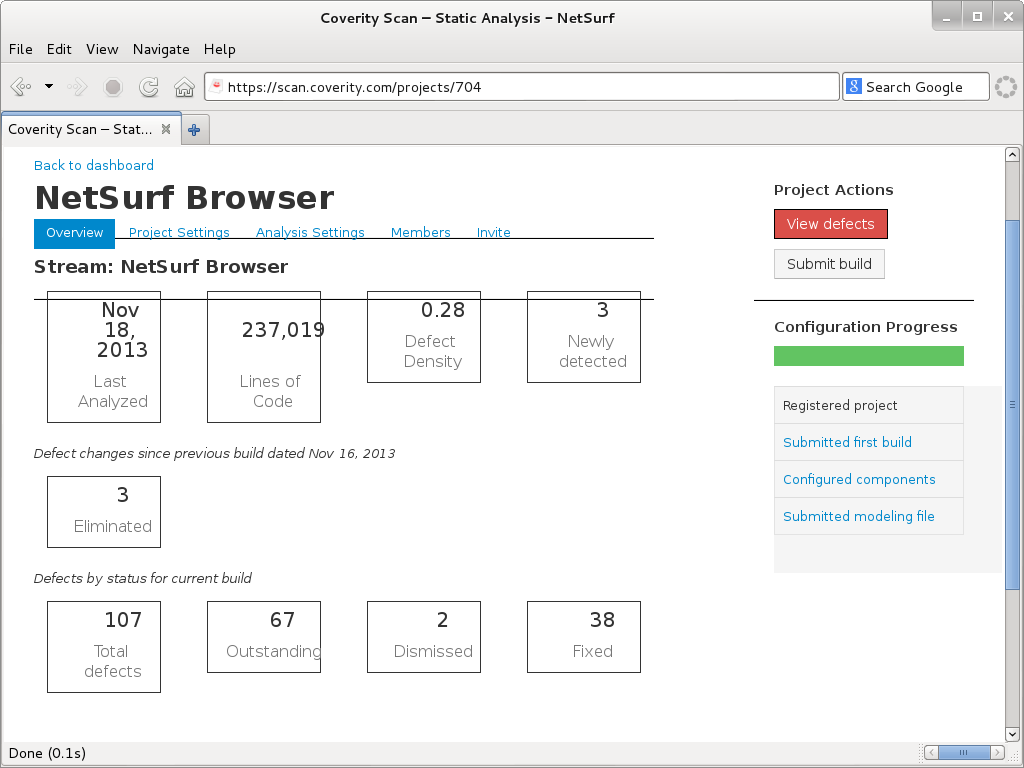
Coverity Interface showing summary of NetSurf analysis. Layout issues are a NetSurf bug
The company hosts a gratis service for open source projects, they even provide scans for the Linux kernel so project size does not appear to be an issue.

The challenges faced integrating the coverity tool into the build process differed from clang however the issue of execution time remained and the CI service was used.

The coverity scanning tool is a binary executable which collects data on the build which is then submitted to the coverity service to be analysed. This tool obviously relies upon the developer running the executable to trust coverity to some degree.

A basic examination of the binary was performed and determined the executable was not establishing network connections or performing and observably undesirable behaviour. From this investigation the decision was made that running the tool inside a sandbox environment on a CI build slave was safe. The CI system also submits the collected results in a compressed form directly to the coverity scan service.

Care must be taken to only submit builds according to the services Acceptable Use Policy which limits the submission frequency of NetSurf scans to every other day. To ensure the project stays within the rules the build performed by the CI system is manually controlled and confined to a subset of NetSurf developers.
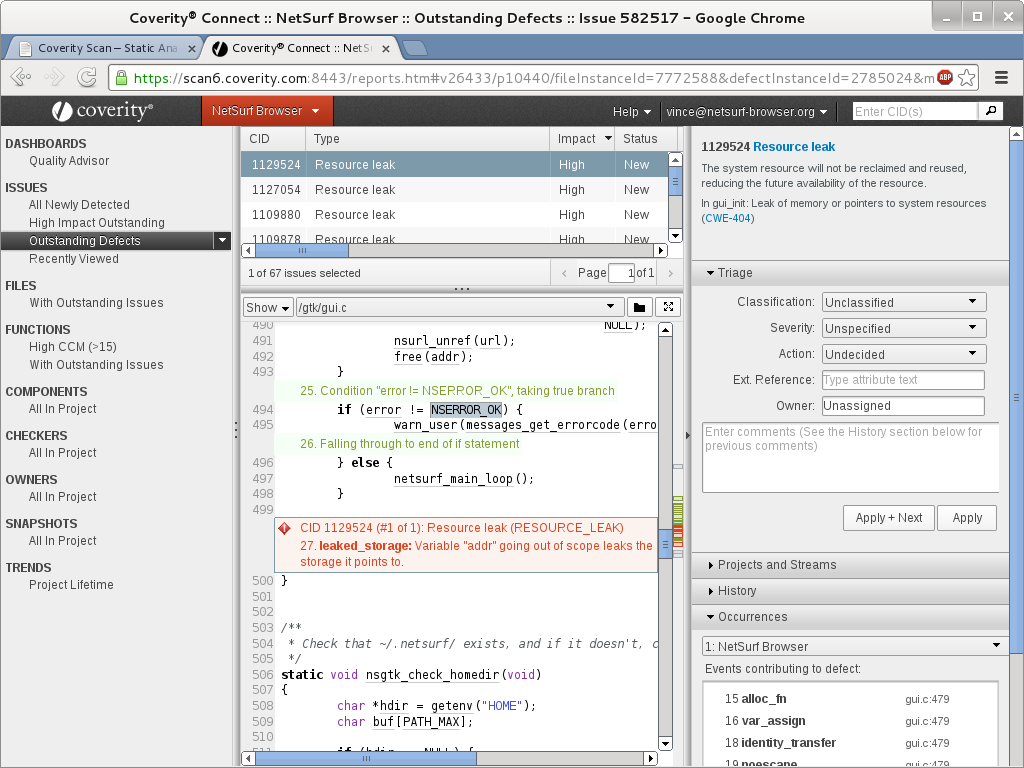
Coverity connect defect management console for NetSurfThe results are presented using the coverity connect web technology based defect management tool. Access to the coverity connect interface is controlled by a user management system which precludes publicly publishing the results within the CI system.

Unfortunately NetSurf itself does not currently have good enough JavaScript DOM bindings to support this interface so another browser must be used to view it.

Despite the drawbacks the quality of the analysis results is greatly superior to the clang solution. The false positive rate is very low while finding many real issues which had not been previously detected.

The analysis can be enhanced by use of collection configuration and modelling files which remove intended constructions from consideration reducing the false positive rate to very low levels. The ability to easily and persistently suppress false positives through the web interface is also available.

The false positive management capabilities coupled with a user interface that makes understanding the defect path simple make this solution very practical and indeed the NetSurf developers have removed over 50 actual issues within a relatively short period since the introduction of the tool.

Not all of those defects could be considered serious but they had the effect of encouraging deeper inspection of some very dubious smelling source.
ConclusionsThe principle conclusions of implementing and using static analysis have been:

When I started looking at this technology I was somewhat dubious about its usefulness but I have definitely changed my mind. It is a useful addition to any non-trivial project and the return on time and effort should be repaid handsomely in all but already perfect code (if you believe you have such code I have a bridge to sell you).

21 November 2013

Russ Allbery: Small but lovely haul

A few things for which I'd been waiting for quite some time were released, so there was another book order. Allie Brosh Hyperbole and a Half (graphic novel)
Jacqueline Carey Dark Currents (sff)
Debra Dunbar A Demon Bound (sff)
Nicola Griffith Hild (historical)
Ursula K. Le Guin The Unreal and the Real, Volume 1 (sff)
Ursula K. Le Guin The Unreal and the Real, Volume 2 (sff)
Ken Stern With Charity for All (non-fiction) I'm trying to buy fewer books given how many I have and haven't read, and also because I've been on a gaming tear recently and there are only so many hours in the day. Unfortunately, playing a lot of video games means reading fewer books. So I'm trying for quality rather than quantity, and this particular order has one of the best densities of hopefully good books as anything I've ordered in a while. For those who aren't familiar with Allie Brosh, Hyperbole and a Half is one of the most brilliant blogs that I've ever read, and this is a collection plus new stories and new illustrations. I specifically got the hardcover, which is beautiful and very high-quality. I've been waiting for Hild for years since Griffith started talking about writing it on her blog, and now I have the lovely hardcover in my hands. That's probably going to be Christmas reading. The Le Guin is a two-volume hardcover collection of Le Guin's personal favorites from her large lifetime oeuvre of short fiction.

Steve McIntyre: Mini-Debconf in Cambridge, November 14-17 2013

Phew, we did it! We successfuly ran our mini-conf last weekend. We welcomed roughly 60 people to the ARM offices in Cambridge over the 4 days. We started off with two days of sprint time, set aside for focussed hacking. We had a selection of ARM development boards on hand that people were playing with, plus a number of other people working on various other projects. The sprint sessions also saw some lively discussions on a couple of topics: the status of the ARM ports in Debian and automated system testing. Saturday and Sunday saw us move over to the more traditional style of conference session. Two full days of talks covered a wide range of topics: system testing to git tools, Debian ftp team work to bootstrapping the new arm64 port, improving ways of tracking and crediting Debian contributions to dealing with the new world of UEFI. Several volunteers from the DebConf video team were on hand too, so our talks were streamed live and recorded too - look out for them online soon! The mini-conf went well and feedback from attendees was universally positive, so we're already planning to run another similar event next year and maybe even apply to host a full DebConf in Cambridge soon too. :-) Many more details about the conference are in the debconf wiki at https://wiki.debconf.org/wiki/Miniconf-UK/2013 . Thanks to the sponsors who helped to make it all happen: ARM, Boston, Open@Citrix/Xen and Codethink/Baserock.

20 November 2013

Matt Zimmerman: Scaling Human Systems: Management

This is part 6 in a series on organizational design and growth.
The change from a business that the owner-entrepreneur can run with helpers to a business that requires management is a sweeping change. [...] One can compare the two kinds of business to two different kinds of organism: the insect, which is held together by a tough, hard skin, and the vertebrate animal, which has a skeleton. Land animals that are supported by a hard skin cannot grow beyond a few inches in size. To be larger, animals must have a skeleton. Yet the skeleton has not evolved out of the hard skin of the insect; for it is a different organ with different antecedents. Similarly, management becomes necessary when an organization reaches a certain size and complexity. But management, while it replaces the hard-skin structure of the owner-entrepreneur, is not its successor. It is, rather, its replacement. Peter Drucker
What it means Management is the art of enabling people to cooperate in achieving shared goals. I ve written elsewhere about what management is not. Management is a multifaceted discipline which is centered on people and the environment in which they work. Why it s important In very small organizations, management can be comparatively easy, and happen somewhat automatically, especially between people who have worked together before. But as organizations grow, management becomes a first-class concern, requiring dedicated practice and a higher degree of skill. Without due attention to management, coordination becomes excessively difficult, working systems are outgrown and become strained, and much of the important work described in this series just won t happen. Management is part of the infrastructure of the organization, and specifically the part which enables it to adapt and change as it grows. Old Status Quo People generally just do stuff , meaning there is little conscious understanding of the system in which people are working. If explicit managers exist, their jobs are poorly understood. Managers themselves may be confused or uncertain about what their purpose is, particularly if they are in such a role for the first time. The organization itself has probably developed more through accretion than deliberate design. New Status Quo People work within systems which help coordinate their work. These systems are consciously designed, explicitly communicated, and changed as often as necessary. Managers guide and coordinate the development and continuous improvement of these systems. The role of managers in the organization is broadly understood, and managers receive the training, support and coaching they need to be successful. Behaviors that help Obstacles that stand in our way

18 November 2013

Russ Allbery: Review: Anathem

Review: Anathem, by Neal Stephenson
Publisher: William Morrow
Copyright: 2008
ISBN: 0-06-147409-6
Format: Hardcover
Pages: 935
Fraa Erasmas is a little less than twenty years old and is an avout of the decade math of the Concent of Saunt Edhar. As Anathem opens, he's approaching his first apert. All of those words are left for the reader to puzzle out for themselves, unless you cheat and read the glossary (which I would recommend doing only with caution, but more on that in a moment), since Erasmas, the first-person narrator of this story, writes (mostly) as if the reader is familiar with the mathic world and its concepts. Translated into English, it means that Erasmas was brought into something akin to a scientific monastery (the "math") at around the age of nine and has been there for ten years, since his math is a decade math and therefore remains closed to all outside (s cular) ideas and contact for periods of ten years at a time. He is still a student there, not yet declaring allegiance to one of the chapters. That's something that he will be expected to do after the first apert. Every ten years, the decade math opens its doors to the outside world for a period of ten days (apert), and the fraas and suurs can leave the math and travel through the outside world as they wish. The start of Anathem is an exercise in alienation and reorientation. Stephenson has constructed a complex society with a long history and its own specific technical jargon and throws the reader into it with a minimum of orientation. Despite being familiar with SF novels that use this technique, I did read the preface and recommend that other readers do as well unless they particularly love piecing together a world from hints and clues. The timeline, in particular, was invaluable and something I referred to throughout the story. But even with the preface, you should expect to read the first part of Anathem interpolating meanings from context or just letting things slip past until you later come to understand them. A lot of people bounce off of Anathem here, and it's one of the reasons why I'd been postponing reading it (the other being that it's a substantial doorstop and I wanted to give it my undivided attention). But it's really not as bad as I feared. One gets a feel for the terms fairly quickly, and the more difficult ones Stephenson defines as he goes with excerpts from a dictionary of the mathic world. I found it slightly disorienting for a chapter or two, and then it started growing on me. The terminology is sometimes different just for the sake of being different (jeejahs are indistinguishable from smartphones for all practical purposes), but usually the invented words provide either important links to the past of the constructed world of Arbre or are technical terms that add precision and clarity once you know their meanings. It can be a little bit frustrating to remember the mapping of famous theories and theorems to the Orth names, but only mildly. (And Diax's Rake is so useful of a name for something that English doesn't name that I may start using it myself.) This is also why I recommend against reading the glossary. The definitions of terms are linked to important parts of history, which are, in turn, linked to important parts of the plot, and the glossary therefore risks spoilers. I liked having the term introduced by the frequent dictionary excerpts scattered through the chapters, and enjoyed the feeling of the terminology unfolding with the plot. The glossary is there if you really get lost, but I think the experienced SF reader (particularly if you have enough history background to pick up on the obvious parallels and start mapping bits to Greece, Rome, the Catholic Church, etc.) will be able to navigate the language without that much difficulty. I also stopped caring about the terminology because the story is so engrossing that it pulled me right into the book, closed over me, and made Erasmas's world feel real, precious, and fascinating. Whether that's going to be true of other people is a surprisingly difficult question, and one that I'll try to tackle as part of this review. But I will say up-front that I think this is the best book that Stephenson has ever written, even better than Snow Crash, despite some undeniable flab and one extremely irritating choice. Anathem is, at its heart, a novel about the scientific method. I think it's the first book by Stephenson that elegantly mingles his tendencies (and obsessions) as a writer with the interests (and obsessions) of the characters and makes the whole novel feel coherent. All of Stephenson's books are prone to discursive infodumps, but they've usually had to be shoehorned in around the characters. Even with the Baroque Cycle, a series full of natural philosophers, the digressions are jammed in around the plot like the filling of an over-packed box and frequently stick out at odd angles or dribble out on the floor. With Anathem, Stephenson has populated a book full of characters who have completely believable and engrossing reasons to digress into scientific debate and analysis, can put them into dialogue and thereby avoid some of the strain of the infodump, and (most importantly) largely restrains himself from narrative digressions via first-person narration and careful attention to when the characters themselves would follow the same digression. In short, this is a book full of very smart and very well-educated people who figure things out from first principles using agreed-upon theory, thrown into an unknown and dangerous situation that requires a great deal of deep thinking, science, engineering, and philosophy. All of Stephenson's quirks are still here, on prominent display, but rarely have I ever seen a better match of writer, characters, plot, and world background than this book. I would go so far as to say that, if you don't like this book, you're unlikely to like any long Stephenson. I haven't said a lot about the plot. Erasmas's apert is only the first part, and barely touches on any significant plot elements. It's mostly there to set some groundwork, introduce characters, and get the reader oriented. I'm not going to say much more, since the way the novel transitions from routine to unusual to emergency, and the resulting scramble to understand the emergency, is the heart and soul of this book and should not be spoiled. (I spoiled myself slightly by reading some analysis that I shouldn't have and regretted it, although it wasn't too much of a problem.) This is one of Stephenson's best-plotted novels. It develops slowly enough for the reader (and the characters) to think hard about it and make some good and bad guesses, but fast enough to stay engrossing. Most of it is very well-paced provided that you find the background of science and philosophy of science interesting. (If you don't, this is probably not a book you're going to enjoy.) I say "most of it" because, as mentioned earlier, this book is a bit flabby. There are a couple of sections where the theory and analysis are pushed aside by exigent circumstances and more action-oriented plot elements, both of which reminded me that Stephenson is very bad at writing action sequences and both of which I wished were shorter. And there are a couple of sections where Erasmas is getting oriented to a new situation or working up the courage to do something where I wished he'd get on with it already. But for a novel of nearly 1,000 pages, the amount of tension and reader interest Stephenson maintained for me was quite impressive. But as good as the plot is, the best part of this book is its full-bore, no-apologies embrace of understanding things. This is a book about making sense of the world, and about what it means to make sense of the world, and how you go about it, and what preconditions are required to do so. It is not, contrary to so much science fiction, a book about knowing things. The people who are already experts appear in this book, but generally only in the context of figuring out new things they've not previously been exposed to. Rather, it's a book about learning things, the thrill that comes from applying theory to understand something new, and the satisfaction of working through something from first principles or previously-established theory, arriving at testable predictions, and then testing them. It's the first novel I've read that captures some of the joy and delight that I got from reading George Gamow's One Two Three... Infinity as a child. Stephenson novels have always been about showing the reader neat things he learned, but I think previous books relied on the reader to bring their own enthusiasm. Anathem, at least for me, goes a step farther and uses the passion and approach of its characters to create that enthusiasm. It's one of those books that I not only enjoyed but went away from feeling like it made me a better person in some subtle but detectable way. Sadly, this is also where the irritating part comes in. I'm going to be very careful and indirect here, since the details are all extremely significant spoilers. You may want to skip to the last paragraph of this review if you want to avoid any knowledge about the end of Anathem. Stephenson pulls several rabbits out of the hat in this book, but most of them are well-defended and nicely handled bits of misdirection. There are a few where I thought the science or engineering was dubious, but even those are usually backed with enough hand-waving about Arbre technology that I could swallow it enough for the purposes of this book. (The timeline here is very helpful in allowing one to write off a few things as unknown technology.) But he puts, at the core of the plot, one of the most scientifically dubious bits of the whole book, and there's simply no avoiding that by the end of the story. Now, this doesn't mean that he just expects the reader to swallow it. Much of Anathem is a carefully-constructed defense of the bits he uses for the plot, and the defense is not half-bad within his fictional world. There are substantial in-book justifications for believing these techniques will work on Arbre even if they wouldn't in our scientific domain. So it's not so much the plausibility that bothered me; the idea is at least as plausible as some of the FTL drive concepts that I've swallowed without complaint. I do hold Anathem to a higher standard because the book is about science in a way that most science fiction isn't, but even with that, I think Stephenson mostly managed to dance across the thin ice he built. The problem is more subtle but more serious: if taken seriously on its own terms, the approach Stephenson takes to the plot destroys science in his universe. I can't really say more than that, since all of the details are huge spoilers, but the more I thought about it, the more irritated and annoyed I got. Anathem is otherwise a brilliant defense of the scientific method, and it felt like Stephenson injected a poison pill in the center of it, leading necessarily to a world where the scientific method no longer works. This does not happen on camera, or even between the pages of the book; you have to think about the implications for a while before you realize that's what happened. But once you do, it's a bitter pill to swallow, and it's hard to escape the feeling that it fundamentally undermines Stephenson's whole project here. And, to make it worse (although also oddly better in a way), I think it was unnecessary. He would have had to reconstruct the ending, but I can't shake the feeling that there were ways to write the ending, even maintaining the same character strengths, without having to pull that particular rabbit out of the hat. Because I think it's, in the end, unnecessary, I was still able to enjoy the whole book, including the ending, despite this, but while the rest of Anathem is a wholehearted 10, that choice knocked a full point off my impression of the book. It's profoundly irritating precisely because Stephenson did such an excellent job with the rest of it. But, that said, this book is still exceptional. I think it's the book that Stephenson was meant to write. Not only did he get the overall construction nearly perfect, he gets so many of the details right, from the history (which for a while I thought was merely clever, once I started seeing the correspondences that moved it out of the realm of pure invention, but which transitioned back to profound with later revelations in the book) to the language to the way that he excerpted some theoretic digressions into very well-done appendices. If you've ever thought of a theory as beautiful, or like reading about smart people debating the nature of understanding and knowledge, I cannot recommend this book too highly. Despite the highly irritating flaw at its center, and despite a few sections that show Stephenson is not a well-rounded writer, I think it's brilliant. Rating: 9 out of 10

16 November 2013

Russ Allbery: Review: Wanderlust

Review: Wanderlust, by Ann Aguirre
Series: Sirantha Jax #2
Publisher: Ace
Copyright: September 2008
ISBN: 0-441-01627-8
Format: Mass market
Pages: 312
Wanderlust is the second book in the Sirantha Jax series and a direct sequel to Grimspace. There's no point in reading them out of order. The new shape of Sirantha's universe is still coming together after the climactic events of Grimspace, but they seem to involve a new job. In politics, even, but one for which she's uniquely qualified. Before she can even accept it, she finds out that multiple parties are interested in her taking this position, for widely varying reasons. But she starts her new position by taking a detour to visit some old friends (and the planet I liked least in Grimspace's settings), which turns into a war and a comprehensive distraction that lasts the rest of the book. The biggest problem with Wanderlust (and unfortunately there are several) is that it doesn't feel like a complete book. The first few chapters set up what appears to be the next step of Sirantha's adventures, as well as establishing a new villain, and then the rest of the book is an extended detour. She does learn more about the new villain, but almost everything that's set up at the start of this book is still unresolved at the end of it. The detours are moderately entertaining and (at least after an initial decision based on unfinished business from the first book) are at least related to the plot, but this feels like the setup and middle-book distractions of a book twice as long. I came away wondering why all of that was really necessary and why I had to wait to the next book to read the actual plot. The second problem with this book is the whining. And the angst. And the self-esteem issues. And did I mention the whining? Okay, I get that one of the distinguishing elements of this series is that it's space opera with an urban fantasy first-person perspective, and the latter usually comes with extensive angst and insecurity about one's love life. But, really, I am not interested in Sirantha complaining about her appearance yet again, and I am particularly not interested in the obnoxiously tedious "I love you and therefore I must push you away" dance that both she and the male romance lead do through half this book, and only stop doing because they can't any more. I realize that self-destructiveness is a thing, and that people do react this way, but I don't want to read about it, and I particularly don't want to listen to the narrator whine about how hard it all is for much of the book. Some of the appeal of Sirantha is that she's fragile, paranoid, and all sorts of messed up, but she muddles through and manages to do the right thing anyway. However, for me, the key word there is "do." When she's twitchy and angry and sarcastic and scared but doing something (which does also happen in this book), I really enjoy this series. When she's living in her own head and building elaborate plans for how she's going to destroy her life this time, it starts getting tiresome. It doesn't help that I don't see what she sees in her romantic partner (at least most of the time; he has his moments), and therefore I have even less sympathy for her grand self-sacrificing gestures. Thankfully, there are good parts too. Aguirre introduces a few new characters, all of whom I liked. Sirantha is assembling quite the ragtag band of misfits, and they're misfits in all the right sorts of ways. They play off each other well and they're full of plot hooks. We also get an amusing twist on Sirantha's relationship with her personal assistant AI, which, while bizarrely tangential to the plot, looks like it will hold a lot of promise for the future. And I love Vel, who made the end of Grimspace and who continues to be a highlight of these books, partly because he doesn't throw emotional temper tantrums or indulge in bizarre silent treatments. I always love the quietly competent characters in stories like this. This is not up to Grimspace, but hopefully it's an aberration. It's not bad, exactly, but it went off the rails. Thankfully, the next book promises quite a lot of Vel, which will hopefully be an improvement. Followed by Doubleblind. Rating: 6 out of 10

Russ Allbery: Review: Blue Remembered Earth

Review: Blue Remembered Earth, by Alastair Reynolds
Series: Poseidon's Children #1
Publisher: Ace
Copyright: January 2012
Printing: June 2012
ISBN: 0-441-02071-2
Format: Hardcover
Pages: 505
Geoffrey Akinya is one heir to the vast Akinya business empire, which straddles the solar system and has created vast riches from exploration and mining. He wants nothing to do with it. His passion is elephants: long and methodical study of wild herds in Africa, including a slow and careful investigation into their thought processes. His obnoxious and superior cousins have a passion for business and finance and can have the running of the company for all he cares. But Geoffrey's grandmother Eunice, the family matriarch and driving force behind much of their business expansion, has died. Her ashes are brought back to Africa from the Winter Palace in orbit around the Moon where she lived out her final days and scattered in a family ceremony. And, shortly thereafter, Geoffrey's cousins convince him to investigate a safe-deposit box left on the Moon by Eunice to ensure that it doesn't contain anything damaging to the family. What it contains is the first step in a puzzle. Despite himself, Geoffrey and his sister Sunday an artist and family black sheep who lives in a region of the Moon that is one of the sole holdouts against the ubiquitous monitoring common in the rest of the inhabited solar system are slowly pulled into unraveling that puzzle. This leads them into an uneasy alliance with one of the major political forces in the solar system and some startling revelations about their grandmother's actual plans. Blue Remembered Earth is another entry in the currently-popular sub-genre of solar system SF. Interstellar travel is still a dream, but a combination of improved technology, suspended animation, and heavy use of robots and robotic factories has let humans slowly expand into more of the solar system. On Earth, powers have risen and fallen, and the leap into the solar system coincided with a surging and powerful Africa. Extensive undersea colonization has established a new international consortium of sea-floor countries, and Earth politics have realigned into a diplomatic and business struggle between surface and oceanic nations. Unusually for this sort of fiction, most characters of significance in this story are African. The United States and Europe have quietly disappeared in the way that all non-US countries tend to in most other SF. Reynolds doesn't do very much with this setup (and the characters don't seem distinctly African to me). It's just there as the unremarked normal. I liked that. I kind of wish more of African culture had come through in the story, but there are enough SF novels with an assumed and unremarked white (and usually US) future that an assumed and unremarked black African culture is a nice change of pace. I picked up this book in part because it was described as a better 2312. That's a fairly accurate summary (although only helpful to those who have read Kim Stanley Robinson's novel). The scope and setting are similar, although Reynolds's future cuts back on the scope of off-world human colonization, relies more heavily on robotics, and keeps the power base on Earth. Both books are structured as a mystery, although in Blue Remembered Earth that mystery is deliberately planted for the characters. Reynolds is nowhere near as good at set pieces as Robinson, sadly. There's nothing here at the level of some of the scenes on Mercury in 2312. But he is much better at plotting and characterization, and Blue Remembered Earth tells a coherent story with increasing tension and a satisfying ending. Reynolds here uses an interesting strategy for spinning a mystery out of pieces of knowledge and discovery: set the discovery process prior to the novel, use protagonists who were unaware of it, and turn the details into a mystery that they have to investigate. This is an interesting way to address the problem that most discovery processes are slow and not particularly dramatic. It is artificial Eunice creates the plot for the novel but that worked for me. By the end of the book, I think I understand her reasons for doing so, and both Geoffrey and Sunday have good reasons to not be aware of any of the details before they start following the clues that Eunice leaves behind. The mystery of course sends Geoffrey and Sunday on a bit of a tour of the solar system as well as a tour of the past of their family business and the politics of the present. Here, Reynolds draws on an old SF idea: a conflict between groups that want to mechanize space exploration and groups that want to adapt humans for space. Long-time SF readers will be familiar with this approach, and I don't think Reynolds does anything startlingly new with it, but I thought it was a well-executed side plot. And, for once, an SF author realizes that Earth's oceans are as compelling of a place for that conflict to play out as outer space. There are, of course, significant mysteries to be uncovered, but it takes much of the book before those revelations start (even if one of them is almost spoiled in the dust jacket summary). The story up until that point is driven by character, particularly Geoffrey's stubborn annoyance at the rest of his family and his complete lack of interest in being the protagonist of a novel. I should probably warn here that many of the Amazon reviews disliked this book because of the characters, particularly Geoffrey. Apparently he comes across to some as whiny, resentful, and annoying. I, however, didn't have this reaction at all, possibly in part because I wholeheartedly share his opinion of both big business and his cousins. I thoroughly enjoyed reading an SF novel whose main characters are not driven either typical capitalist motives or a desire for personal exploration, but instead are pulled into the plot through a sense of loyalty and an inability to get out of the way of the problem. I also liked the way Reynolds manages to broaden and deepen the reader's appreciation for the characters as the story unfolds, and even salvages some characters I thought were unsalvageable. The last third of the book features some excellent plot twists and some very nicely-handled revelations. This is apparently the first book of a trilogy, and I had a suspicion at the end of the book that sequels were coming, but I think it stands on its own quite well. Most of the questions raised by the plot are resolved by the end of the book, and those that remain are of a size that other books have left unanswered intentionally. Despite not reaching the same moments of awe-inspiring beauty, and despite more workman-like descriptions, the stronger plot and more interesting characters do make Blue Remembered Earth a better 2312 for me. Given that 2312 won a Nebula, that's saying something (although I don't agree with that award). It's a bit deliberate in its pacing, and the plot built around a constructed puzzle can feel a bit artificial, but I think it's a solid and satisfying near-space SF novel. Followed by On the Steel Breeze. Rating: 7 out of 10

15 November 2013

Daniel Pocock: Switzerland changes

For those with fond memories of the very successful DebConf13... This photo is actually from a few years ago, but the white stuff has started to appear in some parts of the country. Maybe someone local will even be able to sneak down there and draw the Debian swirl in the snow.

14 November 2013

Russ Allbery: Review: Water Logic

Review: Water Logic, by Laurie J. Marks
Series: Elemental Logic #3
Publisher: Small Beer Press
Copyright: 2007
ISBN: 1-931520-23-2
Format: Trade paperback
Pages: 332
Water Logic is the third book in the Elemental Logic series, starting with Fire Logic. As with Earth Logic, it's best to read all three books in close temporal proximity, since Water Logic offers little recap of what happened in the previous books and relies on a large cast of characters who are not reintroduced. It's also hard to review without spoilers for the previous books. Earth Logic ended with a monumental shift in Shaftal politics, and half of Water Logic is deeply concerned with the implications of that shift and where Shaftal should go from here. Karis and Zanja are, of course, deeply involved, but much of the political story is told from the perspective of the character introduced in Earth Logic, and from the perspective of another earth blood, Meriseth. Water bloods haven't been seen much so far in the series. Water magic is about repeated patterns and the malleability of time, and the plot of Water Logic eventually entangles Zanja in events far in the past of Shaftal. This proceeds in parallel with more of Marks's excellent analysis of the meaning of war and peace, diplomacy, cooperation, multiculturalism, adaptation, and empathy. The two sides of the book do to some extent reinforce each other, but the connections are tricky and less obvious. Parts of this book are excellent. Wars are complicated and powerful, and don't end easily. The mutual incomprehension and mutual (if intermittant) struggle for understanding between the natives of Shaftal and the Sainnites is beautifully presented. I particularly loved Mariseth's approach throughout the book. Earth bloods are perhaps Marks's best invention, and seeing another (besides Karis) at work, with the same stubborn patience but with different tactics and different levels of power, was a delight. I feel like reading, and thinking about, Seth's decisions makes me a better person. As with the previous books, though, parts of Water Logic are a bit boring, or at least don't seem to coherently move in a conclusive direction. Zanja has long journeys across the landscape as well as several adventures after she's grabbed by water logic that seem only distantly connected to the rest of the story. Marks does pull this mostly together in the end, and I could detect other thematic linkages while mulling the book over after finishing it, but the book feels a bit disjointed while reading it. And there are some elements, such as the cowdogs, that are neat bits of world-building but that seem tossed in just because they're neat and don't feel strongly connected to the plot. The other complaint I have, which would probably have been lessened by reading the books closer together, is that the cast is a bit too large. All of Karis's extended family are, of course, still around, which I found more confusing than helpful. Named and important characters keep popping in and then disappearing, with no introduction and no help for the reader who doesn't remember the exact details of their roles from previous books. It's a bit frustrating, and it makes the book feel a bit cluttered, although it does a great job of showing the dynamics of a large and comfortable family. (Marks shows the dynamics of family webs with multiple adults better than any other fantasy author I know.) Karis is a bit more sidelined in this book, casting her in the role of force of nature, and I think that works well. It took me a bit to warm to Zanja again, but by the end of the book I was greatly enjoying her sections. But the star, for me, is Seth. Even though some of her segments should have been the boring parts of the book, since they were mostly concerned with quitodian issues, they were the parts I wanted to read about. I was very touched by the ending, even if I think a bit too much authorial hand-waving was required. There is material left for a sequel at the end of Water Logic, including a villain who has yet to fully appear, but it's currently not clear whether Air Logic will ever materialize. But, as with Earth Logic, Water Logic provides a satisfying ending and leaves the world in a stable enough place that I didn't feel cheated out of the end of the story. I think Fire Logic remains the strongest book of this series, but Water Logic is very much worth reading if you've read the previous books. Unfortunately, the books apparently didn't sell well, so this book is from a small press instead of Tor. You may have to order it on-line instead of finding it a local bookstore. But the whole series is very much worth reading. It's a refreshingly original take on fantasy and is much more thoughtful about human relationships and politics than most fantasy works. Rating: 7 out of 10

Russ Allbery: Small random haul

Paul Lockhart A Mathematician's Lament (non-fiction)
Alastair Reynolds Blue Remembered Earth (sff)
Donna Tartt The Goldfinch (mainstream)
Tor.com (ed.) Some of the Best from Tor.com 2013 (sff) Not very much in this set, but I wanted to post it before I forgot about it. The Reynolds was the only book I picked up on vacation this year, since I'm being good about not buying too many new books until I get back on the reading bandwagon. That said, I did just place another order since several new books came out that I want to have right now, most notably Nicola Griffith's Hild.

Next.

Previous.