Search Results: "ron"

31 March 2020

Chris Lamb: Free software activities in March 2020

Here is my monthly update covering what I have been doing in the free software world during March 2020 (previous month): In addition, I did even more hacking on the Lintian static analysis tool for Debian packages, including:
Reproducible builds One of the original promises of open source software is that distributed peer review and transparency of process results in enhanced end-user security. However, whilst anyone may inspect the source code of free and open source software for malicious flaws, almost all software today is distributed as pre-compiled binaries. This allows nefarious third-parties to compromise systems by injecting malicious code into ostensibly secure software during the various compilation and distribution processes. The motivation behind the Reproducible Builds effort is to ensure no flaws have been introduced during this compilation process by promising identical results are always generated from a given source, thus allowing multiple third-parties to come to a consensus on whether a build was compromised. The initiative is proud to be a member project of the Software Freedom Conservancy, a not-for-profit 501(c)(3) charity focused on ethical technology and user freedom. Conservancy acts as a corporate umbrella allowing projects to operate as non-profit initiatives without managing their own corporate structure. If you like the work of the Conservancy or the Reproducible Builds project, please consider becoming an official supporter. This month, I: In our tooling, I also made the following changes to diffoscope, our in-depth and content-aware diff utility that can locate and diagnose reproducibility issues, including preparing and uploading version 138 to Debian: The Reproducible Builds project also operates a fully-featured and comprehensive Jenkins-based testing framework that powers tests.reproducible-builds.org. This month, I reworked the web-based package rescheduling tool to:
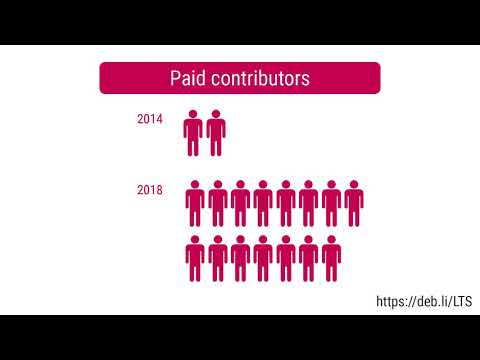
Debian LTS This month I have worked 18 hours on Debian Long Term Support (LTS) and 8 hours on its sister Extended LTS project. You can find out more about the Debian LTS project via the following video:
Debian Uploads For the Debian Privacy Maintainers team I requested that the pyptlib package be removed from the archive (#953429) as well as uploading onionbalance (0.1.8-6) to fix test failures under Pytest 3.x (#953535) and a new upstream release of nautilus-wipe. Finally, I sponsored an upload of bilibop (0.6.1) on behalf of Yann Amar.

Russell Coker: Links March 2020

Rolling Stone has an insightful article about why the Christian Right supports Trump and won t stop supporting him no matter what he does [1]. Interesting article about Data Oriented Architecture [2]. Quarantine Will normalise WFH and Recession will Denormalise Jobs [3]. I guess we can always hope that after a disaster we can learn to do things better than before. Tyre wear is worse than exhaust for small particulate matter [4]. We need better tyres and legal controls over such things. Scott Santens wrote an insightful article about the need for democracy and unconditional basic income [5]. In ancient Greece, work was regarded as a curse is an extreme position but strongly supported by evidence. In his essay In Praise of Idleness, Bertrand Russell wrote Modern methods of production have given us the possibility of ease and security for all; we have chosen, instead, to have overwork for some and starvation for others. Hitherto we have continued to be as energetic as we were before there were machines; in this we have been foolish, but there is no reason to go on being foolish forever. Cory Doctorow wrote an insightful article for Locus titled A Lever Without a Fulcrum Is Just a Stick about expansions to copyright laws [6]. One of his analogies is that giving a bullied kid more lunch money just allows the bullies to steal more money, with artists being bullied kids and lunch money being the rights that are granted under copyright law. The proposed solution includes changes to labor and contract law, presumably Cory will write other articles in future giving the details of his ideas in this regard. The Register has an amusing article about the trial of a former CIA employee on trial for being the alleged vault 7 leaker [7]. Both the prosecution and the defence are building their cases around the defendent being a jerk. The article exposes poor security and poor hiring practices in the CIA. CNN has an informative article about Finland s war on fake news [8]. As Finland has long standing disputes with Russia they have had more practice at dealing with fake news than most countries. The Times of Israel has an interesting article about how the UK used German Jews to spy on German prisoners of war [9]. Cory Doctorow wrote an insightful article Data is the New Toxic Waste about how collecting personal data isn t an asset, it s a liability [10]. Ulrike Uhlig wrote an insightful article about Control Freaks , analysing the different meanings of control, both positive and negative [11]. 538 has an informative article about the value of statistical life [12]. It s about $9M per person in the US, which means a mind-boggling amount of money should be spent to save the millions of lives that will be potentially lost in a natural disaster (like Coronavirus). NPR has an interesting interview about Crypto AG, the Swiss crypto company owned by the CIA [13]. I first learned of this years ago, it s not new, but I still learned a lot from this interview.

30 March 2020

Mike Gabriel: UBports: Packaging of Lomiri Operating Environment for Debian (part 02)

Before and during FOSDEM 2020, I agreed with the people (developers, supporters, managers) of the UBports Foundation to package the Unity8 Operating Environment for Debian. Since 27th Feb 2020, Unity8 has now become Lomiri. Recent Uploads to Debian related to Lomiri Over the past 7-8 weeks the packaging progress has been slowed down due to other projects I am working on in parallel. However, quite a few things have been achieved: The packages qtsystems, qtfeedback, and qtpim are no official Qt5 components, and so I had to package Git snapshots of them; with all implicit consequences regarding ABI and API compatibilities, possibly Debian-internal library transitions, etc. Esp. packaging qtsystems was pretty tricky due to a number of failing unit tests when the package had been built in a clean chroot (like it is the case on Debian's buildd infrastructure). I learned a lot about DBus and DBus mocking while working on all those unit tests to finally pass in chrooted builds. Unfortunately, the Lomiri App Launch component still needs more work due to (finally only) one unit test (jobs-systemd) not always passing. Sometimes, the test gets stucks and then fails after having reached a time out. I'll add it to my list of those unreproducible build failures I have recently seen in several GTest related unit test scenarios. Sigh... Credits A great thanks goes to Lisandro Perez Meyer from the Debian KDE/Qt Team for providing an intro and help on Qt Debian packaging and an intro on symbols handling with C++ projects. Another big thanks goes to Dmitry Shachnev from the Debian KDE/Qt Team for doing a sponsored upload [1] of qtpim (and also a nice package review). Also a big thanks goes to Marius Gripsgard for his work on forking the first Lomiri components on the UBports upstream side. Previous Posts about my Debian UBports Team Efforts References

Mike Gabriel: Mailman3 - Call for Translations (@Weblate)

TL;DR; please help localizing Mailman3 [1]. You can find it on hosted Weblate [2].The next component releases are planned in 1-2 weeks from now. Thanks for your contribution! If you can't make it now, please consider working on Mailman3 translations at some later point of time. Thanks! Time has come for Mailman3 Over the last months I have found an interest in Mailman3. Given the EOL of Python2 in January 2020 and also being a heavy Mailman2 provider for various of my projects and also for customers, I felt it was time to look at Mailman2's successor: Mailman3 [1]. One great novelty in Mailman3 is the strict split up between backend (Mailman Core), and the frontend components (django-mailman3, Postorius, Hyperkitty). All three are Django applications. Postorius is the list management web frontend whereas Hyperkitty is an archive viewer. Other than in Mailman2, you can also drop list posts into Hyperkitty directly (instead of sending a mail to the list). This makes Hyperkitty also some sort of forum software with a mailing list core in the back. The django-mailman3 module knits the previous two together (and handles account management, login dialog, profile settings, etc.). Looking into Mailman3 Upstream Code Some time back in midst 2019 I decided to deploy Mailman3 at a customer's site and also for my own business (which still is the test installation). Living and working in Germany, my customers' demand often is a fully localized WebUI. And at that time, Mailman3 could not provide this. Many exposed parts of the Mailman3 components were still not localized (or not localizable). Together with my employee I put some hours of effort into providing merge requests, filing bug reports, request better Weblate integration (meaning: hosted Weblate), improving the membership scripting support, etc. It felt a bit like setting the whole i18n thing in motion. Call for Translations Over the past months I had to focus on other work and two days ago I was delighted that Abhilash Raj (one of the Mailman3 upstream maintainers) informed me (via closing one of the related bugs [3]) that Mailman3 is now fully integrated with the hosted Weblate service and a continous translation workflow is set to go. The current translation stati of the Mailman3 components are at ~ 10%. We can do better than this, I sense. So, if you are a non-native English speaker and feel like contributing to Mailman3, please visit the hosted Weblate site [2], sign up for an account (if you don't have one already), and chime in into the translation of one of the future mailing list software suites run by many FLOSS projects all around the globe. Thanks a lot for your help. As a side note, if you plan working on translating Mailman Core into your language (and can't find it in the list of supported languages), please request this new language via the Weblate UI. All other components have all available languages enabled by default. References:

Axel Beckert: How do you type on a keyboard with only 46 or even 28 keys?

Some of you might have noticed that I m into keyboards since a few years ago into mechanical keyboards to be precise. Preface It basically started with the Swiss Mechanical Keyboard Meetup (whose website I started later on) was held in the hackerspace of the CCCZH. I mostly used TKL keyboards (i.e. keyboards with just the for me useless number block missing) and tried to get my hands on more keyboards with Trackpoints (but failed so far). At some point a year or two ago, I looking into smaller keyboards for having a mechanical keyboard with me when travelling. I first bought a Vortex Core at Candykeys. The size was nice and especially having all layers labelled on the keys was helpful, but nevertheless I soon noticed that the smaller the keyboards get, the more important is, that they re properly programmable. The Vortex Core is programmable, but not the keys in the bottom right corner which are exactly the keys I wanted to change to get a cursor block down there. (Later I found out that there are possibilities to get this done, either with an alternative firmware and a hack of it or desoldering all switches and mounting an alternative PCB called Atom47.) 40% Keyboards So at some point I ordered a MiniVan keyboard from The Van Keyboards (MiniVan keyboards will soon be available again at The Key Dot Company), here shown with GMK Paperwork (also bought from and designed by The Van Keyboards):
The MiniVan PCBs are fully programmable with the free and open source firmware QMK and started to use that more and more instead of bigger keyboards. Layers With the MiniVan I learned the concepts of layers. Layers are similar to what many laptop keyboards do with the Fn key and to some extent also what the German standard layout does with the AltGr key: Layers are basically alternative key maps you can switch with a special key (often called Fn , Fn1 , Fn2 , etc., or especially if there are two additional layers Raise and Lower ). There are several concepts how these layers can be reached with these keys: My MiniVan Layout For the MiniVan, two additional layers suffice easily, but since I have a few characters on multiple layers and also have mouse control and media keys crammed in there, I have three additional layers on my MiniVan keyboards:

TRNS means transparent, i.e. use the settings from lower layers.
I also use a feature that allows me to mind different actions to a key depending if I just tap the key or if I hold it. Some also call this tap dance . This is especially very popular on the usually rather huge spacebar. There, the term SpaceFn has been coined, probably after this discussion on Geekhack. I use this for all my layer switching keys: With this layout I can type English texts as fast as I can type them on a standard or TKL layout. German umlauts are a bit more difficult because it requires 4 to 6 key presses per umlaut as I use the Compose key functionality (mapped to the Menu key between the spacebars and the cursor block. So to type an on my MiniVan, I have to:
  1. press and release Menu (i.e. Compose); then
  2. press and hold either Shift-Spacebar (i.e. Shift-Fn1) or Slash (i.e. Fn2), then
  3. press N for a double quote (i.e. Shift-Fn1-N or Fn2-N) and then release all keys, and finally
  4. press and release the base character for the umlaut, in this case Shift-A.
And now just use these concepts and reduce the amount of keys to 28: 30% and Sub-30% Keyboards In late 2019 I stumbled upon a nice little keyboard kit shop on Etsy which I (and probably most other people in the mechanical keyboard scene) didn t take into account for looking for keyboards called WorldspawnsKeebs. They offer mostly kits for keyboards of 40% size and below, most of them rather simple and not expensive. For about 30 you get a complete sub-30% keyboard kit (without switches and keycaps though, but that very common for keyboard kits as it leaves the choice of switches and key caps to you) named Alpha28 consisting of a minimal Acrylic case and a PCB and electronics set. This Alpha28 keyboard is btw. fully open source as the source code, (i.e. design files) for the hardware are published under a free license (MIT license) on GitHub. And here s how my Alpha28 looks like with GMK Mitolet (part of the GMK Pulse group-buy) key caps:
So we only have character keys, Enter (labelled Data as there was no 1u Enter key with that row profile in that key cap set; I ll also call it Data for the rest of this posting) and a small spacebar, not even modifier keys. The Default Alpha28 Layout The original key layout by the developer of the Alpha28 used the spacbar as Shift on hold and as space if just tapped, and the Data key switches always to the next layer, i.e. it switches the layer permanently on tap and not just on hold. This way that key rotates through all layers. In all other layers, V switches back to the default layer. I assume that the modifiers on the second layer are also on tap and apply to the next other normal key. This has the advantage that you don t have to bend your fingers for some key combos, but you have to remember on which layer you are at the moment. (IIRC QMK allows you to show that via LEDs or similar.) Kinda just like vi. My Alpha28 Layout But maybe because I m more an Emacs person, I dislike remembering states myself and don t bind bending my fingers. So I decided to develop my own layout using tap-or-hold and only doing layer switches by holding down keys:

A triangle means that the settings from lower layers are used, N/A means the key does nothing.
It might not be very obvious, but on the default layer, all keys in the bottom row and most keys on the row ends have tap-or-hold configurations. Basic ideasBottom row if holdOther rows if holdHow the keys are divided into layersUsing the Alpha28 This layout works surprisingly well for me. Only for Minus, Equal, Single Quote and Semicolon I still often have to think or try if they re on Layer 1 or 2 as on my 40%s (MiniVan, Zlant, etc.) I have them all on layer 1 (and in general one layer less over all). And for really seldom used keys like Insert, PrintScreen, ScrollLock or Pause, I might have to consult my own documentation. They re somewhere in the middle of the keyboard, either on layer 1, 2, or 3. ;-) And of course, typing umlauts takes even two keys more per umlaut as on the MiniVan since on the one hand Menu is not on the default layer and on the other hand, I don t have this nice shifted number row and actually have to also press Shift to get a double quote. So to type an on my Alpha, I have to:
  1. press and release Space-F (i.e. Fn1-F) for Menu (i.e. Compose); then
  2. press and hold A-Spacebar-L (i.e. Shift-Fn1-L) for getting a double quote, then
  3. press and release the base character for the umlaut, in this case L-A for Shift-A (because we can t use A for Shift as I can t hold a key and then press it again :-).
Conclusion If the characters on upper layers are not labelled like on the Vortex Core, i.e. especially on all self-made layouts, typing is a bit like playing that old children s game Memory: as soon as you remember (or your muscle memory knows) where some special characters are, typing gets faster. Otherwise, you start with trial and error or look the documentation. Or give up. ;-) Nevertheless, typing on a sub-30% keyboard like the Alpha28 is much more difficult and slower than on a 40% keyboard like the MiniVan. So the Alpha28 very likely won t become my daily driver while the MiniVan defacto is my already my daily driver. But I like these kind of challenges as others like the game Memory . So I ordered three more 30% and sub-30% keyboard kits and WorldspawnsKeebs for soldering on the upcoming weekend during the COVID19 lockdown: And if I at some point want to try to type with even fewer keys, I ll try a Butterstick keyboard with just 20 keys. It s a chorded keyboard where you have to press multiple keys at the same time to get one charcter: So to get an A from the missing middle row, you have to press Q and Z simultaneously, to get Escape, press Q and W simultaneously, to get Control, press Q, W, Z and X simultaneously, etc. And if that s not even enough, I already bought a keyboard kit named Ginny (or Ginni, the developer can t seem to decide) with just 10 keys from an acquaintance. Couldn t resist when offered his surplus kits. :-) It uses the ASETNIOP layout which was initially developed for on-screen keyboards on tablets.

Louis-Philippe V ronneau: Using Zoom's web client on Linux

TL;DR: The zoom meeting link you have probably look like this:
https://zoom.us/j/123456789
To use the web client, use this instead:
https://zoom.us/wc/join/123456789
Avant-propos Like too many institutions, the school where I teach chose to partner up with Zoom. I wasn't expecting anything else, as my school's IT department is a Windows shop. Well, I guess I'm still a little disappointed. Although I had vaguely heard of Zoom before, I had never thought I'd be forced to use it. Lucky for me, my employer decided not to force us to use it. To finish the semester, I plan to record myself and talk with my students on a Jitsi Meet instance. I will still have to attend meetings on Zoom though. I'm well aware of Zoom's bad privacy record and I will not install their desktop application. Zoom does offer a web client. Sadly, on Linux you need to jump through hoops to be able to use it. Using Zoom's web client on Linux Zoom's web client apparently works better on Chrome, so I decided to use Chromium. Without already having the desktop client installed on your machine, the standard procedure to use the web client would be:
  1. Open the link to the meeting in Chromium
  2. Click on the "download & run Zoom" link showed on the page
  3. Click on the "join from your browser" link that then shows up
Sadly, that's not what happens on Linux. When you click on the "download & run Zoom" link, it brings you to a page with instructions on how to install the desktop client on Linux. You can thwart that stupid behavior by changing your browser's user agent to make it look like you are using Windows. This is the UA string I've been using:
Mozilla/5.0 (Windows NT 10.0; Win64; x64) AppleWebKit/537.36 (KHTML, like Gecko) Chrome/80.0.3987.149 Safari/537.36
With that, when you click on the "download & run Zoom" link, it will try to download a .exe file. Cancel the download and you should now see the infamous "join from your browser" link. Upon closer inspection, it seem you can get to the web client by changing the meeting's URL. The zoom meeting link you have probably look like this:
https://zoom.us/j/123456789
To use the web client, use this instead:
https://zoom.us/wc/join/123456789
Jitsi Meet Puppet Module I've been playing around with Jitsi Meet quite a bit recently and I've written a Puppet module to install and configure an instance! The module certainly isn't perfect, but should wield a working Jitsi instance. If you already have a Puppet setup, please give it a go! I'm looking forward receiving feedback (and patches) to improve it.

Shirish Agarwal: Covid 19 and the Indian response.

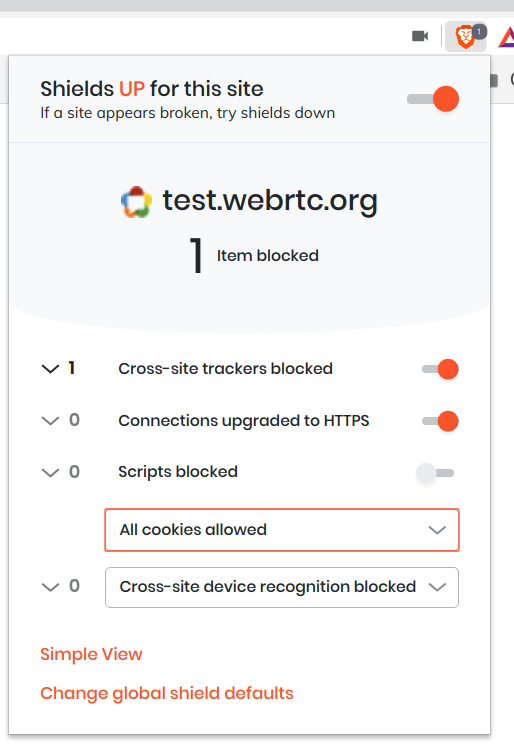
There have been lot of stories about Coronavirus and with it a lot of political blame-game has been happening. The first step that India took of a lockdown is and was a good step but without having a plan as to how especially the poor and the needy and especially the huge migrant population that India has (internal migration) be affected by it. A 2019 World Economic Forum shares the stats. as 139 million people. That is a huge amount of people and there are a variety of both push and pull factors which has displaced these huge number of people. While there have been attempts in the past and probably will continue in future they will be hampered unless we have trust-worthy data which is where there is lots that need to be done. In the recent few years, both the primary and secondary data has generated lot of controversies within India as well as abroad so no point in rehashing all of that. Even the definition of who is a migrant needs to be well-established just as who is a farmer . The simplest lucanae in the later is those who have land are known as farmers but the tenant farmers and their wives are not added as farmers hence the true numbers are never known. Is this an India-specific problem or similar definition issues are there in the rest of the world I don t know.
How our Policies fail to reach the poor and the vulnerable The sad part is most policies in India are made in castles in the air . An interview by the wire shares the conundrum of those who are affected and the policies which are enacted for them (it s a youtube video, sorry)
If one with an open and fresh mind sees the interview it is clear that why there was a huge reverse migration from Indian cities to villages. The poor and marginalized has always seen the Indian state as an extortive force so it doesn t make sense for them to be in the cities. The Prime Minister s annoucement of food for 3 months was a clear indication for the migrant population that for 3 months they will have no work. Faced with such a scenario, the best option for them was to return to their native places. While videos of huge number of migrants were shown of Delhi, this was the scenario of most states and cities, including Pune, my own city . Another interesting point which was made is most of the policies will need the migrants to be back in the villages. Most of these are tied to the accounts which are opened in villages, so even if they want to have the benefits they will have to migrate to villages in order to use them. Of course, everybody in India knows how leaky the administration is. The late Shri Rajiv Gandhi had famously and infamously remarked once how leaky the Public Distribution system and such systems are. It s only 10 paise out of rupee which reaches the poor. And he said this about 30 years ago. There have been numerous reports of both IPS (Indian Police Services) reforms and IAS (Indian Administrative Services) reforms over the years, many of the committee reports have been in public domain and in fact was part of the election manifesto of the ruling party in 2014 but no movement has happened on that part. The only thing which has happened is people from the ruling party have been appointed on various posts which is same as earlier governments. I was discussing with a friend who is a contractor and builder about the construction labour issues which were pointed in the report and if it is true that many a times the migrant labour is not counted. While he shared a number of cases where he knew, a more recent case in public memory was when some labourers died while building Amanora mall which is perhaps one of largest malls in India. There were few accidents while constructing the mall. Apparently, the insurance money which should have gone to the migrant laborer was taken by somebody close to the developers who were building the mall. I have a friend in who lives in Jharkhand who is a labour officer. She has shared with me so many stories of how the labourers are exploited. Keep in mind she has been a labor officer appointed by the state and her salary is paid by the state. So she always has to maintain a balance of ensuring worker s rights and the interests of the state, private entities etc. which are usually in cahoots with the state and it is possible that lot of times the State wins over the worker s rights. Again, as a labour officer, she doesn t have that much power and when she was new to the work, she was often frustrated but as she remarked few months back, she has started taking it easy (routinized) as anyways it wasn t helping her in any good way. Also there have been plenty of cases of labor officers being murdered so its easier to understand why one tries to retain some sanity while doing their job.

The Indian response and the World Response The Indian response has been the lockdown and very limited testing. We seem to be following the pattern of UK and U.S. which had been slow to respond and slow to testing. In the past Kerala showed the way but this time even that is not enough. At the end of the day we need to test, test and test just as shared by the WHO chairman. India is trying to create its own cheap test kits with ICMR approval, for e.g. a firm from my own city Pune MyLab has been given approval. We will know how good or bad they are only after they have been field-tested. For ventilators we have asked Mahindra and Mahindra even though there are companies like Allied Medical and others who have exported to EU and others which the Govt. is still taking time to think through. This is similar to how in UK some companies who are with the Govt. but who have no experience in making ventilators are been given orders while those who have experience and were exporting to Germany and other countries are not been given orders. The playbook is errily similar. In India, we don t have the infrastructure for any new patients, period. Heck only a couple of states have done something proper for the anganwadi workers. In fact, last year there were massive strikes by anganwadi workers all over India but only NDTV showed a bit of it along with some of the news channels from South India. Most mainstream channels chose to ignore it. On the world stage, some of the other countries and how they have responded perhaps need sharing. For e.g. I didn t know that Cuba had so many doctors and the politics between it and Brazil. Or the interesting stats. shared by Andreas Backhaus which seems to show how distributed the issue (age-wise) is rather than just a few groups as has been told in Indian media. What was surprising for me is the 20-29 age group which has not been shared so much in the Indian media which is the bulk of our population. The HBR article also makes a few key points which I hope both the general public and policymakers both in India as well as elsewhere take note of. What is worrying though that people can be infected twice or more as seems to be from Singapore or China and elsewhere. I have read enough of Robin Cook and Michael Crichton books to be aware that viruses can do whatever. They will over time mutate, how things will happen then is anybody s guess. What I found interesting is the world economic forum article which hypothesis that it may be two viruses which got together as well as research paper from journal from poteome research which has recently been published. The biggest myth flying around is that summer will halt or kill the spread which even some of my friends have been victim of . While a part of me wants to believe them, a simple scientific fact has been viruses have probably been around us and evolved over time, just like we have. In fact, there have been cases of people dying due to common cold and other things. Viruses are so prevalent it s unbelivable. What is and was interesting to note is that bat-borne viruses as well as pangolin viruses had been theorized and shared by Chinese researchers going all the way back to 90 s . The problem is even if we killed all the bats in the world, some other virus will take its place for sure. One of the ideas I had, dunno if it s feasible or not that at least in places like Airports, we should have some sort of screenings and a labs working on virology. Of course, this will mean more expenses for flying passengers but for public health and safety maybe it would worth doing so. In any case, virologists should have a field day cataloging various viruses and would make it harder for viruses to spread as fast as this one has. The virus spread also showed a lack of leadership in most of our leaders who didn t react fast enough. While one hopes people do learn from this, I am afraid the whole thing is far from over. These are unprecedented times and hope that all are maintaining social distancing and going out only when needed.

29 March 2020

Enrico Zini: Politics links

How tech's richest plan to save themselves after the apocalypse
politics privilege archive.org
Silicon Valley s elite are hatching plans to escape disaster and when it comes, they ll leave the rest of us behind
Heteronomy refers to action that is influenced by a force outside the individual, in other words the state or condition of being ruled, governed, or under the sway of another, as in a military occupation.
Poster P590CW $9.00 Early Warning Signs Of Fascism Laurence W. Britt wrote about the common signs of fascism in April, 2003, after researching seven fascist regimes: Hitler's Nazi Germany; Mussolini's Italy; Franco's Spain; Salazar's Portugal; Papadopoulos' Greece; Pinochet's Chile; Suharto's Indonesia. Get involved! Text: Early Warning Signs of Fascism Powerful and Continuing Nationalism Disdain For Human Rights Identification of Enemies As a unifying cause Supremacy of the military Rampant Sexism Controlled Mass Media Obsession With National Security
Political and social scientist Stefania Milan writes about social movements, mobilization and organized collective action. On the one hand, interactions and networks achieve more visibility and become a proxy for a collective we . On the other hand: Law enforcement can exercise preemptive monitorin
How new technologies and techniques pioneered by dictators will shape the 2020 election
A regional election offers lessons on combatting the rise of the far right, both across the Continent and in the United States.
The Italian diaspora is the large-scale emigration of Italians from Italy. There are two major Italian diasporas in Italian history. The first diaspora began more or less around 1880, a decade or so after the Unification of Italy (with most leaving after 1880), and ended in the 1920s to early-1940s with the rise of Fascism in Italy. The second diaspora started after the end of World War II and roughly concluded in the 1970s. These together constituted the largest voluntary emigration period in documented history. Between 1880-1980, about 15,000,000 Italians left the country permanently. By 1980, it was estimated that about 25,000,000 Italians were residing outside Italy. A third wave is being reported in present times, due to the socio-economic problems caused by the financial crisis of the early twenty-first century, especially amongst the youth. According to the Public Register of Italian Residents Abroad (AIRE), figures of Italians abroad rose from 3,106,251 in 2006 to 4,636,647 in 2015, growing by 49.3% in just ten years.

28 March 2020

Fran ois Marier: How to get a direct WebRTC connections between two computers

WebRTC is a standard real-time communication protocol built directly into modern web browsers. It enables the creation of video conferencing services which do not require participants to download additional software. Many services make use of it and it almost always works out of the box. The reason it just works is that it uses a protocol called ICE to establish a connection regardless of the network environment. What that means however is that in some cases, your video/audio connection will need to be relayed (using end-to-end encryption) to the other person via third-party TURN server. In addition to adding extra network latency to your call that relay server might overloaded at some point and drop or delay packets coming through. Here's how to tell whether or not your WebRTC calls are being relayed, and how to ensure you get a direct connection to the other host.

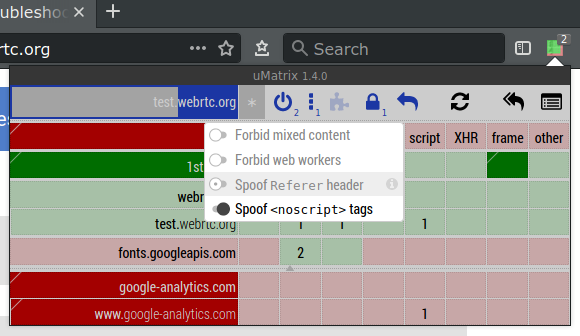
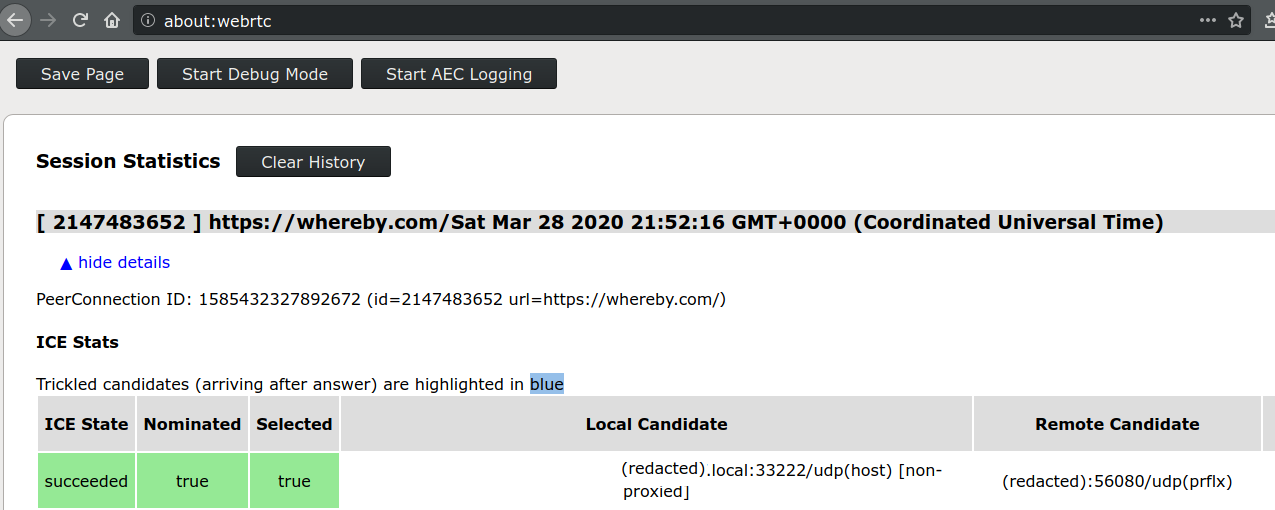
Testing basic WebRTC functionality Before you place a real call, I suggest using the official test page which will test your camera, microphone and network connectivity. Note that this test page makes use of a Google TURN server which is locked to particular HTTP referrers and so you'll need to disable privacy features that might interfere with this:
  • Brave: Disable Shields entirely for that page (Simple view) or allow all cookies for that page (Advanced view).
  • Firefox: Ensure that http.network.referer.spoofSource is set to false in about:config, which it is by default.
  • uMatrix: The "Spoof Referer header" option needs to be turned off for that site.

Checking the type of peer connection you have Once you know that WebRTC is working in your browser, it's time to establish a connection and look at the network configuration that the two peers agreed on. My favorite service at the moment is Whereby (formerly Appear.in), so I'm going to use that to connect from two different computers:
  • canada is a laptop behind a regular home router without any port forwarding.
  • siberia is a desktop computer in a remote location that is also behind a home router, but in this case its internal IP address (192.168.1.2) is set as the DMZ host.

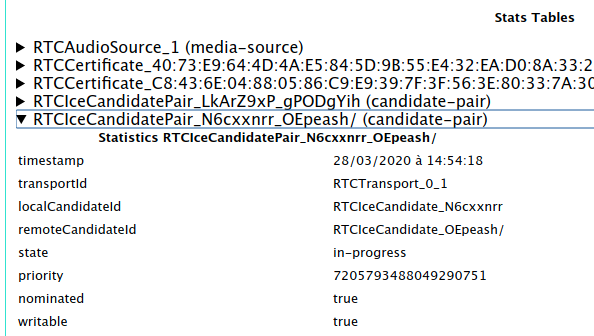
Chromium For all Chromium-based browsers, such as Brave, Chrome, Edge, Opera and Vivaldi, the debugging page you'll need to open is called chrome://webrtc-internals. Look for RTCIceCandidatePair lines and expand them one at a time until you find the one which says:
  • state: succeeded (or state: in-progress)
  • nominated: true
  • writable: true
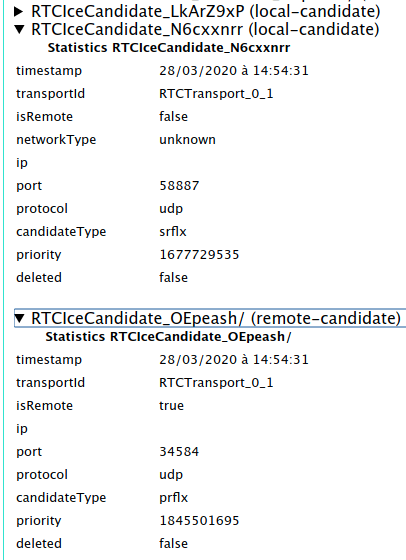
Then from the name of that pair (N6cxxnrr_OEpeash in the above example) find the two matching RTCIceCandidate lines (one local-candidate and one remote-candidate) and expand them. In the case of a direct connection, I saw the following on the remote-candidate:
  • ip shows the external IP address of siberia
  • port shows a random number between 1024 and 65535
  • candidateType: srflx
and the following on local-candidate:
  • ip shows the external IP address of canada
  • port shows a random number between 1024 and 65535
  • candidateType: prflx
These candidate types indicate that a STUN server was used to determine the public-facing IP address and port for each computer, but the actual connection between the peers is direct. On the other hand, for a relayed/proxied connection, I saw the following on the remote-candidate side:

  • ip shows an IP address belonging to the TURN server
  • candidateType: relay
and the same information as before on the local-candidate.

Firefox If you are using Firefox, the debugging page you want to look at is about:webrtc. Expand the top entry under "Session Statistics" and look for the line (should be the first one) which says the following in green:
  • ICE State: succeeded
  • Nominated: true
  • Selected: true
then look in the "Local Candidate" and "Remote Candidate" sections to find the candidate type in brackets.

Firewall ports to open to avoid using a relay In order to get a direct connection to the other WebRTC peer, one of the two computers (in my case, siberia) needs to open all inbound UDP ports since there doesn't appear to be a way to restrict Chromium or Firefox to a smaller port range for incoming WebRTC connections. This isn't great and so I decided to tighten that up in two ways by:
  • restricting incoming UDP traffic to the IP range of siberia's ISP, and
  • explicitly denying incoming to the UDP ports I know are open on siberia.
To get the IP range, start with the external IP address of the machine (I'll use the IP address of my blog in this example: 66.228.46.55) and pass it to the whois command:
$ whois 66.228.46.55   grep CIDR
CIDR:           66.228.32.0/19
To get the list of open UDP ports on siberia, I sshed into it and ran nmap:
$ sudo nmap -sU localhost
Starting Nmap 7.60 ( https://nmap.org ) at 2020-03-28 15:55 PDT
Nmap scan report for localhost (127.0.0.1)
Host is up (0.000015s latency).
Not shown: 994 closed ports
PORT      STATE         SERVICE
631/udp   open filtered ipp
5060/udp  open filtered sip
5353/udp  open          zeroconf
Nmap done: 1 IP address (1 host up) scanned in 190.25 seconds
I ended up with the following in my /etc/network/iptables.up.rules (ports below 1024 are denied by the default rule and don't need to be included here):
# Deny all known-open high UDP ports before enabling WebRTC for canada
-A INPUT -p udp --dport 5060 -j DROP
-A INPUT -p udp --dport 5353 -j DROP
-A INPUT -s 66.228.32.0/19 -p udp --dport 1024:65535 -j ACCEPT

26 March 2020

Jonathan Carter: Lockdown

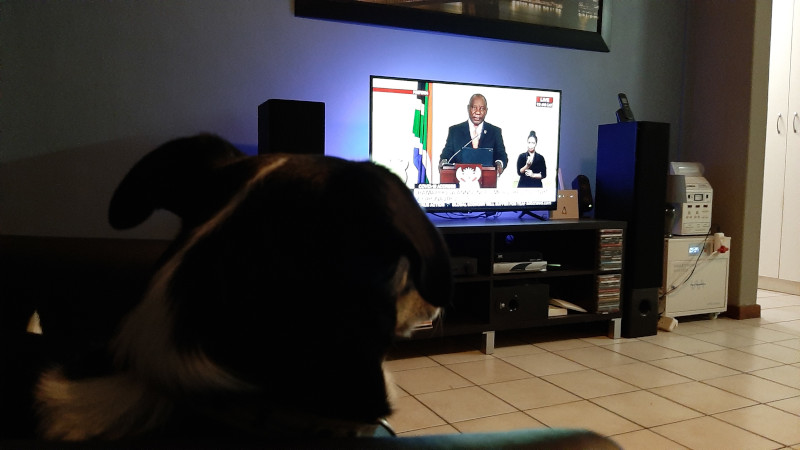
I just took my dog for a nice long walk. It s the last walk we ll be taking for the next 3 weeks, he already starts moping around if we just skip one day of walking, so I m going to have to get creative keeping him entertained. My entire country is going on lockdown starting at midnight. People won t be allowed to leave their homes unless it s for medical emergencies, to buy food or if their work has been deemed essential. Due to the Covid-19 epidemic nearing half a million confirmed infections, this has become quite common in the world right now, with about a quarter of the world s population currently under lockdown and confined to their homes.
Some people may have noticed I ve been a bit absent recently, I ve been going through some really rough personal stuff. I m dealing with it and I ll be ok, but please practice some patience with me in the immediate future if you re waiting on anything. I have a lot of things going on in Debian right now. It helps keeping me busy through all the turmoil and gives me something positive to focus on. I m running for Debian Project Leader (DPL), I haven t been able to put in quite the energy into my campaign that I would have liked, but I think it s going ok under the circumstances. I think because of everything happening in the world it s been more difficult for other Debianites to participate in debian-vote discussions as well. Recently we also announced Debian Social, a project that s still in its early phases, but we ve been trying to get it going for about 2 years, so it s nice to finally see it shaping up. There s also plans to put Debian Social and some additional tooling to the test, with the idea to host a MiniDebConf entirely online. No dates have been confirmed yet, we still have a lot of crucial bits to figure out, but you can subscribe to debian-devel-announce and Debian micronews for updates as soon as more information is available. To everyone out there, stay safe, keep your physical distance for now and don t lose hope, things will get better again.

Axel Beckert: Pictures in pure HTML with chafa and aha

I recently stumbled upon chafa, a tool to display pictures, especially color pictures on your ANSI text terminal, e.g. inside an xterm. And I occasionally use aha, the Ansi HTML Adapter to convert a colorful terminal content into HTML to show off terminal screenshots without the requirement of a picture so that it also works in e.g. text browsers or for blinds. Combining chafa and aha: Examples A moment ago I had the thought what would happen if I feed the output of chafa into aha and expected nothing really usable. But I was surprised by the quality of the outcome.
looks like this after chafa -w 9 -c full -s 160x50 DSCN4692.jpg aha -n:


Checking the Look in Text Browsers It even looks not that bad in elinks as far as I know the only text browser which supports CSS and styles:
In Lynx and Links 2, the text composing the image is displayed only in black and white, but you at least can recognise the edges in the picture:
Same Functionality in One Tool? I knew there was a tool which did this in one step. Seems to have been png2html. Tried to play around with it, too, but neither really understood how to use it (seems to require a text file for the characters to be used why?) nor did I really got it working. It always ran until I aborted it and it never filled the target file with any content. Additionally, png2html insists on one character per pixel, requiring to first properly resize the image before converting to HTML. The Keyboard in the Pictures Oh, and btw., the displayed keyboard is my Zlant. The Zlant is a 40% uniform staggered mechanical keyboard. Currently, only Zlant PCBs are available at 1UP Keyboards (USA), i.e. no complete kits. It is shown with the SA Vilebloom key cap set, currently available at MechSupply (UK).

25 March 2020

Raphaël Hertzog: Freexian s report about Debian Long Term Support, February 2020

A Debian LTS logo Like each month, here comes a report about the work of paid contributors to Debian LTS. Individual reports In February, 226 work hours have been dispatched among 14 paid contributors. Their reports are available: Evolution of the situation February began as rather calm month and the fact that more contributors have given back unused hours is an indicator of this calmness and also an indicator that contributing to LTS has become more of a routine now, which is good. In the second half of February Holger Levsen (from LTS) and Salvatore Bonaccorso (from the Debian Security Team) met at SnowCamp in Italy and discussed tensions and possible improvements from and for Debian LTS. The security tracker currently lists 25 packages with a known CVE and the dla-needed.txt file has 21 packages needing an update. Thanks to our sponsors New sponsors are in bold.

No comment Liked this article? Click here. My blog is Flattr-enabled.

24 March 2020

Dirk Eddelbuettel: New package RcppDate 0.0.1 now on CRAN!

A new small package with a new C++ header library is now on CRAN. It brings the date library by Howard Hinnant to R. This library has been in pretty wide-spread use for a while now, and adds to C++11/C++14/C++17 what will be (with minor modifications) the date library in C++20. I had been aware of it for a while, but not needed thanks to CCTZ library out of Google and our RcppCCTZ package. And like CCTZ, it builds upon std::chron adding a whole lot of functionality and useability enhancement. But a some upcoming (and quite exciting!) changes in nanotime required it, I had a reason to set about packaging it as RcppDate. And after a few days of gestation and review it is now available via CRAN. Two simple example files are included and can be accessed by Rcpp::sourceCpp(). Some brief excerpts follow. The first example shows three date constructors. Note how the month (and the leading digits) are literals. No quotes for strings anywhere. And no format (just like our anytime package for R).
  constexpr auto x1 = 2015_y/March/22;
  constexpr auto x2 = March/22/2015;
  constexpr auto x3 = 22_d/March/2015;
Note that these are constexpr that resolve at compile-time, and that the resulting year_month_day type is inferred via auto. A second example constructs the last day of the months similarly:
  constexpr auto x1 = 2015_y/February/last;
  constexpr auto x2 = February/last/2015;
  constexpr auto x3 = last/February/2015;
For more, see the copious date.h documentation. The (very bland first) NEWS entry (from a since-added NEWS file) for the initial upload follows.

Changes in version 0.0.1 (2020-01-17)
  • Initial CRAN upload of first version

If you like this or other open-source work I do, you can now sponsor me at GitHub. For the first year, GitHub will match your contributions.

This post by Dirk Eddelbuettel originated on his Thinking inside the box blog. Please report excessive re-aggregation in third-party for-profit settings.

Anisa Kuci: Outreachy post 5 - Final report

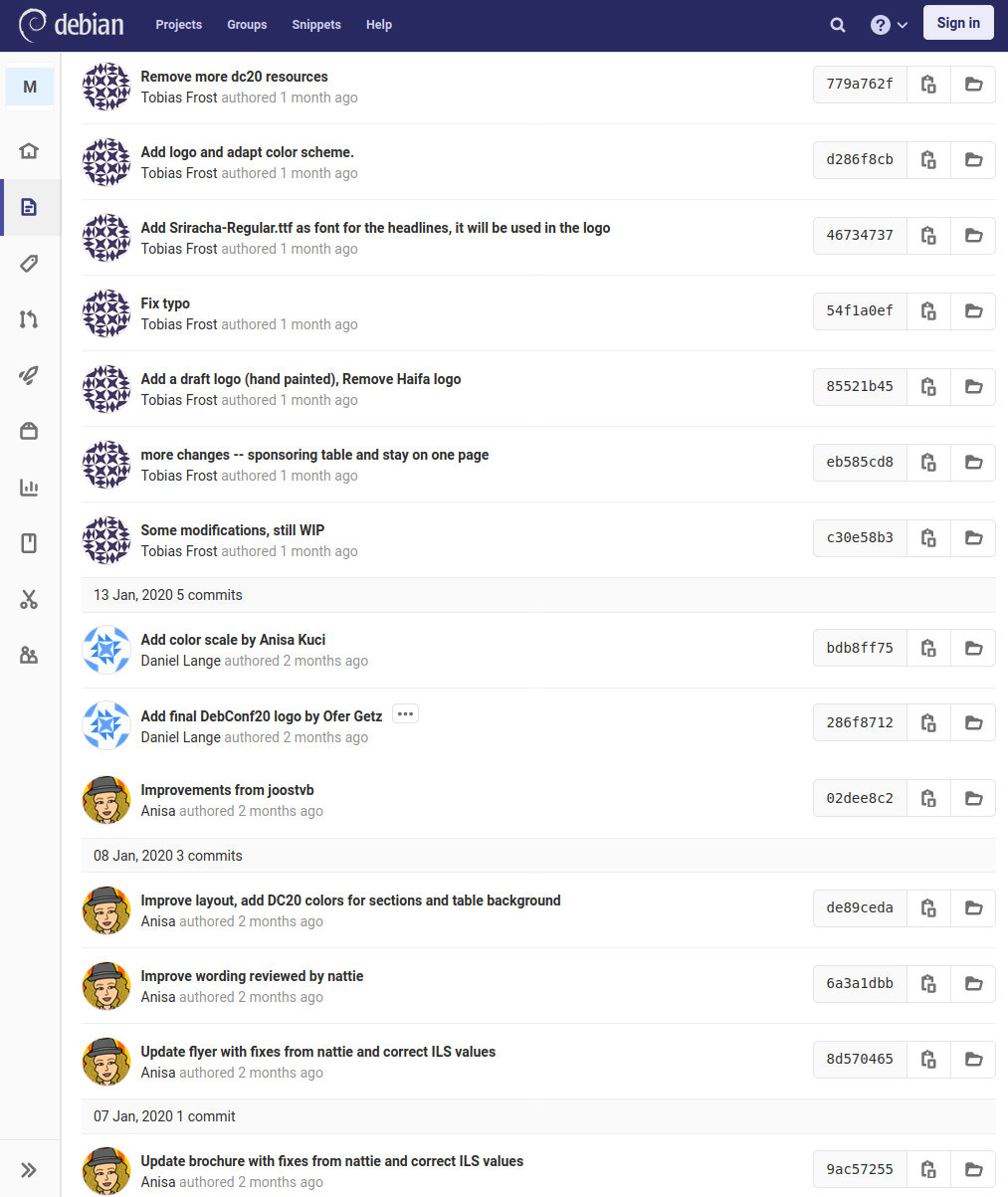
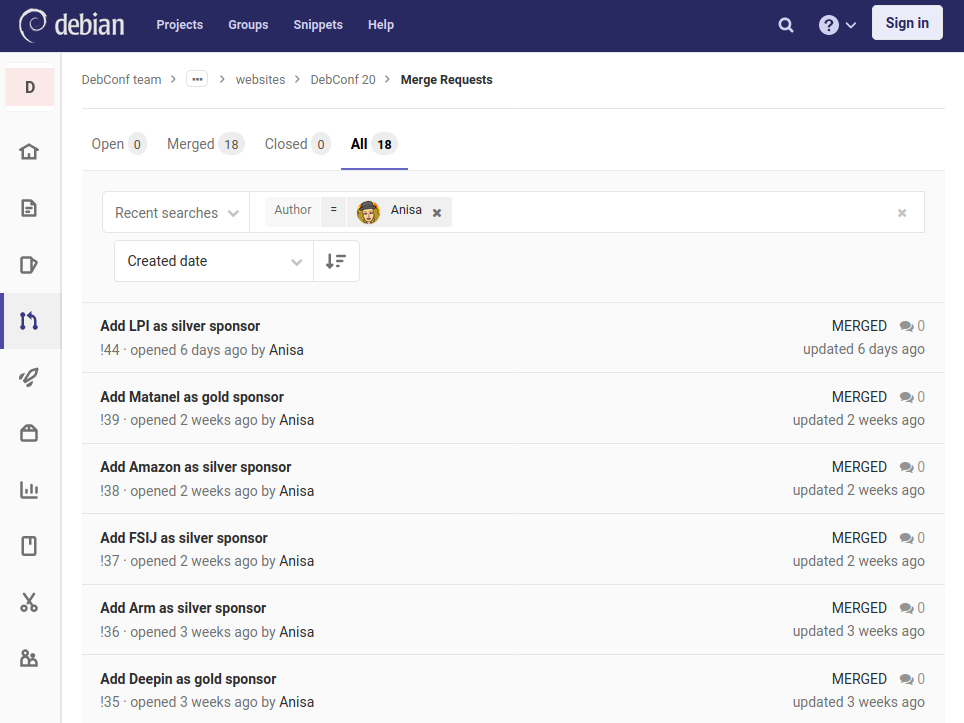
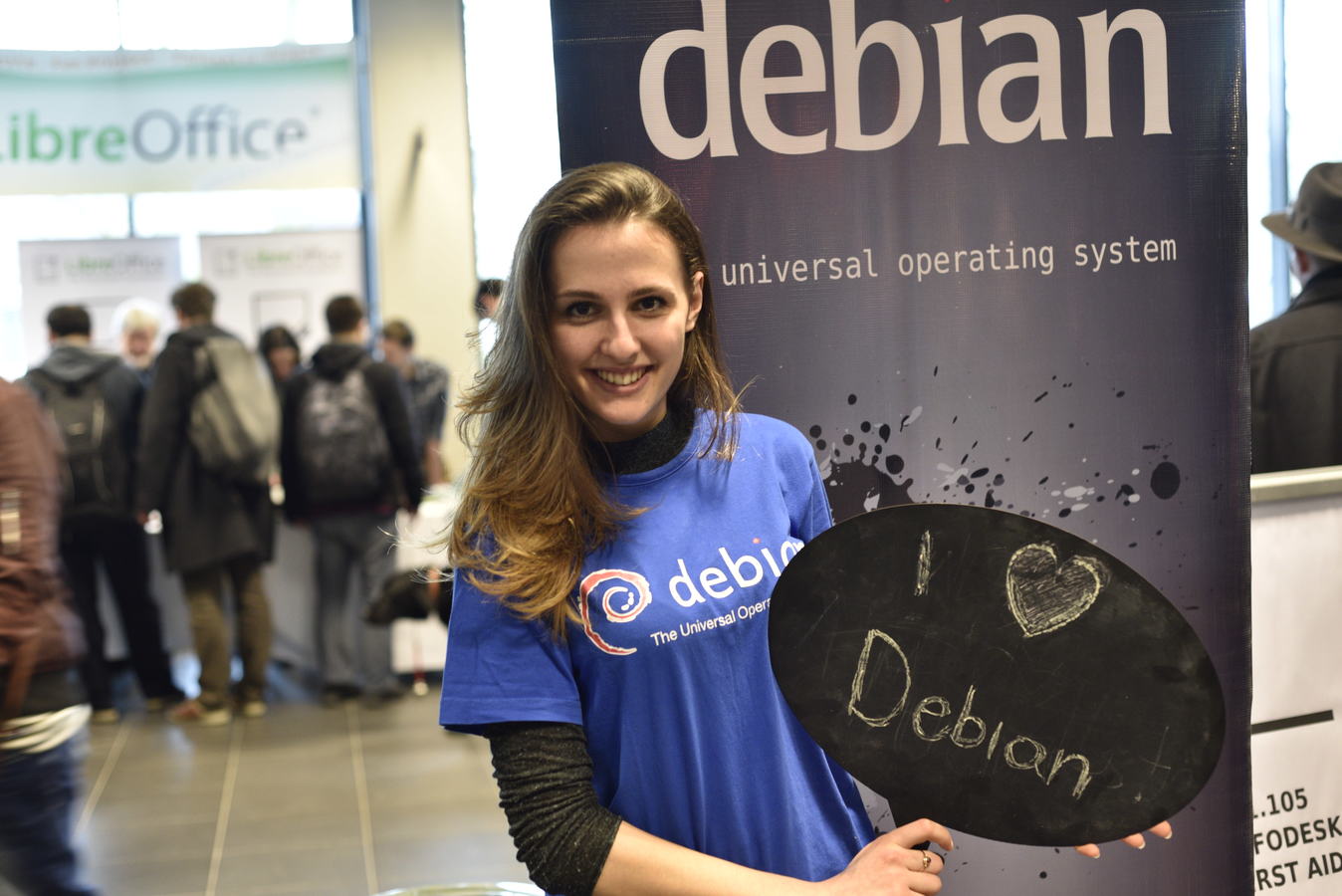
This is my last Outreachy blogpost, as my internship unfortunately has come to an end. It was a blast! Through the Outreachy internship I gained a lot of valuable knowledge and even though I dont know what the future will bring, I am more confident about myself, my skills in fundraising and my technical abilities now. During the contribution phase I did quite a lot of research so I could come up with relevant information to add on the Debian wiki as part of the contribution phase tasks. This was helpful for me to build a more deep understanding of the Debian project, the DebConf conferences and the general style of working within Debian. During this phase I completed most of the tasks given and got onto the mailing lists and IRC channels which are public. This was quite an intense experience by itself as it was like digging into a new job but in a competitive situation as other applicants, of course, were also putting in their best to get one of the 50 Outreachy internships (two in Debian) that were available. When I got selected I also got access to the sponsors@debconf.org email address and the private git repos as they would be needed for me to work on fundraising. I was also provided with an @debconf.org email address that is the one I use for sponsors communication. I learned what makes communication look professional and how to think of the recipient when formulating emails, sending replies or creating marketing messages. As the internship continued I started to learn how the DebConf organizing structure works, with a particular attention on the fundraising team. I have also quickly been given the responsibility to reach out to 100 potential sponsors and combine learning and working experience very nicely. I was given responsibility of working on the fundraising material (flyer and brochure) for DebConf20, so using LaTeX I updated the files in order to remove the translation system, I added the Israeli currency and the visual design chosen from a public logo proposal contest that is held for each DebConf. My creative side could also be put to good use as the team trusted me with selecting the images for the brochure and making sure that the usage rights granted and attribution are all compliant to Free Software/Creative Commons licences. I have continuously maintained those materials and was very happy that long term team members even asked me to approve changes they proposed on the fundraising material. The MiniDebConf team for Regensburg have taken the files I created and made them into their fundraising material (brochure, flyer) which is great to see. MiniDebConf Regensburg commits I have profited so much from other people s work, so I am very happy if community members can build on mine. Afterall sharing is caring! Through the Outreachy travel stipend I was able to attend FOSDEM 2020 and besides meeting many friends from the community and having a fundraising meeting with a sponsor, I was able to also support distributing the DebConf20 fundraising material both in electronic form and as printed versions. During the Outreachy internship I did two communication waves to potential sponsors and maintained the daily communication with them. I followed the documentation that was already available in the Debian wiki guiding me through the process of invoicing sponsors through the organizations that Debian collaborates with. As I have been in frequent contact with the sponsors, I have continuously updated the DebConf20 website with sponsor logos and links through git files, improving web pages on the wafer system and doing 18 merge requests in total. DebConf20 website merge requests I completed six email templates for the DebConf sponsor communication campaigns. While two of them have already been very useful, I hope my other proposals will be the ones used for the next waves of sponsors contacting. I committed them to the sponsors git repo so they can be easily accessible and well documented for other DebConf teams or can be recycled for smaller Debian events. Unfortunately, due to the insecurity about travel around the Corona virus pandemic, the third wave of communication, originally scheduled for the end of my internship in March, has been held. I have committed to the team to do this once the travel restrictions have been lifted and we know that DebConf20 can proceed as planned for August 2020. So yeah, I am definitely going to stay around and continue to help with DebConf fundraising! DebConf has been held for two decades and it also has a generic website, so I also updated the static sponsors page on the main website as it is the first landing page for everyone especially for people who are not necessarily insiders in Debian or DebConf. I have completed a Python tutorial, got the general understanding of the programming language and made some smaller contributions to improve existing tools in the fundraising team based on the learning. The internship was also focused on documentation, so during the whole internship I have kept notes in order to be able to improve existing documentation and I have also written new material, especially on the tasks that I have been working on more closely: Every DebConf has a new team every year, in a new country, so I hope this documentation I have worked on will be useful as a jump-starter for them to organize and finance their events. I would like to take a moment to thank again my mentors Daniel and Karina for all their support, it has been great working with them. Having them as an example, I have learned a lot. Also warm thanks to the DebConf global and local teams which have been very welcoming and always supportive during my internship. So, as you might already know, if you have read my other Outreachy blog posts, this has been a great experience for me! Outreachy provides an awesome opportunity that would not be available if it was not for the generous sponsors and volunteers making such a program for people from underrepresented groups in the FLOSS community. I really encourage people from these groups to find the confidence within themselves and apply for Outreachy! I love Debian
Russ Allbery: Review: Lost in Math

Review: Lost in Math, by Sabine Hossenfelder
Publisher: Basic
Copyright: June 2018
ISBN: 0-465-09426-0
Format: Kindle
Pages: 248
Listening to experts argue can be one of the better ways to learn about a new field. It does require some basic orientation and grounding or can be confusing or, worse, wildly misleading, so some advance research or Internet searches are warranted. But it provides some interesting advantages over reading multiple popular introductions to a field. First, experts arguing with each other are more precise about their points of agreement and disagreement because they're trying to persuade someone who is well-informed. The points of agreement are often more informative than the points of disagreement, since they can provide a feel for what is uncontroversial among experts in the field. Second, internal arguments tend to be less starry-eyed. One of the purposes of popularizations of a field is to get the reader excited about it, and that can be fun to read. But to generate that excitement, the author has a tendency to smooth over disagreements and play up exciting but unproven ideas. Expert disagreements pull the cover off of the uncertainty and highlight the boundaries of what we know and how we know it. Lost in Math (subtitled How Beauty Leads Physics Astray) is not quite an argument between experts. That's hard to find in book form; most of the arguments in the scientific world happen in academic papers, and I rarely have the energy or attention span to read those. But it comes close. Hossenfelder is questioning the foundations of modern particle physics for the general public, but also for her fellow scientists. High-energy particle physics is facing a tricky challenge. We have a solid theory (the standard model) which explains nearly everything that we have currently observed. The remaining gaps are primarily at very large scales (dark matter and dark energy) or near phenomena that are extremely difficult to study (black holes). For everything else, the standard model predicts our subatomic world to an exceptionally high degree of accuracy. But physicists don't like the theory. The details of why are much of the topic of this book, but the short version is that the theory does not seem either elegant or beautiful. It relies on a large number of measured constants that seem to have no underlying explanation, which is contrary to a core aesthetic principle that physicists use to judge new theories. Accompanying this problem is another: New experiments in particle physics that may be able to confirm or disprove alternate theories that go beyond the standard model are exceptionally expensive. All of the easy experiments have been done. Building equipment that can probe beyond the standard model is incredibly expensive, and thus only a few of those experiments have been done. This leads to two issues: Particle physics has an overgrowth of theories (such as string theory) that are largely untethered from experiments and are not being tested and validated or disproved, and spending on new experiments is guided primarily by a sense of scientific aesthetics that may simply be incorrect. Enter Lost in Math. Hossenfelder's book picks up a thread of skepticism about string theory (and, in Hossenfelder's case, supersymmetry as well) that I previously read in Lee Smolin's The Trouble with Physics. But while Smolin's critique was primarily within the standard aesthetic and epistemological framework of particle physics, Hossenfelder is questioning that framework directly. Why should nature be beautiful? Why should constants be small? What if the universe does have a large number of free constants? And is the dislike of an extremely reliable theory on aesthetic grounds a good basis for guiding which experiments we fund?
Do you recall the temple of science, in which the foundations of physics are the bottommost level, and we try to break through to deeper understanding? As I've come to the end of my travels, I worry that the cracks we're seeing in the floor aren't really cracks at all but merely intricate patterns. We're digging in the wrong places.
Lost in Math will teach you a bit less about physics than Smolin's book, although there is some of that here. Smolin's book was about two-thirds physics and one-third sociology of science. Lost in Math is about two-thirds sociology and one-third physics. But that sociology is engrossing. It's obvious in retrospect, but I hadn't thought before about the practical effects of running out of unexplained data on a theoretical field, or about the transition from more data than we can explain to having to spend billions of dollars to acquire new data. And Hossenfelder takes direct aim at the human tendency to find aesthetically appealing patterns and unified explanations, and scores some palpable hits.
I went into physics because I don't understand human behavior. I went into physics because math tells it how it is. I liked the cleanliness, the unambiguous machinery, the command math has over nature. Two decades later, what prevents me from understanding physics is that I still don't understand human behavior. "We cannot give exact mathematical rules that define if a theory is attractive or not," says Gian Francesco Giudice. "However, it is surprising how the beauty and elegance of a theory are universally recognized by people from different cultures. When I tell you, 'Look, I have a new paper and my theory is beautiful,' I don't have to tell you the details of my theory; you will get why I'm excited. Right?" I don't get it. That's why I am talking to him. Why should the laws of nature care what I find beautiful? Such a connection between me and the universe seems very mystical, very romantic, very not me. But then Gian doesn't think that nature cares what I find beautiful, but what he finds beautiful.
The structure of this book is half tour of how physics judges which theories are worthy of investigation and half personal quest to decide whether physics has lost contact with reality. Hossenfelder approaches this second thread with multiple interviews of famous scientists in the field. She probes at their bases for preferring one theory over another, at how objective those preferences can or should be, and what it means for physics if they're wrong (as increasingly appears to be the case for supersymmetry). In so doing, she humanizes theory development in a way that I found fascinating. The drawback to reading about ongoing arguments is the lack of a conclusion. Lost in Math, unsurprisingly, does not provide an epiphany about the future direction of high-energy particle physics. Its conclusion, to the extent that it has one, is a plea to find a way to put particle physics back on firmer experimental footing and to avoid cognitive biases in theory development. Given the cost of experiments and the nature of humans, this is challenging. But I enjoyed reading this questioning, contrarian take, and I think it's valuable for understanding the limits, biases, and distortions at the edge of new theory development. Rating: 7 out of 10

23 March 2020

Joey Hess: quarantimer: a coronovirus quarantine timer for your things

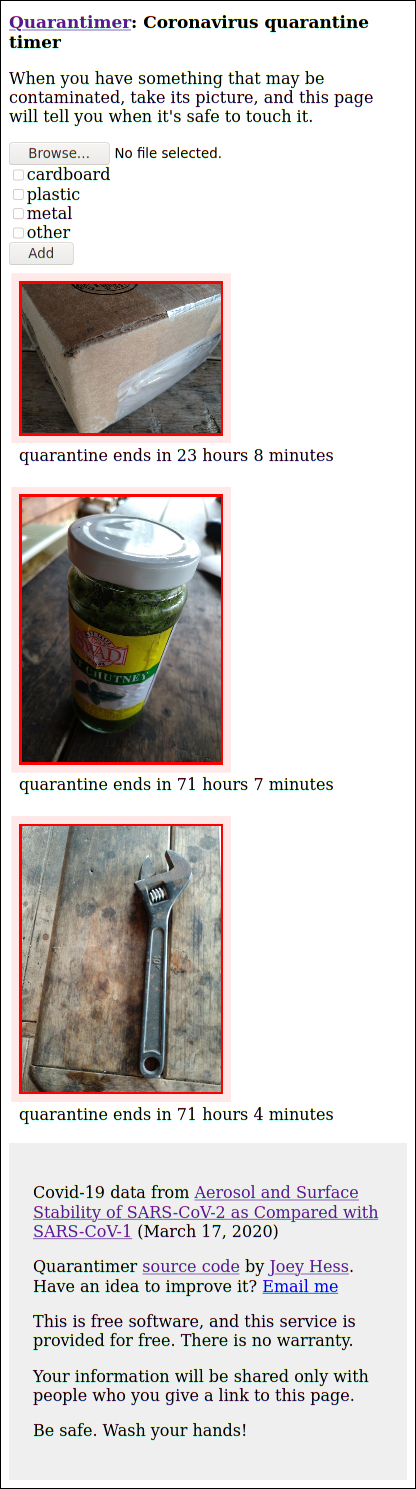
I am trying to avoid bringing coronovirus into my house on anything, and I also don't want to sterilize a lot of stuff. (Tedious and easy to make a mistake.) Currently it seems that the best approach is to leave stuff to sit undisturbed someplace safe for long enough for the virus to degrade away. Following that policy, I've quickly ended up with a porch full of stuff in different stages of quarantine, and I am quickly losing track of how long things have been in quarantine. If you have the same problem, here is a solution: https://quarantimer.app/ Open it on your mobile device, and you can take photos of each thing, select the kind of surfaces it has, and it will track the quarantine time for you. You can share the link to other devices or other people to collaborate. I anticipate the javascript and css will improve, but it's good enough for now. I will provide this website until the crisis is over. Of course, it's free software and you can also host your own. If this seems useful, please tell your friends and family about it. Be well!
This is made possible by my supporters on Patreon, particularly Jake Vosloo.

Gunnar Wolf: Made in what?

Say What? Just bought a 5-pack of 64GB USB keys. Am about to test them to ensure their actual capacity. And the label is Actually true! For basically anything we are likely to encounter, specially in electronics. But still, it demands a photo before opening. How come I ve never come across anything like this before? :-] update Of course, just opening the package yielded this much more traditional (and much more permanent) piece of information:

22 March 2020

Enrico Zini: Notable people

Lotte Reiniger. The Unsung Heroine of Early Animation
history people wikipedia
Lotte Reiniger pioneered early animation, yet her name remains largely unknown. We pay homage to her life and work, and reflect on why she never received the recognition she deserves.
Stephen Wolfram shares what he learned in researching Ada Lovelace's life, writings about the Analytical Engine, and computation of Bernoulli numbers.
Elizabeth Cochran Seaman[1] (May 5, 1864[2] January 27, 1922), better known by her pen name Nellie Bly, was an American journalist who was widely known for her record-breaking trip around the world in 72 days, in emulation of Jules Verne's fictional character Phileas Fogg, and an expos in which she worked undercover to report on a mental institution from within.[3] She was a pioneer in her field, and launched a new kind of investigative journalism.[4] Bly was also a writer, inventor, and industrialist.
Delia Ann Derbyshire (5 May 1937 3 July 2001)[1] was an English musician and composer of electronic music.[2] She carried out pioneering work with the BBC Radiophonic Workshop during the 1960s, including her electronic arrangement of the theme music to the British science-fiction television series Doctor Who.[3][4] She has been referred to as "the unsung heroine of British electronic music,"[3] having influenced musicians including Aphex Twin, the Chemical Brothers and Paul Hartnoll of Orbital.[5]
Charity Adams Earley (5 December 1918 13 January 2002) was the first African-American woman to be an officer in the Women's Army Auxiliary Corps (later WACS) and was the commanding officer of the first battalion of African-American women to serve overseas during World War II. Adams was the highest ranking African-American woman in the army by the completion of the war.

Sylvestre Ledru: Some clang rebuild results (8.0.1, 9.0.1 & 10rc2)

As part of the LLVM release cycle, I am continuing rebuilding the Debian archive with clang instead of gcc to evaluate potential regressions. Processed results are available on the website: https://clang.debian.net/status.php - Now includes some fancy graphs to show the evolution
Raw logs are published on github: https://github.com/opencollab/clang.debian.net/tree/master/logs Since my last blog post on the subject (August 2017), Clang is more and more present in the tech ecosystem. It is now the compiler used to build Firefox and Chrome upstream binaries on all the supported architectures/operating systems. More architectures are supported, it has a new linker (lld), a new hybrid IR (MLIR), a lot of checkers in clang-tidy, cross-language linking with Rust, etc.

Results
Now, about Debian results, we rebuilt using 8.0.1, 9.0.1 and 10.0rc2. Results are pretty similar to what we had with previous versions: between 4 to 5% of packages are failing when gcc is replaced by clang.
Some clang rebuild results (8.0.1, 9.0.1 & 10rc2)

Even if most of the software are still using gcc as compiler, we can see that clang has a positive effect on code quality. With many different kinds of errors and warnings found clang over the years, we noticed a steady decline of the number of errors. For example, the number of incorrect C/C++ main declarations has been decreasing years after years:
Some clang rebuild results (8.0.1, 9.0.1 & 10rc2)

Errors found
The biggest offender is still the qmake changes which doesn't allow the used workaround (replacing /usr/bin/gcc by /usr/bin/clang) - about 250 errors. Most of these packages would probably compile fine with clang. More on the Qt bug tracker. The workaround proposed in the bug isn't applicable for us as we use the dropped-in replacement of the
The second error is still some differences in symbol generation. Unlike gcc, it seems that clang doesn't generate some symbols (or adds some). As a bunch of Debian packages are checking the list of symbols in the library (for ABI management), the build fails on purpose. For example, with libcec, the symbol _ZN10P8PLATFORM14CConditionImplD1Ev@Base 3.1.0 isn't generated anymore. I am not expecting this to be a big deal: the generated libraries probably works most of the time. More on C++ symbol management in Debian.

Current status
As previously said in a blog post, I don't think there is a strong intensive to go away from gcc for most of the Linux distributions. The big reason for BSD was the license (even if the move to the Apache 2 license wasn't received positively by some of them).
While the LLVM/clang ecosystem clearly won the tooling battle, as a C/C++ compiler, gcc is still an excellent compiler which supports more architecture and more languages.
In term of new warnings and checks, as the clang community moved the efforts in clang-tidy (which requires more complex tooling), out of the box, gcc provides a better experience (as example, see the Firefox meta bug to build with -Werror with the default warnings using gcc 9, gcc 10 and clang trunk for example).

Next steps
I see some potential next steps to decrease the number of failure:
  • Workaround the Qt/Qmake issue
  • Fix the objective-c header include issues (echo "#include <objc/objc.h>" > foo.m && clang -c foo.m is currently failing)
  • Identify why clang generates more/less symbols that gcc in the library and try to fix that
  • Rebuild the archive with clang-7 - Seems that I have some data problem

Many thanks to Lucas Nussbaum for the rebuilds.

Sylvestre Ledru: Some clang rebuild results (8.0.1, 9.0.1 & 10rc2)

As part of the LLVM release cycle, I am continuing rebuilding the Debian archive with clang instead of gcc to evaluate potential regressions. Processed results are available on the website: https://clang.debian.net/status.php - Now includes some fancy graphs to show the evolution
Raw logs are published on github: https://github.com/opencollab/clang.debian.net/tree/master/logs Since my last blog post on the subject (August 2017), Clang is more and more present in the tech ecosystem. It is now the compiler used to build Firefox and Chrome upstream binaries on all the supported architectures/operating systems. More architectures are supported, it has a new linker (lld), a new hybrid IR (MLIR), a lot of checkers in clang-tidy, cross-language linking with Rust, etc.

Results
Now, about Debian results, we rebuilt using 8.0.1, 9.0.1 and 10.0rc2. Results are pretty similar to what we had with previous versions: between 4 to 5% of packages are failing when gcc is replaced by clang.
Some clang rebuild results (8.0.1, 9.0.1 &amp; 10rc2)

Even if most of the software are still using gcc as compiler, we can see that clang has a positive effect on code quality. With many different kinds of errors and warnings found clang over the years, we noticed a steady decline of the number of errors. For example, the number of incorrect C/C++ main declarations has been decreasing years after years:
Some clang rebuild results (8.0.1, 9.0.1 &amp; 10rc2)

Errors found
The biggest offender is still the qmake changes which doesn't allow the used workaround (replacing /usr/bin/gcc by /usr/bin/clang) - about 250 errors. Most of these packages would probably compile fine with clang. More on the Qt bug tracker. The workaround proposed in the bug isn't applicable for us as we use the dropped-in replacement of the compiler.
The second error is still some differences in symbol generation. Unlike gcc, it seems that clang doesn't generate some symbols (or adds some). As a bunch of Debian packages are checking the list of symbols in the library (for ABI management), the build fails on purpose. For example, with libcec, the symbol _ZN10P8PLATFORM14CConditionImplD1Ev@Base 3.1.0 isn't generated anymore. I am not expecting this to be a big deal: the generated libraries probably works most of the time. More on C++ symbol management in Debian.
I reported this bug upstream a while back: https://bugs.llvm.org/show_bug.cgi?id=30441

Current status
As previously said in a blog post, I don't think there is a strong intensive to go away from gcc for most of the Linux distributions. The big reason for BSD was the license (even if the move to the Apache 2 license wasn't received positively by some of them).
While the LLVM/clang ecosystem clearly won the tooling battle, as a C/C++ compiler, gcc is still an excellent compiler which supports more architecture and more languages.
In term of new warnings and checks, as the clang community moved the efforts in clang-tidy (which requires more complex tooling), out of the box, gcc provides a better experience (as example, see the Firefox meta bug to build with -Werror with the default warnings using gcc 9, gcc 10 and clang trunk for example).

Next steps
I see some potential next steps to decrease the number of failure:
  • Workaround the Qt/Qmake issue
  • Fix the objective-c header include issues (echo "#include <objc/objc.h>" > foo.m && clang -c foo.m is currently failing)
  • Identify why clang generates more/less symbols that gcc in the library and try to fix that
  • Rebuild the archive with clang-7 - Seems that I have some data problem

Many thanks to Lucas Nussbaum for the rebuilds.

Next.

Previous.