Search Results: "pm"

10 June 2014

Steve Kemp: I did get a job

In my previous blog-post I mentioned, briefly, that I'd posted a couple of adverts on Reddit looking for work. To give more detail I did three things: The advertisement was set to be shown in /r/edinburgh (where I live), and /r/sysadmin (where I thought some people might look if they were struggling for help). The advertising on Reddit was painless to setup, and the traffic stats were interesting, but even though this worked out well I'm a little loathe to repeat the process - since the "non-sterling transaction fee" from my bank effectively doubled my budget. I received a few (private) emails and comments, along with the expected grammar corrections. The end result was that I received contact from an American company founder who seemed interested. He allowed me to write some code to solve a fun problem, appeared to enjoy the code I sent (Ruby code for dealing with (exim) email spam, that's as specific as I will be). The end result was a three month contract, which we obviously hope will lead to more permanent work. Anyway I thought this was an atypical route to find a work, and was about a million times nicer than working with recruiters, so .. consider this documentation! In other news it is now 10pm and I need to go to the gym and pub, in that order.

8 June 2014

Paul Tagliamonte: adventures in android

I ve been learning about android development over the last few weeks, and I think I m slowly getting the hang of best practices. It s a bit tough, there s a lot of stuff that s not super Java-idomatic that s become Android-idiomatic, so getting over that stuff has been interesting. I ve been finding that Android tends to re-implement most things in a similar enough way, but always with some small tweak that feels kinda funny. It s working well enough, and I m hoping that I can clean up a few android libraries to deal with some of the OpenGov datasets I m interested in. If anyone has any tips on proper handling of what to make a fragment, and what activities should look like, I d really love posts about that. It seems like sometimes I have a 1-to-1 mapping of Fragments to Activity, but I want to keep it a fragment for large devices. Anyway, best practices welcome.

6 June 2014

Ian Donnelly: Week 3: First Merge Implementation

This week went much better. I figured out how to properly implement over an Elektra Keyset and was able to write my first implementation of the Merge function. Right now I need to move on to testing my implementation and fixing the bugs. Already I am aware of a change that will need to be made. I am going to need to use full key names for lookup instead of a cascading lookup like I have now. I plan to use the full name for the root of the keyset in conjunction with the keys full names to change the names to look in the right place for each keyset. Additionally I had a video call with Markus and Felix today and I have a clear plan for what the next two weeks should look like. I really feel like I am getting into the swing of things and better understanding Elektra as well as the development process. So for next week I plan to better test the merge implementation and fix any bugs that crop up. Additionally I plan to write some automated tests for the merge function to make sure it is running correctly. Additionally I am going to work to understand Debian packaging. Also I am going to look at Samba and understand when it checks the configuration files when upgrading the package to see where the merge tool would be used. I want to get a prototype of a package upgrade running the kdb merge tool during an upgrade instead of prompting the user to manually merge the config files. I also plan to spend some extra hours looking at the latest version on Elektra and trying to fix errors with the debian package. I am going to package a version with the augeas_plugin. Additionally I am going to work on fixing some of the lintian errors that are occurring. In other words, it is going to be a very busy week. For reference, here is the proper way to iterate through a keyset. KeySet ks;
Key key;
ks.rewind(); //This is the line I was forgetting. It is necessary to call this function to point the KeySet's internal cursor to the beginning of the KeySet.
while(key=ks.next())
//This will iterate through the KeySet until key is no longer valid (the end of the KeySet).
Anyway, I will update you all next week. Until Then,
Ian

Gunnar Wolf: What defines an identity?

I must echo John Sullivan's post: GPG keysigning and government identification. John states some very important reasons for people everywhere to verify the identities of those parties they sign GPG keys with in a meaningful way, and that means, not just trusting government-issued IDs. As he says, It's not the Web of Amateur ID Checking. And I'll take the opportunity to expand, based on what some of us saw in Debian, on what this means. I know most people (even most people involved in Free Software development not everybody needs to join a globally-distributed, thousand-people-strong project such as Debian) are not that much into GPG, trust keyrings, or understand the value of a strong set of cross-signatures. I know many people have never been part of a key-signing party. I have been to several. And it was a very interesting experience. Fun, at the beginning at least, but quite tiring at the end. I was part of what could very well constitute the largest KSP ever in DebConf5 (Finland, 2005). Quite awe-inspiring We were over 200 people, all lined up with a printed list on one hand, our passport (or ID card for EU citizens) in the other. Actwally, we stood face to face, in a ribbon-like ring. And, after the basic explanation was given, it was time to check ID documents. And so it began. The rationale of this ring is that every person who signed up for the KSP would verify each of the others' identities. Were anything fishy to happen, somebody would surely raise a voice of alert. Of course, the interaction between every two people had to be quick More like a game than like a real check. "Hi, I'm #142 on the list. I checked, my ID is OK and my fingerprint is OK." "OK, I'm #35, I also printed the document and checked both my ID and my fingerprint are OK." The passport changes hands, the person in front of me takes the unique opportunity to look at a Mexican passport while I look at a Somewhere-y one. And all is fine and dandy. The first interactions do include some chatter while we grab up speed, so maybe a minute is spent Later on, we all get a bit tired, and things speed up a bit. But anyway, we were close to 200 people That means we surely spent over 120 minutes (2 full hours) checking ID documents. Of course, not all of the time under ideal lighting conditions. After two hours, nobody was checking anything anymore. But yes, as a group where we trust each other more than most social groups I have ever met, we did trust on others raising the alarm were anything fishy to happen. And we all finished happy and got home with a bucketload of signatures on. Yay! One year later, DebConf happened in Mexico. My friend Martin Krafft tested the system, perhaps cheerful and playful in his intent but the flaw in key signing parties such as the one I described he unveiled was huge: People join the KSP just because it's a social ritual, without putting any thought or judgement in it. And, by doing so, we ended up dilluting instead of strengthening our web of trust. Martin identified himself using an official-looking ID. According to his recount of the facts, he did start presenting a German ID and later switched to this other document. We could say it was a real ID from a fake country, or that it was a fake ID. It is up to each person to judge. But anyway, Martin brought his Transnational Republic ID document, and many tens of people agreed to sign his key based on it Or rather, based on it plus his outgoing, friendly personality. I did, at least, know perfectly well who he was, after knowing him for three years already. Many among us also did. Until he reached a very dilligent person, Manoj, that got disgusted by this experiment and loudly denounced it. Right, Manoj is known to have strong views, and using fake IDs is (or, at least, was) outside his definition of fair play. Some time after DebConf, a huge thread erupted questioning Martin's actions, as well as questioning what do we trust when we sign an identity document (a GPG key). So... We continued having traditional key signing parties for a couple of years, although more carefully and with more buzz regarding these issues. Until we finally decided to switch the protocol to a better one: One that ensures we do get some more talk and inter-personal recognition. We don't need everybody to cross-sign with everyone else A better trust comes from people chatting with each other and being able to actually pin-point who a person is, what do they do. And yes, at KSPs most people still require ID documents in order to cross-sign. Now... What do I think about this? First of all, if we have not ever talked for at least enough time for me to recognize you, don't be surprised: I won't sign your key or request you to sign mine (and note, I have quite a bad memory when it comes to faces and names). If it's the first conference (or social ocassion) we come together, I will most likely not look for key exchanges either. My personal way of verifying identities is by knowing the other person. So, no, I won't trust a government-issued ID. I know I will be signing some people based on something other than their name, but hey I know many people already who live pseudonymously, and if they choose for whatever reason to forgo their original name, their original name should not mean anything to me either. I know them by their pseudonym, and based on that pseudonym I will sign their identities. But... *sigh*, this post turned out quite long, and I'm not yet getting anywhere ;-) But what this means in the end is: We must stop and think what do we mean when we exchange signatures. We are not validating a person's worth. We are not validating that a government believes who they claim to be. We are validating we trust them to be identified with the (name,mail,affiliation) they are presenting us. And yes, our signature is much more than just a social rite It is a binding document. I don't know if a GPG signature is legally binding anywhere (I'm tempted to believe it is, as most jurisdictions do accept digital signatures, and the procedure is mathematically sound and criptographically strong), but it does have a high value for our project, and for many other projects in the Free Software world. So, wrapping up, I will also invite (just like John did) you to read the E-mail self-defense guide, published by the FSF in honor of today's Reset The Net effort.

5 June 2014

Johannes Schauer: botch updates

My last update about ongoing development of botch, the bootstrap/build ordering tool chain, was four months ago and about several incremental updates. This post will be of similar nature. The most interesting news is probably the additional data that bootstrap.debian.net now provides. This is listed in the next section. All subsequent sections then list the changes under the hood that made the additions to bootstrap.debian.net possible.

bootstrap.debian.net The bootstrap.debian.net service used to have botch as a git submodule but now runs botch from its Debian package. This at least proves that the botch Debian package is mature enough to do useful stuff with it. In addition to the bootstrapping results by architecture, bootstrap.debian.net now also hosts the following additional services: Further improvements concern how dependency cycles are now presented in the html overviews. While before, vertices in a cycle where separated by commas as if they were simple package lists, vertices are now connected by unicode arrows. Dashed arrows indicate build dependencies while solid arrows indicate builds-from relationships. For what it's worth, installation set vertices now contain their installation set in their title attribute.

Debian package Botch has long depended on features of an unreleased version of dose3 which in turn depended on an unrelease version of libcudf. Both projects have recently made new releases so that I was now able to drop the dose3 git submodule and rely on the host system's dose3 version instead. This also made it possible to create a Debian package of botch which currently sits at Debian mentors. Writing the package also finally made me create a usable install target in the Makefile as well as adding stubs for the manpages of the 44 applications that botch currently ships. The actual content of these manpages still has to be written. The only documentation botch currently ships in the botch-doc package is an offline version of the wiki on gitorious. The new page ExamplesGraphs even includes pictures.

Cross By default, botch analyzes the native bootstrapping phase. That is, assume that the initial set of Essential:yes and build-essential packages magically exists and find out how to bootstrap the rest from there through native compilation. But part of the bootstrapping problem is also to create the set of Essential:yes and build-essential packages from nothing via cross compilation. Botch is unable to analyze the cross phase because too many packages cannot satisfy their crossbuild dependencies due to multiarch conflicts. This problem is only about the dependency metadata and not about whether a given source package actually crosscompiles fine in practice. Helmut Grohne has done great work with rebootstrap which is regularly run by jenkins.debian.net. He convinced me that we need an overview of what packages are blocking the analysis of the cross case and that it was useful to have a crossbuild order even if that was a fake order just to have a rough overview of the current situation in Debian Sid. I wrote a couple of scripts which would run dose-builddebcheck on a repository, analyze which packages fail to satisfy their crossbuild dependencies and why, fix those cases by adjusting package metadata accordingly and repeat until all relevant source packages satisfy their crossbuild dependencies. The result of this can then be used to identify the packages that need to be modified as well as to generate a crossbuild order. The fixes to the metadata are done in an automatic fashion and do not necessarily reflect the real fix that would solve the problem. Nevertheless, I ended up agreeing that it is better to have a slightly wrong overview than no overview at all.

Minimizing the dependency graph size Installation sets in the dependency graph are calculated independent from each other. If two binary packages provide A, then dependencies on A in different installation sets might choose different binary packages as providers of A. The same holds for disjunctive dependencies. If a package depends on A C and another package depends on C A then there is no coordination to choose C so to minimize the overall amount of vertices in the graph. I implemented two methods to minimize the impact of cases where the dependency solver has multiple options to satisfy a dependency through Provides and dependency disjunctions. The first method is inspired by Helmut Grohne. An algorithm goes through all disjunctive binary dependencies and removes all virtual packages, leaving only real packages. Of the remaining real packages, the first one is selected. For build dependencies, the algorithm drops all but the first package in every disjunction. This is also what sbuild does. Unfortunately this solution produces an unsatisfiable dependency situation in most cases. This is because oftentimes it is necessary to select the virtual disjunctive dependency because of a conflict relationship introduced by another package. The second method involves aspcud, a cudf solver which can optimize a solution by a criteria. This solution is based on an idea by Pietro Abate who implemented the basis for this idea back in 2012. In contrast to a usual cudf problem, binary packages now also depend on the source packages they build from. If we now ask aspcud to find an installation set for one of the base source packages (I chose src:build-essential) then it will return an installation set that includes source packages. As an optimization criteria the number of source packages in the installation set is minimized. This solution would be flawless if there were no conflicts between binary packages. Due to conflicts not all binary packages that must be coinstallable for this strategy to work can be coinstalled. The quick and dirty solution is to remove all conflicts before passing the cudf universe to aspcud. But this also means that the solution does sometimes not work in practice.

Test cases Botch now finally has a test target in its Makefile. The test target tests two code paths of the native.sh script and the cross.sh script. Running these two scripts covers testing most parts of botch. Given that I did lots of refactoring in the past weeks, the test cases greatly helped to assure that I didnt break anything in the process. I also added autopkgtests to the Debian packaging which test the same things as the test target but naturally run the installed version of botch instead. The autopkgtests were a great help in weeding out some lasts bugs which made botch depend on being executed from its source directory.

Python 3 Reading the suggestions in the Debian python policy I evaluated the possibility to use Python 3 for the Python scripts in botch. While I was at it I added transparent decompression for gzip, bz2 and xz based on the file magic, replaced python-apt with python-debian because of bug#748922 and added argparse argument parsing to all scripts. Unfortunately I had to find out that Python 3 support does not yet seem to be possible for botch for the following reasons:
  • no soap module for Python 3 in Debian (needed for bts access)
  • hash randomization is turned on by default in Python 3 and therefore the graph output of networkx is not deterministic anymore (bug#749710)
Thus I settled for changing the code such that it would be compatible with Python 2 as well as with Python 3. Because of the changed string handling and sys.stdout properties in Python 3 this proved to be tricky. On the other hand this showed me bugs in my code where I was wrongly relying on deterministic dictionary key traversal.

4 June 2014

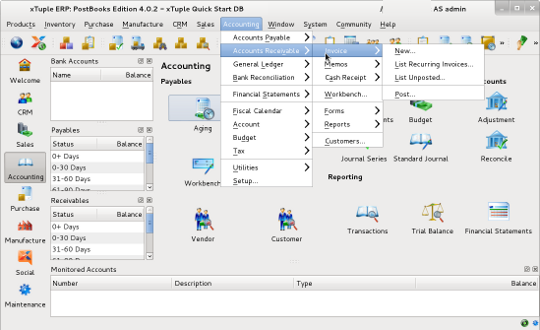
Daniel Pocock: Trialing the xTuple/PostBooks next generation web UI

For some time I've been using PostBooks to keep track of finances. The traditional PostBooks system has a powerful Qt GUI. The xTuple team have been hard at work creating a shiny new web-based user interface. The traditional UI has no dedicated server - all users communicate directly with the PostgreSQL database where stored procedures and triggers ensure the correct logic is applied. The new model provides an xTuple application server that can handle requests from web users and potentially other third-party apps too. Who is it for? Some people may feel that the web UI is intended to appeal to mobile users. While it is useful for mobile and tablet devices, this is not strictly the aim, John has discussed this in a blog. One benefit of the web UI is that accountants and book-keepers do not need to have a copy of every exact PostBooks version that every client is using. Given that many people only need their accountant to look at their books for just a few hours at the end of each year, the ease of access with a web UI will make a big difference. Installing it quickly The xTuple Git repository provides a script to install the whole server quickly. Initially it just supported a single Ubuntu release, I just contributed some tweaks to generalize it for Debian wheezy and potentially other releases. It doesn't appear too difficult to generalize it further for Fedora or RHEL users. To get going, I recommend trying it in a fresh virtual machine, either in a server environment or desktop VirtualBox solution. The installation script will install various packages on the machine and mess about with the PostgreSQL setup so you will not want to run the automated setup script on any machine where you have existing databases. Once the virtual machine is setup, make sure sudo is installed and configured:
# apt-get install sudo
# visudo
and then run the install as your normal user:
git clone --recursive git://github.com/xtuple/xtuple.git
cd xtuple
git remote add XTUPLE git://github.com/xtuple/xtuple.git
git fetch XTUPLE
git checkout git describe --abbrev=0
chmod a+x scripts/install_xtuple.sh
scripts/install_xtuple.sh
If all goes well, 5-10 minutes later it is ready to run:
cd node-datasource
node main.js
The port numbers will appear on the screen and you can connect with a web browser. Trying it out Despite my comments above to the effect that this is not primarily aimed at mobile, the first and second device I tested with were both mobile devices, Samsung Galaxy S3 and a Samsung Galaxy Note 3. I feel the Note is far better for this type of application, primarily due to screen size and the fact that most of the forms in the application have fields that launch popup menus. It appears to work in both Chrome and Firefox on these devices. One handy feature is that the mobile device can dial numbers directly from the CRM address book, this is facilitated with the tel URI. My impression is that this is still a product that is in the final stages of development, although some people will be able to use it almost immediately. One significant thing to note is that the database schema is very stable due to the long history of the traditional xTuple/PostBooks products.

3 June 2014

Sune Vuorela: Bringing KDE forward

The almost-yearly large KDE-sprint in Randa, Switzerland is doing a fundraiser to get this year s event running. See http://www.kde.org/fundraisers/randameetings2014/ This year, it is besides the recurring multimedia topics, a lot about improving the new KDE Frameworks, the related documentation and the development experience with IDE s and such. It is also a good way to come full circle, since it was back in 2011 when I was at the Randa Meetings that the KDE Frameworks initiative was started. So once again: http://www.kde.org/fundraisers/randameetings2014/

Vasudev Kamath: Using WSME with Flask microframework

After reading Julien Danjou's I found out WSME (Web Service Made Easy) a Python framework which allows us to easily create Web Services in Python. For SILPA we needed a REST like interface and I thought of giving it try as WSME readily advertised the Flask integration, and this post was born when I read the documentation for Flask integration. First of all Flask is a nice framework which will right way allow development of REST api for simple purposes, but my requirement was bit complicated where I had to expose function in a separate python modules through SILPA. I think detailed requirement can be part of another post, so let me explain how to use WSME with Flask app. WSME integration with Flask is done via decorator function wsmeext.flask.signature which expects you to provide it with signature of function to expose. And here is its documentation, basically signature of signature function is
wsmeext.flask.signature(return_type, *arg_types, **options)
Yeah thats all docs have sadly. So basically exposing is the only thing WSME handles for us here, routing and other stuffs need to be done by Flask itself. So lets consider a example, simple function to add as shown below.
def add(a, b):
    return a + b
For providing REST like service, all you need below code.
from flask import Flask
from wsmeext.flask import signature
app = Flask(__name__)
@app.route('/add')
@signature(int, int, int)
def add(a, b):
    return a + b
if __name__ == '__main__':
       app.run()
So first argument to signature is return type of function and rest arguments are the argument to function to be exposed. Now you can access the newly exposed service by visiting http://localhost:5000/add but don't forget to pass the arguments either via query string or through post. You can restrict methods of access via Flask's route. So what's the big deal of not having docs right?.. Well fun part began when we use bit more complex return type like dictionaries or lists . Below is modified code I'm using to demonstrate problem I faced during using dict as return type.
from flask import Flask
from wsmeext.flask import signature
app = Flask(__name__)
@app.route('/add')
@signature(dict, int, int)
def add(a, b):
    return  "result": a + b 
if __name__ == '__main__':
    app.run()
Basically I'm returning a dictionary containing result now, for demonstration purpose. When I run the application boom python barked at me with following message.
Traceback (most recent call last):
File "wsme_dummy.py", line 7, in <module>
 @signature(dict, int, int)
File "c:\Users\invakam2\.virtualenvs\wsmetest\lib\site-packages\wsmeext\flask.py", line 48, in decorator
 funcdef.resolve_types(wsme.types.registry)
File "c:\Users\invakam2\.virtualenvs\wsmetest\lib\site-packages\wsme\api.py", line 109, in resolve_types
 self.return_type = registry.resolve_type(self.return_type)
File "c:\Users\invakam2\.virtualenvs\wsmetest\lib\site-packages\wsme\types.py", line 739, in resolve_type
 type_ = self.register(type_)
File "c:\Users\invakam2\.virtualenvs\wsmetest\lib\site-packages\wsme\types.py", line 668, in register
 class_._wsme_attributes = None
TypeError: can't set attributes of built-in/extension type 'dict'
After going through code from files involved in above traces this is what I found
  1. wsmeext.flask.signature inturn uses wsme.signature which is just alias of wsme.api.signature.
  2. Link in documentation in sentence See @signature for parameter documentation is broken and should actually link to wsme.signature in docs.
  3. wsme.signature actually calls resolve_type to check on types of return and arguments. This function checks if types are instance of dict or list in such cases it creates instances of wsme.type.DictType and wsme.type.ArrayType respectively with values from the argument.
  4. When I just passed built-in type dict the control went to else part which just passed the type to wsme.type.Register.registry function which tries to set the attribute _wsme_attribute which actually raises TypeError as we can't set attribute for built-in types.
So by inspecting code of wsme.type.Registry.resolve_type and wsme.type.Registry.register its clear that what signature expects when arguments or return type is dictionary/list is instance of dictionary/list with type of value in it. May be sentence is bit vague but I'm not sure how to put it more clearly, as an example in our case add function returns dictioanry with key as string and value as int, so return type argument for signature will be str: int . Similarly if you return array with int values it will be [int]. With above understanding our add function now looks like below.
@signature( str: int , int, int)
def add(a, b):
   return  'result': a + b 
and now code worked just fine!. What I couldn't figure out here is there is no way to have tuple as return value or argument, but I guess that is not big deal. So immidiate task for me after finding this is fix the link in documentation to point to wsme.signature and probably put some note some where in documentation about above finding.

2 June 2014

B lint R czey: I Can Hear Music again (thanks to forked-daapd/Debian)

When I started looking for a lightweight solution of serving a music library over LAN I did not expect so many complications. I expected it not to be a unique need to have something running on a SheevaPlug straight from the Debian repository. Apparently it kind of was. Debian used to have mt-daapd (popcon: 165), but now it is available from oldstable only and upstream is dead. There is tangerine (popcon: 98) with its Mono dependencies and GUI which seemed to me overkill and more like a demo of a networked application written in Mono than a music library server. The most promising candidate was forked-daapd (popcon: 220) but it was far from being a true winner. First, it had a series of dead upstreams. At the beginning it was forked from mt-daapd (hence the name) by Julien Blache who also served as the prior Debian maintainer. Then the code base was forked and converted to use Grand Central Dispatch. Then the GCD fork died off slowly as well a few years ago. When I found the package it had been unmaintained for a few years and was based on the GCD branch which prevented building it on many architectures and the server itself was crashing or quitting occasionally. Luckily there still existed a fork thanks to Espen J rgensen which was well maintained and could serve as a way out but examining it closely it turned out that it had switched to libevent from GCD but to a version (1.4) which is present only in oldstable! And some say Debian s software versions are ancient ;-). Moreover it was not simply libevent 1.4-based, but it included some heavily patched parts of it. Espen also liked the idea of packaging his version in Debian and we extracted the patches to libevent and slowly got them accepted to libevent s master. Forked-daapd s master works best with libevent 2.1.4-alpha, but thanks to Espen the development branch now also works with libevent 2.0.x giving up some performance and a little feature. This was a long journey, but finally Espen s forked-daapd became ready for being used as a new upstream of the Debian package thus please welcome 20.0+git20140530+gc740e6e-1, the first version of forked-daapd building on all architectures for a very long time and a prime candidate for being the music library server in Jessie (and wheezy-backports, soon)! Testing, bug reports are always welcome! From the package description:
 forked-daapd is an iTunes-compatible media server, originally intended
 as a rewrite of Firefly Media Server (also known as mt-daapd).
 It supports a wide range of audio formats, can stream video to iTunes,
 FrontRow and other compatible clients, has support for Apple's Remote
 iPhone/iPod application and can stream music to AirTunes devices like
 the AirPort Express.
 It also features RSP support for Roku's SoundBridge devices.
 Built-in, on-the-fly decoding support enables serving popular free music
 formats like FLAC, Ogg Vorbis or Musepack to those clients that do not
 otherwise support them.

Russ Allbery: Review: Debt

Review: Debt, by David Graeber
Publisher: Melville House
Copyright: 2011, 2012
Printing: October 2012
ISBN: 1-61219-129-0
Format: Trade paperback
Pages: 453
You probably remember this story from introductory economics. Originally, people exchanged things through barter. I needed grain but had a cow. You had a farm but needed milk. I gave you milk for your grain. But this was tedious and awkward, and required finding the right combination of people who needed something the other person had on hand. Then, people invented money: small objects with an agreed-upon value that you could keep and use later when you needed something else. In other words, both a medium of exchange and a store of value. And that improved matters for a long time, although war-torn societies or societies that collapsed (the supposed "Dark Ages" often raises its head) would sometimes "revert to barter" for some period of time until things were stable enough for currency to reappear. Following that story was usually some story about the emergence of money based on credit: goldsmith shops that started a side business in storing other people's coins and giving them receipts, leading to the receipts trading like the coins since the shops were trustworthy, and from there into the Bank of England and eventually the fractional reserve banking system, fiat money, and all the modern machinery of finance. All of this was dated from the early Enlightenment and the development of modern finance in Europe. It's a very neat story, and it makes a great deal of intuitive sense. That barter system does feel like what you'd have to do without money, but one can immediately see how obnoxious and limiting it would be. These stories play into our intuitive sense of history: people started with emergent properties of the physical world (different people have different goods and different skills and want to exchange them) and then develop layers of abstraction on top of them, eventually leading to the sophistication of modern societies. However, David Graeber is not an economist. He's an anthropologist: the profession devoted to understanding how people actually do things rather than how we've reconstructed our history based on our modern perspective. And, as he points out, engagingly and comprehensively, in chapter two of Debt, there is no evidence that this story about economic history has anything whatsoever to do with reality. And quite a bit of evidence that it does not. As best as we've been able to determine, not only is there no society in the world that deals with routine, day-to-day needs like grain and milk through barter, there never has been such a society in human history. Instead, history and anthropology shows that credit is, in a sense, older than currency: the earliest recorded economic transactions were built on a rich system of credit, but in the form of purchases from shopkeepers on credit, or credit clearinghouses through the local government or temple. Those credit records were often denominated in some standardized commodity so many cattle or bushels of grain that could create the impression that the economy worked on barter. But the anthropological evidence indicates that this was more an accounting technique than a practical currency. People rarely brought the named commodity to the temple to pay off some debt. Rather, there was an agreed conversion from various other goods to that standardized commodity, and its primary purpose was consistent bookkeeping. Specie minted coins appear to come later, and wax and wane throughout history depending on local circumstance. For example, Europe did not "revert to barter" after the collapse of the Roman Empire, but the inhabitants did stop using specie and returned to a system of credit and record-keeping... records that continued to be denominated in Roman currency, even though few people still used the actual coins. That's one fascinating observation with which Graeber begins this book. The other is the question of why we have such a strong social and moral belief that people must pay their debts. This moral belief is ever-present in discussions about the 2008 financial collapse, and more broadly in discussions about the modern economy, but it's not as obvious of a belief as it might appear on the surface. After all, the banking and investment system is founded on the principle that not everyone will repay their debts, and therefore lenders receive a risk premium based on the likelihood that the debt won't be repaid. But, despite building the possibility of non-repayment into the system, debt forgiveness or intentional default is almost unthinkable and considered a huge moral problem. To this, Graeber brings the perspective of historical anthropology: human societies have struggled with the problems of debt and repayment from the beginning of recorded history, and have attempted a wide variety of solutions to those problems, including massive debt forgiveness. The jubilee described in the Bible was not novel; rather, it reflected a common practice to keep abuses of debt under control in ancient Sumer. The subtitle of Debt is The First 5,000 Years, and this book is a historical survey. But Graeber puts off the history to first lay an intellectual groundwork for our understanding of debt, and I found that preliminary discussion extremely valuable. Most memorable was the way Graeber divides human economic relationships into communism (in the old sense, not the political sense), exchange, and hierarchy. Capitalism has consumed our economic analysis to such a degree that exchange is the only economic basis that gets much discussion, but the other two are both obvious and pervasive once Graeber points them out. Human civilization could not exist without all three. And Graeber also points out one aspect of exchange-based economics that had not previously occurred to me: it's the economic relationship that one creates with strangers. Debt has the unique characteristic that it can be discharged, at which point the relationship ceases. This has far more complex and far-reaching moral and social implications than one might initially realize, and Graeber did a wonderful job opening my eyes to some of the subtleties. Debt is clearly a scholarly work, but Graeber's writing is clear and engaging. I found most of this book to be surprisingly easy reading. The hardest going was Graeber's discussion of societies that use a form of currency to arrange relationships between people (marriages, births, and deaths, primarily), but not day-to-day economic transactions. I suspect this area is closer to Graeber's areas of personal research and field work, which resulted in more technical detail. I'm still not sure I completely grasp the principles that Graeber was trying to communicate. But I was struck by the observation of alienation's role in turning a human being into a commodity, and how that links with debt's role as the economic transaction one has with strangers. Graeber covers slavery only glancingly, but makes some memorable points about the use of violence to rip someone out of their social context, and how that is necessary in human cultures before humans can be reduced to a commodity. There's a lot here, and I've only scratched the surface. I haven't mentioned, for example, the fascinatingly elegant theory that coining money and then requiring taxes be paid in the same money is a simple and highly effective way of funding armies, an explanation for specie that is largely unproven but that I find more compelling than the ones I've previously heard. Approaching debt from an anthropological instead of economic perspective is surprisingly enlightening. Debt is primarily a historical and cultural discussion rather than a set of proposed solutions, but Graeber does effectively show that debt as a moral obligation is not an unquestionable moral stance, but rather has a long history as one side of a two-sided political debate. I also came away from this book more conscious of the social implications and costs of debt-structured interactions, and wanting to push more of the language of debt out of my day-to-day dealings. Graeber is well known as one of the supporters of Occupy Wall Street, and Debt, while a well-defended academic work, certainly does advocate a position. But the academic analysis is more prominent than the advocacy, and I found his positions well-defended and well-argued. I do need to give the caveat that I don't have the anthropological background to distinguish the statements from Graeber that are well-established common knowledge in anthropology from the ones that are more controversial, and I would be a bit leery of taking this book as the final word on the topic. But it fully deserves its popularity and reputation as a thought-provoking and valuable contribution to the conversation. It's another book that I want to re-read someday to digest further, and the sort of book whose observations keep occurring to me in subsequent discussions or news stories. If you're at all interested in the way in which we construct the morality around economics and debt, I think this is a book that you should read. It's thoughtful, challenging, and surprising, and it passes my acid test for books of this sort with flying colors: after reading it, you realize that many things are more complicated, more historical, and less novel than you had originally thought. Highly recommended. Rating: 9 out of 10

1 June 2014

Antonio Terceiro: An introduction to the Debian Continuous Integration project

Debian is a big system. At the time of writing, looking at my local package list caches tells me that the unstable suite contains 21306 source packages, and 42867 binary packages on amd64. Between these 42867 binary packages, there is an unthinkable number of inter-package dependencies. For example the dependency graph of the ruby packages contains other 20-something packages. A new version of any of these packages can potentially break some functionality in the ruby package. And that dependency graph is very small. Looking at the dependency graph for, say, the rails package will make your eyes bleed. I tried it here, and GraphViz needed a PNG image with 7653 10003 pixels to draw it. It ain t pretty. Installing rails on a clean Debian system will pull in another 109 packages as part of the dependency chain. Again, as new versions of those packages are uploaded the archive, there is a probability that a backwards-incompatible change, or even a bug fix which was being worked around, might make some funcionality in rails stop working. Even if that probability is low for each package in the dependency chain, with enough packages the probability of any of them causing problems for rails is quite high. And still the rails dependency chain is not that big. libreoffice will pull in another 264 packages. gnome will pull in 1311 dependencies, and kde-full 1320 (!). With a system this big, problems will arrive, and that s a fact of life. As developers, what we can do is try to spot these problems as early as possible, and fixing them in time to make a solid release with the high quality Debian is known for. While automated testing is not the proverbial Silver Bullet of Software Engineering, it is an effective way of finding regressions. Back in 2006, Ian Jackson started the development of autopkgtest as a tool to test Debian packages in their installed form (as opposed to testing packages using their source tree). In 2011, the autopkgtest test suite format was proposed as a standard for the Debian project, in what we now know as the DEP-8 specification. Since then, some maintainers such as myself started experimenting with DEP-8 tests in their packages. There was an expectation in the air that someday, someone would run those tests for the entire archive, and that would be a precious source of QA information. Durign the holiday break last year, I decided to give it a shot. I initially called the codebase dep8. Later I renamed it to debci, since it could potentially also run other other types of test suites in the future. Since early January, ci.debian.net run an instance of debci for the Debian Project. The Debian continuous Integration will trigger tests at most 4 times a day, 3 hours after each dinstall run. It will update a local APT cache and look for packages that declare a DEP-8 test suite. Each package with a test suite will then have its test suite executed if there was any change in its dependency chain since the last test run. Existing test results are published at ci.debian.net every hour, and at the end of each batch a global status is updated. Maintainers can subscribe to a per package Atom feed to keep up with their package test results. People interested in the overall status can subscribe to a global Atom feed of events. Since the introduction of Debian CI in mid-January 2014, we have seen an amazing increase in the number of packages with test suites. We had little less than 200 packages with test suites back then, against around 350 now (early June 2014). The ratio of packages passing passing their test suite has also improved a lot, going from less than 50% to more than 75%. There is documentation available, including a FAQ for package maintainers with further information about how the system works, how to declare test suites in their packages and how to reproduce test runs locally. Also available is development information about debci itself, to those inclined to help improve the system. This is just the beginning. debci is under a good rate of development, and you can expect to see a constant flux of improvements. In special, I would like to mention a few people who are giving amazing contributions to the project:

30 May 2014

Julien Danjou: OpenStack Design Summit Juno, from a Ceilometer point of view

Last week was the OpenStack Design Summit in Atlanta, GA where we, developers, discussed and designed the new OpenStack release (Juno) coming up. I've been there mainly to discuss Ceilometer upcoming developments. The summit has been great. It was my third OpenStack design summit, and the first one not being a PTL, meaning it was a largely more relaxed summit for me! On Monday, we started by a 2.5 hours meeting with Ceilometer core developers and contributors about the Gnocchi experimental project that I've started a few weeks ago. It was a great and productive afternoon, and allowed me to introduce and cover this topic extensively, something that would not have been possible in the allocated session we had later in the week. Ceilometer had his design sessions running mainly during Wednesday. We noted a lot of things and commented during the sessions in our Etherpads instances. Here is a short summary of the sessions I've attended. Scaling the central agent I was in charge of the first session, and introduced the work that was done so far in the scaling of the central agent. Six months ago, during the Havana summit, I proposed to scale the central agent by distributing the tasks among several node, using a library to handle the group membership aspect of it. That led to the creation of the tooz library that we worked on at eNovance during the last 6 months. Now that we have this foundation available, Cyril Roelandt started to replace the Ceilometer alarming job repartition code by Taskflow and Tooz. Starting with the central agent is simpler and will be a first proof of concept to be used by the central agent then. We plan to get this merged for Juno. For the central agent, the same work needs to be done, but since it's a bit more complicated, it will be done after the alarming evaluators are converted. Test strategy The next session discussed the test strategy and how we could improve Ceilometer unit and functional testing. There is a lot in this area to be done, and this is going to be one of the main focus of the team in the upcoming weeks. Having Tempest tests run was a goal for Havana, and even if we made a lot of progress, we're still no there yet. Complex queries and per-user/project data collection This session, led by Ildik V ncsa, was about adding finer-grained configuration into the pipeline configuration to allow per-user and per-project data retrieval. This was not really controversial, though how to implement this exactly is still to be discussed, but the idea was well received. The other part of the session was about adding more in the complex queries feature provided by the v2 API. Rethinking Ceilometer as a Time-Series-as-a-Service This was my main session, the reason we met on Monday for a few hours, and one of the most promising session I hope of the week. It appears that the way Ceilometer designed its API and storage backends a long time ago is now a problem to scale the data storage. Also, the events API we introduced in the last release partially overlaps some of the functionality provided by the samples API that causes us scaling troubles. Therefore, I've started to rethink the Ceilometer API by building it as a time series read/write service, letting the audit part of our previous sample API to the event subsystem. After a few researches and experiments, I've designed a new project called Gnocchi, which provides exactly that functionality in a hopefully scalable way. Gnocchi is split in two parts: a time series API and its driver, and a resource indexing API with its own driver. Having two distinct driver sets allows it to use different technologies to store each data type in the best storage engine possible. The canonical driver for time series handling is based on Pandas and Swift. The canonical resource indexer driver is based on SQLAlchemy. The idea and project was well received and looked pretty exciting to most people. Our hope is to design a version 3 of the Ceilometer API around Gnocchi at some point during the Juno cycle, and have it ready as some sort of preview for the final release. Revisiting the Ceilometer data model This session led by Alexei Kornienko, kind of echoed the previous session, as it clearly also tried to address the Ceilometer scalability issue, but in a different way. Anyway, the SQL driver limitations have been discussed and Mehdi Abaakouk implemented some of the suggestions during the week, so we should very soon see more performances in Ceilometer with the current default storage driver. Ceilometer devops session We organized this session to get feedbacks from the devops community about deploying Ceilometer. It was very interesting, and the list of things we could improve is long, and I think will help us to drive our future efforts. SNMP inspectors This session, led by Lianhao Lu, discussed various details of the future of SNMP support in Ceilometer. Alarm and logs improvements This mixed session, led by Nejc Saje and Gordon Chung, was about possible improvements on the alarm evaluation system provided by Ceilometer, and making logging in Ceilometer more effective. Both half-sessions were interesting and led to several ideas on how to improve both systems. Conclusion Considering the current QA problems with Ceilometer, Eoghan Glynn, the new Project Technical Leader for Ceilometer, clearly indicated that this will be the main focus of the release cycle. Personally, I will be focused on working on Gnocchi, and will likely be joined by others in the next weeks. Our idea is to develop a complete solution with a high velocity in the next weeks, and then works on its integration with Ceilometer itself.

Don Armstrong: Dropbox Recursive Downloader

I'm working on some analyses for the Genetic Analysis Workshop #19, which has placed it's data on Dropbox. Unfortunately, Dropbox doesn't allow for people to download zip archives larger than 1GB, and the data was made available in an unpacked structure with more than a hundred files. Some searching indicated that no one had written a recursive downloader for Dropbox, so 30 minutes of hacking with WWW::Mechanize later, I wrote a simple recursive downloader for Dropbox. Two hours later, all of the files had downloaded.

29 May 2014

Enrico Zini: wheezy-for-industrial-development

Wheezy for industrial software development I'm helping with setting up a wheezy-based toolchain for industrial automation. The basic requirements are: live-build, C++11, Qt 5.3, and a frozen internal wheezy mirror. debmirror A good part of a day's work was lost because of #749734 and possibly #628779. Mirror rebuild is still ongoing, and fingers crossed. This is Italy, and you can't simply download 21Gb of debs just to see how it goes. C++11 Stable toolchains for C++11 now exist and have gained fast adoption. It makes sense, since given what is in C++11 it is unthinkable to start a new C++ project with the old standard nowadays. C++11 is supported by g++ 4.8+ or clang 3.3+. None of them is available on wheezy or wheezy-backports. Backports exist of g++ 4.8 only for Ubuntu 12.04, but they are uninstallable on wheezy due at least to a different libc6. I tried rebuilding g++4.8 on wheezy but quickly gave up. clang 3.3 has a build dependency on g++ 4.8. LOL. However, LLVM provides an APT repository with their most recent compiler, and it works, too. C++11 problem solved! Qt 5.3 Qt 5.3 is needed because of the range of platforms it can target. There is no wheezy backport that I can find. I cannot simply get it from Qt's Download page and install it, since we need it packaged, to build live ISOs with it. I'm attempting to backport the packages from experimental to wheezy. Here are its build dependencies: libxcb-1.10 (needed by qt5) Building this is reasonably straightforward. libxkbcommon 0.4.0 (needed by qt5) The version from jessie builds fine on wheezy, provided you remove --fail-missing from the dh_install invocation. libicu 52.1 (needed by harfbuzz) The jessie packages build on wheezy, provided that mentions of clang are deleted from source/configure.ac, since it fails to build with clang 3.5 (the one currently available for wheezy on llvm.org). libharfbuzz-dev Backporting this is a bloodbath: the Debian packages from jessie depend on a forest of gobject hipsterisms of doom, all unavailable on wheezy. I gave up. qt 5.3 qtbase-opensource-src-5.3.0+dfsg can be made to build with an embedded version of harfbuzz, with just this change:
diff -Naur a/debian/control a/debian/control
--- a/debian/control    2014-05-20 18:48:27.000000000 +0200
+++ b/debian/control    2014-05-29 17:45:31.037215786 +0200
@@ -28,7 +28,6 @@
                libgstreamer-plugins-base0.10-dev,
                libgstreamer0.10-dev,
                libgtk2.0-dev,
-               libharfbuzz-dev,
                libicu-dev,
                libjpeg-dev,
                libmysqlclient-dev,
diff -Naur a/debian/rules b/debian/rules
--- a/debian/rules  2014-05-18 01:56:37.000000000 +0200
+++ b/debian/rules  2014-05-29 17:45:25.738634371 +0200
@@ -108,7 +108,6 @@
                -plugin-sql-tds \
                -system-sqlite \
                -platform $(platform_arg) \
-               -system-harfbuzz \
                -system-zlib \
                -system-libpng \
                -system-libjpeg \
(thanks Lisandro Dami n Nicanor P rez Meyer for helping me there!) There are probably going to be further steps in the Qt5 toolchain. Actually, let's try prebuilt binaries The next day with a fresh mind we realised that it is preferable to reduce our tampering with the original wheezy to a minimum. Our current plan is to use wheezy's original Qt and Qt-using packages, and use Qt's prebuilt binaries in /opt for all our custom software. We run Qt's installer, tarred the result, and wrapped it in a Debian package like this:
$ cat debian/rules
#!/usr/bin/make -f
QT_VERSION = 5.3
%:
    dh $@
override_dh_auto_build:
    dh_auto_build
    sed -re 's/@QT_VERSION@/$(QT_VERSION)/g' debian-rules.inc.in > debian-rules.inc
override_dh_auto_install:
    dh_auto_install
    # Download and untar the prebuild Qt5 binaries
    install -d -o root -g root -m 0755 debian/our-qt5-sdk/opt/Qt
    curl http://localserver/Qt$(QT_VERSION).tar.xz   xz -d   tar -C debian/our-qt5-sdk/opt -xf -
    # Move the runtime part to our-qt5
    install -d -o root -g root -m 0755 debian/our-qt5/opt/Qt
    mv debian/our-qt5-sdk/opt/Qt/$(QT_VERSION) debian/our-qt5/opt/Qt/
    # Makes dpkg-shlibdeps work on packages built with Qt from /opt
    # Hack. Don't try this at home. Don't ever do this unless you
    # know what you are doing. This voids your warranty. If you
    # know what you are doing, you won't do this.
    find debian/our-qt5/opt/Qt/$(QT_VERSION)/gcc_64/lib -maxdepth 1 -type f -name "lib*.so*" \
          sed -re 's,^.+/(lib[^.]+)\.so.+$$,\1 5 our-qt5 (>= $(QT_VERSION)),' > debian/our-qt5.shlibs
$ cat debian-rules.inc.in
export PATH := /opt/Qt/@QT_VERSION@/gcc_64/bin:$(PATH)
export QMAKESPEC=/opt/Qt/@QT_VERSION@/gcc_64/mkspecs/linux-clang/
To build one of our packages using Qt5.3 and clang, we just add this to its debian/rules:
include /usr/share/our-qt5/debian-rules.inc
Wrap up We got the dependencies sorted. Hopefully the mirror will rebuild itself tonight and tomorrow we can resume working on our custom live system.

28 May 2014

C.J. Adams-Collier: Juniper Olive VM XML

For use with http://web.dit.upm.es/vnxwiki/index.php/Vnx-rootfsolive and http://blog.gns3.net/2009/10/olive-juniper/2/
$ cd /var/lib/libvirt/images
$ sudo qemu-img create -f qcow2 vnx_rootfs_olive.qcow2 7G
$ sudo wget ftp://ftp-archive.freebsd.org/pub/FreeBSD-Archive/old-releases/i386/ISO-IMAGES/4.11/4.11-RELEASE-i386-miniinst.iso
$ sudo brctl addbr testnet
$ sudo ip addr add 172.18.36.2/24 dev testnet
$ sudo ip link set up dev testnet
$ wget -O /tmp/olive.xml https://wp.colliertech.org/cj/wp-content/uploads/2014/05/olive.xml
$ sudo virsh define /tmp/olive.xml
$ sudo virsh start olive
/tmp/olive.xml follows:
<domain type='kvm'>
  <name>olive</name>
  <memory unit='KiB'>1048576</memory>
  <currentMemory unit='KiB'>1048576</currentMemory>
  <vcpu placement='static'>2</vcpu>
  <os>
    <type arch='x86_64' machine='pc-1.1'>hvm</type>
    <boot dev='cdrom'/>
  </os>
  <features>
    <acpi/>
    <apic/>
    <pae/>
  </features>
  <clock offset='utc'/>
  <on_poweroff>destroy</on_poweroff>
  <on_reboot>restart</on_reboot>
  <on_crash>restart</on_crash>
  <devices>
    <emulator>/usr/bin/kvm</emulator>
    <disk type='file' device='disk'>
      <driver name='qemu' type='qcow2'/>
      <source file='/var/lib/libvirt/images/vnx_rootfs_olive.qcow2'/>
      <target dev='hda' bus='ide'/>
      <address type='drive' controller='0' bus='0' target='0' unit='0'/>
    </disk>
    <disk type='file' device='cdrom'>
      <driver name='qemu' type='raw'/>
      <source file='/var/lib/libvirt/images/4.11-RELEASE-i386-miniinst.iso'/>
      <target dev='hdc' bus='ide'/>
      <readonly/>
      <address type='drive' controller='0' bus='1' target='0' unit='0'/>
    </disk>
    <controller type='usb' index='0'>
      <address type='pci' domain='0x0000' bus='0x00' slot='0x01' function='0x2'/>
    </controller>
    <controller type='ide' index='0'>
      <address type='pci' domain='0x0000' bus='0x00' slot='0x01' function='0x1'/>
    </controller>
    <controller type='sata' index='0'>
      <address type='pci' domain='0x0000' bus='0x00' slot='0x03' function='0x0'/>
    </controller>
    <interface type='bridge'>
      <mac address='52:54:00:4d:b2:c8'/>
      <source bridge='testnet'/>
      <model type='e1000'/>
      <address type='pci' domain='0x0000' bus='0x00' slot='0x06' function='0x0'/>
    </interface>
    <serial type='pty'>
      <target port='0'/>
    </serial>
    <console type='pty'>
      <target type='serial' port='0'/>
    </console>
    <input type='mouse' bus='ps2'/>
    <graphics type='vnc' port='-1' autoport='yes'/>
    <video>
      <model type='cirrus' vram='9216' heads='1'/>
      <address type='pci' domain='0x0000' bus='0x00' slot='0x02' function='0x0'/>
    </video>
    <memballoon model='virtio'>
      <address type='pci' domain='0x0000' bus='0x00' slot='0x05' function='0x0'/>
    </memballoon>
  </devices>
</domain>

Tanguy Ortolo: GNU/Linux graphic sessions: allowing computer suspend and disabling a monitor

Allowing computer suspend Major desktop environments such as Xfce or KDE have a built-in computer suspend feature, but when you use a lighter alternative, things are a bit more complicated, because basically: only root can suspend the computer. Possible solutions include: With recent updates of the related Debian packages no idea of which one exactly the latter solution may not work any more, in which case it will only return the following error:

Error org.freedesktop.UPower.GeneralError: not authorized
It appears that this error is linked to ConsoleKit, a part of all this modern *Kit gizmo pile. If you are in this case, try prefixing your session launcher with the undocumented dark magic call ck-launch-session. For instance, this is what I have in my .xsession to launch my window manager i3:
exec ck-launch-session i3
Note: I do not know what ck-launch-session does exactly, why it is needed, and I do not want to know. To me, all that WhatsitKit pile is just some opaque, under-documented as in: no man page crap, that no one but their author really understand, designed to solve theoretical problems no one really cares about like: how to allow locally connected users to use the sound card while forbidding it to remote users while creating new issues such as this one. This stuff is too complex and under-documented for me to dive into it, so if it does not work out of the box, it is just some crap that gets in my way to using my computer as I wish. Disabling a monitor In some configurations, you have two monitors and want to disable one. For instance, in addition to my LCD monitor, I have a projector which I only use for movies. According to xorg.conf's man page, it can be disabled this way:
Section "Device"
    Identifier  "Internal graphic card"
    Option      "Monitor-DVI"   "LCD Monitor"
    Option      "Monitor-VGA"   "Projector"
EndSection
Section "Monitor"
    Identifier  "LCD Monitor"
EndSection
Section "Monitor"
    Identifier  "Projector"
    Option      "Enable"    "false"
EndSection
Except that does not work, because contrary to what the man page says the real option to use is not Enable but Disable! So here is the correct configuration to disable that monitor at start-up:
Section "Device"
    Identifier  "Internal graphic card"
    Option      "Monitor-DVI"   "LCD Monitor"
    Option      "Monitor-VGA"   "Projector"
EndSection
Section "Monitor"
    Identifier  "LCD Monitor"
EndSection
Section "Monitor"
    Identifier  "Projector"
    Option      "Disable"   "true"
EndSection
Note: yes, I will send a bug report with a patch against xorg.conf's man page.

24 May 2014

John Goerzen: End of a year

AAAAHHH! LOOK OUT! A SHARK! Such were the cries a few first graders raised Monday. Laura and I had gone to school to eat lunch with Jacob this was his last week of first grade. We stayed for recess after lunch, and Jacob and his friend told us to pretend to be a shark lurking underneath the bridges and things of the playground. I was told that adults are too old to climb up here. So Laura and I started chasing Jacob and his friend around the playground equipment. And, much to their delight, they were usually able to evade us. And, to their even greater delight, sometimes I could reach up and brush a shoe or leg. Pretty soon Laura had enough of the game, but about then other kids started to notice what was going on. Shark-taunting began ( nana-booboo! ), and pretty soon half a dozen first-graders were running away from the shark! Eventually, it was time to go in, and it had been a great time. Jacob had been proud to have Laura and me there to eat lunch with him. He got to be the first in his class to go to lunch, happily slipping into the tour guide role he loves. Sometimes he would tell us in exacting detail what would happen. Other times, I d ask something like how will we know when lunch is over, and he d get a sly smile and say, You will see! The next day was Jacob s last at school, and Oliver had also recently finished preschool. So Laura and I planned a graduation party . We came up with some ideas of things they might like to do, and let them choose. Thankfully they both agreed on a choice: water slide. My parents gave them water slides one time, and we got one out, hooked it up to the hose, and let them have fun. And boy, did they ever! IMG_3222 And after the better part of an hour running with delight on the water slide, they decided to turn another slide into a water slide. So I helped them rig up a hose on our slide, and they d slide down it, and splash into a giant mud puddle at the bottom. Or, as the case may be, just stand in the mud, enjoying it. IMG_3275 We then went out to eat at one of their favorite restaurants and even had time to play in a park. Yes, a wonderful celebration. All four of us were wearing smiles that day. It reminded me of Jacob s school year, but also of the past year it was about a year ago that Jacob and Oliver first had the chance to really meet Laura. I have many photos and stories from the past year that I ll be sharing in the next little while. What an incredible year it has been!

23 May 2014

Emanuele Rocca: A (very) brief history of Australia

This post is mostly a sum-up of the Wikipedia page History of Australia, with some content taken from History of the British Empire. Both texts are available under the Creative Commons Attribution-ShareAlike License. I do not seem to be able to learn about a new topic without taking notes: in this case I have decided to publish my work, hoping that someone will find it useful. Some very important themes such as the Gold Rush and Australian History during the World Wars have been impudently ignored.
Indigenous Australians The ancestors of Indigenous Australians are believed to have arrived in Australia 40,000 to 60,000 years ago, and possibly as early as 70,000 years ago. By 1788, the population of Australia existed as 250 individual nations, many of which were in alliance with one another, and within each nation there existed several clans, from as few as five or six to as many as 30 or 40. Each nation had its own language and a few had multiple, thus over 250 languages existed, around 200 of which are now extinct. Permanent European settlers arrived at Sydney in 1788 and came to control most of the continent by end of the 19th century. Bastions of largely unaltered Aboriginal societies survived, particularly in Northern and Western Australia into the 20th century, until finally, a group of Pintupi people of the Gibson Desert became the last people to be contacted by outsider ways in 1984.
European explorers Terra Australis (Latin for South Land) is one of the names given to a hypothetical continent which appeared on European maps between the 15th and 18th centuries. Although the landmass was drawn onto maps, Terra Australis was not based on any actual surveying of such a landmass but rather based on the hypothesis that continents in the Northern Hemisphere should be balanced by land in the south. The first documented European landing in Australia was made in 1606 by a Dutch ship led by Willem Janszoon. Hence the ancient name "Nova Hollandia". The same year, a Spanish expedition had landed in the New Hebrides and, believing them to be the fabled southern continent, named the land: "Terra Austral del Espiritu Santo". Hence the current name "Australia". Although various proposals for colonisation were made, notably by Pierre Purry from 1717 to 1744, none was officially attempted. Indigenous Australians were less able to trade with Europeans than were the peoples of India, the East Indies, China, and Japan. The Dutch East India Company concluded that there was "no good to be done there". In 1769, Lieutenant James Cook tried to locate the supposed Southern Continent. This continent was not found, and Cook decided to survey the east coast of New Holland, the only major part of that continent that had not been charted by Dutch navigators. Cook charted and took possession of the east coast of New Holland. He noted the following in his journal:
"I can land no more upon this Eastern coast of New Holland, and
 on the Western side I can make no new discovery the honour of
 which belongs to the Dutch Navigators and as such they may lay
 Claim to it as their property, but the Eastern Coast from the
 Latitude of 38 South down to this place I am confident was never
 seen or viseted by any European before us and therefore by the
 same Rule belongs to great Brittan."
Colonisation The American Revolutionary War (1775-1783) saw Great Britain lose most of its North American colonies and consider establishing replacement territories. The British colony of New South Wales was established with the arrival of the First Fleet of 11 vessels in January 1788. It consisted of over a thousand settlers, including 778 convicts (192 women and 586 men). A few days after arrival at Botany Bay the fleet moved to the more suitable Port Jackson where a settlement was established at Sydney Cove on 26 January 1788. This date later became Australia's national day, Australia Day. Between 1788 and 1868, approximately 161,700 convicts (of whom 25,000 were women) were transported to the Australian colonies of New South Wales, Van Diemen's land and Western Australia. Early colonial administrations were anxious to address the gender imbalance in the population brought about by the importation of large numbers of convict men. In 1835, the British Colonial Office issued the Proclamation of Governor Bourke, implementing the legal doctrine of terra nullius upon which British settlement was based, reinforcing the notion that the land belonged to no one prior to the British Crown taking possession of it and quashing any likelihood of treaties with Aboriginal peoples, including that signed by John Batman. Its publication meant that from then, all people found occupying land without the authority of the government would be considered illegal trespassers. A group in Britain led by Edward Gibbon Wakefield sought to start a colony based on free settlement and political and religious freedoms, rather than convict labour. The South Australia Act [1834], passed by the British Government which established the colony reflected these desires and included a promise of representative government when the population reached 50,000 people. Significantly, the Letters Patent enabling the South Australia Act 1834 included a guarantee of the rights of 'any Aboriginal Natives' and their descendants to lands they 'now actually occupied or enjoyed'. In 1836, two ships of the South Australia Land Company left to establish the first settlement on Kangaroo Island. The foundation of South Australia is now generally commemorated as Governor John Hindmarsh's Proclamation of the new Province at Glenelg, on the mainland, on 28 December 1836. By 1851 the colony was experimenting with a partially elected council.
Development of Australian democracy Traditional Aboriginal society had been governed by councils of elders and a corporate decision making process, but the first European-style governments established after 1788 were autocratic and run by appointed governors. The reformist attorney general, John Plunkett, sought to apply Enlightenment principles to governance in the colony, pursuing the establishment of equality before the law. Plunkett twice charged the colonist perpetrators of the Myall Creek massacre of Aborigines with murder, resulting in a conviction and his landmark Church Act of 1836 disestablished the Church of England and established legal equality between Anglicans, Catholics, Presbyterians and later Methodists. In 1840, the Adelaide City Council and the Sydney City Council were established. Men who possessed 1,000 pounds worth of property were able to stand for election and wealthy landowners were permitted up to four votes each in elections. Australia's first parliamentary elections were conducted for the New South Wales Legislative Council in 1843, again with voting rights (for males only) tied to property ownership or financial capacity. Voter rights were extended further in New South Wales in 1850 and elections for legislative councils were held in the colonies of Victoria, South Australia and Tasmania. Women became eligible to vote for the Parliament of South Australia in 1895. This was the first legislation in the world permitting women also to stand for election to political office and, in 1897, Catherine Helen Spence became the first female political candidate for political office, unsuccessfully standing for election as a delegate to the Federal Convention on Australian Federation. Western Australia granted voting rights to women in 1899. Early federal parliamentary reform and judicial interpretation sought to limit Aboriginal voting in practice, a situation which endured until rights activists began campaigning in the 1940s.
Road to independence Despite suspicion from some sections of the colonial community (especially in smaller colonies) about the value of nationhood, improvements in inter-colonial transport and communication, including the linking of Perth to the south eastern cities by telegraph in 1877, helped break down inter-colonial rivalries. New South Wales Premier Henry Parkes addressed a rural audience in his 1889 Tenterfield Oration, stating that the time had come to form a national executive government:
"Australia [now has] a population of three and a half millions,
 and the American people numbered only between three and four
 millions when they formed the great commonwealth of the United
 States. The numbers were about the same, and surely what the
 Americans had done by war, the Australians could bring about in
 peace, without breaking the ties that held them to the mother
 country."
Though Parkes would not live to see it, his vision would be achieved within a little over a decade, and he is remembered as the "father of federation". The Commonwealth of Australia came into being when the Federal Constitution was proclaimed by the Governor-General, Lord Hopetoun, on 1 January 1901. Australia took part in WWI. The contributions of Australian and New Zealand troops during the 1915 Gallipoli Campaign against the Ottoman Empire had a great impact on the national consciousness at home, and marked a watershed in the transition of Australia and New Zealand from colonies to nations in their own right. The countries continue to commemorate this occasion on ANZAC Day. Australia achieved independent Sovereign Nation status after World War I, under the Statute of Westminster, which defined Dominions of the British empire in the following way:
"They are autonomous Communities within the British Empire, equal
 in status, in no way subordinate one to another in any aspect of
 their domestic or external affairs, though united by a common
 allegiance to the Crown, and freely associated as members of the
 British Commonwealth of Nations."
The parliaments of Canada, Australia, New Zealand, the Union of South Africa, the Irish Free State and Newfoundland (currently part of Canada) were now independent of British legislative control, they could nullify British laws and Britain could no longer pass laws for them without their consent. The Australia Act 1986 removed any remaining links between the British Parliament and the Australian states.

19 May 2014

Matthew Garrett: The desktop and the developer

I was at the OpenStack Summit this week. The overwhelming majority of OpenStack deployments are Linux-based, yet the most popular laptop vendor (by a long way) at the conference was Apple. People are writing code with the intention of deploying it on Linux, but they're doing so under an entirely different OS.

But what's really interesting is the tools they're using to do so. When I looked over people's shoulders, I saw terminals and a web browser. They're not using Macs because their development tools require them, they're using Macs because of what else they get - an aesthetically pleasing OS, iTunes and what's easily the best trackpad hardware/driver combination on the market. These are people who work on the same laptop that they use at home. They'll use it when they're commuting, either for playing videos or for getting a head start so they can leave early. They use an Apple because they don't want to use different hardware for work and pleasure.

The developers I was surrounded by aren't the same developers you'd find at a technical conference 10 years ago. They grew up in an era that's become increasingly focused on user experience, and the idea of migrating to Linux because it's more tweakable is no longer appealing. People who spend their working day making use of free software (and in many cases even contributing or maintaining free software) won't run a free software OS because doing so would require them to compromise on things that they care about. Linux would give them the same terminals and web browser, but Linux's poorer multitouch handling is enough on its own to disrupt their workflow. Moving to Linux would slow them down.

But even if we fixed all those things, why would somebody migrate? The best we'd be offering is a comparable experience with the added freedom to modify more of their software. We can probably assume that this isn't a hugely compelling advantage, because otherwise it'd probably be enough to overcome some of the functional disparity. Perhaps we need to be looking at this differently.

When we've been talking about developer experience we've tended to talk about the experience of people who are writing software targeted at our desktops, not people who are incidentally using Linux to do their development. These people don't need better API documentation. They don't need a nicer IDE. They need a desktop environment that gives them access to the services that they use on a daily basis. Right now if someone opens an issue against one of their bugs, they'll get an email. They'll have to click through that in order to get to a webpage that lets them indicate that they've accepted the bug. If they know that the bug's already fixed in another branch, they'll probably need to switch to github in order to find the commit that contains the bug number that fixed it, switch back to their issue tracker and then paste that in and mark it as a duplicate. It's tedious. It's annoying. It's distracting.

If the desktop had built-in awareness of the issue tracker then they could be presented with relevant information and options without having to click through two separate applications. If git commits were locally indexed, the developer could find the relevant commit without having to move back to a web browser or open a new terminal to find the local checkout. A simple task that currently involves multiple context switches could be made significantly faster.

That's a simple example. The problem goes deeper. The use of web services for managing various parts of the development process removes the need for companies to maintain their own infrastructure, but in the process it tends to force developers to bounce between multiple websites that have different UIs and no straightforward means of sharing information. Time is lost to this. It makes developers unhappy.

A combination of improved desktop polish and spending effort on optimising developer workflows would stand a real chance of luring these developers away from OS X with the promise that they'd spend less time fighting web browsers, leaving them more time to get on with development. It would also help differentiate Linux from proprietary alternatives - Apple and Microsoft may spend significant amounts of effort on improving developer tooling, but they're mostly doing so for developers who are targeting their platforms. A desktop environment that made it easier to perform generic development would be a unique selling point.

I spoke to various people about this during the Summit, and it was heartening to hear that there are people who are already thinking about this and hoping to improve things. I'm looking forward to that, but I also hope that there'll be wider interest in figuring out how we can make things easier for developers without compromising other users. It seems like an interesting challenge.

comment count unavailable comments

15 May 2014

Michal &#268;iha&#345;: Rewamping UI for Weblate

For quite some time I was pretty confident that Weblate will need some UI rewrite at some point. This is always problematic thing for me as I'm no way an UI designer and thus I always hope that somebody else will do that. I've anyway spent few hours on train home from LinuxTag to check what I could do with that. The first choice for me was to try Twitter Bootstrap as I've quite good experience with using that for UI at work, so I hoped it will work quite well for Weblate as well. The first steps went quite nicely, so I could share first screenshots on Twitter and continue to work on that. After few days, I'm quite happy with basic parts of the interface, though the most important things (eg. the page for translating) are still missing. But I think it's good time to ask for initial feedback on that. Main motivation was to unite two tab layout used on main pages, which turned out to be quite confusing as most users did not really get into bottom page of the page and thus did not find important functions available there. So all functions are accessible from top page navigation, either directly or being in menu. I've also decide to use colors a bit more to indicate the important things. So the progress bars are more visible now (and the same progress bar now indicates status of translation per words). The quality checks also got their severity, which in turn is used to highlight the most critical ones. The theme will probably change a bit (so far it's using default theme as I did not care much to change that). So let's take a look at following screenshot and let me know your thoughts: Number of applications over time You can also try that yourself, everything is developed in the bootstrap branch in our Git repository.
Filed under: English phpMyAdmin SUSE Weblate 4 comments Flattr this!

Next.

Previous.