Search Results: "nate"

26 April 2016

Pau Garcia i Quiles: Is KDE the right place for Thunderbird?

For years, Mozilla has been saying they are no longer focused on Thunderbird and its place is outside of Mozilla. Now it seems they are going to act on what they said: Mozilla seeks new home for e-mail client Thunderbird. The candidates they are exploring are the Software Freedom Conservancy, The Document Foundation, and I expect at least the Apache Software Foundation to be a serious candidate, and Gnome to propose. Some voices in KDE say we should also propose the KDE eV as a candidate hosting organization. What follows is my opinion, not the official opinion of the eV or the board s, or the KDE Community s opinion. Take it with a grain (or more) of salt. I am not so sure. I am trying to think what the KDE eV can offer to Mozilla to be appealing to them and if my analysis is correct, we are too far and Thunderbird would pose many risks to the other projects in KDE. (I am blurring the lines between KDE eV , KDE community , KDE Frameworks , etc as it has no relevance for the discussion) Thunderbird is an open source project/product with a lot of commercial users and has (still has?) many paid contributors. IMHO what Mozilla is looking for is an organization with a well-oiled funding machine, able to campaign for money (even if in a tight circle, something like ours Patron program), and accept and process funds in a way that directly benefits Thunderbird. I e. hiring developers to implement X or Y, or work on some area full-time, or at least, half-time. KDE does not work like that. KDE has few commercial users (other than distros, if you want to count them as commercial users). Other than Blue Systems, I don t think we have any developer working for KDE. Also, the eV is not exactly a well-oiled funding machine. We have been talking about that for years. And we do not hire developers directly to work on X or Y (at most, we pay for part of the expenses of sprints). All of that makes me think we are not the right host for Thunderbird. But it does not stop there! Let s say Thunderbird comes to KDE and suddenly we are offered USD 1 M from several organizations who want to be Patrons of Thunderbird , or influence Thunderbird, or whatever. First problem: do we allow funds to go to a specific project rather than the eV deciding how to distribute them? AFAIK we do not allow that and at least one KDE sub-project has had trouble with that in the past. Then there is the thing about Patrons of Thunderbird : no such thing. Either you are a Patron of KDE, including Plasma Mobile, OwnCloud, and whatnot, or you are nothing. You cannot be a Patron of Partial KDE, namely Thunderbird . Influencing, did I say? The eV is by its own rules not an influencer on KDE s direction, just an entity to provide legal and economic support. Quite the opposite from what Mozilla does today for Thunderbird. Even if funders would not mind all that, there is the huge risk this poses for all the other projects. With as little as USD 200K donated towards Thunderbird (and USD 200K is not much for a product with so many commercial users, which means a healthy ecosystem of companies making money on support, development, etc, and thus donating to somehow influence or be perceived as important players), Thunderbird becomes the most important project in KDE. How would we manage this? In any sensible organization, Thunderbird would become the main focus and all the other KDE projects would be relegated. Even if we decide not to, external PR would make that look like it happened. For all those reasons, I think KDE is not the right place for Thunderbird at the moment. It would require a big change in what the eV can do and how it operates. And that change may be for good but it s not there now and it will not be by the time Mozilla has to decide if KDE is the right place. All that, and I have not even talked about technology and what any sensible Thunderbird customer would think today: what is the medium and long-term roadmap? Migrate Thunderbird users to Kontact/KDE PIM? Port Thunderbird to Qt + KF5, maybe including moving to QtWebEngine? Will Windows support be deteriorated by that change? Or maybe the plan is to cancel KMail and Akregator? Those are second-thoughts, unimportant right now. Update If you want to contribute to the discussion, please join the KDE-Community mailing list.

Michal Čihař: Weekly phpMyAdmin contributions 2016-W16

Last week was again focused on bug fixing due to increased amount of received bug reports on 4.6.0 release. Fortunately most of the annoying bugs are already fixed in git and will be soon released as 4.6.1. Another bigger task which was started last week was wiki migration. So far we've been using own wiki running MediaWiki and we're migrating it to GitHub wiki. The wiki on GitHub is way simpler, but it seems as better choice for us. During the migration all user documentation will be merged into our documentation, so that it's all in one place and wiki will be targeted on developers. Handled issues:

Filed under: English phpMyAdmin 2 comments

Steinar H. Gunderson: Full stack

As I'm nearing the point where Nageru, my live video mixer, can produce a stream directly that is actually suitable to streaming directly to clients (without a transcoding layer in the chain), it struck me the other day how much of the chain I've actually had to touch: In my test setup, the signal comes into a Blackmagic Intensity Shuttle. At some point, I found what I believe is a bug in the card's firmware; I couldn't fix it, but a workaround was applied in the Linux kernel. (I also have some of their PCI cards, in which I haven't found any bugs, but I have found bugs in their drivers.) From there, it goes into bmusb, a driver I wrote myself. bmusb uses libusb-1.0 to drive the USB card from userspace but for performance and stability reasons, I patched libusb to use the new usbfs zerocopy support in the Linux kernel. (The patch is still pending review.) Said zerocopy support wasn't written by me, but I did the work to clean up the support and push it upstream (it's in the 4.6-rc* series). Once safely through bmusb, it goes of course into Nageru, which I wrote myself. Nageru uses Movit for pixel processing, which I also wrote myself. Movit in turn uses OpenGL; I've found bugs in all three major driver implementations, and fixed a Nageru-related one in Mesa (and in the process of debugging that, found bugs in apitrace, a most useful OpenGL debugger). Sound goes through zita-resampler to stretch it ever so gently (in case audio and video clocks are out of sync), which I didn't wrote, but patched to get SSE support (patch pending upstream). So now Nageru chews a bit on it, and then encodes the video using x264 (that's the new part in 1.3.0 of course, you need a fast CPU to do that as opposed to using Quick Sync). I didn't write x264, but I had to redo parts of the speedcontrol patch (not part of upstream; awaiting review semi-upstream) because of bugs and outdated timings, but I also found a bug in x264 proper (fixed by upstream, pending inclusion). Muxing is done through ffmpeg, where I actually found multiple bugs in the muxer (some of which are still pending fixes). Once the stream is safely encoded and hopefully reasonably standards-conforming (that took me quite a while), it goes to Cubemap, which I wrote, for reflection to clients. For low-bitrate clients, it takes a detour through VLC to get a re-encode on a faster machine to lower bitrate I've found multiple bugs in VLC's streaming support in the past (and also fixed some of them, plus written the code that interacts with Cubemap). From there it goes to any of several clients, usually a browser. I didn't write any browsers (thank goodness!), but I wrote the client-side JavaScript that picks the closest relay, and the code for sending it to a Chromecast. I also found a bug in Chrome for Android (will be fixed in version 50 or 51, although the fix was just about turning on something that was already in the works), and one in Firefox for Linux (fixed by patching GStreamer's MP4 demuxer, although they've since switched away from that to something less crappy). IE/Edge also broke at some point, but unfortunately I don't have a way to report bugs to Microsoft. There's also at least one VLC bug involved on the client side (it starts decoding frames too late if they come with certain irregular timestamps, which causes them to drop), but I want to verify that they still persist even after the muxer is fixed before I go deep on that. Moral of the story: If anyone wants to write a multimedia application and says I'll just use <framework, language or library XYZ>, and I'll get everything for free; I just need to click things together! , they simply don't know what they're talking about and are in for a rude awakening. Multimedia is hard, an amazing amount of things can go wrong, complex systems have subtle bugs, and there is no silver bullet.

Matthias Klumpp: A GNOME Software Hackfest report

Two weeks ago was the GNOME Software hackfest in London, and I ve been there! And I just now found the time to blog about it, but better do it late than never  . Arriving in London and finding the Red Hat offices After being stuck in trains for the weekend, but fortunately arriving at the airport in time, I finally made it to London with quite some delay due to the slow bus transfer from Stansted Airport. After finding the hotel, the next issue was to get food and a place which accepted my credit card, which was surprisingly hard in defence of London I must say though, that it was a Sunday, 7 p.m. and my card is somewhat special (in Canada, it managed to crash some card readers, so they needed a hard-reset). While searching for food, I also found the Red Hat offices where the hackfest was starting the next day by accident. My hotel, the office and the tower bridge were really close, which was awesome! I have been to London in 2008 the last time, and only for a day, so being that close to the city center was great. The hackfest didn t leave any time to visit the city much, but by being close to the center, one could hardly avoid the London experience  . Cool people working on great stuff towerbridge2016That s basically the summary for the hackfest  . It was awesome to meet with Richard Hughes again, since we haven t seen each other in person since 2011, but work on lots of stuff together. This was especially important, since we managed to solve quite some disagreements we had over stuff Richard even almost managed to make me give in to adding <kudos/> to the AppStream spec, something which I was pretty against supporting (it didn t make it yet, but I am no longer against the idea of having that the remaining issues are solvable). Meeting Iain Lane again (after FOSDEM) was also very nice, and also seeing other people I ve only worked with over IRC or bug reports (e.g. William, Kalev, ) was great. Also lots of new people were there, like guys from Endless, who build their low-budget computer for developing/emerging countries on top of GNOME and Linux technologies. It s pretty cool stuff they do, you should check out their website! (they also build their distribution on top of Debian, which is even more awesome, and something I didn t know before (because many Endless people I met before were associated with GNOME or Fedora, I kind of implicitly assumed the system was based on Fedora  )). The incarnation of GNOME Software used by endless looks pretty different from what the normal GNOME user sees, since it s adjusted for a different audience and input method. But it looks great, and is a good example for how versatile GS already is! And for upstream GNOME, we ve seen some pretty great mockups done by Endless too I hope those will make it into production somehow.

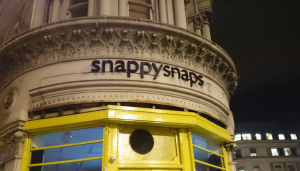
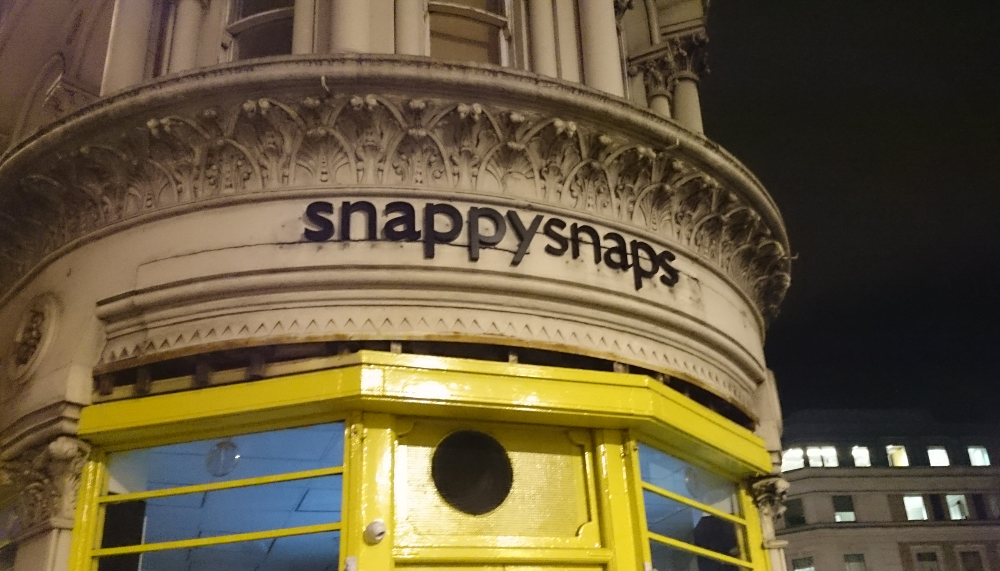
Ironically, a "snapstore" was close to the office ;-)

Ironically, a snapstore was close to the office ;-)

XdgApp and sandboxing of apps was also a big topic, aside from Ubuntu and Endless integration. Fortunately, Alexander Larsson was also there to answer all the sandboxing and XdgApp-questions. I used the time to follow up on a conversation with Alexander we started at FOSDEM this year, about the Limba vs. XdgApp bundling issue. While we are in-line on the sandboxing approach, the way how software is distributed is implemented differently in Limba and XdgApp, and it is bad to have too many bundling systems around (doesn t make for a good story where we can just tell developers ship as this bundling format, and it will be supported everywhere ). Talking with Alex about this was very nice, and I think there is a way out of the too-many-solutions dilemma, at least for Limba and XdgApp I will blog about that separately soon. On the Ubuntu side, a lot of bugs and issues were squashed and changes upstreamed to GNOME, and people were generally doing their best to reduce Richard s bus-factor on the project a little  . I mainly worked on AppStream issues, finishing up the last pieces of appstream-generator and running it against some sample package sets (and later that week against the whole Debian archive). I also started to implement support for showing AppStream issues in the Debian PTS (this work is not finished yet). I also managed to solve a few bugs in the old DEP-11 generator and prepare another release for Ubuntu. We also enjoyed some good Japanese food, and some incredibly great, but also suddenly very expensive Indian food (but that s a different story  ). The most important thing for me though was to get together with people actually using AppStream metadata in software centers and also more specialized places. This yielded some useful findings, e.g. that localized screenshots are not something weird, but actually a wanted feature of Endless for their curated AppStore. So localized screenshots will be part of the next AppStream spec. Also, there seems to be a general need to ship curation information for software centers somehow (which apps are featured? how are they styled? added special banners for some featured apps, app of the day features, etc.). This problem hasn t been solved, since it s highly implementation-specific, and AppStream should be distro-agnostic. But it is something we might be able to address in a generic way sooner or later (I need to talk to people at KDE and Elementary about it). In summary It was a great event! Going to conferences and hackfests always makes me feel like it moves projects leaps ahead, even if you do little coding. Sorting out issues together with people you see in person (rather than communicating with them via text messages or video chat), is IMHO always the most productive way to move forward (yeah, unless you do this every week, but I think you get my point  ). For me, being the only (and youngest ^^) developer at the hackfest who was not employed by any company in the FLOSS business, the hackfest was also motivating to continue to invest spare time into working on these projects. So, the only thing left to do is a huge shout out of THANK YOU to the Ubuntu Community Fund and therefore the Ubuntu community for sponsoring me! You rock! Also huge thanks to Canonical for organizing the sponsoring really quickly, so I didn t get into trouble with paying my flights.

Laney and attente walking on the Millennium Bridge after we walked the distance between Red Hat and Canonical's offices.

Laney and attente on the Millennium Bridge after we walked the distance between Red Hat and Canonical s offices.

To worried KDE people: No, I didn t leave the blue side I just generally work on cross-desktop stuff, and would like all desktops to work as well as possible

Dirk Eddelbuettel: RcppMgsPack 0.1.0

Over the last few months, I have been working casually on a new package to integrate MessagePack with R. What is MessagePack, you ask? To quote its website, "It's like JSON, but fast and small." Or in more extended terms:
MessagePack is an efficient binary serialization format. It lets you exchange data among multiple languages like JSON. But it's faster and smaller. Small integers are encoded into a single byte, and typical short strings require only one extra byte in addition to the strings themselves.
Now, serialization formats are a dime a dozen: JSON, BSON, Protocol Buffers, CaptnProto, Flatbuffer. The list goes on and on. So why another? In a nutshell: "software ecosystems". I happen to like working with Redis, and within the world of Redis, MessagePack is a first-class citizen supported by things close to the core like the embedded Lua interpreter, as well as fancy external add-ons such as the Redis Desktop Manager GUI. So nothing overly fundamentalist here, but a fairly pragmatic choice based on what happens to fit my needs. Plus, having worked on and off with Protocol Buffers for close to a decade, the chance of working with something not requiring a friggin' schema compiler seemed appealing for a chance. So far, we have been encoding a bunch of data streams at work via MessagePack into Redis (and of course back). It works really well---header-only C++11 libraries for the win. I'll provide an updated RcppRedis which uses this (if present) in due course. For now and the foreseeable future, this RcppMsgPack package will live only on the ghrr drat repository. To make RcppMsgPack work, I currently have to include the MessagePack 1.4.0 headers. A matching package for this version of the headers is in Debian but so far only in experimental. Once this hits the mainline repository I can depend on it, and upload a (lighter, smaller) RcppMsgPack to CRAN. Until then, please just do
## install drat if not present
if (!require(drat)) install.packages("drat")
## use drat to select ghrr repo
drat::addRepo("ghrr")
## install RcppMsgPack
install.packages("RcppMsgPack")
More details, issue tickets etc are at the GitHub repository.

This post by Dirk Eddelbuettel originated on his Thinking inside the box blog. Please report excessive re-aggregation in third-party for-profit settings.

25 April 2016

Antoine Beaupr : My free software activities, April 2016

Debian Long Term Support (LTS) This is my 5th month working on Debian LTS, started by Raphael Hertzog at Freexian. This is my largest month so far, in which I worked on completing the Xen and NSS packages updates from last month, but also spent a significant amount of time working on phpMyAdmin and libidn.

Updates to NSS and Xen completed This basically consisted on following up on the reviews from other security people. I basically continued building up on Brian's work and tested the package on a test server at Koumbit, which seems to have survived well the upgrade. The details are in this post to the debian-lts mailing list. As for NSS, the package was mostly complete, but I forgot to ship the tests for some reason, so I added them back. I also wrote the release team to see if it was possible to update NSS to the same version in all suites. Unfortunately, this issue is still pending, but I still hope we can find better ways of managing that package in the long term.

IDN and phpMyAdmin Most of my time this month was spent working on IDN and phpMyAdmin. Unfortunately, it turns out that someone else had worked on the libidn package. This is partly my fault: I forgot to check in the dsa-needed.txt file for assignment before working on the package. But considering how in flux the workflow currently is with the switch between the main security team and the LTS team for the wheezy maintenance, I don't feel too bad. Still, I prepared a package which was a bit more painful than it should have been because of GNUlib. I didn't even know about GNUlib before, oddly enough, and after that experience, I feel that it should just not exist at all anymore. I have filed a bug to remove that dependency at the very least, but I do not clearly see how such a tool is necessary on Debian at this point in time. But phpMyAdmin, no one had worked on that. And I understand why: even though it's a very popular package, there were quite a few outstanding issues (8!) in Wheezy, with 10-15 patches to be ported. Plus, it's ... well, PHP. And old PHP at that, with parts of it with modern autoloader classes, and other with mixed HTML and PHP content, require (and not require_once) and all sorts of nasty things you still find in the PHP universe. I nevertheless managed to produce a new Debian package for wheezy and test it on Koumbit's test servers. Hopefully, that can land into Wheezy soon.

Long term software support I am a little worried that we are, both in Jessie and Wheezy sitting in between stable releases for phpMyAdmin, something that is a recurring issue for a lot of packages in Debian stable or LTS. Sometimes, it just happens that the version that happens to be in Debian testing when it is released as stable is just not a supported release upstream. It's the case for phpMyAdmin in Jessie (4.3, whereas 4.0 and 4.4 are supported) and Wheezy (3.4, although it's unclear how long that was supported upstream). But even if the next Debian stable (Stretch), would pick a stable release upstream, there is actually no phpMyAdmin release that has a support window as long as Debian stable (roughly 3 years), let alone as long as Debian LTS (5 years). This is a similar problem with NSS: upstream is simply not supporting their product in the long term, or at least not in the terms we are used to in the Debian community (ie. only security fixes or regressions). This is, in my opinion, a real concern for the reliability and sustainability of the computing infrastructure we are creating. While some developers are of the opinion that software older than 18 months is too old, here we are shipping hardware and software in space or we have Solaris, which is supported for 16 years! Now that is a serious commitment and something we can rely on. 18 months is really, really, a tiny short time in the history of our civilization. I know computer programmers and engineers like to think of themselves in elitist terms, that they are changing the world every other year. But the truth is that things have not changed much in the last 4 decades where computing has existed, both in terms of security or functionality. Two quotes from my little quotes collection come to mind here:
Software gets slower faster than hardware gets faster. - Wirth's law The future is already here it's just not very evenly distributed. - William Gibson
Because of course, the response to my claims that computing is not really advancing is "but look! we have supercomputers in our pockets now!" Yes, of course, we do have those fancy phones and they are super-connected, but they are a threat to our fundamental rights and freedom. And those glittering advances always pale in comparison to what could be done if we wouldn't be wasting our time rewriting the same software over and over again on different, often proprietary, platforms, simply because of the megalomaniac fantasies of egoistic programmers. It would be great to build something that lasts, for a while. Software that does not need to be updated every 16 months. You'd think that something as basic as a screensaver release could survive what is basically the range of human infancy. Yet it seems we like to run mindlessly in the minefield of software development, one generation following the other without questioning the underlying assumption of infinite growth that permeates our dying civilization. I have talked about this before of course, but working with the LTS project just unnerves me so bad that I just needed to let out another rant. (For the record, I really have a lot of respect for JWZ and all the work he has done in the free software world. I frequently refer to his "no-bullshit" backup guide and use Xscreensaver daily. But I do think he was wrong in this case: asking Debian to remove Xscreensaver is just too much. The response from the maintainer was exemplary of how to handle such issues in the future. I restarted Xscreensaver after the stable update, and the message is gone, and things are still all fine. Thanks JWZ and Tormod for keeping things rolling.)

Other free software work With that in mind, I obviously didn't stop doing other computing work this month. In fact, I did a lot of work to try to generally fix the internet, that endless and not-quite-gratifying hobby so many of us are destroying our bodies to accomplish.

Build tools I have experimented a bit more with different build tools. I got worried because at some point cowbuilder got orphaned and I figured I could refresh the way I build packages for LTS. I looked into sbuild, but that ended up not bringing much improvements over my current cowbuilder setup (which I really need to document better). I was asked by the new maintainer to open a bug report to make such setups easier by guessing the basepath better, so we'll see how that goes. I did enjoy the simplicity of gitpkg and discovered cowpoke which made it about 2 times faster to build packages because I could use another server to build larger packages. I also found that gitpkg doesn't use -n by default when calling gzip, which makes it harder to reproduce tarballs when they are themselves built reproducibly, which is the case for Github tarballs (really nice of them). So I filed bug #820842 about that. It would be pretty awesome if such buildds would be available for Debian Developers to do their daily tasks. It could simply be a machine that would spin up a chroot with cowbuilder or it could even be a full, temporary VM although that would take way more resources than a simple VM with a cowbuilder setup. In the meantime, I should probably look at whalebuilder as an alternative to cowbuilder. It is a tool that supports building packages within a Docker chroot, which means that packages are built from a clean environment like pbuilder, and using COW optimisations but also without privileges or network access, which is a huge plus especially when you build untrusted packages.

Ikiwiki admonitions I have done some work to implement Moinmoin-like admonitions in Ikiwiki, something I am quite happy about since it's something I was really missing about Moinmoin. Admonitions bring a really nice way to outline certain blocks with varying severity levels and distinct styles. For example:
Admonitions are great!
This was done with a macro, but basically, since Markdown allows more or less arbitrary HTML, this can also be done with the <div> tag. I like that we don't have a new weird markup here. Yet, I still liked the sub-parser feature of MoinMoin, something that can be implemented in Ikiwiki, but it's a little more clunky. Normally, you'd probably do this with the inline macro and subpages, but it's certainly less intuitive that directly inlined content.

Ereader I got a new e-reader! I was hesitant between the Kobo Aura H20 and the Kobo Glo HD, which were the ones available at Bestbuy. So I bought both and figured I would return the other. That was a painful decision! In the end, both machines are pretty nice:
  • Aura H2O
    • Pros:
      • waterproof
      • larger screen (makes it easier to see web pages and better for the eyes)
      • naturally drawn to it
    • Cons:
      • heavier
      • larger (fits in outside pocket though)
      • port cover finicky
      • more expensive (180$) - prices may go down in future
  • Aura Glo HD
    • Pros
      • smaller (fits in inside pocket of both coats)
      • better resolution in theory (can't notice in practice)
      • cheaper (100$)
      • may be less common on the future (larger models more common? just a guess)
    • Cons
      • no SD card
      • smaller screen
      • power button in the middle
... but in the end, I ended up settling down on the Glo, mostly for the price. Heck, I saved around 100$, so for that amount, I could have gotten two machines so that if one breaks I would still have the other. I have ordered a cover for it on Deal Extreme about two weeks ago, and it still hasn't arrived. I suspect it's going to take a few more months to get there, by which point I may have changed e-reader again. Note that both e-readers needed an update to calibre, so I started working on a calibre backport (#818309) which I will complete soon. So anyways, I looked into better ways of transferring articles from the web to the e-reader, something which I do quite a bit to avoid spending too much time on the computer. Since the bookmark manager I use (Bookie) is pretty much dead, I started looking at other alternatives. And partly inspired by Framasoft's choice of Wallabag for their bookmarking service (Framabag), I started to look into that software, especially since my friend who currently runs the Bookie instance is thinking of switching to Wallabag as well. It seems the simplest way to browse articles remotely through a standard protocol is by implementing OPDS support in Wallabag. OPDS is a standard developed in part by the Internet Archive and it allows for browsing book collections and downloading them. Articles and bookmarks would then be presented as individual books that would be accessible from any OPDS-compatible device. Unfortunately, the Kobo e-readers don't support OPDS out of the box: you need to setup some OPDS-compatible reader like Koreader. And that I found nearly impossible to do: I was able to setup KSM (the "start menu", not to be confused with that KSM), but not Koreader in KSM. Besides, I do not want a separate OS running here on the tablet: I just want to start Koreader every once in a while. KSM just starts another system when you reboot the e-reader, something which is not really convenient on the Kobo. Basically, I just want to add Koreader as a tile in the home screen on the e-reader. I found the documentation on that topic to be sparse and hard to follow. It is often dispersed across multiple forum threads and involves uploading random binaries, often proprietary, to the e-reader. It had been a long time since I was asked to "register my software" frenetically, and I hadn't missed that one bit. So I decided to stay away from this until that solution and its documentation matures a bit.

Streaming re-established I have worked a bit on my home radio stream. I simply turned the Liquidsoap stream back online, and did a few tweaks to the documentation that I had built back then. All that experimenting led me to do two NMUs. One was for gmpc-plugins to fix a FTBFS (bug #807735) and to properly kill the shout streamer when completing the playback (bug #820908). The other was to fix the ezstream manpage (bug #573928), a patch that had been sitting there for 5 years! This was to try to find an easy way to stream random audio (say from a microphone) to the Icecast server, something which is surprisingly difficult, consider how basic that functionality is. I was surprised to see that Darkice just completely fails to start (bug #821040) and I had to fallback to the simplest ices2 software to stream the audio. I am still having issues with Liquidsoap: it's really unstable! As a server, I would expect it to keep running for days if not years. Unfortunately, there's always something that makes it crash. I had assertion failed (bug #821112) and I keep seeing it crash after 2-3 days fairly reliably, a bug I reported 3 years ago and that is still not fixed (bug #727307). Switching back the stream to Vorbis (because I was having problems with the commandline mp3 players and ogg123 is much more lightweight) created another set of problems too, this time with the phone. It seems that Android cannot stream Vorbis at all, something that is even worse in Cyanogenmod... I also had to tweak my MPD config to make the Android client be able to load the larger playlists (see dmix buffer is full).

Android apps So I have also done quite a bit of work again on my phone. I finally was told how to access from Termux from adb shell which is pretty cool because now I can start a screen on my phone and then, when I'm tired of tapping to type, I can just reconnect to it when I plug in a USB cable on my laptop. I sent a pull request to fix the documentation regarding that. I also tried to see how my SMS and Signal situation could be improved. Right now, I have two different apps to do SMS on my phone: I use both Signal and the VoIP.ms SMS client, because I do not have a contract or SIM card in my phone. Both work well independently, but it's somewhat annoying to have to switch between the two. (In fact, I feel that Signal itself has an issue with how it depends on the network to send encrypted messages: I often have to "ping" people in clear text (and therefore in the other app) so that they connect to their data plan to fetch my "secure" signal messages...) Anyways, I figured it would be nice if at least there would be a SMS fallback in Signal that would allow me to send regular text messages from signal through Voip.MS. That was dismissed really fast. Moxie even closed the conversation completely, something I had never experienced before, and doesn't feel exactly pleasant. The Voip.MS side was of course not impressed and basically shrugged it off because Signal was not receptive. I also tried to clear up the Libresignal confusion: there are 3 different projects named "Libresignal", and I am not sure I figured out the right thing, even though the issue is now closed and there's a FAQ that is supposed to make all that clear. Nevertheless, I opened two distinct feature requests to try to steer the conversation into a more productive direction: GCM-less calls and GCM support. But I'm not sure neither will go anywhere. In the meantime, I am using the official signal client, which I downloaded using gplaycli and which I keep up to date with Aptoide. Even though the reliability of that site is definitely questionable, it seems that once you have a trusted version, it is safe to upgrade, regardless of the source because there is a trust path between you and the developer. I also filed a few issues with varying levels of success/response from the community:

Random background radiation And then there's of course the monthly background noise of all the projects I happened to not only stumble on, but also file bugs or patches against:

23 April 2016

Scott Kitterman: Computer System Security Policy Debate (Follow-up)

As a follow-up to my recent post on the debate in the US over new encryption restrictions, I thought a short addition might be relevant. This continues. There was a recent Congressional hearing on the topic that featured mostly what you would expect. Police always want access to any possible source of evidence and the tech industry tries to explain that the risks associated with mandates to do so are excessive with grandstanding legislators sprinkled throughout. What I found interesting (and I use that word with some trepidation as it is still a multi-hour video of a Congressional hearing) is that there was rather less grandstanding and and less absolutism from some parties than I was expecting.
There is overwhelming consensus that these requirements [for exceptional access] are incompatible with good security engineering practice Dr. Matthew Blaze
The challenge is that political people see everything as a political/policy issue, but this isn t that kind of issue. I get particularly frustrated when I read ignorant ramblings like this that dismiss the overwhelming consensus of the people that actually understand what needs to be done as emotional, hysterical obstructionism. Contrary to what seems to be that author s point, constructive dialogue and understanding values does nothing to change the technical risks of mandating exceptional access. Of course the opponents of Feinstein-Burr decry it as technologically illiterate, it is technologically illiterate. This doesn t quite rise to the level of that time the Indiana state legislature considered legislating a new value (or in fact multiple values) for the mathematical constant Pi, but it is in the same legislative domain.

21 April 2016

John Goerzen: Count me as a systemd convert

Back in 2014, I wrote about some negative first impressions of systemd. I also had a plea to debian-project to end all the flaming, pointing out that jessie will still boot , noting that my preference was for sysvinit but things are what they are and it wasn t that big of a deal. Although I still have serious misgivings about the systemd upstream s attitude, I ve got to say I find the system rather refreshing and useful in practice. Here s an example. I was debugging the boot on a server recently. It mounts a bunch of NFS filesystems and runs a third-party daemon that is started from an old-style /etc/init.d script. We had a situation where the NFS filesystems the daemon required didn t mount on boot. The daemon then was started, and unfortunately it basically does a mkdir -p on startup. So it started running and processing requests with negative results. So there were two questions: why did the NFS filesystems fail to start, and how could we make sure the daemon wouldn t start without them mounted? For the first, journalctl -xb was immensely helpful. It logged the status of each individual mount, and it turned out that it looked like a modprobe or kernel race condition when a bunch of NFS mounts were kicked off in parallel and all tried to load the nfsv4 module at the same time. That was easy enough to work around by adding nfsv4 to /etc/modules. Now for the other question: refusing to start the daemon if the filesystems weren t there. With systemd, this was actually trivial. I created /etc/systemd/system/mydaemon.service.requires (I ll call the service mydaemon here), and in it I created a symlink to /lib/systemd/system/remote-fs.target. Then systemctl daemon-reload, and boom, done. systemctl list-dependencies mydaemon will even show the the dependency tree, color-coded status of each item on it, and will actually show every single filesystem that remote-fs requires and the status of it in one command. Super handy. In a non-systemd environment, I d probably be modifying the init script and doing a bunch of manual scripting to check the filesystems. Here, one symlink and one command did it, and I get tools to inspect the status of the mydaemon prerequisites for free. I ve got to say, as someone that has occasionally had to troubleshoot boot ordering and update-rc.d symlink hell, troubleshooting this stuff in systemd is considerably easier and the toolset is more powerful. Yes, it has its set of poorly-documented complexity, but then so did sysvinit. I never thought the world is falling folks were right, but by now I can be counted among those that feels like systemd has matured to the point where it truly is superior to sysvinit. Yes, in 2014 it had some bugs, but by here in 2016 it looks pretty darn good and I feel like Debian s decision has been validated through my actual experience with it.

Mario Lang: Scraping the web with Python and XQuery

During a JAWS for Windows training, I was introduced to the Research It feature of that screen reader. Research It is a quick way to utilize web scraping to make working with complex web pages easier. It is about extracting specific information from a website that does not offer an API. For instance, look up a word in an online dictionary, or quickly check the status of a delivery. Strictly speaking, this feature does not belong in a screen reader, but it is a very helpful tool to have at your fingertips. Research It uses XQuery (actually, XQilla) to do all the heavy lifting. This also means that the Research It Rulesets are theoretically also useable on other platforms. I was immediately hooked, because I always had a love for XPath. Looking at XQuery code is totally self-explanatory for me. I just like the syntax and semantics. So I immediately checked out XQilla on Debian, and found #821329 and #821330, which were promptly fixed by Tommi Vainikainen, thanks to him for the really quick response! Unfortunately, making xqilla:parse-html available and upgrading to the latest upstream version is not enough to use XQilla on Linux with the typical webpages out there. Xerces-C++, which is what XQilla uses to fetch web resources, does not support HTTPS URLs at the moment. I filed #821380 to ask for HTTPS support in Xerces-C to be enabled by default. And even with HTTPS support enabled in Xerces-C, the xqilla:parse-html function (which is based on HTML Tidy) fails for a lot of real-world webpages I tried. Manually upgrading the six year old version of HTML Tidy in Debian to the latest from GitHub (tidy-html5, #810951) did not help a lot either.
Python to the rescue XQuery is still a very nice language for extracting information from markup documents. XQilla just has a bit of a hard time dealing with the typical HTML documents out there. After all, it was designed to deal with well-formed XML documents. So I decided to build myself a little wrapper around XQilla which fetches the web resources with the Python Requests package, and cleans the HTML document with BeautifulSoup (which uses lxml to do HTML parsing). The output of BeautifulSoup can apparently be passed to XQilla as the context document. This is a fairly crazy hack, but it works quite reliably so far. Here is how one of my web scraping rules looks like:
from click import argument, group
@group()
def xq():
  """Web scraping for command-line users."""
  pass
@xq.group('github.com')
def github():
  """Quick access to github.com."""
  pass
@github.command('code_search')
@argument('language')
@argument('query')
def github_code_search(language, query):
  """Search for source code."""
  scrape(get='https://github.com/search',
         params= 'l': language, 'q': query, 'type': 'code' )
The function scrape automatically determines the XQuery filename according to the callers function name. Here is how github_code_search.xq looks like:
declare function local:source-lines($table as node()*) as xs:string*
 
  for $tr in $table/tr return normalize-space(data($tr))
 ;
let $results := html//div[@id="code_search_results"]/div[@class="code-list"]
for $div in $results/div
let $repo := data($div/p/a[1])
let $file := data($div/p/a[2])
let $link := resolve-uri(data($div/p/a[2]/@href))
return (concat($repo, ": ", $file), $link, local:source-lines($div//table),
        "---------------------------------------------------------------")
That is all I need to implement a custom web scraping rule. A few lines of Python to specify how and where to fetch the website from. And a XQuery file that specifies how to mangle the document content. And thanks to the Python click package, the various entry points of my web scraping script can easily be called from the command-line. Here is a sample invokation:
fx:~/xq% ./xq.py github.com
Usage: xq.py github.com [OPTIONS] COMMAND [ARGS]...
  Quick access to github.com.
Options:
  --help  Show this message and exit.
Commands:
  code_search  Search for source code.
fx:~/xq% ./xq.py github.com code_search Pascal '"debian/rules"'
prof7bit/LazPackager: frmlazpackageroptionsdeb.pas
https://github.com/prof7bit/LazPackager/blob/cc3e35e9bae0c5a582b0b301dcbb38047fba2ad9/frmlazpackageroptionsdeb.pas
230 procedure TFDebianOptions.BtnPreviewRulesClick(Sender: TObject);
231 begin
232 ShowPreview('debian/rules', EdRules.Text);
233 end;
234
235 procedure TFDebianOptions.BtnPreviewChangelogClick(Sender: TObject);
---------------------------------------------------------------
prof7bit/LazPackager: lazpackagerdebian.pas
https://github.com/prof7bit/LazPackager/blob/cc3e35e9bae0c5a582b0b301dcbb38047fba2ad9/lazpackagerdebian.pas
205 + 'mv ../rules debian/' + LF
206 + 'chmod +x debian/rules' + LF
207 + 'mv ../changelog debian/' + LF
208 + 'mv ../copyright debian/' + LF
---------------------------------------------------------------
For the impatient, here is the implementation of scrape:
from bs4 import BeautifulSoup
from bs4.element import Doctype, ResultSet
from inspect import currentframe
from itertools import chain
from os import path
from os.path import abspath, dirname
from subprocess import PIPE, run
from tempfile import NamedTemporaryFile
import requests
def scrape(get=None, post=None, find_all=None,
           xquery_name=None, xquery_vars= , **kwargs):
  """Execute a XQuery file.
  When either get or post is specified, fetch the resource and run it through
  BeautifulSoup, passing it as context to the XQuery.
  If find_all is given, wrap the result of executing find_all on
  the BeautifulSoup in an artificial HTML body.
  If xquery_name is not specified, the callers function name is used.
  xquery_name combined with extension ".xq" is searched in the directory
  where this Python script resides and executed with XQilla.
  kwargs are passed to get or post calls.  Typical extra keywords would be:
  params -- To pass extra parameters to the URL.
  data -- For HTTP POST.
  """
  response = None
  url = None
  context = None
  if get is not None:
    response = requests.get(get, **kwargs)
  elif post is not None:
    response = requests.post(post, **kwargs)
  if response is not None:
    response.raise_for_status()
    context = BeautifulSoup(response.text, 'lxml')
    dtd = next(context.descendants)
    if type(dtd) is Doctype:
      dtd.extract()
    if find_all is not None:
      context = context.find_all(find_all)
    url = response.url
  if xquery_name is None:
    xquery_name = currentframe().f_back.f_code.co_name
  cmd = ['xqilla']
  if context is not None:
    if type(context) is BeautifulSoup:
      soup = context
      context = NamedTemporaryFile(mode='w')
      print(soup, file=context)
      cmd.extend(['-i', context.name])
    elif isinstance(context, list) or isinstance(context, ResultSet):
      tags = context
      context = NamedTemporaryFile(mode='w')
      print('<html><body>', file=context)
      for item in tags: print(item, file=context)
      print('</body></html>', file=context)
      context.flush()
      cmd.extend(['-i', context.name])
  cmd.extend(chain.from_iterable(['-v', k, v] for k, v in xquery_vars.items()))
  if url is not None:
    cmd.extend(['-b', url])
  cmd.append(abspath(path.join(dirname(__file__), xquery_name + ".xq")))
  output = run(cmd, stdout=PIPE).stdout.decode('utf-8')
  if type(context) is NamedTemporaryFile: context.close()
  print(output, end='')
The full source for xq can be found on GitHub. The project is just two days old, so I have only implemented three scraping rules as of now. However, adding new rules has been made deliberately easy, so that I can just write up a few lines of code whenever I find something on the web which I'd like to scrape on the command-line. If you find this "framework" useful, make sure to share your insights with me. And if you impelement your own scraping rules for a public service, consider sharing that as well. If you have an comments or questions, send me mail. Oh, and by the way, I am now also on Twitter as @blindbird23.

20 April 2016

Ben Hutchings: Experiments with signed kernels and modules in Debian

I've lately been working on support for Secure Boot in Debian, mostly in the packages maintained by the kernel team. My instructions for setting up UEFI Secure Boot are based on OVMF running on KVM/QEMU. All 'Designed for Windows' PCs should allow reconfiguration of SB, but it may not be easy to do so. They also assume that the firmware includes an EFI shell. Updated: Robert Edmonds pointed out that the 'Designed for Windows' requirements changed with Windows 10: The ability to reconfigure SB is indeed now optional for devices which are designed to always boot with a specific Secure Boot configuration. I also noticed that the requirements say that OEMs should not sign an EFI shell binary. Therefore I've revised the instructions to use efibootmgr instead. Background UEFI Secure Boot, when configured and enabled (which it is on most new PCs) requires that whatever it loads is signed with a trusted key. The one common trusted key for PCs is held by Microsoft, and while they will sign other people's code for a nominal fee, they require that it also validates the code it loads, i.e. the kernel or next stage boot loader. The kernel in turn is responsible for validating any code that could compromise its integrity (kernel modules, kexec images). Currently there are no such signed boot loaders in Debian, though the shim and grub-signed packages included in many other distributions should be usable. However it's possible to load an appropriately configured Linux kernel directly from the UEFI firmware (typically through the shell) which is what I'm doing at the moment. Packaging signed kernels Signing keys obviously need to be protected against disclosure; the private keys can't be included in a source package. We also won't install them on buildds separately, and generating signatures at build time would of course be unreproducible. So I've created a new source package, linux-signed, which contains detached signatures prepared offline. Currently the binary packages built from linux-signed also contain only detached signatures, which are applied as necessary at installation time. The signed kernel image (only on x86 for now) is named /boot/vmlinuz-kversion.efi.signed. However, since packages must not modify files owned by another package and I didn't want to dpkg-divert thousands of modules, the module signatures remain detached. Detached module signatures are a new invention of mine, and require changes in kmod and various other packages to support them. (An alternate might be to put signed modules under a different directory and drop a configuration file in /lib/depmod.d to make them higher priority. But then we end up with two copies of every module installed, which can be a substantial waste of space.) Preparation The packages you need to repeat the experiment: For Secure Boot, you'll then need to copy the signed kernel and the initrd onto the EFI system partition, normally mounted at /boot/efi. SB requires a Platform Key (PK) which will already be installed on a real PC. You can replace it but you don't need to. If you're using OVMF, there are no persistent keys so you do need to generate your own:
openssl req -new -x509 -newkey rsa:2048 -keyout pk.key -out pk.crt \
    -outform der -nodes
You'll also need to install the certificate for my kernel image signing key, which is under debian/certs in the linux-signed package. OVMF requires this in DER format:
openssl x509 -in linux-signed-1~exp3/debian/certs/linux-image-benh@debian.org.cert.pem \
    -out linux.crt -outform der 
You'll need to copy the certificate(s) to a FAT-formatted partition such as the EFI system partition, so that the firmware can read it. Use efibootmgr to add a boot entry for the kernel, for example:
efibootmgr -c -d /dev/sda -L linux-signed -l '\vmlinuz.efi' -u 'initrd=initrd.img root=/dev/sda2 ro quiet'
You should use the same kernel parameters as usual, except that you also need to specify the initrd filename using the initrd= parameter. The EFI stub code at the beginning of the kernel will load the initrd using EFI boot services. Enabling Secure Boot
  1. Reboot the system and enter UEFI setup
  2. Find the menu entry for Secure Boot customisation (in OVMF, it's under 'Device Manager' for some reason)
  3. In OVMF, enrol the PK from pk.crt
  4. Add linux.crt to the DB (whitelist database)
  5. Ensure that Secure Boot is enabled and in 'User Mode'
Booting the kernel in Secure Boot If all went well, Linux will boot as normal. You can confirm that Secure Boot was enabled by reading /sys/kernel/security/securelevel, which will contain 1 if it was. Module signature validation Module signatures are now always checked and unsigned modules will be given the 'E' taint flag. If Secure Boot is used or you add the kernel parameter module.sig_enforce=1, unsigned modules will be rejected. You can also turn on signature enforcement and turn off various other methods of modifying kernel code (such as kexec) by writing 1 to /sys/kernel/security/securelevel.

Michal &#268;iha&#345;: Testing Sphinx documentation with Jenkins

While reviewing comments on phpMyAdmin wiki (which we're shrinking down to developer documentation and moving end user documentation to proper documentation) I've noticed that people complained there on broken links in our documentation. Indeed there was quite some of them as this is something nobody really checks. It seems like obvious task to automate. It seemed to me as obvious as somebody had to do it already. Unfortunately I have not found much, but at least there was Using Jenkins to parse sphinx warnings. This helps with the build warnings, but unfortunately I found no integration for the linkcheck builder. Fortunately it's quite easy with the Jenkins Warnings plugin to write custom parsers and to parse linkcheck output as well. The Sphinx output parser based on above link can be configured like: Regular Expression:
^(.*):(\d+): \((.*)\) (.*)
Mapping Script:
import hudson.plugins.warnings.parser.Warning
String fileName = matcher.group(1)
String lineNumber = matcher.group(2)
String category = matcher.group(3)
String message = matcher.group(4)
return new Warning(fileName, Integer.parseInt(lineNumber), "sphinx", category, message);
Example Log Message:
Percona-Server-1.0.2-3.rst:67: (WARNING/2) Inline literal start-string without end-string.
The Sphinx linkcheck output is quite similar: Regular Expression:
^(.*):(\d+): \[([^\]]*)\] (.*)
Mapping Script:
import hudson.plugins.warnings.parser.Warning
String fileName = matcher.group(1)
String lineNumber = matcher.group(2)
String category = matcher.group(3)
String message = matcher.group(4)
return new Warning(fileName, Integer.parseInt(lineNumber), "sphinx-linkcheck", category, message);
Example Log Message:
faq.rst:793: [broken] http://www.hardened-php.net/: <urlopen error [Errno -3] Temporary failure in name resolution>
All you need to do now is to enable these in your Jenkins project, let the Sphinx parse output and the Sphinx linkcheck one file generated by linkcheck (usually _build/linkcheck/output.txt). The result can be found on the phpMyAdmin CI server.

Filed under: English phpMyAdmin 2 comments

19 April 2016

Dariusz Dwornikowski: HAProxy and 503 HTTP errors with AWS ELB as a backend

Although, AWS provides load balancer service in the form of Elastic Load Balancer (ELB), a common trick is to use HAProxy in the middle to provide SSL offloading, complex routing and better logging.
In this scenario, a public ELB is the frontier of all the traffic, HAProxy farm in the middle is managed by an Auto Scaling Group, and one (or more) internal backend ELBs stay in front of Web farm. haproxy I think that HAProxy does not need any introductions here. It is highly scalable and reliable piece of software. There is however a small caveat when you use it with domain names and not IP addresses. To speed up things, HAProxy resolves all the domain named during startup (during config file parsing in fact). Hence, when the IP of a domain changes, you end up with a lot of 503s (Service Unavailable). Why is this important ? In AWS, ELB's IP can change over time, so it is recommended to use ELB's domain name. Now, when you use this domain name in HAProxy's backend, you can end up with 503s. ELB IPs do not change so often but still you would not want any downtimes. The solution is to configure runtime resolvers in HAProxy and use them in the backend (unforntunatelly this works only in HAProxy 1.6):
 ::haproxy
 resolvers myresolver
      nameserver dns1 10.10.10.10:53
      resolve_retries       30
      timeout retry         1s
      hold valid           10s
  backend mybackend
      server myelb-internal.123456.eu-west-1.elb.amazonaws.com check resolvers myresolver
Now HAProxy will check the domain at runtime, no more 503s.

18 April 2016

Dirk Eddelbuettel: RcppCCTZ 0.0.4

A few days ago a new upstream version "2.0" of CCTZ was released. See here for the corresponding post on the Google OpenSource Blog. CCTZ is a C++ library for translating between absolute and civil times using the rules of a time zone. It requires only a proper C++11 compiler and the standard IANA time zone data base which standard Unix, Linux, OS X, ... computers tend to have in /usr/share/zoneinfo. RcppCCTZ connects this library to R by relying on Rcpp. This new version adds more support to the notion of civil time representation -- i.e. independent of timezones -- which can then be mapped to different time zone representations. Changes in this version are summarized here:
Changes in version 0.0.4 (2016-04-17)
  • Synchronized with CCTZ v2 upstream.
  • Updated examples.cpp accordingly
A quick example is provided here where we look at the time when Neil Armstrong first stepped on the moon as an absolute ("civil") time and two local representations:
// from examples/hello.cc
// 
// [[Rcpp::export]]
int helloMoon()  
    cctz::time_zone syd;
    if (!cctz::load_time_zone("Australia/Sydney", &syd)) return -1;
    // Neil Armstrong first walks on the moon
    const auto tp1 = cctz::convert(cctz::civil_second(1969, 7, 21, 12, 56, 0), syd);
    const std::string s = cctz::format("%F %T %z", tp1, syd);
    Rcpp::Rcout << s << "\n";
    cctz::time_zone nyc;
    cctz::load_time_zone("America/New_York", &nyc);
    const auto tp2 = cctz::convert(cctz::civil_second(1969, 7, 20, 22, 56, 0), nyc);
    return tp2 == tp1 ? 0 : 1;
 
We can call this from R, and get the expected result (of equivalence between the dates):
R> library(RcppCCTZ)
R> helloMoon()
1969-07-21 12:56:00 +1000
[1] 0
R>
We also have a diff to the previous version thanks to CRANberries. More details, issue tickets etc at the GitHub repository.

This post by Dirk Eddelbuettel originated on his Thinking inside the box blog. Please report excessive re-aggregation in third-party for-profit settings.

17 April 2016

Sean Whitton: Mail expiring out of the postfix mail queue

On my Debian machines I run stunnel to create an secure connection to my e-mail provider s SMTP gateway. Postfix sends mail through that TLS tunnel. Recently I stopped receiving e-mail from rss2email and I discovered tonight that the reason was that the tunnel has caved in on the machine which rss2email was running on. Unfortunately, some mail was permanently discarded from the postfix queue because it turns out that postfix will by default keep mail in the queue for a maximum of only 5 days. Since the connection to the gateway was down, postfix couldn t return the mail to its sender (i.e. me). Fortunately, I m not smart enough to have any log rotation going on, so I could easily find the message that were lost:

grep "status=expired, returned to sender" /var/log/mail.log \
      awk ' print $6 ' \
      while read id; do grep "$id" -m1 /var/log/mail.log; done
The first grep determines the queue id of the messages that were expired, and then the second grep finds the first entry in the mail log for that message, which provides the time the message was sent. Replacing -m1 with -m4 gave me the message-id of the messages and the intended recipient of the messages. This allowed me to restore them from backups or bounce them from my sent mail folder for those that I tried to send myself. To prevent this from happening again, I ve extended the maximum lifetime of messages in the queue from 5 days to 10:
postconf -e maximal_queue_lifetime=10d
I ve incorporated a check for clogged mail queues on my machines into my weekly backup routine.

16 April 2016

Scott Kitterman: Future of secure systems in the US

As a rule, I avoid writing publicly on political topics, but I m making an exception. In case you haven t been following it, the senior Republican and the senior Democrat on the Senate Intelligence Committee recently announced a legislative proposal misleadingly called the Compliance with Court Orders Act of 2016. The full text of the draft can be found here. It would effectively ban devices and software in the United States that the manufacturer cannot retrieve data from. Here is a good analysis of the breadth of the proposal and a good analysis of the bill itself. While complying with court orders might sound great in theory, in practice this means these devices and software will be insecure by design. While that s probably reasonably obvious to most normal readers here, don t just take my word for it, take Bruce Schneier s. In my opinion, policy makers (and it s not just in the United States) are suffering from a perception gap about security and how technically hard it is to get right. It seems to me that they are convinced that technologists could just do security right while still allowing some level of extraordinary access for law enforcement if they only wanted to. We ve tried this before and the story never seems to end well. This isn t a complaint from wide eyed radicals that such extraordinary access is morally wrong or inappropriate. It s hard core technologists saying it can t be done. I don t know how to get the message across. Here s President Obama, in my opinion, completely missing the point when he equates a desire for security with fetishizing our phones above every other value. Here are some very smart people trying very hard to be reasonable about some mythical middle ground. As Riana Pfefferkorn s analysis that I linked in the first paragraph discusses, this middle ground doesn t exist and all the arm waving in the world by policy makers won t create it. Coincidentally, this same week, the White House announced a new Commission on Enhancing National Cybersecurity . Cybersecurity is certainly something we could use more of, unfortunately Congress seems to be heading off in the opposite direction and no one from the executive branch has spoken out against it. Security and privacy are important to many people. Given the personal and financial importance of data stored in computers (traditional or mobile), users don t want criminals to get a hold of it. Companies know this, which is why both Apple IOS and Google Android both encrypt their local file systems by default now. If a bill anything like what s been proposed becomes law, users that care about security are going to go elsewhere. That may end up being non-US companies products or US companies may shift operations to localities more friendly to secure design. Either way, the US tech sector loses. A more accurate title would have been Technology Jobs Off-Shoring Act of 2016. EDIT: Fixed a typo.

Ryan Kavanagh: Specifying a custom MTA path in caff

I recently had to sign someone s GPG key. I ve long used the caff tool from the signing-party package to help me with this. Unfortunately, I m using a new laptop and hadn t yet configured caff on it. Moreover, caff uses the system MTA by default, normally found at /usr/sbin/sendmail, and I hadn t yet properly configured it to send mail to the outside world. Since I have multiple email accounts and use mutt as my mail client, I use msmtp as my SMTP client / sendmail drop-in. This post describes how to configure caff to use msmtp. Reading the caff man page, one sees the following tantalising hint, which leads you to believe it s completely trivial to specify your own MTA:
$CONFIG 'mailer-send'  = [ 'sendmail', '-f', $CONFIG 'email' , '-it' ];
Unfortunately, substituting in a custom path, e.g., /home/rak/bin/msmtp/msmtp-default, for sendmail in the above line results in a long sequence of errors when caff tries to mail the signed keys:
Bareword "home" not allowed while "strict subs" in use at (eval 218) line 1.
Bareword "rak" not allowed while "strict subs" in use at (eval 218) line 1.
Bareword "bin" not allowed while "strict subs" in use at (eval 218) line 1.
Bareword "msmtp" not allowed while "strict subs" in use at (eval 218) line 1.
Bareword "default" not allowed while "strict subs" in use at (eval 218) line 1.
Fortunately, it s still straightforward to accomplish after reading the perldoc for Mail::Mailer. In my case, it was sufficient to add the following to my ~/.caffrc:
$ENV 'PERL_MAILERS'  = 'sendmail:'.$ENV 'HOME' .'/bin/msmtp/msmtp-default';
$CONFIG 'mailer-send'  = [ 'sendmail' ];
To specify alternate paths to your sendmail-style MTA, simply modify the value of $ENV 'PERL_MAILERS' after the initial sendmail: bit. If you re using stock msmtp, I believe the following pair of lines will work, though I haven t tested it:
$ENV 'PERL_MAILERS'  = 'sendmail:/usr/bin/msmtp';
$CONFIG 'mailer-send'  = [ 'sendmail' ];
If there s a more elegant way to accomplish this, I d be happy to hear about it!

Matthias Klumpp: Introducing AppStream-Generator

AppStream GeneratorSince mid-2015 we were using the dep11-generator in Debian to build AppStream metadata about available software components in the distribution. Getting rid of dep11-generator Unfortunately, the old Python-based dep11-generator was hitting some hard limits pretty soon. For example, using multiprocessing with Python was a pain, since it resulted in some very hard-to-track bugs. Also, the multiprocessing approach (as opposed to multithreading) made it impossible to use the underlying LMDB database properly (it was basically closed and reopened in each forked off process, since pickling the Python LMDB object caused some really funny bugs, which usually manifested themselves in the application hanging forever without any information on what was going on). Additionally to that, the Python-based generator forced me to maintain two implementations of the AppStream YAML spec, one in C and one in Python, which consumes quite some time. There were also some other issues (e.g. no unit-tests) in the implementation, which made me think about rewriting the generator. Adventures in Go / Rust / D Since I didn t want to write this new piece of software in C (or basically, writing it in C was my last option  ), I explored Go and Rust for this purpose and also did a small prototype in the D programming language, when I was starting to feel really adventurous. And while I never intended to write the new generator in D (I was pretty fixated on Go ), this is what happened. The strong points for D for this particular project were its close relation to C (and ease of using existing C code), its super-flat learning curve for someone who knows and likes C and C++ and its pretty powerful implementations of the concurrent and parallel programming paradigms. That being said, not all is great in D and there are some pretty dark spots too, mainly when it comes to the standard library and compilers. I will dive into my experiences with D in a separate blogpost. What good to expect from appstream-generator? So, what can the new appstream-generator do for you? Basically, the same as the old dep11-generator: It will extract metadata from a distribution s package archive, download and resize screenshots, search for icons and size them properly and generate reports in JSON and HTML of found metadata and issues. LibAppStream-based parsing, generation of YAML or XML, multi-distro support, As opposed to the old generator, the new generator utilizes the metadata parsers and writers of libappstream. This allows it to return the extracted metadata as AppStream YAML (for Debian) or XML (everyone else) It is also written in a distribution-agnostic way, so if someone wants to use it in a different distribution than Debian, this is possible now. It just requires a very small distribution-specific backend to be written, all of the details of the metadata extraction are abstracted away (just two interfaces need to be implemented). While I do not expect anyone except Debian to use this in the near future (most distros have found a solution to generate metadata already), the frontend-backend split is a much cleaner design than what was available in the previous code. It also allows to unit-test the code properly, without providing a Debian archive in the testsuite. Feature Flags, Optipng, The new generator also allows to enable and disable certain sets of features in a standardized way. E.g. Ubuntu uses a language-pack system for translations, which Debian doesn t use. Features like this can be implemented as disableable separate modules in the generator. We use this at time to e.g. allow descriptions from packages to be used as AppStream descriptions, or for running optipng on the generated PNG images and icons. No more Contents file dependency Another issue the old generator had was that it used the Contents file from the Debian archive to find matching icons for an application. We could never be sure whether the contents in the Contents file actually matched the contents of the package we were currently dealing with. What made things worse is that at Ubuntu, the archive software is only updating the Contents file weekly daily (while the generator might run multiple times a day), which has lead to software being ignored in the metadata, because icons could not yet be found. Even on Debian, with its quickly-updated Contents file, we could immediately see the effects of an out-of-date Contents file when updating it failed once. In the new generator, we read the contents of each package ourselves now and store them in a LMDB database, bypassing the Contents file and removing the whole class of problems resulting from missing or wrong contents-data. It can t all be good, right? That is true, there are also some known issues the new generator has: Large amounts of RAM required The better speed of the new generator comes at the cost of holding more stuff in RAM. Much more. When processing data from 5 architectures initially on Debian, the amount of required RAM might lie above 4GB, with the OOM killer sometimes being quicker than the garbage collector That being said, on subsequent runs the amount of required memory is much lower. Still, this is something I am working on to improve. What are symbolic links? To be faster, the appstream-generator will read the md5sum file in .deb packages instead of extracting the payload archive and reading its contents. Since the md5sums file does not list symbolic links, symlinks basically don t exist for the new generator. This is a problem for software symlinking icons or even .desktop files around, like e.g. LibreOffice does. I am still investigating how widespread the use of symlinks for icons and .desktop files is, but it looks like fixing packages (making them not-symlink stuff and rather move the files) might be the better approach than investing additional computing power to find symlinks or even switch back to parsing the Contents file. Input on this is welcome! Deploying asgen I finished the last pieces of the appstream-generator (together with doing lots of other cool things and talking to great people) at the GNOME Software Hackfest in London last week (detailed blogposts about things that happened there will follow many thanks once again for the Ubuntu community for sponsoring my attendance!). Since today, the new generator is running on the Debian infrastructure. If bigger issues are found, we can still roll back to the old code. I decided to deploy this faster, so we can get some good testing done before the Stretch release. Please report any issues you may find!

John Goerzen: A Year of Flight

Dad-o, I m so glad you re a pilot! My 9-year-old son Jacob has been saying that, always with a big hug and his fond nickname for me ( dad-o ). It has now been a year since the first time I sat in the pilot s seat of a plane, taking my first step towards exploring the world from the sky. And now, one year after I first sat in the pilot s seat of an airborne plane, it s prompted me to think back to my own memories. vlcsnap-2015-07-24-20h35m16s96_1

Flying over the airport at Moundridge, KS Memories Back when I was a child, maybe about the age my children are now, I d be outside in the evening and see this orange plane flying overhead. Our neighbor Don had a small ultralight plane and a grass landing strip next to his house. I remember longing to be up in the sky with Don, exploring the world from up there. At that age, I didn t know all the details of why that wouldn t work I just knew I wanted to ride in it. It wasn t until I was about 11 that I flew for the first time. I still remember that TWA flight with my grandma, taking off early in the morning and flying just a little ways above the puffy clouds lit up all yellow and orange by the sunrise. Even 25 years later, that memory still holds as one of the most beautiful scenes I have ever seen. Exploring I have always been an explorer. When I go past something interesting, I love to go see what it looks like inside. I enjoy driving around Kansas with Laura, finding hidden waterfalls, old county courthouses, ghost towns, beautiful old churches, even small-town restaurants. I explore things around me, too once taking apart a lawnmower engine as a child, nowadays building HF antennas in my treetops or writing code for Linux. If there is little to learn about something, it becomes less interesting to me. I see this starting to build in my children, too. Since before they could walk, if we were waiting for something in a large building, we d go exploring. IMG_7231

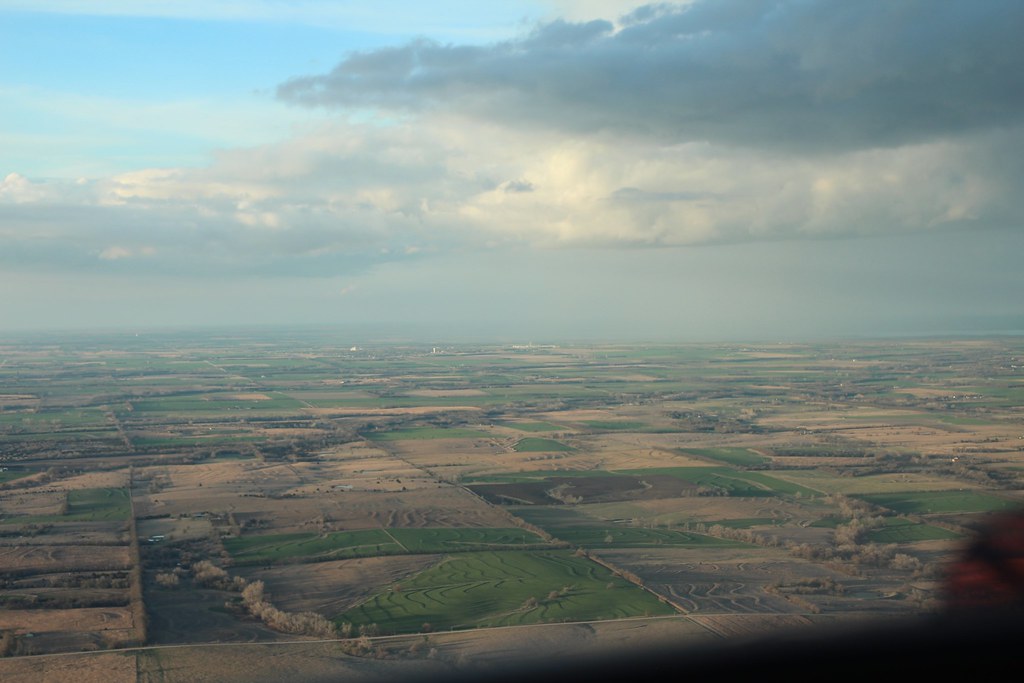
A patch of rain over Hillsboro, KS The New World A pilot once told me, Nobody can become a pilot without it changing the way they see the world and then, changing their life. I doubted that. But it was true. One of the most poetic sights I know is flying a couple thousand feet above an interstate highway at night, following it to my destination. All those red and white lights, those metal capsules of thousands of lives and thousands of stories, stretching out as far as the eye can see in either direction. IMG_7099

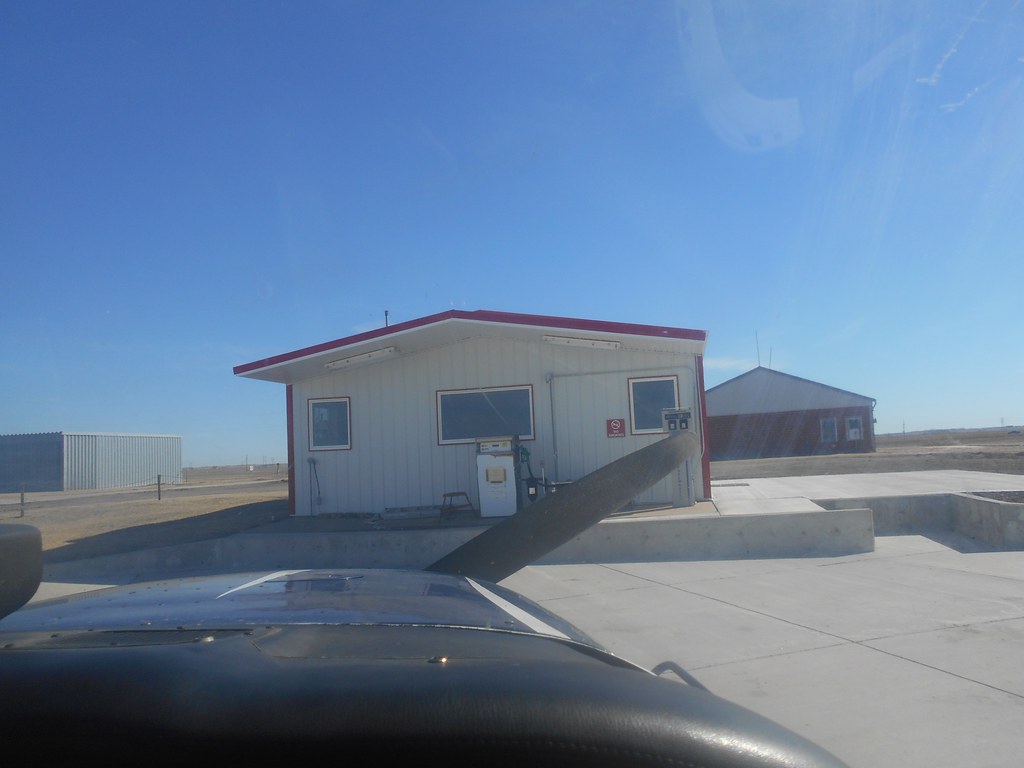
Kansas sunset from the plane When you re in a plane, that small town nowhere near a freeway that always seemed so far away suddenly is only a 15-minute flight away, not even enough time to climb up to a high cruise altitude. Two minutes after takeoff, any number of cities that are an hour s drive away are visible simultaneously, their unique features already recognizable: a grain elevator, oil refinery, college campus, lake, whatever. And all the houses you fly over each with people in them. Some pretty similar to you, some apparently not. But pretty soon you realize that we all are humans, and we aren t all that different. You can t tell a liberal from a conservative from the sky, nor a person s race or religion, nor even see the border between states. Towns and cities are often nameless from the sky, unless you re really low; only your navigation will tell you where you are. I ve had the privilege to fly to small out-of-the-way airports, the kind that have a car that pilots can use for free to go into town and get lunch, and leave the key out for them. There I ve met many friendly people. I ve also landed my little Cessna at a big commercial airport where I probably used only 1/10th of the runway, on a grass runway that was barely maintained at all. I ve flown to towns I d driven to or through many times, discovering the friendly folks at the small airport out of town. I ve flown to parts of Kansas I ve never been to before, discovered charming old downtowns and rolling hills, little bursts of rain and beautiful sunsets that seem to turn into a sea. Smith Center, KS airport terminal

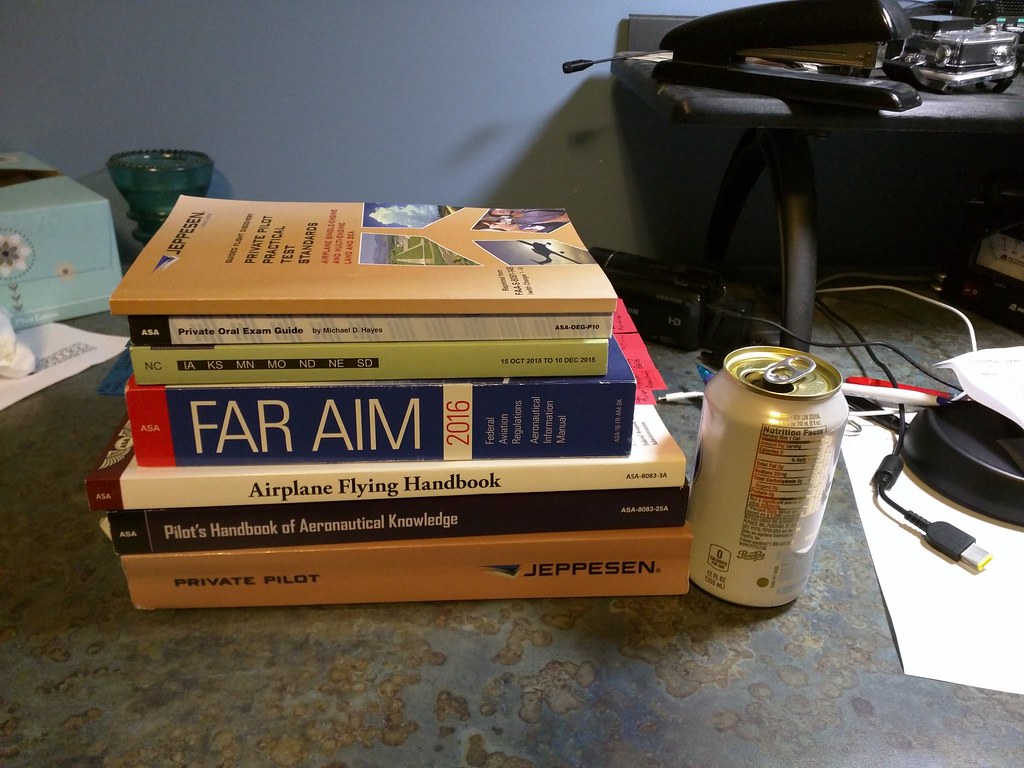
Parked at the Smith Center, KS airport terminal, about to meet some wonderful people For a guy that loves exploring the nooks and crannies of the world that everyone else drives by on their way to a major destination, being a pilot has meant many soul-filling moments. Hard Work I knew becoming a pilot would be a lot of hard work, and thankfully I remembered stories like that when I finally concluded it would be worth it. I found that I had an aptitude for a lot of things that many find difficult about being a pilot: my experience with amateur radio made me a natural at talking to ATC, my fascination with maps and navigation meant I already knew how to read aviation sectional maps before I even started my training and knew how to process that information in the cockpit, my years as a system administrator and programmer trained me with a careful and methodical decision-making process. And, much to the surprise of my flight instructor, I couldn t wait to begin the part of training about navigating using VORs (VHF radio beacons). I guess he, like many student pilots, had struggled with that, but I was fascinated by this pre-GPS technology (which I still routinely use in my flight planning, as a backup in case the GPS constellation or a GPS receiver fails). So that left the reflexes of flight, the art of it, as the parts I had to work on the hardest. The exam with the FAA is not like getting your driver s license. It s a multi-stage and difficult process. So when the FAA Designated Pilot Examiner said congratulations, pilot! and later told my flight instructor that you did a really good job with this one, I felt a true sense of accomplishment. IMG_20151021_193137

Some of my prep materials Worth It Passengers in a small plane can usually hear all the radio conversations going on. My family has heard me talking to air traffic control, to small and big planes. My 6-year-old son Oliver was playing yesterday, and I saw him pick up a plane and say this: Two-four-niner-golf requesting to land on runway one-seven . Two-four-niner-golf back-taxi on one-seven Two-four-niner-golf ready to takeoff on runway one-seven! That was a surprisingly accurate representation of some communication a pilot might have (right down to the made-up tailnumber with the spelling alphabet!) 20160408_203110

It just got more involved from there! Jacob and Oliver love model train shows. I couldn t take them to one near us, but there was one in Joplin, MO. So the day before Easter, while Laura was working on her Easter sermon, two excited boys and I (frankly also excited) climbed into a plane and flew to Joplin. We had a great time at the train show, discovered a restaurant specializing in various kinds of hot dogs (of course they both wanted to eat there), played in a park, explored the city, and they enjoyed the free cookies at the general aviation terminal building while I traded tips on fun places to fly with other pilots. When it comes right down to it, the smiles of the people I fly with are the most beautiful thing in the air. IMG_20151205_183440

Jacob after his first father-son flight with me

14 April 2016

Michal &#268;iha&#345;: Gammu 1.37.2

Yesterday, Gammu 1.37.1 and Gammu 1.37.2 have been released. As usual it collects bug fixes and minor improvements. Full list of changes in 1.37.1: Full list of changes in 1.37.2: Would you like to see more features in Gammu? You an support further Gammu development at Bountysource salt or by direct donation.

Filed under: English Gammu python-gammu Wammu 0 comments

13 April 2016

Matthew Garrett: Skylake's power management under Linux is dreadful and you shouldn't buy one until it's fixed

(Edit to add: this issue is restricted to the mobile SKUs. Desktop parts have very different power management behaviour)

Linux 4.5 seems to have got Intel's Skylake platform (ie, 6th-generation Core CPUs) to the point where graphics work pretty reliably, which is great progress (4.4 tended to lose all my windows every so often, especially over suspend/resume). I'm even running Wayland happily. Unfortunately one of the reasons I have a laptop is that I want to be able to do things like use it on battery, and power consumption's an important part of that. Skylake continues the trend from Haswell of moving to an SoC-type model where clock and power domains are shared between components that were previously entirely independent, and so you can't enter deep power saving states unless multiple components all have the correct power management configuration. On Haswell/Broadwell this manifested in the form of Serial ATA link power management being involved in preventing the package from going into deep power saving states - setting that up correctly resulted in a reduction in full-system power consumption of about 40%[1].

I've now got a Skylake platform with a nice shiny NVMe device, so Serial ATA policy isn't relevant (the platform doesn't even expose a SATA controller). The deepest power saving state I can get into is PC3, despite Skylake supporting PC8 - so I'm probably consuming about 40% more power than I should be. And nobody seems to know what needs to be done to fix this. I've found no public documentation on the power management dependencies on Skylake. Turning on everything in Powertop doesn't improve anything. My battery life is pretty poor and the system is pretty warm.

The best thing about this is the following statement from page 64 of the 6th Generation Intel Processor Datasheet for U-Platforms:

Caution: Long term reliability cannot be assured unless all the Low-Power Idle States are enabled.

which is pretty concerning. Without support for states deeper than PC3, Linux is running in a configuration that Intel imply may trigger premature failure. That's obviously not good. Until this situation is improved, you probably shouldn't buy any Skylake systems if you're planning on running Linux.

[1] These patches never went upstream. Someone reported that they resulted in their SSD throwing errors and I couldn't find anybody with deeper levels of SATA experience who was interested in working on the problem. Intel's AHCI drivers for Windows do the right thing, but I couldn't find anybody at Intel who could get any information from their Windows driver team.

comment count unavailable comments

Next.

Previous.