Search Results: "az"

18 June 2012

Lars Wirzenius: In Kindle store: Getting Things Done for Hackers booklet

cover.jpg I've made some tweaks and fixes to my Gettings Things Done for Hackers booklet on personal productivity, and updated the website and the ebooks (see sidebar on the site). I've also published it on the Amazon Kindle store in case anyone wants to buy it ($1.99). The book remains licensed under the CC-BY-SA 3.0 license, and the Mobipocket version on my site is the same as the one Amazon publishes, modulo any changes Amazon's automation may have done. The Kindle store version is really there for only overly generous people.

16 June 2012

Christian Perrier: 2012 update 26 for Debian Installer localization

Status for D-I level 1 (core D-I files): Status for D-I level 2 (packages that have localized material that may appear during default installs, such as iso-codes, tasksel, etc.): Status for D-I level 3 (packages that have localized material that may appear during non-default installs, such as win32-loader) Full 100% completeness (hall of fame) for 27 languages: Asturian, Belarusian, Bulgarian, Catalan, Czech, Danish, German, Esperanto, Spanish, Persian, French, Hebrew, Indonesian, Italian, Japanese, Kazakh, Khmer, Latvian, Dutch, Polish, Portuguese, Russian, Slovak, Slovenian, Swedish, Turkish, Simplified Chinese

8 June 2012

Lars Wirzenius: Obnam 1.0 (backup software); a story in many words

tl;dr: Version 1.0 of Obnam, my snapshotting, de-duplicating, encrypting backup program is released. See the end of this announcement for the details. Where we see the hero in his formative years; parental influence From the very beginning, my computing life has involved backups. In 1984, when I was 14, my father was an independent telecommunications consultant, which meant he needed a personal computer for writing reports. He bought a Luxor ABC-802, a Swedish computer with a Z80 microprocessor and two floppy drives. My father also taught me how to use it. When I needed to save files, he gave me not one, but two floppies, and explained that I should store my files one one, and then copy them to the other one every now and then. Later on, over the years, I've made backups from a hard disk (30 megabytes!) to a stack of floppies, to a tape drive installed into a floppy interface (400 megabytes!), to a DAT drive, and various other media. It was always a bit tedious. The start of the quest; lengthy justification for NIH In 2004, I decided to do a full backup, by burning a copy of all my files onto CD-R disks. It took me most of the day. Afterwards, I sat admiring the large stack of disks, and realized that I would not ever do that again. I'm too lazy for that. That I had done it once was an aberration in the space-time continuum. Switching to DVD-Rs instead CD-Rs would reduce to the number of disks to burn, but not enough: it would still take a stack of them. I needed something much better. I had a little experience with tape drives, and that was enough to convince me that I didn't want them. Tape drives are expensive hardware, and the tapes also cost money. If the drive goes bad, you have to get a compatible one, or all your backups are toast. The price per gigabyte was coming down fast for hard drives, and it was clear that they were about to be very competitive with tapes for price. I looked for backup programs that I could use for disk based backups. rsync, of course, was the obvious choice, but there were others. I ended up doing what many geeks do: I wrote my own wrapper around rsync. There's hundred, possibly thousands, of such wrappers around the Internet. I also got the idea that doing a startup to provide online backup space would be a really cool thing. However, I didn't really do anything about that until 2007. More on that later. The rsync wrapper script I wrote used hardlinked directory trees to provide a backup history, though not in the smart way that backuppc does it. The hardlinks were wonderful, because they were cheap, and provided de-duplication. They were also quite cumbersome, when I needed to move my backups to a new disk the first time. It turned out that a lot of tools deal very badly with directory trees with large numbers of hardlinks. I also decided I wanted encrypted backups. This led me to find duplicity, which is a nice program that does encrypted backups, but I had issues with some of its limitations. To fix those limitations, I would have had to re-design and possibly re-implement the entire program. The biggest limitation was that it treated backups as full backup, plus a sequence of incremental backups, which were deltas against the previous backup. Delta based incrementals make sense for tape drives. You run a full backup once, then incremental deltas for every day. When enough time has passed since the full backup, you do a new full backup, and then future incrementals are based on that. Repeat forever. I decided that this makes no sense for disk based backups. If I already have backed up a file, there's no point in making me backup it again, since it's already there on the same hard disk. It makes even less sense for online backups, since doing a new full backup would require me to transmit all the data all over again, even though it's already on the server. The first battle I could not find a program that did what I wanted to do, and like every good NIHolic, I started writing my own. After various aborted attempts, I started for real in 2006. Here is the first commit message:
revno: 1
committer: Lars Wirzenius <liw@iki.fi>
branch nick: wibbr
timestamp: Wed 2006-09-06 18:35:52 +0300
message:
  Initial commit.
wibbr was the placeholder name for Obnam until we came up with something better. We was myself and Richard Braakman, who was going to be doing the backup startup with me. We eventually founded the company near the end of 2006, and started doing business in 2007. However, we did not do very much business, and ran out of money in September 2007. We ended the backup startup experiment. That's when I took a job with Canonical, and Obnam became a hobby project of mine: I still wanted a good backup tool. In September 2007, Obnam was working, but it was not very good. For example, it was quite slow and wasteful of backup space. That version of Obnam used deltas, based on the rsync algorithm, to backup only changes. It did not require the user to do full and incremental backups manually, but essentially created an endless sequence of incrementals. It was possible to remove any generation, and Obnam would manage the deltas as necessary, keeping the ones needed for the remaining generations, and removing the rest. Obnam made it look as if each generation was independent of each other. The wasteful part was the way in which metadata about files was stored: each generation stored the full list of filenames and their permissions and other inode fields. This turned out to be bigger than my daily delta. The lost years; getting lost in the forest For the next two years, I did a little work on Obnam, but I did not make progress very fast. I changed the way metadata was stored, for example, but I picked another bad way of doing it: the new way was essentially building a tree of directory and file nodes, and any unchanged subtrees were shared between generations. This reduced the space overhead per generation, but made it quite slow to look up the metadata for any one file. The final battle; finding cows in the forest In 2009 I decided to leave Canonical and after that, my Obnam hobby picked up in speed again. Below is a table of the number of commits per year, from the very first commit (bzr log -n0 awk '/timestamp:/ print $3 ' sed 's/-.*//' uniq -c awk ' print $2, $1 ' tac):
2006 466
2007 353
2008 402
2009 467
2010 616
2011 790
2012 282
During most of 2010 and 2011 I was unemployed, and happily hacking Obnam, while moving to another country twice. I don't recommend that as a way to hack on hobby projects, but it worked for me. After Canonical, I decided to tackle the way Obnam stores data from a new angle. Richard told me about the copy-on-write (or COW) B-trees that btrfs uses, originally designed by Ohad Rodeh (see his paper for details), and I started reading about that. It turned out that they're pretty ideal for backups: each B-tree stores data about one generation. To start a new generation, you clone the previous generation's B-tree, and make any modifications you need. I implemented the B-tree library myself, in Python. I wanted something that was flexible about how and where I stored data, which the btrfs implementation did not seem to give me. (Also, I worship at the altar of NIH.) With the B-trees, doing file deltas from the previous generation no longer made any sense. I realized that it was, in any case, a better idea to store file data in chunks, and re-use chunks in different generations as needed. This makes it much easier to manage changes to files: with deltas, you need to keep a long chain of deltas and apply many deltas to reconstruct a particular version. With lists of chunks, you just get the chunks you need. The spin-off franchise; lost in a maze of dependencies, all alike In the process of developing Obnam, I have split off a number of helper programs and libraries: I have found it convenient to keep these split off, since I've been able to use them in other projects as well. However, it turns out that those installing Obnam don't like this: it would probably make sense to have a fat release with Obnam and all dependencies, but I haven't bothered to do that yet. The blurb; readers advised about blatant marketing The strong points of Obnam are, I think: Backups may be stored on local hard disks (e.g., USB drives), any locally mounted network file shares (NFS, SMB, almost anything with remotely Posix-like semantics), or on any SFTP server you have access to. What's not so strong is backing up online over SFTP, particularly with long round trip times to the server, or many small files to back up. That performance is Obnam's weakest part. I hope to fix that in the future, but I don't want to delay 1.0 for it. The big news; readers sighing in relief I am now ready to release version 1.0 of Obnam. Finally. It's been a long project, much longer than I expected, and much longer than was really sensible. However, it's ready now. It's not bug free, and it's not as fast as I would like, but it's time to declare it ready for general use. If nothing else, this will get more people to use it, and they'll find the remaining problems faster than I can do on my own. I have packaged Obnam for Debian, and it is in unstable, and will hopefully get into wheezy before the Debian freeze. I provide packages built for squeeze on my own repository, see the download page. The changes in the 1.0 release compared to the previous one: The future; not including winning lottery numbers I expect to get a flurry of bug reports in the near future as new people try Obnam. It will take a bit of effort dealing with that. Help is, of course, welcome! After that, I expect to be mainly working on Obnam performance for the foreseeable future. There may also be a FUSE filesystem interface for restoring from backups, and a continous backup version of Obnam. Plus other features, too. I make no promises about how fast new features and optimizations will happen: Obnam is a hobby project for me, and I work on it only in my free time. Also, I have a bunch of things that are on hold until I get Obnam into shape, and I may decide to do one of those things before the next big Obnam push. Where; the trail of an errant hacker I've developed Obnam in a number of physical locations, and I thought it might be interesting to list them: Espoo, Helsinki, Vantaa, Kotka, Raahe, Oulu, Tampere, Cambridge, Boston, Plymouth, London, Los Angeles, Auckland, Wellington, Christchurch, Portland, New York, Edinburgh, Manchester, San Giorgio di Piano. I've also hacked on Obnam in trains, on planes, and once on a ship, but only for a few minutes on the ship before I got seasick. Thank you; sincerely SEE ALSO

Christian Perrier: 2012 update 25 for Debian Installer localization

Status for D-I level 1 (core D-I files): Status for D-I level 2 (packages that have localized material that may appear during default installs, such as iso-codes, tasksel, etc.): Status for D-I level 3 (packages that have localized material that may appear during non-default installs, such as win32-loader) Full 100% completeness (hall of fame) for 26 languages: Asturian, Belarusian, Bulgarian, Catalan, Czech, Danish, German, Esperanto, Spanish, Persian, French, Hebrew, Indonesian, Italian, Japanese, Kazakh, Khmer, Dutch, Polish, Portuguese, Russian, Slovak, Slovenian, Swedish, Turkish, Simplified Chinese

6 June 2012

Tim Retout: NMUs on the go

Today, as an experiment, I attempted to fix a Debian bug while on the train to work. I use a 3G card from Three.co.uk in my Lenovo Thinkpad x121e, and my commute is from Southampton Central to Fleet (changing at Winchester) - just under an hour. 3G coverage is not 100%, but tends to be better around the major stops. Thoughts: firstly, part of me is amazed that this is possible. Secondly, there could be a case for a local Debian mirror on my laptop. Otherwise, an interesting experimental extension to UDD would be "Required bandwidth" - the sum of the recursive build-dependencies plus the upload size of the diff/binaries.

Christian Perrier: Developers per country (June 2012)

This is time again for my annual report about the number of developers per country. This is now the fourth edition of this report, after the 2011, 2010 and 2009 editions. So, here we are with the June 2012 version, sorted by the ratio of *active* developers per million population for each country.
Act: number of active developers
Dev: total number of developers
A/M: number of active devels per million pop.
D/M: number of devels per million pop.
2009: rank in 2009
2010: rank in 2010
2011: rank in 2011 (June)
2012: rank now
Code Name Population Act Dev Dev Act/Million Dev/Million 2009 2010 June 2011 June 2012
fi Finland 5259250 21 33 3,99 6,27 1 1 1 1
ie Ireland 4670976 12 15 2,57 3,21 13 9 6 2 *
ch Switzerland 7870134 20 26 2,54 3,3 2 2 2 3
mq Martinique 396404 1 1 2,52 2,52

3 4
se Sweden 9088728 22 37 2,42 4,07 3 6 7 5 *
no Norway 4973029 12 15 2,41 3,02 5 4 4 6
nz New Zealand 4331600 10 15 2,31 3,46 4 3 5 7
lu Luxemburg 503302 1 1 1,99 1,99 8 5 8 8
de Germany 81471834 155 223 1,9 2,74 7 7 9 9
at Austria 8217280 14 24 1,7 2,92 6 8 10 10
fr France 65350000 94 124 1,44 1,9 12 12 11 11
au Australia 22607571 29 57 1,28 2,52 9 10 12 12
be Belgium 11071483 13 16 1,17 1,45 10 11 13 13
uk United-Kingdom 62698362 71 111 1,13 1,77 14 14 14 14
nl Netherlands 16728091 18 38 1,08 2,27 11 13 15 15
ca Canada 33476688 31 60 0,93 1,79 15 15 17 16 *
dk Denmark 5529888 5 10 0,9 1,81 17 17 16 17
es Spain 46754784 32 53 0,68 1,13 16 16 19 18 *
it Italy 59464644 37 52 0,62 0,87 23 22 22 19 *
hu Hungary 10076062 6 11 0,6 1,09 18 25 26 20 *
cz Czech Rep 10190213 6 6 0,59 0,59 21 20 21 21
lt Lithuania 3535547 2 2 0,57 0,57 28 19 20 22
bg Bulgaria 7364570 4 4 0,54 0,54 25 23 23 23
us USA 313232044 165 368 0,53 1,17 19 21 25 24 *
il Israel 7740900 4 6 0,52 0,78 24 24 24 25
hr Croatia 4290612 2 2 0,47 0,47 20 18 18 26 *
lv Latvia 2204708 1 1 0,45 0,45 26 26 27 27
uy Uruguay 3477778 1 2 0,29 0,58 22 27 28 28
jp Japan 127078679 35 50 0,28 0,39 30 28 29 29
pl Poland 38441588 9 13 0,23 0,34 29 29 30 30
cr Costa Rica 4301712 1 1 0,23 0,23 31 30 31 31
ar Argentina 40677348 8 10 0,2 0,25 34 33 35 32 *
sg Singapore 5183700 1 1 0,19 0,19


33 *
pt Portugal 10561614 2 4 0,19 0,38 27 32 32 34
gr Greece 10787690 2 3 0,19 0,28 33 38 34 35
sk Slovakia 5477038 1 1 0,18 0,18 32 31 33 36
tw Taiwan 23040040 3 3 0,13 0,13 37 34 37 37
br Brazil 192376496 21 22 0,11 0,11 36 35 38 38
by Belarus 9577552 1 1 0,1 0,1 35 36 39 39
mg Madagascar 21281844 2 2 0,09 0,09 44 37 40 40
cu Cuba 11241161 1 1 0,09 0,09
38 41 41
kr South Korea 48754657 4 6 0,08 0,12 39 39 42 42
ec Ecuador 15007343 1 1 0,07 0,07
40 43 43
cl Chile 16746491 1 2 0,06 0,12 42 41 44 44
ru Russia 143030106 7 8 0,05 0,06 43 42 47 45 *
ro Romania 21904551 1 2 0,05 0,09 45 43 45 46
co Colombia 45566856 2 3 0,04 0,07 41 44 46 47
za South Africa 50590000 2 9 0,04 0,18 38 48 48 48
ve Venezuela 28047938 1 1 0,04 0,04 40 45 50 49
my Malaysia 28250000 1 1 0,04 0,04

49 50
pe Peru 29907003 1 1 0,03 0,03 46 46 51 51
tr Turkey 74724269 2 2 0,03 0,03 47 47 52 52
mx Mexico 112336538 2 2 0,02 0,02 49 49 53 53
th Thailand 66720153 1 2 0,01 0,03 50 50 54 54
eg Egypt 80081093 1 3 0,01 0,04 51 51 55 55
cn China 1344413526 9 13 0,01 0,01 53 53 57 56
in India 1210193422 8 8 0,01 0,01 52 52 56 57
sv El Salvador 7066403 0 1 0 0,14

36 58 *
ua Ukraine 45134707 0 0 0 0 48 53 58 59


920 1490 61,74%


A few interesting facts: PS: no, comments are still impossible on this blog. Yes, I know: not good. But I really don't want to have the hassle of dealing with spam and I'm old school. So, comments should be sent by mail to bubulle@d.o.

1 June 2012

Francois Marier: Proper indentation of Javascript files using js2-mode in emacs

If you use emacs for Javascript or Node.js development, you should have a look at js2-mode (apt-get install js2-mode in Debian / Ubuntu). In addition to providing syntax highlight, it will parse your Javascript and issue errors and warnings. (It's not as pedantic as jslint or jshint so you'll probably want to fix all of them before committing your files.) Unfortunately the default indentation style looks a bit crazy and adds excessive indentation to your code. Here's an example:

navigator.id.secret.generate(identity, function (plainKey, wrappedKey)
var data = wrappedKey: wrappedKey ;
$.post('/loggedin', data, function (res)
$("#message").text('All done');
, 'json');
, function (error)
$("#message").text('ERROR: ' + error);
);
It turns out that indenting Javascript properly is really hard, but you can turn on a special flag which will cause the indentation to "bounce" between different strategies, starting with the most likely one. This is what I now have in my ~/.emacs:
(custom-set-variables
'(js2-basic-offset 2)
'(js2-bounce-indent-p t)
)
You can find and configure all other options by issuing the following command:
M-x customize-group [RET] js2-mode [RET]
So yes, you can have both the reasonable indentation of the standard js-mode and the helpful warnings and errors of js2-mode!

31 May 2012

Richard Hartmann: Potpourri II

Traffic jams suck; but they do give you a chance to think and blog. Truckers hams are telling me that four trucks are totalled and need to be removed by the THW. As the trucker next to me just broke out his gas grill and several people are joining him in a spontaneous BBQ, I don't expect to be moving any time soon. Kicking things along This is coming along nicely RAID 4 Unless you are forced to support legacy systems or playing RAIDemon and gotta try them all, there is no valid use case for RAID 4. So doing so is a patently bad idea. RAID 5 is always the better option as you are not relying on a single disk which contains the checksums, but use striping to distribute them. RAID 4 has a chance of 1/n that a failed disk will force all remaining disks to read all respective sectors and then the controller/CPU to XOR everything. There is a reason why RAID 3 was replaced with RAID 4; just as there's a reason why RAID 4 was replaced by RAID 5. Don't use RAID 4. Seriously. Tom Tom vs OSM In case you have been following the news in the GPS circles, you will have noticed that TomTom pretty gave up on innovating and resigned themselves to dying a slow death. Well that and to start a nice amount of FUD. While they have been rebuked pretty thoroughly already, I wanted to add my own POV. There is a kernel of truth in what TomTom said inasmuch they state that pedestrian paths are better than car paths. Of course, while they got the relative quality right, they are wrong about the absolute quality of the data. They claim pedestrian is OK and motorized is bad. In my experience, maps for motorized traffic are good while pedestrian tracks are mind-boggingly great. These days, most people (and probably all who read this) will be at least somewhat familiar with the quality of OSM in the random cities they visit over the year. The common verdict is usually "very nice". But that's not where OSM shines. It's in the lesser-known places where you don't expect too many tech-minded people to come along where it starts to really impress me. While I found a few stubs on a dead-end street in Akureyri which were not mapped, every foot trail I ever walked along in Iceland has been mapped. ski-doo tracks on Svalbard? Check. Backyard in Novosibirsk? Check, as well. And we are talking "packed earth track in between garages opening up into a 'playground' where a man and a pregnant women are passing a bottle back and forth while smoking and watching over their two kids who play next to a middle-aged man who is lying on the ground wasted, using a rock as a pillow all the while an extremely blingy Mercedes with two muscle-packed thugs is cruising by, all in the time it took us to walk through". Mapped. Horse tracks and hiking trails in Mongolia? Yep. Hutongs in Beijing including alleys so narrow you have to walk single file? Of course. Richard Fairhurst is right that the plural of anecdote is not data, but OSM is good. TomTom is afraid for a reason. As an aside, I find the picture used in TomTom's newsletter extremely funny; I am sure they didn't intend this, but hey. Windows 100-300 MiB for any random driver installation package is par for the course. Be it GFX, audio, or network card. If you plug in a different USB mouse, Windows 7 will take several seconds while "setting up" a standard USB HID device. And hitting ctrl-alt-del in the login screen or while logged in does not give you a quick way to shut down or reboot the machine. As I am breaking out the Windows installation every month to install updates and every six months to actually use this does not affect me a lot. Still, it's amazing that so many people are putting up with this. UEFI It's nice to see that Matthew Garrett is still going strong. I am not sure if this is the best way, but it seems to be a workable solution while in between a rock and a hard place. Not sure about the requirements of GPLv3 with regards to the keys Fedora will use to sign GRUB 2 with. From what I remember without rereading the license, as long as Fedora is not selling a system on which you can not disable secure boot they should be in the clear. IANAL, IIRC, etc. Wrapping up And I have not moved a single meter, other than making way to a police motorbike, in over an hour. Pity I don't have anything to BBQ with me; smells delicious over there.

30 May 2012

Lucas Nussbaum: Debian archive rebuilds on Amazon Web Services

I like to think that archive rebuilds play an important role in Debian Quality Assurance and Release Management efforts. By trying to rebuild every Debian package from source, one can identify packages that do not build anymore due to changes in other packages (compilers, interpreters, libraries, ). It is also a good way to stress-test all packages that are involved in building other packages. Since 2007, I had been running Debian archive rebuilds on the Grid 5000 testbed, a research infrastructure for performing experiments on distributed systems HPC/Grid/Cloud/P2P. I filed more than 6000 release-critical bugs in the process. Late last year, Amazon kindly offered us a grant to allow us to run such QA tests on Amazon Web Services. With S bastien Badia, we ported the rebuild infrastructure to AWS (scripts), and several rebuilds have already been carried out on AWS. On the technical level, 50 to 100 EC2 spot instances are started, and then controlled from a master instance using SSH. On build instances, a classic sbuild setup is used. Logs are retrieved to the master node after rebuilds, and build instances are simply shut down when there are no more tasks to process. Several tasks are processed simultaneously on each instance, and when they fail, they are retried again with no other concurrent build on the same instance, to eliminate random failures caused by load or timing issues. All the scripts are designed to support other kind of QA tests, not just rebuilds. Moving to Amazon Web Services will facilitate sharing the human workload of doing those tests. It is now possible for developers interested in custom tests to do them themselves (hint hint).

Christian Perrier: 2012 update 24 for Debian Installer localization

Status for D-I level 1 (core D-I files): Status for D-I level 2 (packages that have localized material that may appear during default installs, such as iso-codes, tasksel, etc.): Status for D-I level 3 (packages that have localized material that may appear during non-default installs, such as win32-loader) Full 100% completeness (hall of fame) for 26 languages: Asturian, Belarusian, Bulgarian, Catalan, Czech, Danish, German, Esperanto, Spanish, Persian, French, Hebrew, Indonesian, Italian, Japanese, Kazakh, Khmer, Dutch, Polish, Portuguese, Russian, Slovak, Slovenian, Swedish, Turkish, Simplified Chinese

29 May 2012

Niels Thykier: Lintian 2.5.7 and 2.5.8

The new version of Lintian (2.5.8) can pretty much be summed up as:
Its like 2.5.7, only with less false positives and no FTBFS.
Especially people annoyed by the hardening flags will hopefully find that 2.5.8 greatly reduces the number of false positives. I believe this is best demonstrated with an example:
$ lintian --print-version && lintian -q -C binaries amarok_2.5.0-1_i386.deb   wc -l 
2.5.7
94
[...]
$ lintian --print-version && lintian -q -C binaries amarok_2.5.0-1_i386.deb   wc -l
2.5.8
4
However, nothing comes for free. We dropped hardening-no-stackprotector from the default profile (and demoted it to an I tag). For hardening-no-fortify-functions we made a false positive -> false negative trade-off by ignoring binaries if their only unprotected function is memcpy. For more information, please refer to #673112. hardening-no-stackprotector is still available and can be used via the debian/extra-hardening profile (or via the tags argument). For the 2.5.7 behaviour of hardening-no-fortify-functions, you have to use hardening-check directly. But 2.5.7 had other changes besides the myriad of false-positives: A consequence of this is that we no longer warn if you use things like dpkg assert-working-epoch or your postinst creates a usr/doc transition symlink . With all the Lintian modules under the Lintian namespace, we can install them in the standard perl @INC path. Admittedly, I am not certain we are ready to commit to the current API in these modules, which is one of the reasons why they are still installed in /usr/share/lintian. But in a couple of releases things may look differently. :) Lintain 2.5.7 ships over 50 data files of various kinds (usually white- or blacklists of some kind). Before 2.5.7, all data files with a few exceptions would be loaded eagerly (i.e. as soon as the check was run for the first time). A few data files had been special cased with manual laziness . In 2.5.7, Lintian::Data was updated to lazily load the data. So depending on the packages being checked, Lintian may now load fewer data files. While this is not something exclusive to 2.5.7, we have separated quite a few checks from their data tables by now. My personal favorites are the table of known interpreters and (from 2.5.8) the table of known versioned interpreters. I am certainly biased here. But this is probably the most awesome feature in Lintian 2.5.7. It is now possible for vendors to extend or simply shadow the core Lintian data files. Allow me to demonstrate how this can be used:
$ lintian --tags build-depends-on-obsolete-package a2ps_4.14-1.1.dsc 
E: a2ps source: build-depends-on-obsolete-package build-depends: dpatch
$ cat ~/.lintian/profiles/local/main.profile 
Profile: local/main
Extends: debian/main
$ cat  ~/.lintian/vendors/local/main/data/fields/obsolete-packages 
@include-parent
@delete dpatch
bison
$ lintian --profile local/main --tags build-depends-on-obsolete-package a2ps_4.14-1.1.dsc
E: a2ps source: build-depends-on-obsolete-package build-depends: bison
$
It is a toy example, but I believe it is a good demonstration of the feature. The full documentation of Vendor specific data files can be found in the Lintian User manual (in lintian/2.5.7 or newer). It will also be on lintian.debian.org when we find time to update lintian there. :)

28 May 2012

Thibaut Girka: Multiarch Cross-toolchains

Hi! I have been selected to work on multiarch cross-toolchains as part of the Google summer of Code. Although coding officially started last week, I have been busy with exams and other uni stuff at the time. Anyway, let's talk about the project itself, that is, multiarch cross-toolchains. What is multiarch? In order to understand what the project is about, one need to know what multiarch is. I'll quickly describe it, and I invite anyone interested to read the spec (really, it's interesting, and not that long). Basically, multiarch lets you install binary packages for multiple architectures on one system, and let package managers resolve dependencies as one would expect. This works by identifying four sets of packages: Anyway, multiarch is an amazing thing that may be of use in various cases, such as running i386-only software on an amd64 system, running armel software on an armhf system, running i386 software on an armhf system using qemu-user-static and binfmt, cross-grading (switching, for instance, from i386 to amd64 on a running system), and, in our case, easing cross-compilation. State of cross-toolchains in Debian There aren't really cross-toolchains available in Debian (although some can be built from source packages), but they are available in emdebian's repositories. However, those packages predate multiarch, and don't make use of it. Instead, they depend on special packages converted using dpkg-cross. Such packages are merely arch: all versions of foreign packages, with files moved to arch-qualified paths to prevent conflicts with normal packages. Such packages thus have to be generated from real packages, either manually or using some sort of automation. In addition, this additional step brings several issues, like keeping in sync converted packages with real packages from the archive. With multiarch, such packages are rendered useless, and may in fact bring additional problems, since converted and multiarch packages may share the same files, and thus may not be co-installable. Switching from dpkg-cross to cross-arch deps Cross-toolchains packages currently depend on a few packages converted using dpkg-cross (ex: libc6-$ARCH-cross and libc6-dev-$ARCH-cross for some packages). They need to depend on the real package with the right arch (ex: libc6:$ARCH, libc6-dev:$ARCH). The obvious way to do so is by annotating the dependency with a specific arch qualifier (ex: Depends: libc6:armhf ). This is, however, not covered by the multiarch spec. Note that some lib*-$ARCH-cross packages will remain (for instance, libgcc1-armhf-cross). Indeed, those packages are different from the packages mentioned above in that they are of the architecture of the build system and actually part of the toolchain itself.
The above isn't actually true. Indeed, those packages are runtime library cross-built during gcc's build. Likewise, cross-toolchains may build-depend on foreign packages (ex: libc6-dev). Thus, specific arch qualifiers must be handled in the Build-Depends source package field too. Changing dpkg and apt to support that should be fairly straightforward. In fact, I already have a few patches, but I need to refresh them, maybe clean them up a little, and push them a little harder to get them accepted!

27 May 2012

Lars Wirzenius: Obnam 0.29 (backup software)

I've just pushed out Obnam 0.29, my backup program. NEWS snippet below. This is a RELEASE CANDIDATE for 1.0, since there are no known bugs that would block a 1.0 release. I'm not entirely happy with Obnam's performance over sftp with small files, but it's not something I am prepared to let block 1.0. I am going to try a few things to improve things, but I want this release out first. Please test and report any problems via this mailing list or as bugs on the website or via IRC. I am on IRC only intermittently until 1.0 is released, so e-mail and bug reports are best options.

26 May 2012

Charles Plessy: Cloud-init uploaded to Debian.

Each instance (virtual machine) started from the same image is configured identically. The same account and the same procedure will be used to connect to it. If the machine image is public and if the instance is open to the Internet, which is common when using commercial providers such as Amazon, an attacker could connect randomly to known IPs from the cloud, and eventually access to an instance before its owner. To individualise the connection to each instance, one can pass informations at startup, called instance metadata, which will be available to this instance only at a fixed HTTP URL. If the owner provides a public SSH key, this can be used to ensure that only the owner of the private key can connect. After the next update of network-console, this method of connection will be available for the Debian Installer. Likewise for the Debian images produced, by installing the cloud-init packages, that I uploaded to the experimental section of our archive. This package is far from ready. It lacks init scripts, it is not translated, and to be honest, I have not tested it. But to have it in Debian makes me benefit from the package and bugs tracking systems. Do not hesitate to report some, or better, to participate to the maintenance of this package. Cloud-init has many other interesting functionalities. I would like to thank Scott Moser, the upstream developer and maintainer of the Ubuntu package, for his cooperation during the creation of the Debian package, as I made large modifications, in particular the removal of the part managing the menu.lst for pv-grub, which will have its own package or will be transferred somewhere else.

25 May 2012

Paul Tagliamonte: playing with non-lintian lintian checks

Crazy title, I know. Over the past $WHILE, I ve found myself checking for the same things. Some of these are fit for inclusion into lintian it s self others, not so much. Here s a rundown on what my lintian wrapper (tragically also called lintian and just higher up on my $PATH. I know it s a hack.) Since I only use lintian on .changes files - it pre-processes for some information that is stuffed in the changes. The first step is to get all the bugs that the package closes. It then takes these bugs, and queries the BTS to see what package they re filed against. If the bug is filed against a different bug then the package s source, it ll emit a warning. It has a greylist for stuff like WNPP . This will fail if something s filed against it s binary package rather then it s source :) Next, the wrapper will get other info from the changes. It checks if the suite is in the blacklist ( UNRELEASED , and testing , (stable for me as well, since I don t usually deal with SRUs often)). It ll also check for the changed-by and maintainer, ensuring they re the same. This will fail for co-maint d packages. If you ve not guessed by now, this system relies on false-positives :) Nextly, if there are .debs in the Files, it ll go through and check the control of each. It ll print out a stanza with the short-description inside a template, to see if the description works . After that, it ll attempt to make HTTP requests to the Homepage (and eventually URLs in the description and VCS-Browse) If the package has python in the source name anywhere, or in any of it s binary packages, it ll trigger jwilk s lintian4python over the source as well. After this, it passes through to regular lintian. Oh, and it colorizes all the output :) Here is a (mostly lint-free) package: As you can see, it s very (very) verbose, but i d rather cross stuff off a checklist then worry about something being off. Anyway, it s a work in progress. Not even a serious one, at that. It s a bunch of hacks put together, so I can t really endorse anyone else using this stuff. If you feel crazy enough to do so, all the tools are found on my dot-bin repo on GitHub

24 May 2012

Richard Hartmann: Public service announcement

This will be a repost for anyone subscribed to Planet Debian, sorry. In case you have not heard about git-annex yet and you care about syncing, tracking, and managing your private or public files, go click the link; it's OK, I will wait. The use cases sound intriguing, don't they? But unless you are comfortable with a shell and git, don't bother using it; pain is inevitable. joeyh announced a kickstarter project to make git-annex more user friendly, support automated adding and syncing of files, and a web front-end. Notwithstanding the cut that kickstarter and amazon payments will take and the inherent questions that are being raised by paying for FLOSS, this is a very worthwhile endeavour to support. PS: Yes, this feels a tad circle-jerky inasmuch joeyh's post links to my blog; I would have linked to his post anyway, though. If anything, this made me think twice about posting this here. PPS: Yes, I will continue writing my Trans-Siberian series even though I am home already. Air China decided to keep me in China longer than planned, real life is busy, and, truth be told, Diablo 3 came out. The second Mongolian post is half-way finished, at least.

23 May 2012

Christian Perrier: 2012 update 23 for Debian Installer localization

Status for D-I level 1 (core D-I files): Status for D-I level 2 (packages that have localized material that may appear during default installs, such as iso-codes, tasksel, etc.): Status for D-I level 3 (packages that have localized material that may appear during non-default installs, such as win32-loader) Full 100% completeness (hall of fame) for 26 languages: Asturian, Belarusian, Bulgarian, Catalan, Czech, Danish, German, Esperanto, Spanish, Persian, French, Hebrew, Indonesian, Italian, Japanese, Kazakh, Khmer, Dutch, Polish, Portuguese, Russian, Slovak, Slovenian, Swedish, Turkish, Simplified Chinese

21 May 2012

Johannes Schauer: sisyphus wins ICRA 2012 VMAC

Sisyphus is a piece of software that I wrote as a member of a team from Jacobs University led by Prof. Dr. Andreas N chter. It managed to place our team first in this year's IEEE ICRA 2012 Virtual Manufacturing Automation Competition in all three rounds. The goal was, to stack a given set of boxes of different length, height and width on a pallet in a way that achieved optimal volume utilization, center of mass and interlock of the boxes. Besides the cartesian placement of a box on the pallet, the only other degree of freedom was a 90 rotation of the box around a vertical axis. Since the arrangement of boxes into a three dimensional container is NP hard (three dimensional orthogonal knapsack), I decided for a heuristic for an approximate solution. The premise is, that there are many boxes of equal height which was the case in the test cases that were available from the 2011 VMAC. Given this premise, my heuristic was, to arrange the boxes into layers of equal height and then stack these layers on top of each other. A set of boxes that would be left over or too little from the start to form its own full layer, would then be stacked on the top of the completed layers. There is a video of how this looked like. My code is now online on github and it even documented for everybody who is not me (or a potential future me of course). This blog post is about the "interesting" parts of sisyphus. You can read about the overall workings of it in the project's README. Python dict to XML and XML to Python dict The evaluation program for the challenge is reading XML files and the pallet size and the list of articles with their sizes are also given in XML format. So I had to have a way to easily read article information from XML and to easily dump my data into XML format. Luckily, all the XML involved was not making use of XML attributes at all, so the only children a node had, where other nodes. Thus, the whole XML file could be represented as an XML dictionary with keys being tagnames and the values being other dictionaries or lists or strings or integers. The code doing that uses xml.etree.ElementTree and turns out to be very simple:
from xml.etree import ElementTree

def xmltodict(element):
def xmltodict_handler(parent_element):
result = dict()
for element in parent_element:
if len(element):
obj = xmltodict_handler(element)
else:
obj = element.text
if result.get(element.tag):
if hasattr(result[element.tag], "append"):
result[element.tag].append(obj)
else:
result[element.tag] = [result[element.tag], obj]
else:
result[element.tag] = obj
return result
return element.tag: xmltodict_handler(element)

def dicttoxml(element):
def dicttoxml_handler(result, key, value):
if isinstance(value, list):
for e in value:
dicttoxml_handler(result, key, e)
elif isinstance(value, basestring):
elem = ElementTree.Element(key)
elem.text = value
result.append(elem)
elif isinstance(value, int) or isinstance(value, float):
elem = ElementTree.Element(key)
elem.text = str(value)
result.append(elem)
elif value is None:
result.append(ElementTree.Element(key))
else:
res = ElementTree.Element(key)
for k, v in value.items():
dicttoxml_handler(res, k, v)
result.append(res)
result = ElementTree.Element(element.keys()[0])
for key, value in element[element.keys()[0]].items():
dicttoxml_handler(result, key, value)
return result

def xmlfiletodict(filename):
return xmltodict(ElementTree.parse(filename).getroot())

def dicttoxmlfile(element, filename):
ElementTree.ElementTree(dicttoxml(element)).write(filename)

def xmlstringtodict(xmlstring):
return xmltodict(ElementTree.fromstring(xmlstring))

def dicttoxmlstring(element):
return ElementTree.tostring(dicttoxml(element))
Lets try this out:
>>> from util import xmlstringtodict, dicttoxmlstring
>>> xmlstring = "<foo><bar>foobar</bar><baz><a>1</a><a>2</a></baz></foo>"
>>> xmldict = xmlstringtodict(xmlstring)
>>> print xmldict
 'foo':  'baz':  'a': ['1', '2'] , 'bar': 'foobar' 
>>> dicttoxmlstring(xmldict)
'<foo><baz><a>1</a><a>2</a></baz><bar>foobar</bar></foo>'
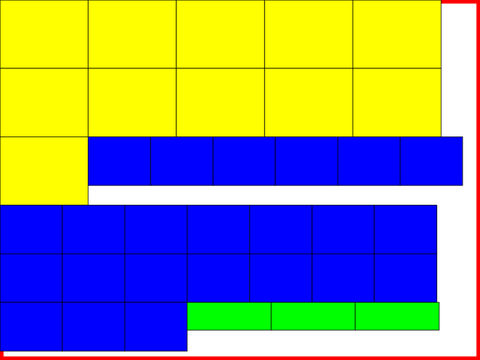
The dict container doesnt preserve order, but as XML doesnt require that, this is also not an issue. Arranging items in layers When it was decided, that I wanted to take the layered approach, it boiled down the 3D knapsack problem to a 2D knapsack problem. The problem statement now was: how to best fit small rectangles into a big rectangle? I decided for a simple and fast approach as it is explained in Jake Gordon's blog article. There is a demo of his code and should the site vanish from the net, the code is on github. This solution seemed to generate results that were "good enough" while simple to implement and fast to execute. If you look very hard, you can still see some design similarities between my arrange_spread.py and his packer.js code. Jake Gordon got his idea from Jim Scott who wrote an article of arranging randomly sized lightmaps into a bigger texture. There is also an ActiveState Code recipe from 2005 which looks very similar to the code by Jake Gordon. The posts of Jake Gordon and Jim Scott explain the solution well, so that I dont have to repeat it. Should the above resources go offline, I made backups of them here and here. There is also a backup of the ActiveState piece here. Spreading items out The algorithm above would cram all rectangles into a top-left position. As a result, there would mostly be space at the bottom and left edge of the available pallet surface. This is bad for two reasons:
  1. the mass is distributed unequally
  2. articles on the layer above at the bottom or left edge, are prone to overhang too much so that they tumble down
Instead all articles should be spread over the available pallet area, creating small gaps between them instead big spaces at the pallet borders. Since articles were of different size, it was not clear to me from the start what "equal distribution" would even mean because it was obvious that it was not as simple as making the space between all rectangles equal. The spacing had to be different between them to accommodate for differently sized boxes. The solution I came up with, made use of the tree structure, that was built by the algorithm that arranged the rectangles in the first place. The idea is, to spread articles vertically first, recursively starting with the deepest nodes and spreading them out in their parent rectangle. And then spreading them horizontally, spreading the upper nodes first, recursively resizing and spreading child nodes. The whole recursion idea created problems of its own. One of the nicest recursive beauty is the following function:
def get_max_horiz_nodes(node):
if node is None or not node['article']:
return [], []
elif node['down'] and node['down']['article']:
rightbranch, sr = get_max_horiz_nodes(node['right'])
rightbranch = [node] + rightbranch
downbranch, sd = get_max_horiz_nodes(node['down'])
ar = rightbranch[len(rightbranch)-1]['article']
ad = downbranch[len(downbranch)-1]['article']
if ar['x']+ar['width'] > ad['x']+ad['width']:
return rightbranch, sr+[downbranch[0]]
else:
return downbranch, sd+[rightbranch[0]]
else:
rightbranch, short = get_max_horiz_nodes(node['right'])
return [node] + rightbranch, short
get_max_horiz_nodes() traverses all branches of the tree that node has below itself and returns a tuple containing the list of nodes that form the branch that stretches out widest plus the list of nodes that are in the other branches (which are shorter than the widest). Another interesting problem was, how to decide on the gap between articles. This was interesting because the number resulting of the subtraction of the available length (or width) and the sum of the articles lengths (or widths), was mostly not divisible by the amount of gaps without leaving a rest. So there had to be an algorithm that gives me a list of integers, neither of them differing by more than one to any other, that when summed up, would give me the total amount of empty space. Or in other words: how to divide a number m into n integer pieces such that each of those integers doesnt differ more than 1 from any other. Surprisingly, generating this list doesnt contain any complex loop constructs:
>>> m = 108 # total amount
>>> n = 7 # number of pieces
>>> d,e = divmod(m, n)
>>> pieces = (e)*[(d+1)]+(n-e)*[d]
>>> print pieces
[16, 16, 16, 15, 15, 15, 15]
>>> sum(pieces) == m
True
>>> len(pieces) == n
True
You can test out the algorithms that arrange rectangles and spread them out by cloning the git and then running:
PYTHONPATH=. python legacy/arrange_spread.py
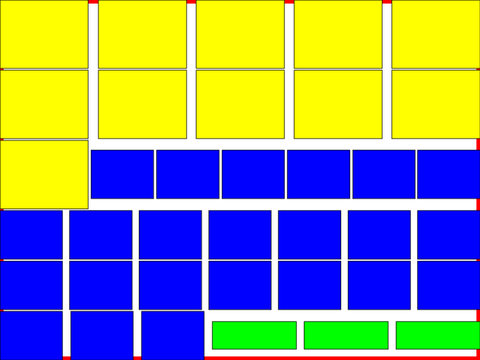
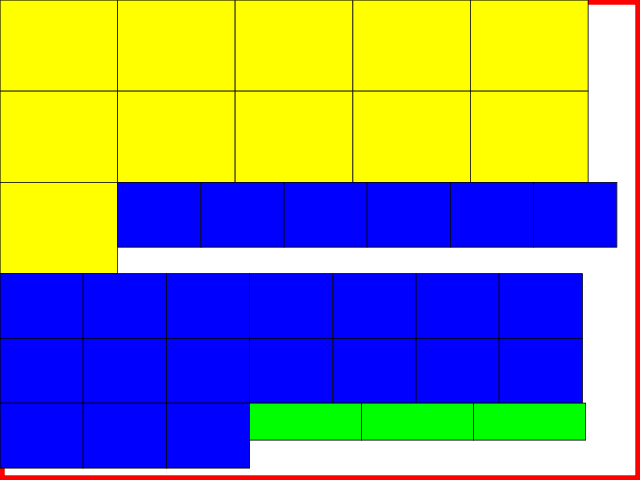
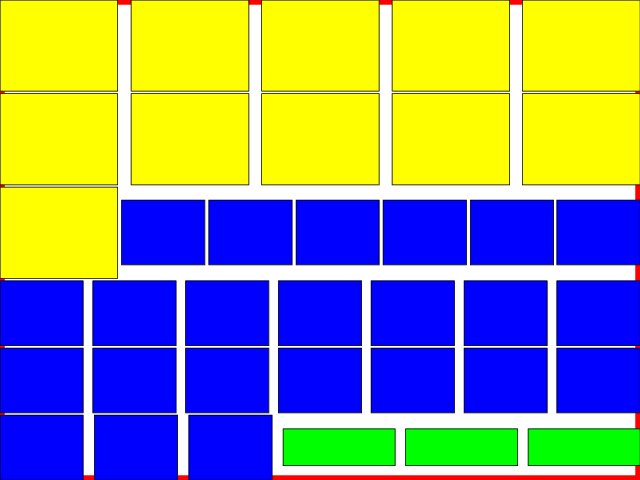
The results will be svg files test1.svg and test2.svg, the latter showing the spread-out result. Here is an example how the output looks like (without the red border which is drawn to mark the pallet border): arrange_spread2.py contains an adaption of arrange_spread.py for the actual problem. Permutations without known length When creating a layer out of articles of same height, then there are four strategies that I can choose from. It is four because there are two methods that I can either use or not. I can rotate the article by 90 per default or not and I can rotate the pallet or not. So every time that I build a new layer, there are those four options. Depending on which strategy I choose, there is a different amount of possible leftover articles that did not fit into any layer. The amount is different because each strategy is more or less efficient. To try out all combinations of possible layer arrangements, I have to walk through a tree where at each node I branch four times for each individual strategy. Individual neighboring nodes might be the same but this outcome is unlikely due to the path leading to those neighboring nodes being different. To simplify, lets name the four possible strategies for each layers 0, 1, 2 and 3. I now want an algorithm that enumerates through all possible permutations of those four numbers for "some" length. This is similar to counting. And the itertools module comes with the product() method that nearly does what I want. For example, should I know that my tree does not become deeper than 8 (read: no more than eight layers will be built), then I can just run:
>>> for i in itertools.product([0,1,2,3], repeat=8):
...     print i
...
(0,0,0,0,0,0,0,0)
(0,0,0,0,0,0,0,1)
(0,0,0,0,0,0,0,2)
(0,0,0,0,0,0,0,3)
(0,0,0,0,0,0,1,0)
(0,0,0,0,0,0,1,1)
(0,0,0,0,0,0,1,2)
(0,0,0,0,0,0,1,3)
This would work if the number of layers created with each strategy was the same. But as each strategy behaves differently depending on the input, it cannot be known before actually trying out a sequence of strategies, how many layers it will yield. The strategy (0,0,0,0,0,0,0,0) might create 7 layers, resulting in (0,0,0,0,0,0,0,1), (0,0,0,0,0,0,0,2) and (0,0,0,0,0,0,0,3) yielding the same output as only the first 7 strategies count. This would create duplicates which I should not waste cpu cycles on later. It might also be that (0,0,0,0,0,0,1,0) turns out to be a combination of strategies that creates more than 8 layers in which case the whole thing fails. So what I need is a generator, that gives me a new strategy depending on how often it is asked for one. It should dynamically extend the tree of possible permutations to accommodate for any size. Since the tree will become humongous (4^11 = 4194304), already traversed nodes should automatically be cleaned so that only the nodes that make the current list of strategies stays in memory at any point in time. This sounded all complicated which made me even more surprised by how simple the solution was in the end. Here a version of the algorithm that could easily be ported to C:
class Tree:
def __init__(self, branch_factor):
self.branch_factor = branch_factor
self.root = "value": None, "parent": None, "children": []
self.current = self.root

def next(self):
if not self.current["children"]:
self.current["children"] = [ "value":val, "parent":self.current, "children":[] for val in range(self.branch_factor)]
self.current = self.current["children"][0]
return self.current["value"]

def reset(self):
if self.current["parent"]:
self.current["parent"]["children"].pop(0)
else:
return False
if self.current["parent"]["children"]:
self.current = self.root
return True
else:
self.current = self.current["parent"]
return self.reset()

def __str__(self):
return str(self.root)
It would be used like this:
>>> tree = Tree(4)
>>> print tree.next(), tree.next(), tree.next()
>>> while tree.reset():
...     print tree.next(), tree.next(), tree.next()
Which would be equivalent to calling itertools.product([1,2,3,4], 3). The special part is, that in each iteration of the loop I can call tree.next() an arbitrary amount of times, just how much it is needed. Whenever I cannot generate an additional layer anymore, I can call tree.reset() to start a new permutation. For my code I used a python specific version which is a generator:
def product_varlength(branch_factor):
root = "value": None, "parent": None, "children": []
current = root
while True:
if not current["children"]:
current["children"] = [ "value":val, "parent":current, "children":[] for val in range(branch_factor)]
current = current["children"][0]
if (yield current["value"]):
while True:
if current["parent"]:
current["parent"]["children"].pop(0)
else:
return
if current["parent"]["children"]:
current = root
break
else:
current = current["parent"]
It is used like this:
it = product_varlength(4)
print it.next(), it.send(False), it.send(False)
while True:
    print it.send(True), it.send(False), it.send(False)
Again, the expression in the loop can have any number of it.send(False). The first it.send(True) tells the generator to do a reset.

20 May 2012

Cyril Brulebois: Busy Release Team

With the sound of the freeze approaching, we have been receiving a few more transition requests lately. Thankfully, a lot of them can apparently be processed at the same time, that's why we have currently the following, crazy tracker summary: Of course there are some transitions that started because maintainers forgot how transitions are supposed to work, but we re trying to get things done anyway.

19 May 2012

Richard Hartmann: Motherland's bosom

I read a translated poem about Russia being "the Motherland" and its vast bosom years ago. Having driven through a significant part of it, I can agree on the "vast" part... Also, as I am on a train and without access to the Internet, I will refrain from linking to a lot of pages; sorry. (Turns out I am posting this a week later, but I will still not link to stuff now; no time). Russia in general Moscow Sights Kreml Our remaining time in Moscow was spent with touring the usual suspects; the Kreml is a lot less impressive in real life, the Red Square is tiny when compared to the stories I heard about it and the Chapel ofi St. Basil is even more colorful and impressive in real life. Lenin's body was inaccessible because workers built seats for the May 9th parade to the left and the right of it and they apparently thought it would be a good idea to block access to one of the main tourist attractions while doing so. A river tour of Moscow was a nice cool-off and we got to see quite a few things. We managed to see the weekly military parade within the Kreml grounds, but it was mostly pomp and little substance. The National Treasure which you can access with an extra ticket within the Kreml grounds is nice, but less impressive than the tourist guides would make you believe. That being said... There's another museum within the museum and.... Whoah... Tourists pay extra, visitors go through the only non-security-theater check I encountered in Russia, guards are armed, people can only enter and leave in batches, and the stuff which is presented is mind-boggling. Disregarding the fist-to-calf-sized chunks of gold and platinum which are still in their original form directly from the mine, there is real, actual treasure galore. Little heaps of uncut and cut diamonds, an outline of Russia filled with cut diamonds and other random "we have this stuff" displays can be found as well. Then, you have various tiaras and other jewellery made from various gems. Not incorporating, but largely made of. All that pales in comparison to the crown, royal apple, scepter, etc. It's hard to put the amount of tiny multi-colored light points that shine at you into words. I was just standing there, swaying back and forth to catch the moving pattern of pinpoints. It's said that this collection is equalled only by the ones in the Tower of London and the one Shaw of Iran had and boy do I believe it. TV Tower Getting up there was funny. The old-style Soviet queuing system was used: "Security" for approaching the tower was multi-level, the guards see you approach along a long walkway way in advance and the main guard shed had several small cabins separated by thick glass. So good so menacing. But in a twist that would make Bizarro and Garry Larson proud, I was required, by means of metal detector gate, metal detector wand and even an x-ray machine to remove every shred of metal and other hard objects from myself and the camera bag and put them onto a table. Once I was without anything except my clothes and the bag was completely empty, I could pass. Everything I had had to remove was just laying there, not inspected in the least, for me to stuff back into pockets and bag and to take with me. This "everything" included a Spot Messenger 2 with lots of green and red blinky lights. The guard did not even glance and it. Security theater? Security theater. The view from 364 meters down on Moscow was nice, but there was a lot of Smog so I couldn't see very far. Jumping on the glass floor while looking down was a lot of fun, though. Subway to Thiefing I bet Christopher Nolan rode the subway in Moscow at least once. That unnerving sound you hear during several key scenes in "The Dark Knight"? Two thirds of all subways make the same sound while moving. Also, I had an encounter with a pickpocket down there; very classical, too. Guy approaches quickly, talks loudly and sounds as if it's really important (in Russian... duh... that's sure to keep me interested). His approach made me turn and protect my left leg pocket automatically, most likely marking the target for the tiny woman standing behind me. Now, I have to tell you something about my usual travel layout. As my normal pockets are very deep, it looks as if their content was in the leg pocket. Plus, there's an extra, hidden leg pocket where I keep the passports and train tickets. The outermost leg pocket is protected by a velcro flap, but it contains nothing of value; usually the appropriate phrasebook, local map, maybe a tissue or chewing gum. Due to this layering, the outermost pocket looks as if it's full to the brim with stuff. Also, I took pains to make it a habit to protect said leg pocket with my hand, nothing else. This looks as if that's the target, but what I am actually doing is protect my normal pocket with my forearm. The right side is different, but the most easily accessibly pocket always holds some small change. I pay from that stash but my actual wallet is well out of reach. Anyway, once the guy ran off, talking to several others, most likely marking all them for the actual pickpockets, I wanted to enter the subway. While the Russian-style queuing took place, I felt an unusual tug at the velcro flap. I looked down and saw a tiny woman to the left of me with a jacket held over her right side with the left arm; I look up to check no one is trying to steal from my permanently assigned female, feel another tug, look the woman into the eyes, look up again and around me, look down again and she is gone. All that took maybe three seconds and I had boarded the subway after an additional two. In hindsight, it makes sense to choose the time of entry for attack. It's crowded, you are being pushed around, and once you are in the subway, it will start moving more or less immediately while the thief remains in the station. In this case, she would only have gotten a grubby map of Moscow's subway and an English-Russian phrasebook, but she got nothing at all. Moscow-Novosibirsk Where to begin... If you think a few hours on a train are a long time, try over fifty hours. Things get so bad, you start getting land-sick while not in a moving train. You even start missing the familiar tunk-cachunk, tunk-cachunk, tunk-cachunk... of driving over rails with gaps in them when you are not moving. The defining element of the Trans-Siberian Railway are birch trees. And birch trees. And then more birch trees. You would not believe how many birch trees there are. This is made "worse" by the way the Russian Railway protects their rails. Left and right of the track, there's a cleared area of maybe ten to twenty meters, sometimes as little as three. Outside of that, they plant ten to twenty meters of birch trees, presumably to catch snow during winter. Beyond that protective perimeter, there's the normal landscape.As a result, on top of the near endless stretches of birch woods, you see most if not all scenery through a layer of birch trees. You get sick sick of birch trees after a few hours and you see them for days on end. Bullet points to save myself some typing and you some reading... Novosibirsk The non-existent hostel We arrived at ~0200 local and made our way to the hostel we had booked a room with. Walking to the correct address, we saw several signs but they all turned out to be for a police station and some other state agency. We walked back, forth, double-checked, triple-checked: no hostel. We then walked around the building through some not-quite-nice back alleys, but other than a few entries to private flats, there was nothing. Thankfully, the booking slip included a number which we called and after at least twenty rings (no kidding), when I had given up and wanted to hang up, it stopped ringing. Dead silence. After maybe ten seconds, someone started talking in Russian. I asked him if he spoke English and told him that we could not find the hostel. He mumbled something about being sorry and that we should wait, he would come down. Fast forward a minute or two and someone walked towards us. Again, he mumbled about being sorry, that the hostel "did not work" at the moment and that we would need to sleep in his private apartment. He ushered us into some back alley entrance, into his flat, and proceeded to remove the sheets from the couch on which he had slept; after putting on new sheets, we had our "hostel" bed, ready to sleep on. We briefly considered if he would murder us in our sleep, but him and me even got to talking a bit. Over cheese, sausage and rum (at 0300), he admitted that the hostel did not exist and he merely planned to turn his flat into a hostel for the summer while he and his family moved into their summer house (the Russian term of which escapes me, at the moment) in the countryside. He had accepted our reservation as he thought he would be finished by that time. He did not even get started, though. While he sent us an overbooking notice through booking.com two days before, we were on the train at that time, so... booking.com even called him to check what happenend to us as we did not book another place through them. Good customer service/protection, that. Next morning, he didn't even want to take our money (we paid anyway) and, as a means of compensation, drove us into the city in the morning and to a train museum well outside the city limits, one of the fabled scientist cities, and a large lake which everyone in Novosibirsk claims is an ocean, in the afternoon. Foreigners, foreigners! All in all, Novosibirsk was relatively uneventful, safe for one bizarre episode. We took our lunch in a local fast food joint (why do all the good stories happen there, and not at the various truly local places?) and threw the cashier our well-rehearsed "Niet Russkie; anglisky?" with phrasebook in hand and he actually understood a few words of English (beef, chicken, fries). We told him, in our worst Russian, that we are from Germany wished him a nice day and went to sit down. A few minutes later, a girl approached us, literally hopping from one foot to the other and wringing her hands. She told us that the cashier had told her that we spoke English and if it would be OK if she talked to us. We suspected some sort of elaborate ruse, but went with it. Turns out, she had English at school and really wanted someone to practice English on. Two young men passed our table and exchanged a few words with her, sitting down out of sight. When she told us that she had to leave now but if it would be OK if the two boys joined us we suspected a ruse yet again. But those two were law students, one with a minor in English and one with a minor in German; both of them also extremely nervous, asking us if we would talk to them. When they had to leave, they told us that the three of them worked at the burger joint and that their shift was just about to start when the news that foreigners were here spread amongst staff like wildfire. The girl stopped by several times in between cleaning tables, getting in a sentence or two before being cussed at by her supervisor. All in all, this took about twenty minutes and seeing three people so nervous and grateful to talk with us felt beyond absurd. On the other hand, not a single traveller we met even considered stopping in Novosibirsk during their transit so there really does seem to be a shortage of non-Russians there. Weird, and memorable. Novosibirsk-Irkutsk Irkutsk / Listvianka / Lake Baikal Listvianka Aah, lake Baikal... the oldest and deepest lake on Earth which holds a fifth of the global non-salt water reserves; a must-see in my book. Quad tours at break-neck speeds, dry-suit diving with Russian regulators, walking barefoot in between and across drift ice that made its way onto the shorei, and extended hiking around the lake's coast... All of which I could not do because I was ill and had to spend two solid days in bed. The draft from the open window in between Novosibirsk and Irkutsk was enough to give me a rather bad cold which peaked at Lake Baikal. Still, the area was lovely and we were glad to be out of a train and able to unpack our stuff without having to repack immediately for once. I am not sure where my current losing streak with regards to diving is coming from (Grimsey, diving north of the Arctic circle with birds that plummet into the water and hunt fish: Only guy who does this is on the Icelandic mainland that day; Svalbard, diving north of the Arctic circle in permanent darkness: The few people who do this privately did not reply while I was there; Baikal, oldest, deepest, largest lake on Earth: ill), but I will most likely return to Russia for a week of ice diving in Lake Baikal next winter or the one after that. As an aside, I saw several people walking to Lake Baikal with buckets to get their water. Other people got it from a well which was still half frozen. If you have running water consider yourself lucky... Irkutsk Nice city, largely uneventful. The farther east you get within Russia, the more normal women look. In Moscow, just as in Paris, they are way over-dressed and even service personnel will walk with high heels. Thankfully, I don't have to wear heels, but for the other males out there: Walking and standing in these things hurts and thus most if not all people who stand and walk for a living have flat shoes. We happened upon preparations for a military parade, complete with cordon, viewing podests, at least half a dozen TV cameras etc, but were not sure if it would start soon enough for us to catch our train.We asked someone who told us it would start at 2100 local, at 1945 local it seemed about to start, and sure enough at 1955 sharp, the whole thing went under way. About a dozen groups of 50-100 people each, all in their own, respective uniforms stood against one side of a cordoned-off street and several higher-ups on the other side. Two highest-ups shouted into microphones and the throng of people on the other side shouted back answers. Then, the two highest-ups stood in the back of a jeep each and drove past said throng, stopping in front of each group, shouting into microphones mounted in the back of the jeeps and the groups shouted back once again. After that, all groups marched around the make-shift plaza once, saluting the higher ups. Once they were done, and they took ages, two trucks drove by with soldiers jumping out of the moving trucks and moving into crouching positions. They ran around in a circle a few times and engaged in pretend hand-to-hand combat. I am sure they are skilled at whatever style they wanted to show, but they were overdoing things so badly, they were funny, not imposing. When they jumped over some barriers, the barriers fell to pieces and everyone scrambled to make it look as if that was part of the show. While carrying off the gear, it fell into further pieces which was even more funny. An armoured personnel carrier ended the show; several tougher looking guys jumped off of that one and their mock combat involved fully automatic fire (of blanks), several flashbangs, smoke grenades and, to top things off, the machine gun mounted on the APC moving down the opposing team with blanks. I never witnessed a "real" military parade in person but this one was somewhat disappointing. On the one hand, there was a distinct lack of ballistic missile carriers and tanks like you see in movies, documentaries and games, on the other hand, the whole thing had a make-do feeling to it. The cordoning police had designated spots to stand on, yet walked around. They were standing to attention, yet checking their cell phones. Several people in one uniformed group were wearing track suits and jeans. Another uniformed guy had a grocery bag with him; yet another one was carrying a huge water bottle. Bikers zig-zagged through the cordon and when the whole show was just about to wrap up the police finally started putting up barriers around the unmoving pedestrians, not blocking the bikers. One little girl was standing well within the cordoned area, watching with big eyes and after she did not react to the police talking to her, they just built the barriers in a curve around her. And to top it all off, some guy with a cane walked all through the parade with his personal camcorder, trying to direct the whole show while being ignored by everyone. Still, I am sure he managed to mess up some otherwise perfectly good TV scenes. Irkutsk-Russian border TL;DR 3000 kilometers of birch trees

Next.

Previous.