Search Results: "ah"

23 March 2011

Kumar Appaiah: Review of "Linux Shell Scripting Cookbook"

I have been reading Linux Shell Scripting Cookbook by Sarath Lakshman, published by Packt, for a while. While most people I know learn shell scripts themselves, I was looking to refresh my concepts a little as well as have a reference lying around on the table for fast access. Since I was asked to review it for someone else, I thought I might as well post the review here.First of all, let me remark by saying that shell scripting is something learned more on a need basis than as a tool to solve the main problem. People would seldom write shell scripts as standalone programs (exceptions exist). However, what makes shell scripting invaluable to know is the fact that knowing some tricks can save several minutes, or hours, of work by automating and simplifying certain tasks, generally (but not restricted to) file management and data processing. Linux Shell Scripting Cookbook does go quite far in pursuing this goal, and is appropriate for both beginners who are looking to gain dexterity in shell scripting, as well as intermediate users who wish to polish their skills. The book also can double up as a quick reference, though I would argue that the "Advanced Bash Scripting Guide" would suit that more.At the outset, the author clarifies that the focus will be on Bash. This, people may or may not like, but the fact that bash has become ubiquitous in terms of the available shells on Unix-like systems today, starting out with bash is not a bad thing to do. Besides, learning other shell scripting languages while knowing bash isn't too hard, since the paradigm remains the same.Let's go through the books from the aspects I found most relevant.OrganizationThe book is organized into chapters based more on utility than scripting concepts themselves, although the language aspects are brought onto the reader gradually. For instance, the examples in the first chapter focus more on the basic data elements (variables, arrays, functions etc.) as well as operators (for numbers, files etc.), and all the examples demonstrate simple usage of these concepts, and he further chapters build upon these in a gradual manner.At the same time, if the reader has some familiarity with shell scripting and needs to only refresh or learn a certain concept, he/she needs to just read the relevant chapter. It is not too difficult to grasp the examples of the later chapters, provided some basic shell knowledge is assumed.Content and PresentationA positive trait in the presentation of this book is that it is all based on practical everyday examples which, with minor adaptation, can be used by many for their own daily tasks. For instance, there are several examples which describe searching for and processing files, which, I'd imagine, many users would want to do on a regular basis. Thus, providing realistic examples allows the book to double its utility. The language and approach used is simple and conversational, and the presentation is very clear, with each idea being described as a problem statement followed by a "How to do it" section with the actual code, and ending with a discussion of the nitty-gritties of the code. It is easy to go for a quick scan for those in a hurry, while those who with to read in more detail will not be disappointed either.The book also covers a wide array of applications. For instance, there are examples on automating fetching web pages and processing them, demonstrations of parsing and simplifying and even some queries around databases wrapped around in shell. It also spans to utilities and tasks connected to statistics, backups, compression, version control and many more.Breadth and DepthThe book goes into a fair amount of detail in terms of describing the shell scripting concept under consideration. The examples used go into a fair amount of detail in order to describe to the user all the aspects involved in the method or command being used. The concepts described are fairly complete, and would be sufficient for the reader to use immediately or with just a little bit of fine tuning. In terms of breadth, the book covers most of the features of shell scripting while also describing the various facilities the shell provides access to in a Unix-like environment. Thus, the book does not disappoint in this front either.In summary...In summary, probably the only thing I'd have liked to see more of is some emphasis on how to write more efficient shell scripts. Granted, most of the shell scripts described in the book are very simple and succinct, but a some words on how loops can be made better, or how to spot situations where pipes are not needed to solve a problem etc. might have been a nice addition. Some explanation of differences with dash, tcsh, zsh etc. might also have been nice, since a lot of users have different default shells. But all this isn't going to prevent me from giving this book a high rating, since it delivers quite well on the promises it makes at the beginning.This is definitely a good book to have near your desk, and kudos to the author for having taken the effort to put it together. I would highly recommend it to the beginner and occasional shell user for a thorough read, and to an intermediate to have on his/her desk for borrowing the cool scripting ideas and applications the author has written in this book.

Kapil Paranjape: John Willard Milnor: Abel Prize 2011

The Abel prize for 2011 has been awarded to John Willard Milnor.[1] In response to a query from Dr. R. Ramachandran who writes about Science and Science Policy for The Hindu'' newspaper group, I wrote the following short piece which others may find interesting as well. Milnor is well-known for his work on topology and geometry. He has also made significant contributions to algebra and even number theory. In addition, he has written a number of books which are loved by graduate students in Mathematics all over the world. One of the striking early results of Milnor was the example he gave of a seven dimensional space which is topologically a sphere but its geometric (differentiable) structure is different. This was the first example of an "exotic sphere". A nice way to state his main result (due to Ajit Sanzgiri) is that "Groups of homotopy spheres are homotopy groups of spheres". Milnor received the Fields' Medal in 1962. In addition, the work of a number of later Fields' medallists such as Donaldson, Thurston, Mori and Voevodsky can be seen as having roots in the work of Milnor.
A more personal perspective The first time I came across the name Milnor was when I heard that the only dimensions in which one can do algebra with division is 1, 2, 4 and 8; I was told that an "easy" proof was based on Characteristic Classes on which Milnor had written a nice book. In later years, I read a number of his other books like Topology from a differentiable viewpoint'', Morse theory'', Isolated singularities of complex hypersurfaces'' and Algebraic K-theory''. These books not only explained the results and definitions, but laid the foundations of my geometric intuition --- the same is probably true for many others in my generation. When I joined TIFR, Raghunathan was full of praise for the work of Milnor and how his deep ideas on differential topology would "lead somewhere". One of the first lectures in our graduate seminar was by Ajit Sanzgiri on Milnor's paper on exotic spheres --- the title of the talk was Groups of homotopy spheres are homotopy groups of spheres''. When Srinivas taught me (algebraic) K-theory, the only available reference text was Milnor's book (Milnor K-theory forms a crucial component of Voevodsky's early 21st century work that won him his Fields Medal!); since then Srinivas has written a more modern and comprehensive book on the topic. Later, when A. J. Parameswaran started work on his Ph.D. under the guidance of Srinivas, AJP and I read Milnor's book on isolated singularities together --- as a prelude to the sequel to Milnor's book (by Looijenga). Much of the modern work on the algebraic theory of singularities (which forms a crucial component of Mori's Fields medal winning work on terminal three dimensional singularities) starts with the notion of "Milnor number" and "Milnor fibrations". If the impact of a mathematician is to be measured not only by his own fantastic results but the great results of others that grow out of his work, then Milnor is certainly one of the greats of the latter half of the twentieth century. Much of the topology and geometry that I have used in my work relies on simpler versions of Milnor's results that were proved by his predecessors. So (unfortunately!) I cannot quote a result that I have proved which actually uses a theorem of Milnor's.
Groups of homotopy spheres are homotopy spheres'' I think the idea of joining two spaces by a tube to make a new space (called connected sum) is due to Whitney or Kervaire. This leads the "algebra of spaces" or to give it its mathematical name "the cobordism group". Milnor showed us how to perform calculations with this group. Another group studied by topologists combines the different ways in which a sphere of one dimension wraps around'' a sphere of a (possibly) different dimension; this is called a homotopy group of the second sphere. Milnor's brilliant idea was to show that in certain cases, the two groups obtained are the same. Said pithily, "Groups of homotopy spheres (exotic spheres)" are the same as "homotopy groups of spheres".
Some remarks A number of people have remarked that what we need in order for institutes like IISER to grow are teaching researchers''. The system of universities in the USA has thrown up a few shining examples --- Richard Feynman in Physics and John Milnor in Mathematics are two names that immediately spring to mind.

[1]The last time I wrote about the Abel Prize was to contribute to a guest post to Rahul Basu's science blog: The Far Side. Unfortunately, Rahul is no longer among us. This post is dedicated to the memory of Rahul Basu.

22 March 2011

Gunnar Wolf: Lets go to Nicaragua, 2012!

Ok, so finally it is official! We just had the DebConf 12 decision meeting. We saw two great proposals, from the cities of Belo Horizonte, Brazil and Managua, Nicaragua. If you are curious on the decision process: We held it over two IRC channels The moderated #debconf-team channel, where only the five members of the decision committee (Marga Manterola, Andrew McMillan, Jeremiah Foster, Holger Levsen, Moray Allan) and two members from each of the bids (Marco T lio Gontijo e Silva and Rafael Cunha de Almeida from Brazil; Leonardo G mez and Eduardo Rosales from Nicaragua) had voices, and the open #dc12-discuss channel where we had an open discussion. Of course, you can get the full conversation logs in those links. I have to thank and congratulate the Brazilian team as they did a great work... The decision was very tight. It was so tight, in fact, that towards the end of the winning all of the committee members were too shy to state the results - so I kidnapped the process by announcing the winner ;-) (I hope that does not cast a shadow of illegitimacy over it) And, very much worth noting, both teams were also very professional: In previous years, we have seen such decisions degenerate into personal attacks and very ugly situations. That has always been painful and unfortunate. And although the Brazilians will not be able to go celebrate tonight, the decision was received with civility, knowing it was a decision among equals, and a decision well carried out. Well, that's it I am very much looking forward for that peculiar two weeks when the whole Debian family meets, this year to be held in Banja Luka, Bosnia-Herzegovina, and I am very eager towards meeting in 2012 in Managua, Nicaragua! Yay!

21 March 2011

Craig Small: Silly C errors in gjay

I have been working on gjay to add support for Music Player Daemon where I had what initially looked like a strange problem. When WITH_MPDCLIENT was defined, the program would crash in all sorts of wierd places when the main program structure had this:
#ifdef WITH_MPDCLIENT
struct mpd_connection *mpdclient_connection;
#endif /* WITH_MPDCLIENT */
But would work fine when it was:
struct mpd_connection *mpdclient_connection;
#ifdef WITH_MPDCLIENT
#endif /* WITH_MPDCLIENT */
I tried changing the structure to just void *blah to see if it made a difference and it didn t. The program would crash every time. The answer was pretty simple in the end. The WITH_MPDCLIENT is defined in the file config.h and not every c source file was including it. Needless to say, they should! So half the program was using one version of the structure and the other was using another; no wonder the whole program was a mess because anything beyond this entry in the structure would be a few bytes out. With that little insanity out of the way i can get back to making gjay work with mpd.

18 March 2011

Kai Wasserb ch: KVIrc updates (ahead)

For the users of Debian Squeeze we, the KVIrc maintainers, plan to upload the soon-to-be-released upstream bug fix release 4.0.4, packages of RC2 are available. RC2 is most likely going to be identical to the final 4.0.4 release. The update will be, if the SRMs agree (still need to ask them, but I wanted to wait for the final version before I do that), uploaded to stable-proposed-updates, maybe squeeze-updates and fix a few nasty bugs, which some users might experience, including graphical glitches when used under Gnome (upstream bug #1010), some crashes (e.g. upstream bugs #878, #879, #1093, #1098 and some without bug numbers like r4796), a regression in the Perl scripting support and a lot of translation updates (btw: if you use KVIrc and the translation for your mothertounge is lacking, consider to help! Coordinate your efforts on IRC.) Apart from that I just uploaded a new SVN snapshot of 4.1 into Sid, the next will follow in about ten days unless you report bugs, which make an earlier upload necessary. ;-)

Adnan Hodzic: Debian CUT, a new rolling release?

This post is also available on/was written for OMG! Ubuntu

It looks like 2011 started well for Debian. The project won awards in two out of seven categories at the Linux New Media Awards 2011 ( Best Open Source Server Distribution and Outstanding Contribution to Open Source/Linux/Free Software ). Just recently Internet.com declared Debian the most influential distribution ever, stating that ~63% of all distributions now being developed come ultimately from Debian. However, my intention for this article is not solely to praise Debian for its recent awards, but rather to focus on a new project, Debian CUT. Don t be surprised if you haven t heard about CUT; it seems most Debian community hasn t either. Then again, maybe it s because it is only labelled as unofficial/development so far.
A bit of history One of the greatest criticisms of Debian is that its release cycles are too long. Debian stable release is seen as often as Ubuntu s LTS release. As a server solution this doesn t present a problem at all, it can even seen as a pro. However, for desktop use and for your average Joe who needs to have the latest software and is unable to get it, this may well present a problem. Of course he can always turn to backports to get what he needs but by the time you have finished reading this very sentence, Joe has already moved to Ubuntu. For those who are completely unaware how things work within Debian, let me try to shed some light. Debian has 3 main branches: Unstable , is a branch used mainly by developers, where the latest changes to the software they are working on are made. Usually, after approximately 10 days this software is pushed to testing , branch which is going to become next Debian stable release. For comparison, in the process of a new Ubuntu release at one point in this process, changes from testing/unstable are frozen where Ubuntu fixes bugs until they are ready to release new Ubuntu release. Debian s testing branch is said by some to be more stable then most of the stable distributions out there. Last but not least is stable branch, which follows the (in)famous mantra it s released when it s ready , although last two releases have been released in a more timely manner. Okay, so what is Debian CUT? The idea stretches back more then 2 years, to Joey Hess proposing the idea of Constantly Usable Testing . For users/developers who can t wait ~2 years to see new Debian release, they usually turn to Debian testing branch. To clarify, testing images are released weekly, but most of us in Debian don t recommend you jump to testing by installing it from weekly image, but rather by upgrading from stable. To make the situation even worse, these builds frequently don t work due to all the changes that have been pushed from unstable. But this is where Constantly Usable Testing idea comes in, where the installer is always installable and you re already using what s going to be next stable release. You wouldn t have to worry about whether the next update is going to break your system, but would get regular security updates, while the big updates would come in shape of new testing snapshot versions. Frequency of release of these snapshots is ought to be on monthly basis, so you can plan on seeing the next release on April 6th (exactly one month after the current release, provided of course if there are no showstopper bugs). To sum it all up, you wouldn t have to wait ~2 years before new Stable release shows up, nor (in case you have already switched to testing) would you have to worry whether your next update will break your system. You would get your updates in form of timely (ie: monthly) snapshots until it s time for major milestone which would turn out to be new Debian release. Even though this might be long term goal, in these early stages no one can guarantees this. Rolling release? The simplest way to explain this concept is that there are two types of Linux distributions: one with milestone version numbers and other where new updates keep coming through their rolling release cycles. Some of the rolling distributions are Gentoo and Arch Linux, while on the other side you have RedHat and Suse. Novell announced that OpenSuse is moving to rolling release with project codename Tumbleweed. It s also worth mentioning that Debian already has its rolling counters and perfect examples are: LMDE and aptosid. It is a way to continuously develop software, a way that best fits Debian as a platform where software is continuously developed. Especially because most of its greatest values could get lost with the release of that big stable version . Perfect case of that could be the almost drop of Chromium in Squeeze. Another great example could be Android, which is criticised most for its versioning. Companies are refusing to release new Android versions to their current phones, because they want you to buy new phone with latest Android version, even though your current one is perfectly capable of running latest Android. Personally, I m sure the future will reveal that rolling releases are the future, towards which all Linux platforms should be heading. Perhaps the definition of rolling releases I gave earlier is why I believe this project has such bright future ahead of it. Debian would be somewhat of a hybrid of this definition, it would be rolling release until it s time to mark a big milestone with a version number, and before you know it, we re rolling again. Unofficial Debian Monthly Testing Snapshot Release (version 2011.03 final) Michael Gilbert took on a big responsibility, trying experimentally to prove the feasibility of such a project. He has released a first wheezy snapshot installer (versioned 2011.03) as a test for the development community to try out and evaluate. Please read official announcement along with download links. While you can use this snapshot to have constantly working installer, after it is installed you could move to testing altogether if you wish. Conclusion As I have already mentioned, this project is still in the development/experimental stage, which makes all of this its very conception. Also, apart from rumors of Ubuntu becoming rolling release, if Ubuntu is to get its rolling release this how it s going to get it Smile If you d like to find out more about Debian CUT, I suggest you read Raphael Hertzog s article A constantly usable testing distribution for Debian , and watch the video of Joey Hess CUT BoF on DebConf10 in NYC. Of course, if you d like to get involved into this project, please use the project s mailing list. If you have any comments, please do share, as I d be happy to answer any of your questions.

16 March 2011

Daniel Kahn Gillmor: CryptLib and the OpenSSL License

I spent part of today looking at packaging Peter Gutmann's CryptLib for debian. My conclusion: it may not be worth my time. One of the main reasons i wanted to package it for debian is because i would like to see more OpenPGP-compliant free software available to debian users and developers, particularly if the code is GPL-compatible. Cryptlib makes it quite clear that it intends to be GPL-compatible:
cryptlib is distributed under a dual license that allows free, open-source use under a GPL-compatible license and closed-source use under a standard commercial license.
However, a significant portion of the cryptlib codebase (particularly within the bn/ and crypt/ directories) appears to derive directly from OpenSSL, and it retains Eric Young's copyright and licensing. This licensing retains the so-called "advertising clause" that is generally acknowledged to be deliberately incompatible with the GPL. (A common counterargument for this incompatibility is that OpenSSL should be considered a "System Library" for GPL'ed tools that link against it; whether or not you believe this for tools linked against OpenSSL, this counterargument clearly does not hold for a project that embeds and ships OpenSSL code directly, as CryptLib does) This does not mean that CryptLib is not free software (it is!), nor does it mean that you cannot link it against GPL'ed code (you can!). However, you probably can't distribute the results of linking CryptLib against any GPL'ed code, because the GPL is incompatible with the OpenSSL license. The un-distributability of derived GPL-covered works makes the CryptLib package much less appealing to me, since i want to be able to write distributable code that links against useful libraries, and many of the libaries i care about happen to be under the GPL. I also note that Peter Gutmann and CryptLib Security Software (apparently some sort of company set up to distribute CryptLib) may be in violation of Eric Young's License, which states:
 * 3. All advertising materials mentioning features or use of this software
 *    must display the following acknowledgement:
 *    "This product includes cryptographic software written by
 *     Eric Young (eay@cryptsoft.com)"
 *    The word 'cryptographic' can be left out if the rouines from the library
 *    being used are not cryptographic related :-).
A Google search for Eric Young's name on cryptlib.com yields no hits. I do find his name on page 340 of the Cryptlib manual, but that hardly seems like it covers "All advertising materials mentioning features or use of this software". I suppose it's also possible that CryptLib has negotiated an alternate license with Eric Young that I simply don't know about. In summary: i think CryptLib could go into debian, but its incorporation of OpenSSL-licensed code makes it less useful than i was hoping it would be. I have a few other concerns about the package after looking it over in more detail. I suspect these are fixable one way or another, but i haven't sorted them out yet. I'm not sure i'll spend the time to do so based on the licensing issues i sorted out above. But in case anyone feels inspired, the other concerns i see are:
embedded code copies
In addition to embedded (and slightly-modified) copies of bn/ and crypt/ from OpenSSL, CryptLib contains an embedded copy of zlib. Debian has good reasons for wanting to avoid embedded code copies. I've got it CryptLib building against the system copy of zlib, but the bits copied from OpenSSL seem to be more heavily patched, which might complicate relying on the system version.
executable stack
lintian reports shlib-with-executable-stack for the library after it is built. I don't fully understand what this means or how to fix it, but i suspect it derives from the following set of object files that also have an executable stack:
0 dkg@pip:~/src/cryptlib/cryptlib$ for foo in $(find . -iname '*.o'); do
>  if ! readelf -S "$foo"   grep -q .note.GNU-stack ; then
>   echo "$foo"
>  fi
> done
./shared-obj/desenc.o
./shared-obj/rc5enc.o
./shared-obj/md5asm.o
./shared-obj/castenc.o
./shared-obj/bfenc.o
./shared-obj/rmdasm.o
./shared-obj/sha1asm.o
./shared-obj/bn_asm.o
./shared-obj/rc4enc.o
0 dkg@pip:~/src/cryptlib/cryptlib$ 
They probably all need to be fixed, unless there's a good reason for them to be that way (in which case they need to be documented).
non-PIC code
lintian reports shlib-with-non-pic-code on the library after it is built. I don't fully understand what this means, or how to resolve it cleanly, but i imagine this is just a question of sorting out the details.
Anyone interested in using my packaging attempts as a jumping off point can start with:
git clone git://lair.fifthhorseman.net/~dkg/cryptlib
Oh, and please correct me about anything in this post; I'd be especially happy to hear that my analysis of the licensing issues above is wrong :) Tags: cryptlib, gpl, licensing, openssl

15 March 2011

Michal Čihař: GPL violation - getting more sources

It has been some time since I updated information about Gammu usage in proprietary software, so here it comes (see other posts tagged with gpl for more information). I still have troubles to explain Anwsoft what they are supposed to release. The good news is that they are still communicating and even providing some updated sources (see git repository), unfortunately they still construct fake projects rather than providing real sources of the application. Anyway if anybody is interested in digging in the sources and finding bits which might be interesting for porting to current Gammu code base, please go ahead, I probably won't have time for that in near future.

Filed under: English Gammu Gpl 3 comments Flattr this!

Colin Watson: Wubi bug 693671

I spent most of last week working on Ubuntu bug 693671 ("wubi install will not boot - phase 2 stops with: Try (hd0,0): NTFS5"), which was quite a challenge to debug since it involved digging into parts of the Wubi boot process I'd never really touched before. Since I don't think much of this is very well-documented, I'd like to spend a bit of time explaining what was involved, in the hope that it will help other developers in the future. Wubi is a system for installing Ubuntu into a file in a Windows filesystem, so that it doesn't require separate partitions and can be uninstalled like any other Windows application. The purpose of this is to make it easy for Windows users to try out Ubuntu without the need to worry about repartitioning, before they commit to a full installation. Wubi started out as an external project, and initially patched the installer on the fly to do all the rather unconventional things it needed to do; we integrated it into Ubuntu 8.04 LTS, which involved turning these patches into proper installer facilities that could be accessed using preseeding, so that Wubi only needs to handle the Windows user interface and other Windows-specific tasks. Anyone familiar with a GNU/Linux system's boot process will immediately see that this isn't as simple as it sounds. Of course, ntfs-3g is a pretty solid piece of software so we can handle the Windows filesystem without too much trouble, and loopback mounts are well-understood so we can just have the initramfs loop-mount the root filesystem. Where are you going to get the kernel and initramfs from, though? Well, we used to copy them out to the NTFS filesystem so that GRUB could read them, but this was overly complicated and error-prone. When we switched to GRUB 2, we could instead use its built-in loopback facilities, and we were able to simplify this. So all was more or less well, except for the elephant in the room. How are you going to load GRUB? In a Wubi installation, NTLDR (or BOOTMGR in Windows Vista and newer) still owns the boot process. Ubuntu is added as a boot menu option using BCDEdit. You might then think that you can just have the Windows boot loader chain-load GRUB. Unfortunately, NTLDR only loads 16 sectors - 8192 bytes - from disk. GRUB won't fit in that: the smallest core.img you can generate at the moment is over 18 kilobytes. Thus, you need something that is small enough to be loaded by NTLDR, but that is intelligent enough to understand NTFS to the point where it can find a particular file in the root directory of a filesystem, load boot loader code from it, and jump to that. The answer for this was GRUB4DOS. Most of GRUB4DOS is based on GRUB Legacy, which is not of much interest to us any more, but it includes an assembly-language program called GRLDR that supports doing this very thing for FAT, NTFS, and ext2. In Wubi, we build GRLDR as wubildr.mbr, and build a specially-configured GRUB core image as wubildr. Now, the messages shown in the bug report suggested a failure either within GRLDR or very early in GRUB. The first thing I did was to remember that GRLDR has been integrated into the grub-extras ntldr-img module suitable for use with GRUB 2, so I tried building wubildr.mbr from that; no change, but this gave me a modern baseline to work on. OK; now to try QEMU (you can use tricks like qemu -hda /dev/sda if you're very careful not to do anything that might involve writing to the host filesystem from within the guest, such as recursively booting your host OS ... [update: Tollef Fog Heen and Zygmunt Krynicki both point out that you can use the -snapshot option to make this safer]). No go; it hung somewhere in the middle of NTLDR. Still, I could at least insert debug statements, copy the built wubildr.mbr over to my test machine, and reboot for each test, although it would be slow and tedious. Couldn't I? Well, yes, I mostly could, but that 8192-byte limit came back to bite me, along with an internal 2048-byte limit that GRLDR allocates for its NTFS bootstrap code. There were only a few spare bytes. Something like this would more or less fit, to print a single mark character at various points so that I could see how far it was getting:
	pushal
	xorw	%bx, %bx	/* video page 0 */
	movw	$0x0e4d, %ax	/* print 'M' */
	int	$0x10
	popal
In a few places, if I removed some code I didn't need on my test machine (say, CHS compatibility), I could even fit in cheap and nasty code to print a single register in hex (as long as you didn't mind 'A' to 'F' actually being ':' to '?' in ASCII; and note that this is real-mode code, so the loop counter is %cx not %ecx):
	/* print %edx in dumbed-down hex */
	pushal
	xorw	%bx, %bx
	movb	$0xe, %ah
	movw	$8, %cx
1:
	roll	$4, %edx
	movb	%dl, %al
	andb	$0xf, %al
	int	$0x10
	loop	1b
	popal
After a considerable amount of work tracking down problems by bisection like this, I also observed that GRLDR's NTFS code bears quite a bit of resemblance in its logical flow to GRUB 2's NTFS module, and indeed the same person wrote much of both. Since I knew that the latter worked, I could use it to relieve my brain of trying to understand assembly code logic directly, and could compare the two to look for discrepancies. I did find a few of these, and corrected a simple one. Testing at this point suggested that the boot process was getting as far as GRUB but still wasn't printing anything. I removed some Ubuntu patches which quieten down GRUB's startup: still nothing - so I switched my attentions to grub-core/kern/i386/pc/startup.S, which contains the first code executed from GRUB's core image. Code before the first call to real_to_prot (which switches the processor into protected mode) succeeded, while code after that point failed. Even more mysteriously, code added to real_to_prot before the actual switch to protected mode failed too. Now I was clearly getting somewhere interesting, but what was going on? What I really wanted was to be able to single-step, or at least see what was at the memory location it was supposed to be jumping to. Around this point I was venting on IRC, and somebody asked if it was reproducible in QEMU. Although I'd tried that already, I went back and tried again. Ubuntu's qemu is actually built from qemu-kvm, and if I used qemu -no-kvm then it worked much better. Excellent! Now I could use GDB:
(gdb) target remote   qemu -gdb stdio -no-kvm -hda /dev/sda
This let me run until the point when NTLDR was about to hand over control, then interrupt and set a breakpoint at 0x8200 (the entry point of startup.S). This revealed that the address that should have been real_to_prot was in fact garbage. I set a breakpoint at 0x7c00 (GRLDR's entry point) and stepped all the way through to ensure it was doing the right thing. In the process it was helpful to know that GDB and QEMU don't handle real mode very well between them. Useful tricks here were: Single-stepping showed that GRLDR was loading the entirety of wubildr correctly and jumping to it. The first instruction it jumped to wasn't in startup.S, though, and then I remembered that we prefix the core image with grub-core/boot/i386/pc/lnxboot.S. Stepping through this required a clear head since it copies itself around and changes segment registers a few times. The interesting part was at real_code_2, where it copies a sector of the kernel to the target load address, and then checks a known offset to find out whether the "kernel" is in fact GRUB rather than a Linux kernel. I checked that offset by hand, and there was the smoking gun. GRUB recently acquired Reed-Solomon error correction on its core image, to allow it to recover from other software writing over sectors in the boot track. This moved the magic number lnxboot.S was checking somewhat further into the core image, after the first sector. lnxboot.S couldn't find it because it hadn't copied it yet! A bit of adjustment and all was well again. The lesson for me from all of this has been to try hard to get an interactive debugger working. Really hard. It's worth quite a bit of up-front effort if it saves you from killing neurons stepping through pages of code by hand. I think the real-mode debugging tricks I picked up should be useful for working on GRUB in the future.

14 March 2011

Axel Beckert: Planet Commandline officially online

Around the first bunch of postings in my Useful but Unknown Unix Tools, Tobias Klauser of inotail and Symlink fame came up with the idea of making a Planet (i.e. a blog aggregator) of all the comandline blogs and blog categories out there. A first Planet Venus running prototype based on the template and style sheets of Planet Symlink was quickly up and running. I just couldn t decide if I should use an amber or phosphor green style for this new planet. Marius Rieder finally had the right idea to solve this dilemma: Offer both, an amber and a phosphor green style. Christian Herzog pointed me to the right piece of code at A List Apart. So here is it, available in you favourite screen colors:

Planet Commandline For a beginning, the following feeds are included:

Which leads us to the discussion what kind of feeds should be included in Planet Commandline. Of course, all blogs or blog categories which (nearly) solely post neat tips and tricks about the command line in English are welcome. Microblogging feeds containing (only) small but useful command line tips are welcome, too, if they neither permanently contain dozens of posts per day nor have a low signal-to-noise ratio. Unfortunately most identi.ca groups do, so they re not suitable for such a planet. What I m though unsure about are non-English feeds. Yes, there s one in already, but I noticed this only after including Beat s Chr tertee and his FreeBSD command line tips are really good. So if it doesn t go overboard, I think it s ok. If there are too many non-English feeds, I ll probably split Planet Commandline off into at least three Planets: One with all feeds, one with English only and one with all non-English feeds or maybe even one feed per language. But for now that s still a long way off. Another thing I m unsure about are more propgram specific blogs like the impressive Mastering Emacs blog about mastering the world s best text editor . *g* (Yeah, I didn t include that one yet. But as soon someone shows me the vi-equivalent of that blog, I ll include both. Anyone thinks, spf13 s vim category is up to that?) Oh, and sure, any shell-specific (zsh, tcsh, bash, mksh, busybox) tips & tricks blogs don t count as program-specific blogs like some $EDITOR, $BROWSER, or $VCS specific blogs do. :-) Of course I m happy about further suggestions for feeds to include in Planet Commandline. Just remember that the feed should provide (at least nearly) exclusively command line tips, tricks or howtos. Suggestions for links to other commandline related planets are welcome, too.

Colin Watson: Wubi bug 693671

I spent most of last week working on Ubuntu bug 693671 ("wubi install will not boot - phase 2 stops with: Try (hd0,0): NTFS5"), which was quite a challenge to debug since it involved digging into parts of the Wubi boot process I'd never really touched before. Since I don't think much of this is very well-documented, I'd like to spend a bit of time explaining what was involved, in the hope that it will help other developers in the future. Wubi is a system for installing Ubuntu into a file in a Windows filesystem, so that it doesn't require separate partitions and can be uninstalled like any other Windows application. The purpose of this is to make it easy for Windows users to try out Ubuntu without the need to worry about repartitioning, before they commit to a full installation. Wubi started out as an external project, and initially patched the installer on the fly to do all the rather unconventional things it needed to do; we integrated it into Ubuntu 8.04 LTS, which involved turning these patches into proper installer facilities that could be accessed using preseeding, so that Wubi only needs to handle the Windows user interface and other Windows-specific tasks. Anyone familiar with a GNU/Linux system's boot process will immediately see that this isn't as simple as it sounds. Of course, ntfs-3g is a pretty solid piece of software so we can handle the Windows filesystem without too much trouble, and loopback mounts are well-understood so we can just have the initramfs loop-mount the root filesystem. Where are you going to get the kernel and initramfs from, though? Well, we used to copy them out to the NTFS filesystem so that GRUB could read them, but this was overly complicated and error-prone. When we switched to GRUB 2, we could instead use its built-in loopback facilities, and we were able to simplify this. So all was more or less well, except for the elephant in the room. How are you going to load GRUB? In a Wubi installation, NTLDR (or BOOTMGR in Windows Vista and newer) still owns the boot process. Ubuntu is added as a boot menu option using BCDEdit. You might then think that you can just have the Windows boot loader chain-load GRUB. Unfortunately, NTLDR only loads 16 sectors - 8192 bytes - from disk. GRUB won't fit in that: the smallest core.img you can generate at the moment is over 18 kilobytes. Thus, you need something that is small enough to be loaded by NTLDR, but that is intelligent enough to understand NTFS to the point where it can find a particular file in the root directory of a filesystem, load boot loader code from it, and jump to that. The answer for this was GRUB4DOS. Most of GRUB4DOS is based on GRUB Legacy, which is not of much interest to us any more, but it includes an assembly-language program called GRLDR that supports doing this very thing for FAT, NTFS, and ext2. In Wubi, we build GRLDR as wubildr.mbr, and build a specially-configured GRUB core image as wubildr. Now, the messages shown in the bug report suggested a failure either within GRLDR or very early in GRUB. The first thing I did was to remember that GRLDR has been integrated into the grub-extras ntldr-img module suitable for use with GRUB 2, so I tried building wubildr.mbr from that; no change, but this gave me a modern baseline to work on. OK; now to try QEMU (you can use tricks like qemu -hda /dev/sda if you're very careful not to do anything that might involve writing to the host filesystem from within the guest, such as recursively booting your host OS ...). No go; it hung somewhere in the middle of NTLDR. Still, I could at least insert debug statements, copy the built wubildr.mbr over to my test machine, and reboot for each test, although it would be slow and tedious. Couldn't I? Well, yes, I mostly could, but that 8192-byte limit came back to bite me, along with an internal 2048-byte limit that GRLDR allocates for its NTFS bootstrap code. There were only a few spare bytes. Something like this would more or less fit, to print a single mark character at various points so that I could see how far it was getting:
	pushal
	xorw	%bx, %bx	/* video page 0 */
	movw	$0x0e4d, %ax	/* print 'M' */
	int	$0x10
	popal
In a few places, if I removed some code I didn't need on my test machine (say, CHS compatibility), I could even fit in cheap and nasty code to print a single register in hex (as long as you didn't mind 'A' to 'F' actually being ':' to '?' in ASCII; and note that this is real-mode code, so the loop counter is %cx not %ecx):
	/* print %edx in dumbed-down hex */
	pushal
	xorw	%bx, %bx
	movb	$0xe, %ah
	movw	$8, %cx
1:
	roll	$4, %edx
	movb	%dl, %al
	andb	$0xf, %al
	int	$0x10
	loop	1b
	popal
After a considerable amount of work tracking down problems by bisection like this, I also observed that GRLDR's NTFS code bears quite a bit of resemblance in its logical flow to GRUB 2's NTFS module, and indeed the same person wrote much of both. Since I knew that the latter worked, I could use it to relieve my brain of trying to understand assembly code logic directly, and could compare the two to look for discrepancies. I did find a few of these, and corrected a simple one. Testing at this point suggested that the boot process was getting as far as GRUB but still wasn't printing anything. I removed some Ubuntu patches which quieten down GRUB's startup: still nothing - so I switched my attentions to grub-core/kern/i386/pc/startup.S, which contains the first code executed from GRUB's core image. Code before the first call to real_to_prot (which switches the processor into protected mode) succeeded, while code after that point failed. Even more mysteriously, code added to real_to_prot before the actual switch to protected mode failed too. Now I was clearly getting somewhere interesting, but what was going on? What I really wanted was to be able to single-step, or at least see what was at the memory location it was supposed to be jumping to. Around this point I was venting on IRC, and somebody asked if it was reproducible in QEMU. Although I'd tried that already, I went back and tried again. Ubuntu's qemu is actually built from qemu-kvm, and if I used qemu -no-kvm then it worked much better. Excellent! Now I could use GDB:
(gdb) target remote   qemu -gdb stdio -no-kvm -hda /dev/sda
This let me run until the point when NTLDR was about to hand over control, then interrupt and set a breakpoint at 0x8200 (the entry point of startup.S). This revealed that the address that should have been real_to_prot was in fact garbage. I set a breakpoint at 0x7c00 (GRLDR's entry point) and stepped all the way through to ensure it was doing the right thing. In the process it was helpful to know that GDB and QEMU don't handle real mode very well between them. Useful tricks here were: Single-stepping showed that GRLDR was loading the entirety of wubildr correctly and jumping to it. The first instruction it jumped to wasn't in startup.S, though, and then I remembered that we prefix the core image with grub-core/boot/i386/pc/lnxboot.S. Stepping through this required a clear head since it copies itself around and changes segment registers a few times. The interesting part was at real_code_2, where it copies a sector of the kernel to the target load address, and then checks a known offset to find out whether the "kernel" is in fact GRUB rather than a Linux kernel. I checked that offset by hand, and there was the smoking gun. GRUB recently acquired Reed-Solomon error correction on its core image, to allow it to recover from other software writing over sectors in the boot track. This moved the magic number lnxboot.S was checking somewhat further into the core image, after the first sector. lnxboot.S couldn't find it because it hadn't copied it yet! A bit of adjustment and all was well again. The lesson for me from all of this has been to try hard to get an interactive debugger working. Really hard. It's worth quite a bit of up-front effort if it saves you from killing neurons stepping through pages of code by hand. I think the real-mode debugging tricks I picked up should be useful for working on GRUB in the future.

13 March 2011

Francois Marier: Setting up RAID on an existing Debian/Ubuntu installation

I run RAID1 on all of the machines I support. While such hard disk mirroring is not a replacement for having good working backups, it means that a single drive failure is not going to force me to have to spend lots of time rebuilding a machine.

The best possible time to set this up is of course when you first install the operating system. The Debian installer will set everything up for you if you choose that option and Ubuntu has alternate installation CDs which allow you to do the same.

This post documents the steps I followed to retrofit RAID1 into an existing Debian squeeze installation. Getting a mirrored setup after the fact.

OverviewBefore you start, make sure the following packages are installed:
apt-get install mdadm rsync initramfs-tools
Then go through these steps:
  1. Partition the new drive.
  2. Create new degraded RAID arrays.
  3. Install GRUB2 on both drives.
  4. Copy existing data onto the new drive.
  5. Reboot using the RAIDed drive and test system.
  6. Wipe the original drive by adding it to the RAID array.
  7. Test booting off of the original drive.
  8. Resync drives.
  9. Test booting off of the new drive.
  10. Reboot with the two drives and resync the array.
(My instructions are mostly based on this old tutorial but also on this more recent one.)

1- Partition the new driveOnce you have connected the new drive (/dev/sdb), boot into your system and use one of cfdisk or fdisk to display the partition information for the existing drive (/dev/sda on my system).

The idea is to create partitions of the same size on the new drive. (If the new drive is bigger, leave the rest of the drive unpartitioned.)

Partition types should all be: fd (or "linux raid autodetect").

2- Create new degraded RAID arraysThe newly partioned drive, consisting of a root and a swap partition, can be added to new RAID1 arrays using mdadm:
mdadm --create /dev/md0 --level=1 --raid-devices=2 missing /dev/sdb1
mdadm --create /dev/md1 --level=1 --raid-devices=2 missing /dev/sdb2
and formatted like this:
mkswap /dev/md1
mkfs.ext4 /dev/md0
Specify these devices explicitly in /etc/mdadm/mdadm.conf:
DEVICE /dev/sda* /dev/sdb*
and append the RAID arrays to the end of that file:
mdadm --detail --scan >> /etc/mdadm/mdadm.conf
dpkg-reconfigure mdadm
You can check the status of your RAID arrays at any time by running this command:
cat /proc/mdstat

3- Install GRUB2 on both drivesThe best way to ensure that GRUB2, the default bootloader in Debian and Ubuntu, is installed on both drives is to reconfigure its package:
dpkg-reconfigure grub-pc
and select both /dev/sda and /dev/sdb (but not /dev/md0) as installation targets.

This should cause the init ramdisk (/boot/initrd.img-2.6.32-5-amd64) and the grub menu (/boot/grub/grub.cfg) to be rebuilt with RAID support.

4- Copy existing data onto the new driveCopy everything that's on the existing drive onto the new one using rsync:
mkdir /tmp/mntroot
mount /dev/md0 /tmp/mntroot
rsync -auHxv --exclude=/proc/* --exclude=/sys/* --exclude=/tmp/* /* /tmp/mntroot/

5- Reboot using the RAIDed drive and test systemBefore rebooting, open /tmp/mntroot/etc/fstab, and change /dev/sda1 and /dev/sda2 to /dev/md0 and /dev/md1 respectively.

Then reboot and from within the GRUB menu, hit "e" to enter edit mode and make sure that you will be booting off of the new disk:
set root='(md/0)'
linux /boot/vmlinuz-2.6.32-5-amd64 root=/dev/md0 ro quiet
Once the system is up, you can check that the root partition is indeed using the RAID array by running mount and looking for something like:
/dev/md0 on / type ext4 (rw,noatime,errors=remount-ro)

6- Wipe the original drive by adding it to the RAID arrayOnce you have verified that everything is working on /dev/sdb, it's time to change the partition types on /dev/sda to fd and to add the original drive to the degraded RAID array:
mdadm /dev/md0 -a /dev/sda1
mdadm /dev/md1 -a /dev/sda2
You'll have to wait until the two partitions are fully synchronized but you can check the sync status using:
watch -n1 cat /proc/mdstat

7- Test booting off of the original driveOnce the sync is finished, update the boot loader menu:
update-grub
and shut the system down:
shutdown -h now
before physically disconnecting /dev/sdb and turning the machine back on to test booting with only /dev/sda present.

After a successful boot, shut the machine down and plug the second drive back in before powering it up again.

8- Resync drivesIf everything works, you should see the following after running cat /proc/mdstat:
md0 : active raid1 sda1[1]
280567040 blocks [2/1] [_U]
indicating that the RAID array is incomplete and that the second drive is not part of it.

To add the second drive back in and start the sync again:
mdadm /dev/md0 -a /dev/sdb1

9- Test booting off of the new driveTo complete the testing, shut the machine down, pull /dev/sda out and try booting with /dev/sdb only.

10- Reboot with the two drives and resync the arrayOnce you are satisfied that it works, reboot with both drives plugged in and re-add the first drive to the array:
mdadm /dev/md0 -a /dev/sda1
Your setup is now complete and fully tested.

Ongoing maintenanceI recommend making sure the two RAIDed drives stay in sync by enabling periodic RAID checks. The easiest way is to enable the checks that are built into the Debian package:
dpkg-reconfigure mdadm
but you can also create a weekly or monthly cronjob which does the following:
echo "check" > /sys/block/md0/md/sync_action
Something else you should seriously consider is to install the smartmontools package and run weekly SMART checks by putting something like this in your /etc/smartd.conf:
/dev/sda -a -d ata -o on -S on -s (S/../.././02 L/../../6/03)
/dev/sdb -a -d ata -o on -S on -s (S/../.././02 L/../../6/03)
These checks, performed by the hard disk controllers directly, could warn you of imminent failures ahead of time. Personally, when I start seeing errors in the SMART log (smartctl -a /dev/sda), I order a new drive straight away.

Lars Wirzenius: DPL elections: candidate counts

Out of curiosity, and because it is Sunday morning and I have a cold and can't get my brain to do anything tricky, I counted the number of candidates in each year's DPL elections.
Year Count Names
1999 4 Joseph Carter, Ben Collins, Wichert Akkerman, Richard Braakman
2000 4 Ben Collins, Wichert Akkerman, Joel Klecker, Matthew Vernon
2001 4 Branden Robinson, Anand Kumria, Ben Collins, Bdale Garbee
2002 3 Branden Robinson, Rapha l Hertzog, Bdale Garbee
2003 4 Moshe Zadka, Bdale Garbee, Branden Robinson, Martin Michlmayr
2004 3 Martin Michlmayr, Gergely Nagy, Branden Robinson
2005 6 Matthew Garrett, Andreas Schuldei, Angus Lees, Anthony Towns, Jonathan Walther, Branden Robinson
2006 7 Jeroen van Wolffelaar, Ari Pollak, Steve McIntyre, Anthony Towns, Andreas Schuldei, Jonathan (Ted) Walther, Bill Allombert
2007 8 Wouter Verhelst, Aigars Mahinovs, Gustavo Franco, Sam Hocevar, Steve McIntyre, Rapha l Hertzog, Anthony Towns, Simon Richter
2008 3 Marc Brockschmidt, Rapha l Hertzog, Steve McIntyre
2009 2 Stefano Zacchiroli, Steve McIntyre
2010 4 Stefano Zacchiroli, Wouter Verhelst, Charles Plessy, Margarita Manterola
2011 1 Stefano Zacchiroli (no vote yet)
Winner indicate by boldface. I expect Zack to win over "None Of The Above", so I went ahead and boldfaced him already, even if there has not been a vote for this year. Median number of candidates is 4.

10 March 2011

Alessio Treglia: To tablet or not to tablet, to tablet or not to tablet, to tablet or

Well, I ve found the answer :) (To be continued )

9 March 2011

Rog rio Brito: (Some) Solutions with Chromium

In my previous post, I was pointing out some of my frustrations with Chromium/Chrome. A very kind reader, Timo Juhani Lindfors, gave me answers to many of the problems that I pointed out and got me straight on some issues:
  • I can disable full zoom in Iceweasel (i.e., I only want to zoom the text, not the images). According to Chromium's project BTS, it seems that this will be a WONTFIX bug, despite many people asking for it (and it having a lot of duplicates).
Timo told me that there is an extension called "Font Size Increase" (ID: ombpcpigmndepfckcifdblemkabaoihk) that adds a button on the side of the URL bar that you can click to increase the size of the text, without affecting the size of the images. Highly recommended. Not that I need this one as much as "Font Size Increase", but there is also a "Font Size Decrease" (ID: mpajngnpcmjjeoflljdjpnehcfaldcia) that, as the name implies, decreases the size of the text. It is nice to have this one when you clicked on the button to increase the size of the font one or two times too many.
  • In Iceweasel, I have a way (without resorting to many extensions or hackish solutions) to use the equivalent of Firefox's "View > Page Style > No Style" (i.e., to ignore any CSS sheet that the document author may have specified on the page).
Timo also told me that there is a very cool extension called "Chrome Page Style" (ID: ddpkgkegfklikkmfmneldonhldahhacb) that allows you to alternate between stylesheets provided by the page (see Joey Hess's ikiwiki's CSS Market for an example of that). It also has the possibility of disabling all the CSS'es that a page may have, which, in many cases around the web actually improves the readability of the pages, for many "fancy" things detract from readability, especially if you have poor eyesight. Although I had said that I didn't want to resort to extensions, this was a simple solution enough that made me consider revisit my requirements. I do, though, wonder why some frequently used extensions are not built into the programs from stock.
  • In Iceweasel, I can press Ctrl+Q and make the damn browser quit, instead of me having to use the mouse/trackpad/pointing device. This is probably a lack of my understanding on how to associate key bindings to Chromium, but the problem still stands.
Of course, Timo also set me straight and told me about Ctrl+Shift+Q for that purpose, which I had missed completely.
  • Similarly, when there is only one tab open, pressing Ctrl+W in Chromium does not close the tab (say, presenting me a blank tab or the list of most visited sites), nor it closes the application.
As a poor writing of my part, Ctrl+W does close the tabs. But when there is only one tab present, it doesn't close the window. I'm OK with that, since I now know the way to close the window. Thanks again Timo. Oh, and one point that may not be known by many is that using about:flags in Chrome does something analogue to Firefox's about:config (even with the warning). And tweaking with it you can try to see if you can enable hardware acceleration of some parts of your pages, as present in newer releases of Chromium. So, there I am: way more satisfied than with earlier with Chromium, but still having Firefox/Iceweasel as my primary browser. Good to have two usable browsers now.

7 March 2011

Daniel Kahn Gillmor: PHP, MySQL, and SSL?

Is there a way to access a MySQL database over the network from PHP and be confident that As far as i can tell, when using the stock MySQL bindings, setting MYSQL_CLIENT_SSL is purely advisory (i.e. it won't fail if the server doesn't advertise SSL support). This means it won't defend against an active network attacker performing the equivalent of sslstrip. Even if MYSQL_CLIENT_SSL was stronger than an advisory flag, i can't seem to come up with a way to tell PHP's basic MySQL bindings the equivalent of the --ssl-ca flag to the mysql client binary. Without being able to configure this, a "man-in-the-middle" should be able to intercept the connection by offering their own certificate on their endpoint, and otherwise relaying the traffic. A client that does not verify the server's identity would be none the wiser. One option to avoid a MITM attack would be for the server to require client-side certs via the REQUIRE option for a GRANT statement, but the basic MySQL bindings for php don't seem to support that either. PHP's mysqli bindings (MySQL Improved, i think) feature a command called ssl_set() which appears to allow client-side certificate support. But its documentation isn't clear on how it handles an invalid/expired/revoked server certificate (let alone a server that announces that it doesn't support SSL), and it also mentions:
This function does nothing unless OpenSSL support is enabled.
Given that debian MySQL packages don't use OpenSSL because of licensing incompatibilities with the GPL, i'm left wondering if packages built against yaSSL support this feature. And i'm more than a little bit leery that i have no way of telling whether my configuration request succeeded, or whether this function just happily did nothing because the interpreter got re-built with the wrong flags. Shouldn't the function fail explicitly if it cannot meet the user's request? Meanwhile, the PDO bindings for MySQL apparently don't support SSL connections at all. What's going on here? Does no one use MySQL over the network via PHP? Given the number of LAMP-driven data centers, this seems pretty unlikely. Do PHP+MySQL users just not care about privacy or integrity of their data? Or (please let this be the case) have i just somehow missed the obvious documentation? Tags: mysql, php, question, security, ssl, tls

5 March 2011

John Goerzen: Visiting Purdue

Terah went to college at Purdue University, and always enjoyed basketball games there. I ve not been much of a sports fan, but have enjoyed watching Purdue games with her on TV. Terah has been wanting to see a game in person for awhile, so a couple of weeks ago, we went. It was a really fun weekend! When we planed the trip, we had no idea that the Purdue-Ohio State game was going to be such a big one. We walked over from the Union Club Hotel where we were staying on the Purdue campus. People were streaming towards Mackey Arena from all directions. Once inside, it was already loud and buzzing people cheering, the band playing. I ve never experienced anything quite so loud. The game started out badly for Purdue; they were down a few points up front. The entire game was a close one, and the crowd sometimes got so loud that nothing else could be heard not even the band or the announcer. When it became clear at the end that Purdue won the game, the people behind me and apparently 12,000 others began screaming at the top of their lungs. My hearing did eventually return to normal. So did my throat, which had gotten rather sore from from cheering myself. This was our first road trip since I got my amateur radio license. I had a lot of fun visiting with people as we drove. I talked to a retired railroad engineer that used to take an amateur radio with him in his locomotive. As he went through a certain town where he had friends he liked to talk with on the radio, he d get their attention by blowing CQ in Morse code with the train s whistle. Some people in Kansas City had us laughing as we passed through. In Missouri, I talked with some farmers and a World War II vet. In Champaign, IL, I visited with a retired Unix systems administrator that had spent decades working with Unix operating systems. Our hotel was connected to the Purdue Memorial Union, a large and historic building. Besides having some ice cream at the Sweet Shop one evening, we also spent a bit of time exploring it. I noticed that the Purdue Amateur Radio Club was having a testing session in there. We walked past once it was underway, and one of the students was not very busy. I introduced myself and asked if we could see their shack. It was neat to see all the equipment some of it quite old in the room that they must have been using for decades. Terah, of course, had ideas for visiting a number of her favorite places while we were there. We visited Arni s and Bruno s, both pizza places. Bruno s happens to be a Swiss pizza place, so much to my surprise, I had Wienerschnitzel there, which was excellent. We ate a (week late) Valentine s dinner at Bistro 501. On our way back, we also chatted with various people on the radio, though not quite as much. We got helpful suggestions for which route to take, and stopped at the excellent Bobby D s Merchant St. BBQ in Emporia, KS for supper. The boys had also enjoyed their weekend with grandparents, but were glad to see us back. They were particularly interested to see a lot of train videos from Youtube with me the next day.

3 March 2011

Kumar Appaiah: A new book on shell scripting

Over the next month or so, I've decided to read an interesting book which covers one of my favourite topics, shell scripting. The book is Linux Shell Scripting Cookbook. It has been quite a while since I have actually read a book on a programming topic (other than K&R or the like), but I guess it does feel "complete" to gain knowledge from a book and feel as though we have gained at least some mastery over the topic!Updates on this will follow.

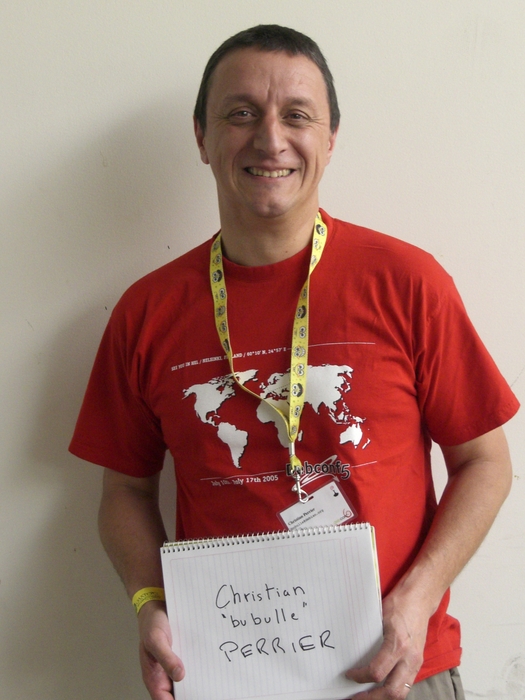
Raphaël Hertzog: People behind Debian: Christian Perrier, translation coordinator

Christian is a figure of Debian, not only because of the tremendous coordination work that he does within the translation project, but also because he s very involved at the social level. He s probably in the top 5 of the persons who attended most often the Debian conference. Christian is a friend (thanks for hosting me so many times when I come to Paris for Debian related events) and I m glad that he accepted to be interviewed. He likes to speak and that shows in the length of his answers :-) but you ll be traveling the world while reading him. My questions are in bold, the rest is by Christian. Who are you? I am a French citizen (which is easy to guess unless you correct my usual mistakes in what follows). I m immensely proud of being married for nearly 26 years with Elizabeth (who deserves a statue from Debian for being so patient with my passion and my dedication to the project). I m also the proud father of 3 wonderful kids , aged 19 to 23. I work as team manager in the Networks and Computers Division of Onera the French Aerospace lab , a public research institute about Aeronautics, Space and Defense. My team provides computer management services for research divisions of Onera, with a specific focus put on individual computing. I entered the world of free software as one of the very first users of Linux in France. Back in the early 1990 s, I happened (though the BBS users communities) to be a friend of several early adopters of Linux and/or BSD386/FreeBSD/NetBSD in France. More specifically, I discovered Linux thanks with my friend Ren Cougnenc (all my free software talks are dedicated to Ren , who passed away in 1996). You re not a programmer, not even a packager. How did you come to Debian? I m definitely not a programmer and I never studied computing (I graduated in Materials Science and worked in that area for a few years after my PhD). However, my daily work always involved computing (I redesigned the creep testing laboratory and its acquisition system all by myself during my thesis research work). An my hobbies often involved playing with home computers, always trying to learn about something new. So, first learning about a new operating system then trying to figure out how to become involved in its development was quite a logical choice. Debian is my distro of choice since it exists. I used Slackware on work machines for a while, but my home server, kheops, first ran Debian 1.1 when I stopped running a BBS on an MS-DOS machine to host a news server. That was back in October 1996. I then happened to be a user, and more specifically a user of genealogy software, also participating very actively in Usenet from this home computer and server, that was running this Debian thing. So, progressively, I joined mailing lists and, being a passionate person, I tried to figure out how I could bring my own little contribution to all this. This is why I became a packager (yes, I am one!) by taking over the geneweb package, which I was using to publish my genealogy research. I applied as DD in January 2001, then got my account in July 2001. My first upload to the Debian archive occurred on August 22nd 2001: that was of course geneweb, which I still maintain. Quite quickly, I became involved in the work on French localization. I have always been a strong supporter of localized software (I even translated a few BBS software back in the early 90 s) as one of the way to bring the power and richness of free software to more users. Localization work lead me to work on the early version of Debian Installer, during those 2003-2005 years where the development of D-I was an incredibly motivating and challenging task, lead by Joey Hess and his inspiring ideas. From user to contributor to leader, I suddenly discovered, around 2004, that I became the coordinator of D-I i18n (internationalization) without even noticing :-) You re the main translation coordinator in Debian. What plans and goals have you set for Debian Wheezy? As always: paint the world in red. Indeed, this is my goal for years. I would like our favorite distro to be able to be used by anyone in the world, whether she speaks English, Northern Sami, Wolof, Uyghur or Secwepemcts n. As a matter of symbol, I use the installer for this. My stance is that one should be able to even install Debian in one s own language. So, for about 7 years, I use D-I as a way to attract new localization contributors. This progress is represented on this page where the world is gradually painted in red as long as the installer supports more languages release after release. The map above tries to illustrate this by painting in red countries when the most spoken language in the country is supported in Debian Installer. However, that map does not give enough reward to many great efforts made to support very different kind of languages. Not only various national languages, but also very different ones: all regional languages of Spain, many of the most spoken languages in India, minority languages such as Uyghur for which an effort is starting, Northern Sami because it is taught in a few schools in Norway, etc., etc. Still, the map gives a good idea of what I would like to see better supported: languages from Africa, several languages in Central Asia. And, as a very very personal goal, I m eagerly waiting for support of Tibetan in Debian Installer, the same way we support its sister language, Dzongkha from Bhutan. For this to happen, we have to make contribution to localization as easy as possible. The very distributed nature of Debian development makes this a challenge, as material to translate (D-I components, debconf screens, native packages, packages descriptions, website, documentation) is very widely spread. A goal, for years, is to set a centralized place where translators could work easily without even knowing about SVN/GIT/BZR or having to report bugs to send their work. The point, however, would be to have this without making compromises on translation quality. So, with peer review, use of thesaurus and translation memory and all such techniques. Tools for this exist: we, for instance, worked with the developers of Pootle to help making it able to cope with the huge amount of material in Debian (think about packages descriptions translations). However, as of now, the glue between such tools and the raw material (that often lies in packages) didn t come. So, currently, translation work in Debian requires a great knowledge of how things are organized, where is the material, how it can be possible to make contribution reach packages, etc. And, as I m technically unable to fulfill the goal of building the infrastructure, I m fulfilling that role of spreading out the knowledge. This is how I can define my coordinator role. Ubuntu uses a web-based tool to make it easy to contribute translations directly in Launchpad. At some point you asked Canonical to make it free software. Launchpad has been freed in the mean time. Have you (re)considered using it? Why not? After all, it more or less fills in the needs I just described. I still don t really figure out how we could have all Debian material gathered in Rosetta/Launchpad .and also how Debian packagers could easily get localized material back from the framework without changing their development processes. I have always tried to stay neutral wrt Ubuntu. As many people now in Debian, I feel like we have reached a good way to achieve our mutual development. When it comes at localization work, the early days where the everything in Rosetta and translates who wants stanza did a lot of harm to several upstream localization projects is, I think, way over. Many people who currently contribute to D-I localization were indeed sent to me by Ubuntu contributors .and by localizing D-I, apt, debconf, package descriptions, etc., they re doing translation work for Ubuntu as well as for Debian. Let s say I m a Debian user and I want to help translate Debian in my language. I can spend 1 hour per week on this activity. What should I do to start? Several language teams use Debian mailing lists to coordinate their work. If you re lucky enough to be a speaker of one of these languages, try joining debian-l10n-<yourlanguage> and follow what s happening there. Don t try to immediately jump in some translation work. First, participate to peer reviews: comment on others translations. Learn about the team s processes, jargon and habits. Then, progressively, start working on a few translations: you may want to start with translations of debconf templates: they are short, often easy to do. That s perfect if you have few time. If no language team exists for your language, try joining debian-i18n and ask about existing effort for your language. I may be able to point you to individuals working on Debian translations (very often along with other free software translation efforts). If I am not, then you have just been named coordinator for your language :-) I may even ask you if you want to work on translating the Debian Installer. What s the biggest problem of Debian? We have no problems, we only have solutions :-) We are maybe facing a growth problem for a few years. Despite the increased welcoming aspects of our processes (Debian Maintainers), Debian is having hard times in growing. The overall number of active contributors is probably stagnating for quite a while. I m still amazed, however, to see how we can cope with that and still be able to release over the years. So, after all, this is maybe not a problem :-) Many people would point communication problems here. I don t. I think that communication inside the Debian project is working fairly well now. Our famous flame wars do of course still happen from time to time, but what large free software project doesn t have flame wars? In many areas, we indeed improved communication very significantly. I want to take as an example the way the release of squeeze has been managed. I think that the release team did, even more this time, a very significant and visible effort to communicate with the entire project. And the release of squeeze has been a great success in that matter. So, there s nearly nothing that frustrates me in Debian. Even when a random developer breaks my beloved 100% completeness of French translations, I m not frustrated for more than 2 minutes. You re known in the Debian community as the organizer of the Cheese & Wine Party during DebConf. Can you tell us what this is about? This is an interesting story about how things build themselves in Debian. It all started in July 2005, before DebConf 5 in Helsinki. Denis Barbier, Nicolas Fran ois and myself agreed to bring at Debconf a few pieces of French cheese as well as 1 or 2 bottles of French wine and share them with some friends. Thus, we settled an informal meeting in the French room where we invited some fellows: from memory, Benjamin Mako Hill, Hannah Wallach, Matt Zimmermann and Moray Allan. All of us fond of smelly cheese, great wine plus some extra p t home-made by Denis in Toulouse. It finally happened that, by word of mouth, a few dozens of other people slowly joined in that French room and turned the whole thing into an improvized party that more or less lasted for the entire night. The tradition was later firmly settled in 2006, first in Debconf 6 in Mexico where I challenged the French DDs to bring as many great cheese as possible, then during the Debian i18n meeting in Extremadura (Sept 2006) where we reached the highest amount of cheese per participant ever. I think that the Creofonte building in Casar de C ceres hasn t fully recovered from it and is still smelling cheese 5 years after. This party later became a real tradition for DebConf, growing over and over each year. I see it as a wonderful way to illustrate the diversity we have in Debian, as well as the mutual enrichment we always felt during DebConfs. My only regret about it is that it became so big over the years that organizing it is always a challenge and I more and more feel pressure to make it successful. However, over the years, I always found incredible help by DebConf participants (including my own son, last year a moment of sharing which we will both remember for years, i think). And, really, in 2010, standing up on a chair, shouting (because the microphone wasn t working) to thank everybody, was the most emotional moment I had at Debconf 10. Is there someone in Debian that you admire for their contributions? So many people. So, just like it happens in many awards ceremonies, I will be very verbose to thank people, sorry in advance for this. The name that comes first is Joey Hess. Joey is someone who has a unique way to perceive what improvements are good for Debian and a very precise and meticulous way to design these improvements. Think about debconf. It is designed for so long now and still reaching its very specific goal. So well designed that it is the entire basis for Joey s other achievement: designing D-I. Moreover, I not only admire Joey for his technical work, but also for his interaction with others. He is not he loudest person around, he doesn t have to .just giving his point in discussion and, guess what? Most of the time, he s right. Someone I would like to name here, also, is Colin Watson. Colin is also someone I worked with for years (the D-I effect, again ) and, here again, the very clever way he works on technical improvements as well as his very friendly way to interact with others just make it. And, how about you, Rapha l? :-) I m really admirative of the way you work on promoting technical work on Debian. Your natural ability to explain things (as good in English as it is in French) and your motivation to share your knowledge are a great benefit for the project. Not to mention the technical achievements you made with Guillem on dpkg of course! Another person I d like to name here is Steve Langasek. We both maintain samba packages for years and collaboration with him has always been a pleasure. Just like Colin, Steve is IMHO a model to follow when it comes at people who work for Canonical while continuing their involvment in Debian. And, indeed, Steve is so patient with my mistakes and stupid questions in samba packaging that he deserves a statue. We re now reaching the end of the year where Stefano Zacchiroli was the Debian Project Leader. And, no offense intended to people who were DPL before him (all of them being people I consider to be friends of mine), I think he did the best term ever. Zack is wonderful in sharing his enthusiasm about Debian and has a unique way to do it. Up to the very end of his term, he has always been working on various aspects of the project and my only hope is that he ll run again (however, I would very well understand that he wants to go back to his hacking activities!). Hat off, Zack!I again have several other people to name in this Bubulle hall of Fame : Don Armstrong, for his constant work on improving Debian BTS, Margarita Manterola as one of the best successes of Debian Women (and the most geeky honeymoon ever), Denis Barbier and Nicolas Fran ois because i18n need really skilled people, Cyril Brulebois and Julien Cristau who kept X.org packaging alive in lenny and squeeze, Otavio Salvador who never gave up on D-I even when we were so few to care about it. I would like to make a special mention for Frans Pop. His loss in 2010 has been a shock for many of us, and particularly me. Frans and I had a similar history in Debian, both mostly working on so-called non technical duties. Frans has been the best release manager for D-I (no offense intended, at all, to Joey or Otavio .I know that both of them share this feeling with me). His very high involvment in his work and the very meticulous way he was doing it lead to great achievements in the installer. The Installation Guide work was also a model and indeed a great example of non technical work that requires as many skills as more classical technical work. So, and even though he was sometimes so picky and, I have to admit, annoying, that explains why I m still feeling sad and, in some way, guilty about Frans loss. One of my goals for wheezy is indeed to complete some things Frans left unachieved. I just found one in bug #564441: I will make this work reach the archive, benefit our users and I know that Frans would have liked that.

Thank you to Christian for the time spent answering my questions. I hope you enjoyed reading his answers as I did. Subscribe to my newsletter to get my monthly summary of the Debian/Ubuntu news and to not miss further interviews. You can also follow along on Identi.ca, Twitter and Facebook.

7 comments Liked this article? Click here. My blog is Flattr-enabled.

2 March 2011

Maximilian Attems: Cross distribution collaboration on longterm 2.6.32 linux-2.6

I'll collect here links to the various linux-2.6 distribution trees based on the longterm release 2.6.32. I won't go into details of bigger external patches (grsec, openvz, rt, xen, ..), which in consequence also aligned themselves on 2.6.32. Important bug fixes usually are connected to some bug report, which may be publicly viewable. So from the patch and changelog entry one can usually assume if a certain patch satisfies the stable criteria and forward it for 2.6.32 longterm inclusion (+ other branches where it might apply). If the patch applies and compiles fine with the Debian tree one can assume that the patch will be fine for upstream 2.6.32 as Debian with small exceptions mostly follows the longterm release: 2.6.32 branch of Debian linux-2.6 (Comment: This is currently only a svn mirror but this bug is worked on for next release). The canonical 2.6.32 linux-2.6 longterm repository is of course on kernel.org maintained by gregkh. Opensuse publishes it's kernel-source on gitorious including all branches and the especially interesting SLE11-SP1 2.6.32 branch. Fedora was following till late Autumn 2.6.32 and the F12 branch has the relevant patches. Ubuntu released 10.04 with 2.6.32 as in a collaborative decision they also based their drm on 2.6.33 (same story as in Debian, thus particularly relevant for us). Oracle had a 2.6.32 that was maintained until Sept 2010 or such. It is already bad that kernel source in Red Hat doesn't really follow upstream 2.6.32 longterm release itself. For 2.6.18 of course no such option existed, but for 2.6.32 this policy already shows a certain snobbery. Red Hat 6.0 Beta at least shipped kernel-2.6.32-37.el6.src.rpm with broken out patches - since then no patch series or git tree to be seen from RH. This strange move got since picked by lwn - RH "obfuscated" kernel source.

Next.

Previous.