Search Results: "tim"

4 July 2022

Russ Allbery: Review: She Who Became the Sun

Review: She Who Became the Sun, by Shelley Parker-Chan
Series: Radiant Emperor #1
Publisher: Tor
Copyright: 2021
Printing: 2022
ISBN: 1-250-62179-8
Format: Kindle
Pages: 414
In 1345 in Zhongli village, in fourth year of a drought, lived a man with his son and his daughter, the last surviving of seven children. The son was promised by his father to the Wuhuang Monastery on his twelfth birthday if he survived. According to the fortune-teller, that son, Zhu Chongba, will be so great that he will bring a hundred generations of pride to the family name. When the girl dares ask her fate, the fortune-teller says, simply, "Nothing." Bandits come looking for food and kill their father. Zhu goes catatonic rather than bury his father, so the girl digs a grave, only to find her brother dead inside it with her father. It leaves her furious: he had a great destiny and he gave it up without a fight, choosing to become nothing. At that moment, she decides to seize his fate for her own, to become Zhu so thoroughly that Heaven itself will be fooled. Through sheer determination and force of will, she stays at the gates of Wuhuang Monastery until the monks are impressed enough with her stubbornness that they let her in under Zhu's name. That puts her on a trajectory that will lead her to the Red Turbans and the civil war over the Mandate of Heaven. She Who Became the Sun is historical fiction with some alternate history and a touch of magic. The closest comparison I can think of is Guy Gavriel Kay: a similar touch of magic that is slight enough to have questionable impact on the story, and a similar starting point of history but a story that's not constrained to follow the events of our world. Unlike Kay, Parker-Chan doesn't change the names of places and people. It's therefore not difficult to work out the history this story is based on (late Yuan dynasty), although it may not be clear at first what role Zhu will play in that history. The first part of the book focuses on Zhu, her time in the monastery, and her (mostly successful) quest to keep her gender secret. The end of that part introduces the second primary protagonist, the eunuch general Ouyang of the army of the Prince of Henan. Ouyang is Nanren, serving a Mongol prince or, more precisely, his son Esen. On the surface, Ouyang is devoted to Esen and serves capably as his general. What lies beneath that surface is far darker and more complicated. I think how well you like this book will depend on how well you get along with the characters. I thought Zhu was a delight. She spends the first half of the book proving herself to be startlingly competent and unpredictable while outwitting Heaven and pursuing her assumed destiny. A major hinge event at the center of the book could have destroyed her character, but instead makes her even stronger, more relaxed, and more comfortable with herself. Her story's exploration of gender identity only made that better for me, starting with her thinking of herself as a woman pretending to be a man and turning into something more complex and self-chosen (and, despite some sexual encounters, apparently asexual, which is something you still rarely see in fiction). I also appreciated how Parker-Chan varies Zhu's pronouns depending on the perspective of the narrator. That said, Zhu is not a good person. She is fiercely ambitious to the point of being a sociopath, and the path she sees involves a lot of ruthlessness and some cold-blooded murder. This is less of a heroic journey than a revenge saga, where the target of revenge is the entire known world and Zhu is as dangerous as she is competent. If you want your protagonist to be moral, this may not work for you. Zhu's scenes are partly told from her perspective and partly from the perspective of a woman named Ma who is a good person, and who is therefore intermittently horrified. The revenge story worked for me, and as a result I found Ma somewhat irritating. If your tendency is to agree with Ma, you may find Zhu too amoral to root for. Ouyang's parts I just hated, which is fitting because Ouyang loathes himself to a degree that is quite difficult to read. He is obsessed with being a eunuch and therefore not fully male. That internal monologue is disturbing enough that it drowned out the moderately interesting court intrigue that he's a part of. I know some people like reading highly dramatic characters who are walking emotional disaster zones. I am not one of those people; by about three quarters of the way through the book I was hoping someone would kill Ouyang already and put him out of everyone's misery. One of the things I disliked about this book is that, despite the complex gender work with Zhu, gender roles within the story have a modern gloss while still being highly constrained. All of the characters except Zhu (and the monk Xu, who has a relatively minor part but is the most likable character in the book) feel like they're being smothered in oppressive gender expectations. Ouyang has a full-fledged case of toxic masculinity to fuel his self-loathing, which Parker-Chan highlights with some weirdly disturbing uses of BDSM tropes. So, I thought this was a mixed bag, and I suspect reactions will differ. I thoroughly enjoyed Zhu's parts despite her ruthlessness and struggled through Ouyang's parts with a bad taste in my mouth. I thought the pivot Parker-Chan pulls off in the middle of the book with Zhu's self-image and destiny was beautifully done and made me like the character even more, but I wish the conflict between Ma's and Zhu's outlooks hadn't been so central. Because of that, the ending felt more tragic than triumphant, which I think was intentional but which wasn't to my taste. As with Kay's writing, I suspect there will be some questions about whether She Who Became the Sun is truly fantasy. The only obvious fantastic element is the physical manifestation of the Mandate of Heaven, and that has only a minor effect on the plot. And as with Kay, I think this book needed to be fantasy, not for the special effects, but because it needs the space to take fate literally. Unlike Kay, Parker-Chan does not use the writing style of epic fantasy, but Zhu's campaign to assume a destiny which is not her own needs to be more than a metaphor for the story to work. I enjoyed this with some caveats. For me, the Zhu portions made up for the Ouyang portions. But although it's clearly the first book of a series, I'm not sure I'll read on. I felt like Zhu's character arc reached a satisfying conclusion, and the sequel seems likely to be full of Ma's misery over ethical conflicts and more Ouyang, neither of which sound appealing. So far as I can tell, the sequel I assume is coming has not yet been announced. Rating: 7 out of 10

3 July 2022

Thorsten Alteholz: My Debian Activities in June 2022

FTP master This month I accepted 305 and rejected 59 packages. The overall number of packages that got accepted was 310. From time to time I am also looking at the list of packages to be removed. If you would like to make life easier for the people who remove packages, please make sure that the resulting dak command really makes sense. If this command consists of garbage, please adapt the Subject: of your bug report accordingly. Also it does not make sense to file bugs to remove packages from NEW. Please don t hesitate to close such bugs again Debian LTS This was my ninety-sixth month that I did some work for the Debian LTS initiative, started by Raphael Hertzog at Freexian. This month my all in all workload has been 30.25h. During that time I did LTS and normal security uploads of: I have to admit that I totally ignored the EOL of Stretch LTS, so my upload of ncurses needs to go to Stretch ELTS now. This month I also moved/refactored the current LTS documentation to a new repository and started to move the LTS Wiki as well. I also continued to work on security support for golang packages. Last but not least I did some days of frontdesk duties and took care of issues on security-master. At this point I also need to mention my first business trip . I drove the short distance between Chemnitz and Freiberg and met Anton to have a face to face talk about LTS/ELTS. It was a great pleasure and definitely more fun than a meeting on IRC. Debian ELTS This month was the forty-seventh ELTS month. During my allocated time I uploaded: Due to the delay of my ncurses upload to Stretch LTS, the ELTS upload got delayed as well. Now I will do both uploads to ELTS in July. Last but not least I did some days of frontdesk duties. Debian Printing This month I uploaded new upstream versions or improved packaging of: Debian Astro As there has been a new indi release arriving in Debian, I uploaded new upstream versions of most of the indi-3rdparty packages. Don t hesitate to tell me whether you really use one of them :-). Other stuff This month I uploaded new upstream versions or improved packaging of:

Martin-Éric Racine: Refactoring Debian's dhcpcd packaging

Given news that ISC's DHCP suite is getting deprecated by upstream and seeing how dhclient has never worked properly for DHCPv6, I decided to look into alternatives. ISC itself recommends Roy Maple's dhcpcd as a migration path. Sadly, Debian's package had been left unattended for a good 2 years. After refactoring the packaging, updating to the latest upstream and performing one NMU, I decided to adopt the package. Numerous issues were exposed in the process: The key advantage of dhcpcd over dhclient is that works as a dual-stack DHCP client by design. With privilege separation enabled, this means separate child processes handling IPv4 and IPv6 configuration and passing the received information to the parent process to configure networking and update /etc/resolv.conf with nameservers for both stacks. Additionally, /etc/network/interfaces no longer needs separate inet and inet6 lines for each DHCP interface, which makes for much cleaner configuration files. A secondary advantage is that the dual-stack includes built-in fallback to Bonjour for IPv4 and SLAAC for IPv6. Basically, unless the interface needs a static IP address, this client handles network configuration in a smart and transparent way. A third advantage is built-in support for DHCPv6 Prefix Delegation. Enabling this requires just two lines in the configuration file. In the long run, I feel that dhcpcd-base should probably replace isc-dhcp-client as the default DHCP client with priority Important. Adequate IPv6 support should come out of the box on a standard Debian installation, yet dhclient never got around implementing that properly.

2 July 2022

Fran ois Marier: Remote logging of Turris Omnia log messages using syslog-ng and rsyslog

As part of debugging an upstream connection problem I've been seeing recently, I wanted to be able to monitor the logs from my Turris Omnia router. Here's how I configured it to send its logs to a server I already had on the local network.

Server setup The first thing I did was to open up my server's rsyslog (Debian's default syslog server) to remote connections since it's going to be the destination host for the router's log messages. I added the following to /etc/rsyslog.d/router.conf:
module(load="imtcp")
input(type="imtcp" port="514")
if $fromhost-ip == '192.168.1.1' then  
    if $syslogseverity <= 5 then  
        action(type="omfile" file="/var/log/router.log")
     
    stop
 
This is using the latest rsyslog configuration method: a handy scripting language called RainerScript. Severity level 5 maps to "notice" which consists of unusual non-error conditions, and 192.168.1.1 is of course the IP address of the router on the LAN side. With this, I'm directing all router log messages to a separate file, filtering out anything less important than severity 5. In order for rsyslog to pick up this new configuration file, I restarted it:
systemctl restart rsyslog.service
and checked that it was running correctly (e.g. no syntax errors in the new config file) using:
systemctl status rsyslog.service
Since I added a new log file, I also setup log rotation for it by putting the following in /etc/logrotate.d/router:
/var/log/router.log
 
    rotate 4
    weekly
    missingok
    notifempty
    compress
    delaycompress
    sharedscripts
    postrotate
        /usr/lib/rsyslog/rsyslog-rotate
    endscript
 
In addition, since I use logcheck to monitor my server logs and email me errors, I had to add /var/log/router.log to /etc/logcheck/logcheck.logfiles. Finally I opened the rsyslog port to the router in my server's firewall by adding the following to /etc/network/iptables.up.rules:
# Allow logs from the router
-A INPUT -s 192.168.1.1 -p tcp --dport 514 -j ACCEPT
and ran iptables-apply. With all of this in place, it was time to get the router to send messages.

Router setup As suggested on the Turris forum, I ssh'ed into my router and added this in /etc/syslog-ng.d/remote.conf:
destination d_loghost  
        network("192.168.1.200" time-zone("America/Vancouver"));
 ;
source dns  
        file("/var/log/resolver");
 ;
log  
        source(src);
        source(net);
        source(kernel);
        source(dns);
        destination(d_loghost);
 ;
Setting the timezone to the same as my server was needed because the router messages were otherwise sent with UTC timestamps. To ensure that the destination host always gets the same IP address (192.168.1.200), I went to the advanced DHCP configuration page and added a static lease for the server's MAC address so that it always gets assigned 192.168.1.200. If that wasn't already the server's IP address, you'll have to restart it for this to take effect. Finally, I restarted the syslog-ng daemon on the router to pick up the new config file:
/etc/init.d/syslog-ng restart

Testing In order to test this configuration, I opened three terminal windows:
  1. tail -f /var/log/syslog on the server
  2. tail -f /var/log/router.log on the server
  3. tail -f /var/log/messages on the router
I immediately started to see messages from the router in the third window and some of these, not all because of my severity-5 filter, were flowing to the second window as well. Also important is that none of the messages make it to the first window, otherwise log messages from the router would be mixed in with the server's own logs. That's the purpose of the stop command in /etc/rsyslog.d/router.conf. To force a log messages to be emitted by the router, simply ssh into it and issue the following command:
logger Test
It should show up in the second and third windows immediately if you've got everything setup correctly

Russ Allbery: Review: Overdue

Review: Overdue, by Amanda Oliver
Publisher: Chicago Review Press
Copyright: 2022
ISBN: 1-64160-534-0
Format: Kindle
Pages: 190
Like many lifetime readers, I adored the public library. I read my way through three different children's libraries at the rate of a grocery sack of books per week, including numerous re-readings, and then moved on to the adult section as my introduction to science fiction. But once I had a regular job, I discovered the fun of filling shelves with books without having to return them or worry about what the library had available. I've always supported my local library, but it's been decades since I spent much time in it. When I last used one heavily, the only computers were at the checkout desk and the only books were physical, normally hardcovers. Overdue: Reckoning with the Public Library therefore caught my eye when I saw a Twitter thread about it before publication. It promised to be a picture of the modern public library and its crises from the perspective of the librarian. The author's primary topic was the drafting of public libraries as de facto homeless service centers, but I hoped it would also encompass technological change, demand for new services, and the shifting meaning of what a public library is for. Overdue does... some of that. The author was a children's librarian in a Washington DC public school and then worked at a downtown branch of the Washington DC public library, and the book includes a few anecdotes from both experiences. Most of the book, though, is Oliver's personal memoir of how she got into field, why she chose to leave it, and how she is making sense of her feelings about the profession. Intermixed with that memoir is wide-ranging political commentary on topics ranging from gentrification to mental health care. This material is relevant to the current challenges libraries face, but it wandered far afield from what I was hoping to get from the book. I think of non-fiction books as coming in a few basic shapes. One is knowledge from an expert: the author has knowledge about a topic that is not widely shared, and they write a book to share it. Another is popularization: an author, possibly without prior special expertise in the topic, does research the reader could have done but doesn't have time to do and then summarizes the results in a format that's easier to understand than the original material. And a third is memoir, in which the author tells the story of their own life. This is a variation of the first type, since the author is obviously an expert in their own life, but most people's lives are not interesting. (Mine certainly isn't!) Successful memoir therefore depends on either having an unusual life or being a compelling storyteller, and ideally both. Many non-fiction books fall into multiple categories, but it's helpful for an author to have a clear idea of which of these goals they're pursuing since they result in different books. If the author is writing primarily from a position of special expertise, the book should focus on that expertise. I am interested in librarians and libraries and would like to know more about that job, so I will read with interest your personal stories about being a librarian. I am somewhat interested in your policy suggestions for how to make libraries work better, although more so if you can offer context and analysis beyond your personal experiences. I am less interested in your opinions on, say, gentrification. That's not because I doubt it is a serious problem (it is) or that it impacts libraries (it does). It's because working in a library doesn't provide any special expertise in gentrification beyond knowing that it exists, something that I can see by walking around the corner. If I want to know more, I will read books by urban planners, sociologists, and housing rights activists. This is a long-winded way of saying that I wish Overdue had about four times as many stories about libraries, preferably framed by general research and background that extended beyond the author's personal experience, or at least more specific details of the politics of the Washington DC library system. The personal memoir outside of the library stories failed to hold my interest. This is not intended as a slam on the author. Oliver seems like a thoughtful and sincere person who is struggling with how to do good in the world without burning out, which is easy for me to sympathize with. I suspect I broadly agree with her on many political positions. But I have read all of this before, and personally lived through some of the same processing, and I don't think Oliver offered new insight. The library stories were memorable enough to form the core of a good book, but the memoir structure did nothing for them and they were strangled by the unoriginal and too-general political analysis. At the risk of belaboring a negative review, there are two other things in Overdue that I've also seen in other writing and seem worth commenting on. The first is the defensive apology that the author may not have the best perspective to write the book. It's important to be clear: I am glad that the Oliver has thought about the ways her experiences as a white woman may not be representative of other people. This is great; the world is a better place when more people consider that. I'm less fond of putting that observation in the book, particularly at length. As the author, rather than writing paragraphs vaguely acknowledging that other people have different experiences, she could instead fix the problem: go talk to librarians of other ethnic and social backgrounds and put their stories in this book. The book would then represent broader experiences and not require the apology. Overdue desperately needed more library-specific content, so that would have improved the book in more than one way. Or if Oliver is ideologically opposed to speaking for other people (she makes some comments to that effect), state up-front, once, that this is a personal memoir and, as a memoir, represents only her own experience. But the author should do something with this observation other than dump its awkwardness on the reader, if for no other reason than that lengthy disclaimers about the author's limited perspective are boring. The second point is about academic jargon and stock phrasing. I work in a field that relies on precise distinctions of meaning (between identity, authentication, and authorization, for example), and therefore I rely on jargon. Its purpose is to make those types of fine distinctions. But authors who read heavily in fields with jargon tend to let that phrasing slip into popular writing where it's not necessary. The result is, to quote Orwell, "gumming together long strips of words which have already been set in order by someone else." The effect may be small in a single sentence but, when continued throughout a book, the overuse of jargon is leaden, belabored, and confusing. Any example I choose will be minor since the effect is cumulative, but one of several I noticed in Overdue is "lived experience." This is jargon from philosophy that, within the field, draws a useful distinction between one's direct experiences of living in the world, and academic or scientific experience with a field. Both types of experience are valuable in different situations, but they're not equivalent. This is a useful phrase when the distinction matters and is unclear. When the type of experience one is discussing is obvious in context (the case in at least three of the four uses in this book), the word "lived" adds nothing but verbosity. If too much of this creeps into writing, it becomes clunky and irritating to read. The best (and not coincidentally the least clunky) part of this book is Oliver's stories of the patrons and other employees of the Northwest One branch of the Washington DC library system and her experiences with them. The picture was not as vivid as I was hoping for, but I came away with some new understanding of typical interactions and day-to-day difficulties. The same was true to a lesser extent for her experiences as a school librarian. For both, I wish there had been more context and framing so that I could see how her experiences fit into a whole system, but those parts of the book were worth reading. Unfortunately, they weren't enough of those parts in the book for me to recommend Overdue. But I'm still interested in reading the book I hoped I was getting! Rating: 5 out of 10

1 July 2022

Steve Kemp: An update on my simple golang TCL interpreter

So my previous post introduced a trivial interpreter for a TCL-like language. In the past week or two I've cleaned it up, fixed a bunch of bugs, and added 100% test-coverage. I'm actually pretty happy with it now. One of the reasons for starting this toy project was to experiment with how easy it is to extend the language using itself Some things are simple, for example replacing this:
puts "3 x 4 = [expr 3 * 4]"
With this:
puts "3 x 4 = [* 3 4]"
Just means defining a function (proc) named *. Which we can do like so:
proc *  a b   
    expr $a * $b
 
(Of course we don't have lists, or variadic arguments, so this is still a bit of a toy example.) Doing more than that is hard though without support for more primitives written in the parent language than I've implemented. The obvious thing I'm missing is a native implementation of upvalue, which is TCL primitive allowing you to affect/update variables in higher-scopes. Without that you can't write things as nicely as you would like, and have to fall back to horrid hacks or be unable to do things.
# define a procedure to run a body N times
proc repeat  n body   
    set res ""
    while  > $n 0   
        decr n
        set res [$body]
     
    $res
 
# test it out
set foo 12
repeat 5   incr foo  
#  foo is now 17 (i.e. 12 + 5)
A similar story implementing the loop word, which should allow you to set the contents of a variable and run a body a number of times:
proc loop  var min max bdy   
    // result
    set res ""
    // set the variable.  Horrid.
    // We miss upvalue here.
    eval "set $var [set min]"
    // Run the test
    while  <= [set "$$var"] $max    
        set res [$bdy]
        // This is a bit horrid
        // We miss upvalue here, and not for the first time.
        eval  incr "$var" 
     
    // return the last result
    $res
 
loop cur 0 10   puts "current iteration $cur ($min->$max)"  
# output is:
# => current iteration 0 (0-10)
# => current iteration 1 (0-10)
# ...
That said I did have fun writing some simple test-cases, and implementing assert, assert_equal, etc. In conclusion I think the number of required primitives needed to implement your own control-flow, and run-time behaviour, is a bit higher than I'd like. Writing switch, repeat, while, and similar primitives inside TCL is harder than creating those same things in FORTH, for example.

Ben Hutchings: Debian LTS work, June 2022

In June I was not assigned additional hours of work by Freexian's Debian LTS initiative, but carried over 16 hours from May and worked all of those hours. I spent some time triaging security issues for Linux. I tested several security fixes for Linux 4.9 and 4.19 and submitted them for inclusion in the upstream stable branches. I rebased the Linux 4.9 (linux) package on the latest stable update (4.9.320), uploaded this and issued the final DLA for stretch, DLA-3065-1.

Paul Wise: FLOSS Activities June 2022

Focus This month I didn't have any particular focus. I just worked on issues in my info bubble.

Changes

Issues

Review
  • Spam: reported 5 Debian bug reports and 45 Debian mailing list posts
  • Debian wiki: RecentChanges for the month
  • Debian BTS usertags: changes for the month
  • Debian screenshots:

Administration
  • Debian wiki: unblock IP addresses, assist with account recovery, approve accounts

Communication

Sponsors The sptag work was sponsored. All other work was done on a volunteer basis.

30 June 2022

Russell Coker: Links June 2022

Google did some interesting research on the impact of discrimination on code reviers [1]. It turns out that this is a bigger problem than most white men would have ever suspected and it even has an adverse effect on Asian people. nothello.net is an amusing site to make the point that you shouldn t use IM to say hello separately from asking the question [2]. A good link to share on your corporate IM system. TechCrunch has an amusing article about the Facebook farewell to Sheryl Sandburg [3]. BleepingComputer has an interesting article about a bug-bunty program from a crime syndicate offering up to $1M in crypto-currency [4]. Among other things finding the real first and last names of the crime lord gets you $1M. BleepingComputer has an interesting article about how deepfakes are being used to apply for work from home jobs [5]. I wonder whether the people doing that intend to actually do any of the work or just get paid for doing nothing while delaying getting sacked for as long as possible. I have read about people getting a job they don t want to do that has a long training period so that they can quit at the end of training without working apparently call center work is a good option for this. BleepingComputer has an interesting article about phishing attacks that use a VNC remote desktop connection to trick a user into authenticating using the attacker s PC [6]. The real problem here is getting humans to do things that computers do better, which is recognising the correct foreign party. Fortune has an interesting article about the problems with Tesla self-driving and the possibility of a recall [7]. The main issue is apparently Teslas driving at full speed into emergency services vehicles that are parked while attending an incident. Having a police car unexpectedly occupying a lane of traffic is something you just have to deal with, either stop or change lanes. Teslas have been turning off autopilot less than one second before impact so Telsa can claim that it didn t happen with autopilot engaged but in reality a human can t take over in less than one second, a pilot I know says it takes 2-3 seconds to take over the controls in a plane. BonAppetit has an interesting and amusing article about protest foods [8] which starts by explaining why Ukrainians are throwing pasta at the Russian consulate. The NVidia blog has an informative post about how Pony.ai optimised their pipeline for sensor data for autonomous cars [9]. Matt Crump wrote an educational and amusing blog post about his battle with cheaters in university tests he administered [10]. The Cricket Monthly has an insightful article about how a batsman manages to see and hit a cricket ball that s going well in excess of 100KM/h [11]. One particularly noteworthy part of this article is the comparison of what amateur cricketers do with what anyone who wants to be a contender for the national team must do. Darker Shades of Blue is an insightful paper by Tony Kern about the needless crash of a B52 at Fairchild air base in 1994 [12]. This is specifically written to teach people about correct and effective leadership.

29 June 2022

Aigars Mahinovs: Long travel in an electric car

Since the first week of April 2022 I have (finally!) changed my company car from a plug-in hybrid to a fully electic car. My new ride, for the next two years, is a BMW i4 M50 in Aventurine Red metallic. An ellegant car with very deep and memorable color, insanely powerful (544 hp/795 Nm), sub-4 second 0-100 km/h, large 84 kWh battery (80 kWh usable), charging up to 210 kW, top speed of 225 km/h and also very efficient (which came out best in this trip) with WLTP range of 510 km and EVDB real range of 435 km. The car also has performance tyres (Hankook Ventus S1 evo3 245/45R18 100Y XL in front and 255/45R18 103Y XL in rear all at recommended 2.5 bar) that have reduced efficiency. So I wanted to document and describe how was it for me to travel ~2000 km (one way) with this, electric, car from south of Germany to north of Latvia. I have done this trip many times before since I live in Germany now and travel back to my relatives in Latvia 1-2 times per year. This was the first time I made this trip in an electric car. And as this trip includes both travelling in Germany (where BEV infrastructure is best in the world) and across Eastern/Northen Europe, I believe that this can be interesting to a few people out there. Normally when I travelled this trip with a gasoline/diesel car I would normally drive for two days with an intermediate stop somewhere around Warsaw with about 12 hours of travel time in each day. This would normally include a couple bathroom stops in each day, at least one longer lunch stop and 3-4 refueling stops on top of that. Normally this would use at least 6 liters of fuel per 100 km on average with total usage of about 270 liters for the whole trip (or about 540 just in fuel costs, nowadays). My (personal) quirk is that both fuel and recharging of my (business) car inside Germany is actually paid by my employer, so it is useful for me to charge up (or fill up) at the last station in Gemany before driving on. The plan for this trip was made in a similar way as when travelling with a gasoline car: travelling as fast as possible on German Autobahn network to last chargin stop on the A4 near G rlitz, there charging up as much as reasonable and then travelling to a hotel in Warsaw, charging there overnight and travelling north towards Ionity chargers in Lithuania from where reaching the final target in north of Latvia should be possible. How did this plan meet the reality? Travelling inside Germany with an electric car was basically perfect. The most efficient way would involve driving fast and hard with top speed of even 180 km/h (where possible due to speed limits and traffic). BMW i4 is very efficient at high speeds with consumption maxing out at 28 kWh/100km when you actually drive at this speed all the time. In real situation in this trip we saw consumption of 20.8-22.2 kWh/100km in the first legs of the trip. The more traffic there is, the more speed limits and roadworks, the lower is the average speed and also the lower the consumption. With this kind of consumption we could comfortably drive 2 hours as fast as we could and then pick any fast charger along the route and in 26 minutes at a charger (50 kWh charged total) we'd be ready to drive for another 2 hours. This lines up very well with recommended rest stops for biological reasons (bathroom, water or coffee, a bit of movement to get blood circulating) and very close to what I had to do anyway with a gasoline car. With a gasoline car I had to refuel first, then park, then go to bathroom and so on. With an electric car I can do all of that while the car is charging and in the end the total time for a stop is very similar. Also not that there was a crazy heat wave going on and temperature outside was at about 34C minimum the whole day and hitting 40C at one point of the trip, so a lot of power was used for cooling. The car has a heat pump standard, but it still was working hard to keep us cool in the sun. The car was able to plan a charging route with all the charging stops required and had all the good options (like multiple intermediate stops) that many other cars (hi Tesla) and mobile apps (hi Google and Apple) do not have yet. There are a couple bugs with charging route and display of current route guidance, those are already fixed and will be delivered with over the air update with July 2022 update. Another good alterantive is the ABRP (A Better Route Planner) that was specifically designed for electric car routing along the best route for charging. Most phone apps (like Google Maps) have no idea about your specific electric car - it has no idea about the battery capacity, charging curve and is missing key live data as well - what is the current consumption and remaining energy in the battery. ABRP is different - it has data and profiles for almost all electric cars and can also be linked to live vehicle data, either via a OBD dongle or via a new Tronity cloud service. Tronity reads data from vehicle-specific cloud service, such as MyBMW service, saves it, tracks history and also re-transmits it to ABRP for live navigation planning. ABRP allows for options and settings that no car or app offers, for example, saying that you want to stop at a particular place for an hour or until battery is charged to 90%, or saying that you have specific charging cards and would only want to stop at chargers that support those. Both the car and the ABRP also support alternate routes even with multiple intermediate stops. In comparison, route planning by Google Maps or Apple Maps or Waze or even Tesla does not really come close. After charging up in the last German fast charger, a more interesting part of the trip started. In Poland the density of high performance chargers (HPC) is much lower than in Germany. There are many chargers (west of Warsaw), but vast majority of them are (relatively) slow 50kW chargers. And that is a difference between putting 50kWh into the car in 23-26 minutes or in 60 minutes. It does not seem too much, but the key bit here is that for 20 minutes there is easy to find stuff that should be done anyway, but after that you are done and you are just waiting for the car and if that takes 4 more minutes or 40 more minutes is a big, perceptual, difference. So using HPC is much, much preferable. So we put in the Ionity charger near Lodz as our intermediate target and the car suggested an intermediate stop at a Greenway charger by Katy Wroclawskie. The location is a bit weird - it has 4 charging stations with 150 kW each. The weird bits are that each station has two CCS connectors, but only one parking place (and the connectors share power, so if two cars were to connect, each would get half power). Also from the front of the location one can only see two stations, the otehr two are semi-hidden around a corner. We actually missed them on the way to Latvia and one person actually waited for the charger behind us for about 10 minutes. We only discovered the other two stations on the way back. With slower speeds in Poland the consumption goes down to 18 kWh/100km which translates to now up to 3 hours driving between stops. At the end of the first day we drove istarting from Ulm from 9:30 in the morning until about 23:00 in the evening with total distance of about 1100 km, 5 charging stops, starting with 92% battery, charging for 26 min (50 kWh), 33 min (57 kWh + lunch), 17 min (23 kWh), 12 min (17 kWh) and 13 min (37 kW). In the last two chargers you can see the difference between a good and fast 150 kW charger at high battery charge level and a really fast Ionity charger at low battery charge level, which makes charging faster still. Arriving to hotel with 23% of battery. Overnight the car charged from a Porsche Destination Charger to 87% (57 kWh). That was a bit less than I would expect from a full power 11kW charger, but good enough. Hotels should really install 11kW Type2 chargers for their guests, it is a really significant bonus that drives more clients to you. The road between Warsaw and Kaunas is the most difficult part of the trip for both driving itself and also for charging. For driving the problem is that there will be a new highway going from Warsaw to Lithuanian border, but it is actually not fully ready yet. So parts of the way one drives on the new, great and wide highway and parts of the way one drives on temporary roads or on old single lane undivided roads. And the most annoying part is navigating between parts as signs are not always clear and the maps are either too old or too new. Some maps do not have the new roads and others have on the roads that have not been actually build or opened to traffic yet. It's really easy to loose ones way and take a significant detour. As far as charging goes, basically there is only the slow 50 kW chargers between Warsaw and Kaunas (for now). We chose to charge on the last charger in Poland, by Suwalki Kaufland. That was not a good idea - there is only one 50 kW CCS and many people decide the same, so there can be a wait. We had to wait 17 minutes before we could charge for 30 more minutes just to get 18 kWh into the battery. Not the best use of time. On the way back we chose a different charger in Lomza where would have a relaxed dinner while the car was charging. That was far more relaxing and a better use of time. We also tried charging at an Orlen charger that was not recommended by our car and we found out why. Unlike all other chargers during our entire trip, this charger did not accept our universal BMW Charging RFID card. Instead it demanded that we download their own Orlen app and register there. The app is only available in some countries (and not in others) and on iPhone it is only available in Polish. That is a bad exception to the rule and a bad example. This is also how most charging works in USA. Here in Europe that is not normal. The normal is to use a charging card - either provided from the car maker or from another supplier (like PlugSufring or Maingau Energy). The providers then make roaming arrangements with all the charging networks, so the cards just work everywhere. In the end the user gets the prices and the bills from their card provider as a single monthly bill. This also saves all any credit card charges for the user. Having a clear, separate RFID card also means that one can easily choose how to pay for each charging session. For example, I have a corporate RFID card that my company pays for (for charging in Germany) and a private BMW Charging card that I am paying myself for (for charging abroad). Having the car itself authenticate direct with the charger (like Tesla does) removes the option to choose how to pay. Having each charge network have to use their own app or token bring too much chaos and takes too much setup. The optimum is having one card that works everywhere and having the option to have additional card or cards for specific purposes. Reaching Ionity chargers in Lithuania is again a breath of fresh air - 20-24 minutes to charge 50 kWh is as expected. One can charge on the first Ionity just enough to reach the next one and then on the second charger one can charge up enough to either reach the Ionity charger in Adazi or the final target in Latvia. There is a huge number of CSDD (Road Traffic and Safety Directorate) managed chargers all over Latvia, but they are 50 kW chargers. Good enough for local travel, but not great for long distance trips. BMW i4 charges at over 50 kW on a HPC even at over 90% battery state of charge (SoC). This means that it is always faster to charge up in a HPC than in a 50 kW charger, if that is at all possible. We also tested the CSDD chargers - they worked without any issues. One could pay with the BMW Charging RFID card, one could use the CSDD e-mobi app or token and one could also use Mobilly - an app that you can use in Latvia for everything from parking to public transport tickets or museums or car washes. We managed to reach our final destination near Aluksne with 17% range remaining after just 3 charging stops: 17+30 min (18 kWh), 24 min (48 kWh), 28 min (36 kWh). Last stop we charged to 90% which took a few extra minutes that would have been optimal. For travel around in Latvia we were charging at our target farmhouse from a normal 3 kW Schuko EU socket. That is very slow. We charged for 33 hours and went from 17% to 94%, so not really full. That was perfectly fine for our purposes. We easily reached Riga, drove to the sea and then back to Aluksne with 8% still in reserve and started charging again for the next trip. If it were required to drive around more and charge faster, we could have used the normal 3-phase 440V connection in the farmhouse to have a red CEE 16A plug installed (same as people use for welders). BMW i4 comes standard with a new BMW Flexible Fast Charger that has changable socket adapters. It comes by default with a Schucko connector in Europe, but for 90 one can buy an adapter for blue CEE plug (3.7 kW) or red CEE 16A or 32A plugs (11 kW). Some public charging stations in France actually use the blue CEE plugs instead of more common Type2 electric car charging stations. The CEE plugs are also common in camping parking places. On the way back the long distance BEV travel was already well understood and did not cause us any problem. From our destination we could easily reach the first Ionity in Lithuania, on the Panevezhis bypass road where in just 8 minutes we got 19 kWh and were ready to drive on to Kaunas, there a longer 32 minute stop before the charging desert of Suwalki Gap that gave us 52 kWh to 90%. That brought us to a shopping mall in Lomzha where we had some food and charged up 39 kWh in lazy 50 minutes. That was enough to bring us to our return hotel for the night - Hotel 500W in Strykow by Lodz that has a 50kW charger on site, while we were having late dinner and preparing for sleep, the car easily recharged to full (71 kWh in 95 minutes), so I just moved it from charger to a parking spot just before going to sleep. Really easy and well flowing day. Second day back went even better as we just needed an 18 minute stop at the same Katy Wroclawskie charger as before to get 22 kWh and that was enough to get back to Germany. After that we were again flying on the Autobahn and charging as needed, 15 min (31 kWh), 23 min (48 kWh) and 31 min (54 kWh + food). We started the day on about 9:40 and were home at 21:40 after driving just over 1000 km on that day. So less than 12 hours for 1000 km travelled, including all charging, bio stops, food and some traffic jams as well. Not bad. Now let's take a look at all the apps and data connections that a technically minded customer can have for their car. Architecturally the car is a network of computers by itself, but it is very secured and normally people do not have any direct access. However, once you log in into the car with your BMW account the car gets your profile info and preferences (seat settings, navigation favorites, ...) and the car then also can start sending information to the BMW backend about its status. This information is then available to the user over multiple different channels. There is no separate channel for each of those data flow. The data only goes once to the backend and then all other communication of apps happens with the backend. First of all the MyBMW app. This is the go-to for everything about the car - seeing its current status and location (when not driving), sending commands to the car (lock, unlock, flash lights, pre-condition, ...) and also monitor and control charging processes. You can also plan a route or destination in the app in advance and then just send it over to the car so it already knows where to drive to when you get to the car. This can also integrate with calendar entries, if you have locations for appointments, for example. This also shows full charging history and allows a very easy export of that data, here I exported all charging sessions from June and then trimmed it back to only sessions relevant to the trip and cut off some design elements to have the data more visible. So one can very easily see when and where we were charging, how much power we got at each spot and (if you set prices for locations) can even show costs. I've already mentioned the Tronity service and its ABRP integration, but it also saves the information that it gets from the car and gathers that data over time. It has nice aspects, like showing the driven routes on a map, having ways to do business trip accounting and having good calendar view. Sadly it does not correctly capture the data for charging sessions (the amounts are incorrect). Update: after talking to Tronity support, it looks like the bug was in the incorrect value for the usable battery capacity for my car. They will look into getting th eright values there by default, but as a workaround one can edit their car in their system (after at least one charging session) and directly set the expected battery capacity (usable) in the car properties on the Tronity web portal settings. One other fun way to see data from your BMW is using the BMW integration in Home Assistant. This brings the car as a device in your own smart home. You can read all the variables from the car current status (and Home Asisstant makes cute historical charts) and you can even see interesting trends, for example for remaining range shows much higher value in Latvia as its prediction is adapted to Latvian road speeds and during the trip it adapts to Polish and then to German road speeds and thus to higher consumption and thus lower maximum predicted remaining range. Having the car attached to the Home Assistant also allows you to attach the car to automations, both as data and event source (like detecting when car enters the "Home" zone) and also as target, so you could flash car lights or even unlock or lock it when certain conditions are met. So, what in the end was the most important thing - cost of the trip? In total we charged up 863 kWh, so that would normally cost one about 290 , which is close to half what this trip would have costed with a gasoline car. Out of that 279 kWh in Germany (paid by my employer) and 154 kWh in the farmhouse (paid by our wonderful relatives :D) so in the end the charging that I actually need to pay adds up to 430 kWh or about 150 . Typically, it took about 400 in fuel that I had to pay to get to Latvia and back. The difference is really nice! In the end I believe that there are three different ways of charging:
  • incidental charging - this is wast majority of charging in the normal day-to-day life. The car gets charged when and where it is convinient to do so along the way. If we go to a movie or a shop and there is a chance to leave the car at a charger, then it can charge up. Works really well, does not take extra time for charging from us.
  • fast charging - charging up at a HPC during optimal charging conditions - from relatively low level to no more than 70-80% while you are still doing all the normal things one would do in a quick stop in a long travel process: bio things, cleaning the windscreen, getting a coffee or a snack.
  • necessary charging - charging from a whatever charger is available just enough to be able to reach the next destination or the next fast charger.
The last category is the only one that is really annoying and should be avoided at all costs. Even by shifting your plans so that you find something else useful to do while necessary charging is happening and thus, at least partially, shifting it over to incidental charging category. Then you are no longer just waiting for the car, you are doing something else and the car magically is charged up again. And when one does that, then travelling with an electric car becomes no more annoying than travelling with a gasoline car. Having more breaks in a trip is a good thing and makes the trips actually easier and less stressfull - I was more relaxed during and after this trip than during previous trips. Having the car air conditioning always be on, even when stopped, was a godsend in the insane heat wave of 30C-38C that we were driving trough. Final stats: 4425 km driven in the trip. Average consumption: 18.7 kWh/100km. Time driving: 2 days and 3 hours. Car regened 152 kWh. Charging stations recharged 863 kWh. Questions? You can use this i4talk forum thread or this Twitter thread to ask them to me.

Tim Retout: Git internals and SHA-1

LWN reminds us that Git still uses SHA-1 by default. Commit or tag signing is not a mitigation, and to understand why you need to know a little about Git s internal structure. Git internally looks rather like a content-addressable filesystem, with four object types: tags, commits, trees and blobs. Content-addressable means changing the content of an object changes the way you address or reference it, and this is achieved using a cryptographic hash function. Here is an illustration of the internal structure of an example repository I created, containing two files (./foo.txt and ./bar/bar.txt) committed separately, and then tagged: Graphic showing an example Git internal structure featuring tags, commits, trees and blobs, and how these relate to each other. You can see how trees represent directories, blobs represent files, and so on. Git can avoid internal duplication of files or directories which remain identical. The hash function allows very efficient lookup of each object within git s on-disk storage. Tag and commit signatures do not directly sign the files in the repository; that is, the input to the signature function is the content of the tag/commit object, rather than the files themselves. This is analogous to the way that GPG signatures actually sign a cryptographic hash of your email, and there was a time when this too defaulted to SHA-1. An attacker who can break that hash function can bypass the guarantees of the signature function. A motivated attacker might be able to replace a blob, commit or tree in a git repository using a SHA-1 collision. Replacing a blob seems easier to me than a commit or tree, because there is no requirement that the content of the files must conform to any particular format. There is one key technical mitigation to this in Git, which is the SHA-1DC algorithm; this aims to detect and prevent known collision attacks. However, I will have to leave the cryptanalysis of this to the cryptographers! So, is this in your threat model? Do we need to lobby GitHub for SHA-256 support? Either way, I look forward to the future operational challenge of migrating the entire world s git repositories across to SHA-256.

Russell Coker: Philips 438P1 43 4K Monitor

I have just returned a Philips 438P1 43 4K Monitor [1] and gone back to my Samsung 28 4K monitor model LU28E590DS/XY AKA UE590. The main listed differences are the size and the fact that the Samsung is TN but the Philips is IPS. Here s a comparison of TN and IPS technologies [2]. Generally I think that TN is probably best for a monitor but in theory IPS shouldn t be far behind. The Philips monitor has a screen with a shiny surface which may be good for a TV but isn t good for a monitor. Also it seemed to blur the pixels a bit which again is probably OK for a TV that is trying to emulate curved images but not good for a monitor where it s all artificial straight lines. The most important thing for me in a monitor is how well it displays text in small fonts, for that I don t really want the round parts of the letters to look genuinely round as a clear octagon or rectangle is better than a fuzzy circle. There is some controversy about the ideal size for monitors. Some people think that nothing larger than 28 is needed and some people think that a 43 is totally usable. After testing I determined that 43 is really too big, I had to move to see it all. Also for my use it s convenient to be able to turn a monitor slightly to allow someone else to get a good view and a 43 monitor is too large to move much (maybe future technology for lighter monitors will change this). Previously I had been unable to get my Samsung monitor to work at 4K resolution with 60Hz and had believed it was due to cheap video cards. I got the Philips monitor to work with HDMI so it s apparent that the Samsung monitor doesn t do 4K@60Hz on HDMI. This isn t a real problem as the Samsung monitor doesn t have built in speakers. The Philips monitor has built in speakers for HDMI sound which means one less cable to my PC and no desk space taken by speakers. I bought the Philips monitor on eBay in opened unused condition. Inside the box was a sheet with a printout stating that the monitor blanks the screen periodically, so the seller knew that it wasn t in unused condition, it was tested and failed the test. If the Philips monitor had been as minimally broken as described then I might have kept it. However it seems that certain patterns of input caused it to reboot. For example I could be watching Netflix and have it drop out, I would press the left arrow to watch that bit again and have it drop out again. On one occasion I did a test and found that a 5 second section of Netflix content caused the monitor to reboot on 6/8 times I viewed it. The workaround I discovered was to switch between maximised window and full-screen mode when it had a dropout. So I just press left-arrow and then F and I can keep watching. That s not what I expect from a $700 monitor! I considered checking for Philips firmware updates but decided against it because I didn t want to risk voiding the warranty if it didn t work correctly and I decided I just didn t like the monitor that much. Ideally for my next monitor I ll get a 4K screen of about 35 , TN, and a screen that s not shiny. At the moment there doesn t seem to be many monitors between 32 and 43 in size, so 32 may do. I am quite happy with the Samsung monitor so getting the same but slightly larger is fine. It s a pity they stopped making 5K displays.

Michael Ablassmeier: More work on virtnbdbackup

Had some time to add more features to my libvirt backup utility, now it supports: Check out my last article on that topic or watch it in action. As a side note: still there s an RFP open, if one is interested in maintaining, as i find myself not having a valid key in the keyring.. laziness.

Michael Ablassmeier: More work on virtnbdbackup

Had some time to add more features to my libvirt backup utility, now it supports: Check out my last article on that topic or watch it in action. Also, the dirty bitmap (incremental backup) feature now seems to be enabled by default as of newer qemu and libvirt (8.2.x) versions. As a side note: still there s an RFP open, if one is interested in maintaining, as i find myself not having a valid key in the keyring.. laziness.

28 June 2022

Jonathan Dowland: WadC 3.1

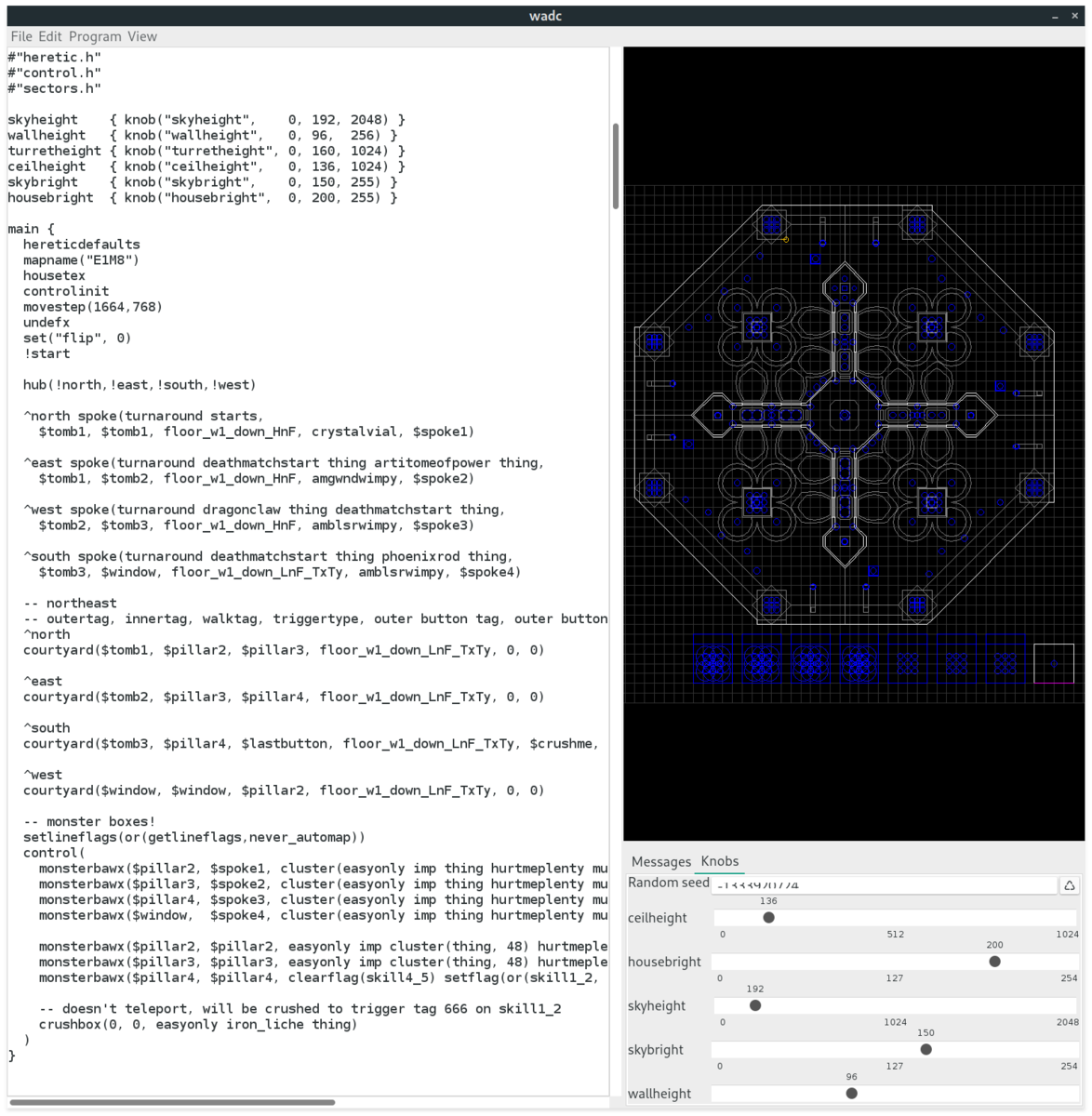
Example map with tuneables on the right Example map with tuneables on the right
WadC the procedural programming environment for generating Doom maps version 3.1 has been released. The majority of this was done a long time ago, but I've dragged my feet in releasing it. I've said this before, but this is intended to be the last release I do of WadC. The headline feature for this release is the introduction of a tuning concept I had for the UI. It occurred to me that a beginner to WadC might want to load up an example program which is potentially very complex and hard to unpick to figure out how it works. If the author could mark certain variables as "tuneable", the UI could provide an easy way for someone to tweak parameters and then see what happened. I had in mind the walls of patch panels and knobs you see with analog synthesizers: tweak this thing over here and see what happens over there. I think this kind of feature would be useful in other, similar programming environments, like OpenSCAD: I don't think they do yet, but I could be wrong.
Kayvan and Me, riding horse statues, somewhere in Germany, in the 1990s
This release of WadC is dedicated to the memory of Kayvan Walker (1983-2022). Kayvan was a childhood friend who committed suicide in March this year. Back in the nineties, Kayvan was responsible for introducing me to Doom in the first place: I used to visit his house on the way home to mine, as it was on the walk back from School. His mum works in IT and always encouraged us into it. Doom was so far ahead, in technical terms, of any other computer game I'd ever seen, and was the closest thing we had to virtual reality: we could create our own worlds. It's in no small part thanks to Kayvan and his Mum that I'm still creating worlds, nearly thirty years later. I owe my career and most of my hobbies to those pivotal moments. Thank you both. Kayvan did a lot more for me than just introduce me to Doom, or computing. He was one of a set of friends that I had every confidence that, no matter what, we would always be friends, through thick and thin. I miss him terribly. Please, if you reading this, are suffering, talk to someone. In the UK you can talk to Samaritans on 116 123.

27 June 2022

Russ Allbery: Review: Light from Uncommon Stars

Review: Light from Uncommon Stars, by Ryka Aoki
Publisher: Tor
Copyright: 2021
ISBN: 1-250-78907-9
Format: Kindle
Pages: 371
Katrina Nguyen is an young abused transgender woman. As the story opens, she's preparing to run away from home. Her escape bag is packed with meds, clothes, her papers, and her violin. The note she is leaving for her parents says that she's going to San Francisco, a plausible lie. Her actual destination is Los Angeles, specifically the San Gabriel Valley, where a man she met at a queer youth conference said he'd give her a place to sleep. Shizuka Satomi is the Queen of Hell, the legendary uncompromising violin teacher responsible for six previous superstars, at least within the limited world of classical music. She's wealthy, abrasive, demanding, and intimidating, and unbeknownst to the rest of the world she has made a literal bargain with Hell. She has to deliver seven souls, seven violin players who want something badly enough that they'll bargain with Hell to get it. Six have already been delivered in spectacular fashion, but she's running out of time to deliver the seventh before her own soul is forfeit. Tamiko Grohl, an up-and-coming violinist from her native Los Angeles, will hopefully be the seventh. Lan Tran is a refugee and matriarch of a family who runs Starrgate Donut. She and her family didn't flee another unstable or inhospitable country. They fled the collapsing Galactic Empire, securing their travel authorization by promising to set up a tourism attraction. Meanwhile, she's careful to give cops free donuts and to keep their advanced technology carefully concealed. The opening of this book is unlikely to be a surprise in general shape. Most readers would expect Katrina to end up as Satomi's student rather than Tamiko, and indeed she does, although not before Katrina has a very difficult time. Near the start of the novel, I thought "oh, this is going to be hurt/comfort without a romantic relationship," and it is. But it then goes beyond that start into a multifaceted story about complexity, resilience, and how people support each other. It is also a fantastic look at the nuance and intricacies of being or supporting a transgender person, vividly illustrated by a story full of characters the reader cares about and without the academic abstruseness that often gets in the way. The problems with gender-blindness, the limitations of honoring someone's gender without understanding how other people do not, the trickiness of privilege, gender policing as a distraction and alienation from the rest of one's life, the complications of real human bodies and dysmorphia, the importance of listening to another person rather than one's assumptions about how that person feels it's all in here, flowing naturally from the story, specific to the characters involved, and never belabored. I cannot express how well-handled this is. It was a delight to read. The other wonderful thing Aoki does is set Satomi up as the almost supernaturally competent teacher who in a sense "rescues" Katrina, and then invert the trope, showing the limits of Satomi's expertise, the places where she desperately needs human connection for herself, and her struggle to understand Katrina well enough to teach her at the level Satomi expects of herself. Teaching is not one thing to everyone; it's about listening, and Katrina is nothing like Satomi's other students. This novel is full of people thinking they finally understand each other and realizing there is still more depth that they had missed, and then talking through the gap like adults. As you can tell from any summary of this book, it's an odd genre mash-up. The fantasy part is a classic "magician sells her soul to Hell" story; there are a few twists, but it largely follows genre expectations. The science fiction part involving Lan is unfortunately weaker and feels more like a random assortment of borrowed Star Trek tropes than coherent world-building. Genre readers should not come to this story expecting a well-thought-out science fiction universe or a serious attempt to reconcile metaphysics between the fantasy and science fiction backgrounds. It's a quirky assortment of parts that don't normally go together, defy easy classification, and are often unexplained. I suspect this was intentional on Aoki's part given how deeply this book is about the experience of being transgender. Of the three primary viewpoint characters, I thought Lan's perspective was the weakest, and not just because of her somewhat generic SF background. Aoki uses her as a way to talk about the refugee experience, describing her as a woman who brings her family out of danger to build a new life. This mostly works, but Lan has vastly more power and capabilities than a refugee would normally have. Rather than the typical Asian refugee experience in the San Gabriel valley, Lan is more akin to a US multimillionaire who for some reason fled to Vietnam (relative to those around her, Lan is arguably even more wealthy than that). This is also a refugee experience, but it is an incredibly privileged one in a way that partly undermines the role that she plays in the story. Another false note bothered me more: I thought Tamiko was treated horribly in this story. She plays a quite minor role, sidelined early in the novel and appearing only briefly near the climax, and she's portrayed quite negatively, but she's clearly hurting as deeply as the protagonists of this novel. Aoki gives her a moment of redemption, but Tamiko gets nothing from it. Unlike every other injured and abused character in this story, no one is there for Tamiko and no one ever attempts to understand her. I found that profoundly sad. She's not an admirable character, but neither is Satomi at the start of the book. At least a gesture at a future for Tamiko would have been appreciated. Those two complaints aside, though, I could not put this book down. I was able to predict the broad outline of the plot, but the specifics were so good and so true to characters. Both the primary and supporting cast are unique, unpredictable, and memorable. Light from Uncommon Stars has a complex relationship with genre. It is squarely in the speculative fiction genre; the plot would not work without the fantasy and (more arguably) the science fiction elements. Music is magical in a way that goes beyond what can be attributed to metaphor and subjectivity. But it's also primarily character story deeply rooted in the specific location of the San Gabriel valley east of Los Angeles, full of vivid descriptions (particularly of food) and day-to-day life. As with the fantasy and science fiction elements, Aoki does not try to meld the genre elements into a coherent whole. She lets them sit side by side and be awkward and charming and uneven and chaotic. If you're the sort of SF reader who likes building a coherent theory of world-building rules, you may have to turn that desire off to fully enjoy this book. I thought this book was great. It's not flawless, but like its characters it's not trying to be flawless. In places it is deeply insightful and heartbreakingly emotional; in others, it's a glorious mess. It's full of cooking and food, YouTube fame, the disappointments of replicators, video game music, meet-cutes over donuts, found family, and classical music drama. I wish we'd gotten way more about the violin repair shop and a bit less warmed-over Star Trek, but I also loved it exactly the way it was. Definitely the best of the 2022 Hugo nominees that I've read so far. Content warning for child abuse, rape, self-harm, and somewhat explicit sex work. The start of the book is rather heavy and horrific, although the author advertises fairly clearly (and accurately) that things will get better. Rating: 9 out of 10

26 June 2022

Russ Allbery: Review: Feet of Clay

Review: Feet of Clay, by Terry Pratchett
Series: Discworld #19
Publisher: Harper
Copyright: October 1996
Printing: February 2014
ISBN: 0-06-227551-8
Format: Mass market
Pages: 392
Feet of Clay is the 19th Discworld novel, the third Watch novel, and probably not the best place to start. You could read only Guards! Guards! and Men at Arms before this one, though, if you wanted. This story opens with a golem selling another golem to a factory owner, obviously not caring about the price. This is followed by two murders: an elderly priest, and the curator of a dwarven bread museum. (Dwarf bread is a much-feared weapon of war.) Meanwhile, assassins are still trying to kill Watch Commander Vimes, who has an appointment to get a coat of arms. A dwarf named Cheery Littlebottom is joining the Watch. And Lord Vetinari, the ruler of Ankh-Morpork, has been poisoned. There's a lot going on in this book, and while it's all in some sense related, it's more interwoven than part of a single story. The result felt to me like a day-in-the-life episode of a cop show: a lot of character development, a few largely separate plot lines so that the characters have something to do, and the development of a few long-running themes that are neither started nor concluded in this book. We check in on all the individual Watch members we've met to date, add new ones, and at the end of the book everyone is roughly back to where they were when the book started. This is, to be clear, not a bad thing for a book to do. It relies on the reader already caring about the characters and being invested in the long arc of the series, but both of those are true of me, so it worked. Cheery is a good addition, giving Pratchett an opportunity to explore gender nonconformity with a twist (all dwarfs are expected to act the same way regardless of gender, which doesn't work for Cheery) and, even better, giving Angua more scenes. Angua is among my favorite Watch characters, although I wish she'd gotten more of a resolution for her relationship anxiety in this book. The primary plot is about golems, which on Discworld are used in factories because they work nonstop, have no other needs, and do whatever they're told. Nearly everyone in Ankh-Morpork considers them machinery. If you've read any Discworld books before, you will find it unsurprising that Pratchett calls that belief into question, but the ways he gets there, and the links between the golem plot and the other plot threads, have a few good twists and turns. Reading this, I was reminded vividly of Orwell's discussion of Charles Dickens:
It seems that in every attack Dickens makes upon society he is always pointing to a change of spirit rather than a change of structure. It is hopeless to try and pin him down to any definite remedy, still more to any political doctrine. His approach is always along the moral plane, and his attitude is sufficiently summed up in that remark about Strong's school being as different from Creakle's "as good is from evil." Two things can be very much alike and yet abysmally different. Heaven and Hell are in the same place. Useless to change institutions without a "change of heart" that, essentially, is what he is always saying. If that were all, he might be no more than a cheer-up writer, a reactionary humbug. A "change of heart" is in fact the alibi of people who do not wish to endanger the status quo. But Dickens is not a humbug, except in minor matters, and the strongest single impression one carries away from his books is that of a hatred of tyranny.
and later:
His radicalism is of the vaguest kind, and yet one always knows that it is there. That is the difference between being a moralist and a politician. He has no constructive suggestions, not even a clear grasp of the nature of the society he is attacking, only an emotional perception that something is wrong, all he can finally say is, "Behave decently," which, as I suggested earlier, is not necessarily so shallow as it sounds. Most revolutionaries are potential Tories, because they imagine that everything can be put right by altering the shape of society; once that change is effected, as it sometimes is, they see no need for any other. Dickens has not this kind of mental coarseness. The vagueness of his discontent is the mark of its permanence. What he is out against is not this or that institution, but, as Chesterton put it, "an expression on the human face."
I think Pratchett is, in that sense, a Dickensian writer, and it shows all through Discworld. He does write political crises (there is one in this book), but the crises are moral or personal, not ideological or structural. The Watch novels are often concerned with systems of government, but focus primarily on the popular appeal of kings, the skill of the Patrician, and the greed of those who would maneuver for power. Pratchett does not write (at least so far) about the proper role of government, the impact of Vetinari's policies (or even what those policies may be), or political theory in any deep sense. What he does write about, at great length, is morality, fairness, and a deeply generous humanism, all of which are central to the golem plot. Vimes is a great protagonist for this type of story. He's grumpy, cynical, stubborn, and prejudiced, and we learn in this book that he's a descendant of the Discworld version of Oliver Cromwell. He can be reflexively self-centered, and he has no clear idea how to use his newfound resources. But he behaves decently towards people, in both big and small things, for reasons that the reader feels he could never adequately explain, but which are rooted in empathy and an instinctual sense of fairness. It's fun to watch him grumble his way through the plot while making snide comments about mysteries and detectives. I do have to complain a bit about one of those mysteries, though. I would have enjoyed the plot around Vetinari's poisoning more if Pratchett hadn't mercilessly teased readers who know a bit about French history. An allusion or two would have been fun, but he kept dropping references while having Vimes ignore them, and I found the overall effect both frustrating and irritating. That and a few other bits, like Angua's uncommunicative angst, fell flat for me. Thankfully, several other excellent scenes made up for them, such as Nobby's high society party and everything about the College of Heralds. Also, Vimes's impish PDA (smartphone without the phone, for those younger than I am) remains absurdly good commentary on the annoyances of portable digital devices despite an original publication date of 1996. Feet of Clay is less focused than the previous Watch novels and more of a series book than most Discworld novels. You're reading about characters introduced in previous books with problems that will continue into subsequent books. The plot and the mysteries are there to drive the story but seem relatively incidental to the characterization. This isn't a complaint; at this point in the series, I'm in it for the long haul, and I liked the variation. As usual, Pratchett is stronger for me when he's not overly focused on parody. His own characters are as good as the material he's been parodying, and I'm happy to see them get a book that's not overshadowed by another material. If you've read this far in the series, or even in just the Watch novels, recommended. Followed by Hogfather in publication order and, thematically, by Jingo. Rating: 8 out of 10

25 June 2022

Jamie McClelland: Deleting an app won't bring back Roe v Wade

In some ways it feels like 2016 all over again. I m seeing panic-stricken calls for everyone to delete their period apps, close their Facebook accounts, de-Google their cell phones and, generally speaking, turn their entire online lives upside down to avoid the techno-surveillance dragnet unleashed by the overturning of Roe v. Wade. I m sympathetic and generally agree that many of us should do most of those things on any given day. But, there is a serious problem with this cycle of repression and panic: it s very bad for organizing. In our rush to give people concrete steps they can take to feel safer, we re fueling a frenzy of panic and fear, which seriously inhibits activism. Now is the time to remind people that, over the last 20 years, a growing movement of organizers and technologists have been building user-driven, privacy-respecting, consentful technology platforms as well as organizations and communities to develop them. We have an entire eco system of: All of these projects need our love and support over the long haul. Please help spread the word - rather then just deleting an app, let s encourage people to join an organziation or try out a new kind of technology that will serve us down the road when we may need it even more then today.

Ryan Kavanagh: Routable network addresses with OpenIKED and systemd-networkd

I ve been using OpenIKED for some time now to configure my VPN. One of its features is that it can dynamically assign addresses on the internal network to clients, and clients can assign these addresses and routes to interfaces. However, these interfaces must exist before iked can start. Some months ago I switched my Debian laptop s configuration from the traditional ifupdown to systemd-networkd. It took me some time to figure out how to have systemd-networkd create dummy interfaces on which iked can install addresses, but also not interfere with iked by trying to manage these interfaces. Here is my working configuration. First, I have systemd create the interface dummy1 by creating a systemd.netdev(5) configuration file at /etc/systemd/network/20-dummy1.netdev:
[NetDev]
Name=dummy1
Kind=dummy 
Then I tell systemd not to manage this interface by creating a systemd.network(5) configuration file at /etc/systemd/network/20-dummy1.network:
[Match]
Name=dummy1
Unmanaged=yes
Restarting systemd-networkd causes these interfaces to get created, and we can then check their status using networkctl(8):
$ systemctl restart systemd-networkd.service
$ networkctl
IDX LINK     TYPE     OPERATIONAL SETUP
  1 lo       loopback carrier     unmanaged
  2 enp2s0f0 ether    off         unmanaged
  3 enp5s0   ether    off         unmanaged
  4 dummy1   ether    degraded    configuring
  5 dummy3   ether    degraded    configuring
  6 sit0     sit      off         unmanaged
  8 wlp3s0   wlan     routable    configured
  9 he-ipv6  sit      routable    configured

8 links listed.
Finally, I configure my flows in /etc/iked.conf, making sure to assign the received address to the interface dummy1.
ikev2 'hades' active esp \
        from dynamic to 10.0.1.0/24 \
        peer hades.rak.ac \
        srcid '/CN=asteria.rak.ac' \
        dstid '/CN=hades.rak.ac' \
        request address 10.0.1.103 \
        iface dummy1
Restarting openiked and checking the status of the interface reveals that it has been assigned an address on the internal network and that it is routable:
$ systemctl restart openiked.service
$ networkctl status dummy1
  4: dummy1
                     Link File: /usr/lib/systemd/network/99-default.link
                  Network File: /etc/systemd/network/20-dummy1.network
                          Type: ether
                          Kind: dummy
                         State: routable (configured)
                  Online state: online
                        Driver: dummy
              Hardware Address: 22:50:5f:98:a1:a9
                           MTU: 1500
                         QDisc: noqueue
  IPv6 Address Generation Mode: eui64
          Queue Length (Tx/Rx): 1/1
                       Address: 10.0.1.103
                                fe80::2050:5fff:fe98:a1a9
                           DNS: 10.0.1.1
                 Route Domains: .
             Activation Policy: up
           Required For Online: yes
             DHCP6 Client DUID: DUID-EN/Vendor:0000ab11aafa4f02d6ac68d40000
I d be happy to hear if there are simpler or more idiomatic ways to configure this under systemd.

24 June 2022

Kees Cook: finding binary differences

As part of the continuing work to replace 1-element arrays in the Linux kernel, it s very handy to show that a source change has had no executable code difference. For example, if you started with this:
struct foo  
    unsigned long flags;
    u32 length;
    u32 data[1];
 ;
void foo_init(int count)
 
    struct foo *instance;
    size_t bytes = sizeof(*instance) + sizeof(u32) * (count - 1);
    ...
    instance = kmalloc(bytes, GFP_KERNEL);
    ...
 ;
And you changed only the struct definition:
-    u32 data[1];
+    u32 data[];
The bytes calculation is going to be incorrect, since it is still subtracting 1 element s worth of space from the desired count. (And let s ignore for the moment the open-coded calculation that may end up with an arithmetic over/underflow here; that can be solved separately by using the struct_size() helper or the size_mul(), size_add(), etc family of helpers.) The missed adjustment to the size calculation is relatively easy to find in this example, but sometimes it s much less obvious how structure sizes might be woven into the code. I ve been checking for issues by using the fantastic diffoscope tool. It can produce a LOT of noise if you try to compare builds without keeping in mind the issues solved by reproducible builds, with some additional notes. I prepare my build with the known to disrupt code layout options disabled, but with debug info enabled:
$ KBF="KBUILD_BUILD_TIMESTAMP=1970-01-01 KBUILD_BUILD_USER=user KBUILD_BUILD_HOST=host KBUILD_BUILD_VERSION=1"
$ OUT=gcc
$ make $KBF O=$OUT allmodconfig
$ ./scripts/config --file $OUT/.config \
        -d GCOV_KERNEL -d KCOV -d GCC_PLUGINS -d IKHEADERS -d KASAN -d UBSAN \
        -d DEBUG_INFO_NONE -e DEBUG_INFO_DWARF_TOOLCHAIN_DEFAULT
$ make $KBF O=$OUT olddefconfig
Then I build a stock target, saving the output in before . In this case, I m examining drivers/scsi/megaraid/:
$ make -jN $KBF O=$OUT drivers/scsi/megaraid/
$ mkdir -p $OUT/before
$ cp $OUT/drivers/scsi/megaraid/*.o $OUT/before/
Then I patch and build a modified target, saving the output in after :
$ vi the/source/code.c
$ make -jN $KBF O=$OUT drivers/scsi/megaraid/
$ mkdir -p $OUT/after
$ cp $OUT/drivers/scsi/megaraid/*.o $OUT/after/
And then run diffoscope:
$ diffoscope $OUT/before/ $OUT/after/
If diffoscope output reports nothing, then we re done. Usually, though, when source lines move around other stuff will shift too (e.g. WARN macros rely on line numbers, so the bug table may change contents a bit, etc), and diffoscope output will look noisy. To examine just the executable code, the command that diffoscope used is reported in the output, and we can run it directly, but with possibly shifted line numbers not reported. i.e. running objdump without --line-numbers:
$ ARGS="--disassemble --demangle --reloc --no-show-raw-insn --section=.text"
$ for i in $(cd $OUT/before && echo *.o); do
        echo $i
        diff -u <(objdump $ARGS $OUT/before/$i   sed "0,/^Disassembly/d") \
                <(objdump $ARGS $OUT/after/$i    sed "0,/^Disassembly/d")
done
If I see an unexpected difference, for example:
-    c120:      movq   $0x0,0x800(%rbx)
+    c120:      movq   $0x0,0x7f8(%rbx)
Then I'll search for the pattern with line numbers added to the objdump output:
$ vi <(objdump --line-numbers $ARGS $OUT/after/megaraid_sas_fp.o)
I'd search for "0x0,0x7f8", find the source file and line number above it, open that source file at that position, and look to see where something was being miscalculated:
$ vi drivers/scsi/megaraid/megaraid_sas_fp.c +329
Once tracked down, I'd start over at the "patch and build a modified target" step above, repeating until there were no differences. For example, in the starting example, I'd also need to make this change:
-    size_t bytes = sizeof(*instance) + sizeof(u32) * (count - 1);
+    size_t bytes = sizeof(*instance) + sizeof(u32) * count;
Though, as hinted earlier, better yet would be:
-    size_t bytes = sizeof(*instance) + sizeof(u32) * (count - 1);
+    size_t bytes = struct_size(instance, data, count);
But sometimes adding the helper usage will add binary output differences since they're performing overflow checking that might saturate at SIZE_MAX. To help with patch clarity, those changes can be done separately from fixing the array declaration.

2022, Kees Cook. This work is licensed under a Creative Commons Attribution-ShareAlike 4.0 License.
CC BY-SA 4.0

Next.

Previous.