Search Results: "tb"

28 April 2014

Evgeni Golov: Debian Bug Squashing Party Salzburg 2014

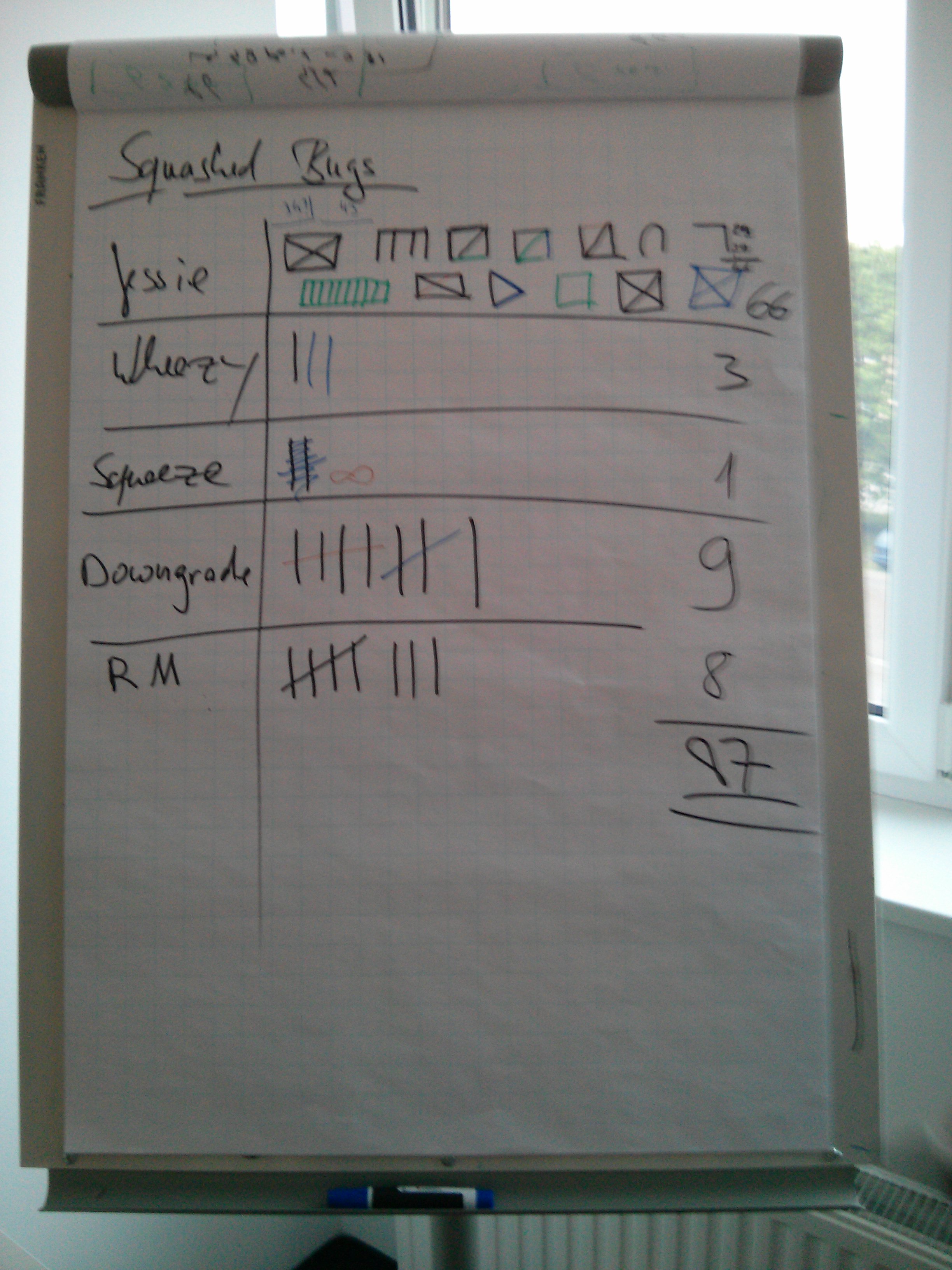
bsp2014_small This weekend, Bernd Zeimetz organized a BSP at the offices of conova in Salzburg, Austria. Three days of discussions, bugfixes, sparc removals and a lot of fun and laughter. We squashed a total of 87 bugs: 66 bugs affecting Jessie/Sid were closed, 9 downgraded and 8 closed via removals. As people tend to care about (old)stable, 3 bugs were fixed in Wheezy and one in Squeeze. These numbers might be not totaly correct, as were kinda creative at counting Marga promised a talk about an introduction to properly counting bugs using the Haus vom Nikolaus algorithm to the base of 7 . IMG_20140427_182902 Speaking of numbers, I touched the following bugs (not all RC): A couple of (non-free) pictures are available at Uwe s salzburg-cityguide.at. Thanks again to Bernd for organizing and conova and credativ for sponsoring!

27 April 2014

Russell Coker: Swap Breaking SSD

I ve seen many comments about swap space and SSD claiming that swap will inherently destroy SSD through using too many writes. The latest was in the comments of my post about swap space and SSD performance [1]. Note that I m not criticising the person who commented on my blog, everyone has heard lots of reports about possible problems that they avoid without analysing them in detail. The first thing to note is that the quality of flash memory varies a lot, the chips that are used in SSDs for workstation/server use are designed to last while those in USB-flash devices aren t. I ve documented my unsuccessful experiments with using USB-flash for the root filesystem of a gateway server [2] (and the flash device that wasn t used for swap died too). The real issue when determining whether swap will break your SSD is the amount of writes. While swapping can do a lot of writing quickly that usually doesn t happen unless something has gone wrong. The workstation that I m currently using has writes to the root fileystem outnumbering writes to swap by a factor of 130:1 (by volume of data written). On other days I ve seen it as low as 42:1, in either case it s writes to the root filesystem (which is BTRFS and includes /home etc) that will break the SSD if anything. For some other workstations I run I see ratios of 201:1 (that s with 8G of RAM), 57:1, and 23:1. In a quick search I couldn t find a single system I run where even 10% of disk writes were attributed to swap. This really isn t surprising given that adding RAM is a cheap way to improve the performance of most systems. If a SSD didn t do any write leveling (as is rumored to be the case with cheap USB flash devices) then swap use might still cause a problem because of the number of writes in a small area, but if that was the case then filesystem journals and other fixed data structures would be more likely to cause a problem and any swap based breakage would break swap not the root filesystem (although if swap was the first partition then it might also break the MBR). Of the workstations that are convenient to inspect the one with the most writes to the root filesystem and swap space (IE everything on /dev/sda) had 128G written per day for 1.2 days of uptime, but that involved running a filesystem balance and some torrent downloads (not the typical use). Among the two systems which had been running for more than 48 hours with typical use the most writes was 24G in a day. If a SSD can sustain 10,000 writes per block (which is smaller than quoted by most flash manufacturers nowadays) and has perfect wear leveling (which is unlikely) then the system with a 120G SSD and 128G written in a day could continue like that for almost 10,000 days or 27 years much longer than storage is expected to work or be useful. So for workstation use (where even 24G of writes per day probably counts as heavy use) a 120G SSD that can sustain 10,000 writes per block shouldn t be at great risk of wearing out. Conclusion I believe that swap is much less likely to break SSDs than regular file access on every system with a reasonable amount of RAM. For systems which don t have enough RAM you probably want the speed of SSD for swap space anyway in spite of the risks. If wear leveling works as designed and the 10,000+ writes per block claims are accurate then SSDs will massively outlast their useful life. Long before they wear out they should be too small, too slow, and probably not compatible. 26 years ago I had a 5.25 full height ST-506 disk in my desktop PC, it wouldn t physically fit in most systems I own now (unless I removed the DVD drive), there is no possibility of buying a controller (I don t own a system with an ISA bus), and that disk was too slow and small by today s standards. A 27yo SSD isn t going to be useful for anything, even for archive storage it s no good as no-one has tested long term storage and data could decay before then.

26 April 2014

Russell Coker: BTRFS Status April 2014

Since my blog post about BTRFS in March [1] not much has changed for me. Until yesterday I was using 2.13 kernels on all my systems and dealing with the occasional kmail index file corruption problem. Yesterday my main workstation ran out of disk space and went read-only. I started a BTRFS balance which didn t seem to be doing any good because most of the space was actually in use so I deleted a bunch of snapshots. Then my X session aborted (some problem with KDE or the X server I ll never know as logs couldn t be written to disk). I rebooted the system and had kernel threads go into infinite loops with repeated messages about a lack of response for 22 seconds (I should have photographed the screen). When it got into that state the ALT-Fn keys to change a virtual console sometimes worked but nothing else worked the terminal usually didn t respond to input. To try and stop the kernel from entering an infinite loop on every boot that I used rootflags=skip_balance on the kernel command line to stop it from continuing the balance which made the system usable for a little longer, unfortunately the skip_balance mount option doesn t permanently apply, the kernel will keep trying to balance the filesystem on every mount until a btrfs balance cancel operation succeeds. But my attempts to cancel the balance always failed. When I booted my system with skip_balance it would sometimes free some space from the deleted snapshots, after two good runs I got to 17G free. But after that every time I rebooted it would report another Gig or two free (according to btrfs filesystem df ) and then hang without committing the changes to disk. I solved this problem by upgrading my USB rescue image to kernel 3.14 from Debian/Experimental and mounting the filesystem from the rescue image. After letting kernel 3.14 work on the filesystem for a while it was in a stage where I could use it with kernel 3.13 and then boot the system normally to upgrade it to kernel 3.14. I had a minor extra complication due to the fact that I was running apt-get dist-upgrade at the time the filesystem went read-only do the dpkg records of which packages were installed were a bit messed up. But that was easy to fix by running a diff against /var/lib/dpkg/info on a recent snapshot. In retrospect I should have copied from an old snapshot of the root filesystem, but I fixed the problems faster than I could think of better ways to fix them. When running a balance the system had a peak IO rate of about 30MB/s reads and 30MB/s writes. That compares to the maximum contiguous file IO speed of 260MB/s for reads and 320MB/s for writes. During that time it had about 50% CPU time used for my Q8400 quad-core CPU. So far the only tasks that I do regularly which have CPU speed as a significant bottleneck are BTRFS filesystem balancing and recoding MP4 files. Compiling hasn t been an issue because recently I haven t been compiling many programs that are particularly big. Lessons Learned I should photograph the screen regularly when doing things that won t be logged, those kernel error messages might have been useful to me or someone else. The fact that the only kernel that runs BTRFS the way I need comes from the Experimental repository in Debian stands in contrast to the recent kernel patch that stops describing BTRFS as experimental. While I have a high opinion of the people who provide support for the kernel in commercial distributions and their ability to back-port fixes from newer kernels I m concerned about their decision to support BTRFS. I m also dubious about whether we can offer BTRFS support in Debian/Jessie (the next version of Debian) without a significant warning. OTOH if you find yourself with a BTRFS system that isn t working well you could always hire me to fix it. I accept payment via Paypal, bank transfer, or Bitcoin. If you want to pay me in Grange then I assure you I will never forget about it. ;) I thought that I wouldn t have CPU speed issues when I started using the AMD64 architecture, for most tasks that s been the case. But for systems for which storage is important I ll look at getting faster CPUs because of BTRFS. Using faster CPUs for storage isn t that uncommon (I used to work for SGI and dealt with some significant CPU power used for file serving), but needing a fast quad-core CPU to drive a single SSD is a little disappointing. While recovery from file system corner cases isn t going to be particularly common it s something that you want completed quickly, for personal systems you want to be doing something else and for work systems you don t want down-time. The BTRFS problems with running out of disk space are really serious. It seems that even workstations used at home can t survive without monitoring. For any other filesystem used at home you can just let it get full and then delete stuff. Include rootflags=skip_balance in the boot loader configuration for every system with a BTRFS root filesystem and in the /etc/fstab for every non-root BTRFS filesystem. I haven t yet encountered a single situation where continuing the balance did any good or when it didn t do any harm.

25 April 2014

Matthias Klumpp: AppStream 0.6.1 released a quick look at what you can do with the cli tool

Today I released AppStream and libappstream 0.6.1, which feature mostly bugfixes, so nothing incredibly exciting to see there (but this also means no API/ABI breaks). The release clarifies some paragraphs in the spec which people found confusing, and fixes a few issues (like one example in the docs not being valid AppStream metadata). As only spec extension, we introduce a priority property in distro metadata to allow metadata from one repository to override data shipped by another one. This is used (although with a similar syntax) in Fedora already to have placeholder data for non-free stuff, which gets overridden by the real metadata if a new application was added. In general, the property tag was added to make the answer to the question which data is preferred much less magic. The libappstream library got some new API to query component data in different ways, and I also brought back support for Vala (so if you missed the Vapi file: It s back now, although you have to manually enable this feature). The CLI tool also got some extensions to query AppStream data. Here is a brief introduction: First of all, we need to make sure the database is up-to-date, which should be the case already (it is rebuilt automatically):
$ sudo appstream-index --refresh
The database will only be rebuilt when necessary, if you want to force a rebuild anyway, use the force parameter. Now imagine we want to search for an app containing the word media (in description, keywords, summary, ):
$ appstream-index -s media
which will return:
Identifier: gnome-media-player.desktop [desktop-app]
Name: GNOME Media Player
Summary: A simple media player for GNOME
Package: gnome-media-player
----
Identifier: mediaplayer-app.desktop [desktop-app]
Name: Media Player
Summary: Media Player
Package: mediaplayer-app
----
Identifier: kde4__plasma-mediacenter.desktop [desktop-app]
Name: Plasma Media Center
Summary: A mediacenter user interface written with the Plasma framework
Package: plasma-mediacenter
----
etc.
If we already know the name if a .desktop-file or the ID of a component, we can have the tool print out information about the application, including which package it was installed from:
$ appstream-index --get lyx.desktop
If we want to see more details, including e.g. a screenshot URL and a longer description, we can pass details to the tool:
Identifier: lyx.desktop [desktop-app]
Name: LyX
Summary: An advanced document processor with the power of LaTeX.
Package: lyx-common
Homepage: http://www.lyx.org/
Icon: lyx.png
Description: LyX is a document processor that encourages an approach to writing
 based on the structure of your documents (WYSIWYM) and not simply
 their appearance (WYSIWYG).
 
 LyX combines the power and flexibility of TeX/LaTeX[...]
Sample Screenshot URL: http://alt.fedoraproject.org/pub/alt/screenshots/f21/source/lyx-ea535ddf18b5c7328c5e88d2cd2cbd8c.png
License: GPLv2+
(I truncated the results slightly ;-) ) Okay, so far so good. But now it gets really exciting (and this is a feature added with 0.6.1): We can now query a component by the items it provides. For example, I want to know which software provides the library libfoo.2:
appstream-index --what-provides -t lib -v libfoo.so.2
This also works with binaries, or Python modules:
appstream-index --what-provides -t bin -v apper
This stuff works distribution-agnostic, and as long as software ships upstream metadata with a valid <provides/> field, or the distributor adds it while generating AppStream distro metadata.
This means that software can as soon as we have sufficient metadata of this kind declare it s dependencies upstream in form of a simple text file, referencing the needed components to build and run it on any Linux distribution. Users can simply install missing stuff by passing that file to their package manager, which can look up the components->packaging mapping and versions and do the right thing in installing the dependencies. So basically, this allows things pip -r does for Python, but for any application (not only Python stuff), and based on the distributors package database. With the provides-items, we can also scan software to detect it s dependencies automatically (and have it in a distro-agnostic form directly). We can also easily search for missing mimetype-handlers, missing kernel-modules, missing firmware etc. to install it on-demand, making the system much smarter in handling it s dependencies. And users don t need to do search orgies to find the right component for a given task. Also on my todo list for the future, based on this feature: A small tool telling upstream authors which distribution has their application in which version, using just one command (and AppStream data from multiple distros). Also planned: A cross-distro information page showing which distros ship which library versions, Python modules and application versions (and also the support status of the distro), so developers know which library versions (or GCC versions etc.) they should at least support to make their application easily available on most distributions. As always, you can get the releases on Freedesktop, as well es the AppStream specification.

24 April 2014

Daniel Pocock: Android betrays tethering data

When I upgraded an Android device the other day, I found that tethering completely stopped working. The updated CyanogenMod had inherited a new bug from Android, informing the carrier that I was tethering. The carrier, Vodafone Italy, had decided to make my life miserable by blocking that traffic. I had a closer look and managed to find a workaround. There is absolutely no difference, from a technical perspective, between data transmitted from a mobile device on-screen application and data transmitted from tethering. Revealing the use of tethering to the carrier is a massive breach of privacy - yet comments in the Google bug tracker suggest it is a feature rather than a bug. This little table helps put that logic in perspective:
Product Person who carries handset
User Mobile network who wants to discriminate against some types of network traffic to squeeze more money out of the Product
Feature Revealing private information about the way the Product uses his/her Internet so the real User can profit.
It is also bad news for the environment: many people are being tricked into buying un-needed USB dongle modems that will end up in the rubbish in 1-2 years time when their contract expires and the company pushes them to upgrade to the next best thing. Behind the scenes What does it really mean in practice, how does Android tell your carrier which data is from tethering? As my device is rooted and as it is my device and I will do what I want with it, I decided to have a look inside. The ip command revealed that there are now two network devices, rmmnet_usb0 and rmmnet_usb1. The basic ip route command reveals that traffic from different source addresses is handled differently and split over the different network devices:
shell@android:/ # ip route
0.0.0.0/1 dev tun0  scope link
default via 100.66.150.89 dev rmnet_usb0
83.224.66.138 via 100.87.31.214 dev rmnet_usb1
83.224.70.94 via 100.87.31.214 dev rmnet_usb1
100.66.150.88/30 dev rmnet_usb0  proto kernel  scope link  src 100.66.150.90
100.66.150.89 dev rmnet_usb0  scope link
100.87.31.212/30 dev rmnet_usb1  proto kernel  scope link  src 100.87.31.213
100.87.31.214 dev rmnet_usb1  scope link
128.0.0.0/1 dev tun0  scope link
192.168.42.0/24 dev rndis0  proto kernel  scope link  src 192.168.42.129
I then looked more closely and found that there is also an extra routing table, it can be found with ip rule
shell@android:/ # ip rule show
0:      from all lookup local
32765:  from 192.168.42.0/24 lookup 60
32766:  from all lookup main
32767:  from all lookup default
shell@android:/ # ip route show table 60
default via 100.87.51.57 dev rmnet_usb1
100.87.51.57 dev rmnet_usb1
192.168.42.0/24 dev rndis0  scope link
In this routing table, it is obvious that data from the tethering subnet (192.168.42.0/24) is sent over the extra device rmnet_usb1. Manually cleaning it up If the phone is rooted, it is possible to very quickly change the routing table to get all the tethering traffic going through the normal rmnet_usb0 interface again. It is necessary to get rid of that alternative routing table first:
ip rule del pref 32765
and then update the iptables entries that refer to interface names:
iptables -t nat -I natctrl_nat_POSTROUTING -s 192.168.0.0/16 -o rmnet_usb0 -j MASQUERADE
iptables -I natctrl_FORWARD -i rmmnet_usb0 -j RETURN
This immediately resolved the problem for me on the Vodafone network in Italy. Conclusion If Google can be bullied into accepting this kind of discriminatory routing in the stock Android builds and it can even propagate into CyanogenMod, then I'm just glad I'm not running one of those Android builds that has been explicitly "enhanced" by a carrier. It raises big questions about who really is the owner and user of the device and who is receiving the value when a person pays money to "buy" a device.

22 April 2014

Steve Kemp: I've not commented on security for a while

Unless you've been living under a rock, or in a tent (which would make me slightly jealous) you'll have heard about the recent heartbleed attack many times by now. The upshot of that attack is that lots of noise was made about hardening things, and there is now a new fork of openssl being developed. Many people have commented about "hardening Debian" in particular, as well as random musing on hardening software. One or two brave souls have even made noises about auditing code. Once upon a time I tried to setup a project to audit Debian software. You can still see the Debian Security Audit Project webpages if you look hard enough for them. What did I learn? There are tons of easy security bugs, but finding the hard ones is hard. (If you get bored some time just pick your favourite Editor, which will be emacs, and look how /tmp is abused during the build-process or in random libraries such as tramp [ tramp-uudecode].) These days I still poke at source code, and I still report bugs, but my enthusiasm has waned considerably. I tend to only commit to auditing a package if it is a new one I install in production, which limits my efforts considerably, but makes me feel like I'm not taking steps into the dark. It looks like I reported only three security isseus this year, and before that you have to go down to 2011 to find something I bothered to document. What would I do if I had copious free time? I wouldn't audit code. Instead I'd write test-cases for code. Many many large projects have rudimentary test-cases at best, and zero coverage at worse. I appreciate writing test-cases is hard, because lots of times it is hard to test things "for real". For example I once wrote a filesystem, using FUSE, there are some built-in unit-tests (I was pretty pleased with that, you could lauch the filesystem with a --test argument and it would invoke the unit-tests on itself. No separate steps, or source code required. If it was installed you could use it and you could test it in-situ). Beyond that I also put together a simple filesystem-stress script, which read/wrote/found random files, computes MD5 hashes of contents, etc. I've since seen similar random-filesystem-stresstest projects, and if they existed then I'd have used them. Testing filesystems is hard. I've written kernel modules that have only a single implicit test case: It compiles. (OK that's harsh, I'd usually ensure the kernel didn't die when they were inserted, and that a new node in /dev appeared ;) I've written a mail client, and beyond some trivial test-cases to prove my MIME-handling wasn't horrifically bad there are zero tests. How do you simulate all the mail that people will get, and the funky things they'll do with it? But that said I'd suggest if you're keen, if you're eager, if you want internet-points, writing test-cases/test-harnesses would be more useful than randomly auditing source code. Still what would I know, I don't even have a beard..

21 April 2014

John Goerzen: A Dry Spring

Spring in the prairie is a bit of an odd thing this year. Here and there, near ditches and creeks, a short, soft blanket of lush green grass covers the ground. A few feet away, patches of green are visible between the brown shoots of last year s grass. Some trees are already turning green, purple, red, and white, while others stand still and brown, stubbornly insisting that spring is not here yet. To look at the thermometer may not be much guide either; two days after the temperature was nearly 90, we woke to see a dusting of snow on the ground. It s been dry, terribly try in Kansas. Grass next to a gravel driveway or road often has a chalkish layer of dust on it, kicked up by passing cars or even a stiff wind. The earth thirsts. It is somehow fitting to celebrate Easter, that spring holiday, in the midst of the dry ground, to remember that water is not the only thing that can quench thirst. Easter morning began sleepily, as we got up early to head to a sunrise service. It was in a pasture just outside a small Kansas town, and we gathered there at about 6:15, wearing only light jackets against the breeze. A fire was burning, and there was water on hand to quickly douse any grass that caught first that wasn t supposed to and it was occasionally used. I was doing the prelude for the service, playing on my penny whistle. I enjoyed being able to do that, and was glad that the wind was calm enough that it didn t interfere too much with the music. We sang some hymns, listened to some Bible readings, and just stood in silence, listening to the crackle of the fire, some country dogs playing, and watching the sky to the east transform as the sun came up. Then it was on to church for breakfast, and a break before the Easter service the pipe organ ringing, piano playing with it, and deep trombone and full sanctuary of people singing our 4-part Easter hymns celebrating the day. Laura had the idea of pinning carnations onto the cross, and we got to watch everyone come up and add theirs. Jacob and Oliver enjoyed the sunrise service. They decided they would keep a watchful eye on the first and the dogs, they enjoyed muffins at breakfast and playing in the church after that. But if you are 4 or 7, what is Easter without an Easter egg hunt? And they got in several. Laura and I hid some eggs around the yard. Jacob asked me to use a radio to tell them when the eggs were ready. Here they are, bounding out the door to begin the hunt! And, of course, if you are 4 or 7 and have a geek for a dad, you will naturally think to bring radios with you to the next hunt. To tell your brother what you re finding, of course. It was a good weekend, and in fact, Jacob even volunteered to put up a wet floor sign after he spilled some water: On the last car ride of the day, Jacob decided he would write a story about his Easter. He decided he would publish a big book, and be a famous author and make other children happy. Oliver, of course, decided he needed an Easter story also. We couldn t very well publish a book in the car, but I did manage to use my phone to capture their stories. It s been a long and busy week, but there is much to be joyful about, even when tired.

Russ Allbery: Review: Hyperbole and a Half

Review: Hyperbole and a Half, by Allie Brosh
Publisher: Touchstone
Copyright: November 2013
ISBN: 1-4767-6459-X
Format: Graphic novel
Pages: 373
It's fundamentally pointless to write this review. Some number of you have already heard of Hyperbole and a Half. Most of that group already own this book and are only reading this review so that you can remember how much fun you had reading it. But, even better, you could just stop reading this review and go read the book again. Some of you who have heard of Hyperbole and a Half didn't know that Allie Brosh had published a book. If that's you, you're probably not reading this review any more, since you're now at your favorite book seller buying a copy of the book, rendering the review somewhat pointless. For those of you who have not heard of Hyperbole and a Half, there's no need to read a review, because it's a blog. So, rather than reading this review, you can just follow that link and read it for yourself. If you find yourself laughing uncontrollably (and occasionally crying) and going "where can I get more of this?", well, there's a book. Which you could have also found out from the blog itself. Like I said, not much point. If you read the blog and don't particularly care for it, well, I greatly respect your position. The diversity of taste in the human race is what leads to our wonderful variety of culture, philosophy, and art, and I appreciate your substantial contribution to that diversity. However, you should now make a mental note to never trust my humor recommendations, and you shouldn't let this review change your mind. But, since I'm here, I may as well write a review anyway. Hyperbole and a Half is, as mentioned, a blog by Allie Brosh. Most of the posts are quite long and substantial and in the form of cartoons mixed with text, usually (but not always) telling some sort of story. The cartoon style is what is often called "MS Paint," meaning that it looks like something drawn in Microsoft Paint with its most basic tools. (Other examples of this style are the Oatmeal and Homestuck, although Brosh stays consistently with a rawer art style than either of those.) It looks extremely simple, like child drawings (and early childhood inspires much of Brosh's material), but once one gets used to it, one realizes that Brosh gets amazing expressiveness and character out of the art style. As an aside, yes, I am wholeheartedly recommending a book that is full of material about young children. Brosh is that good. The subtitle of this book is "unfortunate situations, flawed coping mechanisms, mayhem, and other things that happened," and it's mostly based on (exaggerated) incidents that occurred in Brosh's life. Most of them are hilarious. Some of them are both hilarious and stunning psychological insights. She has an amazing knack for storytelling and for exaggerating just the right moments of the story, or summing up emotions in a wonderful turn of phrase or a picture. She's also amazingly good at telling embarrassing stories about herself in a way that makes you empathize rather than just cringe, and then come away feeling like you understand both her and yourself better. If you've wandered around the Internet much, you have probably run across the phrase "clean ALL the things!" and the corresponding picture. That's from Hyperbole and a Half (specifically, "This is Why I'll Never Be an Adult") and is included in this book (improved; see below). It's even better in context. But, beyond storytelling, the other thing Brosh is amazingly good at is capturing internal mental states and emotions in a way that the reader understands and those who have experienced the emotion immediately go "yes, THAT." The apex of this is her two-part post on depression, which is hands-down the best description of depression that I've ever read. That judgment has been echoed by multiple friends of mine with depression. And yes, both of those posts are included in the book as well, although you can also read them on the web. As you've probably noticed, this book is partly a collection of material that's freely available on the web. Unlike some web comics collections, it's not entirely a reprint collection; there are entirely new stories here (which for me was enough by itself to buy the book). Brosh's post on the book says that it's about 50% new material. But the ones that aren't original have been edited and improved, sometimes substantially. For example, I did a quick comparison of the book version with the web version of "This is Why I'll Never be an Adult" and found Brosh redrew all of the cartoons for the story. The book is also gorgeous, if you care about such things like I do: high quality paper, thick pages, vibrant colors, and a comfortable heft to the hardcover version. It's the sort of book that feels like it will survive for decades, which is good since I intend to re-read it for decades. Brosh has a lot of material on-line, so obviously only a small fraction made it into the book and there's more to discover on the blog. I can particularly recommend "The Alot is Better Than You at Everything" and "Boyfriend Doesn't Have Ebola. Probably.". The latter, which is mostly about creating a better pain scale, is my favorite from the blog that didn't make it into the book. And there are two more examples of the sort of thing that you'll getting here. So ends the probably pointless review. I absolutely adore Hyperbole and a Half. It is my favorite web comic, even surpassing XKCD, which is saying something. Even if there were no material, I would have bought this book in hardcover to support Brosh and to have a high-quality printing of the blog posts. The reworkings and improvements of the republished material and the brand new additions are just bonuses. But there's no need to take my word for it; the best possible advertisement for Brosh's work is on-line, from which you can easily determine if you'll enjoy this book as much as I did. Even the back cover and the inside flaps are awesome. Rating: 10 out of 10

Russell Coker: Sociological Images 2014

White Trash The above poster was on a bridge pylon in Flinders St in 2012. It s interesting to see what the Fringe Festival people consider to be associated with white trash . They claim homophobia is a white trash thing however lower class people have little political power and the fact that we still don t have marriage equality in Australia is clear evidence that homophobia is prevalent among powerful people. Toys vs Fairies Fairies look pretty while boys toys do things I took the above photo at Costco in 2012. I think it s worth noting the way that the Disney Fairies (all female and marketed to a female audience) are standing around looking pretty while the Toy Story characters (mostly male and marketed to a male audience) are running out to do things. Having those items side by side on the shelf was a clear example of a trend in toys towards girls being encouraged to be passive while boys are doing things. The Toy Story pack has one female character, so it could be interpreted as being aimed at both boys and girls. But even that interpretation doesn t remove the clear gender difference. It seems ironic to me that the descriptions on the boxes are Read, Play, and Listen for the Toy Story pack and Read, Play, and Colour on the Fairies pack. Colouring is more active than listening so the pictures don t match the contents. Make Up vs Tools Girls chocolate is make-up and boys chocolate is tools I took the above photo in an Aldi store in early 2013, today I was in Aldi and noticed that the same chocolate is still on sale. A clear and pointless gender difference. Rumor has it that some of the gender difference in kids clothing is so that a child can t wear the clothes of an older sibling of different gender, but chocolate only gets eaten once so there is no reason for this. Oath The above poster was inside the male toilet at Melbourne University in 2013. It would probably be good to have something like that on display all the time instead of just for one event. Locks Locks with inscriptions on a bridge on the Yarra River in Melbourne I took the above picture early this year, it shows hundreds of padlocks attached to a bridge across the Yarra River in Melbourne. Each padlock has a message written or inscribed in it, mostly declarations of love. I first noticed this last year, I m not sure how long it s been up. There was nothing formal about this (no signs about it), people just see it and decide that they want to add to it. I guess that the council cuts some of them off periodically as the number of locks doesn t seem to be increasing much in recent times. It would be interesting to do some research into how many locks are needed to start one of these. It would also be interesting to discover whether the nature of the inscriptions determines the speed at which it takes off, would a bunch of padlocks with messages like I Love Linux inspire others as well as messages declaring love for random people? All that is required is some old locks and an engraving tool. I wonder what the social norm might be regarding messing with those locks. If I was to use those padlocks to practice the sport of lock-picking (which I learned when in Amsterdam) I wonder whether random bystanders would try to discourage me. It seems likely that picking the locks and taking them away would get a negative reaction but I wonder whether picking them one at a time and replacing them (or maybe moving them to another wire) would get a reaction. Blackface for Schoolkids teachers choice blackface and yellowface masks A craft shop at the Highpoint shopping center in Melbourne is selling Teacher s Choice brand Multicultural Face Masks . Multicultural is a well regarded term in education, teaching children about other cultures is a good concept but can be implemented really badly. When I was in high school the subject Social Studies seemed to have an approach of look how weird people are in other places instead of teaching the kids anything useful. Sociological Images has an informative article on the Australian Hey Hey it s Saturday blackface incident in 2009 [1]. The idea of these masks seems to involve students dressing up as caricatures of other races. The mask which looks like someone s idea of a Geisha is an even bigger WTF, mixing what the package calls culture (really race) with sex work. When I visited Tokyo I got the impression that French maids fill a similar niche to Geisha for younger Japanese men and the maid cafe thing is really popular there. I think it s interesting to consider the way that a French maid costume is regarded differently to a Geisha costume. I expect that Teacher s Choice doesn t sell French maid costumes. Delicious Cow picture of a bovine named Delicious Usually meat is advertised in a way that minimises the connection to living animals. Often adverts just show cuts of meat and don t make any mention of animals and when animals are shown they are in the distance. The above picture was on the wall at a Grill d burger restaurant in Point Cook. It shows a bovine (looks like a bull even though I believe that cows are the ones that are usually eaten) with a name-tag identifying it as Delicious . The name tag personalises the animal which is an uncommon thing to do when parts of an animal are going to be eaten. Of the animals that are commonly eaten it seems that the general trend is to only show fish as complete live animals, presumably because people can identify with mammals such as cattle in a way that they can t identify with fish. Fish are also the only complete animals that are shown dead, adverts for fish that are sold as parts (EG salmon and tuna) often show complete dead fish. But I ve never seen a meat advert that shows a complete dead cow or sheep.

20 April 2014

Russell Coker: Sociological Images 2012

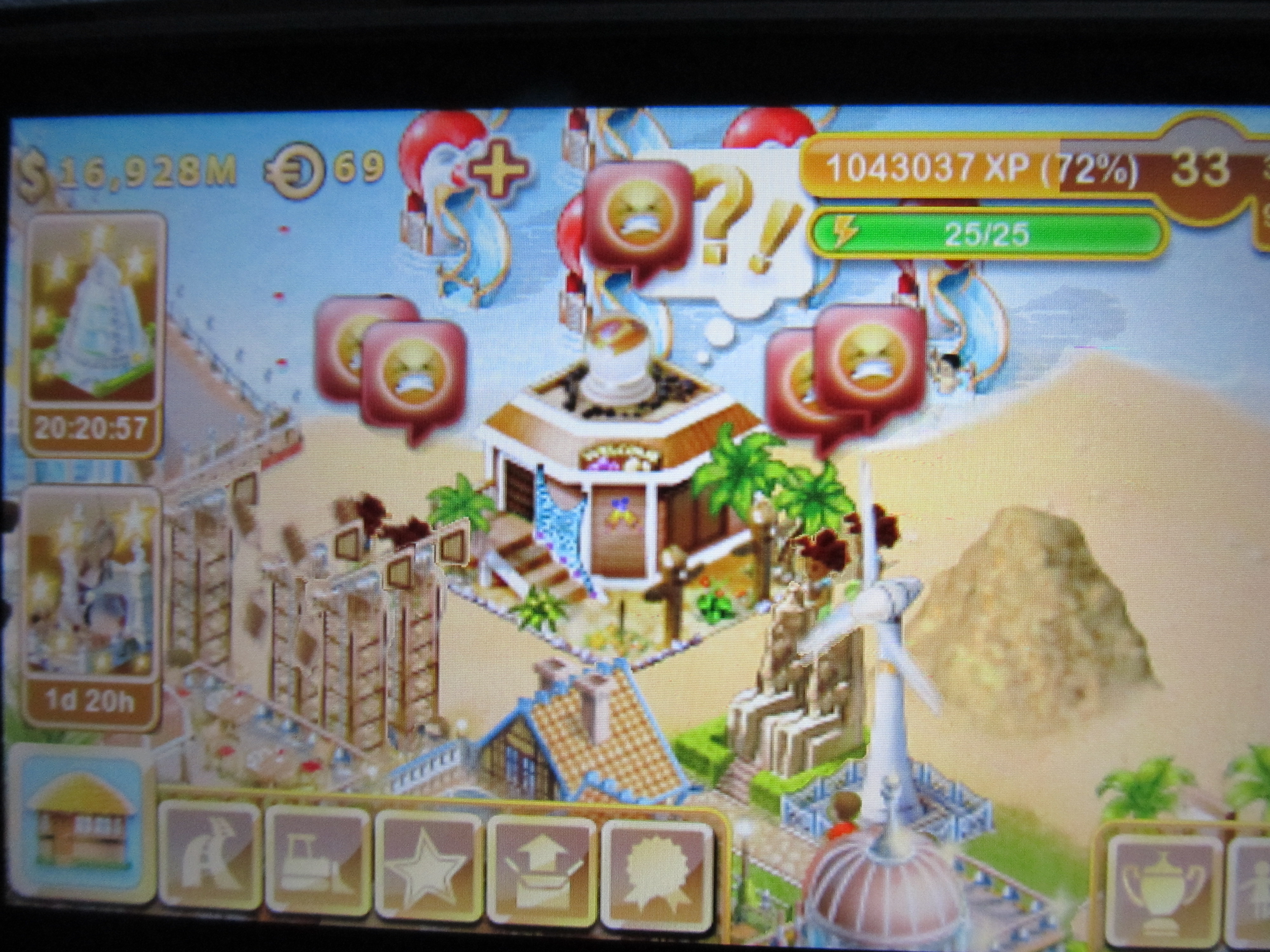
In 2011 I wrote a post that was inspired by the Sociological Images blog [1]. After some delay here I ve written another one. I plan to continue documenting such things. Playground gender segregated playground in 1918 In 2011 I photographed a plaque at Flagstaff Gardens in Melbourne. It shows a picture of the playground in 1918 with segregated boys and girls sections. It s interesting that the only difference between the two sections is that the boys have horizontal bars and a trapeze. Do they still have gender segregated playgrounds anywhere in Australia? If so what is the difference in the sections? Aborigines The Android game Paradise Island [2] has a feature where you are supposed to stop Aborigines from stealing, it plays on the old racist stereotypes about Aborigines which are used to hide the historical record that it s always been white people stealing from the people that they colonise. Angry face icons over AboriginesAborigines described as thieves There is also another picture showing the grass skirts. Nowadays the vast majority of Aborigines don t wear such clothing, the only time they do is when doing some sort of historical presentation for tourists. I took those pictures in 2012, but apparently the game hasn t changed much since then. Lemonade lemonade flavored fizzy drink Is lemonade a drink or a flavour? Most people at the party where I took the above photo regard lemonade as a drink and found the phrase Lemonade Flavoured Soft Drink strange when it was pointed out to them. Incidentally the drink on the right tastes a bit like the US version of lemonade (which is quite different from the Australian version). For US readers, the convention in Australia is that lemonade has no flavor of lemons. Not Sweet maybe gender queer people on bikes In 2012 an apple cider company made a huge advertising campaign featuring people who might be gender queer, above is a picture of a bus stop poster and there were also TV ads. The adverts gave no information at all about what the drink might taste like apart from not being as sweet as you think . So it s basically an advertising campaign with no substance other than a joke about people who don t conform to gender norms. Also it should be noted that some women naturally grow beards and have religious reasons for not shaving [3]. Episode 2 of the TV documentary series Am I Normal has an interesting interview of a woman with a beard. Revolution communist revolution Schweppes drinks A violent political revolution is usually a bad thing, using such revolutions to advertise sugar drinks seems like a bad idea. But it seems particularly interesting to note the different attitudes to such things in various countries. In 2012 Schweppes in Australia ran a marketing campaign based on imagery related to a Communist revolution (the above photo was taken at Southern Cross station in Melbourne), I presume that Schweppes in the US didn t run that campaign. I wonder whether global media will stop such things, presumably that campaign has the potential to do more harm in the US than good in Australia. Racist Penis Size Joke at Southbank racist advert in Southbank paper The above advert was in a free newspaper at Southbank in 2012. Mini Movers thought that this advert was a good idea and so did the management of Southbank who approved the advert for their paper. Australia is so racist that people don t even realise they are being racist.

19 April 2014

Russell Coker: Swap Space and SSD

In 2007 I wrote a blog post about swap space [1]. The main point of that article was to debunk the claim that Linux needs a swap space twice as large as main memory (in summary such advice is based on BSD Unix systems and has never applied to Linux and that most storage devices aren t fast enough for large swap). That post was picked up by Barrapunto (Spanish Slashdot) and became one of the most popular posts I ve written [2]. In the past 7 years things have changed. Back then 2G of RAM was still a reasonable amount and 4G was a lot for a desktop system or laptop. Now there are even phones with 3G of RAM, 4G is about the minimum for any new desktop or laptop, and desktop/laptop systems with 16G aren t that uncommon. Another significant development is the use of SSDs which dramatically improve speed for some operations (mainly seeks). As SATA SSDs for desktop use start at about $110 I think it s safe to assume that everyone who wants a fast desktop system has one. As a major limiting factor in swap use is the seek performance of the storage the use of SSDs should allow greater swap use. My main desktop system has 4G of RAM (it s an older Intel 64bit system and doesn t support more) and has 4G of swap space on an Intel SSD. My work flow involves having dozens of Chromium tabs open at the same time, usually performance starts to drop when I get to about 3.5G of swap in use. While SSD generally has excellent random IO performance the contiguous IO performance often isn t much better than hard drives. My Intel SSDSC2CT12 300i 128G can do over 5000 random seeks per second but for sustained contiguous filesystem IO can only do 225M/s for writes and 274M/s for reads. The contiguous IO performance is less than twice as good as a cheap 3TB SATA disk. It also seems that the performance of SSDs aren t as consistent as that of hard drives, when a hard drive delivers a certain level of performance then it can generally do so 24*7 but a SSD will sometimes reduce performance to move blocks around (the erase block size is usually a lot larger than the filesystem block size). It s obvious that SSDs allow significantly better swap performance and therefore make it viable to run a system with more swap in use but that doesn t allow unlimited swap. Even when using programs like Chromium (which seems to allocate huge amounts of RAM that aren t used much) it doesn t seem viable to have swap be much bigger than 4G on a system with 4G of RAM. Now I could buy another SSD and use two swap spaces for double the overall throughput (which would still be cheaper than buying a PC that supports 8G of RAM), but that still wouldn t solve all problems. One issue I have been having on occasion is BTRFS failing to allocate kernel memory when managing snapshots. I m not sure if this would be solved by adding more RAM as it could be an issue of RAM fragmentation I won t file a bug report about this until some of the other BTRFS bugs are fixed. Another problem I have had is when running Minecraft the driver for my ATI video card fails to allocate contiguous kernel memory, this is one that almost certainly wouldn t be solved by just adding more swap but might be solved if I tweaked the kernel to be more aggressive about swapping out data. In 2007 when using hard drives for swap I found that the maximum space that could be used with reasonable performance for typical desktop operations was something less than 2G. Now with a SSD the limit for usable swap seems to be something like 4G on a system with 4G of RAM. On a system with only 2G of RAM that might allow the system to be usable with swap being twice as large as RAM, but with the amounts of RAM in modern PCs it seems that even SSD doesn t allow using a swap space larger than RAM for typical use unless it s being used for hibernation. Conclusion It seems that nothing has significantly changed in the last 7 years. We have more RAM, faster storage, and applications that are more memory hungry. The end result is that swap still isn t very usable for anything other than hibernation if it s larger than RAM. It would be nice if application developers could stop increasing the use of RAM. Currently it seems that the RAM requirements for Linux desktop use are about 3 years behind the RAM requirements for Windows. This is convenient as a PC is fully depreciated according to the tax office after 3 years. This makes it easy to get 3 year old PCs cheaply (or sometimes for free as rubbish) which work really well for Linux. But it would be nice if we could be 4 or 5 years behind Windows in terms of hardware requirements to reduce the hardware requirements for Linux users even further.

Russell Coker: Phone Based Lectures

Early this month at a LUV meeting I gave a talk with only my mobile phone to store notes. I used Google Keep to write the notes as it s one of the easiest ways of writing a note on a PC and quickly transferring it to a phone if I keep doing this I will find some suitable free software for this task. Owncloud seems promising [1], but at the moment I m more concerned with people issues than software. Over the years I ve experimented with different ways of presenting lectures. I m now working with the theory that presenting the same data twice (by speaking and text on a projector) distracts the audience and decreases learning. Editing and Viewing Notes Google Keep is adequate for maintaining notes, it s based on notes that are a list of items (like a shopping list) which is fine for lecture notes. It probably has lots of other functionality but I don t care much about that. Keep is really fast at updating notes, I can commit a change on my laptop and have it visible on my phone in a few seconds over 3G. Most of the lectures that I ve given have involved notes on a laptop. My first laptop was a Thinkpad 385XD with a 12.1 display and all my subsequent laptops have had a bigger screen. When a laptop with a 12 or larger screen is on a lectern I can see the notes at a glance without having to lean forward when 15 or fewer lines of text are displayed on the screen. 15 lines of text is about the maximum that can be displayed on a slide for the audience to read and with the width of a computer display or projector is enough for a reasonable quantity of text. When I run Keep on my Galaxy Note 2 it displays about 20 rather short lines of text in a portrait orientation (5 points for a lecture) and 11 slightly longer lines in a landscape orientation (4 points). In both cases the amount of text displayed on a screen is less than that with a laptop while the font is a lot smaller. My aim is to use free software for everything, so when I replace Keep with Owncloud (or something similar) I will probably have some options for changing the font size. But that means having less than 5 points displayed on screen at a time and thus a change in the way I present my talks (I generally change the order of points based on how well the audience seem to get the concepts so seeing multiple points on screen at the same time is a benefit). The Samsung Galaxy Note 2 has a 5.5 display which is one of the largest displays available in a phone. The Sony Xperia X Ultra is one of the few larger phones with a 6.44 display that s a large phone but still not nearly large enough to have more than a few points on screen with a font readable by someone with average vision while it rests on a lectern. The most obvious solution to the problem of text size is to use a tablet. Modern 10 tablets have resolutions ranging from 1920*1080 to 2560*1600 and should be more readable than the Thinkpad I used in 1998 which had a 12 800*600 display. Another possibility that I m considering is using an old phone, a Samsung Galaxy S weighs 118 to 155 grams and is easier to hold up than a Galaxy Note 2 which weighs 180g. While 60g doesn t seem like much difference if I m going to hold a phone in front of me for most of an hour the smaller and lighter phone will be easier and maybe less distracting for the audience. Distributing URLs When I give a talk I often want to share the addresses of relevant web sites with the audience. When I give a talk with the traditional style lecture notes I just put the URLs on the final page (sometimes using tinyurl.com) for people to copy during question time. When I use a phone I have to find another way. I did a test with QR code recognition and found that a code that takes up most of the width of the screen of my Galaxy Note 2 can be recognised by a Galaxy S at a distance of 50cm. If I ran the same software on a 10 tablet then it would probably be readable at a distance of a meter, if I had the QR code take up the entire screen on a tablet it might be readable at 1.5m away, so it doesn t seem plausible to hold up a tablet and allow even the first few rows of the audience to decode a QR code. Even if newer phones have better photographic capabilities than the Galaxy S that I had available for testing there are still lots of people using old phones who I want to support. I think that if QR codes are to be used they have to be usable by at least the first three rows of the audience for a small audience of maybe 50 people as that would allow everyone who s interested to quickly get in range and scan the code at the end. Chris Samuel has a photo (taken at the same meeting) showing how a QR code from a phone could be distributed to a room [2]. But that won t work for all rooms. One option is to just have the QR code on my phone and allow audience members to scan it after the lecture. As most members of the audience won t want the URLs it should be possible for the interested people to queue up to scan the QR code(s). Another possibility I m considering is to use a temporary post on my documents blog (which isn t syndicated) for URLs. The WordPress client for Android works reasonably well so I could edit the URL list at any time. That would work reasonably well for talks that have lots of URLs which is quite rare for me. A final option is to use Twitter, at the end of a talk I could just tweet the URLs with suitable descriptions. A good portion of the Tweets that I have written is URLs for web sites that I find interesting so this isn t a change. This is probably the easiest option, but with the usual caveat of using a proprietary service as an interim measure until I get a free software alternative working. Any suggestions? Please comment if you have any ideas about ways of addressing these issues. Also please let me know if anyone is working on a distributed Twitter replacement. Please note that anything which doesn t support followers on multiple servers and re-tweets and tweeting to users on other servers isn t useful in this regard.

18 April 2014

Richard Hartmann: higher security

Instant classic
Trusted:
NO, there were errors:
The certificate does not apply to the given host
The certificate authority's certificate is invalid
The root certificate authority's certificate is not trusted for this purpose
The certificate cannot be verified for internal reasons
Signature Algorithm: md5WithRSAEncryption
    Issuer: C=XY, ST=Snake Desert, L=Snake Town, O=Snake Oil, Ltd, OU=Certificate Authority, CN=Snake Oil CA/emailAddress=ca@snakeoil.dom
    Validity
        Not Before: Oct 21 18:21:51 1999 GMT
        Not After : Oct 20 18:21:51 2001 GMT
    Subject: C=XY, ST=Snake Desert, L=Snake Town, O=Snake Oil, Ltd, OU=Webserver Team, CN=www.snakeoil.dom/emailAddress=www@snakeoil.dom
...
            X509v3 Subject Alternative Name: 
            email:www@snakeoil.dom

For your own pleasure:
openssl s_client -connect www.walton.com.tw:443 -showcerts

or just run
echo '
-----BEGIN CERTIFICATE-----
MIIDNjCCAp+gAwIBAgIBATANBgkqhkiG9w0BAQQFADCBqTELMAkGA1UEBhMCWFkx
FTATBgNVBAgTDFNuYWtlIERlc2VydDETMBEGA1UEBxMKU25ha2UgVG93bjEXMBUG
A1UEChMOU25ha2UgT2lsLCBMdGQxHjAcBgNVBAsTFUNlcnRpZmljYXRlIEF1dGhv
cml0eTEVMBMGA1UEAxMMU25ha2UgT2lsIENBMR4wHAYJKoZIhvcNAQkBFg9jYUBz
bmFrZW9pbC5kb20wHhcNOTkxMDIxMTgyMTUxWhcNMDExMDIwMTgyMTUxWjCBpzEL
MAkGA1UEBhMCWFkxFTATBgNVBAgTDFNuYWtlIERlc2VydDETMBEGA1UEBxMKU25h
a2UgVG93bjEXMBUGA1UEChMOU25ha2UgT2lsLCBMdGQxFzAVBgNVBAsTDldlYnNl
cnZlciBUZWFtMRkwFwYDVQQDExB3d3cuc25ha2VvaWwuZG9tMR8wHQYJKoZIhvcN
AQkBFhB3d3dAc25ha2VvaWwuZG9tMIGfMA0GCSqGSIb3DQEBAQUAA4GNADCBiQKB
gQC554Ro+VH0dJONqljPBW+C72MDNGNy9eXnzejXrczsHs3Pc92Vaat6CpIEEGue
yG29xagb1o7Gj2KRgpVYcmdx6tHd2JkFW5BcFVfWXL42PV4rf9ziYon8jWsbK2aE
+L6hCtcbxdbHOGZdSIWZJwc/1Vs70S/7ImW+Zds8YEFiAwIDAQABo24wbDAbBgNV
HREEFDASgRB3d3dAc25ha2VvaWwuZG9tMDoGCWCGSAGG+EIBDQQtFittb2Rfc3Ns
IGdlbmVyYXRlZCBjdXN0b20gc2VydmVyIGNlcnRpZmljYXRlMBEGCWCGSAGG+EIB
AQQEAwIGQDANBgkqhkiG9w0BAQQFAAOBgQB6MRsYGTXUR53/nTkRDQlBdgCcnhy3
hErfmPNl/Or5jWOmuufeIXqCvM6dK7kW/KBboui4pffIKUVafLUMdARVV6BpIGMI
5LmVFK3sgwuJ01v/90hCt4kTWoT8YHbBLtQh7PzWgJoBAY7MJmjSguYCRt91sU4K
s0dfWsdItkw4uQ==
-----END CERTIFICATE-----
'   openssl x509 -noout -text

At least they're secure against heartbleed.

16 April 2014

David Pashley: Bad Password Policies

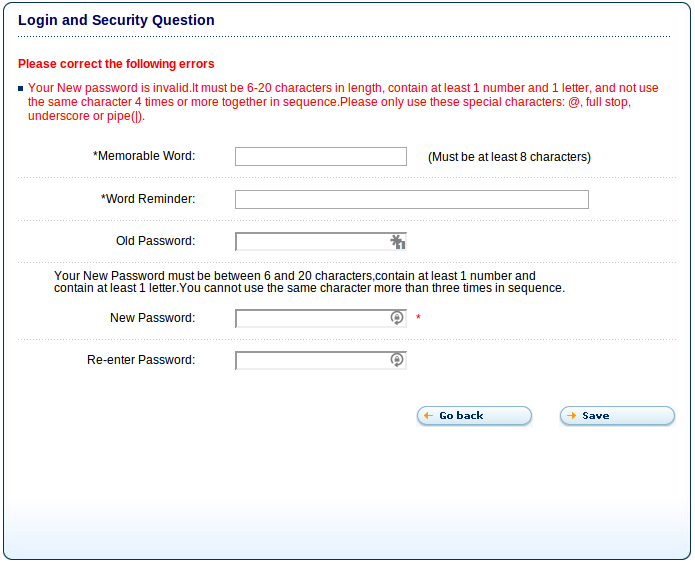
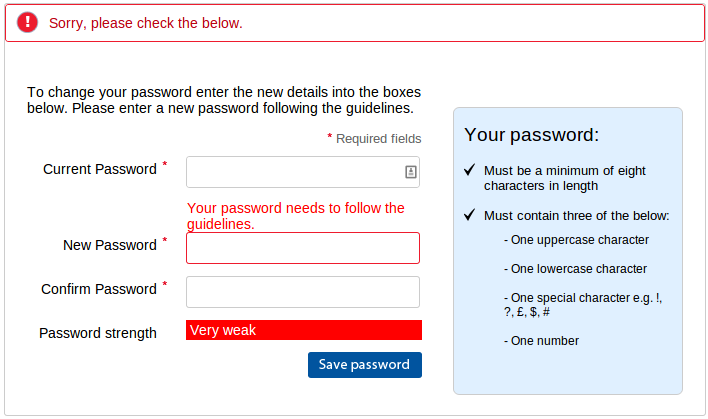
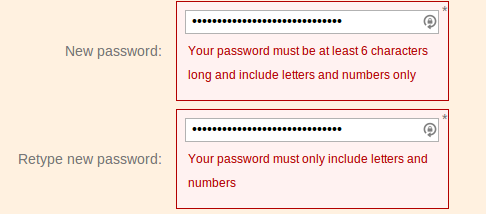
After the whole Heartbleed fiasco, I ve decided to continue my march towards improving my online security. I d already begun the process of using LastPass to store my passwords and generate random passwords for each site, but I hadn t completed the process, with some sites still using the same passwords, and some having less than ideal strength passwords, so I spent some time today improving my password position. Here s some of the bad examples of password policy I ve discovered today. First up we have Live.com. A maximum of 16 characters from the Microsoft auth service. Seems to accept any character though. Screenshot from 2014-04-15 21:36:57 This excellent example is from creditexpert.co.uk, one of the credit agencies here in the UK. They not only restrict to 20 characters, they restrict you to @, ., _ or . So much for teaching people how to protect themselves online. Screenshot from 2014-04-15 17:38:28 Here s Tesco.com after attempting to change my password to QvHn#9#kDD%cdPAQ4&b&ACb4x%48#b . If you can figure out how this violates their rules, I d love to know. And before you ask, I tried without numbers and that still failed so it can t be the three and only three thing. The only other idea might be that they meant i.e. rather than e.g. , but I didn t test that. Screenshot from 2014-04-15 16:20:17 Edit: Here is a response from Tesco on Twitter: Screenshot from 2014-04-16 07:47:58 Here s a poor choice from ft.com, refusing to accept non-alphanumeric characters. On the plus side they did allow the full 30 characters in the password. Screenshot from 2014-04-15 15:22:08 The finest example of a poor security policy is a company who will remain nameless due to their utter lack of security. Not only did they not use HTTPS, they accepted a 30 character password and silently truncated it to 20 characters. The reason I know this is because when I logged out and tried to log in again and then used the forgot my password option, they emailed me the password in plain text. I have also been setting up two-factor authentication where possible. Most sites use the Google Authenticator application on your mobile to give you a 6 digit code to type in in addition to your password. I highly recommend you set it up too. There s a useful list of sites that implement 2FA and links to their documentation at http://twofactorauth.org/. I realise that my choice LastPass requires me to trust them, but I think the advantages outweigh the disadvantages of having many sites using the same passwords and/or low strength passwords. I know various people cleverer than me have looked into their system and failed to find any obvious flaws. Remember people, when you implement a password, allow the following things: If you are going to place restrictions, please make sure the documentation matches the implementation, provide a client-side implementation to match and provide quick feedback to the user, and make sure you explicitly say what is wrong with the password, rather than referring back to the incorrect documentation. There are also many JS password strength meters available to show how secure the inputted passwords are. They are possibly a better way of providing feedback about security than having arbitrary policies that actually harm your security. As someone said to me on twitter, it s not like password is too strong was ever a bad thing. The post Bad Password Policies appeared first on David Pashley.com.

15 April 2014

B lint R czey: Proposing amd64-hardened architecture for Debian

Facing last week s Heartbleed bug the need for improving the security of our systems became more apparent than usually. In Debian there are widely used methods for Hardening packages at build time and guidelines for improving the default installations security. Employing such methods usually come at an expense, for example slower code execution of binaries due to additional checks or additional configuration steps when setting up a system. Balancing between usability and security Debian chose an approach which would satisfy the most users by using C/C++ features which only slightly decrease execution speed of built binaries and by using reasonable defaults in package installations. All the architectures supported by Debian aims using the same methods for enhancing security but it does not have to stay the same way. Amd64 is the most widely used architecture of Debian according to popcon and amd64 hardware comes with powerful CPU-s. I think there would be a significant amount of people (being one of them :-)) who would happily use a version of Debian with more security features enabled by default sacrificing some CPU power and installing and setting up additional packages. My proposal for serving those security-focused users is introducing a new architecture targeting amd64 hardware, but with more security related C/C++ features turned on for every package (currently hardening has to be enabled by the maintainers in some way) through compiler flags as a start. Introducing the new architecture would also let package maintainers enabling additional dependencies and build rules selectively for the new architecture improving the security further. On the users side the advantage of having a separate security enhanced architecture instead of a Debian derivative is the potential of installing a set of security enhanced packages using multiarch. You could have a fast amd64 installation as a base and run Apache or any other sensitive server from the amd64-hardened packages! I have sent the proposal for discussion to debian-dev, too. Please join the discussion there or leave a comment here. Update: Many of you wondered if amd64-hardened could have prevented the exploitation of the Heartbleed vulnerability. I have posted a proof of concept to show that using -fsanitize=address and disabling custom freelist would have protected systems against stealing data using the exploits. Disabling the custom freelist-like solutions and enabling-fsanitize=address would be part of amd64-hardened to make memory protection techniques work effectively thus I think if we had this architecture ready at the beginning of April, it would have been immune to Heartbleed.

Andrew Pollock: [life] Day 77: Port of Brisbane tour

Sarah dropped Zoe around this morning at about 8:30am. She was still a bit feverish, but otherwise in good spirits, so I decided to stick with my plan for today, which was a tour of the Port of Brisbane. Originally the plan had been to do it with Megan and her Dad, Jason, but Jason had some stuff to work on on his house, so I offered to take Megan with us to allow him more time to work on the house uninterrupted. I was casting around for something to do to pass the time until Jason dropped Megan off at 10:30am, and I thought we could do some foot painting. We searched high and low for something I could use as a foot washing bucket, other than the mop bucket, which I didn't want to use because of potential chemical residue. I gave up because I couldn't anything suitable, and we watched a bit of TV instead. Jason dropped Megan around, and we immediately jumped in the car and headed out to the Port. I missed the on ramp for the M4 from Lytton Road, and so we took the slightly longer Lytton Road route, which was fine, because we had plenty of time to kill. The plan was to get there for about 11:30am, have lunch in the observation cafe on the top floor of the visitor's centre building, and then get on the tour bus at 12:30pm. We ended up arriving much earlier than 11:30am, so we looked around the foyer of the visitor's centre for a bit. It was quite a nice building. The foyer area had some displays, but the most interesting thing (for the girls) was an interactive webcam of the shore bird roost across the street. There was a tablet where you could control the camera and zoom in and out on the birds roosting on a man-made island. That passed the time nicely. One of the staff also gave the girls Easter eggs as we arrived. We went up to the cafe for lunch next. The view was quite good from the 7th floor. On one side you could look out over the bay, notably Saint Helena Island, and on the other side you got quite a good view of the port operations and the container park. Lunch didn't take all that long, and the girls were getting a bit rowdy, running around the cafe, so we headed back downstairs to kill some more time looking at the shore birds with the webcam, and then we boarded the bus. It was just the three of us and three other adults, which was good. The girls were pretty fidgety, and I don't think they got that much out of it. The tour didn't really go anywhere that you couldn't go yourself in your own car, but you did get running commentary from the driver, which made all the difference. The girls spent the first 5 minutes trying to figure out where his voice was coming from (he was wired up with a microphone). The thing I found most interesting about the port operations was the amount of automation. There were three container terminals, and the two operated by DP World and Hutchinson Ports employed fully automated overhead cranes for moving containers around. Completely unmanned, they'd go pick a container from the stack and place it on a waiting truck below. What I found even more fascinating was the Patrick terminal, which used fully automated straddle carriers, which would, completely autonomously move about the container park, pick up a container, and then move over to a waiting truck in the loading area and place it on the truck. There were 27 of these things moving around the container park at a fairly decent clip. Of course the girls didn't really appreciate any of this, and half way through the tour Megan was busting to go to the toilet, despite going before we started the tour. I was worried about her having an accident before we got back, she didn't, so it was all good. I'd say in terms of a successful excursion, I'd score it about a 4 out of 10, because the girls didn't really enjoy the bus tour all that much. I was hoping we'd see more ships, but there weren't many (if any) in port today. They did enjoy the overall outing. Megan spontaneously thanked me as we were leaving, which was sweet. We picked up the blank cake I'd ordered from Woolworths on the way through on the way home, and then dropped Megan off. Zoe wanted to play, so we hung around for a little while before returning home. Zoe watched a bit more TV while we waited for Sarah to pick her up. Her fever picked up a bit more in the afternoon, but she was still very perky.

Colin Watson: Porting GHC: A Tale of Two Architectures

We had some requests to get GHC (the Glasgow Haskell Compiler) up and running on two new Ubuntu architectures: arm64, added in 13.10, and ppc64el, added in 14.04. This has been something of a saga, and has involved rather more late-night hacking than is probably good for me. Book the First: Recalled to a life of strange build systems You might not know it from the sheer bulk of uploads I do sometimes, but I actually don't speak a word of Haskell and it's not very high up my list of things to learn. But I am a pretty experienced build engineer, and I enjoy porting things to new architectures: I'm firmly of the belief that breadth of architecture support is a good way to shake out certain categories of issues in code, that it's worth doing aggressively across an entire distribution, and that, even if you don't think you need something now, new requirements have a habit of coming along when you least expect them and you might as well be prepared in advance. Furthermore, it annoys me when we have excessive noise in our build failure and proposed-migration output and I often put bits and pieces of spare time into gardening miscellaneous problems there, and at one point there was a lot of Haskell stuff on the list and it got a bit annoying to have to keep sending patches rather than just fixing things myself, and ... well, I ended up as probably the only non-Haskell-programmer on the Debian Haskell team and found myself fixing problems there in my free time. Life is a bit weird sometimes. Bootstrapping packages on a new architecture is a bit of a black art that only a fairly small number of relatively bitter and twisted people know very much about. Doing it in Ubuntu is specifically painful because we've always forbidden direct binary uploads: all binaries have to come from a build daemon. Compilers in particular often tend to be written in the language they compile, and it's not uncommon for them to build-depend on themselves: that is, you need a previous version of the compiler to build the compiler, stretching back to the dawn of time where somebody put things together with a big magnet or something. So how do you get started on a new architecture? Well, what we do in this case is we construct a binary somehow (usually involving cross-compilation) and insert it as a build-dependency for a proper build in Launchpad. The ability to do this is restricted to a small group of Canonical employees, partly because it's very easy to make mistakes and partly because things like the classic "Reflections on Trusting Trust" are in the backs of our minds somewhere. We have an iron rule for our own sanity that the injected build-dependencies must themselves have been built from the unmodified source package in Ubuntu, although there can be source modifications further back in the chain. Fortunately, we don't need to do this very often, but it does mean that as somebody who can do it I feel an obligation to try and unblock other people where I can. As far as constructing those build-dependencies goes, sometimes we look for binaries built by other distributions (particularly Debian), and that's pretty straightforward. In this case, though, these two architectures are pretty new and the Debian ports are only just getting going, and as far as I can tell none of the other distributions with active arm64 or ppc64el ports (or trivial name variants) has got as far as porting GHC yet. Well, OK. This was somewhere around the Christmas holidays and I had some time. Muggins here cracks his knuckles and decides to have a go at bootstrapping it from scratch. It can't be that hard, right? Not to mention that it was a blocker for over 600 entries on that build failure list I mentioned, which is definitely enough to make me sit up and take notice; we'd even had the odd customer request for it. Several attempts later and I was starting to doubt my sanity, not least for trying in the first place. We ship GHC 7.6, and upgrading to 7.8 is not a project I'd like to tackle until the much more experienced Haskell folks in Debian have switched to it in unstable. The porting documentation for 7.6 has bitrotted more or less beyond usability, and the corresponding documentation for 7.8 really isn't backportable to 7.6. I tried building 7.8 for ppc64el anyway, picking that on the basis that we had quicker hardware for it and didn't seem likely to be particularly more arduous than arm64 (ho ho), and I even got to the point of having a cross-built stage2 compiler (stage1, in the cross-building case, is a GHC binary that runs on your starting architecture and generates code for your target architecture) that I could copy over to a ppc64el box and try to use as the base for a fully-native build, but it segfaulted incomprehensibly just after spawning any child process. Compilers tend to do rather a lot, especially when they're built to use GCC to generate object code, so this was a pretty serious problem, and it resisted analysis. I poked at it for a while but didn't get anywhere, and I had other things to do so declared it a write-off and gave up. Book the Second: The golden thread of progress In March, another mailing list conversation prodded me into finding a blog entry by Karel Gardas on building GHC for arm64. This was enough to be worth another look, and indeed it turned out that (with some help from Karel in private mail) I was able to cross-build a compiler that actually worked and could be used to run a fully-native build that also worked. Of course this was 7.8, since as I mentioned cross-building 7.6 is unrealistically difficult unless you're considerably more of an expert on GHC's labyrinthine build system than I am. OK, no problem, right? Getting a GHC at all is the hard bit, and 7.8 must be at least as capable as 7.6, so it should be able to build 7.6 easily enough ... Not so much. What I'd missed here was that compiler engineers generally only care very much about building the compiler with older versions of itself, and if the language in question has any kind of deprecation cycle then the compiler itself is likely to be behind on various things compared to more typical code since it has to be buildable with older versions. This means that the removal of some deprecated interfaces from 7.8 posed a problem, as did some changes in certain primops that had gained an associated compatibility layer in 7.8 but nobody had gone back to put the corresponding compatibility layer into 7.6. GHC supports running Haskell code through the C preprocessor, and there's a __GLASGOW_HASKELL__ definition with the compiler's version number, so this was just a slog tracking down changes in git and adding #ifdef-guarded code that coped with the newer compiler (remembering that stage1 will be built with 7.8 and stage2 with stage1, i.e. 7.6, from the same source tree). More inscrutably, GHC has its own packaging system called Cabal which is also used by the compiler build process to determine which subpackages to build and how to link them against each other, and some crucial subpackages weren't being built: it looked like it was stuck on picking versions from "stage0" (i.e. the initial compiler used as an input to the whole process) when it should have been building its own. Eventually I figured out that this was because GHC's use of its packaging system hadn't anticipated this case, and was selecting the higher version of the ghc package itself from stage0 rather than the version it was about to build for itself, and thus never actually tried to build most of the compiler. Editing ghc_stage1_DEPS in ghc/stage1/package-data.mk after its initial generation sorted this out. One late night building round and round in circles for a while until I had something stable, and a Debian source upload to add basic support for the architecture name (and other changes which were a bit over the top in retrospect: I didn't need to touch the embedded copy of libffi, as we build with the system one), and I was able to feed this all into Launchpad and watch the builders munch away very satisfyingly at the Haskell library stack for a while. This was all interesting, and finally all that work was actually paying off in terms of getting to watch a slew of several hundred build failures vanish from arm64 (the final count was something like 640, I think). The fly in the ointment was that ppc64el was still blocked, as the problem there wasn't building 7.6, it was getting a working 7.8. But now I really did have other much more urgent things to do, so I figured I just wouldn't get to this by release time and stuck it on the figurative shelf. Book the Third: The track of a bug Then, last Friday, I cleared out my urgent pile and thought I'd have another quick look. (I get a bit obsessive about things like this that smell of "interesting intellectual puzzle".) slyfox on the #ghc IRC channel gave me some general debugging advice and, particularly usefully, a reduced example program that I could use to debug just the process-spawning problem without having to wade through noise from running the rest of the compiler. I reproduced the same problem there, and then found that the program crashed earlier (in stg_ap_0_fast, part of the run-time system) if I compiled it with +RTS -Da -RTS. I nailed it down to a small enough region of assembly that I could see all of the assembly, the source code, and an intermediate representation or two from the compiler, and then started meditating on what makes ppc64el special. You see, the vast majority of porting bugs come down to what I might call gross properties of the architecture. You have things like whether it's 32-bit or 64-bit, big-endian or little-endian, whether char is signed or unsigned, that sort of thing. There's a big table on the Debian wiki that handily summarises most of the important ones. Sometimes you have to deal with distribution-specific things like whether GL or GLES is used; often, especially for new variants of existing architectures, you have to cope with foolish configure scripts that think they can guess certain things from the architecture name and get it wrong (assuming that powerpc* means big-endian, for instance). We often have to update config.guess and config.sub, and on ppc64el we have the additional hassle of updating libtool macros too. But I've done a lot of this stuff and I'd accounted for everything I could think of. ppc64el is actually a lot like amd64 in terms of many of these porting-relevant properties, and not even that far off arm64 which I'd just successfully ported GHC to, so I couldn't be dealing with anything particularly obvious. There was some hand-written assembly which certainly could have been problematic, but I'd carefully checked that this wasn't being used by the "unregisterised" (no specialised machine dependencies, so relatively easy to port but not well-optimised) build I was using. A problem around spawning processes suggested a problem with SIGCHLD handling, but I ruled that out by slowing down the first child process that it spawned and using strace to confirm that SIGSEGV was the first signal received. What on earth was the problem? From some painstaking gdb work, one thing I eventually noticed was that stg_ap_0_fast's local stack appeared to be being corrupted by a function call, specifically a call to the colourfully-named debugBelch. Now, when IBM's toolchain engineers were putting together ppc64el based on ppc64, they took the opportunity to fix a number of problems with their ABI: there's an OpenJDK bug with a handy list of references. One of the things I noticed there was that there were some stack allocation optimisations in the new ABI, which affected functions that don't call any vararg functions and don't call any functions that take enough parameters that some of them have to be passed on the stack rather than in registers. debugBelch takes varargs: hmm. Now, the calling code isn't quite in C as such, but in a related dialect called "Cmm", a variant of C-- (yes, minus), that GHC uses to help bridge the gap between the functional world and its code generation, and which is compiled down to C by GHC. When importing C functions into Cmm, GHC generates prototypes for them, but it doesn't do enough parsing to work out the true prototype; instead, they all just get something like extern StgFunPtr f(void);. In most architectures you can get away with this, because the arguments get passed in the usual calling convention anyway and it all works out, but on ppc64el this means that the caller doesn't generate enough stack space and then the callee tries to save its varargs onto the stack in an area that in fact belongs to the caller, and suddenly everything goes south. Things were starting to make sense. Now, debugBelch is only used in optional debugging code; but runInteractiveProcess (the function associated with the initial round of failures) takes no fewer than twelve arguments, plenty to force some of them onto the stack. I poked around the GCC patch for this ABI change a bit and determined that it only optimised away the stack allocation if it had a full prototype for all the callees, so I guessed that changing those prototypes to extern StgFunPtr f(); might work: it's still technically wrong, not least because omitting the parameter list is an obsolescent feature in C11, but it's at least just omitting information about the parameter list rather than actively lying about it. I tweaked that and ran the cross-build from scratch again. Lo and behold, suddenly I had a working compiler, and I could go through the same build-7.6-using-7.8 procedure as with arm64, much more quickly this time now that I knew what I was doing. One upstream bug, one Debian upload, and several bootstrapping builds later, and GHC was up and running on another architecture in Launchpad. Success! Epilogue There's still more to do. I gather there may be a Google Summer of Code project in Linaro to write proper native code generation for GHC on arm64: this would make things a good deal faster, but also enable GHCi (the interpreter) and Template Haskell, and thus clear quite a few more build failures. Since there's already native code generation for ppc64 in GHC, getting it going for ppc64el would probably only be a couple of days' work at this point. But these are niceties by comparison, and I'm more than happy with what I got working for 14.04. The upshot of all of this is that I may be the first non-Haskell-programmer to ever port GHC to two entirely new architectures. I'm not sure if I gain much from that personally aside from a lot of lost sleep and being considered extremely strange. It has, however, been by far the most challenging set of packages I've ported, and a fascinating trip through some odd corners of build systems and undefined behaviour that I don't normally need to touch.


14 April 2014

Daniel Kahn Gillmor: OTR key replacement (heartbleed)

I'm replacing my OTR key for XMPP because of heartbleed (see below). If the plain ASCII text below is mangled beyond verification, you can retrieve a copy of it from my web site that should be able to be verified.

-----BEGIN PGP SIGNED MESSAGE-----
Hash: SHA512
OTR Key Replacement for XMPP dkg@jabber.org
===========================================
Date: 2014-04-14
My main XMPP account is dkg@jabber.org.
I prefer OTR [0] conversations when using XMPP for private
discussions.
I was using irssi to connect to XMPP servers, and irssi relies on
OpenSSL for the TLS connections.  I was using it with versions of
OpenSSL that were vulnerable to the "Heartbleed" attack [1].  It's
possible that my OTR long-term secret key was leaked via this attack.
As a result, I'm changing my OTR key for this account.
The new, correct OTR fingerprint for the XMPP account at dkg@jabber.org is:
  F8953C5D 48ABABA2 F48EE99C D6550A78 A91EF63D
Thanks for taking the time to verify your peers' fingerprints.  Secure
communication is important not only to protect yourself, but also to
protect your friends, their friends and so on.
Happy Hacking,
  --dkg  (Daniel Kahn Gillmor)
Notes:
[0] OTR: https://otr.cypherpunks.ca/
[1] Heartbleed: http://heartbleed.com/
-----BEGIN PGP SIGNATURE-----
Version: GnuPG v1
iQJ8BAEBCgBmBQJTTBF+XxSAAAAAAC4AKGlzc3Vlci1mcHJAbm90YXRpb25zLm9w
ZW5wZ3AuZmlmdGhob3JzZW1hbi5uZXRFQjk2OTEyODdBN0FEREUzNzU3RDkxMUVB
NTI0MDFCMTFCRkRGQTVDAAoJEKUkAbEb/fpcYwkQAKLzEnTV1lrK6YrhdvRnuYnh
Bh9Ad2ZY44RQmN+STMEnCJ4OWbn5qx/NrziNVUZN6JddrEvYUOxME6K0mGHdY2KR
yjLYudsBuSMZQ+5crZkE8rjBL8vDj8Dbn3mHyT8bAbB9cmASESeQMu96vni15ePd
2sB7iBofee9YAoiewI+xRvjo2aRX8nbFSykoIusgnYG2qwo2qPaBVOjmoBPB5YRI
PkN0/hAh11Ky0qQ/GUROytp/BMJXZx2rea2xHs0mplZLqJrX400u1Bawllgz3gfV
qQKKNc3st6iHf3F6p6Z0db9NRq+AJ24fTJNcQ+t07vMZHCWM+hTelofvDyBhqG/r
l8e4gdSh/zWTR/7TR3ZYLCiZzU0uYNd0rE3CcxDbnGTUS1ZxooykWBNIPJMl1DUE
zzcrQleLS5tna1b9la3rJWtFIATyO4dvUXXa9wU3c3+Wr60cSXbsK5OCct2KmiWY
fJme0bpM5m1j7B8QwLzKqy/+YgOOJ05QDVbBZwJn1B7rvUYmb968yLQUqO5Q87L4
GvPB1yY+2bLLF2oFMJJzFmhKuAflslRXyKcAhTmtKZY+hUpxoWuVa1qLU3bQCUSE
MlC4Hv6vaq14BEYLeopoSb7THsIcUdRjho+WEKPkryj6aVZM5WnIGIS/4QtYvWpk
3UsXFdVZGfE9rfCOLf0F
=BGa1
-----END PGP SIGNATURE-----

Matthew Garrett: Real-world Secure Boot attacks

MITRE gave a presentation on UEFI Secure Boot at SyScan earlier this month. You should read the the presentation and paper, because it's really very good.

It describes a couple of attacks. The first is that some platforms store their Secure Boot policy in a run time UEFI variable. UEFI variables are split into two broad categories - boot time and run time. Boot time variables can only be accessed while in boot services - the moment the bootloader or kernel calls ExitBootServices(), they're inaccessible. Some vendors chose to leave the variable containing firmware settings available during run time, presumably because it makes it easier to implement tools for modifying firmware settings at the OS level. Unfortunately, some vendors left bits of Secure Boot policy in this space. The naive approach would be to simply disable Secure Boot entirely, but that means that the OS would be able to detect that the system wasn't in a secure state[1]. A more subtle approach is to modify the policy, such that the firmware chooses not to verify the signatures on files stored on fixed media. Drop in a new bootloader and victory is ensured.

But that's not a beautiful approach. It depends on the firmware vendor having made that mistake. What if you could just rewrite arbitrary variables, even if they're only supposed to be accessible in boot services? Variables are all stored in flash, connected to the chipset's SPI controller. Allowing arbitrary access to that from the OS would make it straightforward to modify the variables, even if they're boot time-only. So, thankfully, the SPI controller has some control mechanisms. The first is that any attempt to enable the write-access bit will cause a System Management Interrupt, at which point the CPU should trap into System Management Mode and (if the write attempt isn't authorised) flip it back. The second is to disable access from the OS entirely - all writes have to take place in System Management Mode.

The MITRE results show that around 0.03% of modern machines enable the second option. That's unfortunate, but the first option should still be sufficient[2]. Except the first option requires on the SMI actually firing. And, conveniently, Intel's chipsets have a bit that allows you to disable all SMI sources[3], and then have another bit to disable further writes to the first bit. Except 40% of the machines MITRE tested didn't bother setting that lock bit. So you can just disable SMI generation, remove the write-protect bit on the SPI controller and then write to arbitrary variables, including the SecureBoot enable one.

This is, uh, obviously a problem. The good news is that this has been communicated to firmware and system vendors and it should be fixed in the future. The bad news is that a significant proportion of existing systems can probably have their Secure Boot implementation circumvented. This is pretty unsurprisingly - I suggested that the first few generations would be broken back in 2012. Security tends to be an iterative process, and changing a branch of the industry that's historically not had to care into one that forms the root of platform trust is a difficult process. As the MITRE paper says, UEFI Secure Boot will be a genuine improvement in security. It's just going to take us a little while to get to the point where the more obvious flaws have been worked out.

[1] Unless the malware was intelligent enough to hook GetVariable, detect a request for SecureBoot and then give a fake answer, but who would do that?
[2] Impressively, basically everyone enables that.
[3] Great for dealing with bugs caused by YOUR ENTIRE COMPUTER BEING INTERRUPTED BY ARBITRARY VENDOR CODE, except unfortunately it also probably disables chunks of thermal management and stops various other things from working as well.

comment count unavailable comments

13 April 2014

Jeff Licquia: My Heart Bleeds (or, What s Going On With Heartbleed)

[en] One of the big news stories of the week has been the Heartbleed bug . If you know a techie person, you might have noticed that person looking a bit more stressed and tired than usual since Monday (that was certainly true of me). Some of the discussion might seem a bit confusing and/or scary; what s worse, the non-tech press has started getting some of the details wrong and scare-mongering for readers. So here s my non-techie guide to what all the fuss is about. If you re a techie, this advice isn t for you; chances are, you already know what you should be doing to help fix this. (If you re a techie and you don t know, ask! You might just need a little education on what needs to happen, and there s nothing wrong with that, but you ll be better off asking and possibly looking foolish than you will be if you get hacked.) If you re not inclined to read the whole thing, here are the important points:
  • Don t panic! There are reports of people cleaning out their bank accounts, cutting off their Internet service, buying new computers, etc. If you re thinking about doing anything drastic because you re scared of Heartbleed, don t.
  • You ll probably need to change a lot of your passwords on various sites, but wait until each site you use tells you to.
  • This is mostly a problem for site servers, not PCs or phones or tablets. Unless you re doing something unusual (and you d know if you were), you re fine as long as you update your devices like you usually do. (You do update your devices, right?)
So what happened? There s a notion called a heartbeat signal , where two computers talking to each other say Hey, you there? every so often. This is usually done by computer #1 sending some bit of data to computer #2, and computer #2 sending it back. In this particular situation, the two computers actually send both a bit of data and the length of that bit of data. Some of you might be asking so what happens if computer #1 sends a little bit of data, but lies and says the data is a lot longer than that? In a perfect world, computer #2 would scold computer #1 for lying, and that s what happens now with the bug fix. But before early this week, computer #2 would just trust computer #1 in one very specific case. Now, computers use memory to keep track of stuff they re working on, and they re constantly asking for memory and then giving it back when they re done, so it can be used by something else. So, when you ask for memory, the bit of memory you get might have the results of what the program was doing just a moment ago things like decrypting a credit card using a crypto key, or checking a password. This isn t normally a problem, since it s the same program getting its own memory back. But if it s using this memory to keep track of these heartbeats, and it s been tricked into thinking it needs to send back the word HAT, which is 500 characters long , then character 4 and following is likely to be memory used for something just a moment ago. Most of that recycled memory would be undecipherable junk. But credit cards, crypto keys, and passwords tend to be fairly easy to pick out, unfortunately. And that, by the way, is where the name comes from: the heartbeat signal bleeds data, so Heartbleed . There s been some fascinating commentary on how well this bug has been marketed, by the way; hopefully, we in the techie community will learn something about how to explain problems like this for future incidents. Does this affect every site? No. Only sites using certain newer versions of crypographic software called OpenSSL are affected by this. OpenSSL is very popular; I ve seen estimates that anywhere from a third to a half of all secure Internet sites use it. But not all of those sites will have the bug, since it was only introduced in the last two years. How do we know this? OpenSSL is open source, and is developed in public . Because of that, we know the exact moment when the bug was introduced, when it was released to the world, and when it was fixed. (And, just for the record, it was an honest mistake. Don t go and slam on the poor guy who wrote the code with the bug. It should have been caught by a number of different people, and none of them noticed it, so it s a lot more complicated than it s his fault! pitchforks and torches! ) What should I do? Nothing, yet. Right now, this is mostly a techie problem. Remember that bit about crypto keys? That s the part which puts the little lock icon next to the URL in your browser when you go to your bank s Web site, or to Amazon to buy things, or whatever. The crypto keys make sure that your conversation with your bank about your balance is just between you and your bank. That s also the part which is making techies the world over a little more stressed and tired. You see, we know that the people who found the bug were good guys and helped to get the bug fixed, but we don t know if any bad guys found the bug before this week. And if a bad guy used the bug to extract crypto keys, they would still have those crypto keys, and could still use them even though the original bug is fixed. That would mean that a bad guy could intercept your conversation with your bank / Amazon / whoever. Since we don t know, we have to do the safe thing, and assume that all our keys were in fact stolen, That means we have to redo all our crypto keys. That s a lot of work. And because your password is likely protected with those same crypto keys, if a bad guy has Amazon s key, they d be able to watch you change your password at Amazon. Maybe they didn t even have your old password, but now they have your new one. Oops. You re now less secure than you were. Now, it s important to make sure we re clear: we don t know that this has happened. There s really no way of knowing, short of actually catching a bad guy in the act, and we haven t caught anyone yet. So, this is a safety measure. Thus, the best thing to do is: don t panic. Continue to live life as usual. It might be prudent to put off doing some things for a few days, but I wouldn t even worry so much about that. If you pay your bills online, for example, don t risk paying a bill late out of fear. Remember: so far, we have no evidence yet that anyone s actually doing anything malicious with this bug. At some point, a lot of sites are going to post a notice that looks a lot like this:
We highly recommend our users change the password on their Linux Foundation ID which is used for the logins on most Linux Foundation sites, including our community site, Linux.com for your own security and as part of your own comprehensive effort to update and secure as many of your online credentials as you can.
(That s the notice my employer posted once we had our site in order.) That will be your cue that they ve done the work to redo their crypto keys, and that it s now safe to change your password. A lot of sites will make statements saying, essentially, we don t have a problem . They re probably right. Don t second-guess them; just exhale, slowly, and tick that site off your list of things to worry about. Other sites might not say anything. That s the most worrying part, because it s hard to tell if they re OK or not. If it s an important site to you, the best course of action might be to just ask, or search on Google / Bing / DuckDuckGo / wherever for some kind of statement. What about your site? Yup, I use OpenSSL, and I was vulnerable. But I m the only person who actually logs in to anything on this site. I ve got the bugfix, but I m still in the process of creating new keys. Part of the problem is that everyone else is out there creating new keys at the same time, which creates a bit of a traffic jam. So yeah, if you were thinking of posting your credit card number in a comment, and wanted to make sure you did it securely well, don t do that. EVER. And not because of Heartbleed.

Next.

Previous.