Search Results: "nic"

18 March 2020

Antoine Beaupr : How can I trust this git repository?

Join me in the rabbit hole of git repository verification, and how we could improve it.

Problem statement As part of my work on automating install procedures at Tor, I ended up doing things like:
git clone REPO
./REPO/bootstrap.sh
... something eerily similar to the infamous curl pipe bash method which I often decry. As a short-term workaround, I relied on the SHA-1 checksum of the repository to make sure I have the right code, by running this both on a "trusted" (ie. "local") repository and the remote, then visually comparing the output:
$ git show-ref master
9f9a9d70dd1f1e84dec69a12ebc536c1f05aed1c refs/heads/master
One problem with this approach is that SHA-1 is now considered as flawed as MD5 so it can't be used as an authentication mechanism anymore. It's also fundamentally difficult to compare hashes for humans. The other flaw with comparing local and remote checksums is that we assume we trust the local repository. But how can I trust that repository? I can either:
  1. audit all the code present and all the changes done to it after
  2. or trust someone else to do so
The first option here is not practical in most cases. In this specific use case, I have audited the source code -- I'm the author, even -- what I need is to transfer that code over to another server. (Note that I am replacing those procedures with Fabric, which makes this use case moot for now as the trust path narrows to "trust the SSH server" which I already had anyways. But it's still important for my fellow Tor developers who worry about trusting the git server, especially now that we're moving to GitLab.) But anyways, in most cases, I do need to trust some other fellow developer I collaborate with. To do this, I would need to trust the entire chain between me and them:
  1. the git client
  2. the operating system
  3. the hardware
  4. the network (HTTPS and the CA cartel, specifically)
  5. then the hosting provider (and that hardware/software stack)
  6. and then backwards all the way back to that other person's computer
I want to shorten that chain as much as possible, make it "peer to peer", so to speak. Concretely, it would eliminate the hosting provider and the network, as attackers.

OpenPGP verification My first reaction is (perhaps perversely) to "use OpenPGP" for this. I figured that if I sign every commit, then I can just check the latest commit and see if the signature is good. The first problem here is that this is surprisingly hard. Let's pick some arbitrary commit I did recently:
commit b3c538898b0ed4e31da27fc9ca22cb55e1de0000
Author: Antoine Beaupr  <anarcat@debian.org>
Date:   Mon Mar 16 14:37:28 2020 -0400
    fix test autoloading
    pytest only looks for file names matching  test  by default. We inline
    tests inside the source code directly, so hijack that.
diff --git a/fabric_tpa/pytest.ini b/fabric_tpa/pytest.ini
new file mode 100644
index 0000000..71004ea
--- /dev/null
+++ b/fabric_tpa/pytest.ini
@@ -0,0 +1,3 @@
+[pytest]
+# we inline tests directly in the source code
+python_files = *.py
That's the output of git log -p in my local repository. I signed that commit, yet git log is not telling me anything special. To check the signature, I need something special: --show-signature, which looks like this:
commit b3c538898b0ed4e31da27fc9ca22cb55e1de0000
gpg: Signature faite le lun 16 mar 2020 14:37:53 EDT
gpg:                avec la clef RSA 7B164204D096723B019635AB3EA1DDDDB261D97B
gpg: Bonne signature de  Antoine Beaupr  <anarcat@orangeseeds.org>  [ultime]
gpg:                 alias  Antoine Beaupr  <anarcat@torproject.org>  [ultime]
gpg:                 alias  Antoine Beaupr  <anarcat@anarc.at>  [ultime]
gpg:                 alias  Antoine Beaupr  <anarcat@koumbit.org>  [ultime]
gpg:                 alias  Antoine Beaupr  <anarcat@debian.org>  [ultime]
Author: Antoine Beaupr  <anarcat@debian.org>
Date:   Mon Mar 16 14:37:28 2020 -0400
    fix test autoloading
    pytest only looks for file names matching  test  by default. We inline
    tests inside the source code directly, so hijack that.
Can you tell if this is a valid signature? If you speak a little french, maybe you can! But even if you would, you are unlikely to see that output on your own computer. What you would see instead is:
commit b3c538898b0ed4e31da27fc9ca22cb55e1de0000
gpg: Signature made Mon Mar 16 14:37:53 2020 EDT
gpg:                using RSA key 7B164204D096723B019635AB3EA1DDDDB261D97B
gpg: Can't check signature: No public key
Author: Antoine Beaupr  <anarcat@debian.org>
Date:   Mon Mar 16 14:37:28 2020 -0400
    fix test autoloading
    pytest only looks for file names matching  test  by default. We inline
    tests inside the source code directly, so hijack that.
Important part: Can't check signature: No public key. No public key. Because of course you would see that. Why would you have my key lying around, unless you're me. Or, to put it another way, why would that server I'm installing from scratch have a copy of my OpenPGP certificate? Because I'm a Debian developer, my key is actually part of the 800 keys in the debian-keyring package, signed by the APT repositories. So I have a trust path. But that won't work for someone who is not a Debian developer. It will also stop working when my key expires in that repository, as it already has on Debian buster (current stable). So I can't assume I have a trust path there either. One could work with a trusted keyring like we do in the Tor and Debian project, and only work inside that project, that said. But I still feel uncomfortable with those commands. Both git log and git show will happily succeed (return code 0 in the shell) even though the signature verification failed on the commits. Same with git pull and git merge, which will happily push your branch ahead even if the remote has unsigned or badly signed commits. To actually verify commits (or tags), you need the git verify-commit (or git verify-tag) command, which seems to do the right thing:
$ LANG=C.UTF-8 git verify-commit b3c538898b0ed4e31da27fc9ca22cb55e1de0000
gpg: Signature made Mon Mar 16 14:37:53 2020 EDT
gpg:                using RSA key 7B164204D096723B019635AB3EA1DDDDB261D97B
gpg: Can't check signature: No public key
[1]$
At least it fails with some error code (1, above). But it's not flexible: I can't use it to verify that a "trusted" developer (say one that is in a trusted keyring) signed a given commit. Also, it is not clear what a failure means. Is a signature by an expired certificate okay? What if the key is signed by some random key in my personal keyring? Why should that be trusted?

Worrying about git and GnuPG In general, I'm worried about git's implementation of OpenPGP signatures. There has been numerous cases of interoperability problems with GnuPG specifically that led to security, like EFAIL or SigSpoof. It would be surprising if such a vulnerability did not exist in git. Even if git did everything "just right" (which I have myself found impossible to do when writing code that talks with GnuPG), what does it actually verify? The commit's SHA-1 checksum? The tree's checksum? The entire archive as a zip file? I would bet it signs the commit's SHA-1 sum, but I just don't know, on the top of my head, and neither do git-commit or git-verify-commit say exactly what is happening. I had an interesting conversation with a fellow Debian developer (dkg) about this and we had to admit those limitations:
<anarcat> i'd like to integrate pgp signing into tor's coding practices more, but so far, my approach has been "sign commits" and the verify step was "TBD" <dkg> that's the main reason i've been reluctant to sign git commits. i haven't heard anyone offer a better subsequent step. if torproject could outline something useful, then i'd be less averse to the practice. i'm also pretty sad that git remains stuck on sha1, esp. given the recent demonstrations. all the fancy strong signatures you can make in git won't matter if the underlying git repo gets changed out from under the signature due to sha1's weakness
In other words, even if git implements the arcane GnuPG dialect just so, and would allow us to setup the trust chain just right, and would give us meaningful and workable error messages, it still would fail because it's still stuck in SHA-1. There is work underway to fix that, but in February 2020, Jonathan Corbet described that work as being in a "relatively unstable state", which is hardly something I would like to trust to verify code. Also, when you clone a fresh new repository, you might get an entirely different repository, with a different root and set of commits. The concept of "validity" of a commit, in itself, is hard to establish in this case, because an hostile server could put you backwards in time, on a different branch, or even on an entirely different repository. Git will warn you about a different repository root with warning: no common commits but that's easy to miss. And complete branch switches, rebases and resets from upstream are hardly more noticeable: only a tiny plus sign (+) instead of a star (*) will tell you that a reset happened, along with a warning (forced update) on the same line. Miss those and your git history can be compromised.

Possible ways forward I don't consider the current implementation of OpenPGP signatures in git to be sufficient. Maybe, eventually, it will mature away from SHA-1 and the interface will be more reasonable, but I don't see that happening in the short term. So what do we do?

git evtag The git-evtag extension is a replacement for git tag -s. It's not designed to sign commits (it only verifies tags) but at least it uses a stronger algorithm (SHA-512) to checksum the tree, and will include everything in that tree, including blobs. If that sounds expensive to you, don't worry too much: it takes about 5 seconds to tag the Linux kernel, according to the author. Unfortunately, that checksum is then signed with GnuPG, in a manner similar to git itself, in that it exposes GnuPG output (which can be confusing) and is likely similarly vulnerable to mis-implementation of the GnuPG dialect as git itself. It also does not allow you to specify a keyring to verify against, so you need to trust GnuPG to make sense of the garbage that lives in your personal keyring (and, trust me, it doesn't). And besides, git-evtag is fundamentally the same as signed git tags: checksum everything and sign with GnuPG. The difference is it uses SHA-512 instead of SHA-1, but that's something git will eventually fix itself anyways.

kernel patch attestations The kernel also faces this problem. Linus Torvalds signs the releases with GnuPG, but patches fly all over mailing list without any form of verification apart from clear-text email. So Konstantin Ryabitsev has proposed a new protocol to sign git patches which uses SHA256 to checksum the patch metadata, commit message and the patch itself, and then sign that with GnuPG. It's unclear to me what this solves, if anything, at all. As dkg argues, it would seem better to add OpenPGP support to git-send-email and teach git tools to recognize that (e.g. git-am) at least if you're going to keep using OpenPGP anyways. And furthermore, it doesn't resolve the problems associated with verifying a full archive either, as it only attests "patches".

jcat Unhappy with the current state of affairs, the author of fwupd (Richard Hughes) wrote his own protocol as well, called jcat, which provides signed "catalog files" similar to the ones provided in Microsoft windows. It consists of a "gzip-compressed JSON catalog files, which can be used to store GPG, PKCS-7 and SHA-256 checksums for each file". So yes, it is yet again another wrapper to GnuPG, probably with all the flaws detailed above, on top of being a niche implementation, disconnected from git.

The Update Framework One more thing dkg correctly identified is:
<dkg> anarcat: even if you could do exactly what you describe, there are still some interesting wrinkles that i think would be problems for you. the big one: "git repo's latest commits" is a loophole big enough to drive a truck through. if your adversary controls that repo, then they get to decide which commits to include in the repo. (since every git repo is a view into the same git repo, just some have more commits than others)
In other words, unless you have a repository that has frequent commits (either because of activity or by a bot generating fake commits), you have to rely on the central server to decide what "the latest version" is. This is the kind of problems that binary package distribution systems like APT and TUF solve correctly. Unfortunately, those don't apply to source code distribution, at least not in git form: TUF only deals with "repositories" and binary packages, and APT only deals with binary packages and source tarballs. That said, there's actually no reason why git could not support the TUF specification. Maybe TUF could be the solution to ensure end-to-end cryptographic integrity of the source code itself. OpenPGP-signed tarballs are nice, and signed git tags can be useful, but from my experience, a lot of OpenPGP (or, more accurately, GnuPG) derived tools are brittle and do not offer clear guarantees, and definitely not to the level that TUF tries to address. This would require changes on the git servers and clients, but I think it would be worth it.

Other Projects

OpenBSD There are other tools trying to do parts of what GnuPG is doing, for example minisign and OpenBSD's signify. But they do not integrate with git at all right now. Although I did find a hack] to use signify with git, it's kind of gross...

Golang Unsurprisingly, this is a problem everyone is trying to solve. Golang is planning on hosting a notary which would leverage a "certificate-transparency-style tamper-proof log" which would be ran by Google (see the spec for details). But that doesn't resolve the "evil server" attack, if we treat Google as an adversary (and we should).

Python Python had OpenPGP going for a while on PyPI, but it's unclear if it ever did anything at all. Now the plan seems to be to use TUF but my hunch is that the complexity of the specification is keeping that from moving ahead.

Docker Docker and the container ecosystem has, in theory, moved to TUF in the form of Notary, "a project that allows anyone to have trust over arbitrary collections of data". In practice however, in my somewhat limited experience, setting up TUF and image verification in Docker is far from trivial.

Android and iOS Even in what is possibly one of the strongest models (at least in terms of user friendliness), mobile phones are surprisingly unclear about those kind of questions. I had to ask if Android had end-to-end authentication and I am still not clear on the answer. I have no idea of what iOS does.

Conclusion One of the core problems with everything here is the common usability aspect of cryptography, and specifically the usability of verification procedures. We have become pretty good at encryption. The harder part (and a requirement for proper encryption) is verification. It seems that problem still remains unsolved, in terms of usability. Even Signal, widely considered to be a success in terms of adoption and usability, doesn't properly solve that problem, as users regularly ignore "The security number has changed" warnings... So, even though they deserve a lot of credit in other areas, it seems unlikely that hardcore C hackers (e.g. git and kernel developers) will be able to resolve that problem without at least a little bit of help. And TUF seems like the state of the art specification around here, it would seem wise to start adopting it in the git community as well. Update: git 2.26 introduced a new gpg.minTrustLevel to "tell various signature verification codepaths the required minimum trust level", presumably to control how Git will treat keys in your keyrings, assuming the "trust database" is valid and up to date. For an interesting narrative of how "normal" (without PGP) git verification can fail, see also A Git Horror Story: Repository Integrity With Signed Commits.

17 March 2020

Mike Gabriel: Time for home office! Time for X2Go?

Most of us IT people should be in home office by now. If not, make sure you'll arrange that with your employers, cooperation partners, contractors, etc. Please help flatten the curve. X2Go as your Home Office solution If your computer at work runs a GNU/Linux desktop and you can SSH into it, then it might be time for you to try out X2Go [1]. Remote desktop access under GNU/Linux. Free Support for simple Client-Server Setups If your daily work is related to health care, municipal work, medical research, etc. (all those fields that are currently working under very high demands), please join the #x2go IRC channel on Freenode [2] and I'll do my very best to help you with setting up X2Go. Professional Support for Large Scale Setups If you run a business and need X2Go support site-wide, brokerage support, etc. please consider asking for professional support [3]. References

16 March 2020

Bits from Debian: Official communication channels for Debian

From time to time, we get questions in Debian about our official channels of communication and questions about the Debian status of who may own similarly named websites. The main Debian website www.debian.org is our primary medium of communication. Those seeking information about current events and development progress in the community may be interested in the Debian News section of the Debian website. For less formal announcements, we have the official Debian blog Bits from Debian, and the Debian micronews service for shorter news items. Our official newsletter Debian Project News and all official announcements of news or project changes are dual posted on our website and sent to our official mailing lists debian-announce or debian-news. Posting to those mailing lists is restricted. We also want to take the opportunity to announce how the Debian Project, or for short, Debian is structured. Debian has a structure regulated by our Constitution. Officers and delegated members are listed on our Organizational Structure page. Additional teams are listed on our Teams page. The complete list of official Debian members can be found on our New Members page, where our membership is managed. A broader list of Debian contributors can be found on our Contributors page. If you have questions, we invite you to reach the press team at press@debian.org.

Matthias Klumpp: Maintain release info easily in MetaInfo/Appdata files

This article isn t about anything new , like the previous ones on AppStream it rather exists to shine the spotlight on a feature I feel is underutilized. From conversations it appears that the reason simply is that people don t know that it exists, and of course that s a pretty bad reason not to make your life easier  Mini-Disclaimer: I ll be talking about appstreamcli, part of AppStream, in this blogpost exclusively. The appstream-util tool from the appstream-glib project has a similar functionality check out its help text and look for appdata-to-news if you are interested in using it instead. What is this about? AppStream permits software to add release information to their MetaInfo files to describe current and upcoming releases. This feature has the following advantages: The disadvantage of all this, is that humans have to maintain the release information. Also, people need to write XML for this. Of course, once humans are involved with any technology, things get a lot more complicated. That doesn t mean we can t make things easier for people to use though. Did you know that you don t actually have to edit the XML in order to update your release information? To make creating and maintaining release information as easy as possible, the appstreamcli utility has a few helpers built in. And the best thing is that appstreamcli, being part of AppStream, is available pretty ubiquitously on Linux distributions. Update release information from NEWS data The NEWS file is a not very well defined textfile that lists user-visible changes worth mentioning per each version. This maps pretty well to what AppStream release information should contain, so let s generate that from a NEWS file! Since the news format is not defined, but we need to parse this somehow, the amount of things appstreamcli can parse is very limited. We support a format in this style:
Version 0.2.0
~~~~~~~~~~~~~~
Released: 2020-03-14
Notes:
 * Important thing 1
 * Important thing 2
Features:
 * New/changed feature 1
 * New/changed feature 2 (Author Name)
 * ...
Bugfixes:
 * Bugfix 1
 * Bugfix 2
 * ...
Version 0.1.0
~~~~~~~~~~~~~~
Released: 2020-01-10
Features:
 * ...
When parsing a file like this, appstreamcli will allow a lot of errors/ imperfections and account for quite a few style and string variations. You will need to check whether this format works for you. You can see it in use in appstream itself and libxmlb for a slightly different style. So, how do you convert this? We first create our NEWS file, e.g. with this content:
Version 0.2.0
~~~~~~~~~~~~~~
Released: 2020-03-14
Bugfixes:
 * The CPU no longer overheats when you hold down spacebar
Version 0.1.0
~~~~~~~~~~~~~~
Released: 2020-01-10
Features:
 * Now plays a "zap" sound on every character input
For the MetaInfo file, we of course generate one using the MetaInfo Creator. Then we can run the following command to get a preview of the generated file: appstreamcli news-to-metainfo ./NEWS ./org.example.myapp.metainfo.xml - Note the single dash at the end this is the explicit way of telling appstreamcli to print something to stdout. This is how the result looks like:
<?xml version="1.0" encoding="utf-8"?>
<component type="desktop-application">
  [...]
  <releases>
    <release type="stable" version="0.2.0" date="2020-03-14T00:00:00Z">
      <description>
        <p>This release fixes the following bug:</p>
        <ul>
          <li>The CPU no longer overheats when you hold down spacebar</li>
        </ul>
      </description>
    </release>
    <release type="stable" version="0.1.0" date="2020-01-10T00:00:00Z">
      <description>
        <p>This release adds the following features:</p>
        <ul>
          <li>Now plays a "zap" sound on every character input</li>
        </ul>
      </description>
    </release>
  </releases>
</component>
Neat! If we want to save this to a file instead, we just exchange the dash with a filename. And maybe we don t want to add all releases of the past decade to the final XML? No problem too, just pass the --limit flag as well: appstreamcli news-to-metainfo --limit=6 ./NEWS ./org.example.myapp.metainfo.tmpl.xml ./result/org.example.myapp.metainfo.xml That s nice on its own, but we really don t want to do this by hand The best way to ensure the MetaInfo file is updated, is to simply run this command at build time to generate the final MetaInfo file. For the Meson build system you can achieve this with a code snippet like below (but for CMake this shouldn t be an issue either you could even make a nice macro for it there):
ascli_exe = find_program('appstreamcli')
metainfo_with_relinfo = custom_target('gen-metainfo-rel',
    input : ['./NEWS', 'org.example.myapp.metainfo.xml'],
    output : ['org.example.myapp.metainfo.xml'],
    command : [ascli_exe, 'news-to-metainfo', '--limit=6', '@INPUT0@', '@INPUT1@', '@OUTPUT@']
)
In order to also translate releases, you will need to add this to your .pot file generation workflow, so (x)gettext can run on the MetaInfo file with translations merged in. Release information from YAML files Since parsing a no structure, somewhat human-readable file is hard without baking an AI into appstreamcli, there is also a second option available: Generate the XML from a YAML file. YAML is easy to write for humans, but can also be parsed by machines.The YAML structure used here is specific to AppStream, but somewhat maps to the NEWS file contents as well as MetaInfo file data. That makes it more versatile, but in order to use it, you will need to opt into using YAML for writing news entries. If that s okay for you to consider, read on! A YAML release file has this structure:
---
Version: 0.2.0
Date: 2020-03-14
Type: development
Description:
- The CPU no longer overheats when you hold down spacebar
- Fixed bugs ABC and DEF
---
Version: 0.1.0
Date: 2020-01-10
Description:  -
  This is our first release!
  Now plays a "zap" sound on every character input
As you can see, the release date has to be an ISO 8601 string, just like it is assumed for NEWS files. Unlike in NEWS files, releases can be defined as either stable or development depending on whether they are a stable or development release, by specifying a Type field. If no Type field is present, stable is implicitly assumed. Each release has a description, which can either be a free-form multi-paragraph text, or a list of entries. Converting the YAML example from above is as easy as using the exact same command that was used before for plain NEWS files: appstreamcli news-to-metainfo --limit=6 ./NEWS.yml ./org.example.myapp.metainfo.tmpl.xml ./result/org.example.myapp.metainfo.xml If appstreamcli fails to autodetect the format, you can help it by specifying it explicitly via the --format=yaml flag. This command would produce the following result:
<?xml version="1.0" encoding="utf-8"?>
<component type="console-application">
  [...]
  <releases>
    <release type="development" version="0.2.0" date="2020-03-14T00:00:00Z">
      <description>
        <ul>
          <li>The CPU no longer overheats when you hold down spacebar</li>
          <li>Fixed bugs ABC and DEF</li>
        </ul>
      </description>
    </release>
    <release type="stable" version="0.1.0" date="2020-01-10T00:00:00Z">
      <description>
        <p>This is our first release!</p>
        <p>Now plays a "zap" sound on every character input</p>
      </description>
    </release>
  </releases>
</component>
Note that the 0.2.0 release is now marked as development release, a thing which was not possible in the plain text NEWS file before. Going the other way Maybe you like writing XML, or have some other tool that generates the MetaInfo XML, or you have received your release information from some other source and want to convert it into text. AppStream also has a tool for that! Using appstreamcli metainfo-to-news <metainfo-file> <news-file> you can convert a MetaInfo file that has release entries into a text representation. If you don t want appstreamcli to autodetect the right format, you can specify it via the --format=<text yaml> switch. Future considerations The release handling is still not something I am entirely happy with. For example, the release information has to be written and translated at release time of the application. For some projects, this workflow isn t practical. That s why issue #240 exists in AppStream which basically requests an option to have release notes split out to a separate, remote location (and also translations, but that s unlikely to happen). Having remote release information is something that will highly likely happen in some way, but implementing this will be a quite disruptive, if not breaking change. That is why I am holding this change back for the AppStream 1.0 release. In the meanwhile, besides improving the XML form of release information, I also hope to support a few more NEWS text styles if they can be autodetected. The format of the systemd project may be a good candidate. The YAML release-notes format variant will also receive a few enhancements, e.g. for specifying a release URL. For all of these things, I very much welcome pull requests or issue reports. I can implement and maintain the things I use myself best, so if I don t use something or don t know about a feature many people want I won t suddenly implement it or start to add features at random because they may be useful . That would be a recipe for disaster. This is why for these features in particular contributions from people who are using them in their own projects or want their new usecase represented are very welcome.

15 March 2020

Enrico Zini: News and politics links

Theresa Kachindamoto - Wikipedia
empowerment people politics archive.org
Theresa Kachindamoto is the paramount chief, or Inkosi, of the Dedza District in the central region of Malawi. She has informal authority over more than 900,000 people. She is known for her forceful action in dissolving child marriages and insisting on education for both girls and boys.
Daryl Davis is no ordinary musician. He s played with President Clinton and tours the country playing burnin boogie woogie piano and sharing musical stylings inspired by greats like Fats Domino, Chuck Berry and Jerry Lee Lewis. He s a highly respected and electrifying performer who is currently an integral member of The Legendary Blues Band (formerly
An undercover tracking program is revealing the toll of the e-waste trade.
The .io country code top-level domain is pretty popular right now, particularly among tech startups that want to take advantage of the snappy input/output reference and the relative availability of names Fusion.io, Wise.io and Import.io are just a few examples. But who benefits from the sale of .io domains? Sadly, not the people who ultimately should.
FDA ban brings an end to decades-long battle against use of aversive therapy at the Judge Rotenberg Center in Massachusetts

Antoine Beaupr : Remote presence tools for social distancing

As a technologist, I've been wondering how I can help people with the rapidly spreading coronavirus pandemic. With the world entering the "exponential stage" (e.g. Canada, the USA and basically all of Europe), everyone should take precautions and limit practice Social Distancing (and not dumbfuckery). But this doesn't mean we should dig ourselves in a hole in our basement: we can still talk to each other on the internet, and there are great, and free, tools available to do this. As part of my work as a sysadmin, I've had to answer questions about this a few times and I figured it was useful to share this more publicly.

Just say hi using whatever First off, feel free to use the normal tools you normally use: Signal, Facetime, Skype, Zoom, and Discord can be fine to connect with your folks, and since it doesn't take much to make someone's day please do use those tools to call your close ones and say "hi". People, especially your older folks, will feel alone and maybe scared in those crazy times. Every little bit you can do will help, even if it's just a normal phone call, an impromptu balcony fanfare, a remote workout class, or just a sing-along from your balcony, anything goes. But if those tools don't work well for some reason, or you want to try something new, or someone doesn't have an iPad, or it's too dang cold to go on your balcony, you should know there are other alternatives that you can use.

Jitsi We've been suggesting our folks use a tool called "Jitsi". Jitsi is a free software platform to host audio/video conferences. It has a web app which means anyone with a web browser can join a session. It can also do "screen sharing" if you need to work together on a project. There are many "instances", but here's a subset I know about: You can connect to those with your web browser directly. If your web browser doesn't work, try switching to another (e.g. if Firefox doesn't work, try Chrome and vice-versa). There are also apps for desktop and mobile apps (F-Droid, Google Play, Apple Store) that will work better than just using your browser. Jitsi should scale for small meetings up to a dozen people.

Mumble ... but beyond that, you might have trouble doing a full video-conference with a lot of people anyways. If you need to have a large conference with a lot of people, or if you have bandwidth and reliability problems with Jitsi, you can also try Mumble. Mumble is an audio-only conferencing service, similar to Discord or Teamspeak, but made with free software. It requires users to install an app but there are clients for every platform out there (F-Droid, Google Play, Apple Store). Mumble is harder to setup, but is much more efficient in terms of bandwidth and latency. In other words, it will just scale and sound better. Mumble ships with a list of known servers, but you can also connect to those trusted ones:
  • mumble.mayfirst.org - Mayfirst (see also their instructions on how to use it, hosted in New York city
  • mumble.riseup.net - Riseup, an autonomous collective, hosted in Seattle (ask me if you need their password) not a public service
  • talk.systemli.org - systemli, a left-wing network and technics-collective, hosted in Berlin

Live streaming If for some reason those tools still don't scale, you might have a bigger problem on your hands. If your audience is over 100 people, you will not be able to all join in the same conference together. And besides, maybe you just want to broadcast some news and do not need audio or video feedback from the audience. In this case, you need "live streaming". Here, proprietary services are Twitch, Livestream.com and Youtube. But the community also provides alternatives to those. This is more complicated to setup, but just to get you started, I'll link to: For either of those tools, you need an app on your desktop. The Mayfirst instructions use OBS Studio for this, but it might be possible to hotwire VLC to stream video from your computer as well.

Text chat When all else fails, text should go through. Slack, Twitter and Facebook are the best known alternatives here, obviously. I would warn against spending too much time on those, as they can foment harmful rumors and can spread bullshit like a virus on any given day. The situation does not make that any better. But it can be a good way to keep in touch with your loved ones. But if you want to have a large meetings with a crazy number of people, text can actually accomplish wonders. Internet Relay Chat also known as "IRC" (and which oldies might have experienced for a bit as mIRC) is, incredibly, still alive at the venerable age of 30 years old. It is mainly used by free software projects, but can be used by anyone. Here are some networks you can try: Those are all web interface to the IRC networks, but there are also a plenitude of IRC apps you can install on your desktop if you want the full experience.

Whiteboards and screensharing I decided to add this section later on because it's a frequently mentioned "oh but you forgot..." comment I get from this post.
  • Big Blue Button - seems to check all the boxes: free software, VoIP integration, whiteboarding and screen sharing, works from a web browser
  • CodiMD: collaborative text editor with UML and diagrams support
  • Excalidraw: (collaborative) whiteboard tool that lets you easily sketch diagrams that have a hand-drawn feel
I'll also mention that collaborative editors, in general, like Etherpad are just great for taking minutes because you don't have that single person with the load of writing down what people are saying and is too busy to talk. Google Docs and Nextcloud have similar functionality, of course. Update, public Big Blue Button instances: BBB requires one user to register to start the conference, but once that's done, anyone with the secret URL can join.

Common recommendations Regardless of the tools you pick, audio and video streaming is a technical challenge. A lot of things happen under the hood when you pick up your phone and dial a number, and sometimes using a desktop, it can be difficult to get everything "just right". Some advice:
  1. get a good microphone and headset: good audio really makes a difference in how pleasing the experience will be, both for you and your peers. good hardware will reduce echo, feedback and other audio problems. (see also my audio docs)
  2. check your audio/video setup before joining the meeting, ideally with another participant on the same platform you will use
  3. find a quiet place to meet: even a good microphone will pick up noises from the environment, if you reduce this up front, everything will sound better. if you do live streaming and want high quality recording, considering setting up a smaller room to do recording. (tip: i heard of at least one journalist hiding in a closer full of clothes to make recordings, as it dampens the sound!)
  4. mute your microphone when you are not speaking (spacebar in Jitsi, follow the "audio wizard" in Mumble)
If you have questions or need help, feel free to ask! Comment on this blog or just drop me an email (see contact), I'd be happy to answer your questions.

Other ideas Inevitably, when I write a post like this, someone writes something like "I can't believe you did not mention APL!" Here's a list of tools I have not mentioned here, deliberately or because I forgot:
  • Nextcloud Talk - needs access to a special server, but can be used for small meetings (less than 5, or so i heard)
  • Jabber/XMPP - yes, I know, XMPP can do everything and it's magic. but I've given up a while back, and I don't think setting up audio conferences with multiple enough is easy enough to make the cut here
  • Signal - signal is great. i use it every day. it's the primary way I do long distance, international voice calls for free, and the only way I do video-conferencing with family and friends at all. but it's one to one only, and the group (text) chat kind of sucks
Also, all the tools I recommend above are made of free software, which means they can be self-hosted. If things go bad and all those services stop existing, it should be possible for you to run your own instance. Let me know if I forgot anything, but in a friendly way. And stay safe out there. Update: a similar article from the good folks at systemli also recommends Mastodon, Ticker, Wikis and Etherpad. Update 2: same, at SFC, which also mentions Firefox Send and Etherpad (and now I wish I did).

Andreas Metzler: balance sheet snowboarding season 2019/20

Looking at the date I am posting this it will not come as a surprise that the season was not a strong one. For pre-opening I again booked a carving fresh-up workshop with Pure Boarding in Pitztal (November 21 to November 24). Since the resort extends to more than 3400m of atitude the weather can be harsh. This year we had strong southern winds and moved to Riffelsee for Saturday, which turned out to be a really nice resort. Natural snow turned out to be a rare commodity this year, but nevertheless I only rode at Diedamskopf where they rely on tnatural snow almost eclusively. They again managed to prepare quality slopes with natural snow. First day on snow was 15 December followed by a long pause until December 28. Having loads of unused vacation days I did three- or four-day work weeks in January and start of February whenever work (thanks, colleagues!) weather and conditions were nice. In hindsight this saved the season. Since resorts have closed yesterday or will close today due to COVID-19 I am missing out on riding in Warth/Salober in spring. While the number of a days is a low number, the quality of riding was still high. Health-wise jumper's knee has kept me from finally really improving on my backside turn. Well here is the balance-sheet, excluding pre-opening in Pitztal:
2019/20 2018/19 2017/18 2016/17 2015/16 2014/15 2013/14 2012/13 2011/12 2010/11 2009/10 2008/09 2007/08 2006/07 2005/06
number of (partial) days 21 33 29 30 17 24 30 23 25 30 30 37 29 17 25
Dam ls 0 2 8 4 4 9 29 4 10 23 16 10 5 10 10
Diedamskopf 21 26 19 23 12 13 1 19 14 4 13 23 24 4 15
Warth/Schr cken 0 5 2 3 1 2 0 0 1 3 1 4 0 3 0
total meters of altitude 160797 296308 266158 269819 138037 224909 274706 203562 228588 203918 202089 226774 219936 74096 124634
highscore 9375 10850 11116 12245 11015 13278 12848m 13885m 13076m 10976m 11888m 11272m 12108m 8321m 10247m
# of runs 374 701 616 634 354 530 597 468 516 449 462 551 503 189 309

12 March 2020

Julien Danjou: One year of Mergify

One year of MergifyIt has been close to a year now that I've incorporated my new company, Mergify. I've been busy, and I barely wrote anything about it so far. Now is an excellent time to take a break and reflect a bit on what happened during those last 12 months.
One year of Mergify

What problem does Mergify solve?Mergify is a powerful automation engine for GitHub pull requests. It allows you to automate everything and especially merging. You write rules, and it handles the rest.
One year of MergifyExample of rule matching returned in GitHub checks
For example, let's say you want your pull request to be merged, e.g., once your CI passes and the pull request has been approved. You just write such a rule, and our engine merges the pull request as soon as it's ready.We also deal with more advanced use cases. For instance, we provide a merge queue so your pull requests are merged serially and tested by your CI one after another avoiding any regression in your code.Our goal is to make pull request management and automation easy. You can use your bot to trigger a rebase of your pull requests, or a backport to a different branch, just with a single comment.
One year of MergifySome people like to make bots talk to each other.

A New AdventureMergify is the first company that I ever started. I did run some personal businesses before, created non-profit organizations, built FOSS projects but I never created a company from scratch, even less with an associate.Indeed, I've chosen to build the company with my old friend Mehdi. We've known each others for 7 years now, and have worked together all that time on different open-source projects. Having worked with each other for so long has probably been a critical factor in the success of our venture so far.I had little experience sharing the founding seats with someone, and tons of reading seemed to indicate that it would be a tough ride. Picking the right business partner(s) can be a hard task. Luckily, after working so much time together, Mehdi and I both know our strengths and weaknesses well enough to be able to circumvent them. On the other hand, we both have similar backgrounds as software engineers. That does not help to cover all the hats you need to wear when building a company. Over time, we found arrangements to cover most of those equally between us.We don't have any magical advice to give on this. As in every relationship, communication is the key, and the #1 factor of success.

Getting UsersI don't know if we got lucky, but we got users and customers pretty early. We used a few cooperative projects as guinea pigs first, and they were brave enough to try our service and give us feedback. No repository has been harmed during this first phase!Then, as soon as we managed to get our application on the GitHub Marketplace, we saw a steady number of users coming to us.This has been fantastic as it allowed us to get feedback rapidly. We set up a form asking users for feedback after they used Mergify for a couple of weeks. What we hear is that users were happy, that the documentation was confusing and that some features were buggy or missing. We planned all of those ideas as our future work in our roadmap, using the principles we described a few months ago.
How we handle our roadmap for Mergify
Whatever you re building a company, a product, or a house a time comes where you need planning. Pushing random buttons to move forward does not work anymore. You need to take a step back to
One year of Mergify
If you're curious, you can read this article.
We tried various strategies to get new users, but so far, organic growth has been our #1 way of onboarding new users. Like many small startups out there, we're not that good at marketing and executing strategies.We provide our service for free for open-source projects We are now powering many organizations, such as Mozilla, Amazon Web Services, Ceph and Fedora.

Working with GitHubWorking with GitHub has been complicated. When you build an application for a marketplace, your business is entirely dependent on the platform you develop for both in terms of features and quality of service.In our case, we hit quite many bugs with GitHub. Their support has mostly been fast to answer, but some significant issues are still opened months later. The truth is that the GitHub API could deserve more love and care from GitHub. For example, their GraphQL API is a work in progress for years and miss out many essential features.
One year of MergifyGitHub service status is not always green.
We dealt and still deal with all those issues. It obviously impacts our operations and decreases our overall velocity. We regularly have to find new ways to sidestep GitHub limitations.You have no idea how we wished for GitHub to be open-source. The idea of not having access to their code and understand how it works is so frustrating that we publish our engine as an open-source project. That allows all of our users to see how it works and even propose enhancements.
One year of Mergify

Automate all the wayWe're a tiny startup, and we decided to bootstrap our company. We never took any funding. From the beginning, it has been clear to us that we had to think and act like we had no resources. We're built around a scarcity mindset. Every decision we make is based on the assumption that we basically are very limited in terms of money and time.We basically act like any wrong choice we do could (virtually) kill the company. We only do what is essential, we ship fast, and we automate everything.For example, we have built our whole operation about CI/CD systems, and pushing any new fix or feature in production is done in a matter of minutes. It's not uncommon for us to push a fix from our phone, just by reviewing some code or editing a file.

GrowthWe're extremely happy with our steady growth and more users using our service. We now manage close to 30k repositories and merge 15k pull requests per month for our users.That's a lot of mouse clicks saved!If you want to try Mergify yourself, it's a single click log-in using your GitHub account. Check it out!

11 March 2020

Markus Koschany: My Free Software Activities in February 2020

Welcome to gambaru.de. Here is my monthly report (+ the first week in March) that covers what I have been doing for Debian. If you re interested in Java, Games and LTS topics, this might be interesting for you. Debian Games Debian Java Misc Debian LTS This was my 48. month as a paid contributor and I have been paid to work 10 hours on Debian LTS, a project started by Rapha l Hertzog. In that time I did the following: ELTS Extended Long Term Support (ELTS) is a project led by Freexian to further extend the lifetime of Debian releases. It is not an official Debian project but all Debian users benefit from it without cost. The current ELTS release is Debian 7 Wheezy . This was my 21. month and I have been paid to work 8 hours on ELTS. Thanks for reading and see you next time.

10 March 2020

Enrico Zini: COVID-19 links

COVID-19 #CoronaVirus Infographic Datapack Information is Beautiful
chart covid19 health archive.org
COVID-19 Infographic Datapack, Regularly updated
European Centre for Disease Prevention and Control infographics
COVID-19 Italia - Monitoraggio situazione
Real-time tracking of pathogen evolution
Community sharing resources, verified information, and support initiatives, on COVID-19
Live world statistics on population, government and economics, society and media, environment, food, water, energy and health.
Your friends and colleagues are talking about something called Bayes s Theorem or Bayes s Rule, or something called Bayesian reasoning. They sound really enthusiastic about it, too, so you google and find a web page about Bayes s Theorem and... It s this equation. That s all. Just one equation. The page you found gives a definition of it, but it doesn t say what it is, or why it s useful, or why your friends would be interested in it. It looks like this random statistics thing. Why does a mathematical concept generate this strange enthusiasm in its students? What is the so-called Bayesian Revolution now sweeping through the sciences, which claims to subsume even the experimental method itself as a special case? What is the secret that the adherents of Bayes know? What is the light that they have seen? Soon you will know. Soon you will be one of us. While there are a few existing online explanations of Bayes s Theorem, my experience with trying to introduce people to Bayesian reasoning is that the existing online explanations are too abstract. Bayesian reasoning is very counterintuitive. People do not employ Bayesian reasoning intuitively, find it very difficult to learn Bayesian reasoning when tutored, and rapidly forget Bayesian methods once the tutoring is over. This holds equally true for novice students and highly trained professionals in a field. Bayesian reasoning is apparently one of those things which, like quantum mechanics or the Wason Selection Test, is inherently difficult for humans to grasp with our built-in mental faculties. Or so they claim. Here you will find an attempt to offer an intuitive explanation of Bayesian reasoning an excruciatingly gentle introduction that invokes all the human ways of grasping numbers, from natural frequencies to spatial visualization. The intent is to convey, not abstract rules for manipulating numbers, but what the numbers mean, and why the rules are what they are (and cannot possibly be anything else). When you are finished reading this, you will see Bayesian problems in your dreams.
Continuiamo a lavorare, studiare, socializzare grazie a Jitsi Meet

9 March 2020

Sam Hartman: Forged Email

Last night, a series of forged emails was sent to a number of places around the Debian, Ubuntu and Free Software communities. The meat of the mail was a fake message from me to debian-private with the subject "DebConf19 Diversity Girls." I didn't write such a message.
I view this message as the latest installment in a campaign of attacks on Debian that attempt to undermine the project and take up the time of our members.
I was expecting something like this: yesterday, I banned Daniel Pocock from the project.There's been a pattern of related events over the past year and a half:

8 March 2020

Ulrike Uhlig: Implementing feedback into our work culture

Everywhere I worked in the past, the only feedback that was asked of employees was during a yearly evaluation meeting. These meetings always felt to me like talking to Santa Claus and his Knecht Ruprecht. I was asked: Were you a good employee last year? If yes, we might give you a raise. If no, admit all your mistakes now, even if we already know everything, ho ho ho. And don't you talk about your feelings, or your well-being, or say anything about the organization's (invisible) hierarchies, otherwise we will put you on the "naughty list", and that's it with candy. The yearly evaluation set aside, there was no other place to give feedback (except by escalating a matter by involving the Labour Court, if you happen to work in France, or going on strike, also mostly part of French culture). Feedback allows to reflect on work processes, to situate oneself, and to get closure. How surprised was I when, some years ago, I received an email from a collaborator asking me: kindly for just few paragraphs (doesn t have to be anything long) to hear from you about the process, your work, challenges you had, or anything else you want to mention there.. Wow!

This simple email allowed me to reflect about: How do we get to a feedback culture? How do we get from German Christmas folklore, protestant work ethics, and the deeply rooted principles of disciplining and punishing to a feedback culture on eye level? It sounds a bit like going from the dark ages to a really cool science fiction utopia with universal peace, telepathy, and magic between all sentient beings on all inhabited planets in the cosmos at least that's how I imagined it as a child, just like some of my heroes did: the cosmonaut girl who saves Earth, the boy who talks to space flowers that give him the capacity to fly, and the little onion who fights for justice (the Italian author was so popular on our side of the iron curtain that a soviet astronomer named a minor planet after him. His wife meanwhile immortalized Karl Marx.) and some romantic part of me hangs on to these ideas. Feedback is not always easy to hear and to give. I-Statements Giving and receiving feedback is hard in a culture where people learnt that when they made a mistake they won't get candy. Or that they have to constantly please other people because they are not worthy by themselves. This can lead to people putting mistakes on one another. Every sentence that starts with You are has the potential of creating a lot of hurt, and anger. Have you heard of I-Statements? They have very powerfully changed my world view, as they shift from accusation to ownership of feelings. So instead of telling someone Your writing style is impossible! You really need to change the way you write., with an I-Statement one could say I have a hard time understanding that part of the text. I-Statements make cooperation possible. Listening actively Feedback is not about being right or wrong, it's first of all about being able to see how another person has experienced a situation. Active listening is a tool that helps with understanding. It might seem easy, but needs quite some practice and a safe space. One part of active listening is to restate what you hear the other person say (by mirroring, or paraphrasing), to make sure you understood, and make sure they know you understood what they were trying to say. You can practise this: in a circle of three people, have one person tell how they experienced a (possibly conflictual) situation, have one person do the active listening, and the third person observing in order to give feedback to the active listener about how they did. Then switch roles, for example clockwise, until everyone has had every role. Encouraging continuous feedback A working feedback culture does not take place only once a year. It needs to be a continuous process and therefore implemented in meetings, teams, eventually on the level of a project. Making clear: Who can I talk to if I experience an issue? is not different than telling developers and users where and how they can report a bug, or request a feature. A safe space to express feedback is key. Encouraging multiple feedback channels Some people might feel less empowered or more vulnerable over a channel than others. Make sure to have different channels for receiving feedback such as email, a point on each meeting agenda, a one-to-one meeting, or a poll. Giving and receiving feedback on eye level In a workplace that does not have a working feedback culture, feedback is easily perceived as policing. If your feedback process consists of asking people to upload a form to a cloud server every 3 months, and you notice that some people don't do it, you could ask yourself if there is an issue with how your colleagues perceive giving feedback in your organization. Do you meet your colleagues on eye level when it comes to feedback? Do you take feedback seriously and act on it? How do you deal with unpleasant feedback? How do you react when colleagues don't meet your expectations? Can people participate in the feedback process within their paid work time? Did everybody understand what the feedback process is about? Don't jump to conclusions Humans are problem solving animals. When someone comes to us with a problem, the first thing we want to do is to solve it, to help them. But sometimes this is uncalled for, it can be disempowering, or prevent people from acquiring competences themselves, and it can even break people's boundaries. So instead of asking What can I do for you?, try asking What do you need right now? People will often reply something that you did not expect at all. Acting on feedback Make sure you have a process to collect feedback (possibly anonymized) and to regularly evaluate if the organization needs to implement changes to thrive. Conclusion I stumbled upon Hans-Christian Dany's critique of feedback again recently, therefore I need to make it clear: I'm not interested in improving capitalist work culture by using cybernetic principles of self-regulation through feedback. Instead, I am interested in improving cooperation between people who work either individually or in organizations on eye level. In this framework, I see feedback processes as profoundly anti-capitalist methods to improve cooperation while working towards common good. Implementing these ideas should be doable: there are organizations who provide feedback training for example. This document, initially aiming at people in cooperatives, gives many insights on communication skills and feedback, the agile and UX worlds do feedback "retrospectives". and otherwise I'll have to go and write science fiction stories for children myself.

Lisandro Dami n Nicanor P rez Meyer: Qt 4 removed from Debian Sid (unstable)

The day has finally arrived: Qt 4 is no longer part of Debian unstable. It's gone.

Thanks should go to many people. You know who you are, and I really appreciate the support and time you put into this. **Thanks**

7 March 2020

Matthias Klumpp: Introducing the MetaInfo Creator

This year s FOSDEM conference was a lot of fun one of the things I always enjoy most about this particular conference (besides having some of the outstanding food you can get in Brussels and meeting with friends from the free software world) is the ability to meet a large range of new people who I wouldn t usually have interacted with, or getting people from different communities together who otherwise would not meet in person as each bigger project has their own conference (for example, the amount of VideoLAN people is much lower at GUADEC and Akademy compared to FOSDEM). It s also really neat to have GNOME and KDE developers within reach at the same place, as I care about both desktops a lot. An unexpected issue This blog post however is not about that. It s about what I learned when talking to people there about AppStream, and the outcome of that. Especially when talking to application authors but also to people who deal with larger software repositories, it became apparent that many app authors don t really want to deal with the extra effort of writing metadata at all. This was a bit of a surprise to me, as I thought that there would be a strong interest for application authors to make their apps look as good as possible in software catalogs. A bit less surprising was the fact that people apparently don t enjoy reading a large specification, reading a long-ish intro guide with lots of dos and don ts or basically reading any longer text at all before being able to create an AppStream MetaInfo/AppData file describing their software. Another common problem seems to be that people don t immediately know what a reverse-DNS ID is, the format AppStream uses for uniquely identifying each software component. So naturally, people either have to read about it again (bah, reading!  ) or make something up, which occasionally is wrong and not the actual component-ID their software component should have. The MetaInfo Creator It was actually suggested to me twice that what people really would like to have is a simple tool to put together a MetaInfo file for their software. Basically a simple form with a few questions which produces the final file. I always considered this a nice to have, but not essential feature, but now I was convinced that this actually has a priority attached to it. So, instead of jumping into my favourite editor and writing a bunch of C code to create this make MetaInfo file form as part of appstreamcli, this time I decided to try what the cool kids are doing and make a web application that runs in your browser and creates all metadata there. So, behold the MetaInfo Creator! If you click this link, you will end up at an Angular-based web application that will let you generate MetaInfo/AppData files for a few component-types simply by answering a set of questions. The intent was to make this tool as easy to use as possible for someone who basically doesn t know anything about AppStream at all. Therefore, the tool will: For the Meson feature, the tool simply can not generate a use this and be done script, as each Meson snippet needs to be adjusted for the individual project. So this option is disabled by default, but when enabled, a few simple Meson snippets will be produced which can be easily adjusted to the project they should be part of. The tool currently does not generate any release information for a MetaInfo file at all, This may be added in future. The initial goal was to have people create any MetaInfo file in the first place, having projects also ship release details would be the icing on the cake. I hope people find this project useful and use it to create better MetaInfo files, so distribution repositories and Flatpak repos look better in software centers. Also, since MetaInfo files can be used to create an inventory of software and to install missing stuff as-needed, having more of them will help to build smarter software managers, create smaller OS base installations and introspect what software bundles are made of easily. I welcome contributions to the MetaInfo Creator! You can find its source code on GitHub. This is my first web application ever, the first time I wrote TypeScript and the first time I used Angular, so I d bet a veteran developer more familiar with these tools will cringe at what I produced. So, scratch that itch and submit a PR!  Also, if you want to create a form for a new component type, please submit a patch as well. C developer s experience notes for Angular, TypeScript, NodeJS This section is just to ramble a bit about random things I found interesting as a developer who mostly works with C/C++ and Python and stepped into the web-application developer s world for the first time. For a project like this, I would usually have gone with my default way of developing something for the web: Creating a Flask-based application in Python. I really love Python and Flask, but of course using them would have meant that all processing would have had to be done on the server. One the one hand I could have used libappstream that way to create the XML, format it and validate it, but on the other hand I would have had to host the Python app on my own server, find a place at Purism/Debian/GNOME/KDE or get it housed at Freedesktop somehow (which would have taken a while to arrange) and I really wanted to have a permanent location for this application immediately. Additionally, I didn t want people to send the details of new unpublished software to my server. TypeScript I must say that I really like TypeScript as a language compared to JavaScript. It is not really revolutionary (I looked into Dart and other ways to compile $stuff to JavaScript first), but it removes just enough JavaScript weirdness to be pleasant to use. At the same time, since TS is a superset of JS, JavaScript code is valid TypeScript code, so you can integrate with existing JS code easily. Picking TS up took me much less than an hour, and most of its features you learn organically when working on a project. The optional type-safety is a blessing and actually helped me a few times to find an issue. It being so close to JS is both a strength and weakness: On the one hand you have all the JS oddities in the language (implicit type conversion is really weird sometimes) and have to basically refrain from using them or count on the linter to spot them, but on the other hand you can immediately use the massive amount of JavaScript code available on the web. Angular The Angular web framework took a few hours to pick up there are a lot of concepts to understand. But ultimately, it s manageable and pretty nice to use. When working at the system level, a lot of complexity is in understanding how the CPU is processing data, managing memory and using the low-level APIs the operating system provides. With the web application stuff, a lot of the complexity for me was in learning about all the moving parts the system is comprised of, what their names are, what they are, and what works with which. And that is not a flat learning curve at all. As C developer, you need to know how the computer works to be efficient, as web developer you need to know a bunch of different tools really well to be productive. One thing I am still a bit puzzled about is the amount of duplicated HTML templates my project has. I haven t found a way to reuse template blocks in multiple components with Angular, like I would with Jinja2. The documentation suggests this feature does not exist, but maybe I simply can t find it or there is a completely different way to achieve the same result. NPM Ecosystem The MetaInfo Creator application ultimately doesn t do much. But according to GitHub, it has 985 (!!!) dependencies in NPM/NodeJS. And that is the bare minimum! I only added one dependency myself to it. I feel really uneasy about this, as I prefer the Python approach of having a rich standard library instead of billions of small modules scattered across the web. If there is a bug in one of the standard library functions, I can submit a patch to Python where some core developer is there to review it. In NodeJS, I imagine fixing some module is much harder. That being said though, using npm is actually pretty nice there is a module available for most things, and adding a new dependency is easy. NPM will also manage all the details of your dependency chain, GitHub will warn about security issues in modules you depend on, etc. So, from a usability perspective, there isn t much to complain about (unlike with Python, where creating or using a module ends up as a fight the system event way too often and the question which random file do I need to create now to achieve what I want? always exists. Fortunately, Poetry made this a bit more pleasant for me recently). So, tl;dr for this section: The web application development excursion was actually a lot of fun, and I may make more of those in future, now that I learned more about how to write web applications. Ultimately though, I enjoy the lower-level software development and backend development a bit more. Summary Check out the MetaInfo Creator and its source code, if you want to create MetaInfo files for a GUI application, console application, addon or service component quickly.

6 March 2020

Reproducible Builds: Reproducible Builds in February 2020

Welcome to the February 2020 report from the Reproducible Builds project. One of the original promises of open source software is that distributed peer review and transparency of process results in enhanced end-user security. However, whilst anyone may inspect the source code of free and open source software for malicious flaws, almost all software today is distributed as pre-compiled binaries. This allows nefarious third-parties to compromise systems by injecting malicious code into ostensibly secure software during the various compilation and distribution processes. The motivation behind the reproducible builds effort is to provide the ability to demonstrate these binaries originated from a particular, trusted, source release: if identical results are generated from a given source in all circumstances, reproducible builds provides the means for multiple third-parties to reach a consensus on whether a build was compromised via distributed checksum validation or some other scheme. In this month s report, we cover:

If you are interested in contributing to the project, please visit our Contribute page on our website.

Media coverage & upstream news Omar Navarro Leija, a PhD student at the University Of Pennsylvania, published a paper entitled Reproducible Containers that describes in detail the workings of a new user-space container tool called DetTrace:
All computation that occurs inside a DetTrace container is a pure function of the initial filesystem state of the container. Reproducible containers can be used for a variety of purposes, including replication for fault-tolerance, reproducible software builds and reproducible data analytics. We use DetTrace to achieve, in an automatic fashion, reproducibility for 12,130 Debian package builds, containing over 800 million lines of code, as well as bioinformatics and machine learning workflows.
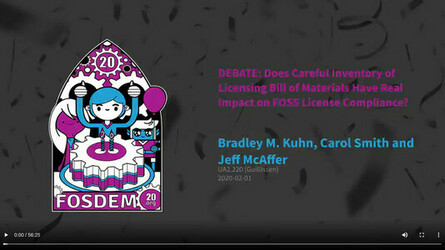
There was also considerable discussion on our mailing list regarding this research and a presentation based on the paper will occur at the ASPLOS 2020 conference between March 16th 20th in Lausanne, Switzerland. The many virtues of Reproducible Builds were touted as benefits for software compliance in a talk at FOSDEM 2020, debating whether the Careful Inventory of Licensing Bill of Materials Have Impact of FOSS License Compliance which pitted Jeff McAffer and Carol Smith against Bradley Kuhn and Max Sills. (~47 minutes in). Nobuyoshi Nakada updated the canonical implementation of the Ruby programming language a change such that filesystem globs (ie. calls to list the contents of filesystem directories) will henceforth be sorted in ascending order. Without this change, the underlying nondeterministic ordering of the filesystem is exposed to the language which often results in an unreproducible build. Vagrant Cascadian reported on our mailing list regarding a quick reproducible test for the GNU Guix distribution, which resulted in 81.9% of packages registering as reproducible in his installation:
$ guix challenge --verbose --diff=diffoscope ...
2,463 store items were analyzed:
  - 2,016 (81.9%) were identical
  - 37 (1.5%) differed
  - 410 (16.6%) were inconclusive
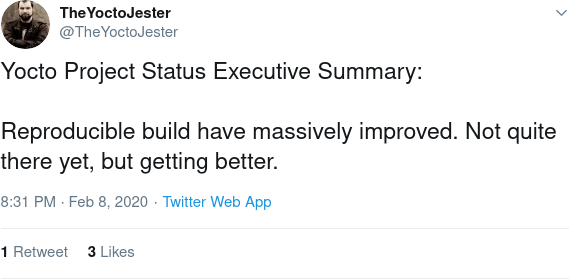
Jeremiah Orians announced on our mailing list the release of a number of tools related to cross-compilation such as M2-Planet and mescc-tools-seed. This project attemps a full bootstrap of a cross-platform compiler for the C programming language (written in C itself) from hex, the ultimate goal being able to demonstrate fully-bootstrapped compiler from hex to the GCC GNU Compiler Collection. This has many implications in and around Ken Thompson s Trusting Trust attack outlined in Thompson s 1983 Turing Award Lecture. Twitter user @TheYoctoJester posted an executive summary of reproducible builds in the Yocto Project: Finally, Reddit user tofflos posted to the /r/Java subreddit asking about how to achieve reproducible builds with Maven and Chris Lamb noticed that the Linux kernel documentation about reproducible builds of it is available on the kernel.org homepages in an attractive HTML format.

Distribution work

Debian Chris Lamb created a merge request for the core debian-installer package to allow all arguments and options from sources.list files (such as [check-valid-until=no] , etc.) in order that we can test the reproducibility of the installer images on the Reproducible Builds own testing infrastructure. (#13) Thorsten Glaser followed-up to a bug filed against the dpkg-source component that was originally filed in late 2015 that claims that the build tool does not respect permissions when unpacking tarballs if the umask is set to 0002. Matthew Garrett posted to the debian-devel mailing list on the topic of Producing verifiable initramfs images as part of a wider conversation on being able to trust the entire software stack on our computers. 59 reviews of Debian packages were added, 30 were updated and 42 were removed this month adding to our knowledge about identified issues. Many issue types were noticed and categorised by Chris Lamb, including:

openSUSE In openSUSE, Bernhard M. Wiedemann published his monthly Reproducible Builds status update as well as provided the following patches:

Software development

diffoscope diffoscope is our in-depth and content-aware diff-like utility that can locate and diagnose reproducibility issues. It is run countless times a day on our testing infrastructure and is essential for identifying fixes and causes of nondeterministic behaviour. Chris Lamb made the following changes this month, including uploading version 137 to Debian:
  • The sng image utility appears to return with an exit code of 1 if there are even minor errors in the file. (#950806)
  • Also extract classes2.dex, classes3.dex from .apk files extracted by apktool. (#88)
  • No need to use str.format if we are just returning the string. [ ]
  • Add generalised support for ignoring returncodes [ ] and move special-casing of returncodes in zip to use Command.VALID_RETURNCODES. [ ]

Other tools disorderfs is our FUSE-based filesystem that deliberately introduces non-determinism into directory system calls in order to flush out reproducibility issues. This month, Vagrant Cascadian updated the Vcs-Git to specify the debian packaging branch. [ ] reprotest is our end-user tool to build same source code twice in widely differing environments and then checks the binaries produced by each build for any differences. This month, versions 0.7.13 and 0.7.14 were uploaded to Debian unstable by Holger Levsen after Vagrant Cascadian added support for GNU Guix [ ].

Project documentation & website There was more work performed on our documentation and website this month. Bernhard M. Wiedemann added a Java Gradle Build Tool snippet to the SOURCE_DATE_EPOCH documentation [ ] and normalised various terms to unreproducible [ ]. Chris Lamb added a Meson.build example [ ] and improved the documentation for the CMake [ ] to the SOURCE_DATE_EPOCH documentation, replaced anyone can with anyone may as, well, not everyone has the resources, skills, time or funding to actually do what it refers to [ ] and improved the pre-processing for our report generation [ ][ ][ ][ ] etc. In addition, Holger Levsen updated our news page to improve the list of reports [ ], added an explicit mention of the weekly news time span [ ] and reverted sorting of news entries to have latest on top [ ] and Mattia Rizzolo added Codethink as a non-fiscal sponsor [ ] and lastly Tianon Gravi added a Docker Images link underneath the Debian project on our Projects page [ ].

Upstream patches The Reproducible Builds project detects, dissects and attempts to fix as many currently-unreproducible packages as possible. We endeavour to send all of our patches upstream where appropriate. This month, we wrote a large number of such patches, including: Vagrant Cascadian submitted patches via the Debian bug tracking system targeting the packages the Civil Infrastructure Platform has identified via the CIP and CIP build depends package sets:

Testing framework We operate a fully-featured and comprehensive Jenkins-based testing framework that powers tests.reproducible-builds.org. This month, the following changes were made by Holger Levsen: In addition, Mattia Rizzolo added an Apache web server redirect for buildinfos.debian.net [ ] and reverted the reshuffling of arm64 architecture builders [ ]. The usual build node maintenance was performed by Holger Levsen, Mattia Rizzolo [ ][ ] and Vagrant Cascadian.

Getting in touch If you are interested in contributing to the Reproducible Builds project, please visit our Contribute page on our website. However, you can get in touch with us via:

This month s report was written by Bernhard M. Wiedemann, Chris Lamb and Holger Levsen. It was subsequently reviewed by a bunch of Reproducible Builds folks on IRC and the mailing list.

3 March 2020

Ian Jackson: Let's Encrypt certificate revocation - panic now!

Let's Encrypt have rather quietly announced (sadly, requires discourse JS!) that they are going to revoke a very large number of certificates. These revocations will start "no earlier than" 00:00 UTC tonight (24:00 on the 3rd of March), a little over 9h from now. Affected websites etc. may stop working. I discovered this at about lunchtime UK time today; two of my certs were affected. xenproject.org and linuxfoundation.org are listed as affected and I am trying to get in touch with the hosting provider to get it fixed. One of the domains we in the Xen Project run ourselves, with the help of the contractors who do much of our sysadmin, is affected - and those contractors (who are very competent) didn't know until I told them. tl;dr: If you are responsible for any Let's Encrypt certificates, check it right away and maybe panic now!
edited 2020-03-03 15:35 to fix arithmetic error

comment count unavailable comments

2 March 2020

Jonathan Carter: Free Software activities for 2020-02

Belgians This month started off in Belgium for FOSDEM on 1-2 February. I attended FOSDEM in Brussels and wrote a separate blog entry for that. The month ended with Belgians at Tammy and Wouter s wedding. On Thursday we had Wouter s bachelors and then over the weekend I stayed over at their wedding venue. I thought that other Debianites might be interested so I m sharing some photos here with permission from Wouter. It was the only wedding I ve been at where nearly everyone had questions about Debian! I first met Wouter on the bus during the daytrip on DebConf12 in Nicaragua, back then I ve eagerly followed the Debianites on Planet Debian for a while so it was like meeting someone famous. Little did I know that 8 years later, I d be at his wedding back in my part of the world. If you went to DebConf16 in South Africa, you might remember Tammy, who have done a lot of work for DC16 including most of the artwork, bunch of website work, design on the badges, bags, etc and also did a lot of organisation for the day trips. Tammy and Wouter met while Tammy was reviewing the artwork in the video loops for the DebConf videos, and then things developed from there. Wouter s Bachelors Wouter was blindfolded and kidnapped and taken to the city center where we prepared to go on a bike tour of Cape Town, stopping for beer at a few places along the way. Wouter was given a list of tasks that he had to complete, or the wedding wouldn t be allowed to continue

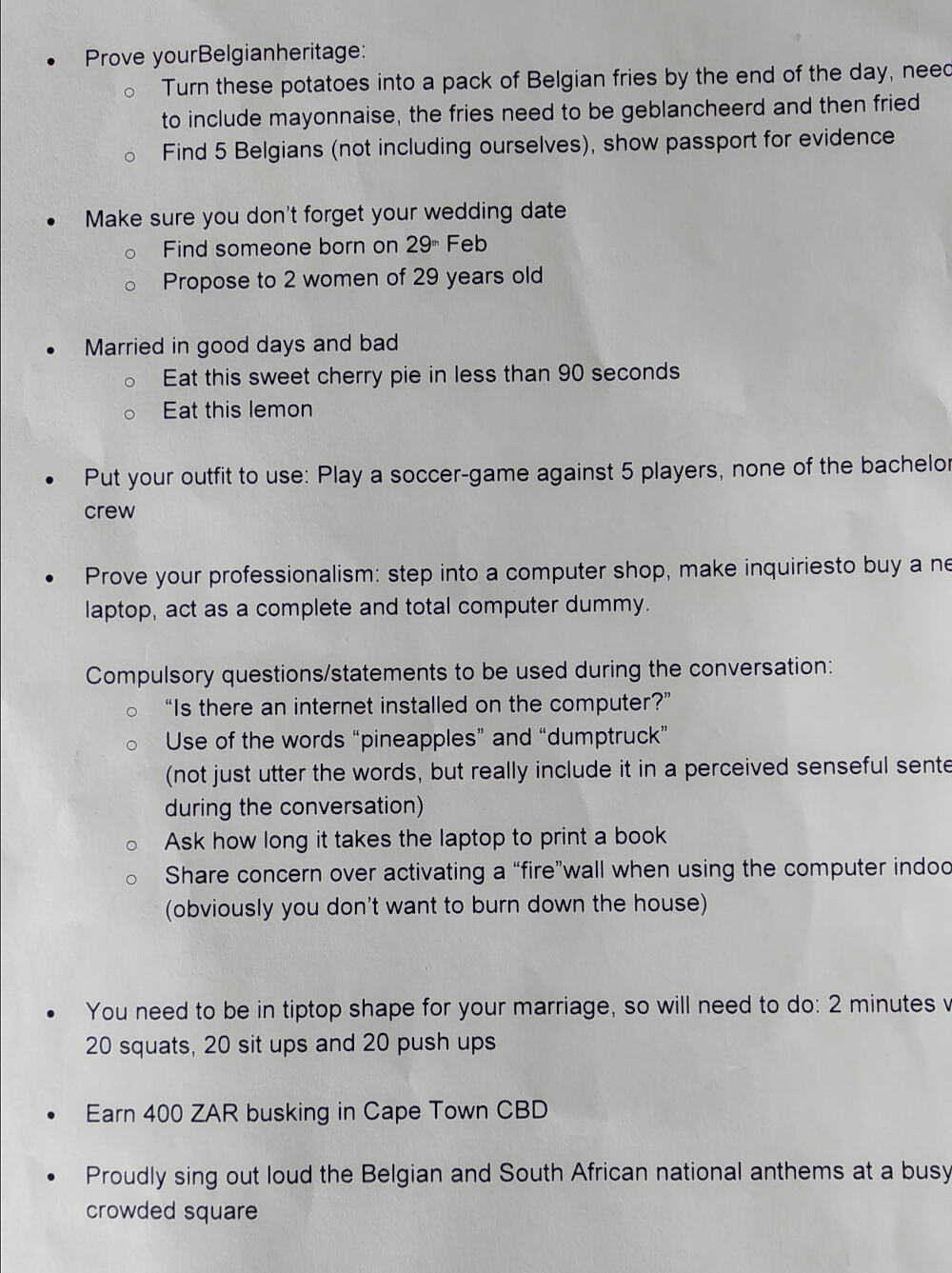
Wouter s tasks
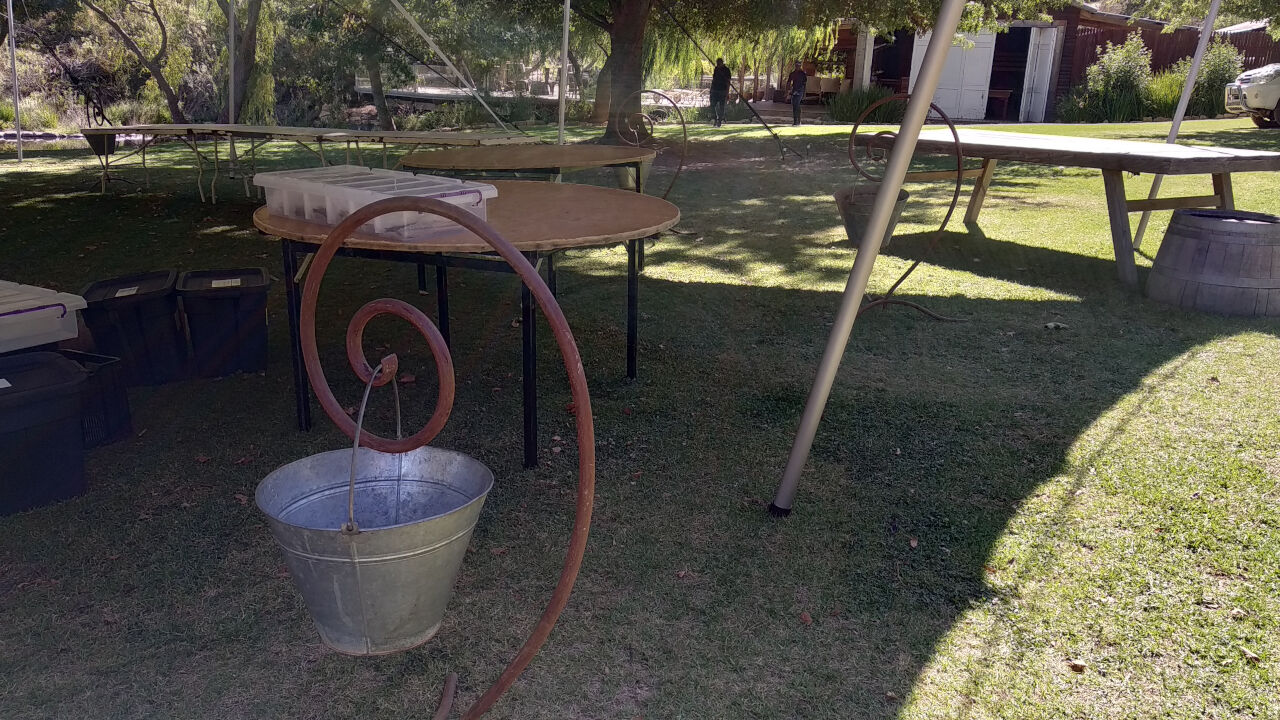
Wouter s props, needed to complete his tasks

Bike tour leg at Cape Town Stadium.

Seeking out 29 year olds.

Wouter finishing his lemon and actually seemingly enjoying it.

Reciting South African national anthem notes and lyrics.

The national anthem, as performed by Wouter (I was actually impressed by how good his pitch was).
The Wedding Friday afternoon we arrived at the lodge for the weekend. I had some work to finish but at least this was nicer than where I was going to work if it wasn t for the wedding.
Accommodation at the lodge
When the wedding co-ordinators started setting up, I noticed that there were all these swirls that almost looked like Debian logos. I asked Wouter if that was on purpose or just a happy accident. He said Hmm! I haven t even noticed that yet! , didn t get a chance to ask Tammy yet, so it could still be her touch.
Debian swirls everywhere
I took a canoe ride on the river and look what I found, a paddatrapper!

Kyle and I weren t the only ones out on the river that day. When the wedding ceremony started, Tammy made a dramatic entrance coming in on a boat, standing at the front with the breeze blowing her dress like a valkyrie.
A bit of digital zoomage of previous image.

Time to say the vows.

Just married. Thanks to Sue Fuller-Good for the photo.

Except for one character being out of place, this was a perfect fairy tale wedding, but I pointed Wouter to https://jonathancarter.org/how-to-spell-jonathan/ for future reference so it s all good.
Congratulations again to both Tammy and Wouter. It was a great experience meeting both their families and friends and all the love that was swirling around all weekend.

Debian Package Uploads 2020-02-07: Upload package calamares (3.2.18-1) to Debian unstable. 2020-02-07: Upload package python-flask-restful (0.3.8-1) to Debian unstable. 2020-02-10: Upload package kpmcore (4.1.0-1) to Debian unstable. 2020-02-16: Upload package fracplanet (0.5.1-5.1) to Debian unstable (Closes: #946028). 2020-02-20: Upload package kpmcore (4.1.0-2) to Debian unstable. 2020-02-20: Upload package bluefish (2.2.11) to Debian unstable. 2020-02-20: Upload package gdisk (1.0.5-1) to Debian unstable. 2020-02-20: Accept MR#6 for gamemode. 2020-02-23: Upload package tanglet (1.5.5-1) to Debian unstable. 2020-02-23: Upload package gamemode (1.5-1) to Debian unstable. 2020-02-24: Upload package calamares (3.2.19-1) to Debian unstable. 2020-02-24: Upload package partitionmanager (4.1.0-1) to Debian unstable. 2020-02-24: Accept MR#7 for gamemode. 2020-02-24: Merge MR#1 for calcoo. 2020-02-24: Upload package calcoo (1.3.18-8) to Debian unstable. 2020-02-24: Merge MR#1 for flask-api. 2020-02-25: Upload package calamares (3.2.19.1-1) to Debian unstable. 2020-02-25: Upload package gnome-shell-extension-impatience (0.4.5-4) to Debian unstable. 2020-02-25: Upload package gnome-shell-extension-harddisk-led (19-2) to Debian unstable. 2020-02-25: Upload package gnome-shell-extension-no-annoyance (0+20170928-f21d09a-2) to Debian unstable. 2020-02-25: Upload package gnome-shell-extension-system-monitor (38-2) to Debian unstable. 2020-02-25: Upload package tuxpaint (0.9.24~git20190922-f7d30d-1~exp3) to Debian experimental.

Debian Mentoring 2020-02-10: Sponsor package python-marshmallow-polyfield (5.8-1) for Debian unstable (Python team request). 2020-02-10: Sponsor package geoalchemy2 (0.6.3-2) for Debian unstable (Python team request). 2020-02-13: Sponsor package python-tempura (2.2.1-1) for Debian unstable (Python team request). 2020-02-13: Sponsor package python-babel (2.8.0+dfsg.1-1) for Debian unstable (Python team request). 2020-02-13: Sponsor package python-pynvim (0.4.1-1) for Debian unstable (Python team request). 2020-02-13: Review package ledmon (0.94-1) (Needs some more work) (mentors.debian.net request). 2020-02-14: Sponsor package citeproc-py (0.3.0-6) for Debian unstable (Python team request). 2020-02-24: Review package python-suntime (1.2.5-1) (Needs some more work) (Python team request). 2020-02-24: Sponsor package python-babel (2.8.0+dfsg.1-2) for Debian unstable (Python team request). 2020-02-24: Sponsor package 2048 (0.0.0-1~exp1) for Debian experimental (mentors.debian.net request). 2020-02-24: Review package notcurses (1.1.8-1) (Needs some more work) (mentors.debian.net request). 2020-02-25: Sponsor package cloudpickle (1.3.0-1) for Debian unstable (Python team request).

Debian Misc 2020-02-12: Apply Planet Debian request and close MR#21. 2020-02-23: Accept MR#6 for ToeTally (DebConf Video team upstream). 2020-02-23: Accept MR#7 for ToeTally (DebConf Video team upstream).

Antoine Beaupr : Moving dconf entries to git

I've been managing my UNIX $HOME repository with version control for almost two decades now (first under CVS, then with git). Once in a while, I find a little hack to make this work better. Today, it's dconf/gsettings, or more specifically, Workrave that I want to put in git. I noticed my laptop was extremely annoying compared with my office workstation and realized I never figured out how to write Workrave's configuration to git. The reason is that its configuration is stored in dconf, a binary database format, but, blissfully, I had forgotten about this and tried to figure out where the heck its config was. I was about to give up when I re-remembered this, when I figured I would just do a quick search ("dconf commit to git") and that brought me to Josh Triplett's Debconf 14 talk about this exact topic. The slides are... a little terse, but I could figure out the gist of it. The key is to change the DCONF_PROFILE environment to point to a new config file (say in your .bashrc):
export DCONF_PROFILE=$HOME/.config/dconf/profile
That file (~/.config/dconf/profile) should be created with the following content:
user-db:user
service-db:keyfile/user
  1. The first line is the default: store everything in this huge binary file.
  2. The second is the magic: it stores configuration in a precious text file, in .config/dconf/user.txt specifically.
Then the last step was to migrate config between the two. For that I need a third config file, a DCONF_PROFILE that has only the text database so settings are forcibly written there, say ~/.config/dconf/profile-edit:
service-db:keyfile/user
And then I can migrate my workrave configuration with:
gsettings list-recursively org.workrave   while read schema key val ; do DCONF_PROFILE=~/.config/dconf/profile-edit gsettings set "$schema" "$key" "$val" ; done
Of course, a bunch of those settings are garbage and do not differ from the default. Unfortuantely, there doesn't seem to be a way to tell gsettings to only list non-default settings, so I had to do things by hand from there, by comparing my generated config with:
DCONF_PROFILE=/dev/null gsettings list-recursively org.workrave
I finally ended up with the following user.txt, which is now my workrave config:
[org/workrave/timers/daily-limit]
snooze=1800
limit=25200
[org/workrave/timers/micro-pause]
auto-reset=10
snooze=150
limit=900
[org/workrave/timers/rest-break]
auto-reset=600
snooze=1800
limit=10800
[org/workrave/breaks/micro-pause]
max-preludes=0
That's a nice setup: "YOLO" settings end up in the binary database that I don't care about tracking in git, and a precious few snowflakes get tracked in a text file. Triplett also made a command to change settings in the text file, but I don't think I need to bother with that. It's more critical to copy settings between the two, in my experience, as I rarely have this moment: "oh I know exactly the key setting I want to change and i'll write it down". What actually happens is that I'm making a change in a GUI and later realize it should be synchronized over. (It looks like Triplett does have a tool to do those diffs and transitions, but unfortunately git://joshtriplett.org/git/home doesn't respond at this time so I can't find that source code.) (Update: that git repository can be downloaded with:
git clone https://joshtriplett.org/git/home
It looks like dconfc is designed to copy settings between the two databases. So my above loop would be more easily written as:
dconf dump /org/workrave/   DCONF_PROFILE=~/.config/dconf/profile-edit dconf load /org/workrave/
Certainly simplifies things. dconfd is also nice although it relies on the above dconfe script which makes it (IMHO) needlessly hard to deploy.) Now if only Firefox bookmarks were reasonable again...

Russell Coker: Amazon Prime and Netflix

I ve been trying both Amazon Prime and Netflix. I signed up for the month free of Amazon Prime to watch Good Omens and Picard . Good Omens is definitely worth the effort of setting up the month free of Amazon Prime and is worth the month s subscription if you have used your free month in the past and Picard is ok. Content Amazon Prime has a medium amount of other content, I m now paying for a month of Amazon Prime mainly because there s enough documentaries to take a month. For reference there are plenty of good ones about war and about space exploration. There are also some really rubbish documentaries, for example a 2 part documentary about the Magna Carta where the second part starts with Grover Norquist claiming that the Magna Carta is justification for not having any taxes (the first part seemed ok). Netflix has a lot of great content. A big problem with Netflix is that there aren t good ways of searching and organising the content you want to watch. It would be really nice if Netflix could use some machine learning for recommendations and recommend shows based on what I ve liked and also what I ve disliked. On both Netflix and Amazon when you view the details of a show it gives a short list of similar shows which is nice. With Amazon I have no complaints about that. But with Netflix the content library is so great that you get lost in a maze of links. On the Android tablet interface for Netflix it shows 12 similar shows in a grid and on the web interface it s a row of 20 shows with looped scrolling. Then as you click a different show you get another list of 12/20 shows which will usually have some overlap with the previous one. It would be nice if you could easily swipe left on shows you don t like to avoid having them repeatedly presented to you. On Netflix I ve really enjoyed the Altered Carbon series (which is significantly more violent than I anticipated), Black Mirror (the episode written by Trent Reznor and starring Miley Cyrus is particularly good), and Love Death and Robots . Overall I currently rate Love Death and Robots as in many ways the best series I ve ever watched because the episodes are all short and get straight to the point. One advantage of online video is that they don t need to pad episodes out or cut them short to fit a TV time slot, they can use as much time as necessary to tell the story. Watch List Having a single row of shows to watch is fine for the amount of content that Amazon has, but for the Netflix content you can easily get 100 shows on your watch list and it would be good to be able to search my watch list by genre (it s a drag to flick through dozens of icons of war documentaries when I m in the mood for an action movie as the icons are somewhat similar). As well as a list of shows you selected to watch Netflix has a list of shows that have been recently watched with no way to edit it which is separate from the list of shows selected to watch. So if you watch 5 minutes of a show and decide that it sucks then it stays on the list until you have partially watched 10 other shows recently. For my usage the recently watched list is the most important thing as I m watching some serial shows and wouldn t want to go through the 100 shows on my watch list to find them. If I ve decided that a movie sucked after watching a bit of it I don t want to be reminded of it by seeing the icon every time I use Netflix for the next month. Amazon has only a single watch next list for shows that you have watched recently and shows that you selected as worth watching. It allows editing the list which is nice, but then Amazon also often keeps shows on the list when you have finished watching them and removed them from the to watch setting. Amazon s watch list is also generally buggy, at one time it decided that a movie was no longer available in my region but didn t let me remove it from the list. Quality Apparently the Netflix web interface on Linux only allows 720p video while the Amazon web interface on all platforms is limited to 720p. In any case my Internet connection is probably only good enough for 1080p at most. I haven t noticed any quality differences between Netflix and Amazon Prime. Multiple Users Netflix allows you to create profiles for multiple users with separate watch lists which is very handy. They also don t have IP address restrictions so it s a common practice for people to share a Netflix account with relatives. If you try to use Netflix when the maximum number of sessions for your account is in use it will show a list of what the other people on your account are watching (so if you share with your parents be careful about that). Amazon doesn t allow creating multiple profiles, but the content isn t that great. The trend in video streaming is for proprietary content to force users to subscribe to a service. So sharing an Amazon Prime account with a few people so you want watch the proprietary content would make sense. Watching Patterns Sometimes when I m particularly distracted I can t focus on one show for any length of time. Both Amazon and Netflix (and probably all other online streaming services) allow me to skip between shows easily. That s always been a feature of YouTube, but with YouTube you get recommended increasingly viral content until you find yourself watching utter rubbish. At least with Amazon and Netflix there is a minimum quality level even if that is reality TV. Conclusion Amazon Prime has a smaller range of content and some really rubbish documentaries. I don t mind the documentaries about UFOs and other fringe stuff as it s obvious what it is and you can avoid it. A documentary that has me watching for an hour before it s revealed to be a promo for Grover Norquist is really bad, did the hour of it that I watched have good content or just rubbish too? Netflix has a huge range of content and the quality level is generally very high. If you are going to watch TV then subscribing to Netflix is probably a good idea. It s reasonably cheap, has a good (not great) interface, and has a lot of content including some great original content. For Amazon maybe subscribe for 1 month every second year to binge watch the Amazon proprietary content that interests you.

1 March 2020

Ulrike Uhlig: Conflict as a clash of strategies and a vector for change

Map of conflict I've been practising Non-Violent Communication (NVC) for several years. It helps me to better understand my feelings and needs. The concepts of NVC can also help to look at conflicts. I would like to introduce a way to look at conflict using the basic concepts of NVC:
  1. Humans have needs. (I would add that this applies to other sentient beings, too).
  2. It's okay to have needs.
  3. When needs are satisfied, we experience pleasant feelings (joy, love, happiness, etc.).
  4. When needs are unsatisfied, we experience unpleasant feelings (sadness, anger, grief, etc.)
  5. To satisfy our needs, we employ strategies. (Example. Need = well-being. Possible strategies = sauna, sleeping, walk in nature, etc.)
  6. When conflict occurs between two parties, it's not the needs that conflict, but the strategies that are employed to satisfy the needs.
An example. May has issues doing all the work they're supposed to do and seeks to talk to their manager about it. The manager repeatedly refuses to receive them, as the manager is very busy. May had the hope to be able to sort their issues out with the manager but now they feel frustrated, and helpless, on top of feeling stressed out. Week after week, May tries to get in touch with the manager, as they don't know how to solve their issue alone. But as their demands become more pressing, the manager starts to feel annoyed, tense, and insecure, and keeps ignoring May's requests. May's needs: communication, cooperation, being understood, being seen, autonomy.
Manager's needs: efficacy, independence, respect, autonomy. Both their needs are legit. Some of them even overlap. The conflict occurs at the level of their strategies: the manager makes the conscious decision to deny May's discussion requests, effectively denying them to voice their concerns and worries, which makes May feel helpless, frustrated, and angry. When May chooses to make their demands more explicit, the manager starts to feel more and more insecure. Working on our strategies There are always different strategies to satisfy our needs. Out of habit, we sometimes fail to see them, and keep using the ever same strategies. How could May deal with the situation differently? When we are aware of the need strategies dynamics, we can work on strategies without compromising our needs. When we are not, we are running in circles, effectively worsening the situation. The manager could also employ different strategies as they start noticing that they are feeling tense and insecure. Which ones could that be? There are also inappropriate strategies, and if not aware, the manager could well end up employing one of those: What would be appropriate strategies for the manager? Transforming organizations Working on strategies is a good first step. But generally the emotional work effectively lies on the shoulders of the individual with lower rank in the organization who lacks control and corresponding privileges to deal with the conflict. I believe that when conflict occurs in the workplace, it is important to draw further conclusions that would benefit the organization as a whole. In the above example, such conclusions could be: These are just some ideas for a fictitious conflict, but you get the idea.
Conflicts effectively are chances for the organization, or the involved parties, to grow in maturity.
More about working with conflict and conflict mapping tools in this great publication.

Next.

Previous.