Search Results: "edd"

16 March 2011

Matt Zimmerman: DEX: Debian and its derivatives, getting things done together

Since I resumed active status in Debian, I ve been thinking about how to bridge the gap between Debian and its derivatives*. I ve spoken at length with Zack, the attendees of the Derivatives BoF at DebConf 10, and the fine folks at the Derivatives Front Desk about the technical and social issues affecting derivative projects, and could probably write a very thorough series of blog posts on the subject. Instead, Zack and I decided to try doing something about it: we have begun a project to test out a new approach to the problem. Introducing DEX DEX is all about action: merging patches, fixing bugs, crunching data, whatever is necessary to get changes from derivatives into Debian proper. DEX doesn t try to change the way any existing project works, but adds a fast path for getting code from one place to another. DEX is a joint task force where developers from Debian and its derivatives work together on this common goal. As a pilot project, we ve established an Ubuntu DEX Team focused on merging code from Ubuntu into Debian. With members from both projects, we hope to be able to resolve blockage anywhere in the pipeline. Whatever needs to get done in order to merge an Ubuntu patch, someone in the Ubuntu DEX team will know what to do. If we get good results with Ubuntu, we hope that other derivatives will follow. With thanks to David Paleino, we re excited that the Utnubu project is merging into DEX as it aligns well with their goals. I m very grateful to have Colin Watson and James Westby signed up to contribute as well. Our first project is simple: turn this list green. This is an archive of quite old patches from Ubuntu, most of which have probably been merged already or made obsolete, but they pre-date any kind of tracking system so they need to be verified. Once that s done, we ll move on to a new project with a new todo list. If you want to see Debian benefit from technical work done in derivatives, DEX is a chance for you to act together to make it happen. If you work on a derivative and want to carry a smaller delta, come and join us. I m sure we ll learn a lot from this experience. * There are many instances of great cooperation between Debian and derivative distributions, including joint package maintenance teams, and some derivatives are even part of the Debian project. Nonetheless, there are areas were most people I ve spoken to agree that we need to do better. This is what I ve referred to as the gap .

Daniel Kahn Gillmor: CryptLib and the OpenSSL License

I spent part of today looking at packaging Peter Gutmann's CryptLib for debian. My conclusion: it may not be worth my time. One of the main reasons i wanted to package it for debian is because i would like to see more OpenPGP-compliant free software available to debian users and developers, particularly if the code is GPL-compatible. Cryptlib makes it quite clear that it intends to be GPL-compatible:
cryptlib is distributed under a dual license that allows free, open-source use under a GPL-compatible license and closed-source use under a standard commercial license.
However, a significant portion of the cryptlib codebase (particularly within the bn/ and crypt/ directories) appears to derive directly from OpenSSL, and it retains Eric Young's copyright and licensing. This licensing retains the so-called "advertising clause" that is generally acknowledged to be deliberately incompatible with the GPL. (A common counterargument for this incompatibility is that OpenSSL should be considered a "System Library" for GPL'ed tools that link against it; whether or not you believe this for tools linked against OpenSSL, this counterargument clearly does not hold for a project that embeds and ships OpenSSL code directly, as CryptLib does) This does not mean that CryptLib is not free software (it is!), nor does it mean that you cannot link it against GPL'ed code (you can!). However, you probably can't distribute the results of linking CryptLib against any GPL'ed code, because the GPL is incompatible with the OpenSSL license. The un-distributability of derived GPL-covered works makes the CryptLib package much less appealing to me, since i want to be able to write distributable code that links against useful libraries, and many of the libaries i care about happen to be under the GPL. I also note that Peter Gutmann and CryptLib Security Software (apparently some sort of company set up to distribute CryptLib) may be in violation of Eric Young's License, which states:
 * 3. All advertising materials mentioning features or use of this software
 *    must display the following acknowledgement:
 *    "This product includes cryptographic software written by
 *     Eric Young (eay@cryptsoft.com)"
 *    The word 'cryptographic' can be left out if the rouines from the library
 *    being used are not cryptographic related :-).
A Google search for Eric Young's name on cryptlib.com yields no hits. I do find his name on page 340 of the Cryptlib manual, but that hardly seems like it covers "All advertising materials mentioning features or use of this software". I suppose it's also possible that CryptLib has negotiated an alternate license with Eric Young that I simply don't know about. In summary: i think CryptLib could go into debian, but its incorporation of OpenSSL-licensed code makes it less useful than i was hoping it would be. I have a few other concerns about the package after looking it over in more detail. I suspect these are fixable one way or another, but i haven't sorted them out yet. I'm not sure i'll spend the time to do so based on the licensing issues i sorted out above. But in case anyone feels inspired, the other concerns i see are:
embedded code copies
In addition to embedded (and slightly-modified) copies of bn/ and crypt/ from OpenSSL, CryptLib contains an embedded copy of zlib. Debian has good reasons for wanting to avoid embedded code copies. I've got it CryptLib building against the system copy of zlib, but the bits copied from OpenSSL seem to be more heavily patched, which might complicate relying on the system version.
executable stack
lintian reports shlib-with-executable-stack for the library after it is built. I don't fully understand what this means or how to fix it, but i suspect it derives from the following set of object files that also have an executable stack:
0 dkg@pip:~/src/cryptlib/cryptlib$ for foo in $(find . -iname '*.o'); do
>  if ! readelf -S "$foo"   grep -q .note.GNU-stack ; then
>   echo "$foo"
>  fi
> done
./shared-obj/desenc.o
./shared-obj/rc5enc.o
./shared-obj/md5asm.o
./shared-obj/castenc.o
./shared-obj/bfenc.o
./shared-obj/rmdasm.o
./shared-obj/sha1asm.o
./shared-obj/bn_asm.o
./shared-obj/rc4enc.o
0 dkg@pip:~/src/cryptlib/cryptlib$ 
They probably all need to be fixed, unless there's a good reason for them to be that way (in which case they need to be documented).
non-PIC code
lintian reports shlib-with-non-pic-code on the library after it is built. I don't fully understand what this means, or how to resolve it cleanly, but i imagine this is just a question of sorting out the details.
Anyone interested in using my packaging attempts as a jumping off point can start with:
git clone git://lair.fifthhorseman.net/~dkg/cryptlib
Oh, and please correct me about anything in this post; I'd be especially happy to hear that my analysis of the licensing issues above is wrong :) Tags: cryptlib, gpl, licensing, openssl

14 March 2011

Scott Kitterman: DNS and Python

If you ve ever needed to care about DNS and Python, you probably know about pydns (python-dns) and dnspython (python-dnspython). Both have been around a long time (dnspython hit 1.0 in 2003 and the origins of pydns are long enough ago that they are lost to the mists of time I think dnslib.py, from which it is derived was initially developed with Python 1.5). They each have their advantages.
Until recently, if you needed DNS functionality and you re interested in Python 3, you were out of luck. Last month I had some business travel with long airplane rides that I put to good use and I ported pydns to Python 3. Upstream took the changes and released it as py3dns, so now you have a Python 3 DNS option. Packages are available in Debian Wheezy/Unstable and in Ubuntu Natty as python3-dns. It passes all the tests (better than the existing pydns), but I know test coverage is incomplete, so take it for a spin and let me know if there are problems. The code isn t pretty (it s set of minimal changes to get to a working Python 3 port), but it seems to work OK.

13 March 2011

Mark Brown: Changing core code

One of the biggest differences between working on most other OSs and working upstream on drivers for the Linux kernel is that elsewhere the core is usually a fixed thing that has been released and can t really be changed, even if source is available (which may not even be the case). If whatever subsystem you re working in can t cope with the thing you re trying to express then one of the things it s really useful to be good at is working out ways to implement the behaviour that s required behind the back of the subsystem. It s very common to see such code in drivers submitted by hardware vendors, particularly those that are new to Linux, as this is such a big mindset shift. With kernel development the approach is much more to make sure that the core can cope with whatever needs expressing. It s not always done in the core for example, sometimes the issue is due to unusually limited hardware and very likely to never come up again but it s very unusual to see code merged that doesn t at least fit in with the design of the subsystem. This post is inspired by a brief exchange with Thomas Gleixner on linux-kernel who articulated the advantages of doing things this way very well:
 - It's usually simpler and faster as the core code has all the
   necessary information. So that's even an argument which managers
   might understand.
 - Such workarounds, when not caught, tend to spread themself
   magically because driver writers checkout the existing code of
   similar devices and copy/paste/modify^Wuglify them over and over.
 - In the worst case such workarounds make the core maintainence
   harder and in some cases impossible, because they silently imply
   semantics on the core w/o the core maintainer knowing about them.
The last point is the most important one to me as a subsystem maintainer I really don t want to be merging code that is going to create issues with ongoing development of the subsystem. This is all another facet of the policy on stable APIs: APIs are only worth working around if they re fixed, and the assumptions that end up embedded in a workaroud are as much part of the API as the explicit interfaces. It s things like this that make Linux such a pleasure to work on.

11 March 2011

Dirk Eddelbuettel: RcppArmadillo 0.2.16

Conrad Sanderson continues an active release schedule for his wonderful Armadillo templated C++ library for linear algebra; release 1.1.8 just came out yesterday. So I made a new release 0.2.16 of RcppArmadillo, our Rcpp-based integration into R. No changes on our side. This new version should now be on most CRAN mirrors. The short NEWS file extract follows below containing just Conrad's entry for 1.1.8.
0.2.16  2011-03-10
    o   Upgraded to Armadillo Version 1.1.8   "Kangaroo Steak"
         * Added floor() and ceil()
         * Added "not a number": math::nan()
         * Added infinity: math::inf()
         * Added standalone is_finite()
         * Faster min(), max(), mean()
         * Bugfix for a corner case with NaNs in min() and max()
And courtesy of CRANberries, here are the diffs to.2.15.
 ChangeLog                                                    6 
 DESCRIPTION                                                 10 
 inst/NEWS                                                   11 
 inst/doc/RcppArmadillo-unitTests.pdf                     binary
 inst/doc/unitTests-results/RcppArmadillo-unitTests.html      6 
 inst/doc/unitTests-results/RcppArmadillo-unitTests.txt      38 -
 inst/include/armadillo                                       2 
 inst/include/armadillo_bits/Cube_meat.hpp                   10 
 inst/include/armadillo_bits/Mat_meat.hpp                    30 -
 inst/include/armadillo_bits/arma_ostream_meat.hpp          119 ++---
 inst/include/armadillo_bits/arma_ostream_proto.hpp           8 
 inst/include/armadillo_bits/arma_version.hpp                 6 
 inst/include/armadillo_bits/arrayops_meat.hpp               39 +
 inst/include/armadillo_bits/arrayops_proto.hpp               5 
 inst/include/armadillo_bits/auxlib_meat.hpp                 10 
 inst/include/armadillo_bits/constants.hpp                  322 +++++++++++---
 inst/include/armadillo_bits/diskio_meat.hpp                 46 +-
 inst/include/armadillo_bits/eglue_core_meat.hpp            345 +++-------------
 inst/include/armadillo_bits/eop_aux.hpp                     16 
 inst/include/armadillo_bits/eop_core_meat.hpp              105 +---
 inst/include/armadillo_bits/eop_core_proto.hpp               6 
 inst/include/armadillo_bits/fn_elem.hpp                     58 ++
 inst/include/armadillo_bits/fn_misc.hpp                     53 ++
 inst/include/armadillo_bits/fn_norm.hpp                     14 
 inst/include/armadillo_bits/format_wrap.hpp                 12 
 inst/include/armadillo_bits/op_max_meat.hpp                 43 -
 inst/include/armadillo_bits/op_mean_meat.hpp                38 -
 inst/include/armadillo_bits/op_min_meat.hpp                 46 +-
 inst/include/armadillo_bits/op_var_meat.hpp                 27 -
 inst/include/armadillo_bits/restrictors.hpp                  9 
 inst/include/armadillo_bits/traits.hpp                      20 
 31 files changed, 782 insertions(+), 678 deletions(-)
More information is on the RcppArmadillo page. Questions, comments etc should go to the rcpp-devel mailing list off the R-Forge page.

Eddy Petrișor: HOWTO: Making Windows usable and avoiding accidental sending of mails in Microsoft Outlook

I've changed jobs recently and after 5 years of not having to work with a Windows system I am having all sorts of adaptation-to-Windows problems at the new job.

First I just had to have the usual X-mouse behaviour and so I installed True X-Mouse Gizmo for Windows. This provides focus under mouse, middle click paste after select (not perfect, but it works), right click to push to bottom the window.

Second I had to have a virtual desktop, so I installed Microsoft's Virtual Desktop Manager from the PowerToys page. I tried another virtual desktop manager before using MSVDM, but I found it too clumsy so I switched to MSVDM which I knew from way back when I used Windows the last time. Good, now I can have my applications organised the way I am used to.

UPDATE:
I gave up on MSVDM in favour of Virtual Dimension since I wasn't able to send a particular window to the intended desktop unless I had in the taskbar all apps visible (Shared Desktop option). I might try other suggestions (Virtual Dimension does not have a way to send a window directly to a specific desktop, but just to the neighbours of the current one.)


Third, I had to make Caps Lock work as Ctrl. I just can't go back to an inferior setup. I found information on this page and ended up at this page from where I got a zip file with various registry keys which allow the deactivation of caps, or turning it into another Ctrl.

Fourth, I am used to write with diacritics in Romanian with the secondary layout of the standard (SR 13392:2004), so I rushed to Cristian Secar 's page for the keyboard driver since on XP the Romanian layout is retarded (some history in which some arbitrary German guy decided y and z had to be switched on Romanian keyboards and some other similarly weird stuff). Since the installation, my keyboard behaves according to this layout:


Things started to look well, but I soon was reminded that Outlook is an idiotic mailer since it doesn't require a confirmation on send, not even if you didn't set a subject. And this is problematic since sending the mail is done via Alt+S, so if the current layer is NOT Romanian, when I want to type (s with a comma below), a fairly common character in Romanian words, you end up looking like an idiot on the recipient side since they receive an incomplete mail. Remember, no confirmation AND no default spell checking before send. Yay!

At my second such accidental mail sending (of which the last two were sent to the same person), I decided to see if this can't be fixed. I initially looked for changing the short cut, but I couldn't find it (I might be inept at finding things in Windows, remember, I haven't touched Windows systems in the last 5 years) but I found another workaround and decided it's good enough to share with other people that might hit the problem.

Just setup a delay rule following these steps.
1. Go to Tools....Rules Wizard
2. Click 'New' Rule
3. Select "Check messages after sending"
4. Click Next on "Which conditions you want to Check?" dialog.
5. Press yes to "This Rule will be applied to every message" message box
6. In the "What do you want to do with message?" dialog, Select "Defer delivery by a number of minutes"
7. Select your favourite number of minutes.... I usually select 2 mins.
8. Select Finish. and close the Rules Wizard.

Now everytime you send an email it will sit in your outbox
for specified number of minutes. If you ever wanted to change it, delete it etc, You have sufficient time to do it :)


I used 3 minutes for the delay. At least now I can prevent looking retarded in front of people... more than necessary :D .


Oh, and Windows' clock display is retarded. It shows, by default, the hour and minutes, but there's no way to change that in a sane way. If you want the date, you must hover over the clock and it shows it, but the day of week is missing. Great job! You can see that information, too, but you have to drag the toolbar to be 2 or even 3 rows high (here it requires 2, but I've seen people saying they needed 3) to get that information, too. Great! One has to choose between wasting desktop real estate and having access to useful information. Or you could install an independent application for the clock... retarded. I am not making this shit up.

I hope this helped.

7 March 2011

Matt Zimmerman: Listening to users

In the software community, people hold strong opinions on the subject of listening to users. Some feel that users are an essential source of information for making successful products, as evidenced in the customer development methodology, and seek to involve users deeply in product development. Others believe that users don t know what they want, invoking the quote attributed to Henry Ford, If I d asked customers what they wanted, they would have said a faster horse . Some say that user needs are unknowable except through the lens of a marketplace, where people choose in aggregate which products suit them best, and customers vote with their wallets (anything else is anecdata ). Regular readers will not be surprised that I believe they are all right, but only in certain contexts. The right strategy for involving users in product decisions will depend on factors related to the product itself, the market, and the product development method being used. One of the most important is the life cycle stage of the product: is it a new and rapidly evolving concept, or a mature commodity, or somewhere in between? Simon Wardley explains this well over on his blog, so I won t rehash his points here, but will add a few of my own. If what we re looking for is inspiration for a new product, it s here that Henry Ford was right: users generally won t hand you a complete product vision on a silver platter. They ll frame their input in terms of what they know, and the choices already available to them. However, this doesn t mean that users don t have a role to play in this instance: watching users can be a great source of inspiration. It s the combination of domain knowledge and passionate imagination which triggers the creative spark. Henry Ford applied his engineer s interests to a problem which was evident all around him. If our goal is to test whether a new product is a good fit for its users, there is no substitute for user feedback. We can guess at whether there is a fit, and our intuition may be good, but users are the ultimate judges, and we don t know if we re right or wrong until users evaluate it. So ask them! By engaging in dialogue with individual users, we can learn unexpected things which will help to refine the idea. If we don t find what they think until our new product is released, we risk making something that no one wants. Why wait until it s too late? It can be challenging to extract useful feedback for a product which doesn t yet exist, but this effort is well worth it to avoid wasting much more effort in software engineering. When our objective is to incrementally improve an existing product, individual anecdotes can mislead us. A given change may be an improvement for one user, but a disaster for another. What we want to know is whether the new version is better for the population as a whole, and in this case, we do well to rely on data. There are pitfalls here as well, of course. We need to choose our questions carefully, and realize that users will often resist any change: not because they re stodgy by nature, but because they have to invest effort in adapting to the change. I think of incremental improvement as a joint investment made between product developers and their users, to improve the whole system of people and technology for the better. By choosing the right tool for the job, we can make better decisions, improve faster, and ultimately solve the right problem for our users.

6 March 2011

Stefano Zacchiroli: on the influence of Debian and derivatives

Counting derivatives In the news, there's an article by Bruce Byfield discussing the influence of Debian and its (transitive) derivatives on the ecosystem of GNU/Linux distributions: Linux Leaders: Debian and Ubuntu Derivative Distros. The article is a sort of review of what you can find in the vast ecosystem of distributions rooted at Debian: from embedded to supercomputer distro, from netbook to scientific computing distros. The articles cites the Debian derivatives front desk and is a study similar to what we might tackle with the derivatives census by Paul Wise. (By the way: did you check if your favorite Debian derivative is already in? No? Do it!) With this article, Bruce has made me quite a favor in harvesting distrowatch to refresh the figures about the number of derivatives that I often use in speeches. The need of doing that has been polluting my LaTeX "% TODO" comments for a while now Here they are: Update: update figures that Bruce misinterpreted; live data are available, thanks to Loris (see comments) for noticing

4 March 2011

Dirk Eddelbuettel: RcppArmadillo 0.2.14 and 0.2.15

A few days ago Conrad Sanderson released version 1.1.6 of his Armadillo templated C++ library for linear algebra. Accordingly, I made a new release 0.2.14 of RcppArmadillo, our Rcpp-based integration into R which included a few local fixes. However, while I updated SVN at the R-Forge project I didn't update the final tarball so Armadillo 1.1.6 wasn't in it. That is corrected in the 0.2.15 upload which is now on CRAN and its mirrors. The short NEWS file extract for both releases follows, also containing Conrad's entry for 1.1.6. A few minor tweaks were added but no user-visible changes:
0.2.15  2011-03-04
    o   Upgraded to Armadillo Version 1.1.6    Baby Carpet Shark 
         * fixed size matrices and vectors can use auxiliary (external) memory
         * .in_range() can use span() arguments
         * subfields can use span() arguments
0.2.14  2011-03-02
    o   Support Run-Time Type Information (RTTI) on matrices by setting the
        state variable vec_state in Row and Col instantiation, with thanks to
        Conrad Sanderson for the hint
    o   fastLm code simplified further by instantiating the Armadillo matrix
        and vector directly from the SEXP coming from R
    o   inst/doc/Makefile now respects $R_HOME environment variable
And courtesy of CRANberries, here are the diffs to.2.14
 ChangeLog                                                   14 -
 DESCRIPTION                                                  8 
 inst/NEWS                                                   10 
 inst/doc/RcppArmadillo-unitTests.pdf                     binary
 inst/doc/unitTests-results/RcppArmadillo-unitTests.html     10 
 inst/doc/unitTests-results/RcppArmadillo-unitTests.txt      39 +-
 inst/include/armadillo_bits/Col_meat.hpp                    51 +++
 inst/include/armadillo_bits/Col_proto.hpp                    3 
 inst/include/armadillo_bits/Cube_meat.hpp                   52 +++
 inst/include/armadillo_bits/Cube_proto.hpp                   7 
 inst/include/armadillo_bits/Mat_meat.hpp                    51 +++
 inst/include/armadillo_bits/Mat_proto.hpp                   12 
 inst/include/armadillo_bits/Row_meat.hpp                    51 +++
 inst/include/armadillo_bits/Row_proto.hpp                    3 
 inst/include/armadillo_bits/arma_version.hpp                 6 
 inst/include/armadillo_bits/config.hpp                       9 
 inst/include/armadillo_bits/field_meat.hpp                 220 ++++++++++++++--
 inst/include/armadillo_bits/field_proto.hpp                 20 +
 inst/unitTests/runit.RcppArmadillo.R                        16 +
 19 files changed, 521 insertions(+), 61 deletions(-)
and to the previous release 0.2.13, respectivel
 ChangeLog                                                   14 ++++++
 DESCRIPTION                                                  6 +-
 inst/NEWS                                                   11 +++++
 inst/doc/Makefile                                           15 +++++--
 inst/doc/RcppArmadillo-unitTests.pdf                     binary
 inst/doc/unitTests-results/RcppArmadillo-unitTests.html     18 ++++----
 inst/doc/unitTests-results/RcppArmadillo-unitTests.txt      34 ++++++++--------
 inst/include/RcppArmadillo/Col_meat.h                       24 ++++++-----
 inst/include/RcppArmadillo/Row_meat.h                       19 ++++----
 src/fastLm.cpp                                              15 ++-----
 10 files changed, 94 insertions(+), 62 deletions(-)
More information is on the RcppArmadillo page. Questions, comments etc should go to the rcpp-devel mailing list off the R-Forge page.

3 March 2011

Kai Wasserb ch: Extending Chronicle

This little blog is created/compiled with Chronicle, coded by Steve Kemp, and one of the cool features is that you can specify a command run before/after your blog gets compiled from the input files. This presents us with one problem and a lot of opportunities. First to the problem: the singular "a command" (from the manual page) might not be enough. Maybe you want to run more than one command. This can be achieved by creating a directory for the commands you want to run before the compilation and one for the commands you want to run after the chronicle run. Then you create a small shell script one directory above and call that from chronicle, the script for the post-run might look like:
#!/bin/sh
set -e
WORKDIR=" dirname $ 0  /post"
find $ WORKDIR  -name "*.sh" -exec " " ";"
This script makes the assumption, that the scripts to run have a .sh suffix and are in a subdirectory named "post". But you can surely adapt this to your needs. Now to one of the oppurtunities this offers: you can now, for example, create static pages, which share the general visual appearance with your blog entries but don't show up in the tags or archive system. I'm using this to generate an imprint for this blog. The script to generate the imprint looks like:
#!/bin/sh
set -e
OUTPUT_PATH= grep output $ HOME /.chroniclerc   cut -d= -f2   tr -d [:blank:] 
sed -ne'/<\?xml version/,/blosxomFirstDayDiv/  /blosxomFirstDayDiv/b;p ' \
        $ OUTPUT_PATH /index.html > $ HOME /tmp/imprint.html
cat  dirname $ 0  /imprint.data >> $ HOME /tmp/imprint.html
echo -e "\n" >> $ HOME /tmp/imprint.html
sed -ne'/imprint_match/,$p' $ OUTPUT_PATH /index.html >> $ HOME /tmp/imprint.html
mv $ HOME /tmp/imprint.html $ OUTPUT_PATH /imprint.html
There are again some assumptions made here, which you'd need to adopt to your setup: Now you have a very powerful system to modify/extend your chronicle-generated blog. I hope you enjoy it as much as I do! A little P.S.: you might want to use version 4.5, as 4.4 had a nasty encoding bug.

Kai Wasserb ch: Extending Chronicle (Updated)

This little blog is created/compiled with Chronicle, coded by Steve Kemp, and one of the cool features is that you can specify a command run before/after your blog gets compiled from the input files. This presents us with one problem and a lot of opportunities. First to the problem: the singular "a command" (from the manual page) might not be enough. Maybe you want to run more than one command. This can be achieved by creating a directory for the commands you want to run before the compilation and one for the commands you want to run after the chronicle run. [UPDATE]Then just add run-parts /path/to/ before,post .d to your .chroniclerc for the pre,post -build configuration entries.[/UPDATE] (Thanks to Steve for pointing the obvious out to me, don't know why I didn't think of run-parts myself.) Now to one of the oppurtunities this offers: you can now, for example, create static pages, which share the general visual appearance with your blog entries but don't show up in the tags or archive system. I'm using this to generate an imprint for this blog. The script to generate the imprint looks like:
#!/bin/sh
set -e
OUTPUT_PATH= grep output $ HOME /.chroniclerc   cut -d= -f2   tr -d [:blank:] 
sed -nre'/<\?xml version/,/blosxomFirstDayDiv/  /blosxomFirstDayDiv/b;p ' \
        $ OUTPUT_PATH /index.html > $ HOME /tmp/imprint.html
cat  dirname $ 0  /imprint.data >> $ HOME /tmp/imprint.html
echo -e "\n" >> $ HOME /tmp/imprint.html
sed -ne'/imprint_match/,$p' $ OUTPUT_PATH /index.html >> $ HOME /tmp/imprint.html
mv $ HOME /tmp/imprint.html $ OUTPUT_PATH /imprint.html
There are again some assumptions made here, which you'd need to adopt to your setup: Now you have a very powerful system to modify/extend your chronicle-generated blog. I hope you enjoy it as much as I do! A little P.S.: you might want to use version 4.5, as 4.4 had a nasty encoding bug.

28 February 2011

Matthew Garrett: Further adventures in mobile Linux

I picked up a couple of cheap Linux devices at the weekend. First of all, a $99 Android tablet from CVS, made by Craig. It's a generic RK2818 device and of course it's lacking any kind of GPL offer in the documentation. As far as I know the only company that's released any Rockchip source so far has been Archos, and even then they haven't released the tools you need to actually build an image - they seem to be floating around the internet anyway. But it's straightforward to get it to run the Android market, and it runs Shortyz quite well, so fit for purpose from my point of view. I am, obviously, attempting to contact Craig to find out how they're going to satisfy their obligations but haven't got past their bizarre text-to-speech based support menu system that dumps you to answerphone after 5 minutes of being on hold. Next attempt will involve pressing more buttons.

The other one was a Sharper Image Literati e-reader, $49 from Macy's (on clearance, obviously). This one's interesting by virtue of not being an Android device. Instead it's got a fairly recognisable Busybox-based Linux environment that's even got udev and dbus running. It brings up a framebuffer and just dumps a QTE-based reader (from Kobo) onto it. Other than being woefully underpowered and slow, it actually seems very competent. There seem to be several versions of the hardware - the one I got has an ARM SoC from SiRF on it. SiRF make GPS chipsets, and it turns out that their Atlas 5 platform is actually intended for Linux-based GPS units. The embedded world always seems to find a way. What surprised me more is that it's probably the most polished looking Linux I've bought for under $300. No bizarre kernel spew. echo mem >/sys/power/state works. Standard backlight interface.

Oh, and no source. Obviously. But an interesting device regardless.

(comment count unavailable Comments Comment on this)

27 February 2011

Dominique Dumont: How to clean up dependencies with version in Debian packages

Hello Now that Squeeze is out, a lot of cleanup is going in Debian packages. One of them is getting rid of unnecessary dependencies with minimal versions in packages. I.e. getting rid if unnecessary versions like perl (>= 5.8.1).
Because Lenny was shipped with Perl 5.10, requiring Perl with version greater than 5.8 is not necessary and needlessly loads dependencies resolvers. In other words, you re not only doing this cleanup to make your source package lighter, you re doing it also for your users so that package upgrade go faster. Anyway, checking these versioned in a real PITA. So I ve enhanced Dpkg control model in Config::Model to take care of this check. To check your package, install libconfig-model-perl (from Sid), go in your package directory and run this command: config-edit -application dpkg -ui none This command will check your control file, your copyright file and may issue warnings or errors. Some warnings like the versioned dependencies can be fixed automatically with this command: config-edit -application dpkg -ui none -apply-fixes -save Be sure to archive your files before running this command to check what s been done by -apply-fixes options. For more information on using config-edit, please read Using config-model wiki page. All the best

24 February 2011

Dirk Eddelbuettel: Rcpp 0.9.2

The 0.9.2 release of Rcpp is now on CRAN and Debian. This version contains a build fix for the older 10.5.* version of OS X and its g++ 4.2.1 compiler; we now skip one test that upset it. CRAN builds for OS X should resume. We also added simple configuration support for the Intel Compiler; feedback would be welcome on the list. Lastly, documentation in the vignettes was expanded a little. The NEWS entry is below; more detail is in the ChangeLog file in the package and on the Rcpp Changelog page.
0.9.2   2011-02-23
    o   The unitTest runit.Module.client.package.R is now skipped on older OS
        X releases as it triggers a bug with g++ 4.2.1 or older; OS X 10.6 is
        fine but as it no longer support ppc we try to accomodate 10.5 too
        Thanks to Simon Urbanek for pinning this down and Baptiste Auguie
        and Ken Williams for additonal testing 
    o   RcppCommon.h now recognises the Intel Compiler thanks to a short
        patch by Alexey Stukalov; this turns off Cxx0x and TR1 features too
    o   Three more setup questions were added to the Rcpp-FAQ vignette
    o   One question about RcppArmadillo was added to the Rcpp-FAQ vignette
Thanks to CRANberries, there is also a diff to the previous release 0.9.1. As always, even fuller details are on the Rcpp Changelog page and the Rcpp page which also leads to the downloads, the browseable doxygen docs and zip files of doxygen output for the standard formats. A local directory has source and documentation too. Questions, comments etc should go to the rcpp-devel mailing list off the R-Forge page

23 February 2011

Dirk Eddelbuettel: RQuantLib 0.3.6

A bug-fix release RQuantLib 0.3.6 is now on CRAN and in Debian. RQuantLib combines (some of) the quantitative analytics of QuantLib with the R statistical computing environment and language. There are only two changes to two files where an explicit conversion as per Rcpp::as<double> was called for. A Debian archive rebuild had triggered one of those fails to build from source bug reports as the compiler version seems to be more finicky now than when version 0.3.5 was uploaded in November. No other changes were made. Thanks to CRANberries, there is also a diff to the previous release 0.3.5. Full changelog details, examples and more details about this package are at my RQuantLib page.

21 February 2011

Steve Langasek: How you can help with multiarch today

Paul Wise called attention recently to the fact that there's renewed activity around multiarch in the face of the squeeze release. Although I fervently wish we could have gotten multiarch support into squeeze, it's better late than never; and real progress is being made now, thanks mostly to the efforts of wonderful package management experts like Raphael Hertzog, Guillem Jover, and David Kalnischkies. Don't believe it's finally coming? Here's some output from my amd64 multiarch chroot:
$ dpkg -l '*:i386'
Desired=Unknown/Install/Remove/Purge/Hold
  Status=Not/Inst/Conf-files/Unpacked/halF-conf/Half-inst/trig-aWait/Trig-pend
 / Err?=(none)/Reinst-required (Status,Err: uppercase=bad)
 / Name           Version        Description
+++-==============-==============-============================================
ii  gcc-4.5-base   4.5.2-3ubuntu2 The GNU Compiler Collection (base package)
ii  libc6          2.13-0ubuntu1+ Embedded GNU C Library: Shared libraries
ii  libdb4.8       4.8.30-5multia Berkeley v4.8 Database Libraries [runtime]
ii  libgcc1        1:4.5.2-3ubunt GCC support library
in  libpam-modules <none>         (no description available)
ii  libpam0g       1.1.2-2ubuntu1 Pluggable Authentication Modules library
ii  libselinux1    2.0.96-1multia SELinux runtime shared libraries
ii  libstdc++6     4.5.2-3ubuntu2 The GNU Standard C++ Library v3
iU  libuuid1       2.17.2-9.1ubun Universally Unique ID library
ii  selinux-utils  2.0.96-1multia SELinux utility programs
ii  zlib1g         1:1.2.3.4.dfsg compression library - runtime
If you're as excited about this making its way into Debian as I am, you might be wondering what you can do to help. That's great, because I'd love to tell you! Perhaps you happen to maintain a package that provides executables; and perhaps other packages depend on your package exclusively to use those executables; and perhaps some of those packages depending on your package are shared libraries. If all of the above is true, please consider declaring this package to be Multi-Arch: foreign as defined here. Note: it is very important that you not use this on any package that will provide architecture-dependent interfaces to its reverse-dependencies. So if you're shipping both shared libraries and executables in the same binary package, don't do this. But if your package does fit this description, this is one part of multiarch that you can safely start implementing today. This will go a long way towards getting the system ready to handle multiarch libraries when they land. My own efforts to help with getting Multi-Arch: foreign packages documented in the archive are trackable here.

19 February 2011

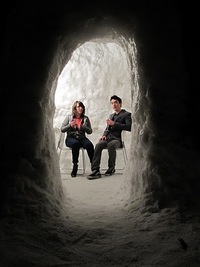
Benjamin Mako Hill: Ask Me Anything in an Igloo

/copyrighteous/images/igloo_danny.jpg When Reddit sold to Cond Nast and the founders all moved to California, their old place in Davis Square was empty for a few months and they let Mika I move in and take it over. It's an awesome place and we're still there along with some Web 2.0 graffiti they left on the roof. And so it is with pleasure that I've agreed to be interviewed by redditor Danny Piccirillo in a giant igloo he helped build -- if the unseasonably warm weather streak of weather doesn't manage to melt it before next week. Questions are being gathered at Reddit so feel free to go there and ask me any question you'd like to see me answer in an igloo.

Dirk Eddelbuettel: RcppArmadillo 0.2.13

Yesterday Conrad Sanderson released version 1.1.4 of his Armadillo templated C++ library for linear algebra, so hot on the heels our 0.2.12 release from a few days ago comes version 0.2.13 of RcppArmadillo, our Rcpp-based integration into R. This new version 0.2.13 is now on CRAN and its mirrors. The short NEWS file extract follows, also containing Conrad's entry for 1.1.4:
0.2.13  2011-02-18
    o   Upgraded to Armadillo Version 1.1.4   "Manta Lodge"
         * Faster sort()
         * Updated installation to detect recent versions of Intel's MKL
         * Added interpretation of arbitrary "flat" subcubes as matrices
And courtesy of CRANberries, here is the diff to the previous release 0.2.12:
Diff between RcppArmadillo versions 0.2.12 dated 2011-02-16 and 0.2.13 dated 2011-02-19
 ChangeLog                                                    6 
 DESCRIPTION                                                 14 
 inst/NEWS                                                    8 
 inst/doc/RcppArmadillo-unitTests.pdf                     binary
 inst/doc/unitTests-results/RcppArmadillo-unitTests.html      6 
 inst/doc/unitTests-results/RcppArmadillo-unitTests.txt      36 
 inst/include/armadillo_bits/Col_meat.hpp                    64 +
 inst/include/armadillo_bits/Col_proto.hpp                    3 
 inst/include/armadillo_bits/Cube_meat.hpp                  124 ++
 inst/include/armadillo_bits/Cube_proto.hpp                   7 
 inst/include/armadillo_bits/Mat_meat.hpp                   696 +++++++++++---
 inst/include/armadillo_bits/Mat_proto.hpp                   36 
 inst/include/armadillo_bits/Row_meat.hpp                    62 +
 inst/include/armadillo_bits/Row_proto.hpp                    3 
 inst/include/armadillo_bits/arma_version.hpp                 4 
 inst/include/armadillo_bits/arrayops_meat.hpp               76 -
 inst/include/armadillo_bits/debug.hpp                      254 ++++-
 inst/include/armadillo_bits/field_meat.hpp                  44 
 inst/include/armadillo_bits/field_proto.hpp                  2 
 inst/include/armadillo_bits/fn_accu.hpp                     15 
 inst/include/armadillo_bits/fn_prod.hpp                     10 
 inst/include/armadillo_bits/forward_proto.hpp                8 
 inst/include/armadillo_bits/injector_meat.hpp               70 +
 inst/include/armadillo_bits/injector_proto.hpp               4 
 inst/include/armadillo_bits/op_sort_meat.hpp               242 ++---
 inst/include/armadillo_bits/op_sort_proto.hpp               15 
 inst/include/armadillo_bits/span.hpp                        72 +
 inst/include/armadillo_bits/subview_cube_meat.hpp          759 +++++++++++++---
 inst/include/armadillo_bits/subview_cube_proto.hpp          19 
 inst/include/armadillo_bits/subview_field_meat.hpp          83 +
 inst/include/armadillo_bits/subview_field_proto.hpp         11 
 inst/include/armadillo_bits/subview_meat.hpp               118 +-
 inst/include/armadillo_bits/subview_proto.hpp               21 
 33 files changed, 2113 insertions(+), 779 deletions(-)
More information is on the RcppArmadillo page. Questions, comments etc should go to the rcpp-devel mailing list off the R-Forge page.

18 February 2011

Vincent Sanders: Shedding

For some time now Melodie has wanted more outside storage.

The current outhouse is an 3 foot by 8 foot converted outside toilet. Due to its age (built 1884) this building is no longer watertight and is generally disintegrating at an alarming rate. One day soon it will have to be demolished. That day has not yet arrived, instead we purchased a plastic shed.

Unfortunately the only viable place for the new shed was next to the old one, this required removing a six foot section of flower bed complete with ivy, bamboo and an old sink.

Last Saturday I completed this removal and lay a concrete base ready to take the new shed. You would not think such a small area (2.8m square) would require so much material and effort to concrete over. 300Kg of 3:2:1 aggregate:sand:cement concrete mix went into the hole along with 100Kg of instant set concrete (for a rapid surface in the changable weather).

Thursday afternoon Geoff (my nice helpful neighbour) offered to assist me in the assembly of the shed. I re-arranged my work schedule (yay home working) and after three hours the shed was assembled.

This morning it occurred to me that my webcam had recorded a time-lapse movie of the construction. I uploaded it to YouTube and present it here for your amusement.

<iframe allowfullscreen="" frameborder="0" height="240" src="http://www.youtube.com/embed/brTXLO2R5D0?rel=0" title="YouTube video player" width="320"></iframe>

17 February 2011

Rapha&#235;l Hertzog: People behind Debian: Maximilian Attems, member of the kernel team

Maximilian, along with the other members of the Debian kernel team, has the overwhelming job of maintaining the Linux kernel in Debian. It s one of the largest package and certainly one where dealing with bug reports is really difficult as most of them are hardware-specific, and thus difficult to reproduce. He s very enthusiastic and energetic, and does not fear criticizing when something doesn t please him. You ll see. My questions are in bold, the rest is by Maximilian. Who are you? My name is Maximilian Attems. I am a theoretical physicist in my last year of PhD at the Technical University of Vienna. My main research area is the early phase of a Quark-Gluon Plasma as produced in heavy ion collisions at the LHC at CERN. I am developing simulations that take weeks on the Vienna Scientific Cluster (in the TOP 500 list). The rest of the lab is much less fancy and boils down to straight intel boxes without any binary blobs or external drivers (although lately we add radeon graphics for decent free 3D). Mathematica and Maple are the rare exceptions to the many dev tools of Debian (LaTeX, editors, git, IDE s, Open MPI, ..) found at the institute, as those are unfortunately yet unmatched in Free Software for symbolic computations. The lab mostly runs a combination of Debian stable (testing starting from freeze) for desktops and oldstable/stable for servers. Debian is in use for more than 10 years. So people in the institute know some ups and downs of the project. Newcomers like my room neighbors are always surprised how functional a free Debian Desktop is. :) What s your biggest achievement within Debian? Building lots and lots of kernels together with an growing uptake of the officially released linux images. I joined the Debian kernel team shortly after Herbert Xu departed. I had been upstream Maintainer of the linux-2.6 janitor project for almost a year brewing hundreds of small cleanups with quilt in a tree named kjt for early linux-2.6. In Debian we had lots of fun in sorting out the troubles that the long 2.5 freeze had imposed: Meaning we were sitting on a huge diverging monolithic semi-good patchset. It was great fun to prepare 2.6.8 for Sarge with a huge team enthusiastic in shipping something real close to mainline (You have to imagine that back then you had no stable or longterm release nor any useful free tools like git. This involved passing patches around, hand editing them and seeing what the result does.) From the Sarge install reports a common pattern emerged that the current Debian early userspace was causing lots of boot failures. This motivated me to develop an alternative using the new upstream initramfs features. So I got involved in early userspace. Thanks to large and active development team initramfs-tools got a nice ecosystem. It still tries to be as generic and flexible as possible and thus gains many nice features. Also H. Peter Anvin (hpa) gave me the official co-maintenance of klibc. klibc saw uptake and good patches from Google in the last 2 years. I am proud that the early userspace is working out fairly well these days, meaning you can shuffle discs around and see your box boot. Later on we focused on 2.6.18 for Etch, which turned out to a be good release and picked up by several other distributions. Only very much later we would see such a sync again. With 2.6.26 for Lenny we got somehow unlucky as we just missed the new longterm release by one release. We also pushed for another update very late (during freeze) in the release cycle, which turned out to semi-work as too much things depend on linux-2.6. For Squeeze 2.6.32 got picked thanks to discussions at Portland Linux Plumbers and it turned out to be a good release picked up by many distributions and external patchsets. The long-term support is going very well. Greg KH is doing a great job in collecting various needed fixes for it. Somehow we had hoped that the Squeeze freeze would start sooner and that the freeze duration would be shorter, since we were ready for a release starting from the actual freeze on. The only real big bastard on the cool 2.6.32 sync is Red Hat. Red Hat Enterprise 6.0 is shipping the linux-2.6 2.6.32 in obfuscated form. They released their linux-2.6 as one big tarball clashing with the spirit of the GPL. One can only mildly guess from the changelog which patches get applied. This is in sharp contrast to any previous Red Hat release and has not yet generated the sharp and snide comments in press it deserves. Red Hat should really step back and not make such stupid management moves. Next to them even the semi-maintained Oracle Unbreakable 2.6.32 branch looks better: It is git fetchable. What are your plans and those of the kernel team for Debian Wheezy? Since 2.6.32 many of the used patches landed upstream or are on the way (speakup, Kbuild Debian specific targets, ..). The proper vfs based unionfs is something we d be looking forward. We haven t yet picked the next upstream release we will base Wheezy on, so currently we can happily jump to the most recent ones. There are plans for better interaction with Debian Installer thanks to generating our udebs properly in linux-2.6 source itself. Also we are looking forward to using git as tool of maintenance. We d hope that this will also allow for even better cross distribution collaboration. Concerning early userspace I plan to release an initramfs-tools with more generic userspace for the default case and finally also a klibc only for embedded or tuning cases. What do you like most in Debian? For one thing I do like the 2 year release cycle. It is not too long to have completely outdated software and on the other hand it gives enough time to really see huge progress from release to release. Also at my institute the software is is recent enough without too much admin overhead. For servers the three years support are a bit short, but on the manageable side. I do enjoy a lot the testing distribution. For my personal use it is very stable and thus I mainly run testing on my desktop and work boxes. (Occasionally mixing in things from sid for unbreaking transition or newer security fixes). Debian is independent and not a commercial entity. I think this is its main force and even more important these days. I enjoy using the Debian platform a lot at work thus in return this motivates me to contribute to Debian itself. I also like the fact that we strive for technical correctness. Is there some recurrent problem that hinders the progress of Debian? The New Maintainer process is a strange way to discourage people to contribute to Debian. It is particularly bureaucratic and a huge waste of time both for the applicant and his manager. It should be completely thrown overboard. One needs a more scalable approach for trust and credibility that also enhances the technical knowledge for coding and packaging of the applicant. NM is currently set in stone as any outside critics is automatically rejected. Young and energetic people are crucial for Debian and the long-term viability of the project, this is the reason why I d consider the New Maintainer process as Debian s biggest problem. Note from Rapha l Hertzog: I must say I do not share this point of view on the New Maintainer process, I have witnessed lots of improvements lately thanks to the addition of the Debian Maintainer status, and to the fact that a good history of contribution can easily subsume the annoying Tasks & Skills questionnaire. Another thing I miss is professional graphics input both for the desktop theme and the website. I know that effort has been done there lately and it is good to see movement there, but the end result is still lacking. Another trouble of Debian is its marketing capabilities. It should learn to better sell itself. It is the distribution users want to run and use not the rebranded copies of itself with lock-in sugar . Debian is about choice and it offers plenty of it: it is a great default Desktop. Linus Torvalds doesn t find Debian (and/or Ubuntu) a good platform to hack on the kernel. Do you know why and what can we do about this? The Fedora linux-2.6 receives contributions from several Red Hat employed upstream sub-Maintainers. Thus it typically carries huge patches which are not yet upstream. As a consequence eventual userland troubles get revealed quite quickly and are often seen there first. The cutting edge nature of Fedora rawhide is appealing for many developers. The usual Debian package division of library development files and the library itself is traditionally an entry barrier for dev on Debian. Debian got pretty easily usable these days, although we could and should again improve a lot more in this sector. Personally I think that Linus hasn t tried Debian for years. I have the feeling that the implication of the Debian Kernel team in LKML has been on the rise. Is that true and how do you explain this? Ben Hutchings is the Nr.1 contributor for 2.6.33. He also is top listed as author of patches on stable 2.6.32. Debian is not listed as organization as many send their linux-2.6 patches from their corporate or personal email address and thus it won t be attributed to Debian. There is currently no means to see how many patches get forwarded for the stable tree, but I certainly forwarded more then fifty patches. I was very happy when Greg KH personally thanked me in the 2.6.32.12 release. In the Squeeze kernel, the firmwares have been stripped and moved into separate packages in the non-free section. What should a user do to ensure his system keeps working? There is a debconf warning on linux-2.6 installation. It is quite clear that the free linux-2.6 can t depend on the firmware of the non-free archive (also there is no strict dependency there technically). On the terminal you d also see warnings by update-initramfs on the initramfs generation for drivers included in the initramfs. The debconf warning lists the filename(s) of the missing firmware(s). One can then apt-cache search for the firmware package name and install it via the non-free repository. The check runs against the current loaded modules. The match is not 100% accurate for special cases as the one where the device might be handled well by this driver without firmware, but is accurate enough to warrant the warning. The set of virtualization technologies that the official Debian kernel supports seems to change regularly. Which of the currently available options would you recommend to users who want to build on something that will last? KVM has been a smooth ride from day zero. It almost got included instantly upstream. The uptake it has is great as it sees both dev from Intel and AMD. Together with libvirt it s management is easy. Also the performance of virtio is very good. The linux containers are the thing we are looking forward for enhanced chroots in the Wheezy schedule. They are also manageable by libvirt. Xen being the bad outside boy has an incredible shrinking patchset, thus is fair to expect to see it for Wheezy and beyond. For many it may come a bit late, but for old hardware without relevant CPU it is there. Many tend to overstate the importance of the virtualization tech. I d be much more looking forward to the better Desktop support in newer linux-2.6. The Desktop is important for linux and something that is in heavy use. The much better graphics support of the radeon and nouveau drivers: The performance optimizations thanks to dcache scalability work and the neat automatic task-grouping for the CPU scheduler are very promising features for the usability of the linux desktop. Another nice to have feature is the online defrag of ext4 and its faster mkfs. Even cooler would be better scalability in ext4 (This side seems to have seen not enough effort lately). Is there someone in Debian that you admire for their contributions? Hans Peter Anvin and Ted Tso are a huge source of deep linux-2.6 knowledge and personal wisdom. I do enjoy all sorts of interactions with them. Christoph Hellwig with Matthew Wilcox and also William Irwin for setting up the Debian kernel Team. Several Debian leaders including the previous and the current one for their engagement, which very often happens behind the scene. The Debian Gnome Team work is great, also the interactions have always been always easy and a pleasure. Martin Michlmayr and previously Thiemo Seufer do an incredible job in porting Debian on funny and interesting ARM and MIPS boxes. Debian has a lot of upcoming potential on this area. I m looking forward to other young enthusiastic people in that area. Colin Watson is bridging Debian and Ubuntu, which is an immense task. Michael Prokop bases on Debian an excellent recovery boot CD: http://www.grml.org. I d be happy if any Debian Developer would work as carefully coding and working.
Thank you to Maximilian for the time spent answering my questions. I hope you enjoyed reading his answers as I did. Subscribe to my newsletter to get my monthly summary of the Debian/Ubuntu news and to not miss further interviews. You can also follow along on Identi.ca, Twitter and Facebook.

One comment Liked this article? Click here. My blog is Flattr-enabled.

Next.

Previous.