Search Results: "az"

7 July 2012

Tiago Bortoletto Vaz: Recycling old Debian t-shirts

debian-bed ...and having beautiful dreams :)

Tiago Bortoletto Vaz: VoIP in Neo Freerunner with Qtmoko and Linphone

I keep using a Neo Freerunner with Qtmoko in a Debian Squeeze (+ some Wheezy) chroot as my daily phone. It also works well for SMS, GPS, MUA, IM, IRC and some Web browsing with Aurora (using both Wifi and GPRS). Last weekend I managed to play a little with VoIP possibilities in Qtmoko and ended with a functional SIP client in my hands. I want to share some points which may be useful for other brave freerunners: UPDATE: I didn't make clear that I get a very nice audio quality using internal mic/speaker with the above voip-handset state file. The issue is only when using the headset, which demands understanding and setting up a proper state file. Enjoy some shots:

Petter Reinholdtsen: Free Timetabling Software - nice free software

Included in Debian Edu / Skolelinux is a large collection of end user and school specific software. It is one of the packages not installed by default but provided in the Debian archive for schools to install if they want to, is a system to automatically plan the school time table using information about available teachers, classes and rooms, combined with the list of required courses and how many hours each topic should receive. The software is named FET, and it provide a graphical user interface to input the required information, save the result in a fairly simple XML format, and generate time tables for both teachers and students. It is available both for Linux, MacOSX and Windows. This is the feature list, liftet from the project web site: I have not used it myself, as I am not involved in time table planning at a school, but it seem to work fine when I test it. If you need to set up your schools time table, and is tired of doing it manually, check it out. A quick summary on how to use it can be found in a blog post from MarvelSoft. If you find FET useful, please provide a recipe for the Debian Edu project in the Debian Edu HowTo section.

6 July 2012

John Goerzen: How to listen to music?

This seems like a simple question: how do you listen to music? But in a way, I think I ve fallen behind the times. I ve enjoyed listening to digital music for years, since well before MP3 even existed (MIDI files could be comfortably downloaded over dialup; some of you may even remember MOD files). Anyhow, a few years ago, I digitized my entire CD collection, ripping it to FLAC and encoding to high-bitrate MP3 for storage on my 160GB iPod. Since, I ve purchased some music from DRM-free MP3 retailers, and even FLAC files from Magnatune, but at this point I basically say that I have enough music. I have only rarely bought anything new in the last couple of years. I have used Musicbrainz Picard to enforce consistent tagging across almost my entire collection. I am usually in front of a Linux machine. I run mt-daapd on my fileserver, so I can stream music from it to any other machine in the house. However, this has a lot of drawbacks. It is generally impossible to create or modify persistent playlists with this protocol. I can t modify metadata. I can t assign ratings. Though perhaps I don t need to. There are a lot of online services I could think of: Pandora, Spotify, Rdio, Slacker. Plus, of course, the upload your music to the cloud services such as Google and Amazon. Have people tried these? I m hesitant to use a service where I pay a monthly fee, unless I wind up owning the music in a DRM-free fashion. And I m a little nervous about the privacy implications of uploading a vast amount of music to the cloud. There are some items in my collection that I am certain are not available on any of those others, but for the most part I m willing to take what is out there if it meets my tastes. My tastes, by the way, typically run to classical and opera but also can go towards middle eastern or certain new age music (though I m very picky about that, since I don t care for most new age stuff I hear.) But these are huge categories; sometimes I d like to hear some load and noisy classical (say, Beethoven s Ninth conclusion, some Wagner, Verdi arias, etc.) And other times, something more contemplative (a Mozert concerto) or even quiet (a nice sonata) meet my mood. I have playlists for these on my iPod Classic a bit of a problem, since I don t use that device much anymore except in the car, and it takes a LOT of time to categorize things into these playlists. (An opera or a symphony could have parts in various styles and various levels of energy, for instance.) I keep a small manually-managed subset on my Android phone, which works fine. A recommendation engine for things like this could be useful, if it works well. My requirements, basically: I want something that will play the same music on my Linux machines. I want to be able to have playlists kept in sync across my machines. And I don t want a monthly fee. Ideally, the software will work on Android as well, and provide similar features there. Anything that requires Windows is a non-starter. I ve considered NFS mounts, but that s a bit annoying when the laptop disconnects from the network or when it s not at home. What are your thoughts? Ideas?

5 July 2012

Christian Perrier: DebConf running: take 3

The Grand Plan today was reaching the end of the road I already explored on Tuesday. Named "Camino Las Viudas", it's climbing in the southern hills up to a place named "Intermzeeo del Bosque", apparently a very fancy (and expensive) restaurant. The road climbs in the apparently "rich" neighbourhood of Managua, with very fancy villas as guarded by private security, as well as private condominiums, guarded as well. What's funny to see is that, at the bottom of the road, when it crosses a large avenue (Pista Suburbana Espana), you can find several auto-rickshaws, just like those you find everywhere in India. Those autos apparently drive people who happen to work in these villas (like maids, gardeners, security guards, etc.) up to the place they work. We even met two cows wandering on the road and I hesitated waiting for a rickshaw to show up and take a pic of the road (with holes), the auto and the cows, then pretending that I'm no longer in Nicaragua but back in Karnataka. I did the run along with No l K the, who I was very happy to find again, restoring our now famous Debconf Runners Duet. We even found the German Embassy! Though climb, even if we took care to start at 6 a.m. to avoid the heat (and also the traffic and noise). No l unfortunately had to give up at 1km from the top of the road, when a 15% climb suddenly "killed" his legs. I need to train him more for ups and downs..:-) I could continue the road and finally reached the restaurant....which was guarded by private security (as apparently everything in this country) who unfortunately didn't let me in despite my desperate attempts to convince him, in broken Spanish, that I just wanted to take a few pictures and not place a bomb or rob someone... So, I gota little bit disappointed and the only option was then....to run down for another 8.5 kilometers, accelerating all the way, to finish nearly at 14 km/h on Managua's sidewalks...Fun. Great run (nearly 400m positive slope in less than 17km). Next challenge : find another such nice run in the neighbourhood! Maybe Volcan Masaya tomorrow. GPS trace is here.

4 July 2012

Christian Perrier: DebConf running: take 2

Second day in managua, second day running. Today, after breakfast, so at about 7h45, I went out running with Gaudenz Steinlin. The goal was to go to laguna de Tiscapa, a lagoon of volcanic origin, in the middle of the city of Managua. The laguna is not really far away from the place we're staying at (about 2.5km). However, as usual here, the only way to get there is along the streets. Noisy streets. Often smelly streets. But that's the only way. For instance, it took Gaudenz several minutes before he could manage to cross the "Pista Beljamin Zelodon", a quite busy highway. The lagoon per se is really nice, particularly the view from the Sandino monument where you can see the Peninsula de Chiltepe. However, apart from that, it was sometimes a quite boring run because of the traffic, noise, etc. But I enjoyed again having a good run with Gaudenz. We'll do this again, but in another place..:-) GPS trace for that run is here.

Michael Banck: 4 Jul 2012

Update on computational chemistry packages in Debian

For many years, me and the Debichem team maintained two computational chemistry packages, first MPQC and later PSI3. In recent years however, two respected quantum chemistry codes have been open sourced and are now available in Debian: ACESIII and NWChem. Make no mistake, those are not recently started codes or some Ph.D.'s pet-project but state-of-the-art projects targeted at massively parallel supercomputers and developed at the University of Florida's Quantum Chemistry Project (QTP) in the case of ACESIII and at Pacific Northwest National Laboratory (PNNL) for NWChem.

While ACESIII has a somewhat narrow focus on Coupled-Cluster (unfortunately, the current version does not yet implement analytic gradients for the "golden standard" CCSD(T) method) and Multi-Body Perturbation Theory methods, NWChem is a very versatile package supporting a variety of molecular quantum chemistry methods (including Density Functional Theory (DFT)), as well as periodic plane-wave electronic structure and (ab-initio and classical) molecular dynamics. At this point, NWChem probably covers 90% of all use cases for routine computational chemistry compared to the popular non-free codes Gaussian and GAMESS, while likely exhibiting superior parallel scaling at least compared to Gaussian.

Over the last year, I have packaged and integrated NWChem and ACESIII for Debian, and they are now both in testing. Furthermore, I have recently overhauled the packaging of MPQC and enabled parallel execution via MPI. Further, both MPQC and PSI will see updated versions (MPQC3 and PSI4) in the near future with significant increased functionality, including some unique (at least among open source codes) features like Symmetry-Adapted Perturbation Theory (SAPT) for PSI4 and general explicitly correlated corrections ([2]f12) for MPQC3. Unfortunately, they both did not get released in time for the wheezy freeze.

On the periodic/plane-wave front, I have also packaged and uploaded Quantum ESPRESSO (formerly PwSCF), a set of plane-wave programs, and I have been working with lafur Jens Sigur sson to get the latest Abinit release packaged. The nanoscale-physics team is also targeting further periodic ab-initio packages like BigDFT and Octopus, but those as well did not land in time for the freeze.

Finally, I also packaged and uploaded CP2K, a well-engineered and versatile periodic plane-wave/pseudo-potential code which focuses on state-of-the-art ab-initio Molecular Dynamics (AIMD) using Density Functional Theory. Some of the authors have recently published a paper reporting linear scaling benchmark calculations on a system with a million atoms using almost 50,000 CPU cores.

All of the above mentioned packages are included either in the molecular ab-initio or the periodic ab-initio Debichem tasks.

2 July 2012

Mehdi Dogguy: Adding useful links on bugreports pages

I'm a heavy user of Debian's Bug Tracking System (especially during this period of the year ;)) and I quite like it. And as a Debian developer, I have to check multiple sources when looking at some source package. Namely, I mainly check the following sources:
All this is great since you can move from the first one to the second one (and vice-versa) just by clicking with your mouse. It becomes less handy when you are looking at any bug report. In fact, the BTS doesn't link back to the previously mentioned services [1]. So, you have to copy/paste the name of the package or start a new tab and write down the address of the desired service. All this is not very nice for a lazy person like me :)

A few days ago, I remembered that I was already using GreaseMonkey and thought : "Hey, it would be nice to hack quickly something using GM to add the missing links". After a few tests, I've come up with a (very simple, yet extremely useful to me) user script that I called Debian BTS extra links [2]. It adds what I've been missing for years. If you are lazy and don't want to install right now, you can check the following pages to see what it adds:
The userscript will add links to PTS, Buildd status pages and Popcon near every pkgreport.cgi?src= link. Simple and useful. I hope you'll enjoy it as much as I do.

Of course, I've submitted a bug (#679282) against the pseudo package bugs.debian.org kindly asking its maintainer to add a link to (for now) the PTS. But I know that they are busy so I'm not expecting a result soon. Fow now, my simple and dumb userscript WFM.

[1] This is partly true since it links back to the PTS on main pages (pages that list all bug reports of a given set of packages).

[2] Only tested with a recent Iceweasel (from experimental) and Chromium (from unstable).

P.S.: If you do wonder, #4300 is the least bug number known to the BTS. Well, or at least, the result of running ls -1 /srv/bugs.debian.org/spool/archive/00/ sort -h head -n1 on bugs.debian.org.

30 June 2012

Russell Coker: Links June 2012

This Youtube video is an amusing satire of EULAs and copyright law as applied to uploading consciousness [1]. Washington s Blog has an insightful article about the way that the lack of trust in the US is killing their economy [2]. It seems that as long as the 1% are allowed to get away with breaking the law the US economy won t recover. It s something we should all keep in mind at election time, let s not be like the US. AirBnB is an interesting service to allow people to rent a room or an apartment, a quick scan indicates that it s a lot cheaper than hotels and offers many good locations [3]. It s probably of most interest to the more social people though which is a down side for me. Queensland s highest court has ruled that vilification of homosexuals is also vilification of bisexuals because an essential aspect of bisexuality is a sexual feeling of a person of the same sex, that is, homosexuality [4]. Anyone who didn t find that totally obvious could simply consult any dictionary or encyclopedia to find out. But the Australian legal system needed a 46 page ruling. We really need some sanity in the courts. Father Gregory Boyle founded an organisation named Homeboy Industries with the purpose of providing jobs for people with criminal records [5]. It s amazing the way he is helping people turn their lives around and it s apparently a lot cheaper than sending them to jail. Related posts:
  1. Links February 2012 Sociological Images has an interesting article about the attempts to...
  2. Links March 2012 Washington s Blog has an informative summary of recent articles about...
  3. Links April 2012 Karen Tse gave an interesting TED talk about how to...

Raphael Geissert: One week later

It's been over a week since I publicly announced the Debian mirrors redirector.
It was covered in several places, including Linux Magazin and mentioned in the latest Debian Project News.

Thanks to all that, and quite a number of early testers of the wheezy image for the Raspberry Pi, http.debian.net has processed over one million requests from APT clients alone. This figure doesn't count users of apt-cacher/apt-cacher-ng/approx, or those who happen to be mirroring Debian with wget. Oh, and this is only the number of requests since last Sunday, when the logs were rotated.

By the way, if you are going to Debconf12 in Nicaragua, why don't you give http.debian.net a try and forget about switching mirrors?

I'm happy to see how it was welcomed and the many emails, blog comments, IRC messages, and other sorts of messages I've received about it. There are surely some rough edges but the service is still under development and all the feedback helps.

In some cases there appear to be some confusion as to how exactly it chooses the mirrors and why sometimes some mirrors are not used. I'll try to cover some of those topics in this blog, hoping the

P.S. If you've sent me an email about http.d.n and I haven't replied, please rest assured I try to take a quick look at them but I can't reply to every single message fast enough.

Thanks to everyone!

Bernhard R. Link: ACPI power button for the rest of us

The acpi-support maintainer unfortunately decided 2012-06-21 that having some script installed by a package to cleanly shut down the computer should not be possible without having consolekit and thus dbus installed. So (assuming this package will migrate to wheezy which it most likely will tomorrow) with wheezy you will either have to write your own event script or install consolekit and dbus everywhere. You need two files. You need one in /etc/acpi/events/, for example a /etc/acpi/events/powerbtn:
event=button[ /]power
action=/etc/acpi/powerbtn.sh
Which causes a power-button even to call a script /etc/acpi/powerbtn.sh, which you of course also need:
#!/bin/sh
/sbin/shutdown -h -P now "Power button pressed"
You can also name it differently, but /etc/acpi/powerbtn.sh has the advantage that the script from acpi-support-base (in case it was only removed and not purged) does not call shutdown itself if it is there. (And do not forget to restart acpid, otherwise it does not know about your event script yet). For those too lazy I've also prepared a package acpi-support-minimal, which only contains those scripts (and a postinst to restart acpid to bring it into effect with installation), which can be get via apt-get using
deb http://people.debian.org/~brlink/acpi-minimal wheezy-acpi-minimal main
deb-src http://people.debian.org/~brlink/acpi-minimal wheezy-acpi-minimal main
or directly from http://people.debian.org/~brlink/acpi-minimal/pool/main/a/acpi-support-minimal/. Sadly the acpi-support maintainer sees no issue at all and ftp-master doesn't like so tiny packages (which is understandable but means the solution is more than a apt-get away).

28 June 2012

Sylvain Le Gall: OASIS 0.3.0 release

Logo OASIS small OASIS is a tool to integrate a configure, build and install system in your OCaml project. It helps to create standard entry points in your build system and allows external tools to analyse your project easily. It is the building brick of OASIS-DB, a CPAN for OCaml. This release takes almost 18 months to complete. This is too long and I will talk in another blog post on the way I am trying to improve this right now (esp. using continuous integration). This new release fixes a small bug (1 line) that prevents setup.ml to run with OCaml 4.00. If you have projects that was generated with a former release consider upgrading to OASIS 0.3.0. There are several big new stuff that comes with this release. It now supports Pack: field for libraries which allows to pack your library using -for-pack and so on. We are also compiling .cmxs (dynlink object for native) by default and we publish them in the META file. This feature was implemented in order to get more libraries to provide .cmxs and to help project like Ocsigen to take advantage of this. If you want to get rid of this at configure time, you can use ./configure --override native_dynlink false. We introduce two new default flags: --enable-tests and --disable-docs for configure. These are implicit flags that define if we will run Test sections or compile Document sections. They are especially useful to reduce the number of dependencies, because dependencies of Test will be excluded by default. We recommend to set Build$: flag(tests) to any Library or Executable sections that are only useful for tests. This allows you to really cut down the number of dependencies. The last change I want to introduce is about the old setup-dev subcommand which is now deprecated. It has been replaced by 2 different update schemes. I am pretty excited by this feature which in fact comes from OASIS user (esp. Lwt project). The former scheme was to have a big 'setup.ml' that always call the command oasis to update. This was complex and not very useful. We now have 2 mode: dynamic and weak. dynamic allow you to have a small setup.ml and to keep your VCS history clean but you need to install OASIS. weak need a big setup.ml but only need to call the command oasis if someone change something in _oasis. This mode is targeted to project that wants to be able to checkout from VCS an OCaml project without installing OASIS. The difference generated by weak mode doesn't pollute too much the VCS history because most the time they make sense. For example, you upgrade your package version number in _oasis and it produces a change with 6 lines where the version number changes in every META, setup.ml files and so on. This version has been tested on: You can download it here or use your favorite package manager: Debian (UPDATE: pending upload)
$ apt-get install -t experimental oasis
GODI
$ godi_console perform -build apps-oasis
odb.ml
$ ocaml odb.ml oasis
Here is the complete changelog: EXTREMLY IMPORTANT changes (read this) PACKAGES uploaded to oasis-db will be automatically "derived" before OCaml 4.00 release (i.e. oUnit v1.1.1 will be regenerated with this new version as oUnit v1.1.1~oasis1). PACKAGES not uploaded to oasis-db need to be regenerated. In order not to break 3rd party tools that consider a tarball constant, I recommend to create a new version. Thanks to INRIA OCaml team for synchronizing with us on this point. Major changes: You can now have the following example:
     ...
     Executable test_exec
       Install: false
       Build$: flag(tests)
       MainIs: testExec.ml
       BuildDepends: oUnit
     
     Test main
       Command: $test_exec
       TestTools: test_exec
     ...
The Run$: flag(tests) is implicit for the section Test main. The default value is false for tests. If all the executable for test are flagged correctly (Build$: flag(tests)), you'll get rid of the dependency on oUnit. It works the same for documentation, however the default is true. (Closes: #866) In order to allow interdependent flags, we transform back lazy values into unit -> string functions. This allows to change a flag value on the command line and to update all the dependent values. (Closes: #827, #938) It defines different ways to manage the auto-update of setup.ml: The choice between weak and dynamic depends on your need with regard to VCS and to the presence of oasis. The weak allow to checkout the project from VCS and be able to work on it, without the need of installing 'oasis' as long as you don't change the file _oasis. But it clutter your VCS history with changes to the build system each time you change something in _oasis. The 'dynamic' mode gives you no VCS history pollution but makes mandatory to have installed oasis libraries. Avoid copying executable to their real name. It helps to call ocamlbuild a single time for the whole build rather than calling it n time (n = number of executable sections) and copying resulting exec. This speeds up the build process because ocamlbuild doesn't have to compute/scan dependencies each time. The drawback is that you have to use $foo when you want to call Executable foo, because $foo will be '_build/.../main.byte'. For example:
CCOpt: -DEXTERNAL_EXP10 -L/sw/lib "-framework vecLib"
Will be parsed correctly and outputed according to target OS. In order to ease building oasis, we have minimize the number of dependencies. You only need to install ocamlmod, ocamlify and ocaml-data-notation for a standard build without tests. Dependencies on pcre, extlib and ocamlgraph has been dropped. The remaining dependencies are hidden behind a flag tests. OASIS now produces .cmxs file by default and add them to META. Now a META looks like:
     ...
     archive(byte) = "oasis.cma"
     archive(byte, plugin) = "oasis.cma"
     archive(native) = "oasis.cmxa"
     archive(native, plugin) = "oasis.cmxs"
     ...
This will ultimately help to generate automatically .cmxs for all oasis enabled projects. We hope that this new feature will improve dynamic linking use in OCaml (esp. for project like Ocsigen). Other changes Thanks to Anil Madhavapeddy, Pierre Chambart, Christophe Troestler, Jeremie Dimino, Ronan Le Hy, Yaron Minsky and Till Varoquaux for their help with this release. Also thanks to all the testers of the numerous release candidates. This was a long work and each time a tester has downloaded oasis has helped me to know that I was working for someone.

26 June 2012

Bastian Venthur: .inputrc

A few days ago I found this blog explaining how to improve the tab completion by tinkering with your .inputrc. The magic lines are:

set show-all-if-ambiguous on
set completion-ignore-case on
set completion-map-case on
Last two lines make tab-completion ignore case, hyphens, underscores, the first one spares you one tab when more than one match was found. Very neat! I would have never found out, since there wasn t even an .inputrc in my home directory. Do you know any other cool .inputrc-tricks?

Russ Allbery: Review: Quiet

Review: Quiet, by Susan Cain
Publisher: Crown
Copyright: 2012
ISBN: 0-307-45220-4
Format: Kindle
Pages: 263
I've always been an introvert. This is something that surprises some people when they first meet me since they equate introversion with shyness, and I'm not at all shy. It surprises others because I'm quite vocal and outspoken in meetings, but introversion also doesn't imply a lack of self-confidence. I can run meetings, give presentations, and argue my perspective in front of just about anyone, but I don't like parties, I crave time by myself, and I could happily go for weeks without seeing another human being. I'm an introvert because I find people draining rather than invigorating, written communication far easier and more comfortable than spoken, and superficial social contact more irritating and frustrating than enjoyable. If you think think that means there may be something wrong with me, or that I would be happier if "drawn out of my shell," I wish you would read this book. But I suspect its core audience will be people like me: those who are tired of being pushed to conform with extrovert beliefs about social interaction, those who are deeply disgusted by the word "antisocial" or feel pangs of irrational guilt when hearing it, or those who just want to read an examination of interpersonal interactions that, for once, is written by and about people who like quiet and solitude just like they do. I first encountered Susan Cain via her TED talk, which I think is both the best possible summary of this book and the best advertisement for it. If you've not already seen it, watch it; it's one of the best TED talks I've seen, good enough that I've watched it three times. If you then want more of the same, buy Quiet. Quiet has, I think, three messages. First, it's a tour of the science: what is introversion and extroversion? Is there evidence that these are real physiological differences? (Spoiler: yes.) What do we know about introversion? How do we know those things what experiments have been done and what methods have been used? Here, it's a good general introduction, although Cain is careful to point out that it only scratches the surface and there's much more scientific depth. For example, she touches on the connections between introversion and sensitivity to stimulus and points out that they're two separate, if related, categorizations, but doesn't have the space here to clarify the distinctions and tease them apart. But she lays a reasonable foundation, particularly in defense of introversion as a natural, physiologically grounded, scientifically analyzable, common, and healthy way of interacting with the world. (For those who are curious about the distinctions between introversion and sensitivity, and the argument that most of what Cain says here about introversion is actually about sensitivity, see the blog post by Elaine Aron.) The second message, the one that resonated with me the most, was Cain's passionate defense of introversion. Business culture (at least in the United States, which is what both Cain and I know) is strongly biased towards extroversion; at least faking extroversion seems to be required for some career advancement. Extrovert culture dominates politics and most public discourse. It's common to find people who consider introversion, particularly in children, to be a sign of unhappiness, poor social adjustment, psychological problems, or other issues that should be "cured" or changed. Cain's gentle but firm passion in defense of introversion is a breath of fresh air. She attacks open plan offices, the current obsession with group learning and social school settings, and the modern group-think bias towards collaboration over solitude and concentration, and she does that with a combination of polite frustration and the conclusions of multiple studies. Introverts will be cheering as she constructs solid arguments and musters evidence against things that we've always found miserable and then been told we were wrong, short-sighted, or socially inept for finding miserable. I am so utterly on her side in this argument that I have no way of knowing how persuasive it will be, but it's lovely just to hear someone put into words what I feel. This defense does skew the book. Quiet is not, and does not purport to be, an even-handed presentation of introversion and extroversion. It's written proudly and unabashedly from the introvert's point of view. I'm fine with that: I, like Cain, think the US is saturated in extrovert perspectives and extrovert advice, particularly in the business world, and could use some balancing by activism from the other perspective. But be aware that this is not the book to look to for an objective study of all angles of the introvert/extrovert dichotomy, and I'm not sure her descriptions of extroversion are entirely fair or analogous to those of introversion. The extroversion described here seems somewhat extreme to me. I'm dubious how many extroverts would recognize themselves in it, which partly undermines the argument. The third message of the book, once Cain has won the introvert's heart, is some advice on how to be a proud introvert, to make the space and find the quiet that one desires, and to balance that against places where one may want and need to act like an extrovert for a while. Cain thankfully does not try to make this too much of the book, nor does she hold up any particular approach as The Answer. All the answers are going to be individual. But she does offer some food for thought, particularly around how to be conscious of and make delibrate choices about one's energy expenditures and one's recharge space. She also captures beautifully something that I've not seen explained this well before: the relief that an introvert can feel in the company of an extrovert who helps navigate social situations, make conversation, and keep discussions going until they can reach the depth and comfort level where the introvert can engage. I wish anyone in a position of authority over social situations would read this book, or at least watch the TED talk and be aware of the issues. Particularly managers, since (at least in my relatively limited experience) workplace culture is so far skewed towards extroversion that it can be toxic to introverts. Many of the techniques used by extrovert managers, and the goals and advice they give their employees, are simply wrong for introverts, and even damaging. Cain speaks well to the difficulties of empathy between people with very different interaction preferences, such as the problems with extroverts trying to "draw out" introverts who have hit social overload (or sensitive people who have hit stimulus overload). She also discusses something that I'd previously not thought about, namely how the pressure towards extroversion leads people to act extroverted even when naturally introverted, and how it's therefore very difficult to tell from behavior (and sometimes even to tell internally!) what one's natural interaction style is. But mostly I recommend this book if you're an introvert, if the TED talk linked above speaks to you. Even if we can't convince the world to respect introversion more, or at least stop treating it as abnormal, it's a lovely feeling to read a book from someone who gets it. Who understands. Who fills a book with great stories about introverts and how they construct their worlds and create quiet space in which to be themselves. Rating: 9 out of 10

Christian Perrier: 2012 update 28 for Debian Installer localization

D-I beta 1 is in preparation. Commits to level 1 are still allowed but no guarantee they'll make it to beta1 and therefore wheezy. Status for D-I level 1 (core D-I files): Status for D-I level 2 (packages that have localized material that may appear during default installs, such as iso-codes, tasksel, etc.): Status for D-I level 3 (packages that have localized material that may appear during non-default installs, such as win32-loader) Full 100% completeness (hall of fame) for 32 languages: Asturian, Belarusian, Bulgarian, Catalan, Czech, Welsh, Danish, German, Esperanto, Spanish, Persian, French, Galician, Hebrew, Indonesian, Italian, Japanese, Kazakh, Khmer, Latvian, Norwegian Bokm l, Dutch, Polish, Portuguese, Russian, Slovak, Slovenian, Swedish, Thai, Turkish, Simplified Chinese, Traditional Chinese

24 June 2012

Brett Parker: Mira Grant - Countdown

I've really got to get a better method down of watching for books than my current periodic searching and checking and hoping, but... Hoorah - Countdown release date has been done - and it's only just over a week away - YAY!

23 June 2012

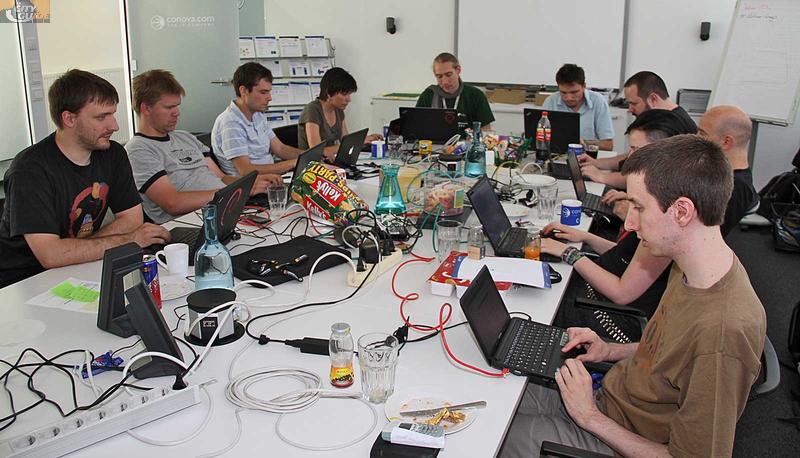
Bernd Zeimetz: Report from the Bug Squashing Party in Salzburg

bsp_2012_salzburg photo from salzburg-cityguide.com, Copyright (C) Uwe Brandl

Participation and Results From June 15-17th we held a Debian BugSquashingParty in Salzburg, hosted and sponsored by conova communications GmbH. It was a fun and busy weekend, with 15-17 people from 5 countries being around, mainly working on RC bugs in Testing/Unstable. Gerfried Fuchs (rhonda) also worked on triaging the impact of RC bugs on the version in Squeeze, while Peter Palfrader (weasel) took care of Tor related things and Debian sysadmin work, including starting on the new bugs and udd hosts. Phillip Hug (hug) worked on the debian.ch infrastructure. Together with Miroslav Such from Red Hat Bernd Zeimetz (bzed) worked on the packaging of the necessary libraries and daemons to add (basic) Spacewalk client support to Debian. As soon as the packages passed NEW and #677871 was applied (thanks to the APT guys for working on that already), managing Debian clients with Spacewalk should work out of the box. Of course we also had a little keysigning party :)

Statistics
  • about 68 bugs in unstable/testing were triaged/patched/fixed or at least pinged
  • 54 bugs were tagged to show if they affect Squeeze, several other bugs were pinged to retrieve necessary information or to trigger an update in the next stable pointrelease.
  • 5 packages were introduced into Debian (still in NEW, though) - the Spacewalk client related packages and libapache2-mod-auth-memcookie.

Accomodation Thanks to Debian funds we were able to provide accomodation for four participants in the JUFA youth hostel in Salzburg. We had paid in advance for eight, but changing to rooms with a higher category for only 4 people would have been equally or more expensive.

Press/Media coverage Additionally to being mentioned in the calendars on ProLinux and similar pages, we had some press coverage by the local newspaper and online magazines:

Fun facts We consumed 2kg of Leberkas, a big plate of "Buchteln mit Vanillesosse", about 16000cm^2 of Pizza, about 80 litres of coke, juice, beer and wine and I guess we drank at least the same amount of water. We had coffee made of 1.5kg coffee beans and managed to empty the (formerly well filled) icemaker in the fridge. Also we had successful training sessions of a standard Debconf game (rules won't be explained here obviously). Maybe we even successfully spread the game to the employees of a commercial linux distribution ;)

22 June 2012

Christian Perrier: 2012 update 27 for Debian Installer localization

The D-I beta release is in preparation so we have many last minute updates and I'm uploading gazillion of packages. Each time, I upload one....a translator pops up and sends another update, etc. :-) Status for D-I level 1 (core D-I files): Status for D-I level 2 (packages that have localized material that may appear during default installs, such as iso-codes, tasksel, etc.): Status for D-I level 3 (packages that have localized material that may appear during non-default installs, such as win32-loader) Full 100% completeness (hall of fame) for 28 languages: Asturian, Belarusian, Bulgarian, Catalan, Czech, Welsh, Danish, German, Esperanto, Spanish, Persian, French, Hebrew, Indonesian, Italian, Japanese, Kazakh, Khmer, Latvian, Dutch, Polish, Portuguese, Russian, Slovak, Slovenian, Swedish, Turkish, Simplified Chinese

20 June 2012

DebConf team: Call for DebConf14 venues! (Posted by Gunnar Wolf)

2000, Bordeaux, France. 2001, Bordeaux, France. 2002, Ottawa, Canada. 2003, Oslo, Norway. 2004, Porto Alegre, Brazil. 2005, Helsinki, Finland. 2006, Oaxtepec, Mexico. 2007, Edinburgh, United Kingdom. 2008, Mar del Plata, Argentina. 2009, C ceres, Spain. 2010, New York, United States. 2011, Banja Luka, Bosnia and Herzegovina. 2012, Managua, Nicaragua. 2013, Vaumarcus, Switzerland. We have gone to all different latitudes (although not yet longitudes!). We have had very hot and very cold weather. Great cities and small villages have hosted us. What will be the next addition to this great list? As we approach DebConf12 (10 days to DebCamp and counting, yay!), we should keep the future in mind. So, as every year in recent history, we will once again have a DebConf session presenting possible venues for the next year. Organizing DebConf in your city means a lot of hard work. It also means one of the greatest personal experiences you can imagine. And it is a great way to contribute to Debian. The decision process for every DebConf venue starts two years before, with presentations during DebConf(n-2). That means, if you consider presenting a bid for DebConf14, now is the moment to act! Do you have to be present at Managua to propose your bid? No. You can proxy via somebody I d suggest to do it via somebody who knows the location you are suggesting, but basically, choose a friend that you trust that trusts you. Of course, you can participate in the presentation session via IRC. Do you have to be a Debian Developer to propose a bid? No. For DebConf9, none of the C ceres guys was a DD; for DebConf10, some of the people most involved from the local New Yorkers were not DDs. For DC11, none of our hosts in Bosnia are DDs. And for DC12, the dear and overworked Nicaraguan crew is also made from people interested in getting closer to the Debian project, but not DDs. Do you have to decide now? No. This is just a call for a first presentation, but the decision regarding DC14 will be taken probably around March 2013. However, giving a nice presentation at DebConf helps a lot, gives you visibility, and will get the ball rolling. Is there a geographical bias? Slight. So far, and since the second DebConf, we have kept the tradition not to repeat continents on two successive DebConfs. This is not a hard condition, however! While there is some probability that DebConf14 will be somewhere in America (the continent, of course), it depends on the proposals more than on any pseudo-rule. What do you need to start thinking about? Go visit our prospective location checklist. You can also look at what other teams have historically presented. And of course, go to the DebConf14 wiki planning page Register there, even if you are just in the early phases of finding data.

19 June 2012

Joey Hess: I work for The Internet now

I have an interesting problem: How do I shoehorn "hired by The Internet for a full year to work on Free Software" into my resume? Yes, the git-annex Kickstarter went well. :) I had asked for enough to get by for three months. Multiple people thought I should instead work on it for a full year and really do the idea justice. Jason Scott was especially enthusiastic about this idea. So I added new goals and eventually it got there. graph: up and to the right, to 800% funded Don Marti thinks the success of my Kickstarter validates crowdfunding for Free Software. Hard to say; this is not the first Free Software to be funded on Kickstarter. Remember Diaspora? Here's what I think worked to make this a success: I've already put two weeks work into developing the git-annex assistant. I'm blogging about my progress every day on its development blog. The first new feature, a git annex watch command that automatically commits changes to git, will be in the next release of git-annex. I can already tell this is going to be a year of hard work, difficult problems, and great results. Thank you for helping make it happen.

Next.

Previous.