Search Results: "ah"

24 April 2011

John Goerzen: Adventure: 1 dad, 2 boys, and lots of trains

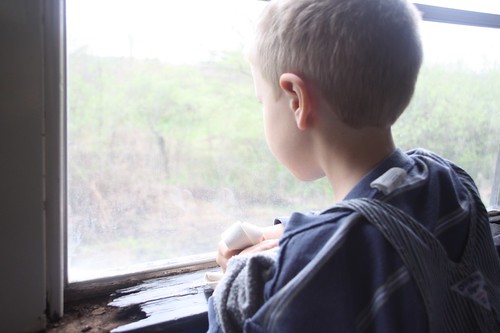
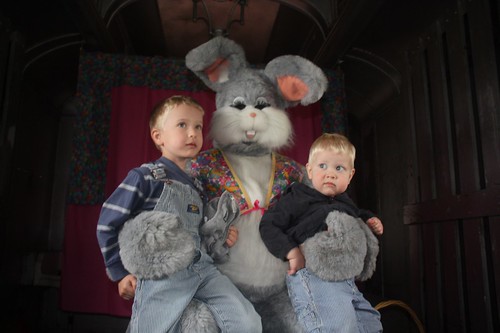
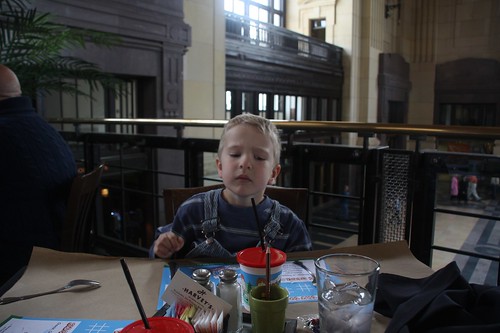
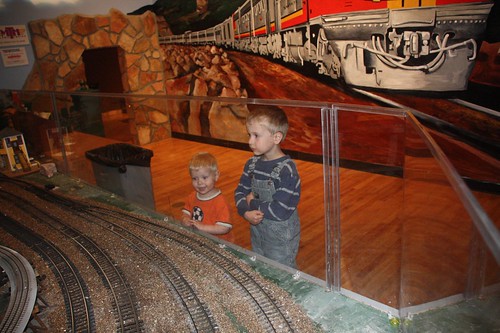
Terah and I recently decided that each of us could use a day off of not having to do work or supervise boys. Yesterday I had the day off work so that was mine. I took my Kindle, along with its Gutenberg copy of War and Peace, which yes, I m reading for fun. I slept in a bit, then got breakfast and sat down at Botanica, the Wichita Gardens with the Kindle for awhile. That was a nice way to spend the morning. Today was Terah s day off. Initially I thought of taking the boys to The Cosmosphere, one of the world s premier space museums, or to the Kansas Aviation Museum. But then I realized that the Midland Railway, a historic excursion line in Baldwin City, KS, was having their first train trip of the year. And it s the Easter special: you take the train a few miles out of town, get off, the kids do an Easter egg hunt, then also get to get their picture taken with the Easter bunny. Kid paradise, right? What could be better? So this is how my alarm came to be set for 5:15 on a Saturday morning. Oliver woke up early, but I had to get Jacob up. He was groggy, trying to cover his face and ears, and annoyed at me for trying to wake him up. Until I said, Jacob, it s time to get ready for the car trip to the train ride. Can you go get dressed for the day? Silence. Then about 5 seconds later, he jumped up, said, OK dad, I will do it, and he did. We drove our 2.5 hours. I had set out a non-dirty breakfast in the car for them the night before, so they munched while we drove. Then had to wait in a huge line for our tickets. An hour later we had them got the last 3 tickets for the first departure of the day, 10AM and ran to get on the train before it left. Jacob and Oliver both got very quiet. Sometimes Jacob especially does that when he s very excited about things. He doesn t always look it right then, but I knew I d be hearing about it later. He had his face almost pressed to the window the whole way. IMG_5685.JPG Oh, and yes, he dressed himself and I didn t check to make sure he had the correct shirt, or that it wasn t on inside-out, until it was too late. Oops. We rode in an ex-CP car built in 1936. One of the cars on the train was built in the 1890s quite some neat equipment. Anyhow, next came the hunt. There were two large lawns covered in eggs, separated by age group. Jacob and Oliver were in the younger group, but still only got a few eggs (there were lots of other parents, uhm, helping their kids by picking up eggs the kids were too slow to get and putting them in baskets ) But they were thrilled with the experience so that s what counts. They moved the locomotive to the other end of the train for the trip back using an adjacent track. Lots of the kids watched them couple it back on. Jacob and Oliver were particularly interested nothing could have distracted them from watching that train though they didn t particularly like the noise of the horn. IMG_5655.JPG On the way back, someone in an Easter bunny suit was on the train for pictures. I took the boys there. They usually refuse to sit on laps of Santa and such, so I didn t figure much success. They actually agreed to do it. And despite their expressions in this photo, Jacob later told me over and over how much fun it was to be with the Easter bunny. IMG_5671.JPG After we got back, we headed for the car. Jacob insisted on carrying his own Easter bag, and predictably wound up carrying it upside down for awhile. So his bag had some grass in it from picking the candy back up. Oliver discovered some rocks by a ditch and had fun throwing them in to make a splash, so we paused for that for awhile. By this point it was about noon. So at this point, what does a dad who has managed to keep two active boys in line for an hour, help them with an egg hunt and giant rabbit, and keep them from falling into the ditch they re throwing rocks into, do? Say that it s time to eat lunch and then head for home so we can be there in time for supper? Or go for MORE ADVENTURE? I said, Jacob, how would you like to eat lunch inside a big train station in Kansas City? Pause for a couple of seconds to think. YEAH! I have never had lunch in a train station before! Let s go! Shall we go NOW? So I gave them the leftover breakfast to eat during the hour drive on towards the beautiful Kansas City Union Station. It s one of the few grand American train stations that survives intact, and is just stunning. Jacob and Oliver both fell asleep on the way there. We parked, walked inside, and Jacob just froze. Dad WOW! That ceiling is SO HIGH! I can t even reach it! He then raised his hand as high as it would go and said, See dad, it is so high I can t touch it! (Most ceilings are, but this one is indeed much, much taller than most.) We ate lunch in the second level of a restaurant right in the Grand Hall, which Jacob really enjoyed. Here s Jacob, annoyed that I pulled out the camera again: IMG_5693.JPG Then we went exploring for an hour. Jacob talked about his adventure . We went up the elevators and checked out the balconies. Then we found the Model Railroad Experience. And oh my. The boys were visibly the most excited they had been all day. Oliver just froze at the spot he walked through the door, not caring to move and see the rest of the exhibit because he was so fascinated by what he already saw. There was a huge layout in the middle of the room, and smaller ones in adjacent rooms. We finally made our way there, and Oliver just ran round and round one of them, following a train, excitedly yelling There it is! There it is! There it is! Here s a photo from the big layout: IMG_5706.JPG Jacob cried when it was time to go, but I had promised them some dessert before we left, so after a bite of ice cream we were on our way. On the way home, every 15 minutes or so, Jacob would make a remark like this: Dad, the train ride was SO fun! or Dad, I really liked Kansas City Union Station! and so forth, naming every highlight of the day for him several times over: the Easter bunny, the egg hunt, train ride, and everything about Union Station. On the way home, we stopped at our favorite restaurant in Emporia: BobbyD s Merchant St. BBQ. This is always a hit for everyone in the family. A down-home place that has excellent food, is not far off our path, and never seems to have a wait. Yum.


Ben Hutchings: Upcoming changes in Debian Linux packages for i386

The major upcoming configuration change in Linux 2.6.39 is to get rid of the '686' flavour. This may be surprising, because it's the most widely used flavour of the 4 we have a present:
Name Minimum CPU features Maximum total CPU threads Physical address space
486 486-class 1 4 GiB
686 686-class; CMOV instruction 32 4 GiB
686-bigmem 686-class; PAE 32 64 GiB
amd64 x86-64 512 64 TiB
However, the physical address limitation means that an increasing proportion of new PCs and the majority of PC servers need the '686-bigmem' flavour. Even those that have less than 4 GiB RAM do support PAE and can run the '686-bigmem' flavour. There is a small cost (up to about 0.1% of RAM) in the use of larger hardware page tables. There is also an important benefit on recent processors: the larger page table entries include an NX bit (also known as XD) which provides protection against some buffer overflow attacks, both in the kernel and in user-space.. Q: What about 686 processors without PAE? There are only a few 686-class processors that support CMOV but not PAE: most Intel Pentium M models, the VIA C3 'Nehemiah' and the AMD Geode LX. These also all lack SMP support, which means the '486' flavour is suitable for them. Some benchmarking on two of those - a Pentium M model 745 and a C3 'Nehemiah' - indicated that they run the '486' flavour slightly faster than the '686' flavour. It appears that the performance gain from using plain uniprocessor code (rather than SMP-alternatives, which are patched with NOPs on uniprocessor systems) outweighs the performance loss from avoiding use of some newer instructions. Q: Why get rid of '686' but keep the 'amd64' flavour? We intend to get rid of 'amd64' too, but we need to ensure that upgrades from linux-image-2.6-amd64:i386 to linux-image-2.6-amd64:amd64 work properly. Q: If '686-bigmem' will be the default, isn't 'bigmem' redundant? Yes, it is. Therefore '686-bigmem' will be renamed to '686-pae'.

23 April 2011

Iustin Pop: Second system effect

A recent email from a user of one of my small software tools prompted me to write this entry If you read Wikipedia's page on Second system effect, it doesn't say much and it's hard to internalise what it means. Some other resources describe it better, but actually learning it first-hand is, shall we say, enlightening. Fortunately, I learned this in my spare time, and not at work. Back in 2002, I started working on a small tool (bakonf) to basically backup /etc and generate a tar archive out of it. It had some other features of course that made it a bit more useful than tar c /etc, but not many. It worked well and I was using it to make incremental dumps of server configuration ready to write to a CD on a few servers. A while later (around a year or so), I came to the conclusion that just having a tar archive is not enough, and rather one would want to be able to check differences between the filesystem and the archive, and ideally between multiple servers configurations (note, this was before DVCSs) online. I started working on cfvers in my free time and initially made reasonable progress. However, I didn't know to hold back from changing the scope and features, so actual progress in the form of a beta release was always postponed. Then came changes to the transport protocol, to the structure of the app, etc., all the fun. Note that this was in my free time, done in bursts of work in a month, then a few months with no work at all, so not too much work overall. Still, I slowly realised that this will go nowhere, so at the end of 2006 I finally gave up on developing it and marked the project as obsolete. However, bakonf is still doing its job, and I've done a few small commits to it in order to add compatibility with Python 3.x as recent as last year. I got an email about it from a user at the start of this year, so it definitely outlived its supposed replacement. Hah! Overall, it was a great lesson. Maybe it wasn't just second system effect, but also not enough effort invested by me, or bad planning, so on. But for me it drove the point home that writing the second version of something is filled with dangerous decisions

Dirk Eddelbuettel: Another nice Rcpp example

While preparing my slides for the Rcpp workshop this Thursday, I had wondered about more nice examples motivating Rcpp. So I posed a quick question on the rcpp-devel list. And I received a few friendly answers. My favourite, so far, was a suggestion by Lance Bachmeier who sent me a short script which used both R and C++ (via Rcpp) to simulate a first-order vector autoregressive process (and he ensured me that it worked well enough on his graduate students). It is indeed a great example as it involves (simple) matrix multiplication in an iterative fashion. Which makes it a great example not only for Rcpp but also for our RcppArmadillo package (which wraps Conrad Sanderson's wonderful Armadillo C++ templated library for linear algebra and more). And at the same time, we can also add another look at the new and shiny R compiler I also blogged about recently. So Lance and I iterated over this a little more over email, and I now added this as a new (and initial) example file in the RcppArmadillo SVN repo. (As an aside: The newest version 0.2.19 of RcppArmadillo has been sitting in incoming at CRAN since earlier in the week while the archive maintainer takes a well-deserved vacation. It should hit the public archive within a few days, and is otherwise available too from my site.) So let's walk through the example:
R> ## parameter and error terms used throughout
R> a <- matrix(c(0.5,0.1,0.1,0.5),nrow=2)
R> e <- matrix(rnorm(10000),ncol=2)
R> ## Let's start with the R version
R> rSim <- function(coeff, errors)  
+   simdata <- matrix(0, nrow(errors), ncol(errors))
+   for (row in 2:nrow(errors))  
+     simdata[row,] = coeff %*% simdata[(row-1),] + errors[row,]
+    
+   return(simdata)
+  
R> rData <- rSim(a, e)                     # generated by R
This starts with a simple enough loop. After skipping the first row, each iteration multiplies the previous row with the parameters and adds error terms. We can then turn to the R compiler:
R> ## Now let's load the R compiler (requires R 2.13 or later)
R> suppressMessages(require(compiler))
R> compRsim <- cmpfun(rSim)
R> compRData <- compRsim(a,e)              # generated by R 'compiled'
R> stopifnot(all.equal(rData, compRData))  # checking results
Nice and easy: We load the compiler package, create a compiled function and use it. We check the results and surely enough find them to be identical. With that, time to turn to C++ using Armadillo via RcppArmadillo:
R> ## Now load 'inline' to compile C++ code on the fly
R> suppressMessages(require(inline))
R> code <- '
+   arma::mat coeff = Rcpp::as<arma::mat>(a);
+   arma::mat errors = Rcpp::as<arma::mat>(e);
+   int m = errors.n_rows; int n = errors.n_cols;
+   arma::mat simdata(m,n);
+   simdata.row(0) = arma::zeros<arma::mat>(1,n);
+   for (int row=1; row<m; row++)  
+     simdata.row(row) = simdata.row(row-1)*trans(coeff)+errors.row(row);
+    
+   return Rcpp::wrap(simdata);
+ '
R> ## create the compiled function
R> rcppSim <- cxxfunction(signature(a="numeric",e="numeric"),
+                        code,plugin="RcppArmadillo")
R> rcppData <- rcppSim(a,e)                # generated by C++ code
R> stopifnot(all.equal(rData, rcppData))   # checking results
Here we load the inline package to compile, link and load C++ snippets. We define a short C++ function in the code variable, declare a signature taking a and e as before and ask cxxfunction() to deploy the plugin for RcppArmadillo so that it and Rcpp are found during build. With that, we have a compiled function to generate data, and we once again check the result. The C++ code is pretty straightforward as well. We can instatiate Armadillo matrices directly from the R objects we pass down; we then run a similar loop building the result row by row. Now, with all the build-up, here is the final timing comparison, using the rbenchmark package:
R> ## now load the rbenchmark package and compare all three
R> suppressMessages(library(rbenchmark))
R> res <- benchmark(rcppSim(a,e),
+                  rSim(a,e),
+                  compRsim(a,e),
+                  columns=c("test", "replications", "elapsed",
+                            "relative", "user.self", "sys.self"),
+                  order="relative")
R> print(res)
            test replications elapsed relative user.self sys.self
1  rcppSim(a, e)          100   0.038   1.0000      0.04        0
3 compRsim(a, e)          100   2.011  52.9211      2.01        0
2     rSim(a, e)          100   4.148 109.1579      4.14        0
So in a real-world example involving looping and some algebra (which is of course already done by BLAS and LAPACK libraries), the new R compiler improves by more than a factor of two, cutting time from 4.14 seconds down to about 2 seconds. Yet, this still leaves the C++ solution, clocking in at a mere 38 milliseconds, ahead by a factor of over fifty relative to the new R compiler And compared to just R itself, the simple solution involving Rcpp and RcppArmadillo is almost 110 times faster. As I mentioned, I quite like this example ;-).

21 April 2011

Timo Jyrinki: Tuning an old but free phone video now available

It was good that I didn't hold up my blog post in November until the videos from FSCONS 2010 (Free Society Conference and Nordic Summit) are out, but now they finally are:


Timo Jyrinki - Tuning an old but free phone (pt 1/2)
Timo Jyrinki - Tuning an old but free phone (pt 2/2)

Definitely see also all videos and since Vimeo doesn't work in Gnash, use a script to download.

ps. As a related item to the talk's future oriented aspects, while waiting for GTA04A3 boards to arrive, GTA04A2 has been patched to run Debian/LXDE.

Timo Jyrinki: Free Society Conference and Nordic Summit (FSCONS 2010)

Just a note that the slides are available (non-slideshare link) for my presentation Tuning an old but free phone (description) that I held in the tremendously great event FSCONS 2010. It could be described as a smaller scale FOSDEM, but that would be actually down-playing it since the free software effects on society are something that I've actually never seen elsewhere on such a scale. My talk was among the purely technical ones, though.

I was planning to hold on with this blog post until the recorded videos arrive, but since it seems it might not be during this year I will just post this now that slides are available.

I've shared a few photos as well at Flickr...


Keynote: Karin Kosina, The Inanna Project. A tech + art workshop for female artists in Damascus, Syria. An experiment in art, technology, and the transformative power of Free Hardware and Software.


Erik de Bruijn, The Future of RepRap, a self-replicating open source 3D printer that fabricates arbitrary objects including parts of itself.


Social event at the Berg 211.


Malin Nilsson on Gender, class and global flows. Using free software to fuel a revolution in home based industrial work.


Keynote: Glyn Moody, Ethics of Intellectual Monopolies.


Keynote: Glyn Moody, Ethics of Intellectual Monopolies (audience).

A few summaries available on a Qaiku seminar channel.

20 April 2011

Niels Thykier: Update on Lintian 2.5.0~rc3

While we are waiting for Lintian 2.5.0~rc3, here is a little update on what you can look forward to. About a week ago I had the pleasure of merging my branch into the Lintian master branch. While the IRC bot DOS ed the #debian-qa channel[SRY], cross-package checks became part of the official Lintian. Beyond the reduced amount of binary-without-manpage false-positives, circular-dependency checking and a partial broken symlink detector, the 2.5.0~rc3 release will also feature java and multiarch checks (kudos to Vincent Fourmond and Steve R. Langasek, respectively). The new java checks are based on the Java Policy and currently mostly covers checking for possibly build misconfigurations (jars without class files etc.), weird classpaths and missing Main-Class/depends on jarwrapper for executable jars. Note that #539315 has not been fixed, so executable jars will still trigger a warning. For people wanting to upgrade their libraries to multiarch, Lintian will have a check to see if you remember the Pre-Depends on multiarch-support. Personally I have not followed the progress of multiarch too closely, but last I checked multiarch-support was not in unstable. I guess we are ahead on this one. :) Other highlights include dont install stuff in /run , armhf support, less false positive on missing B-D on dh_python 2,3 and recognition of 3.9.2 as the latest version of the Policy Manual. I am also planning on starting a new branch and this time I intend to work on Vendor-based customization of Lintian. If you have any ideas/suggestions, by all means follow up on the thread on the Lintian list. [SRY] Sorry to anyone present in the channel!

18 April 2011

Rapha&#235;l Hertzog: Status update of GNOME 3 in Debian experimental

Last week s post generated a lot of interest so I will make a small update to keep you posted on the status of GNOME 3 in Debian experimental. Experimental is not for everybody But first let me reiterate this: GNOME 3 is in Debian experimental because it s a work in progress. You should not install it if you can t live with problems and glitches. Beware: once you upgraded to GNOME 3 it will be next to impossible to go back to GNOME 2.32 (you can try it, but it s not officially supported by Debian). Even with the fallback mode, you won t get the same experience than what you had with GNOME 2.32. Many applets are not yet ported to the newest gnome-panel API. So do not upgrade to it if you re not ready to deal with the consequences. It will come to Debian unstable and to Debian testing over time and it should be in a better shape at this point. Good progress made Most of the important modules have been updated to 3.0. You can see the progress here. The exception is gdm, it still needs to be updated, the login screen looks quite ugly right now when using GNOME 3. Frequently Asked Questions and Common Problems Why do links always open in epiphany instead of iceweasel? You need to upgrade to the latest version on libglib2.0-0, gvfs and gnome-control-center in experimental. Then you can customize the default application used in the control center (under System Information > Default applications ). You might need to switch to iceweasel 4.0 in experimental to have iceweasel appear in the list of browsers. Or you can edit ~/.local/share/applications/mimeapps.list and put x-scheme-handler/http=iceweasel.desktop;epiphany.desktop; in the Added Associations section (replace the corresponding line if it already exists and lists epiphany only). The theme looks ugly, and various icons are missing. Ensure that you have installed the latest version of gnome-themes-standard, gnome-icon-theme and gnome-icon-theme-symbolic. The network icon in the Shell does not work. Ensure you have upgraded both network-manager-gnome and network-manager to the experimental version. Some applications do not start at all. If an application loads GTK2 and GTK3, it exits immediately with a clear message on the standard error output (Gtk-ERROR **: GTK+ 2.x symbols detected. Using GTK+ 2.x and GTK+ 3 in the same process is not supported.). It usually means that one of the library used by that application uses a different version of GTK+ than the application itself. You should report those problems to the Debian bug tracking system if you find any. Some people also reported failures of all GTK+ applications while using the Oxygen themes. Switching to another theme should help. BTW, the default theme in GNOME 3 is called Adwaita. Where are my icons on the desktop? They are gone, it s by design. But you can reenable them with gsettings set org.gnome.desktop.background show-desktop-icons true and starting nautilus (if it s not already running). (Thanks to bronte for the information) Why do I see all applications twice in the shell? The package menu-xdg generates a desktop file from the Debian menu information, those are in a menu entry that is hidden by default in the old GNOME menu. Gnome Shell doesn t respect those settings and displays all .desktop files. Remove menu-xdg and you will get a cleaner list of applications. APT pinning file for the brave Since last week, we got APT 0.8.14 in unstable and it supports pattern matching for package name in pinning files. So I can give you a shorter and more complete pinning file thanks to this:

Package: *gnome* libglib2.0* *vte* *pulse* *peas* libgtk* *gjs* *gconf* *gstreamer* alacarte *brasero* cheese ekiga empathy* gdm3 gcalctool baobab *gucharmap* gvfs* hamster-applet *nautilus* seahorse* sound-juicer *totem* remmina vino gksu xdg-user-dirs-gtk dmz-cursor-theme eog epiphany* evince* evolution* file-roller gedit* metacity *mutter* yelp* rhythmbox* banshee* system-config-printer transmission-* tomboy network-manager* libnm-* update-notifier shotwell liferea *software-properties* libunique-3.0-0 libseed-gtk3-0 libnotify* libpanel-applet-4-0 libgdata11 libcamel* libcanberra* libchamplain* libebackend* libebook* libecal* libedata* libegroupwise* libevent* gir1.2-*
Pin: release experimental
Pin-Priority: 500
Package: *
Pin: release experimental
Pin-Priority: 150
Putting the file above in /etc/apt/preferences.d/gnome and having experimental enabled in /etc/apt/sources.list should be enough to enable apt-get dist-upgrade to upgrade to GNOME 3 in experimental. But if you have packages depending on libimobiledevice1, you might have to wait until #620065 is properly fixed so that libimobiledevice2 is co-installable with libimobiledevice1. Update: integrated the explanation to reenable the desktop icons thanks to bronte s comment.

15 comments Liked this article? Click here. My blog is Flattr-enabled.

16 April 2011

John Goerzen: The Boys

Jacob really enjoys his pajamas. By this point, he can mostly get himself ready for bed. He still wants help brushing his teeth but that s about it. His favorite pajamas are his rocket ship pajamas , which also cover his feet and have a white pad underneath the feet. That s his favorite part. They have rockets all over them, and he sometimes will run out of a room and inform me with delight, I m all rocket ships! Oliver has really started to form up words. We can pick out words like lettuce, truck, book, look, and dad John . He also has a way of saying there it is , most particularly when looking at trains. Jacob still loves trains. In church, he will take his markers, connect them end to end, and have a marker train that will keep him entertained for quite a long while. He will slide it back and forth on the pew, and eventually it will slide in a tunnel (behind my back). This actually started with hymnbook trains get a few books in a row, and it s a train. Anything can be a train to Jacob. Driving down the road, we might see what he calls tree trains, which are just trees in a row. Last Sunday, the Kansas Mennonite Men s Chorus had its first concert of the season. I sing with this group, which has nearly 300 men in it. It s a lot of fun to be a part of that group, and the music is wonderful. Jacob and Oliver were there on Sunday, and both started to take more of an interest in the music that before. Jacob particularly loved the song Dry Bones, which had a number of odd percussion instruments in it. He was laughing at spots, and wanted to hear me sing it for the next several days. He even wanted Terah to read the program from the concert to him before his nap one day. Oliver enjoyed it too, and kept saying dad John (his word for me) whenever there was a soloist. I didn t sing a solo, but apparently to 1-year-old eyes, 300 guys all dressed alike all look like dad. Jacob and I recently have been reading Winnie the Pooh stories at his bedtime. Not the Disney books, but the original A. A. Milne stories. We read a few pages every night, and have made it to page 214 by now. Jacob loves it. And he s becoming increasingly interested in reading things. Sometimes we ve been unsure if he s reading something or just had it memorized. Last night, I got out the book, and we were on a page he had never seen or heard before. He pointed to a word, and said, It says Roo there! And indeed it did. Then he added, It says said Roo. . Yep. And then he read me the whole sentence:
I love jumping, said Roo.
I believe that s the first time I ve been certain Jacob has read me an entire sentence without having memorized any of it beforehand. And he won t be old enough to start Kindergarten for another year and a half. We then read the story, and when I came to the sentence Jacob had read to me, he interrupted, saying, No, dad, I will read that one! And he did.

11 April 2011

Rapha&#235;l Hertzog: Journey of a new GNOME 3 Debian packager

With all the buzz around GNOME 3, I really wanted to try it out for real on my main laptop. It usually runs Debian Unstable but that s not enough in this case, GNOME 3 is not fully packaged yet and it s only in experimental for now. I asked Josselin Mouette (of the pkg-gnome team) when he expected it to be available and he could not really answer because there s lots of work left. Instead Roland Mas gently answered me Sooner if you help . :-) First steps as a GNOME packager This is pretty common in free software and for once I followed the advice, I spent most of sunday helping out with GNOME 3 packaging. I have no prior experience with GNOME packaging but I m fairly proficient in Debian packaging in general so when I showed up on #debian-gnome (irc.debian.org) on sunday morning, Josselin quickly added me to the team on alioth.debian.org. Still being a pkg-gnome rookie, I started by reading the documentation on pkg-gnome.alioth.debian.org. This is enough to know where to find the code in the SVN repository, and how to do releases, but it doesn t contain much information about what you need to know to be a good GNOME packager. It would have been great to have some words on introspection and what it changes in terms of packaging for instance. Josselin suggested me to start with one of the modules that was not yet updated at all (most packages have a pre-release version usually 2.91 in experimental, but some are still at 2.30). Packages updated and problems encountered (You can skip this section if you re not into GNOME packaging) So I picked up totem. I quickly updated totem-pl-parser as a required build-dependency and made my first mistake by uploading it to unstable (it turns out it s not a problem for this specific package). Totem itself was more complicated even if some preliminary work was already in the subversion repository. It introduces a new library which required a new package and I spent a long time debugging why the package would not build in a minimalistic build environment. Indeed while the package was building fine in my experimental chroot, I took care to build my test packages like the auto-builders would do with sbuild (in sid environment + the required build-dependencies from experimental) and there it was failing. In fact it turns out pkg-config was failing because libquvi-dev was missing (and it was required by totem-pl-parser.pc) but this did not leave any error message in config.log. Next, I decided to take care of gnome-screensaver as it was not working for me (I could not unlock the screen once it was activated). When built in my experimental chroot, it was fine but when built in the minimalistic environment it was failing. Turns out /usr/lib/gnome-screensaver/gnome-screensaver-dialog was loading both libgtk2 and libgtk3 at the same time and was crashing. It s not linked against libgtk2 but it was linked against the unstable version of libgnomekbdui which is still using libgtk2. Bumping the build-dependency on libgnomekbd-dev fixed the problem. In the evening, I took care of mutter and gnome-shell, and did some preliminary work on gnome-menus. Help is still welcome There s still lots of work to do, you re welcome to do like me and join to help. Come on #debian-gnome on irc.debian.org, read the documentation and try to update a package (and ask questions when you don t know). Installation of GNOME 3 from Debian experimental You can also try GNOME 3 on your Debian machine, but at this point I would advise to do it only if you re ready to invest some time in understanding the remaining problems. It s difficult to cherry-pick just the required packages from experimental, I tried it and at the start I ended up with a bad user experience (important packages like gnome-themes-standard or gnome-icon-theme not installed/updated and similar issues). To help you out with this, here s a file that you can put in /etc/apt/preferences.d/gnome to allow APT to upgrade the most important GNOME 3 packages from experimental:
Package: gnome gnome-desktop-environment gnome-core alacarte brasero cheese ekiga empathy gdm3 gcalctool gconf-editor gnome-backgrounds gnome-bluetooth gnome-media gnome-netstatus-applet gnome-nettool gnome-system-monitor gnome-system-tools gnome-user-share baobab gnome-dictionary gnome-screenshot gnome-search-tool gnome-system-log gstreamer0.10-tools gucharmap gvfs-bin hamster-applet nautilus-sendto seahorse seahorse-plugins sound-juicer totem-plugins remmina vino gksu xdg-user-dirs-gtk gnome-shell gnome-panel dmz-cursor-theme eog epiphany-browser evince evolution evolution-data-server file-roller gedit gnome-about gnome-applets gnome-control-center gnome-disk-utility gnome-icon-theme gnome-keyring gnome-menus gnome-panel gnome-power-manager gnome-screensaver gnome-session gnome-settings-daemon gnome-terminal gnome-themes gnome-user-guide gvfs gvfs-backends metacity mutter nautilus policykit-1-gnome totem yelp gnome-themes-extras gnome-games libpam-gnome-keyring rhythmbox-plugins banshee rhythmbox-plugin-cdrecorder system-config-printer totem-mozilla epiphany-extensions gedit-plugins evolution-plugins evolution-exchange evolution-webcal gnome-codec-install transmission-gtk avahi-daemon tomboy network-manager-gnome gnome-games-extra-data gnome-office update-notifier shotwell liferea epiphany-browser-data empathy-common nautilus-sendto-empathy brasero-common
Pin: release experimental
Pin-Priority: 500
Package: *
Pin: release experimental
Pin-Priority: 150
The list might not be exhaustive and sometimes you will have to give supplementary hints to apt for the upgrade to succeed, but it s better than nothing. I hope you find this useful. I m enjoying my shiny new GNOME 3 desktop and it s off for a good start. My main complaint is that hamster-applet (time tracker) has not yet been integrated in the shell.

21 comments Liked this article? Click here. My blog is Flattr-enabled.

9 April 2011

Daniel Kahn Gillmor: EDAC i5000 non-fatal errors

I've got a Debian GNU/Linux lenny installation (2.6.26-2-vserver-amd64 kernel) running on a Dell Poweredge 2950 with BIOS 2.0.1 (2007-10-27). It has two Intel(R) Xeon(R) CPU 5160 @ 3.00GHz processors (according to /proc/cpuinfo, 8 1GiB 667MHz DDR2 ECC modules (part number HYMP512F72CP8N3-Y5), according to dmidecode, and an Intel Corporation 5000X Chipset Memory Controller Hub (rev 12) according to lspci. The machine has been running stably for many months. On the morning of March 31st, i started getting the following messages from the kernel, on the order of one pair of lines every 3 seconds:
Mar 31 07:04:38 zamboni kernel: [16883514.141275] EDAC i5000 MC0: NON-FATAL ERRORS Found!!! 1st NON-FATAL Err Reg= 0x800
Mar 31 07:04:38 zamboni kernel: [16883514.141278] EDAC i5000: 	NON-Retry  Errors, bits= 0x800
A bit of digging turned up a redhat bug report that seems to suggest that these warnings are just noise, and should be ignorable. Another link thinks it's a conflict with IPMI, though i don't think this model actually has an IPMI subsystem correction: this machine does have IPMI, though i am not making use of it. However, i also notice from munin logs that at the same time the error messages started, the machine exhibited a marked change in CPU activity (including in-kernel activity) and local timer interrupts: [Individual interrupts - by month][CPU Usage - by month] I also note that more rescheduling interrupts started happening, and fewer megasas interrupts at about the same time. I'm not sure what this means. A review of other logs and graphs on the system turns up no other evidence of interaction that might cause this kind of elevated activity. One thought was that the elevated activity was just due to writing out a bunch more logs. So i tried removing the i5000_edac module just to keep dmesg and /var/log/kern.log cleaner. Leaving that turned off doesn't lower the CPU utilization or change the interrupts, though. Any suggestions on what might be going on, or further diagnostics i should run? The machine is in production, and I'd really rather not take down the machine for an extended period of time to do a lengthy memory test. But i also don't want to see this kind of extra CPU usage (more than double the machine's baseline).Tags: i5000_edac, troubleshooting

6 April 2011

Mehdi Dogguy: Buildd status pages: say goodbye to external dependencies

Last week, I had to put my daily (real) work off for a bit, to get some rest. I took this occasion to implement a few ideas I had for the Buildd Status Pages. Mainly, I wanted to get rid of my external dependencies which are: Besides of getting rid of external dependencies, there were also a few feature requests (#618676, #612174, #518526) waiting for a while and it was good time to fix them. Hopefully, there are related to what I was fixing. The final version is now deployed and can be used. The implemented changes are : I think that I tested well enough this new version and it works okay. Nevertheless, if you encounter a bug or a strange behavior, please don t hesitate to contact me (either by mail or on irc) or submit a bug report against buildd.debian.org. The next steps (probably) are :

5 April 2011

Daniel Kahn Gillmor: Debian on Thecus N8800Pro

I recently set up debian on a Thecus N8800Pro. It seems to be a decent rackmount 2U chassis with 8 3.5" hot-swap SATA drives, dual gigabit NICs, a standard DB9 RS-232 serial port, one eSATA port, a bunch of USB 2.0 connectors, and dual power supplies. I'm happy to be able to report that Thecus appears to be attempting to fulfill their obligations under the GPL with this model (i'm fetching their latest source tarball now to have a look). Internally, it's an Intel Core 2 Duo processor, two DIMMS of DDR RAM, and a PCIe slot for extensions if you like. It has two internally-attached 128MiB SSDs that it wants to boot off of. The downsides as i see them:
BIOS
The BIOS only runs over VGA, which is not easy to access. I wish it ran over the serial port. It's also not clear how one would find an upgrade to the BIOS. dmidecode reports the BIOS as:
        Vendor: Phoenix Technologies, LTD
        Version: 6.00 PG
        Release Date: 02/24/2009
RAM
The mainboard has only two DIMM sockets. It came pre-populated with two 2GiB DDR DIMMs. memtest86+ reports those DIMMs clearly, but sees only 3070MiB in aggregate. The linux kernel also sees ~3GiB of RAM, despite dmidecode and lshw reporting that the two DIMM modules each are only 1GiB in size. I'm assuming this is a bios problem. Anyone know how to get access to the full 4GiB? Should i be reporting bugs on any of these packages?
SSDs
The internal SSDs are absurdly small and very slow for both reading and writing. This isn't a big deal because i'm basically only using them for the bootloader, kernel, and initramfs. But i'm surprised that they could even find 128MiB devices in these days of $10 1GiB flash units.
processor
/proc/cpuinfo reports two cores of a Intel(R) Core(TM)2 Duo CPU T5500 @ 1.66GHz, each with ~3333 bogomips, and apparently without hardware virtualization support. It's not clear to me whether the lack of virtualization support is something that could be fixed with a BIOS upgrade.
I used Andy Millar's nice description of how to get access to the BIOS -- I found i didn't need a hacksaw to modify the VGA cable i had. just pliers to remove the outer metal shield on the side of the connector i plugged into the open socket. lshw sees four SiI 3132 Serial ATA Raid II Controller PCI devices, each of which appears to support two SATA ports. I'm currently using only four of the 8 SATA bays, so i've tried to distribute the disks so that each of them is attached to an independent PCI device (instead of having two disks on one PCI device, and another PCI device idle). I don't know if this makes a difference, though, in the RAID10 configuration i'm using. There's also a neat 2-line character-based LCD display on the front panel which apparently can be driven by talking to a serial port, though i haven't tried. Apparently there are also LEDs that might be controllable directly from the kernel via ICH7 and GPIO, but i haven't tried that yet either. Any suggestions on how to think about or proceed with a BIOS upgrade to get access to the full 4GiB of RAM, BIOS-over-serial, and/or enable hardware virtualization?Tags: n8800pro, thecus

3 April 2011

David Watson: Project 52 - Week 13

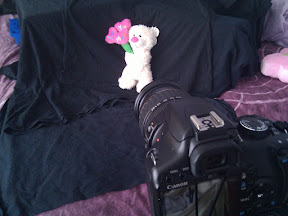
Today I shot an image of a bear my daughter gave to my wife for mothers day. Week 13 - Mothers Day This week I am also including a behind the scenes shot that shows how cheap my home "studio" is. In case you can't tell that is my bed with t-shirt covered boxes on it. All the light for this image comes from the window. After a little editing of the image the final outcome is what you see at the top of this post.

Rapha&#235;l Hertzog: March 2011 wrap up

Since I m soliciting donations to support my Debian work, the least I can do is explain what I do. You can thus expect to see an article like this one every month. Multi-Arch work I updated the code to use another layout for the control files stored in /var/lib/dpkg/info/. Instead of using a sub-directory per architecture (arch/package.type), we decided to use package:arch.type but only for packages which are Multi-Arch: same. dpkg is taking care to rename the files the first time it is executed with write rights and then updates /var/lib/dpkg/info/format to remember that the upgrade has been done and that we can rely on the new structure. I filed a few bugs on packages that are improperly accessing those internal files instead of using the appropriate dpkg-query interface. I sent a heads-up mail on -devel to make other people aware of those problems in the hope to discover most of them as early as possible. After that, the work stalled because Guillem went away for 2 weeks and thus stopped his review of my work. I hope he will quickly resume the review and that we will get something final this month. With the arrival of dpkg 1.16.0, it s now possible to start converting libraries to multi-arch even if full multi-arch support has not yet landed in dpkg proper. See http://wiki.debian.org/Multiarch/Bootstrapping for the detailed plan. If you re curious about Multi-Arch, you might want to read this article of Steve Langasek as well. Bug triage for dpkg in launchpad At the start of the month, there was close to 500 bugs reported against the dpkg package in Launchpad. Unfortunately most of it is noise many of the reported bugs are misfiled, they show an upgrade problem of a random package and that upgrade problem confuses update-manager which tries to configure an already configured package. This generates a second error that apport attributes to dpkg and the resulting bug report is thus filed on dpkg. There are literally hundreds of those that have to be reclassified. Michael Vogt and Brian Murray did some triaging, and I also spend quite some hours on this task. It s a bit frustrating as I tend to mark many reports Incomplete because there s no way they can be acted upon and many of them are so old that the reporter is unlikely to be able to provide supplementary information. But in the middle of this noise, there are some useful bug reports, like LP#739179 which enabled me to fix a regression even before it reached Debian Unstable (because Ubuntu runs a snapshot of dpkg with multiarch support). I subscribed to the Launchpad bugs for dpkg via the Debian Package Tracking System (thanks to the derivatives-bugs keyword) and will try to keep up with the incoming reports. Misc dpkg work The ftpmasters came up with a request for a new field (see 619131) in source packages. After a quick discussion and a round of review on debian-policy@l.d.o, I implemented the new Package-List field. This should allow the ftpmasters to save some time in NEW processing, but we deferred the change for the next dpkg version (1.16.1) to ponder a bit more on the design of the field. I also fixed a bunch of bugs (#619541, #605719, #598922, #616096) and merged a patch of Mark Hymers to recognize the new Built-Using field. Developers-reference work The review process for changes to the developers-reference is not working as it should. And I suffered from it while trying to integrate the patch I wrote for the Developer duties chapter (see #548867). We purposely changed the maintainer field from debian-doc to debian-policy in the hope to have more reviews of suggested changes and to seek some sort of consensus before committing anything. But we don t get more reviews and deciding to commit a patch is now even harder than it was (except for trivial stuff where personal opinions can t interfere). In my case, I only got the feedback of Charles Plessy which was very mixed to say the least. I tried to improve my patch based on what he expressed but I also clearly disagreed with some of his assertions and was convinced that my wording was in line with the dominant point of view within Debian. We tried to involve the release team in the discussion because most of what I documented was about helping making stable release happen, but nobody of the team answered. Instead of letting the situation (and my patch) rot, I solicited feedback from the DPL and from another developers-reference editor to see whether my patch was an improvement or not. After some more time, I went ahead and committed it. It was not pleasant for anyone. I don t know how we can improve this. Contrary to the policy, the developers-reference is a document that is not normative, I believe the result is better when we put some soul into it. But it s a real challenge when you seek a consensus and that the interest in reviewing changes is so low. DVD shop listed on debian.org In February, I launched a DVD shop whose benefits are used to fund my Debian work. Shortly after the launch I used the official form to be added to the official listing of Debian CD vendors and offered a few suggestions to deal with vendors who are selling unofficial images (with firmware in my case). A few weeks later, I got no answers: neither for my request nor for my suggestions, I mailed the cdvendors@debian.org team directly asking for a status update and quickly got an answer suggesting that Simon Paillard usually does the work and can t process the backlog due to some injury. At this point no concerns had been raised about adding me to the list. To save some time and some work for the team, I added myself to the list since I had commit rights and I informed them that I did it, so that they can review it. Shortly after I did that, Martin Zobel Helas objected to my addition. I cleared some misunderstandings but the discussion also lead to some changes to please everybody: the listing now indicates that some images are unofficial and I have prepared a special landing page for people coming from the Debian website through this listing. Debian column on OMG! Ubuntu I have always been a firm believer that it s important for Debian to reach out to the widest public with its message of freedom. Thus when Benjamin Humphrey contacted the debian-publicity team to find volunteers to write a Debian column on OMG! Ubuntu, I immediately jumped in. I wrote 4 articles over there. The tone is very different from my articles on my blog and I like that duality. Check out Debian is dying! Oh my word!, Debian or Ubuntu, which is the best place to contribute?, Are you contributing your share? and Ubuntu s CTO reveals DEX: an effort to close the gap with Debian. It s a great win-win situation, OMG! Ubuntu benefits from my articles, Debian s values are relayed further, and OMG! Ubuntu s large audience also helps me develop my own blog. Work on my book I had lots of paperwork to do this month (annual accounting stuff for my company) and I did not have as much time as I hoped for my book. Still I have a updated a few more chapters of my French book and I certainly hope to complete the update during April. This means that the work on the English translation could start in may. Work on my blog Just like for my book, it has been relatively difficult for me to cope with my policy of two articles every week. But I still managed to get quite some good stuff out. I interviewed Christian Perrier (Debian s translation coordinator) and also Bdale Garbee (chair of Debian s technical committee). I finished my series of Debian Cleanup Tips with 2 supplementary articles: The removal of firmware is causing troubles to quite some users so I wrote an article explaining how to deal with the problem. A regular reader also asked me to write an article about Jigdo, I executed myself because it was a good idea and that he has been very nice with me: Download ISO images of Debian CD/DVD at light speed with Jigdo. Last but not least, I shared my package maintainer pledge which inspired my developers-reference patch (see discussion above). Thanks Many thanks to all the people who showed their appreciation of my work. The 324.37 EUR that you gave me in February represented 2 days and a half of my time that I have spent working on the above projects. See you next month for a new summary of my activities.

2 comments Liked this article? Click here. My blog is Flattr-enabled.

Matthew Palmer: "Every Debian developer is also an Ubuntu developer" indeed...

... to the degree that you may get unsolicited e-mails from Canonical flunkies, asking about your project timeline and status on an Ubuntu bug that is so crucial that it needs its very own project manager, but which isn't important enough to forward to the Debian bug tracker. At the time I got the e-mail, I had already decided to give up on d-i development, so I had a brief gape at the sheer chutzpah of the thing and deleted it. In retrospect, I shouldn't have done that. I've needed a good laugh a few times since then, and re-reading that e-mail would have done nicely. Anyone got one of these e-mails that they kept, so I can keep the lulz going 4eva? E-mail me.

1 April 2011

Aigars Mahinovs: New Nokia games coming

Warning, this post is COMPANY CONFIDENTIAL, do not spread outside of authorized corporate internal communication channels. Today Nokia will announce that in order to increase investor confidence and foster brand loyalty all Nokia Symbian phones in the world will receive two free Nokia-themed games. The first game will be Angry Nokias Nokias have discovered that other phones are taking their market share away and now they are very, very angry! Fling cool and shiny Nokia phone and destroy the competition. Complete all free 30 levels and be first to collect all golden Ovi s by gathering MeeGo and Windows Phone 7 logos in the levels! The other game that is sure to be an instant hit among true Nokia fans will be the Nokia Ninja you are a humble user and sales people are throwing phones at you all kinds of phones. But beware most of those phones are not Nokias! Use your finger to slice trough the competition, rake up combos and achievements! But be careful you do not want to slice trough a Nokia phone! Only trough instant brand recognition you can rake up truly great scores in this game. Nokia connecting people. (P.S. Check the date)

29 March 2011

Daniel Kahn Gillmor: auto-built debirf images

jrollins and i recently did a bunch of cleanup work on debirf, with the result that debirf 0.30 can now build all the shipped example profiles without error (well, as long as debootstrap --variant=fakechroot is working properly -- apprently that's not the case for fakechroot 2.9 in squeeze right now, which is why i've uploaded a backport of 2.14). To try to avoid getting into a broken state again, we set up an autobuilder to create the images from the three example profiles (minimal, rescue, and xkiosk) for amd64 systems. The logs for these builds are published (with changes) nightly at:
git://debirf.cmrg.net/debirf-autobuilder-logs
But even better, we are also publishing the auto-generated debirf images themselves. So, for example, if you've got an amd64-capable machine with a decent amount of RAM (512MiB is easily enough), you can download a rescue kernel and image into /boot/debirf/, add a stanza to your bootloader, and be able to reboot to it cleanly, without having to sort out the debirf image creation process yourself. We're also providing ISOs so people who still use optical media don't have to format their own. Please be sure to verify the checksums of the files you download. The checksums themselves are signed by the OpenPGP key for Debirf Autobuilder <debirf@cmrg.net>, which i've certified and published to the keyserver network. What's next? It would be nice to have auto-built images for i386 and other architectures. And if someone has a good idea for a new example profile that we should also be auto-building, please submit a bug to the BTS so we can try to sort it out.Tags: debirf

Steve Langasek: Multiarch Monomania

So the other day, I was able to do this in an Ubuntu natty amd64 chroot for the first time.
# cat > /etc/apt/apt.conf.d/multiarch-me
APT::Architectures   "amd64"; "i386";  ;
^D
# cat >> /etc/dpkg/dpkg.cfg
foreign-architecture i386
^D
# apt-get update
# apt-get install flashplugin-installer:i386
Reading package lists... Done
Building dependency tree       
Reading state information... Done
[...]
The following NEW packages will be installed:
  flashplugin-installer:i386 flashplugin-nonfree:i386 gcc-4.5-base:i386
  libatk1.0-0:i386 libavahi-client3:i386 libavahi-common-data:i386
  libavahi-common3:i386 libc6:i386 libcairo2:i386 libcomerr2:i386
  libcups2:i386 libdatrie1:i386 libdbus-1-3:i386 libdrm2:i386
  libegl1-mesa:i386 libexpat1:i386 libfontconfig1:i386 libfreetype6:i386
  libgcc1:i386 libgcrypt11:i386 libgdk-pixbuf2.0-0:i386 libgl1-mesa-glx:i386
  libglib2.0-0:i386 libgnutls26:i386 libgpg-error0:i386 libgssapi-krb5-2:i386
  libgtk2.0-0:i386 libgtk2.0-common libice6:i386 libjasper1:i386
  libjpeg62:i386 libk5crypto3:i386 libkeyutils1:i386 libkrb5-3:i386
  libkrb5support0:i386 libnspr4:i386 libnspr4-0d:i386 libnss3:i386
  libnss3-1d:i386 libpango1.0-0:i386 libpcre3:i386 libpixman-1-0:i386
  libpng12-0:i386 libselinux1:i386 libsm6:i386 libsqlite3-0:i386
  libstdc++6:i386 libtasn1-3:i386 libthai-data libthai0:i386 libtiff4:i386
  libudev0:i386 libuuid1:i386 libx11-6:i386 libx11-data libx11-xcb1:i386
  libxau6:i386 libxcb-dri2-0:i386 libxcb-render0:i386 libxcb-shape0:i386
  libxcb-shm0:i386 libxcb-xfixes0:i386 libxcb1:i386 libxcomposite1:i386
  libxcursor1:i386 libxdamage1:i386 libxdmcp6:i386 libxext6:i386
  libxfixes3:i386 libxft2:i386 libxi6:i386 libxinerama1:i386 libxrandr2:i386
  libxrender1:i386 libxt6:i386 libxxf86vm1:i386 x11-common zlib1g:i386
0 upgraded, 78 newly installed, 0 to remove and 3 not upgraded.
Need to get 15.1 MB/15.6 MB of archives.
After this operation, 48.9 MB of additional disk space will be used.
Do you want to continue [Y/n]?
It is a truly heady experience, after so many years of talking about the need to properly support multiarch in Debian and Ubuntu, to see support for cross-installation of packages come to fruition. If you've talked to me any time in the past couple of weeks and noticed it's a little hard to get me to change the subject, well, that's why. Many who have grown accustomed to Debian and Ubuntu's lack of support for installing i386 packages on amd64 (or vice versa) may wonder what the fuss is about. (Whereas others who are well versed in distributions such as Red Hat and SuSE may laugh and wonder what took us so long...) So maybe a few words of explanation are in order. If you've ever installed ia32-libs on an amd64 machine anywhere; if you've ever noticed a bug where ia32-libs didn't work right because of wrong system paths, or had to file a request for another library to be added to ia32-libs because it wasn't included in the set of libraries Debian decided to package up in this grotesque, all-in-one 32-bit compatibility bundle; if you've ever decided not to install a 64-bit OS on your perfectly 64-bit-capable hardware because of concern that you wouldn't be able to run $random32-bitonly_application; multiarch is for you. If you've gotten stuck maintaining a lib32foo "biarch" package in Debian due to popular demand, multiarch is definitely for you. :) If you've ever cross-compiled software for a different Debian architecture than the one you were running, multiarch is for you. If you've ever wanted to run binaries for a different architecture under emulation, and found it awkward to set up the library dependencies, multiarch is for you, too. Because although the .deb world may be a little late to the party, we're also naturally taking things much further than anyone's done with rpm. Multiarch won't just give you the ability to install 32-bit libs on 64-bit systems; it'll give you the ability to install libs for any known architecture on any system. And a whole lot of pain just falls out of the equation in the process. A cross-compiling environment looks the same as a native-compiling environment. An emulated system looks the same as a native system. We can start to seriously consider cross-grading systems from one architecture to another. And all this is happening now. The groundwork is there in Ubuntu natty. Wheezy will be the release that brings multiarch to Debian. When dpkg 1.16.0 is uploaded to unstable real soon now, the bootstrapping will begin. I am immensely grateful to everyone who's helped make multiarch a reality - to Tollef, Matt and others for seeding the vision; Aurelien, Matthias and Arthur for their work to ready the toolchain; David and Michael for the apt implementation; Guillem and Raphael for the dpkg implementation, and Linaro's support to help make this possible; and the many other developers who've helped to refine this design over the years in numerous other BoFs, sessions and mailing list threads. I'm excited to find out what the Debian community will do with multiarch now that it's upon us. Christian, maybe you should start a pool for how long it will take before all the libraries shipped in ia32-libs have been converted to multiarch and we can drop ia32-libs from the archive?

24 March 2011

Joerg Jaspert: Debian FTPMaster meeting 2011 - I didn't do it, nobody saw me do it, there's no way you can prove anything!

And here we are, with another day of work ahead. And another huge unchecked/dinstall run about to finish. Yesterday evening Ansgar and later on Phil turned up, so we are now 5 persons sitting here and mostly coding happily away. Mark continued trying to wrap his brain around the changes we need to properly support multiple archives, with different sets of rights attached to them. It is a complex topic giving lots of headache. Besides that he is on a very good way of letting us completly remove apt-ftparchive by importing all the data we need to write Packages/Sources files on our own. And even better, the same work we can use to rewrite our rm and cruft-report commands in a sane way, not parsing Packages files anymore. Torsten did help with various database issues around the Packages/Sources issue and continued working on importing all the source filenames into the database, so we can soon provide a Contents file for sources. My own work, besides writing blog entries and preparing meeting minutes, consists of a rewrite of the script generating our Release files, the old one just wasn t up to it anymore. Especially not as we are on our way of having more and more of our tools use parallel processing, to fully use the power our ftp-master host has. And when I am done with this I will be off to tackle the keyring maintenance part we will need to enable autosigning by buildds to work. Should get interesting, with the shit of an interface one usually finds to gpg Ansgar started out by working on changes to our NEW handling, something I started with the dpkg bug #619131 and he just finished our site of the NEW handling scripts. Which means that, as soon as the dpkg maintainers added the code on their side and support this field in the .dsc files, NEW handling for packages like linux-2.6 will be much smoother. He is now implementing version control constraints into our control-suite tool. Phil is working on wanna-build stuff. And while this is just a short overview of what we did, there is always lots of discussion and bugfixing going on. It is incredibly useful to have a team sitting in one room for some days.

Next.

Previous.