Search Results: "agi"

3 May 2015

Erich Schubert: @Zigo: Why I don't package Hadoop myself

A quick reply to Zigo's post:
Well, I looked at the Bigtop efforts because I needed Hadoop packages. But they are not very useful. They have lots of issues (including empty packages, naming conflicts etc.).
I filed a few bugs, and I even uploaded my fixes to Github. Some of that went unnoticed, because Sean Owen of Cloudera decided to remove all Debian packaging from Spark. But in the end, even with these fixes, the resulting packages do not live up to Debian quality standards (not to say, they would outright violate policy).
If you wanted to package Hadoop properly, you should ditch Apache Bigtop, and instead use the existing best practises for packaging. Using any of the Bigtop work just makes your job harder, by pulling in additional dependencies like their modified Groovy.
But whatever you do, you will be stuck in .jar dependency hell. Whatever you look at, it pulls in another batch of dependencies, that all need to be properly packaged, too. Here is the dependency chain of Hadoop:
[INFO] +- org.apache.hadoop:hadoop-hdfs:jar:2.6.0:compile
[INFO]    +- com.google.guava:guava:jar:11.0.2:compile
[INFO]    +- org.mortbay.jetty:jetty:jar:6.1.26:compile
[INFO]    +- org.mortbay.jetty:jetty-util:jar:6.1.26:compile
[INFO]    +- com.sun.jersey:jersey-core:jar:1.9:compile
[INFO]    +- com.sun.jersey:jersey-server:jar:1.9:compile
[INFO]       \- asm:asm:jar:3.1:compile
[INFO]    +- commons-cli:commons-cli:jar:1.2:compile
[INFO]    +- commons-codec:commons-codec:jar:1.4:compile
[INFO]    +- commons-io:commons-io:jar:2.4:compile
[INFO]    +- commons-lang:commons-lang:jar:2.6:compile
[INFO]    +- commons-logging:commons-logging:jar:1.1.3:compile
[INFO]    +- commons-daemon:commons-daemon:jar:1.0.13:compile
[INFO]    +- javax.servlet.jsp:jsp-api:jar:2.1:compile
[INFO]    +- log4j:log4j:jar:1.2.17:compile
[INFO]    +- com.google.protobuf:protobuf-java:jar:2.5.0:compile
[INFO]    +- javax.servlet:servlet-api:jar:2.5:compile
[INFO]    +- org.codehaus.jackson:jackson-core-asl:jar:1.9.13:compile
[INFO]    +- org.codehaus.jackson:jackson-mapper-asl:jar:1.9.13:compile
[INFO]    +- tomcat:jasper-runtime:jar:5.5.23:compile
[INFO]    +- xmlenc:xmlenc:jar:0.52:compile
[INFO]    +- io.netty:netty:jar:3.6.2.Final:compile
[INFO]    +- xerces:xercesImpl:jar:2.9.1:compile
[INFO]       \- xml-apis:xml-apis:jar:1.3.04:compile
[INFO]    \- org.htrace:htrace-core:jar:3.0.4:compile
[INFO] +- org.apache.hadoop:hadoop-auth:jar:2.6.0:compile
[INFO]    +- org.slf4j:slf4j-api:jar:1.7.5:compile
[INFO]    +- org.apache.httpcomponents:httpclient:jar:4.2.5:compile
[INFO]       \- org.apache.httpcomponents:httpcore:jar:4.2.4:compile
[INFO]    +- org.apache.directory.server:apacheds-kerberos-codec:jar:2.0.0-M15:compile
[INFO]       +- org.apache.directory.server:apacheds-i18n:jar:2.0.0-M15:compile
[INFO]       +- org.apache.directory.api:api-asn1-api:jar:1.0.0-M20:compile
[INFO]       \- org.apache.directory.api:api-util:jar:1.0.0-M20:compile
[INFO]    +- org.apache.zookeeper:zookeeper:jar:3.4.6:compile
[INFO]       +- org.slf4j:slf4j-log4j12:jar:1.7.5:compile
[INFO]       \- jline:jline:jar:0.9.94:compile
[INFO]    \- org.apache.curator:curator-framework:jar:2.6.0:compile
[INFO] +- org.apache.hadoop:hadoop-common:jar:2.6.0:compile
[INFO]    +- org.apache.hadoop:hadoop-annotations:jar:2.6.0:compile
[INFO]       \- jdk.tools:jdk.tools:jar:1.6:system
[INFO]    +- org.apache.commons:commons-math3:jar:3.1.1:compile
[INFO]    +- commons-httpclient:commons-httpclient:jar:3.1:compile
[INFO]    +- commons-net:commons-net:jar:3.1:compile
[INFO]    +- commons-collections:commons-collections:jar:3.2.1:compile
[INFO]    +- com.sun.jersey:jersey-json:jar:1.9:compile
[INFO]       +- org.codehaus.jettison:jettison:jar:1.1:compile
[INFO]       +- com.sun.xml.bind:jaxb-impl:jar:2.2.3-1:compile
[INFO]          \- javax.xml.bind:jaxb-api:jar:2.2.2:compile
[INFO]             +- javax.xml.stream:stax-api:jar:1.0-2:compile
[INFO]             \- javax.activation:activation:jar:1.1:compile
[INFO]       +- org.codehaus.jackson:jackson-jaxrs:jar:1.8.3:compile
[INFO]       \- org.codehaus.jackson:jackson-xc:jar:1.8.3:compile
[INFO]    +- net.java.dev.jets3t:jets3t:jar:0.9.0:compile
[INFO]       \- com.jamesmurty.utils:java-xmlbuilder:jar:0.4:compile
[INFO]    +- commons-configuration:commons-configuration:jar:1.6:compile
[INFO]       +- commons-digester:commons-digester:jar:1.8:compile
[INFO]          \- commons-beanutils:commons-beanutils:jar:1.7.0:compile
[INFO]       \- commons-beanutils:commons-beanutils-core:jar:1.8.0:compile
[INFO]    +- org.apache.avro:avro:jar:1.7.4:compile
[INFO]       +- com.thoughtworks.paranamer:paranamer:jar:2.3:compile
[INFO]       \- org.xerial.snappy:snappy-java:jar:1.0.4.1:compile
[INFO]    +- com.google.code.gson:gson:jar:2.2.4:compile
[INFO]    +- com.jcraft:jsch:jar:0.1.42:compile
[INFO]    +- org.apache.curator:curator-client:jar:2.6.0:compile
[INFO]    +- org.apache.curator:curator-recipes:jar:2.6.0:compile
[INFO]    +- com.google.code.findbugs:jsr305:jar:1.3.9:compile
[INFO]    \- org.apache.commons:commons-compress:jar:1.4.1:compile
[INFO]       \- org.tukaani:xz:jar:1.0:compile
[INFO] +- org.apache.hadoop:hadoop-core:jar:1.2.1:compile
[INFO]    +- org.apache.commons:commons-math:jar:2.1:compile
[INFO]    +- tomcat:jasper-compiler:jar:5.5.23:compile
[INFO]    +- org.mortbay.jetty:jsp-api-2.1:jar:6.1.14:compile
[INFO]       \- org.mortbay.jetty:servlet-api-2.5:jar:6.1.14:compile
[INFO]    +- org.mortbay.jetty:jsp-2.1:jar:6.1.14:compile
[INFO]       \- ant:ant:jar:1.6.5:compile
[INFO]    +- commons-el:commons-el:jar:1.0:compile
[INFO]    +- hsqldb:hsqldb:jar:1.8.0.10:compile
[INFO]    +- oro:oro:jar:2.0.8:compile
[INFO]    \- org.eclipse.jdt:core:jar:3.1.1:compile
So the first step for packaging Hadoop would be to check which of these dependencies are not yet packaged in Debian... I guess 1/3 is not.
Maybe, we should just rip out some of these dependencies with a cluebat. For the stupid reason of making a webfrontend (which doesn't provide a lot of functionality, and I doubt many people use it at all), Hadoop embeds not just one web server, but two: Jetty and Netty...
Things would also be easier if e.g. S3 support, htrace, the web frontend, and different data serializations were properly put into modules. Then you could postpose S3 support, for example.
As I said, the deeper you dig, the crazier it gets.
If the OpenDataPlatform efforts of Hortonworks, Pivotal and IBM were anything but a marketing gag, they would try to address these technical issues. Instead, they make things worse by specifying yet another fatter core, including Ambari, Apaches attempt to automatically make a mess out of your servers - essentially, they are now adding the ultimate root shell, for all those cases where unaudited puppet commands and "curl sudo bash" was not bad enough:
Example:
  command1 = as_sudo(["cat,"/etc/passwd"]) + "   grep user"
(from the Ambari python documentation)
The closer you look, the more you want to rather die than use this.
P.S. I have updated the libtrove3-java package (Java collections for primitive types; but no longer the fastest such library), so that it is now in the local maven repository (/usr/share/maven-repo) and that it can be rebuilt reproducible (the build user name is no longer in the jar manifest).

2 May 2015

Dimitri Fontaine: Quicklisp and debian

Common Lisp users are very happy to use Quicklisp when it comes to downloading and maintaining dependencies between their own code and the librairies it is using. Sometimes I am pointed that when compared to other programming languages Common Lisp is lacking a lot in the batteries included area. After having had to package about 50 common lisp librairies for debian I can tell you that I politely disagree with that. And this post is about the tool and process I use to maintain all those librairies. Quicklisp is good at ensuring a proper distribution of all those libs it supports and actually tests that they all compile and load together, so I've been using it as my upstream for debian packaging purposes. Using Quicklisp here makes my life much simpler as I can grovel through its metadata and automate most of the maintenance of my cl related packages. It's all automated in the ql-to-deb software which, unsurprisingly, has been written in Common Lisp itself. It's a kind of a Quicklisp client that will fetch Quicklisp current list of releases with version numbers and compare to the list of managed packages for debian in order to then build new version automatically. The current workflow I'm using begins with using ql-to-deb is to check for the work to be done today:
$ /vagrant/build/bin/ql-to-deb check
Fetching "http://beta.quicklisp.org/dist/quicklisp.txt"
Fetching "http://beta.quicklisp.org/dist/quicklisp/2015-04-07/releases.txt"
update: cl+ssl cl-csv cl-db3 drakma esrap graph hunchentoot local-time lparallel nibbles qmynd trivial-backtrace
upload: hunchentoot
After careful manual review of the automatic decision, let's just update all what check decided would have to be:
$ /vagrant/build/bin/ql-to-deb update
Fetching "http://beta.quicklisp.org/dist/quicklisp.txt"
Fetching "http://beta.quicklisp.org/dist/quicklisp/2015-04-07/releases.txt"
Updating package cl-plus-ssl from 20140826 to 20150302.
     see logs in "//tmp/ql-to-deb/logs//cl-plus-ssl.log"
Fetching "http://beta.quicklisp.org/archive/cl+ssl/2015-03-02/cl+ssl-20150302-git.tgz"
Checksum test passed.
     File: "/tmp/ql-to-deb/archives/cl+ssl-20150302-git.tgz"
      md5: 61d9d164d37ab5c91048827dfccd6835
Building package cl-plus-ssl
Updating package cl-csv from 20140826 to 20150302.
     see logs in "//tmp/ql-to-deb/logs//cl-csv.log"
Fetching "http://beta.quicklisp.org/archive/cl-csv/2015-03-02/cl-csv-20150302-git.tgz"
Checksum test passed.
     File: "/tmp/ql-to-deb/archives/cl-csv-20150302-git.tgz"
      md5: 32f6484a899fdc5b690f01c244cd9f55
Building package cl-csv
Updating package cl-db3 from 20131111 to 20150302.
     see logs in "//tmp/ql-to-deb/logs//cl-db3.log"
Fetching "http://beta.quicklisp.org/archive/cl-db3/2015-03-02/cl-db3-20150302-git.tgz"
Checksum test passed.
     File: "/tmp/ql-to-deb/archives/cl-db3-20150302-git.tgz"
      md5: 578896a3f60f474742f240b703f8c5f5
Building package cl-db3
Updating package cl-drakma from 1.3.11 to 1.3.13.
     see logs in "//tmp/ql-to-deb/logs//cl-drakma.log"
Fetching "http://beta.quicklisp.org/archive/drakma/2015-04-07/drakma-1.3.13.tgz"
Checksum test passed.
     File: "/tmp/ql-to-deb/archives/drakma-1.3.13.tgz"
      md5: 3b548bce10728c7a058f19444c8477c3
Building package cl-drakma
Updating package cl-esrap from 20150113 to 20150302.
     see logs in "//tmp/ql-to-deb/logs//cl-esrap.log"
Fetching "http://beta.quicklisp.org/archive/esrap/2015-03-02/esrap-20150302-git.tgz"
Checksum test passed.
     File: "/tmp/ql-to-deb/archives/esrap-20150302-git.tgz"
      md5: 8b198d26c27afcd1e9ce320820b0e569
Building package cl-esrap
Updating package cl-graph from 20141106 to 20150407.
     see logs in "//tmp/ql-to-deb/logs//cl-graph.log"
Fetching "http://beta.quicklisp.org/archive/graph/2015-04-07/graph-20150407-git.tgz"
Checksum test passed.
     File: "/tmp/ql-to-deb/archives/graph-20150407-git.tgz"
      md5: 3894ef9262c0912378aa3b6e8861de79
Building package cl-graph
Updating package hunchentoot from 1.2.29 to 1.2.31.
     see logs in "//tmp/ql-to-deb/logs//hunchentoot.log"
Fetching "http://beta.quicklisp.org/archive/hunchentoot/2015-04-07/hunchentoot-1.2.31.tgz"
Checksum test passed.
     File: "/tmp/ql-to-deb/archives/hunchentoot-1.2.31.tgz"
      md5: 973eccfef87e81f1922424cb19884d63
Building package hunchentoot
Updating package cl-local-time from 20150113 to 20150407.
     see logs in "//tmp/ql-to-deb/logs//cl-local-time.log"
Fetching "http://beta.quicklisp.org/archive/local-time/2015-04-07/local-time-20150407-git.tgz"
Checksum test passed.
     File: "/tmp/ql-to-deb/archives/local-time-20150407-git.tgz"
      md5: 7be4a31d692f5862014426a53eb1e48e
Building package cl-local-time
Updating package cl-lparallel from 20141106 to 20150302.
     see logs in "//tmp/ql-to-deb/logs//cl-lparallel.log"
Fetching "http://beta.quicklisp.org/archive/lparallel/2015-03-02/lparallel-20150302-git.tgz"
Checksum test passed.
     File: "/tmp/ql-to-deb/archives/lparallel-20150302-git.tgz"
      md5: dbda879d0e3abb02a09b326e14fa665d
Building package cl-lparallel
Updating package cl-nibbles from 20141106 to 20150407.
     see logs in "//tmp/ql-to-deb/logs//cl-nibbles.log"
Fetching "http://beta.quicklisp.org/archive/nibbles/2015-04-07/nibbles-20150407-git.tgz"
Checksum test passed.
     File: "/tmp/ql-to-deb/archives/nibbles-20150407-git.tgz"
      md5: 2ffb26241a1b3f49d48d28e7a61b1ab1
Building package cl-nibbles
Updating package cl-qmynd from 20141217 to 20150302.
     see logs in "//tmp/ql-to-deb/logs//cl-qmynd.log"
Fetching "http://beta.quicklisp.org/archive/qmynd/2015-03-02/qmynd-20150302-git.tgz"
Checksum test passed.
     File: "/tmp/ql-to-deb/archives/qmynd-20150302-git.tgz"
      md5: b1cc35f90b0daeb9ba507fd4e1518882
Building package cl-qmynd
Updating package cl-trivial-backtrace from 20120909 to 20150407.
     see logs in "//tmp/ql-to-deb/logs//cl-trivial-backtrace.log"
Fetching "http://beta.quicklisp.org/archive/trivial-backtrace/2015-04-07/trivial-backtrace-20150407-git.tgz"
Checksum test passed.
     File: "/tmp/ql-to-deb/archives/trivial-backtrace-20150407-git.tgz"
      md5: 762b0acf757dc8a2a6812d2f0f2614d9
Building package cl-trivial-backtrace
Quite simple. To be totally honnest, I first had a problem with the parser generator library esrap wherein the README documentation changed to be a README.org file, and I had to tell my debian packaging about that. See the 0ef669579cf7c07280eae7fe6f61f1bd664d337e commit to ql-to-deb for details. What about trying to install those packages locally? That's usually a very good test. Sometimes some dependencies are missing at the dpkg command line, so another apt-get install -f is needed:
$ /vagrant/build/bin/ql-to-deb install
sudo dpkg -i /tmp/ql-to-deb/cl-plus-ssl_20150302-1_all.deb /tmp/ql-to-deb/cl-csv_20150302-1_all.deb /tmp/ql-to-deb/cl-csv-clsql_20150302-1_all.deb /tmp/ql-to-deb/cl-csv-data-table_20150302-1_all.deb /tmp/ql-to-deb/cl-db3_20150302-1_all.deb /tmp/ql-to-deb/cl-drakma_1.3.13-1_all.deb /tmp/ql-to-deb/cl-esrap_20150302-1_all.deb /tmp/ql-to-deb/cl-graph_20150407-1_all.deb /tmp/ql-to-deb/cl-hunchentoot_1.2.31-1_all.deb /tmp/ql-to-deb/cl-local-time_20150407-1_all.deb /tmp/ql-to-deb/cl-lparallel_20150302-1_all.deb /tmp/ql-to-deb/cl-nibbles_20150407-1_all.deb /tmp/ql-to-deb/cl-qmynd_20150302-1_all.deb /tmp/ql-to-deb/cl-trivial-backtrace_20150407-1_all.deb
(Reading database ... 79689 files and directories currently installed.)
Preparing to unpack .../cl-plus-ssl_20150302-1_all.deb ...
Unpacking cl-plus-ssl (20150302-1) over (20140826-1) ...
Selecting previously unselected package cl-csv.
Preparing to unpack .../cl-csv_20150302-1_all.deb ...
Unpacking cl-csv (20150302-1) ...
Selecting previously unselected package cl-csv-clsql.
Preparing to unpack .../cl-csv-clsql_20150302-1_all.deb ...
Unpacking cl-csv-clsql (20150302-1) ...
Selecting previously unselected package cl-csv-data-table.
Preparing to unpack .../cl-csv-data-table_20150302-1_all.deb ...
Unpacking cl-csv-data-table (20150302-1) ...
Selecting previously unselected package cl-db3.
Preparing to unpack .../cl-db3_20150302-1_all.deb ...
Unpacking cl-db3 (20150302-1) ...
Preparing to unpack .../cl-drakma_1.3.13-1_all.deb ...
Unpacking cl-drakma (1.3.13-1) over (1.3.11-1) ...
Preparing to unpack .../cl-esrap_20150302-1_all.deb ...
Unpacking cl-esrap (20150302-1) over (20150113-1) ...
Preparing to unpack .../cl-graph_20150407-1_all.deb ...
Unpacking cl-graph (20150407-1) over (20141106-1) ...
Preparing to unpack .../cl-hunchentoot_1.2.31-1_all.deb ...
Unpacking cl-hunchentoot (1.2.31-1) over (1.2.29-1) ...
Preparing to unpack .../cl-local-time_20150407-1_all.deb ...
Unpacking cl-local-time (20150407-1) over (20150113-1) ...
Preparing to unpack .../cl-lparallel_20150302-1_all.deb ...
Unpacking cl-lparallel (20150302-1) over (20141106-1) ...
Preparing to unpack .../cl-nibbles_20150407-1_all.deb ...
Unpacking cl-nibbles (20150407-1) over (20141106-1) ...
Preparing to unpack .../cl-qmynd_20150302-1_all.deb ...
Unpacking cl-qmynd (20150302-1) over (20141217-1) ...
Preparing to unpack .../cl-trivial-backtrace_20150407-1_all.deb ...
Unpacking cl-trivial-backtrace (20150407-1) over (20120909-2) ...
Setting up cl-plus-ssl (20150302-1) ...
dpkg: dependency problems prevent configuration of cl-csv:
 cl-csv depends on cl-interpol; however:
  Package cl-interpol is not installed.
dpkg: error processing package cl-csv (--install):
 dependency problems - leaving unconfigured
dpkg: dependency problems prevent configuration of cl-csv-clsql:
 cl-csv-clsql depends on cl-csv; however:
  Package cl-csv is not configured yet.
dpkg: error processing package cl-csv-clsql (--install):
 dependency problems - leaving unconfigured
dpkg: dependency problems prevent configuration of cl-csv-data-table:
 cl-csv-data-table depends on cl-csv; however:
  Package cl-csv is not configured yet.
dpkg: error processing package cl-csv-data-table (--install):
 dependency problems - leaving unconfigured
Setting up cl-db3 (20150302-1) ...
Setting up cl-drakma (1.3.13-1) ...
Setting up cl-esrap (20150302-1) ...
Setting up cl-graph (20150407-1) ...
Setting up cl-local-time (20150407-1) ...
Setting up cl-lparallel (20150302-1) ...
Setting up cl-nibbles (20150407-1) ...
Setting up cl-qmynd (20150302-1) ...
Setting up cl-trivial-backtrace (20150407-1) ...
Setting up cl-hunchentoot (1.2.31-1) ...
Errors were encountered while processing:
 cl-csv
 cl-csv-clsql
 cl-csv-data-table
Let's make sure that our sid users will be happy with the update here:
$ sudo apt-get install -f
Reading package lists... Done
Building dependency tree       
Reading state information... Done
Correcting dependencies... Done
The following packages were automatically installed and are no longer required:
  g++-4.7 git git-man html2text libaugeas-ruby1.8 libbind9-80
  libclass-isa-perl libcurl3-gnutls libdns88 libdrm-nouveau1a
  libegl1-mesa-drivers libffi5 libgraphite3 libgssglue1 libisc84 libisccc80
  libisccfg82 liblcms1 liblwres80 libmpc2 libopenjpeg2 libopenvg1-mesa
  libpoppler19 librtmp0 libswitch-perl libtiff4 libwayland-egl1-mesa luatex
  openssh-blacklist openssh-blacklist-extra python-chardet python-debian
  python-magic python-pkg-resources python-six ttf-dejavu-core ttf-marvosym
Use 'apt-get autoremove' to remove them.
The following extra packages will be installed:
  cl-interpol
The following NEW packages will be installed:
  cl-interpol
0 upgraded, 1 newly installed, 0 to remove and 51 not upgraded.
3 not fully installed or removed.
Need to get 20.7 kB of archives.
After this operation, 135 kB of additional disk space will be used.
Do you want to continue? [Y/n] 
Get:1 http://ftp.fr.debian.org/debian/ sid/main cl-interpol all 0.2.1-2 [20.7 kB]
Fetched 20.7 kB in 0s (84.5 kB/s)
debconf: unable to initialize frontend: Dialog
debconf: (Dialog frontend will not work on a dumb terminal, an emacs shell buffer, or without a controlling terminal.)
debconf: falling back to frontend: Readline
Selecting previously unselected package cl-interpol.
(Reading database ... 79725 files and directories currently installed.)
Preparing to unpack .../cl-interpol_0.2.1-2_all.deb ...
Unpacking cl-interpol (0.2.1-2) ...
Setting up cl-interpol (0.2.1-2) ...
Setting up cl-csv (20150302-1) ...
Setting up cl-csv-clsql (20150302-1) ...
Setting up cl-csv-data-table (20150302-1) ...
All looks fine, time to sign those packages. There's a trick here, where you want to be sure you're using a GnuPG setup that allows you to enter your passphrase only once, see ql-to-deb vm setup for details, and the usual documentations about all that if you're interested into the details.
$ /vagrant/build/bin/ql-to-deb sign
 signfile /tmp/ql-to-deb/cl-plus-ssl_20150302-1.dsc 60B1CB4E
 signfile /tmp/ql-to-deb/cl-plus-ssl_20150302-1_amd64.changes 60B1CB4E
Successfully signed dsc and changes files
 signfile /tmp/ql-to-deb/cl-csv_20150302-1.dsc 60B1CB4E
 signfile /tmp/ql-to-deb/cl-csv_20150302-1_amd64.changes 60B1CB4E
Successfully signed dsc and changes files
 signfile /tmp/ql-to-deb/cl-db3_20150302-1.dsc 60B1CB4E
 signfile /tmp/ql-to-deb/cl-db3_20150302-1_amd64.changes 60B1CB4E
Successfully signed dsc and changes files
 signfile /tmp/ql-to-deb/cl-drakma_1.3.13-1.dsc 60B1CB4E
 signfile /tmp/ql-to-deb/cl-drakma_1.3.13-1_amd64.changes 60B1CB4E
Successfully signed dsc and changes files
 signfile /tmp/ql-to-deb/cl-esrap_20150302-1.dsc 60B1CB4E
 signfile /tmp/ql-to-deb/cl-esrap_20150302-1_amd64.changes 60B1CB4E
Successfully signed dsc and changes files
 signfile /tmp/ql-to-deb/cl-graph_20150407-1.dsc 60B1CB4E
 signfile /tmp/ql-to-deb/cl-graph_20150407-1_amd64.changes 60B1CB4E
Successfully signed dsc and changes files
 signfile /tmp/ql-to-deb/hunchentoot_1.2.31-1.dsc 60B1CB4E
 signfile /tmp/ql-to-deb/hunchentoot_1.2.31-1_amd64.changes 60B1CB4E
Successfully signed dsc and changes files
 signfile /tmp/ql-to-deb/cl-local-time_20150407-1.dsc 60B1CB4E
 signfile /tmp/ql-to-deb/cl-local-time_20150407-1_amd64.changes 60B1CB4E
Successfully signed dsc and changes files
 signfile /tmp/ql-to-deb/cl-lparallel_20150302-1.dsc 60B1CB4E
 signfile /tmp/ql-to-deb/cl-lparallel_20150302-1_amd64.changes 60B1CB4E
Successfully signed dsc and changes files
 signfile /tmp/ql-to-deb/cl-nibbles_20150407-1.dsc 60B1CB4E
 signfile /tmp/ql-to-deb/cl-nibbles_20150407-1_amd64.changes 60B1CB4E
Successfully signed dsc and changes files
 signfile /tmp/ql-to-deb/cl-qmynd_20150302-1.dsc 60B1CB4E
 signfile /tmp/ql-to-deb/cl-qmynd_20150302-1_amd64.changes 60B1CB4E
Successfully signed dsc and changes files
 signfile /tmp/ql-to-deb/cl-trivial-backtrace_20150407-1.dsc 60B1CB4E
 signfile /tmp/ql-to-deb/cl-trivial-backtrace_20150407-1_amd64.changes 60B1CB4E
Successfully signed dsc and changes files
Ok, with all tested and signed, it's time we upload our packages on debian servers for our dear debian users to be able to use newer and better versions of their beloved Common Lisp librairies:
$ /vagrant/build/bin/ql-to-deb upload
Trying to upload package to ftp-master (ftp.upload.debian.org)
Checking signature on .changes
gpg: Signature made Sat 02 May 2015 05:06:48 PM MSK using RSA key ID 60B1CB4E
gpg: Good signature from "Dimitri Fontaine <dim@tapoueh.org>"
Good signature on /tmp/ql-to-deb/cl-plus-ssl_20150302-1_amd64.changes.
Checking signature on .dsc
gpg: Signature made Sat 02 May 2015 05:06:46 PM MSK using RSA key ID 60B1CB4E
gpg: Good signature from "Dimitri Fontaine <dim@tapoueh.org>"
Good signature on /tmp/ql-to-deb/cl-plus-ssl_20150302-1.dsc.
Uploading to ftp-master (via ftp to ftp.upload.debian.org):
  Uploading cl-plus-ssl_20150302-1.dsc: done.
  Uploading cl-plus-ssl_20150302.orig.tar.gz: done.
  Uploading cl-plus-ssl_20150302-1.debian.tar.xz: done.
  Uploading cl-plus-ssl_20150302-1_all.deb: done.
  Uploading cl-plus-ssl_20150302-1_amd64.changes: done.
Successfully uploaded packages.
Of course the same text or abouts is then repeated for all the other packages. Enjoy using Common Lisp in debian! Oh and remember, the only reason I've written ql-to-deb and signed myself up to maintain those upteens Common Lisp librairies as debian package is to be able to properly package pgloader in debian, as you can see at https://packages.debian.org/sid/pgloader and in particular in the Other Packages Related to pgloader section of the debian source package for pgloader at https://packages.debian.org/source/sid/pgloader. That level of effort is done to ensure that we respect the Debian Social Contract wherein debian ensures its users that it's possible to rebuild anything from sources as found in the debian repositories.

1 May 2015

Daniel Kahn Gillmor: Preferred Packaging Practices

I just took a few minutes to write up my preferred Debian packaging practices. The basic gist is that i like to use git-buildpackage (gbp) with the upstream source included in the repo, both as tarballs (with pristine-tar branches) and including upstream's native VCS history (Joey's arguments about syncing with upstream git are worth reading if you're not already convinced this is a good idea). I also started using gbp-pq recently -- the patch-queue feature is really useful for at least three things: My preferred packaging practices document is a work in progress. I'd love to improve it. If you have suggestions, please let me know. Also, if you've written up your own preferred packaging practices, send me a link! I'm hoping to share and learn tips and tricks around this kind of workflow at debconf 15 this year. Tags: git, git-buildpackage, packaging

Lisandro Dami&aacute;n Nicanor P&eacute;rez Meyer: Qt4's status and Qt4's webkit removal in Stretch

Hi everyone! As you might know Qt4 has been deprecated (in the sense "you better start to port your code") since Qt5's first release in December 19th 2012. Since that point on Qt4 received only bugfixes. Upstream is about to release the last point release, 4.8.7. This means that only severe bugs like security ones will get a chance to get solved.

Moreover upstream recommended keeping Qt4 until 2017. If we get a Debian release every 2 years that will make Jessie oldstable in 2017 and deprecated in 2018. This means we should really consider starting to port code using Qt4 to Qt5 during Stretch's developing life cycle.

It is important to note that Qt4 depends on a number of dependencies that their maintainers might want to get removed from the archive for similar reasons. In this case we will simply don't hesitate in removing their support as long as Qt4 keeps building. This normally doesn't mean API/ABI breakage but missing plugins that will diminish functionality from your apps, maybe even key ones. As an example let's take the **hypothetical** case in which the libasound2 maintainers are switching to a new libasound3 which is not API-compatible and removing libasound2 in the process. In this case we will have no choice but to remove the dependency and drop the functionality it provides. This is another of the important reasons why you should be switching to Qt5.

Qt4's webkit removalWebkit is definitely not an easy piece of code to maintain. For starters it means having a full copy of the code in the archive for both Qt4 and Qt5. Now add to that the fact that the code evolves quickly and thus having upstream support even for security bugs will be getting harder and harder. So we decided to remove Qt4's webkit from the archive. Of course we still have a lot of KDE stuff using Qt4's webkit, so it won't disappear "soon", but it will at some point.

PortingSome of us where involved in various Qt4 to Qt5 migrations [0] and we know for sure that porting stuff from Qt4 to Qt5 is much much easier and less painful than it was from Qt3 to Qt4.

We also understand that there is still a lot of software still using Qt4. In order to ease the transition time we have provided Wheezy backports for Qt5.

Don't forget to take a look at the C++ API changes page [1] whenever you start porting your application.

[0] http://pkg-kde.alioth.debian.org/packagingqtstuff.html
[1] http://doc.qt.io/qt-5/sourcebreaks.html

Temporarily shipping both Qt4 and Qt5 builds of your libraryIn case you maintain a library chances are that upstream already provides a way to build it using Qt5. Please note there is no point in shipping an application built with both flavours, please use Qt5 whenever possible. This double compilation should be left only for libraries.

You can't mix Qt4 and Qt5 in the same binary, but you may provide libraries compiled against one or the other. For example, your source package foo could provide both libqt4foo1 and libqt5foo1. You need to mangle your debian/rules and/or build system accordingly to achieve this.

A good example both for upstream code allowing both styles of compilation and debian packaging is phonon. Take a look at the CMakeLists.txt files for seeing how a source can be built against both flavours and another to debian/rules to see an example of how to handle the compilation. Just bear in mind that you
need to replace $(overridden_command) with the command itself, that variable substitution comes from internal stuff from our team and you should not be using it without a very good reason. If in doubt, feel free to ask us on IRC [2] or on the mailing list [3].

[2] irc.debian.org #debian-kde
[3] debian-kde@lists.debian.org

TimelineWe plan to start filing wishlist bugs soon. Once we get most of KDE stuff running with Qt5's webkit we will start raising the severities.

28 April 2015

Thomas Goirand: @Erich Schubert: why not trying to package Hadoop in Debian?

Erich, As a follow-up on your blog post, where you complain about the state of Hadoop. First, I couldn t agree more with all you wrote. All of it! But why not trying to get Hadoop in Debian, rather than only complaining about the state of things? I have recently packaged and uploaded Sahara, which is OpenStack big data as a service (in other words: running Hadoop as a service on an OpenStack cloud). Its working well, though it was a bit frustrating to discover exactly what you complained about: the operating system cloud image needed to run within Sahara can only be downloaded as a pre-built image, which is impossible to check. It would have been so much work to package Hadoop that I just gave up (and frankly, packaging all of OpenStack in Debian is enough work for a single person doing the job so no, I don t have time to do it myself). OpenStack Sahara already provides the reproducible deployment system which you seem to wish. We only need Hadoop itself.

Raphael Geissert: Updates to the Debian sources editor

Since the announcement of the chrome/chromium and firefox/iceweasel extensions that add in-browser editing of Debian sources there have been a few changes:


If your browser performs automatic updates of the extensions (the default), you should soon be upgraded to version 0.0.10 or later, bringing all those changes to your browser.

Want to see more? multi-file editing? emacs and vim editing modes? in-browser storage of the modified files? that and more can be done, so feel free to join me and contribute to the Debian sources editor!

27 April 2015

Gunnar Wolf: Worthy weekend

(No, I'm not talking about a future Ubuntu release... After all, what kind of weird animal would a weekend be?) This weekend we took the kids outside for the first time (not counting, of course, visits to the pediatrician). We were quite anxious... Of course, they were born somewhat under weight and at 7 months of gestation. But this Saturday we feelt adventurous, and took the kids out for a day among people! It might not sound like a big deal, but... Well, we took a not such beautiful or scenic route: We took them to the supermarket, and had a small lunch out. For the first time in the already two months they have been with us. Dinner with friends at home, having a very good time, and as expected a... Very hard night for us. All that excitement had the babies very nervous. Today again, for the first time we took the children out to visit some friends of ours. Again, it was great, they behaved very nicely, and were lovely all around. Lets see what this night holds in place for us. Anyway, with them growing slowly but steadily... We are very happy, thankful parents. For the first time since Regina is with me in Mexico, this time we decided we would not have a birthday party (yes, I'm 30 minutes away from being 39 year old). I cannot imagine a fuller, better celebration than what we are having. This two babies are the real event in our lives. Oh... And by the way, this weekend also saw the release of a great new Debian release: Debian 8, codenamed Jessie. Thanks, folks, for such a great birthday present ;-) For reasons that should by now be obvious, I wasn't able to go to either of the release parties I knew of in Mexico City (even one of them was ~500m from home!)

26 April 2015

Erich Schubert: Your big data toolchain is a big security risk!

This post is a follow-up to my earlier post on the "sad state of sysadmin in the age of containers". While I was drafting this post, that story got picked up by HackerNews, Reddit and Twitter, sending a lot of comments and emails my way. Surprisingly many of the comments are supportive of my impression - I would have expected to see much more insults along the lines "you just don't like my-favorite-tool, so you rant against using it". But a lot of people seem to share my concerns. Thanks, you surprised me!
Here is the new rant post, in the slightly different context of big data:

Everybody is doing "big data" these days. Or at least, pretending to do so to upper management. A lot of the time, there is no big data. People do more data anylsis than before, and therefore stick the "big data" label on them to promote themselves and get green light from management, isn't it?
"Big data" is not a technical term. It is a business term, referring to any attempt to get more value out of your business by analyzing data you did not use before. From this point of view, most of such projects are indeed "big data" as in "data-driven revenue generation" projects. It may be unsatisfactory to those interested in the challenges of volume and the other "V's", but this is the reality how the term is used.
But even in those cases where the volume and complexity of the data would warrant the use of all the new toys tools, people overlook a major problem: security of their systems and of their data.

The currently offered "big data technology stack" is all but secure. Sure, companies try to earn money with security add-ons such as Kerberos authentication to sell multi-tenancy, and with offering their version of Hadoop (their "Hadoop distribution").
The security problem is deep inside the "stack". It comes from the way this world ticks: the world of people that constantly follow the latest tool-of-the-day. In many of the projects, you no longer have mostly Linux developers that co-function as system administrators, but you see a lot of Apple iFanboys now. They live in a world where technology is outdated after half a year, so you will not need to support product longer than that. They love reinstalling their development environment frequently - because each time, they get to change something. They also live in a world where you would simply get a new model if your machine breaks down at some point. (Note that this will not work well for your big data project, restarting it from scratch every half year...)
And while Mac users have recently been surprisingly unaffected by various attacks (and unconcerned about e.g. GoToFail, or the fail to fix the rootpipe exploit) the operating system is not considered to be very secure. Combining this with users who do not care is an explosive mixture...
This type of developer, who is good at getting a prototype website for a startup kicking in a short amount of time, rolling out new features every day to beta test on the live users is what currently makes the Dotcom 2.0 bubble grow. It's also this type of user that mainstream products aim at - he has already forgotten what was half a year ago, but is looking for the next tech product to announced soon, and willing to buy it as soon as it is available...
This attitude causes a problem at the very heart of the stack: in the way packages are built, upgrades (and safety updates) are handled etc. - nobody is interested in consistency or reproducability anymore.
Someone commented on my blog that all these tools "seem to be written by 20 year old" kids. He probably is right. It wouldn't be so bad if we had some experienced sysadmins with a cluebat around. People that have experience on how to build systems that can be maintained for 10 years, and securely deployed automatically, instead of relying on puppet hacks, wget and unzipping of unsigned binary code.
I know that a lot of people don't want to hear this, but:
Your Hadoop system contains unsigned binary code in a number of places, that people downloaded, uploaded and redownloaded a countless number of times. There is no guarantee that .jar ever was what people think it is.
Hadoop has a huge set of dependencies, and little of this has been seriously audited for security - and in particular not in a way that would allow you to check that your binaries are built from this audited code anyway.
There might be functionality hidden in the code that just sits there and waits for a system with a hostname somewhat like "yourcompany.com" to start looking for its command and control server to steal some key data from your company. The way your systems are built they probably do not have much of a firewall guarding against such. Much of the software may be constantly calling home, and your DevOps would not notice (nor would they care, anyway).
The mentality of "big data stacks" these days is that of Windows Shareware in the 90s. People downloading random binaries from the Internet, not adequately checked for security (ever heard of anybody running an AntiVirus on his Hadoop cluster?) and installing them everywhere.
And worse: not even keeping track of what they installed over time, or how. Because the tools change every year. But what if that developer leaves? You may never be able to get his stuff running properly again!
Fire-and-forget.
I predict that within the next 5 years, we will have a number of security incidents in various major companies. This is industrial espionage heaven. A lot of companies will cover it up, but some leaks will reach mass media, and there will be a major backlash against this hipster way of stringing together random components.
There is a big "Hadoop bubble" growing, that will eventually burst.
In order to get into a trustworthy state, the big data toolchain needs to:
  • Consolidate. There are too many tools for every job. There are even too many tools to manage your too many tools, and frontends for your frontends.
  • Lose weight. Every project depends on way too many other projects, each of which only contributes a tiny fragment for a very specific use case. Get rid of most dependencies!
  • Modularize. If you can't get rid of a dependency, but it is still only of interest to a small group of users, make it an optional extension module that the user only has to install if he needs this particular functionality.
  • Buildable. Make sure that everybody can build everything from scratch, without having to rely on Maven or Ivy or SBT downloading something automagically in the background. Test your builds offline, with a clean build directory, and document them! Everything must be rebuildable by any sysadmin in a reproducible way, so he can ensure a bug fix is really applied.
  • Distribute. Do not rely on binary downloads from your CDN as sole distribution channel. Instead, encourage and support alternate means of distribution, such as the proper integration in existing and trusted Linux distributions.
  • Maintain compatibility. successful big data projects will not be fire-and-forget. Eventually, they will need to go into production and then it will be necessary to run them over years. It will be necessary to migrate them to newer, larger clusters. And you must not lose all the data while doing so.
  • Sign. Code needs to be signed, end-of-story.
  • Authenticate. All downloads need to come with a way of checking the downloaded files agree with what you uploaded.
  • Integrate. The key feature that makes Linux systems so very good at servers is the all-round integrated software management. When you tell the system to update - and you have different update channels available, such as a more conservative "stable/LTS" channel, a channel that gets you the latest version after basic QA, and a channel that gives you the latest versions shortly after their upload to help with QA. It covers almost all software on your system, so it does not matter whether the security fix is in your kernel, web server, library, auxillary service, extension module, scripting language etc. - it will pull this fix and update you in no time.
Now you may argue that Hortonworks, Cloudera, Bigtop etc. already provide packages. Well ... they provide crap. They have something they call a "package", but it fails by any quality standards. Technically, a Wartburg is a car; but not one that would pass todays safety regulations...
For example, they only support Ubuntu 12.04 - a three year old Ubuntu is the latest version they support... Furthermore, these packages are roughly the same. Cloudera eventually handed over their efforts to "the community" (in other words, they gave up on doing it themselves, and hoped that someone else would clean up their mess); and Hortonworks HDP (any maybe Pivotal HD, too) is derived from these efforts, too. Much of what they do is offering some extra documentation and training for the packages they built using Bigtop with minimal effort.
The "spark" .deb packages of Bigtop, for example, are empty. They forgot to include the .jars in the package. Do I really need to give more examples of bad packaging decisions? All bigtop packages now depend on their own version of groovy - for a single script. Instead of rewriting this script in an already required language - or in a way that it would run on the distribution-provided groovy version - they decided to make yet another package, bigtop-groovy.
When I read about Hortonworks and IBM announcing their "Open Data Platform", I could not care less. As far as I can tell, they are only sticking their label on the existing tools anyway. Thus, I'm also not surprised that Cloudera and MapR do not join this rebranding effort - given the low divergence of Hadoop, who would need such a label anyway?
So why does this matter? Essentially, if anything does not work, you are currently toast. Say there is a bug in Hadoop that makes it fail to process your data. Your business is belly-up because of that, no data is processed anymore, your are vegetable. Who is going to fix it? All these "distributions" are built from the same, messy, branch. There is probably only a dozen of people around the world who have figured this out well enough to be able to fully build this toolchain. Apparently, none of the "Hadoop" companies are able to support a newer Ubuntu than 2012.04 - are you sure they have really understood what they are selling? I have doubts. All the freelancers out there, they know how to download and use Hadoop. But can they get that business-critical bug fix into the toolchain to get you up and running again? This is much worse than with Linux distributions. They have build daemons - servers that continuously check they can compile all the software that is there. You need to type two well-documented lines to rebuild a typical Linux package from scratch on your workstation - any experienced developer can follow the manual, and get a fix into the package. There are even people who try to recompile complete distributions with a different compiler to discover compatibility issues early that may arise in the future.
In other words, the "Hadoop distribution" they are selling you is not code they compiled themselves. It is mostly .jar files they downloaded from unsigned, unencrypted, unverified sources on the internet. They have no idea how to rebuild these parts, who compiled that, and how it was built. At most, they know for the very last layer. You can figure out how to recompile the Hadoop .jar. But when doing so, your computer will download a lot of binaries. It will not warn you of that, and they are included in the Hadoop distributions, too.
As is, I can not recommend to trust your business data into Hadoop.
It is probably okay to copy the data into HDFS and play with it - in particular if you keep your cluster and development machines isolated with strong firewalls - but be prepared to toss everything and restart from scratch. It's not ready yet for prime time, and as they keep on adding more and more unneeded cruft, it does not look like it will be ready anytime soon.

One more examples of the immaturity of the toolchain:
The scala package from scala-lang.org cannot be cleanly installed as an upgrade to the old scala package that already exists in Ubuntu and Debian (and the distributions seem to have given up on compiling a newer Scala due to a stupid Catch-22 build process, making it very hacky to bootstrap scala and sbt compilation).
And the "upstream" package also cannot be easily fixed, because it is not built with standard packaging tools, but with an automagic sbt helper that lacks important functionality (in particular, access to the Replaces: field, or even cleaner: a way of splitting the package properly into components) instead - obviously written by someone with 0 experience in packaging for Ubuntu or Debian; and instead of using the proven tools, he decided to hack some wrapper that tries to automatically do things the wrong way...

I'm convinced that most "big data" projects will turn out to be a miserable failure. Either due to overmanagement or undermanagement, and due to lack of experience with the data, tools, and project management... Except that - of course - nobody will be willing to admit these failures. Since all these projects are political projects, they by definition must be successful, even if they never go into production, and never earn a single dollar.

25 April 2015

Jonathan McCrohan: New packages in Debian 8.0 Jessie

[I liked the #newinwheezy effort for the last Debian release, so I tipped Mika off about it again this time] A short post about what is #newinjessie, Debian's new 8.0 Jessie release. See Mika's debian-devel post for more information. For this release cycle, I have uploaded two new packages: I've also have taken over as (co-)maintainer of some existing packages during this release cycle: I've updated nearly all of my existing packages during this release cycle: The following package received no updates during this release cycle due to a combination of no upstream releases and the existing package already being in good shape: I hope you find them useful. Enjoy!

24 April 2015

Michael Prokop: The #newinjessie game: new forensic packages in Debian/jessie

Repeating what I did for the last Debian release with the #newinwheezy game it s time for the #newinjessie game: Debian/jessie AKA Debian 8.0 includes a bunch of packages for people interested in digital forensics. The packages maintained within the Debian Forensics team which are new in the Debian/jessie stable release as compared to Debian/wheezy (and ignoring wheezy-backports): Join the #newinjessie game and present packages which are new in Debian/jessie.

Jonathan Wiltshire: Jessie Countdown: 1

One further contributor became a non-uploading Debian Developer in 2015, joining 11 others who achieved that status its introduction in 2010. Non-uploading developers are really important to our project. They re a recognition of the invaluable work that contributors do which doesn t involve packaging, for which they may not have the skill nor inclination. Nevertheless we would be much weaker without those tireless contributions in the community, translations, bug handling the list is much longer and covers every aspect of Debian life. If you re reading this and thinking I have a sustained involvement in some aspect of Debian, and make regular contributions , please consider chatting to those you work with and see if you re ready to be recognised too. (source: https://nm.debian.org/public/people#dd)
Jessie Countdown: 1 is a post from: jwiltshire.org.uk Flattr

23 April 2015

Jonathan Dowland: Deterministic Doom

What happens if you remove randomness from Doom? For some reason, recently I have been thinking about Doom. This evening I was wanting to explore some behaviour in an old version of Doom and to do so, I hex-edited the binary and replaced the random number lookup table with static values. Rather than consume system randomness, Doom has a fixed 256-value random number table from which numbers are pulled by aspects of the game logic. By replacing the whole table with a constant value, you essentially make the game entirely deterministic. What does it play like? I tried two values, 0x00 and 0xFF. With either value, the screen "melt" effect that is used at the end of levels is replaced with a level vertical wipe: the randomness was used to offset each column. Monsters do not make different death noises at different times; only one is played for each category of monster. The bullet-based (hitscan) weapons have no spread at all: the shotgun becomes like a sniper rifle, and the chain-gun is likewise always true. You'd think this would make the super-shotgun a pretty lethal weapon, but it seems to have been nerfed: the spread pattern is integral to its function. With 0x00, monsters never make their idle noises (breathing etc.) On the other hand, with 0xFF, they always do: so often, that each sample collides with the previous one, and you just get a sort-of monster drone. This is quite overwhelming with even a small pack of monsters. With 0xFF, any strobing sectors (flickering lights etc.), are static. However, with 0x00, they strobe like crazy. With 0x00, monsters seem to choose to attack much more frequently than usual. Damage seems to be worst-case. The most damaging floor type ("super hellslime"/20%) can hurt you even if you are wearing a radiation suit: There was a very low chance of it hurting whilst wearing the suit (~2.6%) each time the game checked; this is rounded up to 100%. Various other aspects of the game become weird. A monster may always choose to use a ranged attack, regardless of how close you are. They might give up pursuing you. I've seen them walk aimlessly in circles if they are obstructed by another thing. The chance of monster in-fighting is never, or a certainty. The player is either mute, or cries in pain whenever he's hurt. If you want to try this yourself, the easiest way is to hack the m_random.c file in the source, but you can hex-edit a binary. Look for a 256-byte sequence beginning beginning ['0x0', '0x8', '0x6d', '0xdc', '0xde', '0xf1'] and ending ['0x78', '0xa3', '0xec', '0xf9'].

22 April 2015

Jonathan Wiltshire: Jessie Countdown: 3

Three is the new number for continuing oldstable security support: thanks to the efforts of those behind the Long-Term Support initiative, the full stable lifecycle of a release has therefore become five years (source: https://www.debian.org/News/2014/20140424). Where do those numbers come from? 2 years as stable, 1 year overlap support as oldstable, plus 2 new years under LTS = 5 years. Having been successful for Squeeze (6), LTS is widely anticipated to follow a similar pattern for Wheezy (7) and Jessie (8) for the same lifetimes. Some reduction in coverage is unavoidable (for example, Squeeze only covers the most popular amd64 and i386 architectures), but for a majority of users this reduces the need to follow a three-year upgrade cycle invaluable when you are managing hundreds or thousands of servers and can t achieve that in a single year.
Jessie Countdown: 3 is a post from: jwiltshire.org.uk Flattr

Dirk Eddelbuettel: RcppArmadillo 0.5.000.0

A new major version 5.000 of Armadillo was released by Conrad a couple of days ago. Armadillo is a powerful and expressive C++ template library for linear algebra aiming towards a good balance between speed and ease of use with a syntax deliberately close to a Matlab. This version brings several new functions for sparse matrices, and automagically switches to 64-bit matrix indices in C++11 mode. See below for a short description of all the major changes based on the NEWS.Rd file. This version is now on CRAN, as well as in Debian. The integration into CRAN was delayed by a few days as my testing had a shortcoming. We run full reverse-dependency checks against all 115 CRAN package depending in RcppArmadillo, and we even made full pre-release 0.4.999.1 and 0.5.000.0 shipped to the drat repo of the RcppCore GitHub organization (which was described in the previous release post). But a minor flaw in my setup made it miss how the change in indexing affected packages dfcomb and dfmta. My thanks to its maintainer Marie-Karelle Riviere for providing updates to her packages permitting this release to get onto CRAN. The testing process has been tightened and this should not happen again.
Changes in RcppArmadillo version 0.5.000.0 (2015-04-12)
  • Upgraded to Armadillo release Version 5.000 ("Ankle Biter")
    • added spsolve() for solving sparse systems of linear equations
    • added svds() for singular value decomposition of sparse matrices
    • added nonzeros() for extracting non-zero values from matrices
    • added handling of diagonal views by sparse matrices
    • expanded repmat() to handle sparse matrices
    • expanded join_rows() and join_cols() to handle sparse matrices
    • sort_index() and stable_sort_index() have been placed in the delayed operations framework for increased efficiency
    • use of 64 bit integers is automatically enabled when using a C++11 compiler
    • workaround for a bug in recent releases of Apple Xcode
    • workaround for a bug in LAPACK 3.5
Changes in RcppArmadillo version 0.4.999.1.0 (2015-04-04)
  • Upgraded to Armadillo release preview 4.999.1
  • Non-CRAN test release
Courtesy of CRANberries, there is also a diffstat report for the most recent CRAN release. As always, more detailed information is on the RcppArmadillo page. Questions, comments etc should go to the rcpp-devel mailing list off the R-Forge page.

This post by Dirk Eddelbuettel originated on his Thinking inside the box blog. Please report excessive re-aggregation in third-party for-profit settings.

John Goerzen: Today I FLEW A PLANE

DJI00694
For once you have tasted flight,
You will walk the earth with your eyes turned skyward;
For there you have been,
And there you long to return. Leonardo da Vinci
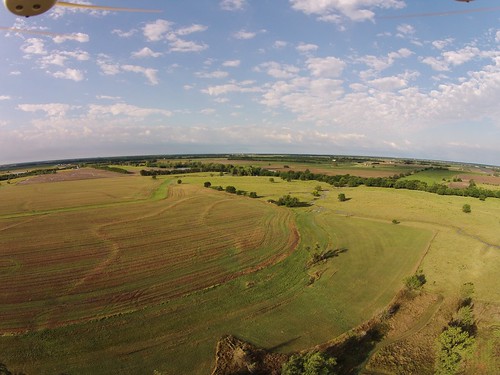
There is something of a magic to flight, to piloting. I remember the first flight I ever took, after years of dreaming of flying in a plane: my grandma had bought me a plane ticket. In one of the early morning flights, I witnessed a sunrise above cumulus clouds. Although I was just 10 or so at the time, that still is a most beautiful image seared into my memory. I have become meh about commercial flight over the years. The drive to the airport, the security lines, the lack of scenery at 35,000 feet. And yet, there is much more to flight than that. When I purchased what was essentially a flying camera, I saw a whole new dimension of the earth s amazing beauty. All the photos in this post, in fact, are ones I took. I then got a RC airplane, because flying the quadcopter was really way too easy. DJI00620
It s wonderful to climb the liquid mountains of the sky.
Behind me and before me is God, and I have no fears. Helen Keller
Start talking to pilots, and you notice a remarkable thing: this group of people that tends to be cool and logical, methodical and precise, suddenly finds themselves using language almost spiritual. Many have told me that being a pilot brings home how much all humans have in common, the unifying fact of sharing this beautiful planet together. Many volunteer with organizations such as Angel Flight. And having been up in small planes a few times, I start to glimpse this. Flying over my home at 1000 up, or from lake to lake in Seattle with a better view than the Space Needle, seeing places familiar and new, but from a new perspective, drives home again and again the beauty of our world, the sheer goodness of it, and the wonderful color of the humanity that inhabits it. DJI00120
The air up there in the clouds is very pure and fine, bracing and delicious. And why shouldn t it be? It is the same the angels breathe. Mark Twain
The view from 1000 feet, or 3000, is often so much more spectacular than the view from 35,000 ft as you get on a commercial flight. The flexibility is too; there are airports all over the country that smaller planes can use which the airlines never touch. Here is one incredible video from a guy that is slightly crazy but does ground-skimming, flying just a few feet off the ground: (try skipping to 9:36) So what comes next is something I blame slightly on my dad and younger brother. My dad helped get me interested in photography as a child, and that interest has stuck. It s what caused me to get into quadcopters ( a flying camera for less than the price of a nice lens! ). And my younger brother started mentioning airplanes to me last year for some reason, as if he was just trying to get me interested. Eventually, it worked. I started talking to the pilots I know (I know quite a few; there seems to be a substantial overlap between amateur radio and pilots). I started researching planes, flight, and especially safety the most important factor. And eventually I decided I wanted to be a pilot. I ve been studying feverishly, carrying around textbooks and notebooks in the car, around the house, and even on a plane. There is a lot to learn. And today, I took my first flight with a flight instructor. Today I actually flew a plane for awhile. Wow! There is nothing quite like that experience. Seeing a part of the world I am familiar with from a new perspective, and then actually controlling this amazing machine I really fail to find the words to describe it. I have put in many hours of study already, and there will be many more studying and flying, but it is absolutely worth it. Here is one final video about one of the most unique places you can fly to in Kansas. And a blog with lots of photos of a flight to Beaumont called Horse on the runway .

21 April 2015

Manuel A. Fernandez Montecelo: About the Debian GNU/Linux port for OpenRISC or1k

In my previous post I mentioned my involvement with the OpenRISC or1k port. It was the technical activity in which I spent most time during 2014 (Debian and otherwise, day job aside). I thought that it would be nice to talk a bit about the port for people who don't know about it, and give an update for those who do know and care. So this post explains a bit how it came to be, details about its development, and finally the current status. It is going to be written as a rather personal account, for that matter, since I did not get involved enough in the OpenRISC community at large to learn much about its internal workings and aspects that I was not directly involved with. There is not much information about all of this elsewhere, only bits and pieces scattered here and there, but specially not much public information at all about the development of the Debian port. There is an OpenRISC entry in the Debian wiki, but it does not contain much information yet. Hopefully, this piece will help a bit to preserve history and give an insight for future porters. First Things First I imagine that most people reading this post will be familiar with the terminology, but just in case, to create a new Debian port means to get a Debian system (GNU/Linux variant, in this case) to run in the OpenRISC or1k computer architecture. Setting to one side all differences between hardware and software, and as described in their site:
The aim of the OpenRISC project is to create free and open source computing platforms
It is therefore a good match for the purposes of Debian and Free Software world in general. The processor has not been produced in silicon, or not available for the masses in any case. People with the necessary know-how can download the hardware description (Verilog) and synthesise it in a FPGA, or otherwise use simulators. It is not some piece of hardware that people can purchase yet, and there are no plans to mass-produce it in the near future either. The two people (including me) involved in this Debian port did not have the hardware, so we created the port entirely through cross-compiling from other architectures, and then compiling inside Qemu. In a sense, we were creating a Debian port for hardware that "does not [phisically] exist". The software that we built was tested by people who had hardware available in FPGA, though, so it was at least usable. I understand that people working in the arm64 port had to work similarly in the initial phases, working in the dark without access to real hardware to compile or test. The Spark The first time that I heard about the initiative to create the port was in late February of 2014, in a post which appeared in Linux Weekly News (sent by Paul Wise) and Slashdot. The original post announcing it was actually from late January, from Christian Svensson (blueCmd):
Some people know that I've been working on porting Glibc and doing some toolchain work. My evil master plan was to make a Debian port, and today I'm a happy hacker indeed! Below is a link to a screencast of me installing Debian for OpenRISC, installing python2.7 via apt-get (which you shouldn't do in or1ksim, it takes ages! (but it works!)) and running a small Python script. http://asciinema.org/a/7362
So, now, what can a Debian Hacker do when reading this? (Even if one's Hackery Level is not that high, as it is my case). And well, How Hard Can It Be? I mean, Really? Well, in my own defence, I knew that the answer to the last two questions would be a resounding Very . But for some reason the idea grabbed me and I couldn't help but think that it would be a Really Exciting Project, and that somehow I would like to get involved. So I wrote to Christian offering my help after considering it for a few days, around mid March, and he welcomed me aboard. The Ball Was Already Rolling Christian had already been in contact with the people behind DebianBootstrap, and he had already created the repository http://openrisc.debian.net/ with many packages of the base system and beyond (read: packages name_version_or1k.deb available to download and install). Still nowadays the packages are not signed with proper keys, though, so use your judgement if you want to try them. After a few weeks, I got up to speed with the status of the project and got my system working with the necessary tools. This meant basically sbuild/schroot to compile new packages, with the base system that Christian already got working, installed in a chroot, probably with the help of debootstrap, and qemu-system-or1k to simulate the system. Only a few of the packages were different from the version in Debian, like gcc, binutils or glibc -- they had not been upstreamed yet. sbuild ran through qemu-system-or1k, so the compilation of new packages could happen "natively" (running inside Qemu) rather than cross-compiling the packages, pulling _or1k.deb packages for dependencies from the repository that he had prepared, and _all.deb packages from snapshots.debian.org. I started by trying to get the packages that I [co-]maintain in Debian compiled for this architecture, creating the corresponding _or1k.deb. For most of them, though, I needed many dependencies compiled before I could even compile my packages. The GNU autotools / autoreconf Problem Since very early, many of the packages failed to build with messages such as:
Invalid configuration 'or1k-linux-gnu': machine 'or1k' not recognized
configure: error: /bin/bash ../config.sub or1k-linux-gnu failed
This means that software packages based on GNU autotools and using configure scripts need recent versions of the files config.sub and config.guess that they ship in their root directory, to be able to detect the architecture and generate the code accordingly. This is counter-intuitive, having into account that GNU autotools were designed to help with portability. Yet, in the case of creating new Debian ports, it meant that unless upstream had very recent versions of config. guess,sub , it would prevent the package to compile straight away in the new architectures -- even if invoking gcc without ado would have worked without problems in most cases for native compilation. Of course this did not only affect or1k, and there was already the autoreconf effort underway as a way to update these files automatically when building Debian packages, pushed by people porting Debian to the new architectures added in 2013/2014 (mips64el, arm64, ppc64el), which encountered the same roadblock. This affected around a thousand source packages in unstable. A Royal Pain. Also, all of their reverse dependencies (packages that depended on those to be built) could not be compiled straight away. The bugs were not Release Critical, though (none of these architectures were officially accepted at the time), so for people not concerned with the new ports there was no big incentive to get them fixed. This problem, which conceptually is easily solvable, prevented new ports to even attempt compile vast portions of the archive straight away (cleanly, without modifications to the package or to the host system), for weeks or months. The GNU autotools / autoreconf Solution We tackled this problem mainly in two ways. First, more useful for Debian in general, was to do as other porters were doing and submit bug reports and patches to Debian packages requesting them to use autoreconf, and NMUing packages (uploading changes to the archive without the official maintainers' intervention). A few NMUs were made for packages which had bug reports with patches available for a while, that were in the critical path to get many other packages compiled, and that were orphan or had almost no maintainer activity. The people working in the other new ports, and mainly Ubuntu people which helped with some of those ports and wanted to support them, had submitted a large amount of requests since late 2013, so there was no shortage of NMUs to be made. Some porters, not being Debian Developers, could not easily get the changes applied; so I also helped a bit the porters of other architectures, specially later on before the freeze of Jessie, to get as many packages compiled in those architectures as possible. The second way was to create dpkg-buildpackage hooks that updated unconditionally config. guess,sub before attempting to build the package in the local build system. This local and temporary solution allowed us in the or1k port to get many _or1k.deb packages in the experimental repository, which in turn would allow many more packages to compile. After a few weeks, I set up many sbuilds in a multi-core machine attempting to build uninterruptedly packages that were not previously built and which had their dependencies available. Every now and then (typically several times per day in peak times) I pushed the resulting _or1k.deb files to the repository, so more packages would have the necessary dependencies ready to attempt to build. Christian was doing something similar, and by April at peak times, among the two of us, we were compiling some days more than a hundred packages -- a huge amount of packages did not need any change other than up-to-date config. guess,sub files. At some point, late April, Christian set up wanna-build in a few hosts to do this more elegantly and smartly than my method, and more effectively as well. Ugly Hacks, Bugs and Shortcomings in the Toolchain and Qemu Some packages are extremely important because many other packages need them to compile (like cmake, Qt or GTK+), and they are themselves very complex and have dependency loops. They had deeper problems than the autoreconf issue and needed some seriously dirty hacking to get them built. To try to get as many packages compiled as possible, we sometimes compiled these important packages with some functionality disabled, disabling some binary packages (e.g. Java bindings) or specially disabling documentation (using DEB_BUILD_OPTIONS=nodoc when possible, and more aggressively when needed by removing chunks of debian/rules). I tried to use the more aggressive methods in as few packages as possible, though, about a dozen in total. We also used DEB_BUILD_OPTIONS=nocheck for speeding up compilation and avoiding build failures -- many packages' tests failed due to qemu-system-or1k not supporting multi-threading, which we could do nothing about at the time, but otherwise the packages mostly passed tests fine. Due to bugs and shortcomings in Qemu and the toolchain --like the compiler lacking atomics, missing functionality in glibc, Qemu entering in endless loops, or programs segfaulting (especially gettext, used by many packages and causing the packages failing to build)--, we had to resort to some very creative ways or time-consuming dull work to edit debian/rules, or to create wrappers of the real programs avoiding or forcing certain options (like gcc -O0, since -O2 made buggy binaries too often). To avoid having a mix of cleanly compiled and hacked packages in the same repository, Christian set up a two-tiered repository system -- the clean one and the dirty one. In the dirty one we dumped all of the packages that we got built, no matter how. The packages in the clean one could use packages from the dirty one to build, but they themselves were compiled without any hackery. Of course this was not a completely airtight solution, since they could contain code injected at build time from the "dirty repository" (e.g. by static linking), and perhaps other quirks. We hoped to get rid of these problems later by rebuilding all packages against clean builds of all their dependencies. In addition, Christian also spent significant amounts of time working inside the OpenRISC community, debugging problems, testing and recompiling special versions of the toolchain that we could use to advance in our compilation of the whole archive. There were other people in the OpenRISC community implementing the necessary bits in the toolchain, but I don't know the details. Good Progress Olof Kindgren wrote the OpenRISC health report April 2014 (actually posted in May), explaining the status at the time of projects in the broad OpenRISC community, and talking about the software side, Debian port included. Sadly, I think that there have been no more "health reports" since then. There was also a new post in Slashdot entitled OpenRISC Gains Atomic Operations and Multicore Support shortly thereafter. In the side of the Debian port, from time to time new versions of packages entered unstable and we started to use those newer versions. Some of them had nice fixes, like the autoreconf updates, so they did not require local modifications. In other cases, the new versions failed to build when old ones had worked (e.g. because the newer versions added support and dependencies of new versions of gnutls, systemd or other packages not yet available for or1k), and we had to repeat or create more nasty hacks to get the packages built again. But in general, progress was very good. There were about 10k arch-dependent packages in Debian at the time, and we got about half of them compiled by the beginning of May, counting clean and dirty. And, if I recall correctly, there were around the same number of arch=all (which can be installed in any architecture, after the package is built in one of them). Counting both, it meant that systems using or1k got about 15k packages available, or 75% of the whole Debian archive (at least "main", we excluded "contrib" and "non-free"). Not bad. By the middle to end of May, we had about 6k arch-dependent packages compiled, and 4k to go. The count of packages eventually reached ~6.6k at its peak (I think that in June/July). Many had been built with hacks and not rebuilt cleanly yet, but everything was fine until the amount of packages built plateaued. Plateauing There were multiple reasons for that. One of them is that after having fixed the autoreconf issue locally in some packages, new versions were uploaded to Debian without fixing that problem (in many cases there was no bug report or patch yet, so it was understandable; in other cases the requests were ignored). The wanna-build for the clean repository set up by Christian rightly considered the package out-of-date and prepared to build the more recent version, that failed. Then, other packages entering the unstable archive and build-depending on newer versions of those could not be built ("BD-Uninstallable"), until we built the newer versions of the dependencies in the dirty repository with local hacks. Consequently, the count of cleanly built packages went back-and-forth, when not backwards. More challenging was the fact that when creating a new port, language compilers which are written in that same language need to be built for that architecture first. Sometimes it is not the compiler, but compile-time or run-time support for modules of a language are not ported yet. Obviously, as with other dependencies, large amounts of packages written in those languages are bound to remain uncompiled for a long time. As Colin Watson explained in porting Haskell's GHC to arm64 and ppc64el, untangling some of the chicken-and-egg problems of language compilers for new ports is extremely challenging. Perl and Python are pretty much a pre-requisite of the base Debian system, and Christian got them working early on. But for example in May, 247 packages depended on r-base-dev (GNU R) for building, and 736 on ghc, and we did not have these dependencies compiled. Just counting those two, 1k source packages of the remaining 4k to 5k to be compiled for the new architecture would have to wait for a long time. Then there was Java, Mono, etc... Even more worrying problems were the pending issues with the toolchain, like atomics in glibc, or make check failing for some packages in the clean repository built with wanna-build. Christian continued to work on the toolchain and liasing with the rest of the OpenRISC community, I continued to request more changes to the Debian archive through a few requests to use autoreconf, and pushing a few more NMUs. Though many requests were attended, I soon got negative replies/reactions and backed off a bit. In the meantime, the porters of other new architectures at the time were mostly submitting requests to support them and not NMUing much either. Upstreaming Things continued more or less in the same state until the end of the summer. The new ports needed as many packages built as possible before the evaluation of which official ports to accept (in early September, I think, the final decision around the time of the freeze). Porters of the other new architectures (and maintainers, and other helpful Debian Developers) were by then more active in pushing for changes, specially remaining autoreconf issues, many of which benefited or1k. As I said before, I also kept pushing NMUs now and then, specially during summer, for packages which were not of immediate benefit for our port but helped the others (e.g. ppc64el needed updates to ltmain.sh for libtool which were not necessary for or1k, in addition to config. guess,sub ). In parallel in the or1k camp, there were patches that needed changes to be sent upstream, like for example Python's NumPy, that I submitted in May to the Debian package and upstream, and was uploaded to Debian in September with a new upstream release. Similar paths were followed between May and September for packages such as jemalloc, ocaml, gstreamer0.10, libgc, mesa, X.org's cf module and cmake (patch created by Christian). In April, Christian had reached the amazing milestone of tracking and getting all of the contributors of the port of GNU binutils to assign copyright to the Free Software Foundation (FSF), all of the work was refreshed and upstreamed. In July or August, he started to gather information about the contributors of the GCC port, which had started more than a decade ago. After that, nothing much happened (from the outside) until the end of the year, when Christian sent a message about the status of upstreaming GCC to the OpenRISC community. There was only one remaining person to assign the copyright to the FSF, but it was a blocker. In addition, there was the need to find one or more maintainers to liaise with upstream, review the patches, fix the remaining failures in the test suite and keeping the port in good shape. A few months after that and from what I could gather, the status remains the same. Current Status, and The Future? In terms of the Debian port, there have not been huge visible changes since the end of the summer, and not only because of the Jessie freeze. It seems that for this effort to keep going forward and be sustainable, sorting out the issues with GCC and Glibc is essential. That means having the toolchain completely pushed upstream and in good shape, and particularly completing the copyright assignment. Debian will not accept private forks of those essential packages without a very good reason even in unofficially supported ports; and from the point of view of porters, working in the remaining not-yet-built packages with continuing problems in the toolchain is very frustrating and time-consuming. Other than that, there is already a significant amount of software available that could run in an or1k system, so I think that overall the project has achieved a significant amount of success. Granted, KDE and LibreOffice are not available yet, neither are the tools depending on Haskell or Java. But a lot of software is available (including things high in the stack, like XFCE), and in many aspects it should provide a much more functional system that the one available in Linux (or other free software) systems in the late 1990s. If the blocking issues are sorted out in the near future, the effort needed to get a very functional port, on par with the unofficial Debian ports, should not be that big. In my opinion, and looking at the big picture, not bad at all for an architecture whose hardware implementation is not easy to come by, and in which the port was created almost solely with simulators. That it has been possible to get this far with such meagre resources, it's an amazing feat of Free Software and Debian in particular. As for the future, time will tell, as usual. I will try to keep you posted if there is any significant change in the future.

20 April 2015

B lint R czey: Hot upgrading Erlang applications using tools in Debian

Erlang lets you write applications supporting zero downtime by switching one live system to another running a different application version converting the application s state on the fly to the new representation. Debian packages however can have only one installed version on a system which prevents using Erlang s hot-upgrade feature easily. Engineers at Yakaz (Jean-S bastien P dron) came up with a nice solution by creating separate directories for each application release and creating .deb packages for managing the transitions. I had to solve the same problem recently and found that the erlsvc Perl application they created needed a few patches to be usable with latest Erlang and other packages and with the changes it worked perfectly. Yakaz was not interested in accepting the patches and developing it further, but let me continue the maintenance. Please find the updated erlsvc application under my GitHub account and feel free to submit patches if you find something to fix in it. I have also packaged erlsvc as an official Debian package and it is waiting in the NEW queue for being accepted. When it enters unstable you will have to make very little effort to make your applications hot-upgradeable on Debian!

Russ Allbery: Review: The Girls from Alcyone

Review: The Girls from Alcyone, by Cary Caffrey
Series: Girls from Alcyone #1
Publisher: Tealy
Copyright: 2011
ISBN: 1-105-33727-8
Format: Kindle
Pages: 315
Sigrid is a very special genetic match born to not particularly special parents, deeply in debt in the slums of Earth. That's how she finds herself being purchased by a mercenary corporation at the age of nine, destined for a secret training program involving everything from physical conditioning to computer implants, designed to make her a weapon. Sigrid, her friend Suko, and the rest of their class are a special project of the leader of the Kimura corporation, one that's controversial even among the corporate board, and when the other mercenary companies unite against Kimura's plans, they become wanted contraband. This sounds like it could be a tense SF thriller, but I'll make my confession at the start of the review: I had great difficulty taking this book seriously. Initially, it had me wondering what horrible alterations and mind control Kimura was going to impose on the girls, but it very quickly turned into, well, boarding school drama, with little of the menace I was expecting. Not that bullying, or the adults who ignore it to see how the girls will handle it themselves, are light-hearted material, but it was very predictable. As was the teenage crush that grows into something deeper, the revenge on the nastiest bully that the protagonist manages to not be responsible for, and the conflict between unexpectedly competent girls and an invasion of hostile mercenaries. I'm not particularly well-read or informed about the genre, so I'm not the best person to make this comparison, but the main thing The Girls from Alcyone reminded me of was anime or manga. The mix of boarding-school interpersonal relationships, crushes and passionate love, and hypercompetent female action heroes who wear high heels and have constant narrative attention on their beauty had that feel to it. Add in the lesbian romance and the mechs (of sorts) that show up near the end of the story, and it's hard to shake the feeling that one is reading SF yuri as imagined by a North American author. The other reason why I had a hard time taking this seriously is that it's over-the-top action sequences (it's the Empire Strikes Back rescue scene!) mixed with rather superficial characterization, with one amusing twist: female characters almost always end up being on the side of the angels. Lady Kimura, when she appears, turns into exactly the sort of mentor figure that one would expect given the rest of the story (and the immediate deference she got felt like it was lifted from anime). The villains, meanwhile, are hissable and motivated by greed or control. While there's a board showdown, there's no subtle political maneuvering, just a variety of more or less effective temper tantrums. I found The Girls from Alcyon amusing, and even fun to read in places, but that was mostly from analyzing how closely it matched anime and laughing at how reliably it delivered characteristic tropes. It thoroughly embraces its action-hero story full of beautiful, deadly women, but it felt more like a novelization of a B-grade sci-fi TV show than serious drama. It's just not well-written or deep enough for me to enjoy it as a novel. None of the characters were particularly engaging, partly because they were so predictable. And the deeper we got into the politics behind the plot, the less believable I found any of it. I picked this up, along with several other SFF lesbian romances, because sometimes it's nice to read a story with SFF trappings, a positive ending, and a lack of traditional gender roles. The Girls from Alcyone does have most of those things (the gender roles are tweaked but still involve a lot of men looking at beautiful women). But unless you really love anime-style high-tech mercenary boarding-school yuri, want to read it in book form, and don't mind a lot of cliches, I can't recommend it. Followed by The Machines of Bellatrix. Rating: 3 out of 10

19 April 2015

Wouter Verhelst: Youn Sun Nah 5tet: Light For The People

About a decade ago, I played in the (now defunct) "Jozef Pauly ensemble", a flute choir connected to the musical academy where I was taught to play the flute. At the time, this ensemble had the habit of goin on summer trips every year; sometimes these trips were large international concert tours (like our 2001 trip to Australia), but that wasn't always the case; there have also been smaller trips, like the 2002 one to the French Ardennes. While there, we went on a day trip to the city of Reims. As a city close to the front in the first world war, it has a museum dedicated to that subject that I remembered going to. But the fondest memory of that day was going to a park where a podium was set up, with a few stacks of fold-up chairs standing nearby. I took one and listened to the music. That was the day when I realized that I kindof like jazz. I had come into contact with Jazz before, but it had always been something to be used as a kind of musical wallpaper; something you put on, but don't consciously listen to. Watching this woman sing, however, was a different kind of experience altogether. I'm still very fond of her rendition of "Besame Mucho". After having listened to the concert for about two hours, they called it quits, but did tell us that there was a record which you could buy. Of course, after having enjoyed the afternoon so much, I couldn't imagine not buying it, so that happened. Fast forward several years, in the move from my apartment above my then-office to my current apartment (just around the corner), the record got put into the wrong box, and when I unpacked things again it got lost; permanently, I thought. Since I also hadn't digitized it yet at the time, I haven't listened to it anymore in quite a while. But that time came to an end today. The record which I thought I'd lost wasn't, it was just in a weird place, and while cleaning yesterday, I found it sitting among a bunch of old stuff that I was going to throw out. Putting on the record today made me realize again how good it really is, and I thought that I might want to see if she was still active, and if she might perhaps have made another album. It was great to find out that not only had she made six more albums since the one I bought, she'd also become a lot more known in the Jazz world (which I must admit I don't really follow all that well), and won a number of awards. At the time, Youn Sun Nah was just a (fairly) recent graduate from a particular Jazz school in Paris. Today, she appears to be so much more...

Laura Arjona: Six months selfhosting: my userop experiences

Note: In this post I mention some problems and ask questions (to myself, like thinking aloud ). The goal is not to get answers to those questions (I suppose that I will find them soon or later in the internet, manuals and so), but to show the kind of problems and questions that arise in my selfhosting adventures, which I suppose are common to other people trying to administer a home server with some web services. Am I an userop? Well I m something in the middle of (GNU/Linux) user and sysadmin: I have studied computer technical engineering but most of my experience has been in helpdesk, providing support for Windows users. I m running Debian in some LAMP boxes at work (without GUI) since 2008 or so, and in my desktops (with GUI) since 2010. I don t code nor package, but I don t mind trying to read code and understand it (or not). I know a bit of C, a bit of Python, of PHP, and enough Perl to open a Perl file and close it after two minutes, understanding that it s great, but too much for me :) I translate software, so I m not scared to clone a repository, edit files, commit or submit a patch. I m not scared of compiling a program (except if it s an Android app: I try to avoid setting up the development environment just to try some translation that I made but I built my Puma before it was the binary available for download or in F-Droid). In conclusion, I feel more like a GNU/Linux power user than a sysadmin . Sometimes just a user or even a newbie (for example, I don t know very well the Unix/Linux folder tree where are the wallpapers stored? Does it depend on the desktop that I use?). Anyway. I won t stop my free software + free networks digital life because I don t know many things. I bought a small server for home last September, and I wanted to try to selfhost some services, for me and for my family. I want to be a home sysadmin or something like that, so I joined the userops mailing list :) Here you have my experiences on selfhosting/being an userop until now. Mail I even didn t try to setup my mail server, because many people say it s a pain (although nice articles were published about how to do it, for example this series in ArsTechnica) and I need a static IP which is 14 /month more to my ISP, and Gandi, the place where I rented my domain name, provides mail, and they use Debian and Roundcube, and sponsor Debian too, so I decided to trust on them. So this is my strategy now, to try to keep mail under my control: MediaGoblin I ve setup two MediaGoblin instances (yes, two!). I managed to do it in Debian 7 stable (I think NodeJS npm was not needed then), but soon later I upgraded to Jessie so now it s even better. I installed Nginx and PostgreSQL via apt, to use them for both instances (and probably some more software later). One instance is public, and I use a Debian user, a PostgreSQL database, and it s running in http://media.larjona.net
I have requested an SSL cert to Gandi but I still didn t deployed it (lazy LArjona!!). The other instance is private, for family photos. I didn t know very well how much of my existing setup could reuse and how to keep both instances in case of downtimes or attack I know more or less the concept or chroot but I don t know how to deploy it in my machine. So I decided to use another Debian user, another PostgreSQL database, deploy MediaGoblin in a different folder, and create another virtual server in my Nginx to serve it. I managed to setup that virtual server to http-authenticate and to serve content via a different port, and use a self-signed SSL certificate (it s only for family, so it does not matter). I created another (unprivileged) Debian user with a password for the nginx authentication, and gave my family the URL in the form https://mediaprivate.larjona.net:PortNumber and the user and password (mediaprivate is a string, and PortNumber is a number). I think they don t use the instance too much, but at least I upload photos there from time to time and email the link instead of emailing the photos themselves (they don t use GPG either ). Upgrades I upgraded MediaGoblin from 0.7.1 to 0.8.0 successfully, I sent a report about how I did it to the mailing list. First I upgraded the public instance, when I figure out the process, I upgraded the second instance to test my instructions, and then, I sent the report with the instructions to the mailing list. Static site and LimeSurvey: the power of free software (with instructions) I wanted to act as a mirror of floss2013.libresoft.es and surveys.libresoft.es since they suffer a downtime and I participated in that project (not in the sysadmin part, but in the research and content creation). The static site floss2013.libresoft.es offered a zip with the whole website tree (since the website was licensed as AGPL), and I had access to the git repo holding the development copy of the website. So I just cloned the repository and setup another nginx virtual server in my machine, and tuned my DNS zone in Gandi website to serve floss2013.larjona.net from home. 10 minutes setup YAY! #inGitWeTrust #FreeSoftwareFTW :) For surveys.larjona.net I had to install a LimeSurvey instance. I knew how to do it because we use LimeSurvey at work, but at home I had Nginx instead of Apache, and PostgreSQL instead of MySQL. And no PHP I searched about how to install PHP in Nginx (I can use apt-get, nice!) and how to install LimeSurvey with Nginx and PostgreSQL (I had documentation about that, so I followed, and it worked). For making available the data (one survey and its results, so people can login as visitor to query and get statistics), I downloaded the LimeSurvey export dataset that we were providing in the static website, followed the replication instructions (hey, I wrote them!), and they worked #oleole! (And here, dear researchers, gets demonstrated that free software and free culture really empower your research and help spreading your results). Etherpad: not so easy, it seems! I m trying to install Etherpad-Lite, but I m suffering a bit. I think I did everything ok according to some guides but I get Bad Gateway and these kind of errors when trying to browse with Lynx in the host:
[error] 3615#0: *24 upstream timed out (110: Connection timed out) 
while reading response header from upstream, 
client: 127.0.0.1, 
server: pad.larjona.net, 
request: "GET / HTTP/1.0", 
upstream: "http://127.0.0.1:9001/", 
host: "pad.larjona.net"
2015/04/17 20:52:56 [error] 3615#0: *24 connect() failed 
(111: Connection refused) while connecting to upstream, 
client: 127.0.0.1, 
server: pad.larjona.net, 
request: "GET / HTTP/1.0", 
upstream: "http://[::1]:9001/", 
host: "pad.larjona.net"
I m not sure if I need to open some port in iptables, my router, or change my nginx configuration because the guides assume you re only serving one website in the port 80 (and I have several of them, now ), or what I ve spent three chunks of time (maybe ~2h each?) on this, in different days, and couldn t figure it out, so I decided to round-robin in my TODO list. Userops thoughts Debian brings peace of mind (for me) On one side, maintaining a Debian box it s quite easy, and the more software that it s packaged, the less time that I spend installing or upgrading. I like being in stable, I m in Jessie now (I migrated when it was frozen), but I ll stay in stable as much as I can. I like that I can use the software that I installed via apt-get for several services (nginx, PostgreSQL ). About the software that is not packaged (MediaGoblin, LimeSurvey, EtherPad, maybe others later), I wonder how dependencies and updates are handled. And maybe (probably) I have installed some components several times, one for each service (this sounds like a Windows box #grr). For example MediaGoblin uses PyPump. PyPump 0.5 is packaged in Debian Jessie. MediaGoblin uses PyPump 0.7+. What if PyPump 0.7+ gets, let s say, into Jessie-backports? Can I benefit from that? I know that MediaGoblin upgrade instructions includes upgrading the dependencies, but what about some security patch in one dependency? Should I upgrade the pip modules periodically? How to know if some upgrade is recommended because patches a vulnerability, or it s just new features (and maybe breaking my setup)? This kind of things are the peace of mind that Debian packaging brings to me: when some piece of software is packaged, I know maybe I need to care about proper setup and configuration, but later, it s kind-of-easy to maintain (since the Debian maintainers care about the rest). I don t mind about cloning a repo and compiling, I mind about later, or coexistance with other program/services. I trust in the MediaGoblin community and I m an active member (I m not developer, but hang on IRC, follow the mailing list, etc) but for example I don t know anything about the EtherPad project. And I don t feel like joining the community (I m already an active member in Debian, MediaGoblin, F-Droid, Pump.io, translator of LimeSurvey and many other small apps that I use, and in the future will use more services, like OwnCloud, XMPP ), joining the community of each software that I use is becoming not sustainable :s Free software is more than software I follow the userop mailing list, and it s becoming very technical. I mostly understand the problems (which are similar to the problems that I face: how to isolate different services, how to easily-configure them, how to make them installable by average user ) But I don t understand most of the solutions proposed, and I think that probably we need technical solutions, but in the meanwhile, some issues can be addressed not with software, but with other means: good documentation, community support, translations, beta-testers This is my conclusion until now. When a project is well documented, I think I can find my way to selfhost no matter if the software is packaged (or contained ) or not. MediaGoblin, and LimeSurvey, are well documented, and the user support channels are very responsive. I find lots of instructions that assume that you will use a whole machine for their service (and not for other things). And lots of documentation for the LAMP stack, but not for Nginx + PostgreSQL and Node instead of PHP So, for each particularity of my setup, I search the internet and try to pick good sources to help me do what I wanted to do. I m kind of privileged Some elements, not software related, to take into account as pre-requisites for succeed selfhosting services: These aspects are not present in a lot of people. If I look around to the computer users that I know (mostly Windows+Android, some GNU/Linux users, some Mac OSX users, some iOS users), I find that they search things like X does not work or they cannot write a proper search query in English. Or they trust some random person writing a recipe in their blog, without trying first to understand what the recipe does. Other people just say I m not a professional sysadmin, I ll just do what everybody does (aka use Google services or whatever). What if I try and I don t succeed? . Things like that. We may need some technical solutions (and hackers are thinking about that, and working on that). But I feel that we need (more) a huge group of beta-testers, dogfooding people, aventurers that try the half-cooked solutions and provide successful and unsuccessful experiences, to guide the research and make software technologies advance. I m not sure if I am an userop, but I feel part of that vanguard force , I want to be part of the future of free software and free networks. Comments? You can comment about this post on this pump.io thread.
Filed under: My experiences and opinion Tagged: Communities, Contributing to libre software, Debian, Developer motivations, English, free networks, Free Software, Freedom, innovation, MediaGoblin, Moving into free software, Project Management, selfhosting, sysadmin

Next.

Previous.