Search Results: "ag"

8 October 2008

Ingo Juergensmann: English vs German

No, it's not about football/soccer nor about rivalry, but simply about the two sections of my blog: the english speaking and the german speaking section.
Whereas the English section is being read by quite many people, because it's aggregated on planet.debian.org, the German section of my blog is not that well-known, as it seems. Or maybe not that interesting. Or maybe most Germans reading planet.debian.org just doesn't know about my other feeds?
So, dear lazyweb, if you like you can either leave a comment or - even better - subscribe to my all-in-one RSS feed.
Another possibility would be to rate my blog on blogoscoop.net.

Rob Taylor: Wizbit ars d

So it seems ars technica picked up on Codethink’s little pet project! Obviously the little amount of info on the wiki isn’t enough for everyone who’s interested and enough has changed since the GUADEC talk that I should write a bit here to clarify what’s going on and where we’re going. First off, we’re currently not using GVFS or FUSE - the core Wizbit component is simply a versioning, distributed object store. The current plan is to later hook up with a metadata service, maybe tracker, and use this to export a FUSE filesystem using the metadata. This core Wizbit service is just a library with its own api, maybe hooking up to gio streams for ease of use from GLib based applications. The current focus of our work is solidifying this store and the synchronization between multiple machines. We’re prototyping its use in Tomboy. Karl is also working on making some of these pretty widgets for navigating history work. We’re not actually using Git underneath, but using our own implementation of concepts from both Git and Bzr. This is for a number of reasons, partially that making a library from git’s code proved more trouble than just reimplementing the concepts (as things like JGit found). Also the nature of the problem is sufficiently different that things like the packed format don’t behave in a suitable way for general file system usage. The work on packing is yet to be started but we’ll probably use Robert Collin’s groupcompress idea from bzr. I promise we’ll make the wiki a bit better when the code’s stabilised a bit!

Sven Mueller: How to solve a credit crisis

Anand Kumria wrote:
If IBM were to go bankrupt, would the government step in? Unlikely. Investors would lose (money), staff — another word for investors — would lose (jobs), but customers would win (their computers would keep working). Some customers would win more than others (especially those who had the equipment on lease); if no one is collecting, why pay?
I’m wondering here where Anand got the idea that once a company went bankrupt, that you don’t need to pay to that company anymore. When a company goes bankrupt, at least in Germany the following happens: A trustee/liquidator is selected. This liquidator is then collecting the information who owes money to the company and who still needs to get (how much) money from it. The liquidator also has to check the option of selling company assets (which might include the contracts of customers that still have to pay) to fulfill the debts of the bankrupt company. After he turned all assets into money, the money is distributed among those who still have to get money from the bankrupt company. Anyway, regarding his main argument that the (average) customer of a company (bank in this case) should never have to pay for the failed speculations of that company, I somehow have to agree with him. Someone putting money into a regular bank account or papers with fixed interest rate should never lose his money. But there are also customers buying bank shares with a chance of higher revenue than with fixed interest rate papers. These should suffer from failure of the bank management, as they more or less explicitly wanted to be tied to the success (or failure) of the bank. However, this is mostly irrelevant, since the failure of so many “investment banks” has side affects that might cost the average inhabitant of the affected countries even more than the discussed rescue plans. One of these effects is that the banks are now much more conservative regarding lease and mortgage plans, effectively leaving many home owners with no option to fulfill previous obligations (remaining debt after a previous mortgage expired can’t be refinanced by a new mortgage), causing them to have to sell their homes to pay the first mortgage. This is in some way stupid because this causes people who were perfectly paying their mortgage rates to loose their house, while the bank which would be giving them a new mortgage could get a new and good customer, improving their income. On the other hand, if the other side effects of the current crisis cause those “good” mortgage customers to loose their jobs, they might turn into bad customers who are unable to pay their rates. All in all, this is a spiral that could cause the whole economy to break down (a small example: The bank is not giving out mortgages, so no one will build new houses so the builders loose their jobs so they don’t pay their mortgage rates anymore,…. - over simplified, but still shows what I mean). Unless the spiral is terminated in time, before too drastic things happen. All in all, I do understand why the politicians try to rescue those banks (or at least the customers of those banks), though I think that in an economy with slightly higher regulation, there wouldn’t be the need for such a rescue plan. I know there are some german banks affected by the crisis as well (among them Hypo Real Estate and others), but the average private customer of such banks shouldn’t loose money due to the regulations we have in place. In general, there should be some security fund which makes sure that private customers never loose money put into regular bank accounts or fixed interest papers, vice-versa, banks should calculate mortgages so that they can be pretty sure their customers are actually able to pay off their rates - it doesn’t make sense if someone starts off having to pay 500$/month for their mortgage and has to pay over 1000$ a few years (as in 2-3 years) later, because the bank raised the interest that much. I have no problem with people loosing money from shares of banks or other companies directly or indirectly through investment funds.

MJ Ray: Nestle Boycott 20th Anniversary

It’s the 20th anniversary of the Nestle Boycott this week. The theme is “Change Nestl , Change the World”. This is one of few boycotts that I wholeheartedly support and participate in. While reading a report from the NI cooperative, I learnt of a new outrage by Nestle. Over in Canada, Wellington Water Watchers document a Nestle plant that is (as I understand it), taking drinking water for free, bottling it as “Aqua Fina”, trucking it to cities and selling it. (Thanks to whoever it was gave me the WWW link - I didn’t find the email, so please claim it in a comment if you want it.) You may remember that when Coca-Cola tried to do the same by selling contaminated Kent tap water as “Dasani”, it was widely ridiculed as Peckham Spring. Finally, “Dasani” was withdrawn from sale. It’s disappointing that Nestle’s Peckham Spring seems to be on sale in Canada, at a lower “manufacturing” cost than Coke’s UK one. Do we really want multinationals selling us our tap water in an inefficient way? No. Boycott Nestle.

Ian Wienand: Why symbol visibility is good

ELF has two related concepts for managing symbols in your programs. The first concept is the symbol binding. Global binding means the symbol is visible outside the file being built; local binding is the opposite and keeps the symbol local only (static) and weak is like global, but suggests that the symbol can be overridden.
$ cat syms.c
static int local(void)    
int global(void)    
int  __attribute__((weak)) weak(void)    
$ gcc -o syms -c syms.c
$ readelf --syms ./syms
Symbol table '.symtab' contains 10 entries:
   Num:    Value  Size Type    Bind   Vis      Ndx Name
...
     5: 00000000     8 FUNC    LOCAL  DEFAULT    1 local
     8: 00000008     8 FUNC    GLOBAL DEFAULT    1 global
     9: 00000010     8 FUNC    WEAK   DEFAULT    1 weak
...
This is all well and good, but starts breaking down when you want to load many different modules and keep strict API's (such as, say, dynamic libraries!). Consider that for two files to share a common function, the function must end up with a global visibility.
$ cat file1.c
void common_but_not_part_of_api(void)    
$ cat file2.c
extern void common_but_not_part_of_api(void);
void api_function(void)  
     common_but_not_part_of_api();
 
$ gcc -shared -fPIC  -o library file1.c file2.c
$ readelf --syms ./library
Symbol table '.symtab' contains 60 entries:
   Num:    Value  Size Type    Bind   Vis      Ndx Name
...
    53: 00000424    29 FUNC    GLOBAL DEFAULT   11 api_function
    55: 0000041c     5 FUNC    GLOBAL DEFAULT   11 common_but_not_part_of_api
...
In the example above, both the function we want exported (api_function) and the function we don't wish exported (common_but_not_part_of_api) end up with exactly the same attributes. Binding attributes are useful for the linker putting together object files; but aren't a complete solution. To combat this, ELF provides for visibility attributes. Symbols can be default, protected, hidden or internal. Using these attributes, we can flag extra information for the dynamic loader so it can know which symbols are for public consumption, and which are for internal use only. The most logical way to use this is to make all symbols by default hidden with -fvisibility=hidden and then "punch holes in the wall" for those symbols you want visible.
$ cat file1.c
void common_but_not_part_of_api(void)    
$ cat file2.c
extern void common_but_not_part_of_api(void);
void  __attribute__((visibility("default"))) api_function(void)  
      common_but_not_part_of_api();
 
$ gcc -fvisibility=hidden -shared -fPIC  -o library file1.c file2.c
$ readelf --syms ./library
Symbol table '.symtab' contains 60 entries:
   Num:    Value  Size Type    Bind   Vis      Ndx Name
    48: 000003cc     5 FUNC    LOCAL  HIDDEN   11 common_but_not_part_of_api
    54: 000003d4    29 FUNC    GLOBAL DEFAULT  11 api_function
Now the dynamic loader has enough information to distinguish between the two, and can stop any external access to common_but_not_part_of_api easily. This extra information also has potential for performance improvements. Any time a symbol may be overridden, the compiler must generate a program lookup table (PLT) entry for the function so that the dynamic loader can re-direct the function call. The PLT is a trampoline which gets the correct address of the function being called (from the global offset table, GOT) and bounces the function call to the right place. An example should illustrate: Bouncing via the PLT In the first example, there was not enough information to tell if the function would ever be able to be overridden, hence a PLT entry had to be created and the function called through it (disassemble it to see the details!). With correct symbol visibility attributes, there is enough information to know that common_but_not_part_of_api is never to be overridden, hence the PLT (and the associated costs of trampolining) can be avoided. The internal attribute is even stricter; it says that this function will never be called from outside this module (for example, we might pass the address of common_but_not_part_of_api to anyone). This can lead to even better code, because on many architectures transitioning to another module might involve flipping global pointer registers or other similarly expensive operations. So that's how symbol binding and visibility attributes can work together to get you the best performance possible from your program!

Russell Coker: Future Video Games

I just watched an interesting TED.com talk about video games [1]. The talk focussed to a large degree on emotional involvement in games, so it seems likely that there will be many more virtual girlfriend services [2] (I’m not sure that “game” is the correct term for such things) in the future. The only reference I could find to a virtual boyfriend was a deleted Wikipedia page for V-Boy, but I expect that they will be developed soon enough. I wonder if such a service could be used by astronauts on long missions. An advantage of a virtual SO would be that there is no need to have a partner who is qualified, and if a human couple got divorced on the way to Mars then it could be a really long journey for everyone on the mission. VR training has been used for a long time in the airline industry (if you have never visited an airline company and sat in a VR trainer for a heavy passenger jet then I strongly recommend that you do it). It seems that there are many other possible uses for this. The current prison system is widely regarded as a training ground for criminals, people who are sent to prison for minor crimes come out as hardened criminals. I wonder if a virtual environment for prisoners could do some good. Instead of prisoners having to deal with other prisoners they could deal with virtual characters who encourage normal social relationships, prisoners who didn’t want to meet other prisoners could be given the option of spending their entire sentence in “solitary confinement” with virtual characters, multi-player games, and Internet access if they behave well. Game systems such as the Nintendo Wii [3] would result in prisoners getting adequate exercise, so after being released from a VR prison it seems likely that the ex-con would be fitter, healthier, and better able to fit into normal society than most parolees. Finally it seems likely that someone who gets used to spending most all their spare time playing computer games will be less likely to commit crimes. It seems to me that the potential for the use of virtual environments in schools is very similar to that of prisons, for similar reasons. Update: Currently Google Adsense is showing picture adverts on this page for the “Shaiya” game, the pictures are of a female character wearing a bikini with the caption “your goddess awaits”. This might be evidence to support my point about virtual girlfriends.

7 October 2008

Andrew Pollock: [debian] manpages.debian.net

Neil:
$ host -t txt manpages.debian.net
manpages.debian.net descriptive text "Javier Pen~a <jfs@debian.org>"
manpages.debian.net descriptive text "PGP D6 91 BB 89 88 7A F7  A0 BA E4 27 FD 7A 6A FE DA"
manpages.debian.net descriptive text "PGP 86AA DB04 D2F5 CC55  3A4D 940F B1A9 DD82 DC81 4B09"

Christian Perrier: Breizhoneig D-I

Yesterday, a small commi tin D-I SVN marked the beginning of the work on the translation of Debian Installer to Breton. First French regional language to be worked on (if we except Basque where the effort mostly comes from South Basque country, namely the spanish part of "Pays Basque". There have been discussion about support for Occitan. Some translations are rotting in Launchpad even though the translators have been notified that nothing can happen in Ubuntu when the language isn't first supproted in Debian Installer. Among the 'major' regional languages in France, we'd need people to catch up with Alsacian and Corsican as well.... Maybe some day....

Kai Hendry: Marking up mail

Marking up email on the Web is not a pretty picture in 2008. What I look like on a telecon Notable mail archiving services: Random thoughts: Any other relevant RFCs, tools or tips I might have missed?

Alexander Reichle-Schmehl: About the number of rc bugs

In addition to my last post, here some information about the current number of release critical bugs. Yes, it is true, that our official bug tracker lists the next release has still 264 bugs1. And some wonder, when Lenny will be released. It's a little bit difficult to work with that page, let's look at the unofficial rc bug thingy I already mentioned in my previous post. As you might have noticed it supports several filters mechanism the official bts don't have. At the very bottom of the detailed list you'll see the overall number of the bugs matching your selected filter. So let's have a look at the number of bugs, which are already fixed in the unstable branch and need to propagate to Lenny. Currently that are 118 RC bugs. Of those 264 preventing us to release, 118 are already fixed; the fix just hasn't arrived in Lenny, yet. Okay, but there are still 147 rc Bugs open in both Lenny and Sid. So let's take a look at them. By using the filters at the top, you can calculate, that 19 already have a patch. 14 are marked pending (so they are already fixed, but the maintainer hasn't uploaded the package yet). 15 of these bugs have been reported multiple times and have been merged. Oh, and 3 are about packages in non-free and contrib. Granted, for some of them, there is a patch, but the patch needs to be tested, or the bug has been marked pending by mistake. But still: If you ignore all these types of bugs, there are only 104 bugs left. one-hundred-and-four! Summary: So the only thing left (beside the points I mention in my previous post) to do, is to migrate 118 fixes to Lenny somehow, get the 33 fixes for the probably fixed bugs uploaded, and fix the remaining 104 bugs. Yes, that's still a lot of work to do... So let's get things rolling, shall we? 1: You might further notice, that the current stable release is affected by more than 700 bugs. However many of them are false counts, e.g. when a specific package doesn't build with a newer version of a compiler. The package in the current stable release is of course affected, so there it is kind of buggy. However, we can ignore these kind of bugs, since the newer version of the compiler isn't shipped in the current stable release at all. Those bugs should actually be tagged sid and lenny...

Alexander Reichle-Schmehl: What you can do for Lenny (Update #2)

You probably noticed by now, that Debian GNU/Linux 5.0 aka Lenny hasn't been released in September. Well, that's a shame, but very easy to explain: Too many release critical bugs. Well, it's pretty hard to estimate, how fast RC bugs will be fixed, and apparently our release team was a bit too optimistic :( The big question is: What can you do, to help release Lenny at least in this quarter? That's pretty easy: Fix rc-bugs, take care, that the fixed packages are migrated to Lenny, do upgrade tests, document problems in the release-notes. Pretty simple, isn't it? For users Even as a simple user (aren't we all just users?) you may help getting Lenny released. Some things you can do: See? Even as a simple user without deeper technical knowledge you can help us getting Lenny in shape to be released. If you have technical knowledge: Very good! You might want to read the next section, too, and see what applies to you, there :) For maintainers It basically boils down to two things: If your packages have RC bugs open in Lenny fix them and take care, that the fix will propagate to Lenny. If your packages don't have RC bugs open, fix someone else's RC bug. Surely you don't think, the release team will fix the remaining rc bugs, do you? And surely you understand, that your shiny rc bug free packages are kind of useless, if they aren't released? To search for bugs to be fixed, take a look at the unofficial rc bugs thingy. The URL lists RC bugs open in both Sid and Lenny. Obviously they should be fixed ASAP. If no one takes care about these packages, they might be removed from Lenny (if possible). Again: Try to reproduce the bug, try fix it, upload an NMU (or send your patch to the bug report and search for an sponsor). You'll notice, that some of these bugs already have a patch. In that case, your job would be to test the patch, report that to the bug report and offer to sponsor an NMU. Another interesting list is the list of rc bugs open only in Lenny. These bugs have been fixed, but the fix hasn't propagated to Lenny, yet. Normally, the release team will grant freeze exceptions for these packages if possible. However, if the changes to the fixed version are quite grave or the package in Sid depends on a newer package than in Lenny that's not possible. In these cases look out for packages marked as need tpu upload or similar. Oh, and if you could refrain from upload new upstream versions of packages to Sid, you would make all our lives easier. Some reasons: And of course you should spend your time fixing rc bugs anyway ;) Update: Rhonda pointed out, that running rc-alert -d TU -o and will limit the output to bugs open in both Sid and Lenny, which is the more interesting list of bugs.

Lucas Nussbaum: Hype

It’s really funny to see how popular things can get, and then totally disappear. Some time ago, there was a TV show on the french TV called “Un an de +”, that talked about what was in the news one year before. It was really interesting to see how quickly everybody can forget stuff that looks so important now. For example, who remembers Second Life? Apparently, it has been on the decline for some time already, according to Google Trends:
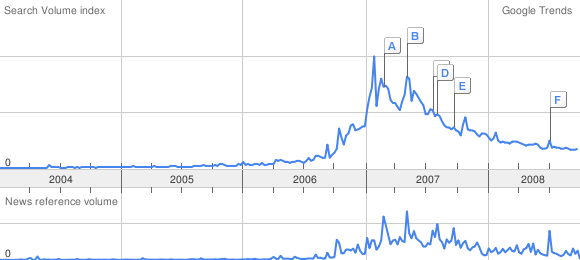
Will Facebook be the next Second Life?

Bastian Venthur: Lenny s release date

Today, an article at heise online claimed, that Lenny is supposed to ship this year, quoting Alexander’s blog entry. While I can’t find a single word in Alexander’s article claiming that we’ll release this year, I’m pretty sorry that just after we failed the first deadline which was obviously too “optimistic”, we get another one which is too short. Two month’s ago I created a pretty simple estimation regarding Lenny’s release by looking at the rc-bugfix-rate of the last two releases and applying them to the current number of rc-bugs. As a result it looked more likely that we release Lenny in June 2009 than in September 2008. Until now, my guess for Lenny’s release still holds, at least the updated rc-graph lies perfectly on the line I’ve created two months ago. rc-graph2.png While I wish that we’ll release Lenny as soon as possible, I hope that someone will clarify the proposed release date to the media and this time with a more defensive deadline. Some people might actually trust our estimation (I know this sounds silly). And even if everyone knows that Debian notoriously releases too late — we could at least try to propose more realistic dates and update them regularly. Just two weeks ago I still read and heard in the media that Debian will release Lenny in September although it was clear at this point that this is impossible.

Miriam Ruiz: Apostasy in Spain

Data ordered by entry data is not a data file, and thus not protected by the law regarding personal data files, because it’s hard to do searches in them. I know it sounds ridiculous, but that’s the argument that the highest court in Spain (Tribunal Supremo) has used to prevent the Catholic Church from losing believers. Many children are automatically baptisted by their parents when they’re just babies, without having any decision in that, and thus they names are written down in the Church files^Wlists of baptisted people. That’s the numbers they will use later when asking for privileges for the Catholic Church, and that’s why it’s so important for them that all of us are counted as catholics, whether we are or not believers. Fewer than half of Spanish youth consider themselves Catholic, so it’s important for them to keep appearances to keep their power intact. In Spain thousands of non believers are demanding that the Church cancel their baptism records, in order to annul any official connection with Catholicism. And church leaders in turn have gone to the courts to try to stop parishioners deserting. The Tribunal Supremo seems to be taking a political side with their decision trying to vulnerate non-believers rights to artificially promote the Catholic Church. Apostasy is the formal religious disaffiliation or abandonment or renunciation of one’s religion. The United Nations Commission on Human Rights, considers the recanting of a person’s religion a human right legally protected by the International Covenant on Civil and Political Rights: “The Committee observes that the freedom to ‘have or to adopt’ a religion or belief necessarily entails the freedom to choose a religion or belief, including the right to replace ones current religion or belief with another or to adopt atheistic views […] Article 18.2 bars coercion that would impair the right to have or adopt a religion or belief, including the use of threat of physical force or penal sanctions to compel believers or non-believers to adhere to their religious beliefs and congregations, to recant their religion or belief or to convert.”. Anyway, many religious groups and even some states punish apostates. For Catholics, the word “apostasy” signifies the desertion of faith, which had been one of the three unpardonable sins in the early years of the Church. AEPD, the national agency for data protection, is pondering now whether to appeal against the sentence. I hope they do. There are other legitimate subjects that could appeal against it, too. No one should be forced to belong to a Church they don’t believe in.

Neil Williams: I didn't know about . . .

It's really quite strange to come across a tool that is incredibly useful, does exactly what I need but of which I was completely unaware. This time it is manpages.debian.net - how long has this been around and why hasn't it been announced somewhere?
The best part is that if a manpage uses a See also section, the references to other manpages get turned into HTML links to the relevant manpage on the site.
Getting a manpage is now as simple as:
http://manpages.debian.net/cgi-bin/man.cgi?query=%s

which makes it trivial to put this onto the epiphany smart bookmark toolbar.
The site supports:

Thanks to Patrick Schoenfeld for inadvertently leading me to the site - I couldn't find who created the site so step up and be known.
Update
To those making comments on this entry, please note:
I have nothing directly to do with the site, I just found it and blogged about it so don't use my blog as a bug list. Ta. Such comments have been deleted and further comments are now disabled for this entry.

Russell Coker: The Security Benefits of Being Unimportant

A recent news item is the “hacking” of the Yahoo mailbox used by Sarah Palin (the Republican VP candidate) [1]. It seems most likely that it was a simple social-engineering attack on the password reset process of Yahoo (although we are unlikely to learn the details unless the case comes to trial). The email address in question had been used for some time to avoid government data-retention legislation but had only been “hacked” after she was listed as the VP candidate. The reason of course is that most people don’t care much about who is the governor of one of the least populous US states. Remote attack on a mailbox (which is what we presume happened) is only one possible problem. Another of course is that of the integrity of the staff at the ISP. While I know nothing about what happens inside Yahoo, I have observed instances of unethical actions by employees at some ISPs where I have previously worked, I have no doubt that such people would have read the email of a VP candidate without any thought if they had sufficient access to do so. If an ISP stores unencrypted passwords then the way things usually work is that the helpdesk people are granted read access to the password data so that they can login to customer accounts to reproduce problems - this is a benefit for the customers in terms of convenience. But that also means that they can read the email of any customer at any time. I believe that my account on Gmail (the only webmail service I use) is relatively safe. I’m sure that there are a huge number of people who are more important than me who use Gmail. But if I was ever considered to have a reasonable chance of becoming Prime Minister then I would avoid using a Gmail account as a precaution. There is a rumoured Chinese proverb and curse in three parts:
May you live in interesting times
May you come to the attention of those in authority
May you find what you are looking for [2]
In terms of your email, everyone who has root access to the machine which stores it (which includes employees of the companies that provide warranty service to all the hardware in the server room) and every help-desk person who can login to your account to diagnose problems is in a position of authority. Being merely one of thousands of customers (or millions of customers for a larger service) is a measure of safety. As for the “interesting times” issue, the Republican party is trying to keep the issue focussed on the wars instead of on the economy. The problem with basing a campaign on wars is that many people will come to the conclusion that the election is not about people merely losing some money, but people dying. This could be sufficient to convince people that the right thing to do is not to abide by the usual standards for ethical behavior when dealing with private data, but to instead try and find something that can be used to affect the result of an election. Mail that is not encrypted (most mail isn’t) and which is not transferred with TLS (so few mail servers support TLS that it hardly seems worth the effort of implementing it) can be intercepted at many locations (the sending system and routers are two options). But the receiving system is the easiest location. A big advantage for a hostile party in getting mail from the receiving system is that it can be polled quickly (an external attacker could use an open wireless access-point and move on long before anyone could catch them) and that if it is polled from inside the company that runs the mail server there is almost never any useful audit trail (if a sysadmin logs in to a server 10 times a day for real work reasons, and 11th login to copy some files will not be noticed). One of the problems with leaks of secret data is that it is often impossible to know whether they have happened. While there is public evidence of one attack on Sarah Palin’s Yahoo account, there is no evidence that it was the first attack. If someone had obtained the password (through an insider in Yahoo, or through a compromised client machine) then they could have been copying all the mail for months without being noticed. It seems to me that your choice of ISP needs to be partly determined by how many hostile parties will want to access your mail and what resources they may be prepared to devote to it. For a significant political candidate using a government email address seems like the best option, with the alternative being to use a server owned and run by the political party in question, if you can have the staff fired for leaking your mail then your email will be a lot safer!

Andrea De Iacovo: Away from my brain


Hello world! Is someone in the crowd (crowd?!?) wondering about where I’ve been in the last months? Well it’s time for you to know. First of all I’ve been on holiday till the end of August: it wasn’t a real holyday though ’cause I was working for two of my university exams. In September my “winter life” started again so I had not so much time to write my thoughts here. However you should not worry about my Debian work: if you use wordpress (and I hope so) you’d've seen a number of recent uploads. I worked hard to correct all security issues in wordpress 2.5.1 before the lenny release date. At the moment we have no open CVEs and this makes me really glad. In the meanwhile I’m also working to bring playonlinux in Debian. I hope I could release a package as soon as Lenny becomes our new stable.
So, guys, I’m still working even if I don’t write about it ;-)       

Kartik Mistry: Active DDs


* Looking at Bubulle’s post, percentage of active DDs are: 75% India has very interesting situation: 6 DDs. Now, we have 4 only as Kumar and Varun are in US of A!       

6 October 2008

Jeff Bailey: ... when we last saw our intrepid explorers,

they were hanging out in California. Being warm. (That's Angie's comment. I'm still wearing sandals. Although I saw a Montrealer shudder at me today. That was worth it. I think I'll keep wearing them all week, even if it causes me to lose my toes)

but.. BUT! that's not the exciting part!

This is: http://www.realtor.ca/PropertyResults.aspx?Mode=5&id=1487634

This evening we accepted the counter-offer on the place.

The timeline so far: arrived Saturday, looked at places 10:30 Sunday morning. Made offer 7pm. They made a counter-office at 8:30pm. We accepted the counter-office at 6:30pm today.

Next up: Review property agreement. Find someone to sign all the paperwork for us when we're out of town. Pray that CMHC aren't rat bastards. Inspection on Saturday at 1pm.

Oh, and none of this includes going to the house party on Saturday night, the last minute finding of a hotel as our friend's place had a pipe burst where we were going to stay. Finding out that another friend had a place to stay. Me forgetting my laptop at the hotel. We saw the midwife this morning. And I went to work today.

Sometimes I think that Aikido Rondori has nothing on my life. =)

Matthew Garrett

Things:
Things I want to do:

Next.

Previous.


