John Goerzen: One Hundred
Today, as I was riding my bicycle home from work, I noticed that the road maintainer had been by on the dirt and sand roads near our house. Unfortunately for me, he left a few sections of road with deep sand, and I almost wiped out several times. I ride a bike with narrow road tires that doesn't deal well with that.
But I'm not the first one to have a problem with roads.
A hundred years ago, the "brethren to the south" were having trouble getting to the community's main church, Alexanderwohl. Back in the days before paved roads, or heavy road-maintaining machinery, it took time and endurance to travel the distance even on good roads. A group of them started holding weekly Sunday Schools in local schoolhouses. Eventually, after much discussion, they decided to build a church, and it was completed in 1908 -- Tabor Mennonite, more than 4 miles from Alexanderwohl!
Tabor thrived over the years, though not without difficulty. Everything from how to shelter members' horses during services to what do to about the weighty social and political issues of the day were discussed and documented in church minutes. The church sent people out as missionaries, planted new churches, and supported several young pastors just starting out. In 1938, they expanded their building, and in 1965, replaced it entirely.
Tonight our weekend of centennial festivities began. It started with a prelude played on the church's first organ -- now about 90 years old if memory serves. Its current owner was tracked down, it was brought to the church, and still sounds wonderful. Tomorrow we will have music and activities outdoors under a tent, and all our living former pastors will be around, with a drama and meal in the evening. Then on Sunday, the big day with singing choirs (and a work commissioned for this occasion), each former pastor giving a short (we hope) message, a potluck (of course!), and the opening of the cornerstone.
It's been 6 years in the planning. I've spent the last couple of years collecting photos and other material for the archives and for the coffee table-style book we published for the centennial, and others have put in lots of hours too.
Sunday's worship service will conclude with singing the "Mennonite Anthem", also known as "606" from its number in an old hymnal. It will be a capella as is tradition for this piece. (Click for MP3 of a small choir singing it) It will be loud and beautiful, hundreds of voices joining in, a fitting way to mark this occasion.
What a wonderful thing we have been left by those that came before. And still, a responsibility for us as we look to the future. Rural churches are disappearing, and while Tabor is the rare rural church that is growing, still we hope that its location at the corner of two mostly dirt roads 4 miles from the nearest town (population 600) will not get in the way in years to come.
At the end of the events tonight, we were reminded of the favorite Bible verse of Rev. P. H. Richert, first pastor of Tabor, who served as pastor for almost 40 years:
(Isaiah 2:2)
Somehow it seems improbable that dirt roads led to all this.
But I'm not the first one to have a problem with roads.
A hundred years ago, the "brethren to the south" were having trouble getting to the community's main church, Alexanderwohl. Back in the days before paved roads, or heavy road-maintaining machinery, it took time and endurance to travel the distance even on good roads. A group of them started holding weekly Sunday Schools in local schoolhouses. Eventually, after much discussion, they decided to build a church, and it was completed in 1908 -- Tabor Mennonite, more than 4 miles from Alexanderwohl!
Tabor thrived over the years, though not without difficulty. Everything from how to shelter members' horses during services to what do to about the weighty social and political issues of the day were discussed and documented in church minutes. The church sent people out as missionaries, planted new churches, and supported several young pastors just starting out. In 1938, they expanded their building, and in 1965, replaced it entirely.
Tonight our weekend of centennial festivities began. It started with a prelude played on the church's first organ -- now about 90 years old if memory serves. Its current owner was tracked down, it was brought to the church, and still sounds wonderful. Tomorrow we will have music and activities outdoors under a tent, and all our living former pastors will be around, with a drama and meal in the evening. Then on Sunday, the big day with singing choirs (and a work commissioned for this occasion), each former pastor giving a short (we hope) message, a potluck (of course!), and the opening of the cornerstone.
It's been 6 years in the planning. I've spent the last couple of years collecting photos and other material for the archives and for the coffee table-style book we published for the centennial, and others have put in lots of hours too.
Sunday's worship service will conclude with singing the "Mennonite Anthem", also known as "606" from its number in an old hymnal. It will be a capella as is tradition for this piece. (Click for MP3 of a small choir singing it) It will be loud and beautiful, hundreds of voices joining in, a fitting way to mark this occasion.
What a wonderful thing we have been left by those that came before. And still, a responsibility for us as we look to the future. Rural churches are disappearing, and while Tabor is the rare rural church that is growing, still we hope that its location at the corner of two mostly dirt roads 4 miles from the nearest town (population 600) will not get in the way in years to come.
At the end of the events tonight, we were reminded of the favorite Bible verse of Rev. P. H. Richert, first pastor of Tabor, who served as pastor for almost 40 years:
the mountain of the LORD's temple will be established as chief among the mountains; it will be raised above the hills, and all nations will stream to it.
(Isaiah 2:2)
Somehow it seems improbable that dirt roads led to all this.
 When


 I was sure it will be possible.
With current awesome git version it's possible to run a

 And don't say it's useless!
Thanks to Gregor "farhaven" Best for wasting his time with that.
 A few years into this running hobby, I realized that my times were getting
better. But I had no feel for by how much, or whether that was a constant
rate of improvement etc pp. Long story short, I started to plot some of the data. What
seemed natural was to record the date, the distance in miles as well as in a
qualitative variable, and finally the average pace. Additionally, I played
with groupings into just three categories 'short', 'mid' and 'long'.
This leads to a natural 'one-factor' model of pace as a function of race date
grouped by race distance. And given how easy it is to do conditional plots in
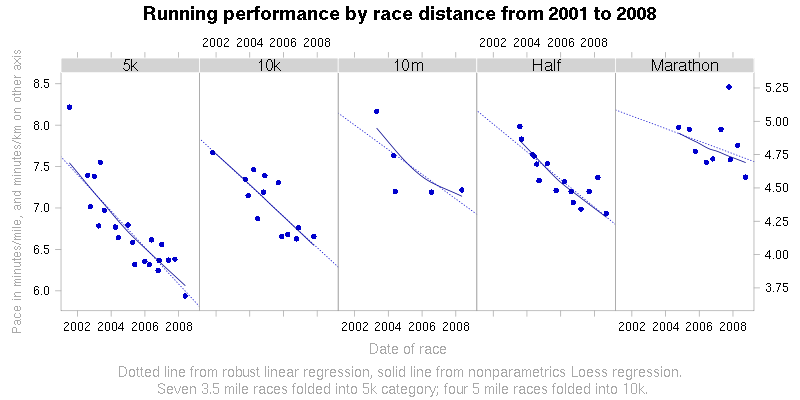 At first, some of the groups had too few data points to actually reliably
construct regression lines, let alone non-parametric smoothers. But over
time more and more data points were added as I kept running races.
Including for example the somewhat disappointing result from
 As a beta tester for the new email application from Nokia, you will have to give your mail account password:


 Today, I shall be mostly at
 Most package maintainers might have noticed the longstanding l10n NMU campaign.
It started softly back in March, with the goal to tackle as many po-debconf l10n bug report as possible (while we're at it, we also fix other l10n bug reports, of course).
It became more aggressive after the freeze, with shortened reaction delay given to maintainers and shorter timeframes for translators to use an l10n NMU opportunity to send out new/updated translations.
So, *you*.... Will you be spotted by it?
Just


 In a recent blog post,
 Since Saturday, I m in Dresden, to work for
