Search Results: "sf"

25 January 2014

Russell Coker: Links January 2014

Fast Coexist has an interesting article about the art that Simon Beck creates by walking in snow [1]. If you are an artist you can create art in any way, even by walking in patterns in the snow. Russ Altman gave an interesting TED talk about using DNA testing before prescribing drugs [2]. I was surprised by the amount of variation in effects of codeine based on genetics, presumably many other drugs have a similar range. Helen Epstein wrote an interesting article about Dr. Sara Josephine Baker who revolutionised child care and saved the lives of a huge number of children [3]. Her tenacity is inspiring. Also it s interesting to note that the US Republican party was awful even before the Southern Strategy . The part about some doctors opposing child care because it s the will of God for children to die and keep them in employment is chilling. Jonathan Weiler wrote an insightful article about the problems with American journalism in defending the government [4]. He criticises the media for paying more attention to policing decorum than to content. Tobias Buckell wrote an interesting post about the so-called socialised health-care in the US [5]. He suggests that Ronald Reagan socialised health-care by preventing hospitals from dumping dying people on the street. I guess if doing nothing for people until they have a medical emergency counts as socialised health-care then the US has it. Kelvin Thomson MP made some insightful comments about climate change, the recent heat-wave in Australia, and renewable energy [6]. Iwan Baan gave an interesting TED talk about ways that people have built cheap homes in unexpected places [7], lots of good pictures. Racialicious has an interesting article by Arturo R. Garc a about research into the effects of concussion and the way the NFL in the US tried to prevent Dr. Bennet Omalu publicising the results of his research [8]. Stani (Jan Schmidt) wrote an interesting post about how they won a competition to design a commemerative Dutch 5 Euro coin [9]. The coin design is really good (a candidate for the geekiest coin ever), I want one! Seriously if anyone knows how to get one at a reasonable price (IE close to face value for circulated or not unreasonably expensive for uncirculated) then please let me know. When writing about Edward Snowden, Nathan says Imagine how great a country would be if if it were governed entirely by people who Dick Cheney would call Traitor [10]. That s so right, that might make the US a country I d be prepared to live in. Andrew Solomon gave an interesting TED talk Love No Matter What about raising different children [11]. Aditi Shankardass gave an interesting TED talk about using an ECG to analyse people diagnosed wit severe Autism and other developmental disorders [12]. Apparently some severe cases of Autism have a root cause that can be treated with anti-seizure medication. George Monbiot wrote an insightful article about the way that Bono and Bob Geldoff promote G8 government intervention in Africa and steal air-time that might be given to allow Africans to represent themselves in public debates [13]. Daniel Pocock wrote an informative article about racism in Australian politics and how it is bad for job-seekers and the economy (in addition to being horribly wrong) [14]. Aeon Magazine has an interesting article by Anne Buchanan about the difference between scientists and farmers [15]. She has some interesting points about the way that the lack of general knowledge impacts research, but misses the point that in most fields of study there is a huge problem of people not knowing about recent developments in their own field. I don t think it s a pipe dream to be well educated in humanities and science, but I guess that depends on the definition of well educated . Brian Cox gave an interesting TED talk titled Why We Need the Explorers about the benefits of scientific research [16]. Yupu Zhang, Abhishek Rajimwale, Andrea C. Arpaci-Dusseau, and Remzi H. Arpaci-Dusseau from the University of Wisconsin-Madison wrote an interesting paper about ZFS corruption in the face of disk and memory errors [17]. One thing to note is that turning off atime can reduce the probability of a memory error leading to corrupt data being written to disk, run zfs set atime=off tank to fix this. The comedian Solomon Georgio celebrated Martin Luther King day by tweeting I love you to racists [18]. It s an interesting approach and appears to have worked well.

24 January 2014

Erich Schubert: Definition of Data Science

Everything is "big data" now, and everything is "data science". Because these terms lack a proper, falsifiable definition.
A number of attempts to define them exist, but they usually only consist of a number of "nice to haves" strung together. For Big Data, it's the 3+ V's, and for Data Science, this diagram on Wikipedia is a typical example.
This is not surprising: effectively these term are all marketing, not scientific attempts at definiting a research domain.
Actually, my favorite definition is this, except that it should maybe read pink pony in the middle, instead of unicorn.
Data science has been called "the sexiest job" so often, this has recently led to an integer overflow.
The problem with these definitions is that they are open-ended. They name some examples (like "volume") but they essentially leave it open to call anything "big data" or "data science" that you would like to. This is, of course, a marketers dream buzzword. There is nothing saying that "picking my nose" is not big data science.

If we ever want to get to a usable definition and get rid of all the hype, we should consider a more precise definition; even when this means making it more exclusive (funnily enough, some people already called above open-ended definitions "elitist" ...).
Big data:
  • Must involve distributed computation on multiple servers
  • Must intermix computation and data management
  • Must advance over the state-of-the-art of relational databases, data warehousing and cloud computing in 2005
  • Must enable results that were unavailable with earlier approaches, or that would take substantially longer (runtime or latency)
  • Must be disruptively more data-driven
Data science:
  • Must incorporate domain knowledge (e.g. business, geology, etc.).
  • Must take computational aspects into account (scalability etc.).
  • Must involve scientific techniques such as hypothesis testing and result validation.
  • Results must be falsifiable.
  • Should involve more mathematics and statistics than earlier approaches.
  • Should involve more data management than earlier approaches (indexing, sketching&hashing etc.).
  • Should involve machine learning, AI or knowledge discovery algorithms.
  • Should involve visualization and rapid prototyping for software development.
  • Must satisfy at least one of these shoulds in a disruptive level.
But this is all far from a proper definition. Partially because these fields are so much in flux; but largely because they're just too ill-defined.
There is a lot of overlap, that we should try to flesh out. For example, data science is not just statistics. Because it is much more concerned with how data is organized and how the computations can be made efficiently. Yet often, statistics is much better at integrating domain knowledge. People coming from computation, on the other hand, usually care too little about the domain knowledge and falsifiability of their results - they're happy if they can compute anything.
Last but not least, nobody will be in favor of such a rigid definition and requirements. Because most likely, you will have to strip that "data scientist" label off your business card - and why bite the hand that feeds? Most of what I do certainly would not qualify as data science or big data anymore with an "elitist" definition. While this doesn't lessen my scientific results, it makes them less marketable.
Essentially, this is like a global "gentlemans agreement". Buzz these words while they last, then move on to the next similar "trending topic".

Maybe we should just leave these terms to the marketing folks, and let them bubble them till it bursts. Instead, we should just stick to the established and better defined terms...
Thank you.
Of course, sometimes you will have to play Buzzword Bingo. Nobody is going to stop you. But I will understand that you are doing "playing buzzword bingo", unless you get more precise.
Once you then have results that are so massively better, and really disrupted science, then you can still call it "data science" later on.
You have been seeing, I've been picking on the word "disruptive" a lot. As long as you are doing "business as usual", and focusing on off-the-shelf solution, it will not be disruptive. And it then won't be big data science, or a big data approach that yields major gains. It will be just "business as usual" with different labels, and return results as usual.
Let's face it. We don't just want big data or data science. What everybody is looking for is disruptive results, which will require a radical approach, not a slight modification involving slightly more computers of what you have been doing all along.

22 January 2014

Daniel Pocock: Launching FreePhoneBox.net

The https://freephonebox.net service has now gone live. This is a great way for people without a SIP account to call those who do have one (like all the Debian Developers who got SIP on Saturday) using nothing more than a web browser (no plugin required). Not just voice, webcams too The freephonebox.net supports voice and video calls from leading web browsers with WebRTC support. Free calls made possible by free software The service itself runs on free software, including some of the following components: SIP users who want to receive calls from freephonebox.net users simply need to make sure they have SIP over TLS enabled for their domain. Calls from the phone box are anonymous but will always appear to come from the SIP address sip:anonymous@freephonebox.net. For Debian SIP users To make and receive WebRTC calls quickly and reliably:

20 January 2014

Matthew Garrett: Not all CLAs are equal

Contributor License Agreements ("CLAs") are a mechanism for an upstream software developer to insist that contributors grant the upstream developer some additional set of rights. These range in extent - some CLAs require that the contributor reassign their copyright over the contribution to the upstream developer, some merely provide the upstream developer with a grant of rights that aren't explicit in the software license (such as an explicit patent grant for a contribution licensed under a BSD-style license).
CLAs aren't new. FSF-copyrighted projects have been using copyright assignment since at least 1985 - in return, the FSF promise that the software will always be distributed under a copyleft-style license. For over a decade, Apache Software Foundation projects have required that contributors sign a CLA that allows them to retain copyright, but grants the ASF the right to relicense the work as it wishes. For the most part, this hasn't been terribly controversial.

So why do people object so much when Canonical do it? I've written about this in the context of Mir before, but it's worth expanding on the general case. The FSF's copyright assignment ensures that contributions to GPLed software will only be distributed under GPL-style licenses. The Apache CLA permits the ASF to relicense a contribution under a proprietary license, but the Apache license allows anyone to do that anyway. Going through Wikipedia's list of CLA users, the majority cover projects that are under BSD- or Apache-style licenses, with a couple of cases covering GPLed projects with a promise that any contributions will only be distributed under GPL-like licenses[1]. Either everyone can produce proprietary derivative works, or nobody can.

In contrast, Canonical ship software under the GPLv3 family of licenses (GPL, AGPL and LGPL) but require that contributors sign an agreement that permits Canonical to relicense their contributions under a proprietary license. This is a fundamentally different situation to almost all widely accepted CLAs, and it's disingenuous for Canonical to defend their CLA by pointing out the broad community uptake of, for instance, the Apache CLA.

Canonical could easily replace their CLA with one that removed this asymmetry - Project Harmony, the basis of Canonical's CLA, permits you to specify an "inbound equals outbound" agreement that prevents upstream from relicensing under a proprietary license[2]. Canonical's deliberate choice not to do so just strengthens the argument that the CLA is primarily about wanting to produce proprietary versions of software rather than wanting to strengthen their case in any copyright or patent disputes. It's unsurprising that people feel disinclined to contribute to projects under those circumstances, and it's difficult to understand why Canonical simultaneously insist on this hostile behaviour and bemoan the lack of community contribution to Canonical projects.

[1] The one major exception is the Digia/Qt project CLA, which covers an LGPLed work but makes it entirely clear that Digia will ship your contributions under proprietary licenses as well. At least they're honest.

[2] See the various options in section 2.1(d) here. Canonical chose option five. If they'd chosen option one instead, this wouldn't be a problem.

comment count unavailable comments

19 January 2014

Daniel Pocock: Debian solving Drupal's third-party library challenge

The tremendously successful Drupal community observes stringent requirements about many things, in particular, licensing and the prohibition of bundling third-party JavaScript. While these policies may seem onerous at first glance, it turns out there is another project with a written guarantee to provide third-party code in a form that meets the expectations of Drupal and does so in a way that completely automates all that tedious effort into one-click oblivion. I'm talking about the Debian GNU/Linux operating system. Drupal's libraries module The libraries module for Drupal appeared as an initial attempt to help track third-party JavaScript. The module has been available in Debian for almost a year and has recently been provided in the wheezy-backports distribution for people running the stable version of Debian. The library provides a standard way for other modules to reference third-party JavaScript but it still leaves the web master with some manual work to go out and download all the necessary JavaScript and copy it into the right place. This is where Debian comes to the rescue. Using the module in practice I've recently uploaded JSCommunicator to Debian and wanted to provide a convenient way for people to get it in Drupal. Therefore, in addition to providing the JSCommunicator packages, I created an extra package, drupal7-mod-jscommunicator. JSCommunicator itself depends on other JavaScript, specifically, the JsSIP library. I repeated the same process for JsSIP. This gives us the following collection of four related packages:
Third-party library Library itself Drupal module, packaged
JSCommunicator libjs-jscommunicator drupal7-mod-jscommunicator
JsSIP libjs-jssip drupal7-mod-jssip
If you explore the package details in Debian's package catalog you will notice that each package depends on the other packages it requires. Debian's package management utility, apt-get, can transitively resolve all the relationships between this set of packages. In fact, on a newly built server, you can simply run the command:
apt-get install drupal7-mod-jscommunicator
and the apt-get utility will install Apache, MySQL, Drupal itself, the libraries module, all the related JavaScript libraries and the final Drupal module of JSCommunicator itself. It really is that easy. Here is an example of the output displayed by the command on a freshly built server:
# apt-get -d install drupal7-mod-jscommunicator
Reading package lists... Done
Building dependency tree       
Reading state information... Done
The following extra packages will be installed:
  apache2 apache2-bin apache2-data curl dbconfig-common drupal7
  drupal7-mod-jssip drupal7-mod-libraries fontconfig-config fonts-dejavu-core
  javascript-common libaio1 libapache2-mod-php5 libapr1 libaprutil1
  libaprutil1-dbd-sqlite3 libaprutil1-ldap libarchive-extract-perl libc6
  libcurl3 libdbd-mysql-perl libdbi-perl libedit2 libfontconfig1 libgcrypt11
  libgd3 libhtml-template-perl libjbig0 libjpeg8 libjs-jssip libjson-c2
  liblocale-gettext-perl liblog-message-simple-perl liblua5.1-0
  libmodule-pluggable-perl libmysqlclient18 libonig2 libperl4-corelibs-perl
  libpng12-0 libpod-latex-perl libqdbm14 librtmp0 libssh2-1 libterm-ui-perl
  libtext-charwidth-perl libtext-iconv-perl libtext-soundex-perl libtiff5
  libuuid-perl libvpx1 libxml2 libxpm4 locales mysql-client mysql-client-5.5
  mysql-common mysql-server mysql-server-5.5 mysql-server-core-5.5 perl
  perl-base perl-modules php5 php5-cli php5-common php5-gd php5-json
  php5-mysql php5-readline ssl-cert wwwconfig-common
Suggested packages:
  apache2-doc apache2-suexec-pristine apache2-suexec-custom apache2-utils
  php-pear glibc-doc libclone-perl libmldbm-perl libnet-daemon-perl
  libplrpc-perl libsql-statement-perl rng-tools libgd-tools
  libipc-sharedcache-perl libterm-readkey-perl tinyca perl-doc
  libterm-readline-gnu-perl libterm-readline-perl-perl make libb-lint-perl
  libcpanplus-dist-build-perl libcpanplus-perl libfile-checktree-perl
  liblog-message-perl libobject-accessor-perl php5-user-cache
  openssl-blacklist postgresql-client
The following NEW packages will be installed:
  apache2 apache2-bin apache2-data curl dbconfig-common drupal7
  drupal7-mod-jscommunicator drupal7-mod-jssip drupal7-mod-libraries
  fontconfig-config fonts-dejavu-core javascript-common libaio1
  libapache2-mod-php5 libapr1 libaprutil1 libaprutil1-dbd-sqlite3
  libaprutil1-ldap libarchive-extract-perl libcurl3 libdbd-mysql-perl
  libdbi-perl libfontconfig1 libgd3 libhtml-template-perl libjbig0 libjpeg8
  libjs-jssip libjson-c2 liblog-message-simple-perl liblua5.1-0
  libmodule-pluggable-perl libmysqlclient18 libonig2 libperl4-corelibs-perl
  libpng12-0 libpod-latex-perl libqdbm14 librtmp0 libssh2-1 libterm-ui-perl
  libtext-soundex-perl libtiff5 libvpx1 libxpm4 mysql-client mysql-client-5.5
  mysql-common mysql-server mysql-server-5.5 mysql-server-core-5.5 php5
  php5-cli php5-common php5-gd php5-json php5-mysql php5-readline ssl-cert
  wwwconfig-common
The following packages will be upgraded:
  libc6 libedit2 libgcrypt11 liblocale-gettext-perl libtext-charwidth-perl
  libtext-iconv-perl libuuid-perl libxml2 locales perl perl-base perl-modules
12 upgraded, 60 newly installed, 0 to remove and 222 not upgraded.
Need to get 37.2 MB of archives.
After this operation, 152 MB of additional disk space will be used.
Do you want to continue [Y/n]? 
Libraries API in Drupal 8 Contrary to an earlier version of this blog, the libraries module is not joining the core in Drupal 8 however its use has been strongly encouraged for any new modules submitted through the Drupal community approval process. This means there will be further opportunity for Drupal users to consolidate on their use of Debian to completely automate the management of all third-party libraries and modules throughout their Drupal system(s).

17 January 2014

Michael Stapelberg: debmirror 6x speed-up, or how to fill a 1 GBps Rackspace link

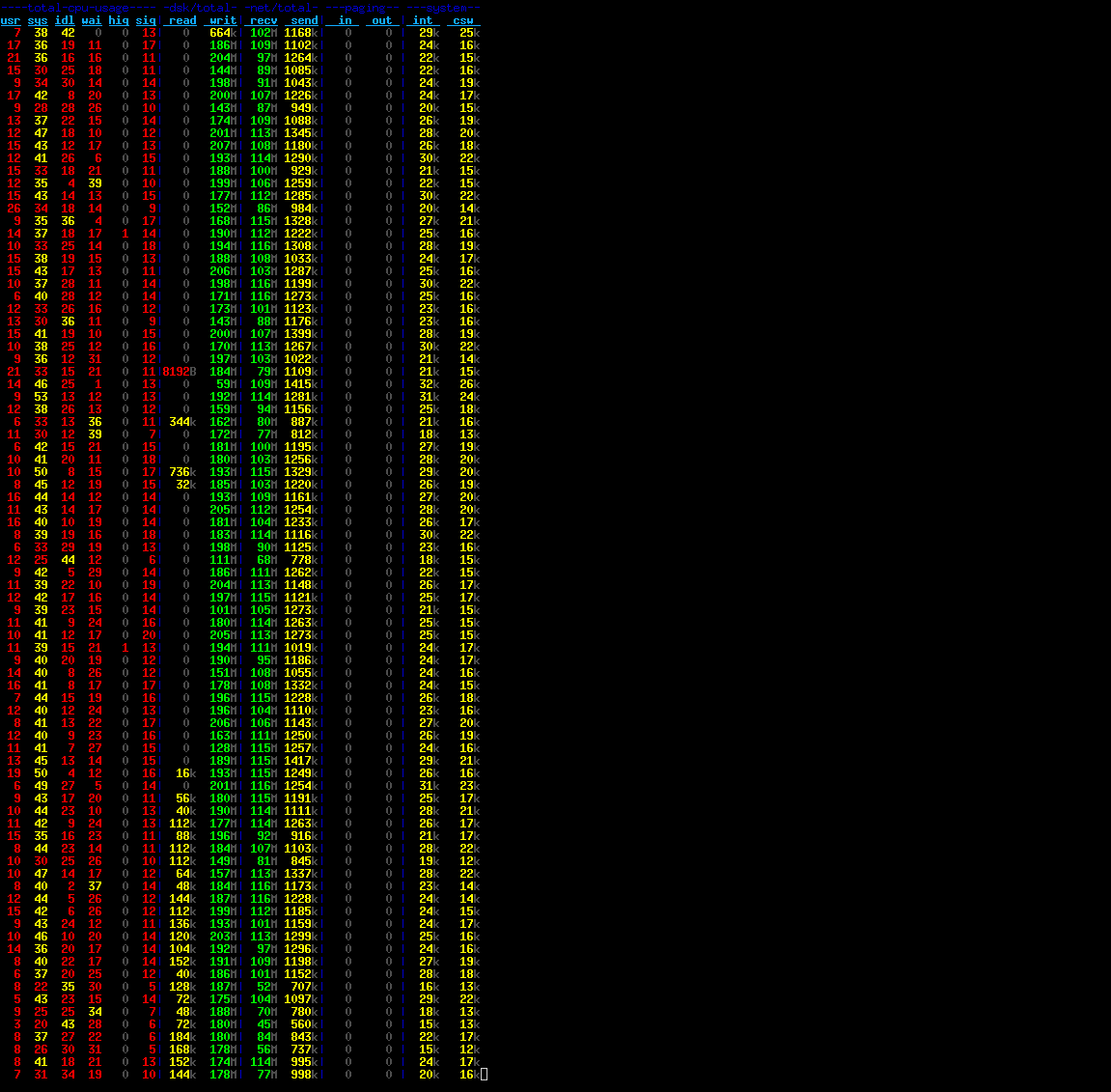
As explained in more detail in my my last blog post, Rackspace is providing hosting for Debian Code Search. For those of you who don t know, Rackspace is a cloud company that provides (among other services) a public cloud based on OpenStack. That means you can easily (and programmatically, if you want) bring up virtual servers, block storage volumes, configure the network between them, etc. As part of my initial performance experiments, I was running debmirror to clone a full Debian source mirror, and I noticed this took about one hour. Given that the peak network and storage write rates I have observed in my benchmarks are much higher, I wondered why it took so long. About 43 GB (that s how big the Debian sid sources are) in 60 minutes means 12 MB/s download rate, which is a bit more than a sustained 100 MBit/s connection. Luckily, at least the Rackspace servers I looked at are connected with 1 GBit/s to the internet, so more should be possible. Note that these are the old Rackspace servers. There is a new generation of servers, which I have not yet tried, that apparently offer even higher performance. After a brief look at the debmirror source code, I concluded that it can only use a single mirror and downloads files sequentially. There is some obvious potential for improvement here, and the fact that I could come up with a proof of concept written in Go to determine the files to download in a couple of minutes encouraged me to spend my saturday on this problem :-). About 7 hours later, my prototype had gone through various iterations and the code could sustain about 115 MB/s incoming bandwidth for most of the time. Here is a screenshot of dstat measuring the performance: Another 3 hours later, the most obvious bugs were weeded out and the code successfully cloned an entire mirror for the first time. I verified the correctness by running debmirror afterwards, and no files were downloaded that had not actually arrived on the mirror in the meantime. Features

  1. Parallel downloading from multiple mirrors.
    Of course, it is not guaranteed that the mirrors are consistent, but that is a solvable problem: whenever a non-200 HTTP response is encountered, the file is put back into the queue and gets rescheduled onto any mirror. Eventually, it will be rescheduled onto the mirror from which the sources.gz was downloaded, and that mirror has to have it.
  2. HTTP keep-alive and pipelining.
    debmirror also does HTTP keep-alive (I read that in the source, did not verify it), but it downloads files sequentially, i.e. it downloads one file, then sends the request for the next file. This means that after one file was received, no data is being received until another round-trip finished. For a lot of small files (think of .dsc and .debian.tar.gz files or small orig tarballs) that really adds up.
    Therefore, I use HTTP pipelining: I send 99 requests and then just receive all the responses at full speed. The magic number 99 comes from the fact that this is the smallest common denominator that all mirrors I have tested allow. nginx by default allows 100 requests.
  3. Request ordering.
    Instead of sending requests at random, I sort the download queue by size and make sure that the first request on each connection is for a big file. The intention is that TCP will adapt to that quickly and use a bigger window size as soon as possible instead of ramping up slower later on. Note that I have not actually measured the window sizes, so this is just a hunch.
    Another nice side-effect of the ordering is that the amount of data that is being sent through each connection is roughly equal. This means we don t waste TCP connections by sending 99 requests for small files only.
  4. (Goroutines).
    I m a bit hesitant to even write about it, so let s make it quick: Perl (and thus debmirror) is typically single-threaded, whereas Goroutines scale nicely on multi-core systems. I don t think it makes a big difference on the machines I am running this on as they have only two cores and are not maxed out on CPU usage at all. But maybe this will be more important for saturating 10 GBit/s? :-)
  5. (Mirror selection).
    It s not a feature of the code, but certainly relevant: of course I selected mirrors that are connected to the internet with at least a Gigabit link, serve files reasonably fast and have low latency to Rackspace s Chicago presence.
    Interestingly, while I used to think that universities have access to big uplinks and beefy machines, none of the mirrors that I use are located at a university. In fact, every mirror ending in .edu that I tried was really slow most of them providing something like 2-4 MB/s.
Results With the latest iteration of the code, I can clone an entire Debian source mirror with 43 GB of data in about 11.5 minutes, which corresponds to a 63 MB/s download rate:
GOMAXPROCS=20 ./dcs-debmirror -num_workers=20
68,24s user 384,90s system 66% cpu 11:25,97 total
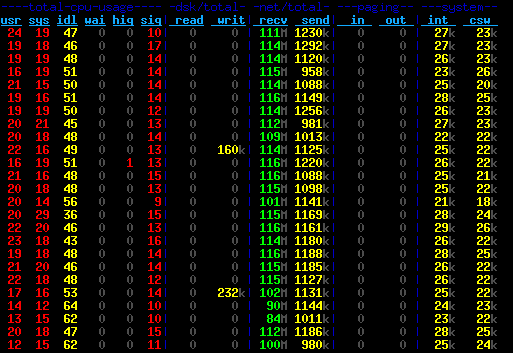
It should be noted that the download rate is very low in the first couple of seconds since the sources.gz file is downloaded from a single mirror, then unpacked and analyzed. The peak download rate is about 115 MB/s (= 920 MBit/s) which is reasonably close at what you can achieve with a Gigabit link, I think. If the entire uplink was available to me at all time, the Rackspace hardware would be able to saturate that easily, both in terms of reading from the network and in terms of writing to block storage. I tested this on an SSD volume, but I see about 113 MB/s throughput with the internal hard disk, so I think that should work, too. There is another dstat screenshot of the final version (writing to disk). Perhaps even more interesting to some readers is the time for an incremental update:
GOMAXPROCS=20 ./dcs-debmirror -tcp_conns=20
2013/10/13 11:09:55 Downloading 307 files (447 MB total)
 
2013/10/13 11:10:04 All 307 files downloaded in 9.105605931s. Download rate is 49.186567 MB/s
4,91s user 3,99s system 67% cpu 13,205 total
The wall clock time is higher than the time reported by the code because the code does not count the time for downloading and parsing the sources.gz file. The entire program is about 400 lines (not SLOC) of Go code. It s part of the Debian Code Search source. If you re interested, you can read dcs-debmirror.go in your browser. Conclusions The outcome of this experiment is that I now know (and have shown!) that there are significantly more efficient ways of cloning a Debian mirror than what debmirror does. Furthermore, I have a good grasp on what kind of performance the Rackspace cloud offers and I am fairly happy with the numbers :-). My code is useful to me in context of Debian Code Search, but unless you need a sid-only source-only mirror, it will not be useful to you directly. Of course you can take the ideas that I implemented and implement them elsewhere personally, I don t plan to do that. If you have hardware, bandwidth and a use-case for 10 GBit/s+ mirroring, I d like to hear about it! :-)

15 January 2014

Jan Wagner: Bye bye Nagios-Plugins

Last night it seems the so called 'Nagios Plugins' project was cut off. The story started a decade ago when development of the plugins compatible with Nagios was taken over by an independend group of developers. Some time later, the domain of the 'Nagios Plugins' project was handed over to 'Nagios Enterprises, LLC.' due trademark reasons. To get an idea about that, I suggest to read on the 'Nagios Trademark Truth' and 'Nagios Trademark Triumph Provides Promise To Open Source Developers, Shows Power of Community'. In the latter Mr. Galstad is cited with "This violation took more than four years and thousands in legal fees before it was finally resolved. My hope is that this can serve as an example to Open Source developers worldwide that they can overcome infringements and protect their brands if they are persistent and engage their respective communities.". Yesterday in the evening the project members recognised that the DNS of nagios-plugins.org was moved to a different location. Now there seems to be a hosted (some may call that 'hijacked' or 'pirated') 'mirror' of the old site. Anyhow ... the content is already different from the original one or maybe changed even more in the future. From my point of view this can serve as an example to Open Source developers worldwide that they can be obstructed by (trademark holding) companies even if those companies profit from the work of them. So please don't use downloads from there, even the release tarballs maybe modified. The news all about that: 'Nagios Plugins are dead, we now have Monitoring Plugins in place!" Be sure you download your tarballs from https://www.monitoring-plugins.org/download.html and verify your checksums! You can follow the Monitoring Plugins Development Team also via Twitter.

13 January 2014

Daniel Pocock: PostFinance, where is my money?

Update: my money has been returned by PostFinance very soon after this blog appeared There's no better way to get the year off to a good start than finding money has gone missing from your bank account. Where I live in Switzerland, it is mandatory for everybody to make a monthly payment for health insurance (as it is mandatory, it is basically a tax, like the monthly council tax in England). Just like British council tax, the premiums go up each year and every person in the country has to log into their bank's web site and change their standing order. A few days after doing just that, I went back in to the web site to make another payment and noticed that the first health insurance payment for 2014 had been duplicated on two consecutive days, the 30th and 31st of December: I immediately sent them an email to alert them to the fault and ask for the duplicate transaction to be corrected. Normally, when a company makes a mistake, it would be fixed within a couple of days and certainly never reach my blog. Instead of getting a helpful reply, I was astonished to receive this:
There has been a misunderstanding when you have set up your standing order.
You selected "First execution" December 30, 2013 and then "monthly execution" 31. The system has followed your instruction and it results a double execution December 30 and 31.
Unfortunately, we are not able to return you the amount.
Great, apparently it is all my own fault. I thought "monthly" would mean one payment in each one month but apparently not everybody uses the same definition of monthly. (Actually, banks do have systems such as the 360 day calendar but that is another story). So let's look at these faulty instructions I supposedly gave. I immediately went back to the standing order page to take a screenshot. I even compared the page in English (my default language, which they are kind enough to let me use) and French (one of the four official languages of the Swiss Confederation) and I found they say much the same thing: Note: exact amounts and account numbers concealed The form is relatively clear: I authorised a monthly payment (Periodicite: mensuel) with the first (Premiere) payment on 30.12.2013 and then, or so I believed (and still do) a following payment (ensuite) on the 31st of each month, with the last payment at the end of November, for 12 payments in total. Simple, right? Where it says ensuite le 31, I sincerely believe that means the second payment is on 31 January, but Postfinance seem to be arguing that I meant the 31 December: just one day, rather than one month, after the first payment. Delaying tactics I replied to their email, telling them explicitly that I had authorized a monthly payment only and demanding the immediate return of the duplicate payment. When I got their next reply, I didn't know what to think:

We are pleased to do the necessary to revoke the transfer to SWICA. This will take at least two weeks.
On the one hand, it appears they are now starting to accept they may have made a blunder. But two more weeks? This was already 10 days after the money went missing. Do they even know what is wrong with their system? It doesn't give me confidence. I wrote back again and insisted that this is their error and that an immediate correction is required. Pass the buck, take three Today, another reply came back. After almost 14 days, I've now got three fob-off excuse mails and none of my money returned:
We did the request at SWICA to send back the money on your account on the 8th January 2014. The decision will be taken by them if they agree to send back this amount.
Unfortunately, we cannot do more except waiting their answer. You can call them and explain them the situation. With your call, maybe the reimbursement could be faster.
Why is it in the hands of the health insurance company? It is not their fault that Postfinance has a problem processing standing orders. Why do I have to waste my time chasing people, will I get compensation for that? Am I the only victim? With many people configuring their new health insurance payments at this time of the year, I can imagine that there may be other victims of this fault too. Are they all being fobbed off with these excuses? Some may not even realize if they don't check their account closely. What next? Sure, maybe I can just cancel the next health insurance payment: but why should I have that inconvenience? What exactly was I supposed to put on that form to not make this mistake they suggest I made? If I cancel the next payment like they suggest and then set up the payment again from March, how can I be sure the same duplication won't happen again? Using customers as unpaid QA testers Many leading financial organisations have experienced teams of developers, QA testers, and comprehensive regime of simulation/testing with paid participants to ensure their systems are reliable and as friendly and accurate as possible. Here, it feels like PostFinance has skipped all that, deploying a form that is ambiguous at best and they are using real customers like me to test the system and report the bugs. Normally organisations pay me for doing that very same task as part of my job as a software engineer. Not only have Postfinance taken almost 200 CHF of my money, but they have wasted my time with their strategy of fobbing me off and at the same time they are probably sending my feedback to their developers instead of paying a QA tester to check their systems. You be the judge What is your opinion?
  • Daniel can't use a web form, it is definitely Daniel's mistake, nobody else would make a mistake like that
  • The Postfinance form is ambiguous and so it is probably their fault and they should give back the money, it is likely these are cut and paste emails they send to all the customers who are duped by the form
  • Postfinance is completely wrong. Monthly means one payment each month.

11 January 2014

Debian Sysadmin Team: Peter Palfrader: The Debian DNS universe

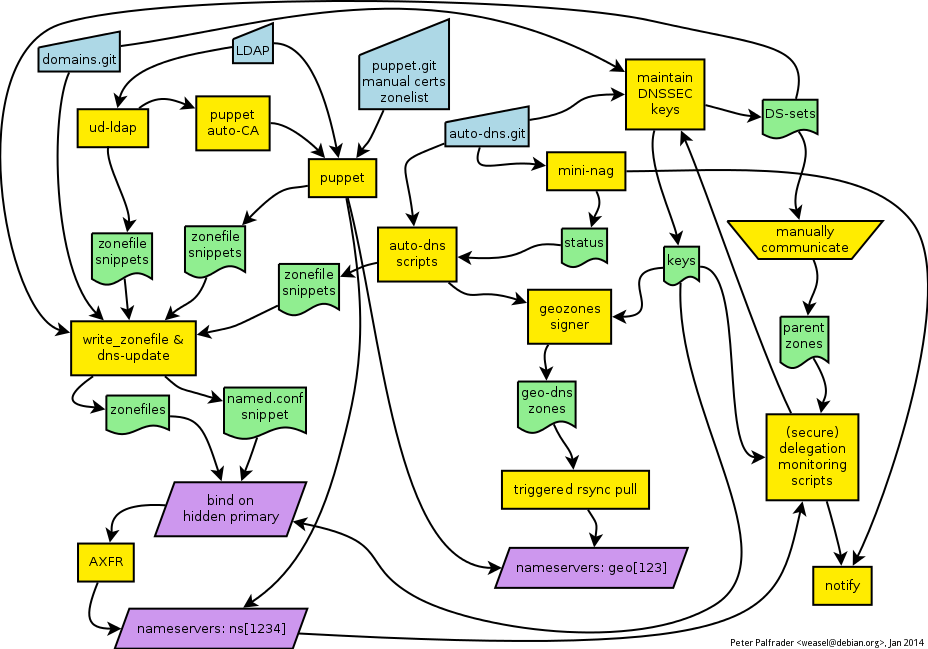
Abstract I recently moved our primary nameserver from orff.debian.org, which is an aging blade in Greece, to a VM on one of our ganeti clusters. In the process, I rediscovered a lot about our DNS infrastructure. In this post, I will describe the many sources of information and how they all come together.

Introduction The Domain Name System is the hierarchical database and query protocol that is in use on the Internet today to map hostnames to IP addresses, to map the reverse thereof, to lookup relevant servers for certain services such as mail, and a gazillion other things. Management and authority in the DNS is split into different zones, subtrees of the global tree of domain names. Debian currently has a bit over a score of zones. The two most prominents clearly are debian.org and debian.net. The rest is made up of debian domains in various other top level domains and reverse zones, which are utilized in IP address to hostname mappings.

Types and sources of information The data we put into DNS comes from a wide range of different systems:
  • Classical zonefiles maintained in git. This represents the core of our domain data. It maps services like blends.debian.org to static.debian.org or specifies the servers responsible for accepting mail to @debian.org addresses. It also is where all the ftp.CC.debian.org entries are kept and maintained together with the mirror team.
  • Information about debian.org hosts, such as master, is maintained in Debian's userdir LDAP, queryable using LDAP1.
    • This includes first and foremost the host's IP addresses (v4 and v6).
    • Additionally, we store the server responsible for receiving a host's mail in LDAP (mXRecord LDAP attribute, DNS MX record type).
    • LDAP also has some specs on computers, which we put into each host's HINFO record, mainly because we can and we are old-school.
    • Last but not least, LDAP also has each host's public ssh key, which we extract into SSHFP records for DNS.
  • LDAP also has per-user information. Users of debian infrastructure can attach limited DNS elements as dnsZoneEntry attributes to their user2.
  • The auto-dns system (more on that below).
  • Our puppet also is a source of DNS information. Currently it generates only the TLSA records that enable clients to securely authenticate certificates used for mail and HTTPS, similar to how SSHFP works for authenticating ssh host keys.

Debian's auto-dns and geo setup We try to provide the best service we can. As such, our goal is that, for instance, user access to www or bugs should always work. These services are, thus, provided by more than one machine on the Internet. However, HTTP did not specify a requirement for clients to re-try a different server if one of those in a set is unavailable. This means for us that when a host goes down, it needs to be removed from the corresponding DNS entry. Ideally, the world wouldn't have to wait for one of us to notice and react before they can have their service in a working manner. Our solution for this is our auto-dns setup. We maintain a list of hosts that are providing a service. We monitor them closely. Whenever a server goes away or comes back we automatically rebuild the zone that contains the element. This setup also lets us reboot servers cleanly since one of the things we monitor is "is there a shutdown running", we can, simply by issuing a shutdown -r 30 kernel-update, de-rotate the machine in question from DNS. Once the host is back it'll automatically get re-added to the round-robin zone entry. The auto-dns system produces two kinds of output:
  • In service-mode it generates a file with just the address records for a specific service. This snippet is then included in its zone using a standard bind $INCLUDE directive. Services that work like this include bugs and static (service definition for static).
  • In zone-mode, auto-dns produces zonefiles. For each service it produces a set of zonefiles, one for each out of a set of different geographic regions. These individual zonefiles are then transferred using rsync to our GEO-IP enabled nameservers. This enables us to give users a list of security mirrors closer to them and thus hopefully faster for them.

Tying it all together The Debian DNS Rube Goldberg Machine. Figure 1: The Debian DNS Rube Goldberg Machine. Once all the individual pieces of source information have been collected, the dns-update and write_zonefile scripts from our dns-helpers repository take over the job of building complete zonefiles and a bind configuration snippet. Bind then loads the zones and notifies its secondaries. For geozones, the zonefiles are already produced by auto-dns' build-zones and those are pulled from the geo nameservers via rsync over ssh, after an ssh trigger.

and also DNSSEC All of our zones are signed using DNSSEC. We have a script in dns-helpers that produces, for all zones, a set of rolling signing keys. For the normal zones, bind 9.9 takes care of signing them in-process before serving the zones to its secondaries. For our geo-zones we sign them in the classical dnssec-signzone way before shipping them. The secure delegation status (DS set in parent matches DNSKEY in child) is monitored by a set of nagios tests, from both [dsa-nagios] and dns-helpers. Of these, manage-dnssec-keys has a dual job: not only will it warn us if an expiring key is still in the DSset, it can also prevent it from getting expired by issuing timly updates of the keys metadata.

Relevant Git repositories -- Peter Palfrader

  1. ldapsearch -h db.debian.org -x -ZZ -b dc=debian,dc=org -LLL 'host=master'
  2. ldapsearch -h db.debian.org -x -ZZ -b dc=debian,dc=org -LLL 'dnsZoneEntry=*' dnsZoneEntry

7 January 2014

Vincent Sanders: Healthy discontent is the prelude to progress

Back in the mists of Internet time (2002) when spirits were brave, the stakes were high, men were real men, women were real women and small furry creatures from Alpha Centauri were real small furry creatures from Alpha Centauri there were few hosting options for a budding open source project.

Despite the meteoric rise of many dot com companies in the early noughties a project either had to go it alone by running everything themselves or pick from a small selection of companies that had not yet worked out how to turn free hosting into money.

One such company, arguably the first, was VA Research with their SourceForge system. Many projects used their platform including a small niche web browser called NetSurf. For years the service was great, there were rough edges but nothing awful.

Netsurf issue tracker in the new SourceForge interface
Over time the NetSurf projects requirements grew beyond what SourceForge could provide and service after service was migrated away eventually all that was left was the bug tracking system. This remained the state of affairs until mid 2013 when SourceForge forced a migration to their new platform which made them unsuitable for the projects use case.

Aside from the issue trackers questionable user interface SourceForge had started aggressively placing advertising throughout their platform. Some of the placements so inadvisable that projects started taking the decision to leave.

While I appreciate that SourceForge had to make money to provide a service they appear to have sown discontent within a large part of their user base without understanding that there are a number of alternatives solutions with a much less onerous funding model.

NetSurf used this as an opportunity to move the remaining issue tracking service to our own infrastructure. Rob Kendrick proceeded to evaluate several solutions and in December 2013 I finally found the time to migrate an XML dump of the old data from SourceForge into MantisBT.

Migrating data from one database into another via incompatible formats took me back to my roots. My early career started with programming tasks moving historical business data from ancient large systems which were about to be scrapped to modern Sparc based systems. Later I would be in a role where financial data needed to be retrieved from obsolete proprietary systems and moved into databases on x86 servers.

My experience in this field was not really stretched as it turns out that modern systems can process a few tens of megabytes in seconds rather than the days for a run in my youth! So some ugly perl scripts and a few hours later I had a nice shiny SQL database filled with NetSurfs bugs and MantisBT instance configured to use them.

NetSurf MantisBT instance showing most recently updated open bugs
Then came the hard bit, triaging all the open bugs, fixing up all the bugs submitted as an anonymous user but with email addresses in, removing duplicates and checking every open bug was still valid took almost two weeks of tedious drudge.

I set up an initial bug workflow within the system that the project developers are still fine tuning to better suit their needs but overall Mantis is proving a very flexible tool. The main deficiencies center around configuration for the projects useage, especially removing unused fields from filters and making the workflow more intuitive..

The resulting system is now getting bug reports submitted again where the sourceforge system had had three in the six months since the forced migration.

The issue tracker is once more a useful tool for the developers allowing us to focus on areas actually causing problems for our users and allowing us to see progress we are making fixing issues.

Overall this was a successful migration and provides a platform the NetSurf project can control where we can offer guarantees to our users about their personal information usage and having a clean rapid interface with no advertisements.

6 January 2014

Aurelien Jarno: Debian QEMU images updated

Following the release of Debian Wheezy, I have (finally) updated my set of Debian QEMU images for both Squeeze (6.0.8) and Wheezy (7.3). The following images are now available: Each of these directories contains a GPG signed README.txt file with the md5sums all files, detailed instructions how to run these images and especially the minimum QEMU version to use. The requirements to run the default desktop environment have increased a lot between Squeeze and Wheezy. An accelerated graphics card is now needed to be able to use Gnome (unless you use the fallback mode), which is not something provided by QEMU (actually there is now a QXL para-virtualized video card, but the driver is only in unstable). In addition GDM now needs more than 128MiB to start, while this is the default amount of memory provided for virtual machines. I have therefore decided to switch the default desktop environment on the Wheezy images to Xfce and the display manager to LightDM. Both Gnome and GDM are still installed on the images, and the original default can easily be restored using the following commands: Beside this the new images only contain minor changes. The filesystems have been tweaked to not run fsck after a certain amount of days, and locales-all and openssh-server are now installed in all images. For MIPS and MIPSEL, 64-bit kernels are now also installed and provided, so that it is possible to choose between a 32-bit or a 64-bit kernel (see the README.txt for more details). There is no Debian Wheezy SPARC image available, as QEMU does not fully support SPARC64 yet (it is actually possible to run it, but then the VM crashes often), and Debian Wheezy now only supports 64-bit kernels. I will also invest time to build an S390X image, but so far I haven t been successful on that. The following images are still available at the same location, though they haven t been updated:

Vincent Sanders: NetSurf Developer Workshop Redux

The NetSurf Developers bringing you alternative LOLcat viewing software since 2002Once again the NetSurf developers congregated in Cambridge at the Collabora offices where we were made welcome in a nice environment for the event.

Five developers managed to attend from around the UK Rob Kendrick, Vincent Sanders, Daniel Silverstone, John-Mark Bell and Michael Drake. We also had Chris Young and Fran ois Revol providing some bug fixes remotely.

This was the first time we had all met since the previous event towards the end of 2012 and we took full advantage of this to discuss a pretty extensive agenda in addition to the practical programming tasks.

From Friday lunchtime through to Sunday evening we managed 30 hours of work consisting of over 70 commits to over 100 files.

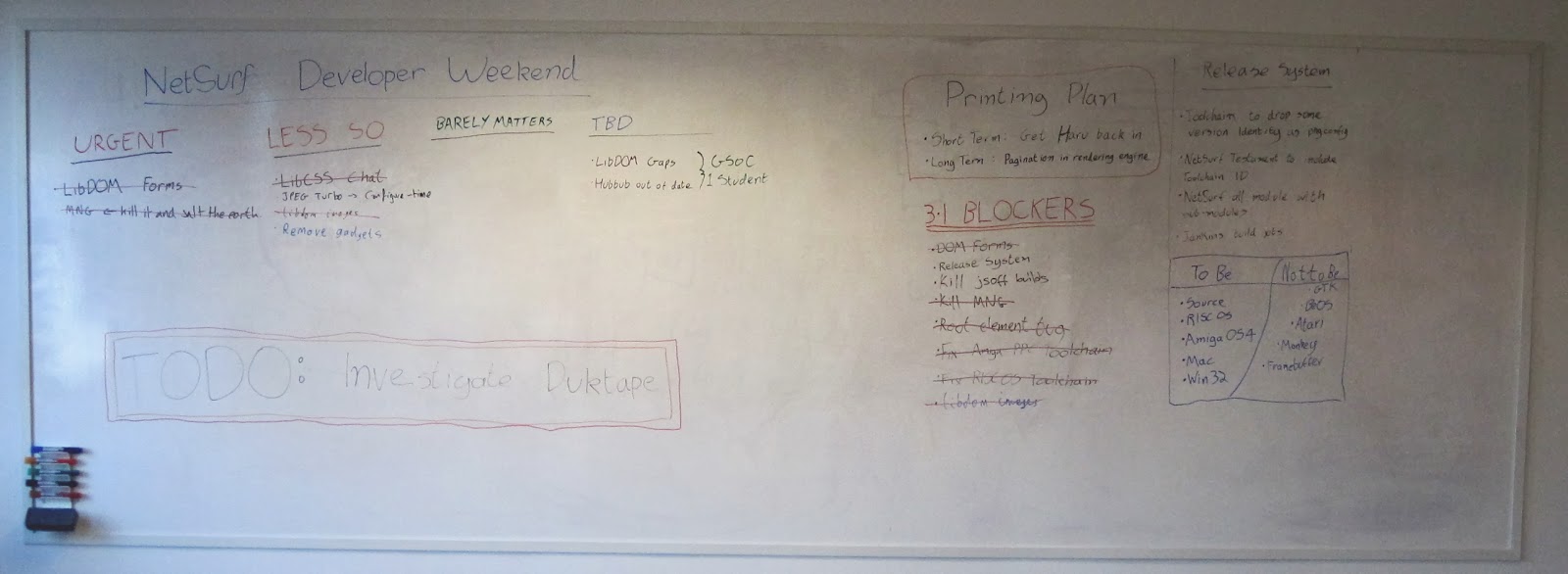
The whiteboard of our notes

Our main focus was working towards a 3.1 release which is scheduled for early April. Along with the source the release will have binary builds for RISC OS, AmigaOS, Windows and Mac OS X (x86 and ppc). Although the NetSurf project will not be directly releasing binaries for the GTK and Framebuffer frontends we will be ensuring the Debian packages are updated which is our prefered method of distribution for those targets.

We analysed the 3.0 release and formulated an improved process for the future. The 3.1 release will be generated automatically by the CI system ensuring constant results and removing the problems we encountered previously.

A set of release blocking issues was derived which we used as a task list during the workshop.The majority of these were completed including:
DOM based forms
Web forms are a feature Netsurf has supported for a long time and their implementation has not kept up with the rest of the browser. This is a long standing problem area which has resulted in numerous strange bugs with form submission. With this change the form system has been reworked to correctly operate directly from the DOM resulting in the squashing of a large number of bugs and a much improved user experience.

DOM based image loading
Up to now image fetching was performed only during the rendering of a page. With this change when the image link is placed into the DOM during the page parse it is scheduled to be fetched, this should give an improved user experience as images should be available earlier in a pages render.

Removal of MNG support
NetSurf has supported MNG since the 1.0 release, indeed the MNG library used to provide the PNG support too though we have long ago transitioned to libPNG. Alas the web has moved on and MNG has been largely forgotten, the libMNG library that performs the image decoding is old and generally unsupported specifically lacking security updates.

The build issues with libMNG (lack of pkg-config, reliance on libcms1 etc.) were causing maintenance issues in code nobody was actually using (there were crash bugs discovered during its removal!). Because of these issues it was decided to join the vast majority of browsers and remove support for this format.
The developers also addressed several issues with toolchain construction and a number of annoying usability bugs.

Plans for how to improve printing support we made. Initially we intend to fix the existing haru based pdf generation using this to print via pdf and in future have correct css styled page paginated printing render output.

The perennial issue of javascript was discussed however, while efforts to improve the existing support are ongoing, our usage of the spidermonkey library continues to raise various challenges including platform support and API changes between versions.

Due to these issues it has been suggested that we might add support for using the duktape JS engine instead, initial results are promising but given the size of the task of implementing an additional javascript engine binding further investigation is necessary before making a commitment.

Amongst the other discussions the group has also agreed that we will once again apply to be a GSoC organisation for a single student with some very focused projects:
  • Improving our HTML5 parser (hubbub)
  • Improving the DOM library implementing missing functionality.
While neither of these projects are as fashionable as some of our previous proposals they are well defined enough that as a group we believe we could offer enough support to the student to make their experience a pleasurable one and get the resulting code reviewed and merged promptly.

This event was very successful with a great deal achieved, the project is much more likely to be in a good shape to release 3.1 by April now and the meeting has given the developers a much welcomed boost.

I would like to extend the groups thanks to Robert McQueen for letting us use the Collabora offices, Dor e Carrier for organising all the administrative things and to Vivek Dasmohapatra for coming out on his Sunday afternoon to let us back in after locking ourselves out.


5 January 2014

Jon Dowland: 2013 In Fiction

I read a lot this year - I'll write more about that and reflections on goodreads in another post - but most of the things I read weren't published in 2013. (I should also write a bit about my thoughts on e-readers). However, it seems I have enough to write about 2013's novels to make a round-up post worthwhile, so here we go.

The Cuckoos Calling UK cover
This year, crime author Robert Galbraith published his first novel The Cuckoo's Calling. I'd never have heard of it if Galbraith was not outed as an alias for Joanne "JK" Rowling. Clues that Rowling was working on a detective story exist as early as a Guardian preview article in 2012 for her last novel, The Casual Vacancy. Further hints, for me, that this was no first-time author were the taglines from Ian Rankin and Val McDermid on the cover, writers of a calibre I'd be surprised a new author could attract. However I don't know whether they were on the pre-unveiling cover or not. Rowling was upset be outed, having enjoyed the freedom to write without the baggage of expectation that she is subject to. I hope she's pleased: prior to her unmasking the novel was warmly received by the (admittedly relatively small) number of people who read it. And a very good novel it is too. It starts with a genre clich of a grizzled, meloncholy detective, Mr. Cormoran Strike, in an upstairs office with a neon light flickering through the window, but fleshes the story out both forwards - a client, a mysterious death - and backwards - how did Mr. Strike end up in that upstairs office - living out of it, no less? As is traditional for the genre there's a very clever twist. What I really enjoyed about Cormoran Strike was Galbraith/Rowling moving quickly from Chandler-esque everyman to a well fleshed-out, complex protagonist, intertwining the development of the character with the unfolding of the wider plot. I'm looking forward to the sequel, expected in 2014.
The Shining Girls UK cover
A second surprise favourite this year was Lauren Beukes' time-tripping crime story The Shining Girls. A monsterous murder of women somehow finds a room in Chicago that lets him travel through time (or perhaps the room finds him). He uses this facility to stalk and murder a set of Shining Girls: women who, for one reason or another, literally 'shine' in his perception of them. One such woman survives his first attack and decides to try and find out who attacked her, and why. The crimes are described in a brutal fashion which - from a distance - resemble the sometimes glorified violence for which crime fiction is sometimes criticised, but the focus of the story is very much on the victims: they are fully fleshed out characters and each death is felt by the reader as a genuine tragedy. I discovered Beukes when her earlier novel Zoo City was included in a Humble eBook bundle. On reading The Shining Girls I felt that the novel deserved to be more widely known than I would expect it to be trapped in the ghetto of genre fiction, so I was pleased to discover that the very mainstream Richard and Judy Book Club discovered it. In established author news, Terry Pratchett, having adopted speech recognition for writing (to combat his debilitating Alzheimer's) has seemingly managed to accelerate his rate of production and squeezed out at least two this year: The Long War with Stephen Baxter is the sequel to 2012's The Long Earth which I very much enjoyed, but it really felt like "difficult second novel" to me. Hopefully there'll be a third. Raising Steam, the 40th Discworld novel, was an enjoyable romp around the concept of steam trains, featuring the relatively new Moist von Lipwig who has managed to become one of my favourite Discworld characters. I can't think of much more to say about the novel, really. It's a Discworld novel, probably not the best introduction to the series for a new reader, but will give a reader familiar with the franchise everything they expect, and possibly no more. Iain Banks sadly died this year, shortly after the publication of his last novel, The Quarry. It's sat on my hardback shelf for the time being. I couldn't bring myself to read it in 2013. I did read his last SF offering from the year prior, The Hydrogen Sonata. Sadly, yet coincidentally, both of these books examine the nature of living and dying, The Quarry in particular from the point of view of a terminal cancer sufferer. I have a small backlog of unread Banks fiction which I want to take my time over with. Finally, whilst not really a book, I thoroughly enjoyed the BBC's 2013 adaptation of Neil Gaiman's Neverwhere. Natalie Dormer wrote a piece on the making of the drama which should serve as a good introduction. At the time of writing, most of the programmes have disappeared from iPlayer, but I would be surprised if this wasn't released commercially at some point.

1 January 2014

Vincent Fourmond: Rubyforge is dead, but ctioga2 goes on...

In the light of the frequent recent downtimes of rubyforge, and thanks to the information from @copiousfreetime, I finally decided to move the hosting of ctioga2 away from rubyforge, to sourceforge. Transition went smooth, git is now the only VCS. Code is hosted at sourceforge and mirrored at github.
Work goes on on ctioga2. I've recently implemented a decent support for histograms. It is already much more powerful than the one in the old ctioga, but it is far from being feature-full. Here's a preview.I'm slowly preparing a new release for ctioga2, that would incorporate quite some fixes since the last time, and quite a few nice features in addition to the histograms. Stay tuned !

Russ Allbery: Review: The Female Man

Review: The Female Man, by Joanna Russ
Publisher: Beacon
Copyright: 1975
Printing: 1986
ISBN: 0-8070-6299-5
Format: Trade paperback
Pages: 214
The Female Man is one of the most famous novels of feminist science fiction, written by a giant of the field. Joanna Russ was one of the strongest writers of the first era of explicitly feminist SF and one of the most challenging. Along with Alice Sheldon (James Tiptree, Jr.) and Sheri Tepper, she's probably the best known author whose approach tended towards the directly confrontational. She was also a noted essayist, critic, and reviewer; her book How to Suppress Women's Writing is one of the most famous works of feminist literary criticism. That said, I wasn't sure what to expect from this book. I'd heard that it was about four different women: Jeannine, Joanna, Janet, and Jael. They're parallels of sorts but from far different cultures, alternate worlds displaced in time. I'd also heard that it was full of biting, accurate sarcasm, which is certainly the case. This is a book written from a place of righteous anger combined with keen social observation and a desire to point out how different the world could be. And how toxic male behavior towards women currently is. What it's not, however, is much of a novel, in the sense of having a clear plot that carries the reader through the book. There is a story of sorts, which revolves around the appearance of Janet in Joanna's time. Janet is a native of Whileaway, an alternate future Earth in which there are no men at all and social organization is significantly different. We get a fairly detailed description of her life and of some Whileaway customs over the course of the book. But they're mixed with excerpts from the lives of both Jeannine (from an alternate past in which the Great Depression never ended) and Joanna. If Janet's story is a sort of utopian alternate future, following the basic model of female separatist societies, Jeannine's is the dystopia drawn from our past. She's locked entirely into traditional gender roles and the desire to catch a man and be a wife. I found her the hardest character to read about by far, largely because she locks herself into the worst constraints of that role. She's almost entirely passive, and she's devoted to a man for whom it's difficult to have any respect at all. Janet is interesting in part because she's not particularly exceptional in either ability or intelligence. She just reflects the Whileaway culture, which leads to some sharp conflicts with the norms of Joanna's time. It's a very effective tactic for alienating the reader from current gender roles (or, at least, roles from the 1970s) and showing how absurd they appear with a different set of starting assumptions. Russ makes the point clearly; this is not a book that tends towards the subtle, although it can be a little hard to track the characters' progress through alternate timelines. Towards the end of the book, they meet the fourth character. (This is not really the sort of book that is possible to spoil by summary.) Jael is by far the most aggressive of any of them, the closest that any of them come to the caricature of a "man-hating feminist." One of the strengths of The Female Man is that, by the time the story reaches her, I at least was feeling quite a lot of sympathy towards her aggressively violent approach, after watching Joanna be put down and Jeannine simper ineffectually. However, it's worth nothing that Janet, the representative of the supposed utopia, does not agree with Jael or her methods, and the relationship between their worlds is interestingly complex. None of the four characters are exactly wrong (although Jeannine comes close); none of them are entirely right either. They're all struggling in different ways with how to define femininity. While the quiet and simplicity of Janet's world has definite appeal, it's the sort of utopia that one isn't sure one would actually want. And Jael has some pointed commentary on how wanting such a world is one thing, but the acts required to create it is quite another. I can see why this book is so well-known. Many of the scenes that show gender relations and male behavior are both painful and funny. Reading it forty years after it was written, it's clear that social norms have changed; men do and say things here that they would no longer be able to get away with, that are clearly from another era. But it's also clear that some of the underlying attitudes have not changed, just been cloaked in different language. And Russ's bluntness here is refreshing: this book does not pull its punches, both in openly ridiculing sexist behavior, and in showing how oppressive it is for women. That said, it didn't work as a story for me, in part because the plot is sketchy at best. It's a collection of individual excerpts and commentary, only some of which are shaped like a story. Much of it feels stream of consciousness, and when cut between three different viewpoints, it's also occasionally confusing. There are also a few too-obvious characters: some of the men, particularly in Jael's section, but also Jeannine, who I never liked even after she starts changing her mind about women's roles. I wanted a bit more story and a bit less introspection. I think this is an important book that's worth reading, and sadly it's not as obsolete as one would like. But I don't think it's entirely successful as a novel. Best treated as a piece of literary history. Rating: 6 out of 10

31 December 2013

Clint Adams: Tax year close

As I watch my friends and enemies rush to make their 501(c)3-qualified donations before midnight, I think to ask, What if, instead of giving to these fat, corrupt organizations that are rolling in money and waste most of it, you gave to the FSF, the SFLC, or the Tor project?

Benjamin Mako Hill: When Free Software Isn t Better Talk

In late October, the FSF posted this video of a talk called When Free Software Isn t (Practically) Better that I gave at LibrePlanet earlier in the year. I noticed it was public when, out of the blue, I started getting both a bunch of positive feedback about the talk as well as many people pointing out that my slides (which were rather important) were not visible in the video! Finally, I ve managed to edit together a version that includes the slides and posted it online and on Youtube. The talk is very roughly based on this 2010 article and I argue that, despite our advocacy, free software isn t always (or even often) better in practical terms. The talk moves beyond the article and tries to be more constructive by pointing to a series of inherent practical benefits grounded in software freedom principles and practice. Most important to me though, the talk reflects my first serious attempt to bring together some of the findings from my day job as a social scientist with my work as a free software advocate. I present some nuggets from my own research and talk about about what they mean for free software and its advocates. In related news, it also seems worth noting that I m planning on being back at LibrePlanet this March and that the FSF annual fundraiser is currently going on.

30 December 2013

Carl Chenet: Virtual environments with Python 3.3

Follow me on Identi.ca or Twitter One of the major features of Python 3.3 is the new venv module, allowing the creation of Python virtual environments on your system. 1. What is a virtual environment? A virtual environment is a directory dedicated to the execution of your Python applications. Activating your virtual environment will force Python to execute in this directory as the top level of this directory was the root of your file system. The virtual environments are interesting because of the independence they have toward the host they run on, especially when you want to install several versions of Python or if you want to install lots of dependencies without being the system administrator of the host. python-logo-master-v3-TM If you are a Python developer, you must know virtualenv. This really nice application offers a nice way to create Python virtual environment. Moreover it comes with pip already installed in your virtual environment, in order to install other dependencies you need in a really convenience way. Starting from Python 3.3, the module venv of the Python standard library offers the users to create virtual environments. This new feature will encourage all users to create virtual environments to develop their own Python applications, which is a good practice. Thanks to the experiences of several applications being used in the Python community, the module venv was written to be really efficient and widely available. The Python Enhancement Proposal 405 (PEP405) offers a really interesting reading if you wish to find more information about this topic. 2. Creating a virtual environment with Python 3.3 With Python 3.3 comes pyvenv-3.3, allowing to create Python virtual environment:
$ pyvenv-3.3 myvirtualenv
$ cd myvirtualenv/
$ tree .
.
  bin
    activate
    pydoc
    python -> python3.3
    python3 -> python3.3
    python3.3 -> /usr/bin/python3.3
  include
  lib
    python3.3
        site-packages
  pyvenv.cfg
As we can see, three directories were created.
$ cat pyvenv.cfg 
home = /usr/bin
include-system-site-packages = false
version = 3.3.2
Just before moving on, if you want to use the existing modules in your global site-packages directory on your system, the option system-site-packages is available. 3. Activate the virtual environment Lets activate our virtual environment. We need to use the bin/activate file in this environment:
$ source bin/activate 
(myvirtualenv) $
A change in our prompt indicated the good activation of the virtual environment. 4. Installing applications in the virtual environment But playing around with only the default Python interpreter is not really funny. Lets download pip, the Python installer, but before that we need a dependency setuptools:
(myvirtualenv) $ curl https://bitbucket.org/pypa/setuptools/raw/bootstrap/ez_setup.py -o ez_setup.py
 % Total % Received % Xferd Average Speed Time Time Time Current
 Dload Upload Total Spent Left Speed
 100 11356 100 11356 0 0 18507 0 --:--:-- --:--:-- --:--:-- 18495
(myvirtualenv) $ curl https://raw.github.com/pypa/pip/master/contrib/get-pip.py -o get-pip.py
 % Total % Received % Xferd Average Speed Time Time Time Current
 Dload Upload Total Spent Left Speed
 100 543k 100 543k 0 0 685k 0 --:--:-- --:--:-- --:--:-- 685k
Now lets install Setuptools and Pip:
(myvirtualenv) $ python3.3 ez_setup.py
 Downloading https://pypi.python.org/packages/source/s/setuptools/setuptools-2.0.tar.gz
 Extracting in /tmp/tmpxlrv7q
 Now working in /tmp/tmpxlrv7q/setuptools-2.0
 Installing Setuptools
... (lots of lines)...
Installed /tmp/myvirtualenv/lib/python3.3/site-packages/setuptools-2.0-py3.3.egg
 Processing dependencies for setuptools==2.0
 Finished processing dependencies for setuptools==2.0
(myvirtualenv) $ python3.3 get-pip.py
 Downloading/unpacking pip
 Downloading pip-1.4.1.tar.gz (445kB): 445kB downloaded
 Running setup.py egg_info for package pip
 ... (lots of lines)...
 Successfully installed pip
 Cleaning up...
Ok now we re ready to use pip to install anything we need in our virtual environment. Lets think one more second about what we did: we install the Setuptools and the Pip application inside our virtual environment, with nothing written on our main system. Now lets try to install Brebis, the fully automated backup checker, and run it in this environment:
(myvirtualenv) $ pip-3.3 install brebis
 Downloading/unpacking brebis
 Downloading brebis-0.8.tar.gz
 Running setup.py egg_info for package brebis
Installing collected packages: brebis
 Running setup.py install for brebis
 changing mode of build/scripts-3.3/brebis from 644 to 755
changing mode of /tmp/myvirtualenv/bin/brebis to 755
 Successfully installed brebis
 Cleaning up...
We re now ready to launch Brebis, executing in our virtual environment:
(myvirtualenv) $ brebis -h
usage: brebis [-h] [-c DIR] [-C DIR] [-d DELIMITER] [-g] [-G] [-l FILE]
 [-L DIR] [-O DIR] [-v] 
Fully automated backup checker
positional arguments:
 archives archives to check
optional arguments:
 -h, --help show this help message and exit
 -c DIR, --configpath DIR
 the path to the configurations
 -C DIR, --output-conf-dir DIR
 the directory to store the configuration file
 -d DELIMITER, --delimiter DELIMITER
 delimiter of the fields for the list of files
 -g, --gen-list generate a list of files inside a backup
 -G, --gen-full generate the configuration file and the list of files
 for the backup
 -l FILE, --log FILE the log file
 -L DIR, --output-list-dir DIR
 the directory to store the list of files inside an
 archive or tree
 -O DIR, --output-list-and-conf-dir DIR
 the directory to store the configuration file and the
 list of files inside an archive or tree
 -v, --version print the version of this program and exit
For more information: http://www.brebisproject.org
So we get an execution of the Brebis application inside our virtual environment, installed from our virtual environment with tools installed only in the virtual environment. That s a big step that such a feature is now included in the standard library. In the future, you will enjoy the possibility to create new virtual environments for each Python version right out of the box. Moreover, using the upgrade option of the pyvenv command, you will upgrade, if needed, your virtual environment in a really easy and straightforward way, making environments adaptable in time. What about you? What do you think about the Python 3 virtual environments and their features, given your own needs? Feel free to use the comments section of this post.

29 December 2013

Steve Kemp: A good week?

This week my small collection of sysadmin tools received a lot of attention; I've no idea what triggered it, but it ended up on the front-page of github as a "trending repository". Otherwise I've recently spent some time "playing about" with some security stuff. My first recent report wasn't deemed worthy of a security update, but it was still a fun one. From the package description rush is described as:
GNU Rush is a restricted shell designed for sites providing only limited access to resources for remote users. The main binary executable is configurable as a user login shell, intended for users that only are allowed remote login to the system at hand.
As the description says this is primarily intended for use by remote users, but if it is installed locally you can read "any file" on the local system. How? Well the program is setuid(root) and allows you to specify an arbitrary configuration file as input. The very very first thing I tried to do with this program was feed it an invalid and unreadable-to-me configuration file. Helpfully there is a debugging option you can add --lint to help you setup the software. Using it is as simple as:
shelob ~ $ rush --lint /etc/shadow
rush: Info: /etc/shadow:1: unknown statement: root:$6$zwJQWKVo$ofoV2xwfsff...Mxo/:15884:0:99999:7:::
rush: Info: /etc/shadow:2: unknown statement: daemon:*:15884:0:99999:7:::
rush: Info: /etc/shadow:3: unknown statement: bin:*:15884:0:99999:7:::
rush: Info: /etc/shadow:4: unknown statement: sys:*:15884:0:99999:7:::
..
How nice? The only mitigating factor here is that only the first token on the line is reported - In this case we've exposed /etc/shadow which doesn't contain whitespace for the interesting users, so it's enough to start cracking those password hashes. If you maintain a setuid binary you must be trying things like this. If you maintain a setuid binary you must be confident in the codebase. People will be happy to stress-test, audit, examine, and help you - just ask. Simple security issues like this are frankly embarassing. Anyway that's enough: #733505 / CVE-2013-6889.

Russ Allbery: Review: The Incrementalists

Review: The Incrementalists, by Steven Brust & Skyler White
Publisher: Tor
Copyright: September 2013
ISBN: 0-7653-3422-4
Format: Hardcover
Pages: 304
The Incrementalists are a secret society that has been in continuous existence for forty thousand years. The members are immortal... sort of (more on that in a moment). They are extremely good at determining what signals, triggers, and actions have the most impact on people, and adept at using those triggers to influence people's behavior. And they're making the world better. Not in any huge, noticeable way, just a little bit, here and there. Incrementally. Brust and White completely had me with this concept. There are several SF novels about immortals, but (apart from the vampire subgenre) they mostly stay underground and find ways to survive without trying to change the surrounding human society. I love the idea of small, incremental changes, and I was looking forward to reading a book about how that would work. How do they choose what to do? How do they find the right place to push? What long-term goals would such an organization pursue, and what governance structure would they use? I'm still wondering about most of those things, sadly, since that isn't what this novel is about at all. I should be fair: a few of those questions hover in the background. There are some political arguments (that parallel arguments on Brust's blog), and a tiny bit about governance. But mostly this is a sort of romance, a fight over identity, and an extensive exploration of the mental "garden" that the Incrementalists use and build to hold their memories and share information with each other. The story revolves around two Incrementalists: Phil, who is one of the leaders and has one of the longest continuous identities of any of the group, and Renee, a new recruit by Phil who picks up the memories and capabilities (sort of) of the recently-deceased Incrementalist Celeste. Phil is the long-term insider, although a fairly laid-back one. Renee is the outsider, the one to which the story is happening at the beginning, who is taught how the Incrementalists' system works. The Incrementalists is told in alternating first-person viewpoint sections by Phil and Renee (making me wonder if the characters were each written by one of the authors). Once I got past my disappointment over this book not being quite what I wanted, the identity puzzles that Brust and White play with here caught my attention. The underlying "magic" of the Incrementalists is based on the "memory palace" concept of storing memories via visualizations, but takes it into something akin to personal alternate worlds. Their immortality isn't through physical immortality, but rather the ability to store their memories and personality in their garden, which is their term for the memory palace, and then have it imposed on someone else: a combination of reincarnation, mental takeover, and mental merging. This makes for complex interpersonal relationships and complex interactions between memory, belief, and identity, not to mention some major ethical issues, which come to a head in Phil and Renee's relationship and Celeste's lingering meddling. I think Brust and White are digging into some interesting questions of character here. There's a lot of emphasis in The Incrementalists on the ease with which people can be manipulated, and the Incrementalists themselves are far from immune. Choice and personal definition are both questionable concepts given how much influence other people have, how many vulnerabilities everyone carries with them, and how much one's opinions are governed by one's life history. That makes identity complex, and raises the question of whether one can truly define oneself. But, while all these ideas are raised, I think The Incrementalists dances around them more than engages them directly. It's similar to the background hook: yes, these people are slowly improving the world, and we see a little bit of that (and a little bit of them manipulating people for their own convenience), but the story doesn't fully engage with the idea. There's a romance, a few arguments, some tension, some world-building, but I don't feel like this book ever fully committed to any of them. One of the occasional failure modes of Brust for me is insufficient explanation and insufficient clarity, and I hit that here. My final impression of The Incrementalists is interesting, enjoyable, but vaguely disappointing. It's still a good story with some interesting characters and nice use of the memory palace concept, and I liked Renee throughout (although I think the development of the love story is disturbingly easy and a little weird). But I can't strongly recommend it, and I'm not sure if it's worth seeking out. Rating: 7 out of 10

Next.

Previous.