Search Results: "hug"

23 February 2006

Simon Law: CodeCon 2006, Day 2


House
Originally uploaded by sfllaw.
I woke up to a breakfast of pancakes, cooked by the wonderful [info]riseorbleed. I don't know about you but waking up to a hot breakfast is heavenly. After some morning ablutions, we hailed a cab and along the way we chatted with the cabbie as I looked out the window. Luxor cabbies are really nice, every time I travelled with them, they had some interesting story to tell and big, broad smiles. Smiling is the way to fatter tips! The weather in San Francisco is supposed to be rather variable. You know how that is, rain one minute and then sun the next. Well, the entire time I was there, it was bright and sunny and gorgeous. San Francisco really put on her best to charm me and she really succeeded. I didn't think that postcard-perfect pictures were possible, but I saw them everywhere. I was happy to walk around without needing a winter coat. And everyone else smirked at how happy I was. Daniel seemed to have recovered from the previous night's revelry. His talk on delta was excellent because he's a very good public speaker. Which is good, because he gave two presentations at CodeCon. When I talked to him on Thursday night, he seemed a little embarassed at how successful delta had become since it such a simple piece of software. But people like GCC use it to fare down their bug reports to the lines of code that reproduce its bugs. Rob and Tristan sidled up to my bar and asked me if I could get them some juice. For their laptops. They were working on their presentation all the way until the last minute, which involved a drunken Tristan stumbling around on stage. Except that Tristan doesn't drink, so his imitation was quite poor. They were presenting Djinni, which is their implementation of a fast simulated-annealing algorithm that takes also pressure into account. Sadly, they didn't explain their algorithm but their talk was entertaining nevertheless.

Shoes
Originally uploaded by sfllaw.
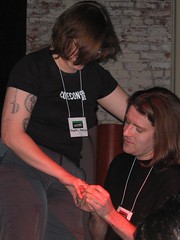
At lunch, Spider snuck me out of the building and she showed me around San Francisco. She pointed out the Eagle Tavern with a glimmer in her eye. I think she's trying to corrupt me. Or she's trying to pimp me out. Then we went to Stompers where she tried on some boots. We were stymied, however, by the fact that a very annoying woman and her husband were trying on every single pair of boots in the entire store. iGlance is a real-world video-conferencing and screen-sharing application that has some fairly good usability built into it. It also has a fairly sensible privacy model and does some NAT punching to boot. Although it's only got a Win32 port for now, it's free software so someone will fix it up. Sometime in the afternoon, the beautiful and fair [info]wealhtheow came behind the bar and surprised me with a hug and a sandwich! I was happy with the random hug from a new friend, but the sandwich was wonderful. I had not eaten lunch on Friday so I was very grateful. She put a huge smile on my face. I munched on the sandwich while listening to the OASIS talk. This technology is a locality-aware server-selection resolver, which is pretty good for distributing servers around the world and finding the fastest one. They implement this as a DNS redirector so that lookups are transparent to normal Internet software. This made me feel a little bad for [info]holdenk, whose SelfDirectedProject happens to be on a very similar topic. It does, however, validate his approach. [info]maradydd's presentation about Query by Example was up next. She did a very good introduction to data-mining, which segued into her hack on PostgreSQL where you can specify examples of things you want to search for. That is not how SQL normally works, where you specify constraints. With QBE, you just specify things similiar to what you want, and things similar to what you don't want.

Proposal
Originally uploaded by sfllaw.
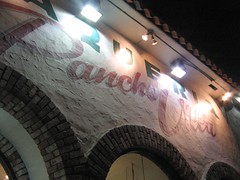
I was chatting with Rob Pascual when I noticed Len lining up in the Q&A; queue. Suddenly, my ears perked up as I sensed something important was going to happen. So I pulled out my camera, stepped on some toes, and got into position. When it was his turn at the microphone, he started saying random stuff that wasn't question at all! Something cheesy like how Meredith had changed his life and how he wanted to be with her. Then he got up on stage and asked The Question. It was beautiful. The audience broke out into cheers and applause, except for the heartless bastards beside me. But who cares about them? This was such an awesome occurance that an interview was taped. After teardown, some people were going to head to a franchise Mexican restaurant. Spider insisted that I get real food, so we walked down to the Mission. We made a detour to Good Vibrations which is a San Francisco landmark if ever there was one. I swear that she's trying to corrupt me. Anyway, as we were walking out, I must have mentioned that I was from Canada. Because Cohen, a Torontonian, came out of nowhere and introduced himself to us. Well, what was I to do but to invite my fellow countryman to dinner? So we set off to find a Taqueria that served nopales. This failed since Californians don't seem to like eating cactus. Instead, we went to Pancho Villa where I ate enchiladas and salsa verde and guacamole and churros and I was so very happy! We bid farewell to Cohen after exchanging contact information and tried to find everyone else. Unfortunately, we couldn't reach anyone by cellphone, so we sat around dejected for a while. Then we realised that we could go to Annie's Social Club where an event was happening. This turned out to be a good and a bad idea.

Taqueria
Originally uploaded by sfllaw.
It was a good idea because we found everyone at CodeCon. It was a bad idea because Annie's Social Club double-booked us with bad karaoke! And then were quite rude when we complained. And then kicked out John Gilmore. So I just want to say that Annie's Social Club hates geeks and freedom. So Len hailed a black stretch limousine, we all climbed into it, invited some reporters along and moved the entire party to the XYZ bar. The XYZ staff were very awesome, accommodating an extra hundred patrons and getting an extra bartender. And they were very nice about it. Unfortunately, the bar was full, so I had to lead a bunch of introverts in the fine art of taking over an establishment. We walked in, started talking, I encouraged people to sit down in empty spots on the couches. They did a very admirable job of taking over the back. I got the stunningly adorable [info]akashayi a seat and a drink, before I taked to the people sitting with us. They were a couple who had moved from Florida to San Francisco, and a man from New York who was quite the boor. The man in the couple knew the New Yorker and seemed quite embarassed about him. After twenty minutes of conversation, they excused themselves and bid us good night. This gave us plenty of seating space to talk about geeky things until the manager kindly kicked us out. I made sure Akasha got safely to her hostel and then took a taxi back to the guest room. It was quite the challenge to direct the cab driver, since I had lost the directions back, but I managed!

21 February 2006

Josselin Mouette: Kill the lizard

In tonight's dinstall run, new versions of epiphany and yelp will enter unstable, built against xulrunner. This means that finally, gnome will be installable without a mozilla-browser dependency. Packages using XUL are now linked to correctly versioned libraries, that also use the system versions of libraries wherever possible. This is hopefully the end of a long-standing history of various problems with mozilla.

Thanks a lot to glandium for his huge work on xulrunner.

17 February 2006

Martin F. Krafft: Pet peeves: cookies and redirects

If you design your website so that it requires cookies, you ought to be punched (c.f. Sesse). When I surf the web, I usually choose to deny cookies for this reason; should I find out that cookies are actually needed, the excellent Cookie Button Firefox extension allows me to rethink my choice. If you implement redirect chains like ticketcorner.ch to www.ticketcorner.ch to www.ticketcorner.com to www2.ticketcorner.com, you ought to be kicked and battered, especially if those are implemented with meta refresh instead of HTTP redirect. If you set a cookie from www.ticketcorner.com with cookie domain .ticketcorner.com and require that on www2.ticketcorner.com, you should be slaughtered. And Firefox should certainly have a better means to edit cookie restrictions outside of the current domain than to require me to go to the preferences and click a hundred times until I can browse a huge list of cookie exceptions (no search) for a the entry, remove it, reload the page, and cast another vote. I have not found an extension to do this...

13 February 2006

Joey Hess: patch followup

Followup on my previous review of Ubuntu's patches to my packages: So things have improved for my packages, at least after I made a stink about it and some people pretty clearly made it a priority to fix it. I doubt that this can be extrapolated to any other set of packages though. Total useful stuff gleaned this time: One minor build-depends fix, one icon.
Total estimated time to subit those to Debian BTS: approximatly 2 minutes.
Total time it took me to extract them from the diffs: about an hour.

10 February 2006

Michael Janssen: Pet peeve number 1

Okay, something bugs me, and it's somewhat irrational, and somewhat rational. I totally hate really long URLs needed to "verify" that the sign-up is valid. There are more than one type of these, sometimes they are required to continue into the site, sometime just for extra features, but they are more often that not, very long. Now, I don't like long URLs in general in emails, because there are many services which allow you to shorten them for public use. Recently I signed up for 30 boxes and they sent me this monstrosity:

http://30boxes.com/signup.php?action=finishSignup&d=aSDFJKLa43da
safjdAL5RLKj4afjrafa45J5kljtyTGJrALKJgFKLsaj5klJ4jkljakljdkalflk
fASJKjdfa4r23890fdfjskl342390fakjlei309dk390ujkal39032kd03j9djd9

Okay, so lets look at this rationally for a bit. How many unique strings can they have from that huge behemoth of an identifier. There are 145 characters. They are using the entire uppercase (26), lowercase (26) and numbers (10), so there are a total of 62 unique symbols for each spot. That gives us a total of 62145 different strings. That's

78848779858160540639233408124436328679807474352650645474403652978
77812230999983634922053904324829205441837830921209410767866820350
39259149646534571887966722870103317751633817974743087029882020930
78213775489032524047364643001443429901072761743321026356976812032

different combinations. In scientific notation, thats 7.8 × 10259. Just for comparison, the entire number of atoms in the universe is high-balled at 6 × 1079 (on this page). That's more than a googol of identifiers for EACH ATOM, EVERYWHERE. Isn't naming each atom once enough? Then you would only need 45 characters, which would nicely fit in one line of my email client if you just shortened your "finishSignup" to "fS" and action to "a". As a bonus, it also saves you approximately 117 bytes of bandwidth per email. UPDATE: Apparently it has ALL the information, in addition to being completely too long. I replaced it with random crap.

6 February 2006

Norbert Tretkowski: Logo for ion3

\documentclass article
\usepackage pstricks
\begin document
\pagestyle empty
\begin pspicture (-5,-5)(5,5)
\newrgbcolor tuomoblue .6 .6 .6667
\pscircle[fillstyle=solid,fillcolor=tuomoblue](0,0) .7
\rput(0,0) \Huge$i^+_3$
\end pspicture
\end document
Details in the ion wiki. I like this logo.

3 February 2006

Dirk Eddelbuettel: RGtk2 packages available

Michael Lawrence announced the release of RGtk2 yesterday on both r-packages and r-sig-gui. This follows his impressive presentation at DSC 2005 and finally makes the code available. RGtk2 is, as the name suggests, an update of the older RGtk package (that I'd been maintaining in Debian as r-omegahat-rgtk) to the 'newer' version 2 of Gtk (aka The GIMP Toolkit). It provides Gtk goodies for the amazing R language and environment many of us dig for its use in statistical computing, visualization, data analysis, estimation and more. RGtk2 is quite an achievement. The source package is huge at 1.9mb, the resulting Debian package even huger at 5.3mb, and it all seems to work fine based on some initial tests of running the demos. Based on the two source packages, I created two packages of RGtk2 (as r-omegahat-rgtk2) and the Cairo device (as r-omegahat-cairodevice) which you can fetch from here. Not sure if I feel the urge to maintain them, but if someone else wants to step forward, let me know. Sources and diffs are in the same directory. Feedback welcome. Update: By the way, what do we need to build with gtkmozembed? I didn't find a proper Build-Depends: for this.

2 February 2006

Andres Salomon: need some Home Alone-style booby traps

When I returned home to my apartment today, I noticed the front door was open. I heard voices upstairs, so I didn’t close it. Later on, I heard the sounds of walkie talkies in the hall, so I poked my head out of the door to see what was going on. Apparently, someone in my apartment had been robbed; cops were in the hall, talking to the lady that lives on the second floor. However, while the thieves were carrying a TV outside and loading it into a car, apparently some cops happened to notice. There was some form of a chase, and one person was caught while the other got away. I checked the outside of the apartment building, but didn’t see any “Break into me! I have lots of valuables!” signs posted anywhere. Oh well, maybe there’s something else that makes this place a huge target for thieves. Or perhaps it’s just the neighborhood.

1 February 2006

Martin F. Krafft: I have the fastest cable modem

Either Lars really publishes Gigabytes worth in a single image and my provider is the fastest on earth, or the Extended Statusbar plugin for Firefox has some other issues:
http://blog.madduck.net/static/lars-huge-image.jpg

David Nusinow: Modular Server Debs!

I've been relatively quiet lately because I've been plodding along, working on modular packages for Xorg. For those who don't know, the next release of Xorg will actually be two releases of the same code. One release, 6.9, will be based on the old monolithic build system. This system requires me to build every single part of Xorg whenever I want to update any one part. This means that whenever I push out an Xorg fix, no matter which component it's in, you have to download all the other components even if they are 100% identical to the previous version already on your hard drive. We've all lived with this for a long time, and while it's not pleasant, we all seem to get by. The packaging apparatus for this system is mature, stable, and well understood, if complex. That's why I've been able to get the 6.9 release candidate packages out to experimental fairly quickly after they are released.

The other release happening is for 7.0, which is obviously a major version number bump. The actual code you run for 6.9 and 7.0 is 100% identical, but the build system has been totally rewritten around the venerable autotools (you know... configure /make/make install). Each piece has been split out from the others so that you can build any one component without building all the others. This means that if we want to ship a driver update, you don't have to download all of the fonts and other things that weren't touched. That also means that you won't have to install the drivers for cards you don't own if you don't want them. Furthermore, it lowers the barrier for things like hacking on X significantly.

The problem with the modular tree is that the packages for it are brand new. Ubuntu shipped modularized versions of the libraries, and I've already stolen those, fixed them up for Debian, and built them locally (they're sitting in our svn repo, but running them won't get you anything at this point.) The server and driver packages are brand new, and I've been taking the packages from Ubuntu's development branch and working on them for Debian. Today was a milestone day because in addition to the libs, with Daniel Stone's constant help I've finally managed to build packages for the modular X server itself. Now I can't run it yet (I haven't packaged the drivers and a few other bits) but the fact that I managed to produce what will be a functional server package is a huge step, and constitutes the cornerstone of the whole thing.

Once we can create packages that can actually run on at least the machines of the XSF, we can start looking at getting the packages in to the archive. Since these aren't well tested like the monolithic packages, we'll have to do a lot of polishing to get them to the same level of quality. My goal is to get that done for etch though, and I think we can do it. Exciting things are happening, and I'm hoping that the modular packages will encourage more people to hack on X, leading to even more exciting things. Build that momentum.

David Nusinow: Quilt Rocks My Socks

Last time I blogged about a bug a lot of people had reported with X.Org, and at that time the workaround was to download a file and replace the installed version with it. Well, Eugene Konev came through and found a more complete patch and we've got that bug essentially fixed on our end, so I think most people can now run X.Org on Debian without fear. The bug in gcc4 is still present, but the next upload of gcc will include a fix for the issue, so we'll feel a lot more confident that the bug is really dealt with the next time we upload. Another thing that's happened is that it appears that the current upload does finally build on all arches (after I messed up -3, which should have been the one to do so) so that's one major issue happily out of the way.

We've already begun putting together another X.Org upload that should happen soonish. There's a pretty crippling bug on alpha that Steve Langasek has already provided a patch for. The big news though is that I've finally ripped out the X.Org package reliance on dbs and replaced it with quilt. Eugene Konev hacked up a very good version of the debian/rules file (which controls building of the package, for those of you who haven't dealt with the internals of a .deb before) that uses quilt instead of dbs. I did a little work on it myself so that it would provide the same basic features that dbs gave us, and now it's been rolled in to the svn archive.

Now this won't directly affect any users, but what it will do is let us process patches much faster than with dbs. dbs requires that you copy the whole source tree once, copy it again after applying patches, and then diff the whole tree when it's done. For small trees this isn't a huge deal, but for X.Org this is crippling, especially on my laptop where I do all my work. quilt lets me edit patches in place, and only diff those files that are edited. In addition, if there's a patch that I already pulled from somewhere like X.Org CVS or Redhat's bugzilla, I can simply tell quilt to import it and it will. This literally will save me an hour per patch. quilt also buys us some cool features like being able to check patch dependencies, tell what patches alter what files, and sort patches in to subdirectory heirarchies rather than having hundreds of patches sorted solely by name. Plus, it knows about patch documentation, which dbs will overwrite by default, and quilt will happily preserve.

So hopefully this will make the XSF ever so slightly faster at getting things done, although we're still obviously hampered by the scale of the source tree. Future patch audits should be on the order of days rather than weeks with this system, which lays the groundwork for work on 6.9/7.0.

David Nusinow: X.Org: Oops

Last time I blogged about the libglu situation, which I explained was necessary because of the C++ ABI transition in changing over from gcc3 to gcc4. libglu is the one library written in C++ in all of the X.Org source tree, so it was the only one that had to be broken.

It turns out we were wrong about that. libglu is indeed written in C++, but Marcelo Magallon pointed out that it only exports a C ABI, and as such it doesn't need to be transitioned. I have admittedly little experience with shlibs myself, so I didn't know such a thing was even possible, and no one else caught it either. The next version of X.Org, which will be uploaded as soon as I can get it built, will have this fixed, and nvidia-glx, and everything that depended on xlibmesa3-glu will hopefully install just fine once that goes in. Sorry about that everyone.

In addition, this upload should have correct MANIFEST files for all arches, which will hopefully allow it to build successfully on all of them. This will allow X.Org to transition in to etch after a week and a half. This will also unstick gnome 2.10's transition in to etch, which is now tied up with X.Org. Daniel Stone helped pull those MANIFEST updates together, which has been a huge help, so you should send him your hugs 'n kisses. There is an issue with libvgahw which a lot of people have reported, which causes problems when you switch to a virtual text console and then back in to X, which should be fixed in this upload as well (you can thank David Mart nez Moreno for tracking that one down before I could even blink). Finally, xterm bold fonts have been looking like garbage, but Eugene Konev came up with a patch to fix that, which I'm working on rolling in right now.

So if all goes according to plan (that's your cue to laugh mercilessly at me) the next upload will move in to testing just fine, leaving us with room to make larger improvements in the X.Org packaging, as well as working towards getting the (currently unreleased) next version of X.Org in to Debian.

David Nusinow: Today Was A Good Day

Today was a very good day. One of those days where somehow things just go very well.

First, I managed to debug a problem at work over which I've been tearing my hair out for the past year. This means I can start generating some real data tomorrow and maybe even graduate one day.

Second, I checked my mail to find that kick-ass ftpmaster Joerg Jaspert has approved almost all the modular packages I uploaded to experimental. This includes the protocol headers and libraries which are a big chunk of the whole. He also gave me some stuff to fix up on two packages which didn't make it, so I'll be working on getting those two ready ASAP, but simply having some of the mass start to enter experimental is nice. Note: I seriously do not recommend running the modular stuff yet from experimental, since the change from X11R6 to X11R7 introduces a serious change that will break unless you know what you're doing or have a full X11R7 system (which you won't). I'm not even running 7.0 yet outside of a chroot, which brings me to the next item...

Third, I finally managed to get the modular X server running entirely from what's packaged in our svn repo. This is a huge step because it means that I'm getting much closer to the full functionality offered by the current 6.9 packages. This is a major milestone for me personally, because I'm starting to see the end of what I set out to do when I took on the Xorg packages a few months ago. It also gives me a serious hope for shipping 7.0 with etch. Needless to say, I'm pretty happy.

28 January 2006

Uwe Hermann: Al Gore Speech on Unlawful Wiretapping, Imprisonment, and Torture by US President Bush

Al Gore Al Gore, former vice president of the US, has given a very, very interesting and impressing speech on Martin Luther King Day a few days ago. He states very clearly a huge number of (unlawful, illegal, or immoral) things the current US president Bush and/or his administration have done. For example: A quote of Al Gore, from a small Reuters summary of the speech:
We still have much to learn about the NSA's domestic surveillance. What we do know about this pervasive wiretapping virtually compels the conclusion that the president of the United States has been breaking the law repeatedly and insistently.
Transscripts are available from The Raw Story and the Washington Post, and there's also a full audio recording of the speech (MP3, 48 MB). Although I'm not very political usually (or at least I don't write too much about it), this is really something I highly recommend listening to. I cannot imagine why a president of a democratic country can still be in charge, after all these things have become publically known... (via Tim Pritlove)

27 January 2006

Colin Watson: debconf/cdebconf coinstallability

Joey has been campaigning for a while to get everything in the archive changed to depend on debconf debconf-2.0 or similar rather than just debconf, in order that we can start rolling out cdebconf as its replacement. Like most jobs that involve touching the bulk of the archive, this looks set to take quite a while, as the list of bugs should indicate. Recently it occurred to me that we didn't necessarily have to do it that way round. In a bout of late-night hacking while staying awake to look after a sick child (he seems mostly OK now, although the rushed trip to the hospital earlier was a bit on the nerve-wracking side), I've shuffled things around in the cdebconf package so that it no longer has any file conflicts with debconf or debconf-doc, and changed the debconf confmodule to fire up the cdebconf frontend rather than its own if the DEBCONF_USE_CDEBCONF environment variable is non-empty. (The details of this may change before it actually gets uploaded, as I'd like to get Joey to look it over and approve it first.) This allows you to install cdebconf, set that environment variable, and play around with cdebconf with relative ease; when we come to switch to cdebconf for real, instead of a huge conflicting mess that apt will probably have trouble resolving, it'll just be a matter of changing a couple of lines in /usr/share/debconf/confmodule. Of course, don't expect cdebconf to be a complete working replacement for debconf just yet; if you try using it for a dist-upgrade run it'll fall over. Due to its d-i heritage, it doesn't yet load templates automatically; that has to be done by hand. Frontend names differ from debconf's, which will need some migration code. At the moment it can only handle UTF-8 templates, which are mandated in the installer but only optional in the rest of the system. It doesn't have all of debconf's rich array of database modules. I haven't adapted the Perl or Python confmodules yet. The list goes on. However, I think we at least stand a chance of getting a handle on the problem now. (I'll post this article to debian-devel once the changes have been reviewed and uploaded.)

26 January 2006

Steve Kemp: These are a few of my favourite things

Yesterday
Yesterday was a hectic day involving lots of beer. Last night I:
  • Went out for a meal with some visiting Americans. (2 pints of beer)
  • Went out to the Guildford Arms to meet some visiting Dutch people (2 pints of guiness) [Signed and uploaded all three GPG keys this morning]
  • Went out to The Auld Hoose to meet friends. (1 bottle Newcastle Brown Ale)
Waking up this morning was a long and gradual process. Now I have to fight to install SCO upon a new HP server. The machine has no floppy drive, and requires additional drivers to be installed to access the disks. Fun stuff.
Today
Some Debian work:
  • Orphaned “ud” since it is in a bad shape and I just can’t bring myself to care.
  • (Now every package I “own” is in a great state and used by me semi-daily.)
  • Made a new sarge backport of xen-tools.
  • Have a pending upload of Komi to fix a FTBFS issue.
  • Need to make the CSS changes to the Debian Admin site to improve the site header.
Tomorrow I need to setup a new site to advert the commercial setup/support I’ve been doing for the past few months. First of all I need to actually clarify what I’ll offer, then work out how to charge, etc. In the past I’ve mostly done single-server setups for one-off fees, and maintainence which just included applying security updates plus monitoring disk-space + services. Not sure that there is a huge market for it, but it is something I’d like to do more of, even if there is no money involved.

21 January 2006

Ian Murdock: The celestial jukebox

Fred Wilson: “I will not buy music that I cannot remove the DRM from.” I agree wholeheartedly, though the strategy I use is the one Fred dismisses in the first paragraph, namely burning the music to CD and ripping it back, sans DRM, to MP3 format. Yes, it’s a pain, but it beats having to jump through all the digital hoops at some indeterminate point in the future when all I want to do is queue up a song I’ve legitimately purchased and have probably forgotten where I bought the thing, let alone what magic pixie dust I need to decode it. Sure, the MP3 format has issues too, but at least I know my music will play anywhere. (Since I’m on the subject, I’m looking for some sort of a virtual CD burner, which the operating system thinks is a CD burner but which is actually a piece of software that converts the tracks it “burns” to MP3 format. Anyone know if such a beast exists? That would certainly do wonders to curtail my contribution to the world’s coaster supply.) In practice, DRM isn’t as much as a problem for me as it seems to be for other people. Personally speaking, I don’t want to be in the music storage business—I’d much rather stream music on demand from some digital jukebox in the sky, which is why I’ve been a Rhapsody customer since 2003. (Greg Papadopoulos sums up my thinking pretty well exactly here: “I’ll bet that we will look back of this era of quasi-networking and wince, ‘How did we ever live that way?’ And the idea of wanting to carry all of your content with you will seem both old-fashioned and rather ridiculous.”) In my case, DRM is normally a non-issue—I simply route around it. Rhapsody has come a long way since I first started using it in 2003: They added a Rhapsody To Go service, which more or less solves the “disconnected operation” problem (though I still tangle with DRM issues from time to time if I go for too many days untethered), and they finally embraced the web, though the current web offering leaves much to be desired—the Linux plugin still doesn’t support Firefox 1.5 nearly two months after its release, the web interface has huge gaps compared to the jukebox software (you can’t access your music library on the web, among other things?!), and they don’t seem to be taking advantage of the new web platform at all (where, oh where, are the RSS feeds of my favorites, recommendations, etc, so I can mash them up with other stuff?). At the end of the day, I suspect the “economic boycott” James Governor calls for is the right way to fix the DRM problem. For my part, I’m voting with my wallet by supporting the model I want to win out in the end (that your music library will live on the web, not on your PC or in your pocket) and by buying music, in those rare cases when I do want to manage my own music library rather than letting someone else do it for me, from legitimate music services but opting out of the silos the platform providers are trying to build around me as a byproduct. Above all, I resist the temptation to climb into the big, beautiful lockbox Apple is building for us. As Clayton Christensen recently told BusinessWeek, I’m firmly convinced open standards will win out in the end:
Look at any industry — not just computers and MP3 players. You also see it in aircrafts and software, and medical devices, and over and over. During the early stages of an industry, when the functionality and reliability of a product isn’t yet adequate to meet customer’s needs, a proprietary solution is almost always the right solution — because it allows you to knit all the pieces together in an optimized way. But once the technology matures and becomes good enough, industry standards emerge. That leads to the standardization of interfaces, which lets companies specialize on pieces of the overall system, and the product becomes modular. At that point, the competitive advantage of the early leader dissipates, and the ability to make money migrates to whoever controls the performance-defining subsystem.
I don’t know about the rest of you, but that day can’t arrive soon enough for me.

20 January 2006

Edd Dumbill: On the internet, everyone can see your underpants

The controversy over Apple's "photocast" extensions, and the strangeness of their iTunes RSS enhancements, is illustrative of the transition that software companies need to make as they become web-enabled. It's no longer enough to make your applications and hardware pretty and functional, but the guts that other people get to see must look good too. This is one reason that people prefer RELAX NG over XML Schema, for instance. Where markup is concerned, it turns out that the excuse "only computers will read it, and we'll provide tools to generate it" doesn't cut it. The web's had a view-source mentality since it started, and the aesthetics of markup matter a great deal. They matter not only because they're nice for geeks to look at, but also because well-structured and standards-compliant markup is simply more interoperable. The end user experience is ultimately improved. Microsoft now gets this, I think. It's not hard--you just need to have your engineers exposed to the web, not hidden in some blinkered bunker. It's a shame that Apple doesn't yet understand that the aesthetics of markup count. Even their new web tool, iWeb, lacks somewhat in this department. Apple do so well in the rest of the computing experience, these poor web efforts really stand out. It was rather sad to read the disappointment OS X-hugging web developers felt with the iPhoto RSS use. Will Apple "get" the web better someday? I hope so, because we'll all benefit.

Amaya Rodrigo: Rejoice?

And while I rejoice, fEnIo mourns his loss. It is always terrible to loose a loved one. I send XXL Hugs your way.

Dan Weber: DWeb's guide to cleaning shoes

Today I was running out the door chasing the dog. The dog saw a person walking on the street and ran up to see her. I managed to get a hold on the dog and bring her home, but on the way back, theres this mini slope. Of course I'm bringing dog back inside and didn't think of this and get my sneakers covered in mud as there is a big ditch at the bottom. :(

So here's my instructions on washing shoes:

- First toss them in the washing machine on a low water level setting. Add in a bit of laundry detergent to help get the stink and mud out.
- Next take them out and stuff them with newspaper. Don't let the chunks of newspaper be too thick or it will not absorb as well. Leave newspaper in both shoes for 30-45 minutes.
- Now its time to let them air dry. The best approach is to put a fan in front of them. The more power the faster they dry. Right where I live right now, its the middle of a heat wave. So I realized the big air conditioning fan and motor outside is going around 24/7 and with huge amounts of hot air. If you take the latter approach, the shoes are usually dry with 1.5-2 hours, especially since it runs at least 10000 rpm. Otherwise the in house approach may take 4-6 hours. Also note that the air blown out from under your refrigerator is also good.

So in under 3 hours you can have your shoes squeaky clean with a nice smell, and be dry.

Next.

Previous.