Search Results: "edd"

6 April 2011

Michal Čihař: Pushing harder on incomplete translations

Looking at current state of some phpMyAdmin translations, I came to conclusion that some are not worth shipping, because they really do not translate reasonable amount of the interface. The problematic question is where to draw the line. For 3.4.0-rc1 I drew it at 50% of messages, what means that 25 languages currently pass. It might look too strict and the threshold will most likely change for final 3.4.0, but we need to start somewhere. While discussing this topic on mailing list, Tyron Madlener came with idea to tell users of incomplete translations about it and point them to information how to contribute. I quickly implemented this idea and it is now in git and live on demo server. I deliberately decided not to remove incomplete translations on demo server, maybe they will attract new contributors thanks to new warning on main page.

Filed under: English Phpmyadmin 2 comments Flattr this!

5 April 2011

Dirk Eddelbuettel: Rcpp 0.9.3

A brand new and shiny 0.9.3 release of Rcpp is now on CRAN and Debian. This version contains an actual bug fix for Rcpp modules and a few build improvements, including for both clang/llvm and g++-4.6 (which, being in Debian, is already used for conformance checks on CRAN's incoming directory) and g++-4.5. We also updated the main introductory vignette Rcpp-introduction to the content of what should be a forthcoming paper in the Journal of Statistical Software. The complete NEWS entry is below; more details are in the ChangeLog file in the package and on the Rcpp Changelog page.
0.9.3   2011-04-05
    o   Fixed a bug in which modules code was not behaving when compiled 
        twice as can easily happen with inline'ed version
    o   Exceptions code includes exception_defines.h only when g++ is 4.5 or
        younger as the file no longer exists with g++-4.6
    
    o   The documentation Makefile now uses the $R_HOME environment variable
    o   The documentation Makefile no longer calls clean in the all target
    o   C++ conformance issue found by clang/llvm addressed by re-ordering
        declarations in grow.h as unqualified names must be declared before
        they are used, even when used within templates
    o   The 'long long' typedef now depends on C++0x being enabled as this
        was not a feature in C++98; this suppresses a new g++-4.5 warning
    o   The Rcpp-introduction vignette was updated to the forthcoming JSS paper
Thanks to CRANberries, there is also a diff to the previous release 0.9.2:
Diff between Rcpp versions 0.9.2 dated 2011-02-24 and 0.9.3 dated 2011-04-05
 ChangeLog                                                      60 
 DESCRIPTION                                                     8 
 R/00_classes.R                                                  5 
 R/01_show.R                                                    44 
 R/Module.R                                                      1 
 cleanup                                                         2 
 inst/NEWS                                                      23 
 inst/doc/Makefile                                              74 
 inst/doc/Rcpp-FAQ.pdf                                       binary
 inst/doc/Rcpp-FAQ/Rcpp-FAQ.Rnw                                  2 
 inst/doc/Rcpp-extending.pdf                                 binary
 inst/doc/Rcpp-introduction.Rnw                               1355 +++++++------
 inst/doc/Rcpp-introduction.pdf                              binary
 inst/doc/Rcpp-modules.pdf                                   binary
 inst/doc/Rcpp-package.pdf                                   binary
 inst/doc/Rcpp-quickref.pdf                                  binary
 inst/doc/Rcpp-sugar.pdf                                     binary
 inst/doc/Rcpp-unitTests.pdf                                 binary
 inst/doc/Rcpp.bib                                              99 
 inst/doc/jss.bst                                            only
 inst/doc/unitTests-results/Rcpp-unitTests.html                 18 
 inst/doc/unitTests-results/Rcpp-unitTests.txt                  46 
 inst/include/Rcpp/Module.h                                     40 
 inst/include/Rcpp/Vector.h                                      6 
 inst/include/Rcpp/config.h                                      2 
 inst/include/Rcpp/grow.h                                       91 
 inst/include/Rcpp/module/Module_generated_ctor_signature.h     18 
 inst/include/Rcpp/vector/RangeIndexer.h                         5 
 inst/include/RcppCommon.h                                       6 
 inst/unitTests/runit.Module.R                                  19 
 inst/unitTests/testRcppModule/src/stdVector.cpp                 7 
 src/exceptions.cpp                                              2 
 32 files changed, 1167 insertions(+), 766 deletions(-)
As always, even fuller details are on the Rcpp Changelog page and the Rcpp page which also leads to the downloads, the browseable doxygen docs and zip files of doxygen output for the standard formats. A local directory has source and documentation too. Questions, comments etc should go to the rcpp-devel mailing list off the R-Forge page

4 April 2011

Dirk Eddelbuettel: RQuantLib 0.3.7

A build-fix release RQuantLib 0.3.7 is now on CRAN and in Debian. RQuantLib combines (some of) the quantitative analytics of QuantLib with the R statistical computing environment and language. Thanks to the help by Brian Ripley (who compiled QuantLib for 64 bit Windows), Josh Ulrich (who did the same for 32 bit Windows, and arranged the Windows builds) and Uwe Ligges (who runs win-builder for R) we once again have Windows binaries as well as the usual source distribution (and Debian binaries). The only other change was minor fix to the documentation files. We had found that the pdf reference manual build would break for Uwe and Kurt (using A4 paper settings) but not myself (using letter). Uwe finally tracked that down: we had some arguments to \url with over seventy characters, and that broke typesetting. I commented those out (as the entries were in doxygen-generated QuantLib page which have volatile names anyway) and fully automated builds now resume as usual. Thanks again to Uwe for that too. No other changes were made. Thanks to CRANberries, there is also a diff to the previous release 0.3.6. Full changelog details, examples and more details about this package are at my RQuantLib page.

Dirk Eddelbuettel: RcppArmadillo 0.2.18

Conrad Sanderson made a bug-fix release (1.1.92) by for his wonderful Armadillo templated C++ library for linear algebra appeared yesterday and as usual a new release 0.2.18 of RcppArmadillo, our Rcpp-based integration into R is now on CRAN mirrors. The short NEWS file extract follows below containing just Conrad's entry for 1.1.92. No further changes from our side.
0.2.18  2011-04-03
    o   Upgraded to Armadillo Version 1.1.92  "Jurassic Barbecue"
          * Bugfix in cor()
          * Automatic installation now requires CMake >= 2.6
And courtesy of CRANberries, here are the diffs to the previous release.
 ChangeLog                                          8 ++
 DESCRIPTION                                       10 +--
 inst/NEWS                                          7 ++
 inst/doc/Makefile                                  2 
 inst/doc/RcppArmadillo-unitTests.tex           only
 inst/include/armadillo_bits/Cube_meat.hpp         12 ---
 inst/include/armadillo_bits/Cube_proto.hpp         4 -
 inst/include/armadillo_bits/Mat_meat.hpp           2 
 inst/include/armadillo_bits/Mat_proto.hpp          4 -
 inst/include/armadillo_bits/arma_version.hpp       4 -
 inst/include/armadillo_bits/glue_cor_meat.hpp     83 ++++++++++++--------------
 11 files changed, 73 insertions(+), 63 deletions(-)
More information is on the RcppArmadillo page. Questions, comments etc should go to the rcpp-devel mailing list off the R-Forge page.

3 April 2011

Dirk Eddelbuettel: Race That's Good For Life 2011

Today was the 30th annual Race That's Good for Life 5k race in Oak Park. I had run this in 2003, 2004, 2005 and 2006 but not afterwards as the spring marathons got in the way. As I am now on a more relaxed (and seemingly non-marathon ;-) schedule, I was able to participate again. Really nice to leave your house fifty minutes before race start and cycle over... And kudos to the Oak Park Runner's Club who once again put a nice race together. Given the lack of (more intense) training, I am also a lot slower: 21:50.7 was the chip time, or a 7:02 pace. We will see if I ever get faster again. On race day I am usually motivated; it remains to be seen if I get over to the track in the early morning to push myself through some speedwork.

Rog rio Brito: Running GRUB2 on PowerPC Macs

Here I write a little bit about my experiences running GRUB2 with a PowerPC Mac (actually, an iBook G4), since the current documentation is lacking in many places (outdated, incorrect, etc.). Some of what I say is platform agnostic, though, and may be of interest to users of GRUB in general.

Basics using GRUB2 with PowerPC First of all, it is important to understand (at least superficially) how botting on a Mac works. One of the first programs that run in your Mac is the OpenFirmware. It works with more or less the same purpose of a BIOS in a regular x86 system. The basic idea is the same: get the computer running with whatever programs you want it to run. The implementation, though, differs quite a bit. First of all, OpenFirmware (OF) usually presents itself as a command-line interface that is programmable, differently from the common day BIOSes from x86 boxes. As it is programmable, it is more flexible, but this flexibility comes at the price of an increased complexity. I may write some things more in a future article, if there is any interest. For now, it just suffices to say that to get to the OF prompt in a Mac, you have to press a combination keys during the time that your Mac gives a chime when you turn it on. At that moment, you have to press (simulaneously) Cmd + Option + O + F. (Note: the Cmd key is the key that has an Apple drawn on it, usually on the side of the space bar).

Limitations of Open Firmware Differently from usual BIOSes of x86 computers, Open Firmware can read the contents of a partition in your HD (or other devices), as long as it is formatted in the original HFS format (not in HFS+ or one of its descendents). This is the reason why some older versions of Linux create an HFS partition in your HD, even if you don't intent to run or use anything besides Linux. The yaboot bootloader consists of, among other things, one binary that is understandable by OpenFirmware. That binary is a file called yaboot, after the name of the booloader. As an aside, you have to indicate to OF what is the file that you want it to load during the boot process, so that it knows what to do. The way to indicate this is to "bless" the file (and the folder that contains it). Some ways to bless a file are to, for example, use the bless command in MacOS X or the hattrib -b command from hfsutils. Files in an HFS filesystem have two attributes that many other filesystems don't: a creator ID (the "application" that created the file) and the type ID (which determines what kind of file it is). OpenFirmware, in particular, looks for files with the type tbxi for the bootstrap process. The yaboot binary is loaded by OF into memory and, then, control is passed to the yaboot program, which then reads its configuration file (yaboot.conf) from the same folder where the binary was in. The file yaboot.conf contains instructions for yaboot to do its job. The file yaboot.conf is very similar in construction to configurations of an older bootloader for x86 computers, lilo.conf. Also, in a way similar to what LILO requires, after you install some new kernel, change some parameter in the configuration file, etc., you have to run a program that will set up everything so that the boot process can know of your new configuration. With LILO, this command was called lilo, while with yaboot the command is called ybin (which, essentially, takes care of putting yaboot.conf in the bootstrap/HFS partition and blesses the yaboot binary).

Going to GRUB2 One of the characteristics of yaboot (which is left as an exercise to the reader to determine if it is a drawback or not) is exactly the way that changes in the configuration have to be copied to the special HFS partition: the step of running ybin. GRUB2 (and its older sibling, GRUB legacy) do away with that: during boot-time, it can understand the filesystems that you have in your computer and interactively load whatever you want from there, also from a command-line like OF, before any (regular) operating system has even been started. But how do you start GRUB2? Well, the way that this is performed is copying a binary to that special HFS partition. Here things start to be hairy, because GRUB2 has a lot of functionality, but it comes at the price of it consuming a lot of space (especially if you are using encrypted partitions or some kind of logical volume managements with some journalling filesystem that allows files to be compressed etc. on top of it). The list goes on. Usually, that special HFS partition only has 800KB, which, BTW, is the size of an old 3.5" floppy used with older Macs (note: due to some contraints on partitions and aligments of such partitions on cylinders, it is not uncommon for disk partitioning software to create partitions slighly larger than 800KB, but not much larger than that). A full-featured binary of GRUB2 to be placed on that HFS partition can have much more than those 800KB. But how do you get that binary, in the first place? And how do you fit that in the HFS partition?

Creating the GRUB2 binary To answer the first question, you have to construct it from your grub-ieee1275 package (I'm assuming here that you are using Debian or Ubuntu, but similar instructions may apply to other distributions). Then, a first step would be to create such binary with:
 mkdir /tmp/foo
 cd /tmp/foo
 cp -a /usr/lib/grub/powerpc-ieee1275/* .
 grub-mkimage -O powerpc-ieee1275 -o ../grub.img *.mod
The last command of these create an executable named grub.img that is callable from OF and which contains every module from grub-ieee1275. This executable that I call here grub.img is called, in GRUB2 parlance, the core image and it it seems to be named core.img in many systems. On my system, with those commands, the binary grub.img is about 1208KB, which is 50% larger than that 800KB partition. And you would like it to be much smaller, becase you want to still have your yaboot bootloader by default while you are evaluating your bootloaders (or using it as a backup plan). As GRUB2 follow a modular design, you can mix and match the features that you want. This already hints you to the way we can fit it in the HFS partition, and it is always the same story: just trim the fat.

Creating the configuration file You will also have to have GRUB2 configuration's file (or you will have to play with way more commands than you'd want to). An important distinction here is that you usually have 2 or more partitions on your Mac:
  • the special bootstrap/HFS partition where OF is going to look at (I'll call it /dev/hda2 here);
  • the partition where your / filesystem resides (denoted by /dev/hda3 here);
  • some partition to hold /boot (I don't have one of these, but let's say that it is /dev/hda7 for our discussion purposes), usually containing your kernels and initial ramdisks.
  • other partitions.
With this in mind, you can With Let's say that this last one, in Linux parlance, is /dev/hda3 (as is the case of this author), and optionally a partition where your Linux kernel resides (people usually use it to store the /boot subtree of a Linux filesystem). Let's say that this last one is /dev/hda7. Then, you would compose something like the following as a configuration file for GRUB2 (named grub.cfg):
insmod part_apple
insmod ext2
set root='(hd,apple7)'
menuentry "Linux"  
    linux /vmlinux root=/dev/hda3
    initrd /initrd
 
There are one two important points here that deserve more comments:
  • Note that, differently from a regular x86 system, in a Mac system with only one HD the way that you specify an HD does not have a trailing zero. For instance, in the case above of the variable root, we have (hd,apple7), while in a "common PC" we would have the (hd part replaced with (hd0. That's something that you should make your distribution aware of, if they aren't yet. As an addendum, I don't know how it works with systems with more than one HD, as I only have (PowerPC) Macs that are notebooks. If you can share any experiences, please do.
  • One point of caution here: what GRUB2 calls root is not necessarily the root of your filesystem (i.e., the partition that holds /), but the device that everything that is "not fully qualified" is interpreted as being relative to. The "not fully qualified" above means anything that is not prefixed with GRUB's device notation. As an example, (hd,apple2)/boot/vmlinux if fully qualified for GRUB's purpose, while /boot/vmlinux is not.

Putting it all together The next step is to just copy the files grub.img and grub.cfg to the special HFS partition. You can do that using hmount, hcopy, and humount or you can use the regular Linux hfs module to copy to that partition. Then, boot your system, get into the OF prompt and execute:
boot hd:2,grub.img
Here, the 2 above is a reference to my HFS partition. Substitute that with yours, appropriately. You will then see the common (familiar?) GRUB prompt and, from there, everything else that you know will (hopefully) work.

The list of modules that "Works for Me(TM)" As I mentioned above, I use a subset of all modules that come with grub-ieee1275 to create my grub.img binary. Here is the list of modules that I use and that gives me a reasonably sized bootloader:
bitmap.mod        datehook.mod  gzio.mod         lsmmap.mod      reboot.mod          terminal.mod
bitmap_scale.mod  datetime.mod  halt.mod         memdisk.mod     regexp.mod          test.mod
blocklist.mod     echo.mod      help.mod         memrw.mod       relocator.mod       trig.mod
boot.mod          elf.mod       hexdump.mod      minicmd.mod     scsi.mod            true.mod
bufio.mod         ext2.mod      hfs.mod          msdospart.mod   search.mod          video.mod
cat.mod           fat.mod       hfsplus.mod      normal.mod      search_fs_file.mod  video_fb.mod
cmp.mod           font.mod      ieee1275_fb.mod  part_apple.mod  search_fs_uuid.mod  videoinfo.mod
configfile.mod    fshelp.mod    linux.mod        part_msdos.mod  search_label.mod
cpio.mod          gettext.mod   loadenv.mod      parttool.mod    setjmp.mod
crypto.mod        gfxmenu.mod   loopback.mod     probe.mod       sleep.mod
date.mod          gfxterm.mod   ls.mod           read.mod        suspend.mod
Just for the record, my grub.img file has 624KB, and that can certainly be shrunk.

The command line that "Works for Me(TM)" to create the image Actually, I lied when I told you that I used the lines above to create my grub.img file, because I'm lazy and I don't want to type the .img extension. I also embed my configuration file in the binary that I create with GRUB2, so that I don't have two files to copy to my HFS partition, but only one. I do that with:
grub-mkimage -c grub.cfg -o ../grub -O powerpc-ieee1275 -d . *.mod
OK. No more lies here. The nice aspect of GRUB is that one you install that image, you don't have to touch that HFS partition anymore: you simply update your regular filesystem's /boot/grub/grub.cfg file (which is usually performed when you install a new kernel, at least with Debian) and you're ready to go. The good way to do that is to use a minimal configuration file embedded in your grub binary in your HFS partition that will hook into the system's /boot/grub/grub.cfg to read newer kernels and leave the HFS partition (and your system's NVRAM) alone. Here is what I am using right now:
search --no-floppy --fs-uuid --set=root 35d26869-f7c9-4852-a9b8-100314560c34
set prefix=($root)/boot/grub
configfile /boot/grub/grub.cfg
You will, of course, want to modify the file above as you install newer kernels (perhaps even that unsupported operating system from that fruity company, who knows?). Don't forget to change the UUID's, and partition numbers to fit your needs. Well, that's it. I hope that it helps somebody out there, as the information that I got otherwise was way outdated, incomplete, etc. to keep up with GRUB2 from these days. Now, let's go patch the tools that we have so that not everybody who wants to use GRUB2 have to learn about its workings. Oh, of course, you can now have your kernels in ext4, btrfs, xfs etc. partitions without the fear that your bootloader won't load them.

2 April 2011

Niels Thykier: Cross package checks in Lintian

If you have been using Lintian you may also know that it has some limitations. One of these are that Lintian always checks every package isolated from each other unlike other tools like piuparts. It has its advantages (such as not requiring all dependencies being present) but it also has it disadvantages. Currently Lintian emits a binary-without-manpage -tag if the package contains a binary without a manpage. At first glance this appears reasonable, but it really is too simple (#512645). Basically Lintian complains about the missing manpage even if the manpage will always be present. A simple case is package foo depends on foo-data, the binary is in foo and the manpage is in foo-data. A live example of this is gedit and gedit-common[1]. The problem is that Lintian does not know if a given package is going to processed or not. Lintian does have a few cross package checks; namely binary checks can see the source package if it is available. This can be done with a bit of clever sorting (quote from Lintian source code):
# [...] (the sort is to make sure that source packages are
# before the corresponding binary packages--this has the advantage that binary
# can use information from the source packages if these are unpacked)
This works rather well, but its scope is very limited. Particularly it is no help, if we need to check if the manpage missing in foo might be in foo-data. This is what #513663 is all about. In January I branched the Lintian code and started working on grouping packages from the same source together. Yesterday I finished refactoring Lintian to do just that. However, this in itself is not very useful if the checks cannot take advantage of this. So today I sat down and extended our manpages check a bit and posted the results to the Lintian mailing list. [1]http://packages.debian.org/sid/gedit http://packages.debian.org/sid/gedit-common

31 March 2011

Benjamin Drung: System cleanup

Tonight was system cleanup day. Baobob showed me where are the gigabytes hide. The home directory got rid of huge, old VCS checkouts of various projects. Then it was time to look at the system directories. I cleaned my apt cache sudo apt-get clean and the cache from pbuilder. Then I found something that lead to this blog post: /var/log consumed 3.8 GB. The biggest files were 1.8 GB /var/log/kern.log
1.8 GB /var/log/syslog
4.3 MB /var/log/dpkg.log
1.4 MB /var/log/kern.log.1
Flattr this

Josselin Mouette: News@11: Mozilla gives the finger to embedders

There have been a lot of web browsers embedding the Gecko engine, especially through the gtkmozembed library (it was not really a proper library but let s call it like that). I remember being a happy user of galeon, which went on as epiphany, but there were also all these small applications that just need a good HTML renderer in one of their widgets, like yelp, or several Python applications using python-gtkmozembed. Anyone having had to deal with these applications, especially the most complex ones, could tell you a few things: So, today, it is official: Mozilla is dropping gtkmozembed from their codebase. I don t think this will come as a surprise to anyone. You can t develop a new version of a behemoth, monolithic application every 3 months while still caring about the interfaces underneath. Embedded applications have been migrating to webkit over the recent years, and those that don t do it really soon will die. The interesting part of the announcement is not here. It can be found hidden in a bug report: a stable and versioned libmozjs will just never happen. What does it mean? First of all, it means that Debian and Ubuntu will have to go on maintaining their own versioning of libmozjs so that it can be linked to in a decent way by applications using the SpiderMonkey JS engine. It also means that this version will have to be bumped more often. But it also puts into question the whole future of SpiderMonkey as a separate library. With a shortened release cycle, the Mozilla developers will be tempted to add more specific interfaces to SpiderMonkey, reducing its genericity in favor of its use in Firefox itself. This will produce less and less useful libmozjs versions, until we reach the point when they ll make the same announcement as above, with s/gtkmozembed/libmozjs/. This is especially relevant in the context of the GNOME Shell, which is at the core of the GNOME 3 experience. The developers deliberately chose to avoid using JavaScriptCore (the JS library inside webkit) through the Seed engine, and used GJS instead, that relies on libmozjs. In my opinion this was done for frivolous reasons (being able to use more language extensions); and not only this put the GNOME developers in an awkward situation where 2 JS interpreters compete in the same desktop, but now it puts a risk on a technology which is at the core of the desktop. One of the reasons for the limited adoption of JSCore is that it lies currently in the same library as Webkit, which is a huge dependency. I ve been very glad to learn that Gustavo is considering the idea of splitting it. We need to provide an escape route for applications using libmozjs, and it looks like more than a decent one. I hope that GNOME Shell follows it sooner than later.

Kartik Mistry: New toy: Canon 550D

* Finally! Thanks to Sham who forced me for this ;)

30 March 2011

Benjamin Drung: Hardware review I

This month I built two systems with identical hardware component (except for the case). Here s the list of components: Cases often don t meet my high requirements. Many cases are sharp-edged, bad designed (inside and outside), use cheep plastic, and/or vibrate, because the hard drives confer their vibration to the case. The Sugo SG02-F case is not perfect, but I will recommend it. The Silentium T11 case has no shard edges, but I won t recommend it. Too much plastic and optical not appealing. You probably have to replace the boxed CPU heat sink and use a better power supply if you want a silent system. How well do these components work with Ubuntu 10.10 (and probably other recent GNU/Linux distributions)? Perfectly. Everything that I tested worked: Flattr this

Benjamin Drung: First interview

Kristian Ki ling from the Ubuntu User magazine interviewed me at the last Ubucon. You can read the (German) interview in Ubuntu User 02/2011 or on-line. Flattr this

Eddy Petrișor: Do you agree that Linux desktops are here?

I found some time ago this site which aims at proving that Linux desktops are currently over 1%. So, I registered my and my wife's Debian GNU/Linux desktops to contribute to the statistic.

http://www.dudalibre.com/gnulinuxcounter?lang=en

As publicity for GNU/Linux, this project has potential to put Linux on the radar of more producers, so, please, add your desktops to the counter!

26 March 2011

Dirk Eddelbuettel: Branford Marsalis and Terence Blanchard

Wonderful jazz concert at CSO yesterday in classic double-header plus intermission format. First up was Branford Marsalis (ss,ts) with his quartet featuring Joey Calderazzo (p), Eric Revis (b) and Justin Faulkner (dr) and they simply blew the roof off the place. Best set I heard in a while: dynamic, joyful, playful, modern, whathaveyou. Really really nice. The second set was the Terence Blanchard (tp) quintet featuring Brice Winston (ts), Fabian Almazan (p), Joe Sanders (b) and Kendrick Scott (dr) who also played a nice set, but as far as I am concerned did not gel as a much as the spectacular first set. Great evening.

Mark Brown: ASoC conference 2011 Edinburgh, 4-5th May

There will be an ASoC conference in Edinburgh 4th-5th May this year, held in the Scotch Malt Whisky Society in Edinburgh. Full details are in the announcement if you ve got an interest in embedded audio on Linux I recommend you attend, there s a lot of development going on in this area right now and it promises to be a great opportunity to coordinate development plans and make sure things work well for everyone. Having met quite a few of the attendees who ve signed up already I can also say that it should be an opportunity to meet some really excellent people.

25 March 2011

Dirk Eddelbuettel: R inside Qt: A simple RInside application

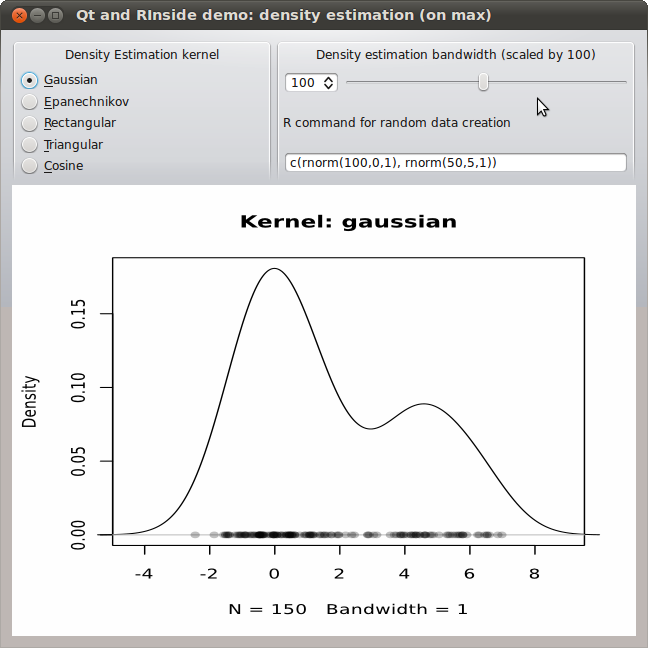
The RInside package makes it pretty simple and straightforward to embed R, the wonderful statistical programming environment and language, inside of a C++ application. This uses both the robust embedding API provided by R itself, and the higher-level abstractions from our Rcpp package. A number of examples are shown on this blog both here and here as well as on the RInside page; and the source package actually contains well over a dozen complete examples which cover anything from simple examples to parallel use via MPI for parallel computing. Beginning users sometimes ask about how to use RInside inside larger projects. And as I had meant to experiment with embedding inside of the powerful Qt framework anyway, I started to dabble a little. A first result is now in the SVN sources of RInside. My starting point was the classic tkdensity demo that comes with R itself. It is a good point of departure as Tcl/Tk makes it very portable---in fact it should run on every platform that runs R---and quite expressive. And having followed some of the GUI experiments around R over the years, I have also seen various re-implementations using different GUI frameworks. And so I am adding mine to this body of work: Example of embedding R via RInside into a Qt C++ application: density estimation for a mixture The problem I addressed first was actual buildability. For the RInside examples, Romain and I provide a Makefile that just works by making calls to R itself to learn about flags for R, Rcpp and RInside such that all required headers and libraries are found. That is actually relatively straightforward (and documented in our vignettes) but a little intimidating at first---which is why a ready-made Makefile is a good thing. Qt of course uses qmake and the .pro files to encode / resolve dependencies. So task one was to map what our Makefile does into its variables. Turns out that wasn't all that hard:
## -*- mode: Makefile; c-indent-level: 4; c-basic-offset: 4;  tab-width: 8; -*-
##
## Qt usage example for RInside, inspired by the standard 'density
## sliders' example for other GUI toolkits
##
## Copyright (C) 2011  Dirk Eddelbuettel and Romain Francois
TEMPLATE =              app
HEADERS =               qtdensity.h 
SOURCES =               qtdensity.cpp main.cpp
QT +=                   svg
## comment this out if you need a different version of R, 
## and set set R_HOME accordingly as an environment variable
R_HOME =                $$system(R RHOME)
## include headers and libraries for R 
RCPPFLAGS =             $$system($$R_HOME/bin/R CMD config --cppflags)
RLDFLAGS =              $$system($$R_HOME/bin/R CMD config --ldflags)
RBLAS =                 $$system($$R_HOME/bin/R CMD config BLAS_LIBS)
RLAPACK =               $$system($$R_HOME/bin/R CMD config LAPACK_LIBS)
## if you need to set an rpath to R itself, also uncomment
#RRPATH =               -Wl,-rpath,$$R_HOME/lib
## include headers and libraries for Rcpp interface classes
RCPPINCL =              $$system($$R_HOME/bin/Rscript -e \'Rcpp:::CxxFlags\(\)\')
RCPPLIBS =              $$system($$R_HOME/bin/Rscript -e \'Rcpp:::LdFlags\(\)\')
## for some reason when building with Qt we get this each time
## so we turn unused parameter warnings off
RCPPWARNING =           -Wno-unused-parameter 
## include headers and libraries for RInside embedding classes
RINSIDEINCL =           $$system($$R_HOME/bin/Rscript -e \'RInside:::CxxFlags\(\)\')
RINSIDELIBS =           $$system($$R_HOME/bin/Rscript -e \'RInside:::LdFlags\(\)\')
## compiler etc settings used in default make rules
QMAKE_CXXFLAGS +=       $$RCPPWARNING $$RCPPFLAGS $$RCPPINCL $$RINSIDEINCL
QMAKE_LFLAGS +=         $$RLDFLAGS $$RBLAS $$RLAPACK $$RCPPLIBS $$RINSIDELIBS
## addition clean targets
QMAKE_CLEAN +=          qtdensity Makefile
The double dollar signs and escaping of parentheses are a little tedious, but hey it works and expands the compiler and linker flags such that everything <emjust works="Works">. The code itself is pretty straightforward too. We instantiate the RInside object as well as the main Qt application object. We then instantiate a new object of class QtDensity that will launch the main widget; it is given a reference to the RInside object.
// -*- mode: C++; c-indent-level: 4; c-basic-offset: 4;  tab-width: 8; -*-
//
// Qt usage example for RInside, inspired by the standard 'density
// sliders' example for other GUI toolkits
//
// Copyright (C) 2011  Dirk Eddelbuettel and Romain Francois
#include <QApplication>
#include "qtdensity.h"
int main(int argc, char *argv[])
 
    RInside R(argc, argv);  		// create an embedded R instance
    QApplication app(argc, argv);
    QtDensity qtdensity(R);
    return app.exec();
 
The definition of the main object is pretty simple: a few private variables, and a few functions to interact with the GUI and get values from the radio buttons, slider or input field---as well as functions to update the chart or re-draw the random variables.
// -*- mode: C++; c-indent-level: 4; c-basic-offset: 4;  tab-width: 8; -*-
//
// Qt usage example for RInside, inspired by the standard 'density
// sliders' example for other GUI toolkits
//
// Copyright (C) 2011  Dirk Eddelbuettel and Romain Francois
#ifndef QTDENSITY_H
#define QTDENSITY_H
#include <RInside.h>
#include <QMainWindow>
#include <QHBoxLayout>
#include <QSlider>
#include <QSpinBox>
#include <QLabel>
#include <QTemporaryFile>
#include <QSvgWidget>
class QtDensity : public QMainWindow
 
    Q_OBJECT
public:
    QtDensity(RInside & R);
private slots:
    void getBandwidth(int bw);
    void getKernel(int kernel);
    void getRandomDataCmd(QString txt);
    void runRandomDataCmd(void);
private:
    void setupDisplay(void);    // standard GUI boilderplate of arranging things
    void plot(void);            // run a density plot in R and update the
    void filterFile(void);      // modify the richer SVG produced by R
    QSvgWidget *m_svg;          // the SVG device
    RInside & m_R;              // reference to the R instance passed to constructor
    QString m_tempfile;         // name of file used by R for plots
    QString m_svgfile;          // another temp file, this time from Qt
    int m_bw, m_kernel;         // parameters used to estimate the density
    QString m_cmd;              // random draw command string
 ;
#endif
Lastly, no big magic in the code either (apart from the standard magic provided by RInside). A bit of standard GUI layouting, and then some functions to pick values from the inputs as well as to compute / update the output. One issue is worth mentioning. The screenshot and code show the second version of this little application. I built a first one using a standard portable network graphics (png) file. That was fine, but not crisp as png is a pixel format so I went back and experimented with scalable vector graphics (svg) instead. One can create svg output with R in a number of ways, one of which is the cairoDevice package by Michael Lawrence (who also wrote RGtk2 and good chunks of Ggobi). Now, it turns out that Qt displays the so-called SVG tiny standard whereas R creates a fuller SVG format. Some discussion with Michael reveals that one can modify the svg file suitably (which is what the function filterFile below does) and it all works. Well: almost. There is a bug (and Michael thinks it is the SVG rendering) in which the density estimate does not get clipped to the plotting region.
// -*- mode: C++; c-indent-level: 4; c-basic-offset: 4;  tab-width: 8; -*-
//
// Qt usage example for RInside, inspired by the standard 'density
// sliders' example for other GUI toolkits -- this time with SVG
//
// Copyright (C) 2011  Dirk Eddelbuettel and Romain Francois
#include <QtGui>
#include "qtdensity.h"
QtDensity::QtDensity(RInside & R) : m_R(R)
 
    m_bw = 100;                 // initial bandwidth, will be scaled by 100 so 1.0
    m_kernel = 0;               // initial kernel: gaussian
    m_cmd = "c(rnorm(100,0,1), rnorm(50,5,1))"; // simple mixture
    m_R["bw"] = m_bw;           // pass bandwidth to R, and have R compute a temp.file name
    m_tempfile = QString::fromStdString(Rcpp::as<std::string>(m_R.parseEval("tfile <- tempfile()")));
    m_svgfile = QString::fromStdString(Rcpp::as<std::string>(m_R.parseEval("sfile <- tempfile()")));
    m_R.parseEvalQ("library(cairoDevice)");
    setupDisplay();
 
void QtDensity::setupDisplay(void)   
    QWidget *window = new QWidget;
    window->setWindowTitle("Qt and RInside demo: density estimation");
    QSpinBox *spinBox = new QSpinBox;
    QSlider *slider = new QSlider(Qt::Horizontal);
    spinBox->setRange(5, 200);
    slider->setRange(5, 200);
    QObject::connect(spinBox, SIGNAL(valueChanged(int)), slider, SLOT(setValue(int)));
    QObject::connect(slider, SIGNAL(valueChanged(int)), spinBox, SLOT(setValue(int)));
    spinBox->setValue(m_bw);
    QObject::connect(spinBox, SIGNAL(valueChanged(int)), this, SLOT(getBandwidth(int)));
    QLabel *cmdLabel = new QLabel("R command for random data creation");
    QLineEdit *cmdEntry = new QLineEdit(m_cmd);
    QObject::connect(cmdEntry,  SIGNAL(textEdited(QString)), this, SLOT(getRandomDataCmd(QString)));
    QObject::connect(cmdEntry,  SIGNAL(editingFinished()), this, SLOT(runRandomDataCmd()));
    QGroupBox *kernelRadioBox = new QGroupBox("Density Estimation kernel");
    QRadioButton *radio1 = new QRadioButton("&Gaussian");
    QRadioButton *radio2 = new QRadioButton("&Epanechnikov");
    QRadioButton *radio3 = new QRadioButton("&Rectangular");
    QRadioButton *radio4 = new QRadioButton("&Triangular");
    QRadioButton *radio5 = new QRadioButton("&Cosine");
    radio1->setChecked(true);
    QVBoxLayout *vbox = new QVBoxLayout;
    vbox->addWidget(radio1);
    vbox->addWidget(radio2);
    vbox->addWidget(radio3);
    vbox->addWidget(radio4);
    vbox->addWidget(radio5);
    kernelRadioBox->setMinimumSize(260,140);
    kernelRadioBox->setMaximumSize(260,140);
    kernelRadioBox->setSizePolicy(QSizePolicy::Fixed, QSizePolicy::Fixed);
    kernelRadioBox->setLayout(vbox);
    QButtonGroup *kernelGroup = new QButtonGroup;
    kernelGroup->addButton(radio1, 0);
    kernelGroup->addButton(radio2, 1);
    kernelGroup->addButton(radio3, 2);
    kernelGroup->addButton(radio4, 3);
    kernelGroup->addButton(radio5, 4);
    QObject::connect(kernelGroup, SIGNAL(buttonClicked(int)), this, SLOT(getKernel(int)));
    m_svg = new QSvgWidget();
    runRandomDataCmd();         // also calls plot()
    QGroupBox *estimationBox = new QGroupBox("Density estimation bandwidth (scaled by 100)");
    QHBoxLayout *spinners = new QHBoxLayout;
    spinners->addWidget(spinBox);
    spinners->addWidget(slider);
    QVBoxLayout *topright = new QVBoxLayout;
    topright->addLayout(spinners);
    topright->addWidget(cmdLabel);
    topright->addWidget(cmdEntry);
    estimationBox->setMinimumSize(360,140);
    estimationBox->setMaximumSize(360,140);
    estimationBox->setSizePolicy(QSizePolicy::Fixed, QSizePolicy::Fixed);
    estimationBox->setLayout(topright);
    QHBoxLayout *upperlayout = new QHBoxLayout;
    upperlayout->addWidget(kernelRadioBox);
    upperlayout->addWidget(estimationBox);
    QHBoxLayout *svglayout = new QHBoxLayout;
    svglayout->addWidget(m_svg);
    QVBoxLayout *outer = new QVBoxLayout;
    outer->addLayout(upperlayout);
    outer->addLayout(svglayout);
    window->setLayout(outer);
    window->show();
 
void QtDensity::plot(void)  
    const char *kernelstrings[] =   "gaussian", "epanechnikov", "rectangular", "triangular", "cosine"  ;
    m_R["bw"] = m_bw;
    m_R["kernel"] = kernelstrings[m_kernel]; // that passes the string to R
    std::string cmd1 = "Cairo(width=6,height=6,pointsize=10,surface='svg',filename=tfile); "
                       "plot(density(y, bw=bw/100, kernel=kernel), xlim=range(y)+c(-2,2), main=\"Kernel: ";
    std::string cmd2 = "\"); points(y, rep(0, length(y)), pch=16, col=rgb(0,0,0,1/4));  dev.off()";
    std::string cmd = cmd1 + kernelstrings[m_kernel] + cmd2; // stick the selected kernel in the middle
    m_R.parseEvalQ(cmd);
    filterFile();               // we need to simplify the svg file for display by Qt 
    m_svg->load(m_svgfile);
 
void QtDensity::getBandwidth(int bw)  
    if (bw != m_bw)  
        m_bw = bw;
        plot();
     
 
void QtDensity::getKernel(int kernel)  
    if (kernel != m_kernel)  
        m_kernel = kernel;
        plot();
     
 
void QtDensity::getRandomDataCmd(QString txt)  
    m_cmd = txt;
 
void QtDensity::runRandomDataCmd(void)  
    std::string cmd = "y <- " + m_cmd.toStdString();
    m_R.parseEvalQ(cmd);
    plot();                     // after each random draw, update plot with estimate
 
void QtDensity::filterFile()  
    // cairoDevice creates richer SVG than Qt can display
    // but per Michaele Lawrence, a simple trick is to s/symbol/g/ which we do here
    QFile infile(m_tempfile);
    infile.open(QFile::ReadOnly);
    QFile outfile(m_svgfile);
    outfile.open(QFile::WriteOnly   QFile::Truncate);
    
    QTextStream in(&infile);
    QTextStream out(&outfile);
    QRegExp rx1("<symbol"); 
    QRegExp rx2("</symbol");    
    while (!in.atEnd())  
        QString line = in.readLine();
        line.replace(rx1, "<g"); // so '<symbol' becomes '<g ...'
        line.replace(rx2, "</g");// and '</symbol becomes '</g'
        out << line << "\n";
     
    infile.close();
    outfile.close();
 
What the little application does is actually somewhat neat for the few lines. One key features is that the generated data can be specified directly by an R expression which allows for mixtures (as shown, and as is the default). With that it easy to see how many points are needed in the second hump to make the estimate multi-modal, and how much of a distance between both centers is needed and so on. Obviously, the effect of the chosen kernel and bandwidth can also be visualized. And with the chart the being a support vector graphics display, we can resize and scale at will and it still looks crisp. The code (for both the simpler png variant and the svg version shown here) is in the SVN repository for RInside and will be in the next release. Special thanks to Michael Lawrence for patiently working through some svg woes with me over a few emails.

Update: Some typos fixed.

Update 2: Two URLs corrected.

24 March 2011

Neil Williams: Qt-embedded [armel] for Emdebian

I'm experimenting with building Qt Embedded for armel using Emdebian toolchains and Debian packaging/patches. Initially, I've just "got it to build" with a few too many things nobbled and disabled - the results (using the package from Squeeze) are in Emdebian SVN - and the next task is to enable the missing bits and get closer to the standard Qt4-X11 binaries. Certain packages will simply not exist, even when finished, but it's been fun working out how to create a qmake.conf to map the Emdebian toolchain to what Qt expects from toolchains like CodeSourcery.

If it continues to work, it may be worth pushing upstream - but it may be better to wait until Multi-Arch supports cross-building, I'd only have to submit a different qmake.conf with updated paths otherwise.

I've also got a basic qmake.conf to help Qt applications cross-build using the Emdebian toolchains. This also needs updating once we finally get Multi-Arch-Cross.

The way I see this working is that the Qt Embedded packages would have to kept entirely separate from the Debian Qt4-X11 binaries from the KDE/Qt team because they use the same package names. That's relatively simple if the embedded packages are kept for cross-building only, either as -armel-cross packages generated by dpkg-cross or (eventually) as Multi-Arch packages. What won't work is having Qt-X11 and Qt-Embedded installed on the same architecture, without using a chroot or similar.

Initially, I hoped to keep the changes small enough that the Debian package could include the tweaks in a conditional part of debian/rules via a DEB_BUILD_OPTION. The current diff is a little too awkward (mainly in the .install files) but that's still worth keeping as a goal.

No warranty, created in the hope it's useful etc. etc., nothing to say it'll build on your system, no support for anything except the Debian armel port and only tested with the Emdebian toolchains from Lenny, not coming to a distribution near you anytime soon, don't blame me if it messes up your entire Qt-X11 installation on your desktop.... yada, yada.

It's just a bit of tinkering really, although it would be more fun if Qt didn't take quite so many hours to build each time I want to test a change....

23 March 2011

Dirk Eddelbuettel: RcppArmadillo 0.2.17

Another release (1.1.90) by Conrad Sanderson for his wonderful Armadillo templated C++ library for linear algebra appeared yesterday. Consequently, a new release 0.2.17 of RcppArmadillo, our Rcpp-based integration into R is now on CRAN mirrors. The short NEWS file extract follows below containing just Conrad's entry for 1.1.90. No further changes from our side.
0.2.17  2011-03-22
    o   Upgraded to Armadillo Version 1.1.90  "Inside Job"
         * Added .min() & .max(), which can provide the extremum's location
         * More robust mean(), var(), stddev()
And courtesy of CRANberries, here are the diffs to the previous release.
 ChangeLog                                                    6 
 DESCRIPTION                                                  8 
 inst/NEWS                                                    7 
 inst/doc/RcppArmadillo-unitTests.pdf                     binary
 inst/doc/unitTests-results/RcppArmadillo-unitTests.html      6 
 inst/doc/unitTests-results/RcppArmadillo-unitTests.txt      36 +-
 inst/include/armadillo_bits/Cube_meat.hpp                  112 ++++++++-
 inst/include/armadillo_bits/Cube_proto.hpp                  14 -
 inst/include/armadillo_bits/Mat_meat.hpp                    98 +++++++
 inst/include/armadillo_bits/Mat_proto.hpp                   10 
 inst/include/armadillo_bits/arma_version.hpp                 4 
 inst/include/armadillo_bits/fn_prod.hpp                     12 
 inst/include/armadillo_bits/fn_stddev.hpp                   18 -
 inst/include/armadillo_bits/fn_var.hpp                      18 -
 inst/include/armadillo_bits/glue_mixed_meat.hpp             22 -
 inst/include/armadillo_bits/op_max_meat.hpp                199 ++++++++++------
 inst/include/armadillo_bits/op_max_proto.hpp                21 +
 inst/include/armadillo_bits/op_mean_meat.hpp               154 +++++++++++-
 inst/include/armadillo_bits/op_mean_proto.hpp               22 +
 inst/include/armadillo_bits/op_min_meat.hpp                199 ++++++++++------
 inst/include/armadillo_bits/op_min_proto.hpp                19 +
 inst/include/armadillo_bits/op_stddev_meat.hpp              44 ++-
 inst/include/armadillo_bits/op_stddev_proto.hpp              9 
 inst/include/armadillo_bits/op_var_meat.hpp                198 +++++++++++----
 inst/include/armadillo_bits/op_var_proto.hpp                14 -
 25 files changed, 925 insertions(+), 325 deletions(-)
More information is on the RcppArmadillo page. Questions, comments etc should go to the rcpp-devel mailing list off the R-Forge page.

22 March 2011

Dirk Eddelbuettel: 2011 March Madness Half Marathon in Cary

On Sunday the annual March Madness Half Marathon in Cary took place, which (at least informally) opens the running season in greater Chicago. Following my participation in 2005. 2006, 2007, 2008, 2009). and 2010, I kept that streak going. Weather was pretty bad: A forecast of rain materialized with a shower at the start, another at about the halfway mark and a more solid downpour at the end, while temperature where in the lower 40s. And as I train less than I used to, I was also few just a few second slower than last year at 1:39:55 (hand-stopped) but managed to sneak in just under 100 minutes (and having taken six seconds to the starting lime, the official non-chip time has me just over that mark). All-in-all another nice half-marathon and I was appropriately sore yesterday.

21 March 2011

Martin Meredith: Japan Disaster

It seems that once again, the squirrel has it right:- <iframe allowfullscreen="allowfullscreen" frameborder="0" height="390" src="http://www.youtube.com/embed/5_mZrUkzabk" title="YouTube video player" width="480"></iframe> For those of you reading this via a planet, or similar, please click on the title of this post to see the video I ve embedded above. (Please note, may contain language that offends some)

flattr this!

Next.

Previous.

