Search Results: "bod"

20 June 2013

Daniel Pocock: Wrong cloud: Victorian schools and Ultranet

wrong cloud
"The blood, sweat and tears that has gone into the Ultranet and the work teachers put in it's soul destroying. I have to face parents who took me on face value when I said: 'This is the best thing since sliced bread every school is going to be using it in the future."
Those are the words of a school principal at Alkira Secondary College in Victoria, Australia. His school is receiving a real-life lesson in the the risks of cloud computing. Ultranet, the state-wide private cloud project for schools is at risk of being cancelled in 10 days due to budget cuts. It is not clear whether the vendor, NEC, is obliged to release data back to the users if the original four year contract is not extended. Commercial, confidential discussions It appears that the possibility of ending the contract was not supposed to be public knowledge. If the finance department had kept their intentions secret then it is possible that users would not even have had the opportunity to try and manually extract some of their data, as they are rushing to do now. Instead of getting on with the business of education itself, teachers and students are having to waste time trying to individually download student projects, photos, feedback and other meta data from the system in an ad-hoc manner. An opportunity for free and open source software This debacle may well be a huge opportunity for the free and open source software community to remind people that the value of retaining control over user data can not be forgotten when evaluating outsourced, private cloud solutions that claim to be "free" or offer low costs to get started. There were apparently 18 schools who initially trialed the program and many more have gradually joined up. This would be the perfect opportunity for advocates of genuinely free software solutions to contact them and let them know they are not alone and that many of us have anticipated these problems for years. While central government administrators tend to be hooked on the idea of administering big contracts with trusted' vendors, these local school administrators and the communities around them are probably more receptive to the free software message than at any other time. List of schools using Ultranet Many of the schools using Ultranet can be found with Google, as it appears to be integrated in their web sites. Click here for a Google search that finds many of the schools and related technical pages, support documents and other material A message to schools everywhere For schools facing this crisis or considering adopting such services in other countries, I would share this very simple advice: if you are offered a solution that doesn't give you complete control to conveniently extract all of your data in bulk whenever you want and use it in your own software on any computer, then it is not a good foundation to build on. The free software community has been actively working to provide truly free solutions for schools and I would strongly encourage schools to look at projects like Skolelinux/Debian-Edu and k12Linux that have been built by educators who also have a deep understanding of software and data freedom issues.

19 June 2013

Daniel Pocock: Australia's war on brains (and immigration)

Some weeks ago, our Prime Minister was slashdotted when she suspended her usual racist attacks on refugees to attack foreign IT workers and the companies that employ them with absurd accusations of "rorts" and "stealing" jobs. Today, she's introduced new laws in the parliament aiming to further bastardization of intelligent, skilled and educated workers and anybody who associates with them, including Australian employers. Unwarranted attention on a minority of IT workers This is not just some random bill before the parliament. There are just two weeks left before the parliament concludes and an election campaign begins. It is clear that what we are seeing now is the Real Julia coming though, choosing to make the small minority of foreign workers in our country at the center of people's thoughts as they go to vote in September. A debt of gratitude to foreign workers These verses from our national anthem, Advance Australia Fair say a lot about how Australia became what it is today:

For those who've come across the seas

We've boundless plains to share;

With courage let us all combine

To Advance Australia Fair.
The last 200 years of Australia's history has been a story of immigration. It is not something to be afraid of: our forefathers celebrated it. Foreign workers: why Australia needs you Australia has had some appalling flops in IT and engineering: There is no doubt in my mind that additional foreign workers would have made a positive contribution to all of these problems or can do so in the future. The sun never sets on IT Every day, I collaborate with dozens of IT specialists all over the world through the virtual workplace that is the Internet, particularly in the free and open source software community. Many of these people, I've never even met and in most cases I don't even know where they are, where they were born or what is the colour of their skin. Those details wouldn't make any difference to the way that we work in IT today. How many IT managers have time to waste dealing with more real world bureaucracy when they've experienced online, global productivity? How many IT workers feel demotivated by having to explain trivial details about their personal life to a Government bureaucrat who doesn't understand their skills and just looks at their colour? If you think about it, any immigration officer who really understands IT wouldn't be an immigration officer. They would be working in IT themselves. Immigration officers, who don't understand IT, are now going to be further empowered to bully companies away from employing some talented workers on the basis of race or nationality. Hiring managers will be intimidated into these prejudiced and biased decisions by delays, processing fees and invasive demands for sensitive documents about business planning and recruitment strategies. Australia's immigration system already has a horrendous reputation. Any visa application seems to take more than a year: no small company can keep a job position vacant that long. Families can't plan their children's schooling. Other life events come and go. There are exhorbitant fees, 1000% higher than in other western countries. Fewer and fewer self-respecting skilled workers are willing to put their spouses and children through the degrading medical examinations. Judging the impact of poor immigration policy While the economic impact of this immigration mess on industry is hard to quantify with an exact figure, we can take some insight from the education system. As the visa system has been hijacked by racists over the last 10 years, there has been a dramatic fall in participation (and revenues) from foreign students. In one year, enrolments (and revenue) fell 30%. This is not just bad for the balance sheets of the universities, it also means that in a future where commerce is global, Australians are more and more isolated and inexperienced culturally. IT workers and their employers have plenty of choices: Australia's close neighbor, Singapore, is one of them. Visas are granted in 2 weeks, no degrading medical exam required, low taxes and tropical sunshine all year round. Many companies that find it impractical to deal with Australia's bureaucracy end up moving their best Australian workers to places like Singapore to be part of a global team. This can't be good for the workforce that is left behind without jobs. The training delusion Government officials continue to rant and rave about companies failing to train Australian workers. The new laws supposedly force companies to "fix" this problem and train Australian workers. This, too, is a delusion: employers are not to blame. Some of the best Australian workers are already long gone to places like Singapore, London and the US. With talented foreign workers denied the opportunity to come and fill the void, there is less opportunity for skills to be acquired by more junior workers in Australian workplaces. It is also extremely difficult for more junior workers to get a foot in the door in the international job market and the primary reason for this is the Australian Government's failure to fund university programs beyond a bachelor's degree. Compare this to Europe and the US where all competent graduates are funded through to a Masters or PhD program. The bottom line is that more junior workers are denied the opportunity to get the best training either at home or abroad and in both cases it's not the foreign workers that can be blamed: it's the Government's own fault. Why do we need skilled foreign workers when Australians can win Nobel Prizes? The Australian press recently went into a frenzy when an Australian won the Nobel Prize for physics. There was a catch though: he's a migrant from the United States (just don't tell the Prime Minister). Dr. Schmidt migrated to Australia 20 years ago when the immigration system was not the same as today. Today, future Nobel Prize winners are being shown a brick wall - maybe we even have one of them rotting away in our death camps or left in the sea for sharks to eat. The BBC recently revealed that Britain's successor to Stephen Hawking may be a young girl who migrated from India - it is chilling to imagine where a child like this may be hidden away under Australia's immigration system. Bureaucracy leads to fraud and exploitation It's been clearly demonstrated that wherever you have elaborate, artificial systems of bureaucracy it leads to inefficiency, it suppresses innovation and in the worst cases it enables fraud and exploitation. The typical examples usually involve police in some third-world African nation setting up road blocks and collecting fees from travellers who want to pass the queues. This type of opportunism has also been found in Australia's immigration system, with one Federal politician already directly implicated and jailed for his role in a visa racket. Gillard's own bullet man A Queensland pensioner made international headlines recently when he was caught sending bullets in the mail to the Prime Minister. His demands were clear: stop immigration. While most world leaders refuse to let nutcases like this dictate their actions, Gillard appears to have been transcribing his racist letters directly into these newest immigration laws. It is a sad reality that Australian politics regularly seeks to appeal to the worst instincts in people like bullet man. The ultimate political failure When politicians stoop to the level of demonizing immigrants it is usually a clue that the politicians themselves are past their use-by dates and out of fresh policy ideas. When former French president Sarkozy tried to play the racist card in his campaign for re-election, it bit him in the bum and he was swept from power by the socialists. As always in politics, there is an element of hypocrisy at work: neither our Head of Government (the Prime Minister) nor our Head of State (the Queen) was born in Australia. Gillard was born in Wales and migrated to Australia as a child. If Australians don't vote for her in September, will she be given 28 days notice to pack her bags and go back home'? From the frying pan and into the fire Tony Abbott, Australia's would-be Prime Minister contemplating his colleague's statements on bestiality The scariest thing is that if Australians see through this racist charade and refuse to vote for it, we could end up with something equally obnoxious: the other major political party is now gaining worldwide attention for their campaign linking gay marriage and homosexuals to bestiality. Which prejudice is the lesser evil: racism or homophobia?

18 June 2013

Daniel Pocock: RSA Key Sizes: 2048 or 4096 bits?

Many people are taking a fresh look at IT security strategies in the wake of the NSA revelations. One of the issues that comes up is the need for stronger encryption, using public key cryptography instead of just passwords. This is sometimes referred to as certificate authentication, but certificates are just one of many ways to use public key technology. One of the core decisions in this field is the key size. Most people have heard that 1024 bit RSA keys have been cracked and are not used any more for web sites or PGP. The next most fashionable number after 1024 appears to be 2048, but a lot of people have also been skipping that and moving to 4096 bit keys. This has lead to some confusion as people try to make decisions about which smartcards to use, which type of CA certificate to use, etc. The discussion here is exclusively about RSA key pairs, although the concepts are similar for other algorithms (although key lengths are not equivalent) The case for using 2048 bits instead of 4096 bits
  • Some hardware (many smart cards, some card readers, and some other devices such as Polycom phones) don't support anything bigger than 2048 bits.
  • Uses less CPU than a longer key during encryption and authentication
  • Using less CPU means using less battery power (important for mobile devices)
  • Uses less storage space: while not an issue on disk, this can be an issue in small devices like smart cards that measure their RAM in kilobytes rather than gigabytes
So there are some clear benefits of using 2048 bit keys and not just jumping on the 4096 bit key bandwagon The case for using 4096 bits
  • For some types of attack, security is not just double, it is exponential. 4096 is significantly more secure in this scenario. If an attack is found that allows a 2048 bit key to be hacked in 100 hours, that does not imply that a 4096 bit key can be hacked in 200 hours. The hack that breaks a 2048 bit key in 100 hours may still need many years to crack a single 4096 bit key
  • Some types of key (e.g. an OpenPGP primary key which is signed by many other people) are desirable to keep for an extended period of time, perhaps 10 years or more. In this context, the hassle of replacing all those signatures may be quite high and it is more desirable to have a long-term future-proof key length.
The myth of certificate expiration Many types of public key cryptography, such as X.509, offer an expiry feature. This is not just a scheme to force you to go back to the certificate authority and pay more money every 12 months. It provides a kind of weak safety net in the case where somebody is secretly using an unauthorised copy of the key or a certificate that the CA issued to an imposter. However, the expiry doesn't eliminate future algorithmic compromises. If, in the future, an attacker succeeds in finding a shortcut to break 2048 bit keys, then they would presumably crack the root certificate as easily as they crack the server certificates and then, using their shiny new root key, they would be in a position to issue new server certificates with extended expiry dates. Therefore, the expiry feature alone doesn't protect against abuse of the key in the distant future. It does provide some value though: forcing people to renew certificates periodically allows the industry to bring in new minimum key length standards from time to time. In practical terms, content signed with a 2048 bit key today will not be valid indefinitely. Imagine in the year 2040 you want to try out a copy of some code you released with a digital signature in 2013. In 2040, that signature may not be trustworthy: most software in that era would probably see the key and tell you there is no way you can trust it. The NIST speculates that 2048 bit keys will be valid up to about the year 2030, so that implies that any code you sign with a 2048 bit key today will have to be resigned with a longer key in the year 2029. You would do that re-signing in the 2048 bit twilight period while you still trust the old signature. Fortunately, there are likely to be few projects where such old code will be in demand. 4096 in practice One of the reasons I decided to write this blog is the fact that some organisations have made the 4096 bit keys very prominent (although nobody has made them mandatory as far as I am aware). Debian's guide to key creation currently recommends 4096 bit keys (although it doesn't explicitly mandate their use) Fedora's archive keys are all 4096 bit keys. The CACert.org project has developed a 4096 bit root These developments may leave people feeling a little bit naked if they have to use a shorter 2048 bit key for any of the reasons suggested above (e.g. for wider choice of smart cards and compatibility with readers). It has also resulted in some people spending time looking for 4096 bit smart cards and compatible readers when they may be better off just using 2048 bits and investing their time in other security improvements. In fact, the "risk" of using only 2048 rather than 4096 bits in the smartcard may well be far outweighed by the benefits of hardware security (especially if a smartcard reader with pin-pad is used) My own conclusion is that 2048 is not a dead duck and using this key length remains a valid decision and is very likely to remain so for the next 5 years at least. The US NIST makes a similar recommendation and suggests it will be safe until 2030, although it is the minimum key length they have recommended. My feeling is that the Debian preference for 4096 bit PGP keys is not based solely on security, rather, it is also influenced by the fact that Debian is a project run by volunteers. Given this background, there is a perception that if everybody migrates from 1024 to 2048, then there would be another big migration effort to move all users from 2048 to 4096 and that those two migrations could be combined into a single effort going directly from 1024 to 4096, reducing the future workload of the volunteers who maintain the keyrings. This is a completely rational decision for administrative reasons, but it is not a decision that questions the security of using 2048 bit keys today. Therefore, people should not see Debian's preference to use 4096 bit keys as a hint that 2048 bit keys are fundamentally flawed. Unlike the Debian keys (which are user keys), the CACert.org roots and Fedora archive signing keys are centrally managed keys with a long lifetime and none of the benefits of using 2048 bit keys is a compelling factor in those use cases. Practical issues to consider when choosing key-length Therefore, the choice of using 2048 or 4096 is not pre-determined, and it can be balanced with a range of other decisions:
  • Key lifetime: is it a long life key, such as an X.509 root for an in-house CA or an OpenPGP primary key? Or is it just for a HTTPS web server or some other TLS server that can be replaced every two years?
  • Is it for a dedicated application (e.g. a closed user group all using the same software supporting 4096 bit) or is it for a widespread user base where some users need to use 2048 bit due to old software/hardware?
  • Is it necessary to use the key(s) in a wide variety of smartcard readers?
  • Is it a mobile application (where battery must be conserved) or a server that is likely to experience heavy load?

Tollef Fog Heen: An otter, please (or, a better notification system)

Recently, there's been discussions on IRC and the debian-devel mailing list about how to notify users, typically from a cron script or a system daemon needing to tell the user their hard drive is about to expire. The current way is generally "send email to root" and for some bits "pop up a notification bubble, hoping the user will see it". Emailing me means I get far too many notifications. They're often not actionable (apt-get update failed two days ago) and they're not aggregated. I think we need a system that at its core has level and edge triggers and some way of doing flap detection. Level interrupts means "tell me if a disk is full right now". Edge means "tell me if the checksums have changed, even if they now look ok". Flap detection means "tell me if the nightly apt-get update fails more often than once a week". It would be useful if it could extrapolate some notifications too, so it could tell me "your disk is going to be full in $period unless you add more space". The system needs to be able to take in input in a variety of formats: syslog, unstructured output from cron scripts (including their exit codes), snmp, nagios notifications, sockets and fifos and so on. Based on those inputs and any correlations it can pull out of it, it should try to reason about what's happening on the system. If the conclusion there is "something is broken", it should see if it's something that it can reasonably fix by itself. If so, fix it and record it (so it can be used for notification if appropriate: I want to be told if you restart apache every two minutes). If it can't fix it, notify the admin. It should also group similar messages so a single important message doesn't drown in a million unimportant ones. Ideally, this should be cross-host aggregation. The notifications should be possible to escalate if they're not handled within some time period. I'm not aware of such a tool. Maybe one could be rigged together by careful application of logstash, nagios, munin/ganglia/something and sentry. If anybody knows of such a tool, let me know, or if you're working on one, also please let me know.

17 June 2013

Gunnar Wolf: Cultural objects/goods: When a superhero is too famous for his own good

I found the following news item; if you can read Spanish, you will most probably prefer the original version in the Proceso magazine's site. The subject? The federal police (PGR) and army arrest 17 artisans for making money out of Spiderman. The following translation is mine. Done past midnight, and being quite tired, and translated so this news item can reach a broader audience. All errors are mine (except those carried out by the security forces, that is).
June 13, 2013 Cuernavaca, Morelos. Policement from the General Republic Attorney (Procuradur a General de la Rep blica, PGR) and the Army entered and searched the "3 de mayo" neighbourhood, in the municipality of Emiliano Zapata, detaining 17 ceramist artisans that sold candies, dolls and pi atas shaped like Spiderman. This search was done on the evening of last Wednesday, around 16:00. Federal ministerial policement and army soldiers closed a street with several informal stores and detained workers taht were selling this Marvel Comics character, following said company's denounce. As a result for this operation, 17 artisants were detained, although the same day five of them were freed. The policemen also seized 12 bags of candies, pi atas, ceramics and wooden figures of the superhero. PGR closed down 11 stores where ceramics with this same figure was being sold, accusing the detainees of plagiarizing Spiderman's image, protected under the copyright law. The 12 that remained under detention were put at the Federal Justice's disposal, which prompted that this Thursday, around 10AM, hundreds of sellers of "3 de mayo" went out to PGR's building to demand their friends' freedom, who are facing a bail of up to 200,000 pesos (~USD$18,000). Outraged because they said they were treated as if they were part of a drug ring, hundreds of artisans closed intermitently Avenida Cuauhn huac, where the PGR representation in Morelos state is located. The artisans' pressure helped for the amount of the bail to be lowered from MX$200,000 to MX$16,000, and so they were set free. Francisco Fern ndez Flores, president of the Ceramists Association, criticized the operation because, he said, it was as strong as if they were "drug dealers". The artisans explained that they don't even make the Spiderman figures, they are made by the interns of the Centro Estatal de Reinserci n Social de Atlacholoaya (prision), located in the Xochitepec municipality, who offered them to the ceramists so they could be sold. "The Atlacholoaya inmates do them, we buy them to support them, and turns out we are the delinquents now", said Miriam Monroy, sister of one of the detainees. This information was contradicted by Jes s Valencia Valencia, responsible for Morelos' state prision system, who assured that in said prision no ceramics are done. Fern ndez Flores insisted though that from within the prision they are being offered pi atas, candies and "piggy banks" with Spiderman's shape. Jos Luis Pozo, vicepresident of the Ceramists Union, said that to avoid more such federal operations for copyright breaches, they have committed not to produce or commercialize Marvel superhero figures, and any other characters the authority demands. "We do commit to, from now on, those products singled out to us will not be commercialized", he said. Pozo said that the PGR operation caused losses not just to the detained producers and salesmen, but to over 200 ceramists that had to close their stores in solidarity with their friends. Acording to the artisans, the products were a success until the PGR came, seized the products and detained the salesmen.
And yes, the copyright insanity does not stop. Spiderman is by today a clear part of popular culture. Marvel brilliantly succeeded in creating such a popular icon that everybody recognizes, that everybody identifies with And that everybody should be able to recreate. We are not talking about brand protection. Marvel does not, and will never, commercialize pi atas, ceramics or wooden toys. And even if they were plastic-cast While Spiderman is still under the protection of copyright, as the Berne Convention defines it (and of course, as the much stricter Mexican laws agree), that does not mean that any and every product resembling a Spiderman should be protected. Many ceramists and pi ata makers will create unique pieces of art Ok, handicraft. But reading the copyright law more strictly, Spiderman is more treated as a trademark than as a copyright. And it is a trademark that should be declared as having passed on to the public domain.

16 June 2013

Daniel Pocock: Monitoring with Ganglia: an O'Reilly community book project

I recently had the opportunity to contribute to an O'Reilly community book project, developing the book Monitoring with Ganglia in collaboration with other members of the Ganglia team

The project itself, as a community book, pays no royalties back to the contributors, as we have chosen to donate all proceeds to charity. People who contributed to the book include
Robert Alexander, Jeff Buchbinder, Frederiko Costa, Alex Dean, Dave Josephsen, Bernard Li, Matt Massie, Brad Nicholes, Peter Phaal and Vladimir Vuksan and we also had generous assistance from various members of the open source community who assisted in the review process. Ganglia itself started at University of California, Berkeley as an initiative of Matt Massie, for monitoring HPC cloud infrastructure My own contact with Ganglia only began in 2008 when I was offered the opportunity to work full-time on the enterprise-wide monitoring systems for a large investment bank. Ganglia had been chosen for this huge project due to it's small footprint, support for many platforms and it's ability to work on a heterogeneous network as well as providing dedicated features for the bank's HPC grid. This brings me to one important point about Ganglia: it's not just about HPC any more. While it is extremely useful for clusters, grids and clouds, it is also quite suitable for a mixed network of web servers, mail servers, databases and all the other applications you may find in a small business, education or ISP environment. Instantly up and running with packages One of the most compelling features, even for small sites with less than 10 nodes, is the ease of installation: install the packages on Debian, Ubuntu, Fedora, OpenCSW and some other platforms, and it just works. Ganglia nodes will find each other over multicast, instantly, no manual configuration changes necessary. On one of the nodes, the web interface must be installed for viewing the statistics. Dare I say it: it is so easy, you hardly even need the book for a small installation. Where the book is really compelling is if you have hundreds or thousands of nodes, if you want custom charts or custom metrics or anything else beyond just installing the package. If monitoring is more than 10% of your job, the book is probably a must-have. Excellent open source architecture Ganglia's simplicity is largely thanks to the way it leverages other open source projects such as Tobi Oetiker's RRDtool and PHP Anybody familiar with these tools will find Ganglia is particularly easy to work with and customise. Custom metrics: IO service times One of my own contributions to the project has been the creation of ganglia-modules-linux, some plugins for Linux-specific metrics and ganglia-modules-solaris providing some similar metrics for Solaris. These projects on github provide an excellent base for people to fork and implement their own custom metrics in C or C++ The book provides a more detailed account of how to work with the various APIs for Python, C/C++, gmetric (command line/shell scripts) and Java. The new web interface For people who had tried earlier versions of Ganglia (and for those people who installed versions < 3.3.0 and still haven't updated), the new web interface is a major improvement and well worth the effort to install. It is available on the most recent packages (for example, it is in Debian 7 (wheezy) but not in Debian 6.) It was originally promoted as a standalone project (code-named gweb2) but was adopted as the official Ganglia web interface around the release of Ganglia 3.3.0. This web page provides a useful overview of what has changed and here is the original release announcement.

15 June 2013

Daniel Pocock: Girls Around Me and the NSA

When the Girls Around Me app was released in 2012, it received massive criticism on the basis that it could enable stalking and undermine privacy. Nonetheless, the existence of this app may well be an even bigger problem for the NSA right now than it is for single women. US Government officials in damage control mode over the NSA surveillance leaks have sought to deny that it is even possible to monitor people in the way that The Guardian reported the matter. Leaders of Internet giants such as Google and Facebook have also tried to deny and downplay the possibilities of PRISM. In my view, a company like Google is no more likely to admit hiving off customer data than a bank is likely to admit a liquidity crisis, for fear of starting a self-fulfulling bank run. User trust is as existential with data as it is with bank deposits. So my question is, if the NSA with an $8 billion annual budget can't track people in real-time, how come a small team of app developers could do much the same thing so easily in Girls Around Me? One possibility is that some companies may be accurate in what they have reported: they are not letting data out the back door. The scary thing is, they are letting it out the front door and it is just as possible for third-party commercial operators and foreign powers to harvest a lot of this data in the same way as Girls Around Me In one of the most remarkable cases, the chief of British MI6 (the team that James Bond plays for) may have been compromised by his wife's Facebook posts - if Facebook really is an outsourced NSA operation, then that is a remarkable case of friendly fire Both the scandals around Girls Around Me and the NSA spying leaks only serve to confirm one thing: that people need to think twice every time they fill in some form or submit some data that could be used to identify or track them.


Ingo Juergensmann: Debian-ports mirror on Buildd.Net

As a more or less unrelated side effect of the Debian m68k port resurrection I decided to give back something to debian-ports.org as we are relying on that service for our port. So I set up a debian-ports.org mirror: The mirror is running on a fast Gigabit connection and is reachable via IPv4 and (native) IPv6. It carries all current archs. Enjoy!
Kategorie:

Ingo Juergensmann: First m68k buildd relocated to FU Berlin

It's already been some days ago, but our first m68k buildd, elgar.buildd.net, has been relocated to its new hosting facility in Berlin on June 2nd. Its new home is located at the Physics Department of Freie Universit t (FU) Berlin. So a big thank you to FU Berlin and John Paul Adrian Glaubitz to make this happen! With Elgar being now hosted in Berlin the resurrection of the m68k port is steadily ongoing. More machines will be follow Elgar: while Elgar will be accompanied in Berlin by Akire (akire.buildd.net), Kullervo and Crest will hopefully be hosted at their old hosting donator NMMN in Hamburg somewhat later. The m68k port itself is doing fine and coped well with the all the new packages after the release of Wheezy:
  wanna-build statistics - Sat Jun 15 16:51:13 CEST 2013
  -----------------------------------------------------
Distribution unstable:
---------------------
Installed       :  7041 (buildd_m68k-ara5: 1016, buildd_m68k-arrakis: 157,
                         buildd_m68k-elgar: 201, buildd_m68k-kullervo: 238,
                         buildd_m68k-vivaldi: 153, tg: 53, unknown: 5223)
Needs-Build     :   780
Building        :     9 (buildd_m68k-ara5: 1, buildd_m68k-arrakis: 3,
                         buildd_m68k-elgar: 2, buildd_m68k-kullervo: 2,
                         buildd_m68k-vivaldi: 1)
Built           :     1 (buildd_m68k-elgar: 1)
Uploaded        :     0
Failed          :    73 (buildd_m68k-ara5: 51, buildd_m68k-kullervo: 10,
                         tg: 12)
Dep-Wait        :     3 (tg: 3)
Reupload-Wait   :     0
Install-Wait    :     0
Failed-Removed  :     0
Dep-Wait-Removed:     0
BD-Uninstallable:  1977
Auto-Not-For-Us :   192
Not-For-Us      :    50
total           : 10227
 68.85% (7041) up-to-date,  68.85% (7041) including uploaded
  7.63% (780) need building
  0.09% (  9) currently building
  0.01% (  1) already built, but not uploaded
  0.74% ( 76) failed/dep-wait
  0.00% (  0) old failed/dep-wait
 19.33% (1977) not installable, because of missing build-dep
  1.88% (192) need porting or cause the buildd serious grief (Auto)
  0.49% ( 50) need porting or cause the buildd serious grief
We are now constantly above 7000 packages installed, which is great considering the fact that we were at 10% keeping up by December 2012. Now we are approx 70% with just 5 buildds. Of course we would like to get more buildds up & running, but currently there is the SCSI driver for the NCR53C9XF(espfast) chip missing for m68k. Sadly this chip is used on several accelerator cards for Amiga. With a working SCSI driver we could easily double our number of buildds. But I hope that this will just be a matter of time... :-)
Kategorie:

13 June 2013

Daniel Pocock: Skype Scandal and the Jedi Council

Normally Skype isn't mentioned by name on this blog, but today I'm making an exception. When a new scandal broke out in the Australian Army today, one of the first questions asked was how does it compare to the Skype Scandal which had everybody talking (and blushing) in 2011. A concise military reply direct from the General: "I'd say it's worse than the Skype matter" (the original Skype Scandal cadets are going on trial in six weeks) Jedi Council brings cultural change in the Army: from Skype to email Since the original scandal, there have been plenty of PR-orchestrated headlines about cultural change in the Army. Sadly, it seems that several ranking officers believed that was a cue to simply start using email instead of live feeds Operating under the operational code name Jedi Council, they've apparently been swapping annotated images of female colleagues and members of the public service. A more detailed account summarises it: "They were calling themselves the Jedi Council but they were doing the exact opposite of what Jedis are supposed to do" While the Skype scandal involved cadets behaving much like college kids elsewhere, this latest scandal involves the officer corp, the most senior officer implicated is allegedly a Lieutenant Colonel. Senior ranking officers like this have given many years of dedicated service to the country. They are widely respected and the vast majority of officers in these positions are unlikely to ever be implicated in such a scandal. Officers are in leadership roles, it should be no surprise if they have top secret security clearances. After the revelation that Australia has a direct and high-volume data sharing arrangement with the US Government (and in turn Facebook, Google, etc), there are all kinds of questions about whether a couple of rogue officers have access to pursue their private Jedi Council project using tools like PRISM and Boundless Informant. It's already been confirmed that they were keeping their own Jedi database of their victim's names, phone numbers, home addresses and various clothing measurements and if they are already emailing these photos about on Defence computers, does it seem improbable that they would be using PRISM or other sources to cross-reference their data? Behavior described as systematic and predatory It can't be ruled out that some defence computer systems may have direct access to NSA copies of images from those invasive airport body scanners - like these pictures that were not supposed to exist. Just like the British undercover cops stealing the identities of dead children and fully engaging with impressionable young women from environment campaign groups, there are a long list of possible abuses when the security state is over-empowered. While this latest Army example involves private pursuits, it is not hard to imagine many other permutations: perhaps a couple of rogue Government employees making unauthorised use of PRISM data for a commercial objective and gaining the upper hand on private sector competitors who have no such data feed. 100% trust? In every organisation there will always be a few people bending the rules. It's human nature, if it wasn't that way, we'd all be robots (or drones). The Army and the Catholic Church tend to be hammered a lot more in the public eye when these transgressions are discovered although statistically their crime rates are no higher than average. The bottom line is that no organisation is perfect and people have to take some responisbility to object to the excessive growth of the security state and keep our data to ourselves as you just never know who you can trust.


12 June 2013

Daniel Pocock: When conspiracy theories come true

In a blog attempting to join the dots between Australia's intelligence services and the US PRISM program, I speculated that Australia has had extensive access to data harvested by PRISM. My hunch has just been exposed rather dramatically today: Top secret data center under construction to house all our secrets. "There has been no discussion of the project in Senate estimates committee hearings, and the public reports of Parliament's joint committee on intelligence and security make no reference to it." The news story also suggests that the relationship is bi-directional, with data harvested from Australian ISPs cross referenced against US databases from Facebook and Google. From a human rights perspective, the implications of this data sharing are much more dramatic than the NSA just snooping on US citizens within the US. While Australia often tries to portray the image that it is a safe and happy country, it has a dark side. Police are kept busy investigating politicians and Government officials: Prime Minister and her associates connected to a union slush fund, the central bank's banknote printing agency's chief executive and 8 colleagues on conspiracy charges and even a senator on good old fashioned shoplifting and assault charges Exporting PRISM data to a human rights backwater As an Australian, my own rights and those of my family are more heavily protected and respected living in Europe than if I lived in my country of birth. Australia does not have a bill of rights like the US (where PRISM data is harvested) or the European Convention of Human Rights. Once US data is exported to Australia, it can be used to support sinister programs like the indefinite detention of coloured people in sinister desert camps. Just this week, the Government left over 50 bodies of poor refugees for the sharks to eat. For someone with such a lack of a conscience, can you imagine them thinking twice about using PRISM data for unscrupulous purposes? Is US PRISM data at greater risk? Despite the stench of corruption and lip service to human rights, is there any hard evidence that PRISM data will be at greater risk if allowed into the hands of Australians? Death by SMS One former Australian official (having dual-citizenship with Sri Lanka) is accused of facilitating war crimes in the Sri Lankan civil war. At present he is Sri Lanka's ambassador at the UN, giving him the benefit of diplomatic immunity. When he was working for Australia, how much data did he have access to? Isn't it ludicrous that in the name of stopping terrorism, data may have been collected and handed to war criminals on a silver platter? Behind enemy lines Like James Bond in reverse, an Australian official was exposed unofficially engaging in a relationship with a Vietnamese spy colonel. In addition to the $20 million in bribery to win a bank note printing contract, is data being used as a tool to leverage trade negotiations, officially or otherwise? If an Australian official with top-secret clearance ends up under the control of a foreign agent, what is the risk that they would be exploited to obtain PRISM data? Defence minister resignation in Chinese spy scandal In 2009 Australia's defence minister was identified having close links to a Chinese-Australian business woman including all the usual little luxuries: first class flights, apartment rental and joint business deals with family members. He subsequently resigned. Little details were made public. How much PRISM data was directly available to political officials like the defence minister? Disappearing Prime Ministers The disappearance of a serving Prime Minister, Harold Holt, during the cold war remains an unsolved mystery to this day. People continue to ask was he swept out to sea or voluntarily whisked away in a Chinese or Soviet nuclear submarine. While Australia has traditionally had strong ties to Britain and the US, there have been exceptions to the rule. Fortunately this all happened before PRISM and Harold Holt red submarine rumours are no more well-founded than the UFO theories of his abduction. Where did all the data go? As the music industry has found out the hard way, digital data can be copied at will with the originator having no control. The revelations that Britain and Australia are in on the PRISM shenanigans only confirms that this data is seen as a new form of currency for exchange in geo-political posturing. While used weapons take decades to work their way down the chain, data can spread at the speed of light.

Daniel Pocock: The week that everything changed

Last Wednesday, I felt an urge to carefully write out a list of all the possible characteristics that would make communications technology genuinely free. I felt this was important for a number of reasons: for example, to follow up on my earlier claim that free software does not always provide free communications, it is necessary to be able to measure the shortcomings against a perfect (although possibly unachievable) benchmark. Then something happened Just hours after my blog was live, The Guardian, a leading British newspaper (and contributor to open source) started publishing explosive allegations about the extent of US Government monitoring of communications. They kicked off a dramatic four days of coverage of this topic with the story that one of America's largest phone companies, Verizon, is secretly passing details of all customer phone calls and approximate locations (metadata) to the NSA. I've published further blog entries about this subject in the meantime. One thing I want to make clear: real friends tell each other the truth. There is no need to flatter America with gratitude for inventing the Internet when discussing these fundamental privacy failings. Anybody who has tried to generalise any comments about the NSA scandal as anti-American' is themselves failing to respect America's own principles of free speech. A doctor doesn't make up fairy tales for a patient diagnosed with cancer, he puts the facts on the table as that is the first step in making progress. The winds of change Activity on all my free communications web sites, especially Lumicall and OpenTelecoms.org has doubled. Google Play reports that the rate of Lumicall installations have also doubled - hopefully it is getting closer to the point where Metcalfe's Law kicks in and everybody will have federated SIP on their phone. What next One thing is clear: this situation provides a huge opportunity for anybody promoting free software, not just for communications. As I mentioned, web sites on the subject of free and private communications are attracting significant interest and I hope this rubs off on other projects. While I have contended that free software does not always provide free communications, there is a compelling argument for the case that you can't have free communications without having genuinely free software. Some of the developments that are coming up in the very near future: An upcoming release of DruCall, initially packaged for Debian and leveraging the libraries API packaging scheme, is going to make it much, much easier for the vast majority of web sites to offer a secure calling facility, without any third-party browser plugins required. Other CMS vendors such as xWiki are also working on WebRTC support. DebConf13 is aiming to feature a half-day track on Free real-time communications with a focus on the way free operating systems, particularly Debian (and it's derivatives like Ubuntu) are fundamental to rolling out an alternative to the status quo. Federated VoIP is also a confirmed feature of the upcoming Fedora 19 release and will eventually work it's way into EPEL. This is another great way for people who work in an RPM environment to start getting more active deploying SIP as a standard service in their environment. The real-time communication (RTC) quick-start guide is currently being updated and will include a convenient web-checker to help people test their federated connectivity. Can you help? Not sure where to begin? Come and join us on the Free RTC discussion list that has been sponsored by the FSF Europe or join the discussion list of one of your favourite free RTC applications.

11 June 2013

Daniel Pocock: Interrupt-free computing

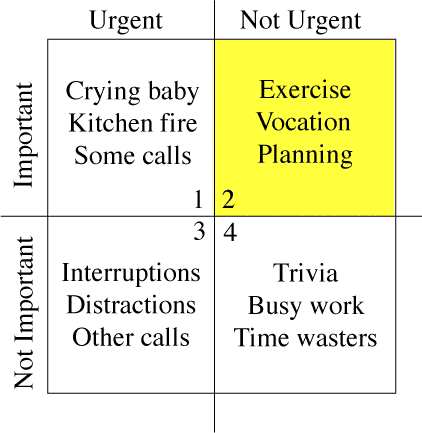
On debian-devel, there has been a discussion about the security issues of "spontaneously" appearing popups demanding the root password to make immediate security updates. There is a much more general issue related to this: computing without interruptions. Most of us have probably seen some friend or acquaintance with a (usually non-Linux) PC that is constantly beeping and flashing with chat notifications, new email popups, Adobe update this, Java update that, etc. In one recent case I came across somebody who had experienced a dramatic drop in his productivity as a consequence - giving him a laptop with a freshly installed copy of Linux made a dramatic difference to his work. I can already hear people insisting that security trumps everything (which isn't an original argument either) and that popups can't be avoided. A search on the web for "computing without interruptions" reveals users have a particular distaste for these things appearing while watching a video. Websites responding to that complaint fill the search results. With many types of interactive real-time content (video, WebRTC phone/video calls and so on) deployed within browsers, it is even more important for UI designers to contemplate when it is not appropriate to interrupt a user and to do everything possible to avoid interrupting the user. Preparing for disaster On the other hand, just ignoring security updates and not telling the user their disk is filling until 0 bytes remain available could only shift the problem down the road (from constant annoyance to periodic crisis). That said, sometimes you can still fill the disk very suddenly (especially with fast SSDs) and rather than relying on popups to keep users away from the precipice, applications (particularly the core desktop and daemon processes) could be tested more regularly to ensure they remain resilient in full disk situations. Managing information overload Popups are just part of a wider problem of information overload. There are emails too: some applications, such as Drupal, will send daily or weekly emails to a user if their system is not up to date. For many virtual-hosted sites, this starts to resemble a small flood. There is a flaw in this design: applications are competing for attention by sending more and more emails and popups or making them more annoying (e.g. the security updates in Debian 6 were ignorable popups in the top right-hand corner of the screen, Debian 7's Gnome Classic mode displays a big password prompt in the middle of the screen). The solution would be to develop a mechanism for unifying, de-duplicating and then prioritising these information/event flows. Some fault alerting systems already do this for their own events - these are niche solutions that aren't always applicable to the average PC-owner, although the principles are well tested. Some email organisation tools have similar features, but only for email. I'm not currently aware of any solution that synthesizes such an experience for all possible information sources. Setting priorities One well-read work on this subject in the business world is The 7 Habits of Highly Effective People (Stephen R. Covey, 1989). Of particular interest for the problem at hand is the priority matrix (borrowed from the Eisenhower Method): The left column, Urgent items, typically must be executed by a certain date (e.g. buying a gift before a birthday or installing a new SSL certificate before the old one expires). A security update or Acrobat reader update does not have this same characteristic. Under this model:

Urgent Non-urgent
Important Replace SSL certificate
Buy birthday gift
Security update
Run backup job
Not important Register for conference before deadline for free gift Non-security update for Acrobat reader
Covey even released an Outlook plugin, Plan Plus to help people organise their tasks (and their lives) using his methodology. Unfortunately it is closed-source software with a terrible set of ratings on Amazon - this review from a customer stands out: "My take is that Franklin does not consider robust software nor customer support to be either Urgent or Important." Could this be replicated more successfully with an open-source plugin for Mozilla Lightning or a similar productivity tool, and could the concept be extended across the range of data sources, including email, calendar items, system notifications and more to provide a unified approach to both the computing platform and general productivity (real-life) time management? Would this help solve the same problem in a more effective manner? In other words, would such an effort to help users integrate the demands of technology with the other demands of life make them more likely to keep their systems up to date? The wider community experience Going beyond the desktop/user experience, could this model be extended to automatically integrate external tasks, such as handling bug reports, moderating mailing lists and other slightly tedious things that have to be given regular attention to keep the free-software world moving along smoothly? Managing down-time For people who work in computing, there is almost no down-time any more. Even when on holiday, checking in for a flight might involve navigating through a buggy wifi access control system and an annoying set of advertisements from your low-cost airline as you try to print a boarding pass. These things often trigger thoughts about similar issues on client projects. Glancing at your email to find the booking number could awaken thoughts of a whole lot of projects you had tried to put out of your mind for a week. This is another area where excessive popups and emails can only compound the problem. Who really wants to download and install security updates while on holiday using an intermittent wifi connection? Managing all these events through a common mechanism may also finally make it possible to have an "ordinary user" experience with your PC. In practice, this might mean being able to view information/events through a time-of-day filter or "holiday mode" - and only on demand. A worthy design goal? Would any free software operating system make it a design goal to give their users a 100% interrupt-free experience? Of course there would still be things like chat notifications - but those would only be possible when a user has signed-in to a chat application. The distinction for the interrupt-free experience would only need to apply to default system behavior and not to every application.

9 June 2013

Daniel Pocock: The Pope saw right through them


Popemobile - is it secure enough for the Pope to make confession without the NSA hearing anything? In his final days as Pope, Benedict XVI took it upon himself to comment on a political subject that has had the whole world talking for some time: those invasive airport scanners pushed by US securocrats. "Every action, it is above all essential to protect and value the human person in their integrity." "Even in this situation, one must never forget that respecting the primacy of the human person and attention to his or her needs does not make the service less efficient nor penalise economic management." At least, the press thought he was talking about body scanners. Maybe it was divine intervention, or maybe just a very good understanding of the dark side of human nature, but these comments could be equally applicable to the unfolding scandal engulfing the NSA as they seek to monitor, record and understand every thought and feeling we have at every moment of our lives. On the issue of those scanners, however, it now appears clear that the reassurances we've been hearing - that invasive airport body scanners don't save copies of the pictures, for example - are about as believable as the ousted Iraqi Information minister Mohammed Saeed al-Sahaf appearing daily on TV to reassure the world that Saddam would be victorious even as the invading forces entered Baghdad. Saddam's former Information Minister, Mohammed Saeed al-Sahaf
Saddam's former Information Minister, Mohammed Saeed al-Sahaf

Ingo Juergensmann: Edward Snowden whistleblowed PRISM

Sometimes there are true heros. Even today. Like Edward Snowden who made PRISM publically known. There's an interview by The Guardian with Edward Snowden:
In a note accompanying the first set of documents he provided, he wrote: "I understand that I will be made to suffer for my actions," but "I will be satisfied if the federation of secret law, unequal pardon and irresistible executive powers that rule the world that I love are revealed even for an instant." [...] He has had "a very comfortable life" that included a salary of roughly $200,000, a girlfriend with whom he shared a home in Hawaii, a stable career, and a family he loves. "I'm willing to sacrifice all of that because I can't in good conscience allow the US government to destroy privacy, internet freedom and basic liberties for people around the world with this massive surveillance machine they're secretly building."
Neither Bradley Manning nor Edward Snowden should be sentenced, but the Government that is responsible for such surveilance programs like PRISM should.
Kategorie:
Tags:

8 June 2013

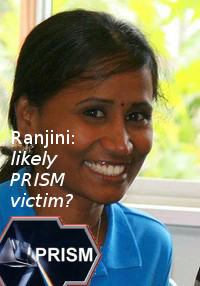
Daniel Pocock: Rendition link to PRISM

The Guardian is reporting that Britain's GCHQ first started getting produtive with PRISM early 2012. It was about the same time that their buddies down under, ASIO revised their earlier assessment of a refugee, Ranjini, and scooped her up in Australia's domestic rendition program. This may be more than a notable co-incidince, because it adds further support to the hypothesis that Ranjini is a victim of Big Data and PRISM. If ASIO first gained access to PRISM at the same time as GCHQ, then they may have used some tenuous PRISM data to form their revised assessment of her suitability for a visa. Making such inferences, and using them as the basis for a cruel program of indefinite detention is a gross violation of human rights and goes far beyond the claim that PRISM is about catching real terrorists. I've previously mentioned the systematic persecution of coloured people in my own country. Like many honest people, I'm utterly ashamed of it. The Government also has similar programs for indigineous people (they cooked one aboriginal elder alive on our national holiday) and they've also toyed with outlawing homosexuality. Having seen first hand some of the prejudiced, Government-sanctioned evil that exists in Australia, it's not hard to imagine small-minded members of the public service using PRISM data to target these classes of people for an unhealthy dose of bastardisation. Ranjini was ripped away from her husband by the rendition program and dumped in Sydney's Villawood death camp. Twenty-four hours after the gestapo got their hands on her, it was discovered she was pregnant - her child, an Australian citizen, was recently born and confined to the same concentration camp. Ranjini has racked up more than 12 months in captivity now, most of it while pregnant, and the Government has still not made any official charges against this woman. They say they can't comment on her case for fear of revealing their sources: once again, they don't want to talk about programs like PRISM that they share with the US. Maybe she just had one of the wrong people in her facebook friends list? That is not the sort of evidence that can be used to convict somebody in court, especially if the Government wants to avoid public questioning about their access to a close ally's secret database. Various rapists and murderers have made multiple court appearances in the last 12 months, tried and convicted in accordance with the procedures of justice. Ranjini has not been brought into a court room even once because the spooks don't want to reveal their sinister sources like PRISM.
Potential PRISM victim Ranjini
Australia's close ties with the US Australia has had particularly close ties with the US for many years and just as the British GCHQ has been linked to PRISM, it seems Australia's ASIO is also in on the act. For those not familiar with the depth of this alliance, it is worth checking up on Pine Gap, the ECHELON program and the recent exposure (by Wikileaks) of one of our senators with unauthorised US spy connections - he quietly resigned for family reasons'. Pine Gap
Pine Gap, Australia This is not to say that the US is universally bad or that the strategic alliance is undesirable: rather, it is simply to demonstrate the strength of these links and the real risk that data-sharing is used for inappropriate purposes. While many of us in a technical field treat large volumes of data from a very theoretical perspective, it is worth remembering that in the wrong hands, data can be very dangerous and there are real human victims.

7 June 2013

Daniel Pocock: "Do as we say, not as we do"

When I was preparing my blog entry about the Gold Standard in Free communications, I had absolutely no idea that The Guardian (another Ganglia user) would be hot on my heels with dramatic revelations about US Government surveillance of dangerous terrorists and maybe sucking up a little bit of data about a few hundred million of their own citizens and another 90% of the world's population for good measure. Some people even thought I've been a bit paranoid with my concerns about excessive surveillance. However, it is just remarkable to see that in the same week that the trial of Bradley Manning is getting under way for inappropriate use of his employer's computer, the US has been exposed plotting cyber attacks and setting a very bad example for all those little script kiddies out there. Practical questions for every one of us Is it time to start blocking email to and from sites like gmail and hotmail? What about the reports that the US Government was engineering back doors in the OpenBSD operating system? Have any open source projects actually been comprised in this way? Will spammers and other criminals take this as a cue that there is nothing morally wrong with hacking? Have certificate authorities been infiltrated too? They may well be the elephant in the room - while everybody was joking about the NSA key hidden in the depths of Microsoft Windows, maybe one or more of the well known trusted root certificates, right under our noses, is also a back door? The danger is real Anybody wondering about the practical implications of all this data gathering doesn't have to look very far to find out what can go wrong. In the same week as all these things were exposed, there have been more dramatic revelations about law enforcement officers selling private data for their own commercial gain. While the vast majority of police are surely good citizens, every organisation has it's bad apples and as Bradley Manning demonstrated so well, it only takes one person to breach security and enormous volumes of data can end up escaping.

Tanguy Ortolo: Looking for an SPF milter

Envelope

For email extensions such as SPF, DKIM and DMARC, I think the most flexible and portable system is the milter protocol. Originally developed for Sendmail, it is now also supported by Postfix, and it allows to plug specific filters in the mail server without the hassle of the previous systems like SMTP proxies.

SPF milters in Debian OpenDKIM provides a good milter for checking DKIM. OpenDMARC provides a similar milter for DMARC. But the situation is more difficult for SPF in Debian which is a requirement for DMARC! :
spf-milter
It was based on the buggy libspf0 and was never updated to libspf2, and was finally removed from Debian;
spf-milter-python
This one seems a bit Sendmail-centric it uses a dbm configuration file for instance and not very documented.
Packaging a new SPF milter? There are other milters for SPF, which have not been packaged for Debian yet, but I am ready to package one. Has anybody tried another SPF milter?
spfmilter
Still in beta test, still to be ported to libspf2 which may never happen since it was not updated since 2005.
smf-spf
Based on libspf2, seems rather neat, with a clean configuration, but inactive since 2007.
milter-spiff
Proprietary.

5 June 2013

Daniel Pocock: The Gold Standard in Free Communications Technology

In a previous blog entry, I posed the question whether open source communications software is really free and came to the conclusion that additional principles need to be defined for free communications, above and beyond the normal expectations of free software. This is a fundamental problem that projects like the FreedomBox, Lumicall and other privacy-enabling free communications solutions must be familiar with. Otherwise there is a risk that development will never end as there is no finish line in sight. Practical solutions are not so easily defined though: so let's just imagine a perfect solution for a moment. Later, we can contemplate the trade-offs that are necessary to make it practical. Perfect privacy Here are some attributes that may exist for a perfect solution: Privacy must be the default: the user should not have to explicitly request privacy. If there is a risk that an incoming communication will establish a session without full privacy, the user should be able to decline the opportunity to participate. Only participants to a communication can receive the communication A third party should not be able to replay, modify or forge any aspect of the communication or the request to initiate a session Only participants to a communication are aware that a communication occurred Only participants to the communication are aware of who participated in the communication A participant may be anonymous: but in this case, all other participants will be aware that there is an anonymous party present in the communication Participants may not deduce any information about the other participants that is not explicitly shared (e.g. location, type of device, service provider) In the case of real-time communication, a participant may leave the communication without any other party even realising that they left or why. Communication is off-the-record: No participant can save and reproduce a copy of the communication in such a way that a third-party will know it was authentic. Anonymous reception of communications - the perfect post-office box: someone may create an anonymous identifier that allows other people to call them without being able to trace their location or identity Some consequences of a perfect solution Just imagine if all communications worked in this manner. There are many potential consequences. For example, if you call somebody and the call is not connected, you will get no feedback about whether their line is busy, out of service or whether they deliberately chose to reject your call. Another example is somebody who is driving while talking on a telephone. If they have an accident, there will be no way to prove that they were using the phone. This may already be the case if somebody uses a VoIP app on their phone - the police investigating the accident later will simply find no records of calls through the mobile phone account. Conclusion The perfect solution described here is something of a holy grail rather than a recipe that a developer can implement. It is unlikely that such a solution will fall out of the sky in the immediate future. Most software products that offer secure communications only address less than half the issues described above: for example, digital mobile phones prevent eavesdropping with arbitrary radio receivers, but they don't prevent shops detecting the IMEI (serial numbers) of phones that pass through their store and using that information to identify repeat visits to their store.

4 June 2013

Ingo Juergensmann: Problems with DaviCal after Wheezy Upgrade

It's been a while since Wheezy was released, but the problems with DaviCal started with that upgrade. I don't know whether this is a DaviCal bug or not, maybe partly. This is just a informational note, before I'll file a bug report (or not). First problem was that I couldn't add any contacts anymore (CardDAV) from OS X. A friend of mine has the same issue as he's using my server for that. He mailed that he's getting the following error of the Contacts app under OS X:
[NSInvalidArgumentException] -[CoreDAVNullParser rootElement]:
unrecognized selector sent to instance 0x7f91bad6b1d0
When I looked at the webfrontend I discovered that the database of DaviCal didn't get updated. I don't know whether this is a general problem or it just happened to me. Anyway. Executing the proper database upgrade script delivered by DaviCal was no problem at all. Adding new contacts worked again. But then I discovered somewhen later that my calendars on the iPhone didn't update anymore. That was a bigger problem to solve, because it appears that it's an IOS 6.x problem and not a DaviCal issue. Finally I found on Google this mail on the DaviCal mailing list:
As I started using DAViCal, I created calenders with "named" paths, not these
long names, like you stated in your message. With iOS 6 this was not a good
idea. I created every calender new with the iOS 6 device and copied all
calender-items to the new calendars. Was a work auf 15 minutes for me. I
described it in a blog-post (german):
http://tech.blog.rana.at/2012/10/24/davical-caldav-mit-ios-6/ Not a real solution for the problem, but a workaround.
So, as linked page is in German, I'll rephrase the "solution" here: The problem seems to be that the old principal path names like user/calendar or user/home do not work anymore under iOS 6. Instead you'll need to create a new calender from your iPhone. So, just configure your calendar account as usually. You'll end with an empyt calendar. Now create a new event in your calendar on the iPhone. This new calendar should show up under OS X (or other clients). There you can export your existing appointments to an *.ics file which you can import in DaviCal webfrontend to the new prinicipal collection. Your dates should now show up on your iPhone again. But you'll end up with duplicate entries in iCal app under OS X. You need to define your new principal as default calendar to be able to delete your old default calendar, if that's not possible. If everything went well, you can share your dates between OS X and your iPhone via DaviCal again. At least this worked for me. :-) It's late over here, so I'll postpone writing the bugreport for now...
Kategorie:

Next.

Previous.