Search Results: "ag"

2 November 2008

Joerg Jaspert: archive.debian.org, old bugs and list archives

sarge archived As already written a few days ago I was going to archive Sarge on archive.debian.org. That is done, you can get sarge from there now. The dists/sarge directory also already disappeared from the regular mirrors a few days ago. Im not simply deleting all source and binary packages from Sarge. Instead I am doing a removal of 1000 packages every second day, which ends up in batches of about 10000 removed files every other day. While that is a little more work on the archive side I think it pays off - many mirrors, including Debians own ones, limit the amount of files they delete in one mirror run and it is much less work than asking every mirror admin to make sure it will work on their system. Oh, just in case you mirror archive.debian.org somewhere: Make sure to use -H in your rsync call, will save about 30G of disk space.
Sarge AMD64, volatile and backports Now, while I was already working on archive.debian.org I thought it could do a little more than it did in the past. So I also went and put the Sarge AMD64 release on it, in a seperate directory. And as it would have felt lonely I put sarge-backports and sagre-volatile right beside it.
security and non-us non-us.debian.org is a service thats dead since the sarge release. Finally it also got archived on archive.debian.org (it helps that this service is, since a long time, no longer on a host in the US). security.debian.org now also appears on archive.debian.org, and the security archive will soon lose the files of old releases like slink, potato, woody and also sarge.
0.93R6, Rex and Buzz I got a few responses to my post about old releases and now we also provide 0.93R6. And to make it even better we now also have the binary packages for Rex and Buzz again. I still would like to see even older releases, including alpha and beta versions, so if you have such old things somewhere - tell me. Just make sure they somehow include the source too. I do have 0.91 for example, but it is missing any kind of source except for one package and one patchset. :(
Old list archives, old bugs On one of the CD images I thankfully got from J.H.M. Dassen I found another nice thing - old mailinglist archives from 1995 and 1996 as well as old bugs, #350 - #1626. The list- and bugpeople both got a tarball and just need to import them to make them available again. (Well, Don will kill me for that just, the bugs are html and textfile dumps, so he needs to parse them to get them in the right format for debbugs. But I’m sure he will manage. :) ). Comments: 2


Decklin Foster: Tap that class

And now, something entirely impractical. I picked up Beginning Ruby by Peter Cooper the other day to look for some teaching material. Flipping through, I came across a basic feature that had heretofore escaped my notice: the Struct class. If you want to use a class for nothing more than bundling together a few values, you can create a Struct instead of writing out initialize and attr_accessor yourself. The idiom is like this:
class Server < Struct.new(:host, :port, :password)
  def to_s
    port == 6600 ? host : "# host :# port "
  end
end
That particular one's from Njiiri (which may clue you in that it took me several months to get around to writing this post). For educational purposes, it's nice: you can point out how we give a name to a class (I've also tried to explain assignment as "naming" rather than "storing"), that there's an unnamed class (classes are also objects!), and overriding a method (which uses the dynamically defined stuff), without any boilerplate to get in the way. So it's tempting to use this in a lesson. Unfortunately, Ruby is a little bit weird here, and you run into those distracting "practical" issues about the particular language you're working in. Your classes can't subclass Class, and thus you can't say Foo.new like you can Struct.new. Struct is actually implemented in C (or Java, or whatever's native). So you have to do some handwaving. This is because the "metaclasses" we have in Ruby are implemented, so to speak, as singleton classes of objects (including class objects). I do not mean this as a criticism of Matz at all, but they seem like more of a serendipitous thing than an intentional design -- "hey, if we implement classes in this particular way, we get this sort of metaclassing automatically [1]." (The clearest explanation of why this is that I've found is in the first chapter of Advanced Rails by Brad Ediger.) I wanted to be able to just subclass Class, rather than have all that fun power that we normally get to abuse in Ruby, only because I think this is the clearest way to explain the abstraction. Even I still have trouble describing singletons in plain English. Struct is intuitively a class of classes, and factors out similar/boring stuff -- a good practice. It could be an example of how to refactor some simple classes, if only we could follow it. I decided to give up on the idea for my tutorial, but it kept me up at night. Ruby metaclasses clearly can do anything that the sort of Struct-like metaclasses I have in my mind -- "parametric" classes, if you will -- can do, and I can dynamically define just about anything; why not make it happen? We can instantiate Class itself, but the tool we have to shape that class is singleton methods. This can certainly be abstracted away. So, I whipped something up. Before getting to it, though, let's visit a new construct in Ruby 1.9 and 1.8.7: Object#tap. Apart from the obvious debugging use described in its documentation, it makes it quite easy to factor out this pattern:
def gimme_a_thing
  thing = Thing.new
  thing.do_stuff_to_it
  thing
end
Into something closer to the style of functional or declarative programming:
def gimme_a_thing
  Thing.new.tap  thing 
    thing.do_stuff_to_it
  end
end
(Well, "do stuff" is obviously still procedural, but A for effort.) Which one is "better" could probably be the subject of much debate, but: I really prefer the second one; even though it has exactly the same effect, it looks like "what" rather than "how" (something else I try to beat into impressionable young heads. :-)), which is I think easier to write tests for. I'm going to use it here, because it's shorter. Now, Object#tap passes the object as an argument to the block; in our case, we are going to define a metaclass, so we want to work with self, instead. So we define a new version, class_tap -- by analogy with class_def, I suppose --- which class_evals the block rather than simply evaluating it:
class Class
  def class_tap(&blk)
    tap  _self  _self.class_eval &blk  
  end
end
And to do the following trickery, we make use of MetAid, written by why the lucky stiff -- it's very small, so we could always just incorporate the bits we want into the code here, but this short file provides a common vocabulary for talking about metaclass stuff which is quite valuable. Now, we can write a method to create our new classes on the fly. Here's what I came up with:
require 'metaid'
class << Class
  def meta(_super=Object, &blk)
    new.class_tap do                     # 1
      meta_def :new do  *args            # 2
        Class.new(_super).class_tap do   # 3
          class_exec *args, &blk         # 4
        end
      end
    end
  end
end
(Note the "class << Class", opening the singleton, rather than "class Class", opening Class itself. Also, the distinction between new and Class.new -- they are the same method, but from inside the meta_def we're no longer in the Class class.) The lines of meta itself mean:
  1. The value of this thing is a generated class, which we will describe thusly:
  2. Its singleton class has a new method, which gives you a value that is:
  3. Another generated class, which is defined by:
  4. the original block, which now gets run with new's arguments.
Nary an assignment in sight! The (embarrassing) caveat is that methods in the block that defines the new class instance cannot use def to create methods as normal. A def is evaluated in a totally fresh scope (I don't think I get the opinion behind this decision, to be honest), so we need to use class_def instead. This is, I must admit, rather hideous. Perhaps someday the language will change. But, first things first: now we can implement Struct in pure Ruby.
class MyStruct < Class.meta \
  do  *args 
    attr_accessor *args
    class_def :initialize do  *instance_args 
      args.zip(instance_args).each do  attr, val 
        instance_variable_set :"@# attr ", val
      end
    end
  end
end
The real Struct class does a few other nice things for you, but this is the heart of it; I can go back to that Njiiri example and just swap in MyStruct for Struct (Providing an instant performance gain of -200%... :-)). Here's a "shapes" example from my abandoned OO lesson:
class Polygon < Struct.new(:sides)
  def perimeter
    @sides.inject(&:+)
  end
end
class RegularPolygonClass < Class.meta(Polygon) \
  do  n_sides 
    class_def :initialize do  side_length 
      @sides = [side_length] * n_sides
    end
    class_def :area do
      @sides.size * @sides.first**2 / Math.tan(Math::PI / @sides.size) / 4
    end
  end
end
class Square < RegularPolygonClass.new(4); end
class Pentagon < RegularPolygonClass.new(5); end
(Note that area has no free variables and thus could actually be defined with def. It would just look funny.) You only have to change one number here to make new polygon classes, rather than accumulating parameter lint or explicitly subclassing and redefining something implicit just for the derived class [2]. In a way it the exact analogue of the imperative vs. tap style described above. There is quite a bit of aesthetics involved; one way is not "right". Apart from the syntactical wart, I like being able to do things this way. Ruby is, as they say, optimized for programmer happiness and the principle of least surprise. Still, I'm sure it is quite slow, and I don't particularly need it for any real-world application right now. For an intro to OO it's way too much complexity to have lurking unexplained beneath the surface and still requires getting bogged down in the language you happen to be using. But hey! It's neat.
[1]I basically try to do this whenever possible, anyway. Design decisions are like sex: they're better when they're free.
[2]Of course, if Ruby class variables were not leaked across the entire inheritance hierarchy, something as trivial as this one-variable example would be... trivial. At least, few people would actually miss metaprogramming features. Blub blub blub.

Ben Hutchings: My Debian packages in Git

I finally got sufficiently fed up with Subversion yesterday to begin converting my package repositories to Git. This has many benefits, including the fact that I can now easily publish them. Browse or clone them as you prefer. Or just ignore them.

Matthew Garrett: Ultamatix

First, let me make one thing clear. This isn't constructive criticism. This is just criticism. It's directed at software that's so wrong-headed that there's no way to make it significantly better, and everyone involved would be much better spending their time doing something else instead of trying to fix any of what I'm about to describe. It's not worth it. Sit in a park or something instead. Meet new and interesting people. Take up a hobby that doesn't involve writing shell scripts for Linux. You'll be happier. I'll be happier. Everyone wins.

Anyway. I wrote about Automatix some time ago. It died and the world became a better place. More recently it's been resurrected as something called Ultamatix. In summary, don't bother. It's crap. And dangerous. But mostly crap. Again, I'm going to utterly ignore the UI code and just concentrate on what it runs.
There's almost certainly more. I got bored. The worrying thing about this is that the Ultamatix author read my criticisms of Automatix and appears to have attempted to fix all of them. The problem with this is that there's clearly a complete lack of understanding of the fundamental problem in several cases. For example, one of my criticisms of Automatix:

sudo sed -i "s/^vboxusers\(.*\):$/vboxusers\1:$AXUSER/" /etc/group

- assumes that the system isn't using some sort of user directory service.


and the Ultamatix response:

Fixed...Got rid of Virtualbox

Except exactly the same problem is present at other points in Ultamatix, as noted above. Taking a bug list and slavishly fixing or deleting all the bugs isn't helpful if you then proceed to add the same bug back in 24 other places. In that respect, it's even worse than Automatix - the author's managed to produce a huge steaming pile of shite despite having been told how to avoid doing so beforehand. He may be no newbie to programming, but if not it's a perfect example of how experience doesn't imply competence.

Don't install this package. Don't let anyone else install this package. If you see anyone advocating the installation of this package, call them a fool. There's absolutely no excuse whatsoever for the existence of this kind of crap.

Minor update:
The above was looking at 1.8.0-4. It turns out that there's a 1.8.0-5 that's not linked off the website. There's no substantive difference, but some of the numbers may be slightly different.

Russell Coker: Integrity and Mailing Lists

One significant dividing factor between mailing lists is the difference between summary lists (where the person who asks a question receives replies off-list and then sends a summary to the list) and the majority of mailing lists which are discussion lists (where every reply goes to the list by default). I have seen an argument put forward that trusting the answers on a mailing list that operates under the summary list model is inherently risky and that peer review is required. It could be argued that the process of sending a summary to the list is the peer review. I’m sure that if someone posts a summary which includes some outrageously bad idea then there will be some commentary in response. Of course the down-side to this is that it takes a few days for responses to the question to arrive and as it’s common that computer problems need to be solved in hours not days the problem will be solved (one way or another) before the summary message is written. But the idea of peer review in mailing lists seems to fall down in many other ways. The first problem with the idea of peer review is that the usual aim of mailing lists is that most people will first ask google and only ask the list if a reasonable google search fails (probably most mailing lists would fall apart under the load of repeated questions otherwise). Therefore I expect that the majority of such problems to be solved by reading a web page (with no peer review that is easily accessible). Some of those web pages contain bad advice and part of the skill involved in solving any problem relates to recognising which advice to follow. Also it’s not uncommon for a question on a discussion list to result in a discussion with two or more radically different points of view being strongly supported. I think that as a general rule there is little benefit in asking for advice if you lack any ability to determine whether the advice is any good, and which of the possible pieces of good advice actually apply to your situation. Sometimes you can recognise good advice by the people who offer it, in a small community such as a mailing list it’s easy to recognise the people who have a history of offering reasonable advice. It seems that the main disadvantage of asking google when compared to asking a mailing list is that the google results will in most cases contain links to web sites written by people who you don’t know. Sometimes the advice is easy to assess, for example if someone recommends a little-known and badly documented command-line option for a utility it’s easy to read the man page and not overly difficult to read the source to discover whether it is a useful solution. Even testing a suggested solution is usually a viable option. Also it’s often the case that doing a google search on a recommended solution will be very informative (sometimes you see web pages saying “here’s something I tried which failed”). Recommendations based on personal experience are less reliable due to statistical issues (consider the the regular disagreements about the reliability of hard disks where some people claim that RAID is not necessary due to not having seen failures while others claim that RAID-5 is inadequate because it has failed them). There are also issues of different requirements, trivial issues such as the amount of money that can be spent will often determine which (if any) of the pieces of good advice can be adopted. The fact that a large number of people (possibly the majority of Internet users) regularly forward as fact rumors that are debunked by Snopes.com (the main site for debunking urban legends) seems to indicate that it is always going to be impossible to increase the quality of advice beyond a certain level. A significant portion of the people on the net are either unwilling to spend a small amount of effort in determining the accuracy of information that they send around or are so gullible that they believe such things beyond the possibility of doubt. Consider that the next time you ask for advice on a technical issue, you may receive a response from someone who forwarded a rumor that was debunked by Snopes. Sometimes technical advice is just inherently dangerous because it is impossible to verify the integrity of some code that is being shared, or because it may be based on different versions of software. In a previous blog post I analyse some issues related to security of the Amazon EC2 service [1]. While the EC2 service is great in many ways (and implements a good well-documented set of security features on the servers) the unsigned code for managing it and the old versions of the images that they offer to customers raise some serious issues that provide avenues for attack. Getting the EC2 management tools to work correctly on Debian is not trivial, I have released patches but will not release packages for legal reasons. It seems most likely to me that someone will release packages based on my patches (either because they don’t care about the legal issues or they have legal advice suggesting that such things are OK - maybe due to residing in a different jurisdiction). Then people who download such packages will have to determine whether they trust the person who built them. They may also have the issue of Amazon offering a newer version of the software than that which is packaged for Debian (for all I know Amazon released a new version yesterday). The term integrity when applied to computers refers to either accidental or malicious damage to data [2]. In the context of mailing list discussions this means both poorly considered advice and acts of malice (which when you consider spam and undisclosed conflicts of interest are actually quite common). If you ask for advice in any forum (and I use the term in it’s broadest sense to cover web “forums”, IRC, twitter, etc) then getting a useful result will depend on having the majority of members of the forum possessing sufficient integrity and skill, being able to recognise the people whose advice should be followed, or being able to recognise good advice on it’s own. I can think of few examples of forums of which I have been involved where the level of skill was sufficient to provide quality answers (and refutations for bad answers) for all areas of discussion that were on topic. People whose advice should generally be followed will often offer advice on areas where their skills are less well developed, someone whose advice can be blindly followed in regard to topic A may not be a reliable source for advice on topic B - which can cause confusion if the topics in question are closely related. Finally a fundamental difference between “peer review” (as applied to conferences and academic journals) is that review for conferences and journals is conducted before the presentation. Not only does the work have to be good enough to pass the review, but the people doing it will never be sure what the threshold is (and will generally want to do more than a minimal effort) so the quality will be quite high. While peer review in mailing lists is mostly based around the presence or absence of flames. A message which doesn’t attract flames will either have some minimal quality or be related to a topic that is not well known (so no-one regards it as being obviously wrong). Update: The “peer review” process of publishing a post on my blog revealed that I had incorrectly used who’s instead of whose.

1 November 2008

Andrew McMillan: DAViCal 0.9.6.1 release

Well, it seems that there were few problems with the pre-release of DAViCal I pushed out last week, so 0.9.6 is out now. The full release notes are on the wiki. The biggest change is that this release now supports free/busy using the method defined in the draft scheduling extensions for CalDAV, so it's possible to schedule meetings with Sunbird/Lightning or iCal, and possibly other clients if they support that. Now I can concentrate on getting some paid work done for a few weeks before I start on the next stage. Updated After release I discovered that due to the changed behaviour of DAViCal, interoperation with Mozilla Sunbird/Lightning 0.8 was no longer working. A new 0.9.6.1 version has been released to resolve this issue.

Andrew McMillan: DAViCal 0.9.6.1 release

Well, it seems that there were few problems with the pre-release of DAViCal I pushed out last week, so 0.9.6 is out now. The full release notes are on the wiki. The biggest change is that this release now supports free/busy using the method defined in the draft scheduling extensions for CalDAV, so it's possible to schedule meetings with Sunbird/Lightning or iCal, and possibly other clients if they support that. Now I can concentrate on getting some paid work done for a few weeks before I start on the next stage. Updated After release I discovered that due to the changed behaviour of DAViCal, interoperation with Mozilla Sunbird/Lightning 0.8 was no longer working. A new 0.9.6.1 version has been released to resolve this issue.

Asheesh Laroia: Mouse cursors

John Goerzen was surprised by a mouse pointer change. His mouse changed from X.org's class black mouse pointer to the new GNOME translucent set. Upset, he wrote:
I noticed that my beloved standard X11 cursors had been replaced by some ugly antialiased white cursor theme. I felt as if XP had inched closer to taking over my machine.
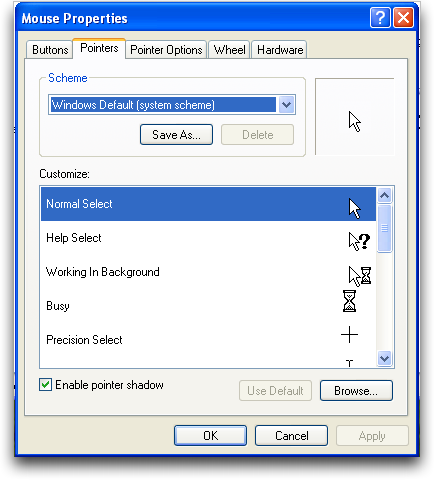
Windows users seem to place similar importance on that clicky thing. A recent PC Magazine article writes, "Few things are more important in Windows than the mouse pointers." Dave Taylor discussed mouse pointers once, showing this picture of Windows XP's mouse pointers: Windows XP's mouse pointer, then, doesn't look like the one John Goerzen got. They look like a bent version of the normal X11 pointers with inverted colors. Windows Vista's mouse cursors do look like GNOME's (via a BlogIsEverything post): For this reason, Windows Vista feels like a cheap knock-off of GNOME to me whenever I use it.

Thomas Girard: Playing with C++0x -- tuple

C++0x is approaching, and it comes with a lot of new stuff, so I've decided to play with it. Some C++0x features are already available in g++ 4.3. Others will be available in the 4.4 release -- see this page for a summary of C++0x language support in g++. What is a tuple? It's a std::pair on stero ds: it can contain any number of elements. For the impatient, the whole sample program is available from here. It can be compiled with: g++-4.3 --std=c++0x tuple.cpp -o tuple. Now let's see how to create a tuple:
#include <string>
#include <tuple>
typedef std::tuple<int, double, std::string> my_tuple_t;
my_tuple_t a_tuple(1, 5.0);
Every element of the tuple gets initialized to its default value if it's not specified. Indeed displaying the third element:
std::cout << std::get<2>(a_tuple) << std::endl;
outputs nothing, because the string element was default-constructed to an empty string. The std::make_tuple function, like std::make_pair for std::pair, can be used to create a tuple using type deduction:
std::cout << std::get<1>(std::make_tuple(false, std::string("see"))) << std::endl;
A tuple element can be changed using the same get function:
std::get<2>(a_tuple) = "a string";
Of course, a tuple is type safe. Trying to put a string at the first element:
std::get<0>(a_tuple) = "another string";
does not compile. But there's more: you also get a compilation error when trying to access an element that does not exist. For example trying to display fourth element does not compile:
std::cout << std::get<3>(a_tuple) << std::endl;
What else can you do with tuples? You can test them for equality, or assign them:
my_tuple_t another_tuple = std::make_tuple(2, 10.0, std::string("nothing"));
std::cout << (a_tuple == another_tuple) << std::endl;
another_tuple = a_tuple;
std::cout << (a_tuple == another_tuple) << std::endl;
You can also retrieve multiple elements at once, possibly ignoring some of them:
std::string a_string;
std::tie(std::ignore, std::ignore, a_string) = another_tuple;
Last, you can concatenate two tuples into a new tuple:
std::tuple<int, double, std::string, bool, std::string> cat =
    std::tuple_cat(a_tuple, std::make_tuple(false, std::string("see")));

Biella Coleman: Voter Fraud

My colleague Mark Crispin Miller has written an excellent piece in the Wall Street Journal Will this Election Be Stolen?. The issue he raises–voter fraud of various stripes–is the single most important issue the American electorate faces. He concludes with the following powerful thought:
It is not the failure or success of any candidate or party that most matters but the exercise of voting rights, and, through them, our self-government. If either team prevails despite the disenfranchisement of some Americans, that victory will mean all that much less; and if your favorite wins, and then the U.S. doesn’t do anything to fix its voting system (and otherwise restore this faltering democracy), that victory of his won’t matter much at all, since We the People will have lost control for good.

Raphael Geissert: Self-healing DEHS


If someone by any chance has noticed in
DEHS' stats page
that there was a bump in the number of failing watch files and is
wondering why it hasn't gone down like it used to, here's the answer:
I'm testing how DEHS' can heal itself, and how long it takes.

In the past when such kind of bumps occurred I used to start a special
DEHS run which retries all the failed watch files, but since doing
that is probably the reason why some of the normal runs process many
more watch files and take longer to finish I decided to let DEHS
automatically recover.

According to my plan it should take from 6 to 7 days to completely
recover from the last mass-failure which was caused by sourceforge's
garr mirror going down abruptly. And I hope this information will be
of some use to design a proper self-healing/recovery mechanism for
DEHS2 (or should it be DEHS-ng? I don't know yet, feel free to propose
names)

Ingo Juergensmann: New Toy: Nikon D90

Last week I ordered and received a Nikon D90 DSLR which replaces my very rusty Kodak DX3600. I got it on Friday and there was not much time to deal with all the functions when we visted some puppies on Saturday. But the results are nice, though:

A classical still life image.
An Eurasier puppy.
Two puppies playing in the garden.


Although the camera is the successor of the D80 and inherited some parts from the D300, it is still not supported by Linux apps. Gphoto2 just recognizes D80 and D300 in PTP mode and digikam is the same. One drawback with the D90 is, that it can't be operated in mass storage mode but only in PTP mode. So, I'll need to either use my USB cardreader or Windows. Needless to say I prefer the cardreader. :)
But I hope that either Linux apps will support the D90 soon or Nikon will add mass storage mode for the D90 in newer firmwares.

Thijs Kinkhorst: Electronisch Pati ntendossier

Today everyone in the Netherlands received a letter about the new national electronic health record (EPD) and the possibility to object against registration. EPD aims to provide access to one's patient data to every care provider through a central information broker. I have submitted the form to disallow my data to be accessed through this system. First of all, there's no clear benefit for me, and I think that goes for the large majority of people. The possible situation where someone has a critical condition and isn't treated by his regular doctor and is unable to inform the stand-in of this and the stand-in has the time to delve through the entire EPD and actually finds and correctly interprets the necessary information seems extremely small for anyone, let alone the big majority that doesn't suffer such critical conditions in the first place. Hence, making it the default for everyone seems very inappropriate. See also this interesting article, written in Dutch by my uncle. Interestingly the same minister was recently opposed to a default-allow for organ donorship, which may address a problem that is much more real. The other concern is security. I am not worried by the technical security of the system, it seems to be of acceptable standard (see this report by my friend Niels). I am more concerned about access restrictions: these are implemented post hoc, that is, anyone can access my file and I can check who accessed my it and whether they had the right to. However, this procedure involves sending in paper forms which I think in practice will not bring about much review. Combined this project reminds me of voting computers - introducing new concerns while solving no actual problems.

Uwe Hermann: Google Tech Talks: coreboot (aka LinuxBIOS): The Free/Open-Source x86 Firmware

coreboot Google Tech Talk 2 Here's a nice opportunity for everyone to learn more about coreboot, a Free Software / Open Source firmware/BIOS for x86 PCs. Ron Minnich, founder of the LinuxBIOS (now called coreboot) project, Peter Stuge of Stuge Konsult, and Stefan Reinauer of coresystems GmbH have given a presentation for the Google Tech Talks series recently. The topic was (of course) coreboot, its history, goals, features and technical details, surrounding tools and libraries such as flashrom and libpayload, as well as an automated test system for running a hardware test-suite upon every checkin in the coreboot repository. coreboot Google Tech Talk 1 A video of the talk, aptly named coreboot (aka LinuxBIOS): The Free/Open-Source x86 Firmware (134 MB), is available from Youtube, get it for instance via:
  $ apt-get install youtube-dl
  $ youtube-dl http://www.youtube.com/watch?v=X72LgcMpM9k
The talk includes various demos of coreboot and various payloads you can use with coreboot. One nice example is the TINT payload, a Tetris-like game for Linux (apt-get install tint for the curious), which has been reworked to be usable as a coreboot payload. coreboot Google Tech Talk 3 So, yes, you can now put Tetris in your BIOS ROM chip and play it from there (no hard drive required). Other demos included some cluster nodes with coreboot, and a "normal" x86 desktop board booting coreboot + Linux in a very few seconds (much room left for optimizing there though, if you really want to get into fast booting). Check out the full talk for more infos, and if you're willing to give it a try (see the list of currently supported boards), contact us on the mailing list or join the #coreboot IRC channel on Freenode.

Francois Marier: Preventing accidental deletion of important files using safe-rm

Some weeks ago, I accidentally deleted half of my /usr/lib. I didn't lose anything important and was able to restore everything (thanks to my Ctrl+C'ing the process in time) but that user error did strike me as too easy to make (apparently, I'm not alone). So I started thinking about how I could prevent something like that from happening again.

I realized one thing: there is no way I would ever want to delete /usr or /etc for example. I figured that "rm" should, by default, refuse to delete certain critical directories (or files). Of course, that would be a very controversial patch to "rm" itself and the chances of this approach succeeding were pretty close to zero.

So instead, I decided to build a wrapper around "rm" which prevents the deletion of important files by checking each one against a blacklist. Anything you add to the blacklist will not be deletable using "rm" unless you override this protection by calling "rm.real" directly.


This tool, safe-rm, ships with a default system-wide configuration file (/etc/safe-rm.conf), but each user can supplement that list of "protected" directories and files by adding lines to ~/.safe-rm.

Debian and Ubuntu packages are available from the usual places.

There are of course different approaches to preventing these kinds of problems...

Christian Perrier: John Goerzen is my hero...

...for maintaining bacula and maintaining it well. I adopted Bacula as backup solution for my local machines, at home, after I went very close to a complete disaster on my home server, last summer. As of now, my home server and my laptop are now backed up with it. The backup is done on a dedicated disk of the server (until I setup a dedicated server, probably in the house's ceiling). And things are just...working. Of course, Bacula is a fairly compilcated beast but, well, as I managed to make it work, I consider that anybody can do it. This morning, I finally setup the bacula graphical console on my laptop. As the laptop is running unstable, with Bacula 2 packages, I indeed had to upgrade bacula packages on the server (which runs Etch, where Bacula version is 1.*). I just went to backports.org, found backported packages there, kindly prepared by John (and Rhonda, apparently). One "apt-get install -t etch-backports" after, I'm just running Bacula 2. John, you deserve a full tank of beers... I'll think about it next time I happen to come in the middle of Kansas..:-)

31 October 2008

Jaldhar Vyas: Da Na Na Na Na Na Na Na Da Na Na Na Na Na Na Na...

Nilu as Batman

Jose Luis Rivas Contreras: New xscreensaver 5.07-1

It was about time, xscreensaver 5.07-1 is ready and is being uploaded right now to experimental (for sanity check with kde components) and available as well from here (binary packages only for i386 at the link). Fixes to XRandr functions and finally xscreensaver is lintian clean since I adopted it 11 months ago. Soon 0 minors and higher priority bugs.

Gunnar Wolf: How (and how not) to create cyclist awareness

Michael blogs about Critical Mass.
What is Critical Mass in case you are too lazy to go to Michael's or to the Wikipedia? A cyclist-awareness movement, showing how bikers are safer (i.e. more visible) when there are more of them. The (dis)organizational nature of this movement (at least according to Wikipedia's information) seems quite fun and interesting.
However, I have to oppose what Michael says is a strong point of CM in Austria - At least, given my country's culture.
People who don't bike often say we have the least bike-aware culture, and that this city must be like hell to cyclists. It is not - Mexicans tend to believe this is the worst place possible on many accounts, and I'm happy to prove the contrary. I do feel that bringing people out to the streets, as our local government's Mu vete en bici program pushes, is completely right: It shows people how fast they can move in real streets in the city, taking away the fear of being run over by a bus, and people will gradually understand we can all excercise the right to use the streets without polluting, and gives us a better idea on how to behave with traffic (even if the traffic is made of fellow bikers) around us. I know this program works - At least, because it worked on me. Whenever possible, I go everywhere in this (not small or friendly by any measure) city by bike.
Anyway - What criticism do I have for Michael's post? That he states they:
Bicycling ludicrously slowly for a good hour, we managed to claim some fairly busy streets while many people tried to get home by car.
IMHO, what we should be doing is to demand the drivers to respect us, not to make them want to run us over. They should not be driven into hating bikers because of the chaos they generate - It is terrible to sit in a car for two hours when you usually take 30 minutes. There is simply no justification for that.
When I took part of the World Naked Bike Ride, some people wanted to take all four lanes of Reforma. Fortunately, reason prevailed, and we took only the lane we were assigned. And we should keep that in mind! Whenever possible, we should protest and make ourselves heard, but without interfering, without damaging, other people's lives!
Oh, by the way: If anybody in Mexico wants to have some nice hours of healthy fun: I am still pondering whether to join, as it is a huge effort, but I am very inclined to do so. Next week, November 9, we will go by bike from Mexico City's Z calo to Pachuca. We face 95Km and close to four hours. The road to Pachuca is basically flat, and going in a large group is a great experience. Hope to see you there!

Michael Schutte: Soundcycle vs. car horns

Wikipedia says:
Critical Mass is a bicycling event typically held on the last Friday of every month in over 300 cities around the world.
My home town of Innsbruck has been one of these cities since 29th August. I joined the movement for the third protest ride (de_AT) today to avoid the Hallowe en fuss, to have some fun, to get to know people, and out of personal conviction. Bicycling ludicrously slowly for a good hour, we managed to claim some fairly busy streets while many people tried to get home by car. A few of them attempted to get us out of their way by honking, but they gave up when they realized that our constant ringing and the music coming from the Soundcycle was louder than them. The hardest part was to get attention by pedestrians and drivers without interfering with buses and trams, but it worked most of the time. What s so great about Critical Mass is that it makes the participants experience just what they want to deliver: When there are more cyclists on the streets, every single one feels much safer, and motorists drive more carefully. I would usually avoid S dring at 5 p. m., but with an estimated fifty people around me, it is an entirely different matter. I also basically like the overall non-organisation of the trips: Whoever is at the top of the convoy can decide where it goes. Sadly, this spontaneity has its drawbacks: It briefly got us into the absurd situation of unlawfully using the street even though a cycle lane was available, which made our protest pointless for a few minutes. But a little room for improvement won t prevent me from taking part once more before the winter break.

Next.

Previous.