Search Results: "spa"

4 November 2017

Steinar H. Gunderson: Tr ndisk 2017 live stream

We're streaming live from Tr ndisk 2017, first round of the Norwegian ultimate frisbee series, today from 0945 CET and throughout the day/weekend. It's an interesting first for Nageru in that it's sports, where everything happens much faster and there are more demands for overlay graphics (I've made a bunch of CasparCG templates). I had hoped to get to use Narabu in this, but as the (unfinished) post series indicates, I simply had to prioritize other things. There's plenty of new things for us anyway, not the least that I'll be playing and not operating. :-) Feel free to tune in to the live stream, although we don't have international stream reflectors. It's a fun sport with many nice properties. :-) There will be YouTube not too long after the day is over, too. Edit: All games from Saturday and Sunday are now online; see this YouTube list. Most commentary is in Norwegian, although some games are in English. I was happy everything worked well, and the production crew did a great job (I was busy playing), but of course there's tons of small things we want to improve for next time.

3 November 2017

Chris Lamb: Faking cleaner URLs in the Debian BTS

Debian bug #846500 requests that the Bug Tracking System moves the canonical URL for a given bug from:

https://bugs.debian.org/cgi-bin/bugreport.cgi?bug=846500 to the shorter, cleaner and generally less ugly:

https://bugs.debian.org/846500 (The latter currently redirects to the former.)


However, whilst we wait for a fix we can abuse the window.history object from the HTML History API to fake this locally:
var m = window.location.href
  .match(/https:\/\/bugs.debian.org\/cgi-bin\/bugreport.cgi\?bug=(\d+)(#.*)?$/);
if (!m) return;
for (var x of document.getElementsByTagName("a"))  
  var href = x.getAttribute("href");
  if (href && href.match(/^[^:]+\.cgi/))  
      // Mangle relative URIs; <base> tag does not DTRT
      x.setAttribute('href', "/cgi-bin/" + href);
   
 
history.replaceState( , "", "/" + m[1] + window.location.hash);

This should work with most "user script" managers I happen to use TamperMonkey in Chrome.

Joerg Jaspert: Automated wifi login, update 2

Seems my blog lately just consist of updates to my automated login script for the ICE wifi But I do hate the entirely useless Click a button crap, every day, twice. I ve seen it once, now leave me alone, please. Updated script:
#!/bin/bash
# (Some) docs at
# https://wiki.ubuntuusers.de/NetworkManager/Dispatcher/
IFACE=$ 1:-"none" 
ACTION=$ 2:-"up" 
TMPDIR=$ TMPDIR:-"/tmp" 
WGET="/usr/bin/wget"
TIMEOUT="/usr/bin/timeout -k 20 15"
case $ ACTION  in
    up)
        CONID=$ CONNECTION_ID:-$(iwconfig $IFACE   grep ESSID   cut -d":" -f2   sed 's/^[^"]*"\ "[^"]*$//g') 
        if [[ $ CONID  == WIFIonICE ]]; then
            REFERER="http://www.wifionice.de/de/"
            LOGIN="http://www.wifionice.de/de/"
            COOKIETMP=$(mktemp -p $ TMPDIR  nmwifionice.XXXXXXXXX)
            trap "rm -f $ COOKIETMP " EXIT TERM HUP INT QUIT
            csrftoken=$($ TIMEOUT  $ WGET  -q -O - --keep-session-cookies --save-cookies=$ COOKIETMP  --referer $ REFERER  $ LOGIN     grep -oP  'CSRFToken"\ value="\K[0-9a-z]+')
            if [[ -z $ csrftoken  ]]; then
                echo "CSRFToken is empty"
                exit 0
            fi
            sleep 1
            $ TIMEOUT  $ WGET  -q -O - --load-cookies=$ COOKIETMP  --post-data="login=true&connect=connect&CSRFToken=$ csrftoken " --referer $ REFERER  $ LOGIN  >/dev/null
        fi
        ;;
    *)
        # We are not interested in this
        :
        ;;
esac

2 November 2017

Steinar H. Gunderson: Introducing Narabu, part 5: Encoding

Narabu is a new intraframe video codec. You probably want to read part 1, part 2, part 3 and part 4 first. At this point, we've basically caught up with where I am, so thing are less set in stone. However, let's look at what qualitatively differentiates encoding from decoding; unlike in interframe video codecs (where you need to do motion vector search and stuff), encoding and decoding are very much mirror images of each other, so we can intuitively expect them to be relatively similar in performance. The procedure is DCT, quantization, entropy coding, and that's it. One important difference is in the entropy coding. Since our rANS encoding is non-adaptive (a choice made largely for simplicity, but also because our streams are so short) works by first signaling a distribution and then encoding each coefficient using that distribution. However, we don't know that distribution until we've DCT-ed all blocks in the picture, so we can't just DCT each block and entropy code the coefficients on-the-fly. There are a few ways to deal with this: As you can see, tons of possible strategies here. For simplicity, I've ended up with the former, although this could very well be changed at some point. There are some interesting subproblems, though: First of all, we need to decide the data type of this temporary array. The DCT tends to concentrate energy into fewer coefficients (which is a great property for compression!), so even after quantization, some of them will get quite large. This means we cannot store them in an 8-bit texture; however, even the bigger ones are very rarely bigger than 10 bits (including a sign bit), so using 16-bit textures wastes precious memory bandwidth. I ended up slicing the coefficients by horizontal index and then pairing them up (so that we generate pairs 0+7, 1+6, 2+5 and 3+4 for the first line of the 8x8 DCT block, 8+15, 9+14, 10+13 and 11+12 for the next line, etc.). This allows us to pack two coefficients into a 16-bit texture, for an average of 8 bits per coefficient, which is what we want. It makes for some slightly fiddly clamping and bit-packing since we are packing signed values, but nothing really bad. Second, and perhaps surprisingly enough, counting efficiently is nontrivial. We want a histogram over what coefficients are used the more often, ie., for each coefficient, we want something like ++counts[dist][coeff] (recall we have four distinct distributions). However, since we're in a massively parallel algorithm, this add needs to be atomic, and since values like e.g. 0 are super-common, all of our GPU cores will end up fighting over the cache line containing counts[dist][0]. This is not fast. Think 10 ms/frame not fast. Local memory to the rescue again; all modern GPUs have fast atomic adds to local memory (basically integrating adders into the cache, as I understand it, although I might have misunderstood here). This means we just make a suitably large local group, build up our sub-histogram in local memory and then add all nonzero buckets (atomically) to the global histogram. This improved performance dramatically, to the point where it was well below 0.1 ms/frame. However, our histogram is still a bit raw; it sums to 1280x720 = 921,600 values, but we want an approximation that sums to exactly 4096 (12 bits), with some additional constraints (like no nonzero coefficients). Charles Bloom has an exposition of a nearly optimal algorithm, although it took me a while to understand it. The basic idea is: Make a good approximation by multiplying each frequency by 4096/921600 (rounding intelligently). This will give you something that very nearly rounds to 4096 either above or below, e.g. 4101. For each step you're above or below the total (five in this case), find the best single coefficient to adjust (most entropy gain, or least loss); Bloom is using a heap, but on the GPU, each core is slow but we have many of them, so it's better just to try all 256 possibilities in parallel and have a simple voting scheme through local memory to find the best one. And then finally, we want a cumulative distribution function, but that is simple through a parallel prefix sum on the 256 elements. And then finally, we can take our DCT coefficients and the finished rANS distribution, and write the data! We'll have to leave some headroom for the streams (I've allowed 1 kB for each, which should be ample except for adversarial data and we'll probably solve that just by truncating the writes and accepting the corruption), but we'll compact them when we write to disk. Of course, the Achilles heel here is performance. Where decoding 720p (luma only) on my GTX 950 took 0,4 ms or so, encoding is 1,2 ms or so, which is just too slow. Remember that 4:2:2 is twice that, and we want multiple streams, so 2,4 ms per frame is eating too much. I don't really know why it's so slow; the DCT isn't bad, the histogram counting is fast, it's just the rANS shader that's slow for some reason I don't understand, and also haven't had the time to really dive deeply into. Of course, a faster GPU would be faster, but I don't think I can reasonably demand that people get a 1080 just to encode a few video streams. Due to this, I haven't really worked out the last few kinks. In particular, I haven't implemented DC coefficient prediction (it needs to be done before tallying up the histograms, so it can be a bit tricky to do efficiently, although perhaps local memory will help again to send data between neighboring DCT blocks). And I also haven't properly done bounds checking in the encoder or decoder, but it should hopefully be simple as long as we're willing to accept that evil input decodes into garbage instead of flagging errors explicitly. It also depends on a GLSL extension that my Haswell laptop doesn't have to get 64-bit divides when precalculating the rANS tables; I've got some code to simulate 64-bit divides using 32-bit, but it doesn't work yet. The code as it currently stands is in this Git repository; you can consider it licensed under GPLv3. It's really not very user-friendly at this point, though, and rather rough around the edges. Next time, we'll wrap up with some performance numbers. Unless I magically get more spare time in the meantime and/or some epiphany about how to make the encoder faster. :-)

Antoine Beaupr : October 2017 report: LTS, feed2exec beta, pandoc filters, git mediawiki

Debian Long Term Support (LTS) This is my monthly Debian LTS report. This time I worked on the famous KRACK attack, git-annex, golang and the continuous stream of GraphicsMagick security issues.

WPA & KRACK update I spent most of my time this month on the Linux WPA code, to backport it to the old (~2012) wpa_supplicant release. I first published a patchset based on the patches shipped after the embargo for the oldstable/jessie release. After feedback from the list, I also built packages for i386 and ARM. I have also reviewed the WPA protocol to make sure I understood the implications of the changes required to backport the patches. For example, I removed the patches touching the WNM sleep mode code as that was introduced only in the 2.0 release. Chunks of code regarding state tracking were also not backported as they are part of the state tracking code introduced later, in 3ff3323. Finally, I still have concerns about the nonce setup in patch #5. In the last chunk, you'll notice peer->tk is reset, to_set to negotiate a new TK. The other approach I considered was to backport 1380fcbd9f ("TDLS: Do not modify RNonce for an TPK M1 frame with same INonce") but I figured I would play it safe and not introduce further variations. I should note that I share Matthew Green's observations regarding the opacity of the protocol. Normally, network protocols are freely available and security researchers like me can easily review them. In this case, I would have needed to read the opaque 802.11i-2004 pdf which is behind a TOS wall at the IEEE. I ended up reading up on the IEEE_802.11i-2004 Wikipedia article which gives a simpler view of the protocol. But it's a real problem to see such critical protocols developed behind closed doors like this. At Guido's suggestion, I sent the final patch upstream explaining the concerns I had with the patch. I have not, at the time of writing, received any response from upstream about this, unfortunately. I uploaded the fixed packages as DLA 1150-1 on October 31st.

Git-annex The next big chunk on my list was completing the work on git-annex (CVE-2017-12976) that I started in August. It turns out doing the backport was simpler than I expected, even with my rusty experience with Haskell. Type-checking really helps in doing the right thing, especially considering how Joey Hess implemented the fix: by introducing a new type. So I backported the patch from upstream and notified the security team that the jessie and stretch updates would be similarly easy. I shipped the backport to LTS as DLA-1144-1. I also shared the updated packages for jessie (which required a similar backport) and stretch (which didn't) and those Sebastien Delafond published those as DSA 4010-1.

Graphicsmagick Up next was yet another security vulnerability in the Graphicsmagick stack. This involved the usual deep dive into intricate and sometimes just unreasonable C code to try and fit a round tree in a square sinkhole. I'm always unsure about those patches, but the test suite passes, smoke tests show the vulnerability as fixed, and that's pretty much as good as it gets. The announcement (DLA 1154-1) turned out to be a little special because I had previously noticed that the penultimate announcement (DLA 1130-1) was never sent out. So I made a merged announcement to cover both instead of re-sending the original 3 weeks late, which may have been confusing for our users.

Triage & misc We always do a bit of triage even when not on frontdesk duty, so I: I also did smaller bits of work on: The latter reminded me of the concerns I have about the long-term maintainability of the golang ecosystem: because everything is statically linked, an update to a core library (say the SMTP library as in CVE-2017-15042, thankfully not affecting LTS) requires a full rebuild of all packages including the library in all distributions. So what would be a simple update in a shared library system could mean an explosion of work on statically linked infrastructures. This is a lot of work which can definitely be error-prone: as I've seen in other updates, some packages (for example the Ruby interpreter) just bit-rot on their own and eventually fail to build from source. We would also have to investigate all packages to see which one include the library, something which we are not well equipped for at this point. Wheezy was the first release shipping golang packages but at least it's shipping only one... Stretch has shipped with two golang versions (1.7 and 1.8) which will make maintenance ever harder in the long term.
We build our computers the way we build our cities--over time, without a plan, on top of ruins. - Ellen Ullman

Other free software work This month again, I was busy doing some serious yak shaving operations all over the internet, on top of publishing two of my largest LWN articles to date (2017-10-16-strategies-offline-pgp-key-storage and 2017-10-26-comparison-cryptographic-keycards).

feed2exec beta Since I announced this new project last month I have released it as a beta and it entered Debian. I have also wrote useful plugins like the wayback plugin that saves pages on the Wayback machine for eternal archival. The archive plugin can also similarly save pages to the local filesystem. I also added bash completion, expanded unit tests and documentation, fixed default file paths and a bunch of bugs, and refactored the code. Finally, I also started using two external Python libraries instead of rolling my own code: the pyxdg and requests-file libraries, the latter which I packaged in Debian (and fixed a bug in their test suite). The program is working pretty well for me. The only thing I feel is really missing now is a retry/fail mechanism. Right now, it's a little brittle: any network hiccup will yield an error email, which are readable to me but could be confusing to a new user. Strangely enough, I am particularly having trouble with (local!) DNS resolution that I need to look into, but that is probably unrelated with the software itself. Thankfully, the user can disable those with --loglevel=ERROR to silence WARNINGs. Furthermore, some plugins still have some rough edges. For example, The Transmission integration would probably work better as a distinct plugin instead of a simple exec call, because when it adds new torrents, the output is totally cryptic. That plugin could also leverage more feed parameters to save different files in different locations depending on the feed titles, something would be hard to do safely with the exec plugin now. I am keeping a steady flow of releases. I wish there was a way to see how effective I am at reaching out with this project, but unfortunately GitLab doesn't provide usage statistics... And I have received only a few comments on IRC about the project, so maybe I need to reach out more like it says in the fine manual. Always feels strange to have to promote your project like it's some new bubbly soap... Next steps for the project is a final review of the API and release production-ready 1.0.0. I am also thinking of making a small screencast to show the basic capabilities of the software, maybe with asciinema's upcoming audio support?

Pandoc filters As I mentioned earlier, I dove again in Haskell programming when working on the git-annex security update. But I also have a small Haskell program of my own - a Pandoc filter that I use to convert the HTML articles I publish on LWN.net into a Ikiwiki-compatible markdown version. It turns out the script was still missing a bunch of stuff: image sizes, proper table formatting, etc. I also worked hard on automating more bits of the publishing workflow by extracting the time from the article which allowed me to simply extract the full article into an almost final copy just by specifying the article ID. The only thing left is to add tags, and the article is complete. In the process, I learned about new weird Haskell constructs. Take this code, for example:
-- remove needless blockquote wrapper around some tables
--
-- haskell newbie tips:
--
-- @ is the "at-pattern", allows us to define both a name for the
-- construct and inspect the contents as once
--
--   is the "empty record pattern": it basically means "match the
-- arguments but ignore the args"
cleanBlock (BlockQuote t@[Table  ]) = t
Here the idea is to remove <blockquote> elements needlessly wrapping a <table>. I can't specify the Table type on its own, because then I couldn't address the table as a whole, only its parts. I could reconstruct the whole table bits by bits, but it wasn't as clean. The other pattern was how to, at last, address multiple string elements, which was difficult because Pandoc treats spaces specially:
cleanBlock (Plain (Strong (Str "Notifications":Space:Str "for":Space:Str "all":Space:Str "responses":_):_)) = []
The last bit that drove me crazy was the date parsing:
-- the "GAByline" div has a date, use it to generate the ikiwiki dates
--
-- this is distinct from cleanBlock because we do not want to have to
-- deal with time there: it is only here we need it, and we need to
-- pass it in here because we do not want to mess with IO (time is I/O
-- in haskell) all across the function hierarchy
cleanDates :: ZonedTime -> Block -> [Block]
-- this mouthful is just the way the data comes in from
-- LWN/Pandoc. there could be a cleaner way to represent this,
-- possibly with a record, but this is complicated and obscure enough.
cleanDates time (Div (_, [cls], _)
                 [Para [Str month, Space, Str day, Space, Str year], Para _])
    cls == "GAByline" = ikiwikiRawInline (ikiwikiMetaField "date"
                                           (iso8601Format (parseTimeOrError True defaultTimeLocale "%Y-%B-%e,"
                                                           (year ++ "-" ++ month ++ "-" ++ day) :: ZonedTime)))
                        ++ ikiwikiRawInline (ikiwikiMetaField "updated"
                                             (iso8601Format time))
                        ++ [Para []]
-- other elements just pass through
cleanDates time x = [x]
Now that seems just dirty, but it was even worse before. One thing I find difficult in adapting to coding in Haskell is that you need to take the habit of writing smaller functions. The language is really not well adapted to long discourse: it's more about getting small things connected together. Other languages (e.g. Python) discourage this because there's some overhead in calling functions (10 nanoseconds in my tests, but still), whereas functions are a fundamental and important construction in Haskell that are much more heavily optimized. So I constantly need to remind myself to split things up early, otherwise I can't do anything in Haskell. Other languages are more lenient, which does mean my code can be more dirty, but I feel get things done faster then. The oddity of Haskell makes frustrating to work with. It's like doing construction work but you're not allowed to get the floor dirty. When I build stuff, I don't mind things being dirty: I can cleanup afterwards. This is especially critical when you don't actually know how to make things clean in the first place, as Haskell will simply not let you do that at all. And obviously, I fought with Monads, or, more specifically, "I/O" or IO in this case. Turns out that getting the current time is IO in Haskell: indeed, it's not a "pure" function that will always return the same thing. But this means that I would have had to change the signature of all the functions that touched time to include IO. I eventually moved the time initialization up into main so that I had only one IO function and moved that timestamp downwards as simple argument. That way I could keep the rest of the code clean, which seems to be an acceptable pattern. I would of course be happy to get feedback from my Haskell readers (if any) to see how to improve that code. I am always eager to learn.

Git remote MediaWiki Few people know that there is a MediaWiki remote for Git which allow you to mirror a MediaWiki site as a Git repository. As a disaster recovery mechanism, I have been keeping such a historical backup of the Amateur radio wiki for a while now. This originally started as a homegrown Python script to also convert the contents in Markdown. My theory then was to see if we could switch from Mediawiki to Ikiwiki, but it took so long to implement that I never completed the work. When someone had the weird idea of renaming a page to some impossible long name on the wiki, my script broke. I tried to look at fixing it and then remember I also had a mirror running using the Git remote. It turns out it also broke on the same issue and that got me looking in the remote again. I got lost in a zillion issues, including fixing that specific issue, but I especially looked at the possibility of fetching all namespaces because I realized that the remote fetches only a part of the wiki by default. And that drove me to submit namespace support as a patch to the git mailing list. Finally, the discussion came back to how to actually maintain that contrib: in git core or outside? Finally, it looks like I'll be doing some maintenance that project outside of git, as I was granted access to the GitHub organisation...

Galore Yak Shaving Then there's the usual hodgepodge of fixes and random things I did over the month.
There is no [web extension] only XUL! - Inside joke

1 November 2017

Steve Kemp: Possibly retiring blogspam.net

For the past few years I've hosted a service for spam-testing blog/forum comments, and I think it is on the verge of being retired. The blogspam.net service presented a simple API for deciding whether an incoming blog/forum comment was SPAM, in real-time. I used it myself for two real reasons: As a result of the Debian-Administration server cleanup I'm still in the process of tidying up virtual machines, and servers. It crossed my mind that retiring this spam-service would allow me to free up another host. Initially the service was coded in Perl using XML/RPC. The current version of the software, version 2, is written as a node.js service, and despite the async-nature of the service it is still too heavy-weight to live on the host which runs most of my other websites. It was suggested to me that rewriting it in golang might allow it to process more requests, with fewer resources, so I started reimplementing the service in golang at 4AM this morning: The service does the minimum: I've ported several plugins, I've got 100% test-coverage of those plugins, and the service seems to be faster than the node.js version - so there is hope. Of course the real test will be when it is deployed for real. If it holds up for a few days I'll leave it running. Otherwise the retirement notice I placed on the website, which chances are nobody will see, will be true. The missing feature at the moment is keeping track of the count of spam-comments rejected/accepted on a per-site basis. Losing that information might be a shame, but I think I'm willing to live with it, if the alternative is closing down..

31 October 2017

Paul Wise: FLOSS Activities October 2017

Changes

Issues

Review

Administration
  • Debian: respond to mail debug request, redirect hardware access seeker to guest account, redirect hardware donors to porters, redirect interview seeker to DPL, reboot system with dead service
  • Debian mentors: security updates, reboot
  • Debian wiki: upgrade search db format, remove incorrect bans, whitelist email addresses, disable accounts with bouncing email, update email for accounts with bouncing email
  • Debian website: remove need for a website rebuild
  • Openmoko: restart web server, set web server process limits, install monitoring tool

Sponsors The talloc/cmocka uploads and the remmina issue were sponsored by my employer. All other work was done on a volunteer basis.

Chris Lamb: Free software activities in October 2017

Here is my monthly update covering what I have been doing in the free software world in October 2017 (previous month):
Reproducible builds

Whilst anyone can inspect the source code of free software for malicious flaws, most software is distributed pre-compiled to end users. The motivation behind the Reproducible Builds effort is to allow verification that no flaws have been introduced either maliciously or accidentally during this compilation process by promising identical results are always generated from a given source, thus allowing multiple third-parties to come to a consensus on whether a build was compromised. I have generously been awarded a grant from the Core Infrastructure Initiative to fund my work in this area. This month I:


I also made the following changes to our tooling:
diffoscope

diffoscope is our in-depth and content-aware diff utility that can locate and diagnose reproducibility issues.

  • Improve names in output of "internal" binwalk members. (#877525).
  • Don't crash on malformed md5sums files. (#877473).
  • Omit misleading "any of" prefix when only complaining about a single module on import. [...]
  • Adjust tests as ps2ascii now varies its output on timezone. [...]

strip-nondeterminism

strip-nondeterminism is our tool to remove specific non-deterministic results from a completed build.

  • Clojure considers .class file to be stale if it shares the same timestamp of the .clj. We thus adjust the timestamps of the .clj to always be younger. (#877418).
  • Print a message in --verbose mode if no canonical time was specified. [...]

buildinfo.debian.net

buildinfo.debian.net is my experiment into how to process, store and distribute .buildinfo files after the Debian archive software has processed them.

  • Always show SHA-256 checksums, regardless of the browser viewport size. [...]
  • Add an API endpoint to fetch specific .buildinfo files for a certain package/version/architecture. [...]


Debian My activities as the current Debian Project Leader are covered in my "Bits from the DPL" email to the debian-devel-announce mailing list.
Patches contributed
  • devscripts: Please print the actual arguments debuild makes to Lintian. (#880124)
  • hw-detect: Drop reference to floppy disks; it's almost 2018. (#880122)
  • debci:
    • Use deb.debian.org over http.debian.net. (#879654)
    • Document how to use an alternative mirror. (#879655)

Debian LTS

This month I have been paid to work 18 hours on Debian Long Term Support (LTS). In that time I did the following:
  • "Frontdesk" duties, triaging CVEs, etc.
  • Followed up on a large number of upstream "pings" that have been left dormant.
  • Issued DLA 1121-1 to fix an out-of-bounds read vulnerability in curl where a malicious FTP server could abuse this to prevent clients from interacting with it.
  • Issued DLA 1123-1 for the "Go" programming language where an attacker could generate a MIME request such that the server ran out of file descriptors.
  • Issued DLA 1126-1 for the libxfont font selection and rasterisation library, correcting two vulnerabilities, both involving the library being tricked into reading invalid/random memory.
  • Issued DLA 1134-1 for sdl-image1.2, an image loading library. A maliciously-crafted .xcf file could cause a stack-based buffer overflow resulting in potential code execution.

Uploads
  • python-django:
    • 2.0~beta1-1 New upstream 2.x release.
    • 1.11.6-1 New upstream bugfix release.
  • gunicorn (19.6.0-10+deb9u1) Prepared a release for stable to avoid a runtime dependency on a compiler. (#877722)
  • redis:
    • 4:4.0.2-3:
      • Drop the Debian-specific /etc/redis/redis-server.pre-up.d (etc.) hooks and remove them if unchanged.
      • Include systemd redis-server@.service and redis-sentinel@.service template files to easily run multiple Redis instances. (#877702)
      • Patch redis.conf and sentinel.conf with quilt instead of maintaining our own versions under debian/.
    • 4:4.0.2-4:
      • Add input validity checking to cluster config slot numbers to fix CVE-2017-15047. (#878076)
      • Drop debian/bin/generate-parts now we aren't calling it.
      • Correct Bash-ism in NEWS file.
    • 4:4.0.2-5: Replace the existing patch for CVE-2017-15047 with an upstream-blessed version that covers another case.
  • redisearch (0.21.3-5) Initial release.
  • docbook2man (2.0.0-40) Correct spelling mistakes in binaries and other misc packaging tidying.
  • python-redis (2.10.6-1) New upstream release.
  • bfs (1.1.3-1) New upstream release.

FTP Team

As a Debian FTP assistant I ACCEPTed 103 packages: amcheck, argagg, binutils, blockui, bro-pkg, chkservice, citus, django-axes, docker-containerd, doctest, dtkwidget, duktape, feed2exec, fontforge, fonttools, gcc-8, gcc-8-cross, generator-scripting-language, gitgraph.js, haskell-uri-encode, hoel, iniparser, its, jquery-areyousure, kodi, libcatmandu-mods-perl, libcatmandu-template-perl, libcatmandu-xml-perl, libcatmandu-xsd-perl, libcode-tidyall-plugin-sortlines-naturally-perl, libgdamm5.0, libinfinity, libmods-record-perl, libreoffice-dictionaries, libset-intervaltree-perl, libsodium, linux, linux-grsec, ltsp-manager, lxqt-themes, mailman3-core, measurement-kit, mini-buildd, musescore, node-babel, node-babel-eslint, node-babel-loader, node-babel-plugin-add-module-exports, node-babel-plugin-transform-define, node-gulp-newer, node-regenerate-unicode-properties, node-regexpu-core, node-regjsparser, node-unicode-data, node-unicode-loose-match, openjdk-9, orafce, pgaudit, pgsql-ogr-fdw, pk4, postgresql-mysql-fdw, powa-archivist, python-azure-devtools, python-colormap, python-darkslide, python-dotenv, python-karborclient, python-logfury, python-lupa, python-marshmallow, python-murano-pkg-check, python-octaviaclient, python-pathspec, python-pgpy, python-pydub, python-randomize, python-sabyenc, python-searchlightclient, python-stestr, python-subunit2sql, python-twitter, python-utils, python-wsgilog, r-cran-bindr, r-cran-desc, r-cran-hms, r-cran-readstata13, r-cran-rprojroot, r-cran-wikidatar, r-cran-wikipedir, r-cran-wikitaxa, repmgr, requests-file, resteasy3.0, sdl-kitchensink, stardicter, systemd-el, thunderbird, tomcat8.0, uwsgi-plugin-luajit, uwsgi-plugin-mongo, uwsgi-plugin-php & uwsgi-plugin-v8. I additionally filed 3 RC bugs against packages that had incomplete debian/copyright files against: fonttools, generator-scripting-language & libsodium.

Norbert Preining: Debian/TeX Live 2017.20171031-1

Halloween is here, time to upload a new set of scary packages of TeX Live. About a month has passed, so there is the usual big stream up updates. There was actually an intermediate release to get out some urgent fixes, but I never reported the news here. So here are the accumulated changes and updates. My favorite this time is wallcalendar, a great class to design all kind of calendars, it looks really well done. I immediately will start putting one together. On the font side there is the new addition coelacanth. To quote from the README: Coelacanth is inspired by the classic Centaur type design of Bruce Rogers, described by some as the most beautiful typeface ever designed. It aims to be a professional quality type family for general book typesetting. And indeed it is beautiful! Other noteworthy addition is the Spark font that allows creating sparklines in the running text with LaTeX. Enjoy. New packages algobox, amscls-doc, beilstein, bib2gls, coelacanth, crossreftools, dejavu-otf, dijkstra, ducksay, dynkin-diagrams, eqnnumwarn, fetchcls, fixjfm, glossaries-finnish, hagenberg-thesis, hecthese, ifxptex, isopt, istgame, ku-template, limecv, mensa-tex, musicography, na-position, notestex, outlining, pdfreview, spark-otf, spark-otf-fonts, theatre, unitn-bimrep, upzhkinsoku, wallcalendar, xltabular. Updated packages acmart, amsmath, animate, arabluatex, arara, babel, babel-french, bangorexam, baskervillef, beebe, biblatex-philosophy, biblatex-source-division, bibletext, bidi, bxjaprnind, bxjscls, bxpapersize, bytefield, classicthesis, cochineal, complexity, cooking-units, curves, datetime2-german, dccpaper, doclicense, docsurvey, eledmac, epstopdf, eqparbox, esami, etoc, fbb, fei, fithesis, fmtcount, fnspe, fonts-tlwg, fontspec, genealogytree, glossaries, glossaries-extra, hecthese, hepthesis, hvfloat, ifplatform, ifptex, inconsolata, jfmutil, jsclasses, ketcindy, knowledge, koma-script, l3build, l3experimental, l3kernel, l3packages, langsci, latex2man, latexbug, lato, leadsheets, libertinust1math, listofitems, luatexja, luatexko, luatodonotes, lwarp, markdown, mcf2graph, media9, newtx, novel, numspell, ocgx2, overpic, philokalia, phonenumbers, platex, poemscol, pst-exa, pst-geometrictools, pst-ovl, pst-plot, pst-pulley, pst-tools, pst-vehicle, pst2pdf, pstool, pstricks, pstricks-add, pxchfon, pxjahyper, quran, randomlist, rec-thy, reledmac, robustindex, scratch, skrapport, spectralsequences, tcolorbox, tetex, tex4ht, texcount, texdoc, tikzducks, tikzsymbols, toptesi, translation-biblatex-de, unicode-math, updmap-map, uplatex, widetable, xcharter, xepersian, xetexko, xetexref, xsim, zhlipsum.

29 October 2017

Russ Allbery: Review: Why We Sleep

Review: Why We Sleep, by Matthew Walker
Publisher: Scribner
Copyright: October 2017
ISBN: 1-5011-4433-2
Format: Kindle
Pages: 341
The world is full of theories, and corresponding books, about things that will make you healthier or prevent disease. Nearly all of them are scams, either intentional or created through the placebo effect and the human tendency to see patterns that don't exist. The rare ones that aren't have a certain pattern: they're grounded in our best understanding of biology, align with what our body wants to do anyway, have been thoroughly studied using proper testing methodology, and don't make money for powerful corporations. I'm fairly sure this is one of those rare ones that isn't a scam. And, if so, it's rather important and worth your attention. Matthew Walker is a professor of neuroscience and biology at the University of California at Berkeley, where he's the founder of the Center for Human Sleep Science. He's not a doctor; he started medical training, but (as he says in the book) found himself more attracted to questions than answers. He's a professional academic researcher who has been studying sleep for decades. This book is a combination of summary of the current state of knowledge of academic sleep research and a plea: get more sleep, because we're literally killing ourselves with the lack of it. Walker opens the book with a discussion of the mechanisms of sleep: how we biologically fall asleep and why, how this has changed over time, and how it changes with age. Along with that, he defines sleep: the REM and NREM sleep cycle that you may have already heard of, how it manifests itself in most people, and where dreams fit in. The second part then discusses what happens when you sleep, with a focus on what goes wrong when you don't. (Spoiler: A lot. Study after study, all cited and footnoted, has found connections between sleep and just about every aspect of mental and physical health.) The third part does the same for dreams, fitting them into the picture along with a scientific discussion of just what's going on during dreams. The fourth and final part tackles the problem: why don't we get enough sleep, and what can we do about it? I will warn in advance that this book will make you paranoid about your sleeping patterns. Walker has the missionary zeal of an academic who has sunk his teeth into something really important that society needs to take into account and will try to drown you in data, analysis, analogies, and sheer earnestness until you will believe him. He wants you to get at least seven, and preferably eight, hours of sleep a night. Every night, with as little variation as you can manage. Everyone, even if you think you're someone who doesn't need as much sleep (you're probably not). There's a ton of science here, a great popularization of a whole field of research, but this is also a book that's trying to get you to do something. Normally, that sort of book raises my shields. I'm not much of a believer in any book of the general genre of "most people are doing this basic part of life wrong, and should do it my way instead." But the hallmarks of good science are here: very widespread medical consensus, no corporate interest or obvious path to profit, and lots of studies (footnoted here, with some discussions of methodology although not the statistical details, which will require looking up the underlying studies and careful caveats where studies indicate correlation but may not find causes). And Walker makes the very telling point early in the book that nearly every form of life on the planet sleeps in one way or another (defined as a daily recurring period of time during which it doesn't respond to outside stimulus), which is a strong indicator of universal necessity. Given the vulnerability and loss of useful hours that come with sleep, one would expect some species to find an evolutionary path away from it if it were dispensable. But except for extremely short-lived species, we've never found a living creature that didn't sleep. Walker's argument for duration is also backed up by repeated studies on human capability before and after various quantities of sleep, and on studies of the sleep phases in various parts of the night. Study after study used six hours as the cutoff point and showed substantial deterioration in physical and mental capabilities even after only one night of short sleeping. (Reducing sleep to four hours is nearly catastrophic.) And, more worrisomely, that degradation is still measurable after "catching up" on sleep on subsequent nights. Sleeping in on weekends doesn't appear to fully compensate for the damage done by short-sleeping during the week. When Walker gets into the biological reasons for sleep, one starts to understand why it's so important. I think the part I found the most fascinating was the detailed analysis of what the brain is doing while you sleep. It's not inactive at all, even outside of REM sleep. Walker and other sleep researchers have done intriguing experiments showing how different parts of the sleep cycle transfer memories from short to long term storage, transfer physical skills into subconscious parts of the brain, discard short term memories that the conscious brain has tagged as being unwanted, and free up space for new knowledge acquisition. REM sleep appears to attempt to connect otherwise unrelated memories and bits of knowledge, inverting how association normally works in the brain, thus providing some concrete explanation for sleep's role in creativity. And (this research is fairly new), deep NREM sleep causes temporary physical changes in the brain that appear to be involved in flushing metabolic waste products away, including the plaque involved in Alzheimer's. The last part of the book is probably the most concretely useful: what can one practically do to get more sleep? There is quite a lot that's proven effective, but Walker starts with something else: sleeping pills. Here, you can almost see the lines drawn by a lawyer around what Walker should say. He stresses that he's not a medical doctor while laying out study after study that all point in the same direction: sleeping pills are a highly dangerous medical fraud that will shorten your lifespan for negligible benefit in helping you fall asleep, while limiting your brain's ability to enter true sleep. They're sedation, sedation is not sleep, and the four billion dollar sleeping pill market is literally making everything worse. The good news is there is an effective treatment for insomnia that works for many people; the better news is that it's completely free (although Walker does suggest some degree of medical supervision for serious insomnia so that some parts of it can be tailored to you). He walks through CBT-I (cognitive behavior therapy for insomnia), which is now the medically recommended primary treatment for insomnia, and takes apart the pieces to show how they line up with the results of sleep research studies. Alongside that are recommendations for improving sleep for people who don't have clinical insomnia but who aren't regularly getting the recommended amount of sleep. There are a lot of interesting bits here (and he of course talks about blue LED light and its relationship to melatonin cycles), but I think the most interesting for me was that you have to lower your core body temperature by a couple of degrees (Fahrenheit) to enter sleep. The temperature of your sleeping environment is therefore doubly important: temperature changes are one of the signals your body uses to regulate circadian rhythms (cold being a signal of night), and a colder sleeping area helps you lower your core body temperature so that you can fall asleep. (The average person does best with a sleeping room temperature of 65F, 18C.) There's even more in here: I haven't touched on Walker's attack on the US tendency to push high school start times earlier and earlier in the day (particularly devastating for teenagers, whose circadian rhythms move two hours later in the day than adults before slowly returning to an adult cycle). Or the serious problems of waking to an alarm clock, and the important benefits of the sleep that comes at the end of a full night's cycle. Or the benefits of dreams in dealing with trauma and some theories for how PTSD may interfere with that process. Or the effect of sleep on the immune system. Walker's writing style throughout Why We Sleep is engaging and clear, although sometimes too earnest. He really wants the reader to believe him and to get more sleep, and sometimes that leaks around the edges. One can also see the effort he's putting into not reading too much into research studies, but if there's a flaw in the science here, it's that I think Walker takes a few tentative conclusions a bit too far. (I'm sure these studies have the standard research problem of being frequently done on readily-available grad students rather than representative samples of the population, although the universality of sleep works in science's favor here.) Some of the recitations of research studies can get rather dry, and I once again discovered how boring I find most discussion of dreams, but for a first book written by an academic, this is quite readable. This is one of those books that I want everyone to read mostly so that they can get the information in it, not as much for the enjoyment of reading the book itself. I've been paying closer attention to my own sleep patterns for the last few years, and my personal experience lines up neatly with the book in both techniques to get better sleep and the benefits of that sleep. I'd already reached the point where I was cringing when people talk about regularly going on four or five hours of sleep; this is an entire book full of researched reasons to not do that. (Walker points out that both Reagan and Thatcher, who bragged about not requiring much sleep, developed Alzheimer's, and calls out Trump for making the same brag.) The whole book may not be of interest to everyone, but I think everyone should at least understand why the World Heath Organization recommends eight hours a night and labels shift work a probable carcinogen. And, as Walker points out, we should be teaching some of this stuff in school health classes alongside nutrition and sex education. Alas, Walker can't provide much advice on what I think is the largest robber of sleep: the constant time pressure of modern life, in which an uninterrupted nine hour sleep opportunity feels like an unaffordable luxury. Rating: 9 out of 10

28 October 2017

Russ Allbery: Review: Provenance

Review: Provenance, by Ann Leckie
Publisher: Orbit
Copyright: September 2017
ISBN: 0-316-38863-7
Format: Kindle
Pages: 448
In a rather desperate attempt to please her mother, Ingray has spent every resource she has on extracting the son of a political enemy from Compassionate Removal (think life imprisonment with really good marketing). The reason: vestiges, a cultural touchstone for Ingray's native planet of Hwae. These are invitation cards, floor tiles, wall panels, or just about anything that can be confirmed to have been physically present at an important or historical moment, or in the presence of a famous figure. The person Ingray is retrieving supposedly pulled off the biggest theft of vestiges in history. If she can locate them, it would be a huge coup for her highly-placed politician mother, and the one time she would be victorious in her forced rivalry with her brother. About the best thing that could be said for this plan is that it's audacious. The first obstacle is the arrival of the Geck on the station for a Conclave for renegotiation of the treaty with the Presger, possibly the most important thing going on in the galaxy at the moment, which strands her there without money for food. The second is that the person she has paid so much to extract from Compassionate Removal says they aren't the person she was looking for at all, and are not particularly interested in going with her to Hwae. Only a bit of creative thinking in the face of a visit from the local authorities, and the unexpected kindness of the captain from whom she booked travel, might get her home with the tatters of her plan intact. But she's clearly far out of her depth. Provenance is set in the same universe as Ancillary Justice and its sequels, but it is not set in the empire of the Radchaai. This is another human world entirely, one with smaller and more provincial concerns. The aftermath of Ancillary Mercy is playing out in the background (so do not, on risk of serious spoilers, read the start of this book without having read the previous trilogy), but this is in no way a sequel. Neither the characters nor the plot are involved in that aftermath. It's a story told at a much smaller scale, about two political families, cut-throat maneuvering, horrible parenting, the inexplicable importance of social artifacts, the weirdness of human/alien relations, and the merits of some very unlikely allies. Provenance is a very different type of story than Ancillary Justice, and Ingray is a very different protagonist. The shape of the plot reminded me of one of Lois McMaster Bujold's Miles Vorkosigan stories: hair-brained ideas, improvisation, and unlikely allies. But Ingray couldn't be more different than Miles. She starts the book overwhelmed, despairing, and not at all manic, and one spends the first part of the story feeling sorry for her and becoming quite certain that everything will go horribly wrong. The heart of this book is the parallel path Leckie takes the reader and the characters along as they discover just what Ingray's true talents and capabilities are. It's a book about being hopelessly bad at things one was pressured towards being good at, while being quietly and subtly good at the skills that let one survive a deeply dysfunctional family. There are lots of books with very active protagonists, and a depressing number of books with passive protagonists pushed around by the plot. There are very few books that pull off the delicate characterization that Leckie manages here: a protagonist who is rather hopeless at taking charge of the plot in the way everyone wants (but doesn't particularly expect) her to, but who charts her own path through the plot in an entirely unexpected way. It's a story that grows on you. The plot rhythm never works in quite the way one expects from other books, but it builds its own logic and its own rhythm, and reached a very emotionally satisfying conclusion. The Radchaai, or at least one Radchaai citizen, do show up eventually, providing a glimmer of outside view at the Ancillary Justice world. Even better, the Geck play a significant role. I adore Leckie's aliens: they're strange and confusing, but in a refreshingly blunt way rather than abusing gnomic utterances and incomprehensible intelligence. And the foot-stomping of the spider bot made me laugh every time. The stakes are a lot lower here than in Ancillary Justice, and Ingray isn't the sort of character who's going to change the world. But that's okay; indeed, one of the points of this book is why and how that's okay. I won't lie: I'd love more Breq, and I hope we eventually get an exploration of the larger consequences of her story. But this is a delightful story that made me happy and has defter character work than most SF being written. Recommended, but read the Ancillary trilogy first. One minor closing complaint, which didn't change my experience of the book but which I can't help quibbling about: I'm completely onboard with the three-gender system that Leckie uses for the Hwae (I wish more SF authors would play with social as well as technological ideas), and I think she wove it deftly into the story, but I wish she hadn't used Spivak pronouns for the third gender. (e/em/eir, for those who aren't familiar.) Any of the other gender-neutral pronouns look better to me and cause fewer problems for my involuntary proofreader. I prefer zie/zir for personal reasons, but sie/hir, zhe/zhim/zher, or even thon or per would read more smoothly. Eir is fine, but em looks like 'em and throws my brain into dialect mode and forces a re-parse, and e just looks like a typo. I know from lots of Usenet discussions of pronouns that I'm not the only one who has that reaction to Spivak. But it's a very minor nit. Rating: 8 out of 10

27 October 2017

Sam Hartman: How Can Debian Turn Disagreement into Something that Makes us Stronger

Recently, when asked to engage with the Debian Technical Committee, a maintainer chose to orphan their package rather than discuss the issue brought before the committee. In another decision earlier this year, a maintainer orphaned their package indicating a lack of respect for the approach being taken and the process. Unfortunately, this joins an ever longer set of issues where people walk away from the TC process disheartened and upset.

For me personally the situations where maintainers walked away from the process were hard. People I respect and admire were telling me that they were unwilling to participate in our dispute resolution process. In one case the maintainer explicitly did not respect a process I had been heavily involved in. As someone who values understanding and build a team, I feel disappointed and hurt thinking about this.

Unfortunately, I don't feel much better when I consider several of the other issues brought before the TC. In a number of cases, the process has concluded, but it feels like a pyrrhic victory. We have an answer, but often we never reached an understanding of one of the key stakeholder's positions. People are sufficiently disappointed or frustrated that they reduce their involvement. That is, the answer is not one they can live with. Sometimes, I'm not even sure that answering the question was worth the cost.

My initial suspicion as I begin to consider issues that have come before the TC in the last few years is that as a necessary consequence of how the TC operates, we will drive a significant chunk of those who come to us away from our community. I will not be part of that. If I end up eventually agreeing with this suspicion, I will either work to improve the TC process or find a different way to contribute to the project that is more aligned with my goals.


Our Community is More Important than Technical Correctness I firmly believe that Debian's strength is its community. Distributions, upstreams, free-software advocates, corporate interests, and everything in between work together. Because we are working on a concrete product,we actually have to understand how our needs conflict and compliment each other. Also, like any organization, our ability to get things done is dependent on our contributors and the time we all put in.

I cannot think of anything more harmful we can do than drive away a constructive contributor. Technical quality is important: many of us will eventually go away if quality drops too much. However, Debian itself can be improved incrementally. Yes, new people do join Debian. However, it takes a lot of new people to make up for a situation where everyone involved is frustrated, and some leave and tell their friends to stay away from Debian.

When a Disagreement Reaches the TC When a disagreement reaches the TC, we know a few things. First, people have not have not been able to resolve it on their own. Second, the disagreement is important enough to at least one of the parties to ask for outside help.

If the TC were to simply announce a decision, it is very likely that at least one party would feel frustrated and disappointed. If the decision is important to someone it almost always means that they care about the outcome. If previous efforts have not reached agreement then there is an outcome that is undesired. While it's possible under the constitution that two parties could bring an issue to the TC mutually where the dynamics could be different, this does not happen in practice.

When we "lose" When a decision making process decides to select one of my undesired outcomes, I have strong negative feelings. First, there is the technical result itself. Because of an adverse decision it is generally harder for me to do my technical work, or some ethical position or group I care about is disadvantaged. However, the strongest feelings are related to needs about my place in the community, not a direct response to the technical decision. I worry about whether issues I care about will be valued in the future; I would likely feel weary or scared thinking of contributing in an environment where issues that matter to me aren't going to be considered. I tend to feel frustrated if my position was not adequately considered this time around.

Often, the strongest feelings do not stem from how I am impacted by the decision itself. Thus, if my more general needs are addressed, I will feel a lot better about not having my preferred outcome selected. Confidence that my position was understood is the single biggest factor in being able to accept the result. If the community took the time to understand me, then I have confidence that I am valued. I can advocate for change and be part of the ongoing discussion. If I understand the other positions then I can understand that the position was not arbitrary. Understanding the other positions is also a prerequisite to seeing how things I value were considered, especially when the tradeoff did not ultimately favor these values.

My conversations with others about their experience with conflict suggest my feelings and needs are common.


However, the TC focuses almost exclusively on the technical matter before it. I don't think the TC has done a good job of actually understanding maintainers or the people bringing issues to us. Especially when we're fairly sure we understand what the ultimate decision will be, we focus on getting to that decision. Of course part of actually understanding someone is considering what they have to say. Even when you have high confidence in an outcome, if you want someone to feel understood, you do have to listen at a point where you can consider what they bring forward.

Frustration of Being Questioned

On the other side, it's frustrating to have your decisions questioned. Reviewing a decision takes time. Even if the TC agrees with a maintainer, asking that maintainer to sit through a long process can create frustrations as deep as any I discussed in the previous section.

So the process is doubly bad for maintainers. Someone can bring up an issue which requires precious time. Then if the TC decides against the maintainer, we have all the problems I discussed previously.

I acknowledge this. A good process must respect the maintainer's time. However, it must respect the community members who disagree with maintainers. Everyone who brings an issue to the TC is a developer. They have contributed significantly to our community and are part of our team. Yes, we need to protect the process against abuse. But in a very real sense if we aren't willing to consider an issue and we aren't willing to engage with someone, understand why they think the issue should be considered, and work until they understand why we made our decision, we are saying we do not respect them enough to take that time. We should expect that to drive people away.

I wonder if the solution here involves a two phase process. During the first phase we work with someone bringing an issue to us until we understand it. We either engage the maintainer at that point, spend the time to help the person bringing an issue to us understand why we are not engaging the maintainer, or have decided the issue is abusive of the processs/misdirected. For this to work maintainers would have to trust us enough to actually be willing to sit back and not spend a lot of their time.

Sam, It's Just Personalities

One criticism I've heard as I discuss this is that a lot of the negative feelings surround interpersonal conflict and are personality conflicts. Yes, personalities matter. Yes, we re still healing from the Systemd discussion.

However, as a community, I think we need to figure out how we respect the inevitable personality conflicts. I can think of one or two developers I'm still upset with years after an issue. It happens. Perhaps if I were a maintainer when one of these developers raised a concern with my packages, I could ask that someone else be a primary advocate for an issue. Similarly, if a developer wanted to address an issue with me as a maintainer but would prefer not to deal with me, perhaps we could figure out some way that we could see if someone else shared the concern.

Dropping a Package is Sometimes an Answer

My concerns were sparked by instances where a maintainer dropped a package rather than interact with the TC. Sometimes that can be a healthy step in a transition. At Debconf this year, Enrico Zini gave a talk on consent culture in Debian. One of the key points of his talk is that we can find over time that what we're being asked to do in Debian is no longer consistent with our boundaries. If it isn t helping us move forward if it isn t fun then it is likely time to stop.

In that sense, approaching disagreement can be a great time to take stock and ask whether we still enjoy maintaining a package. If we don t, then stepping aside and letting others take it on can be a great way that we and they can be happier. I don t really think that s what happened in these instances though. Based on comments made to me, this sounded more like a lack of faith in being treated well or in our ability as a committee.

Even so, Enrico s talk applies in a number of ways here. He suggests that the approach we should take when someone is done and steps away is to thank then. I couldn t agree more. From the depth of my heart I offer thanks: Thank you for taking care of yourself and stepping away when it is no longer fun. Thank you for all the effort you have put into these packages. I hope to work with you on great things in the future.

26 October 2017

Russ Allbery: Review: Waypoint Kangaroo

Review: Waypoint Kangaroo, by Curtis C. Chen
Series: Kangaroo #1
Publisher: Thomas Dunne
Copyright: June 2016
ISBN: 1-250-08179-3
Format: Kindle
Pages: 312
Disclaimer: Curtis was a classmate of mine at Stanford and part of the same social circle. That was a surprisingly long time ago. Kangaroo is a spy (and, for this book, you should think James Bond). Agency training, fake identities, lots of gadgets, grumpy yet ridiculously competent support staff... the typical package. But Kangaroo also has a special power, which is the entire reason he ended up in the position he has. He's apparently the only person in the world who can open the pocket: a hole into another dimension, which can function as infinite storage and quite a bit more. Waypoint Kangaroo opens with the tail end of a mission and Kangaroo in action, as an introduction to Kangaroo's first-person narrative voice, job, and the capabilities of the pocket. But the real story starts when Kangaroo is sent on vacation. The office is being audited, Kangaroo hasn't had time off basically ever, and his boss insists on a trip to Mars on the space equivalent of a cruise ship. No work. An expense account. Just relax and have fun. Kangaroo isn't sure he knows how to not work. Or how to avoid boredom when trying hard to not work. It leads to probably ill-advised decisions like falling in love at first glance with the chief engineer, or going on entirely unauthorized spacewalks in the middle of the night. It's very lucky for him that the captain of this commercial cruise ship appears to also work for his agency. And it's good for his inability to stop working that there's a murder on board. For a first novel, this is refreshingly free of a lot of first novel problems. It's lean, well-structured, easy to follow, moves right along, and doesn't feel over-stuffed with exposition or world-building. There's an interplanetary war in the past background, and of course a lot of loving description of the precise mechanics of the pocket and the tricks with momentum and retrieval Kangaroo can do with it, but the book never falls into too much explanation. And the plot is satisfyingly twisty. It's an action story plot, to be clear: don't expect deep puzzles or complex deduction. But there are enough players and hidden motives to keep things interesting. The downside is that I didn't like Kangaroo very much. He's a bit of an ass. Some of this goes with the spy novel territory, and some of it is good (if occasionally grating) characterization. Kangaroo doesn't know how to turn off the part of his brain that makes everything a mission. But his flippant, know-it-all attitude got on my nerves after a book full of first-person narration, and while (full credit to Curtis here) the romance in this book is clearly consensual and stays well away from the creepy romances so common in spy stories, the love-at-first sight bits and some of Kangaroo's awkward reactions provoked more eye-rolling than enjoyment. A lot of this is just personal taste, but that's the peril of books told with first-person narration. The reader has to really like the protagonist to spend a whole book in their head. If that relationship doesn't click, the supporting characters have a harder time salvaging the experience. Waypoint Kangaroo avoids the problem of too many loving descriptions of guns, partly because it's a spy novel and instead has loving descriptions of spy equipment in a future that supports implanted devices. I think there was a smidgen too much of this, but it was within genre conventions and spy stuff is more interesting than guns. But (and I admit that this is probably idiosyncratic), it also had way too many loving descriptions of alcohol and one drunk scene. I don't care to ever read another book with a drunk protagonist (particularly first-person), and I care considerably less about alcohol than I do about spy equipment or guns. That said, I still liked this well enough that I'll probably buy the sequel. (No cliffhangers; Waypoint Kangaroo is a complete story. But this is a character who could easily support a long episodic series.) The pocket is a neat gimmick, the world background is at least mildly interesting, and some of the supporting characters were excellent. (Particularly the security chief and the engineer.) I might even warm to Kangaroo over time if subsequent stories stay more on his creative fast-talking rather than his drinking and awkward romances. I don't think this is quite good enough for me to recommend it, but if you're in the mood for a light and fast-moving first-person Bond-style story with science fiction trappings, it does deliver. Rating: 6 out of 10

25 October 2017

Petter Reinholdtsen: Locating IMDB IDs of movies in the Internet Archive using Wikidata

Recently, I needed to automatically check the copyright status of a set of The Internet Movie database (IMDB) entries, to figure out which one of the movies they refer to can be freely distributed on the Internet. This proved to be harder than it sounds. IMDB for sure list movies without any copyright protection, where the copyright protection has expired or where the movie is lisenced using a permissive license like one from Creative Commons. These are mixed with copyright protected movies, and there seem to be no way to separate these classes of movies using the information in IMDB. First I tried to look up entries manually in IMDB, Wikipedia and The Internet Archive, to get a feel how to do this. It is hard to know for sure using these sources, but it should be possible to be reasonable confident a movie is "out of copyright" with a few hours work per movie. As I needed to check almost 20,000 entries, this approach was not sustainable. I simply can not work around the clock for about 6 years to check this data set. I asked the people behind The Internet Archive if they could introduce a new metadata field in their metadata XML for IMDB ID, but was told that they leave it completely to the uploaders to update the metadata. Some of the metadata entries had IMDB links in the description, but I found no way to download all metadata files in bulk to locate those ones and put that approach aside. In the process I noticed several Wikipedia articles about movies had links to both IMDB and The Internet Archive, and it occured to me that I could use the Wikipedia RDF data set to locate entries with both, to at least get a lower bound on the number of movies on The Internet Archive with a IMDB ID. This is useful based on the assumption that movies distributed by The Internet Archive can be legally distributed on the Internet. With some help from the RDF community (thank you DanC), I was able to come up with this query to pass to the SPARQL interface on Wikidata:
SELECT ?work ?imdb ?ia ?when ?label
WHERE
 
  ?work wdt:P31/wdt:P279* wd:Q11424.
  ?work wdt:P345 ?imdb.
  ?work wdt:P724 ?ia.
  OPTIONAL  
        ?work wdt:P577 ?when.
        ?work rdfs:label ?label.
        FILTER(LANG(?label) = "en").
   
 
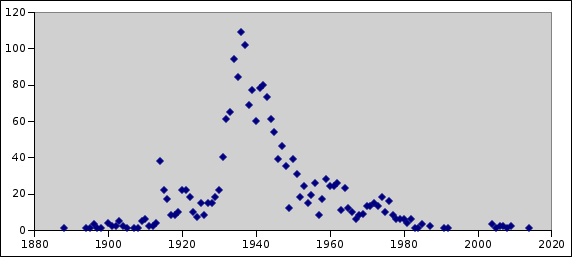
If I understand the query right, for every film entry anywhere in Wikpedia, it will return the IMDB ID and The Internet Archive ID, and when the movie was released and its English title, if either or both of the latter two are available. At the moment the result set contain 2338 entries. Of course, it depend on volunteers including both correct IMDB and The Internet Archive IDs in the wikipedia articles for the movie. It should be noted that the result will include duplicates if the movie have entries in several languages. There are some bogus entries, either because The Internet Archive ID contain a typo or because the movie is not available from The Internet Archive. I did not verify the IMDB IDs, as I am unsure how to do that automatically. I wrote a small python script to extract the data set from Wikidata and check if the XML metadata for the movie is available from The Internet Archive, and after around 1.5 hour it produced a list of 2097 free movies and their IMDB ID. In total, 171 entries in Wikidata lack the refered Internet Archive entry. I assume the 70 "disappearing" entries (ie 2338-2097-171) are duplicate entries. This is not too bad, given that The Internet Archive report to contain 5331 feature films at the moment, but it also mean more than 3000 movies are missing on Wikipedia or are missing the pair of references on Wikipedia. I was curious about the distribution by release year, and made a little graph to show how the amount of free movies is spread over the years: I expect the relative distribution of the remaining 3000 movies to be similar. If you want to help, and want to ensure Wikipedia can be used to cross reference The Internet Archive and The Internet Movie Database, please make sure entries like this are listed under the "External links" heading on the Wikipedia article for the movie:
*  Internet Archive film id=FightingLady 
*  IMDb title id=0036823 title=The Fighting Lady 
Please verify the links on the final page, to make sure you did not introduce a typo. Here is the complete list, if you want to correct the 171 identified Wikipedia entries with broken links to The Internet Archive: Q1140317, Q458656, Q458656, Q470560, Q743340, Q822580, Q480696, Q128761, Q1307059, Q1335091, Q1537166, Q1438334, Q1479751, Q1497200, Q1498122, Q865973, Q834269, Q841781, Q841781, Q1548193, Q499031, Q1564769, Q1585239, Q1585569, Q1624236, Q4796595, Q4853469, Q4873046, Q915016, Q4660396, Q4677708, Q4738449, Q4756096, Q4766785, Q880357, Q882066, Q882066, Q204191, Q204191, Q1194170, Q940014, Q946863, Q172837, Q573077, Q1219005, Q1219599, Q1643798, Q1656352, Q1659549, Q1660007, Q1698154, Q1737980, Q1877284, Q1199354, Q1199354, Q1199451, Q1211871, Q1212179, Q1238382, Q4906454, Q320219, Q1148649, Q645094, Q5050350, Q5166548, Q2677926, Q2698139, Q2707305, Q2740725, Q2024780, Q2117418, Q2138984, Q1127992, Q1058087, Q1070484, Q1080080, Q1090813, Q1251918, Q1254110, Q1257070, Q1257079, Q1197410, Q1198423, Q706951, Q723239, Q2079261, Q1171364, Q617858, Q5166611, Q5166611, Q324513, Q374172, Q7533269, Q970386, Q976849, Q7458614, Q5347416, Q5460005, Q5463392, Q3038555, Q5288458, Q2346516, Q5183645, Q5185497, Q5216127, Q5223127, Q5261159, Q1300759, Q5521241, Q7733434, Q7736264, Q7737032, Q7882671, Q7719427, Q7719444, Q7722575, Q2629763, Q2640346, Q2649671, Q7703851, Q7747041, Q6544949, Q6672759, Q2445896, Q12124891, Q3127044, Q2511262, Q2517672, Q2543165, Q426628, Q426628, Q12126890, Q13359969, Q13359969, Q2294295, Q2294295, Q2559509, Q2559912, Q7760469, Q6703974, Q4744, Q7766962, Q7768516, Q7769205, Q7769988, Q2946945, Q3212086, Q3212086, Q18218448, Q18218448, Q18218448, Q6909175, Q7405709, Q7416149, Q7239952, Q7317332, Q7783674, Q7783704, Q7857590, Q3372526, Q3372642, Q3372816, Q3372909, Q7959649, Q7977485, Q7992684, Q3817966, Q3821852, Q3420907, Q3429733, Q774474

23 October 2017

Patrick Schoenfeld: Testing javascript in a dockerized rails application with rspec-rails

The other day I wanted to add support for tests of javascript functionality in a (dockerized) rails application using rspec-rails. Since rails 5.1 includes system tests with niceties like automatically taking a screenshot on failed tests, I hoped for a way to benefit from this
features without changing to another test framework. Lucky me only recently the authors of rspec-rails added support for so-called system specs. There is not much documentation so far (but there are a lot of useful information in the corresponding bug report #1838 and a friendly guy named Thomas Walpole (@twalpole) is helpfully answering to questions in that issue. To make things a little bit more complicated: the application in question is usually running in a docker container and thus the tests of the application are also run in a docker container. I didn t want to change this, so here is what it took me to get this running. Overview Let s see what we want to achieve exactly: From a technical point of view, we will have the application under test (AUT) and the tests in one container (let s call it: web) and we will need another container running a javascript-capable browser (let s call it browser). Thus we need the tests to drive a remote running browser (at least when running in a docker environment) which needs to access the application under a different address than usually. Namely an address reachable by the chrome-container, since it will not be reachable via 127.0.0.1 as is (rightfully) assumed by default. If we want Warden authentication stubbing to work (as we do, since our application uses Devise) and transactional fixtures as well (e.g. rails handling database cleanup between tests without database_cleaner gem) we also need to ensure that the application server is being started by the tests and the tests are actually run against that server. Otherwise we might run into problems. Getting the containers ready Assuming you already have a container setup (and are using docker-compose like we do) there is not that much to change on the docker front. Basically you need to add a new service called chrome and point it to an appropriate image and add a link to it in your existing web-container. I ve decided to use standalone-chrome for the browser part, for which there are docker images provided by the selenium project (they also have images for other browsers). Kudos for that.
...
services:
  chrome:
    image: selenium/standalone-chrome
   
  web:
   
    links:
      - chrome
The link ensures that the chrome instance is available before we run the tests and that the the web-container is able to resolve the name of this container. Unfortunately this is not true for the other way round, so we need some magic in our test code to find out the ip-address of the web-container. More to this later. Other than that, you probably want to configure a volume for you to be able to access the screenshots, which get saved to tmp/screenshots
in the application directory. Preparing the application for running system tests There is a bit more to do on the application side. The steps are roughly:
  1. Add necessary depends / version constraints
  2. Register a driver for the remote chrome
  3. Configure capybara to use the appropriate host for your tests (and your configured driver)
  4. Add actual tests with type: :system and js: true
Let s walk them through. Add necessary depends What we need is the following: The required features are already part of 3.7.0, but this version is the version I used and it contains a bugfix, which may or may not be relevant. One comment about the rails version: for the tests to properly work it s viable to have puma use certain settings. In rails 5.1.4 (the version released, at time of writing this) uses the settings from config/puma.rb which most likely collides with the necessary settings. You can ensure these settings yourself or use rails from branch 5-1-stable which includes this change. I decided for the latter and pinned my Gemfile to the then current commit. Register a driver for the remote chrome To register the required driver, you ll have to add some lines to your rails_helper.rb:
if ENV['DOCKER']
  selenium_url =
      "http://chrome:4444/wd/hub"
  Capybara.register_driver :selenium_remote do  app 
    Capybara::Selenium::Driver.new(app,
         :url => selenium_url, :browser => :remote, desired_capabilities: :chrome )
  end
end
Note that I added those lines conditionally (since I still want to be able to use a local chrome via chromedriver) if an environment variable DOCKER is set. We defined that environment variable in our Dockerfile and thus you might need to adapt this to your case. Also note that the selenium_url is hard-coded. You could very well take a different approach, e.g. using an externally specified SELENIUM_URL, but ultimately the requirement is that the driver needs to know that the chrome instance is running on host chrome, port 4444 (the containers default). Configure capybara to use the appropriate host and driver The next step is to ensure that javascript-requiring system tests are actually run with the given driver and use the right host. To achieve that we need to add a before-hook to the corresponding tests or we can configure rspec accordingly to always include such a hook by modifying the rspec-configuration in rails_helper.rb like this:
RSpec.configure do  config 
  ...
  config.before(:each, type: :system, js: true) do
    if ENV['DOCKER']
      driven_by :selenium_remote
      ip = Socket.ip_address_list.detect addr  addr.ipv4_private?  .ip_address
      host! "http://# ip :# Capybara.server_port "
    else
      driven_by :headless_chrome
    end
  end
Note the part with the ip-address: it tries to find an IPv4 private address for the web-container (the container running the tests) to ensure the chrome-container uses this address to access the application. The Capybara.server_port is important here, since it will correspond to the puma instance launched by the tests. That heuristic (first ipv4 private address) works for us at the moment, but it might not work for you. It is basically a workaround to the fact that I couldn t get web resolvable for the chrome container which may be fixable on the docker side, but I was to lazy to further investigate that. If you change it: Just make sure the host! method uses an URI pointing to an address of the web-container that is reachable to the chrome-container. Define tests with type: :system and js: true Last but certainly not least, you need actual tests of the required type and with or without js: true. This can be achieved by creating tests files starting like this:
RSpec.feature "Foobar", type: :system, js: true do
Since the new rspec-style system tests are based around the feature-specs which used to be around previously, the rest of the tests is exactly like it is described for feature specs. Run the tests To run the tests a commandline like the following should do: docker-compose run web rspec It won t make a big noise about running the tests against chrome, unless something fails. In that case you ll see a message telling you where the screenshot has been placed. Troubleshooting Below I add some hints about problems I ve seen during configuring that: Test failing, screenshot shows login screen In that case puma might be configured wrongly or you are not using transactional fixtures. See the hints above about the rails version to use which also includes some pointers to helpful explanations. Note that rspec-rails by default does not output the puma startup output as it clutters the tests. For debugging purposes it might be helpful to change that by adding the following line to your tests:
ActionDispatch::SystemTesting::Server.silence_puma = false
Error message: Unable to find chromedriver This indicates that your driver is not configured properly, because the default for system tests is to be driven_by selenium, which tries to spawn an own chrome instance and is suitable for non-dockerized tests. Check if your tests are marked as js: true (if you followed the instructions above) and that you properly added the before-hook to your rspec-configuration. Collisions with VCR If you happen to have tests that make use of the vcr gem you might see it complaining about not knowing what to do with the requests between the driver and the chrome instance. You can fix this, by telling VCR to ignore that requests, by adding a line where you configured VCR:
VCR.configure do  config 
# required so we don't collide with capybara tests
config.ignore_hosts 'chrome'
...

22 October 2017

Iain R. Learmonth: Free Software Efforts (2017W42)

Here s my weekly report for week 42 of 2017. In this week I have replaced my spacebar, failed to replace a HDD and begun the process to replace my YubiKey.

Debian Eariler in the week I blogged about powerline-taskwarrior . There is a new upstream version available that includes the patches I had produced for Python 2 support and I have filed #879225 to remind me to package this. The state of emscripten is still not great, and as I don t have the time to chase this up and I certainly don t have the time to fix it myself, I ve converted the ITP for csdr to an RFP. As I no longer have the time to maintain map.debian.net, I have released this domain name and published the sources behind the service.

Tor Project There was a request to remove the $ from family fingerprint on Atlas. These actually come from Onionoo and we have decided to fix this in Onionoo, but I did push a small fix for Atlas this week that makes sure that Atlas doesn t care if there are $ prefixes or not. I requested that a Trac component be created for metrics-bot. I wrote a seperate post about metrics-bot. I also attended the weekly metrics team meeting.

Sustainability I believe it is important to be clear not only about the work I have already completed but also about the sustainability of this work into the future. I plan to include a short report on the current sustainability of my work in each weekly report. I have not had any free software related expenses this week. The current funds I have available for equipment, travel and other free software expenses remains 60.52. I do not believe that any hardware I rely on is looking at imminent failure. I do not find it likely that I ll be travelling to Cambridge for the miniDebConf as the train alone would be around 350 and hotel accomodation a further 600 (to include both me and Ana).

Hideki Yamane: openSUSE.Asia Summit 2017 in Tokyo

This weekend large typhoon is approaching to Japan, however, I went to UEC (The University of Electro-Communications, ) to give a talk in openSUSE.Asia Summit 2017 in Tokyo.

"... hey, wait. openSUSE? Are you using openSUSE?"

Honestly no, I'm not. My talk was "openSUSE tools on Debian" - the only one session about Debian in that conference :)

Photo by Youngbin Han (Ubuntu Korea Loco), thanks!


We Debian distribute some tools from openSUSE - OBS (Open Build Service), Snapper and I'm now working on openQA. So, it is a good chance to contact to upstream (=openSUSE) people, and I got some hints from them, thanks!


openSUSE tools on Debian from Hideki Yamane

21 October 2017

Michael Stapelberg: pk4: a new tool to avail the Debian source package producing the specified package

UNIX distributions used to come with the system source code in /usr/src. This is a concept which fascinates me: if you want to change something in any part of your system, just make your change in the corresponding directory, recomile, reinstall, and you can immediately see your changes in action. So, I decided I wanted to build a tool which can give you the impression of that, without the downsides of additional disk space usage and slower update times because of /usr/src maintenance. The result of this effort is a tool called pk4 (mnemonic: get me the package for ) which I just uploaded to Debian. What distinguishes this tool from an apt source call is the combination of a number of features: If you don t want to wait for the package to clear the NEW queue, you can get it from here in the meantime:
wget https://people.debian.org/~stapelberg/pk4/pk4_1_amd64.deb
sudo apt install ./pk4_1_amd64.deb
You can find the sources and issue tracker at https://github.com/Debian/pk4. Here is a terminal screencast of the tool in action, availing the sources of i3, applying a patch, rebuilding the package and replacing the installed binary packages:

Jaldhar Vyas: Sal Mubarak 2074

Wishing all Debian people a prosperous and auspicious Gujarati new year (V.S. 2074 called Saumya.) This year fireworks became legal for the first time in New Jersey. Not that it ever stopped us before but it is nice to see the government stop meddling for no reason. (Eff you, Indian Supreme Court.) Sparklers on Diwali. Although you can only see sparklers in the picture above, we got enough armament to make ISIS jealous. There were also lots of diabetes-inducing sweets and (inexpensive, practical) presents for young and old. That's what I call a proper Diwali and new year.

20 October 2017

Rapha&#235;l Hertzog: Freexian s report about Debian Long Term Support, September 2017

A Debian LTS logoLike each month, here comes a report about the work of paid contributors to Debian LTS. Individual reports In August, about 170 work hours have been dispatched among 13 paid contributors. Their reports are available: Evolution of the situation The number of sponsored hours is the same as last month. But we have a new sponsor in the pipe. The security tracker currently lists 52 packages with a known CVE and the dla-needed.txt file 49. The number of packages with open issues decreased slightly compared to last month but we re not yet back to the usual situation. Thanks to our sponsors New sponsors are in bold.

No comment Liked this article? Click here. My blog is Flattr-enabled.

Next.

Previous.