Search Results: "rra"

29 July 2008

Joerg Jaspert: Argentina

Despite all those talks about the Lufthansa strikes my flight down to Argentina worked pretty well. We have been delayed by about 20 minutes, and the service on board was less than usual, but still enough to not get a cannibal during the flight. :) But looking at what I hear from various sources people with later flights might have a little more trouble. Hopefully not too many, like cancelled flights. Right now we (Mark ‘mhy’ Hymers, Stephen ‘sgran’ Gran and myself) are sitting at Martin ‘Tincho’ Ferraris place, where we stayed the last night. Current plan seems to be “Go to BA, look around the City a bit (after we found a place to store our luggage there), in the evening meet with local people, then take the night bus to Mar del Plata, so we arrive there on Wednesday”. Comments: 0

Wouter Verhelst: On LVM volume group names

Lior blogs about LVM volume group names colliding, after he'd done an installation on two systems with 'vg00' as the volume group name, and trying to add the hard disk from one of them to the other machine. Which breaks in all kinds of interesting ways, of course. Me, I avoid the problem altogether by just naming my volume groups sensibly.
wouter@samba:~$ sudo vgdisplay grep 'VG Name'
  VG Name               samba
[...]
wouter@goa:~$ sudo vgdisplay grep 'VG Name'
  VG Name               goa
... etcetera. If I ever have to put one of the disks from goa's (500G) RAID array into samba, then that'll be no problem, at all.

27 July 2008

Jeff Bailey: I'm off the drugs


drugs
Originally uploaded by jbailey
Well, tomorrow will be one week since my last of the prescription drugs, and the last Tylenol I had was on Tuesday. I think I'm finally free of these damned things.

It's worth noting that these bottles aren't all empty, but this doesn't include the ones given to me in the hospital, the various stomach things I had to take so that the steroids didn't hurt me, and the various bottles of Tylenol that I lost from being such a basket case (Everyone, especially Angie, has been so patient with me with the mood swings, the memory holes, etc. Thank-you so much!) Based on this, I'm assuming that the count probably evens out. I totalled the number of pills in these bottles: 1333.

I've heard that there's an org, "Doctors Without Borders" to which I can donate the ones that I will definitely not need again, like the steroids and such. I'll hunt them down soon.

Next update: Tuesday. I get to see the surgeon again and my movement restrictions are expected to be lifted. That means the only other visit is to the oncologist who *still* after 5 months can't manage to schedule an appointment with me. They're the ones who finally phoned a week ago to schedule one. I wanted to check with my surgeon on something, and when I went to phone them back, their call display number isn't valid. They were supposed to phone me back anyway, but I also asked my surgeon's practice coordinator to arrange it for me. Still nothing. *sigh* I'm going to take the opportunity at the hospital to go talk to them in person to see if I can get things moving. We're still at the stage where noone expects anything, but they want the tests to make sure that's actually the case.

Still, I'm excited to be this far. It's nice to finally feel like I'm thinking somewhat more clearly now.

26 July 2008

Philipp Kern: Stable Point Release: Etch 4.0r4 (aka etchnhalf)

Another point release for Etch has been done; now it's the time for the CD team to roll out new images after the next mirror pulse. The official announcements (prepared by Alexander Reichle-Schmehl, thanks!) will follow shortly afterwards. FTP master of the day was Joerg Jaspert, who did his first point release since Woody, as he told us on IRC. We appreciate your work and you spending your time that shortly before going to Argentina. This point release includes the etchnhalf update introducing a new kernel image (based on 2.6.24) and some driver updates. Additionally the infamous openssl hole will be fixed for good, even for new installs. Again I want to present you a list of people who contributed to this release. It cannot be complete as I got the information out of the Changed-by fields of the uploads. From the Release Team we had dann frazier (who drove the important kernel part of etchnhalf), Luk Claes, Neil McGovern, Andreas Barth, Martin Zobel-Helas and me working on it. ;-)

23 July 2008

Martín Ferrari: Wanted: Nokia n810

Image of an N810 from WikipediaDear lazyweb, I'm craving for one of these niceties. But unfortunately in Argentina they are very expensive and not easy to find (I think there's not any 'legal' channel to buy them currently). So, anyone coming to DebConf from the States would be so kind as to bring me one of these? They are small (72 128 14 mm) and lightweight (226 grams), and aren't so expensive as to be a big risk; I can buy it from here so you don't even have to lend the money for the time being. So if you want to help make a DebConf organiser happy, you know how :-). I can bribe in the form of a nice bbq at home, or a dinner at some restaurant. Tags: Planet Debian

MJ Ray: LugRadio Live Event Review, Part Web2.0


LUGRadioLive 2008 by sheilaellen (cc-by-2.0) One aspect I didn’t mention in the LugRadio Live Event Review was how old-fashioned it seemed in some ways. I guess I’ve got used to seeing conferences experimenting with various web2.0 toys like live-blogging, feedback walls and so on, or the excellent live video streaming of DebConfs, but it was a bit of a surprise to find myself the only person in the audience who connected to the IRC channel from the event. One possible reason for that was that the wireless network was a bit difficult, or at least that was what I was told. I felt quite smug with my 3G smartphone IRC client (which I’ll blog about later) until Rufus Pollock mentioned the 800+ patents involved in 3G. Damn - I guess I hate freedom. In one way, I guess it’s appropriate if the network wasn’t up to the task. Broken networks were a regular feature of early ALUG meetings, as the end of this email hints. Web2.0 was there a little bit. There was a facebook page (which I accidentally spammed while travelling to the event), flickr:lugradiolive and a twitter link of #lugradiolive - but how does that work? There’s no user called lugradiolive and you can’t have usernames containing # Update: twitter:#lugradiolive (thanks to Dave Briggs for the explanation in a comment). Anyway, seeing as there will be another LUG Radio Live, maybe we can arrange something more interactive but free-software-friendly for 2009? More reviews I’ve read: davee: Lugradio-in makes me feel good , Peter Cannon: The party’s over for LugRadio Live and No’: Lugradio Undead - but why aren’t more people writing about this event? There seemed to be enough there. Or are they out there but I’m just not seeing them?

22 July 2008

Russ Allbery: Tired now

Last week, Stanford University hosted Cartel, a gathering of several schools that share similarities of infrastructure and IT problems. I was one of the coordinators, handled most of the content for the web site, helped prepare the agenda, and presented for three of the segments. It's considerably more work hosting and coordinating one of these than just attending one, even with the travel. Jeff Altman and Derrick Brashear, the other two OpenAFS gatekeepers, were also in town for half of Cartel and stayed through Friday, so we went out to dinner several times, played a great deal of Fluxx, talked about the state of the world, and caught up. This was all great and very informative, but I'm also an introvert, which means that no matter how much I'm enjoying social interaction, it's also extremely tiring. I'm still fairly wiped; I'm getting more done (and got more done last weekend) than I really expected, but I expect I'll be paying the price all the way through this week. (And then I have more company from out of town that I've been looking forward to for months, but which will then take its own toll, which means it's likely I'm going to be exhausted until well into August.) So, I'm currently looking at all the things I want to do and trying to tell myself that not only is it okay that they're not all going to get done right away, but I need to make a concerted effort to take time to relax, try to work less than 40 hours this week (after working 56 last week), and spend more time reading. Of course, writing reviews is one of the other things that I'm currently a bit behind on.... Debian is freezing for lenny next weekend. If I have a few moments, I may do final uploads of OpenAFS (to clarify that hppa isn't a supported platform) and kstart (a long-awaited new upstream release that adds a flag saying not to get forwardable tickets, needed if one has a krb5.conf configuration saying to get them and a site policy that says you can't). gnubg could stand another upload, but I probably won't get to that. The Shibboleth packages are all in good shape except that they don't all have complete copyright files for all the Autotools helper stuff, which is very not important. Thankfully, the freeze is basically meaningless for Lintian, which will continue apace (and Adam D. Barratt continues to take much of the load off by doing a ton of commit work), and means that Debian Policy work should actually slow. My intention is to make the next normative release of Policy shortly after the lenny release, which gives us plenty of time to work on more changes for the next version. I plan on somewhat ignoring both for a bit while I catch up on other things, since I released Lintian 1.24.2 on the 13th (which I see I never announced here — whoops). In other news, I finally started the process of moving services from systems I own and have to fix to systems where someone else owns the hardware and has to fix it when it breaks by buying a VM from Panix. I still need to sort out my DNS situation and get more direct control over my zone file now that I have somewhere I can run my own DNS server so that I can start moving services there, but so far, so good. I'm extremely impressed by their service and capabilities and already have all of my Git repositories on the system and gitweb set up once I get DNS updated.

18 July 2008

Benjamin Mako Hill: The Googlenet

At the hotel I'm staying at in Alexandria for Wikimania, there is wifi from a closed network that requires login and that has no user-accessible way to gain increased access. However, they have defined a set of "exceptions" to their closed network policy. The exceptions are described on the page users are redirected to upon connecting. Essentially, the exceptions boil down to any website that ends in google.com. You can use Google search (but not click on the links), use GMail, Google Talk, Google Reader (but not see any images on the blogs you are reading), Google Calendar, Google Maps, Google Checkout, Google Docs, and so on. A few people at the conference seem only barely inconvenienced by the arrangement and most seem to be able to get work done! I can't help feel like I'm experiencing some dystopian version of the Internet from 10 years in the future.

17 July 2008

Russell Coker: Pollution and Servers

There is a lot of interest in making organisations “green” nowadays. One issue is how to make the IT industry green. People are talking about buying “offsets” for CO2 production, but the concern is that some of the offset schemes are fraudulent. Of course the best thing to do is to minimise the use of dirty power as much as possible. Of course the first thing to do is to pay for “green power” (if available) and if possible install solar PV systems on building roofs. While the roof space of a modern server room would only supply a small amount of the electricity needed (maybe less than needed to power the cooling) every little bit helps. The roof space of an office building can supply a significant portion of the electricity needs, two years ago Google started work on instralling Solar PV panels on the roof of the “Googleplex” [1] with the aim of supplying 30% of the building’s power needs. For desktop machines a significant amount of power can be saved if they are turned off overnight. For typical office work the desktop machines should be idle most of the time, so if the machine is turned off outside business hours then it will use something close to 45/168 of the power that it might otherwise use. Of course this requires that the OS support hibernation (which isn’t supported well enough in Linux for me to want to use it) or that applications can be easily stopped and restarted so that the system can be booted every morning. One particular corner case is that instant-messaging systems need to be server based with an architecture that supports storing messages on the server (as Jabber does [2]) rather than requiring that users stay connected (as IRC does). Of course there are a variety of programs to proxy the IRC protocol and using screen on a server to maintain a persistent IRC presence is popular among technical users (for a while I used that at a client site so that I could hibernate the PowerMac I had on my desktop when I left the office). It seems that most recent machines have BIOS support for booting at a pre-set time. This would allow the sys-admin to configure the desktop machines to boot at 8:00AM on every day that the office is open. That way most employees will arrive at work to find that their computer is already booted up and waiting for them. We have to keep in mind the fact that when comparing the minimum pay (about $13 per hour in Australia) with the typical electricity costs ($0.14 per KWh - which means that a desktop computer might use $0.14 of electricity per day) there is no chance of saving money if employee time is wasted. While companies are prepared to lose some money in the process of going green, they want to minimise that loss as much as possible. The LessWatts.org project dedicated to saving energy on Linux systems reports that Gigabit Ethernet uses about 2W more power than 100baseT on the same adapter [3]. It seems most likely that similar savings can be achieved from other operating systems and also from other network hardware. So I expect that using 100baseT speed would not only save about 2W at the desktop end, but it would also save about 2W at the switch in the server-room and maybe 1W in cooling as well. If you have a 1RU switch with 24 Gig-E ports then that could save 48W if the entire switch ran at 100baseT speed, compared to a modern 1RU server which might take a minimum of 200W that isn’t very significant. The choice of server is going to be quite critical to power use, it seems that all vendors are producing machines that consume less power (if only so that they can get more servers installed without adding more air-conditioning), so some effort in assessing power use before purchase could produce some good savings. When it comes time to decommission old servers it is a good idea to measure the power use and decommission the most power hungry ones first whenever convenient. I am not running any P4 systems 24*7 but have a bunch of P3 systems running as servers, this saves me about 40W per machine. It’s usually the case that the idle power is a significant portion of the maximum power use. In the small amount of testing I’ve done I’ve never been able to find a case where idle power was less than 50% of the maximum power - of course if I spun-down a large number of disks when idling this might not be the case. So if you can use one virtual server that’s mostly busy instead of a number of mostly idle servers then you can save significant amounts of power. Before I started using Xen I had quite a number of test and development machines and often left some running idle for weeks (if I was interrupted in the middle of a debugging session it might take some time to get back to it). Now if one of my Xen DomU’s doesn’t get used for a few weeks it uses little electricity that wouldn’t otherwise be used. It is also possible to suspend Xen DomU’s to disk when they are not being used, but I haven’t tried going that far. Xen has a reputation for preventing the use of power saving features in hardware. For a workstation this may be a problem, but for a server that is actually getting used most of the time it should not be an issue. KVM development is apparently making good progress, and KVM does not suffer from any such problems. Of course the down-side to KVM is that it requires an AMD64 (or Intel clone) system with hardware virtualisation, and such systems often aren’t the most energy efficient. A P3 system running Xen will use significantly less power than a Pentium-D running KVM - server consolidation on a P3 server really saves power! I am unsure of the energy benefits of thin-client computing. I suspect that thin clients can save some energy as the clients take ~30W instead of ~100W so even if a server for a dozen users takes 400W there will still be a net benefit. One of my clients does a lot of thin-client work so I’ll have to measure the electricity use of their systems. Disks take a significant amount of power. For a desktop system they can be hibernated at times (an office machine can be configured such that the disks can spin-down during a lunch break). This can save 7W per disk (the exact amount depends on the type of disk and the efficiency of the PSU - (see the Compaq SFF P3 results and the HP/Compaq Celeron 2.4GHz on my computer power use page [4]). Network booting of diskless workstations could save 7W for the disk (and also reduce the noise which makes the users happy) but would drive the need for Gigabit Ethernet which then wastes 4W per machine (2W at each end of the Ethernet cable). Recently I’ve been reading about the NetApp devices [5]. By all accounts the advanced features of the NetApp devices (which includes their algorithms for the use of NVRAM as write-back cache and the filesystem journaling which allows most writes to be full stripes of the RAID) allow them to deliver performance that is significantly greater than a basic RAID array with a typical filesystem. It seems to me that there is the possibility of using a small number of disks in a NetApp device to replace a larger number of disks that are directly connected to hosts. Therefore use of NetApp devices could save electricity. Tele-commuting has the potential to save significant amounts of energy in employee travel. A good instant-messaging system such as Jabber could assist tele-commuters (it seems that a Jabber server is required for saving energy in a modern corporate environment). Have I missed any ways that sys-admins can be involved in saving energy use in a corporation? Update: Albert pointed out that SSD (Solid State Disks) can save some power. They also reduce the noise of the machine both by removing one moving part and by reducing heat (and therefore operation of the cooling fan). They are smaller than hard disks, but are large enough for an OS to boot from (some companies deliberately only use a small portion of the hard drives in desktop machines to save space on backup tapes). It’s strange that I forgot to mention this as I’m about to buy a laptop with SSD.

Gunnar Wolf: Kept silent for a week...

Last week (July 7-13) was basically hell on Earth, for me and for the group that somehow got the name Cabras locas, of which I am part since I joined the National Pedagogical University, where I worked full-time 2003-2005.
It was, yes, the first of my officially three weeks of Summer holiday at IIEc-UNAM, so no problems here. So, why hell on Earth? Because we were in charge basically of anything related with information flow, retrieval and manipulation at the 11th International Congress on Mathematical Education, in Monterrey.
What we thought would basically be one or two days of hard work followed by six days of relaxed vacations (we had even planned to have an internal seminar, showing off the shiny stuff each of us is working on) became... A mind-boggling eight day experience where we worked over 12 hours a day on being human replacements for Google, SQL engines, full-text parsers, report generators, printer watchdogs, and in general lines, just a bunch of unhappy firemen, ready to be called off for whatever task was necessary.
We did have, of course, several calm periods every now and then. We even had to learn how to look busy while doing something compeltely unrelated (that would explain, for example, a couple of low-hanging bugs I fixed for Debian, or some dozens of lines of code I could get off my head).
But my advice for whoever reads this: Don't trust people with long database-handling experience. Specially when they insist that hand-capturing a thousand registers is preferrable (i.e. less error-prone) than parsing three separate databases and discarding duplicates. And, of course, specially when this person is your boss, which is enough of an argument to have it his way.

16 July 2008

Russell Coker: Mobile SSH Client

There has been a lot of fuss recently about the release of the iPhone [1] in Australia. But I have not been impressed. I read an interesting post Why I don’t want an iPhone [2] which summarises some of the issues of it not being an open platform (and not having SSH client support). Given all the fuss about iPhones (which have just arrived in Australia) I had been thinking of writing my own post about this, but TK covered most of the issues that matter to me. One other thing I have to mention is the fact that I want a more fully powered PC with me. So even if I had a Green Phone (which doesn’t seem to be on general sale) [3] or OpenMoko [4] I would still want at least a PDA running Familiar and preferrably a laptop - I often carry both. A Nokia N8×0 series Internet Tablet [4] would satisfy my PDA needs (and also remove the need to carry an MP3/MP4 player and audio recorder). When doing serious travelling I carry a laptop, a PDA, and a MP3 player all areas of my digital needs are covered better than an iPhone could reasonably manage. Finally mobile phones tend to not work or not work well ($1 per minute calls is part of my definition of “not well”) in other countries. While I haven’t been doing a lot of traveling recently I still try to avoid buying things that won’t work in other countries. I had planned to just mention TK’s post in a links post. But then a client offered to buy me an iPhone. He wants me to be able to carry a ssh client with me most places that I go so that whenever his systems break I can login. Now apart from the lack of ssh client support an iPhone seems ideal. :-# The cheapest Optus iPhone plan seems to be $19 per month for calls and data (which includes 100M of data) and $21 per month over 24 months for the iPhone thus giving a cost of $40 per month for 100M of data transfer (and a nice phone). There is a plan ofr a $19 per month iPhone, but that has a $19 per month un-capped phone plan and doesn’t sound like a good way of saving $2 per month. The “Three” phone company offers USB 3G modems for $5 per month (on a 24 month contract) and their cheapest plan is $15 per month which gives you 1GB of data per month and $0.10/M for additional data transfer. So it’s $20 per month for 1G (which requires a laptop) vs $40 per month for 100M. Three also has a range of phone plans that allow 3G data access over bluetooth to a PC, it seems that a Nokia N8×0 tablet can be used with that which gives a result of two devices the size of mobile phones. But that costs $20 per month (on top of a regular Three bill) for a plan that offers 500M of data and still requires two devices while not giving the full PC benefits. In the past I’ve done a lot of support work with a Nokia Communicator, so I’ve found that anything less than a regular keyboard really slows things down. While a EeePC keyboard is not nearly as good as a full sized keyboard it is significantly better than a touch-screen keyboard on a PDA (IE the Nokia N8×0 or the OpenMoko). At the moment I’m looking at the option of carrying an EeePC with a USB Internet access device. That will cost $20 per month for net access. The cost of the EeePC is around $300 for a low-end model or about $650 for a 901 series that can run Xen (as noted in my previous post I’m considering the possibilities for having a mobile Xen simulation of a production network [5]). The savings of $20 per month over 24 months will entirely cover the cost of a low-end EeePC (ssh terminal, web browsing, and local storage of documentation) and cover most of the cost of a high-end EeePC. Another possibility to consider is using an old Toshiba Satellite I have hanging around (which I used to use as a mobile SE Linux demonstration machine) for a few months while the price on the EeePC 901 drops (as soon as the 70x series is entirely sold out and the 1000 series is available I expect that the 901 will get a lot cheaper).

15 July 2008

MJ Ray: Good News on the Koha 3.0.0-final Approach

Koha 3.0.0-final is very close, delayed mainly by a few serials bugs and translation updates as far as I know, but the big news recently has been Venezuela s National Library evaluated, decided to deploy the Koha Integrated Library System ecorrado which was very good to see. Myself, I’m in a world of RFID-tag-related pain, which I’ll describe and publish code for as soon as it stops hurting, including perl modules like RFID::Reader::TRF7960::Serial and RFID::Reader::TRF7960::SSL. (Contact me if you want them before I get free time, please.) I also need to remember how to publish git trees to alioth collab-maint. Too many tasks, too little time.

12 July 2008

David Pashley: Rebuilding a RAID array

I recently had a failed drive in my RAID1 array. I've just installed the replacement drive and thought I'd share the method. Let's look at the current situation:
root@ace:~# cat /proc/mdstat 
Personalities : [linear] [multipath] [raid0] [raid1] [raid6] [raid5] [raid4] [raid10] 
md1 : active raid1 sda3[1]
      483403776 blocks [2/1] [_U]
      
md0 : active raid1 sda1[1]
      96256 blocks [2/1] [_U]
      
unused devices: <none>
So we can see we have two mirrored arrays with one drive missing in both. Let's see that we've recognised the second drive:
root@ace:~# dmesg   grep sd
[   21.465395] Driver 'sd' needs updating - please use bus_type methods
[   21.465486] sd 2:0:0:0: [sda] 976773168 512-byte hardware sectors (500108 MB)
[   21.465496] sd 2:0:0:0: [sda] Write Protect is off
[   21.465498] sd 2:0:0:0: [sda] Mode Sense: 00 3a 00 00
[   21.465512] sd 2:0:0:0: [sda] Write cache: enabled, read cache: enabled, doesn't support DPO or FUA
[   21.465562] sd 2:0:0:0: [sda] 976773168 512-byte hardware sectors (500108 MB)
[   21.465571] sd 2:0:0:0: [sda] Write Protect is off
[   21.465573] sd 2:0:0:0: [sda] Mode Sense: 00 3a 00 00
[   21.465587] sd 2:0:0:0: [sda] Write cache: enabled, read cache: enabled, doesn't support DPO or FUA
[   21.465590]  sda: sda1 sda2 sda3
[   21.487248] sd 2:0:0:0: [sda] Attached SCSI disk
[   21.487303] sd 2:0:1:0: [sdb] 976773168 512-byte hardware sectors (500108 MB)
[   21.487314] sd 2:0:1:0: [sdb] Write Protect is off
[   21.487317] sd 2:0:1:0: [sdb] Mode Sense: 00 3a 00 00
[   21.487331] sd 2:0:1:0: [sdb] Write cache: enabled, read cache: enabled, doesn't support DPO or FUA
[   21.487371] sd 2:0:1:0: [sdb] 976773168 512-byte hardware sectors (500108 MB)
[   21.487381] sd 2:0:1:0: [sdb] Write Protect is off
[   21.487382] sd 2:0:1:0: [sdb] Mode Sense: 00 3a 00 00
[   21.487403] sd 2:0:1:0: [sdb] Write cache: enabled, read cache: enabled, doesn't support DPO or FUA
[   21.487407]  sdb: unknown partition table
[   21.502763] sd 2:0:1:0: [sdb] Attached SCSI disk
[   21.506690] sd 2:0:0:0: Attached scsi generic sg0 type 0
[   21.506711] sd 2:0:1:0: Attached scsi generic sg1 type 0
[   21.793835] md: bind<sda1>
[   21.858027] md: bind<sda3>
So, sda has three partitions, sda1, sda2 and sda3, and sdb has no partition table. Let's give it one the same as sda. The easiest way to do this is using sfdisk:
root@ace:~# sfdisk -d /dev/sda   sfdisk /dev/sdb
Checking that no-one is using this disk right now ...
OK
Disk /dev/sdb: 60801 cylinders, 255 heads, 63 sectors/track
sfdisk: ERROR: sector 0 does not have an MSDOS signature
 /dev/sdb: unrecognised partition table type
Old situation:
No partitions found
New situation:
Units = sectors of 512 bytes, counting from 0
   Device Boot    Start       End   #sectors  Id  System
/dev/sdb1   *        63    192779     192717  fd  Linux RAID autodetect
/dev/sdb2        192780   9960299    9767520  82  Linux swap / Solaris
/dev/sdb3       9960300 976768064  966807765  fd  Linux RAID autodetect
/dev/sdb4             0         -          0   0  Empty
Successfully wrote the new partition table
Re-reading the partition table ...
If you created or changed a DOS partition, /dev/foo7, say, then use dd(1)
to zero the first 512 bytes:  dd if=/dev/zero of=/dev/foo7 bs=512 count=1
(See fdisk(8).)
If we check dmesg now to check it's worked, we'll see:
root@ace:~# dmesg   grep sd
...
[  224.246102] sd 2:0:1:0: [sdb] 976773168 512-byte hardware sectors (500108 MB)
[  224.246322] sd 2:0:1:0: [sdb] Write Protect is off
[  224.246325] sd 2:0:1:0: [sdb] Mode Sense: 00 3a 00 00
[  224.246547] sd 2:0:1:0: [sdb] Write cache: enabled, read cache: enabled, doesn't support DPO or FUA
[  224.246686]  sdb: unknown partition table
[  227.326278] sd 2:0:1:0: [sdb] 976773168 512-byte hardware sectors (500108 MB)
[  227.326504] sd 2:0:1:0: [sdb] Write Protect is off
[  227.326507] sd 2:0:1:0: [sdb] Mode Sense: 00 3a 00 00
[  227.326703] sd 2:0:1:0: [sdb] Write cache: enabled, read cache: enabled, doesn't support DPO or FUA
[  227.326708]  sdb: sdb1 sdb2 sdb3
So, now we have identical partition tables. The next thing to do is to add the new partitions to the array:
root@ace:~# mdadm /dev/md0 --add /dev/sdb1
mdadm: added /dev/sdb1
root@ace:~# mdadm /dev/md1 --add /dev/sdb3
mdadm: added /dev/sdb3
Everything looks good. Let's check dmesg:
[  323.941542] md: bind<sdb1>
[  324.038183] RAID1 conf printout:
[  324.038189]  --- wd:1 rd:2
[  324.038192]  disk 0, wo:1, o:1, dev:sdb1
[  324.038195]  disk 1, wo:0, o:1, dev:sda1
[  324.038300] md: recovery of RAID array md0
[  324.038303] md: minimum _guaranteed_  speed: 1000 KB/sec/disk.
[  324.038305] md: using maximum available idle IO bandwidth (but not more than 200000 KB/sec) for recovery.
[  324.038310] md: using 128k window, over a total of 96256 blocks.
[  325.417219] md: md0: recovery done.
[  325.453629] RAID1 conf printout:
[  325.453632]  --- wd:2 rd:2
[  325.453634]  disk 0, wo:0, o:1, dev:sdb1
[  325.453636]  disk 1, wo:0, o:1, dev:sda1
[  347.970105] md: bind<sdb3>
[  348.004566] RAID1 conf printout:
[  348.004571]  --- wd:1 rd:2
[  348.004573]  disk 0, wo:1, o:1, dev:sdb3
[  348.004574]  disk 1, wo:0, o:1, dev:sda3
[  348.004657] md: recovery of RAID array md1
[  348.004659] md: minimum _guaranteed_  speed: 1000 KB/sec/disk.
[  348.004660] md: using maximum available idle IO bandwidth (but not more than 200000 KB/sec) for recovery.
[  348.004664] md: using 128k window, over a total of 483403776 blocks.
Everything still looks good. Let's sit back and watch it rebuild using the wonderfully useful watch command:
root@ace:~# watch -n 1 cat /proc/mdstat
Personalities : [linear] [multipath] [raid0] [raid1] [raid6] [raid5] [raid4] [raid10] 
md1 : active raid1 sdb3[2] sda3[1]
      483403776 blocks [2/1] [_U]
      [=====>...............]  recovery = 26.0% (126080960/483403776) finish=96.2min speed=61846K/sec
      
md0 : active raid1 sdb1[0] sda1[1]
      96256 blocks [2/2] [UU]
      
unused devices: <none>
The Ubuntu and Debian installers will allow you create RAID1 arrays with less drives than you actually have, so you can use this technique if you plan to add an additional drive after you've installed the system. Just tell it the eventual number of drives, but only select the available partitions during RAID setup. I used this method when a new machine recent didn't have enough SATA power cables and had to wait for an adaptor to be delivered. (Why did no one tell me about watch until recently. I wonder how many more incredibly useful programs I've not discovered even after 10 years of using Linux)
Read Comments (3)

10 July 2008

Andrew Pollock: [tech] What is a good RAID reconstruction speed?

I'm in the process of converting my poor-man's SAN from IDE disks attached to the host by IDE-USB adapters to SATA disks attached by eSATA to SATA cables. I had some spare time tonight, so I thought I'd prepare the new RAID-10 on brutus. The intent is to then take the 4-port USB 2.0 card out of minotaur during a lull in recordings on Saturday, and put it in brutus as well, and do a giant pvmove, then put the 4-port eSATA card back in minotaur with the new disks attached. So I've got the 4-port eSATA card (a Silicon Image SiI 3124) in brutus, and I've built the RAID-10 with mdadm and it's busily reconstructing. I'm getting a reconstruction speed of around 60Mb per second (/proc/mdstat says 60254K/sec right now). I have no idea if that's good, bad, or indifferent. I do know that output of hdparm -tT is very nice by comparison:
apollock@brutus:~$ sudo hdparm -tT /dev/sda
/dev/sda:
 Timing cached reads:   260 MB in  2.01 seconds = 129.06 MB/sec
 Timing buffered disk reads:  222 MB in  3.01 seconds =  73.77 MB/sec
compared to
apollock@minotaur:~$ sudo hdparm -tT /dev/sda
/dev/sda:
 Timing cached reads:   162 MB in  2.02 seconds =  80.20 MB/sec
 Timing buffered disk reads:   48 MB in  3.04 seconds =  15.78 MB/sec
Those times are with a reconstruction running on brutus and a recording being written to the array on minotaur, so not the most controlled benchmarking environment. If I can sit on my hands long enough, I'll try some benchmarks from the MythTV machine, comparing the performance of the SAN before and after switching disks.

DebConf team: DebConf 8 website: a call for help (Posted by Mart n Ferrari)

DebConf 8 is approaching and our website is clearly not what we’d like it to be. It turns out that compiling all the useful stuff that travellers might need is not easy, so we kindly ask you —dear lazyweb—, to lend us a hand. The most important thing we need, is to recognise missing data. When you’re a local, is difficult to know what foreigners might need to know. So, even if you don’t know the country, your different point of view could help. The second thing is to actually get articles written, some stuff ought to be written by locals, but the majority can be researched from the web (as we already did!). Proof-reading and checking translation is also appreciated. Send us your patches, comments and suggestions to the website queue at the RT system, or contact Tincho@OFTC. Don’t sweat over formatting: plain text is OK, if you want to provide markup, please use very spartan XHTML Strict.

7 July 2008

Simon Richter: Yay

Dammit has learned to arrange files into a tree. This is awesome, because Missing so far: Thus, no new upload yet; example tree below the fold.

6 July 2008

Mart&iacute;n Ferrari: How to organise DebConf and remain sane

Forget it, there's no fucking way in hell to accomplish that. The last 6 months of my life had been turned upside-down, it's too much work, too much pressure... My performance at the University (which was never too good) degraded, sometimes I took too much time from my paid work, not to mention the abandon of almost all my other Debian duties. That is enough to drive you nuts, but there's more: a couple of event at my jobs resulted in lots of overwork around March-April and even more in the last month... Sum all this up, and you find that the only way to keep doing things is to rob precious sleeping hours: to finish pending work, to prepare the exams, and from time to time to have a little fun. The result is a grumpy mood, a aching back, and a tendency to get into arguments easily. My apologies to all the people that I mistreated, specially Marga, who's in a similar state of madness. So I really hope that DC8 turn out to be a great conference, and that everybody will have a good time. So all this would be justified. Tags: Planet Debian, Planet Lugfi

Mart&iacute;n Ferrari: ,

" , "/Oi u gaiu, pry Dunaiu, usually translated as "In a glade", is the title of a song I love. I first heard it about ten years ago, when I heard Milla's first album (she was not well known at the time, now she's quite popular because of her acting in many movies). It is a traditional Ukrainian folk song with a beautiful melody. A few weeks ago, I wanted to hear that Milla record again, and then curiosity led me to search for the mysterious song. I found a different version in a slow rock tempo (Milla's version is in 3/4), that I recommend you to hear. That led me to the discovery of the The community music project, a group of people that record and edit music to later release it for free to friends and in the Internet. They have a lot of "world music" (I hate the term, but I don't know any other way of saying that), the musicians' quality varies, but there is some nice stuff to discover. Tags: Planet Debian, Planet Lugfi

John Goerzen: Look out Nebraska, Here Comes Jacob!

img_5195.jpg

This weekend, the three of us got in the car and drove up to Tekamah, NE for Blogstock 08 at Cliff's. That's Jacob when we were stopped at a park halfway there. Sure looks like he's about to do something ornery, doesn't it? I think he looks even more ornery than the photo of Cliff. That's saying something.

We all really enjoyed Blogstock. Ralph, Cliff, and the rest of the Morrows sure know how to have an event. Ralph said that Cliff's BBQ smoked chicken is the best we'll ever have, and he may just have been right.

I'm going to include a few of my photos in this post; you can see all of my 200+ Blogstock photos on Flickr. (In case anyone else uploads Blogstock photos, you might tag them blogstock08).

Jacob had a blast, and I think he took special pleasure in keeping Terah and me busy. I recall saying something like this, all strung together:

"Jacob, please stop throwing dirt at the cat. That cat doesn't like to have dirt thrown on it. Jacob, stop throwing grass on the cat. Jacob, stop hitting the cat. The cat doesn't like to be hit. Can you pet the cat gently like this? Good job! Jacob, stop sitting on the cat. That hurts the cat. Stop throwing dirt at the cat. Would you like to go play in the corn?"

The Morrow cat was the most tolerant cat I've ever seen, and didn't really seem to mind having a toddler sit on its head. However, we noticed this morning that Jacob's legs mysteriously have some scratches that look very much like cat scratches. We didn't see anything happen, and Jacob didn't come crying to us or anything. I suspect the cat found a way to communicate that it doesn't very much like to have someone sit on it. I also suspect that Jacob understood the message.

img_4996.jpg

As for corn -- Jacob loves corn. He first noticed it within the past week or two, and always gets excited when we drove past some. He calls it "koh!", and particularly tall corn is "koh-koh" or "ah-koh". Cliff has tall corn, and when I first asked Jacob if he wanted to see it, he immediately stopped pestering the cat, yelled "KOOHHHHH!!! KOH KOH KOH KOH!!!" and started running towards it. He started by carefully inspecting the corn from the edge of the field. (I can't help but thinking he looks a bit like is great-grandpa Yoder in this picture.) I can almost hear him saying "yep, this corn looks pretty good" in a couple of years.

img_5051.jpg

The real fun begins when you get into the corn, apparently. With a little bit of holding my hand to balance while walking over the rows of dirt, he'd get between the rows of corn and have a blast. That means mainly picking up a full handful of dirt, running to another random corn plant somewhere, throwing the dirt in the general direction of the corn, and cackling like this was the best thing ever. I had to watch out with the camera, because I didn't really care for it to be hit by dirt, and well, I was in the general direction of corn, too.

img_5062.jpg

And, in case you didn't know, having fun in the corn is serious business.

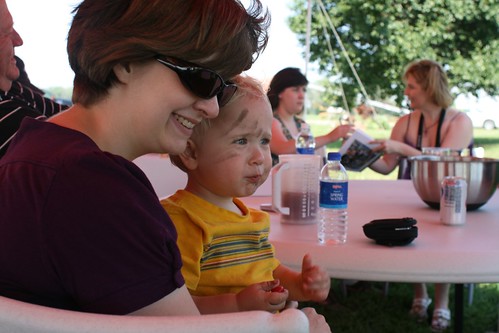
Now, what can a toddler possibly do after playing in the corn, eating some cherries off a tree, and smearing some dirt on his face with cherry juice?
img_5088.jpg

Well, plan his next activity, of course! From the look on his face, it will be another one to keep Terah and me busy.

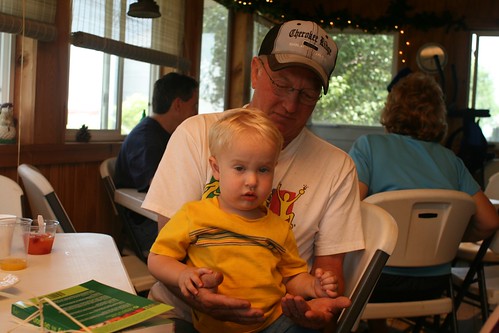
Jacob seemed to get along really well with everyone. But Ralph said that everytime he came close, Jacob would give him a nasty glare. Here's Ralph holding Jacob. Was this the look, Ralph?
img_5078.jpg

Or maybe it was this:

img_5116.jpg

Friday evening, Cliff and Ralph made up some great hamburgers, hot dogs, and sausages. We all ate under the big tent, and had a nice time visiting. It was sort of an unusual thing -- meeting people you already know for the first time -- but very nice. We left somewhere around 8. Jacob enjoyed the hotel room, too.

img_5027r.jpg

That's Jacob talking on the telephone. Well, I would normally use it as a TV remote, but to Jacob it looks like a phone, so a phone it is. (I can see his point.) This is Jacob answering the phone by saying Hi! Jacob's word for a phone, by the way, is "hi." He'll find a remote by the TV in the room, point to it, and yell "hi!"

Jacob's usual bedtime is 6:30PM. He normally falls asleep fairly easily and sleeps soundly until 6:30AM. Well, we got him in bed well after 6:30PM. Then he made the discovery that the hotel crib/playpen has a mattress that is not attached to the bottom like our mattresses at home are. This was good for at least an hour of excited playing. As Terah and I were trying to sleep, we'd hear these cackles from Jacob's crib, and the noises of a very active boy. I'd peek around and see him using the mattress as a tent, as a peek-a-boo toy, or just as something to throw. I think he fell asleep at about 11.

And woke up promptly at 6:30 on Saturday, just like clockwork, ready to make some phone calls and start the day.

Now, just a tidbit for anyone that doesn't have kids: a toddler, low on sleep, and endless excitement all combine to make for busy parents. Jacob did pretty well, and got in a good long nap in the afternoon. We did take several trips to the corn field.

For most of us, Saturday was a day for brunch, for sitting around and visiting under the tent, for horse rides, and maybe a massage for those that wanted it. Terah got to ride a horse, and Jacob got to ride a pony, too.

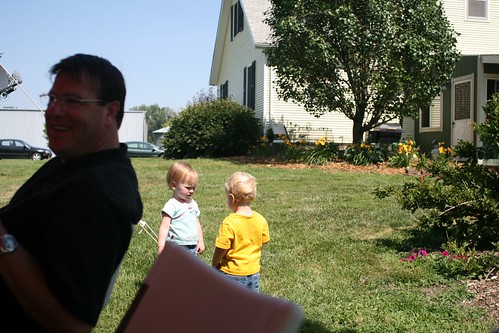
For Jacob, it was a day to make new friends, too.
img_5095.jpg

I took this picture just a second after she had given him a hug. I was just a little too slow whipping out the camera.

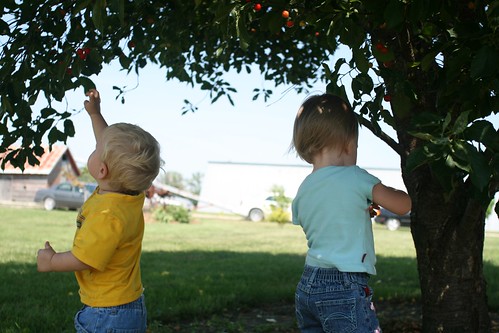
But when it comes to cherry picking, it's all serious business once again.
img_5098.jpg

Jacob loved eating these sour cherries. At first, he would pick one cherry off the tree, run over to the tent, give it to Terah for her to get the pit out, eat it, then go back to the tree for another one. He must have decided this was inefficient not long after I did. After a few roundtrips, he started trying to get the closest adult, whoever that might be, to pit the cherry for him. When he found one that would do it, he'd keep bringing cherries back to that person.

And then he was under the tree for a long time. Terah and I noticed, and had a conversation about just how many cherry pits it's OK to swallow. But when I checked it out, I found out that Jacob had figured out how to pit cherries himself. He did lose about half a cherry each time he did it, but I guess that was more efficient than pestering adults to do it for him. Though it may have also worked to carry two cherries to the tent at a time.
img_5123.jpg

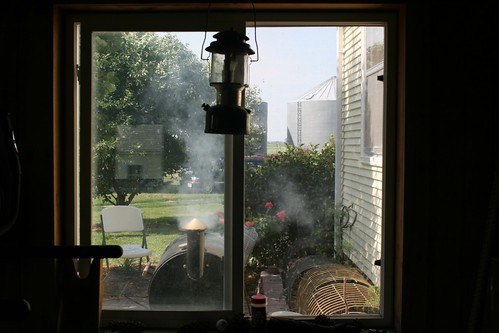
Late in the afternoon, Cliff started up the smoker for the chicken. He had rented a big smoker for the occasion, but it wasn't working, so he made do with his regular smoker, ovens for the corn, and an array of dutch ovens or side grills for everything else. I couldn't keep track of it all, and I was just watching, but somehow it all turned out perfect.
img_5140.jpg

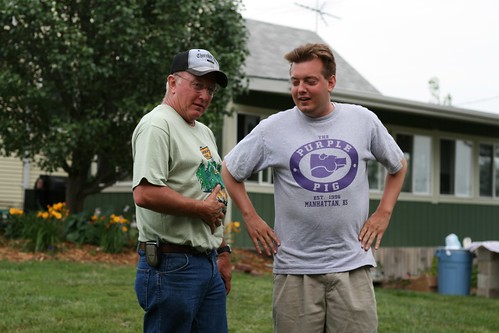
While the chicken was cooking, Ralph and son-of-Ralph (SOR) were having a conversation and patting their bellies. I couldn't hear, and didn't ask questions, so I'm choosing to believe that they were discussing how many pieces of chicken they could eat. When they heard my camera click, Ralph said, "He didn't just take a photo, did he?" Thereby guaranteeing a spot on my blog.

I had the distinction, I think, of being the least-read blogger at Blogstock. I can't quite remember how many times I'd meet someone, and they'd say, "Oh, you're the computer guy, right? I tried reading your blog, but I didn't understand it, sorry!" Completely understandable, I assure you!

After dinner Saturday, we talked about how we got started blogging (hi, Marty and Andy if you're reading), why we were there. Cliff said some very kind things about Terah and me, which really meant a lot.

Later, Cliff told me how Terah showed up in the kitchen with her tray of deviled eggs. Cliff saw them, and said, "Terah, I love you." Later, Cliff said "I love you" to someone else. From the next room, Terah piped up, "What food did she bring?"

Saturday evening, Terah took her horse ride. Jacob was quite tired by that point, and threw a tantrum about not being able to go with mom and ride a horse, too. We were talking about it when Rachel came over. Jacob asked her to pick him up, she did, and he instantly stopped fussing. Maybe it was a "so there" to me, since I had been holding him a minute before, and he took the opportunity to scream in my ear. But in any case, Jacob loved Rachel. She let him sit on a pony, carried him all around the yard, and he managed to hold it together until Terah came back at 9:30.

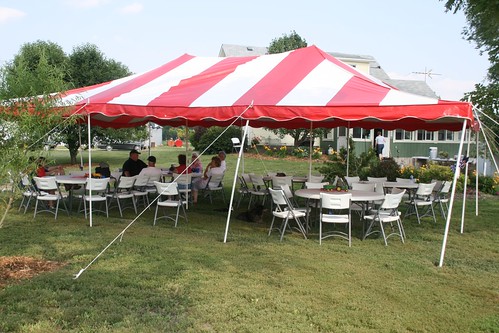
Saturday evening it was time for goodbyes. We all had a blast and I'm sure we'll do this again. If you weren't there, here's what Blogstock looks like:
img_4991.jpg

A bunch of friends sitting around chatting under a tent pretty well sums it up.

(There was a full tent of people; some were just elsewhere when this particular photo was taken.)

Jacob shared his thoughts on the whole trip on the way home, too. Well put, Jacob.

img_5202.jpg

4 July 2008

Daniel Burrows: CWidget tutoral 1: 'Hello, world!'

Late last year, I spent some time disentangling aptitude's internal UI library and packaging it as a separate library, which I named cwidget. This article is the first in what will hopefully become a series describing the basic concepts and APIs of cwidget. It applies to the versions of cwidget currently available in Debian sid and lenny, 0.5.11-1 and 0.5.12-1. Autogenerated documentation of cwidget can be found here (but beware that as of this writing it is somewhat incomplete).
In this tutorial, I will walk through a simple program (hello.cc) that initializes cwidget, displays a simple message box, and then terminates the program when the user confirms the message. I assume a basic familiarity with C++. Screenshot of the 'Hello, World' program The first thing to do is to include the portions of cwidget that our program will use. Most importantly, we need the top level cwidget routines. These are the global routines that initialize cwidget, shut it down, and control its main loop (among other things).

#include <cwidget/toplevel.h>
cwidget comes with a collection of stock dialog boxes for things like displaying messages to the user. To access the routines that build these dialogs, we write:
#include <cwidget/dialogs.h>
All the symbols provided by the cwidget library are in the cwidget namespace. Using the full library name means that there's a reasonable chance that its names will not conflict with the names provided by other libraries; however, it's a real pain to type cwidget over and over. Since this is the only namespaced library we are using in this program, it's handy to define cw as an alias for cwidget:
namespace cw = cwidget;
Now we're ready to write the main routine. The first interaction of client code with the cwidget library is to initialize it. This will initialize the ncurses library and put the terminal into a mode suitable for a full-screen curses program.
cw::toplevel::init();
Next, we create a dialog box that will be displayed to the user. There are two things to note about this code:
  1. cwidget is Unicode-aware and the ok() routine expects the message string to be a wide-character string. In this case, that means that we need to pass in a wide-character string (indicated by typing L in front of the string).
  2. The second argument tells cwidget what to do when the ok button is pressed. The expression
      sigc::ptr_fun(cw::toplevel::exitmain);
    
    creates a slot using libsigc++. Briefly, a slot is a reference to a function or to a method of a class instance. When invoked, this particular slot will call cwidget::toplevel::exitmain(), which causes the main cwidget loop to exit. The slot is wrapped in cwidget::util::arg, a utility function that handles passing slots as optional arguments.
cw::widgets::widget_ref dialog =
    cw::dialogs::ok(L"Hello, world!",
                    cw::util::arg(sigc::ptr_fun(cw::toplevel::exitmain)));
Now that we have a widget, the next step is to arrange for it to appear on the terminal. In cwidget, control of the terminal is assigned to a single top-level widget: whatever it displays is what gets displayed on the terminal, and all user input is passed directly to it. In a real program this widget will typically manage a collection of sub-widgets and assign each one a screen region, but for now let's just display the dialog box we created:
cw::toplevel::settoplevel(dialog);
With everything initialized, we're ready to start the main loop. mainloop() will keep the display up-to-date and dispatch incoming events (for instance, keystrokes and mouse presses) until exitmain() is invoked.
cw::toplevel::mainloop();
When the user presses Enter or clicks on the Ok button in the dialog, exitmain() will be invoked by the binding that we set up earlier. Once this happens, we need to shut down cwidget in order to restore the terminal to its original state. If you skip this step, the terminal will be garbled and will not work properly when your program exits.
cw::toplevel::shutdown();
And that's it! To compile the program, change to the directory containing hello.cc and run:
$ g++ -o hello hello.cc $(pkg-config --cflags --libs cwidget)
Of course, you'll need to have the g++ and libcwidget-dev packages installed for this to work!

Next.

Previous.