Search Results: "ron"

15 May 2020

Dirk Eddelbuettel: Let s celebrate Anna!

Today is graduation at Washington University, and just like many other places, the ceremonies are a lot more virtual and surreal that in other years. For Anna today marks the graduation from Biomedical Engineering with a BSc. The McKelvey School of Engineering put a Zoom meeting together yesterday which was nice, and there is something more virtual here. Hopefully a real-life commencenment can take place in a year the May 30, 2021, date has been set. The university also sent out a little commencement site/video which was cute. But at end of the day online-only still falls short of the real deal as we all know too well by now. During those years, just about the only thing really I ever tweeted about appears to be soccer related. As it should because ball is life, as we all know. Here is one from 1 1/2 years ago when her Club Team three-peated in their NIRSA division: And that opens what may be the best venue for mocking Anna: this year, which her a senior and co-captain, the team actually managed to loose a league game (a shocking first in these years) and to drop the final. I presume they anticipated that all we would all talk about around now is The Last Dance and three-peats, and left it at that. Probably wise. Now just this week, and hence days before graduating with her B.Sc., also marks the first time Anna was addressed as Dr Eddelbuettel. A little prematurely I may say, but not too shabby to be in print already! But on the topic of gratulations and what comes next, this tweet was very sweet: As was this, which marked another impressive score: So big thanks from all of us to WashU for being such a superb environment for Anna for those four years, and especially everybody at the Pappu Lab for giving Anna a home and base to start a research career. And deepest and most sincere congratulations to Anna before the next adventure starts .

14 May 2020

Iustin Pop: New internet provider

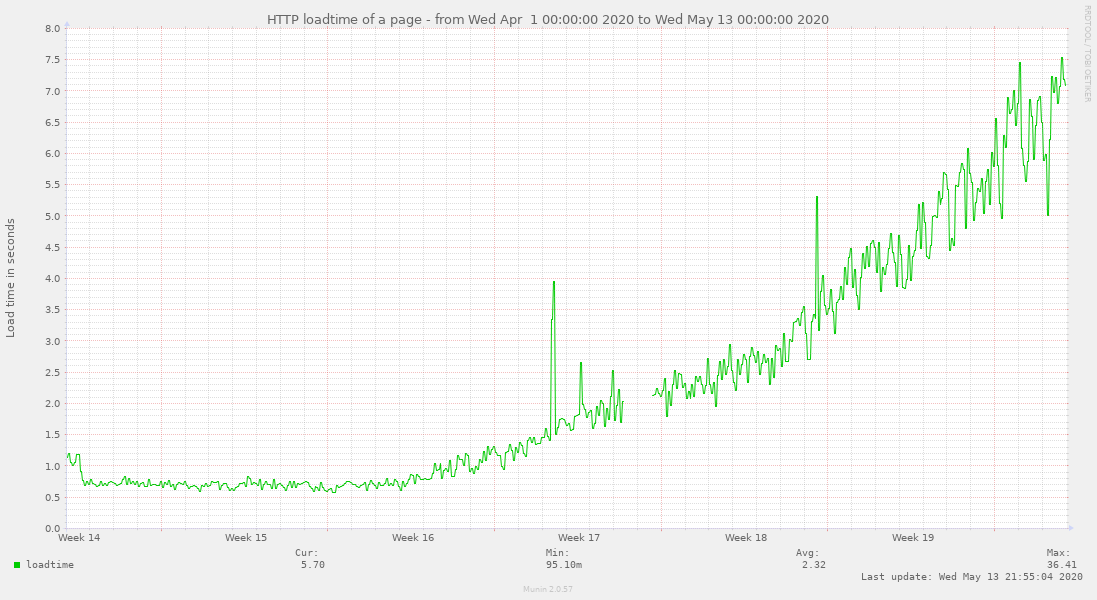
Note: all this is my personal experience, on my personal machines, and I don t claim it to be the absolute truth. Also, I don t directly call out names, although if you live in Switzerland it s pretty easy to guess who the old provider is from some hints. For a long time, I wanted to move away from my current (well, now past) provider, for a multitude of reasons. The main being that the company is very classic company, with classic support system, that doesn t work very well - I had troubles with their billing system that left me out cold without internet for 15 days, but for the recent few years, they were mostly OK, and changing to a different provider would have meant me routing a really long Ethernet cable around the apartment, so I kept postponing it. Yes, self-inflicted pain, I know. Until the entire work-from-home thing, when the usually stable connection start degrading in a very linear fashion day-by-day (this is a graph that basically reflects download bandwidth):
1+ month download bandwidth test 1+ month download bandwidth test
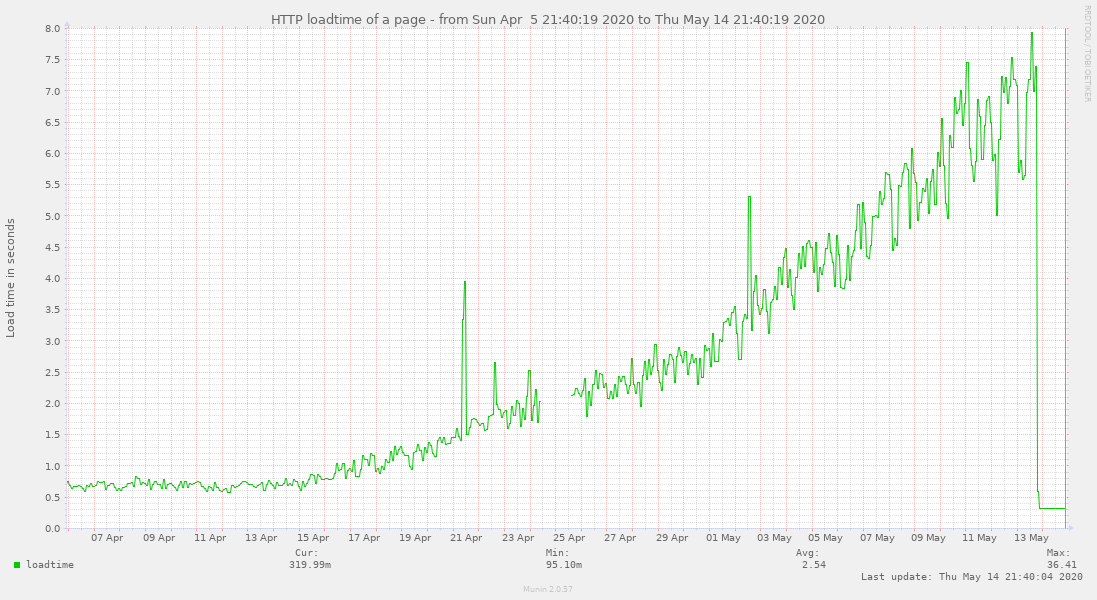
At first, I didn t realise this, as even 100Mbps is still fast enough. But once the connection went below (I believe) 50Mbps, it became visible in day to day work. And since I work daily from home yeah. Not fun. So I started doing speedtest.net - and oh my, ~20Mbps was a good result, usually 12-14Mbps. On a wired connection. On a connection that officially is supposed to be 600Mbps down. The upload speed was spot on, so I didn t think it was my router, but: Nothing helped. Once in a blue moon, speedtest would give me 100Mbps, but like once every two days, then it would be back and showing 8Mbps. Eight! It ended up as even apt update was tediously slow, and kernel downloads took ages The official instructions for dealing with bad internet are a joke: And the best part: If you are not satisfied with the results, read our internet optimisation guide. If you are still not happy, use our community forums or our social platforms. Given that it was a decline over 3-weeks, that I don t know of any computer component that would degrade this steadily but not throw any other errors, and that my upload speed was all good, I assumed it s the provider. Maybe I was wrong, but I wanted to do this anyway for a long while, so I went through the find how to route cable, check if other provider socket is good, order service, etc. dance, and less than a week later, I had the other connection. Now, of course, bandwidth works as expected:
1+ month updated bandwidth test 1+ month updated bandwidth test
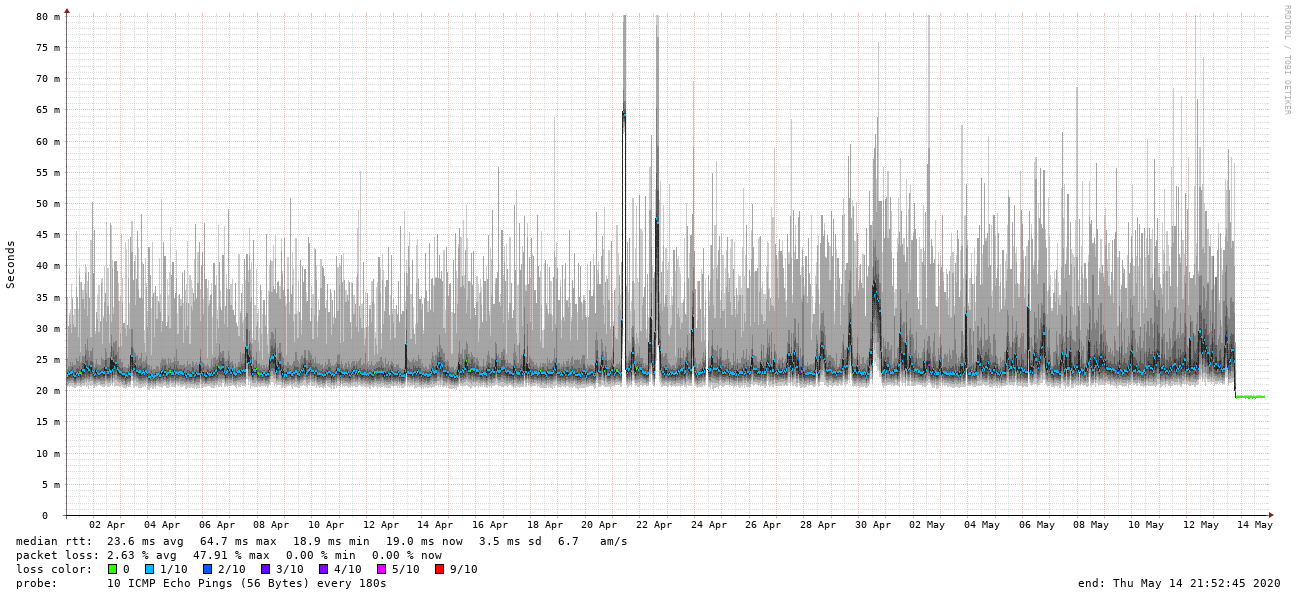
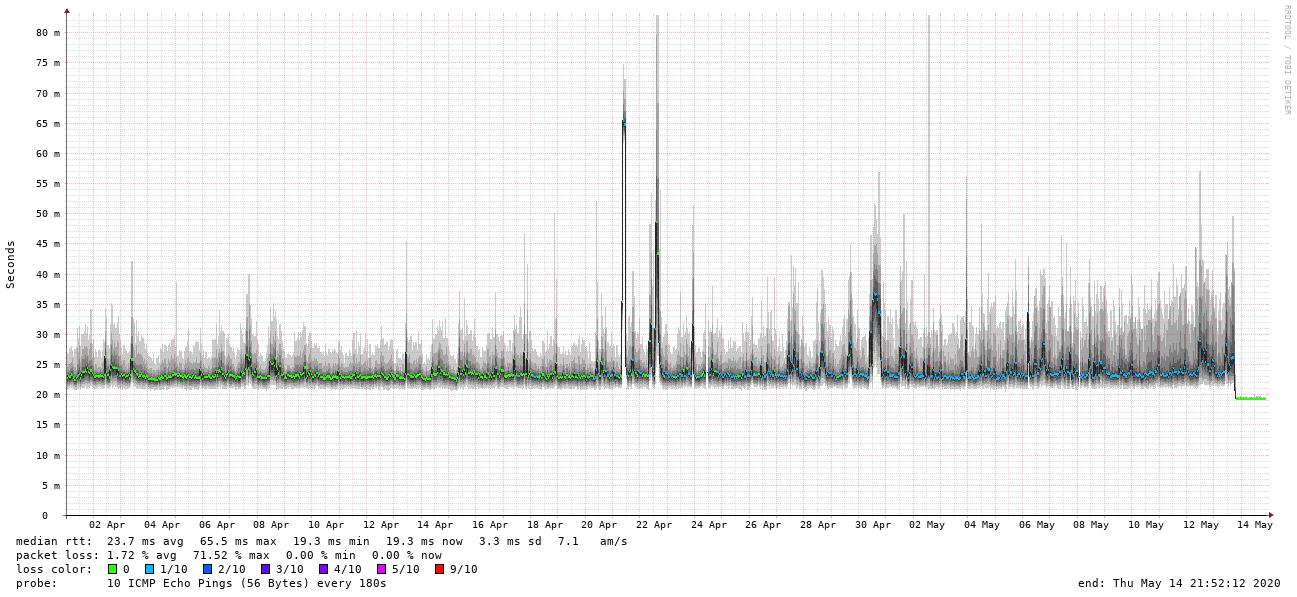
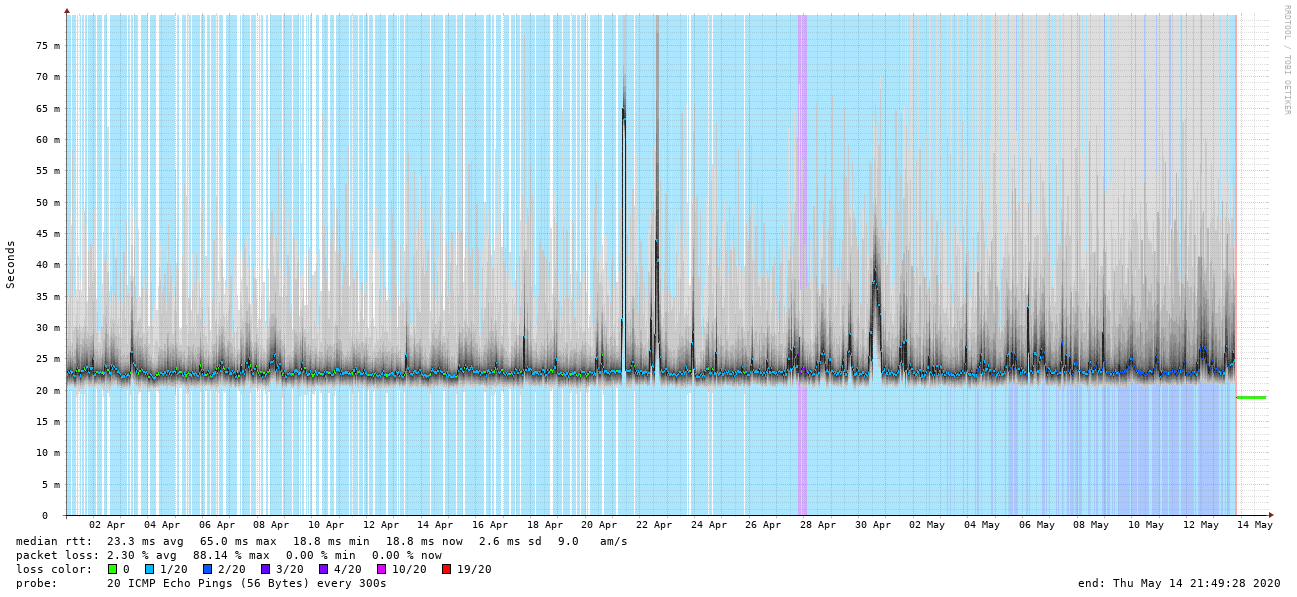
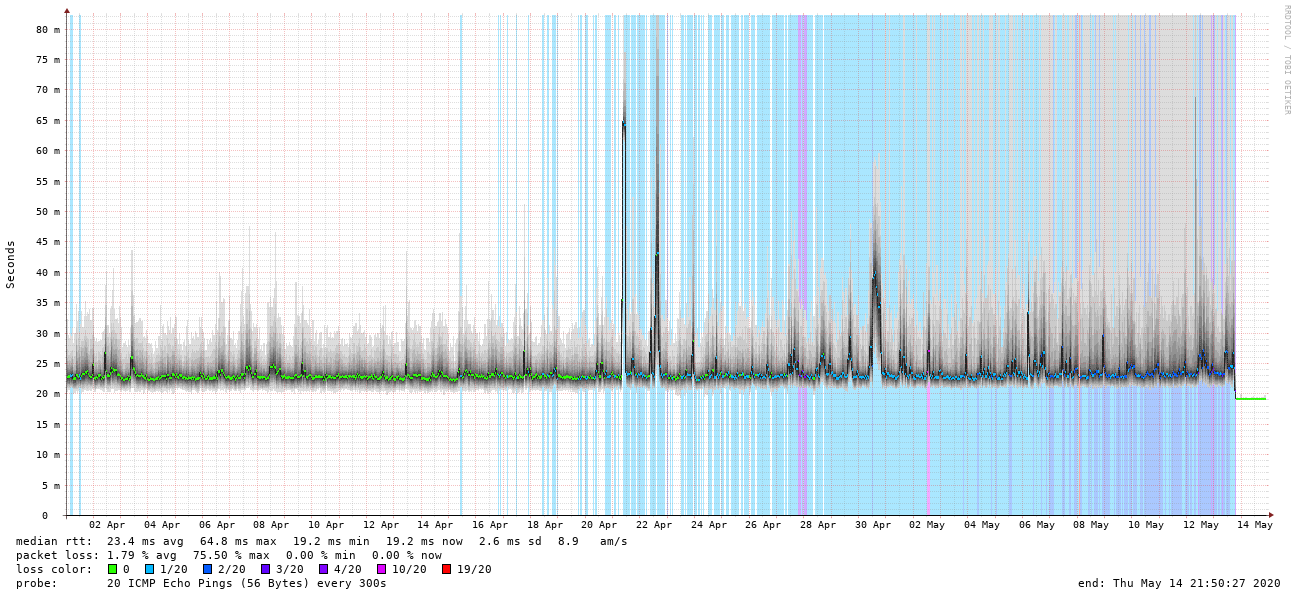
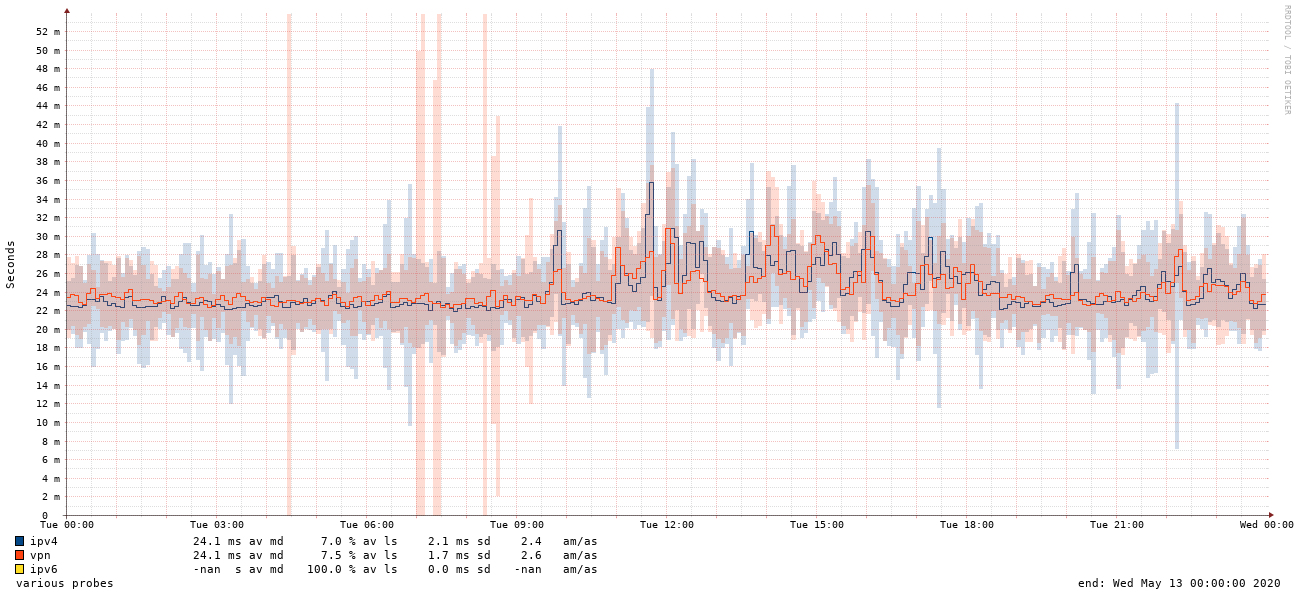
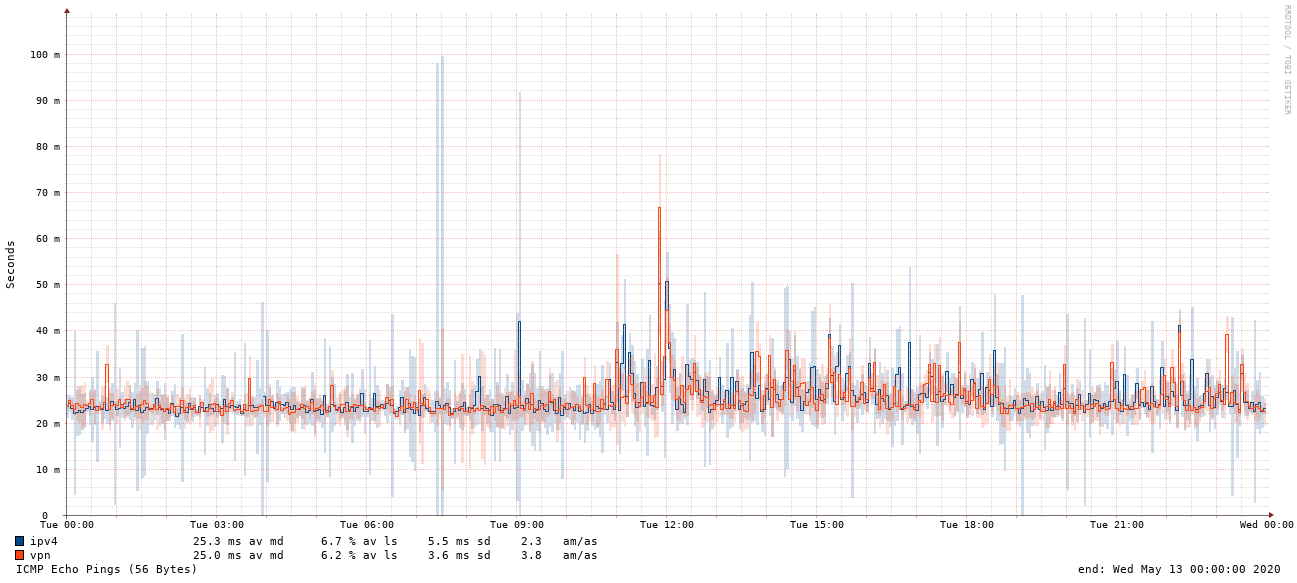
Both download and upload are fine (the graph above is just download). Latency is also much better, towards many parts of the internet that matter. But what is shocking is the difference in jitter to some external hosts I care about. On the previous provider, a funny thing was that both outgoing and incoming pings had both more jitter and packet loss when done directly (IPv4 to IPv4) than when done over a VPN. This doesn t make sense, since VPN is just overhead over IPv4, but the graphs show it, and what I think happens is that a VPN flow is cached in the provider s routers, whereas a simple ping packet not. But, the fact that there s enough jitter for a ping to a not-very-far host doesn t make me happy. Examples, outgoing:
Outgoing smokeping to public IPv4 Outgoing smokeping to public IPv4
Outgoing smokeping over VPN Outgoing smokeping over VPN
And incoming:
Incoming smokeping to public IPv4 Incoming smokeping to public IPv4
Incoming smokeping over VPN Incoming smokeping over VPN
Both incoming and outgoing show this weirdness - more packet loss and more jitter over VPN. Again, this is not a problem in practice, or not much, but makes me wonder what other shenanigans happen behind the scenes. You can also see clearly when the work from home traffic entered the picture and started significantly degrading my connection, even over the magically better VPN connection. Switching to this week s view shows the (in my opinion) dramatic improvement in consistency of the connection:
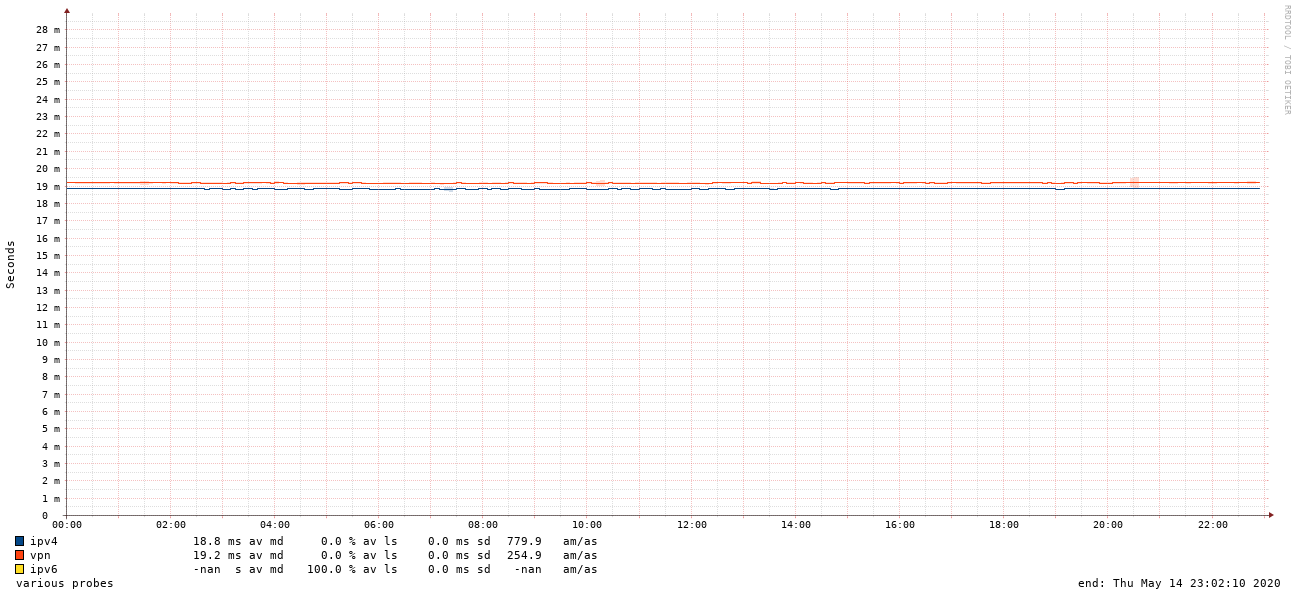
Outgoing current week smokeping to public IPv4 Outgoing current week smokeping to public IPv4
Outgoing current week smokeping over VPN Outgoing current week smokeping over VPN
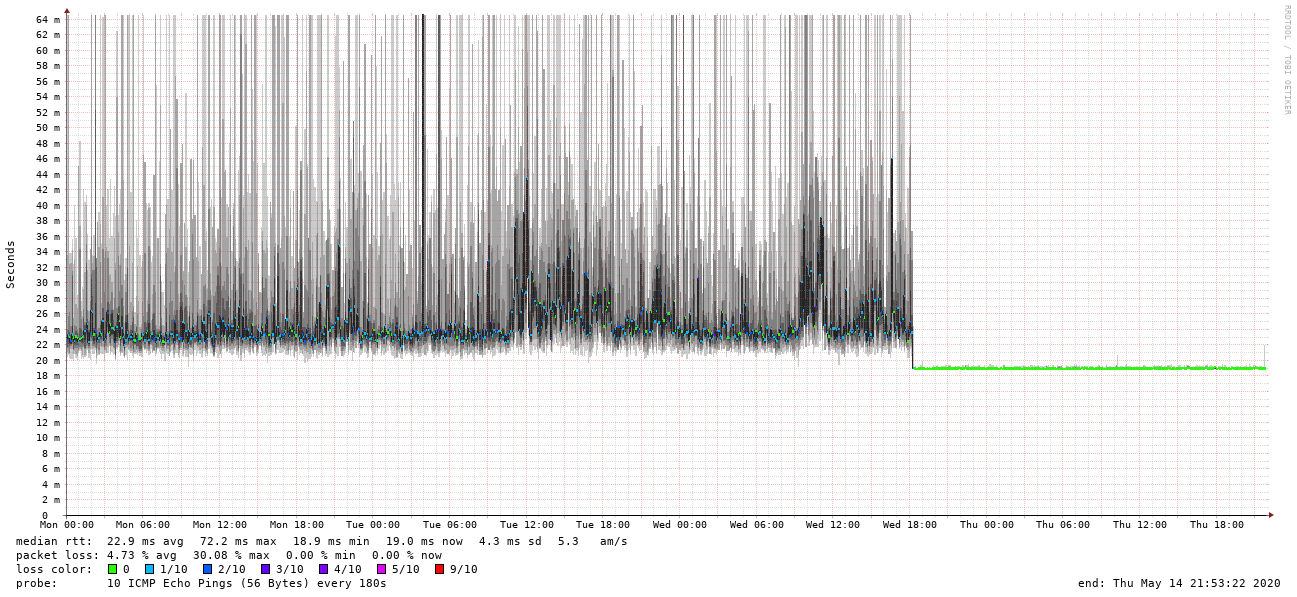
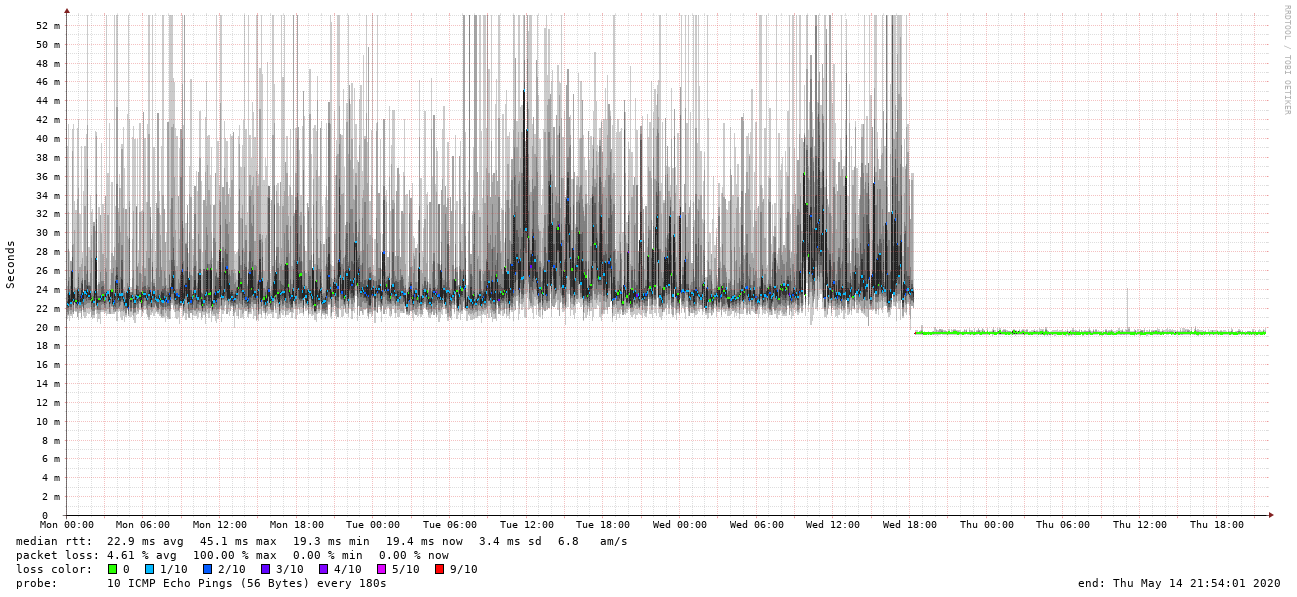
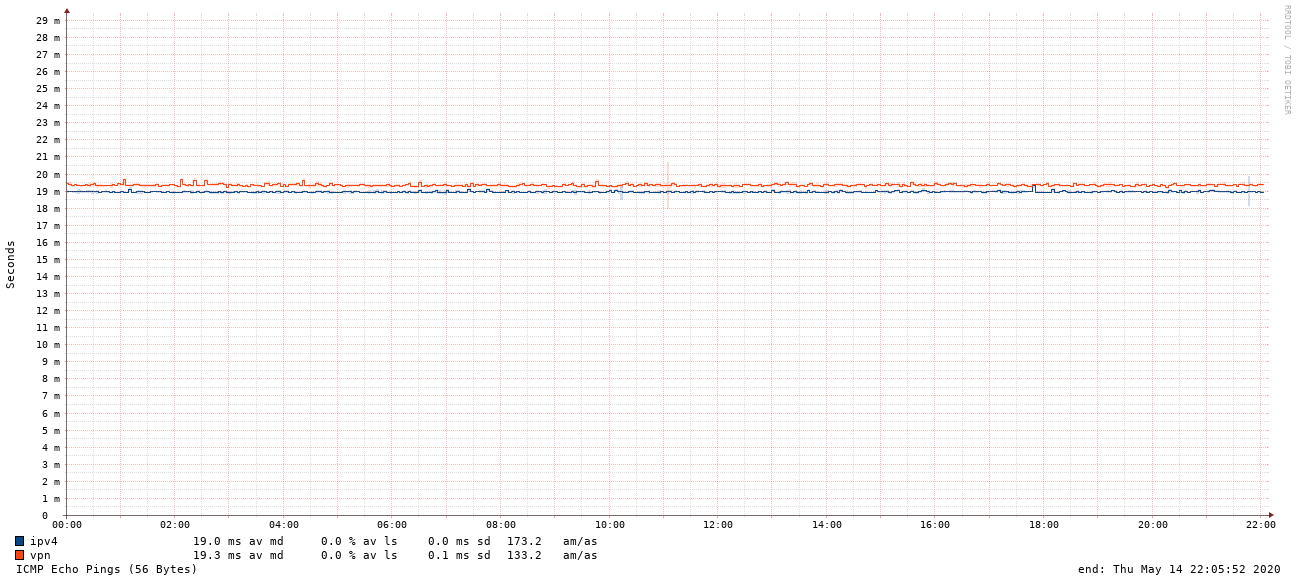
No more packet loss, no more jitter. You can also see my VPN being temporarily down during provider switchover because my firewall was not quite correct for a moment. And the last drill down, at high resolution, one day before and one day after switchover. Red is VPN, blue is plain IPv4, yellow is the missing IPv6 connection :) Incoming old:
Incoming 1-day smokeping, old provider Incoming 1-day smokeping, old provider
and new:
Incoming 1-day smokeping, new provider Incoming 1-day smokeping, new provider
Outgoing old:
Outgoing 1-day smokeping, old provider Outgoing 1-day smokeping, old provider
and new:
Outgoing 1-day smokeping, new provider Outgoing 1-day smokeping, new provider
This is what I expect, ping-over-VPN should of course be slower than plain ping. Note that incoming and outgoing have slightly different consistency, but that is fine for me :) The endpoints doing the two tests are different, so this is expected. Reading the legend on the graphs for the incoming connection (similar story for outgoing): So to my previous provider: it can be done better. Or at least, allow people easier ways to submit performance issue problems. For me, the moral of the story is that I should have switched a couple of years ago, instead of being lazy. And that I m curious to see how IPv6 traffic will differ, if at all :) Take care, everyone! And thanks for looking at these many graphs :)

Norbert Preining: Switching from NVIDIA to AMD (including tensorflow)

I have been using my Geforce 1060 extensively for deep learning, both with Python and R. But the always painful play with the closed source drivers and kernel updates, paired with the collapse of my computer s PSU and/or GPU, I decided to finally do the switch to AMD graphic card and open source stack. And you know what, within half a day I had everything, including Tensorflow running. Yeah to Open Source!

Preliminaries So what is the starting point: I am running Debian/unstable with a AMD Radeon 5700. First of all I purged all NVIDIA related packages, and that are a lot I have to say. Be sure to search for nv and nvidia and get rid of all packages. For safety I did reboot and checked again that no kernel modules related to NVIDIA are loaded. Firmware Debian ships the package amd-gpu-firmware but this is not enough for the current kernel and current hardware. Better is to clone git://git.kernel.org/pub/scm/linux/kernel/git/firmware/linux-firmware.git and copy everything from the amdgpu directory to /lib/firmware/amdgpu. I didn t do that at first, and then booting the kernel did hang during the switch to AMD framebuffer. If you see this behaviour, your firmwares are too old. Kernel The advantage of having open source driver that is in the kernel is that you don t have to worry about incompatibilities (like every time a new kernel comes out the NVIDIA driver needs patching). For recent AMD GPUs you need a rather new kernel, I have 5.6.0 and 5.7.0-rc5 running. Make sure that you have all the necessary kernel config options turned on if you compile your own kernels. In my case this is
CONFIG_DRM_AMDGPU=m
CONFIG_DRM_AMDGPU_USERPTR=y
CONFIG_DRM_AMD_ACP=y
CONFIG_DRM_AMD_DC=y
CONFIG_DRM_AMD_DC_DCN=y
CONFIG_HSA_AMD=y
When installing the kernel, be sure that the firmware is already updated so that the correct firmware is copied into the initrd. Support programs and libraries All the following is more or less an excerpt from the ROCm Installation Guide! AMD provides a Debian/Ubuntu APT repository for software as well as kernel sources. Put the following into /etc/apt/sources.list.d/rocm.list:
deb [arch=amd64] http://repo.radeon.com/rocm/apt/debian/ xenial main
and also put the public key of the rocm repository into /etc/apt/trusted.d/rocm.asc. After that apt-get update should work. I did install rocm-dev-3.3.0, rocm-libs-3.3.0, hipcub-3.3.0, miopen-hip-3.3.0 (and of course the dependencies), but not rocm-dkms which is the kernel module. If you have a sufficiently recent kernel (see above), the source in the kernel itself is newer. The libraries and programs are installed under /opt/rocm-3.3.0, and to make the libraries available to Tensorflow (see below) and other programs, I added /etc/ld.so.conf.d/rocm.conf with the following content:
/opt/rocm-3.3.0/lib/
and run ldconfig as root. Last but not least, add a udev rule that is normally installed by rocm-dkms, put the following into /etc/udev/rules.d/70-kfd.rules:
SUBSYSTEM=="kfd", KERNEL=="kfd", TAG+="uaccess", GROUP="video"
This allows users from the video group to access the GPU.
Up to here you should be able to boot into the system and have X running on top of AMD GPU, including OpenGL acceleration and direct rendering:
$ glxinfo
ame of display: :0
display: :0  screen: 0
direct rendering: Yes
server glx vendor string: SGI
server glx version string: 1.4
...
client glx vendor string: Mesa Project and SGI
client glx version string: 1.4
...
Tensorflow Thinking about how hard it was to get the correct libraries to get Tensorflow running on GPUs (see here and here), it is a pleasure to see that with open source all this pain is relieved. There is already work done to make Tensorflow run on ROCm, the tensorflow-rocm project. The provide up to date PyPi packages, so a simple
pip3 install tensorflow-rocm
is enough to get Tensorflow running with Python:
>> import tensorflow as tf
>> tf.add(1, 2).numpy()
2020-05-14 12:07:19.590169: I tensorflow/stream_executor/platform/default/dso_loader.cc:44] Successfully opened dynamic library libhip_hcc.so
...
2020-05-14 12:07:19.711478: I tensorflow/core/common_runtime/gpu/gpu_device.cc:1247] Created TensorFlow device (/job:localhost/replica:0/task:0/device:GPU:0 with 7444 MB memory) -> physical GPU (device: 0, name: Navi 10 [Radeon RX 5600 OEM/5600 XT / 5700/5700 XT], pci bus id: 0000:03:00.0)
3
>>
Tensorflow for R Installation is trivial again since there is a tensorflow for R package, just run (as a user that is in the group staff, which normally own /usr/local/lib/R)
$ R
...
> install.packages("tensorflow")
..
Do not call the R function install_tensorflow() since Tensorflow is already installed and functional! With that done, R can use the AMD GPU for computations:
$ R
...
> library(tensorflow)
> tf$constant("Hellow Tensorflow")
2020-05-14 12:14:24.185609: I tensorflow/stream_executor/platform/default/dso_loader.cc:44] Successfully opened dynamic library libhip_hcc.so
...
2020-05-14 12:14:24.277736: I tensorflow/core/common_runtime/gpu/gpu_device.cc:1247] Created TensorFlow device (/job:localhost/replica:0/task:0/device:GPU:0 with 7444 MB memory) -> physical GPU (device: 0, name: Navi 10 [Radeon RX 5600 OEM/5600 XT / 5700/5700 XT], pci bus id: 0000:03:00.0)
tf.Tensor(b'Hellow Tensorflow', shape=(), dtype=string)
>
AMD Vulkan From the Vulkan home page:
Vulkan is a new generation graphics and compute API that provides high-efficiency, cross-platform access to modern GPUs used in a wide variety of devices from PCs and consoles to mobile phones and embedded platforms.
Several games are using the Vulkan API if available and it is said to be more efficient. There are Vulkan libraries for Radeon shipped in with mesa, in the Debian package mesa-vulkan-drivers, but they look a bit outdated is my guess. The AMDVLK project provides the latest version, and to my surprise was rather easy to install, again by following the advice in their README. The steps are basically (always follow what is written for Ubuntu): All as described in the linked README. Just to make sure, I removed the JSON files /usr/share/vulkan/icd.d/radeon* shipped by Debians mesa-vulkan-drivers package. Finally I deviated a bit by not editing the file /usr/share/X11/xorg.conf.d/10-amdgpu.conf, but instead copying to /etc/X11/xorg.conf.d/10-amdgpu.conf and adding there the section:
Section "Device"
        Identifier "AMDgpu"
        Option  "DRI" "3"
EndSection
. To be honest, I did not follow the Copy driver and JSON files literally, since I don t want to copy self-made files into system directories under /usr/lib. So what I did is: With this in place, I don t pollute the system directories, and still the new Vulkan driver is available. But honestly, I don t really know whether it is used and is working, because I don t know how to check.
With all that in place, I can run my usual set of Steam games (The Long Dark, Shadow of the Tomb Raider, The Talos Principle, Supraland, ) and I don t see any visual problem till now. As a bonus, KDE/Plasma is now running much better, since NVIDIA and KDE has traditionally some incompatibilities. The above might sound like a lot of stuff to do, but considering that most of the parts are not really packaged within Debian, and all this is rather new open source stack, I was surprised that in half a day I got all working smoothly. Thanks to all the developers who have worked hard to make this all possible.

12 May 2020

Petter Reinholdtsen: Debian Edu interview: Yvan Masson

It has been way too long since my last interview, but as the Debian Edu / Skolelinux community is still active, and new people keep showing up on the IRC channel #debian-edu and the debian-edu mailing list, I decided to give it another go. I was hoping someone else might pick up the idea and run with it, but this has not happened as far as I can tell, so here we are This time the announcement of a new free software tool to create a school year book triggered my interest, and I decided to learn more about its author. Who are you, and how do you spend your days? My name is Yvan MASSON, I live in France. I have my own one person business in computer services. The work consist of visiting my customers (person's home, local authority, small business) to give advise, install computers and software, fix issues, and provide computing usage training. I spend the rest of my time enjoying my family and promoting free software. What is your approach for promoting free software? When I think that free software could be suitable for someone, I explain what it is, with simple words, give a few known examples, and explain that while there is no fee it is a viable alternative in many situations. Most people are receptive when you explain how it is better (I simplify arguments here, I know that it is not so simple): Linux works on older hardware, there are no viruses, and the software can be audited to ensure user is not spied upon. I think the most important is to keep a clear but moderated speech: when you try to convince too much, people feel attacked and stop listening. How did you get in contact with the Skolelinux / Debian Edu project? I can not remember how I first heard of Skolelinux / Debian Edu, but probably on planet.debian.org. As I have been working for a school, I have interest in this type of project. The school I am involved in is a school for "children" between 14 and 18 years old. The French government has recommended free software since 2012, but they do not always use free software themselves. The school computers are still using the Windows operating system, but all of them have the classic set of free software: Firefox ESR, LibreOffice (with the excellent extension Grammalecte that indicates French grammatical errors), SumatraPDF, Audacity, 7zip, KeePass2, VLC, GIMP, Inkscape What do you see as the advantages of Skolelinux / Debian Edu? It is free software! Built on Debian, I am sure that users are not spied upon, and that it can run on low end hardware. This last point is very important, because we really need to improve "green IT". I do not know enough about Skolelinux / Debian Edu to tell how it is better than another free software solution, but what I like is the "all in one" solution: everything has been thought of and prepared to ease installation and usage. I like Free Software because I hate using something that I can not understand. I do not say that I can understand everything nor that I want to understand everything, but knowing that someone / some company intentionally prevents me from understanding how things work is really unacceptable to me. Secondly, and more importantly, free software is a requirement to prevent abuses regarding human rights and environmental care. Humanity can not rely on tools that are in the hands of small group of people. What do you see as the disadvantages of Skolelinux / Debian Edu? Again, I don't know this project enough. Maybe a dedicated website? Debian wiki works well for documentation, but is not very appealing to someone discovering the project. Also, as Skolelinux / Debian Edu uses OpenLDAP, it probably means that Windows workstations cannot use centralized authentication. Maybe the project could use Samba as an Active Directory domain controller instead, allowing Windows desktop usage when necessary. (Editors note: In fact Windows workstations can use the centralized authentication in a Debian Edu setup, at least for some versions of Windows, but the fact that this is not well known can be seen as an indication of the need for better documentation and marketing. :) Which free software do you use daily? Nothing original: Debian testing/sid with Gnome desktop, Firefox, Thunderbird, LibreOffice Which strategy do you believe is the right one to use to get schools to use free software? Every effort to spread free software into schools is important, whatever it is. But I think, at least where I live, that IT professionals maintaining schools networks are still very "Microsoft centric". Schools will use any working solution, but they need people to install and maintain it. How to make these professionals sensitive about free software and train them with solutions like Debian Edu / Skolelinux is a really good question :-)

Jacob Adams: Roman Finger Counting

I recently wrote a final paper on the history of written numerals. In the process, I discovered this fascinating tidbit that didn t really fit in my paper, but I wanted to put it somewhere. So I m writing about it here. If I were to ask you to count as high as you could on your fingers you d probably get up to 10 before running out of fingers. You can t count any higher than the number of fingers you have, right? The Romans could! They used a place-value system, combined with various gestures to count all the way up to 9,999 on two hands.

The System Finger Counting (Note that in this diagram 60 is, in fact, wrong, and this picture swaps the hundreds and the thousands.) We ll start with the units. The last three fingers of the left hand, middle, ring, and pinkie, are used to form them. Zero is formed with an open hand, the opposite of the finger counting we re used to. One is formed by bending the middle joint of the pinkie, two by including the ring finger and three by including the middle finger, all at the middle joint. You ll want to keep all these bends fairly loose, as otherwise these numbers can get quite uncomfortable. For four, you extend your pinkie again, for five, also raise your ring finger, and for six, you raise your middle finger as well, but then lower your ring finger. For seven you bend your pinkie at the bottom joint, for eight adding your ring finger, and for nine, including your middle finger. This mirrors what you did for one, two and three, but bending the finger at the bottom joint now instead. This leaves your thumb and index finger for the tens. For ten, touch the nail of your index finger to the inside of your top thumb joint. For twenty, put your thumb between your index and middle fingers. For thirty, touch the nails of your thumb and index fingers. For forty, bend your index finger slightly towards your palm and place your thumb between the middle and top knuckle of your index finger. For fifty, place your thumb against your palm. For sixty, leave your thumb where it is and wrap your index finger around it (the diagram above is wrong). For seventy, move your thumb so that the nail touches between the middle and top knuckle of your index finger. For eighty, flip your thumb so that the bottom of it now touches the spot between the middle and top knuckle of your index finger. For ninety, touch the nail of your index finger to your bottom thumb joint. The hundreds and thousands use the same positions on the right hand, with the units being the thousands and the tens being the hundreds. One account, from which the picture above comes, swaps these two, but the first account we have uses this ordering. Combining all these symbols, you can count all the way to 9,999 yourself on just two hands. Try it!

History

The Venerable Bede The first written record of this system comes from the Venerable Bede, an English Benedictine monk who died in 735. He wrote De computo vel loquela digitorum, On Calculating and Speaking with the Fingers, as the introduction to a larger work on chronology, De temporum ratione. (The primary calculation done by monks at the time was calculating the date of Easter, the first Sunday after the first full moon of spring). He also includes numbers from 10,000 to 1,000,000, but its unknown if these were inventions of the author and were likely rarely used regardless. They require moving your hands to various positions on your body, as illustrated below, from Jacob Leupold s Theatrum Arilhmetico-Geometricum, published in 1727: Finger Counting with Large Numbers

The Romans If Bede was the first to write it, how do we know that it came from Roman times? It s referenced in many Roman writings, including this bit from the Roman satirist Juvenal who died in 130:
Felix nimirum qui tot per saecula mortem distulit atque suos iam dextera computat annos. Happy is he who so many times over the years has cheated death And now reckons his age on the right hand.
Because of course the right hand is where one counts hundreds! There s also this Roman riddle:
Nunc mihi iam credas fieri quod posse negatur: octo tenes manibus, si me monstrante magistro sublatis septem reliqui tibi sex remanebunt. Now you shall believe what you would deny could be done: In your hands you hold eight, as my teacher once taught; Take away seven, and six still remain.
If you form eight with this system and then remove the symbol for seven, you get the symbol for six!

Sources My source for this blog post is Paul Broneer s 1969 English translation of Karl Menninger s Zahlwort und Ziffer (Number Words and Number Symbols).

11 May 2020

Markus Koschany: My Free Software Activities in April 2020

Welcome to gambaru.de. Here is my monthly report (+ the first week in May) that covers what I have been doing for Debian. If you re interested in Java, Games and LTS topics, this might be interesting for you. Debian Games

Playonlinux
Debian Java Misc Debian LTS This was my 50. month as a paid contributor and I have been paid to work 11,5 hours on Debian LTS, a project started by Rapha l Hertzog. In that time I did the following: ELTS Extended Long Term Support (ELTS) is a project led by Freexian to further extend the lifetime of Debian releases. It is not an official Debian project but all Debian users benefit from it without cost. The current ELTS release is Debian 7 Wheezy . This was my 23. month and I have been paid to work 2 hours on ELTS. Thanks for reading and see you next time.

Gunnar Wolf: Certified printer fumes

After losing a fair bit of hair due to quality and reliability issues with our home laser multifunctional (Brother DCP1600-series, which we bought after checking it was meant to work on Linux And it does, but with a very buggy, proprietary driver Besides being the printer itself of quite low quality), we decided it was time to survey the market again, and get a color inkjet printer. I was not very much an enthusiast of the idea, until I found all of the major manufacturers now offer refillable ink tanks instead of the darn expensive cartridges of past decades. Lets see how it goes! Of course, with over 20 years of training, I did my homework. I was about to buy an Epson printer, but decided for an HP Ink Tank 410 Wireless printer. The day it arrived, not wanting to fuss around too much to get to see the results, I connected it to my computer using the USB cable. Everything ran smoothly and happily! No driver hunting needed, print quality is superb I hope, years from now, we stay with this impression. Next day, I tried to print over WiFi. Of course, it requires configuration. And, of course, configuration strongly wants you to do it from a Windows or MacOS machine which I don t have. OK, fall back to Android For which an app download is required (and does not thrill me, but what can I say. Oh and the app needs location services to even run. Why Maybe because it interacts with the wireless network in WiFi Direct, non-authenticated way?) Anyway, things seem to work. But they don t My computers can identify and connect with the printer from CUPS, but nothing ever comes out. Printer paused, they say. Entering the printer s web interface is somewhat ambiguous Following the old HP practices, I tried http://192.168.1.75:9100/ (no point in hiding my internal IP), and got a partial webpage sometimes (and nothing at all othertimes). Seeing the printer got detected over ipps://, my immediate reaction was to try pointing the browser to port 631. Seems to work! Got some odd messages But it seems I ll soon debug the issue away. I am not a familiar meddler in the dark lands of cups, our faithful print server, but I had to remember my toolkit..
# cupsenable HP_Ink_Tank_Wireless_410_series_C37468_ --release
Sucess in enabling, but self-auto-disabled right away lpstat -t was not more generous, reporting only it was still paused. Some hours later (mix in attending kids and whatnot), I finally remember to try cupsctl --debug-logging, and magically, /var/log/cups/error_log turns from being quiet to being quite chatty. And, of course, my first print job starts being processed:
D [10/May/2020:23:07:20 -0500] Report: jobs-active=1
(...)
D [10/May/2020:23:07:25 -0500] [Job 174] Start rendering...
(...)
D [10/May/2020:23:07:25 -0500] [Job 174] STATE: -connecting-to-device
(...)
Everything looks fine and dandy so far! But, hey, given nothing came out of the printer keep reading one more second of logs (a couple dozen lines)
D [10/May/2020:23:07:26 -0500] [Job 174] Connection is encrypted.
D [10/May/2020:23:07:26 -0500] [Job 174] Credentials are expired (Credentials have expired.)
D [10/May/2020:23:07:26 -0500] [Job 174] Printer credentials: HPC37468 / Thu, 01 Jan 1970 00:00:00 GMT / 28A59EF511A480A34798B6712DEEAE74
D [10/May/2020:23:07:26 -0500] [Job 174] No stored credentials.
D [10/May/2020:23:07:26 -0500] [Job 174] update_reasons(attr=0(), s=\"-cups-pki-invalid,cups-pki-changed,cups-pki-expired,cups-pki-unknown\")
D [10/May/2020:23:07:26 -0500] [Job 174] STATE: -cups-pki-expired
(...)
D [10/May/2020:23:08:00 -0500] [Job 174] envp[16]="CUPS_ENCRYPTION=IfRequested"
(...)
D [10/May/2020:23:08:00 -0500] [Job 174] envp[27]="PRINTER_STATE_REASONS=cups-pki-expired"
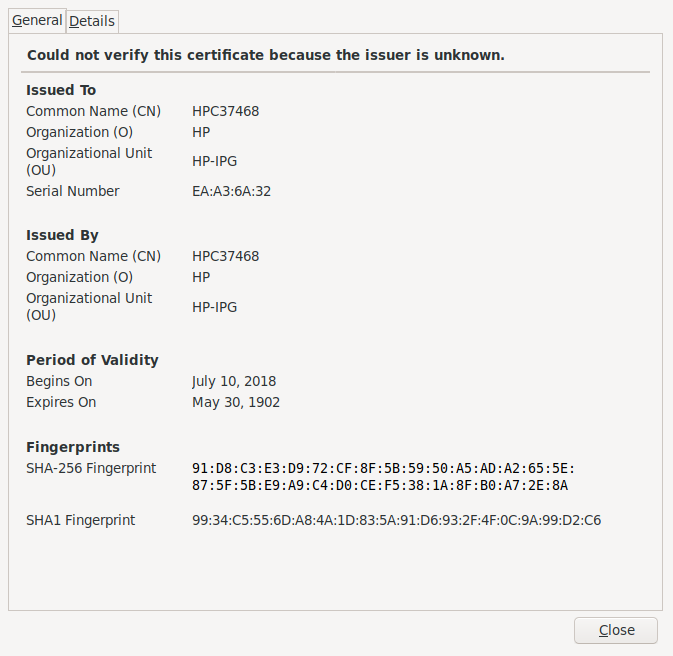
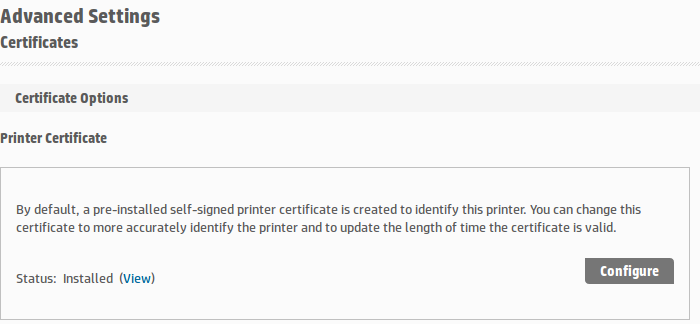
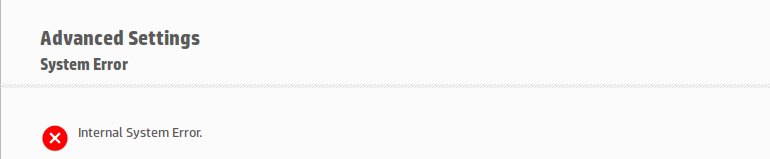
My first stabs were attempts to get CUPS not to care about expired certificates, but it seems to have been hidden or removed from its usual place. Anyway, I was already frustrated. WTF Well, yes, turns out that from the Web interface, I paid some attention to this the first time around, but let it pass (speaks wonders about my security practices!): Way, way, way too expired cert So, the self-signed certificate the printer issued at itself expired 116 years before even being issued. (is this maybe a Y2k38 bug? Sounds like it!) Interesting thing, my CUPS log mentions the printer credentials to expire at the beginning of the Unix Epoch (01 Jan 1970 00:00:00 GMT). OK, lets clickety-click away on the Web interface Didn t take me long to get to Network Advanced settings Certificates: Can manage certs! However, clicking on Configure leads me to the not very reassuring Way, way, way too expired cert I don t remember what I did for the next couple of minutes. Kept fuming Until I parsed again the output of lpstat -t, and found that:
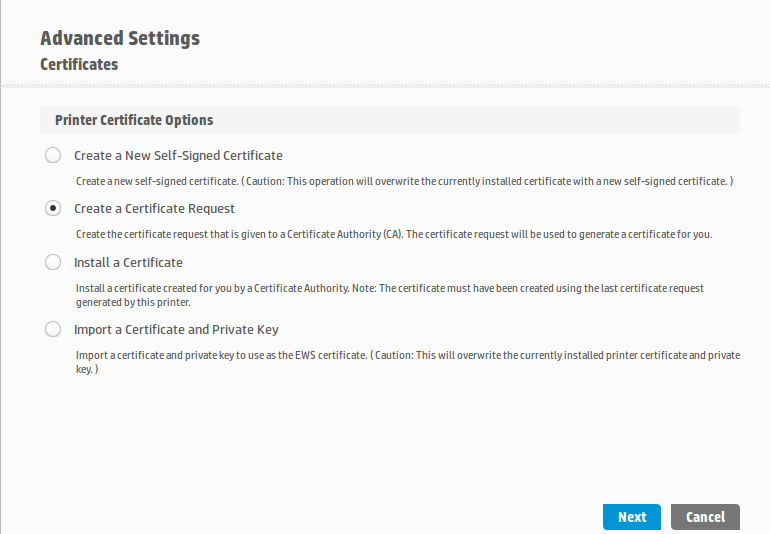
# lpstat -t
(...)
device for HP_Ink_Tank_Wireless_410_series_C37468_: ipps://HPF43909C37468.local:443/ipp/print
(...)
Hmmmm CUPS is connecting using good ol port 443, as if it were a Web thingy What if I do the same? Now we are talking! Click on New self-signed certificate , click on Next, a couple of reloads And a very nice color print came out of the printer, yay! Now, it still baffles me (of course I checked!): The self-signed certificate is now said to come from Issuer : CN=HPC37468, L=Vancouver, ST=Washington, C=US, O=HP,OU=HP-IPG, alright not that it matters (I can import a more meaningful one if I really feel like it), but, why is it Issued On: 2019-06-14 and set to Expires On: 2029-06-11? Anyway, print quality is quite nice. I hope to keep the printer long enough to rant at the certificate being expired in the future!

Comments Jeff Epler (Adafruit) 2020-05-11 20:39:17 -0500 why is it Issued On: 2019-06-14 and set to Expires On: 2029-06-11? Because it s 3650 days Gunnar Wolf 2020-05-11 20:39:17 -0500 Nice catch! Thanks for doing the head-scratching for me

10 May 2020

Russ Allbery: Review: Golden Gates

Review: Golden Gates, by Conor Dougherty
Publisher: Penguin
Copyright: 2020
ISBN: 0-525-56022-X
Format: Kindle
Pages: 249
This review, for reasons that will hopefully become clear later, starts with a personal digression. I have been interested in political theory my entire life. That sounds like something admirable, or at least neutral. It's not. "Interested" means that I have opinions that are generally stronger than my depth of knowledge warrants. "Interested" means that I like thinking about and casting judgment on how politics should be done without doing the work of politics myself. And "political theory" is different than politics in important ways, not the least of which is that political actions have rarely been a direct danger to me or my family. I have the luxury of arguing about politics as a theory. In short, I'm at high risk of being one of those people who has an opinion about everything and shares it on Twitter. I'm still in the process (to be honest, near the beginning of the process) of making something useful out of that interest. I've had some success when I become enough a part of a community that I can do some of the political work, understand the arguments at a level deeper than theory, and have to deal with the consequences of my own opinions. But those communities have been on-line and relatively low stakes. For the big political problems, the ones that involve governments and taxes and laws, those that decide who gets medical treatment and income support and who doesn't, to ever improve, more people like me need to learn enough about the practical details that we can do the real work of fixing them, rather than only making our native (and generally privileged) communities better for ourselves. I haven't found my path helping with that work yet. But I do have a concrete, challenging, local political question that makes me coldly furious: housing policy. Hence this book. Golden Gates is about housing policy in the notoriously underbuilt and therefore incredibly expensive San Francisco Bay Area, where I live. I wanted to deepen that emotional reaction to the failures of housing policy with facts and analysis. Golden Gates does provide some of that. But this also turns out to be a book about the translation of political theory into practice, about the messiness and conflict that results, and about the difficult process of measuring success. It's also a book about how substantial agreement on the basics of necessary political change can still founder on the shoals of prioritization, tribalism, and people who are interested in political theory. In short, it's a book about the difficulty of changing the world instead of arguing about how to change it. This is not a direct analysis of housing policy, although Dougherty provides the basics as background. Rather, it's the story of the political fight over housing told primarily through two lenses: Sonja Trauss, founder of BARF (the Bay Area Renters' Federation); and a Redwood City apartment complex, the people who fought its rent increases, and the nun who eventually purchased it. Around that framework, Dougherty writes about the Howard Jarvis Taxpayers Association and the history of California's Proposition 13, a fight over a development in Lafayette, the logistics challenge of constructing sufficient housing even when approved, and the political career of Scott Wiener, the hated opponent of every city fighting for the continued ability to arbitrarily veto any new housing. One of the things Golden Gates helped clarify for me is that there are three core interest groups that have to be part of any discussion of Bay Area housing: homeowners who want to limit or eliminate local change, renters who are vulnerable to gentrification and redevelopment, and the people who want to live in that area and can't (which includes people who want to move there, but more sympathetically includes all the people who work there but can't afford to live locally, such as teachers, day care workers, food service workers, and, well, just about anyone who doesn't work in tech). (As with any political classification, statements about collectives may not apply to individuals; there are numerous people who appear to fall into one group but who vote in alignment with another.) Dougherty makes it clear that housing policy is intractable in part because the policies that most clearly help one of those three groups hurt the other two. As advertised by the subtitle, Dougherty's focus is on the fight for more housing. Those who already own homes whose values have been inflated by artificial scarcity, or who want to preserve such stratified living conditions as low-density, large-lot single-family dwellings within short mass-transit commute of one of the densest cities in the United States, don't get a lot of sympathy or focus here except as opponents. I understand this choice; I also don't have much sympathy. But I do wish that Dougherty had spent more time discussing the unsustainable promise that California has implicitly made to homeowners: housing may be impossibly expensive, but if you can manage to reach that pinnacle of financial success, the ongoing value of your home is guaranteed. He does mention this in passing, but I don't think he puts enough emphasis on the impact that a single huge, illiquid investment that is heavily encouraged by government policy has on people's attitude towards anything that jeopardizes that investment. The bulk of this book focuses on the two factions trying to make housing cheaper: Sonja Trauss and others who are pushing for construction of more housing, and tenant groups trying to manage the price of existing housing for those who have to rent. The tragedy of Bay Area housing is that even the faintest connection of housing to the economic principle of supply and demand implies that the long-term goals of those two groups align. Building more housing will decrease the cost of housing, at least if you build enough of it over a long enough period of time. But in the short term, particularly given the amount of Bay Area land pre-emptively excluded from housing by environmental protection and the actions of the existing homeowners, building more housing usually means tearing down cheap lower-density housing and replacing it with expensive higher-density housing. And that destroys people's lives. I'll admit my natural sympathy is with Trauss on pure economic grounds. There simply aren't enough places to live in the Bay Area, and the number of people in the area will not decrease. To the marginal extent that growth even slows, that's another tale of misery involving "super commutes" of over 90 minutes each way. But the most affecting part of this book was the detailed look at what redevelopment looks like for the people who thought they had housing, and how it disrupts and destroys existing communities. It's impossible to read those stories and not be moved. But it's equally impossible to not be moved by the stories of people who live in their cars during the week, going home only on weekends because they have to live too far away from their jobs to commute. This is exactly the kind of politics that I lose when I take a superficial interest in political theory. Even when I feel confident in a guiding principle, the hard part of real-world politics is bringing real people with you in the implementation and mitigating the damage that any choice of implementation will cause. There are a lot of details, and those details matter. Without the right balance between addressing a long-term deficit and providing short-term protection and relief, an attempt to alleviate unsustainable long-term misery creates more short-term misery for those least able to afford it. And while I personally may have less sympathy for the relatively well-off who have clawed their way into their own mortgage, being cavalier with their goals and their financial needs is both poor ethics and poor politics. Mobilizing political opponents who have resources and vote locally isn't a winning strategy. Dougherty is a reporter, not a housing or public policy expert, so Golden Gates poses problems and tells stories rather than describes solutions. This book didn't lead me to a brilliant plan for fixing the Bay Area housing crunch, or hand me a roadmap for how to get effectively involved in local politics. What it did do is tell stories about what political approaches have worked, how they've worked, what change they've created, and the limitations of that change. Solving political problems is work. That work requires understanding people and balancing concerns, which in turn requires a lot of empathy, a lot of communication, and sometimes finding a way to make unlikely allies. I'm not sure how broad the appeal of this book will be outside of those who live in the region. Some aspects of the fight for housing generalize, but the Bay Area (and I suspect every region) has properties specific to it or to the state of California. It has also reached an extreme of housing shortage that is rivaled in the United States only by New York City, which changes the nature of the solutions. But if you want to seriously engage with Bay Area housing policy, knowing the background explained here is nearly mandatory. There are some flaws I wish Dougherty would have talked more about traffic and transit policy, although I realize that could be another book but this is an important story told well. If this somewhat narrow topic is within your interests, highly recommended. Rating: 8 out of 10

9 May 2020

Thorsten Alteholz: My Debian Activities in April 2020

FTP master This month I accepted 384 packages and rejected 47. The overall number of packages that got accepted was 457. Debian LTS This was my seventieth month that I did some work for the Debian LTS initiative, started by Raphael Hertzog at Freexian. This month my all in all workload has been 28.75h. During that time I did LTS uploads of: As there have been lots of no-dsa-CVEs I continued my work on wireshark. Last but not least I did some days of frontdesk duties. Debian ELTS This month was the twenty second ELTS month. During my small allocated time I only uploaded: I also did some days of frontdesk duties. Other stuff Unfortunately this month again strange things happened outside Debian and I only got some stuff done. I improved packaging of I sponsored uploads of I uploaded the new package On my Go challenge I uploaded:
golang-github-facebookgo-subset, golang-github-facebookgo-ensure, golang-github-shurcool-gopherjslib, golang-github-grafana-grafana-plugin-model, golang-github-crewjam-httperr, golang-github-hashicorp-terraform-svchost, golang-github-neelance-sourcemap, golang-github-neelance-astrewrite, golang-github-kisielk-gotool, golang-github-gopherjs-gopherjs, golang-github-yvasiyarov-newrelic-platform-go, golang-github-rhnvrm-simples3, golang-github-robfig-go-cache, golang-github-xorcare-pointer, golang-github-goburrow-serial

8 May 2020

Petter Reinholdtsen: Jami as a Zoom client, a trick for password protected rooms...

Half a year ago, I wrote about the Jami communication client, capable of peer-to-peer encrypted communication. It handle both messages, audio and video. It uses distributed hash tables instead of central infrastructure to connect its users to each other, which in my book is a plus. I mentioned briefly that it could also work as a SIP client, which came in handy when the higher educational sector in Norway started to promote Zoom as its video conferencing solution. I am reluctant to use the official Zoom client software, due to their copyright license clauses prohibiting users to reverse engineer (for example to check the security) and benchmark it, and thus prefer to connect to Zoom meetings with free software clients. Jami worked OK as a SIP client to Zoom as long as there was no password set on the room. The Jami daemon leak memory like crazy (approximately 1 GiB a minute) when I am connected to the video conference, so I had to restart the client every 7-10 minutes, which is not a great. I tried to get other SIP Linux clients to work without success, so I decided I would have to live with this wart until someone managed to fix the leak in the dring code base. But another problem showed up once the rooms were password protected. I could not get my dial tone signaling through from Jami to Zoom, and dial tone signaling is used to enter the password when connecting to Zoom. I tried a lot of different permutations with my Jami and Asterisk setup to try to figure out why the signaling did not get through, only to finally discover that the fundamental problem seem to be that Zoom is simply not able to receive dial tone signaling when connecting via SIP. There seem to be nothing wrong with the Jami and Asterisk end, it is simply broken in the Zoom end. I got help from a very skilled VoIP engineer figuring out this last part. And being a very skilled engineer, he was also able to locate a solution for me. Or to be exact, a workaround that solve my initial problem of connecting to password protected Zoom rooms using Jami. So, how do you do this, I am sure you are wondering by now. The trick is already documented from Zoom, and it is to modify the SIP address to include the room password. What is most surprising about this is that the automatically generated email from Zoom with instructions on how to connect via SIP do not mention this. The SIP address to use normally consist of the room ID (a number), an @ character and the IP address of the Zoom SIP gateway. But Zoom understand a lot more than just the room ID in front of the at sign. The format is "[Meeting ID].[Password].[Layout].[Host Key]", and you can hear see how you can both enter password, control the layout (full screen, active presence and gallery) and specify the host key to start the meeting. The full SIP address entered into Jami to provide the password will then look like this (all using made up numbers):
sip:657837644.522827@192.168.169.170
Now if only jami would reduce its memory usage, I could even recommend this setup to others. :) As usual, if you use Bitcoin and want to show your support of my activities, please send Bitcoin donations to my address 15oWEoG9dUPovwmUL9KWAnYRtNJEkP1u1b.

6 May 2020

Reproducible Builds: Reproducible Builds in April 2020

Welcome to the April 2020 report from the Reproducible Builds project. In our regular reports we outline the most important things that we and the rest of the community have been up to over the past month. What are reproducible builds? One of the original promises of open source software is that distributed peer review and transparency of process results in enhanced end-user security. But whilst anyone may inspect the source code of free and open source software for malicious flaws, almost all software today is distributed as pre-compiled binaries. This allows nefarious third-parties to compromise systems by injecting malicious code into seemingly secure software during the various compilation and distribution processes.

News It was discovered that more than 725 malicious packages were downloaded thousands of times from RubyGems, the official channel for distributing code for the Ruby programming language. Attackers used a variation of typosquatting and replaced hyphens and underscores (for example, uploading a malevolent atlas-client in place of atlas_client) that executed a script that intercepted Bitcoin payments. (Ars Technica report) Bernhard M. Wiedemann launched ismypackagereproducibleyet.org, a service that takes a package name as input and displays whether the package is reproducible in a number of distributions. For example, it can quickly show the status of Perl as being reproducible on openSUSE but not in Debian. Bernhard also improved the documentation of his unreproducible package to add some example patches for hash issues. [ ]. There was a post on Chaos Computer Club s website listing Ten requirements for the evaluation of Contact Tracing apps in relation to the SARS-CoV-2 epidemic. In particular:
4. Transparency and verifiability: The complete source code for the app and infrastructure must be freely available without access restrictions to allow audits by all interested parties. Reproducible build techniques must be used to ensure that users can verify that the app they download has been built from the audited source code.
Elsewhere, Nicolas Boulenguez wrote a patch for the Ada programming language component of the GCC compiler to skip -f.*-prefix-map options when writing Ada Library Information files. Amongst other properties, these .ali files embed the compiler flags used at the time of the build which results in the absolute build path being recorded via -ffile-prefix-map, -fdebug-prefix-map, etc. In the Arch Linux project, kpcyrd reported that they held their first rebuilder workshop . The session was held on IRC and participants were provided a document with instructions on how to install and use Arch s repro tool. The meeting resulted in multiple people with no prior experience of Reproducible Builds validate their first package. Later in the month he also announced that it was now possible to run independent rebuilders under Arch in a hands-off, everything just works solution to distributed package verification. Mathias Lang submitted a pull request against dmd, the canonical compiler for the D programming languageto add support for our SOURCE_DATE_EPOCH environment variable as well the other C preprocessor tokens such __DATE__, __TIME__ and __TIMESTAMP__ which was subsequently merged. SOURCE_DATE_EPOCH defines a distribution-agnostic standard for build toolchains to consume and emit timestamps in situations where they are deemed to be necessary. [ ] The Telegram instant-messaging platform announced that they had updated to version 5.1.1 continuing their claim that they are reproducible according to their full instructions and therefore verifying that its original source code is exactly the same code that is used to build the versions available on the Apple App Store and Google Play distribution platforms respectfully. Lastly, Herv Boutemy reported that 97% of the current development versions of various Maven packages appear to have a reproducible build. [ ]

Distribution work In Debian this month, 89 reviews of Debian packages were added, 21 were updated and 33 were removed this month adding to our knowledge about identified issues. Many issue types were noticed, categorised and updated by Chris Lamb, including: In addition, Holger Levsen filed a feature request against debrebuild, a tool for rebuilding a Debian package given a .buildinfo file, proposing to add --standalone or --one-shot-mode functionality.
In openSUSE, Bernhard M. Wiedemann made the following changes: In Arch Linux, a rebuilder instance has been setup at reproducible.archlinux.org that is rebuilding Arch s [core] repository directly. The first rebuild has led to approximately 90% packages reproducible contrasting with 94% on the Reproducible Build s project own ArchLinux status page on tests.reproducible-builds.org that continiously builds packages and does not verify Arch Linux packages. More information may be found on the corresponding wiki page and the underlying decisions were explained on our mailing list.

Software development

diffoscope Chris Lamb made the following changes to diffoscope, the Reproducible Builds project s in-depth and content-aware diff utility that can locate and diagnose reproducibility issues (including preparing and uploading versions 139, 140, 141, 142 and 143 to Debian which were subsequently uploaded to the backports repository):
  • Comparison improvements:
    • Dalvik .dex files can also serve as APK containers so restrict the narrower identification of .dex files to files ending with this extension and widen the identification of APK files to when file(1) discovers a Dalvik file. (#28)
    • Add support for Hierarchical Data Format (HD5) files. (#95)
    • Add support for .p7c and .p7b certificates. (#94)
    • Strip paths from the output of zipinfo(1) warnings. (#97)
    • Don t uselessly include the JSON similarity percentage if it is 0.0% . [ ]
    • Render multi-line difference comments in a way to show indentation. (#101)
  • Testsuite improvements:
    • Add pdftotext as a requirement to run the PDF test_metadata text. (#99)
    • apktool 2.5.0 changed the handling of output of XML schemas so update and restrict the corresponding test to match. (#96)
    • Explicitly list python3-h5py in debian/tests/control.in to ensure that we have this module installed during a test run to generate the fixtures in these tests. [ ]
    • Correct parsing of ./setup.py test --pytest-args arguments. [ ]
  • Misc:
    • Capitalise Ordering differences only in text comparison comments. [ ]
    • Improve documentation of FILE_TYPE_HEADER_PREFIX and FALLBACK_FILE_TYPE_HEADER_PREFIX to highlight that only the first 16 bytes are used. [ ]
Michael Osipov created a well-researched merge request to return diffoscope to using zipinfo directly instead of piping input via /dev/stdin in order to ensure portability to the BSD operating system [ ]. In addition, Ben Hutchings documented how --exclude arguments are matched against filenames [ ] and Jelle van der Waa updated the LLVM test fixture difference for LLVM version 10 [ ] as well as adding a reference to the name of the h5dump tool in Arch Linux [ ]. Lastly, Mattia Rizzolo also fixed in incorrect build dependency [ ] and Vagrant Cascadian enabled diffoscope to locate the openssl and h5dump packages on GNU Guix [ ][ ], and updated diffoscope in GNU Guix to version 141 [ ] and 143 [ ].

strip-nondeterminism strip-nondeterminism is our tool to remove specific non-deterministic results from a completed build. In April, Chris Lamb made the following changes:
  • Add deprecation plans to all handlers documenting how or if they could be disabled and eventually removed, etc. (#3)
  • Normalise *.sym files as Java archives. (#15)
  • Add support for custom .zip filename filtering and exclude two patterns of files generated by Maven projects in fork mode. (#13)

disorderfs disorderfs is our FUSE-based filesystem that deliberately introduces non-determinism into directory system calls in order to flush out reproducibility issues. This month, Chris Lamb fixed a long-standing issue by not drop UNIX groups in FUSE multi-user mode when we are not root (#1) and uploaded version 0.5.9-1 to Debian unstable. Vagrant Cascadian subsequently refreshed disorderfs in GNU Guix to version 0.5.9 [ ].

Upstream patches The Reproducible Builds project detects, dissects and attempts to fix as many currently-unreproducible packages as possible. We endeavour to send all of our patches upstream where appropriate. This month, we wrote a large number of such patches, including: In addition, Bernhard informed the following projects that their packages are not reproducible:
  • acoular (report unknown non-determinism)
  • cri-o (report a date issue)
  • gnutls (report certtool being unable to extend certificates beyond 2049)
  • gnutls (report copyright year variation)
  • libxslt (report a bug about non-deterministic output from data corruption)
  • python-astropy (report a future build failure in 2021)

Project documentation This month, Chris Lamb made a large number of changes to our website and documentation in the following categories:
  • Community engagement improvements:
    • Update instructions to register for Salsa on our Contribute page now that the signup process has been overhauled. [ ]
    • Make it clearer that joining the rb-general mailing list is probably a first step for contributors to take. [ ]
    • Make our full contact information easier to find in the footer (#19) and improve text layout using bullets to separate sections [ ].
  • Accessibility:
    • To improve accessibility, make all links underlined. (#12)
    • Use an enhanced foreground/background contrast ratio of 7.04:1. (#11)
  • General improvements:
  • Internals:
    • Move to using jekyll-redirect-from over manual redirect pages [ ][ ] and add a redirect from /docs/buildinfo/ to /docs/recording/. (#23)
    • Limit the website self-check to not scan generated files [ ] and remove the old layout checker now that I have migrated all them [ ].
    • Move the news archive under the /news/ namespace [ ] and improve formatting of archived news links [ ].
    • Various improvements to the draft template generation. [ ][ ][ ][ ]
In addition, Holger Levsen clarified exactly which month we ceased to do weekly reports [ ] and Mattia Rizzolo adjusted the title style of an event page [ ]. Marcus Hoffman also started a discussion on our website s issue tracker asking for clarification on embedded signatures and Chris Lamb subsequently replied and asked Marcus to go ahead and propose a concrete change.

Testing framework We operate a large and many-featured Jenkins-based testing framework that powers tests.reproducible-builds.org that, amongst many other tasks, tracks the status of our reproducibility efforts as well as identifies any regressions that have been introduced.
  • Chris Lamb:
    • Print the build environment prior to executing a build. [ ]
    • Drop a misleading disorderfs-debug prefix in log output when we change non-disorderfs things in the file and, as it happens, do not run disorderfs at all. [ ]
    • The CSS for the package report pages added a margin to all <a> HTML elements under <li> ones, which was causing a comma/bullet spacing issue. [ ]
    • Tidy the copy in the project links sidebar. [ ]
  • Holger Levsen:
    • General:
    • Debian:
      • Reduce scheduling frequency of the buster distribution on the arm64 architecture, etc.. [ ][ ]
      • Show builds per day on a per-architecture basis for the last year on the Debian dashboard. [ ]
      • Drop the Subgraph OS package set as development halted in 2017 or 2018. [ ]
      • Update debrebuild to version from the latest version of devscripts. [ ][ ]
      • Add or improve various parts of the documentation. [ ][ ][ ]
    • Work on a Debian rebuilder:
      • Integrate sbuild. [ ][ ][ ][ ][ ]
      • Select a random .buildinfo file and attempt to build and compare the result. [ ][ ][ ][ ]
      • Improve output and related output formatting. [ ][ ][ ][ ][ ]
      • Outline next steps for the development of the tool. [ ][ ][ ]
      • Various refactoring and code improvements. [ ][ ][ ]
Lastly, Mattia Rizzolo fixed some log parsing code regarding potentially-harmless warnings from package installation [ ][ ] and the usual build node maintenance was performed by Holger Levsen [ ][ ][ ] and Mattia Rizzolo [ ][ ][ ].

Misc news On our mailing list this month, Santiago Torres asked whether we were still publishing releases of our tools to our website and Chris Lamb replied that this was not the case and fixed the issue. Later in the month Santiago also reported that the signature for the disorderfs package did not pass its GPG verification which was also fixed by Chris Lamb. Hans-Christoph Steiner of the Guardian Project asked whether there would be interest in making our website translatable which resulted in a WIP merge request being filed against the website and a discussion on how to track translation updates.
If you are interested in contributing to the Reproducible Builds project, please visit our Contribute page on our website. However, you can get in touch with us via:

This month s report was written by Bernhard M. Wiedemann, Chris Lamb, Daniel Shahaf, Holger Levsen, Jelle van der Waa, kpcyrd, Mattia Rizzolo and Vagrant Cascadian. It was subsequently reviewed by a bunch of Reproducible Builds folks on IRC and the mailing list.

4 May 2020

Russ Allbery: Review: Seraphina

Review: Seraphina, by Rachel Hartman
Series: Seraphina #1
Publisher: Ember
Copyright: 2012
ISBN: 0-375-89658-9
Format: Kindle
Pages: 360
Forty years ago, dragons and humans negotiated a fragile truce. The fighting stopped, the dragon-killing knights were outlawed, and dragons were allowed to visit the city in peace, albeit under stringent restrictions. Some on both sides were never happy with that truce and now, as the anniversary approaches, Prince Rufus has been murdered while hunting. His head was never found, and not a few members of the court are certain that it was eaten. Sixteen-year-old Seraphina had no intention of being part of that debate. She's desperately trying to keep a low profile as the assistant court music director and music tutor to a princess. Her father is furious that she's at court at all, since that they are hiding a family secret that cannot get out. But Seraphina has a bad habit of being competent in ways that are hard to ignore: improving the princess's willingness to learn music beyond all expectations, performing memorably at Prince Rufus's funeral, and then helping, with her dragon tutor, a newskin dragon (one new to shapeshifting) who was attacked by a mob. This brings her to the attention of Prince Lucian Kiggs: royal bastard, fiance of the princess, head of the royal guard, and observant investigator. For Seraphina and her secrets, that's a threat, but she has made more friends at court than she realizes. I probably should spoil Seraphina's secret, since it's hard to talk about this book without it and Hartman reveals it relatively early, but I try to avoid spoilers. I'll instead say that Seraphina is in danger from both the court and the dragons if her secret is uncovered, but she has an ability that will prove more useful than she ever expected in helping the kingdom avoid war. That ability is not something flashy; it lies in listening, understanding, and forming connections. As you have probably guessed from the age of the protagonist, this is a young adult fantasy. It has that YA shape; Seraphina is uncertain but brave, gets into trouble by being unable to keep her mouth shut or stand by when she can prevent bad things from happening, and is caught by surprise when others find those characteristics likable. The cast is small despite an epic fantasy setup, and the degree to which Seraphina ends up at the heart of the kingdom's affairs is perhaps a touch unrealistic. Like a lot of YA, Seraphina is very centered on its main character. Your enjoyment of this book will likely hinge on how much you like her mix of uncertainty, determination, and ethics. I liked her. I also appreciated the way that Hartman had her stumble into the plot through a series of accidents and entanglements with her past and her secret, despite her own best intentions. Seraphina is trying to avoid attention, not get into the middle of a novel, but she's naturally the sort of person who rushes towards danger to help others whenever events happen too fast for her to think. She has also attracted the attention (and unexpected friendship) of critical members of the royal family who like to meddle, which is bad for her attempts to hide. This could have felt artificial and too coincidental, but it didn't. The one thing that did bother me about this book, though, was the nature of dragons, although it's possible that I'm being unfair. Dragons in Hartman's world can shapeshift into human form, but they don't understand (and deeply distrust) human emotions, finding them overwhelming and impure. This bit of world-building is not original to this book, and perhaps I should attribute it to the ubiquitous influence of Spock and Vulcans. But I kept stumbling over the feeling like dragons were based partly on stereotypes of the autism spectrum, which hurt my ability to engross myself in the story. It would not surprise me if I had this all wrong, Hartman didn't intend anything of the sort, and no one else will read it that way. But it still seemed worth mentioning. Seraphina's dynamic with Kiggs becomes the core of the story, but it's slow and stumbling and occasionally frustrating when Seraphina is more cautious than the reader thinks she needs to be. The payoff is mostly worth the frustration, though. I wish Seraphina had been a bit more curious about her abilities, a bit more willing to notice the obvious (the bit with the dancers drug on far too long), and a bit more trusting of people who deserve her trust, and I wish Hartman had taken a different approach with the dragon attitude towards emotions. But this was fun. Recommended if you want a good-hearted story where doing the right thing is rewarded and people in positions of power notice when someone is a good person. Followed by Shadow Scale. Rating: 7 out of 10

3 May 2020

Sean Whitton: Processing mail from discussion lists differently

I realised this week that for some years I have been applying Inbox Zero indiscriminately to all e-mail that I receive, but this does not make sense, and has some downsides. My version of Inbox Zero works very well when applied to mail addressed directly to me, and for mail to certain mailing lists, where each post to the list might as well be addressed directly to me, in addition to the list. However, I also receive by e-mail the following things to which I now believe Inbox Zero should not be applied: I believe that applying Inbox Zero to these sorts of things is not only incorrect but is actually harming my engagement with these mediums. Let us distinguish

  1. processing e-mail this means applying the Inbox Zero decision procedure to incoming messages, at set times during the day (I do it once, around 4pm)
  2. browsing and sometimes catching up RSS articles and list mail looking through unread items, replying if I think I have something useful to say, leaving things for later, and occasionally marking all as read if I ve not had time for that group of lists lately.
These should be kept apart. The easy case to see is why you shouldn t apply the browsing/catching up approach to e-mail which should rather be processed that s just the original wisdom of Inbox Zero. And clearly you don t want ever to have to resort to just marking all mail addressed directly to you as read. What goes wrong, then, if you misapply the processing mentality to e-mail which should, rather, be browsed/caught up? Well, the core of Inbox Zero is deciding whether to read and reply to something right now, add it to your todo list to handle later, or decide the mail cannot be dealt with quickly but is not important enough to go on that todo list. If you apply this to RSS articles and discussion list mail, then the third option is basically ruled out, because almost nothing on mailing lists or on blogs that I follow is important enough to go on my list of Real Tasks. But then you re faced with either reading the article/post right now, or discarding it. There is no option to leave the item marked as unread and then maybe come back to it, or postpone discarding it until you ve decided to catch up the group. Applying Inbox Zero to discussion lists and RSS feeds creates a false sense of urgency. I ve realised that my implicit response to this has been reluctance to subscribe to new mailing lists and feeds, because I don t have things set up to allow me to read them in a leisurely way. But then I m missing out on discussions and writing that might be relevant and beneficial to me if I could only approach them when I m in a frame of mind other than time to get my inbox down to zero . This also means that subscribing to new mailing lists just in order to post something has an unreasonably high cost: introducing all mail on those lists into my Inbox Zero processing window. So, what s needed is to make the virtual folder views which I use to read new mail correspond cleanly to the distinction between mail to be processed and mail to be browsed. I.e. for each virtual folder it should be clear whether mail there is to be processed or to be browsed. Then I can continue to use my processing views once per day, and access the browsing views at leisure. (Indeed, I ve created a keybinding to cycle through the new browsing views, and another to catch them up.) As I mentioned, some list mail ought to be processed. For example, I want to process rather than browse the debian-policy mailing list, as one of the Policy Editors. With notmuch, it s easy to include this mail in the relevant processing views (I ve long had one processing view for weekdays and another for weekends). Additionally, I ve used a bit of Emacs Lisp to create a dynamic uncategorised unread view which catches mail to be browsed which (i) doesn t show up in one of the other virtual folders for mail to be browsed, and (ii) doesn t show up in one of the processing views. So now subscribing to a mailing list is cheap: mail will end up in the uncategorised view, and I can decide whether to leave it there for a low traffic list; create a new virtual folder for the list (trivial as it s all just more Emacs Lisp, no actual moving of files required); or unsubscribe. I ve been experiencing nostalgia for my time in secondary school when my friends and I had all sorts of interesting stuff flowing into our mailstores, from RSS feeds to each other s blogs where we d post both our own content and links elsewhere, RSS feeds to stranger s blogs, and e-mails sent to each other with links. We didn t have to worry about processing anything back then, as our e-mail accounts were used for intellectual enrichment but not the completion of tasks. I think I can recapture something of that with my new virtual folders for browsing.

Evgeni Golov: Remote management for OpenWRT devices without opening inbound connections

Everyone is working from home these days and needs a decent Internet connection. That's especially true if you need to do video calls and the room you want to do them has the worst WiFi coverage of the whole flat. Well, that's exactly what happened to my parents in law. When they moved in, we knew that at some point we'll have to fix the WiFi - the ISP provided DSL/router/WiFi combo would not cut it, especially not with the shape of the flat and the elevator shaft in the middle of it: the flat is essentially a big C around said shaft. But it was good enough for email, so we postponed that. Until now. The flat has wired Ethernet, but the users MacBook Air does not. That would have been too easy, right? So let's add another access point and hope the situation improves. Luckily I still had a TP-Link Archer C7 AC1750 in a drawer, which I could quickly flash with a fresh OpenWRT release, disable DHCPd and configure the same SSID and keys as the main/old WiFi. But I didn't know which channels would be best in the destination environment. Under normal circumstances, I'd just take the AP, drive to my parents in law and finish the configuration there. Nope, not gonna happen these days. So my plan was to finish configuration here, put the AP in a box and on the porch where someone can pick it up. But this would leave me without a way to further configure the device once it has been deployed - I was not particularly interested in trying to get port forwarding configured via phone and I was pretty sure UPnP was disabled in the ISP router. Installing a Tor hidden service for SSH was one possibility, setting up a VPN and making the AP a client another. Well, or just creating a reverse tunnel with SSH! sshtunnel Creating a tunnel with OpenSSH is easy: ssh -R127.0.0.1:2222:127.0.0.1:22 server.example.com will forward localhost:2222 on server.example.com to port 22 of the machine the SSH connection originated from. But what happens if the connection dies? Adding a while true; do ; done around it might help, but I would really like not to reinvent the wheel here! Thankfully, somebody already invented that particular wheel and OpenWRT comes with a sshtunnel package that takes care of setting up and keeping up such tunnels and documentation how to do so. Just install the sshtunnel package, edit /etc/config/sshtunnel to contain a server stanza with hostname, port and username and a tunnelR stanza referring said server plus the local and remote sides of the tunnel and you're good to go.
config server home
  option user     user
  option hostname server.example.com
  option port     22
config tunnelR local_ssh
  option server         home
  option remoteaddress  127.0.0.1
  option remoteport     2222
  option localaddress   127.0.0.1
  option localport      22
The only caveat is that sshtunnel needs the OpenSSH client binary (and the package correctly depends on it) and OpenWRT does not ship the ssh-keygen tool from OpenSSH but only the equivalent for Dropbear. As OpenSSH can't read Dropbear keys (and vice versa) you'll have to generate the key somewhere else and deploy it to the OpenWRT box and the target system. Oh, and OpenWRT defaults to enabling password login via SSH, so please disable that if you expose the box to the Internet in any way! Using the tunnel After configuring and starting the service, you'll see the OpenWRT system logging in to the configured remote and opening the tunnel. For some reason that connection would not show up in the output of w -- probably because there was no shell started or something, but logs show it clearly. Now it's just a matter of connecting to the newly open port and you're in. As the port is bound to 127.0.0.1, the connection is only possible from server.example.com or using it as a jump host via OpenSSH's ProxyJump option: ssh -J server.example.com -p 2222 root@localhost. Additionally, you can forward a local port over the tunneled connection to create a tunnel for the OpenWRT webinterface: ssh -J server.example.com -p 2222 -L8080:localhost:80 root@localhost. Yes, that's a tunnel inside a tunnel, and all the network engineers will go brrr, but it works and you can access LuCi on http://localhost:8080 just fine. If you don't want to type that every time, create an entry in your .ssh/config:
Host openwrt
  ProxyJump server.example.com
  HostName localhost
  Port 2222
  User root
  LocalForward 8080 localhost:80
And we're done. Enjoy easy access to the newly deployed box and carry on.

Fran ois Marier: Backing up to a GnuBee PC 2

After installing Debian buster on my GnuBee, I set it up for receiving backups from my other computers.

Software setup I started by configuring it like a typical server but without a few packages that either take a lot of memory or CPU: I changed the default hostname:
  • /etc/hostname: foobar
  • /etc/mailname: foobar.example.com
  • /etc/hosts: 127.0.0.1 foobar.example.com vogar localhost
and then installed the avahi-daemon package to be able to reach this box using foobar.local. I noticed the presence of a world-writable directory and so I tightened the security of some of the default mount points by putting the following in /etc/rc.local:
mount -o remount,nodev,nosuid /etc/network
mount -o remount,nodev,nosuid /lib/modules
chmod 755 /etc/network
exit 0

Hardware setup My OS drive (/dev/sda) is a small SSD so that the GnuBee can run silently when the spinning disks aren't needed. To hold the backup data on the other hand, I got three 4-TB drives drives which I setup in a RAID-5 array. If the data were valuable, I'd use RAID-6 instead since it can survive two drives failing at the same time, but in this case since it's only holding backups, I'd have to lose the original machine at the same time as two of the 3 drives, a very unlikely scenario. I created new gpt partition tables on /dev/sdb, /dev/sdbc, /dev/sdd and used fdisk to create a single partition of type 29 (Linux RAID) on each of them. Then I created the RAID array:
mdadm /dev/md127 --create -n 3 --level=raid5 -a /dev/sdb1 /dev/sdc1 /dev/sdd1
and waited more than 24 hours for that operation to finish. Next, I formatted the array:
mkfs.ext4 -m 0 /dev/md127
and added the following to /etc/fstab:
/dev/md127 /mnt/data/ ext4 noatime,nodiratime 0 2
To reduce unnecessary noise and reduce power consumption, I also installed hdparm:
apt install hdparm
and configured all spinning drives to spin down after being idle for 10 minutes by putting the following in /etc/hdparm.conf:
/dev/sdb  
       spindown_time = 120
 
/dev/sdc  
       spindown_time = 120
 
/dev/sdd  
       spindown_time = 120
 
and then reloaded the configuration:
 /usr/lib/pm-utils/power.d/95hdparm-apm resume
Finally I setup smartmontools by putting the following in /etc/smartd.conf:
/dev/sda -a -o on -S on -s (S/../.././02 L/../../6/03)
/dev/sdb -a -o on -S on -s (S/../.././02 L/../../6/03)
/dev/sdc -a -o on -S on -s (S/../.././02 L/../../6/03)
/dev/sdd -a -o on -S on -s (S/../.././02 L/../../6/03)
and restarting the daemon:
systemctl restart smartd.service

Backup setup I started by using duplicity since I have been using that tool for many years, but a 190GB backup took around 15 hours on the GnuBee with gigabit ethernet. After a friend suggested it, I took a look at restic and I have to say that I am impressed. The same backup finished in about half the time.

User and ssh setup After hardening the ssh setup as I usually do, I created a user account for each machine needing to backup onto the GnuBee:
adduser machine1
adduser machine1 sshuser
adduser machine1 sftponly
chsh machine1 -s /bin/false
and then matching directories under /mnt/data/home/:
mkdir /mnt/data/home/machine1
chown machine1:machine1 /mnt/data/home/machine1
chmod 700 /mnt/data/home/machine1
Then I created a custom ssh key for each machine:
ssh-keygen -f /root/.ssh/foobar_backups -t ed25519
and placed it in /home/machine1/.ssh/authorized_keys on the GnuBee. On each machine, I added the following to /root/.ssh/config:
Host foobar.local
    User machine1
    Compression no
    Ciphers aes128-ctr
    IdentityFile /root/backup/foobar_backups
    IdentitiesOnly yes
    ServerAliveInterval 60
    ServerAliveCountMax 240
The reason for setting the ssh cipher and disabling compression is to speed up the ssh connection as much as possible given that the GnuBee has avery small RAM bandwidth. Another performance-related change I made on the GnuBee was switching to the internal sftp server by putting the following in /etc/ssh/sshd_config:
Subsystem      sftp    internal-sftp

Restic script After reading through the excellent restic documentation, I wrote the following backup script, based on my old duplicity script, to reuse on all of my computers:
# Configure for each host
PASSWORD="XXXX"  # use  pwgen -s 64  to generate a good random password
BACKUP_HOME="/root/backup"
REMOTE_URL="sftp:foobar.local:"
RETENTION_POLICY="--keep-daily 7 --keep-weekly 4 --keep-monthly 12 --keep-yearly 2"
# Internal variables
SSH_IDENTITY="IdentityFile=$BACKUP_HOME/foobar_backups"
EXCLUDE_FILE="$BACKUP_HOME/exclude"
PKG_FILE="$BACKUP_HOME/dpkg-selections"
PARTITION_FILE="$BACKUP_HOME/partitions"
# If the list of files has been requested, only do that
if [ "$1" = "--list-current-files" ]; then
    RESTIC_PASSWORD=$PASSWORD restic --quiet -r $REMOTE_URL ls latest
    exit 0
# Show list of available snapshots
elif [ "$1" = "--list-snapshots" ]; then
    RESTIC_PASSWORD=$GPG_PASSWORD restic --quiet -r $REMOTE_URL snapshots
    exit 0
# Restore the given file
elif [ "$1" = "--file-to-restore" ]; then
    if [ "$2" = "" ]; then
        echo "You must specify a file to restore"
        exit 2
    fi
    RESTORE_DIR="$(mktemp -d ./restored_XXXXXXXX)"
    RESTIC_PASSWORD=$PASSWORD restic --quiet -r $REMOTE_URL restore latest --target "$RESTORE_DIR" --include "$2"   exit 1
    echo "$2 was restored to $RESTORE_DIR"
    exit 0
# Delete old backups
elif [ "$1" = "--prune" ]; then
    # Expire old backups
    RESTIC_PASSWORD=$PASSWORD restic --quiet -r $REMOTE_URL forget $RETENTION_POLICY
    # Delete files which are no longer necessary (slow)
    RESTIC_PASSWORD=$PASSWORD restic --quiet -r $REMOTE_URL prune
    exit 0
# Catch invalid arguments
elif [ "$1" != "" ]; then
    echo "Invalid argument: $1"
    exit 1
fi
# Check the integrity of existing backups
RESTIC_PASSWORD=$PASSWORD restic --quiet -r $REMOTE_URL check   exit 1
# Dump list of Debian packages
dpkg --get-selections > $PKG_FILE
# Dump partition tables from harddrives
/sbin/fdisk -l /dev/sda > $PARTITION_FILE
/sbin/fdisk -l /dev/sdb > $PARTITION_FILE
# Do the actual backup
RESTIC_PASSWORD=$PASSWORD restic --quiet --cleanup-cache -r $REMOTE_URL backup / --exclude-file $EXCLUDE_FILE
I run it with the following cronjob in /etc/cron.d/backups:
30 8 * * *    root  ionice nice nocache /root/backup/backup-machine1-to-foobar
30 2 * * Sun  root  ionice nice nocache /root/backup/backup-machine1-to-foobar --prune
in a way that doesn't impact the rest of the system too much. Finally, I printed a copy of each of my backup script, using enscript, to stash in a safe place:
enscript --highlight=bash --style=emacs --output=- backup-machine1-to-foobar   ps2pdf - > foobar.pdf
This is actually a pretty important step since without the password, you won't be able to decrypt and restore what's on the GnuBee.

2 May 2020

Jonathan Carter: Free Software Activities for 2020-04

Debian project leader This month contained the first week and a half or so of my term as Debian Project Leader. So far my focus has been getting up to speed and keeping the gears turning with day to day DPL tasks. The updates listed here will also be available on the DPL blog, where I aim to make more frequent updates. During May, Debian Brazil will host Debian talks throughout the month which they will stream to their YouTube channel. You can find the schedule in this git repository, most of the talks will be in Portuguese, but on the 4th of May at 21:00 UTC, I ll be covering some Debian project topics for an hour or so and take some questions if there s time left. 2020-04-19: Handover session with Sam, our outgoing DPL. We covered a lot of questions I had and main areas that the DPL works in. Thanks to Sam for having taken the time to do this. 2020-04-21: First day of term! Thank you to everybody who showed support and have offered to help! 2020-04-21: Request feedback from the trademark team on an ongoing trademark dispute. 2020-04-21: Join the GNOME Advisory Board as a representative from Debian. 2020-04-21: Reply on an ongoing community conflict issue. 2020-04-21: Update Debian project summary for SPI annual report. 2020-04-21: Received a great e-mail introduction from Debian France and followed up on that. 2020-04-21: Posted Bits from the new DPL to debian-devel-announce. 2020-04-22: Became Debian s OSI Affilliate representative. 2020-04-22: Reply to a bunch of media inquiries for interviews, will do them later when initial priorities are on track. 2020-04-23: Resign as Debian FTP team trainee and mailing list moderator. In both these areas there are enough people taking care of it and I intend to maximise available time for DPL and technical areas in the project. 2020-04-25: Review outgoing mail for trademark team. 2020-04-25: Answer some questions in preparation for DAM/Front Desk delegation updates. 2020-04-26: Initiated wiki documentation for delegation updates process. 2020-04-27: Update delegation for the Debian Front Desk team. 2020-04-29: Schedule video call with Debian treasurer team. 2020-04-29: OSI affiliate call. Learned about some Open Source projects including OpenDev, OpenSourceMatters, FOSS Responders and Democracy Labs.

Debian Social Work on the Debian Social project is progressing, we plan to start a separate blog syndicated to Planet Debian that contains progress and status updates. I ve been terrible at tracking the work we ve been doing on this, so for now, here are some micro updates:

MiniDebConf Online In the DebConf video team, we ve been wondering whether we have all the tools required to successfully host a DebConf (or even a mini DebConf) entirely online. There s really just one way to know for sure, so we re going to host MiniDebConf Online from 28 May to 31 May. The first two days will be an online MiniDebCamp, where we can try to hold online spints, meetings and general chit-chat. The last two days will be for talks and lightnight talks, with BoFs likely to take place throughout the 4 days (this will probably be decided once we have a content team). Announcements should go out within the next week, in the meantime, save the dates.

Debian package uploads 2020-04-07: Upload package flask-autoindex (0.6.6-1) to Debian unstable. 2020-04-07: Upload package gamemode (1.5.1-1) to Debian unstable. 2020-04-08: Accept MR#2 for live-tasks (add usbutils to live-task-standard). 2020-04-08: Upload package live-tasks (11.0.2) to Debian unstable (Closes: #955526, #944578, #942837, #942834). 2020-04-08: Close live-config bug #655198 (Only affects squeeze which is no longer supported). 2020-04-08: Upload package live-config (11.0.1) to Debian unstable. 2020-04-08: Upload package calamares (3.2.22-1) to Debian unstable. 2020-04-15: Upload package xabacus (8.2.6-1) to Debian unstable. 2020-04-16: Merge MR#1 for gnome-shell-extension-dashtodock (new upstream release). 2020-04-16: Upload package gnome-shell-extension-dashtodock (67+git20200225-1) to Debian unstable. 2020-04-16: Merge MR#1 for gnome-shell-extension-hard-disk-led (fix some lintian issues). 2020-04-16: Merge MR#1 for gnome-shell-extension-system-monitor (fix some lintian issues). 2020-04-17: Upload package calamares (3.2.23-1) to Debian unstable. 2020-04-17: Upload package catimg (2.6.0-1) to Debian unstable (Closes: #956150). 2020-04-17: Upload package fabulous (0.3.0+dfsg1-7) to Debian unstable (Closes: #952242). 2020-04-17: Upload package gnome-shell-extension-system-monitor (38+git20200414-32cc79e-1) to Debian unstable (Closes: #956656, #956171). 2020-04-17: Upload package gnome-shell-extension-arc-menu (45-1) to Debian unstable (Closes: #956168). 2020-04-18: Upload package toot (0.26.0-1) to Debian unstable. 2020-04-23: Update packaging for gnome-shell-extension-tilix-shortcut, upstream section needs some additional work before release is possible. 2020-04-23: Upload package xabacus (8.2.7-1) to Debian unstable. 2020-04-27: Upload package gnome-shell-extension-dash-to-panel (37-1) to Debian unstable (Closes: #956162, #954978). 2020-04-27: Upload package gnome-shell-extension-dash-to-panel (37-2) to Debian unstable. 2020-04-27: Upload package gnome-shell-extension-dashtodock (68-1) to Debian unstable. 2020-04-30: Merge MR#8 for gamemode (add symbol files) (Closes: #952425). 2020-04-30: Merge MR#9 for gamemode (reduce number of -dev packages generated). 2020-04-30: Merge MR#10 for gamemode (deal better with upgrades on a buggy version). 2020-04-30: Manually merge changes from MR#11 for gamemode (packaging fixes). 2020-04-30: Upload package gamemode (1.5.1-2) to Debian unstable.

Sylvain Beucler: Debian LTS and ELTS - April 2020

Debian LTS Logo Here is my transparent report for my work on the Debian Long Term Support (LTS) and Debian Extended Long Term Support (ELTS), which extend the security support for past Debian releases, as a paid contributor. In April, the monthly sponsored hours were split evenly among contributors depending on their max availability - I was assigned 28.75h for LTS (out of 30 max; all done) and 7.75h for ELTS (out of 20 max; I did 2.75). Escalation procedures were (internally) documented with a focus on discussing issues with team coordinator(s) first. Debian LTS had its first team meeting through IRC and lots of workflow question were discussed. This should help discuss questions that are a bit hard to bring up, and ensure everybody participates. There were lots of topics and it was a bit rushed, but this is something we want to repeat monthly now, possibly with audio/video in a couple months. Remarks from last month's report were discussed, strengthening the Front-Desk role. 10% of the global funding is now reserved for infrastructure work. What kind of work, and who (LTS or external) will do the work, will be discussed further. A fellow DD suggested (in a private conversation) that LTS may be taking time from the Debian Security team, due to additional commits to review. Conversely, this is another opportunity to mention all the global, non-LTS-specific work that LTS provides, which I usually highlight in my reports, and maybe I should be even more ;) ELTS - Wheezy LTS - Jessie Documentation/Scripts

1 May 2020

Paul Wise: FLOSS Activities April 2020

Changes

Issues

Review

Administration
  • myrepos: fix the forum
  • Debian: restart non-responsive tor daemon, restart processes due to OOM, apply debian.net changes for DD with expired key
  • Debian wiki: approve accounts
  • Debian QA services: deploy changes, auto-disable oldoldstable pockets

Communication

Sponsors The purple-discord work was sponsored by my employer. All other work was done on a volunteer basis.

30 April 2020

Chris Lamb: Free software activities in April 2020

Here is my monthly update covering what I have been doing in the free software world during April 2020 (previous month's report). Looking it over prior to publishing, I am surprised how much I got done this month I felt that I was not only failing to do all the extra things I had planned, but I was doing far less than normal. But let us go easy on ourselves; nobody is nailing this. In addition, I did more hacking on the Lintian static analysis tool for Debian packages:
Reproducible builds One of the original promises of open source software is that distributed peer review and transparency of process results in enhanced end-user security. However, whilst anyone may inspect the source code of free and open source software for malicious flaws, almost all software today is distributed as pre-compiled binaries. This allows nefarious third-parties to compromise systems by injecting malicious code into ostensibly secure software during the various compilation and distribution processes. The motivation behind the Reproducible Builds effort is to ensure no flaws have been introduced during this compilation process by promising identical results are always generated from a given source, thus allowing multiple third-parties to come to a consensus on whether a build was compromised. The initiative is proud to be a member project of the Software Freedom Conservancy, a not-for-profit 501(c)(3) charity focused on ethical technology and user freedom. Conservancy acts as a corporate umbrella allowing projects to operate as non-profit initiatives without managing their own corporate structure. If you like the work of the Conservancy or the Reproducible Builds project, please consider becoming an official supporter. Elsewhere in our tooling, I made the following changes to diffoscope, our in-depth and content-aware diff utility that can locate and diagnose reproducibility issues, including preparing and uploading versions 139, 140, 141 and 142 to Debian: Lastly, I made a large number of changes to our website and documentation in the following categories:
Debian LTS This month I have contributed 18 hours to Debian Long Term Support (LTS) and 7 hours on its sister Extended LTS project. You can find out more about the project via the following video:
Debian I only filed three bugs in April, including one against snapshot.debian.org to report that a Content-Type HTTP header is missing when downloading .deb files (#956471) and to report build failures in the macs & ruby-enumerable-statistics packages:

29 April 2020

Craig Small: Sending data in a signal

The well-known kill system call has been around for decades and is used to send a signal to another process. The most common use is to terminate or kill another process by sending the KILL or TERM signal but it can be used for a form of IPC, usually around giving the other process a kick to do something. One thing that isn t as well known is besides sending a signal to a process, you can send some data to it. This can either be an integer or a pointer and uses similar semantics to the known kill and signal handler. I came across this when there was a merge request for procps. The main changes are using sigqueue instead of kill in the sender and using a signal action not a signal handler in the receiver. To illustrate this feature, I have a small set of programs called sender and receiver that will pass an integer between them. The Sender The sender program is extremely simple, use a random(ish) from time masked to two bytes, put it in the required union and send the lot to sendqueue.
# include <signal.h>
# include <stdlib.h>
# include <stdio.h>
# include <time.h>
int main(int argc, char **argv)
 
    union sigval sigval;
    pid_t pid;
    if (argc < 2   (pid = atoi(argv[1])) < 0)
	return EXIT_FAILURE;
    sigval.sival_int = time(NULL) &amp; 0xff;
    printf("sender: sending %d to PID %d\n",
        sigval.sival_int, pid);
    sigqueue(pid, SIGUSR1, sigval);
    return EXIT_SUCCESS;
 
The key lines are 13 and 16 where the random (ish) integer is stored in the sigval union and then sent to the other process with the sigqueue. The receiver The receiver just sets up the signal handler, sends its PID (so I know what to tell the sender) and sits in a sleeping loop.
# include <stdio.h>
# include <stdlib.h>
# include <sys/types.h>
# include <unistd.h>
# include <signal.h>
void signal_handler(int signum, siginfo_t *siginfo, void *ucontext)
 
    if (signum != SIGUSR1) return;
    if (siginfo->si_code != SI_QUEUE) return;
    printf("receiver: Got value %d\n",
	    siginfo->si_int);
 
int main(int argc, char **argv)
 
    pid_t pid = getpid();
    struct sigaction signal_action;
    printf("receiver: PID is %d\n", pid);
    signal_action.sa_sigaction = signal_handler;
    sigemptyset (&amp;signal_action.sa_mask);
    signal_action.sa_flags = SA_SIGINFO;
    sigaction(SIGUSR1, &amp;signal_action, NULL);
    while(1) sleep(100);
    return EXIT_SUCCESS;
 
Lines 16-26 setup the signal handler. The main difference here is SA_SIGINFO used for the signal flags and sigaction references a sa_sigaction function rather than sa_handler. We need to use a different function because the sigaction only is passed the signal number but we need more information, including the integer that the sender process stored in sigval. Lines 7-14 are the signal handler function itself. It first checks that the receiver process got the correct signal (SIGUSR1 in this case) and that we got this signal from sigqueue because the type is SI_QUEUE. Checking the type of signal is important because different signals give you different data. For example, if you signalled this process with kill then si_int is undefined. The result As a proof of concept, the results are not terribly exciting. We see the sender say what it will be sending and the receiver saying it got it. It was useful to get some results, especially when things went wrong.
$ ./receiver &amp;
[1] 370216
receiver: PID is 370216
$ ./sender 370216
sender: sending 133 to (gdPID 370216
receiver: Got value 133
Gotchas While testing the two process there was two gotchas I encountered. GDB and the siginfo structure The sigaction manual page shows a simple siginfo_t structure, however when looking at what is passed to the signal handler, it s much more complicated.
(gdb) p *siginfo
$2 =  si_signo = 10, si_errno = 0, si_code = -1, __pad0 = 0, _sifields =  _pad =  371539, 1000, 11, 32766, 0 <repeats 24 times> , _kill =  si_pid = 371539, si_uid = 1000 , _timer =  si_tid = 371539, 
      si_overrun = 1000, si_sigval =  sival_int = 11, sival_ptr = 0x7ffe0000000b , _rt =  si_pid = 371539, si_uid = 1000, si_sigval =  sival_int = 11, sival_ptr = 0x7ffe0000000b , _sigchld =  
      si_pid = 371539, si_uid = 1000, si_status = 11, si_utime = 0, si_stime = 0 , _sigfault =  si_addr = 0x3e80005ab53, si_addr_lsb = 11, _bounds =  _addr_bnd =  _lower = 0x0, _upper = 0x0 , _pkey = 0 , 
    _sigpoll =  si_band = 4294967667539, si_fd = 11 , _sigsys =  _call_addr = 0x3e80005ab53, _syscall = 11, _arch = 32766 
(gdb) p siginfo->_sifields._rt.si_sigval.sival_int
$3 = 11
So the integer is stored in a union in a structure in a structure. Much harder to find than just simply sival_int. The pointer is just a pointer So perhaps sending an integer is not enough. The sigval is a union with an integer and a pointer. Could a string be sent instead? I changed line 13 of the sender so it used a string instead of an integer.
    sigval.sival_ptr = "Hello, World!"
The receiver needed a minor adjustment to print out the string. I tried this and the receiver segmentation faulted. What was going on? The issue is the set of system calls does a simple passing of the values. So if the sender sends a pointer to a string located at 0x1234567 then the receiver will have a pointer to the same location. When the receiver tries to dereference the sival_ptr, it is pointing to memory that is not owned by it but by another process (the sender) so it segmentation faults. The solution would be to use shared memory between the processes. The signal queue would then use the pointer to the shared memory and, in theory, all would be well.

Next.

Previous.