Dominique Dumont: An improved GUI for cme and Config::Model


found USB scanner (vendor=0x04f9, product=0x021d) at libusb:003:002I recently upgraded that Linux system to Debian/Testing (which will soon be released as Debian/Bullseye) and scanning broke. The command sane-find-scanner would find the USB connected scanner (with the above output), but scanimage -L didn t. It turned out that I had to edit /etc/sane.d/dll.d/hplip which had a single uncommented line of hpaio and replace that with brother3 to make SANE load the driver /usr/lib64/sane/libsane-brother3.so from the brscan3 package (which Brother provided from their web site years ago). I have the following script to do the scanning (which can run as non-root):
#!/bin/bash set -e if [ "$1" == "" ]; then echo "specify output filename" exit 1 fi TMP=$(mktemp) scanimage > $TMP convert $TMP $1 rm $TMPFinal Note This blog post doesn t describe everything that needs to be done to setup a scanner, I already had part of it setup from 10 years ago. But for anyone who finds this after having trouble, /etc/sane.d/dll.d is one place you should look for important configuration (especially if sane-find-scanner works and scanimage -L fails). Also the Brother drivers are handy to have although I apparently had it working in the past with the hpaio driver from HP (the Brother device emulates a HP device).
remotes/private/attic/novena 822ca2bb add letter i sent to novena, never published
remotes/private/attic/secureboot de09d82b quick review, add note and graph
remotes/private/attic/wireguard 5c5340d1 wireguard review, tutorial and comparison with alternatives
remotes/private/backlog/dat 914c5edf Merge branch 'master' into backlog/dat
remotes/private/backlog/packet 9b2c6d1a ham radio packet innovations and primer
remotes/private/backlog/performance-tweaks dcf02676 config notes for http2
remotes/private/backlog/serverless 9fce6484 postponed until kubecon europe
remotes/private/fin/cost-of-hosting 00d8e499 cost-of-hosting article online
remotes/private/fin/kubecon f4fd7df2 remove published or spun off articles
remotes/private/fin/kubecon-overview 21fae984 publish kubecon overview article
remotes/private/fin/kubecon2018 1edc5ec8 add series
remotes/private/fin/netconf 3f4b7ece publish the netconf articles
remotes/private/fin/netdev 6ee66559 publish articles from netdev 2.2
remotes/private/fin/pgp-offline f841deed pgp offline branch ready for publication
remotes/private/fin/primes c7e5b912 publish the ROCA paper
remotes/private/fin/runtimes 4bee1d70 prepare publication of runtimes articles
remotes/private/fin/token-benchmarks 5a363992 regenerate timestamp automatically
remotes/private/ideas/astropy 95d53152 astropy or python in astronomy
remotes/private/ideas/avaneya 20a6d149 crowdfunded blade-runner-themed GPLv3 simcity-like simulator
remotes/private/ideas/backups-benchmarks fe2f1f13 review of backup software through performance and features
remotes/private/ideas/cumin 7bed3945 review of the cumin automation tool from WM foundation
remotes/private/ideas/future-of-distros d086ca0d modern packaging problems and complex apps
remotes/private/ideas/on-dying a92ad23f another dying thing
remotes/private/ideas/openpgp-discovery 8f2782f0 openpgp discovery mechanisms (WKD, etc), thanks to jonas meurer
remotes/private/ideas/password-bench 451602c0 bruteforce estimates for various password patterns compared with RSA key sizes
remotes/private/ideas/prometheus-openmetrics 2568dbd6 openmetrics standardizing prom metrics enpoints
remotes/private/ideas/telling-time f3c24a53 another way of telling time
remotes/private/ideas/wallabako 4f44c5da talk about wallabako, read-it-later + kobo hacking
remotes/private/stalled/bench-bench-bench 8cef0504 benchmarking http benchmarking tools
remotes/private/stalled/debian-survey-democracy 909bdc98 free software surveys and debian democracy, volunteer vs paid work
Wow, what a mess! Let's see if I can make sense of this:
novena: the project is ooold now, didn't seem to fit a LWN
article. it was basically "how can i build my novena now" and "you
guys rock!" it seems like the MNT Reform is the brain child of
the Novena now, and I dare say it's even cooler!secureboot: my LWN editors were critical of my approach, and
probably rightly so - it's a really complex subject and I was
probably out of my depth... it's also out of date now, we did
manage secureboot in Debianwireguard: LWN ended up writing extensive coverage, and
I was biased against Donenfeld because of conflicts in a previous
projectdat: I already had written Sharing and archiving data sets with
Dat, but
it seems I had more to say... mostly performance issues, beaker, no
streaming, limited adoption... to be investigated, I guess?packet: a primer on data communications over ham radio, and the
cool new tech that has emerged in the free software world. those
are mainly notes about Pat, Direwolf, APRS and so
on... just never got around to making sense of it or really using
the tech...performance-tweaks: "optimizing websites at the age of http2",
the unwritten story of the optimization of this website with HTTP/2
and friendsserverless: god. one of the leftover topics at Kubecon, my notes
on this were thin, and the actual subject, possibly even
thinner... the only lie worse than the cloud is that there's no
server at all! concretely, that's a pile of notes about
Kubecon which I wanted to sort
through. Probably belongs in the attic now.astropy: "Python in astronomy" - had a chat with saimn
while writing about sigal, and it
turns out he actually works on free software in astronomy, in
Python... I actually expect LWN to cover this sooner than
later, after Lee Phillips's introduction to SciPyavaneya: crowdfunded blade-runner-themed GPLv3 simcity-like
simulator, i just have that link so farbackups-benchmarks: review of backup software through performance
and features, possibly based on those benchmarks, maybe based
on this list from restic although they refused
casync. benchmark articles are hard though, especially when
you want to "cover them all"... I did write a silly Attic vs
Bup back when those programs existed (2014), in a related
note...ideas/cumin: review of the Cumin automation tool from
WikiMedia Foundation... I ended up using the tool at work and
writing service documentation for itideas/future-of-distros: modern packaging problems and complex
apps, starting from this discussion about the removal of
Dolibarr from Debian, a summary of the thread from liw,
and ideas from joeyh (now from the outside of Debian), then
debates over the power of FTP masters - ugh, glad I
didn't step in that rat's nestideas/on-dying: "what happens when a hacker dies?" rather grim
subject, but a more and more important one... joeyh has ideas
again, phk as well, then there's a protocol for dying
(really grim)... then there are site policies like GitHub,
Facebook, etc... more in the branch, but that one I can't help but
think about now that family has taken a bigger place in my life...ideas/openpgp-discovery: OpenPGP discovery mechanisms (WKD, etc),
suggested by Jonas Meurer (somewhere?), only links to
Mailveloppe, LEAP, WKD (or is it WKS?), another
standard, probably would need to talk about OpenPGP CA now
and how Debian and Tor manage their keyrings... pain in the back.ideas/password-bench: bruteforce estimates for various password
patterns compared with RSA key sizes, spinoff of my smartcard
article, in
the crypto-bench, look at this shiny graph, surely that
must mean an article, right?ideas/prometheus-openmetrics: "Evolving the Prometheus exposition
format into a standard", seems like this happenedideas/telling-time: telling time to users is hard. xclock vs
ttyclock, etc. maybe gameclock and undertime as well? syncing time
is hard, but it turns out showing it is non trivial as
well... basically turning this bug report into an article. for
some reason I linked to this meme, derived from this
meme, presumably a premonition of my stupid idea of writing
undertime TIMEZONES!ideas/wallabako: "talk about wallabako, read-it-later + kobo
hacking", that's it, not even a link to the project!stalled/bench-bench-bench benchmarking http benchmarking tools, a
horrible mess of links, copy-paste from terminals, and ideas about
benchmarking... some of this trickled out into this benchmarking
guide at Tor, but not much more than the list of toolsstalled/debian-survey-democracy: "free software surveys and
Debian democracy, volunteer vs paid work"... A long standing
concern of mine is that all Debian work is supposed to be
volunteer, and paying explicitly for work inside Debian has
traditionally been frowned upon, even leading to serious drama and
dissent (remember Dunc-Tank)? back when I was writing for LWN,
I was also doing paid work for Debian LTS. I also learned
that a lot (most?) Debian Developers were actually being paid by
their job to work on Debian. So I was confused by this apparent
contradiction, especially given how the LTS project has been mostly
accepted, while Dunc-Tank was not... See also this talk at Debconf
16. I had hopes that this study would show the "hunch"
people have offered (that most DDs are paid to work on Debian) but
it seems to show the reverse (only 36% of DDs, and 18% of all
respondents paid). So I am still confused and worried about the
sustainability of Debian.
As you may know, Puppet uses facter to get facts about the machine it is about to configure. That s fine, and a nice concept. One can later use variables in a puppet manifest to do different things depending on what facter tells. For example, the operating system name oh no! This thing is really stupid Here s the code one has to do to be compatible with puppet from version 3 up to 5:
if $::lsbdistcodename == undef
# This works around differences between facter versions
if $facts['os']['lsb'] != undef
$distro_codename = $facts['os']['lsb']['distcodename']
else
$distro_codename = $facts['os']['distro']['codename']
else
$distro_codename = downcase($::lsbdistcodename)
Indeed, the global variable $::lsbdistcodename still existed up to Stretch (and is gone in Buster). The global $::facts wasn t an array before (but a hash), so in Jessie, it breaks with the error message facts is not a hash or array when accessing it with os . So, one need the full code above to make this work.
It s ok to improve things. It is NOT OK to break os detection. To me it is a very bad practice from upstream Puppet authors. I m publishing this in the hope to avoid others to fall in the same trap as I did.
Back in 2005 we had Debconf in Helsinki. Earlier in the year I'd ended up invited to Canonical's Ubuntu Down Under event in Sydney, and one of the things we'd tried to design was a reasonable graphical boot environment that could also display status messages. The design constraints were awkward - we wanted it to be entirely in userland (so we didn't need to carry kernel patches), and we didn't want to rely on vesafb[1] (because at the time we needed to reinitialise graphics hardware from userland on suspend/resume[2], and vesa was not super compatible with that). Nothing currently met our requirements, but by the time we'd got to Helsinki there was a general understanding that Paul Sladen was going to implement this.
A new release of drat arrived on CRAN today. This is the first release in a few months (with the last release in July of last year) and it (finally) makes the leap to supporting docs/ in the main branch as we are all so tired of the gh-pages branch. We also have new vignettes, new (and very shiny) documentation and refreshed vignettes!
drat stands for drat R Archive Template, and helps with easy-to-create and easy-to-use repositories for R packages. Since its inception in early 2015 it has found reasonably widespread adoption among R users because repositories with marked releases is the better way to distribute code. See below for a few custom reference examples.
Because for once it really is as your mother told you: Friends don t let friends install random git commit snapshots. Or as we may now add: stay away from semi-random universes snapshots too.
Properly rolled-up releases it is. Just how CRAN shows us: a model that has demonstrated for two-plus decades how to do this. And you can too: drat is easy to use, documented by (now) six vignettes and just works.
The NEWS file summarises the release as follows:
Courtesy of my CRANberries, there is a comparison to the previous release. More detailed information is on the drat page. If you like this or other open-source work I do, you can now sponsor me at GitHub.Changes in drat version 0.2.0 (2021-04-21)
- A documentation website for the package was added at https://eddelbuettel.github.io/drat/ (Dirk)
- The continuous integration was switched to using r-ci (Dirk)
- The
docs/directory of the main repository branch can now be used instead ofgh-pagesbranch (Dirk in #112)- A new repository https://github.com/drat-base/drat can now be used to fork an initial
dratrepository (Dirk)- A new vignette Drat Step-by-Step was added (Roman Hornung and Dirk in #117 fixing #115 and #113)
- The test suite was refactored for
docs/use (Felix Ernst in #118)- The minimum R version is now R (>= 3.6) (Dirk fixing #119)
- The vignettes were switched to
minidown(Dirk fixing #116)- A new test file was added to ensure NEWS.Rd is always at the current release version.
This post by Dirk Eddelbuettel originated on his Thinking inside the box blog. Please report excessive re-aggregation in third-party for-profit settings.
I had a twitter fight few days back with a gentleman and the article is a result of that fight. Sadly, I do not know the name of the gentleman as he goes via a psuedo name and then again I ve not taken permission from him to quote him in either way. So I will just state the observations I was able to make from the conversations we had. As people who read this blog regularly would know, I am and have been against Railway Privatization which is happening in India. And will be sharing some of the case studies from other countries as to how it panned out for them.
UK railway map with operators

Railway map of Japan with private ownership courtesy Wikimedia commons
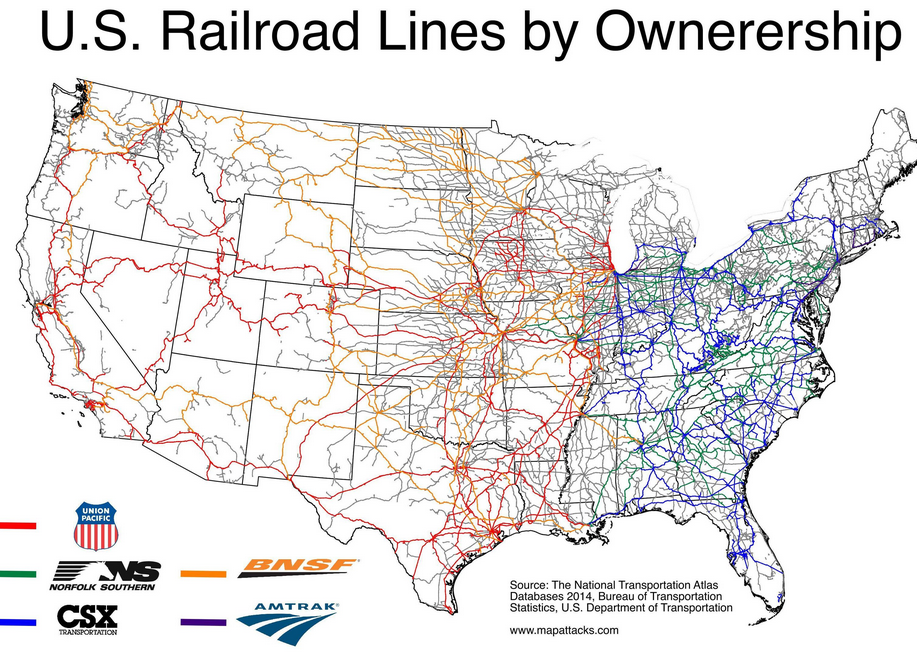
U.S. Railway lines with the different owners
Vaccine issues
Currently, though the issue has been the Vaccine and the pricing of the same. A good article to get a summation of the issues outlined has been shared on Economist. Another article that goes to the heart of the issue is at scroll. To buttress the argument, the SII chairman had shared this few weeks back
Adar Poonawala talking to Vishnu Som on Left, right center, 7th April 2021.
Prices of AstraZeneca among various states and countries.Internet Freedom and Aarogya Setu App.
Internet Freedom had shared the chilling effects of the Aarogya Setu App. This had also been shared by FSCI in the past, and recently had their handle being banned on Twitter. This was also apparent in a legal bail order which the high court judge gave. While I won t go into the merits and demerits of the bail order, it is astounding for the judge to say that the accused, even though he would be on bail install an app. so he can be surveilled. And this is a high court judge, such a sad state of affairs. We seem to be putting up new lows every day when it comes to judicial jurisprudence. One interesting aspect of the whole case was shared by Aishwarya Iyer. She shared a story that she and her team worked on quint which raises questions on the quality of the work done by Delhi Police. This is of course, up to Delhi Police to ascertain the truth of the matter because unless and until they are able to tie in the PMO s office in for a leak or POTUS s office it hardly seems possible. For e.g. the dates when two heads of state can meet each other would be decided by the secretaries of the two. Once the date is known, it would be shared with the press while at the same time some sort of security apparatus would kick in place. It is incumbent, especially on the host to take as much care as he can of the guest. We all remember that World War 1 (the war to end all wars) started due to the murder of Archduke Ferdinand.
As nobody wants that, the best way is to make sure that a political murder doesn t happen on your watch. Now while I won t comment on what it would be, it would be safe to assume that it would be z+ security along with higher readiness. Especially if it as somebody as important as POTUS. Now, it would be quite a reach for Delhi Police to connect the two dates. They either will have to get creative with the dates or some other way. Otherwise, with practically no knowledge in the public domain, they can t work in limbo. In either case, I do hope the case comes up for hearing soon and we see what the Delhi Police says and contends in the High Court about the same. At the very least, it would be irritating for them to talk of the dates unless they can contend some mass conspiracy which involves the PMO (and would bring into question the constant vetting done by the Intelligence dept. of all those who work in PMO). And this whole case is to kind of shelter to the Delhi riots which happened in which majorly the Muslims died but their deaths lay unaccounted till date 
Conclusion In Conclusion, I would like to share a bit of humor because right now the atmosphere is humorless, both with authoritarian tendencies of the Central Govt. and the mass mismanagement of public health which they now have left to the state to do as they fit. The peice I am sharing is from arre, one of my goto sites whenever I feel low.
#!/usr/bin/python3 import sys import time def display(line: str): cur = '0' * len(line) while True: print(cur, end="\r") if cur == line: break time.sleep(0.09) cur = "".join(chr(min(ord(c) + 1, ord(oc))) for c, oc in zip(cur, line)) print() message = " ".join(sys.argv[1:]) display(message.upper())
cat, and you get a long wait, and then the final string, without the
animation.
What is happening is that since the output is not going to a terminal,
optimizations kick in that buffer the output and send it in bigger chunks, to
make processing bulk I/O more efficient.
I haven't found a good introductory explanation of buffering in Python's
documentation. The details seem to be scattered in the io module
documentation and they mostly
assume that one is already familiar with concepts like unbuffered,
line-buffered or block-buffered. The libc documentation has a good quick
introduction
that one can read to get up to speed.
Controlling buffering in Python
In Python, one can force a buffer flush with the flush() method of the output
file descriptor, like sys.stdout.flush(), to make sure pending buffered
output gets sent.
Python's print() function also supports flush=True as an optional argument:
print(cur, end="\r", flush=True)
reconfigure()
method, which can reconfigure line buffering only:
sys.stdout.reconfigure(line_buffering=True)
sys.stdout to something that has the
behaviour one wants (code from this StackOverflow
thread):
import io # Python 3, open as binary, then wrap in a TextIOWrapper with write-through. sys.stdout = io.TextIOWrapper(open(sys.stdout.fileno(), 'wb', 0), write_through=True)
I ve mostly had the preference of controlling my data rather than depend on someone else. That s one reason why I still believe email to be my most reliable medium for data storage, one that is not plagued/locked by a single entity. If I had the resources, I d prefer all digital data to be broken down to its simplest form for storage, like email format, and empower the user with it i.e. their data.
Yes, there are free services that are indirectly forced upon common users, and many of us get attracted to it. Many of us do not think that the information, which is shared for the free service in return, is of much importance. Which may be fair, depending on the individual, given that they get certain services without paying any direct dime.
#!/bin/bash mkdir -p $ DESTDIR /etc/keys cp /etc/keys/* $ DESTDIR /etc/keysMaking the Keys
#!/bin/sh
GENKEY=ima.genkey
cat << __EOF__ >$GENKEY
[ req ]
default_bits = 1024
distinguished_name = req_distinguished_name
prompt = no
string_mask = utf8only
x509_extensions = v3_usr
[ req_distinguished_name ]
O = hostname
CN = whoami signing key
emailAddress = whoami @ hostname
[ v3_usr ]
basicConstraints=critical,CA:FALSE
#basicConstraints=CA:FALSE
keyUsage=digitalSignature
#keyUsage = nonRepudiation, digitalSignature, keyEncipherment
subjectKeyIdentifier=hash
authorityKeyIdentifier=keyid
#authorityKeyIdentifier=keyid,issuer
__EOF__
openssl req -new -nodes -utf8 -sha1 -days 365 -batch -config $GENKEY \
-out csr_ima.pem -keyout privkey_ima.pem
openssl x509 -req -in csr_ima.pem -days 365 -extfile $GENKEY -extensions v3_usr \
-CA ~/kern/linux-5.11.14/certs/signing_key.pem -CAkey ~/kern/linux-5.11.14/certs/signing_key.pem -CAcreateserial \
-outform DER -out x509_evm.der
To get the below result I used the above script to generate a key, it is the /usr/share/doc/ima-evm-utils/examples/ima-genkey.sh script from the ima-evm-utils package but changed to use the key generated from kernel compilation to sign it. You can copy the files in the certs directory from one kernel build tree to another to have the same certificate and use the same initrd configuration. After generating the key I copied x509_evm.der to /etc/keys on the target host and built the initrd before rebooting.
[ 1.050321] integrity: Loading X.509 certificate: /etc/keys/x509_evm.der [ 1.092560] integrity: Loaded X.509 cert 'xev: etbe signing key: 99d4fa9051e2c178017180df5fcc6e5dbd8bb606'Errors Here are some of the kernel error messages I received along with my best interpretation of what they mean. [ 1.062031] integrity: Loading X.509 certificate: /etc/keys/x509_ima.der
[ 1.049170] integrity: Loading X.509 certificate: /etc/keys/x509_ima.der [ 1.093092] integrity: Problem loading X.509 certificate -126Error -126 means -ENOKEY, so the key wasn t in the file or the key wasn t signed by the kernel signing key.
[ 1.074759] integrity: Unable to open file: /etc/keys/x509_evm.der (-2)Error -2 means -ENOENT, so the file wasn t found on the initrd. Note that it does NOT look at the root filesystem. References
A new version of the RcppAPT package interfacing from R to the C++ library behind the awesome apt, apt-get, apt-cache, commands and their cache powering Debian, Ubuntu and the like arrived on CRAN yesterday. This comes a good year after the previous maintenance update for release 0.0.6.
RcppAPT allows you to query the (Debian or Ubuntu) package dependency graph at will, with build-dependencies (if you have deb-src entries), reverse dependencies, and all other goodies. See the vignette and examples for illustrations.
The maintenance release responds to call for updates from CRAN desiring that make all implicit dependencies on packages markdown and rmarkdown explicit via a Suggests: entry. Two of the many packages I maintain were part of the (large !!) list in the CRAN email, and this is one of them. While making the update, we refreshed two other packaging details.
Courtesy of my CRANberries, there is also a diffstat report for this release. A bit more information about the package is available here as well as as the GitHub repo. If you like this or other open-source work I do, you can now sponsor me at GitHub.Changes in version 0.0.7 (2021-04-16)
- Add rmarkdown to Suggests: as an implicit conditional dependency
- Switch vignette to minidown and its water framework, add minidown to Suggests as well
- Update two URLs in the README.md file
This post by Dirk Eddelbuettel originated on his Thinking inside the box blog. Please report excessive re-aggregation in third-party for-profit settings.
In the past, I've talked about building a Z80-based computer. I made some progress towards that goal, in the sense that I took the initial (trivial steps) towards making something:
0x00 which is the Z80 NOP instruction.cls to clear the screen), as well as got the hang of using the wordstar keyboard shortcuts as used within the turbo pascal environment.
I have some plans for development:
TYPE, and allow terminating with Q. B>LOCATE H*.COM
P:HELLO COM
P:HELLO2 COM
G:HITCH COM
E:HYPHEN COM
I've also written some other trivial assembly language tools, which was surprisingly relaxing. Especially once I got back into the zen mode of optimizing for size.
I forked the upstream repository, mostly to tidy up the contents, rather than because I want to go into my own direction. I'll keep the contents in sync, because there's no point splitting a community even further - I guess there are fewer than 100 of these boards in the wild, probably far far fewer!
A new website containing introductory videos and slide decks is now available for your perusal at ess-intro.github.io. It provides a series of introductions to the excellent Emacs Speaks Statistics (ESS) mode for the Emacs editor.
This effort started following my little tips, tricks, tools and toys series of short videos and slide decks for the command-line and R, broadly-speaking . Which I had mentioned to friends curious about Emacs, and on the ess-help mailing list. And lo and behold, over the fall and winter sixteen of us came together in one GitHub org and are now proud to present the initial batch of videos about first steps, installing, using with spaceemacs, customizing, and org-mode with ESS. More may hopefully fellow, the group is open and you too can join: see the main repo and its wiki.
This is in fact the initial announcement post, so it is flattering that we have already received over 350 views, four comments and twenty-one likes.
We hope it proves to be a useful starting point for some of you. The Emacs editor is quite uniquely powerful, and coupled with ESS makes for a rather nice environment for programming with data, or analysing, visualising, exploring, data. But we are not zealots: there are many editors and environments under the sun, and most people are perfectly happy with their choice, which is wonderful. We also like ours, and sometimes someone asks tell me more or how do I start . We hope this series satisifies this initial curiousity and takes it from here.
With that, my thanks to Fr d ric, Alex, Tyler and Greg for the initial batch, and for everybody else in the org who chipped in with comments and suggestion. We hope it grows from here, so happy Emacsing with R from us!
qemu-system-x86_64 -kernel arch/x86/boot/bzImage -initrd ../initrd-$KERN_VER -curses -m 2000 -append "root=/dev/vda ro nokaslr" -gdb tcp::1200The command to run GDB is gdb vmlinux , when at the GDB prompt you can run the command target remote localhost:1200 to connect to the GDB server port 1200. Note that there is nothing special about port 1200, it was given in an example I saw and is as good as any other port. It is important that you run GDB against the vmlinux file in the main directory not any of the several stripped and packaged files, GDB can t handle a bzImage file but that s OK, it ends up much the same in RAM. When the target remote command is processed the kernel will be suspended by the debugger, if you are looking for a bug early in the boot you may need to be quick about this. Using qemu-system-x86_64 instead of kvm slows things down and can help in that regard. The bug I was hunting happened 1.6 seconds after kernel load with KVM and 7.8 seconds after kernel load with qemu. I am not aware of all the implications of the kvm vs qemu decision on debugging. If your bug is a race condition then trying both would be a good strategy. After the target remote command you can debug the kernel just like any other program. If you put a breakpoint on print_modules() that will catch the operation of printing an Oops which can be handy.
$ restic check
using temporary cache in /var/tmp/restic-tmp/restic-check-cache-854484247
repository b0b0516c opened successfully, password is correct
created new cache in /var/tmp/restic-tmp/restic-check-cache-854484247
create exclusive lock for repository
load indexes
check all packs
check snapshots, trees and blobs
error for tree 4645312b:
decrypting blob 4645312b443338d57295550f2f4c135c34bda7b17865c4153c9b99d634ae641c failed: ciphertext verification failed
error for tree 2c3248ce:
decrypting blob 2c3248ce5dc7a4bc77f03f7475936041b6b03e0202439154a249cd28ef4018b6 failed: ciphertext verification failed
Fatal: repository contains errors
I started by locating the snapshots which make use of these corrupt trees:
$ restic find --tree 4645312b
repository b0b0516c opened successfully, password is correct
Found tree 4645312b443338d57295550f2f4c135c34bda7b17865c4153c9b99d634ae641c
... path /usr/include/boost/spirit/home/support/auxiliary
... in snapshot 41e138c8 (2021-01-31 08:35:16)
Found tree 4645312b443338d57295550f2f4c135c34bda7b17865c4153c9b99d634ae641c
... path /usr/include/boost/spirit/home/support/auxiliary
... in snapshot e75876ed (2021-02-28 08:35:29)
$ restic find --tree 2c3248ce
repository b0b0516c opened successfully, password is correct
Found tree 2c3248ce5dc7a4bc77f03f7475936041b6b03e0202439154a249cd28ef4018b6
... path /usr/include/boost/spirit/home/support/char_encoding
... in snapshot 41e138c8 (2021-01-31 08:35:16)
Found tree 2c3248ce5dc7a4bc77f03f7475936041b6b03e0202439154a249cd28ef4018b6
... path /usr/include/boost/spirit/home/support/char_encoding
... in snapshot e75876ed (2021-02-28 08:35:29)
and then deleted them:
$ restic forget 41e138c8 e75876ed
repository b0b0516c opened successfully, password is correct
[0:00] 100.00% 2 / 2 files deleted
$ restic prune
repository b0b0516c opened successfully, password is correct
counting files in repo
building new index for repo
[13:23] 100.00% 58964 / 58964 packs
repository contains 58964 packs (1417910 blobs) with 278.913 GiB
processed 1417910 blobs: 0 duplicate blobs, 0 B duplicate
load all snapshots
find data that is still in use for 20 snapshots
[1:15] 100.00% 20 / 20 snapshots
found 1364852 of 1417910 data blobs still in use, removing 53058 blobs
will remove 0 invalid files
will delete 942 packs and rewrite 1358 packs, this frees 6.741 GiB
[10:50] 31.96% 434 / 1358 packs rewritten
hash does not match id: want 9ec955794534be06356655cfee6abe73cb181f88bb86b0cd769cf8699f9f9e57, got 95d90aa48ffb18e6d149731a8542acd6eb0e4c26449a4d4c8266009697fd1904
github.com/restic/restic/internal/repository.Repack
github.com/restic/restic/internal/repository/repack.go:37
main.pruneRepository
github.com/restic/restic/cmd/restic/cmd_prune.go:242
main.runPrune
github.com/restic/restic/cmd/restic/cmd_prune.go:62
main.glob..func19
github.com/restic/restic/cmd/restic/cmd_prune.go:27
github.com/spf13/cobra.(*Command).execute
github.com/spf13/cobra/command.go:852
github.com/spf13/cobra.(*Command).ExecuteC
github.com/spf13/cobra/command.go:960
github.com/spf13/cobra.(*Command).Execute
github.com/spf13/cobra/command.go:897
main.main
github.com/restic/restic/cmd/restic/main.go:98
runtime.main
runtime/proc.go:204
runtime.goexit
runtime/asm_amd64.s:1374
As you can see above, the prune command failed due to a corrupt pack and
so I followed the process I previously wrote
about
and identified the affected snapshots using:
$ restic find --pack 9ec955794534be06356655cfee6abe73cb181f88bb86b0cd769cf8699f9f9e57
before deleting them with:
$ restic forget 031ab8f1 1672a9e1 1f23fb5b 2c58ea3a 331c7231 5e0e1936 735c6744 94f74bdb b11df023 dfa17ba8 e3f78133 eefbd0b0 fe88aeb5
repository b0b0516c opened successfully, password is correct
[0:00] 100.00% 13 / 13 files deleted
$ restic prune
repository b0b0516c opened successfully, password is correct
counting files in repo
building new index for repo
[13:37] 100.00% 60020 / 60020 packs
repository contains 60020 packs (1548315 blobs) with 283.466 GiB
processed 1548315 blobs: 129812 duplicate blobs, 4.331 GiB duplicate
load all snapshots
find data that is still in use for 8 snapshots
[0:53] 100.00% 8 / 8 snapshots
found 1219895 of 1548315 data blobs still in use, removing 328420 blobs
will remove 0 invalid files
will delete 6232 packs and rewrite 1275 packs, this frees 36.302 GiB
[23:37] 100.00% 1275 / 1275 packs rewritten
counting files in repo
[11:45] 100.00% 52822 / 52822 packs
finding old index files
saved new indexes as [a31b0fc3 9f5aa9b5 db19be6f 4fd9f1d8 941e710b 528489d9 fb46b04a 6662cd78 4b3f5aad 0f6f3e07 26ae96b2 2de7b89f 78222bea 47e1a063 5abf5c2d d4b1d1c3 f8616415 3b0ebbaa]
remove 23 old index files
[0:00] 100.00% 23 / 23 files deleted
remove 7507 old packs
[0:08] 100.00% 7507 / 7507 files deleted
done
And with 13 of my 21 snapshots deleted, the checks now pass:
$ restic check
using temporary cache in /var/tmp/restic-tmp/restic-check-cache-407999210
repository b0b0516c opened successfully, password is correct
created new cache in /var/tmp/restic-tmp/restic-check-cache-407999210
create exclusive lock for repository
load indexes
check all packs
check snapshots, trees and blobs
no errors were found
This represents a significant amount of lost backup history, but at least
it's not all of it.
First up, I am alive and well. I have been receiving calls from friends for quite sometime but now that I have become deaf, it is a pain and the hearing aids aren t all that useful. But moreover, where we have been finding ourselves each and every day sinking lower and lower feels absurd as to what to write and not write about India. Thankfully, I ran across this piece which does tell in far more detail than I ever could. The only interesting and somewhat positive news I had is from south of India otherwise sad days, especially for the poor. The saddest story is that this time Covid has reached alarming proportions in India and surprise, surprise this time the villain for many is my state of Maharashtra even though it hasn t received its share of GST proceeds for last two years and this was Kerala s perspective, different state, different party, different political ideology altogether.
Kerala Finance Minister Thomas Issac views on GST, October 22, 2020 Indian Express.
Next.