Search Results: "eric"

8 July 2007

Jose Carlos Garcia Sogo: Tagging entries

I am using PyBlosxom as my blogging software. It is quite simple and thus I love it. I think it is a bit overkill to use MySQL for writing some few entries (as wordpress does). As it is simple, it uses file text entries, with a directory based hierachy, so your entries are only going to one of those categories you have defined. Of course this is little flexible; you cannot file a entry in two oro more different categories. This leads you to have quite generic categories, in which almost everything can fit. I have looking today for a tagging system for PyBlosxom and I have found a folksonomy tagging plugin which serves my needs fine. Welcome tagging world to my blog!

Daniel Stone: gtkdoc and separate builddir

Does anyone know how to make gtk-doc actually work with srcdir != builddir builds? The whole 'this is too complicated to work in those situations' premise is a sheer copout, and I'm sure this has annoyed someone else before me enough to come up with a fix. (No, it won't work in absolutely every single situation ever, but c'est la vie.)

At least it's not the worst thing I've encountered today:
typedef struct generic_list_rec

    void *next;

GenericListRec, *GenericListPtr, *glp;

Eric Warmenhoven: Wolf Camera sucks.

Lately I’ve been thinking that I’d like to buy a tripod, for a variety of reasons. I’ve been doing some research into them and decided that I’d really like to try a few out in the store before I consider buying one (especially since head and legs together will possibly cost $600). So today Lisa and I went out driving around to a bunch of different camera stores. Or at least, we tried to go to a bunch of different stores. Los Gatos Camera closed, and we weren’t able to find a couple other of the stores on my list. The Wolf Cameras that I’ve been to have had an extremely limited variety of tripods, and I wouldn’t consider buying any of the ones that they have. Are there any decent camera shops in the San Jose area?

6 July 2007

Biella Coleman: Blue Cross Blue Shield Internal Memos Leaked

Don’t you just love leaked corporate memos? I do. They are a window into that which we KNOW exists, yet we are not privvy to very often. Because corporations like to keep their dark, dirty secrets well hidden. Memos give us access to what I call in High Academic Jargonese “Corporate Psychological Interiority,” or to put in simpler language: memos allow us to see corporations crapping in their pants. Gross, but pleasant to see from time to time. I just got word of leaked memos from the Insurance Company I love to hate: Blue Cross Blue Shield. The four pages are chock full of interesting stuff, so take a read for yourself. Here, I will only highlight two things:
* Horizon BlueCross/BlueShield is picked out early in the film in a collage of stories citing bad
treatment of members.
And well, as most readers here know, I concur. Well at least
Blue Cross Blue Shield of New Jersey/Horizon can be proud for being one of the worst. In their concluding talking point sections, they say:
2) The Blues recognize the need for improvement of both the coverage and delivery of healthcare.
But the divisive tone set forth by Michael Moore and his movie “Sicko” is not helpful. Positive
change to our healthcare system can be best achieved through shared responsibility, not
recrimination. To ensure Americans have access to the best healthcare that is both timely,
efficient, and of high quality, requires the collective contribution of all stakeholders
consumers, providers, employers and the government.
Try NOT being angry at a 4,000 dollar bill or worse, an 80,000 dollar bill, or even worse a death. It is near to impossible to stop the rumblings of anger. We are human beings, after all. We are born with the capacity to think and feel, passionately and deeply. And some of the best change comes from the fire that is anger and I hope that enough Americans are finally feeling the fire.

5 July 2007

Michael Janssen: :

Yesterday was pretty much a long day of preparation and presenting. The day started with no internet, possibly for the entire island of Kos, I wasn't really every that clear on the whole of it. Apparently there are 2 underwater lines coming to Kos island and both had been severed or put out of service by someone. This was a bad thing, because I had intended to finish some final experiments and do some statistics on results, and Excel wasn't working. I suspect it is because I hadn't installed the updating tool of Office 2004 for Mac. Anyway I could do what I needed to do with R or Gnumeric, but they were both not installed yet. No internet = no new applications.

I finished the experiments and data gathering and the internet came back on just in time for me to download Gnumeric and get some of the stats working correctly. The final presentation didn't change that much, only changing on one slide and adding one small table, but the added result was significant enough to justify all of the work that it entailed. Indeed, it proved that the entire premise of the paper and simulation was valid. That made me feel all warm and fuzzy inside.

The talk was at 3:30, the first in a session which was mostly unrelated papers. I don't feel as bad because many of the other papers were kind of a hodge-podge as well, and we were probably all placed in the session because we didn't really fit anywhere else. I met a nice researcher who was chairing the session because the actual chair was presenting in another session (something we had worked out with software in the ICRA2006 schedule, but apparently wasn't taken into account here). The actual presentation went well, and Nikos lent me his laser pointer which added a little to the presentation I believe. Nikos said the talk was good, but I also got a comment that it was well-presented later in the day from a unrelated researcher. I was so-so about the presentation until I got the unsolicited comment.

After the talk I called up Diana on Skype and chatted for a while, but the network was too flaky at the conference, so she called my cell phone. Using Skype is one of the things that I have done more in this trip than I have done before ever. It is really a wonderful program and network for people who are far away from each other, and it actually has much more impact when you consider the costs of calling home with other methods. I estimate I saved about $200 in just three days of Skype calling instead of regular calling, even with calling to cell phones in the US every once in a while, and with Diana calling my Hellenic cell phone when my network was flaky as well. It is much more of a disruptive technology in the non-US world where every call isn't already paid for.

The banquet was next. Usually I don't like going to banquets, but this was set up different than the normal ones that accompany these conferences. Instead of a large service crew bringing out fancy food to a large set of tables, it was setup in a buffet with a large selection of Greek food so you could pick and choose your favorites and even go back for more food if you liked. I ended up trying a large variety of foods and discovering some new tastes that I hadn't had before. It was throughly enjoyable especially when listening to the others at my table of which three or four were Greek.

Then it was back to the hotel by bus, and an early bedtime in order to stock up on sleep for the long hours in the next day. Today I plan on just relaxing, sleeping a bit when I get tired, and maybe trying out some local snacks. I've already arranged for a Taxi. The last installment will be written from the Athens airport tomorrow.

Comments: (0) Trackbacks: (0)

Comments
  1. No comments
Trackbacks
  1. No Trackbacks

MJ Ray: New (or new style) memberships and blog groups

I was accepted as ODP Editor: slef for the Weston-super-Mare Business and Economy listings a while ago, but I forgot to mention it here until now. I've just done a bit of basic tidying there so far and I'm finding my feet. ODP seems rather more structured and process-y than WWWVL ever was. I'm not sure whether that's good or not. I've also gained a LinkedIn Profile: MJ Ray after an invitation (and real email) from Richard Smedley of M6-IT, if that interests anyone. LinkedIn seems to work even without Javascript (ignoring the odd layout bug), but it really seems to get much slower in the English afternoons - America waking up? I've done a bit of CSS-tidying on my main site, my debian site, and OtherWayUp - I'm also looking to launch new groups on OtherWayUp. If you have a blog from or about Somerset or Cooperatives that you'd like to appear there, please leave me a comment or email.

Erich Schubert: Back from Amsterdam Lindy Exchange

Last weekend, I was at the Amsterdam Lindy Exchange. Both my first trip to Amsterdam (A crazy place, I think you can get high just from walking the streets because of the smoke clouds coming out of the Coffee Shops... And I really wouldn't have thought the prostitutes are even in their windows on Sunday and Monday mornings ...) and my first Lindy Exchange [wikipedia].A lindy exchange is
a gathering of lindy hop dancers in one city for several days to experience the dance venues and styles of that local community, and to dance with visitors and locals alike
And it was fun. I didn't get a glimpse of 'typical' Amsterdam night life, because the evenings were already filled with dance events. We did a boat trip on sunday however, so I did do something typical for Amsterdam, too.Going to a different city to meet other dancers is a great thing to do. If you're a dancer, you should definitely do that. If you're not a dancer, you should become one. :-)My next lindy exchange will be in September: the Munich Lindy-Exchange, where I actually ended up in the organization crew. We're really trying hard to make that a great event. We'll be having some great parties. And we'll be going to Oktoberfest (aka "Munich beer festival") with you. And yes, we'll probably end up dancing there, too.

30 June 2007

Dirk Eddelbuettel: Improving simple charts

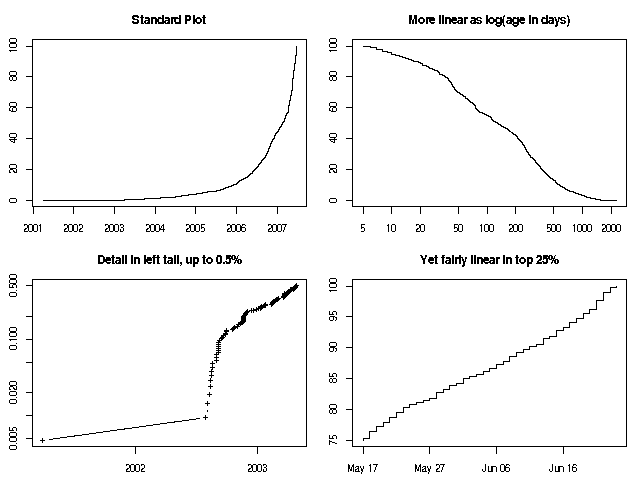
Earlier today and via Planet Debian, Lucas blogged about the 'age distribution' of Debian packages, defined as the time since the last (re-)compilation. He illustrated his findings with an, umm, rather ugly chart. Having climbed onto the soap box once before, I would like to point out how easy it can be to create simple, informative, and, at to least to me, prettier charts using R. Lucas included a URL to the data. The first nice thing to note that we can read the data directly from the URL -- no need to copy the file:
pkgAge <- read.table(file="http://people.debian.org/~lucas/arch-age/arch-age.log", col.names=c("pkg","yyyymmdd"))
read the data into a data.frame which we have given two column names.
pkgAge[,"date"] <- as.Date(as.character(pkgAge[,"yyyymmdd"]), "%Y%m%d")
pkgAge[,"age"] <- as.numeric(difftime(Sys.Date(), pkgAge[,"date"], units="day"))
pkgAge[,"prop"] <- (1:nrow(pkgAge)) / nrow(pkgAge) * 100
We then create three new columns. First is a date, by parsing the (integer) dates (after first casting them into characters) by supplying the format in standard C notation: "%Y%m%d" for year, date and month without any separators or formatters. Now, having the date as an actual date object inside a real data analysis language we can do things as e.g. computing date differences. The difftime function does just that, using the current date as other point. We ask for the return to be in days, and cast this down to a purely numeric vector (instead of datediff object). Lastly, we quickly compute the date proportion in percentages. We can then view the date. Before we plot,
png("packageAges.png", quality=100, width=640, height=480, pointsize=10)
oldpar <- par(mfrow=c(2,2), mar=c(2.5,2.5,3,1))
we direct the charts to a png file of given dimensions, and ask for all plots in one figure (using mfrow with two rows by two) with somewhat smaller figure margins using the mar argument to par. The first chart shows again proportion over date:
with(pkgAge, plot(date, prop, type='l', main="Standard Plot"))
(The with() function simply allows us to refer to the columns by their names without explicit subsetting. plot(pkgAge[,"date",], pkgAge[,"prop"]) is equivalent, but more cumbersome.) As it clear that the data has a fairly long tail in the older dates, we can also try to plot the plot over logarithmic time differences. This doesn't work for dates, but it works for our (positive-valued) age variable:
with(pkgAge, plot(age, prop, type='l', log="x", main="More linear as log(age in days)"))
The very far left tail below 0.5 percent is interesting as the one very old package is clearly an outlier within an outlier region. We use the subset function to take just one portion of the data, use logs, and explicit plotting symbols '+' in a points-and-lines plot:
with(subset(pkgAge, prop0.5), plot(date, prop, type='b', log="y", pch="+", main="Detail in left tail, up to 0.5%"))
Lastly, the upper quartile is fairly linear.
with(subset(pkgAge, prop>75), plot(date, prop, type='l', pch=".", main="Yet fairly linear in top 25%"))
At the end
oldpar <- par(mfrow=c(2,3))
dev.off()
we restore the graphics paramters and close the device (here the file). All this then yields the following chart: Debian Package Age-since-recompile Distributions Updated to correctly display the assignment operator <-
Eric Dorland: Random

One thing I'm really missing is Montr al in the summer time. Particularly the Fantasia Festival, where I would usually take in twenty-odd movies over a couple of weeks and I've been going for years. It was great. New York doesn't seem to have anything that compares, except maybe The New York Asian Film Festival. But that seems quite a bit smaller and more focused. I'll still check out it out though.

It's been nearly 7 months since I've moved here and time has really flown. Work has consumed most of my life and it's been amazing, but I'm starting to feel like it's lacking in certain areas. I've barely seen most of Manhattan and it's really not that big. I need to make sure I get the balance right.

DebConf 7 was fantastic, doubly so since I got to share it. My BoF was not that popular (which is what I expected) but people were interested and audience participation was high, so I was pleased. I sort of divided my time between the conference and being a tourist, so I hope no one felt like I was ignoring them. Edinburgh was an amazing city, really very beautiful. It felt good to be connected with this place (my mother was born in Perth, not too far away). Simon, Martin and Kai, you guys rock!

Speaking of DebConf, I should have cornered Keith for some troubleshooting. I bought a spiffy new desktop recently with a 965G chipset and plugged in an SDVO card and tried to get dual monitor set up going. After much Googling I found that Xrandr is apparently the new cool way to configure this, but information is pretty scarce. I can't seem to get them to both work at the same time. There could be problems because they have different resolutions (one is a 22" wide screen and one is a regular 19"). The lack of information about this is slightly frustrating and tells me either no one is trying this or no one else is having problems. Neither is good :)

28 June 2007

Biella Coleman: Minimizing Lingusitic Drift for the Sake of Political Clarity and Integrity

I am finally catching up with the remarkably thick goulash of email and blogs entries that comes from traveling for well over a month and today I read one in particular When is Open Source not Open Source? that captivated my interest for it compellingly addresses the dangers that follow from diluting, or one might say hijacking, the term open source. When people learn that I study “free software” one of the most common questions I get asked is: why did I chose free software over open source? The answer is quite simple: given that the bread and butter of my research covers ethics, freedom, and liberalism, free software is the obvious path to follow, yet I also feel like a lot of my work is still relevant to the open source camp because of the affinities between the two. I have long maintained that the ideological gulf between open source and free software is not so great nor impassable, but more modest. As most know, both share a certain strong commitment to access and in a strict technical sense they refer to the same set of licenses. Philosophically there is agreement that openness and, especially, non-discrimination are essential for the quality of software and often by close extension, the vibrancy of community responsible for the software. Of course, when pontificating the ramifications and implications of openness, they do part company and enter into different territories. Free software tends to flag rights and freedoms, while open source meanders into a discussion of markets, business, and competition and in this regard they do craft different visions of the social world and human behavior, etc. But the case that Karl Fogel writes about, where OSI is strongly opposing the use of the term open source for licenses that don’t adhere to the definition demonstrates where the two positions join. As Michael Tiemann from the OSI succinctly put it:
The FSF may have got the orthodoxy wrong, and the OSI may have got the interpretation wrong, but we both agree that prohibition of commercial use without special permission is antithetical to both positions.
There is a unmistakable kernel of agreement and it is great to see the OSI taking such a strong stance in this regard. Now, David Richard’s response, who seeks, I think, to essentially dilute the term open source, is as (or perhaps even more) fascinating for in a nut shell, and using a lot of florid religious imagery, it accuses the OSI of being too rigid! In his own words:
I believe the OSI has a wonderful opportunity to continue being relevant and helping to lead the movement forward. If, however, y’all choose to define your denomination of this religion in a way that we don’t fit in, that’s fine. No hard feelings. It’s your choice. You’ll ultimately be excluding a large congregation and we for one will continue trying to build a church made up of others like ourselves.
In response, I would say that the goal of F/OSS is not to be inclusive of anyone who wants to release bits of source code, but to create the conditions under which software, as it has been defined by the community, can be created. Join the church if you would like to make free/open source software as defined and you can go elsewhere (i.e., create a different term) if you are creating something different, even if it is only slightly different. Integrity matters. And again inclusiveness, if it comes at the expense of the main goal, is not a boon but a danger to F/OSS. The OSI will remain relevant by halting the dilution of the term OSI, not by expanding the definition so that it is left with no substance. And in contradistinction to what David Richard maintains, however, there is a great degree of flexibility within this domain but it does not lie in the strict definition of F/OSS but in the realm of interpretation. You are also free, as Mako and I have argued elsewhere to interpret the significance of F/OSS in multiple ways. And I think this is where the political strength of free software lies. There is interplay between a well-defined goal (in this case for creating free software) and a more flexible realm of interpreting the significance of these technical practice. And we wold lose and I might add, a lot if we became flexible about the strict definition of F/OSS and inflexible about its political significance. I get irked with folks like David Richards who would like to bend open source rules to meet their (often commercial) interests and I find it pretty na ve when folks say the political significance of F/OSS is just x (or worse should be x) for in reality its political significance lies in the fact that it has spawned multiple types of political and economic projects. And there is something almost playfully ironic, (or at least it makes me smile) in this fact. Though there is strict definition contained withing F/OSS, this strictness has, at least to some extent, encouraged by an extreme and very healthy form of political proliferation and promiscuity. More than anyone else I know, Mako has most passionately and thoughtfully argued for the importance of what I would call political clarity and integrity. That is, the importance of having a well articulated definition for social movements, for they act, as he says a rallying point to realize a social movement. Urging the Creative Commons to learn from F/OSS and dare to simultaneously narrow and more clearly define their goals, he states it quite nicely in the following terms:
Free software advocates have been able to use the free software definition as the rallying point for a powerful social movement. Free software, like the concept of freedom in any freedom movement, is something that one can demand, something that one can protest for, and something that one can work toward. Working toward these goals, free and open source software movements have created the GNU/Linux operating system and billions of lines of freely available computer code.
In essence, a definition that people can abide by, respect, and perhaps eventually cherish is the condition of possibility to make working political code. And given how hard it is to make social change happen (at least in comparison to build computer code), we should learn from what F/OSS has to offer. And at the same time there is another lesson embedded in F/OSS. The Free Software Definition is well defined; but it must be emphasized, narrowly so. It does not try to do everything and have everyone pledge allegiance to an inordinately complex set of commitments. Clarity, narrowness, and well-defined goals –> these three attributes have powered it far and wide and I hope it remains so. Now, since the term open source is not trademarked, we are left with the problem of how to challenge the current hijacking of the term. For the solution, I will leave you with Karl Fogel, who I think proposes a good solution:
Note that the OSI s objection is not to the Zimbra license per se. The objection is just to Zimbra s calling that license open source . They can use any license they want, but they shouldn t call it open source unless it actually is. Freedom is freedom, and no amount of spin will change that. So what should we do about this? The term open source isn t trademarked. Years ago, the OSI tried to register it, but it was apparently too generic. …But there is public opinion. What Danese and Michael are proposing doing is organizing a lot of open source developers (and I mean open source according to the traditional definition, the one the OSI and I and most other open source developers I know adhere to) to stand up and, basically, say All of us agree on what the definition of open source is, and we reject as non-open source any license that does not comply with the letter and spirit of the Open Source Definition.

Fabio M. Di Nitto: Linux running on SUN's LDOM!

Guys.. meet Super Davem We did it again. After another *really* long session of super-tag-team play with Davem coding as hell and me testing like crazy we finally managed to do a full install of Linux (based on Debian/Ubuntu installer) on SUN's LDOM as guest host (similar to domU concept of Xen). There is still a lot of work to do and major problems to solve before we will able to call this "stable" for the generic user. David's blog has detailed instructions on how to install and a complete list of the issues. If you plan to try it, make sure to read David's blog! A net-boot gutsy installer image is available here and net-boot kernel here. The code published by David will hit the gutsy kernel as soon as we are satisfied with the overall situation. Most of the userland bits required to install are already in the archive and others will land soon after Tribe-2 release. STAY TUNED!

27 June 2007

Benjamin Mako Hill: Significant Digits

According to the advertisements (and Wikipedia), the film Live Free or Die Hard is being marked as Die Hard 4.0 outside of North America. This is too many significant digits.

25 June 2007

MJ Ray: Stupidity: Reader Comment: Verified by VISA

Stephen Touset commented:
"The worst offender in my experience is the "Verified by VISA" program. They restrict you to a subset of characters (alphanumeric, if I recall correctly) and even restrict the maximum length! You know what the worst part of it is, though? If they were using a widely-published, widely-analyzed, and widely-reviewed secure hash standard like SHA-1, Whirlpool, or any number of alternatives, these restrictions wouldn't be in place. This tells me that they're likely not using a well-reviewed standard, and instead have probably come up with their own bastardized password "encryption"."
I'm a bit worried by this, but I'm moving my customers to Verfied by VISA and Mastercard 3DSecure because of the carrot-and-stick used by the payment gateways. Am I sleepwalking off the cliff here?

24 June 2007

Julien Valroff: Iceweasel is not Firefox!

capture-virginmega-iceweasel.pngVirginMega.fr is a one of the French music download service which offers MP3 files (without DRM). They previously prevented all the browsers except MS Internet Explorer on MS Windows platform from accessing their website. I (we) used to change the browser id thanks to the FF User Agent Switcher plugin.
It now seems they have changed their mind under the pressure of Linux users. However, it seems there is still a problem for me (us) to access their website as they do not use the engine (Gecko in our case), but the user agent name… No, Iceweasel is not Firefox! Nor is Galeon! But why blocking access to a website which works perfectly with these browsers which share the same engine?

22 June 2007

Eric Warmenhoven: To 3 or not to 3

Apparently there’s lots of interest in the TiVo-Comcast product that I took a picture of. Already that picture has nearly 350 views, and the blog entry got a couple questions about it. And it’s a crap photo of something that was seen at CES. The two questions that were asked were: When can I get it? I have no idea. All I know is that we got 1.0 done and Comcast currently has it. Most likely they’re going to be doing some testing of it privately, and then start market trials in select areas, but I don’t know when or where. (It’s also going to be available for Cox customers, but I have even less information about that.) Should I wait for it or get a Series 3? I can’t really answer that question. I have a Series 3 at home and it’s awesome. For me, if the choice were between this or a Series 3, I’d take the Series 3, despite the several hundred dollar price tag (especially since it’s currently available). Before I got the Series 3, I had the old Comcast DVR; and if I had to choose between that and the TiVo, I’d definitely choose the TiVo. (I’m biased, but I was a TiVo fan even before I got hired. That’s part of the reason I wanted to work here.) Disclaimer Please keep in mind that I’m not speaking on behalf of TiVo. I only work here.

20 June 2007

Eric Warmenhoven: TiVo!


TiVo!

Originally uploaded by warmenhoven

This is my desk. I’m planning on blogging about working at TiVo. I’m also testing phone-Flickr-blog.

19 June 2007

Gunnar Wolf: Fun at Debconf - And redefining targets

For some days at Debconf, I've been somewhat stressed and frustrated. You see, the first DebCamp/DebConf I took part in (Oslo), I was really productive - Besides meeting lots and lots of people and having a great time, during DebConf3 I learnt a scary lot about the project in many aspects and, although I was already a DD, it really decided me to get more involved.
When we were at Brazil, I had a great time as well, but (code-wise, bugs-wise and so on) I was much less productive - I started peeking at the processes that involve running such a strange and intensive conference, I was more active talking with other Latin Americans, and so on.
So, for DebConf5, I was a full orga team member - Man, did that make me feel powerful! Of course, as there was so much orga work to be done, I basically didn't hack into anything. During the day it was organizational work, and during the night time-after-22:00 (how do you people live without a night!?) it was sauna. What a great invention of the Finns! After getting relaxed by sauna, nights were socially intensive
About DebConf 6... Well, it was hectic and chaotic. It is probably the most stressful two-week period (two week? Two months at least! Well, anyway) period of my life. It is the only Debconf so far I don't even remember having had much social interaction. But still, for reasons I fail to understand, I am really happy we held DebConf in Mexico. It is one of the best, most exciting and (hopefully!) unrepeatable experiences in life.
What about this year? Well, I took a couple of steps back, and while I'm formally still part of the always-great orga team, there are way too many things I don't know or can answer. Partially, I blame that impossible dialect of English they speak in the UK - Please, next time you feel a bit tired, lock yourself in a room with six hurried English and Scottish people, add a couple of Germans to the mix (no, I don't have problem with the other accents spoken in there), and try to get the general lines discussed. Impossible.
As I took a couple of steps back, I thought I would be able to hack a bit. There were some great ideas of things to work on - But so far, I've practically not started with any! I wanted to do some QA rounds in the pkg-perl repository, kill a couple of long-standing bugs, and then there is thismetainit idea we have been discussing... So we held the MetaInit BoF, and Nomeata has been actively hacking it - But I must recognize I have done little besides documenting and cleaning a bit a minor module of it. The second day I was here, I started working on something that was completely outside of my plan (hacking up a subsystem for Pentabarf to help the video team, as I previously complained). Just after we finished with it, DebConf properly started - So I've been basically taping the talks, reviewing the files, in the orga and video meetings... Until yesterday, I was quite frustrated not to have been able to work a bit on the couple of things I wanted to do. I have not yet been able even to work on three things I need for my Real Life, which still counts, even at DebConf.
But then, yesterday I read a post by Wouter - Man, you are completely right, and I must keep this in mind at all times: DebCamp to me isn't about being productive, so much as it is about meeting people and getting to know the environment. Well, I've terribly even failed to get to know the environment (I'll reserve some time on Thursday or Friday, I hope), but so far this has been quite fun, and completely out of what I usually do. And, even without me considering this, DebConf has been quite productive for me in ways I didn't expect - I've met and had a couple of beers with the pkg-perl group (and today I'll meet with the pkg-ruby-extras group), have plotted several things with the Spanish-Speaking group (which, by the way, has tremendously grown since we were at Oslo), I even started hacking a bit my way into Pentabarf, which will be very useful once I get back to work!
Anyway, in short: Wouter, you made me reconsider, you made my day - Thanks! And now, I'm a happy man again :)

Scott James Remnant: Slippery Slopes

One of the most interesting thing about slippery slopes is how you never seem to be standing at the top of them, looking down. The slope seems fine at the top, and it’s only once you start down it that you realise this could end up with some broken limbs. When Ubuntu was formed, Debian were having a debate about how to treat GFDL documentation. It was their opinion that the GFDL was inherently non-free, and they’ve since taken steps to remove all such licensed documentation from their main distribution. We took a more pragmatic approach, and decided that it maintained the spirit of freedom, and thus we continue to this day to ship that documentation in our main distribution. A similar discussion resulted in the handling of data files such as graphics, icons, fonts, etc. We decided that such things didn’t necessarily need to ship with corresponding source code, as frequently they don’t have any such thing or when they do, it’s just as easy to modify the data file directly. The slope didn’t seem at all slippery back then. Then came the issue of firmware, binary blobs in the kernel which are uploaded into a flash (or similar) chip in the hardware. Could we distribute these? On one hand, these blobs have always existed, they just used to be in ROM in the hardware; the move to firmware doesn’t change that. On the other hand, they’re machine code and if we had the source, we could improve the hardware as well. And what if we didn’t distribute them? Our users would be stuck without being able to use some fairly (to them) critical parts of their computer. In the end, the argument that firmware isn’t inherently any less free on the disk than in the ROM won, so we opted to continue to ship it. Perhaps that slope is a bit slippery, but we’ve got a good foothold. Of course, at that point somebody notices the binary “Hardware Access Layer” in the Atheros WiFi card driver. It’s not firmware, it’s run on the host processor, and is separate to “comply with FCC law”. (The ipw3495 driver has a binary daemon that allegedly performs the same legal function). Again, if we don’t distribute that, a large section of laptop users will not be able to use their WiFi cards. A compromise was reached; because the driver is necessary we’d ship it, but in a special restricted component that makes it absolutely clear that it’s not completely free. Users could choose to remove that component and any packages from it, to keep their system untainted. Ok, foothold wasn’t as strong as we thought; tumbled a bit, but we’re definitely on solid ground now! That’s what we thought, anyway. Unfortunately it seems that there’s a point a little bit lower down the slope which has a fantastic vista. The views from there are just incredible, people are saying, much prettier than where we are now. The only trouble is that we’re not sure there’s a foothold down there, if we try for the better view, we could end up broken at the bottom. I’m talking, of course, about the NVIDIA binary X driver. (Some reports/blogs/etc. indicate we’re also considering the ATI fglrx driver, this isn’t true – that driver doesn’t support AIGLX, so it’s not being considered.) We’ve shipped this driver in our restricted section, but not enabled it by default. It’s been there for people who want it to switch on, if they know how, but the default driver has always been the free (albeit obfuscated) one in the Xorg distribution. The problem is that users do not need this driver, they can get decent enough 2D graphics support from the free(ish) driver. In the long term, they may even get decent 3D graphics support from the nouveau driver effort. What’s the problem then? Simple, other operating systems use the 3D GPU to make the desktop seriously beautiful. If Linux doesn’t catch up and do the same, then we’ll be considered obsolete again. And just to drive the point home, some of our Linux friends shipped similar support in their last releases. They don’t enable the NVIDIA binary driver, but this means that a large percentage of their user base can’t get the bling without manual hackery. We needed a way to catch up with both the commerical operating systems and other Linux distributions; we have a policy of not doing our own software development, but only packaging what others have developed, so the only way for us to get ahead was to package something that others wouldn’t. Which brings us back to the NVIDIA binary driver. If we install that by default, we’ll be bringing a 3D desktop to more people. And we’ll gain a step ahead of the other distributions. Will our users care? To be brutally honest, I think the answer is no! In fact, I suspect our users will largely love us for this decision. Most probably already install the NVIDIA driver anyway, because they think it’s better, or because (sadly, like me) they have a card combination not supported by the free one. Will this make any difference to the effort to get NVIDIA to free up the driver, or at least the specs? Sorry, but to be honest again, I don’t think it’ll make one little difference. Linux distributions have been refusing to install it for years, and yet NVIDIA haven’t budged in their position. Perhaps a new tactic is required. Maybe if we do install it, we’ll be more likely to be chosen by OEMs as we can actually support the hardware they install. Then later, we may be able to actually affect their decision as to what hardware they install, and maybe then NVIDIA will pay attention. Will this change the perception of Ubuntu in the Linux developer community? I’m not sure about this one, I think that those who already feel strongly about the distribution of binary drivers are probably already pretty grumpy at us distributing things like the Atheros and ipw3495 drivers. I suspect this will change the opinion of a lot of people who’ve been on the fence until now, probably equal in both directions. Will we be able to sleep at night? Despite all of the above, personally I still think that installing and using the nvidia driver by default, when the nv driver would do, is the wrong decision. If the nv driver doesn’t work, I’m willing to accept the nvidia driver being used; provided that there’s some message informing the user what’s happened, why it has happened, and which alternate graphics cards they can purchase if they aren’t willing to accept a non-free binary driver. If the nv driver is good enough for 2D, I would prefer that we instead disabled the 3D desktop effects for this group of users (by default). A similar message could explain why this is disabled, again which alternate graphics cards provide this by default, but also provide a button for the user to enable it if they wish. While we should make the correct moral decision for the defaults, we shouldn’t stand in the way of users who wish to make a different decision for themselves. Later as the nouveau driver becomes stable, we may be able to activate 3D support for nvidia users by default. I think that preserves our current foothold, we’d only activate it if there is no free alternative. Where there is, we’d be educating users about why they may wish to consider alternatives to NVIDIA in future, while at the same time not getting too much in their way if they want to see the better view down the slope. Unfortunately it’s not my decision, and I suspect that the lure of the bling will win out. With any luck, we’ll find a foothold there, and the fallout of doing so won’t be too bad. I’m just worried that once we compromise on this, we’ll start compromising on other things … would we replace Firefox with a non-free web browser that rendered web pages “better”? The slippery slope only gets steeper from here on …

MJ Ray: Blogging from debconf7: 3. A Short History of Time

The second day of debconf went a bit odd. It seemed like, apart from the first session, everything else I attended was at a different time to when it was advertised yesterday. Even my talk had moved and I didn't notice, so I turned up early and was thrown before I started. Maybe more on that later. (Summary: 2 dozen rattling around a large hall, no clock, and I really hate fixed microphones. It dragged.) Anyway, things which I didn't think would conflict suddenly did and things which I thought conflicted didn't any more - but I didn't notice the missing conflicts until too late. I bumped into Sam who seems to be tracking conference sessions on a pad of paper - I've no idea how he's managing that. The SPI half-human half-IRC board meeting was interesting to watch. I also discovered that my typing speed has dropped a little and that it's much harder to copy-type north americans than locals. I still don't know what tune was being whistled when the board stopped talking and started typing.

17 June 2007

Meike Reichle: What I learned during my thesis ...

Right, so as announced I finished my thesis this week. Its translated title is (if anyone want to know)

"Design and Implementation of a Model for the Retrieval of Free/Libre Open Source Software using a Case-Based Reasoning System".

Writing it certainly was an educational experience but I am still happy it's done now. Especially the last weeks where rather unfunny, more so since about ten days before my deadline we had a massive heat wave here in Lower Saxony. Now that it's done I am still waiting for enthusiam to kick in. So far weariness still prevails. Maybe also because finishing my thesis does not yet end my studies. We also have to do written and oral examinations which will take place in July and after. So at the moment I spend my days mostly sleeping and trying to muster up enough wanderlust for my trip to DebConf7. (At the moment the prospect of traveling long distance with trains and cheap flights and then be surrounded by a few hundred happy people is still rather daunting.) Anyway, in order to give an impression of my last weeks and months and to sum this all up, a list of random notes, taken during the last weeks, of what I learned while writing my thesis:

Next.

Previous.