Search Results: "dom"

3 October 2013

Joachim Breitner: Experimenting with the TI eZ430 Chronos

For a while I have been eyeing with the TI eZ430 Chronos watch, a slightly bulky sports watch that not only comes with a built-in thermometer, barometer and accelerometer, but also a freely programmable micro controller (from the TI MSP430 family hence the name). In addition it has a small radio chip included and can communicate wirelessly with the computer, or possibly other devices. All in all, a very geeky toy. A week ago I managed to buy one quite cheaply via eBay (30 including shipping). It took me a while to get an overview of the various resources about the device. Here is what I have learned. After I found that out, I tried to hack a bit on the various software. The first issue I had (and still have) is that I cannot use the buttons of the device while it is attached to the debug board. They do work if forget to take out the battery, but supposedly that is bad for the battery. So my compile-upload-test-cycle becomes a compile-upload-detach-insert-battery-test-remove-battery-attach-cycle. I could not find out how to emulate button presses using mspdebug. Any suggestions are welcome. The other problem was the new altimeter hardware: Neither OpenChronos nor openchronos-ng support that yet. I originally planned to port the driver from the official software to a random OpenChronos fork when I read that Richard Rondu did that to openchronos-ng yet. I found the code in a month-old merge-request. I tried it, it worked, and I started to clean up the code a bit and add a variometer mode to it, e.g. displaying the current rate of climb my ultimate goal is to use this as a surprisingly cheap variometer for paragliding. After a day of hacking and quickly lifting the watch from the room floor to the room ceiling and back I believe that it works okish, although quite a few parameter can benefit from more tweaking: sample rate (currently 20Hz), length of history (currently 2s) and the linear regression method (currently simply the difference between the average of the samples of the current second with the samples of the last second). As always, patches welcome, the code is in my fork on sf.net.
Next to do would be to enable some buzzing noise depending on the rate of change; during flight I don t want to decipher a low-contract LCD screen. But it is questionable whether the buzzer is loud enough we ll see. I was also happy to hear that there are other zE430-hackers in Karlsruhe, one of them for example tries to make the alarm clock sleep-cycle-aware.

Lior Kaplan: freedom 0

The license says you can use free and open source software for any reason, but the FBI wouldn t agree with your questions Silk Road operator identified by asking a PHP related question on stackoverflow. See The Bonehead Mistake That Brought Down an Online Drug-Dealing Empire on Slate.com
Filed under: Uncategorized

27 September 2013

Petter Reinholdtsen: Videos about the Freedombox project - for inspiration and learning

The Freedombox project have been going on for a while, and have presented the vision, ideas and solution several places. Here is a little collection of videos of talks and presentation of the project. A larger list is available from the Freedombox Wiki. On other news, I am happy to report that Freedombox based on Debian Jessie is coming along quite well, and soon both Owncloud and using Tor should be available for testers of the Freedombox solution. :) In a few weeks I hope everything needed to test it is included in Debian. The withsqlite package is already in Debian, and the plinth package is pending in NEW. The third and vital part of that puzzle is the metapackage/setup framework, which is still pending an upload. Join us on IRC (#freedombox on irc.debian.org) and the mailing list if you want to help make this vision come true.

26 September 2013

Steve Kemp: Random hacking for fun

Recently I've been playing gtetrinet, against the publicly accessible server at tetrinet.debian.net. If you're unfamiliar with the game it is a multi-player variant of Tetris. You clear many lines and your opponents suffer. Want to make them suffer some more? Use the special blocks you acquire. Special blocks? How about shuffling your opponents playing field? Adding new semi-formed rows? etc. All good stuff. There is support for up to six players. To fire a special block at the player in field 1 you press "1". To fire the special block to the player in field 6 press "6". But to fire a block at yourself, to clear your playing field ("nuke") or remove a single line ("clear") you have to know what player-number you are, which will change from day to day, as it is literally a marker for the order you joined the channel in. It seems obvious that there should be a special-case keybinding "fire to self", and indeed there was bug #291844 filed in 2005 saying as much. I've just submitted a functional patch to resolve this, and already my playing is getting better. Join me sometime.

23 September 2013

Russell Coker: Hive Bluetooth Stereo Speakers

picture of Hive bluetooth speakers I ve just been given a set of Hive Bluetooth speakers by MobileZap (see this link for all their Bluetooth speakers) [1]. The speakers charge by a micro-USB cable so I started charging them in my car immediately after collecting them. To connect them to a phone or other Bluetooth device you just press the Bluetooth button on top and get the phone to be visible and scanning for devices, they identify themselves as Hive , after that they just work. My first test of using them was playing Ingress and the quality of the sound was impressive, I had thought that the Ingress recommendation to use headphones was due to the risk of annoying other people or alerting other players, but the quality of the sound was impressive and the internal speakers of a phone can t do it justice. After getting home I did some tests listening to music. For watching music videos it didn t work so well as the sound was too far removed from the video, but the audio quality was very good. I listened to Vow by Garbage (a good benchmark for stereo sound) and even though the Hive speakers are only 16.5cm wide I could still notice the stereo effect when they were about 1.5m away from me. The audio quality didn t compare well with my Bose QC-15 headphones, but for affordable and portable speakers it was quite good and an obvious improvement over the speakers that are built in to any phone I ve used. According to the Bluetooth Wikipedia page the range of a class 2 device is 10m and the range of a class 3 device is 1m. When my Samsung Galaxy Note 2 is talking to it I get a reliable range of about 5 meters and a mostly working range of 6 or 7 meters (sound randomly drops out and gets choppy). It could be that other phones would support a longer range due to having a higher transmission power (either class 1 or being closer to the limits of class 2) and a more sensitive receiver. But it doesn t seem likely that a 5m range is going to be a problem. Volume and Quality The speakers are rated at 5 Watt, when running at maximum volume (both through the phone volume setting and the volume control on the speakers) the sound is reasonably distortion free, as good as can be expected from playing an MP3 that s not compressed with the highest quality. Sound Meter [2] reports the sound volume as almost 85dB on a Galaxy S3 and as almost 100dB on a Galaxy Note 2, that would be somewhere between the volume of a busy street or alarm clock and the volume of a subway train or blow dryer which seems like a reasonable description, I find it very unpleasant to be within a meter of the speakers at maximum volume. With the typical amount of background noise in my house I can play music on the Hive speakers at one end of my house and hear it clearly at the other end. These speakers are more than capable of supplying the music for any party I d want to host or attend. I m not really into wild parties, but I think that anyone who has a one room party would be more than satisfied with the Hive speakers. Obviously the sound quality of portable speakers in a box that s 16.5cm wide and 6cm high isn t going to equal that of a full size set of speakers, but I think that hardly anyone who attends a party would expect better sound quality than the Hive speakers can provide. The aim of such speakers is to be portable, not really expensive, and to provide good sound quality within those constraints. I think that they meet such aims well. Over the years there have been many occasions when I have used a Thinkpad to provide the music for a party and found it to be quite loud enough. My current Thinkpad is a T420 which can produce 75dB according to my Galaxy S3 or 85dB according to my Galaxy Note 2. So it seems that I only really need about 10dB less than the maximum volume of the Hive speakers. Appearance The designers obviously made an effort on the appearance of the device. They have gone with the Hive concept and used hexagons everywhere. It really looks nice. Unfortunately when I took the photo there was some dust on it which didn t look bad to the eye but caught the camera flash. But with a matte black device there s always the problem of light colored dust. Even with a bit of dust it still looks great as a set of speakers, the dust just detracts from the appearance in photos. Line In One of the features I looked for was an audio line input so I could connect it directly to a non-Bluetooth device. I m assuming that this feature works as it s something that s difficult to stuff up when designing such a product, but I haven t got around to testing it. Once I started using the device I just found that I didn t have a real need for that feature. One thing that it might be useful for is PC desktop speakers that are powered by a USB port on the monitor. Currently I have a bearable (but not great) set of speakers for each PC and I don t need to change anything. But having the option of another set of speakers is very handy in case I suddenly need to make hardware changes. Other People s Reviews When I review a product I generally try and get opinions from random other people if possible. My mother and my mother-in-law were both impressed by the Hive speakers and expressed interest in owning a set. My mother-in-law was particularly interested as she uses her phone to listen to radio stations from outside Australia (I m going to get her onto Aldi for cheap 3G data ASAP so she can listen to Internet radio when travelling). Generally the impression that other people have of this device seems to be very positive. It seems that Bluetooth speakers aren t just a Geek toy. Conclusion While I m very impressed by this product, at this stage I m not sure whether I would pay for this one or something cheaper if I was paying for it. MobileZap offers a range of other products that look appealing at lower price points. It really depends on how much I use it. I ve just got a Makerbot Replicator 3D printer working and I ve found the Hive speakers very useful for the purpose of drowning out it s noise. If I keep doing that sort of thing then I ll get enough use out of the speakers to justify the price.

22 September 2013

Matthew Garrett: Implementing UEFI Boot to Zork

One of the earlier examples of students using MIT computer resources to lay the groundwork for a later commercial endeavour, Zork was originally written in a LISP derivative called MDL. This was later tuned into the Zork Implementation Language, a domain specific language that was compiled to target the Z-machine rather than a specific piece of hardware. Combined with machine-specific Z-machine interpreters, this allowed rapid porting of games to a wide range of platforms - the only thing that needed to be rewritten was the interpreter, and that could be reused for any future games running on the same hardware. Infocom were eventually acquired and killed off, but fan interest in their games continued. New Z-machine interpreters were written in order to allow their games (including Zork) to be run on platforms that Infocom had never targetted. One of the best known is Frotz. This has the advantage of being (a) portable and (b) including a "dumb" UI that makes no assumptions about the availablity of any vaguely useful functionality. Like, say, a Curses library. So, Frotz seemed like the natural choice when this happened. But despite having a set of functionality that makes it look much more like an OS than a boot environment, UEFI doesn't actually expose a standard C library. The EFI Application Development Kit solves this particular design decision. Porting Frotz ended up involving far more fixing up of Frotz bugs that tripped up -Werror than anything else. One note, though - make sure you include DevShell in the list of required packages at build time, otherwise file i/o will mysteriously fail. The tying of file i/o to the shell protocol unfortunately means that Frotz can't be directly launched by the firmware. The Boot to Zork images therefore contain a UEFI shell in the standard boot location (\EFI\BOOT\BOOTX64.EFI) which is executed when the firmware attempts to boot the device. The shell then looks for a file called "startup.nsh" in the root directory of the boot device and executes it. Unfortunately this doesn't actually set the shell equivalent of the current device, and so just launching Frotz from startup.nsh fails when Frotz can't open the Zork data file. The solution for this is simple, if ugly - the script walks through the list of devices, looking for one that contains ZORK1.DAT in the root directory. It then changes to that device and launches Frotz. If Frotz exits, it then resets the system. This could be avoided by doing some more work and turning Frotz into a more UEFI-native application. Teaching Frotz to make native UEFI calls would avoid the requirement for the shell protocols, and the firmware provides a mechanism to obtain the path of the currently running executable which would avoid the need to explicitly locate the device. But I'm lazy and this was a "I'm spending the day on a plane" project initially inspired by a Sazerac-fuelled conversation during the UEFI plugfest, not a demonstration of UEFI best practices. UEFI Boot To Zork and the source code to the modified Frotz can be downloaded here.

comment count unavailable comments

Russ Allbery: Review: Throne of the Crescent Moon

Review: Throne of the Crescent Moon, by Saladin Ahmed
Series: Crescent Moon Kingdoms #1
Publisher: DAW
Copyright: January 2013
ISBN: 0-7564-0778-8
Format: Mass market
Pages: 367
Doctor Adoulla Makhslood is the last ghul hunter in Dhamsawaat. He's an old man, and tired, and increasingly uncertain whether he wants to continue putting his life in danger to fight one more fight. But there are no replacements; his young and idealistic dervish apprentice, despite obvious skill, is too inexperienced and uninterested in the knowledge and investigation that makes Adoulla so good at what he does. So, when a young boy shows up on his doorstep, a survivor of a vicious ghul attack, he goes hunting once again. And both finds something much darker and stronger than he expected and meets an unexpected ally: a shape-shifting girl who is herself a survivor of something far worse than ghuls. Throne of the Crescent Moon is a first-novel fantasy that has made quite a splash, including a Hugo nomination (although I thought a win was unlikely, and I was right). One of the more interesting comments I've read about it was the observation by Jo Walton that if it had come out in 1980, it would have been an amazing, unusually wonderful, non-normative book. That it isn't is evidence of the changes in fantasy since then. The field has grown. As you might guess from the publisher's insistence on comparing it with The Arabian Nights, and from the names mentioned above, this book is set in an unspecified Middle Eastern culture and draws heavily from its mythology. It does not contain any western characters; the entire story is native to its region. The same is true of the mythology, which gave it a refreshing originality for me. And while I'm not the best one to judge, the presentation of that setting seemed free of the tint of the exotic. People live here, there are factions and multiple cultures, and the supernatural is a backdrop to most of the city. This would be very unusual decades ago. It's a bit less unusual now, and the story itself is a familiar ensemble fantasy, if refreshingly free of extended map exploration journeys. Ahmed brings together five characters with very different backgrounds and throws their varying talents at a problem. A few of those elements are a bit too familiar: female sexuality as a threat to male power is a world-building element that I could do without, for example. I also found the villain completely inadequate in its unidimensional evil (reinforced with a few more torture scenes than I needed to read), and even the attempted complication felt too predictable to me. Except for one touch of perspective, I'd call Throne of the Crescent Moon a competent, enjoyable, but somewhat forgettable fantasy novel, albeit one that's refreshingly concerned with a city instead of countrysides and travel. That touch is in the age of several of the protagonists. We get sections following several of the main characters in tight third person, but Adoulla is the first protagonist and the focus of much of the book. And Adoulla is neither young nor inexperienced, and is not going through the typical fantasy bildungsroman. He's old, experienced, a bit set in his ways, cranky, cantankerous, and deeply in love with his city. In tone, this shifts the story towards Star Wars as seen through the eyes of Obi-Wan Kenobi instead of Luke Skywalker. And that change I really liked, and would be happy to see become more common in fantasy. There was a bit of a downside for me in three of the five main characters being older. At times, Throne of the Crescent Moon has an elegiac tone, a feeling of life, power, and time slipping away and cultures and ways of life being lost. That's not my favorite thematic element. I tend to find it more depressing than I really want in my reading. But, here, the mature perspective more than makes up for some occasional negativity. I particularly liked how the older characters treated the likely budding young romance, which would have been the center of many books in this genre, with bemused detachment and playful encouragement without giving it more significance than it deserves. There's another romance that ends up being more significant, and which needs the weight of time and well-lived lives to become so. I don't think this book deserves a Hugo, but it is an enjoyable fantasy with some interesting characters and a refreshing perspective and setting. The villain really isn't adequate to the story, there's a bit too much torture for my liking, and I could have done without a few of the tropes, but it's a solid entry in its genre and a pleasant few hours of reading. And despite being advertised as the first of a series, it comes to a satisfying conclusion. Rating: 7 out of 10

Paul Tagliamonte: Musings about Debian and Python

On a regular basis, I find myself the odd-man-out when it comes to talking about how to work with Python on Debian systems. I'm going to write this and post it so that I might be able to point people at my thoughts without having to write the same email in response to each thread that pops up. Turns out I don't fit in with the Debian hardliners (which is to say, the mindset that pip sucks and shouldn't exist), nor do I fit in with the Python hardliners (which is to say apt and dpkg are out of date, and neither have a place on a Development machine). I think our discourse on this topic has become petty and stupid in general. Let's all try to step back and drop a bit of the attitude. pip doesn't suck, and neither does apt. The truth is, both sides are wrong. As with any subject, the real answer here is much more nuanced than either side presents it. I'm going to try and present my opinion on this, in the way that both my Pythonista self and my Debianite self see the issue. Hopefully I can keep this short, to the point, and caked with logic. The case for dpkg (the Debianite in me) In defense of dpkg and apt, imagine having to install python-gnome2 on all your systems when you install. It'd be hell on earth. Imagine having a user try to do this. It's insane to assume that end-users will be using pip for this purpose. pip is fun and all, but it's also installing 100% untrusted code to your system (perhaps as root, if you're using pip with sudo for some reason), and hasn't been reviewed for software freeness, which is something Debian (and Debian users) take seriously. This isn't even to mention the hell that pip wreaks on dpkg controlled files / packages. Try to remember how much of your system running (yes, right now) is running because of Python or Python modules. Try to imagine how much of a pain in the ass it'd be if you couldn't boot into GNOME to use nm-applet to connect to wifi to pip install something. I'm sure even the most extreme pip'er understands the need for Operating System level package management. Debian also has a bigger problem scope - we're not maintaining a library in Debian for kicks, we're maintaining it so that end user applications may use the library. When we update something like Django, we have to make sure that we don't break anything using it (although, to be honest, the fact that we package webapps is an entire rant for later) before we get to update it to the newest release. Hell, with a few coffees, I could automate the process of releasing a .deb with a new upstream release, 100% unattended. I won't, however, since this is an insane idea. Let's go over a brief list of things I do before uploading a new package:
  1. Review the entire codebase for simple mistakes.
  2. Review the entire codebase for license issues.
  3. Review the entire codebase for files without source, and track down (and include source for) any sourceless files (such as pickle files, etc).
  4. Get to know the upstream, get to know open bugs, write something using the lib, in case I need to debug later.
  5. Install the package.
  6. Test the package.
  7. Work out any Debian package issues (this is easy).
Now, a brief list of things I do before I update a package:
  1. Review the changes between the last uploaded version (in diff format, if it's sane, otherwise get the VCS and review), ensure all the above are still OK.
  2. Review for Debian-local issues (such as how it will upgrade, using piuparts, and adequate, etc).
  3. Check to make sure it won't break any reverse dependencies.
  4. Review for bugfixes that I might need to bring back to the stable release.
  5. Figure out if I should (or even can) backport the package, if API is stable.
  6. Review for bugs (upstream or in Debian) that I need to mention in the debian/changelog.
Clearly, this isn't a quick-and-dirty task. It's not a matter of getting a package updated (technically), it's a much more detailed process than that. This is also why Debian is so highly regarded for its technical virtuosity, and why the ISS decided to deploy Debian in space, despite other commercial distros such as Red Hat, or Ubuntu, and community distros, such as Fedora or Arch. It's also not Debian's job to package the world in the archive. This is an insane task, and it's not Debian's place to do it. We introduce libraries as things need them, not because we wrote some new library that someone may find slightly useful at some point in the future. maybe. Upstream developers and language communities (not only Python here) tend to lose sight of why we're doing this in the first place, which is our users. This isn't some sort of technical pissing contest to see who can distribute the software in the best way. Debian-folk always keep end users as our highest priority. I quote the Debian Social Contract, when I say that Our priorities are our users and free software. No one's trying to get developers to use dpkg to create software. In fact, as you'll see below, I actively discourage using system modules for development. The case for pip (the Pythonista in me) In defense of pip, the idea that Debian will keep the latest versions of packages is insane. The idea that we can keep pace with upstream releases is nuts, and the idea that every upstream release on pypi is ready to ship is bananas. b-a-n-a-n-a-annas. As a developer, I don't want to support every release, and I surely don't want other people depending on some random snapshot. Often times, I'll put stuff up on pypi as a preview, or to release often, and solicit feedback without having to give out instructions on using a git checkout (it's also easier to have them try a version from pypi so I can cross-ref the git tag to reproduce issues when they file them) pypi is easy, ubiquitous and works regardless of the platform, which means less of my development time is spent packaging stuff up for platforms I don't really care about (Arch, Fedora, OSX, Windows), even though I value feedback from users on those systems. The effort it takes to release something is limited to python setup.py sdist upload, and it's in a place (and in a shape) that anyone can use it without having 10 sets of platform-local instructions. Even ignoring all the above, when I'm writing a new app or bit of code, I want to be sure I'm targeting the latest version of the code I depend on, so that future changes to API won't hit me as hard. By following along with my dependencies' development, I can be sure that my code breaks early, and breaks in development, not production. Upstreams also tend to not like bug reports against old branches, so ensuring I have the latest code from pypi means I can properly file bugs. Lastly, I prefer virtualenv based setups for development, since I'm usually working on many things at once. This often means version mismatches in libraries, which brings in API changes (another whole rant here as well). I don't want to keep installing and uninstalling packages to switch between the two projects, and using a chroot(8) means a lot of overhead and that it's disconnected from my development environment / filesystem, so I resort to virtualenv to isolate my Development environment. Final notes I don't want to keep arguing about this. Just accept that the world's a big place and that there exist use-cases that both apt and pip need to exist and work in the way they're working now. At the very least, try and understand there exist smart people on both sides, and no one is trying to screw anyone over or keep their own little private club to themselves. Hopefully, going forward, we can make sure that the integration between these two tools gets better, not worse. Help make this dream a reality. Contribute to a productive tone, not a destructive one. In short:

19 September 2013

Luca Falavigna: So long, and thanks for all the packages!

I ve been running several Deb-o-Matic instances on several servers since ages. This service, meant to provide a way to automate the build of Debian source packages, has been the starting point for a lot of Italian developers to start packaging, and eventually become Debian or Ubuntu developers. I can t exactly tell how many packages Deb-o-Matic servers have built so far, but it has been the primary build and test environment for at least three Debian Developers since four years. This service was hosted for free since the beginning, but the good things always come to an end. My provider decided they cannot keep our servers running (its core business is totally unrelated to hosting servers), and asked me to shut them down. I started with the two kfreebsd-* machines, and soon I will shut down i386 and amd64 as well. When all services will be down, I ll take care of removing the debian.net domains I created for them. Deb-o-Matic development won t stop, but developers who used Deb-o-Matic daily will have to find a different solution to build and test their packages.

18 September 2013

Craig Small: Goodbye mygbiz

Google seems to try to invent new and interesting ways for spammers to spam me (and many others). I ve still not worked out a good way to block fake googlegroups which follow this method:
  1. Make new fake gmail login
  2. Make new fake google group
  3. Add lots of people s email addresses to the group
  4. Send lots of junk to these people
  5. Repeat when it gets closed down
I m not sure why groups aren t opt-in. A rather simple and standard way to stop this exact problem. Anyhow, the next new spammer enablement that the nice folks at Google have come up with is the mygbiz.com domain. These are temporary email addresses you can use when setting up Google apps. The only thing I have ever seen from them is spam. So I thought I d try to report some to Google. After looping around several help screens that were, despite their name, very unhelpful, I ve come to the conclusion that Google isn t too serious about fixing this problem. If you have postfix, the solution is very simple:
  1. vi /etc/postfix/access_sender
  2. Add a line like mygbiz.com REJECT
  3. postmap /etc/postfix/access_sender
  4. postfix reload
I find the results to this method far superior to trying to get Google interested in being responsible for a domain they run. If you want to use google apps then spend the $50 and get a domain. Alternatively don t use something that spammers abuse. Does it work? You bet it does!
Sep 18 23:26:38 elmo postfix/smtpd[19013]: NOQUEUE: reject: RCPT from mail-ye0-f208.google.com[209.85.213.208]: 554 5.7.1 <grace@sheiladolan.mygbiz.com>: Sender address rejected: Do not send from mygbiz.com domains; from=<grace@sheiladolan.mygbiz.com> to=<ME@MYDOMAIN> proto=ESMTP helo=<mail-ye0-f208.google.com>

16 September 2013

Debian Med

DebConf 13 report (by Andreas Tille) General impression unofficial  Scenic Hacklab I'm beginning my DebConf report in an unofficial "Scenic Hacklab" right at the edge of the lake in Yverdon. This is the right place to memorise the last days. When I started from this place cycling to Le Camp 12 days ago I was full of great expectations and what should I say - the reality has even beaten these. Once it comes about comparing DebConfs even if it is an unfair comparison due all the differences my secret long term favourite was Helsinki very closely followed by Argentina and also very closely followed by all the other great DebConfs I joined (and I joined all in Europe). Would Le Camp be able to beat it? The short answer is: Yes, it is now my favourite DebConf while I think I do not suffer from the last-Debconf-was-the-best-DebConf-syndrome (and I realised there are others thinking the same). As you might probably know I'm a bit addicted to swimming. While Helsinki had admittedly the better conditions I was at least able to fix the distance issue using my bicycle. (Hey, those Le Camp photographers did a great job in hiding the fact that you can not actually touch the lake right from the meadow of Le Camp.) Being able to have my bicycle at DebConf scored some extra points. However, the really great view of the lake, the inspiring "Scenic Hacklab" which was my favourite place has bumped DebConf13 at first place in my personal ranking. So it comes quite natural to say: "Kudos to the great organisation team!" They did a Swiss-like precise work and perfectly succeeded in hiding any problems (I assume there were some as always) from the attendees so everything went smooth, nice and shiny for the attendees. The local team was even precise in setting up great weather conditions for DebConf. sunrise over  the lake While saying thanks to the local team I would like to also explicitly thank Luca Capello who has quite some share that this DebConf was possible at all (while I have to decrease my DebConf score one point because he was not really there - Luca to bad that you were not able to come full time!) Also thanks to Gunnar and Gannef who helped remotely (another score down because I were missing them this year as well). Even if it was my favourite DebConf I was not able to work down my todo list fully (which was not only uploading one package per day which I at least statistically fullfilled). But that's probably a general feature of todo lists anyway. One item was definitely done: Doing my daily swimming BoF. I actually was able to do the other parts of the triathlon which was skipped by Christian and have done in summary about 150km cycling with 3500m elevation and estimated 7-8km swimming (0m elevation ;-)). Considering the great view at sunrise over the lake I was not hating my "Senile bed escape" disease too much (I was every day waking up at sunset) - it was simply a great experience. I will never forget seeing water drips glimmering like gold inside the morning sun while seeing the Alps panorama in the distant. I hope I was able to help all interested swimmers with the DebConf Beach Map which was just a by-product of my activities in DebCamp. Speaking about OSM: I was astonished that the area was way less covered than I expected. Thanks to several DebConf attendees the situation became better and the map does not only show random trees in the wild but also the tracks leading to these. (Remark: It was no DebConf attendee who is responsible for plastering the map with single trees.) While I had my mapping focus basically close to the edge of the lake I was also able to even map my very own street. :-) I clearly remember one specific mapping tour when I was invited by the DPL: He convinced me to join him on a bicycle tour and since I was afraid to get fired I joined him instead to keep on hacking. Also Sorina was brave enough to join us on the tour and she did quite well. (Sorina, do you remember the agreement about your work on the installer? ;-)) Lucas described the tour as: going uphill on only asphalted roads. Sorina and me were witnessing the mighty DPL powers when we left the wood around Le Camp to reach the described road: The asphalt was just put onto the road - no doubt that it was done on the immediate demand of mighty DPL. :-) DebCamp time was flying like nose dive and a lot of known (and unknown) faces arrived at Le Camp. What I really liked a lot this year was that several really young children has pulled down the average age of DebConf attendees. I clearly remember all the discussion one year ago what to do about children. As always the issue was solved in a typical Debian way: Just do it and bring your children - they had obviously a great time as well. I think the youngest child was 2 months and the oldest "child" above 20. ;-) Actually Baptiste Perrier did great in making the C&W party a success and had obviously a nice time. (I wished my son would have been able to come as well but he needs to write his bachelor s thesis in physics. :-() It was nice to see the kids using all playing facilities and communicating with geeks. Also I would like to point out that even the very young attendees had their share at the success of DebConf: Just think of the three "bell ringing assistants" who helped me ringing the bells for lunch and dinner. I've got this cool job from Didier in the beginning of DebCamp. I must say having some real bells ringing is by far nicer than just the "lunch / dinner starts in 10 minutes" from IRC bot. The only thing I did not understand was that people did not considered ringing the bells at 8:00 for breakfast as a good idea. Regarding the food in general I would also like to send kudos to the kitchen: It was tasty, freshly prepared, regional food with a good change rate. I really liked this. Extra points for having the chance to sit outside when eating. Talks But lets have a look into the conference programme. I'd really recommend watching the videos of the talks Bits from the DPL (video) and Debian Cosmology (video). I considered both talks as entertaining and interesting. I also really hope that the effort Enrico Zini started in Debian Contributors (video) will be successful. I had some talks and BoFs myself starting with Why running a Blend (video) and I admit that (as usual) the number of attendees was quite low even if I think there is some proof (see below) that it is interesting for way more people who should consider working more "blendish" in their team. Do you know how to recruit one developer per year and relax the man power problem in your team? Feel free to watch the video. We have confirmation that ten DDs of our team have considered to join Debian only because Debian Med exists. Admittedly biology and medicine are really leaf topics inside the Debian universe. So if even this topic that has a very tiny share of the Debian users is able to attract this level of attention - how many more people could we win for multimedia, games, GIS and others? So if you feel you are quite overworked with your packaging and you have no time this is most probably wrong. The amount of time is basically a matter of priorities you set for your tasks. Try to put some higher priority onto using the just existing Blends tools I explained in my talk to attract more users and developers to your team and by doing so spread the workload over more people. It works, the prove was given in my main talk. So before you start working on a specific package you should wonder who else could have an even stronger interest to get this work done and provide him with some additional motivation and help to get the common goal done. The interesting thing is that my BoF about How to attract new developers for your team (video) - which was a simple report about some by-product of the Blends work - made it into the main talk room and got way more attention. For me this is the proof that the Blends concept itself is probably badly perceived as something like "a few outsiders are doing damn specific stuff which is not really interesting for anybody else" instead of what is really is: Smoothing the way from specific upstream applications to the end user via Debian. Once you see the video of this BoF you can observe how my friend Asheesh Laroia became more and more excited about the Blends concept and admitted what I said above: We should have more Blends for different fields. Funnily enough Asheesh asked me in his excitement to talk more about Blends. This would have been a really good suggestion ten years ago. At DebConf 3 in Oslo I had my very first talk about Blends (at this time under the name "Debian Internal Projects"). I continuously kept on talking about this (MiniDebConf Peking 2005, DebConf 5, Helsinki (video), DebConf 7, Edinburgh (video), DebConf 8, Mar del Plata (video), DebConf 9, C ceres (video), MiniDebConf Berlin 2010 (video in German), MiniDebConf Paris 2010 (not video recorded), DebConf 11, Banja Luka (video) ... and these are only (Mini)DebConfs my talks page is full of this topic) and every new year I try different ways to communicate the idea to my fellow Debianistas. I'm wondering how I could invent a title + abstract avoiding the term Blends, put "Git", "release" and "systemd versus upstart" in and being able to inform about Blends reasonably by not becoming to off topic with the abstract. I also registered the Debian Science round table. I admit we were lacking some input from remote via IRC which used to be quite helpful in the past. The attendees agreed upon the handling of citations in debian/upstream files which was invented by Debian Med team to create even stronger bounds to our upstream developers by giving their work extra reward and providing users with even better documentation (see my summary in Wiki). As usual I suggested to create some Debian Science offsprings like "Debian Astronomy", "Debian Electronics", "Debian Mathematics", "Debian Physics" etc. who could perfectly leave the Debian Science umbrella to get a more fine grained structure and a more focused team to enhance the contact to our users. Unfortunately there is nobody who volunteers to take over the lead for such Blends. I have given a short summary about this BoF on the Debian Science mailing list. In the Debian Med meeting I have given some status report. No other long term team members were attending DebConf and so I gave some kind of introduction for newcomers and interested people. I touched also the DebiChem topic which maintains some packages that are used by biologists frequently and so we have a good connection to this team. Finally I had registered three BoFs in Blends I'm actually not (or not yet) active part of. My motivation was to turn the ideas I have explained in my main talk into specific application inside these teams and helping them to implement the Blends framework. In the first BoF about Debian GIS I have shown the usual team metrics graphs to demonstrate, that the one packaging team Pkg-OSM is in danger to become MIA. There are only three persons doing actual uploads. Two of them were at DebConf but did not joined the BoF because they do not consider their contribution to Pkg-OSM as a major part of their general Debian work. I will contact the main contributor David Paleino about his opinion to move the packages step by step into maintenance of Debian GIS packaging team to try to overcome the split of two teams that are sharing a good amount of interest. At least if I might become an Uploader for one of the packages currently maintained by Pkg-OSM I will move this to pkg-grass-devel (which is the name of the packaging team of Debian GIS for historical reasons). The attendees of the BoF have considered this plan as sensible. Moreover I talked about my experiences with OSGeo Live - an Ubuntu derivative that tries to provide a full tool chain to work on GIS and OSM problems ... basically the same goal as Debian GIS has just provided by the OSGeo project. I'm lurking on OSGeo mailing list when I asked explicitly I've got the answer that they are working together with Debian GIS and are using common repository (which is IMHO the optimal way of cooperation). However, it seems that several protagonists of OSGeo Live are underestimating the resources provided by Debian. For instance there was a question about Java packaging issues but people were not aware about the existence of the debian-java mailing list. I was able to give an example how the Debian Med team managed to strengthen its ties to BioLinux that is also an Ubuntu derivative for biologists. At our first Debian Med sprint in 2011 we invited developers from BioLinux and reached a state where they are using the very same VCS on Alioth where we are maintaining our packages. At DebConf I was able to upload two packages where BioLinux developers did certain changes for enhancing the user experience. My "work" was just bumping the version number in changelog and so we did profit from the work of the BioLinux developers as well as they are profiting from our work. I plan to dive a bit more into Debian GIS and try to strengthen the connection to OSGeo Live a bit. The next BoF was the Debian Multimedia meeting. It was nice that the current leader of Ubuntu Studio Kaj Ailomaa joined the meeting. When I was explaining my ideas about cooperation with derivatives I repeated my detailed explanation about the relation with BioLinux. It seems every topic you could cover inside Debian has its related derivative. So to me it seems to be quite natural to work together with the developers of the derivative to join forces. I actually consider a Blend a derivative done the right way = inside Debian. The final work for the derivers that might be left for them is doing some shiny customising of backgrounds or something like this - but all the hard work could and should be done in common with the relevant Debian team. My dream is to raise such relevant teams inside Debian ... the Blends. Finally the last BoF of this series was the Debian Games meeting. As always I presented the team metrics graphs and the Debian Games team members who attended the BoF were quite interested. So it seems to be some unknown fact that team metrics are done for several teams in side Debian and so I repeat the link to it for those who are not yet aware of it. As a result of the BoF Debian Games team members agreed to put some more effort into maintaining their Blends tasks. Moreover Miriam Ruiz wants to put some effort into reviving Debian Jr. Regarding Debian Jr. there was an interesting talk about DouDouLinux - in case you might want to watch the video I'd recommend skipping the first 30min and rather watch the nice live demo. There was also an ad hoc BoF about Debian Jr scheduled to bring together all people interested into this cute project and Per Anderson volunteered to take over the lead. I have given a summary about this specific BoF at the Debian Jr list. For some other talks that I'd regard as remarkable for some reasons: I'd regard the talk "Debian-LAN" by Andreas Mundt as some hidden pearl because it did not got a lot of attention but after having seen the video I was quite impressed - specifically because it is also relevant for the Blends topic. Memories I also liked "Paths into Debian" by Moray Allan (and I was only able to enjoy the latter talks thanks to the great work of the video team!) because it also scratched the same topic I was concerned about in my mentoring talk. Related to this was in my opinion also "Women in Debian 2013" were we tried to find out reasons for the lack of woman compared to other projects and how to overcome this issue. Geert hovering  over the grass Besides the talks I will probably never forget two specific moments that make DebConf so special. One of these moments is recorded on an image that clearly needs no words - just see Geert hovering over the grass. Another strong moment in my personal record was in the DebConf Newbies BoF "First time at DebConf" that unfortunately was not recorded but at least for this statement it would have been very great if we would have some reference better than personal memory. Aarsh Shah a GSoC student from India suddenly raised up and said: "Four months ago I was not even aware that Free Software exists. Now I'm here with so many people who are totally equal. If I will tell my mother at home that I was standing in the same queue where the Debian Project Leader was queuing up for food she will never believe me." He was totally excited about things we are regarding as normal. IMHO we should memorise moments like this that might be part of the key to success in cultures, where Debian is widely unknown and very rarely in use. Amongst these not scheduled great moments the scheduled day trip was also a great thing. I had a really hard time to decide what tour I might join but ended up in the "long distance walking (or should I say running) group". Inspired by the "running Bubulle" who was flashing between the walking groups we went uphill with 5.4km/h which was a nice exercise. Our destination the large cliff was an exciting landscape and I guess we all enjoyed the dinner organised by the "Trout cabal". ;-) say goodby to  friends So I had a hard time to leave Le Camp and tried hard to make sure my memories will remain as long as possible. Keeping some signs attached to my bicycle, conserving the "Scenic Hacklab" sign for my private "scenic hacklab @ home" was one part. I also have cut some branches of the Buxus sempervirens in Le Camp and have put them in my garden at home (where I create some hedgerow from places where I spent some great time). These will probably build a great part of the hedgerow ... Thanks for reading this longish report. Looking forward to see you all in Germany 2015 (or earlier) Andreas. Scenic Hacklab  @ home

13 September 2013

Daniel Pocock: Calendar and Contact data with free software in the Smartphone era

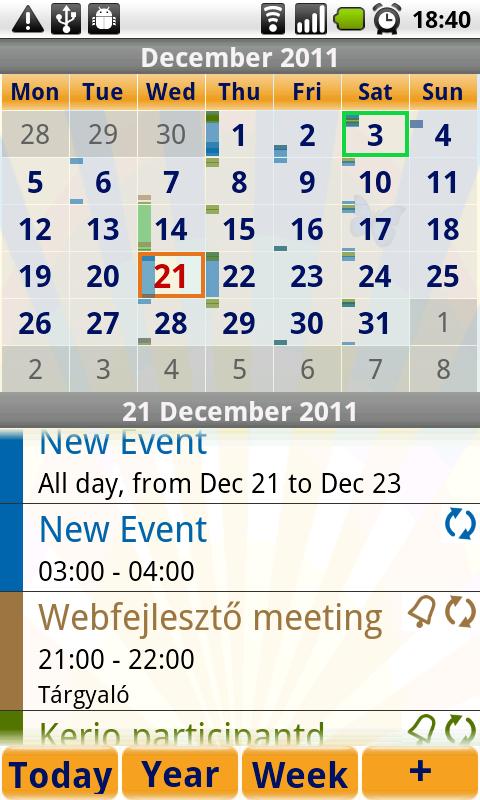
Since the rise of smartphones, first Blackberry, then iPhone and now Android, the world at large has had a convenient option to fall back on for management of contact and calendar data. The data itself seems somewhat trivial: many of us software developers have worked with a plethora of obscenely more obscure schemas. It is unlikely that most people would ever have to perform an operation on their address book that requires a statistical toolkit like the R project or any of the other advanced tools we now have for data processing. In terms of data, addresses and phone numbers can appear quite boring. So why hasn't the free software community mastered it and cloud providers are currently running rampant hoovering up the data of billions of users? Ruling out LDAP One problem that people have faced is the existence of different standards. LDAP has quite a high profile and appears to be supported by default in many desktop applications. For this reason, it tends to grab people's attention but after a close look, many people find it is not the right solution. LDAP tends to work well for organisations where the data is centrally managed and in situations where fine-grained access control is not required. LDAP servers often need a capable UNIX administer to manage effectively. To top it off, LDAP itself does not provide an effective solution for two-way synchronization of data with remote and mobile users. The emergence of SyncML, CalDAV, GroupDAV and CardDAV Addressing this final problem (two-way mobile/portable device sync) has brought on the development of further standards. Initially, SyncML (now known as Open Mobile Alliance Data Synchronization and Device Management) grabbed significant attention, partly because it had been included in some of the first generation of smartphones from once-prominent vendors like Nokia. Open source server solutions for SyncML did not gain traction though. The most prominent is Funambol, however, it is not packaged in any major Linux distribution and it requires some basic Java knowledge to maintain it effectively. Like LDAP it appears to be most comfortable in enterprise use cases and doesn't appeal to the people who run a private mail and web server. SyncML has further suffered with the lack of support in more recent generations of smartphones. WebDAV was formalised in 1999 and there are now various derivative standards such as CalDAV and CardDAV which use WebDAV as a foundation. However, standards didn't arrive at this place directly: CalDAV only appeared as RFC 4791 in 2007 and CardDAV as RFC 6352 in 2011. In the meantime, some vendors experiemented with an alternative called GroupDAV. GroupDAV is largely obsolete now and GroupDAV v2 is a subset of CalDAV and CardDAV. Finally gaining traction The good news is, CardDAV and CalDAV are gaining traction, in no small part due to support from Apple and the highly proprietary iPhone. Some free software enthusiasts may find that surprising. It appears to be a strategic move from Apple, using open standards to compete with the dominance of Microsoft Exchange in large corporate networks. Both protocols are supported natively in iPhones and Mac OS X. More exciting, Apple releases their Contacts Server and Calendar Server as open source software, making it easier to look under the hood and observe any deviations from the standards. Apple's adoption of CardDAV and CalDAV has been accompanied by a similar effort in free software, however, support is more patchy. The Mozilla Lightning calendar plug-in for Thunderbird (known as the iceowl-extension plugin for icedove on Debian) has supported CalDAV for some time. In contrast, Thunderbird's address book lacks native support for CardDAV and has other limitations (discussed in detail below). Limited CardDAV support in Thunderbird can be achieved using the third-party SOGo Connector, which is not just for ScalableOGo server. The Evolution PIM appears to support both CardDAV and CalDAV relatively smoothly and appears to be more functional and easier to get started with. Free software servers are also emerging. DAViCal, despite the name, supports both CardDAV and CalDAV. It is a good solution for people who have an existing mail server and don't want to transition to an all-in-one groupware suite. Packages available in Debian make it easy to deploy and get started. It is a PHP solution, using a PostgreSQL database underneath. For people who do want a groupware suite, CardDAV and CalDAV are supported in products like ScalableOGo and Zimbra. For people who don't want a server at all and just want to sync between a desktop and a mobile device, there are options like Calypso. Mobile support: the missing link A number of people have blogged about using the Android apps CardDAV-Sync and CalDAV-Sync to complete the picture. I've tested these myself and verified that they work. However, there is one vital thing missing: the source code. Nobody knows what is inside these apps except the developer. That makes it impossible for other developers to troubleshoot them and improve them and it also makes it impossible to be certain that they do not leak information. An alternative is the aCal app for Android. Despite the name, aCal can synchronize the address book as well as the calendar. However, in my tests against DAViCal, I found that the addressbook can only be synced once and that on subsequent syncs, it fails to discover any new server-side contacts. aCal source code is available on gitorious.
aCal appears to be a compelling solution for Android users, hopefully the contact sync will be fixed soon. It only syncs once after installation and then fails to detect any new contacts. Thunderbird's limitations It has already been mentioned that the Thunderbird address book can be synchronized to a CardDAV server by adding the SOGo Connector plugin. However, this is not a perfect solution. The plugin itself is fine: the SOGo web site describes the connector (as opposed to the SOGo Integrator plugin) as a portable solution: in other words, it is vendor neutral, compatible with any standards-compliant server. The first limitation is that it is necessary to duplicate the setup process for both the calendar sync and the address book sync. This is just a question of convenience.
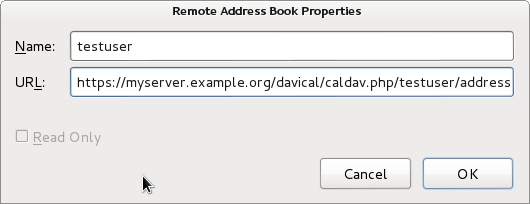
The SOGo Connector plugin configuration window is very trivial. I recommend using read-only mode to avoid the problems with multiple email addresses or telephone numbers. More serious limitations exist in the address book itself: if the CardDAV server has more than 2 email addresses, they will not appear in the Thunderbird address book. Changing an email address on the client side will result in loss of those additional email addresses on the server-side. The Mozilla team initially committed to rewrite the address book from the ground up but it is not clear whether that work is still in progress. DAViCal confusion I had been using DAViCal for quite some time as a CalDAV server before I recently decided to try and use it for CardDAV as well. As a calendar server, it had been working fine. I have a small number of users with some private calendars and also some shared calendars. When I installed the SOGo Connector plugin and went to setup the client-side configuration, it asked me for the server URL. Having used CalDAV already, I simply tried copying the existing CalDAV URL, which is of the form https://myserver.example.org/davical/caldav.php/daniel/home The URL was accepted and I could create address book entries on the client side. No errors appeared. I then tried setting up the same URL as an address book in Evolution. This time, I found I was able to create contacts and sync them to the server and access them from another copy of Evolution. It appeared DAViCal was working fine and I felt that Thunderbird or the SOGo Connector was somehow broken, because the Evolution clients were syncing but Thunderbird was not. The lack of any errors from the Thunderbird GUI further undermined my confidence in the SOGo Connector. Nonetheless, I decided to dig a little deeper, looking through the DAViCal source code. This brought me to the realisation that each URL could be flagged as either a calendar resource or an address book resource. This had not been obvious to me before. Evolution had effectively been storing the contact entries into a calendar URL and DAViCal had been happily accepting them. SOGo Connector, querying the URL, appears to have received both calendar and contact records from DAViCal and given up.
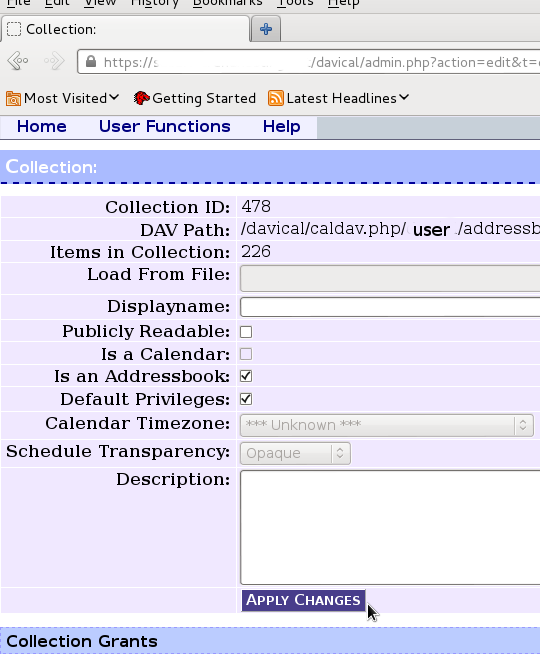
Here is where I configured the extra resource for an address book store under my user account in DAViCal In the DAViCal web management console, I created an extra resource for my user ID and set the appropriate checkbox to mark the resource as an address book. Then I put this resource URL into all the clients and found that they were all able to sync with each other. DAViCal's maintainer has explained that this is a limitation in the CardDAV/CalDAV protocols: technically, it is valid for the client to store the wrong type of objects in each URL. Clients need to be more resilient when they stumble across objects they don't expect in a particular resource. Conclusion A complete free software based contact-management solution can be easily deployed using any of the servers mentioned above, particularly if Evolution is the preferred client software. Using Thunderbird as a client, it can also work, but attention is needed to avoid data loss on sync. Thunderbird could also be used in a read-only mode to access address books maintained with Evolution. Mobile support is still patchy on Android. The closed source solution (CardDAV-Sync and CalDAV-Sync) appears to work and a promising open source close, aCal, appears to be "nearly there". Some people would obviously prefer to use a standalone contact/calendar server, while others may prefer an all-in-one groupware suite. Both approaches appear to be feasible, but the standalone contact/calendar server appears to offer a more compelling way to start quickly and have minimal administrative overhead, particularly due to the fact that DAViCal is available in a supported package.
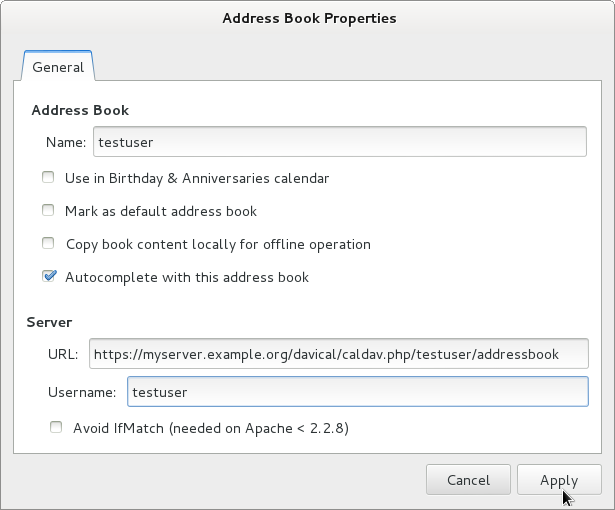
This is the contact server configuration window in Evolution. It offers slightly more options than SOGo Connector in Thunderbird and appears to be a more finished solution overall.

11 September 2013

Steve Kemp: I've always relied upon the kindness of strangers

Many thanks to Vincent Meurisse who solved my node.js callback woe. Some history of the blogspam service:
Back in 2008 I was annoyed by the many spam-comments that were being submitted to my Debian Administration website. I added some simple anti-spam measures, which reduced the flow, but it was a losing battle. In the end I decided I should test comments, as the users submitted them, via some kind of external service. The intention being that any improvements to that central service would benefit all users. (So I could move to testing comments on my personal blog too, for example). Ultimately I registered the domain-name "blogspam.net", and set up a simple service on it which would test comments and judge them to be "SPAM" or "OK". The current statistics show that this service has stopped 20 million spam comments, since then. (We have to pretend I didn't wipe the counters once or twice.)
I've spent a while now re-implementing most of the old plugins in node.js, and I think I'll be ready to deploy the new service over the weekend. The new service will have to handle two different kinds of requests:
New Requests
These will be submitted via HTTP POSTed JSON data, and will be handled by node.js. These should be nice and fast.
Legacy Requests
These will come in via XML-RPC, and be proxied through the new node.js implementation. Hopefully this will mean existing clients won't even notice the transition.
I've not yet deployed the new code, but it is just a matter of time. Hopefully being node.js based and significantly easier to install, update, and tweak, I'll get more contributions too. The dependencies are happily very minimal: The only significant outstanding issue is that I need to pick a node.js library for performing CIDR lookups - "Does 10.11.12.23 lie within 10.11.12.0/24?" - I'm surprised that functionality isn't available out of the box, but it is the only omission I've missed. I've been keeping load & RAM graphs, so it will be interesting to see how the node.js service competes. I expect that if clients were using it, in preference to the XML-RPC version, then I'd get a hell of a lot more throughput, but with it hidden behind the XML-RPC proxy I'm less sure what will happen. I guess I also need to write documentation for the new/preferred JSON-based API... https://github.com/skx/blogspam.js

10 September 2013

Craig Small: Odd WordPress pingbacks

I m getting some odd log messages for the apache module modsecurity. Essentially its xml parser is breaking when random places are sending pingbacks. The requests go to xmlrpc.php and the response headers are ok, but the body is binary. The message in the modsecurity log looks like:
Message: XML parser error: XML: Failed parsing document.
After a bit of guessing and sending messages to and fro, I can now see that it is a gziped response. So I m not sure if it is modsecurity not realising that the response is gziped or wordpress not marking it correctly. In any case I can regularly get very similar binary strings using gzip and the usual xml response. So that s half the mystery solved. Most of the requests are spammers so I m not too worried. I think it also impacts legitimate pingbacks because I ve not had any, even from the usual automatic places.

Petter Reinholdtsen: Recipe to test the Freedombox project on amd64 or Raspberry Pi

I was introduced to the Freedombox project in 2010, when Eben Moglen presented his vision about serving the need of non-technical people to keep their personal information private and within the legal protection of their own homes. The idea is to give people back the power over their network and machines, and return Internet back to its intended peer-to-peer architecture. Instead of depending on a central service, the Freedombox will give everyone control over their own basic infrastructure. I've intended to join the effort since then, but other tasks have taken priority. But this summers nasty news about the misuse of trust and privilege exercised by the "western" intelligence gathering communities increased my eagerness to contribute to a point where I actually started working on the project a while back. The initial Debian initiative based on the vision from Eben Moglen, is to create a simple and cheap Debian based appliance that anyone can hook up in their home and get access to secure and private services and communication. The initial deployment platform have been the Dreamplug, which is a piece of hardware I do not own. So to be able to test what the current Freedombox setup look like, I had to come up with a way to install it on some hardware I do have access to. I have rewritten the freedom-maker image build framework to use .deb packages instead of only copying setup into the boot images, and thanks to this rewrite I am able to set up any machine supported by Debian Wheezy as a Freedombox, using the previously mentioned deb (and a few support debs for packages missing in Debian). The current Freedombox setup consist of a set of bootstrapping scripts (freedombox-setup), and a administrative web interface (plinth + exmachina + withsqlite), as well as a privacy enhancing proxy based on privoxy (freedombox-privoxy). There is also a web/javascript based XMPP client (jwchat) trying (unsuccessfully so far) to talk to the XMPP server (ejabberd). The web interface is pluggable, and the goal is to use it to enable OpenID services, mesh network connectivity, use of TOR, etc, etc. Not much of this is really working yet, see the project TODO for links to GIT repositories. Most of the code is on github at the moment. The HTTP proxy is operational out of the box, and the admin web interface can be used to add/remove plinth users. I've not been able to do anything else with it so far, but know there are several branches spread around github and other places with lots of half baked features. Anyway, if you want to have a look at the current state, the following recipes should work to give you a test machine to poke at. Debian Wheezy amd64
  1. Fetch normal Debian Wheezy installation ISO.
  2. Boot from it, either as CD or USB stick.
  3. Press [tab] on the boot prompt and add this as a boot argument to the Debian installer:
    url=http://www.reinholdtsen.name/freedombox/preseed-wheezy.dat
  4. Answer the few language/region/password questions and pick disk to install on.
  5. When the installation is finished and the machine have rebooted a few times, your Freedombox is ready for testing.
Raspberry Pi Raspbian
  1. Fetch a Raspbian SD card image, create SD card.
  2. Boot from SD card, extend file system to fill the card completely.
  3. Log in and add this to /etc/sources.list:
    deb http://www.reinholdtsen.name/freedombox wheezy main
    
  4. Run this as root:
    wget -O - http://www.reinholdtsen.name/freedombox/BE1A583D.asc   \
       apt-key add -
    apt-get update
    apt-get install freedombox-setup
    /usr/lib/freedombox/setup
    
  5. Reboot into your freshly created Freedombox.
You can test it on other architectures too, but because the freedombox-privoxy package is binary, it will only work as intended on the architectures where I have had time to build the binary and put it in my APT repository. But do not let this stop you. It is only a short "apt-get source -b freedombox-privoxy" away. :) Note that by default Freedombox is a DHCP server on the 192.168.1.0/24 subnet, so if this is your subnet be careful and turn off the DHCP server by running "update-rc.d isc-dhcp-server disable" as root. Please let me know if this works for you, or if you have any problems. We gather on the IRC channel #freedombox on irc.debian.org and the project mailing list. Once you get your freedombox operational, you can visit http://your-host-name:8001/ to see the state of the plint welcome screen (dead end - do not be surprised if you are unable to get past it), and next visit http://your-host-name:8001/help/ to look at the rest of plinth. The default user is 'admin' and the default password is 'secret'.

Daniel Kahn Gillmor: Support privacy-respecting network services!

Support privacy-respecting network services! Donate to Riseup.net! There's a lot of news recently about some downright orwellian surveillance executed across the globe by my own government with the assistance of major American corporations. The scope is huge, and the implications are depressing. It's scary and frustrating for anyone who cares about civil society, freedom of speech, cultural autonomy, or data sovereignty. As bad as the situation is, though, there are groups like Riseup and May First/People Link who actively resist the data dragnet. The good birds at Riseup have been tireless advocates for information autonomy for people and groups working for liberatory social change for years. They have provided (and continue to provide) impressive, well-administered infrastructure using free software to help further these goals, and they have a strong political committment to making a better world for all of us and to resisting strongarm attempts to turn over sensitive data. And they provide all this expertise and infrastructure and support on a crazy shoestring of a budget. So if the news has got you down, or frustrated, or upset, and you want to do something to help improve the situation, you could do a lot worse than sending some much-needed funds to help Riseup maintain an expanding infrastructure. This fundraising campaign will only last a few more days, so give now if you can! (note: i have worked with some of the riseup birds in the past, and hope to continue to do so in the future. I consider it critically important to have them as active allies in our collective work toward a better world, which is why i'm doing the unusual thing of asking for donations for them on my blog.)

9 September 2013

Kurt Roeckx: State of encryption

With all the articles about the NSA going around it seems to be hard to follow what is still safe. After reading various things it boils down to:
I don't think this should really surprise anybody. There is also speculation that maybe the NSA has better algorithms for reducing the complexity of public key cryptography or that maybe RC4 might be broken. Those things clearly are possible, but it's not clear. Nobody has suggested that AES has any problems, and I think that's still safe to use. One of the question becomes what does properly done encryption mean. There are various factors to this and many applications using various protocols. SSL/TLS is the most used, so I'm going to concentrate on the parts in that. Bit sizes As far as I understand it, 80 bit of security is around what is currently the upper practical limit of a brute force attack. In 2003 NIST said to stop using 80 bit by 2015, in 2005 they said to stop using it by 2010. When using something like SSL/TLS you using various things each having it's own size. So it's important to known which is the weakest part. Public key encryption (RSA, DSA, DH) doesn't offer the same amount of security per bit than symmetric keys. The equivalent sizes I find are:
Symmetric Public
80 1024
112 2048
128 3072
256 15360
There are other sources that have other numbers, but they're similar So this basically means you really should stop using 80 bit symmetric and 1024 bit public keys and that your public key really should be at least 2048 bit, and should maybe even consider going to 3072 bit. There seems to be a push to moving Diffie-Hellman (DH) to provide Perfect Forward Secrecy (PFS). There are many variants to this. We want to use ephemeral (temporary) keys. But it basically boils down to 2 variants:
With DHE you first negotiate a temporary DH key for this session (hopefully) using a random number on both sides, and then using that DH key to exchange a normal symmetric key for the session. This temporary DH key is what provides the PFS, assuming that this temporary key is thrown away. The drawback of this is that creating a sessions takes a lot more CPU time. The standard DH has the same security as other public key encryption. So we really also want to stop using 1024 keys for that. With ECDHE the key size needs to be the double of the symmetric size. This is also faster than DHE, so people want to move to this. There are various curves that can be used for this, and some of them are generated the the NSA and people have no trust in them. Some people even don't trust any of the curves. Most people seem to think that ECDH is the way forward, but then limit the curves they support. There are also hashes used for various things including signatures and MACs. Depending on how it's used the properties of the hash are important. They have 2 important properties collision resistance and preimage resistance. For a collision attack the upper limit is a little more than the output size over 2. But there are attacks that are known to give worst results. I found those numbers:
MD5 2^20
SHA-1 2^60
SHA-2 No known attack (so SHA-256 would have 1.2 * 2^128)
For preimage attacks I found:
MD5 2^123
SHA-1 No known attack (2^160)
SHA-256 No known attack (2^256)
So I think that MD5 is still safe when a collision attack isn't possible, but should really be avoided for anything else and SHA-1 should probably be considered the same. So you want to avoid them in things like certificates. SSL/TLS also use MD5 / SHA-1, but as part of a HMAC. I understand that those are not vulnerable to the collision attack but preimage resistance is important then and so are still considered safe. Randomness A lot of the algorithms depend on good random numbers. That is that the attacker can't guess what a (likely) random number you've selected. There have been many cases of bad RNG that then resulted in things getting broken. It's hard to tell from the output of most random number generators that they are secure or not. One important thing is that the RNGs gets seeded with random information (entropy) to begin with. If it gets no random information, very limited amount of possible inputs or information that is guessable as input it can appear to give random numbers, but they end up being predictable There have been many cases where this was broken. Ciphers There are various encryption algorithms. But since the public key algorithms take a lot of time we usually want to limit the amount we do with them and do most with a symmetric key encryption. There are basically 2 types of symmetric ciphers: stream and block ciphers. For block ciphers there are various ways of combining the blocks. The most popular was CBC. But in combination with TLS 1.0 it was vulnerable to the BEAST attack, but there is a workaround for this. An other mode is GCM but it's not yet widely deployed. This resulted in the stream cipher RC4 suddenly getting popular again. Some ciphers have known weaknesses. For instance triple DES has 3*56=168 bits, but only provides for 2*56=112 bits of security. Other attacks make this even less. The algorithms them self might be secure, but they might be attacked by other mechanism known as sidechannel attacks. The most important of that is timing attacks. If the algorithm has branches they might result in different amount of time taking in each branch. This might result in an attacker finding out some information about the secret key that is being used. It's important that the difference should be reduced as much as possible. This is usually not a problem if it's implemented in hardware. SSL/TLS Session A typical SSL/TLS session uses those things:
Important aspects of using certificates:
The client sends it's list of supported ciphers to the server and the server will then pick one. This is usually the first from that list that is supported by the server, but it might also be the order that is configured on the server that is used. Current status in software If you go looking at all of those things, you find problems in most if not all software. Some of that is to be compatible with old clients or servers, but most of it is not. If you want to test web servers for various of those properties you can do that at ssllabs. Based on that there are stats available at SSL-pulse. Apache only supports 1024 bit DHE keys and they don't want to apply a patch to support other bit size. Apache 2.2 doesn't offer ECDHE but 2.4 does. I don't know of any good site has lists which browser supports which ciphers, but you can test your own browser here. It lacks information about EC curves that your client offers. You can of course as look at this with wireshark. Mozilla currently has a proposal to change it's list of supported ciphers here. They currently don't have TLS 1.1 or 1.2 enabled yet, but as far as I understand the NSS library should support it. They should now have support for GCM, but they still have an open bug for a constant time patch. In general Mozilla seems to be moving very slowly with adopting things. Last I heard Apple still didn't patch Safari for the BEAST attack. For XMPP see client to server, server to server, clients.

For TOR see here.

7 September 2013

Daniel Pocock: Evacuating Australia

With the news that Australia's 100mbit (and potentially gigabit) fibre to the home is to be abolished and replaced with a cheap 25mbps service using Europe's ADSL hand-me-downs (which will be obsolete in 5 years when the deployment is finished), I've had quite a few emails from people asking just how easy it is to move abroad.
The acoustic modem has a nice retro look Word has got out that I've been spending some time in Switzerland enjoying the world-beating rate of IPv6 deployment. That is not the only reason to leave Australia of course, nor is it the only criteria for people choosing which country will give them a better deal than either of the two non-choices we had in Australia's elections. A free $20,000 for leaving Australia The first good news is that any recent graduate with a big bad ugly HECS bill is only obliged to pay this extra tax when they earn a salary from an Australian employer and file an Australian tax return. Australians who live abroad are not automatically obliged to file tax returns and are not slogged with this extra tax for having attended university. If somebody just graduated and has this hanging over their head, or if they've just started working and seen how much is being deducted on the payslip, moving abroad could make a lot of sense financially. If you have any moral qualms about this, just reflect on the fact that while the Government intimidates students with the feeling that they have to "pay" for fulfilling an education that makes them into a productive member of society, thousands of would-be athletes are given money with no obligation to repay it. The easiest route: a second passport One in four Australians has a parent born abroad. Most of those people qualify for a passport from their parent's country of birth. In some cases this also applies to people with grandparents born abroad. With the European Union now spanning 28 countries and guaranteeing the rights of any citizen from any country to live, work and study in any of the other 27 countries, a passport from any of the EU countries gives a lot of choices, including places where I have lived myself such as the UK, Ireland, France and Switzerland. Europe's citizen-friendly immigration In other words, an Australian with an Italian parent can go up to the Italian embassy in Canberra, collect an Italian passport and immediately fly into London and start working there with no bureaucratic delays, invasive and degrading medical checks or other Government interference in their life.
London's nightlife is popular for Australians. The UK started rolling out their high speed 21CN many years before Australia started the NBN. The rights also transfer automatically to all family members (spouse and children) - an Australian with a second passport is not restricted to living in Australia simply because they are married to somebody who does not have a second passport. As long as they arrive together at a European airport, they can simply show a marriage/birth certificate (in any language) and cross the border immediately, enjoy the same rights as a citizen, including work, study, healthcare and better broadband. No paperwork is necessary, no cottage industry for otherwise unemployable immigration agents, these are basic human rights for those living in Europe.
Eiffel tower: potentially part of the wireless network for France's new 4G internet, potentially two to four times the fixed-line speed planned for Australia's crippled broadband Uncle Sam wants more Australians Although it is not widely known, the US has a fast lane for immigration from Australia. The regular programs for skilled visas in the US are usually exhausted every year, whereas 10,000 "E3" class visas for Australians are never fully taken in any year. Surely it's not that easy to go to the US? It is. To qualify, an Australian only needs a university degree and a suitable job offer. Although the visa is for 2 years, it can be renewed and Australians who meet and marry an American have in various cases have gained full residence or citizenship. Anything is possible, you could even end up becoming a NASA Astronaut.
San Francisco, home to leading technology professionals and innovators from many countries. Some US cities such as Austin and Kansas City have let Google install fibre to the home, San Francisco could follow Working holiday schemes are not just for Britain Most Australians know somebody who went to London on a "working holiday" visa. These visas are not just for the UK and Australia has similar reciprocal programs with many other countries too. These rules for these schemes are rooted in the industrial age concept of workers with punch cards. Participants are typically limited to work 20 hours per week. Of particular interest for those in IT, such rules are hard to quantify for freelancers, web designers or creative people who earn their living charging fees per-project or undertaking management work without specified working hours. Although the visas are limited to 4 years, I've heard of Australians benefiting from the open borders of mainland Europe, spending 4 years in one country and then obtaining another 4 year visa for an adjacent country and travelling freely back and forth, building up a business and lifestyle of their own design. Singapore and Hong Kong Singapore and Hong Kong have become enormously popular destinations for Australians, particularly those with special skills in IT, finance, engineering and international business.
Singapore is respected as one of the cleanest and most orderly cities in Asia while embracing significant diversity in dining, shopping, leisure and lifestyle possibilities. They have recently boosted speeds to help people get a full 100MBit over fibre. A SIM card with high speed broadband charges SGD 7 (about $5) for 1 Gigabyte. These are not necessarily destinations that a graduate can easily move to. People are measured by their salary and the Government simply assumes that anybody earning a high salary is going to make a valuable contribution to society and they are given a visa in 1 or 2 weeks. Usually 3-5 years employment experience is required before making a move to one of these countries. The Not Ordinarily Resident (NOR) scheme gives some hints about the minimum salary level that ex-pats aim for, many earn significantly more with bonuses, stock programs and properly engineered tax-free offshore pension arrangements. These countries offer particularly low taxes (around 10%) and great technology. They have some rough edges too: like Europe, spouses are automatically given a visa too, but in contrast, their visa does not permit them to work unless they also work in a profession that is highly paid. Visas are issued quickly but they are also canceled very quickly if the job is terminated or the company goes bust. There have been various stories of people paying the typical 2-month deposit on an appartment in Singapore and then finding that it is forfeited when their job and visa are canceled and they have 4 weeks to leave. The bottom line is that people moving to these locations usually have a wide professional network and confidence to change their job quickly if necessary. Freestyle immigration and the visa run Not too long ago I was at a house party in Prague, Czech Republic, which is like a Paris of eastern Europe. Somebody introduced me to some Americans who I was told had similar interests in technology. They were operating an offshore web site and living very well. They had spent 10 years in Prague living on tourist visas. Authorities seemed quite happy for them to remain as long as they left every 3 months and spent 1 night abroad, a typical visa run. That could be as simple as a train journey to Vienna, Austria and an overnight stay.
Making a visa run in comfort and style with European railways. The Railjet train pictured includes free wifi, a lot cheaper than the $20 billion Tony Abbott plans to spend rolling out yesterday's technology in Australia When European countries abolished border controls, this system became much more convoluted for those who depend on the visa run. However, it remains common in many Asian and Latin American countries and many ex-pats live this way. Officials in many of these medium sized economies recognise the value of people bringing in money from offshore business (such as web sites) and using it to pay rent, food and local services. To make this effective, the ex-pats typically need to have an international private health insurance policy (high quality offshore policies can be found quickly with a search engine) and not aspire to work in a normal 9-5 job. Conclusion Young Australians might not want to just consider travel, it may even become unavoidable. The reality is, by 2020, one in three Australians will be a retired baby boomer and one way or another, whichever Government is in office will be unable to avoid taxing those of working age to pay for the health care and pension promises made to older generations. Serious expenditure on public infrastructure such as broadband or high speed rail appears to remain a pipe dream. Moving abroad, however, is just so much fun. Look at the way multinational companies make countries compete to attract their new factories and other projects: why should any individual citizen be any less demanding in choosing where they work, play and get the best value for whatever taxes they have to pay? Some people raise questions of patriotism or responsibility to the nation. Think again. The 200,000 Australians who live abroad or travel extensively make a significant contribution to Australia's international profile, engage in new trade initiatives, bring skills back to Australia and generally represent what our country is really about much better than some of those who are paid to do so.

Ben Armstrong: Wifi roaming on the move redux

It has been nearly six years with a netbook and five since I last wrote about wifi roaming from the bus to stay on irc without a costly celluar link during the daily commute. Since then, some readers have asked me to share my refinements to the method in a followup post. So here it is. The software On the server: On the client: Putting it together: on the client Make sure if you have a wireless manager installed (such as NetworkManager) it is configured to skip your wireless interface, disabled entirely, or if possible, removed. Set up /etc/wpa_supplicant/wpa_supplicant.conf and /etc/network/interfaces for roaming, as per the instructions in /usr/share/doc/wpasupplicant/README.modes.gz. Don t forget to add yourself to the netdev group if you are not in it already. In /etc/wpa_supplicant/wpa_supplicant.conf, list common names of open networks. Normally the catch-all network that associates with any essid, i.e. the first stanza below, works well. However, occasionally the strongest signal is neither one of the common networks nor an easily accessible network (e.g. web portals), so having a list of common open networks helps to quickly select from among those instead. The more you travel, the more of these will discover and add. Just use reconfigure from wpa_cli to reload your edited list each time you add a new one.
ctrl_interface=DIR=/var/run/wpa_supplicant GROUP=netdev
network= 
        key_mgmt=NONE
 
network= 
        ssid="default"
        key_mgmt=NONE
 
network= 
        ssid="linksys"
        key_mgmt=NONE
 
...
Since you ll be using ssh repeatedly to connect and it has to be fast, make sure your server is set up to accept your key and use ssh-add so that you only have to enter your ssh key password once. You can tweak isc-dhcp-client to make connections faster. In /etc/dhcp/dhclient.conf, use:
backoff-cutoff 1;
initial-interval 1;
Here are a few scripts I wrote to facilitate quick roaming from one open AP to another and reconnect to irssi running in screen, to break a connection and try the next one, and to recover from occasional lockups (more about that later). ~/bin/screen_reconnect This is a script to reconnect continuously via ssh to a screen session:
#!/bin/sh
reset
while ! ssh -t 10.9.8.7 'screen -UDr' 2>/dev/null ; do echo -n "." ; sleep .1 ; done
Just substitute the IP of your own server here. Using an IP instead of domain name makes the connection faster because a DNS lookup is not required. ~/bin/wifi_reassociate This script closes any open ssh sessions and informs wpa_supplicant to attempt to connect again.
#/bin/sh
/sbin/wpa_cli rea
killall ssh >/dev/null 2>&1
~/bin/wifi_killall This optional, somewhat ugly script addresses an issue I hope you never have. On my ASUS Eee PC 1001PX, occasionally scanning stops. When this happens, and I have never figured out why, apparently ACPI events are blocked. At this point wifi becomes unusable and ACPI sleep is inhibited. By trial and error I found that if you bring down the interface, kill all network-related processes, and bring it up again, ACPI events are unblocked and wifi is usable once more (and any pending request to sleep will finally happen). The script requires sudo, and to use the openbox key binding, gksudo.
#/bin/sh
sudo ifdown wlan0
# in case any of these are hung
sudo killall dhclient3
sudo killall wpa_cli
sudo killall wpa_action
sudo killall wpa_supplicant
# in case any of these are *really* hung
sleep 1
sudo killall -9 dhclient3
sudo killall -9 wpa_cli
sudo killall -9 wpa_action
sudo killall -9 wpa_supplicant
sudo dhclient -r
sudo ifup wlan0
Openbox Since certain actions need to be performed repeatedly and quickly, it is useful to have hotkeys bound in your window manager to the scripts. In ~/.config/openbox/rc.xml, key bindings for <alt>-r to reassociate and <alt>-d to disconnect a hung connection would look like:
  
<keyboard>
  <!-- My keybindings -->
  <keybind key="A-R">
    <action name="Execute">
        <execute>/home/synrg/bin/wifi_reassociate</execute>
    </action>
  </keybind>
  <keybind key="A-D">
    <action name="Execute">
        <execute>gksudo /home/synrg/bin/wifi_killall</execute>
    </action>
  </keybind>
</keyboard>
Putting it together: on the server There is very little to do here. Just start screen, and start irssi in screen. Running screen on the client as well as the server means you should either bind the screen meta keys to a different key sequence on each system, or else learn to press meta twice to pass through meta to the server screen as needed. I use the latter approach. Alternatively, you could use a tabbed terminal on the client, or separate terminals per client process instead of screen. This is a matter of personal taste. Ready to roam Here is a typical setup for roaming on the bus: In a terminal (I use urxvt), first ssh-add, then start screen with these three processes running in separate virtual terminals: March of the dots Most of the commute, just enjoy watching the dots march by, waiting for a new connection. If you estimate a connection is unusable, press <alt>-r to reassociate immediately, giving the next network a chance. If the connection is already firmly established, this might not work on the first try. If the dots don t resume immediately, wait a bit and press it again. This might take a few tries. Changing selected networks on the fly Use wpa_cli when you need to do some fine-tuning of network selections on the fly. While normally you can just watch the march of the dots until a connection is acquired, sometimes you can improve your chances of connecting to a good network by manually controlling the selected candidate networks here. For example, by watching the speed of the bus relative to known good APs, you can predict which networks are more likely to succeed. Rather than connect to any arbitrary network, you might select a specific one by id, and then later when it goes out of range, revert to the original configuration, e.g.
> select_network 5
...
> reconfigure
You can use tab-completion in wpa_cli to type these commands quickly or else just abbreviate the commands. Another common scenario is when you pass through a business area with many captive portal hotspots. These rarely make good choices because they either require a password not known to you or else you can t click through I agree in time before the bus moves on. In this case, you might just disable the catch-all stanza and let the common open network stanzas you listed ( default , linksys , etc.) do the work:
> disable_network 1
Become a type ahead wizard While running, a continuous stream of periods fills the screen, which provides you with a highly visible cue that no available APs are in range. When the movement stops, you know a connection is being attempted. While waiting to connect, you can type ahead any comments you want to make in the current irssi window (taking care to remember which one you are in!) While having periods interspersed in what you type may be disorienting at first, you get used to it. There is a point when a connection is first established and ssh is accepting input, but anything you type can no longer be seen while you re typing. Depending on whether the connection was completely successful or not, what you type now may or may not finally be sent. For best results, only type ahead before the dots stop moving. Eventually you can become skilled enough at this to type ahead a comment in one channel, switch channels with /win # and continue typing ahead in the new channel, all buffered until the next few seconds (or even fraction of a second) of connection time. Fine-tune antenna direction with wavemon When the bus has come to a standstill, you may find wavemon useful to pull in a weak signal. Because wavemon has continuously updated signal level and link quality bars, you can use it to fine-tune the antenna position. Just turn your laptop until the bars are at their maximum. Captive portals I have not figured out how to do any automation for this, so it really is a crapshoot, as it is likely the bus has moved on by the time you ve managed to manually navigate the login through a captive portal. But in rush hour, you may have the luxury of time to connect to these as you pass them. I have recently learned about the CoovaFX Firefox plugin which automates logins to captive portals. I m going to give it a try to see if it helps. Update: I can t recommend this plugin, as it is not compatible with Iceweasel >= 23.0. Also, the standard it is based on, WISPr, appears to have an uncertain future. That, coupled with the fact that the plugin appears to not be open source means I m still looking for alternatives. Summary If all of this sounds a bit nuts to you, well, it probably is. But after half a decade enjoying free access to irc from the bus, it all seems perfectly natural to me! If you try this method and like it, please let me know in the comments. Likewise, if you have any improvements to the process or scripts, please share them!

6 September 2013

Vincent Bernat: High availability with ExaBGP

When it comes to provide redundant services, several options are available: A common setup is a combination of those solutions: web servers are behind a couple of load-balancers achieving both redundancy and load-balancing. The load-balancers use VRRP to ensure redundancy. The whole setup is replicated to another datacenter and round-robin DNS is used to ensure both redundancy and load-balacing of the datacenters. There is a fourth option which is similar to VRRP but relies on dynamic routing and therefore is not limited to nodes in the same subnet: We will explore how to implement this fourth option using ExaBGP, the BGP swiss army knife of networking, in a small lab based on KVM. You can grab the complete lab from GitHub. ExaBGP 3.2.5 is needed to run this lab.

Environment We will be working in the following (IPv6-only) environment: Lab with three web nodes

BGP configuration BGP is enabled on ER2 and ER3 to exchange routes with peers and transits (only R1 for this lab). BIRD is used as a BGP daemon. Its configuration is pretty basic. Here is a fragment:
router id 1.1.1.2;
protocol static NETS   #  
  import all;
  export none;
  route 2001:db8::/40 reject;
 
protocol bgp R1   #  
  import all;
  export where proto = "NETS";
  local as 64496;
  neighbor 2001:db8:1000::1 as 64511;
 
protocol bgp ER3   #  
  import all;
  export all;
  next hop self;
  local as 64496;
  neighbor 2001:db8:1::3 as 64496;
 
First, in , we declare the routes that we want to export to our peers. We don t try to summarize them from the IGP. We just unconditonnaly export the networks that we own. Then, in , R1 is defined as a neighbor and we export the static route we declared previously. We import any route that R1 is willing to send us. In , we share everything we know with our pal, ER3, using internal BGP.

OSPF configuration OSPF will distribute routes inside the AS. It is enabled on ER2, ER3, DR6, DR7 and DR8. For example, here is the relevant part of the configuration of DR6:
router id 1.1.1.6;
protocol kernel  
   persist;
   import none;
   export all;
 
protocol ospf INTERNAL  
  import all;
  export none;
  area 0.0.0.0  
    networks  
      2001:db8:1::/64;
      2001:db8:6::/64;
     ;
    interface "eth0";
    interface "eth1"   stub yes;  ;
   ;
 
ER2 and ER3 inject a default route into OSPF:
protocol static DEFAULT  
  import all;
  export none;
  route ::/0 via 2001:db8:1000::1;
 
filter default_route  
  if proto = "DEFAULT" then accept;
  reject;
 
protocol ospf INTERNAL  
  import all;
  export filter default_route;
  area 0.0.0.0  
    networks  
      2001:db8:1::/64;
     ;
    interface "eth1";
   ;
 

Web nodes The web nodes are pretty basic. They have a default static route to the nearest router and that s all. The interesting thing here is that they are each on a separate IP subnet: we cannot share an IP using VRRP2. Why are those web servers on different subnets? Maybe they are not in the same datacenter or maybe your network architecture is using a routed access layer. Let s see how to use BGP to enable redundancy of those web nodes.

Redundancy with ExaBGP ExaBGP is a convenient tool to plug scripts into BGP. They can then receive and advertise routes. ExaBGP does the hard work of speaking BGP with your routers. The scripts just have to read routes from standard input or advertise them on standard output.

The big picture Here is the big picture: Using ExaBGP to advertise web services Let s explain it step by step:
  1. Three IP addresses will be allocated for our web service: 2001:db8:30::1, 2001:db8:30::2 and 2001:db8:30::3. Those are distinct from the real IP addresses of W1, W2 and W3.
  2. Each web node will advertise all of them to the route servers we added in the network. I will talk more about those route servers later.
  3. Each route comes with a metric to help the route server choose where it should be routed. We choose the metrics such that each IP address will be routed to a distinct web node (unless there is a problem).
  4. The route servers (which are not routers) will then advertise the best routes they learned to all the routers in our network. This is still done using BGP.
  5. Now, for a given IP address, each router knows to which web node the traffic should be directed.
Here are the respective metrics announced routes for W1, W2 and W3 when everything works as expected:
Route W1 W2 W3 Best Backup
2001:db8:30::1 102 101 100 W3 W2
2001:db8:30::2 101 100 102 W2 W1
2001:db8:30::3 100 102 101 W1 W3

ExaBGP configuration The configuration of ExaBGP is quite simple:
group rs  
  neighbor 2001:db8:1::4  
    router-id 1.1.1.11;
    local-address 2001:db8:6::11;
    local-as 65001;
    peer-as 65002;
   
  neighbor 2001:db8:8::5  
    router-id 1.1.1.11;
    local-address 2001:db8:6::11;
    local-as 65001;
    peer-as 65002;
   
  process watch-nginx  
      run /usr/bin/python /lab/healthcheck.py -s --config /lab/healthcheck-nginx.conf --start-ip 0;
   
 
A script is entailed to check if the service (an nginx web server) is up and running and advertise the appropriate IP addresses to the two declared route servers. If we run the script manually, we can see the advertised routes:
$ python /lab/healthcheck.py --config /lab/healthcheck-nginx.conf --start-ip 0
INFO[healthcheck] send announces for UP state to ExaBGP
announce route 2001:db8:30::3/128 next-hop self med 100
announce route 2001:db8:30::2/128 next-hop self med 101
announce route 2001:db8:30::1/128 next-hop self med 102
[...]
WARNING[healthcheck] Check command was unsuccessful: 7
INFO[healthcheck] Output of check command:  curl: (7) Failed connect to ip6-localhost:80; Connection refused
WARNING[healthcheck] Check command was unsuccessful: 7
INFO[healthcheck] Output of check command:  curl: (7) Failed connect to ip6-localhost:80; Connection refused
WARNING[healthcheck] Check command was unsuccessful: 7
INFO[healthcheck] Output of check command:  curl: (7) Failed connect to ip6-localhost:80; Connection refused
INFO[healthcheck] send announces for DOWN state to ExaBGP
announce route 2001:db8:30::3/128 next-hop self med 1000
announce route 2001:db8:30::2/128 next-hop self med 1001
announce route 2001:db8:30::1/128 next-hop self med 1002
When the service becomes unresponsive, the healthcheck script detect the situation and retry several times before acknowledging that the service is dead. Then, the IP addresses are advertised with higher metrics and the service will be routed to another node (the one advertising 2001:db8:30::3/128 with metric 101). This healthcheck script is now part of ExaBGP.

Route servers We could have connected our ExaBGP servers directly to each router. However, if you have 20 routers and 10 web servers, you now have to manage a mesh of 200 sessions. The route servers are here for three purposes:
  1. Reduce the number of BGP sessions (from 200 to 60) between equipments (less configuration, less errors).
  2. Avoid modifying the configuration on routers each time a new service is added.
  3. Separate the routing decision (the route servers) from the routing process (the routers).
You may also ask yourself: why not use OSPF? . Good question!
  • OSPF could be enabled on each web node and the IP addresses advertised using this protocol. However, OSPF has several drawbacks: it does not scale, there are restrictions on the allowed topologies, it is difficult to filter routes inside OSPF and a misconfiguration will likely impact the whole network. Therefore, it is considered a good practice to limit OSPF to network equipments.
  • The routes learned by the route servers could be injected into OSPF. On paper, OSPF has a next-hop field to provide an explicit next-hop. This would be handy as we wouldn t have to configure adjacencies with each router. However, I have absolutely no idea how to inject BGP next-hop into OSPF next-hop. What happens is that BGP next-hop is resolved locally using OSPF routes. For example, if we inject BGP routes into OSPF from RS4, RS4 will know the appropriate next-hop but other routers will route the traffic to RS4.
Let s look at how to configure our route servers. RS4 will use BIRD while RS5 will use Quagga. Using two different implementations will help with resiliency by avoiding a bug to hit the two route servers at the same time.

Bird configuration There are two sides for BGP configuration: the BGP sessions with the ExaBGP nodes and the ones with the routers. Here is the configuration for the later:
template bgp INFRABGP  
  export all;
  import none;
  local as 65002;
  rs client;
 
protocol bgp ER2 from INFRABGP  
  neighbor 2001:db8:1::2 as 65003;
 
protocol bgp ER3 from INFRABGP  
  neighbor 2001:db8:1::3 as 65003;
 
protocol bgp DR6 from INFRABGP  
  neighbor 2001:db8:1::6 as 65003;
 
protocol bgp DR7 from INFRABGP  
  neighbor 2001:db8:1::7 as 65003;
 
protocol bgp DR8 from INFRABGP  
  neighbor 2001:db8:1::8 as 65003;
 
The AS number used by our route server is 65002 while the AS number used for routers is 65003 (the AS numbers for web nodes will be 65001). They are reserved for private use by RFC 6996. All routes known by the route server are exported to the routers but no routes are accepted from them. Let s have a look at the other side:
# Only import loopback IPs
filter only_loopbacks   #  
  if net ~ [ 2001:db8:30::/64 128,128  ] then accept;
  reject;
 
# General template for an EXABGP node
template bgp EXABGP  
  local as 65002;
  import filter only_loopbacks; #  
  export none;
  route limit 10; #  
  rs client;
  hold time 6; #  
  multihop 10;
  igp table internal;
 
protocol bgp W1 from EXABGP  
  neighbor 2001:db8:6::11 as 65001;
 
protocol bgp W2 from EXABGP  
  neighbor 2001:db8:7::12 as 65001;
 
protocol bgp W3 from EXABGP  
  neighbor 2001:db8:8::13 as 65001;
 
To ensure separation of concerns, we are being a bit more picky. With and , we only accept loopback addresses and only if they are contained in the subnet that we reserved for this use. No server should be able to inject arbitrary addresses into our network. With , we also limit the number of routes that a server can advertise. With , we reduce the hold time from 240 to 6. It means that after 6 seconds, the peer is considered dead. This is quite important to be able to recover quickly from a dead machine. The minimal value is 3. We could have use a similar setting with the session with the routers.

Quagga configuration Quagga s configuration is a bit more verbose but should be strictly equivalent:
router bgp 65002 view EXABGP
 bgp router-id 1.1.1.5
 bgp log-neighbor-changes
 no bgp default ipv4-unicast
 neighbor R peer-group
 neighbor R remote-as 65003
 neighbor R ebgp-multihop 10
 neighbor EXABGP peer-group
 neighbor EXABGP remote-as 65001
 neighbor EXABGP ebgp-multihop 10
 neighbor EXABGP timers 2 6
!
 address-family ipv6
 neighbor R activate
 neighbor R soft-reconfiguration inbound
 neighbor R route-server-client
 neighbor R route-map R-IMPORT import
 neighbor R route-map R-EXPORT export
 neighbor 2001:db8:1::2 peer-group R
 neighbor 2001:db8:1::3 peer-group R
 neighbor 2001:db8:1::6 peer-group R
 neighbor 2001:db8:1::7 peer-group R
 neighbor 2001:db8:1::8 peer-group R
 neighbor EXABGP activate
 neighbor EXABGP soft-reconfiguration inbound
 neighbor EXABGP maximum-prefix 10
 neighbor EXABGP route-server-client
 neighbor EXABGP route-map RSCLIENT-IMPORT import
 neighbor EXABGP route-map RSCLIENT-EXPORT export
 neighbor 2001:db8:6::11 peer-group EXABGP
 neighbor 2001:db8:7::12 peer-group EXABGP
 neighbor 2001:db8:8::13 peer-group EXABGP
 exit-address-family
!
ipv6 prefix-list LOOPBACKS seq 5 permit 2001:db8:30::/64 ge 128 le 128
ipv6 prefix-list LOOPBACKS seq 10 deny any
!
route-map RSCLIENT-IMPORT deny 10
!
route-map RSCLIENT-EXPORT permit 10
  match ipv6 address prefix-list LOOPBACKS
!
route-map R-IMPORT permit 10
!
route-map R-EXPORT deny 10
!
The view is here to not install routes in the kernel3.

Routers Configuring BIRD to receive routes from route servers is straightforward:
# BGP with route servers
protocol bgp RS4  
  import all;
  export none;
  local as 65003;
  neighbor 2001:db8:1::4 as 65002;
  gateway recursive;
 
protocol bgp RS5  
  import all;
  export none;
  local as 65003;
  neighbor 2001:db8:8::5 as 65002;
  multihop 4;
  gateway recursive;
 
It is important to set gateway recursive because most of the time, the next-hop is not reachable directly. In this case, by default, BIRD will use the IP address of the advertising router (the route servers).

Testing Let s check that everything works as expected. Here is the view from RS5:
# show ipv6  bgp  
BGP table version is 0, local router ID is 1.1.1.5
Status codes: s suppressed, d damped, h history, * valid, > best, i - internal,
              r RIB-failure, S Stale, R Removed
Origin codes: i - IGP, e - EGP, ? - incomplete
   Network          Next Hop            Metric LocPrf Weight Path
*  2001:db8:30::1/128
                    2001:db8:6::11         102             0 65001 i
*>                  2001:db8:8::13         100             0 65001 i
*                   2001:db8:7::12         101             0 65001 i
*  2001:db8:30::2/128
                    2001:db8:6::11         101             0 65001 i
*                   2001:db8:8::13         102             0 65001 i
*>                  2001:db8:7::12         100             0 65001 i
*> 2001:db8:30::3/128
                    2001:db8:6::11         100             0 65001 i
*                   2001:db8:8::13         101             0 65001 i
*                   2001:db8:7::12         102             0 65001 i
Total number of prefixes 3
For example, traffic to 2001:db8:30::2 should be routed through 2001:db8:7::12 (which is W2). Other IP are affected to W1 and W3. RS4 should see the same thing4:
$ birdc6 show route 
BIRD 1.3.11 ready.
2001:db8:30::1/128 [W3 22:07 from 2001:db8:8::13] * (100/20) [AS65001i]
                   [W1 23:34 from 2001:db8:6::11] (100/20) [AS65001i]
                   [W2 22:07 from 2001:db8:7::12] (100/20) [AS65001i]
2001:db8:30::2/128 [W2 22:07 from 2001:db8:7::12] * (100/20) [AS65001i]
                   [W1 23:34 from 2001:db8:6::11] (100/20) [AS65001i]
                   [W3 22:07 from 2001:db8:8::13] (100/20) [AS65001i]
2001:db8:30::3/128 [W1 23:34 from 2001:db8:6::11] * (100/20) [AS65001i]
                   [W3 22:07 from 2001:db8:8::13] (100/20) [AS65001i]
                   [W2 22:07 from 2001:db8:7::12] (100/20) [AS65001i]
Let s have a look at DR6:
$ birdc6 show route
2001:db8:30::1/128 via fe80::5054:56ff:fe6e:98a6 on eth0 * (100/20) [AS65001i]
                   via fe80::5054:56ff:fe6e:98a6 on eth0 (100/20) [AS65001i]
2001:db8:30::2/128 via fe80::5054:60ff:fe02:3681 on eth0 * (100/20) [AS65001i]
                   via fe80::5054:60ff:fe02:3681 on eth0 (100/20) [AS65001i]
2001:db8:30::3/128 via 2001:db8:6::11 on eth1 * (100/10) [AS65001i]
                   via 2001:db8:6::11 on eth1 (100/10) [AS65001i]
So, 2001:db8:30::3 is owned by W1 which is behind DR6 while the two others are in another part of the network and will be reached through the appropriate link-local addresses learned by OSPF. Let s kill W1 by stopping nginx. A few seconds later, DR6 learns the new routes:
$ birdc6 show route
2001:db8:30::1/128 via fe80::5054:56ff:fe6e:98a6 on eth0 * (100/20) [AS65001i]
                   via fe80::5054:56ff:fe6e:98a6 on eth0 (100/20) [AS65001i]
2001:db8:30::2/128 via fe80::5054:60ff:fe02:3681 on eth0 * (100/20) [AS65001i]
                   via fe80::5054:60ff:fe02:3681 on eth0 (100/20) [AS65001i]
2001:db8:30::3/128 via fe80::5054:56ff:fe6e:98a6 on eth0 * (100/20) [AS65001i]
                   via fe80::5054:56ff:fe6e:98a6 on eth0 (100/20) [AS65001i]

Demo For a demo, have a look at the following video (it is also available as an Ogg Theora video).

  1. The primary target of VRRP is to make a default gateway for an IP network highly available by exposing a virtual router which is an abstract representation of multiple routers. The virtual IP address is held by the master router and any backup router can be promoted to master in case of a failure. In practice, VRRP can be used to achieve high availability of services too.
  2. However, you could deploy an L2 overlay network using, for example, VXLAN and use VRRP on it.
  3. I have been told on the Quagga mailing-list that such a setup is quite uncommon and that it would be better to not use views but use --no_kernel flag for bgpd instead. You may want to look at the whole thread for more details.
  4. The output of birdc6 shows both the next-hop as advertised in BGP and the resolved next-hop if the route have to be exported into another protocol. I have simplified the output to avoid confusion.

Next.

Previous.