Search Results: "bod"

12 July 2013

Marc 'Zugschlus' Haber: PowerDNS (pdns) 3.3-1~exp1 in Debian experimental

I have just uploaded PowerDNS 3.3-1~exp1 to Debian experimental. This new upstream version has introduced its own include directive, so Debian was able to drop its patch. Hence, our conffiles had to grow a .conf extension, which most of them didn t have in previous version. If anybody wants to test updates from PowerDNS 3.1 to the new 3.3-1~exp1 in Debian unstable, please go ahead and report bugs in the Debian BTS. The package is known to not offer seamless DNSSEC, I ll work on that before I upload to unstable. While we re at it: I would appreciate help with the PostgreSQL backend. Myself, I use mainly MySQL and am not too proficient in PostgreSQL. I ll accept both patches and more formal co-maintenance.

Daniel Pocock: Practical VPNs with strongSwan, Shorewall, Linux firewalls and OpenWRT routers

There is intense interest in communications privacy at the moment thanks to the Snowden scandal. Open source software has offered credible solutions for privacy and encryption for many years. Sadly, making these solutions work together is not always plug-and-play. In fact, secure networking, like VoIP, has been plagued by problems with interoperability and firewall/filtering issues although now the solutions are starting to become apparent. Here I will look at some of them, such as the use of firewall zones to simplify management or the use of ECDSA certificates to avoid UDP fragmentation problems. I've drawn together a lot of essential tips from different documents and mailing list discussions to demonstrate how to solve a real-world networking problem. A typical network scenario and requirements Here is a diagram of the network that will be used to help us examine the capabilities of these open source solutions. Some comments about the diagram:
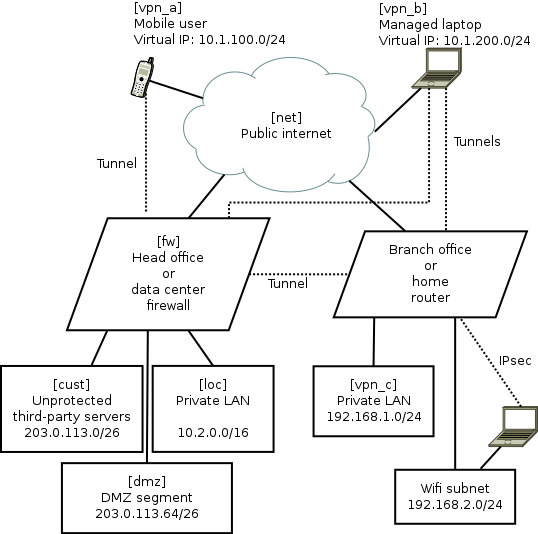
  • The names in square brackets are the zones for Shorewall, they are explained later.
  • The dotted lines are IPsec tunnels over the untrusted Internet.
  • The road-warrior users (mobiles and laptops) get virtual IP addresses from the VPN gateway. The branch offices/home routers do not use virtual IPs.
  • The mobile phones are largely untrusted: easily lost or stolen, many apps have malware, they can only tunnel to the central VPN and only access a very limited range of services.
  • The laptops are managed devices so they are trusted with access to more services. For efficiency they can connect directly to branch office/home VPNs as well as the central server.
  • Smart-phone user browsing habits are systematically monitored by mobile companies with insidious links into mass-media and advertising. Road-warriors sometimes plug-in at client sites or hotels where IT staff may monitor their browsing. Therefore, all these users want to tunnel all their browsing through the VPN.
  • The central VPN gateway/firewall is running strongSwan VPN and Shorewall firewall on Linux. It could be Debian, Fedora or Ubuntu. Other open source platforms such as OpenBSD are also very well respected for building firewall and VPN solutions, but Shorewall, which is one of the key ingredients in this recipe, only works on Linux at present.
  • The branch office/home network could be another strongSwan/Shorewall server or it could also be an OpenWRT router
  • The default configuration for most wifi routers creates a bridge joining wifi users with wired LAN users. Not here, it has been deliberately configured as an independent network. Road-warriors who attach to the wifi must use VPN tunnelling to access the local wired network. In OpenWRT, it is relatively easy to make the Wifi network an independent subnet. This is an essential security precaution because wifi passwords should not be considered secure: they are often transmitted to third parties, for example, by the cloud backup service in many newer smart phones.
Package mayhem The major components are packaged on all the major Linux distributions. Nonetheless, in every case, I found that it is necessary to re-compile fresh strongSwan packages from sources. It is not so hard to do but it is necessary and worth the effort. Here are related blog entries where I provide the details about how to re-build fresh versions of the official packages with all necessary features enabled: Using X.509 certificates as a standard feature of the VPN For convenience, many people building a point-to-point VPN start with passwords (sometimes referred to as pre-shared keys (PSK)) as a security mechanism. As the VPN grows, passwords become unmanageable. In this solution, we only look at how to build a VPN secured by X.509 certificates. The certificate concept is not hard. In this scenario, there are a few things that make it particularly easy to work with certificates:
  • strongSwan comes with a convenient command line tool, ipsec pki. Many of it's functions are equivalent to things you can do with OpenSSL or GnuTLS. However, the ipsec pki syntax is much more lightweight and simply provides a convenient way to do the things you need to do when maintaining a VPN.
  • Many of the routine activities involved in certificate maintainence can be scripted. My recent blog about using Android clients with strongSwan gives a sample script demonstrating how ipsec pki commands can be used to prepare a PKCS#12 (.p12) file that can be easily loaded into an Android device using the SD-card.
  • For building a VPN, there is no need to use a public certificate authority such as Verisign. Consequently, there is no need to fill in all their forms or make any payments for each device/certificate. Some larger organisations do choose to outsource their certificate management to such firms. For smaller organisations, an effective and sometimes better solution can be achieved by maintaining the process in-house with a private root CA.
UDP fragmentation during IPsec IKEv2 key exchange and ECDSA A common problem for IPsec VPNs using X.509 certificates is the fragmentation of key exchange datagrams during session setup. Sometimes it works, sometimes it doesn't. Various workarounds exist, such as keeping copies of all certificates from potential peers on every host. As the network grows, this becomes inconvenient to maintain and to some extent it eliminates the benefits of using PKI. Fortunately, there is a solution: Elliptic Curve Cryptography (ECC). Many people currently use RSA key-pairs. Best practice suggests using RSA keys of at least 2048 bits and often 4096 bits. Using ECC with a smaller 384-bit key is considered to be equivalent to a 7680 bit RSA key pair. Consequently, ECDSA certificates are much smaller than RSA certificates. Furthermore, at these key sizes, the key exchange packets are almost always smaller than the typical 1500 byte MTU. A further demand for ECDSA is arising due to the use of ECC within smart cards. Many smartcards don't support any RSA key larger than 2048 bits. The highly secure 384-bit ECC key is implemented in quite a few common smart cards. Smart card vendors have shown a preference for the ECC keys due to the US Government's preference for ECC and the lower computational overheads make them more suitable for constrained execution environments. Anyone who wants to use smart cards as part of their VPN or general IT security now, or in the future, needs to consider ECC/ECDSA. Making the network simple with Shorewall zones For this example, we are not just taking some easy point-to-point example. We have a real-world, multi-site, multi-device network with road warriors. Simplifying this architecture is important to help us understand and secure it. The solution? Each of these is abstracted to a "zone" in Shorewall. In the diagram above, the zone names are in square brackets. The purpose of each zone is described below:
Zone name Description
loc This is the private LAN and contains servers like databases, private source code respositories and NFS file servers
dmz This is the DMZ and contains web servers that are accessible from the public internet. Some of these servers talk to databases or message queues in the LAN network loc
vpn_a These are road warriors that are not very trustworthy, such as mobile devices. They are occasionally stolen and usually full of spyware (referred to by users as "apps"). They have limited access to ports on some DMZ servers, e.g. for sending and receiving mail using SMTP and IMAP (those ports are not exposed to the public Internet at large). They use the VPN tunnel for general internet access/browsing, to avoid surveillance by their mobile carrier.
vpn_b These are managed laptops that have a low probability of malware infection. They may well be using smart cards for access control. Consequently, they are more trusted than the vpn_a users and have access to some extra intranet pages and file servers. Like the smart-phone users, they use the VPN tunnel for general internet access/browsing, to avoid surveillance by third-party wifi hotspot operators.
vpn_c This firewall zone represents remote sites with managed hardware, such as branch offices or home networks with IPsec routers running OpenWRT.
cust These are servers hosted for third-parties or collaborative testing/development purposes. They have their own firewall arrangements if necessary.
net This zone represents traffic from the public Internet.
A practical Shorewall configuration Shorewall is chosen to manage the iptables and ip6tables firewall rules. Shorewall provides a level of abstraction that makes netfilter much more manageable than manual iptables scripting. The Shorewall concept of zones is very similar to the zones implemented in OpenWRT and this is an extremely useful paradigm for firewall management. Practical configuration of Shorewall is very well explained in the Shorewall quick start. The one thing that is not immediately obvious is a strategy for planning the contents of the /etc/shorewall/policy and /etc/shorewall/rules files. The exact details for making it work effectively with a modern IPsec VPN are not explained in a single document, so I've gathered those details below as well. An effective way to plan the Shorewall zone configuration is with a table like this:
Destination zone
loc dmz vpn_a vpn_b vpn_c cust net
Source zone loc \
dmz ? \ X X X
vpn_a ? ? \ X X
vpn_b ? ? X \ X
vpn_c X \
cust X ? X X X \
net X ? X X X \
The symbols in the table are defined:
Symbol Meaning
ACCEPT in policy file
X REJECT or DROP in policy file
? REJECT or DROP in policy file, but ACCEPT some specific ports in the rules file
Naturally, this modelling technique is valid for both IPv4 and IPv6 firewalling (with Shorewall6) Looking at the diagram in two dimensions, it is easy to spot patterns. Each pattern can be condensed into a single entry in the rules file. For example, it is clear from the first row that the loc zone can access all other zones. That can be expressed very concisely with a single line in the policy file:
loc all ACCEPT
Specific Shorewall tips for use with IPsec VPNs and strongSwan Shorewall has several web pages dedicated to VPNs, including the IPsec specific documentation.. Personally, I found that I had to gather a few details from several of these pages to make an optimal solution. Here are those tips:
  • Ignore everything about the /etc/shorewall/tunnels file. It is not needed and not used any more
  • Name the VPN zones (we call them vpn_a, vpn_b and vpn_c) in the zones file but there is no need to put them in the /etc/shorewall/interfaces file.
  • The /etc/shorewall/hosts file is not just for hosts and can be used to specify network ranges, such as those associated with the VPN virtual IP addresses. The ranges you put in this file should match the rightsourceip pool assignments in strongSwan's /etc/ipsec.conf
  • One of the examples suggests using mss=1400 in the /etc/shorewall/zones file. I found that is too big and leads to packets being dropped in some situations. To start with, try a small value such as 1024 and then try larger values later after you prove everything works. Setting mss for IPsec appears to be essential.
  • Do not use the routefilter feature in the /etc/shorewall/interfaces file as it is not compatible with IPsec
Otherwise, just follow the typical examples from the Shorewall quick start guide and configure it to work the way you want. Here is an example /etc/shorewall/zones file:
fw firewall
net ipv4
dmz ipv4
loc ipv4
cust ipv4
vpn_a ipsec mode=tunnel mss=1024
vpn_b ipsec mode=tunnel mss=1024
vpn_c ipsec mode=tunnel mss=1024
Here is an example /etc/shorewall/hosts file describing the VPN ranges from the diagram:
vpn_a eth0:10.1.100.0/24 ipsec
vpn_b eth0:10.1.200.0/24 ipsec
vpn_c eth0:192.168.1.0/24 ipsec
Here is an example /etc/shorewall/policy file based on the table above:
loc all ACCEPT
vpn_c all ACCEPT
cust net ACCEPT
net cust ACCEPT
all all REJECT
Here is an example /etc/shorewall/rules file based on the network:
SECTION ALL
# allow connections to the firewall itself to start VPNs:
# Rule  source    dest    protocol/port details
ACCEPT   all       fw                ah
ACCEPT   all       fw                esp
ACCEPT   all       fw                udp 500
ACCEPT   all       fw                udp 4500
# allow access to HTTP servers in DMZ:
ACCEPT   all       dmz               tcp 80
# allow connections from HTTP servers to MySQL database in private LAN:
ACCEPT   dmz       loc:10.2.0.43     tcp 3306
# allow connections from all VPN users to IMAPS server in private LAN:
ACCEPT vpn_a,vpn_b,vpn_c loc:10.2.0.58 tcp 993
# allow VPN users (but not the smartphones in vpn_a) to the
# PostgresQL database for PostBooks accounting system:
ACCEPT vpn_b,vpn_c loc:10.2.0.48      tcp 5432
SECTION ESTABLISHED
ACCEPT   all       all
SECTION RELATED
ACCEPT   all       all
Once the files are created, Shorewall can be easily activated with:
# shorewall compile && shorewall restart
strongSwan IPsec VPN setup Like Shorewall, strongSwan is also very well documented and I'm just going to focus on those specific areas that are relevant to this type of VPN project.
  • Allow the road-warriors to send all browsing traffic over the VPN means including leftsubnet=0.0.0.0/0 in the VPN server's /etc/ipsec.conf file. Be wary though: sometimes the road-warriors start sending the DHCP renewal over the tunnel instead of to their local DHCP server.
  • As we are using Shorewall zones for firewalling, you must set the options leftfirewall=no and lefthostaccess=no in ipsec.conf. Shorewall already knows about the remote networks as they are defined in the /etc/shorewall/hosts file and so firewall rules don't need to be manipulated each time a tunnel goes up or down.
  • As discussed above, X.509 certificates are used for peer authentication. In the certificate Distinguished Name (DN), store the zone name in the Organizational Unit (OU) component, for example, OU=vpn_c, CN=gw.branch1.example.org
  • In the ipsec.conf file, match the users to connections using wildcard specifications such as rightid="OU=vpn_a, CN=*"
  • Put a subjectAltName with hostname in every certificate. The --san option to the ipsec pki commands adds the subjectAltName.
  • Keep the certificate distinguished names (DN) short, this makes the certificate smaller and reduces the risk of fragmented authentication packets. Many examples show a long and verbose DN such as C=GB, O=Acme World Wide Widget Corporation, OU=Engineering, CN=laptop1.eng.acme.example.org. On a private VPN, it is rarely necessary to have all that in the DN, just include OU for the zone name and CN for the host name.
  • As discussed above, use the ECDSA scheme for keypairs (not RSA) to ensure that the key exchange datagrams don't suffer from fragmentation problems. For example, generate a keypair with the command ipsec pki --gen --type ecdsa --size 384 > user1Key.der
  • Road warriors should have leftid=%fromcert in their ipsec.conf file. This forces them to use the Distinguished Name and not the subjectAltName (SAN) to identify themselves.
  • For road warriors who require virtual tunnel IPs, configure them to request both IPv4 and IPv6 addresses (dual stack) with leftsourceip=%config4,%config6 and on the VPN gateway, configure the ranges as arguments to rightsourceip
  • To ensure that roadwarriors query the LAN DNS, add the DNS settings to strongswan.conf and make sure road warriors are using a more recent strongSwan version that can dynamically update /etc/resolv.conf. Protecting DNS traffic is important for privacy reasons. It also makes sure that the road-warriors can discover servers that are not advertised in public DNS records.
Central firewall/VPN gateway configuration Although they are not present in the diagram, IPv6 networks are also configured in these strongSwan examples. It is very easy to combine IPv4 and IPv6 into a single /etc/ipsec.conf file. As long as the road-warriors have leftsourceip=%config4,%config6 in their own configurations, they will operate dual-stack IPv4/IPv6 whenver they connect to the VPN. Here is an example /etc/ipsec.conf for the central VPN gateway:
config setup
        charonstart=yes
        charondebug=all
        plutostart=no
conn %default
        ikelifetime=60m
        keylife=20m
        rekeymargin=3m
        keyingtries=1
        keyexchange=ikev2
conn branch1
        left=198.51.100.1
        leftsubnet=203.0.113.0/24,10.0.0.0/8,2001:DB8:12:80:/64
        leftcert=fw1Cert.der
        leftid=@fw1.example.org
        leftfirewall=no
        lefthostaccess=no
        right=%any
        rightid=@branch1-fw.example.org
        rightsubnet=192.168.1.0/24
        auto=add
conn rw_vpn_a
        left=198.51.100.1
        leftsubnet=0.0.0.0/0,::0/0
        leftcert=fw1Cert.der
        leftid=@fw1.example.org
        leftfirewall=no
        lefthostaccess=no
        right=%any
        rightid="OU=vpn_a, CN=*"
        rightsourceip=10.1.100.0/24,2001:DB8:1000:100::/64
        auto=add
conn rw_vpn_b
        left=198.51.100.1
        leftsubnet=0.0.0.0/0,::0/0
        leftcert=fw1Cert.der
        leftid=@fw1.example.org
        leftfirewall=no
        lefthostaccess=no
        right=%any
        rightid="OU=vpn_b, CN=*"
        rightsourceip=10.1.200.0/24,2001:DB8:1000:200::/64
        auto=add
Sample branch office or home router VPN configuration Here is an example /etc/ipsec.conf for the Linux server or OpenWRT VPN at the branch office or home:
conn head_office
        left=%defaultroute
        leftid=@branch1-fw.example.org
        leftcert=branch1-fwCert.der
        leftsubnet=192.168.1.0/24,2001:DB8:12:80:/64
        leftfirewall=no
        lefthostaccess=no
        right=fw1.example.org
        rightid=@fw1.example.org
        rightsubnet=203.0.113.0/24,10.0.0.0/8,2001:DB8:1000::/52
        auto=start
# notice we only allow vpn_b users, not vpn_a
# these users are given virtual IPs from our own
# 192.168.1.0 subnet
conn rw_vpn_b
        left=branch1-fw.example.org
        leftsubnet=192.168.1.0/24,2001:DB8:12:80:/64
        leftcert=branch1-fwCert.der
        leftid=@branch1-fw.example.org
        leftfirewall=no
        lefthostaccess=no
        right=%any
        rightid="OU=vpn_b, CN=*"
        rightsourceip=192.168.1.160/27,2001:DB8:12:80::8000/116
        auto=add
Further topics Shorewall and Shorewall6 don't currently support a unified configuration. This can make it slightly tedious to duplicate rules between the two IP variations. However, the syntax for IPv4 and IPv6 configuration is virtually identical. Shorewall only currently supports Linux netfilter rules. In theory it could be extended to support other types of firewall API, such as pf used by OpenBSD and the related BSD family of systems. A more advanced architecture would split the single firewall into multiple firewall hosts, like the inner and outer walls of a large castle. The VPN gateway would also become a standalone host in the DMZ. This would require more complex routing table entries. Smart cards with PIN numbers provide an effective form of two-factor authentication that can protect certificates for remote users. Smart cards are documented well by strongSwan already so I haven't repeated any of that material in this article. Managing a private X.509 certificate authority in practice may require slightly more effort than I've described, especially when an organisation grows. Small networks and home users don't need to worry about these details too much, but for most deployments it is necessary to consider things like certificate revocation lists and special schemes to protect the root certificate's private key. EJBCA is one open source project that might help. Some users may want to consider ways to prevent the road-warriors from accidentally browsing the Internet when the IPsec tunnel is not active. Such policies could be implemented with some basic iptables firewalls rules in the road-warrior devices. Summary Using these strategies and configuration tips, planning and building a VPN will hopefully be much simpler. Please feel free to ask questions on the mailing lists for any of the projects discussed in this blog.

11 July 2013

Daniel Pocock: Using debcheckout to build strongSwan 5.0 on Debian wheezy

Normally most people try to use packages from a stable Linux distribution because of their convenience and security support. Sometimes it's necessary to use a newer version, I recently had to do this with strongSwan and I'm sharing the procedure for other people to try. These days, it is actually very very easy to build a new version of a package from source and this procedure will work for many Debian packages. Debian wheezy ships with strongSwan version 4.5 packages. These are lacking support for a couple of features I needed, including dual-stack IPv4/IPv6 virtual IPs on a single user connection and maintaining the DNS server list on road-warriors Oddly enough, for a variety of reasons, I had to rebuild strongSwan on all the platforms where I wanted to use it (not just on Debian). I recently described how to build it with ECDSA support on Fedora and also how to build it with ECDSA support on OpenWRT. Following all of these procedures you will end up with strongSwan packages on all systems that can interoperate using dual stack IPv4, IPv6 and establish connections quickly, securely and reliably using ECC certificates. Get the build dependencies Many packages require extra tools and header files when building. These are packages that are not usually installed or required when running the package. However, they are very easy to get. For strongSwan:
sudo apt-get update
sudo apt-get install devscripts fakeroot
sudo apt-get build-dep strongswan
This should download and install the necessary dependencies. Notice we also installed the devscripts package, it provides the very handy debcheckout utility. Obtain and build the package Now for the real work. Fortunately this is not too hard either:
mkdir ~/ws
cd ~/ws
debcheckout strongswan
cd strongswan
dpkg-buildpackage -rfakeroot -uc -b
Look in the directory ~/ws and you will find the .deb package files. Problems? On my own system, I observed that I could upgrade from the existing packages to the v5.0.4-6 package without any change to the configuration files. It just worked. Hopefully, these packages will eventually end up in Debian's backports catalog where you can install them without compiling. Nonetheless, problems for these packages can still be submitted through Debian's bug tracker - just make sure you clearly indicate that you built the package from source and give the git commit number (output of the command cd ~/ws/strongswan && git show head -1) Before trying the package and definitely before reporting any problem, it is worth checking the bug tracker and the Package Tracking System for known issues

Matt Zimmerman: Scaling Human Systems: From individual achievement to teamwork

This is part 4 in a series on organizational design and growth. What it means

Getting things done together, as a team, achieving more than the sum of our individual efforts. Why it s important

Once a company reaches a certain size, perhaps with a substantial customer base and ambitious goals for the future, it takes a lot more momentum to move it forward. No one person can do it alone. From product delivery, to strategic decision making, to customer service, no single individual has all of the knowledge, skills or time necessary to perform these functions at the scale and velocity necessary to make real progress. Cooperation is not just a good idea: it s essential to success.

The most important system we re building is the company itself: a system of people working together to achieve common goals. Old status quo

In a startup, everyone embodies the spirit of the pioneer: passion, fortitude, individualism, daring, and the willingness to do whatever it takes to reach the goal. Individuals wear many hats: engineering, product management, marketing, customer support. We often don t even think of them as distinct disciplines. Projects often depend on the resoluteness of a single Jill-of-all-trades to drive them to completion, and the culture may reward this kind of heroism. Thanks to the relatively small scale of the company and its customer base, one person working independently can effect significant change without much risk. If what was delivered wasn t good enough, it could be discarded with no great loss. New status quo

In a growing company, we still need a variety of different disciplines in order to reach our goals, in fact more than ever. A successful product needs to be conceived, validated, designed, built, documented, adopted, supported, and we need to confirm that it satisfies customers over time. These elements are all essential, and each requires deep knowledge, expertise and practice. Good engineering + mediocre product management + inept marketing = total failure. It s not realistic to expect one person to do all of these things and deliver consistently good results, but consistently good results are exactly what we need. The solution is to organize for individuals to do what they do best, and cooperate effectively together. We also need to manage risk more carefully: our customers are depending on us. We have a lot more to lose now, and need to learn how to maintain forward progress while continuing to meet our customers expectations. Delivering sub-par products would damage our reputation and erode their trust. Most of all, we need to be getting better at all of this over time, faster than our competition. Behaviors that help

Obstacles that get in the way

9 July 2013

Wouter Verhelst: Mark groet 's morgens de dingen

Or, Mark greeting the things in the morning
Dag ventje met de fiets op de vaas met de bloem Hi little guy with the bike on the vase with the flower
ploem ploem ploum ploum
Dag stoel naast de tafel Hi chair besides the table
Dag brood op de tafel Hi bread on the table
Dag visserke-vis met de pijp Hi fishery-man with the pipe
en and
Dag visserke-vis met de pet Hi fishery-man with the hat
goeiendag good day
Daa-ag vis Bye-ee fish
Dag lieve vis Bye dear fish
Dag klein visselijn mijn Bye my little fishery-fish
The above is one of Paul van Ostaijen's poems, and is, in my opinion, one of his finest. I tried translating it to English so that my non-Dutch-speaking readers could appreciate it (Dutch-speaking readers will most likely already know it anyway), but it's almost impossible to properly translate it. In this poem, van Ostaijen invents a few words that aren't part of the Dutch language proper. A good example is 'visserke-vis'. The first part, 'visserke', is (now) a dialect diminutive of 'visser', which translates to "fisherman" (though it is likely that in Van Ostaijen's days, 'visserke' wasn't considered to be a dialect word). The second part, 'vis', is just Dutch for 'fish'. A literal translation would thus be 'fishereman-fish' On the other hand, given the relative similarity of both words, it is conceivable that Van Ostaijen is just playing with the sound of those words here (he does that later in the poem, anyway), and as such, it's not entirely clear whether he's talking about a fish with a pipe and a had, or about a fisherman with a pipe and a hat. It could be both. His use of the word 'Dag' adds to confusion. In Dutch, the word 'Dag' can be used as a greeting when seeing people for the first time in the morning, but it can also be used as a greeting when leaving people in the evening. Since this is used near the end of the poem, I translated it by using its second meaning; but it's also possible that Van Ostaijen is just playing with us. Of that final line, I should add that the size of the letters is not my doing; Van Ostaijen's original version contained this. In fact, he is known for his expressionistic way of using letters, and some of his other poems go into extremes with that; his wikipedia entry has a nice example. The final verse of the poem sounds pretty well, but defies all grammar. In proper grammar, the verse would read "Dag mijn klein visje". Van Ostaijen turns 'visje' into 'visselijn' so that it rhymes on 'mijn', and puts 'mijn' at the end. Whereas it's still possible to figure out a meaning of the first part of 'visserke-vis', this certainly isn't possible with 'visselijn'. It just isn't a word; all you can make of it is that he's talking about a fish. This certainly contradicts the idea that he was talking about a fisherman earlier. All in all, "Mark groet 's morgens de dingen" is a very funny poem; it describes a man or a boy who does nothing else than say hello to objects when he gets up in the morning; and though it's necessary to explain the language if you don't speak Dutch to fully appreciate it, the idea that there's much more to be found behind the words is most likely wrong. This is just silly amusement.

Raphaël Hertzog: My Free Software Activities in June 2013

This is my monthly summary of my free software related activities. If you re among the people who made a donation to support my work (106.39 , thanks everybody!), then you can learn how I spent your money. Otherwise it s just an interesting status update on my various projects. Debian France I handled some subscriptions that we collected during Solutions Linux at the end of last month and I also worked on updating the accounts in preparation of our annual general assembly. As the current president, I wrote a moral assessment of the organization and I helped Sylvestre Ledru (the treasurer) to prepare an overview of our financial situation (which is rather good). The plan for this general assembly included the renewal of 6 of our 9 board members so I tried to motivate some persons to candidate and I m pretty happy to see that we managed to have 9 candidates for 6 seats, a real election for once. :-) And as usual, I updated Galette to version 0.7.4.2 and I filed a couple of tickets (#621, #622). Debian Package Tracking System We re getting close to one month of work on the Google Summer of Code Project that rewrites the Package Tracking System. On average I spent a good 1h30 per day on reviewing the code, giving my feedback, and preparing the user stories for the next iteration, plus a 2 hour meeting each Wednesday afternoon. This is more than I expected but at I m rather happy with the result so far. We have a live test instance updated each week (after the end of the iteration) at pts.debian.net. The web interface is empty because the bulk of the work has been spent on the email interface for now, but it s now feature complete and already has seen some improvements compared to the current implementation (fixing #340863 for example). You can interact with it by sending mails to control@pts.debian.net. The Debian Administrator s Handbook The fundraising for the liberation of the original book in French met its initial target very quickly and we added new targets with supplementary rewards (more ebook from Eyrolles, donation to Debian). All the supplementary targets were met, although the last one took until the last day! Thanks to all the supporters, we now have a French translation of the Debian Administrator s Handbook which is free and we have collected about 2700 EUR for Debian. Debian Packaging I got a couple of release critical bug reports that I had to fix: And trying to anticipate future issues, I filed an upstream ticket on feed2omb (#33) to see whether upstream had plans to support the new pump.io API that identi.ca is supposed to use soonish. Kali Linux I filed a couple of Debian bugs: #711866 to request a new upstream version of w3af in Debian, #711044 to report a missing dependency in LSB meta-informations of the vsftpd init script. I worked on packaging passing-the-hash. Basically this is a fork of several software just to override some NTLM authentication functions. In some cases, I managed to avoid the fork by transforming the patches in LD_PRELOAD libraries that override the specific symbol of the patched functions. Among the forked software, there was winexe which wasn t packaged yet. So I packaged it but we quickly ran into some segfaults (which was already reported to upstream since a few months). I investigated the problem and prepared a patch. It has been submitted to upstream and merged. Thanks See you next month for a new summary of my activities.

No comment Liked this article? Click here. My blog is Flattr-enabled.

Daniel Pocock: Enabling Elliptic Curve Cryptography in OpenWRT and strongSwan VPNs

OpenWRT currently ships an OpenSSL package with Elliptic Curve Cryptography (ECC) disabled. This is very inconvenient as ECC is now standard in other distributions like Debian and Ubuntu and it is necessary to solve certain problems such as making IPsec VPNs work reliably It is relatively easy to enable it, this also provides a useful opportunity to see how the OpenWRT build system works. Preparing the build environment The build was done on a Debian 7 (wheezy) workstation. It is necessary to install some packages that provide tools needed for the build:
apt-get install gcc binutils flex make unzip gawk libz-dev linux-libc-dev
Rebuild the OpenSSL and StrongSwan packages This was tested with an ar71xx CPU-based router. You can easily change the config (run make menuconfig just before make defconfig) for other variations of router.
Running strongSwan IPsec on a router requires a router with plenty of flash, RAM and CPU power. Cheap routers with limited flash will not be able to install the packages at all. I tested on the Buffalo WZR-HP-AG300H-EU which has 32MB flash and 128MB RAM Here are the commands executed on the Debian build workstation:
mkdir ~/ws
cd ~/ws
svn checkout svn://svn.openwrt.org/openwrt/trunk openwrt-trunk
cd openwrt-trunk
./scripts/feeds update -a
./scripts/feeds install -a
wget -O .config \
  http://danielpocock.com/sites/danielpocock.com/files/openwrt.config.txt
sed -i -e 's/no-ec//' package/libs/openssl/Makefile 
make defconfig
make -j 13
The "make" command will build all the packages. It takes some time. Copy the packages to a router The actual location of the packages in your source tree depends on the CPU architecture you chose to build for. You can find them with a command such as:
find . -name '*.ipk'
Here we look at how to copy the packages for the ar71xx based router into the /tmp directory on the router. The router IP is 192.168.1.1 below:
cd ./bin/ar71xx/packages/
scp libopenssl_1.0.1e-1_ar71xx.ipk strongswan*.ipk root@192.168.1.1:/tmp
Installing the packages It is relatively easy to install the packages using the opkg utility on OpenWRT. When using self-compiled packages, you are likely to get errors about the checksums. OpenWRT compares the checksum of the package to the checksum from the package catalog file. You can delete the catalog file (e.g. rm /var/opkg-lists/attitude_adjustment) and then opkg will install the package without complaining. The file is automatically placed there each time you run opkg update so there is no harm in deleting it. In my earlier blog, I looked at how to link Android clients to the strongSwan VPN. Unfortunately Android has a bug in ECC support too and must still be used with RSA certificates. Nonetheless, the OpenWRT VPN will be quite happy talking to Linux laptops and servers - you may need to rebuild OpenSSL and StrongSwan on any Fedora, Red Hat or CentOS systems that require ECC support too. As you migrate from RSA to ECC certificates it is quite feasible to have both types of certificates in use at the same time. strongSwan supports this type of hybrid environment. To make the migration to ECC go smoothly it is desirable to ensure all boxes have ECC support at the earliest opportunity.

8 July 2013

Olivier Berger: Experimenting with Linked Open Data about FLOSS projects : matching Debian upstream projects

I ve been experimenting with Linked Open Data about FLOSS projects harvested from different sources of DOAP or ADMS.SW descriptions. I ve tried and match upstream projects of Debian packages with upstream projects hosted at Apache, Gnome, or Alioth.debian.org, or catalogued on Pypi. I m matching them on identical values of the Homepage field (comparing the Homepage Control field set by Debian packagers with the doap:homepage meta-data in the RDF documents harvested from the upstream project catalogues). Here are initial results of my little experiment, for number of matched projects, and results on project name s similarity :
Upstream catalogue Total matching projs Exact same project name Same project name (case independant)
apache 31 0 (0 %) 0 (0 %)
alioth 16 13 (81 %) 13 (81 %)
pypi 439 217 (49 %) 273 (62 %)
gnome 21 0 (0 %) 7 (33 %)
Total 507 230 (45%) 293 (58 %)
The data set contains tens of thousands of projects, with probably many duplicates, but from all of these, only 507 have common homepages. As you can see, in some cases, the Debian source package names match the upstream project name (sometimes with lower/upper case variants), but in general, the project names aren t identical, so it is interesting to try and match them by homepage. For the curious ones, the Apache, Gnome and Pypi project catalogues use to provide RDF meta-data for quite some time. More recently have we introduced ADMS.SW meta-data for Debian source packages, and even more recently for the Alioth projects (through the ADMS.SW exporter plugin for FusionForge). There are still some ways for improvements, for instance to normalize homepage URLs which tend to vary (trailing slashes, or different HTTP/HTTPS schemes). Stay tuned for more details.

7 July 2013

Daniel Pocock: Melbourne and Detroit emergency call centers simultaneously fail

A co-incidence that caught my eye this week was the failure of emergency call centers in Melbourne, Australia and Detroit, USA. Melbourne's system failed at 19:00 local time on Friday, 5 July. Detroit's communications meltdown started at 05:00 local time on the same day. 19:00 - 05:00 = 14:00 hours, which is, co-incidentally, the difference in timezones between the two cities Detroit's failure was slashdotted, Melbourne's was not. Were there other cities that experienced this same outage on Friday? Just what could be going on then? Are they running their systems on a common cloud infrastructure that is not completely under the control of local technical staff? Was there an expired SSL certificate embedded in the application software, much like the certificate expiry that recently caused failure in Microsoft Azure? Using free and open source software is a life or death issue Are these systems based on free and open source software? Can the local authorities, their technical experts and auditors inspect the software to detect such issues ahead of time? Closed, proprietary outsourced solutions often take significant control away from the users of technology.

4 July 2013

Emanuele Rocca: Useful tools for Python developers

Python is a great language with an impressive number of tools designed to make developers' life easier. Sometimes, however, the problem is getting to know that these tools exist in the first place. By contributing to projects like OpenStack's Nova client and Falcon, I have recently come across some useful tools that can seriously improve the quality of your code. The first one is called pyflakes, a passive checker of Python programs developed by Phil Frost. What it does is parsing your source files and checking for possible errors such as undefined names and unused imports. Let's consider the following example: <figure class="code">
1
2
3
4
import urllib

print "pyflakes example"
urlib.urlopen('http://www.linux.it')
</figure>The code above contains a typo, we have misspelled urllib. Here is what pyflakes thinks about our program:
$ pyflakes example.py
example.py:1: 'urllib' imported but unused
example.py:4: undefined name 'urlib'
On line 4 we try to use urlib which is not defined. Also, we import urllib on line 1 and we do nothing with it. Our typo has been spotted! Notice that, even though our program contains a print statement, 'pyflakes example' has not been printed. That is because pyflakes parses the source files it checks, without importing them, making it safe to use on modules with side effects. pyflakes can be installed with pip or apt-get. The second tool I want to talk about is Ned Batchelder's coverage.py. No doubt you write unit tests for your programs. Right? Good. coverage.py is out there to help you checking how much of your program is actually covered. Let's use as an example codicefiscale, a Python project of mine. First we install coverage:
pip install coverage
Then we run our unit tests:
$ coverage run --source=codicefiscale tests.py
.......
----------------------------------------------------------------------
Ran 7 tests in 0.003s
We pass the module we want to test with --source=codicefiscale so that coverage will only report information about that specific module. Now that our tests have been performed successfully it is time to check how much of our code is covered by unit tests:
$ coverage report -m
Name            Stmts   Miss  Cover   Missing
---------------------------------------------
codicefiscale      73      4    95%   61, 67, 95, 100
Not bad, 95% of our module is covered! Still, coverage let us know that 4 lines have not been touched by the unit tests. With this information, we can go write some meaningful test cases that will also cover the missing lines.

Daniel Pocock: My Linux server IPv6 deployment approach

I previously discussed the ease of deploying IPv6 for Linux servers. Whether it is Debian, Fedora or another distribution the IPv6 stack should "just work" these days. However, for maintaining a production network with minimum risk of interruption, there are a few extra things to be aware of during IPv6 deployment. Here I present a rough set of steps that can be followed, usually with minimal or no downtime, to deploy IPv6. The steps are in the order that they should be used in practice Plenty of other web sites already explain the theory of IPv6 networks or practical configuration detail (like how to set a static IPv6 address in Debian). This page ignores all of that detail and looks at the overall project strategy. Borrow the last decimal octet (or host bits) of IPv4 addresses As mentioned in my earlier blog:
  • Of the 128 bits in IPv6 addresses, most sites now use a fixed 64 bit netmask for all their subnets. This is the practice encouraged by RFC 4291.
  • Therefore, there are always more bits in the 64-bit "host" portion of the address than in the host portion of any 32-bit IPv4 address.
  • Consequently, it is possible to just borrow the host portion (typically the last octet for a class-C network) and use it as the host portion of an IPv6 address
IPv4 address Host portion of address IPv6 address
192.168.1.5/24 5 2001:1234:567::5
Gotcha: remember that the IPv4 addresses are usually written in decimal while IPv6 addresses, including the example above, are hex. This doesn't really matter in practice unless the addresses are being manipulated by code that is sensitive to the host bits. For all other intents and purposes, it just makes it easy to read the addresses and associate them with IPv4. A completely valid alternative is to use the full IPv4 address as the host portion of the IPv6 address. For example, if the IPv4 address = 192.168.1.5, the IPv6 address may be 2001:1234:567::192.168.1.5. This approach is slighly more verbose and is completely valid. Which approach you use is at your discretion. Create reverse mappings (PTR records) in DNS Just as IPv4 has the in-addr.arpa zone and telephone numbers have the e164.arpa zone (for ENUM), IPv6 addresses have a reverse mapping zone too: ip6.arpa The recommended way to proceed is to create reverse mappings for all hosts that have IPv4 reverse mappings. Some services may be using reverse lookups for authentication (e.g. MySQL will check this for any user who has a "Host" restriction defined). This is why it is recommended to create all the reverse mappings very early in the IPv6 program, before any hosts start making connections over IPv6. Create extra A records in DNS It's possible that some applications will be more stubborn about IPv6 adoption than others. For example, if you have a host called wolf.example.org and it hosts a mail server, web server, DNS server and XMPP server all using the name wolf then all those server processes will have to support IPv6 connectivity from the moment you add an AAAA record. A good practice is to create independent DNS A records (such as ns1.example.org and mail.example.org) for each application (not just CNAME records). Existing CNAME records can be converted to A records and converted back to CNAME records after the IPv6 deployment is 100% complete. Duplicate firewall entries Duplicate all IPv4 firewall entries to create an IPv6 firewall For many types of network, this is a trivial (although possibly tedious) task. There are some small gotchas:
  • There is no NAT. Any firewall entries for NAT need to be reviewed: for source NAT, it is necessary to use a mechanism like connection tracking to protect workstations that previously had asymmetrical access to the public Internet. For destination NAT, see the TPROXY feature in ip6tables
  • IPsec works slightly differently. Rules for AH and ESP packets can't simply be duplicated for IPv6, they need further tweaks or warnings will be generated.
  • IPv6 makes some ICMP packages mandatory. If IPv4 ICMP is completely blocked, you still need to enable the IPv6 ICMP (or at least the subset of ICMP packets that are mandatory).
For more comments about firewalling IPv6, please see my earlier blog on the subject Put the IPv6 addresses on the hosts Add the necessary records to the appropriate place, for example, the /etc/network/interfaces files on Debian/Ubuntu style systems. For hosts that have multiple addresses on a single interface, it is often desirable to ensure that outbound connections always appear to come from just one of the addresses. This can be achieved using the preferred_lft option when configuring the non-default addresses. For example, if configuring three addresses on eth0:
ip addr add dev eth0 preferred_lft 0 2001:1234:567::10/64
ip addr add dev eth0  2001:1234:567::11/64
ip addr add dev eth0 preferred_lft 0 2001:1234:567::12/64
In the example above, all outgoing IPv6 connections will appear to come from 2001:1234:567::11/64 Important: this is only a very shallow discussion of the issues around source addresses. If it doesn't provide a valid solution for you, there are many dedicated articles about this specific topic, madduck's blog looks at it for firewalls and tunnels but the concepts are valid for any type of multi-homed host Review listening processes with netstat Now that hosts have IPv6 addresses, it is worthwhile looking through the output of
netstat -nlp
to see which processes have bound to both IPv4 and IPv6 addresses and which processes remain stuck on IPv4 only. For processes that are only listening on IPv4 or only bound to a specific address (rather than 0.0.0.0), it is a good idea to investigate the way they are configured and find out if they will support IPv6. Review the monitoring infrastructure (Nagios, Ganglia, etc) Now is a good time to review the monitoring infrastructure. Make sure that tools like Nagios are testing the services using their dedicated DNS names and not the host names. For example, if the host wolf.example.org runs an LDAP server accessible as ldap1.example.org, make sure Nagios is configured to poll ldap1.example.org. Look at the check_v46 wrapper for Nagios and similar solutions to make sure that Nagios is testing both the IPv4 and IPv6 version of each service. Just as developers use unit testing as part of test-driven development workflows, administrators deploying IPv6 can use the monitoring framework to validate the progress of their IPv6 program. Check for ACLs Do any server processes use IP-based ACLs to control access? For example, an Apache web server may be using an IP ACL to restrict access to some pages. MySQL or Postgres databases may have IP ACLs defined for some users or databases. When hosts start using IPv6 to connect to services, their IPv6 source addresses won't pass the ACL and services may be inaccessible. Therefore, it is worthwhile checking for such ACLs early on. Prepare DNS servers first Preparing the DNS servers first is a good step. The DNS servers should be configured to accept queries over IPv6. Once the DNS servers are listening on IPv6 addresses, go ahead and do some of the following:
  • Insert IPv6 AAAA records for the name servers in their own zone files. As mentioned in the previous tip, the name server records should have their own independent A records already with names such as ns1.example.org. Consequently, no other application should notice when the AAAA record is created.
  • Create IPv6 glue records for any name servers that have IPv4 glue records
Configure secondary name servers to poll over IPv6 Configure the secondary nameservers to poll the primary nameserver using it's new IPv6 address. Update resolv.conf on all hosts Now that DNS servers are listening on IPv6, it is possible to put IPv6 nameserver addresses in /etc/resolv.conf on all the other hosts. Configure and test other low-level services Although services such as LDAP and MySQL may not be exposed to public Internet users, they are an essential foundation for many other applications to run. Make sure all these low level services are accessible over IPv6. Test them. After testing each of these services, it is OK to go ahead and create the AAAA records for the service. Configure and test other services Continue testing each service is accessible over it's IPv6 address and then add the necessary AAAA record. This includes all the high level services now, such as mail and web servers. Configure and test hostnames Finally, start adding AAAA records associated with hostnames to the DNS zone. Now it should be possible to ssh or ping6 the hostnames using IPv6. You may also want to add the IPv6 address of each host into it's own /etc/hosts file at this stage.

3 July 2013

Matthew Garrett: Explaining Intel Rapid Start Technology

Recent Intel-based systems often implement something called Intel Rapid Start Technology. Like many things with the word "Technology" in the name, there's a large part of this that's marketing. The relatively small amount of technical documentation available implies that it's tied to your motherboard chipset and CPU, but as far as I can tell it's entirely implemented in firmware and could work just as well on, say, a Cyrix on a circa 1996 SIS-based motherboard if someone wrote the BIOS code[1]. But since nobody has, we're stuck with the vendors who've met Intel's requirements and licensed the code.

The concept of IRST is pretty simple. There's a firmware mechanism for setting a sleep timeout. If you suspend your computer and this timeout expires, it'll resume. However, instead of handing control back to the OS, the firmware just copies the entire contents of RAM to a special partition and turns the computer off. Next time you hit the power button, the firmware dumps the partition contents back into RAM and resumes as if nothing had changed. This takes a few seconds longer than resume from S3 but is far faster than resume from hibernation since it starts the moment the system gets power.

At a more technical level, it's a little more complicated. The first thing to know about this feature is that it's entirely invisible unless your hard drive is set up correctly. There needs to be a partition that's at least the size of your system's physical RAM. For GPT systems, this needs to have a type GUID of D3BFE2DE-3DAF-11DF-BA-40-E3A556D89593. For MBR systems, you need a partition type of 0x84[2]. If the firmware doesn't find an appropriate partition then the OS will get no indication that the firmware supports it. Boo.

(The second thing is that it seems like it really does have to be on an SSD, and if you try to do this on spinning media your firmware will ignore it anyway)

If all the prerequisites are in place, an ACPI device with an HID of INT3392 will exist. It has four methods associated with it: GFFS, SFFS, GFTV and SFTV. GFFS returns an integer representing the events that will cause the system to wake up from S3 and suspend to SSD. The system will wake after the timeout expires if bit 0 is set, and will wake when the battery becomes critically low if bit 1 is set. The other bits appear to be unused at the moment[3]. SFFS sets the wakeup events, using the same bit values as GFFS. GFTV returns an integer containing the current wakeup timeout in minutes. SFTV sets it. Values above 1440 (ie, 24 hours) seem to be considered invalid - if I set them the value instead ends up as 10 and the timeout flag gets cleared from the wakeup events field.

I've submitted a patch that adds a sysfs interface for setting these values, and unless anyone objects it'll probably end up in 3.11. There's still the remaining question of how userspace should make use of these, and also how installers should behave when it comes to systems that support IRST. As previously mentioned, there's no obvious indication to the OS that the feature is supported unless the appropriate partition already exists. The easiest way to deal with this is for installers to default to retaining any partitions with the magic IDs, but I'm still looking into whether it's possible to get the firmware to cough up some more information so it can be created automatically even if the drive's entirely blank.

And now, having got this working on a test machine, I just need to split my Thinkpad's swap partition in half and make sure it works here as well. Woo.

[1] Note: I am not going to do this.
[2] Conveniently, the same as the partition type that APM systems used for suspend to disk back when dubstep hadn't been invented yet
[3] At least, if you attempt to set them they get ignored.

comment count unavailable comments

1 July 2013

Russ Allbery: Review: Dark Lies the Island

Review: Dark Lies the Island, by Kevin Barry
Publisher: Greywolf
Copyright: 2012
Printing: 2013
ISBN: 1-55597-651-4
Format: ARC
Pages: 185
This is a literary short story collection by a mainstream Irish writer, rather far from my normal fare. It was the second book in a shipment of Powell's Indiespensable, which is generally (when there is one) a proof or Advanced Reading Copy of something relatively obscure. I'm not really the target audience, not being much of a short story aficionado, but the whole point of doing this Indiespensable experiment is to stretch my reading range. First off, as I would generally expect by mainstream fiction, the quality of the writing is excellent. One thing I particularly like about Barry is that he's refreshingly and unhesitatingly profane. His characters curse like I expect people to curse, some of them at the drop of a hat, and for me it gives a feel of solid realism to his dialogue. He's also very good with eye dialect, giving the impression of accents without making the text hard to read. Some of these stories I liked a great deal, rather more than I had expected. But if there was a general undermining flaw for me, it was that I prefer stories that go somewhere, that have a plot or lead up to a definite point. Some of Barry's do, but a lot of them seem more vignettes or just scenes, sketches of characters, that drift off without resolution. I can admire those as writing exercises, but for me they don't fill the desire I have when I sit down with a story. I'm not sure how useful these reviews will be, given that I don't have a lot of mainstream fiction background to compare them with, but here are some reactions, for whatever they're worth. "Across the Rooftops": This is one of those sketches, but it's one of the best of them. It's a single moment on the rooftops, an attempt to capture the moment of possibility around the first romantic overture. It's sadly quite conventional in gender roles (nervous man initiating, woman as relationship gatekeeper), but apart from that it's very well-written. This kind of thing is normally not to my taste, but Barry does such a great job capturing the sense of uncertainty and the sharp focus on detail that I couldn't help but like it. (7) "Wifey Redux": This is by far my favorite story of this book. I think it's both hilarious and brilliant, right from the starting line.
This is the story of a happy marriage but before you throw up and turn the page let me say that it will end with my face pressed hard into the cold metal of the Volvo's bonnet, my hands cuffed behind my back, and my rights droned into my ear this will occur in the car park of a big-box retail unit on the Naas Road in Dublin.
It's the story of a marriage and how it changes over time, but also the story of being a father and his baffled, flailing reactions to his daughter's sexual explorations. But that's not what makes the story. What makes the story is what leads up to the arrest at the end, which had me laughing out-loud in delight. Barry is great at writing a sort of devilish humor; I wish more of the collection was like this. (9) "Fjord of Killary": This is another one of the ones I enjoyed. It's about an author who buys a hotel (with a bar) on the fjord of Killary thinking that the local culture and contact along with the wild beauty would inspire his poetry. At the start of the story, he's thoroughly sick of both the climate and the people, and the collision between his idyllic dreams and the reality, as well as his acerbic first-person complaints, is quite entertaining. A huge storm and resulting flood provides the conflict and impetus for change, and a few moments of humor in the understated local reactions. I thought the closing epiphany was a bit too obvious and expected, and the ending didn't quite work for me, but it has some good moments. (7) "A Cruelty": Here's where the collection started losing me. This is still well-written and closely observed, but in the case of this story, I wish it weren't, since I found it extremely uncomfortable. The viewpoint character is vulnerable to an encounter of unalloyed nastiness. I'm sure that's the point, but, similar to how I avoid horror, it's the sort of story I'd rather not read. (3) "Beer Trip to Llandudno": This was my second-favorite story of the collection. It's about a group of men who take periodic beer-tasting trips and rate beers. They're just normal men, from a variety of backgrounds and professions, and I thought Barry did a great job capturing the sort of camaraderie that comes from long association with a hobby. That includes, here, the awkward limits on what one talks about and the tendency to use the hobby as a shield from anything that drifts into less certain territory. I thought the story suffered somewhat from not having much of a plot or conclusion, but that's also necessary from the setup. This group of people isn't actually going to solve problems, but will be there for each other in their own way. (8) "Ernestine and Kit": Another very dark story, although that's not quite as obvious at the start. As with "A Cruelty," it's well-written but disturbing and lacks any sort of positive resolution. Here, I think Barry went a bit far into portraying people who are a large part of the popular imagination but who are exceptionally rare in reality. It's the kind of story that, at least for me, plays badly with my brain's threat analysis: too memorable for the level of actual risk, and feeling like it was playing a bit too much with popular boogeymen. (4) "The Mainland Campaign": This one was just too subtle for me. Some of the summaries for this book hint at a meaning for the story that I didn't pick up at all on my first reading. On re-reading, I suspect that analysis is right, but even re-reading the story with that interpretation in mind (this is the sort of story where I'm not sure the average American would pick it up on first reading, but others might), I still don't understand exactly what happened. I think some mainstream writing, and some short stories, tends to err on the side of subtle. (4) "Wistful England": Another one that's way over on the sketch of a moment side of stories. Unlike "Across the Rooftops," it failed to make any impression on me whatsoever; I had to skim it just now to remind myself of any details at all, and by the time I edited this review for posting, I'd forgotten it again. I think it was aiming at capturing a mood, but the mopey viewpoint character didn't mean anything to me. (3) "Doctor Sot": This is another odd one, and I'm not quite sure what I think of it. Either it's another character sketch without much of a plot, or the plot was too subtle. The protagonist is a rather unlikable drunk who doubles as a small town's incompetent doctor. The story involves his encounter with a local sort of hippie encampment, which is moderately interesting even though I couldn't stand the man. Then it leads to an encounter that clearly meant something, but which was entirely lost on me. (4) "The Girls and the Dogs": And from an absence of plot back to the deeply disturbing. This story is about a moderately unlikable drug dealer who gets refuge from an extremely unlikable crazy person in a weird relationship with a woman and her sister. (As is sadly typical, polyamory only makes an appearance when the author wants to paint a scenario that's utterly fucked up and psychotic.) There's a pseudo-fantasy element here in that the characters talk about spells, but I think the only spell involved is authorial fiat to create a deeply broken and sick game that plays into a host of negative stereotypes. Despite myself, I did get drawn into the suspense of the story (Barry's undoubtedly a good writer), but it left me feeling dirty on several levels. (4) "White Hitachi": Finally, another story that I liked, although not as good as the ones earlier in the collection. This one follows a con man and two-bit thief as he gets his brother out of lockup and tries to resolve, or at least stay ahead of, various problems in his life. Again, no real ending, but I thought Barry did a good job at taking a snapshot of a life from a perspective that I don't read much in literature (along with all the sexism and racism that comes along with it). It sort of drifts off rather than ends (although the last sentence is a great bit of characterization), but I found it oddly enjoyable. (6) "Dark Lies the Island": I'm not sure what to make of this. It's another character sketch, a moment of deep psychological significance for a character, floating somewhat alone but described in detail. But the character is a girl struggling with cutting, from a male author whose other stories did not fill me with confidence in his handling of female characters. Barry makes this psychologically believable, but I'm a little nervous about trusting his portrayal of that mindset. It's also, again, just a bit too subtle; I had a hard time getting an emotional feel for how the events of the story connect. (5) "Berlin Arkonaplatz My Lesbian Summer": The final story of the collection is fairly typical of the problem I had with most of it. It seems reasonably well-written, I had a hard time connecting with the protagonist or understanding his motivations. It looks at a slice of life with which I have no familiarity at all (and is interesting for that reason), but I don't quite trust the story enough to submerge in it. Barry seems to write a lot of protagonists who seem aimless, befuddled, or just largely out of control, and I like a bit more agency in the primary character. Silvija is an interesting character, even shown from another's perspective, but the story is almost purely observational: showing her without comment, without obvious motive, and mostly without plot. It's strangely compelling, but not quite compelling enough that I'd actually seek it out. Which, really, is the whole book in a nutshell. (6) Rating: 6 out of 10

28 June 2013

Russ Allbery: Review: This Alien Shore

Review: This Alien Shore, by C.S. Friedman
Publisher: DAW
Copyright: 1998
Printing: July 1999
ISBN: 0-88677-799-2
Format: Mass market
Pages: 564
Jamisia is an orphan taken in by the Shido corporation, but she has a fairly comfortable and happy life in Shido Station. She lives in the care of her tutor, has friends, has something that feels like a relatively normal life. Then the station is attacked and destroyed by a rival corporation and she barely escapes in a one-person lifeboat, sent inexplicably by her tutor with a fake identity to rendezvous with a spaceship heading for the up-and-out. That begins a long and quite confusing flight away from everything she's known, and a discovery that her life is far more complicated than she thought. Meanwhile, far from the backwater of corporate tyranny that Earth has become, a new computer virus is wreaking havoc on Guild outpilots. The Guild navigate the ainniq: a sort of subspace that allows ships to slip between nodes without regard to distance. This is the only acceptable method of interstellar travel now that humans know that the more conventional Hausman Drive causes massive genetic mutations, and only Guerans have the secret of navigating it safely. But a virus of a sophistication no one has seen before appears to be targeting outpilot brains through their implants. This Alien Shore is told in two threads but multiple characters and viewpoints. Jamisia (yes, I stumbled over that name the entire book) spends nearly the whole book running while discovering that her head is a very complicated place for very bad reasons. Meanwhile, various other people (most notably the careful and meticulous Kio Masada) are analyzing and tracing the virus, which is of deep concern to the powers that be in the Guaran-controlled network of human colonies. The threads do come together eventually, helped by a young and much more impulsive hacker named Phoenix who is also on the trail of the virus, but it takes much longer than I expected. The book is a bit of cyberpunk, a bit of space opera, and is stuffed to the brim with world-building ideas. There's always something that feels slightly emotionally off about C.S. Friedman novels. Her characters are a bit too intense, a bit too full of primary colors and inherent natures. They don't do a lot of changing; they're just a little too much purely themselves to feel quite accurate. Sometimes it matters and sometimes it doesn't. This is one of the books where it mostly doesn't, partly because it's full of such an amazing variety of characters, and partly because Friedman does a great job adding situational complexity by playing them off of each other and showing them through each other's eyes. Pyschological realism, though, this isn't, nor would I look to Friedman for that. That's somewhat unfortunate given how central psychology is to this book. The focus that slowly emerges from this novel is the whole-hearted embrace of psychological difference as a force for creativity, power, and perspective. Acceptance, respect for, and integration of difference borders on a religious belief for Guerans, which makes this book one of the most wholeheartedly inclusive stories (at least for psychology) I've read. I loved that message enough to overlook the fact that those psychological differences are not treated with much subtlety. The most central of the differences (a very mild spoiler, but one that's essentially given away on the back cover and that is easy to guess early in the book) is multiple personalities. Sadly, I thought that was also the least successful. Friedman treats the topic respectfully and as a difficult asset, which I liked, but it's bog-standard fictional multiple personalities. The presentation owes much more to popular fiction than to the reality of disassociative identity, and the notes that Friedman hits (and the characteristics that the multiples embody) are predictable. However, her second major psychological idea is simply brilliant. The Guerans have developed a coding system for people to communicate their psychological profile to anyone who sees them, and all of the Gueran characters in the novel actively engage with that system and make extensive use of it. Friedman hints at a great deal of subtlety: a wealth of primary patterns (many of which are described in quite enjoyable animal metaphors as chapter epigraphs), secondary patterns that can be layered underneath, and a complex interaction of base patterns and patterns for daily mood. Here, I think Friedman's mild tendency towards archetypal characters helps, since it makes the psychological coding system clearer for the reader. I wish it had been more central to the story and explained further, although I can see the risk of turning the novel into an RPG sourcebook. (Although, now that I mention it, I would love to read an RPG sourcebook for this universe.) The other point for which I have to give Friedman huge credit is that at least half of the book is about a computer virus, the analysis of that virus, and the hacking culture of her future universe, and at no point during the story did I want to start throwing things. There are no completely unbelievable magic computer programs, the sense of movement of data and virtual presence through computer networks seemed vaguely plausible and less steeped in unrealistic VR metaphors, the sense of aesthetics of code is captured remarkably well for a story of this sort, and Friedman even brings some variety to her computer-savvy characters. There are a few mildly stereotyped young hackers (although even those have a tendency to have more depth than the stereotype), but Friedman also populates her electronic world with the other types you rarely see in these novels: thoughtful, brilliant, but meticulous researchers, competent technicians who don't engage as much on the aesthetic aspects, and even moderately-intelligent users who pay attention to the computers their lives are built around. I could actually believe in both these people and the software they use with only the suspension of disbelief required for any future SF. That's not to say there are no flaws, quibbles, or places where computers probably won't ever work that way. But that's part of what makes me so impressed. Friedman is still using computers and hacking in the direct service of a fairly typical SF plot to achieve specific dramatic ends and to create a mystery. She's not building the story around actual technology; she's staying fairly close to the sort of technology and plots that a lot of cyberpunk and hacking novels have. And yet she manages not to make the computing entirely stupid or unbelievable. It's existence proof that an SF author can pay attention to experts and research without compromising the story they want to tell. I want to take this book and smack Robert Sawyer upside the head with it. This is a great idea book with a heavily computer-driven plot strand that I quite enjoyed. It is, however, not without its flaws. The virus-hunting part of the plot is significantly more interesting than Jamisia's flight, particularly given that she keeps running, and running, and running, encountering various people who seem important and end up not being important at all. It takes more than half the book before anything particularly interesting happens to her; up until then, I was dragging myself through her segments so that I could get back to Masada and the other Guerans. She's also annoyingly dim about some things. I figured out what the deep secret in her brain was within the first four or five chapters (it's entirely obvious from the political structure of Friedman's universe), and I have no idea why it took everyone else so long to figure it out. There is also, as mentioned, the slightly off feeling of the characters that I find typical of Friedman, and a cut-throat power struggle at the heart of the book that just didn't have enough psychological believability to fully engage me. But the ideas are wonderful: technology-driven political structures, corporate-controlled states, ideological clashes, lots of believable cultural interactions, and a neat two-option interstellar travel system (even if the nature of the Hausman Drive damage bears no resemblence to any genetic science known to our reality). And that's on top of a wonderful visual language of psychology and discussions of computer security that I actually enjoyed reading. Friedman's the sort of author who won't be to everyone's tastes. You have to have some tolerance for her tendency to write grand clashes of power between highly flawed, aggressively emotional people. Sometimes you have to put up with rather a lot of setup. But I really liked this novel. I suspect I'm editing out a lot of the boring bits in my memory, but I fondly remember that edited version as a ton of fun. Rating: 8 out of 10

27 June 2013

Russ Allbery: Review: The Odd Clauses

Review: The Odd Clauses, by Jay Wexler
Publisher: Beacon
Copyright: 2011
ISBN: 0-8070-0089-2
Format: Trade paperback
Pages: 193
The subtitle of this book summarizes it nicely: Understanding the Constitution through Ten of Its Most Curious Provisions. (The constitution in question is the United States Constitution.) It's a sort of popularization of US constitutional law, but rather than look at the most well-known and controversial parts, it takes a look at some of the odd side points, obscure clauses, or clauses that one rarely thinks about because they rarely appear in the news. This is partly a tour of curiosity aimed at those who like legal trivia, but it also provides, indirectly, a look at how constitutional law is made and debated, and at some of the burning concerns at the time of the writing that have since faded away. Sometimes why the concern has faded is as interesting as the original problem. This is the sort of book whose table of contents provides a lot of insight into what you're getting. It has ten chapters, each devoted to a particular clause or amendment: incompatibility, weights and measures, recess appointments (one of the rare ones that has made the news), original jurisdiction, natural-born citizen (odd, but sadly now not at all obscure), letters of marque and reprisal, titles of nobility, bills of attainder, and the 3rd and 21st amendments. (For those who haven't memorized all the amendments to the US Constitution, the 3rd is the prohibition on quartering soldiers in private homes and the 21st is Prohibition, which here is examined not for its core intent but for the implications for federalism.) As you can see, this is quite a selection, and while the clauses are often obscure, the issues raised by them are still generally quite active. There are some that were intensely controversial at the time of the original debate that are little more than amusing trivia at this point (the prohibition on officers of the United States taking titles of nobility), or have become so much a part of the structure of the government that people rarely given them a second thought (such as the incompatibility clause, which prohibits members of Congress from holding positions in the executive branch). But most of these clauses establish ground rules for the US government that are still quite current today, even if the legal terminology used at the time is no longer familiar. A good example is the clause prohibiting bills of attainder, something that the writers of the US Constitution saw no need to define. A bill of attainder is an act of a legislature declaring a person guilty of a crime and assigning some punishment without trial. Framed that way, it seems like an obvious extension of the separation of powers system that the US government is constructed around, but unlikely to provoke much modern controversy. However, as Wexler explains quite lucidly, there's a reason why this clause is right next to the prohibition on ex post facto laws. While no one would stand for the US Congress declaring guilt on a matter of criminal law, it has written some startlingly specific laws that seem aimed solely at specific individuals or organizations, which is exactly the sort of behavior that this prohibition, interpreted broadly, was intended to prevent. Similarly, one might think that Congress's power to issue letters of marque and reprisal is little more than ground for an interesting history lesson. But that clause is deeply entangled with the checkered history of US declarations of war and controversies over Congressional oversight, and Wexler uses it as a jumping-off point to take a look at the implications for the modern habit of undeclared wars fought by military contractors. This is a short book, so these treatments are necessarily brief. Some of them are also fairly minor; for example, the discussion of the weights and measures clause is mostly an extended rant on the US refusal to adopt the metric system. That's a sentiment with which I entirely agree, but I'm not sure it has much to do with constitutional law. But Wexler is an entertaining and concise writer; even when the discussion is relatively shallow, I enjoyed reading his analysis. (I will warn, though, that he takes a few potshots from a liberal perspective, so one's enjoyment of his humor may to some extent depend on your personal political allegiances.) I wouldn't rush out to find this book, but I found it mildly diverting and occasionally quite informative. The chapter on original jurisdiction, for instance, explained how the Supreme Court handles certain classes of cases that must be filed directly with it, despite not being a trial court. This was a question that I didn't even know I had, and a side system of judicial procedure that turned out to be surprisingly interesting. I suspect The Odd Clauses will be the most interesting to people who have only a news media understanding of the US Constitution. I went through a personal libertarian period, during which I read the constitution in detail and sought out some discussions of its specifics, so quite a bit of this book was familiar ground to me. Others without that study background may find more novelty. But even with that background, I was entertained, and don't regret buying it. One note, though: I bought this book on the recommendation of Kevin Underhill, author Lowering the Bar, which is a masterpiece of dry humor. If you're looking for legal humor, parts of The Odd Clauses are mildly funny, but Lowering the Bar is the sort of site that will have you staying up late reading just one more page of archives and reading bits aloud to anyone nearby. Rating: 7 out of 10

26 June 2013

Daniel Pocock: The irrational fear of the Internet, foreign hackers and blue ties

In recent times, many people around the world have come to appreciate the fears of Australians. Fear of the Internet drove our communications minister to pursue a policy of Internet censorship that has been compared to countries like North Korea. Senator Stephen Conroy's policies achieved the global ridicule that they deserve when he was awarded the title of 2009 Internet Villain of the year. Today, a change of leadership has censored him out of a job and his scare campaign will hopefully disappear with him. Fear of people who work surfaced more recently. Our Prime Minister spent much of this year lashing out at highly skilled workers, especially IT workers she disrespectfully accused of "stealing jobs". Promoting a fear of men in blue ties took her into uncharted territory. In London, the omniprescent security theatre constantly reminds people to fear suspicious packages. But is Australia really to be concerned about blue ties? Blue ties get their revenge As always in politics, it is a story of hyopcrisy. Gillard herself was born in the UK and has no right to be criticising other hard working, highly skilled professionals because they have a foreign background. As for that pesky bunch of bloggers running wild on the Internet her communications minister aspired to suppress: when the Prime Minister did a widely derided photo shoot for a women's magazine, the bloggers lit up the web like a Christmas tree. Within 24 hours, a petition was circulating within her party to sack her Remarkably, while accusing foreigners of "stealing" jobs, it has been a subject of some debate that she only obtained her own job by taking it from another member of her own party in the middle of the night. Today, that same man came to work in a blue tie and took the job back. Hopefully Gillard's fears will leave with her.

Russ Allbery: Review: River of Stars

Review: River of Stars, by Guy Gavriel Kay
Publisher: Roc
Copyright: April 2013
ISBN: 0-451-46497-4
Format: Hardcover
Pages: 639
In Under Heaven, Guy Gavriel Kay applied his style of slightly fantastic alternate history to Tang Dynasty China and wrote possibly the best book of his career. In River of Stars, he takes the unusual step of revisiting one of his historical worlds, something I don't think he's done explicitly apart from the Sarantime Mosaic duology. River of Stars is set in the same land of Kitai, Kay's alternate China, four centuries later. It's a stand-alone novel, not a sequel, but the effects of the events of the earlier book are deeply felt on the structure of society. Under Heaven was one of my favorite books of all time, so you can imagine how eagerly I've been awaiting this book ever since it was announced. It starts, once again, in the distant regions of Kitai, this time with a boy. Ren Daiyan is the second son of a minor clerk in a backwater town with a very atypical dream for someone of his social rank: to win back the lost provinces of Kitai from the Xiaolu and restore the glory of the empire as the center of the world. One sees little hope for this dream in a world where no one with any choice in the matter would let their sons join the discredited and suspected army. And, as River of Stars opens, it's become much less likely since the town's only teacher has closed his school and left. As with Under Heaven, the unfolding of Daiyan's life is full of surprises, all of which should be enjoyed in the flow of the story. Here, I think the cover flap even gives away too much information, despite only mentioning events at the start of the book, since the incident that it recounts has much more impact without being spoiled. I recommend avoiding any plot summary and just reading, and therefore will avoid giving any more details. River of Stars, in another echo of its predecessor novel, has a second, female protagonist. Lin Shan is the daughter of a scholar on the edges of imperial court life, a man who has quietly but persistently refused to educate her differently than he would have educated a son. This matters in the time of this novel. Kitai has turned more conservative, turned away from the roles of women in public life seen (in their limited ways) in Under Heaven, and has pressed women into new roles of formal modesty. Shan has been set up for a difficult life. But she's also brilliant, careful, and canny, making use of opportunties, and manages to make several extraordinary friends within the power structures of the court. It's impossible not to compare this novel to Under Heaven, but that's an unfair standard to which to hold any novel. So I will say up front that, at least for me, River of Stars does not capture quite the same magic. Shen Tai was a brilliant protagonist, and his unwanted journey into the circles of power was the perfect palette on which to mix personal integrity with sweeping politics. It used history as a backdrop for a novel that was always grounded in Shen Tai's modest ambitions and quiet integrity. Neither Daiyan nor Shen are that character, nor is River of Stars that book. This novel is far more political from the start, concerned directly with issues of governance, court intrigue, and military maneuvers. Even with Shen to ground the story, the personal is the political and the events of history have been moved to center stage. I've seen Kay approach a history both ways, and I prefer when he uses history as backdrop rather than focus. I find it easier to identify and celebrate with the protagonists when their journies are less caught up in grand events. When, as here, the personal becomes the political, it creates a darker tone. The stakes are higher, and there is little separable individual triumph to blunt the tragic moments. That said, Kay remains at the height of his form. Once again, this novel contains some of the best conversations I have ever read. I'm not sure what Kay is doing that other novelists aren't. It may be that he is discarding some realism in favor of presenting the purified essence of sharp and dangerous exchanges (more on that in a bit). But there are several conversations here that read like the distilled essence of a high-stakes, insightful exchange between fearsomely intelligent adversaries: steeped in strategy, carefully managed for effect, and full of thrilling rhetorical tightropes. There are also moments that literally sent shivers up my spine: moments when the story changes, and lives change, in ways that I was not expecting at all. The story is beautifully stage-managed, imbuing every moment with a feeling of a broader resonance. I do have to warn, as with all Kay but particularly recent writing, that this is done openly and explicitly via an omniscient and very obvious narrative voice. Kay writes in the style of high fantasy in which the narrator is nearly a character in the story, one who foreshadows events and shares observations directly with the reader. Some people dislike that style inherently, and if so, Kay may not be for you. I love it when it's done well, and I don't think anyone does it better than Kay. I feel like I'm in the hands of a master storyteller who is carefully crafting the story to preserve surprise and suspense and who knows exactly where he wants the story to go. That's fitting, since one of the major themes of this book is stories and legends, and how they are shaped by events but then come to shape events in turn. River of Stars is partly about the construction of stories in the way that Under Heaven was partly about poetry. Some of the characters try to control the setting and subject matter, some use stories as a way to focus their personal motivation, and some use them to define their lives. But stories also shape politics because they can define popular reaction and the limits of the possible. This theme is subtle through much of the book, but the more I thought about it the more I noticed it woven through the story. Unfortunately, and very unusually for one of Kay's novels, the journey was intense but the destination was mildly unsatisfying. I don't want to give away any detail of the plot, so this is necessarily vague, but while I intellectually appreciate the themes that I think Kay was exploring, I think River of Stars lacks the powerful catharsis that I normally get from his novels. This for me returns to the focus on the politics over the personal (which is in some ways another of the themes of the novel). The catharsis in a novel for me begins and ends with the characters, and these characters didn't have quite enough independence from the broader sweep of events. Another theme of the novel is the degree to which every character is operating within tight constraints. This also showed up in Under Heaven, but Under Heaven was full of characters who subverted and manipulated those constraints. In River of Stars, they are more often suffocating. Shen is my favorite character, and I think the strongest character in the novel, because she manages to work around the most constraints and has the most personal story. But the roles into which she's forced remain smothering and push her out of the center of the action. Her life is full of lovely details (I particularly liked her domestic situation, which shows a family model that I think was far more common in reality than it has been in fiction and one that I would like to see portrayed far more often), but she simply doesn't have realistic room, within the society portrayed here, to maneuver to the catharsis I was looking for. One other, minor note: as in Tigana, but more blatantly, unusual sexual desires make an appearance linked with the closest thing this story has to a villain. (In this case, femdom BDSM, although shown so glancingly that I suspect some readers will not pick up on what's being described.) It was neither unrealistic nor out of character, but there is a moment of nastiness that caught me by surprise and bothered me. I hope eventually to see alternative sexuality show up in a Kay novel without the negative linkages. It's not quite characterization by stereotype (I think Kay was going for a deeper point about the constrained roles available to women), but it's close enough to not work for me. I'm spending a lot of words on what didn't quite work for me, but that's because it's complex to explain, not because this is a bad story. Rather the opposite: it's an excellent novel that I didn't enjoy quite as much as its predecessor for reasons that are very individual to me. It's quite likely that those with different narrative preferences or different tolerances for certain emotional tones in novels will have a far different reaction. The quality of the writing is quite high, provided that you don't mind Kay's intrusive narrator, and several moments in this novel made me catch my breath in wonder. If you like Kay, read this; it's very much worth your time. If you're new to Kay, I would start with Under Heaven, which is near the top of my list of novels to recommend to anyone. Then read this, since seeing how the world develops and how the events of the previous novel change and shape subsequent politics is fascinating. It's not quite at the same level, but it's very much worth reading on its own terms. Rating: 9 out of 10

25 June 2013

Daniel Pocock: Configuring strongSwan on Debian, RHEL and Fedora with the Android client

In my earlier blog post about VPNs, I looked at a range of VPN options. The strongSwan wiki documentation is generally quite good but it doesn't describe the exact procedure for an Android user anywhere. This blog aims to fill that gap. Here I am sharing some working examples of how to configure and use RSA certificate authentication between a Linux box and an Android phone using strongSwan. There are several commands to execute for each step, but they can be easily scripted. Here are the versions in play: Certificate creation: private certificate authority "example.org CA root" For production, I would highly recommend creating your own root CA on a smart card and managing it from a clean machine without any network connection. To start quickly for testing, just create a CA using the steps from the strongSwan wiki, in particular:
umask 0177
ipsec pki --gen > caKey.der
ipsec pki --self --in caKey.der \
   --dn "C=CH, O=Acme Ltd, CN=example.org CA root" \
   --ca > caCert.der
Certificate creation: VPN gateway machine vpn.example.org Now you need to create a key for the server. The key thing to observe here is the use of the "--san" argument: the Android client expects a subjectAltName in the certificate from the server. The VPN gateway has the hostname vpn.example.org:
ipsec pki --gen > vpnKey.der
ipsec pki --pub --in vpnKey.der   \
   ipsec pki --issue --cacert caCert.der --cakey caKey.der \
  --dn 'CN=vpn.example.org' \
  --san vpn.example.org > vpnCert.der 
cp vpnKey.der /etc/ipsec.d/private/
cp vpnCert.der /etc/ipsec.d/certs/
Certificate creation: mobile user For the Android client, it is necessary to create a private key and certificate and then embed them together with a copy of the root certificate in a PKCS#12 file. We will need OpenSSL or GnuTLS for some of these steps. The pkcs12 command will prompt for a password: make up a long, obscure password, you will only use it once when importing the certificate into the phone. Here is a script you can use for each client certificate you want to create:
#!/bin/bash -e
umask 0177
TARGET_HOST=$1
DOMAIN=example.org
IPSEC=/usr/sbin/ipsec
KEY_FILE="$ TARGET_HOST Key.der"
CRT_FILE="$ TARGET_HOST Cert.der"
if [ -f $ KEY_FILE  ];
then
  echo "$KEY_FILE exists"
  exit 1
fi
$ IPSEC  pki --gen > $ KEY_FILE  
$ IPSEC  pki --pub --in  $ KEY_FILE    \
  $ IPSEC  pki --issue \
  --cacert caCert.der --cakey caKey.der \
  --dn "CN=$ TARGET_HOST .$ DOMAIN " > $ CRT_FILE 
[ -f caCert.pem ]   \
   openssl x509 -in caCert.der -inform der -out caCert.pem -outform pem
openssl rsa \
   -in $ KEY_FILE  -out $ TARGET_HOST Key.pem -inform der
openssl x509 \
   -in $ CRT_FILE  -inform der \
   -out $ TARGET_HOST Cert.pem -outform pem
openssl pkcs12 \
   -export \
   -in $ TARGET_HOST Cert.pem \
   -inkey $ TARGET_HOST Key.pem \
   -certfile caCert.pem \
   -out $ TARGET_HOST .p12
# delete the key files, leaving only the key in the p12 file:
rm $ KEY_FILE  $ TARGET_HOST Key.pem
Assuming you call that script make-client-creds, you would run it once for each Android device:
$ ./make-client-creds phone1
$ ./make-client-creds phone2
...
Loading the PKCS#12 file into the phone Copy the cert bundle (the p12 file only) to the SD card in the phone. You can mount the phone over USB or using ADB, e.g.
$ adb push phone1.p12 /sdcard/
Now go to the Android settings, select Security and Install from SD card. Follow the prompts. Setting up the VPN gateway Add the following line to /etc/ipsec.secrets
: RSA vpnKey.der
and add a stanza like the following to /etc/ipsec.conf
conn private-droid
	left=vpn.example.org
	leftsubnet=insert gateway IP here/32
	leftcert=vpnCert.der
	leftid=@vpn.example.org
	leftfirewall=no
	lefthostaccess=no
	right=%any
	rightsourceip=192.168.10.0/24
	auto=add
Finally, restart ipsec and you should be ready.
# service ipsec restart
Install the app on the phone Finally, install the app on the phone. This bit should be quite easy. Once installed, press the option ADD VPN, put in the DNS name of the VPN gateway (must match the name in the certificate, e.g. vpn.example.org from the example above) and tell it to use IKEv2 Certificate as the authentication type. Press to select a certificate and highlight the certificate that you installed earlier. Checking for problems You should see a message on the phone telling you it is connected to the VPN. If it fails, it will let you see the log messages. If you see the error Constraint check failed it often means that the subjectAltName was not included in the VPN gateway's certificate (see the steps above) or the DNS name doesn't match the name in the certificate. On the server side, this command shows who is connected:
# ipsec status
Making it secure with iptables Once the packets are decrypted by strongSwan on the VPN gateway, the kernel will route them appropriately just like any other packet. Use standard Linux netfilter/iptables rules to ensure that routing is restricted appropriately so that the clients can access the services they need and nothing else. Support and discussion Please feel free to post comments below or discuss on the strongSwan Users mailing list

24 June 2013

Daniel Pocock: Private WANs may be less secure than VPNs

The latest round of Snowden revelations concern a British GCHQ program dubbed "Mastering the Internet (MTI)". The program involves, among other things, tapping the world's under-sea fibre-optic cables and systematically monitoring all communications. One of the most significant facts that appears is the benefit of using IPsec and VPNs over the public Internet instead of trusting un-encrypted traffic to pass over private WAN connections. The definition of a private WAN connection is quite broad: many ISPs in the UK, for example, use the British Telecom OpenReach platform to tunnel DSL connections back to their data centers and offer virtual WANs to their business customers. Can any wifi be trusted? It should be assumed that all Wifi networks can be compromised at-will by a sophisticated attacker. This is another situation where VPNs may be part of the solution: even WPA2 secured wifi segments should be treated as untrusted public Internet networks and not bridged or routed onto any private subnets. Users with devices on a wifi network should be forced to use a VPN over wifi connection, even when the wifi is within the same building as the private network. Tor may be compromised by an attacker with this much data As I've mentioned in previous blogs with a focus on real-time communications there is no such thing as perfect privacy. Simply encrypting data with IPsec does not prevent the attacker knowing the volume of data transmitted or the time it was transmitted. Using a service like Tor for onion-routing provides some benefit. However, an attacker with sufficient infiltration of many points in the network may be able to deduce the real origins of a data transfer over Tor using some combination of packet sizes and timestamps. "Mastering the Internet (MTI)" may have sufficient coverage to achieve that. Tor could overcome this by putting dummy data into the network and adding fragmentation, but such schemes may add latency, reduce throughput and require significant effort to upgrade existing users. Gaining intelligence from encrypted data VoIP signals are typically compressed using some type of codec. These are dedicated, lossy compression schemes optimised for voice signals. Some codecs use a fixed compression ratio. Other codecs use a variable compression ratio (VBR): a simple example involves sending shorter packets to indicate a period of silence. Encrypting these packets prevents an attacker seeing what is inside them but the attacker can easily detect the lengths of the packets. Researchers have demonstrated that statistical techniques can be applied to VBR dataflows to identify syllables used in speech and then make a hypothesis about what has been said. (This would be an interesting hack to try and reproduce by collecting data with tcpdump and analysing it with R) Identifying phrases in encrypted VoIP using statistical analysis In many cases like those described, it is necessary to go beyond default encryption settings and put extra dummy data or frame padding into the data flow to gain a more fool-proof level of privacy. Simply connecting VoIP phones to an IPsec network doesn't automatically make them secure. The rise of the free-software VPN Even if the default configurations are not always universally resilient to every type of attack, many free software prodcuts provide an excellent building block for VPNs. Having the source code and specifications on hand, free software developers can then innovate to mix-and-match different technologies or add random data flows to mask the real activity on the network. In a recent hosting migration project, I successfully used the rather trivial VPN package tinc to bridge the ethernet segments between virtual machines in the old and new networks. This allowed virtual machines to be moved one-by-one over a period of a week. This is a remarkably simple solution that can protect the integrity of communications on a private subnet. A more comprehensive solution is strongSwan which provides support for industry-standard IPsec in various topologies. They now offer a full IPsec client for Android phones (hopefully it will be made available on f-droid: using a Google account to access Google Play may result in Google accidentally helping you "back up" your settings, including credentials, to their cloud, undermining the privacy of the system) An IPsec VPN can be deployed to all hosts on a network: then they can use opportunistic encryption for any type of communication without needing to worry about the underlying network. Furthermore, it is possible to add smart cards to further boost VPN security while using free software for the whole solution. For those interested in looking beyond Linux solutions, the *BSD range of operating systems, particularly OpenBSD provide a compelling alternative. This paper about OpenBSD's iked, which is also available on other platforms as OpenIKEd is very recent and provides a thorough overview of it's current status. One notable limitation is that their MOBIKE support is not yet complete. Many older VPNs likely to need an ugprade When I first started deploying Linux VPNs in the 90s the market was favourable for any type of Linux VPN. In extreme cases (which were surprisingly common at the time) companies accustomed to paying $20,000 per month for a leased line would happily pay a flat fee of $100,000 to purchase a VPN that was cobbled together using less than $10,000 of commodity hardware and some free software. Many of the first generation of these VPNs were built using RSA key lengths and algorithms no longer considered secure, such as DES. Some of these solutions (or products derived from them) may still remain in use today: managers may be slightly embarrassed to put aside their $100,000 VPN and replace it with a $50 router that is more secure. While that is the more extreme example, there are many intermediate solutions out there in the field. There are clear opportunities here to upgrade users to free software solutions.

21 June 2013

Daniel Pocock: Practical challenges for interrupt-free computing

My previous blog on interrupt-free computing has been very well read. I've had a look at some practical implementation possibilities and can share some more details about how to go about it and potential problems. No perfect solution They say that a certain billionaire is so rich that he would not spend 5 seconds bending over to pick up a $100 banknote on the ground because he makes $500 in 5 seconds anyway. A man from Ethiopia may well run a marathon for the same $100. This little anecdote underlines the point that no two people have exactly the same priorities and it is hard to provide a one-size-fits-all solution. A good technical solution needs to let the user have some control over their own priorities as that will go a lot further in respecting their preferences, their objectives and their environment. A practical example: some users may not want to be disturbed by a VoIP call while watching a movie with their PC. Other users may be quite happy to receive these interruptions. Some users may want to only allow this interruption from a subset of possible callers. Building blocks In the original blog on this subject I suggested that Thunderbird and it's popular plugin, Mozilla Lightning calendar would provide one useful framework for integrating events, alerts and to-do items of various grades of importance. I already use these applications myself, from the re-branded icedove and iceowl-extension packages on Debian. They are also available in Fedora and many other distributions. Priority with Lightning An initial look at Lightning reveals a Priority attribute for tasks. It can be set to the values High, Medium or Low. These don't map to the concepts of Urgency and Importance from the Eisenhower method discussed in the original blog. Potential hacks: there are two ideas that come to mind, with no coding changes:

  • One possibility is to set Due dates for any item that has the Urgent characteristic and no date for items without the characteristic. In this case, the Priority attribute can then be used to distinguish Important and non-Important tasks.
  • The other possibility is to use the Categories feature to define four categories: Urgent-Important, non-Urgent-but-Important, Urgent-non-Important and neither-Urgent-Important.
A more elegant solution would be to develop an additional plugin that provides new attributes for the Urgency and Importance characteristics. For server-side storage of these attributes, it would be feasible to use extension properties as defined in RFC 2445, for example, X-urgency and X-importance This approach would make it easier to view a large range of tasks across multiple domains with the most urgent and important tasks at the top. Ideally, the Categories attribute of tasks can be used to distinguish tasks that relate to work (or project/client) from personal tasks (such as planning a holiday) Challenges with Lightning Some of the challenges that I've identified after reviewing this solution:
  • the Categories in Lightning don't appear to be synchronized with the Tags used in Thunderbird for email.
  • Furthermore, the Tags are not synchronized automatically with the list of server-side IMAP keywords and somebody having multiple Thunderbird profiles (e.g. on both a desktop and a laptop) needs to manually synchronize the lists of tags and categories between all their devices.
  • Many people use mobile devices such as smartphones and tablets to access their email, calendar and tasks. The lightweight mail/calendar clients on these devices don't support the full range of features for classification of content. Furthermore, their low-resolution user interfaces may even make it difficult to replicate the same experience on a mobile device. There is some hope, for example, rooting a tablet device and installing Linux would allow it to run a proper installation of Thunderbird with the various plugins described above.
Feeding system events and other data into the pipeline Given the text-based nature of the iCalendar format, it should be easy enough for any application that is capable of generating mail to generate these iCal events with X-Urgency and X-importance properties. These events - such as alerts about security updates - could then be dispatched through the system's mailer. Some additional effort may be needed to avoid duplication. The notification system in the desktop UI may then prioritize events from the mailbox rather than showing all alerts in real-time. Only applications that implicitly need to do so (such as VoIP/chat clients) would display notifications to the user directly. Conclusion: Interrupting the user Finally, after gathering all the events for the user in a mailbox like this, it would be possible for the plugin to be configured to interrupt the user only when some event reaches the user's own urgency/importance threshold. For example:
  • The user may want to be interrupted for Urgent items with a deadline in less than 24 hours, but if the task has a work' category, only interrupt during business hours
  • For all other items, the user only sees them when they open Lightning or some other calendar/task management application to explicitly review things that they need to do.

Next.

Previous.