Search Results: "az"

26 August 2012

Andrew Cater: Helios - Ken Starks - appeal for (time-critical) help

For anybody that doesn't know - Ken Starks is the man behind the Helios Project - recycling computers, putting Linux on them, donating them to youngsters and the needy in Austin Texas.

He has a cancer diagnosis but his disability pension is enough to defeat his state provided insurance. Now he himself needs the help of the community.

More details here: http://linuxlock.blogspot.co.uk/2012/08/something-ive-been-putting-off-all-day.html and his partner's post above.

and here: Thomas A. Knight, who is setting up donations.

http://thomasaknight.com/blog.php?id=71

UPDATE:

There is now also a donate button at the Blog of Helios (linuxlock.blogspot.com).

Enough has been raised so far to buy Ken an appropriate monitor - because of the effects of radiotherapy, he's been unable to tolerate using a monitor with backlighting.

One donor has also stepped in to buy a month's drug treatment.

The initial target -US $5000 - has been met but The cost of an operating theatre session is at least US $50,000. All donations continue to be gratefully received.

Should efforts for raising funds for Ken himself be unsuccessful, all surplus funds raised will be ploughed back into the Helios Project (now known as Reglue following a recent merger with another local computer charity).

The Helios Project has been associated with Software in the Public Interest [SPI - also the umbrella organisation supporting Debian] for some years.

UPDATE2 - From Thomas A. Knight's blog referenced above:

By Thomas A. Knight on Sun 19 Aug 2012 07:33:49 am $11,000 so far, and still going strong. The outpouring of support for this is amazing. My most humble thanks to all contributors.

Even though we are still far from our goal, this has been far more successful than I ever thought possible. Thank you.

UPDATE3 - From Ken Starks, Sunday 26 August 2012

The amount of money needed has been raised. Donations to Helios Project/Reglue are welcome, as ever - but Ken's immediate needs are satisfactorily met and he himself doesn't wish to profit further from the community's goodwill. As he says, he can't thank us enough
More news at http://linuxlock.blogspot.com is due on 27/08/2012

23 August 2012

Gunnar Wolf: Historic airplane found, cash spammed!

Sometimes, very rarely, I am happy that the spam filters in my personal mail server are so far from perfect. Many of us were amazed, some days ago, news broke that Amelia Earhart's plane was found in the Southwestern Pacific. The news is amazing and worthy in itself. But today, I got this mail, proof that Amelia lived through all those years: (all addresses obscured, of course)
Date: Wed, 22 Aug 2012 23:38:59 -0700
From: Amelia Earhart <some-mail@gmail.com>
To: undisclosed-recipients: ;
Subject: Hello
Reply-To: some-other-mail@live.com Hello friend, With due respect to humanity, i am compelled to write to you on a humanitarian ground, however, it has been my wish to execute in life. Please, I am contacting you based on my desire to create a charitable fund in your country with this sum of EURO 3.5 Million which I inherited from my late husband (Dr. Ahrens Earhart). It is my desire to see that this money is invested in any organization of your choice in your country and distributed each year among the charity organizations, the house mother of the child, mosques, churches, schools, support for disadvantaged older men and women or in whatever way you intend helping the less privileged. I took this decision because I was raised out of the house of mother and baby at the moment, i am admitted in a hospital in London were i am taking severe treatment to my cancer illness. Please answer as soon as possible to confirm your agreement with this proposal, so I ll give you all the necessary information that will enable you to have access to this funds my personal accountant will be aware of my arrangements with you. Thank you for your attention and I hope to hear from you soon. Please contact me through my this email- some-other-mail@live.com the nurse helping me will attend to you i have been restricted from touching the computer due to my illness i will direct you through her she is a nice person. Sincerely,
Ms. Amelia Earhart.

22 August 2012

Gunnar Wolf: An industry commits suicide and blames us

[ once again, I am translating somebody else's material In this case, my good Costa Rican friend Carolina Flores. Please excuse my stylistic mistakes My English is far from native as you well know. But this material is worth sharing, and worth investing some tens of minutes doing a quick translation. If you can read Spanish, go read Caro's original entry ] Have you been to a music record store lately? I did so last Saturday, as a mere excercise. I was not planning on buying anything but I wanted to monitor things and confirm my suspicions. What was I suspicious of? First, that I would only find old records. And so it was: The only recent record I found was ...little broken hearts by Norah Jones. the second, that I would only find music for over 50 year old people. so it was: Were I there to look for a present for my father, I would have walked out with 10 good records. Third, that in the store nothing worth commenting would happen. About that last point, I should point out it was around 10 AM and the store had just opened its doors. Lets concede the benefit of doubt. I don't think many of you will remember, but in Barrio La California (where there is now a beauty parlour, almost in front of AM.PM) there was Auco Disco. In Auco Disco there was a guy specialized in rock (Mauricio Alice) and another one specialized in jazz (I don't remember his name). In that record you could always find rare records, but if they were not there, at least you were sure to find somebody to say: "No, we don't have that, but that's an excellent record, it's the best that [insert group here] have ever recorded because just afterwards they switched their guitar player, they had gone a bit south but with that record they are flying. But no, we don't have it; I can recommend you this record by [insert another group] because it has a guitar solo in track six that is amazing". It would happen more or less like that, which means, one would arrive to Auco Disco at 10 AM and leave around 5 PM with three new records, after having listened to a spectacular music selection. What happened to those stores? Were they killed by The Pirate Bay? That's the simplistic answer from the recording industry! The answer is that those stores never got anything from the industry but an invoice. The industry specially in prescindible markets such as ours was limited to hiring artists, taking care of them recording a sellable product, producing the object called record, and that's it. The more commercial radio stations were paid to program those songs as it cannot be casual that "Mosa, mosa" is the summer hit in all of Latin America, can it? but, record stores? Nothing. Lets carry on with that idea: Radio stations are paid to program said music. This idea should not lead us to believe that recording companies are to blame for bad taste. I won't reveal my sources, but I know the success of the "Locura autom tica" song by La Secta was a real example. Nobody paid for it. That song got to the number one because of its own merits(?) (you don't know the effort it took to find that thing, I cannot recommend it to you). Same thing happens with other stations that don't program reggaet n, that try to save the species, and where they play what we do like. But the thing is, everything we like is not available in any record store in this country. Then, even if we wanted to buy a record or give it as a gift to somebody, it is plain impossible. And don't tell me it's the same to present as a gift a link or a CD full of downloaded MP3 as it is to give a record with cover and booklet, wrapped in gift paper. I might be old-school, but the fetish object record still exists, not only because of its cover, but because of its sound. A 3MB MP3 is akin to drinking coffee dripping from a bag that has been used eight times with the same coffee beans. That format is the worst that has ever happened to music, and if we had any bit dignity we would never purchase digital files in Amazon or iTunes safe for MP3 with an acceptable compression level. That, if we could buy them, because not only that is allowed to us. As the musical industry has no interest in resolving ITS problem (that is not our problem, it is those companies') it has not even been resolved how to charge for a MP3 download that includes import fees (well, if downloading from here a MP3 from a USA-based file server can be considered importing goods into Costa Rica!!!) so we don't have to get dizzy entering into the nineties to Titi Online to discover there is nothing by Muse, Andrew Bird, The Killers, Death Cab for Cutie, Paramore, Bj rk... (believe me, I looked them all up, even Norah jones and La Secta. They also were not there). This all leads me to the question, which I present with all due respect (NOT): What the fuck do they expect us to do??? It is outrageous; above all because in the best case they will sell us a watery coffee download that won't allow us to get all the details a vinyl or less compression would give us. In the worst case, post-MP3 groups will end up recording music with no harmonics or hidden sounds, because, what for? Nobody will hear it. They even admit it: "Some musicians and audio engineers say the MP3 format is changing the way studios mix their recordings. They say the MP3 format "flattens" dynamics differences in tone and volume in a song. As a result, a great deal of new music sounds very much alike, and there is nothing as focusing to create a dynamic listening experience. Why working so hard in creating complex sound if nobody can detect it?" (Rolling Stone, The Death of High fidelity, December 26 2007, taken from here). That's why I am not surprised by Adri n's post regarding the sales of old records. The price has nothing to do with it. The causes are related to the fetish object record and what it means or does not mean for people that have never purchased one. Adri n also asks if somebody here keeps buying records. I answered that I would if the stores sold anything I like. I do it even after the nausea I feel while reading "This phonogram is an intellectual work protected in favor of its producer COPYING IT IN WHOLE OR PARTIALLY IS FORBIDDEN " (like that, uppercased, yelling to whoever is only guilty of having bought a record and defending the producer, not the artist). But I am sure that almost nobody buys records because doing so is no longer a gratifying experience; because if buying a record is clicking to wait 15 days for it to reach the mailbox, we prefer clicking on the download link. But there is another reason for people not to buy records anymore. In one of my talks regarding the dictatorship of the all rights reserved, I asked the 30 twenty-something-year-old students if any of them had ever bought a record. One answered he had, because he is an author and performer (cantautor in Spanish) and understands the effort that producing a record entails. The rest of them had never done so. Is it possible that said young people have never listened to real music? Is it possible that, were it not for concerts, what they consider music is a set of washed-out MP3 that are about to fill up 1TB of their computer? Does people no longer buy records because they cannot differentiate one sound from the other? It is not very clear for me where do I want to get to. The recording industry is despicable. An industry that instead of innovating sets its energy on suing adolescents for downloading songs, trying to pass laws restricting our freedoms in Internet, putting up DRMs making us hostages to our devices* and forcing us to listen just the aroma of music, deserves my whole contempt. If we add ot this that said industry won't allow us to legally download their breadcrumbs because it has not understood that Internet does not need a van crossing borders, besides my contempt they deserve my pity and my heartfelt condolence. But the condolence is also for music, real music, that which is not compressed under the shoe using a terrible format. It is also for independent musicians that have not realized that begging for a bit of space to that industry they just add to themselves the "despicable" tag, given they deserve the fruits of their work to enter their bank account. However, there are good things that have come out of this absurdity. Be it for those that have joined projects such as Aut mata (even if it is in MP3) and for dreams come true such as Musopen (that have achieved that the music that's in theory Public Domain becomes so in practice as well). Good for the Electronic Frontier Foundation and the list of lawyers willing to defend people accused of ilegally downloading music in the USA. Good for the Creative Commons licenses that allow free sharing. All those are growing solutions, although none of them allows me to buy the Panamanian Carlos M ndez's record. Thankfully, a friend of mine who knows I will never give a dime to Apple, bought the files for me in iTunes. I thank him deeply, although I would have prefered to go to Auco Disco and have Mauricio tell me that the 2007 EP I have from Carlos is better than the record he did on 2009. * My devices don't have DRM because I use free software. I also use the ogg file format. Image by verbeeldingskr8

21 August 2012

Russell Coker: Mirror Displays

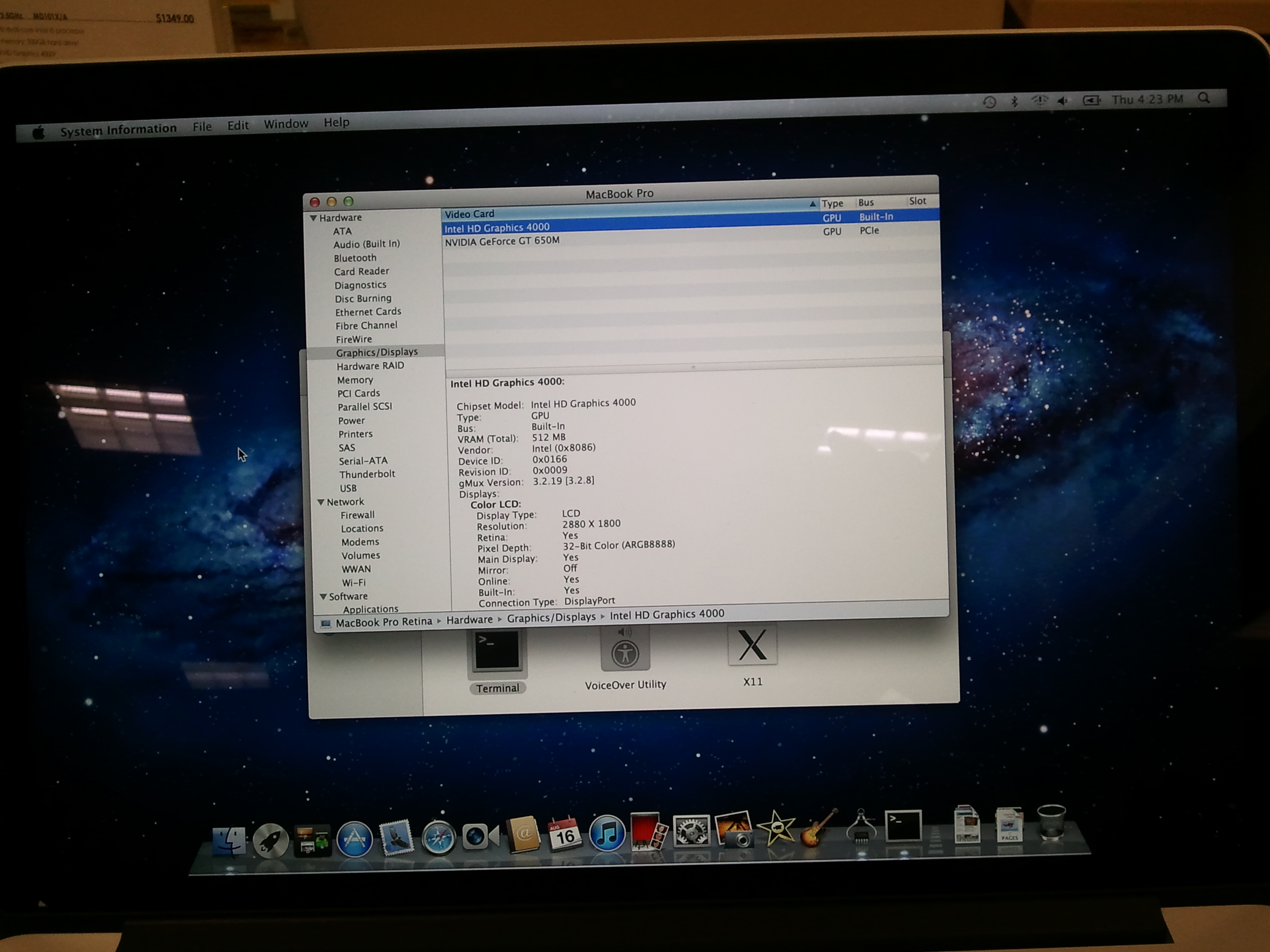
Image of a Macbook Pro with a Retina display showing how badly it reflects When I previously wrote about the Retina display in the new Macbook Pro I was so excited that I forgot to even check whether the display reflects light [1]. A TFT display with a mirrored surface apparently permits more intense color which is generally a good thing. It also makes it easier to clean the surface which is really important for phones and tablets. The down-side of a mirrored surface on a display is that it can reflect whatever else is in the area. This generally isn t a problem in an office as you can usually adjust the angle of the monitor and the background lighting to avoid the worst problems. It s also not a serious problem for a hand-held device as it s usually easy to hold it at an angle such that you don t have light from anything particularly bright reflecting. But my experience of laptop use includes using them anywhere at any time. I ve done a lot of coding on all forms of public transport in all weather conditions. Doing that with a Thinkpad which has a matte surface on it s screen is often difficult but almost always possible. Doing that on a system with a mirrored display really isn t possible. The above photo of a 15 Macbook Pro model MD103X/A was taken at a Myer store which was specifically designed to make the computers look their best. The overall lighting wasn t particularly bright so that the background didn t reflect too much and the individual lights were diffuse to avoid dazzling point reflections. But even so the lights can be clearly seen. Note that the photo was taken with a Samsung Galaxy S, far from the best possible camera. If I was buying a laptop that would only ever be used in the more northern parts of Europe or if I was buying a laptop to use only at home and at the office then I might consider a mirror display. But as I mostly use my laptop in mainland Australia including trips to tropical parts of Australia and I use it in all manner of locations a mirror display isn t going to work for me. This isn t necessarily a bad decision by Apple designers. My observation of Macbook use includes lots of people using them only in offices and homes. Of the serious geeks who describe their laptop as My Precious hardly anyone has a Macbook while Thinkpads seem quite popular in that market segment. I don t think that it s just the matte screen that attracts serious geeks to the Thinkpad, but it does seem like part of a series of design decisions (which include the past tradition of supporting hard drive removal without tools and the option of a second hard drive for RAID-1) that make Thinkpads more suitable for geeks than Macbooks. While the new tradition in Apple design of gluing things together so they can never be repaired, recycled, or even have their battery replaced seems part of a pattern that goes against geek use. Even when Apple products are technically superior in some ways their catering to the less technical buyers makes them unsuitable to people like me. Maybe the ability to use a Macbook as a shaving mirror could be handy, but I d rather grow a beard and use a Thinkpad. Related posts:
  1. The Retina Display Last night I played with an Apple Macbook Pro with...
  2. are Thinkpads meant to run 24*7? My Thinkpad has started to run hot recently. If I...
  3. presentations and background color In response to my last post about using laptops for...

19 August 2012

John Goerzen: Crazy Enough?

So far this year, I ve read somewhere in the neighborhood of 5000 pages. As I ve started to read more, I ve started to watch TV, movies, and Youtube less, because they are simply boring and shallow in comparison. War and Peace, in particular, deeply touched me. Lately I have been reading the Wheel of Time series, which has its own unique characteristics. Whether an epic (or super-epic, such as Wheel of Time) novel, or the Sherlock Holmes series, or nonfiction works, there is something magical about reading a book. We often see characters, real or fictional, that rise from obscurity to do great things for the world. We are transported in time and place to a time or place we will never be able to experience, perhaps because it is long past, or perhaps because it never was. But in any case, we can be inspired. I am reminded of this quote: The people crazy enough to think they can change the world are the ones that do. If someone told me that a street vendor in Tunisia would, in less than a year, cause the overthrow of 4 dictatorships and reform in a handful more, I would have, yes, thought that was crazy. And while Mohamed Bouazizi isn t a household name in much of the world, he managed exactly that. But not just him. It took crazy unarmed people to occupy Tahrir Square, some to die, for progress to be made in Egypt. This story is written all over history. People have done the impossible, have defied all odds, through sheer belief that they could. Civil rights have been granted due to the leaders we all know, but also due to the millions of marchers we don t. Changing the world doesn t have to mean that the world knows you. It just has to mean that you love the world, as Tolstoy pointed out:
Love hinders death. Love is life. All, everything that I understand, I understand only because I love. Everything is, everything exists, only because I love. Everything is united by it alone. Love is God, and to die means that I, a particle of love, shall return to the general and eternal source.
Whatever your stance on religion, this is a powerful quote. Sometimes particles of love might look crazy. But isn t it then that they are the most alive? Isn t it then that they are the greatest hindrance to death and despair?

16 August 2012

Rapha&#235;l Hertzog: Happy Birthday Debian! And memories of an old-timer

For Debian s birthday, Francesca Ciceri of the Debian Publicity team suggested that developers blog about their first experiences with Debian . I found this a good idea so I m going to share my own early experience. It s quite different from what happens nowadays Before speaking of my early Debian experience, I have to set some context. In my youth, I have always been a Windows user and a fan of Bill Gates. That is until I got Internet at home at that point, I got involved in Usenet and made some friends there. One of those made me discover Perl and it has been somewhat of a revelation for me who had only been programming in Visual Basic, Delphi or ObjectPal. Later the same friend explained me that Perl was working much better on Linux and that Debian Linux installs it by default so I should try this one. I had no idea of what Linux was, but given how I loved Perl, I was eager to try his advice. So I got myself a Tri-Linux CD with Debian/RedHat/Slackware on it and started the installation process (which involved preparing boot floppies). But I did not manage to get the graphical interface working despite lots of fiddling with Xfree86 s configuration file. So I ended up installing RedHat and used it for a few months. But since many of the smart guys in my Usenet community were Debian users, I persisted and finally managed to get it to work! After a few months of usage, I was amazed at everything that was available for free and I wanted to give back. I filed my first bug report in July 1998, I created my first Debian packages in August 1998 and I got accepted as an official Debian developer in September 1998 (after a quick chat over the phone with Martin Schulze or James Troup I never understood the name of my interlocutor on the phone and I was so embarassed to have to use my rusty English over the phone that I never asked). That s right, it took me less than 3 months to become a Debian developer (I was 19 years old back then). I learned a lot during those months by reading and interacting with other Debian developers. Many of those went away from Debian in the mean time but some of them are still involved (Joey Hess, Manoj Srivastava, Ian Jackson, Martin Schulze, Steve McIntyre, Bdale Garbee, Adam Heath, John Goerzen, Marco D Itri, Phil Hands, Lars Wirzenius, Santiago Vila, Matthias Klose, Dan Jacobowitz, Michael Meskes, ). My initial Debian work was centered around Perl: I adopted dpkg-ftp (the FTP method for dselect) because it was written in Perl and had lots of outstanding bug reports. But I also got involved in more generic Quality Assurance work and tried to organize the nascent QA team. It was all really a lot of fun, I could take initiatives and it was clear to me that my work was appreciated. I don t know if you find this story interesting but I had some fun time digging through archives to find out the precise dates if you want to learn more about what I did over the following years, I maintain a webpage for this purpose.
One comment Liked this article? Click here. My blog is Flattr-enabled.

15 August 2012

Jakub Wilk: Spell-checker for irssi

I tried many spell-checkers for irssi, and they all sucked (and some of them were also completely insane). So I took the one that seemed least crazy and forked it.

Sylvestre Ledru: libc++: New C++ standard library in Debian

Thanks to the work of Andrej Belym, Debian has now a new C++ standard library. This work has been done in the context of the Google Summer of Code 2012.
Available in Debian Experimental, this new packages provides both the runtime libraries (libc++abi1) and the C++ headers (libc++-dev). With this library, it is possible to build a C++-based program without any dependency on libstdc++. For example, as detailed in README.Debian, with the (amazing) C++ code:
// foo.cpp
#include <iostream> int main()
std::cout < < "plop" << std::endl;
return 0;
build with clang++ (or g++) will give:
$ clang++ -o plop foo.cpp
$ ldd plop grep c++
libstdc++.so.6 => /usr/lib/x86_64-linux-gnu/libstdc++.so.6 (0x00007f15791cb000)
Using libc++, it will drop the dependency on libstdc++ to use lib++
$ clang++ -stdlib=libc++ -o plop foo.cpp
$ ldd plop grep c++
libc++.so.1 => /usr/lib/x86_64-linux-gnu/libc++.so.1 (0x00007f87464df000)
For the record, it is not that trivial to do with g++. The command being:
g++ -nostdlib -lc++ -lc++abi -std=c++11 -o plop /usr/lib/x86_64-linux-gnu/crt1.o /usr/lib/x86_64-linux-gnu/crti.o foo.cpp /usr/lib/x86_64-linux-gnu/crtn.o -isystem/usr/include/c++/v1 -lc -lgcc_s
Besides this change, libc++ provides a support of C++ 11, considered as "correct" against the C++11 standard by upstream.
// bar.cpp
#include <chrono>
int main()
return 0;
clang++ -stdlib=libc++ -o bar bar.cpp
More information:

14 August 2012

Sven Mueller: UK going completely crazy on cryptography law.

It seems that the UK government recently passed a law that makes it illegal to be unable to decrypt what the law enforcement entities think is encrypted: From http://falkvinge.net/2012/07/12/in-the-uk-you-will-go-to-jail-not-just-for-encryption-but-for-astronomical-noise-too/:
But it s worse than that. Much worse. You re not going to be sent to jail for refusal to give up encryption keys. You re going to be sent to jail for an inability to unlock something that the police think is encrypted. Yes, this is where the hairs rise on our arms: if you have a recorded file with radio noise from the local telescope that you use for generation of random numbers, and the police asks you to produce the decryption key to show them the three documents inside the encrypted container that your radio noise looks like, you will be sent to jail for up to five years for your inability to produce the imagined documents.
This is just insane. Edit: The law was created several years ago, but the blog post somehow made me think it was more recent.

13 August 2012

Robert Collins: minimising downtime for schema changes with postgresql

Two years ago Launchpad did schema changes once a month. Everyone would cross their fingers and hope while the system administrators took all the application servers offline, patched the database with a months worth of work and brought up the servers again running the new QA d codebase. This had two problems:
  1. due to the complexity of the system something like 300 processes have to be stopped or inhibited to take everything offline the downtime duration was often about 90 minutes long irrespective of the schema patch duration. [Some of the processes don't like being interrupted at all].
  2. We simply could not deliver any change in less than 1 week, with the on average latency for something that jumped all the queues still being 2 weeks.
About a year ago we wanted to increase the rate at which schema changes could be carried out the efforts to speed Launchpad up had consumed most low hanging fruit and more and more schema patches were required. We didn t want to introduce additional 90 minute downtime windows though. Adopting incremental migrations the sort of change process described in various places on the internet seemed like a good way to make it possible to apply the schema changes without this slow shutdown-and-restart step, which was required because the pre-patch codebase couldn t speak to the new schema. We could optimise each patch to be very fast by avoiding anything that causes a full table scan or table rewrite (such as adding indices, adding columns with a non-NULL default value). That would let us avoid the 90 minutes of downtime caused by stopping and restarting everything. However, that wasn t sufficient the reason Launchpad ended up doing monthly downtime is that previous attempts to do more frequent schema changes had too high a failure rate. A key reason for patch deployment time blowing out when everything wasn t shut down was due to Launchpad being a very busy system with the use of Slony, schema changes require an exclusive lock on all tables. [More recent versions of Slony only lock some tables, but it still requires very widespread locks for most DDL operations]. We re doing nearly 10 thousand transactions per minute, at any point in time there are always locks open on some table in the system: it was highly improbably and effectively impossible for slonik to get an exclusive lock on all tables in a reasonable timeframe. Background tasks that take many minutes to complete exacerbate this we can t just block new transactions long enough to deliver all the in-flight web pages and let locks clear that way. PGBouncer turns out to be an ideal tool here. If you route all your connections through PGBouncer, you have a single point you can deliberately interrupt to clear all database locks in a second or so (it takes time for backends to all notice that their clients have gone). So we combined these things to get what we called Fast Down Time or FDT. We set the following rules for developers:
  1. Any schema patch had to complete in <= 15 seconds in our schema staging environment (which has a full copy of the production DB), or we d roll it back and redesign.
  2. Any patch could change either code or schema, never both. schema patches were to land on a separate branch and would be promoted to trunk only after deployment. That branch also receives automated merges from trunk after every commit to trunk, so its running the latest code.
This meant that we could be confident in QA: we would QA the new schema and the application process with the current live code (we deploy trunk multiple times a day). We published some documentation about how to write fast schema patches to help socialise the approach. Then we wrote an automated tool that would:
  1. Check for known fragile processes and abort if any were found.
  2. Check for very long transactions and abort if any were found.
  3. Shutdown pgbouncer, disconnecting all clients instantly.
  4. Use slonik to apply one or more schema patches.
  5. Start pgbouncer back up again.
The code for this (call it FDTv1) is in the Launchpad source code history its pretty entangled but its there for grabbing if you need it. Read on to see why its only available in the history :) The result was wonderful we immediately were able to deploy schema changes with <= 90 seconds of downtime, which was significantly less than the 5 minutes our stakeholders had agreed to as a benchmark if we were under 5 minutes, we could schedule downtime once a day rather than once a month. We had to fix some API client code to retry more reliably, and likewise fix a few minor bugs in the database connection handling logic in the appservers, but all in all it was a pretty smooth project. Along the way we spun off a small python helper to run and control pgbouncer, which let us write effective tests for the connection handling code paths. In This gave us the following workflow for making schema changes:
  1. Land and deploy an incremental schema change.
  2. Land and deploy any indices that need to be added these are deployed live using CREATE INDEX CONCURRENTLY.
  3. Land and deploy code changes to populate any additional fields/tables from both application servers, and from cron we do a bulk backfill that does many small transactions while walking over the entire dataset that needs to be updated / populated.
  4. Land and deploy code changes to drop references to the old schema, whatever it was.
  5. Land and deploy an incremental schema change to finalise the change such as making a new column NOT NULL once the backfill is complete.
This looks long and unwieldy but its worth noting that its actually just repeated applications of a smaller primitive:
  1. Make a schema change that is fast and compatible with existing code.
  2. Change code to take advantage of the changed schema
Pretty much any change that is desired can be done using this single primitive. We wanted to go further though the multiple stages required for complex migrations became a burden with one change a day. Fortunately PostgreSQL now includes its own replication engine, which replicates the WAL logs rather than installing triggers on all tables like Slony. Stuart, our intrepid DBA migrated Launchpad to PostreSQL 9.1, updated the FDT tool to work with native replication, and migrated Launchpad off of Slony. The result is again wonderful the overhead in doing a schema patch, with all the protection I described above, is now ~5 seconds. We can do incremental changes in less time than it takes your browser to figure out that a given server is offline. We re now negotiating with the Launchpad stakeholders to get multiple downtime windows each day, with this almost unnoticable, super reliable process in place. Reliability wise, FDT has been superb. We ve had 2 failures: one where we believe we encountered a bug in Slony when dropping two tables at once, and one where we landed a patch that worked on staging but led to lock contention in production so the patch applied, but the system was very unhealthy after that until we fixed it. Thats after doing approximately 60 patches over a 1 year period. We re partway through extracting the patching logic from Launchpad s code base into a reusable tool, but the basic principles will apply to any PostgreSQL environment.

12 August 2012

Patrick Matth i: glusterfs Wheezy status

While many (german) IT magazines write about glusterfs since RedHat has taken it over, here is a short summarzy of the glusterfs Debian packaging status. If you are interested, I am still seeking for help!

John Goerzen: A Verbose, Hands-On Nexus 7 Review

Some of you may have noticed that I am not a concise author. Perhaps that has something to do with the fact that I am not a concise reader. I like facts, details, and lots of them. So as a recent Nexus 7 purchaser, here you go. Genesis I ve long used Android devices, and last year had a company-issued Motorola Xoom, which was the first Google Experience tablet with Honeycomb. That tablet has specs roughly similar to iPads; its 10.1 screen was the same, the 1280 800 screen was better than the iPad available at the time, and its 730g weight identical to the early iPads (though 10% higher than the current iPad). I lost access to it when I changed jobs, and had been without a tablet until recently. Other devices I own are the Galaxy Nexus, sporting a 4.65 screen; and what s now called the Kindle Keyboard, with an eInk screen. I had been somewhat interested in the Kindle Fire, but the closed nature and limited capability of the system kept me away. The Nexus 7 reviews, however, were stunning, as was the price. $200 for a great tablet. I wound up buying the $250 16GB model. But not until after I spent a great deal of time thinking about size. Physical Size My main concern was that the Nexus 7 would be too small to be useful. I had never been particularly pleased with my input speed on the Xoom. I tried to touch type on it, but was just never fast enough to surpass frustratingly slow. I have long been a fast and accurate typist on keyboard; well over 100 words per minute, and it is frustrating when my fingers can t maintain that speed. I figured the situation would be even worse on the Nexus 7, given its smaller size. I also found the Xoom to sometimes feel a little small with the 10 screen, and was concerned about that as well. And finally, 7 doesn t sound all that much larger than 4.65 . However, having actually had the Nexus 7 for a little while now, I m very pleased with the size, and may even prefer it. The 10 tablets are just too big and heavy to comfortably hold in one hand, and I ve realized that part of my Xoom frustration was the fact that I had to set it down and prop it up for anything beyond very brief use. At 340g, the Nexus 7 is less than half the weight of the Xoom or iPad, and it makes a huge difference. While still nowhere near where I d be with a keyboard, two-thumb typing in portrait mode, or even something approaching touch typing in landscape mode, is possible on the Nexus 7. The screen size hasn t been a bother, at all. This may be due to the fact that it s higher resolution (it s 1280 800 like the Xoom, but those pixels are crammed into only 7 ). I think it s also partly due to the fact that the browser in Jelly Bean is significantly better than the one in Honeycomb, and perhaps that websites are better at tablet-friendliness, too. Overall, the Nexus 7 feels a lot farther from the size of a laptop than did the Xoom, and as such is more prone to come with me in lots of situations, I think. It works reasonably well with foldable Bluetooth keyboards, so when thinking about a laptop replacement or alternative, that might be the way I go. A Bluetooth mouse also works with it, though I found it didn t provide near the utility that a BT keyboard does. Display The display is both amazing and disappointing. Browse some photos and some of them will show up in eye-popping clarity. Websites display fine. But the screen can also take on a washed-out appearance at times. I am notoriously picky in my displays, and this bothered me enough that I researched it. Analysis has shown that poor firmware calibration has lead to the compression of highlights, which mirrors what I was seeing. I am mostly used to it by now, but it s a disappointment. Most of the time, though, the screen is excellent. In comparison to my eInk Kindle, however, I don t think any tablet will ever be as good for book reading. The eInk screen truly is easier on the eyes, and the reflection of overhead lights on the Nexus 7 display can be distracting at first. I have had occasional issues with it not registering touches properly. This is always cleared up by touching the power button to put the unit to sleep, then waking it back up. Other Hardware There are three hardware buttons: power and volume up/down. Physically, the device fits my hand well, though I might wish it was a little lighter like my Kindle. Charging is accomplished via high-power 2A micro-USB, and there is, of course, a headphone port. There is no alert LED like my Galaxy Nexus has, and no vibration feature. The speaker is on the back, and the microphones along the left side a position which, it appears, many Nexus 7 cases are blocking. Battery Life I am astonished at how good this device is battery-wise, especially compared to the battery disaster that is the Galaxy Nexus. Google claims the Nexus 7 can survive 8 hours of solid screen-on use, and I don t doubt it. Mine s never gotten low enough to get a solid measurement. Wifi The wifi works well, as far as it goes. The wifi doesn t support 802.11n in 5GHz, which although somewhat common for devices like this, is a bit of a disappointment. Software The big story about the Nexus 7 is Jelly Bean. I had used Honeycomb on the Xoom, and Ice Cream Sandwich on my Galaxy Nexus, so I m familiar with its predecessors. Let s take a look. Project Butter Much has been made of Project Butter, Google s attempt to optimize Android to improve its responsiveness and the smoothness of things like scrolling. I can say they have done quite well. This device is so smooth you don t notice how smooth it is. It wasn t until I had been using it for a bit that I really noticed. That s a job well-done. Chrome The browser in Jelly Bean is now called Chrome. I am not sure if this is just marketing or not. It doesn t really feel all that different from previous versions of the Android browser, and the changes have been along the lines of incremental changes Google has introduced before. One of the very best new features happens when you touch a link that is close to other links on a page. Rather than getting a pretty much random page, Chrome pops up a partial-screen zoom box showing the part of the page near where your finger touched. With everything showing up huge, it is now easy to touch the precise link you want. Do so, and the box goes away, and your page loads. I am amazed at how much improvement this one change brings. Compared to ICS Browser, bookmarks can be brought up quicker, and the tab interface is nicer. All is not perfect in the land of Chrome, however. It contains several regressions from the Ice Cream Sandwich browser. I have two complaints about bookmarks. One is that previous versions of the browser would show thumbnails of sites in the bookmark viewer. This was a nice navigation aid. Chrome shows only favorites icons, if one is available, or a generic icon if not. Also, the bookmarks synced with other Android devices are called, confusingly enough, Desktop Bookmarks now, and require an extra tap to access. I have had occasional trouble with Chrome not wanting to prompt for credentials for servers on my LAN that use HTTP auth. Chrome has also removed the ICS browser s ability to save a page, including all its elements, for offline viewing. Good for things like an airline checkin screen and such. I have no idea why Chrome removed this. I installed the Firefox Beta for Android, which also doesn t have the offline save feature, but it does have a save to PDF feature. Soft Keyboard The on-screen soft keyboard in Jelly Bean is a significant regression from previous versions of Android. My biggest complaint is the lack of visual feedback for keypresses. On earlier versions of Android, when you push a key, you ll see an image of it pop up on the screen, offset a little from the location of the key itself. In JB, all that happens is that the key itself changes colors. Not very helpful, because it is under your finger at the time. This small thing frustrates me to no end. The keyboard in ICS introduced some nice features as well, mainly long-presses as shortcuts to other features. For instance, you can long-press a key on the top row of letters to get numerals without having to switch to the number mode. Similarly, long press the period and you get other common punctuation. The JB keyboard removed both of those features. Thankfully, in the Market, there is an app called Ice Cream Sandwich Keyboard. It appears geared towards people running earlier versions of Android. Sadly, it is also a step up over what we have in JB. Google Now and Voice Recognition The other main headline feature in Jelly Bean is Google Now. The somewhat-competitor to Apple s Siri, Google Now takes a bit of a different approach than Apple. It is said that Siri is better than Google Now at responding to queries, but Google Now is better at predicting what you want to know before you ever ask. I haven t ever used Siri, but I would buy that explanation. Google Now is available with a swipe up from the bottom of the screen, or with a single touch from any Home screen. Bring it up and it shows you current information about what it thinks you need to know. Examples include weather and forecast information, time to get to home or work from your current location, alerts that you need to leave soon to get to a certain place on time, flight schedules, sports scores, etc. Google Now has been mostly a gimmick to me, but that may be because I fall outside its target demographic in significant ways. I live nowhere near a public transportation system, work at home for the most part, haven t flown wince I ve had the Nexus 7, don t follow sports, and already know how long it takes to get places (and when it varies, it s because of muddy roads or harvest neither things that traffic services know about.) The weather widget always seems to show the temperature from a couple of hours ago. It does show the weather in your current location. Well, mostly. I was in Newton, KS one day. I tapped on the icon for more detail. That simply took me to a Google search for weather Newton . Which showed me the weather for Newton, Massachusetts 1600 miles away. Fail. Speech recognition in JB is definitely improved. It is somewhat useful with Google Now. I like being able to simply say set alarm for 30 minutes. And it does it a lot quicker than I could in the interface. It s supposed to be able to let me bring up my contacts in the same way, but it is much more likely to try turning such an attempt into a Google search than an actual display of a contact. It s picky on the precise language used for setting an alarm too; say it slightly differently, and it s another Google search. JB also supports limited offline speech recognition. I say limited because it s a bit strange. I have, for instance, a Remember the Milk widget on my home screen. It has a microphone icon to use to speak a new reminder. Tap it, and you can t use it offline. It also has a button that brings up the on-screen keyboard. Do that, then touch the microphone on the keyboard, and you can use offline recognition. I have no idea how to explain this difference, since both are clearly using Google s engine. The speech recognition is indeed better, and might make it suitable for use instead of a keyboard for composing short texts and such. But it rarely produces even a sentence that I don t have to correct in some way, even now. Conclusion Despite some of its shortcomings, I am very fond of the Nexus 7. It is an excellent device. And at $200-$250, it is an AMAZING device. I am truly impressed with it, and don t regret my purchase at all.

11 August 2012

Russ Allbery: Review: Design Patterns

Review: Design Patterns, by Erich Gamma, et al.
Author: Erich Gamma
Author: Richard Helm
Author: Ralph Johnson
Author: John Vlissides
Publisher: Addison-Wesley
Copyright: 1995
Printing: September 1999
ISBN: 0-201-63361-2
Format: Hardcover
Pages: 374
Design Patterns: Elements of Reusable Object-Oriented Software by the so-called "Gang of Four" (Gamma, Helm, Johnson, and Vlissides) is one of the best-known books ever written about software design, and one of the most widely cited. The language introduced here, including the names of specific design patterns, is still in widespread use in the software field, particularly with object-oriented languages. I've had a copy for years, on the grounds that it's one of those books one should have a copy of, but only recently got around to reading it. The goal of this book is to identify patterns of design that are widely used, and widely useful, for designing object-oriented software. It's specific to the object-oriented model; while some of the patterns could be repurposed for writing OO-style programs in non-OO languages, they are about inheritance, encapsulation, and data hiding and make deep use the facilities of object-oriented design. The patterns are very general, aiming for a description that's more general than any specific domain. They're also high-level, describing techniques and methods for constructing a software system, not algorithms. You couldn't encapsulate the ideas here in a library and just use them; they're ideas about program structure that could be applied to any program with the relevant problem. With the benefit of seventeen years of hindsight, I think the primary impact of this book has been on communication within the field. The ideas in here are not new to this book. Every pattern in Design Patterns was already in use in the industry before it was published; the goal was taxonomy, not innovation. One would not come to Design Patterns to learn how to program, although most introductory texts on object-oriented programming now borrow much of the pattern terminology. Rather, Design Patterns is as influential as it is because it introduced a shared terminology and a rigor around that terminology, allowing writers and programmers to put a name to specific program structures and thus talk about them more clearly. This also allows one to take a step back and see a particular structure in multiple programs, compare and contrast how it's used, and draw some general conclusions about where it would be useful. I have the feeling that the authors originally hoped the book would serve as a toolbox, but I think it's instead become more of a dictionary. The pattern names standardized here are widely used even by people who have never read this book, but I doubt many people regularly turn to this book for ideas for how to structure programs. Design Patterns is divided into two parts: a general introduction to and definition of a software pattern followed by a case study, and then a catalog of patterns. The catalog is divided into creational patterns (patterns for creating objects), structural patterns (patterns for composing objects into larger structures), and behavioral patterns (patterns for interactions between objects). Each pattern in turn follows a very rigid presentation structure consisting of the pattern name and high-level classification, its basic intent, other common names, a scenario that motivates the pattern, comments on the applicability of the pattern, the structure and classes or objects that make up the pattern, how those participants collaborate, how the pattern achieves its goals, comments on implementation issues, sample code, known uses of the pattern in real-world software, and related patterns. As with a dictionary, the authors go to great lengths to keep the structure, terminology, and graphical representations uniform throughout, and the cross-referencing is comprehensive (to the point of mild redundancy). As for the patterns themselves, their success, both as terminology and as useful design elements, varies. Some have become part of the core lexicon of object-oriented programming (Factory Method, Builder, Singleton), sometimes to the point of becoming syntactic elements in modern OO languages (Iterator). These are terms that working programmers use daily. Others aren't quite as widespread, but are immediately recognizable as part of the core toolkit of object-oriented programming (Adapter, Decorator, Proxy, Observer, Strategy, Template Method). In some cases, the technique remains widespread, but the name hasn't caught on (Command, for example, which will be immediately familiar but which I rarely hear called by that name outside of specific uses inside UI toolkits due to ambiguity of terms). Other patterns are abstract enough that it felt like a bit of a reach to assign a name to them (Bridge, Composite, Facade), and I don't think use of those names is common, but the entries are still useful for definitional clarity and for comparing similar approaches with different implications. Only one pattern (Interpreter) struck me as insufficiently generic to warrant recording in a catalog of this type. So far, so good, but the obvious question arises: if you've not already read this book, should you read it? I think the answer to that is debatable. The largest problem with Design Patterns is that it's old. It came late enough in the development of object-oriented programming that it does capture much of the foundation, but OO design has continued to change and grow, and some patterns have either been developed subsequently or have become far more important. For example, Model-View-Controller is conspicuous by its absence, mentioned only in passing in the discussion of the Observer pattern. Any pattern catalog written today would have an extensive discussion. Similarly absent are Inversion of Control and Data Access Object, which are much more central to the day-to-day world of the modern programmer than, say, Memento or Visitor. One could easily go on: Lazy Initialization, Mock Object, Null Object... everyone will have their own list. A related problem is that all the implementation examples are shown in either C++ or Smalltalk (occasionally both). Those were probably the best languages to use at the time, but it's doubtful a modern rewrite would choose them. Smalltalk, in particular, I found nearly incomprehensible for the uninitiated, to the point where I ignored the code and only read the surrounding English description. C++ fares better, but Design Patterns occasionally drifts off into tedious discussions of how to work around C++'s limitations in ways that are irrelevant to the pattern itself and would not be necessary in, say, Java or Python. (This is ameliorated by the fact that C++, unlike Smalltalk, is still in widespread use, so those discussions remain moderately helpful for some readers.) Design Patterns is not, therefore, a very good source for a working knowledge of the most common patterns in use today. It has also become somewhat obsolete via its own success: the concept of a design pattern has become so popular that nearly all introductory texts include at least a basic discussion of design patterns and an introduction to the most notable and useful patterns. I think that's a more comfortable and more efficient way to pick up the basics than reading through this book, which is somewhat dense and which expects from the reader a reasonably good working knowledge of object-oriented programming. And, once you have the basics, MVC, DAO, and similar design patterns are probably more important than the more subtle design patterns presented here. That said, I think the rigor of description and the comparisons and discussions here still have some value. Design Patterns encourages the reader to look at patterns from a higher-level perspective, to think about meta-patterns such as the balance between data hiding and access, or between structure designed for the present purpose and structure that's adaptable to future needs. It's also mildly interesting from a historical standpoint; one can see the inspiration for future language designers in how problems are described here, and see how many of the implementation issues and negative consequences have been corrected or simplified by richer language designs. Overall, I would hesitate to recommend buying this book today, particularly at new textbook prices. But if you're a working object-oriented software designer or programmer, I think it's worth checking out from a library (and, thanks to its influence, any library with a decent software design section will almost certainly have a copy). Read the overall discussion, skim the catalog, and read the discussion of the patterns that strike your interest. It may help provide some additional structure and perspective to how you think about OO design. Rating: 6 out of 10

9 August 2012

C.J. Adams-Collier: Linus on Instantiation and Armadaification

I feel a sense of pride when I think that I was involved in the development and maintenance of what was probably the first piece of software accepted into Debian which then had and still has direct up-stream support from Microsoft. The world is a better place for having Microsoft in it. The first operating system I ever ran on an 08086-based CPU was MS-DOS 2.x. I remember how thrilled I was when we got to see how my friend s 80286 system ran BBS software that would cause a modem to dial a local system and display the application as if it were running on a local machine. Totally sweet. When we were living at 6162 NE Middle in the nine-eight 292, we got an 80386 which ran Doom. Yeah, the original one, not the fancy new one with the double barrel shotgun, but it would probably run that one, too. It was also totally sweet and all thanks to our armadillo friends down south and partially thanks to their publishers, Apogee. I suckered my brothers into giving me their allowance from Dad one time so that we could all go in on a Sound Blaster Pro 16 sound card for the family s 386. I played a lot of Team Fortress and Q2CTF on that rig. I even attended the Quake 3 Arena launch party that happened at Zoid s place. I recall that he ported the original quake to Linux. I also recall there being naughty remarks included in the README.txt. When my older brother, Aaron turned 16, he was gifted a fancy car. When asked what type of car I would like when I turned 16, I said that I d prefer a computer instead. So I got a high-end 80486 with math co-processor. It could compile the kernel in 15 minutes flat. With all the bits turned on on in /usr/src/linux/.config. But this was later. I hadn t even heard of linux when I got my system. I wanted to be entertained by the thing. I made sure to get a CD-Rom and a sound card. I got on the beta for Ultima Online and spent a summer as a virtual collier. Digging stuff out of mines north of Britannia and hauling them to town to make weapons and armor out of them. And then setting out in said armor only to be PK d because I forgot healing potions and I was no good at fighting. While I was in the middle of all this gaming, my friend Lucas told me that I should try out this lynx thing that they run at the University of Washington. He heard that it was reported to run doom faster than it ran on MS-DOS. It turns out that it did, but that it was not, in fact, called lynx. Or pine. The Doom engine ran so fast that the video couldn t keep up. This was probably because they didn t use double buffering for frame display, since they didn t want to waste the time maintaining and switching context. I think I downloaded the boot/root 3.5 disk pair and was able to get the system to a shell with an on-phone assist from the Rev. I then promptly got lost in bash and the virtual terminals (OMG! I GET SIX CONSOLES!?) and bought a book on the subject. It shipped with slackware. Which I ran. Until Debian came along. Lucas also recommended that I try out this IRC thing, so I did. And I m still doing it on #linpeople just like I did back then. I learned to write Pascal on dos. Then I learned c while they were trying to teach me c++. I learned emacs and vi when I was attending North Kitsap High School. I learned sed and only a little awk when I took Running Start classes in Lynnwood at Edmonds Community College and perl & x.509 while attending Olympic Community College and simultaneously jr-administering Sinclair Communications. I studied TCP/IP, UNP, APUE, C and algorithms & data structures while preparing for an interview with a company whose CEO claimed to have invented SCSI. I learned PGP and PHP while writing web-based adware for this company. I didn t want to write ads and instead wanted to work in security, so took a job with Security Portal. While there, I wrote what one might call a blogging platform. It worked and made it possible for authors to write prose and poetry. Editors didn t have to manage a database in order to review and publish the posts that were ready. Everyone but me was able to avoid html and cgi. Then I sold pizza. Then I helped bring the bombay company onto the interwebs using the Amazon ECS (now AWS) platform. Then I helped support MaxDB. Then I helped develop and maintain the Amazon blogging platform. And then attempted to reduce the load on the Amazon pager system by doing and enforcing code reviews. It turns out that they prefer to run their support team at full bore and a load average of 16.
<iframe allowfullscreen="" frameborder="0" height="288" scrolling="no" src="http://www.youtube.com/embed/MShbP3OpASA" width="448"></iframe>
I am now, still, fully employed in an effort to make hard things possible. The hard thing we re working on now is the implementation and ongoing operations of distributed x.500 infrastructure. This includes request handling, processing and delivery of response ( la HTTP, SMTP, IMAP, SIP, RTP, RTSP, OCSP) including authentication, authorization and auditing (AAA) of all transactions. It s a hard thing to get right, but our product development team gets it right. Consistently and reliably. We make mistakes sometimes (sorry Bago), but we correct them and make the product better. I m the newest member of an R and d team (note: big R, little d) called NTR, which sits behind the firewall that is Product Development, out of production space. In a manner that reminds me of Debian Testing. We try new things. Our current project is to allow users to compare their current (cloud-based or iron-based) IT system with what their system would be like with a BIG-IP in front of it. I can probably come up with a demo if anyone s interested in checking it out. I ll go work on that now.

5 August 2012

Dirk Eddelbuettel: Counting CRAN Package Depends, Imports and LinkingTo

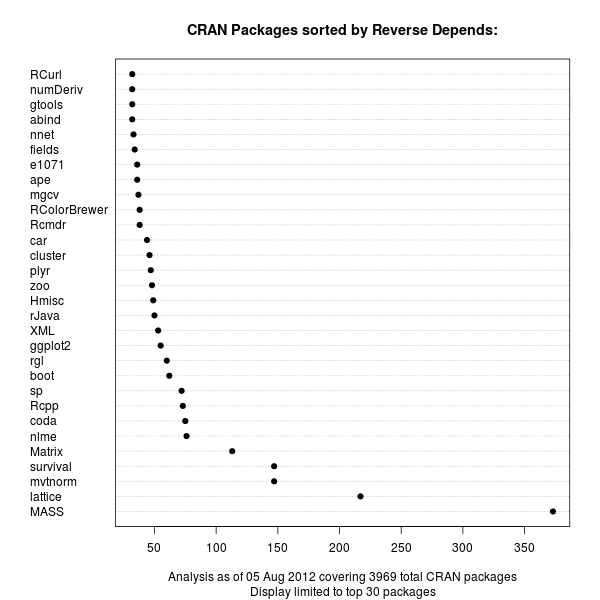
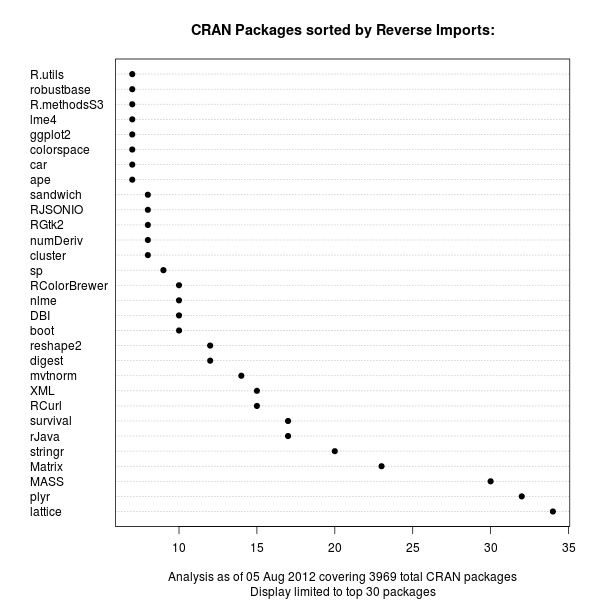
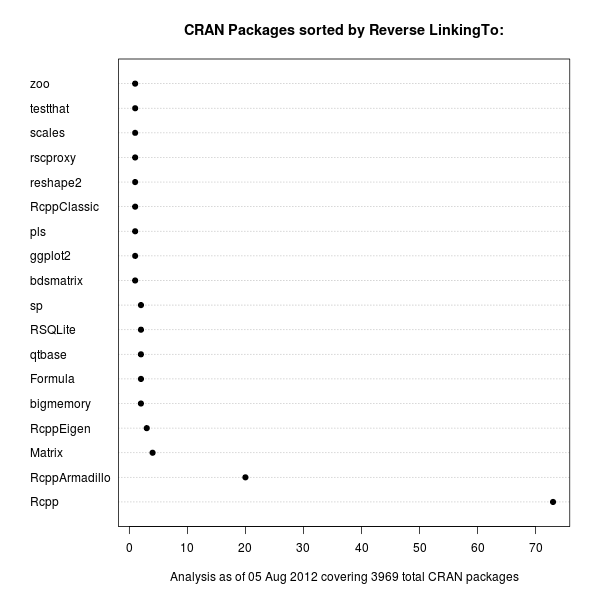
The recent update by S ren H jsgaard's to his gRbase package for graphical models made it the 75th package to depend on our Rcpp package for R and C++ integration. So in a lighthearted weekend moment, I tweeted about gRbase being number 75 for Rcpp to which Hadley replied, asking if Rcpp was in fact number one among R package Depends. Far from it, and I immediately replied listing lattice and Matrix as packages with way more other packages depending upon them. But as the question seemed deserving of a bit more analysis, I spent a few minutes on this and prepared three charts listing package in order of reverse Depends, reverse Imports and reverse LinkingTo. First off, the reverse Depends:. This is the standard means of declaring a dependence of one package upon another. CRAN package chart of Reverse Depends relations Unsurprisingly, the MASS package from the classic Venables and Ripley book comes first, with Deepayan Sarkar's powerful lattice package (also covered in a book) coming second. These are both recommended packages which are commonly distributed with R itself. Next are mvtnorm and survival. Our Rcpp is up there in the top-ten, but not a frontrunner. With the advent of namespaces a few R releases ago, it became possible to import functions from other packages. So the Imports: statement now provides an alternative to the (older) Depends:. The next chart displays the same relationship for Imports:: CRAN package chart of Reverse Imports relations Now lattice still leads, but Hadleys's plyr package grabbed the second spot just before MASS and Matrix. It is interesting to see that the sheer number of Imports: is still not where the Depends: are. On the other hand, we see a number of more recent packages popping up in the second chart. This may reflect more recent coding practices. It will be interesting to see how this stacks up over time when we revisit this chart. Lastly, we can also look at LinkingTo:, a declaration used to provide a C/C++-level dependency at the source code level. We use this in the Rcpp family to provide automatic resolution of the header files needed to compile against our packages. And unsurprisingly, because packages using Rcpp actually use its API (rather than R functions), the package is a little ahead of others. In the package we find three more packages of the Rcpp family, but only a limited number of other packages as C/C++-level dependencies are still somewhat rare in the R universe. There are also fewer packages overall making use of this mechanism. CRAN package chart of Reverse LinkingTo relations One could of course take this one level further and sum up dependencies in a recursive manner, or visualize the relationship differently. But these dotchart graphs provide a first visual description of the magnitude of Depends, Imports and LinkingTo among CRAN packages for R.

4 August 2012

Russell Coker: Love of Technology at First Sight

After seeing the Retina display I ve been thinking about the computer products that I ve immediately desired. Here is the list of the ones I can still remember:
  1. My first computer which was the TEC-1 [1], in 1982 or 1983.
  2. A computer with a full keyboard and a monitor (Microbee), in about 1984. A hex-only keypad is very limiting.
  3. Unix, initially SunOS 4.0 in 1991. Primarily the benefits of this were TCP/IP networking, fast email (no multi-day delay for Fidonet mail), IRC, and file transfer from anywhere in the world. Not inherent benefits to Unix, but at the time only Unix systems did TCP/IP at all well.
  4. OS/2 2.0 in 1992. At the time OS/2 had the best GUI of any system available (IMHO) and clearly the best multitasking of DOS and Windows programs.
  5. Linux in 1992. I started with the TAMU and MCC Interim distributions and then moved to SLS when it was released. The first kernel I compiled was about 0.52. At the time the main use of Linux for almost everyone was to learn about Unix and compile kernels. In 1993 I started running a public access Linux server.
  6. Trinitron monitors in 1996. I first saw an IBM Trinitron monitor when working on an IBM project and had to buy one for home use, at the time a 17 Trinitron monitor beat the hell out of any other display device that one could reasonably afford. A bigger screen allowed me to display more code at once which allowed easier debugging.
  7. Thinkpad laptops from 1998 until now. They just keep working well and seem to be better than other products every time I compare them. I also like the TrackPoint. 1998 was when a Thinkpad dropped to a mere $3,800 for a system that could run with 96M of RAM, enough compute power for the biggest compiles and it cost less than most cars!
  8. The KDE desktop environment in 1998. In 1998 I switched my primary workstation from a PC running OS/2 to a Thinkpad running Linux because of KDE. Prior to KDE nothing on Linux was user-friendly enough.
  9. The iPaQ hand-held PC. I got one in 2002 and ran the Familiar distribution of Linux on it. I had it running SE Linux and used it for writing an article for Linux Journal. Being able to get a computer out on public transport to do some work really saved some time. In some ways the iPaQ hardware and the Familiar OS beat modern Android systems.
  10. The EeePC 701 which I bought in 2008 [2]. In the last 4 years someone has probably released a system that s no larger or heavier and has the same amount of compute power (enough for web browsing, email, and ssh). But most Netbooks that I ve seen don t compete. The EeePC allowed me to take laptops to places where it previously wasn t convenient.
  11. Android, before using Android I never had a smart phone that I used for anything other than taking photos. The other smart phone OSs are either locked down or don t have the app support that Android has. I listed lots of problems with my first phone the Sony Ericsson Xperia X10, but I still really enjoyed using it a lot [3]. Since getting an Android phone I ve read a lot of email while on the go, this means I can respond faster when necessary and use time that might otherwise be wasted. The ssh client means that I don t need to carry a laptop with me when there s a risk that emergency sysadmin work may be required.
  12. Cheap rented servers, Amazon defined cloud computing with EC2, Linode offers great deals for small virtual servers, and Hetzner offers amazing deals on renting entire servers. Getting your own Internet connection or running your own physical server in someone s data-center is a lot of effort and expense. Being able to just rent servers is so much easier and allows so many new projects. I can t remember when I first started using such services, maybe 5 years ago.
  13. The Apple Retina Display [4] a few days ago.
For the period between 1998 and 2008 I can t think of anything that really excited me apart from the iPaQ. Computers became a lot smaller, faster, cheaper, etc. But it was never a big exciting change. The AMD64 architecture wasn t particularly exciting as most systems didn t need more than 4G of RAM and the ones that did could use PAE. What are the most exciting computer products you have seen? Related posts:
  1. Old PDA vs New Mobile Phone for PDA use Since about 2002 I have been using a iPaQ [1]...
  2. CyanogenMod and the Galaxy S Thanks to some advice from Philipp Kern I have now...
  3. Moving from a Laptop to a Cloud Lifestyle My Laptop History In 1998 I bought my first laptop,...

31 July 2012

Christian Perrier: Discovering a new package: HotelDruid

What is good in "my" job in Debian are opportunities to discover new interesting packages. While surveying the completion of debconf translations in unstable, I thus noticed a new package named "hoteldruid", that has a few questions and interaction with users. After my usual mumble because French and a few other languages were *finally* virtually 100% in unstable for a few days...... I went on my usual task in such cases: propose a review of debconf templates and package description to my fellow debian-l10n-english co-workers (/me bends to Justin B. Rye, our tireless, picky, efficient and very clever Master Reviewer for over 5 years now). Then I discovered what HotelDruid is about: this is a piece of PHP-based software meant to manage....an hotel or bed and breakfast...or any kind of such facility. Real end-user software. Really useful software. For real people...:-) Not the gazillionth obscure development language, or yet another encryption library, or yet another mysterious virtualization thing used by 10 people in the world (even if they host thousands of machines). These are the free software pieces I like the most. Probably Marco Maria Francesco De Santis (the upstream author and Debian package maintainer) somewhere in, I guess, Italy is running a small B&B (or maybe his parents, or his wife/cousin/whatever) *and* is a free software addict. And he wanted to run his business with free software. Same for this French genealogist who once wanted to display his data over the web (and make a real use of that obscure Ocaml language.....yes, pun itended to my friends, here). Of the person who wrote LedgerSMB to manage his business. Or those who use free software to manage hospitals (hi Andreas) or schools (hi DebianEdu folks...and special hi to Petter). Real software for real people. Of course, developed with obscure geeky things used only by those weird geeks who like to sometimes travel half a planet to just gather together and develop the best free operating system ever. Guess what? I like this! And guess what? I proposed the HotelDruid author to check whether we could imrove....translation, of course..:-)

29 July 2012

Joey Hess: build a dynamic webapp in Yesod in just three days

This screencast shows what I built. Scroll down for my Yesod braindump. <video controls="controls" src="http://joeyh.name/screencasts/git-annex-webapp.ogg"></video> video link I've been astonished how quickly this went together. This is my first time using any sort of web framework, and I used a still unusual one, Yesod. It's my first time using Bootstrap too. It's also the first time I've done any AJAX programming! Bootstrap was something I'd heard of and seen some suspiciously similar looking sites built with, but it was really a pleasant surprise. Being able to make things that work and look good on the web without struggling with CSS is such a nice change. For the first time, it makes the web feel like a UI toolkit to me. As I've learned Yesod, I kept seeing problems the web framework solves that I either solved in an ad-hoc basis in Ikiwiki, or didn't realize were problems. In the former group are things like having a consistent way to store a URL to redirect to after an action (such as logging in) finishes, and generating urls programmatically in ways that avoid broken links. In the latter group are things like exploiting types to guarantee mistakes can't be made. And also the abstraction of widgets, which combine html, css, and javascript, in a way that can be composed with other widgets. Overall, I'm really enjoying Yesod, and it's making me productive in new ways. I also see a lot of potential in Yesod to improve from where it is.
    webpage = bootstrap Dynamic $ do
        setTitle "FooCorp"
        login <- getLogin
        navbar [FixedTop] $ do
            brand "FooCorp"
            link AboutR
            link BlogR
            nav [PullRight] $
                link . maybe LoginR ProfileR login
        div [ContainerFluid] $ content login
        where
            content Nothing = heroUnit $ do
                para $ "We're the FooCorp for you."
                button "Register Today" [Primary, Large] SignUpR
                carousel
                    [ amazingFeatures
                    , aboutFooCorp
                    , pricing
                    ]
            content (Just user)  = do
                para $ "Welcome back " ++ name user ++ "!"
                showProfile user

28 July 2012

John Goerzen: How to get started programming?

I have been asked for advice from several people recently on how to get started programming, or how to further develop a nascent interest in coding or software engineering. The people asking the questions range in age from about 10 years old to older than me. These are people that, for various reasons, are not very easily able to take computer science courses right now. One would think that, since I ve been doing this for somewhere around a quarter century (oh I do feel old now), that I d be ready to offer up some great advice. And offer some suggestions I have. But I m not convinced they re good ones. I have two main tensions. The first is that I, like many in the communities I tend to hang out in such as Debian s, have a personality that leads me to take a deep dive into details of anything that holds my interest. Whether it s Linux, Haskell, or amateur radio, I want to do more than skim the surface if I m having fun with it. Many people are not like that. They may have a lot of fun programming in Visual Basic, not really caring that other languages are out there. Or some people are not like this yet. I feel unqualified to provide good advice to people that are different from me in that way. To put it a different way: most people don t want to wait 4 years to be useful, and want to start out right away and get better over time (and I was the same way too.) The second is related. I learned programming at a time when, other than BASIC, interpreted languages were not really available to me. (Yes, they were available, but not to me.) I cut my teeth on BASIC, Pascal, and C. Although I rarely use C anymore, I can still drop into it at a moment s notice and be perfectly comfortable. I feel it was a fundamentally valuable experience, and that it would be very hard to become a great programmer without ever having lived and breathed something like C, where memory and pointers must be managed manually. Having said that, it is probably possible to become a good coder without ever having touched C. Here, then, is an edited version of some rambly advice I sent to someone recently, where learning OOP was particularly mentioned. I would welcome your comments and suggestions. I may point people that ask to this post in the future. For simply learning how to write code, Dive Into Python has long been a decent resource, though it may assume more experience than some have. I haven t read them myself, but I ve also heard good things about the How to Think Like a Computer Scientist series from Green Tea Press. They re all available as free PDF downloads, too! Eric S. Raymond s The Art of Unix Programming is another work I ve heard good things about, despite having never read it myself. A quick glance at the table of contents makes me think that even if people don t wind up working on Unix, the lessons and philosophy should be informative. It seems that many Computer Science programs are using Java for the core of their instruction, or even almost exclusively. Whether that is good or bad, I m not completely sure. It certainly gets people into OOP more deeply, but I m a right tool for the job kind of person. Despite the hype, OO like everything else isn t the right tool for every job. It is fine for people to dive straight into OO and become good programmers/engineers. However, I think it would be difficult to become a great programmer/engineer without ever having a solid understanding of a more low-level language, such as C in particular. I did my CS work when it was mostly based in C, and am glad for it. If someone never has to manage memory or pointers, I suspect they will be at a disadvantage in the long run for not being able to understand or work with the system at a more fundamental level. If a person knows C, plus some concepts of OO and Functional Programming (FP), it should be easy to pick up just about any other language out there. I used to think Python was a great first language, but during the 2.x series they added so much fluff and so many special cases that I m less enthusiastic now, though I don t know how much of that got cleaned up in 3.x. I am not too keen on Java as a first language, because too many things that should be simple aren t. I have a fondness for Haskell, and its close relationship to mathematics could make it a great first language or maybe a poor one, depending on your perspective. One other thing I think it s important for good programmers to have experience with all three major models of programming (procedural, OO, functional.) Even if a person winds up working mostly in one universe, knowledge of and experience with the others is important and informative and, in my experience, leads to better algorithms and architecture all around.

Next.

Previous.