Search Results: "rra"

21 August 2008

Frank Lichtenheld: RC bugs in etch (Starting Stable QA, Part 1)

As everyone can see in the graph of release critical bugs, the number of RC bugs in etch had constantly risen since the release (which was already noted in some other blogs) up until last week. Since I suspected that this number included a lot of false positives, I began to triage this list last week during Debconf. I started with identifying all bugs that were filed against the version in etch, but really only meant the package in testing/unstable (but can't be interpreted correctly with version tracking alone since the version in stable, testing, and unstable is actually identical). There are a lot of reasons why an RC bug might be valid for testing/unstable, but not for stable, even though they share the same package:
Library transitions.
While most cases of library transitions can be handled with targeted binNMUs these days, there remain a few cases where a sourceful upload is needed, e.g. for renamed -dev packages and necessary source changes to adapt to new APIs.
Build-Problems caused by toolchain changes.
Newer gcc versions are often more strict about what constructs they allow. This can cause build problems in a lot of packages once the default version used is increased. Other packages that regulary cause new build problems are linux-libc-dev and dpkg-dev. Since we only require that a package is buildable in the release it is contained in, these are not valid RC bugs for stable.
Changes in the RC policy of the release team.
One example during the lenny release cycle was the use of invoke-rc.d in maintainer scripts to (re-)start daemons. Bugs were filed against a lot of packages not using invoke-rc.d before the etch release but they were only declared to be of RC severity after etch.
etc.
So as the first part of my triaging efforts I tried to identify these cases. I also looked for bugs that were listed as affecting etch due to incomplete version information (i.e. if there is no version given, the bug is assumed to affect all versions). As you can see from the bump in the graph I was able to identify about 200 bugs that met one of these conditions. We should avoid in the future to let the number of false positives grow to such large numbers. Everyone can help with that:
Maintainers
If you get bugs reported without a version number and you can verify that this bug was not present in an older version of the package, add correct "found" information. If you get a bug reported against a version that is both in stable and in testing/unstable, but not valid for stable, tag the bug appropriatly. I would recommend to err on the side of false positives though instead of on the side of false negatives!
Mass-bug filers
Most mass-bug filing that involve RC bugs should use tags to avoid creating false positives.
QA Group
Bugs filed about the proposed orphaning or removal of packages should usually be tagged, since only in very few cases these actually warrant any changes in stable.
At this point you probably ask yourself: What are the appropriate tags? This is much less clear than one might hope, since the involved tags (<suite>) changed/lost their meaning somewhat with the introduction of version tracking. Following my question about the appropriate tags on debian-release the release team and Don Armstrong for the debbugs maintainers seem to have agreed on their new meaning: A bug with suite tags affects the intersection of the set of suites indicated by its version information and the set of suites indicated by its suite tags. Next post: What about the other 600 RC bugs in stable?

20 August 2008

Adam Rosi-Kessel: Walter Michalik and the Roslindale Community Center

I’ve had little time in the four years I’ve lived in Roslindale to get involved in community volunteer efforts. My wife Rachele, however, has devoted several years to efforts such as the Roslindale Community Center, Roslindale Village Main Streets, and Roslindale Clean and Green. She has served as chair of both RCC and one of the RVMS committees. Over the past few months, I’ve been disappointed to see the RCC board endure repeated senseless attacks by a perhaps overzealous community member, Walter Michalik, who has effectively paralyzed the organization. I have nothing personal against this guy, but I thought I could do my part here by publishing an example of an email he broadcast to the committee, which I think is embarrassing enough on its own merits to need no editorializing from me, except to say any email that starts with “just so you won’t be surprised when the IRS launches its investigation” can be neither productive nor taken seriously. The context is a response to an announcement sent out pursuant to the Community Centers By-Laws scheduling a special meeting to discuss the recent upheaval on the Council. There’s no reason this should not be in the public record:
Rachele Just so you won’t be surprised when the IRS launches its investigation, be advised that YOU DO NOT HAVE THE AUTHORITY TO CALL FOR A SPECIAL MEETING. The By Laws do not allow the President/Chair to call for a Special meeting - that right is reserved for the MEMBERS to have a power over a hostile or non-performing President/Chair. It was created by a Membership wary of annimosity within its ranks in order to protect itself from falling into a useless dysfunctional body. That’s why our By Laws require the majority of the membership request it through the Chair and not the other way around. So you screwed that up too. Your continuous violation of rules and laws have proven beyond a doubt that this current Roslindale Community Center Council has violated the trust behind its IRS-designated not-for-profit status. The failures are on so many significant levels over 6 months it is readily apparent that the Roslindale Community is better served without a Community Center Council. There is no longer any excuse to allow the residents of Roslindale to be denied the services they deserve that you and the officers have no idea how to deliver. Because that’s what you are supposed to do - serve the residents of Roslindale and not preseide over a self-serving board. You’ve taken us from dysfunctional to non-functional over the past 60 days. You and your officers have already driven away our Archdale partners and now the merger is off. Congratulations. You got what you wanted. You and the officers have withheld information from the Members of the Council imposing gag orders along the way and in more than one instance spreading lies within this community. There are so very many lapses on your part and the rest of the officers that it is very apparent that the Roslindale Community Center exists IN SPITE OF the Roslindale Community Center Council - not because of it. It would be far better indeed, if the Center were run without the Council. What have you done in 6 months? All you do is avoid the work of leadership. Please, just gracefully step aside and let a real leader emerge - or dissolve the Council and let the Center run itself under BCYF before the IRS makes that happen. Of course this is my stated opinion. You can choose not to belive it. You can huddle with a group of self-serving officers and invent excuses or change the agenda away from the message and continue with your ad hominem attacks against the messenger. I’m thick-skinned. Feelings aren’t important to me - services to residents are important to me. While I have, in fact, enjoyed the confidences of others within this community and their true displesure with this Council, I will produce that to the appropriate authorities as I see fit along with the Bill of Particulars I have produced with documentation for all charges. As a founder of the Roslindale Community Center Council I can no longer support you or the officers as any legitimate authority in this community.
Technorati Tags: , ,

Russell Coker: DNS Secondaries and Web Security

At the moment there are ongoing security issues related to web based services and DNS hijacking. the Daily Ack has a good summary of the session hijacking issue [1]. For a long time it has been generally accepted that you should configure a DNS server to not allow random machines on the Internet to copy the entire zone. Not that you should have any secret data there anyway, but it’s regarded as just a precautionary layer of security by obscurity. Dan Kaminsky (who brought the current DNS security issue to everyone’s attention) has described some potential ways to alleviate the problem [2]. One idea is to use random case in DNS requests (which are case insensitive but case preserving), so if you were to lookup wWw.cOkEr.CoM.aU and the result was returned with different case then you would know that it was forged. Two options which have been widely rejected are using TCP for DNS (which is fully supported for the case where an answer can not fit in a single UDP packet) and sending requests twice (to square the number of combinations that would need to be guessed). They have been rejected due to the excessive load on the servers (which are apparently already near capacity). One option that does not seem to get mentioned is the possibility to use multiple source IP addresses, so instead of merely having 2^16 ports to choose from you could multiply that by as many IP addresses as you have available. In the past I’ve worked for ISPs that could have dedicated a /22 (1024 IP addresses) to their DNS proxy if it would have increased the security of their customers - an ISP of the scale that has 1024 spare IP addresses available is going to be a major target of such attacks! Also with some fancy firewall/router devices it would not be impossible to direct all port 53 traffic through the DNS proxies. That would mean that an ISP with 200,000 broadband customers online could use a random IP address from that pool of 200,000 IP addresses for every DNS request. While attacking a random port choice out of 65500 ports is possible, if it was 65500 ports over a pool of 200,000 IP addresses it would be extremely difficult (I won’t claim it to be impossible). One problem with the consideration that has been given to TCP is that it doesn’t account for the other uses of TCP, such as for running DNS secondaries. In Australia we have two major ISPs (Telstra and Optus) and four major banks (ANZ, Commonwealth, NAB, and Westpac). It shouldn’t be difficult for arrangements to be made for the major ISPs to have their recursive DNS servers (the caching servers that their customers talk to) act as slaves for the DNS zones related to those four banks (which might be 12 zones or more given the use of different zones for stock-broking etc). If that was combined with a firewall preventing the regular ISP customers (the ones who are denied access to port 25 to reduce the amount of spam) from receiving any data from the Internet with a source port of 53 then the potential for attacks on Australian banks would be dramatically decreased. I note that the Westpac bank has DNS secondaries run by both Optus and Telstra (which makes sense for availability reasons if nothing else), so it seems that the Telstra and Optus ISP services could protect their customers who use Westpac without any great involvement from the bank. Banks have lots of phone lines and CTI systems. It would be easy for each bank to have a dedicated phone number (which is advertised in the printed phone books, in the telephone “directory assistance” service, and in brochures available in bank branches - all sources which are more difficult to fake than Internet services) which gave a recorded message of a list of DNS zone names and the IP addresses for the master data. Then every sysadmin of every ISP could mirror the zones that would be of most use to their customers. Another thing that banks could do would be to create a mailing list for changes to their DNS servers for the benefit of the sysadmins who want to protect their customers. Signing mail to such a list with a GPG key and having the fingerprint available from branches should not be difficult to arrange. Another possibility would be to use the ATM network to provide security relevant data. Modern ATMs have reasonably powerful computers which are used to display bank adverts when no-one is using them. Having an option to press a button on the ATM to get a screen full of Internet banking security details of use to a sysadmin should be easy to implement. For full coverage (including all the small building societies and credit unions) it would be impractical for every sysadmin to have a special case for every bank. But again there is a relatively easy solution. A federal agency that deals with fraud could maintain a list of zone names and master IP addresses for every financial institution in the country and make it available on CD. If the CD was available for collection from a police station, court-house, the registry of births, deaths, and marriages, or some other official government office then it should not have any additional security risks. Of course you wouldn’t want to post such CDs, even with public key signing (which many people don’t check properly) there would be too much risk of things going wrong. In a country such as the US (which has an unreasonably large number of banks) it would not be practical to make direct deals between ISPs and banks. But it should be practical to implement a system based on a federal agency distributing CDs with configuration files for BIND and any other DNS servers that are widely used (is any other DNS server widely used?). Of course none of this would do anything about the issue of Phishing email and typo domain name registration. But it would be good to solve as much as we can.

Mart&iacute;n Ferrari: Wunderbar!

DC8 group photoYou can say that DebConf8 is officially is over for you, when you're finally home, after three weeks in Mar del Plata; go to a primary school friend's house to celebrate his birthday, and end the day watching a movie alone. It's also when you delete the reminder for the two weekly IRC meetings, when you have to go back to classes, convince your boss not to kill you because of all the work hours spent on organisation, make your pet cat recognise you again, and be able to make a blog post about it. What can I say about DC8? It's been madness, rush, fun, tiredness beyond belief, intoxication, mao, meetings every day with the hotel, friends that you get to see only once a year, musicians out of key, and pride. Pride of seeing people enjoying themselves, things going more or less as were planned, and being part of a group of people that worked hard to make this dream come true: thanks to all of you! Cl mence Po syOne little thing I brought from MDQ is a copy of In Bruges, a movie I didn't know anything about, but whose title caught me. That's the movie I've just seen and loved because it brought me memoirs of Bruges and Belgium. City and country I visited last year after DebConf, and fell in love with. That's something else that DebConf has been for me: the opportunity to visit countries far away from mine, and not wanting to ever stop. Anyway, I still want to see some fellow debianites before they go to their respective countries. So a barbecue will take place at my home this weekend, just to compete with Steve's. If you're still around, just talk to me to arrange details and eat a little more beef if you hadn't got an overdose yet! By the way, I totally fell in love with Cl mence Po sy after this movie :-) Tags: Planet Lugfi, Planet Debian

19 August 2008

Jonathan McDowell: Back from DebConf8

I got back home from DebConf8 about 11pm last night, having left Mar del Plata at 11am on Sunday morning. 4 hours time difference makes for a 32 hour trip time covering minibus, 2 planes, a coach and a car, 3 time zones (I flew via Madrid) and 4 countries. Not fun, and I'm glad I booked today off to recover. However I'm also exceptionally glad I went to what's probably my best DebConf so far.

Marga and Mart n, along with the rest of the local team, did a fantastic job. The venue was great - I really like it when the talks and accomodation are in the same building. It helps convince me to roll out of bed to the first talk of the day after a late night playing Mao if I know I only have to walk upstairs to get to it! ;) Bonus points for the hotel being actually in the middle of the city so it was possible to go out and walk about during the breaks or in the evening. Special mention to zer0 (website looks down at present, but given that he gave his machine up to act as the schedule announce by the restaurant it should hopefully be back soonish) who arranged for the hotel to supply us with Antares beer, as well as taking us to their pub/restaurant several times.

Mark, Steve and Joerg did the usual great job of running the network. They were hampered by a dodgy 3com switch (don't think they'll be using one of those again), but wireless that coped with roaming between the ground, 1st, 3rd and 7th floors without dropping connections is pretty impressive. Phil Hands' VOIP setup was much appreciated too.

I've got a few notes about the talks I attended that I'll try to write up this week (it might help explain to my workmates just exactly why I went as well), as well as a few todo things I should really post so I actually do some of them. For now I'm going back to relaxing on my sofa and trying not to think about having to go to work tomorrow.

16 August 2008

Ond&#345;ej &#268;ert&iacute;k: I am switching from Mercurial to git

After a long night of debugging and while preparing, reviewing and pushing final patches before a SymPy release, I got this:

$ hg qpush
applying 1645.diff
Unable to read 1645.diff
** unknown exception encountered, details follow
** report bug details to http://www.selenic.com/mercurial/bts
** or mercurial@selenic.com
** Mercurial Distributed SCM (version 1.0.1)
Traceback (most recent call last):
File "/usr/bin/hg", line 20, in
mercurial.dispatch.run()
File "/var/lib/python-support/python2.5/mercurial/dispatch.py", line 20, in run
sys.exit(dispatch(sys.argv[1:]))
File "/var/lib/python-support/python2.5/mercurial/dispatch.py", line 29, in dispatch
return _runcatch(u, args)
File "/var/lib/python-support/python2.5/mercurial/dispatch.py", line 45, in _runcatch
return _dispatch(ui, args)
File "/var/lib/python-support/python2.5/mercurial/dispatch.py", line 364, in _dispatch
ret = _runcommand(ui, options, cmd, d)
File "/var/lib/python-support/python2.5/mercurial/dispatch.py", line 417, in _runcommand
return checkargs()
File "/var/lib/python-support/python2.5/mercurial/dispatch.py", line 373, in checkargs
return cmdfunc()
File "/var/lib/python-support/python2.5/mercurial/dispatch.py", line 356, in
d = lambda: func(ui, repo, *args, **cmdoptions)
File "/var/lib/python-support/python2.5/hgext/mq.py", line 1942, in push
mergeq=mergeq)
File "/var/lib/python-support/python2.5/hgext/mq.py", line 833, in push
top = self.applied[-1].name
IndexError: list index out of range

I am using:

$ hg --version
Mercurial Distributed SCM (version 1.0.1)

Copyright (C) 2005-2008 Matt Mackall and others
This is free software; see the source for copying conditions. There is NO
warranty; not even for MERCHANTABILITY or FITNESS FOR A PARTICULAR PURPOSE.


And I just got pissed off and I am switching to git for good. I've been using mercurial every day since about November 2007, and I think I am quite proficient in it. But we were missing some features, like recording a patch by hunks (git add -p), so Kirill Smelkov (another SymPy developer) just implemented this to mercurial queues, it is now included in hg 1.0. But I am constantly beaten by stupid bugs, mercurial broke into pieces several times already (last time with hg bisect, before it with mercurial queues and file renaming), that just should not happen in a production version. Another problem is that hgweb is constantly using 100% of CPU on my server whenever someone clicks to see the contents of the README file. Again I can spend time debugging it, but I will just use git and if it works, I'll stay with it.

I started learning git recently and it is just better in every aspect. Bigger community, it has all the features that I was always missing in mercurial (like rebase, hunks recording, diff diff --color-words, better gitk). And it's superfast.

Unless I find some showstopper bugs in git too, I don't think I am coming back.

We'll have to create a live mercurial mirror of SymPy, so that people can continue using mercurial, but I'll myself just be using git. We wrote a simple translation table for anyone using mercurial to get started:

http://wiki.sympy.org/wiki/Git_hg_rosetta_stone

I love Python and I like that Mercurial is just a small C core and the rest is in Python, but for some reason, it still has the baby bugs, that should have been fixed years ago and why should we spend our time fixing and improving Mercurial, if other people have already done the job for us (and usually a better job than I could do) in git?

Another reason for switching is that in Debian, mercurial is not used for packages, while git is used a lot.

15 August 2008

DebConf 8 video: Debian Edu 100% in main

This talk will briefly explain what Debian Edu is, how we develop our distribution, how we differ from Debian, how we work on bridging the gaps that still exist and what our plans for the future are.

In July 2007 the Debian Edu project released its third release, codename "Skolelinux 3.0 Terra". Debian Edu is probably the most widely known and most widely used Custom Debian Distribution - at least if you follow the official criteria for a CDD, which we aim to finally fulfill 100% for Lenny: all packages are taken unmodified from Debian main.

This talk will explain the development process of Debian Edu and the various differences to a default Debian install. An overview of the planned features for Lenny will be given as well as a list of current showstoppers will be presented. To explain to the audience, what challenges have been overcome since Debian Edu was started, the history of how 100% inclusion in Debian was achieved, will also be explained. (Debian Edu used to be a seperate distribution! Now we have become a part of Debian!)

Using wiki.debian.org to write a fine manual will be explained briefly too: our documentation is written in a wiki, then exported as docbook and translated using .po files, then transfered back into docbook, to generate html and PDFs versions, which are made available in the debian-edu-doc package, which is installed on a webserver again.

In the end, releasing with Lenny will not be the end of the process of becoming part of Debian. Currently it looks like we might release with Lenny, but then do point releases on our own. Whether this is a sensible strategy or if there are others, will (hopefully) become clearer in future. Until & after the talk - it's a long and winding road!Full event details

14 August 2008

Pablo Lorenzzoni: Finally! We won a battle!

Although far from winning the war against Azeredo s bill, we finally won a battle. Chamber-of-Deputies IT Committee approved the request [pt-BR] for a public hearing [pt-BR]. Although a small step forward, all people involved with entities and NGOs interested in blocking this bill will have a chance to speak their minds. This comes in a very special timing. A pool was published early this week [pt-BR] run by Vox Populi revealing that more than a half of the Brazilian voters distrust e-voting and about 20% think it s possible to spy on their choices. This is a election year in Brazil, and all this setting can end up helping our case. More than 106-thousand already signed the petition and I think with all those signatures adding to this setting this is going to be a very interesting hearing. At least people supporting this bill will have to stand up and say they are for it And who knows what damage this can cause to them in a election year. Some public hearings are broadcast through Internet. I ll let you know if this one will be.

Benjamin Mako Hill: Vaporizer

Nothing is more embarrassing than a website announcing that something will happen on a particular date -- e.g., a product will be released, a feature will be turned on -- after the date has come and gone! Even worse, putting things off repeatedly can be a lot of work! To help such people, I just did a very quick 10 minute hack I'm calling The Vaporizer. It looks like just a date on a webpage. However, if the date originally listed has come and gone, a little bit of Javascript will change the site so that it shows tomorrow's date instead. Vaporware providers of all types can use it to safely (and effortlessly) put things off without worrying about looking overdue! I have seen the future, and the future is tomorrow.

Daniel Stone: ryan farmer is a spammer

Unfortunately, Matthew is correct, and it seems that Ryan Farmer is the idiot that signed a few of us up to about 200 mailing lists this morning. Not only do I trust Matthew's analysis (and was watching him go through the various steps on IRC as it happened), but then there were two other bits.

Ryan refused to approve two of my comments I made on his latest blog entry (more than happy to screenshot this). He claimed he too had been spammed, and had to abandon his email address of a few years. Even if you ignore the length of the text blanked out in the title bar not even remotely matching the length of his personal email address, there were only 131 messages in the inbox, of which 127 were unread, and no others but spam visible. He claimed they were archived; I offered to publicly apologise if he'd do a quick screencast showing him logging into that account and showing some messages from the archive to prove the point. Unfortunately he didn't bother approving these comments. (Incidentally, if you had to 'abandon' an email address due to an avalance of newsletters, et al, which took an hour or two to fully unsubscribe from, would you still bother blacking out the address everywhere?)

As per his standard 'insult everyone with random images from the internet and YouTube videos, then wildly claim conspiracies against him' policy, he went on to claim Matthew was conspiring against him, but given the choice between Matthew conspiring and severely irritating a few of his friends in the process, and some scorned 16-year old continuing his track record of acting like an irrational, immature idiot, I know which one I'd pick.

It takes some skill to be banned from all the Ubuntu IRC channels and the Ubuntu forums both, but I guess this morning showed that was completely justified. Apologies to everyone waiting on the announcement of sponsorship for XDS, as well as hotels, but unfortunately some people just can't conceive of having better things to do than acting like chavs. Hopefully IzanbardPrince/TheAlmightyCthulu/etc goes back to impersonating Kevin Carmony, flaming the bejesus out of companies using BIOSes which trip Linux bugs, and other, equally productive, uses of his time.

Filip Van Raemdonck: Perl hash tree helper

Last week I needed a way of converting a two-dimensional array, in perl, into a tree-like datastructure.<br /> While seemingly trivial, the convoluted use of references when passing around arrays and hashes between perl function calls -- recursive calls, in this case -- made this a mind-boggling exercise to me. (the fact that I hadn't seriously used perl in the last eight years might have had part in that, too)<br /> <br /> Below the jump is my implementation, debugging info left in and all. If it's useful for someone, that's great; if not, ... well, except for my mental sanity no harm was done in writing this, either :)
Continue reading "Perl hash tree helper"

12 August 2008

Russell Coker: SpamAssassin During SMTP

For some time people have been telling me about the benefits of SpamAssassin (SA). I have installed it once for a client (at their demand and against my recommendation) but was not satisfied with the result (managing the spam folder was too complex for their users). The typical configuration of SA has it run after mail has been accepted by the server. Messages that it regards as spam are put into a spam folder. This means that when someone phones you about some important message you didn’t receive then you have to check that folder. Someone who sends mail to a user who has such a SA configuration can not expect that the message will either be received or rejected (thus giving them a bounce message). Even worse it seems to be quite common for technical users to train the Bayesian part of SA on messages from the spam folder - without reviewing them! Submitting a folder of spam that has been carefully reviewed for Bayesian training can increase the accuracy of classification (including taking account for locality and language differences in spam). Submitting a folder which is not reviewed means that when a false-positive gets into that folder (which will eventually happen) it is used as training for spam recognition thus increasing the incidence of false-positives! Spam has been becoming more of a problem for me recently, on a typical day between 20 and 40 spam messages would get past the array of DNSBL services I use and be re-sent to pass the grey-listing. Also I have been receiving complaints from people who want to send email to me about some of the DNSBL and RHSBL services I use (the rfc-ignorant.org service gets a lot of complaints - there are a huge number of ignorant and lazy people running mail servers). So now I have installed spamassassin-milter to have SA run during the SMTP protocol. Then if SA checks indicate that the message is SPAM my mail server can just reject the message with a 55x which will cause the sending mail server to generate a local bounce (if it’s a legitimate message) or to just be discard it in the case of a spam server. Here is how to set it up on Debian/Lenny and CentOS 5: Install the package yum install spamass-milter or apt-get install spamass-milter spamassassin spamc (spamassassin seems to be installed by default on CentOS). On a Debian system the milter will be setup and running. On CentOS you have to run the following commands:
useradd -m -c "Spamassassin Milter" -s /bin/false spamass-milter
mkdir /var/run/spamass-milter
chown spamass-milter /var/run/spamass-milter
chmod 711 /var/run/spamass-milter
echo SOCKET="/var/run/spamass-milter/spamass.sock" >> /etc/sysconfig/spamass-milter On CentOS edit /etc/init.d/spamass-milter and change the daemon start line to ‘runuser - spamass-milter -s /bin/bash -c "/usr/sbin/spamass-milter -p $SOCKET -f $EXTRA_FLAGS"‘ Then add the following lines below it:
chown postfix:postfix /var/run/spamass-milter/spamass.sock
chmod 660 /var/run/spamass-milter/spamass.sock The spamass-milter program talks to the SpamAssassin daemon spamd. On both Debian and CentOS run the command “useradd -c Spamassassin -m -s /bin/false spamassassin” to create an account for SA. The Debian bug #486914 [1] has a request to have SA not run as root by default. On CentOS it seems that SA wants to use a directory under the spamass-milter home directory, the following commands alllow this. It would be good to have it not do that, or maybe it would be better to have the one Unix account used for SA and the milter.
chmod 711 ~spamass-milter
mkdir ~spamassassin/.spamassassin
chown spamassassin ~spamassassin/.spamassassin On Debian edit the file /etc/default/spamassassin and add “-u spamassassin -g spamassassin” to the OPTIONS line. On CentOS edit the file /etc/sysconfig/spamassassin and add “-u spamassassin -g spamassassin” to the SPAMDOPTIONS line. To enable the daemons, on CentOS you need to run “chkconfig spamass-milter on ; chkconfig spamassassin on“, on Debian edit the file /etc/default/spamassassin and set ENABLED=1. Now start the daemons, on CentOS use the command “service spamassassin start ; service spamass-milter start“, on Debian use the command “/etc/init.d/spamassassin start“. Now you have to edit the mail server configuration, for Postfix on CentOS the command “postconf -e smtpd_milters=unix:/var/run/spamass-milter/spamass.sock” will do it, for Postfix on Debian the command “postconf -e smtpd_milters=unix:/var/spool/postfix/spamass/spamass.sock” will do it. Now restart Postfix and it should be working. For correct operation you need to ensure that the score needed for a bounce is specified as the same number in both the spamass-milter and SA configuration. If you have a lower number for the spamass-milter configuration (as is the default in Debian) then bounces can be generated - you should never generate a bounce for a spam. The config file /etc/default/spamass-milter allows you to specify the score for rejecting mail, I am currently using a score of 5. Any changes to the score need matching changes to /etc/mail/spamassassin/local.cf (which has a default required_score of 5 in Debian). You can grep for “spamd..result..Y” in your mail log to see entries for messages that were rejected. One problem that I have with this configuration on Debian (not on CentOS) is that spamd is logging messages such as “spamd: handle_user unable to find user: ‘russell’“. I don’t want it to look for ~russell when processing mail for russell@coker.com.au because I have a virtual domain set up and the delivery mailbox has a different name. Ideally I could configure it to know the mapping between users and mailboxes (maybe by parsing the /etc/postfix/virtual.db file). But having it simply not attempt to access per-user configuration would be good too. Any suggestions would be appreciated. Now that I have SpamAssassin running it seems that I am getting about 5 spams a day, the difference is significant. The next thing I will do is make some of the DNSBL checks that are prone to false-positives become SpamAssassin scores instead. When I started writing this post I was not planning to compare the sys-admin experiences of CentOS and Debian. But it does seem that there is less work involved in the task of installing Debian packages.

10 August 2008

Russell Coker: Executable Stacks in Lenny

One thing that I would like to get fixed for Lenny is the shared objects which can reduce the security of a system. Almost a year ago I blogged about the libsmpeg0 library which is listed as requiring an executable stack [1]. I submitted a two-line patch which fixes the problem while making no code changes (the patch gives the same result as running “execstack -c” on the resulting shared object). My previous post documents the results of the problem when running SE Linux (a process is not permitted to run and an AVC message is logged). Some people might incorrectly think that this is merely a SE Linux functionality issue. The program paxtest (which is in Debian but is i386 only) tests for a variety of kernel security features in terms of memory management. To demonstrate the problem that is caused by this issue I ran the commands “paxtest kiddie” and “LD_PRELOAD=/usr/lib/libsmpeg-0.4.so.0 paxtest kiddie“. The difference is that the test named “Executable stack” returns a result of Vulnerable when the object is loaded. This means for example that attacks which rely on an executable stack will be permitted if the libsmpeg-0.4.so.0 shared object is loaded. So for example a program that loads the library and which takes data from the Internet (EG FreeCiv in network mode) will become vulnerable to attacks which rely on an executable stack because of this bug! My Etch SE Linux repository has had a libsmpeg0 package which fixes this bug on i386 for almost a year [2] (the AMD64 packages are more recent). I have now added packages to fix this bug to my Lenny SE Linux repository [3]. I have also volunteered to NMU the package for Lenny. It seems that it would be rather embarrassing for everyone concerned systems were vulnerable to attack because of a two-line patch not being applied for almost a year. I expect that the Release Team will be very accepting of package updates for Lenny which have patches to address this issue. A patch that has one line per assembler file (in the worst-case) to mark the object code is very easy to review. The results of the patch can be tested easily, and failure to have such a patch opens potential security holes. Package maintainers who can’t fix the assembly code can always run “execstack -c” in the build scripts to give the same result. Lintian performs checks for executable stacks and the results are archived here [4]. There are currently 36 packages which contain binaries listed as needing executable stacks, I would be surprised if more than 6 of them actually contain shared objects that need an executable stack. If you use a package that is on that list then please test whether an executable stack is required by running “execstack -c” on the shared object and see if it still works. If a test of most of the high-level operations of the program in question can be completed successfully without an executable stack then it’s a strong indication that it’s not needed. Note that execstack is in the prelink package. I am happy to help with writing the patches to the packages and using my repositories to distribute the packages, but am not going to do so unless I can work with someone who uses the program in question and can test it’s functions. As an example of such testing I played a game of Frozen Bubble to test out the libsmpeg0 patch.

7 August 2008

Ian Wienand: How to find the current glibc version

A recent post reminded me of a problem I once had; determine the glibc version and its support for various things. There's actually a little known but useful confstr call defined for just this sort of thing. Here's a minimal example:
#include <stdio.h>
#include <unistd.h>
#include <alloca.h>
#include <string.h>
int main (void)
 
        size_t n = confstr (_CS_GNU_LIBC_VERSION, NULL, 0);
        if (n > 0)
         
                char *buf = alloca (n);
                confstr (_CS_GNU_LIBC_VERSION, buf, n);
                printf("%s\n", buf);
         
        return 0;
 
man confstr has all the details. If you don't need it in your program, you can also just run /lib/libc/so.6 and it will print out it's version info, e.g.
$ /lib/libc.so.6
GNU C Library stable release version 2.7, by Roland McGrath et al.
Copyright (C) 2007 Free Software Foundation, Inc.
This is free software; see the source for copying conditions.
There is NO warranty; not even for MERCHANTABILITY or FITNESS FOR A
PARTICULAR PURPOSE.
Compiled by GNU CC version 4.3.1 20080523 (prerelease).
Compiled on a Linux >>2.6.24.4<< system on 2008-06-02.
Available extensions:
	crypt add-on version 2.1 by Michael Glad and others
	GNU Libidn by Simon Josefsson
	Native POSIX Threads Library by Ulrich Drepper et al
	BIND-8.2.3-T5B
For bug reporting instructions, please see:
<http://www.gnu.org/software/libc/bugs.html>.
There's also another glibc trick that often comes in useful; the LD_DEBUG environment variable. Start with help and you can get more details from there.
$ LD_DEBUG=help ls
Valid options for the LD_DEBUG environment variable are:
  libs        display library search paths
  reloc       display relocation processing
  files       display progress for input file
  symbols     display symbol table processing
  bindings    display information about symbol binding
  versions    display version dependencies
  all         all previous options combined
  statistics  display relocation statistics
  unused      determined unused DSOs
  help        display this help message and exit
To direct the debugging output into a file instead of standard output
a filename can be specified using the LD_DEBUG_OUTPUT environment variable.

6 August 2008

Pablo Lorenzzoni: 100-thousand and counting

For those of you wondering how is the battle against the Brazilian Internet Surveillance Bill, I have to report we already got more than 100-thousand people to sign the petition. You can check the current count in the image on the right. I am updating it every 15 minutes, so you can even use its URL in another place (as are some people doing already). The bill will be voted by the Chamber-of-Deputies any time now We heard it would be on yesterday, but apparently it was not even enlisted for this week. This doesn t mean much, since the Deputies can hold an out-of-list voting we ll be watching. Meanwhile, I read an article by S rgio Amadeu that summarizes some of our feeling about that bill. Are we in the Western World (allegedly freedom lovers) turning into control-freaks? A whole lot of people I know are not even offended by this bill! These are the same people that don t think it s weird that USA claimed the right to seize any storage device entering their borders, for any time they want, with no warranted privacy. Are we in a middle of a paradigm shift? Are we accepting less freedom? What would George Orwell think of that? Maybe we got in a wormhole and ended up in 1984

4 August 2008

Russell Coker: New HP Server

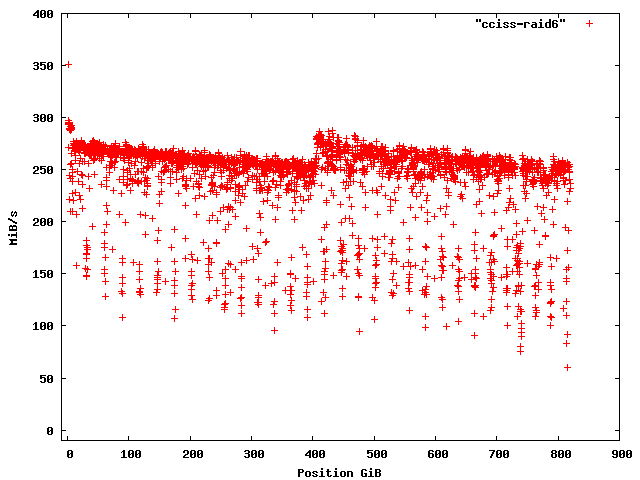
I’ve just started work on a new HP server running RHEL5 AS (needs to be AS to support more than 4 DomU’s). While I still have the Xen issues that made me give up using it on Debian [1] (the killer one being that an AMD64 Xen Dom0 would kernel panic on any serious disk IO) but the Xen implementation in RHEL is quite solid. The first thing I did was run zcav (part of my Bonnie++ benchmark suite) [2] to see how the array performs (as well as ensuring that the entire array actually appears to work). The result is below. For a single disk performance is expected to decrease as you read along the disk (from outer to inner tracks). I don’t know why the performance decreases until the half-way point and then starts with good performance again and again decreases. The next thing was to ensure that the machine had RAID-6 (I have been convinced that that using only RAID-5 verges on professional malpractice). As the machine is rented from a hosting company there was no guarantee that they would follow my clear written instructions involving running RAID-6. The machine is a HP rack-mounted server with a CCISS RAID controller, so to manage the array the command /usr/sbin/hpacucli is used. The command hpacucli controller all show reveals that there is a “Smart Array P400 in Slot 1“. The command hpacucli controller slot=1 show gives the following (amongst a lot of other output):
RAID 6 (ADG) Status: Enabled
Cache Board Present: True
Cache Status: OK
Accelerator Ratio: 25% Read / 75% Write
Drive Write Cache: Disabled
Total Cache Size: 512 MB
Battery Pack Count: 1
Battery Status: OK
SATA NCQ Supported: True So the write-back cache is enabled, 384M of data is for the write-back cache and 128M is for the read cache (hopefully all for read-ahead - the OS should do all the real caching for reads). The command hpacucli controller slot=1 array all show reveals that there is one array: “array A (SAS, Unused Space: 0 MB)“. The command hpacucli controller slot=1 array a show status tells me that the status is “array AOK“. Finally the command hpacucli controller slot=1 show config gives me the data that I really want at this time and says:
Smart Array P400 in Slot 1 (sn: *****)
array A (SAS, Unused Space: 0 MB)
logicaldrive 1 (820.2 GB, RAID 6 (ADG), OK) Then it gives all the data on the disks. It would be nice if there was a command to just dump all that. I would like to be able to show the configuration of all controllers with a single command. Also it would be nice if the fact that hpacucli is the tool to use for managing CCISS RAID arrays when using Linux on HP servers was more widely documented. It took me an unreasonable amount of effort to discover what tool to use for CCISS RAID management.

David Moreno Garza: On phone calls

I've enjoyed reading Sarah Hatter's (from 37signals) blog post about phone support. I can't say anything else that I totally agree about it, and I'd like to share my own experience.

Recently, I bought a ticket for my mom to come to visit us in New York. She finally couldn't do it for the dates we had picked so I had to cancel the airline ticket that I had already paid in Orbitz. I did this through their website, I saw how much of penalties it'd be, and it wasn't too much, so I accepted without too many other alternatives. Basically, from the total cost of the ticket, I'd have to take a small penalty fee for Orbitz and big one for the airline. The rest wouldn't be reimbursed but could be used as credit for another reservation, for the same passenger, of course. None of those tickets are transferrable, which yes, it's OK, it was just a delay of dates on the trip. Now, she is able to come again in a couple of months, so I tried to find a way to use that remaining credit to make a new reservation. I couldn't. After spending a lot of minutes (I should be an idiot, I guess) trying to find their phone number on the website, I called. A nice lady with a very weird accent for me answered, I tried to explain the issue and she was very gentle and told me that I had to do the reservation by phone. I asked if there wasn't any way that I could do the reservation online myself. She said no. I asked how come. She said that in order for me to use that credit I had to do it by phone. She started asking me the preferred days for traveling, whether at morning or at night, etc. All of this was OK, but it was very, very difficult for me to understand what she was saying sometimes, and most of the times I was embarrased to ask her to say things again and again. It was very, very difficult and frustrating to do this over phone for me. I apologized, thanked her and hung up. I couldn't do it.

This could have been easily solved over an online interface or over email (they already have my freaking credit card numbers!). I've been mostly happy with Orbitz and after all they are not guilty on having me as their customer, one that cannot speak to nice ladies with very weird accents, but it'd be easier for everybody to not leave phone support as the last resource for solving an issue. I still have to call and claim my unused credit. I've been avoiding it, both because I still want to find the energy and patience and because I'm waiting for next payroll :)

Paralelly, having spent a couple of weeks with the family in Mexico City I remembered how annoying phone calls to people's houses from companies are. All of us at my family place are economically actives. Because of this, a lot of companies, credit card companies, banks, inssurance companies, etc, annoy at any time offering their products. I almost had forgotten it since my phone activity is not too active here. Those fucking companies (or the representatives rather) call, introduce themselves and start talking saying that you've won an special thing, bonus, award for your records' activities, whatever. This is so impersonal, so cold, so bitter, tacky and so stupidly impolite and annoying that I've reached the point on saying nothing at all but hanging up immediately. Some other times I interrupt saying I was busy, how they dare calling with all their bullcrap without asking me a single question on whether I can or want to receive the call. This is incredibly annoying and find it very unpleasent and impolite. What, as customer, I have to do? Avoid connections with those companies, they don't deserve my attention, they had lost it. I should only maintain a private cell phone for family and friends and try to not give that number to any kind of company.

Die phone support, die!

Marcela Tiznado: When did we start attacking each other?

So, I should be at DebCamp, but I'm back home after driving 800km in one day.  
Why? I still don't know.

The main reason for this post is the irrational and unilateral response I got
from the DebConf Orga Team, with no right to replica of any kind, and with
the violence and humiliation we were treated with. I've helped to make
3 DebConf's possible, and have been involved in many ways for the past years
in Debian, so this shocked me deeply.

The short story is that there was an extra bed in the room I was staying in, the
person who was suppose to be in that bed is a close friend of mine, so I asked
if someone else could use it while they weren't, since that meant I could take
the necessary equipment that I managed to get for DebConf, and also introduce
to Debian someone who is very active and well known in our local community
(and also part of the umbrella foundation used for local finance issues).
I was excited about getting there, like every year. Just to make this extra
clear, this person had already booked the full week of DebConf, just not
DebCamp, as he previously thought he couldn't attend. When he found out he
could, he was thrilled to be able to go and help setup. So, I made the mistake
of not notifying the Orga team about the switch. I did this because it truly
was harmless action, where a bed which would otherwise be wasted would get
used, and, I did not notify the Orga team because they've been very
aggressive, inflexible and unhelpful throughout the planning of the
conference. This doesn't justify it, just explains why someone who generally
is helpful decides to take the wrong path to solve something.

Up to here, nothing very exciting. What made this special, is that when one
of the organizers, Margarita Manterola, found out about the switch, instead
of coming to talk to me, even though she's known me for *years*, she went
and informed the hotel that somebody had committed a crime, and checked in
under a different name, as if me or the person that came with me where
some random stranger. All I can say is, WTF?

Let me stress this, the email that was sent out[1] twisted the facts, to the
extent that some of them are a lie, like the problem arrived at check-in,
when it actually happened while we where napping a few hours after we had
arrived, and any effort made by the Orga team with the hotel where wasted,
as it was one of them who had originally created the problem.

Instead of solving this among us as a group, and, again, "solve" is a
bureaucratic thing, because no one was being harmed, Marga decided to
actually *harm* me personally, the person who I had brought, and DebConf
as a group. What got solved? Nothing. I left, along with someone who
would of otherwise been helping out build DebConf, while the Orga team
demanded a ridiculous fee for me to stay in the hotel.
Rules are rules, I understand, but I also understand everybody listens to
downloaded music, people in Germany install[2] nmap, and a very long list
of rules that we tend not to follow because they're unreasonable or
unnecessarily complicated.
Is this really what DebConf is turning into?

All I can say is I'm very sad and shocked that the people I've worked with
for so many years decided to condemn me over such a meaningless issue, and
especially that the local team, Martin Ferrari, Damian Viano, Maximiliano
Curia and Margarita Manterola would do such thing to "one of there own",
and that the international Orga team would mindlessly follow through with it.

I apologized to the hotel, I do want to apologize to the innocent people who
had to deal with this, and, even though my intentions where good and unselfish,
I regret what happened.

Despite all of this, I'm still deeply committed to Debian, have worked during
the year and deserve to relax and enjoy it, so I will be there for DebConf
as a regular attendee.

See you there!

[1] http://lists.debconf.org/lurker/message/20080802.231856.66c7d3fd.en.html
[2] http://it.slashdot.org/article.pl?sid=07/05/31/1629259&from=rss

30 July 2008

Matthew Garrett

The Linux Plumbers Call for Papers is open for another day or so. It's looking like we'll have an excellent spread of interesting power management topics, but if you've got anything interesting to say then throw it forward. We're looking for kernel issues that have an impact on userspace, userspace issues that need kernel support and anything else that involves the interesting interactions between the two.


Hats for everyone and cab it to the Gold Club

San Francisco has been somewhat hectic, but yesterday included a quick trip to the office to discuss community involvement in improving power management. Look forward to developments there. Independently, I now join Brian the guy who had been clean too long to get onto the drugs rehab program (hurrah voicemail) in being an ex-owner of my US phone number. Probably best to delete it if you have it.

In other news, Foxconn are sending me a board with the "controversial" AMI BIOS in order to figure out what's going on. Progress by this time next week, with luck.

29 July 2008

Russell Coker: Variable Names

For a long time I have opposed single letter variable names. Often I see code which has a variable for a fixed purpose with a single letter name, EG “FILE *f;“, the problem with this is that unless you choose a letter such as ‘z‘ which has a high scrabble score (and probably no relation to what your program is doing) then it will occur in other variable names and in reserved words for the language in question. As a significant part of the time spent coding will involve reading code so even for programmers working on a project a useful amount of time can be saved by using variable names that can easily by found by a search program. Often it’s necessary to read source code to understand what a system does - so that is code reading without writing. With most editors and file viewing tools searching for a variable with a single character name in a function (or source file for a global variable) is going to be difficult. Automated searching is mostly useless, probably the best option is to have your editor highlight every instance and visually scan for the ones with are not surrounded by brackets, braces, parenthesis, spaces, commas, or whatever else is not acceptable in a variable name in the language in question. Of course if you have a syntax highlighting editor then it might parse enough of the language to avoid this. But the heavier editors are not always available. Often I edit code on the system where the crash occurs (it makes it easier to run a debugger). Installing one of the heavier editors is often not an option for such a task (the vim-full Debian/Lenny package for AMD64 has dependencies that involve 27M of packages files to download and would take 100M of disk space to install quite a lot to ask if you just want to edit a single source file). Incidentally I am interested in suggestions for the best combination of features and space in a vi clone (color syntax highlighting is a feature I desire). But even if you have a fancy editor, there is still the issue of using tools such as less and grep to find uses of variables. Of course for some uses (such as a loop counter) there is little benefit in using grep. Another issue to consider is the language. If you write in Perl then a search for \$i should work reasonably well. One of the greatest uses of single letter variable names is the ‘i‘ and ‘j‘ names for loop counters. In the early days of computing FORTRAN was the only compiled language suitable for scientific tasks and it had no explicit way of declaring variables, if a variable name started with i, j, k, l, m, or n then it was known to be an integer. So i became the commonly used name for a loop counter (the first short integer variable name). That habit has been passed on through the years so now many people who have never heard of FORTRAN use i as the name for a loop counter and j as the name for the inner loop in nested loops. [I couldn't find a good reference for FORTRAN history - I'll update this post if someone can find one.] But it seems to me that using idx, index, or even names such as item_count which might refer to the meaning of the program might be more efficient overall. Searching for instances of i in a program is going to be difficult at the best of times, even without having multiple loops (either in separate functions or in the same function) with the same variable name. So if there is to be a policy for variable names for counters, I think that it makes most sense to have multiple letters in all variable names to allow for easy grepping, and to have counter names which apply to what is being counted. Some effort to give different index names to different for/while loops would make sense too. Having two different for loops with a counter named index is going to make things more difficult for someone who reads the code. Of course there are situations where two loops should have the same variable, for example if one loop searches through an array to find a particular item and then the next loop goes backward through the array to perform some operation on all preceding items then it makes sense to use the same variable.

Next.

Previous.