Search Results: "edd"

10 May 2011

Steve Kemp: So I put together another picture sharing site

Almost a year ago I put together a simple picture sharing site, which was designed to accept uploaded images via OpenID logins and then share them. It was created because none of the existing image sharing sites allowed OpenID logins - and because frankly I rarely trust sites I don't control. (Especially when they're free sites, with no obvious revenue stream. We can reference recent compromises if we wish to be topical, but even without them it is all about trust.) I opened up the site to allow others to use it, but assumed it would remain Steve-only - After all why would somebody choose to use my site rather than imgur, or similar? Over the year I've spotted several minor problems with the site. The built-in support for comments was never used, primarily because I didn't have any other users, and some of the tagging aspects were hard to use. Since I've started using twitter I again found myself wanting a picture-hosting site, one with "short links". I started using twitpic.com, but wasn't happy with it. So the plan was formed; build another picture sharing site. But this time with short URLS. Sadly my first choice of http://picc.ie was denied to me - I couldn't register it as I don't live in Ireland. But my second choice http://linkti.me was free. As a challenge to myself this site uses Redis for storing all user-details, all image details, and all session data. It hasn't been difficult to implemenet a multi-user site, with logins, file uploads, and tagging. I guess I cheated as a lot of the code is borrowed from the previous site, but this time it looks prettier and there have been many cleanups due to my previous experience. This time round I was more focussed upon short links, so each image is allowed an incrementing number, which is then encoded using base 36 math - which is the alphabet you get if you use [0-9A-Z]. I designed three shareable links for each image to keep it simple: Why "/r" for the thumbnail? Well because it is a random thumbnail. To cope with difference sizes, and allow the recent image display to look regular, I wanted each thumbnail to be 150x150 pixels. My thumbnail generation simply picks a random X,Y co-ordinate from the image and then cuts out a 150x150 square block starting at that offset. The results of a random segment of an uploaded image are sometimes very cool, altough equally often they are misleading. If I upload naked people there is the possability that we'll just get a nipple or a cock - but I'm actually quite smug about the way it turned out. Simpler to code than to resize, scale, or similar and surprisingly random when you see 9x9 random images (as you do on the front page). Anyway that's all for now. I was tempted to talk about implementation or migration, but I've written too much for an early morning already. Some other time? ObQuote: "He's just trying to freak us out. " - 30 Days of Night.

9 May 2011

Wouter Verhelst: Moved house

I was amazed this morning that it's only been a month since I moved house. So much has happened since. For reasons that I won't go into, I've had to move house. Since I like living in Mechelen, not too far from work, however, I decided to search for something close by. And I did find something close by; I moved to "just around the corner". Which is a bit silly, but then blame the bureaucrats. At any rate, I'm starting to feel at home in the new spot. It's a bit smaller and a bit more expensive than the old place, but it looks a lot better, and that more than makes up for it. And it's not like I needed the extra space in the old place -- I kept having this big empty spot in the middle of my living room, anyway. To make matters more interesting, I've been on stage three times and out of the country once in this past month: One wedding, two concerts, and a work trip to Cork. I guess that's why it seemed like so much more time. But that's over now, and recently I finally managed to make some time working on other projects. Today it was incorporating some patches (which turned out not to work entirely) and doing a release for nbd. That release was overdue by quite a bit; there were a few fairly serious bugs outstanding that I had commits for in the git repository already, I just had to get them out there. Oh well. A few weeks back I've also managed to work a bit on ipcfg some more. The reason it has been so long since the last time I worked on it was that I had started to realize there were several things wrong with it, and I wasn't sure how to best move forward. But then not so long ago I had an epiphany, and I've now started to reimplement the broken bits which is, well, most of it. But hey. Moving isn't fun. Glad it's over. Almost.

8 May 2011

Dominique Dumont: Checking versioned dependencies in Debian packages Take 2

One of my last blog suggested a way to systematically clean up versioned dependencies in packages. Given the comments posted thereafter, it s clear that the one-size-fits-all strategy is ill-advised. Sorry about that. So, should these versioned dependencies be cleaned up or not ? Well It depends. Cleaning up versioned dependencies will hurt people when the package you re working on may be back-ported to old version of Debian. In corporate world, upgrading a machine may cost a lot, so you can still find production machine running etch. I would not be surprised to hear about older systems still used in production. In consumer world (mostly desktop or multimedia), people will mostly run more recent versions of Debian. All in all, the following elements must be considered before removing old versioned dependencies: Unfortunately, there s no universal strategy. In case you want to clean up old dependencies, the latest version of Dpkg::Control model for Config::Model will be helpful. The last version of this models provides a bunch of meta Dpkg parameters. These parameters are used to customize the behavior of the Dpkg editor tool to suit your needs (For more details, see Config::Model::models::Debian::Dpkg::Meta). The dependency meta parameters will enable you to tune the behavior of config-edit to your needs. There are 3 dependency parameters, from the most global to the most specific ones: Before applying a cleanup, config-edit will check the policies in the above order. The most specific one will be applied. Ie. the group policy will supersede your personal policy and the package specific policy will override the group policy. Here s a screenshot of config-edit GUI invoked on a package: config-edit with a view on dpkg meta parameters From the parameters set in the GUI above, you can see that a warning will be raised for : Last but not least, if you want to use config-edit without any dependency filtering, just make sure that all these filter parameters are empty. You will still benefits from other features, like warning if a package dependency is unknown, which is useful to catch typos. All the best

6 May 2011

Matt Zimmerman: Moving on from Canonical (but not from Ubuntu)

This June, soon after my seventh anniversary with Canonical, I will finish my job as Ubuntu CTO at Canonical. You can read my official announcement on the Canonical blog. It s sometimes hard to believe that it s been that long since we first envisioned a Linux desktop for human beings . When I look at how far we ve come, at the difference we ve made to so many people, it s easy to see how the time passed so quickly. It s been an incredible experience for me to play a part in building Ubuntu and Canonical. Whether building a decentralized company of hundreds of people, to a global community project of tens of thousands of members, I m grateful for all of the learning opportunities along the way. It has been a privilege to work with so many brilliant, passionate and thoughtful people under such auspicious circumstances. There is much I will miss, and I have many memories to enjoy, from all-night global hacking sessions driving toward a ship date, to casual singing and playing music at our many face-to-face events Nonetheless, it is time for me to seek out new challenges and stretch myself in new ways. I ll be moving back to the US, closer to old friends and family, and starting a new job with a different type of company. I am leaving behind a capable and dedicated team at Canonical, who I am confident will achieve even greater things in the years to come. I will remain active in the free software community as a volunteer. I intend to continue to participate in Ubuntu, and to serve on the Technical Board. I will also be continuing my work with Debian and the DEX project. This year, I ve accepted advisory positions with the Ada Initiative and the Freedom Box Foundation, and will continue to support those organizations and their missions. I ll be in Budapest at the Ubuntu Developer Summit for the next week, and look forward to seeing my friends in Canonical and the Ubuntu community. I ll have more to say soon about what I ll be doing next professionally. Watch this space for updates!

4 May 2011

loldebian - Can I has a RC bug?: rrrrrrrrrrrrrrrrrrrrrrrrolling


1 May 2011

Luca Falavigna: Blessed Ioannes Paulus II

I will never forget.

30 April 2011

Julian Andres Klode: last two weeks

The last two weeks, two new python-apt releases were made. 0.8.0~exp3 did not add much, but 0.8.0~exp4 added some new bindings for our friends at the mancoosi project. I also committed several fixes to the APT repository, but did not upload them yet. In #debian-devel, some people (including me and others on the Debian side; and sladen, sabdfl for the Ubuntu side) discussed the Ubuntu font license which is considered non-free by Debian, due to extreme naming restrictions in section 2 (unmodified versions must keep the name, slightly modified versions must keep the name and add something). Some consider those restrictions equivalent to invariant sections. After we discusses the font license, we quickly got to discuss Doctor Who and time travel, as those two are obviously connected. Some other things happened as well, like closing more bugs, but all in all, the last two weeks where a bit less intensive than the two weeks before them.
Filed under: Debian

Thomas Girard: ACE+TAO Debian packaging moved to git

We recently converted Debian ACE+TAO package repository from Subversion to git. This was a long and interesting process; I learned a lot on git in the course. I had been using git for a while for other packages: BOUML, dwarves and GNU Smalltalk. But I did not really get it. A preliminary study led by Pau[1] showed that out of the following three tools: the last one was giving results that look better.
The conversion svn-all-fast-export requires physical access to the repo, so the Alioth SVN repo was copied on my machine svn-pkg-ace/ before running the tool:
svn-all-fast-export --identity-map authors.txt --rules pkg-ace.rules svn-pkg-ace
Here's the content of the pkg-ace.rules configuration file that was used:
create repository pkg-ace
end repository
match /trunk/
  repository pkg-ace
  branch master
end match
match /(branches tags)/([^/]+)/
  repository pkg-ace
  branch \2
end match
The author mapping file authors.txt being:
markos = Konstantinos Margaritis <email-hidden>
mbrudka-guest = Marek Brudka <email-hidden>
pgquiles-guest = Pau Garcia i Quiles <email-hidden>
tgg = Thomas Girard <email-hidden>
tgg-guest = Thomas Girard <email-hidden>
The tool sample configuration file merged-branches-tags.rules recommends to post-process tags, which are just a branch in SVN. That's why the configuration file above treats branches as tags. The conversion was indeed fast: less than 1 minute.
Post-conversion observations Invoking gitk --all in the converted repo revealed different kind of issues:
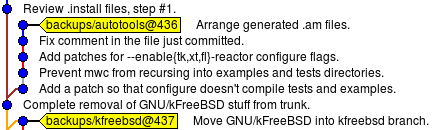
  • svn tags as branches: http://thomas.g.girard.free.fr/ACE/tags-as-branches.png Branches are marked with green rectangles, and tags with yellow arrows. What we have here (expected given our configuration of the tool) are branches (e.g. 5.4.7-5) corresponding to tags, and tags matching the SVN tagging commit (e.g. backups/5.4.7-5@224). We'll review and fix this.

  • merged code that did not appear as such: http://thomas.g.girard.free.fr/ACE/missing-merge-metadata.png Branches that were not merged using svn merge look like they were not merged at all.

  • commits with wrong author: http://thomas.g.girard.free.fr/ACE/wrong-author.png Before being in SVN, the repository was stored in CVS. When it was imported into SVN, no special attention was given to the commit author. Hence I got credited for changes I did not write.

  • obsolete branches: http://thomas.g.girard.free.fr/ACE/obsolete-branches.png The tool leaves all branches, including removed ones (with tag on their end) so that you can decide what to do with them.

  • missing merges: http://thomas.g.girard.free.fr/ACE/missing-merge.png The branch 5.4.7-12 was never merged into the trunk!

Learning git Based on observations above, I realized my limited knowledge won't do to complete the conversion and clean the repository. There are tons of documentation on git out there, and you can find a lot of links from the git documentation page. Here's the one I've used:
The Git Object Model It's described with pictures here. You really need to understand this if you haven't already. Once you do, you understand that git is built bottom-up: the plumbing then the porcelain. If you can't find the tool you need, it's easy to write it.
git fast-import The Migrating to Git chapter explains how you can use the git fast-import tool to manually import anything into git. I've used it to create tags with dates in the past, slightly changing the Custom Importer example in the book:
#!/usr/bin/env ruby
#
# retag.rb
#
# Small script to create an annotated tag, specifying commiter as well as
# date, and tag comment.
#
# Based on Scott Chacon "Custom Importer" example.
#
# Arguments:
#  $1 -- tag name
#  $2 -- sha-1 revision to tag
#  $3 -- committer in the form First Last <email>
#  $4 -- date to use in the form YYYY/MM/DD_HH:MM:SS

def help
  puts "Usage: retag <tag> <sha1sum> <committer> <date> <comment>"
  puts "Creates a annotated tag with name <tag> for commit <sha1sum>, using "
  puts "given <committer>, <date> and <comment>"
  puts "The output should be piped to git fast-import"
end
def to_date(datetime)
  (date, time) = datetime.split('_')
  (year, month, day) = date.split('/')
  (hour, minute, second) = time.split(':')
  return Time.local(year, month, day, hour, minute, second).to_i
end
def generate_tag(tag, sha1hash, committer, date, message)
  puts "tag # tag "
  puts "from # sha1hash "
  puts "tagger # committer  # date  +0000"
  print "data # message.size \n# message "
end
if ARGV.length != 5
  help
  exit 1
else
  (tag, sha1sum, committer, date, message) = ARGV
  generate_tag(tag, sha1sum, committer, to_date(date), message)
end
graft points (graft means greffe in French) Because of missing svn:mergeinfo some changes appear unmerged. To fix this there are graft points: they override git idea of parents of a commit. To create a graft point, assuming 6a6d48814d0746fa4c9f6869bd8d5c3bc3af8242 is the commit you want to change, currently with a single parent 898ad49b61d4d8d5dc4072351037e2c8ade1ab68, but containing changes from commit 11cf74d4aa996ffed7c07157fe0780ec2224c73e:
me@mymachine$ echo 6a6d48814d0746fa4c9f6869bd8d5c3bc3af8242 11cf74d4aa996ffed7c07157fe0780ec2224c73e 898ad49b61d4d8d5dc4072351037e2c8ade1ab68 >> .git/info/grafts
git filter-branch git filter-branch allows you to completely rewrite history of a git branch, changing or dropping commits while traversing the branch. As an additional benefit, this tool use graft points and make them permanent. In other words: after running git filter-branch you can remove .git/info/grafts file. I've used it to rewrite author of a given set of commits, using a hack on top of Chris Johnsen script:
#!/bin/sh

br="HEAD"
TARG_NAME="Raphael Bossek"
TARG_EMAIL="hidden"
export TARG_NAME TARG_EMAIL
filt='
    if test "$GIT_COMMIT" = 546db1966133737930350a098057c4d563b1acdf -o \
            "$GIT_COMMIT" = 23419dde50662852cfbd2edde9468beb29a9ddcc; then
        if test -n "$TARG_EMAIL"; then
            GIT_AUTHOR_EMAIL="$TARG_EMAIL"
            export GIT_AUTHOR_EMAIL
        else
            unset GIT_AUTHOR_EMAIL
        fi
        if test -n "$TARG_NAME"; then
            GIT_AUTHOR_NAME="$TARG_NAME"
            export GIT_AUTHOR_NAME
        else
            unset GIT_AUTHOR_NAME
        fi
    fi
'
git filter-branch $force --tag-name-filter cat --env-filter "$filt" -- $br
(Script edited here; there were much more commits written by Raphael.)

Important

It's important to realize that the whole selected branch history is rewritten, so all objects id will change. You should not do this if you already published your repository.

The --tag-name-filter cat argument ensures our tags are copied during the traversal; otherwise they would be untouched, and hence not available in the new history.

Hint

Once git filter-branch completes you get a new history, as well as a new original ref to ease comparison. It is highly recommended to check the result of the rewrite before removing original. To shrink the repo after this, git clone the rewritten repo with file:// syntax -- git-filter-branch says it all.

Cleaning up the repo To recap, here's how the ACE+TAO git repo was changed after conversion:
  1. Add graft points where needed.

  2. Clean tags and branches. Using git tag -d, git branch -d and the Ruby script above it was possible to recreate tags. During this I was also able to add missing tags, and remove some SVN errors I did -- like committing in a branch created under tags/.

  3. Remove obsolete branches.

  4. Merge missing pieces. There were just two missing debian/changelog entries. I did this before git filter-branch because I did not find a way to use the tool correctly with multiple heads.

  5. Fix commit author where needed. Using the shell script above Raphael is now correctly credited for his work.

That's it. The ACE+TAO git repository for Debian packages is alive at http://git.debian.org/?p=pkg-ace/pkg-ace.git;a=summary.
[1]http://lists.alioth.debian.org/pipermail/pkg-ace-devel/2011-March/002421.html
[2]available in Debian as svn-all-fast-export

29 April 2011

John Goerzen: Anniversary: Europe Ideas?

Terah and I have our 10th wedding anniversary coming up this fall. We ve discussed a bit what we d like to do. Terah said that she d enjoy a relaxing resort on a beach somewhere with a reasonable hotel room so there isn t really anything we have to do just relax. I said that I d love to go back to Europe enjoy some more history, have a fun adventure together, see more of the countryside perhaps. This didn t sound all that relaxing to Terah. So I commented that Europe also has plenty of water, beaches, and resorts and perhaps we could find a place in Europe with history and adventure, plus also a relaxing beach so we can have some adventure but not too much <grin> We ll probably be looking to travel in September or October and would hope for reasonably warm weather though if we need to go at a different time of year, that option is still open. I m at a loss for where to start looking here, so I m hoping readers of this blog can give a suggestion. I very much appreciated the great tips last time I asked. Our first trip to Europe last year was great it was nice to stay with some old friends and make some new ones, to see some amazing cities and buildings, and live for a few days someplace with a culture different from home. Our boys would not be coming with us on this trip. We did get passports for them recently and are looking at some options for a trip with them, but that wouldn t be this one.

Dirk Eddelbuettel: Slides from Rcpp workshop / master class yesterday

Romain and I just posted our slides from yesterday's Rcpp workshop and class (preceding the now-ongoing R/Finance conference). You can access the slides via my presentation page, or directly from here as Part 1 (Introduction), Part 2 (Details), Part 3 (Advanced) and Part 4 (Applications). The page also contains a link to the examples as a tar.gz and zip file.

Update: One link corrected.

Rapha&#235;l Hertzog: Do we need project-wide support for Debian rolling?

The discussion about Debian rolling started sooner than expected on debian-devel (see the thread here). I initially wanted to iron out the biggest problems through discussions on my blog and try to submit a somewhat polished proposal instead we ended up discussing the same things both on -devel and on my blog. That said it s not that bad (except for the time I lost to have similar conversations in both places) because the debian-devel discussions included members of the release team and it looks like they are not fundamentally opposed to the idea. Despite this, the introduction of a frozen suite branched off from testing/rolling is not really consensual (yet?). But the idea of officially supporting testing on a best-effort basis appears to have almost no opposition. While some will undoubtedly believe that this is a useless exercise, I believe it would help if the project stated this in a somewhat official manner. My answer to the question in the title is thus: YES I am thus considering to submit a general resolution to that effect. My current draft is below.
Title: Debian endorses usage of testing by end-users, and renames it to rolling The Debian project recognizes that the Debian testing distribution initially created to make it easier to prepare and test the next stable release has become a useful product of its own. It satisfies the needs of users who are looking for the latest stable versions of software and who can cope (or even appreciate) a system that s constantly evolving. The Debian project decides to endorse this usage and will strive to provide a good experience to users of testing . To better communicate this policy change to our users, testing will be renamed rolling . While we believe that this is a good move, we would like to remind our users that Debian is a volunteer project and that our resources are not infinite. Package maintainers are contributing to Debian on a best-effort basis. This means that they might not be able to properly support their package(s) in all distributions. In that case, the project recommends that maintainers apply the following priorities:
  1. Support in stable (security updates, release critical bugs)
  2. Preparation of the next stable release
  3. Support in rolling
Note that this general resolution could have amendments with s/rolling/current/ and that would solve the bikeshedding over the name that started several times already. I deliberately separated Preparation of the next stable release and Support in rolling so that priorities are clear even if we decide to not freeze rolling and to introduce a frozen distribution to finalize the next stable release. I also did not go into too much details on the implications that it might have, it s best to leave that up to each contributor/team/etc. I hesitated to add a paragraph stating that we want to try to gradually improve the usability of testing but in the end I think it would be somewhat redundant. We re always trying to do our best when we decide to take on something. All comments welcome (even if you just agree and would be willing to second such a GR). Update: I will tweak the draft included in this article when I get good suggestions. Thanks to Lucas Nussbaum for the first one.

10 comments Liked this article? Click here. My blog is Flattr-enabled.

26 April 2011

Julien Danjou: Why not Lua

Since my latest announcement of the Lua workshop, I received a couple of emails asking why I discourage the use of Lua. Actually, I already wrote out many of the things I dislike about Lua. I won't come back on this technical issues here, but since Lua 5.2 is not yet released (it's still at alpha stage), they are still relevant nowadays. Stack based API is harder

The ease of integration of Lua into a C program is one of the point of Lua. They claim it's very easy to integrate Lua into your C application, because it does not use pointer, nor reference counting, nor anything that requires a minimum amount of skills to be used. It uses a virtual stack based approach. You push or pop things on a stack, and refers to them using a relative or absolute index. In order to people who never wrote Lua code to understand, here's a quick example on how this work. The L pointer is a Lua environment.

/* Create a table on the stack: index 1 */
lua_newtable(L);
/* Push a string on the stack: index 2 */
lua_pushstring(L, "hello");
/* Push a number on the stack: index 3 */
lua_pushnumber(L, 123);
/* Set newtable["hello"] = 123 */
lua_settable(L, -3);
You first push a table (in Lua, a table is almost equivalent to what you'd call a hash table in other language), then push the key, the value, and do the assignment operation. In the settable, we use -3 as index, meaning the "3rd item on the stack counting from top". We could also have written lua_settable(L, 1), since the table is also the first item on the stack from the bottom. So far, so good. Problems arise when you do more complicated stuff. My previous example is what you would typically find in a tutorial, but of course, real life is different, and usually more complex. If you cut the things in different parts, it can start to be more complicated. Let's take a look at the following:
/* Create a table on the stack: index 1 */
lua_newtable(L);
/* Push a string on the stack: index 2 */
lua_pushstring(L, "hello");
/* Push a number on the stack: index 3 */
lua_pushnumbe(L, mycomputingfunction());
/* Set newtable["hello"] = 123 */
lua_settable(L, -3);
Here, we do exactly the same thing, but we do not push 123 directly: we compute it. And here's the trick: if your computing function is also using the Lua stack, things can become very messy. As long as your computing function use the stack cleanly by pushing and poping all its item, and returning the stack in the same state it was before, you're safe. The problem is that in a complex program, you also write bugs. You do not chose to, but you do. And sometimes, you forget to pop one of the item you fetched from a table. Imagine that mycomputingfunction is:
int
mycomputingfunctiong(void)
 
  /* Just push the table we want to fetch
     the number from on the stack */
  pushatableonstack(L);
  lua_pushstring(L, "mykey");
  lua_gettable(L, -2);
  return lua_tonumber(L, -1);
 
This function works perfectly. It pushes a table, then a key ("mykey"), then fetches mytable["mykey"] and pops the key (lua_gettable does push value/pop key itself), and then returns the numeric value of the last item (the fetched one) of the stack. However, this function has a bug: it does not pop the table! This does not prevent the function to work. It does not raise a segmentation fault. It does not show any problem under gdb. It does not show any leak under Valgrind. It does now show any problem under any standard C debugging tool. But when you'll start using it, your program will start to do weird things, and you'll have to spend a huge amount of time debugging it manually, dumping the stack content at each step of your program to watch out what's wrong. Another bad thing, that can happen, is some code poping accidentally an item from the stack, or worst, from an empty stack. This does not raise any error on the Lua side, but will break your program in very unfunny way. Even if I've been very meticulous writing awesome, but we hit that problem regularly. The easiest workaround is to use lua_settop(L, 0) to reset the stack to 0 element. Doing this regularly (like after each program event or treatment) can remove left-over items and avoid the never ending stack grow you may experience if your left-over items continue to pile up. Did I tell you I dislike work-around? You could also use lua_call(), which would avoid such an error, but this would require a huge amount of indirection, and would make write more (useless) code. This kind of problem does not exists with pointer based API. If you screw things up, the problem will cause a segmentation fault or leak memory, or cause things you can (easily) debug with standard tools like gdb or Valgrind. No reference counting is a pain in the ass

Userdata objects are variable Lua size objects embedding a C struct you define. It's the equivalent of an object in object oriented language. Lua does not provide any reference counting for the userdata objects. That means you can push this objects on the stack, use them, but they cannot directly reference each others. If you have a "car" userdata and a "wheel" one, the car cannot hold directly a reference to the wheel. This is not possible because userdata are allocated and garbage collected by Lua, and there's no way to increase the reference counting yourself. So the common hack is to store the wheel into a table as a value, and store the table index as an integer into the car data structure. This obviously makes memory leaks tracking harder, add huge level of reference indirection in usage (still more code), and does not make the whole process less error prone (at least in my opinion). No paradigm makes you lose time

Lua is proud to come with no paradigm and to provide metatables. I already showed 3 years ago that it has big flaws. To me, this ain't no good. Lua is not functional, nor it is object oriented. Most people, including me, want one of this paradigm, or any else. Plain old imperative is not enough. So you'll start to build more, or to use something like LOOP, which implements an object model. You'll implement your paradigm. I say life is too short to (re)write a paradigm. In awesome we wanted to have an object oriented approach (this is kind of typical in such a graphical application context), so we tried to build one. To me, this started to be a show stopper when I realized that I've ended writing Python object model into Lua while developing awesome (which aims to be a window manager, not a language). This is one of the reason I stopped hacking on Lua things. I liked Python object model and wanted to have it in Lua, and spending time rewriting Python is just not worth it. I probably should have chose Python, not Lua. YMMV. Embedding may not be a good choice

This is not Lua related, but I want to mention it. Googling for "embedding vs extending" will probably tell you more about why you should double check that you really need to embed Lua rather than to extend it. Being small is not an excuse

One common argument to choose Lua is that it has a small footprint. Yeah, that's true, but that's useless. Bummer! When I program, I don't have any resource usage pressure. People who have such pressure are either paranoids or playing in the world of embedded computers. This is also a no more existing conception since quad core processors equiped phones are coming into the market. I'm rather confident that what we used to call embedded devices are just dead and are now plain computers. But as usual, YMMV. So start to forget about it, run in your underpants and yelling "yay we killed that shit!", and then use real computers stuff. :-) Even if benchmarks show how Lua is damn fast, remember what a benchmark proves: that you can do useless things very fast. Too few extension modules

This is not directly Lua's fault, but there's too few extension modules for Lua. The community is quite small compared to other big languages' ones. So think twice

before you choose Lua (or any other language). My recommendations these days would be not to embed, but to extend. If you really have no choice and need to embed a language into your application, GNU Guile is probably worth considering, because it's a Scheme and therefore a functional language :-), and because it can provides also different languages. Including Lua. Flattr this

25 April 2011

Dirk Eddelbuettel: RInside 0.2.4

After several months, it was time for a new release 0.2.4 of RInside which is now on CRAN. RInside is a set of convenience classes which facilitate embedding of R inside of C++ applications and programs, using the classes and functions provided by the Rcpp R and C++ integration package. This new release contains a few small internal changes to the initialization code, as well as a number of slightly improved examples employing more of the simplifications which Rcpp offers. Also included is a brand new example embedding R inside of the Qt framework; an earlier blog post had already discussed this example. Two more examples were added to the standard/examples directory which now contains fourteen plus two tests. We also added a NEWS file, the entry for this release is below.
0.2.4   2011-04-24
   o    Minor code cleanups in initialization code 
   o    New example embedding R inside a Qt application, along with pro file
        for Qt's qmake providing a complete simple C++ GUI application
   o    New examples rinside_sample 10,11  based on questions on the
        r-help and r-devel mailing list
   o    Some improvements and simplifications throughout examples/standard 
        as well as examples/mpi/
   o    Added this NEWS files -- with entries below summarised from ChangeLog
        and the corresponding blog posts
And courtesy of CRANberries, here are the changes from the previous release.
RInside-0.2.3/RInside/inst/ChangeLog only RInside-0.2.3/RInside/libRInside.a only RInside-0.2.4/RInside/ChangeLog only RInside-0.2.4/RInside/DESCRIPTION 24 ++++-- RInside-0.2.4/RInside/R/RInsidePaths.R 4 - RInside-0.2.4/RInside/doxyfile 8 +- RInside-0.2.4/RInside/inst/NEWS only RInside-0.2.4/RInside/inst/THANKS 1 RInside-0.2.4/RInside/inst/examples/mpi/rinside_mpi_sample0.cpp 10 +- RInside-0.2.4/RInside/inst/examples/mpi/rinside_mpi_sample1.cpp 11 +-- RInside-0.2.4/RInside/inst/examples/mpi/rinside_mpi_sample2.cpp 10 +- RInside-0.2.4/RInside/inst/examples/mpi/rinside_mpi_sample3.cpp 9 -- RInside-0.2.4/RInside/inst/examples/qt only RInside-0.2.4/RInside/inst/examples/standard/rinside_sample1.cpp 30 ++++---- RInside-0.2.4/RInside/inst/examples/standard/rinside_sample10.cpp only RInside-0.2.4/RInside/inst/examples/standard/rinside_sample11.cpp only RInside-0.2.4/RInside/inst/examples/standard/rinside_sample2.cpp 15 +--- RInside-0.2.4/RInside/inst/examples/standard/rinside_sample3.cpp 6 - RInside-0.2.4/RInside/inst/examples/standard/rinside_sample5.cpp 10 +- RInside-0.2.4/RInside/inst/examples/standard/rinside_sample6.cpp 12 +-- RInside-0.2.4/RInside/inst/examples/standard/rinside_sample7.cpp 9 -- RInside-0.2.4/RInside/inst/examples/standard/rinside_sample9.cpp 2 RInside-0.2.4/RInside/inst/include/RInsideAutoloads.h 35 ++++++++-- RInside-0.2.4/RInside/inst/include/RInsideEnvVars.h 13 +-- RInside-0.2.4/RInside/src/Makevars 2 RInside-0.2.4/RInside/src/RInside.cpp 21 +++--- 26 files changed, 121 insertions(+), 111 deletions(-)
More information is on the RInside page. Questions, comments etc should go to the rcpp-devel mailing list off the R-Forge page.

24 April 2011

Dirk Eddelbuettel: RcppArmadillo 0.2.19

Last Monday, Conrad Sanderson released version 1.2.10 of his most excellent Armadillo templated C++ library for linear algebra; I followed up the same day with version 0.2.19 of our RcppArmadillo wrapper for R based on our Rcpp library. However, the chief gatekeeper at CRAN took a well-deserved vacation last week, and with that it arrived only today on CRAN. The short NEWS file extract follows below containing just Conrad's entry for 1.2.0. No further changes from our side (and the benchmark comparison between R, compiled R and Rcpp for computing a VAR(1) dataset which I blogged about yesterday is only in SVN and will be in the next release.)
0.2.19	2011-04-18
    o	Upgraded to Armadillo version 1.2.0 "Unscrupulous Carbon Emitter"
	  * Added ability to use Blas & Lapack libraries with capitalised
	    function names 
	  * Reduction of pedantic compiler warnings
And courtesy of CRANberries, here are the diffs to the previous release.
 RcppArmadillo-0.2.18/RcppArmadillo/inst/doc/RcppArmadillo-unitTests.tex                     only
 RcppArmadillo-0.2.19/RcppArmadillo/ChangeLog                                                   10 
 RcppArmadillo-0.2.19/RcppArmadillo/DESCRIPTION                                                 10 
 RcppArmadillo-0.2.19/RcppArmadillo/R/fastLm.R                                                   2 
 RcppArmadillo-0.2.19/RcppArmadillo/inst/NEWS                                                   22 
 RcppArmadillo-0.2.19/RcppArmadillo/inst/doc/Makefile                                            5 
 RcppArmadillo-0.2.19/RcppArmadillo/inst/doc/RcppArmadillo-unitTests.pdf                     binary
 RcppArmadillo-0.2.19/RcppArmadillo/inst/doc/unitTests-results/RcppArmadillo-unitTests.html     16 
 RcppArmadillo-0.2.19/RcppArmadillo/inst/doc/unitTests-results/RcppArmadillo-unitTests.txt      40 -
 RcppArmadillo-0.2.19/RcppArmadillo/inst/include/armadillo_bits/arma_ostream_meat.hpp           14 
 RcppArmadillo-0.2.19/RcppArmadillo/inst/include/armadillo_bits/arma_ostream_proto.hpp           4 
 RcppArmadillo-0.2.19/RcppArmadillo/inst/include/armadillo_bits/arma_version.hpp                 6 
 RcppArmadillo-0.2.19/RcppArmadillo/inst/include/armadillo_bits/auxlib_meat.hpp                128 +--
 RcppArmadillo-0.2.19/RcppArmadillo/inst/include/armadillo_bits/blas_proto.hpp                  92 +-
 RcppArmadillo-0.2.19/RcppArmadillo/inst/include/armadillo_bits/compiler_setup.hpp              12 
 RcppArmadillo-0.2.19/RcppArmadillo/inst/include/armadillo_bits/config.hpp                       3 
 RcppArmadillo-0.2.19/RcppArmadillo/inst/include/armadillo_bits/constants.hpp                   20 
 RcppArmadillo-0.2.19/RcppArmadillo/inst/include/armadillo_bits/diskio_meat.hpp                  2 
 RcppArmadillo-0.2.19/RcppArmadillo/inst/include/armadillo_bits/lapack_proto.hpp               344 ++++++----
 19 files changed, 460 insertions(+), 270 deletions(-)
More information is on the RcppArmadillo page. Questions, comments etc should go to the rcpp-devel mailing list off the R-Forge page.

23 April 2011

Dirk Eddelbuettel: Another nice Rcpp example

While preparing my slides for the Rcpp workshop this Thursday, I had wondered about more nice examples motivating Rcpp. So I posed a quick question on the rcpp-devel list. And I received a few friendly answers. My favourite, so far, was a suggestion by Lance Bachmeier who sent me a short script which used both R and C++ (via Rcpp) to simulate a first-order vector autoregressive process (and he ensured me that it worked well enough on his graduate students). It is indeed a great example as it involves (simple) matrix multiplication in an iterative fashion. Which makes it a great example not only for Rcpp but also for our RcppArmadillo package (which wraps Conrad Sanderson's wonderful Armadillo C++ templated library for linear algebra and more). And at the same time, we can also add another look at the new and shiny R compiler I also blogged about recently. So Lance and I iterated over this a little more over email, and I now added this as a new (and initial) example file in the RcppArmadillo SVN repo. (As an aside: The newest version 0.2.19 of RcppArmadillo has been sitting in incoming at CRAN since earlier in the week while the archive maintainer takes a well-deserved vacation. It should hit the public archive within a few days, and is otherwise available too from my site.) So let's walk through the example:
R> ## parameter and error terms used throughout
R> a <- matrix(c(0.5,0.1,0.1,0.5),nrow=2)
R> e <- matrix(rnorm(10000),ncol=2)
R> ## Let's start with the R version
R> rSim <- function(coeff, errors)  
+   simdata <- matrix(0, nrow(errors), ncol(errors))
+   for (row in 2:nrow(errors))  
+     simdata[row,] = coeff %*% simdata[(row-1),] + errors[row,]
+    
+   return(simdata)
+  
R> rData <- rSim(a, e)                     # generated by R
This starts with a simple enough loop. After skipping the first row, each iteration multiplies the previous row with the parameters and adds error terms. We can then turn to the R compiler:
R> ## Now let's load the R compiler (requires R 2.13 or later)
R> suppressMessages(require(compiler))
R> compRsim <- cmpfun(rSim)
R> compRData <- compRsim(a,e)              # generated by R 'compiled'
R> stopifnot(all.equal(rData, compRData))  # checking results
Nice and easy: We load the compiler package, create a compiled function and use it. We check the results and surely enough find them to be identical. With that, time to turn to C++ using Armadillo via RcppArmadillo:
R> ## Now load 'inline' to compile C++ code on the fly
R> suppressMessages(require(inline))
R> code <- '
+   arma::mat coeff = Rcpp::as<arma::mat>(a);
+   arma::mat errors = Rcpp::as<arma::mat>(e);
+   int m = errors.n_rows; int n = errors.n_cols;
+   arma::mat simdata(m,n);
+   simdata.row(0) = arma::zeros<arma::mat>(1,n);
+   for (int row=1; row<m; row++)  
+     simdata.row(row) = simdata.row(row-1)*trans(coeff)+errors.row(row);
+    
+   return Rcpp::wrap(simdata);
+ '
R> ## create the compiled function
R> rcppSim <- cxxfunction(signature(a="numeric",e="numeric"),
+                        code,plugin="RcppArmadillo")
R> rcppData <- rcppSim(a,e)                # generated by C++ code
R> stopifnot(all.equal(rData, rcppData))   # checking results
Here we load the inline package to compile, link and load C++ snippets. We define a short C++ function in the code variable, declare a signature taking a and e as before and ask cxxfunction() to deploy the plugin for RcppArmadillo so that it and Rcpp are found during build. With that, we have a compiled function to generate data, and we once again check the result. The C++ code is pretty straightforward as well. We can instatiate Armadillo matrices directly from the R objects we pass down; we then run a similar loop building the result row by row. Now, with all the build-up, here is the final timing comparison, using the rbenchmark package:
R> ## now load the rbenchmark package and compare all three
R> suppressMessages(library(rbenchmark))
R> res <- benchmark(rcppSim(a,e),
+                  rSim(a,e),
+                  compRsim(a,e),
+                  columns=c("test", "replications", "elapsed",
+                            "relative", "user.self", "sys.self"),
+                  order="relative")
R> print(res)
            test replications elapsed relative user.self sys.self
1  rcppSim(a, e)          100   0.038   1.0000      0.04        0
3 compRsim(a, e)          100   2.011  52.9211      2.01        0
2     rSim(a, e)          100   4.148 109.1579      4.14        0
So in a real-world example involving looping and some algebra (which is of course already done by BLAS and LAPACK libraries), the new R compiler improves by more than a factor of two, cutting time from 4.14 seconds down to about 2 seconds. Yet, this still leaves the C++ solution, clocking in at a mere 38 milliseconds, ahead by a factor of over fifty relative to the new R compiler And compared to just R itself, the simple solution involving Rcpp and RcppArmadillo is almost 110 times faster. As I mentioned, I quite like this example ;-).

21 April 2011

Timo Jyrinki: Free Society Conference and Nordic Summit (FSCONS 2010)

Just a note that the slides are available (non-slideshare link) for my presentation Tuning an old but free phone (description) that I held in the tremendously great event FSCONS 2010. It could be described as a smaller scale FOSDEM, but that would be actually down-playing it since the free software effects on society are something that I've actually never seen elsewhere on such a scale. My talk was among the purely technical ones, though.

I was planning to hold on with this blog post until the recorded videos arrive, but since it seems it might not be during this year I will just post this now that slides are available.

I've shared a few photos as well at Flickr...


Keynote: Karin Kosina, The Inanna Project. A tech + art workshop for female artists in Damascus, Syria. An experiment in art, technology, and the transformative power of Free Hardware and Software.


Erik de Bruijn, The Future of RepRap, a self-replicating open source 3D printer that fabricates arbitrary objects including parts of itself.


Social event at the Berg 211.


Malin Nilsson on Gender, class and global flows. Using free software to fuel a revolution in home based industrial work.


Keynote: Glyn Moody, Ethics of Intellectual Monopolies.


Keynote: Glyn Moody, Ethics of Intellectual Monopolies (audience).

A few summaries available on a Qaiku seminar channel.

Alastair McKinstry: How much wind energy can we use?

So how much wind energy can we realistically use? A paper (Earth System Dynamics, DOI: 10.5194/esd-2-1-2011) by Miller,Gans and Kleidon (MGK10) has generated a lot of controversy courtesy of a New Scientist review (See Climate Progress for a good rebuttal). They argue that the effective limit we can safely extract without (bad) climatic consequences is around 18--68 TW (we currently use 0.2 TW of wind power). This paper is a follow-on to Kleidons work on the thermodynamics of the climate, where he points out that the free energy is the important measure of what energy can be generated by renewables. The free energy of the atmosphere is on the scale of hundreds of TW, he argues, much less than the heat energy of ~10^5 TW that comes from the sun. He argues that not enough attention is paid to the free energy budget, and argues that from MEP theory that free energy flows through different geophysical processes are more important than people currently think: such energy and momentum flows then lead to faster depletion of gradients than people currently use in their models. Frequently we use "diffusive-like" approximations to stuff we can't explicitly handle,such as convection and eddies below the resolution of our computer models. That the free energy budget, and small-scale processes need more detailed study (such as the transfer of momentum and energy from wind to water), I agree. But paradoxically, MGK10's estimates based on diffusive processes are what gets it into trouble. The critiques (e.g. Jacobsen and Archer) seem to concentrate on the estimates for diffusive and other energy losses (eg. wake fields) and climatic consequences are very loose, and out by factors of 50-100. They also ignore the fact that using wind as a substitute for more destructive energy sources produces a net gain, climate-wise. Based on these numbers, the real limits on wind power are more limited by where we can realistically place turbines, and the use and availability of rare earth metals in turbine magnets (MW sized turbines use over a ton of neodynium each in magnets!) One of the focuses of research at ICHEC and Met Eireann is wind for wind power: this becomes increasingly important for Ireland as we have more energy production by wind. I've been recently involved in a European project Weather Intelligence for Renewable Energies on investigating weather and climate forecasting needs of wind energy. In our weather models, we are getting to finer and finer resolutions (down to 2-5 km operationally, but working on 1 km in research), but as yet do not take account of wind energy changes. Modelling the wake turbulence, etc. and other effects of turbines is a 'fluid dynamics' problem done by the wind turbine manufacturers, mostly, in order to lay out turbines in a farm efficiently; this is done on the timescale of metres and seconds, while on the other end of the spectrum work is done in climate research on the changes in potential winds to see if wind energy will change in a few decades. But little is done on 'weather' scales of kilometres, minutes and hours: it turns out there are wind patterns that we don't predict in our models (vortices, etc.; especially for offshore turbines) that affect wind energy production, but would be very useful for wind farm and electrical grid operators to know about. So we should think about adapting our weather models for these. Either way, it looks like more detailed work on the interactions between atmospheric dynamics and wind farms would be a good thing. Incidentally, whatever about the alarmist nature of the article, kudos to New Scientist for their linking to papers: they quoted the names of the journals (Earth System Dynamics,Philosophical Transactions of the Royal Society), but where the article was not yet published (or behind a paywall), linked to the Arxiv.org version. More could do this. Tags , , , , ,

Rapha&#235;l Hertzog: People behind Debian: Meike Reichle, member of Debian Women

Meike Reichle is a Debian developer since 2008 but has been involved for longer than that, in particular in Debian Women. She s a great speaker and shared her experience in a Debconf talk. She s also part of the Debian publicity team and managed the live coverage of the last release on identi.ca. Enough introduction, learn more about her by reading the interview. My questions are in bold, the rest is by Meike. Who are you? My name is Meike Reichle, I am a studied information scientist and work as a project manager at Pengutronix, an embedded Linux company probably best known for their ARM kernel work. I live in Germany, more exactly in Lower Saxony, but I was originally born and raised in Swabia. Although I moved here ten years ago I still have a rather strong Swabian cultural identity. (Among other things I pride myself on having introduced a number of fellow DDs to the true promise that are real hand-made Sp tzle ;-) ) I am married to Alexander Reichle-Schmehl, we ll have our third wedding anniversary this summer. Apart from Debian most of my spare time is used for all kinds of crafts and DIY activities. Making things with my hands always gives me a great sense of accomplishment. My Free software history is summed up pretty quickly. Like most women of my age I wasn t introduced to computers until well into my teens. I didn t have a computer of my own until I started studying at the university in 2001. From there on things developed rather quickly: Working on the University s Unix terminals got me hooked on *nixes, so I got me one of those Linuxes everyone talked about. I tried a couple of different distributions, ended up with Debian around 2004, started contributing in 2005, and finally became a full DD what a nice coincidence! exactly this day (Apr 18th) three years ago. You re part of Debian Women. How is the project going? I have the feeling that the number of women involved in Debian has not significantly increased. The amount of women active within Debian is a tricky thing to judge. Here s a quick example why: When the DPL was elected in 2004 there were 911 Debian Developers eligible to vote, 4 of them were female. Shortly after, during DebConf4, debian-women was founded. When the current DPL was reelected last month, there were again 911 Debian Developers eligible to vote, but this time 13 of them were women. You can look at these numbers and say The number of female DDs has more than tripled, what a success! Or you can pull out your calculator and it will tell you that in terms of ratio this puts us from a measly 0.4% to an only slightly less measly 1.4% ratio of female DDs. This still is pardon my language a bloody shame, but sadly also pretty close to the average ratio of women in Free Software. So, while I do think that the debian-women project did already have a significant impact on the Debian project as a whole, I don t think it has achieved its goals yet. Not for a long time. There s still a lot to be done but unfortunately the debian-women project has somewhat run out of steam at the moment. The seven years of its existence divide quite equally into the first half, which was very active and saw great results, and the second half, which was very slow and much more passive. In my impression debian-women is currently undergoing a rather bumpy generational change. On the one hand a lot of the original members, including myself, have reduced their involvement. Speaking for myself this is caused by shift of interests as much as general weariness. On the other hand there are only very few women following up. This development is also reflected quite harshly in DD numbers: If I don t misjudge any first names (and I desperately hope I do!) for the last three years not a single woman has joined Debian as a developer! After the great start debian-women has had, this is a very painful thing to see! That said, things don t look all bad. There is a number of women maintaining packages without being DDs and there s also at least one woman currently in NM, so there s hope this standstill won t last very much longer. But still, the fact remains that debian-women is suffering from a rather serious recruitment problem and I hope that this interview might actually help to spur some new or not yet active members into action. The aim of debian-women is far from achieved and now that its initial members are receding its time for new members to step up and take initiative. What should Debian do to be more attractive to women ? I think the general atmosphere has improved, we re less tolerant with rude behaviour, the usual tone on mailing lists has improved. Yet it doesn t seem to be enough. If there was a female DD for every time I answered that question First of all, I agree, Debian as a community has improved tremendously! Our general tone is much more friendly and cooperative and there is now a much better awareness of the impression we give to outsiders and newcomers. Now on to the difficult part: The question what should be done to get more women into Free Software has been around almost as long as Free Software exists, and it has been answered very well by a lot of people: Twenty years ago Ellen Spertus wrote Why are There so Few Female Computer Scientists? and most of it still holds true. Almost ten years ago Val Henson (now Aurora) wrote HOWTO Encourage Women in Linux and that also is still pretty accurate. In 2006 Floss Pols undertook extensive research to find out why there were so few women in Open Source and Free Software and how that could be changed. They also came up with a very good set of recommendations. All of these texts highlight different aspects of that question and all of them have very good points. I personally have, over the years, arrived at a rather sociological, not to say holistic point of view. In fact I answered the exact same question a few days ago, and the answer I gave then was this: After ~10 years of women in tech advocacy I d say the ultimate and final measure to get more women into Free Software is by finally achieving a truly equal society and at the same time dramatically improving child care support in almost any country. I ve come to the conclusion that what really holds women back in practice is not so much a lack of skill or interest but a simple lack of opportunity. For most of us Free Software is what we do in our spare time and that s something that women, even today, have considerably less of than men. Even in couples where both partners work full-time it is still mostly the woman who does the majority of the housework and child care duties. In most cultures men have a perceived right to their leisure time that does not to the same degree exist for women. That is one major reason, the other is instilled modesty, which has kind of become my personal arch-enemy by now. I ve talked to so many girls and women at all sorts of events about why they won t take up Computer Science studies or join a Free Software project and the answer I hear most often is that they do not consider themselves good enough in one or another aspect. Sometimes they will doubt their technical skills, sometimes their language skills, sometimes their stamina. Needless to say these girls and women were not any less qualified than the people already active in Free Software. So, yes, in the short and medium term making Debian a more welcoming and friendly place is the way to go. As many others pointed out already this will not only benefit prospective contributors but the community as a whole: those new to it as well as those who ve been in it for a long time. In the long term however what we need is empowerment! Women who are just as confident about their skills as men and are not discouraged by uncooperative environments. This is of course something that is culturally deep-rooted and can only happen in a very large time frame. So, for the moment the way to go in my view is accessibility: a cooperative atmosphere, a code of conduct, comprehensive documentation not only of technical aspects but also of structures and processes. The other thing we need to do is to have as many already active women as possible attend as many Linux/Debian/Free Software/Whatever events as possible. In my experience it happens quite often that other women see these women, feel very inspired by them, get to talk to them and then a few days later show up on some mailing list or IRC channel. From what I ve seen personal contact still beats any other kind of recruiting measures. You re a Debian developer but you re also married with a Debian developer (Alexander Reichle-Schmehl). Did you meet because of Debian? If not, who introduced Debian to the other one? :-) We did in fact meet because of Debian. More specifically during our booth shift at the Debian booth at LinuxTag 2005, where I did a talk on the debian-women project and Alex organised the DebianDay. After that our relationship developed pretty much along our Debian activities: After our initial meeting we talked a lot on #debian.de, when Alex went to DebConf5 and I didn t we noticed that we kind of missed each other. The first gift he ever gave me was a Debconf5 shirt and a box Finnish chocolates (I still have one of them today. :) ) Our first secret kiss was at ApacheCon 2005, where we were both staffing the Debian booth (kudos to abe for pretending not to notice). We then became an official couple at Berlinux 2005 where we were both staffing the Debian booth and giving talks on packaging and user motivation. Our first real relationship stress test was when we both joined the DebConf6 orga team. It was a stressful time, but we passed it with flying colours! About a year later we announced our engagement via planet.debian.org. Our wedding was a veritable MiniDebConf, one of the best gifts we got was a Debian cookbook including the favourite recipes of DDs from around the world. By now we ve both finished university and work full-time jobs, so we don t do as many talks and attend as many Debian events as we used to. Instead we now mainly focus on press and publicity work, which is quite practical to work on as a pair. It s actually rather funny that way, Alex and I get confused with each other quite often, since we have almost the same name, often pick up on each other s E-Mail conversations and are most often quoted by our function rather than by name. Because of we have kind of merged into this virtual Debian Press Person in the perception of many of our contacts. You also have another hat : Debian Press Officer. What is this about? What would you suggest to people who would like get involved in that domain? Debian press work is mainly about providing an official and coordinated point of contact to anyone wanting information from or about Debian. The press team answers all sorts of inquiries (the most popular one is is of course always the next release date) and makes sure all important events and developments within Debian receive the attention and recognition they deserve. Debian is a diverse project where every sort of contributor is free to voice his or her opinion in any way. We don t have NDAs or prescribed terminology. That s one of the things I love about Debian but also something that makes us difficult to handle for conventional media. They want official statements, in generally understandable terms, at appointed times. That s what the press team takes care of. Almost all of the press work is done in the publicity team, which coordinates using IRC, Mail and SVN. The publicity team also publishes the Debian Project News, which are very popular among our users and developers. Press work is also an area of work that offers lots of possibilities for non-technical contribution. http://wiki.debian.org/Teams/Publicity lists a number of possibilities for contribution and, like most Debian Teams, we d be more than grateful to get some more helping hands and happy to introduce interested newcomers to our work. What s the biggest problem of Debian? In my view: Overwork. Debian has thousands of contributors but still a lot of the main work rests on very few shoulders. We need more contributors, especially, but not only in the key teams. In order to get more people we need to do some marketing which is very hard for us, since we are very proud of our independence and have a strong focus on purely technical aspects rather than aiming for popularity. However, with the current amount of Open Source and Free Software projects to join we find ourselves not only in a contest on technical excellence but also a sort of popularity contest that is about perception rather than hard facts. This popularity contest is difficult for Debian and currently costs us quite a bunch of very capable people. Do you have wishes for Debian Wheezy? My answer to that is a non-technical one: I think Debian is currently very under-appreciated, we do a lot of great work and maybe even more importantly we do a lot of important work for Software Freedom, sometimes even at the cost of our above-mentioned popularity. I hope people will appreciate that more again in the future. Is there someone in Debian that you admire for their contributions? Over the years I have made a lot of friends within the Debian community, some have even become family. That makes it somewhat hard to single out individual people. I think what I admire most is continuous commitment. I am very impressed by those among us who have kept up a high level of commitment over many years and at the same time managed to bring that in line with a fulfilled personal/family life. That s something that I hope I ll also be able to achieve in the years to come.
Thank you to Meike for the time spent answering my questions. I hope you enjoyed reading her answers as I did. Subscribe to my newsletter to get my monthly summary of the Debian/Ubuntu news and to not miss further interviews. You can also follow along on Identi.ca, Twitter and Facebook.

2 comments Liked this article? Click here. My blog is Flattr-enabled.

20 April 2011

Niels Thykier: Update on Lintian 2.5.0~rc3

While we are waiting for Lintian 2.5.0~rc3, here is a little update on what you can look forward to. About a week ago I had the pleasure of merging my branch into the Lintian master branch. While the IRC bot DOS ed the #debian-qa channel[SRY], cross-package checks became part of the official Lintian. Beyond the reduced amount of binary-without-manpage false-positives, circular-dependency checking and a partial broken symlink detector, the 2.5.0~rc3 release will also feature java and multiarch checks (kudos to Vincent Fourmond and Steve R. Langasek, respectively). The new java checks are based on the Java Policy and currently mostly covers checking for possibly build misconfigurations (jars without class files etc.), weird classpaths and missing Main-Class/depends on jarwrapper for executable jars. Note that #539315 has not been fixed, so executable jars will still trigger a warning. For people wanting to upgrade their libraries to multiarch, Lintian will have a check to see if you remember the Pre-Depends on multiarch-support. Personally I have not followed the progress of multiarch too closely, but last I checked multiarch-support was not in unstable. I guess we are ahead on this one. :) Other highlights include dont install stuff in /run , armhf support, less false positive on missing B-D on dh_python 2,3 and recognition of 3.9.2 as the latest version of the Policy Manual. I am also planning on starting a new branch and this time I intend to work on Vendor-based customization of Lintian. If you have any ideas/suggestions, by all means follow up on the thread on the Lintian list. [SRY] Sorry to anyone present in the channel!

Joey Hess: the popcon problem

I have noticed some problems with how Debian is using the popularity-contest data.

Next.

Previous.