Search Results: "eric"

12 August 2007

Nico Golde: censorship on MSN?

Reading this and the AdiumX wiki it seems like MSN is censoring IM on the server-side.

However trying with ak who is actually using Adium X this seem to be bullshit^WFUD since our little .info test conversation worked flawlessly.

"According to communications director of MSN Sweden, Jessica B rjel, this is being done to protect users against exploits and worms spreading through the MSN Messenger service."

According to what I know about big companies they make official statements, not just some foobar in a private mail. So can someone please enlighten me? :-)

Anyway, stop crying guys, there are better alternatives.

UPDATE: They really censor!
It seems to be no FUD, it seems to be true. But it's not just the .info keyword but the whole URL. So if you send http://test.info/download.php?foo=bar this will be blocked. At least you get an error message in AdiumX, in centericq/im you don't get one :-)
Shame on Microsoft yet another time, especially for this lame approach of muddling security with obscurity, but as said there are better alternatives :-)

Lars Wirzenius: Random thought: Floppy icons

This thought just struck me: the GNOME "save file" icon is still an image of a floppy (or it is at least in Gnumeric). How many people still remember what a floppy looks like?

Dirk Eddelbuettel: The amazing Prof. Ripley (cont'ed)

A little mini-meme got started on August 1 when Ben Bolker posted the following code to the r-devel list (and here I substituted the more standard '-' assignment operator for the less standard though-now permitted '='):
x <- readLines("http://developer.r-project.org/R.svnlog.2007")
rx <- x[grep("^r",x)]
who <- gsub(" ","",sapply(strsplit(rx,"\\ "),"[",2))
twho <- table(who)
twho["ripley"]/sum(twho)
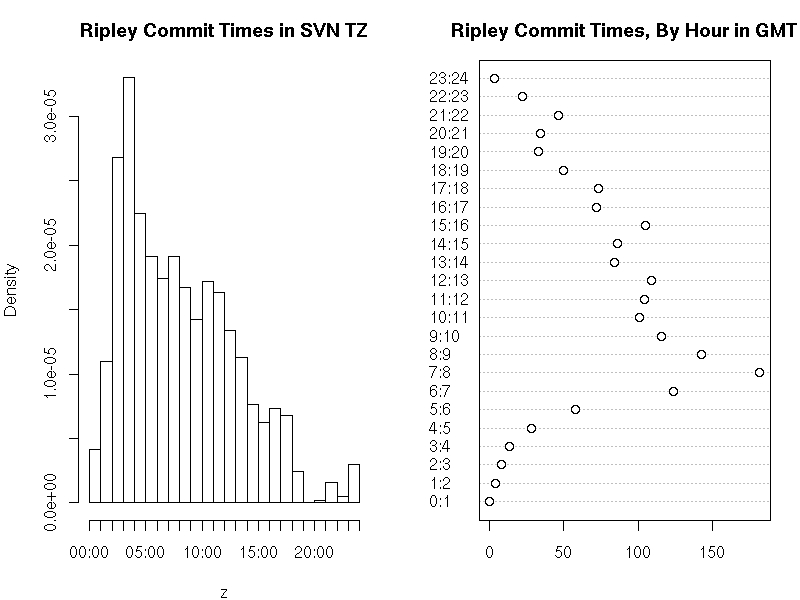
In five lines (that could be shortened to three at the expense of some readibility), the SVN log for R is downloaded directly from the website, the revision authors are extraced and then tabulated by submitter. The relative percentage of Brian Ripley is found to be a staggering 74.8% -- or about three times as much as the other fifteen committers combined. Smokes. [ Oh, and for those who don't know him, he's also got a day job which presumably entails looking after his graduate students at Oxford. Who knows, he may even teach. Kidding aside, he's actually one of the nicest persons you'll ever meet in real life. ] Now yesterday, Simon Jackman who had at first simply repeated Ben's analysis on his own blog followed up with a nice analysis (albeit typeset in a way that rendered the code inoperational, which has now been fixes) that creates both a histogram and a dotplot of commits per hour of the day. Omitting Ben's code which Simon reuses, we have the following for histogram and dotchart:
tod <- unlist(sapply(rx,function(x)strsplit(x,split=" ")[[1]][6]))
tod <- tod[who=="ripley"]
tz <- sub(pattern=".*(-[0-9] 4 ).*",replacement="\\1",x=rx)
tz <- tz[who=="ripley"]
tz <- as.numeric(tz)/100
offset <- 3600*tz
z <- strptime(tod,format="%H:%M:%S")
hist(z,"hours",main="Ripley Commit Times in SVN TZ")
h <- z - offset
h <- format(h,format="%H")
h <- factor(as.numeric(h), levels=0:23)
dotchart(table(h), main="Ripley Commit Times, By Hour in GMT",
         labels=paste(0:23,1:24,sep=":"))
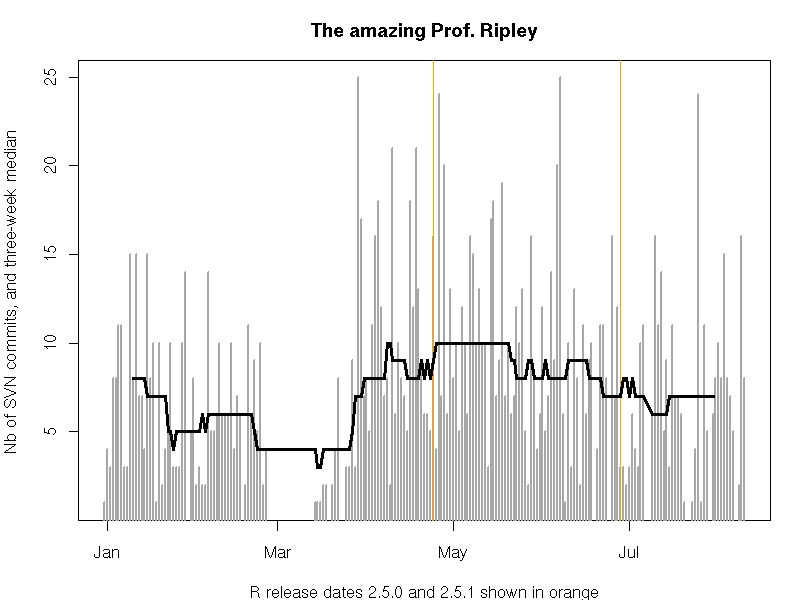
This extracts the commit times, subsets to the ones by Prof. Ripley, extracts the timezones component (as strptime seemingly doesn't do that which is a pain), extracts the tz-less time via strptime into a variable 'z' for which the histogram is drawn. He then corrects the times by the tz offset expressed in seconds, formats is as hour of the day and turns it into a 'factor' (an R data type for qualitative variables which may be ordered as is the case here) and draws a dotplot. This results in the following chart: Simon Jackman's per-hour charts of Brian Ripley's commit patterns Now, nobody has looked at the time series. So we correct this and add the following:
## rather extract both  date and time
dat <- unlist(sapply(rx, function(x)  
  txt <- strsplit(x,split=" ")[[1]]
  paste(txt[5], txt[6])
 ))
## subset on Prof Ripley
dat <- dat[who == "ripley"]
## and convert to POSIXct, correcting by tz as well
datpt <- as.POSIXct(strptime(dat,format="%Y-%m-%d %H:%M:%S")) - offset
## turn into zoo -- we use a constant series of ones as each
## committ is taken as a timestamped event
datzoo <- zoo(1, order.by=datpt)
## and use zoo to aggregate into commits per date
daily <- aggregate(datzoo, as.Date(index(datzoo)), sum)
## now plot as grey bars
plot(daily, col='darkgrey', type='h', lwd=2,
     ylab="Nb of SVN commits, three-week median",
     xlab="R release dates 2.5.0 and 2.5.1 shown in orange",
     main="The amazing Prof. Ripley")
## mark the two R releases of 2007
abline(v=c(as.Date("2007-04-24"),as.Date("2007-06-28")),col='orange',lwd=1.5)
## and do a quick centered rolling median
lines(rollmedian(daily, 21, align="center"), lwd=3)
This extracts both date and time, creates a proper R time object (a so-called POSIXct type) from it, fills a zoo ('the' magic class for time series) object with it, uses zoo to aggregate commits per day and plots those in a barchart-alike (I know, I know, ...) plot to which we add the two releases as well as a rolling and centered three-week median (as a real quick hack rather than a proper smooth). Timeseries of Brian Ripley's commit patterns This shows that Prof Ripley averaged about ten commits a day before and after the release of R 2.5.0, and that he has slowed down ever so slightly since then to end up at around a mere seven commits a day. Every day. For the seven-plus months we looked at. So, anyone for analysing his r-help posting frequencies ?

11 August 2007

Dirk Eddelbuettel: UseR! 2007: Two talks and a new R package 'RDieHarder'

The first UseR! conference in North America ended yesterday. I gave two talks and updated my presentations page accordingly. One talk was joint work with Steffen Moeller (who had also presented our work in Italy in June, and I added that presentation too), David Vernazobres and Albrecht Gebhard and concerns automated building of around two thousand (!!) new Debian source packages for all CRAN and BioConductor packages for GNU R. I plan to send something to debian-devel on that in a day or two as well because the time is right for some feedback on this. The other talk was on about RDieHarder. This is joint work with Robert G. Brown and uses his DieHarder library for random number testing (that I've added to Debian a few months back). It allows R to both runs these tests, and to further analyse and visualize the test results. I finally uploaded RDieHarder to CRAN a few days ago -- in fact, my CRANberries rss feed of new CRAN packages had it show up the morning of the presentation. And now that I've added a webpage about RDieHarder I can finally say it's been released.

David Nusinow: This Is My Good Free Software Experience

What do you know? I wake up this morning, check my mail, and find that Paul Wise contacted the Free Software sticker book guys and got them to change their license to MIT, which is very much Free. Thanks to Paul and the sticker creators for acting on this so fast! Apparently they were going to GPL it, but they thought that the license terms wouldn't make sense because it refers to "software", so they went with CC because it supposedly made more sense.

I've seen this sort of thing show up on debian-legal before. The opinion of most of the people on the list is that it doesn't matter because software is speech, and everything else derives from that principle. I agree with this, but it'd be really nice to have a more generic license to point people to instead for cases like these just to get rid of the doubts. Perhaps the CC-BY-SA license is a good choice. On the other hand, maybe we really do want to add one more to the license proliferation pile to solve this problem.

9 August 2007

Daniel Jacobowitz: So much for that computer

My desktop seems to have melted something precious in this morning’s lightning storm, despite the recent and rather hefty UPS sitting behind it. I am, to say the least, annoyed. It was a nice self-built Shuttle system from 2005, but now all it is is a machine check generator:
HARDWARE ERROR. This is *NOT* a software problem!
Please contact your hardware vendor
CPU 0 4 northbridge TSC 6eb92ec370b
  Northbridge Watchdog error
       bit57 = processor context corrupt
       bit61 = error uncorrected
  bus error 'generic participation, request timed out
      generic error mem transaction
      generic access, level generic'
STATUS b200000000070f0f MCGSTATUS 4
It’s not even bad RAM or a bad RAM socket, the way most memory errors seem to be; I had two DIMMs in two sockets so I was able to try for both possibilities. Unless it fried both somehow, of course. It seems to boot a little further when left cold for a while, and not as far just after crashing. I am inclined to suspect the motherboard. I think I’m going to have to write it off as a loss. Which means I need a replacement. I can get by with just my laptop for a little while, but not indefinitely. Are there any good options for pre-built Linux systems yet? I was somewhat underwhelmed by Dell’s. I usually build from parts, so looking at pre-built systems always has a certain amount of sticker shock. My main concerns are CPU / memory performance (a lot of compiling here), room for at least three hard drives, and reasonably quiet. Otherwise it’s off to newegg again…

Daniel Jacobowitz: So much for that computer

My desktop seems to have melted something precious in this morning’s lightning storm, despite the recent and rather hefty UPS sitting behind it. I am, to say the least, annoyed. It was a nice self-built Shuttle system from 2005, but now all it is is a machine check generator:
HARDWARE ERROR. This is *NOT* a software problem!
Please contact your hardware vendor
CPU 0 4 northbridge TSC 6eb92ec370b
  Northbridge Watchdog error
       bit57 = processor context corrupt
       bit61 = error uncorrected
  bus error 'generic participation, request timed out
      generic error mem transaction
      generic access, level generic'
STATUS b200000000070f0f MCGSTATUS 4
It’s not even bad RAM or a bad RAM socket, the way most memory errors seem to be; I had two DIMMs in two sockets so I was able to try for both possibilities. Unless it fried both somehow, of course. It seems to boot a little further when left cold for a while, and not as far just after crashing. I am inclined to suspect the motherboard. I think I’m going to have to write it off as a loss. Which means I need a replacement. I can get by with just my laptop for a little while, but not indefinitely. Are there any good options for pre-built Linux systems yet? I was somewhat underwhelmed by Dell’s. I usually build from parts, so looking at pre-built systems always has a certain amount of sticker shock. My main concerns are CPU / memory performance (a lot of compiling here), room for at least three hard drives, and reasonably quiet. Otherwise it’s off to newegg again… Or I could always buy an equivalent computer to my current one, for a fraction of the original price, at a local consumer electronics megastore! How’s that for a different idea.

Evan Prodromou: 21 Thermidor CCXV

So, a few weeks ago (Journal/22 Prairial CCXV) I expressed some discomfort about the Mister Wong logo. I'm very happy to see that the company has taken my and other people's uneasiness into consideration and removed the logo from their site. They've started a new Mister Wong logo contest with a grand prize of $6000 (American, assumably) and two second prizes of $3000. That's a pretty good cash-out for a logo contest; Mister Wong is also a high-profile and growing site. I hope some of my designer friends and colleagues decide to jump in. (Yeah, Brigitte, Marie-Claude, Patrick, and Mark, I mean you!) I think it's definitely an interesting challenge for someone doing identity work. I'm not going to join the contest, though. My only idea right now is to do a copy of the current Mister Wong logo (same gray suit and tie) but with a Caucasian man's face instead. The sub-title? It can't be Wong when it feels so white. Yeah, that's why I don't get the big bucks in the corporate identity biz. tags:

Back on Planet So, I got a lot of feedback about removing my blog from Planet Debian -- all of it bad. People really felt that it was important for all Debian developers to be able to say their piece on PD. So, I re-instated it this morning. I'm going to try to make some changes to fix the main thing that seems to bother people: that my post titles are the current date in the French Revolutionary Calendar. For some reason, that really gets under people's skins. Unfortunately, a few things on my (hand-coded) wiki-blog site expect that format, so it's going to be a little tricky. One thing I might do is create and distribute a Greasemonkey script for planet.debian.org (and p.d.net) that seeks out titles that look like French revolutionary calendar dates and replaces them with a random selection from an array of more typical blog post titles:
  • "Some thoughts"
  • "A funny thing happened today"
  • "What I've been doing lately"
  • "Depressing thought"
  • "Haven't blogged in a while"
  • "WTF!?!?!"
  • "My opinion"
  • "Random notes"
  • "IMHO"
  • "Snapshots from my life"
  • "Further proof that we live in a crazy world"
  • "Memo to myself"
Any other suggestions for all-purpose blog-post titles to add to the array are welcome. tags:

8 August 2007

Eric Warmenhoven: Self portraits are hard.

A few weeks ago, Lisa and I were in Barnes&Noble, and I decided to buy a few photography books: The Digital Photography Book by Scott Kelby: This book is, as advertised, not a book about concepts and theories but rather about practical advice and tips. If you already know some of the theory, it’s pretty easy to see how it plays out in practice in this book. Composition Photo Workshop by Blue Fier: I love the name “Blue Fier”, even though I’m probably pronouncing “Fier” wrong (”Fire”). Anyway, this book started off a little slow for me because he covers things like aperture and depth of field and focus, and shutter speed and ISO and other things I’m already fairly familiar with. When he started getting into framing and rule-of-thirds type stuff it got more interesting. He also covered several different styles of photography (landscape, macro, portrait, etc.) and so it was a pretty good introductory book. Digital Portrait Photography and Lighting by Catherine Jamieson and Sean McCormick: I’m only half way through this book so far, and already it’s prompted me to spend hundreds of dollars on a new flash, and gotten me thinking about getting lights and umbrellas and reflectors and setting up my own miniature studio. I’ve spent the past few days trying to take portraits of Pixel and Lisa and myself, and haven’t had much success, mainly due to poor lighting (hence the flash and the dreams of better lighting equipment). When taking self portraits I’ve had such trouble getting the camera placement and focus and lighting right that I haven’t even gotten to really working on posing much. Which is fine, since I haven’t gotten to that chapter yet anyway. There’s a portrait workshop being held in Los Gatos at the end of September that I think I’m going to enroll in, but I’m worried based on the description that I’ll have already heard most of it from the portrait book I bought. In the spring I may enroll for a photography class at the local community college as well.

Miriam Ruiz: El rei de la casa

The Proof of the PuddingThis is an updated translation into English of the one-question interview with pjorge (based on Darren Rowse’s one-question interviews idea) in which Javier Candeira (Barrapunto co-founder and editor among many other things, and a good, loved friend of mine) comments about an interesting game of his creation that’s being exhibited in Barcelona and that deals with the fears many parents have towards the Internet and the new enterntainment technologies and videogames. The game code will be released as GPL, even though the game data will have a non-free Creative Commons (with a non-commercial clause). The game has a really interesting approach, and mixes the concept of pinball games with that of graphics generated with “paper dolls” techniques, to try to make people think about the ideas mainstream media are pushing, and the way they try to tell everybody how to raise their kids. You might like it or not, but it will probably won’t leave you indifferent. That’s what art is about, in fact, isn’t it? What is ‘El rei de la casa’? ‘El rei de la casa‘ (an expression that in Catalan and Spanish means “the precious child”) is an exhibition and a videogame. The exhibition deals with the cultural construction of the idea of childhood, and can be visited until September 24 in the Palau de la Virreina in Barcelona. From there. Among other works, in the exhibition there are photos by Loretta Lux and Bego a Egurbide, paintings by Marc Ryden, Kiki Smith and James Reilly… it’s really worth a visit. El rei/la reina de la casa. ( The videogame is a commission from Andr s Hispano and Marc Roig, curators of the exhibition. They wanted to portray Internet and videogame arcades (or cybercafes, which are their modern equivalent) as one of the “new forests”, these places where parents don’t dare allow their children go alone for fear of the dangers (real or imagined) that may lie in ambush. The Internet has entered into the collective imagination, and one of the memetic niches that it has crept into is that of the bogeyman, the scapegoat that bears the brunt of all the evil that happens in society. It is enough to look at the news programmes from right-wing TV stations with their adversative Internet coverage: “it’s good, but…”. All over the media you see headlines like “gang of pedophiles arrested who sold child pornography *on the internet*”. They conveniently skip that pedophiles filmed those poor kids *in a flat*, and that they did it *on a bed* and used *videocameras* just like those used by the reporters now sounding the alarm. But no, what’s bad is *the Internet*.
The other theme that we wanted to touch on with the pinball game is how videogames are presumed to corrupt childhood. When pinball games were introduced, the North American authorities laid down the law: it was an infernal machine that incited gambling and even lust. From the religious right to the secular left, every moral guardian has denounced the supposed harmful effects of videogames on childhood: because of them children and teenagers engage in murder, robbery, truancy, bad school grades and even untidy bedrooms and doubtful personal hygiene. For this reason, the “new forest” of the Internet and videogames had to be a videogame, proving once more that games are cultural vectors, a form of artistic, political or commercial expression like any other. It also had to be a videogame about the a triangle: on one side the children, on the second one the children minders (parents and society at large), and finally the Great Scapegoat: the Internet. After many abandoned and reworked proposals we arrived at the present design for the game: an emulated pinball game presented on a panoramic TV screen, and having two levels: one set in the real world and named after the exhibition, and a second one set in a more or less conventional cyberspace. This second level is called “Prey of the Net”, and portrays the vision of the Internet that a Fox viewer may have: you have Spam, game-playing killers, kids making more money than their parents, S&M gear, dildos… in short, everything that is scary and nothing that is comforting, at least to some.  Presa de la red! (All the illustrations for this pinball, both on the gameplay field and on the scoreboard, are by Mauro Entrialgo. For the scoreboard I asked him to prepare a set of drawings similar to KISS dolls (like the cut-up dolls that kids still played with in the last century). Thanks to these dress-up dolls the scoreboard shows more than the score (which grows randomly anyway); it also portrays the state of the boy or girl protagonist of the game. I say “boy” or “girl” because in the game, just like in real life, you have a 50/50 chance of starting the game of life with either sex. The fist level, ‘El rei de la casa’, portrays the stress that families feel when facing children’s media consumption. The targets trigger lines from the parents: “All day in front of the Idiot Box!” when you hit the tv, or “without a degree, you are nothing” when you hit the school. There are four targets on the right, which can be reached shooting the ball with the left flipper (the one representing the parents): school, museum, church and reading. On the left, and reachable from the right flipper, representing the kids’ id, are the TV, the kid’s peers and the videogame console; at the top of the playing field, towering above it, the internet-enabled computer. As the ball hits the different targets, the scoreboard dresses the kids in a housecoat, a leather jacket, and gives them a mortarboard or a saint’s halo. They are the pride of their parents, kids still not perverted by the Internet. It is cheap symbolism, I confess, two-dimensional sociology, but that was also something we aimed for. After all, pinballs have always been complicated allegories rather than complex ones. In a first design I planned to make computer accessible only under certain conditions, but that is not something that would have work in this exhibition: some people just play and play (which gives me an immense joy), but other people can’t or won’t give it much effort. It’s best to make it easier for everyone, so they can send the ball into the next level even without meaning to. The second level, “Prey of the Net”, is accessed when the player puts the ball through the PC’s screen. Here the character on the scoreboard keeps smiling while the game dresses them in a straightjacket, S&M headgear, or leaves them in their underwear, with their hands full of money, playing cards, bloody knives and sex toys… to their parents’ horror. The player has no fixed goal here, only to make the ball go through the pachinko and the spinning spider. These elements work as an atrocity generator and a rebuke distributor. Parents’ voices scold the player, faced with the horrors of the Internet. But the star is the scoreboard. Mauro rocks. Right now the code and content for downloadable game are done, and the people responsible for the ISO are giving it the final touches. It will be a bootable liveCD with some Debian variant that (hopefully) will run on any PC bought in the last two or three years. We will treat the computer as a games console, which may or may not be symbolic (if you want it symbolic, we can make it symbolic!). The game itself is under the GPL license (the pinball part is based on Henrik Enkvist’s Emilia, which is packaged in Debian), and only the graphic resources will be under a non-commercial Creative Commons license. The music is also under a non-free Creative Commons license because of the status of the original samples, but I recommend you download it and play it because its author is none other than man, the Barrapunto founder and sometimes editor.

Russell Coker: Tactical Voting

In response to a blog conversation on Planet Debian, Wouter Verhelst writes about voting tactics in which he claims that Instant-Runoff (wikipedia) (the method used in Australia to elect members of the house of representatives) is broken. I have read the Wikipedia review and neither it nor my previous understanding of Instant-Runoff leads me to believe that it is broken or prone to tactical voting problems. The main tactical voting issue in Australian elections is to give first preference to a small party (such as The Greens) in a seat where there is almost no chance of the small party winning. The idea is to have the vote effectively be a vote for whichever of the two major parties the voter prefers while also sending a message (by the first-preference votes which are widely publicised) as to their desires. If a major party wins a seat while 20% of the first preferences went to the Greens then they might find it an incentive to try and get some Green policies adopted if they want to win the next election (whether this actually works is debatable but it is a fact that people try it). There are many people who don’t understand how the Australian voting system works and believe that they have to vote for one of the major parties to avoid a “wasted vote”. This is not due to the voting system but due to American media - and ill-educated Australians who can’t work out which parts of the news apply to them. Wouter has an advantage in living in a country where English is not the primary language - English news does not directly concern him and his country-men can probably work out that English-language voting instructions should not be followed! The condorcet.org site has a useful analysis which demonstrates one theoretical flaw in IR, but realistically getting the average voter to use Condorcet would essentially be an IQ test as a pre-requisite to voting (numbering all the candidates in order for IR is difficult enough). The fact that an election system is not theoretically fair is not a valid criticism unless there is a viable alternative which is better. If the lower house is to actually represent the people of each electorate (which is rarely the case nowadays) then IR seems to be the best option. If members of the lower house are not expected to represent geographic regions then Wouter’s advocacy of proportional representation makes sense. As for the Australian Senate, the voting system for that is far too complex and I think that as a matter of principle any voting system which can not be understood by the majority of voters is wrong. A good case could be made for proportional representation in the senate. Update: In response to Wouter’s post - tactical voting that doesn’t change the outcome of the election and merely sends a message to a political party is OK IMHO. But if you convince enough people that tactical voting is the only option in the US then the result may change.

Thijs Kinkhorst: Serendipity 1.1.4 uploaded

Erich Schubert reports about a Serendipity issue he found. Thanks Erich for researching that and thanks upstream fox quickly fixing it. I'm glad to report that I've just uploaded the fixed version to unstable, and that Sarge and Etch are not vulnerable.

Erich Schubert: Security issue in Serendipity

Yesterday, a friend mentioned that some program had been accessing most of his (s9y) blog, and apparently even manged to access password protected entries.Now I'm not a s9y user myself, but somehow I felt like digging into this. I wouldn't consider myself a web security expert, actually. I'm more interested in data mining and such algorithms these days.It took me 10 minutes to find the problem (despite not having used PHP much in years; I don't trust that programming language; including some searching if it was maybe already reported somewhere). By sending an appropriate POST request, you could override the password used, and that way disabling it.Granted: "locating" a security issue you know it exists is a lot easier than actually discovering new ones...Official announcement in the s9y blog, including a fix for the problem.Memo to the guys who wrote that bot that was accessing the blog of my friend: You messed with the wrong people, guys. We know how to detect your scan, and we'll spoil the fun for you by helping in fixing the bug!

7 August 2007

Evan Prodromou: 19 Thermidor CCXV

I'm on the plane down from Vancouver to San Francisco this morning. My flight from Taipei hit Vancouver around 8PM last night, so I stayed at the Fairmont Hotel at the airport. It was definitely a special treat -- the Fairmont's pretty pricey -- but this trip has been really low-budget and I needed a lot of rest and recharge. I had a good room with a view of the airport and the city beyond. My flight over was uneventful -- sleep, eat, Spiderman 3 -- which was good since I'd had such a big last day in Taipei. In the morning, I'd gone out to see Taipei 101, which claims to be the tallest building in the world by some standards. I think there are lots of ways to slice the "tallest building" category -- the CN Tower has a strong claim, but that's only counting the huge antenna on top. And there's an unfinished tower in Dubai that's already close to, or taller than, Taipei 101. Regardless, Taipei 101 is a real interesting site. The elevators are the fastest in the world -- 38 seconds to go from floor 5 to floor 87. The windowed observation deck is interesting, and there's an outdoor deck two flights above it. The outdoor deck is racked by Taipei's scorching heat -- when I was there, it was 31C, up above the city's protective smog belt. The sun and empty sky make for an otherworldly experience. After 101, I took Taipei's local subway, the MRT, to the National Palace Museum. I've found the MRT easy to get around on -- most of the information was available in English as well as Chinese -- but I got a little lost looking for the museum. I was disappointed that the information booth in the Taiwan Main Station had so little tourism information, and all of it in Chinese. (Yeah, I forgot to print out the Wikitravel Taipei guide before leaving the hotel. My bad.) But I managed to wend my way out to Shilin Station and took a cab to the museum. It was worth the search. When the Chinese Nationalists left the mainland for Taiwan, they took with them many of the treasures of the Imperial Palace (much to the chagrin of the victorious Communists). These form the core of the museum's collection, and they're really quite amazing -- articles in bronze, ivory and gold from the Neolithic era to the modern day. While Western culture has gone through so many distinct and discontinuous phases -- Egypt and Mesopotamia, Greco-Roman, Medieval and Modern -- China's has varied much more smoothly and continuously. It's a little disconcerting to see artistic themes from 4000BC that are echoed in items for sale in the stores today. I had to get back to the Wikimania site -- by then almost empty -- to do a GChat conference with Niko. There were a passel of Wikimaniacs still around after the conference looking around Taiwan like I was, and after consulting Wikitravel we decided to go to Taipei's most famous restaurant, Din Something Something. It's got a short menu of delicious steamed dumplings -- pork, veggie, crab and shrimp. The shop's claim to fame is the elastic skin that keeps a pocket of hot broth inside the dumplings. Hey: if you do something well, why vary the menu? It was the best meal I've had in a long time. The dumplings themselves were incredibly good -- moist and rich with complex flavors. But the company was even better -- about 14 Wikimedians from all continents and walks of life, some of the most fascinating and important people on the planet. We were a big enough group to be stowed in our own party room, and with basket after basket of steamed dumplings piled onto the table, washed down with shared bottles of the ubiquitous Taiwan Beer, we had a crazy chaotic and fun time. I'm so glad I took an extra day after the conference to see a bit of the city. I think there's a lot more that I missed, but I'm glad that I got a taste. tags:

Wikimania 2008 Inevitably the conversation at Din Something Something turned to Wikimania 2008 and possible venues for it. Right now, the only serious bid is from Alexandria, Egypt, home of the Biblioteca Alexandrina. This is a modern reconstruction of the famous Library of Alexandria, centre of learning for the ancient world and repository of all of its knowledge. The bid is to use the sleek, glamourous conference centre attached to the Biblioteca -- offered to us free of charge. You couldn't put together a more powerful metaphor -- Wikimedia being itself a project to capture the world's knowledge and share it with all humanity. Having our event on the African continent would also send a great message about the Foundation's commitment to making free information accessible to the developing world. North Africa is definitely the most accessible part of the continent for Europeans and North Americans -- many of whom balked at the price and distance of travel to Taipei. The big problem with planning Wikimanias (Wikimaniae?) in the past has been the short time-frame. Typically bids for the event don't start until after the previous one, and the bidding process takes several months. By the time a venue is selected, there may be only 6-8 months of planning time available. For an international conference of several hundred people, this is a stressful, breakneck schedule. The idea was floated to do a little stutter-step and put Wikimania on a more long-term planning schedule. The event committee would short-circuit the bidding process this year, and declare Alexandria the site for Wikimania 2008 unless other groups insisted on bids for other cities. Then, bidding for Wikimania 2009 would start in September or October, with a decision made by the end of 2007. This would give 20 months for the Wikimania 2009 organizing team to prepare. Most importantly, they'd be able to shadow the 2008 team, learn how the job is done, attend the 2008 conference, and present about their venue for the next year. I think this is a really good idea. The Biblioteca conference centre staff will be able to provide us some professional services, making the shorter schedule (still about 11 months) a lot easier. There are some concerns about fairness of the process, or appearance of same, but my guess is that if the 2009 bid process starts soon after, people won't have a big beef. There are two major concerns with going to Alexandria, though. First is Egypt's worrying problem with human rights -- specifically gay rights. Homosexual Egyptian men are subject to arrest, and the laws are occasionally enforced. One foreigner was arrested in 2002. That's enough to put Egypt on a no-visit list with some gay-rights groups. Depressing as it is, I think it might be too much to hope for a venue in a country with an absolutely spotless human rights record. Maybe parts of Scandinavia...? There's a cruel calculus needed to evaluate which national human rights abuses can be reluctantly overlooked, and which are unacceptable. It's also clear that my personal judgment might be clouded, since this particular human rights issue is not one I would be directly targeted by. My hope is that an official statement by the Foundation would make it clear to the Egyptian government that this kind of policy is not conducive to attracting overseas business and tourism. The second concern is that Egypt and the Arab world in general have only embryonic local Wikimedian communities. While there are many people who contribute to Arabic Wikipedia, there is not a Wikimedia chapter in Egypt, nor are there regular meetups in the country or region. This might be a chicken-and-egg problem: choosing Alexandria would probably kick-start local groups. I hope that ar: Wikimedians pick up the mantle of leadership that the world Wikimedia community is offering them. tags:

Michal &#268;iha&#345;: Looking for new phone

As it looks like I will be sent to business trip to Japan, I found out that I will need to buy yet another phone. I'm quite happy with my Sony-Ericsson K750i right now and I will continue to use it after I return, so I need just short term replacement. From this comes my requirements:
  1. It must work in Japan. This means 3G phone is needed.
  2. I don't want to spend lot of money.
  3. Should be available on Czech or Japanese market as I don't have time for buying somewhere else.
Currently I have Nokia 6151 and Sony-Ericsson K610i in my viewfinder as they seem to be cheapest 3G solutions available here on market. If you have better tip for cheap 3G phone, just write me on michal@cihar.com, thanks! PS: Of course I will try my new phone with Gammu. If you want to have support for some special 3G phone in Gammu, just drop me a note. Donations for such phone is welcome :-).

Andrew Pollock: [tech] Squid 2.6 redirector API change pain

So it seems that Squid changed its redirector API with 2.6. This pissed me off no end once I got to the bottom of a problem related to it at work last week. Squid's had redirector functionality since, oh, last century, and it's a really handy feature, if you want to intercept URLs that Squid's handling, and change them to something else. I've used it in a past life at an ISP to force people to use a local mirror for various things, regardless of where they think they want to go. So for the longest time, the API has been documented that an external program, which Squid will attach to the stdin and stdout of, will receive on stdin four words on a line, pertaining to the URL being requested: the IP address/FQDN of the client requesting it, the username of the user, if they've authenticated to the cache, and the HTTP method being used. All good. So we had an in-house redirector script, which used a regex (^(\S+) \S+ \S+ \S+)$) to determine if it should apply any logic to the URL at all, or just output a newline, meaning no redirection should occur. So along comes Squid 2.6, which changes that API. It now passes in five things on stdin. The changelog has an innocuous "Added to the redirectors interface the support for SSL client certificate" entry, so I presume on a good day, that's what is passed in as the fifth word instead of a hyphen. Anyway, our redirector script started not rewriting anything at all, which made some other stuff break spectacularly. It was most fun in one location, where we had four proxy servers behind a load balancer, and two were running Squid 2.5 and two were running Squid 2.6. Yay for non-deterministic behaviour. So once I'd tracked down the problem, I swore a lot, and changed the regex to be ^(\S+) \S+ \S+ \S+( \S+)?$ and proceeded to rant at anyone and everyone within earshot on how messed up this whole situation was. The thing that is irritating me the most is that this seems to have been a fairly poorly communicated change, as best I can determine. It happened between Squid.2.6.STABLE1 and Squid.2.6.STABLE2 (hmm, stable?). I mean, the FAQ hasn't even been updated. This clearly caught out other projects like jesred that provide generic extensible Squid redirectors, looking at #381984. I wonder if SquidGuard in Debian Etch is busted? So, whilst Squid 2.6 (the release that changed this behaviour anyway) is just over 12 months old, if you haven't upgraded yet, and you have custom redirectors, consider this rant a head's up.

4 August 2007

Riku Voipio: Debian armel status

The debian armel port reached one milestone yesterday: Being able to run debootstrap from DD-signed, upto-date unmodified debian/unstable packages.

Looking backward:

* When watching the buildd's, the worst of Debian is visible. You don't spend much time wondering on successful builds. The time goes into wondering about the crappy code that fails to compile, the maintainers who ignore RC bugs for months, code with dead upstream..
* bootstrapping a Debian port is still painful. Fortunately Lennert did that for us this time.
* Most maintainers are very responsive, and are happy enough apply patches that help even unofficial ports. The few who ignore patches or are else effectively MIA can cause long delays...
* C++ code is evil. or at least the g++ implementation of it. A random game written in C++ can take 5h to build, when even the most complex C apps compile in 2-3 hours (with a few exceptions like glibc and linux-2.6). Worse, g++-4.2 seems to be another 10-20% slower than g++-4.1... Remember God kills a kitten every time you upload a c++ package unnecessarily!.
* Esoteric language bindings suck too.

Looking forward:

There is some 500 (out of 7100) packages that in Dep-Wait state due some missing packages on armel port:
* ~290 packages that would need FORTRAN (!). specifically the old g77 version...
* ~80 packages waiting for objective C / gnustep
* ~70 packages waiting for ghc6 or related Haskell code
* ~40 packages waiting for Java (being worked on)
* ~15 packages waiting for mono (patch in BTS)
* Then there usual crop of esoteric languages, packages failing to build with current unstable on any port, and packages build-depending on stuff removed or to-be-removed packages.

Effectively this means getting armel over 90% built of Debian needs either g77 to armel or getting Debian to migrate from g77 to gfortran (which is available but not throughly tested on armel). I'm working on the second route..

* Start building d-i images. So that Eddyp can have blazingly fast softfloat rrdtool on his nslu-2 without bugs and trouble.

* Request inclusion into Debian ftp archives. I think with the latest milestones, armel should be ready for archive as a "second class citizen". Inclusion for lenny needs still some work.

* Finally: there's tablets and phones waiting to for Debian armel mobile ;)

Matthew Garrett

Anyway, back to pure Linux stuff. A while ago, the Ubuntu Technical Board were asked to take a look at Automatix. I've finally got around to doing so, and here are my initial conclusions. I'd appreciate any factual corrections, and note that at this point this is my individual opinion rather than any sort of official statement.

Automatix is a combination system configuration/package installation
tool, aimed at making it easy for users to install features like
graphics drivers, media codecs and software not distributed as part of
the Ubuntu distribution. It is provided as a .deb file containing a
python GUI frontend that calls out to a shell backend. The frontend
parses an XML file which contains module descriptions and function
names for installing and uninstalling modules, with these functions
being part of the shell backend. An install module will typically
check whether another package manager is running, and if not either
install a set of debs or download and manually install a
tarball. Uninstall modules generally remove the same software or clean
up the manually installed files.

The following is a list of identified issues with the current version
of Automatix - it is the result of a few hours of investigation, so
may not be complete.
Conclusion:

Automatix exists to satisfy a genuine need, and further work should be
carried out to determine whether these user requirements can be
satisfied within the distribution as a whole. However, in its current
form Automatix is actively dangerous to systems - ranging from damage
to small items of user configuration, through removing user-installed
packages without adequate prompting or warning and up to the (small
but existing) potential to leave a system in an unbootable state.

The current design of Automatix precludes any reasonable way to fix
some of these problems. It is attempting to fulfil the role of a
high-level package manager without actually handling any sort of
dependency resolution itself.

A more reasonable method of integrating Automatix's functionality into
Ubuntu would be for the Automatix team to provide deb files to act as
installers for the software currently provided. These could then be
installed through the existing package manager interfaces. This would
solve many of the above problems while still providing the same level
of functionality.

In its current form Automatix is unsupportable, and a mechanism for
flagging bugs from machines with Automatix installed may provide a
valuable aid for determining whether issues are due to supported
distribution packages or third party software installers.

3 August 2007

Erich Schubert: Why my blog has become so silent

In case you're wondering why my blog has become so silent (3 posts in July, 2 posts in June - yes, my posting frequency is down by a magnitude!):About a year ago I started dancing, and this has by now become my main leisure time activity. And since I'm now off dancing (and meeting friends I know from dancing) like 5-7 days a week, that also means I'm spending much less of my free time on the computer.It's not just that I'm not blogging as much anymore; I'm also spending much less work on my opensource projects. Sorry about that; but all the dancing has recently been very fulfilling, whereas sometimes opensource work can be somewhat demotivating (especially when you fail to attract people to join your project).This especially means that some of the projects I started or played a bigger role in (e.g. SELinux on Debian) now need to find someone else to take over my work. Especially SELinux could definitely use some fresh hackers.

29 July 2007

Ross Burton: Knackered

This weekend, we tidied the garden a little. This involved some gardening and throwing away rubbish. Thirteen large bin bags of garden waste, and a skip full of doors, concrete and metal tubing later, we've finished the easy tasks. Next week the new door and paving slabs arrive, so the hard work can begin. I haven't been sleeping too well recently so bought a herbal sleep remedy today, but I don't think I'll need any help tonight. In other news, Jekyll finished last night. An excellent series with some interesting twists and a good mix of horror and comedy, I highly recommend it to anyone who can watch it (I believe it's being aired on BBC America next Saturday, and I'm sure its all over the interwebs).

Next.

Previous.