Russ Allbery: Free software log (September 2017)
I said that I was going to start writing these regularly, so I'm going to
stick to it, even when the results are rather underwhelming. One of the
goals is to make the time for more free software work, and I do better at
doing things that I record.
The only piece of free software work for September was that I made
rra-c-util compile cleanly with the
Clang static analyzer. This was fairly tedious work that mostly involved
unconfusing the compiler or converting (semi-intentional) crashes into
explicit asserts, but it unblocks using the Clang static analyzer as part
of the automated test suite of my other projects that are downstream of
rra-c-util.
One of the semantic changes I made was that the vector utilities in
rra-c-util (which maintain a resizable array of strings) now always
allocate room for at least one string pointer. This wastes a small amount
of memory for empty vectors that are never used, but ensures that the
strings struct member is always valid. This isn't, strictly
speaking, a correctness fix, since all the checks were correct, but after
some thought, I decided that humans might have the same problem that the
static analyzer had. It's a lot easier to reason about a field that's
never NULL. Similarly, the replacement function for a missing
reallocarray now does an allocation of size 1 if given a size of 0,
just to avoid edge case behavior. (I'm sure the behavior of a realloc
with size 0 is defined somewhere in the C standard, but if I have to look
it up, I'd rather not make a human reason about it.)
I started on, but didn't finish, making rra-c-util compile without Clang
warnings (at least for a chosen set of warnings). By far the hardest
problem here are the Clang warnings for comparisons between unsigned and
signed integers. In theory, I like this warning, since it's the cause of
a lot of very obscure bugs. In practice, gah does C ever do this all over
the place, and it's incredibly painful to avoid. (One of the biggest
offenders is write, which returns a ssize_t that you almost
always want to compare against a size_t.) I did a bunch of
mechanical work, but I now have a lot of bits of code like:
     if (status < 0)
         return;
    written = (size_t) status;
    if (written < avail)
        buffer->left += written;
which is ugly and unsatisfying. And I also have a ton of casts, such as
with:
buffer_resize(buffer, (size_t) st.st_size + used);since
st.st_size is an off_t, which may be signed. This is
all deeply unsatisfying and ugly, and I think it makes the code moderately
harder to read, but I do think the warning will potentially catch bugs and
even security issues.
I'm still torn. Maybe I can find some nice macros or programming styles
to avoid the worst of this problem. It definitely requires more thought,
rather than just committing this huge mechanical change with lots of ugly
code.
Mostly, this kind of nonsense makes me want to stop working on C code and
go finish learning Rust....
Anyway, apart from work, the biggest thing I managed to do last month that
was vaguely related to free software was upgrading my personal servers to
stretch (finally). That mostly went okay; only a few things made it
unnecessarily exciting.
The first was that one of my systems had a very tiny / partition that was
too small to hold the downloaded debs for the upgrade, so I had to resize
it (VM disk, partition, and file system), and that was a bit exciting
because it has an old-style DOS partition table that isn't aligned (hmmm,
which is probably why disk I/O is so slow on those VMs), so I had to use
the obsolete fdisk -c=dos mode because I wasn't up for replacing
the partition right then.
The second was that my first try at an upgrade died with a segfault during
the libc6 postinst and then every executable segfaulted. A mild panic and
a rescue disk later (and thirty minutes and a lot of swearing), I tracked
the problem down to libc6-xen. Nothing in the dependency structure
between jessie and stretch forces libc6-xen to be upgraded in lockstep or
removed, but it's earlier in the search path. So ld.so gets upgraded, and
then finds the old libc6 from the libc6-xen package, and the mismatch
causes immediate segfaults. A chroot dpkg --purge from the rescue
disk solved the problem as soon as I knew what was going on, but that was
a stressful half-hour.
The third problem was something I should have known was going to be an
issue: an old Perl program that does some internal stuff for one of the
services I ran had a defined @array test that has been warning for
eons and that I never fixed. That became a full syntax error with the
most recent Perl, and then I fixed it incorrectly the first time and had a
bunch of trouble tracking down what I'd broken. All sorted out now, and
everything is happily running stretch. (ejabberd, which other folks had
mentioned was a problem, went completely smoothly, although I suspect I
now have too many of the plugin packages installed and should do a
purging.)
 Here s my weekly report for week 41 of 2017. In this week I have explored some
 With the development of
 While the format is not 100% stable I might change some thing I consider it pretty settled. The output of tlmgr info --data json is a JSON array with JSON objects for each package requested (default is to list all).

 If you read

 Today we received updates on the OpenSSL 1.0 removal status:
 Dear all,
This would be a longish blog post (as most of mine are) compiled over days but as there is so short a time and so much to share.
I had previously thought to share beautiful photographs of Ganesh mandals taking out the procession at time of
 The firefox version I was using to test the site/wordpress-wp-admin was Mozilla Firefox 52.4.0 which AFAIK is a pretty recentish one and people using Debian stretch would probably be using the same version (firefox stable/LTS) rather than the more recent versions. I went to the link it linked


 Often, when I mention how things work in the interactive theorem prover [Isabelle/HOL] (in the following just Isabelle
 It feels like the past week or two has been very busy, and so I'm looking forward to my "holiday" next month.
I'm not really having a holiday of course, my wife is slowly returning to work, so I'll be taking a month of paternity leave, taking
sole care of Oiva for the month of November. He's still a little angel, and now that he's reached 10 months old he's starting to
get much more mobile - he's on the verge of walking, but not quite there yet. Mostly that means he wants you to hold his hands so
that he can stand up, swaying back and forth before the inevitable collapse.
Beyond spending most of my evenings taking care of him, from the moment I return from work to his bedtime (around 7:30PM), I've
made the







 A
 pristine-tar 1.41: support for signatures
This release saw the addition of support for storage and retrieval of upstream signatures, contributed by Chris Lamb.
pristine-tar 1.42: optionally recompressing tarballs
I had this idea and wanted to try it out: most of our problems reproducing tarballs come from tarballs produced with old compressors, or from changes in compressor behavior, or from uncommon compression options being used. What if we could just recompress the tarballs before importing then? Yes, this kind of breaks the pristine bit of the whole business, but on the other hand, 1) the contents of the tarball are not affected, and 2) even if the initial tarball is not bit by bit the same that upstream release, at least future uploads of that same upstream version with Debian revisions can be regenerated just fine.
In some cases, as the case for the test tarball
 In other cases, if the current heuristics can t produce a reasonably small delta, recompressing makes a huge difference. It s the case for
 Recompressing is not enabled by default, and can be enabled by passing the
 Stardicter 1.1,

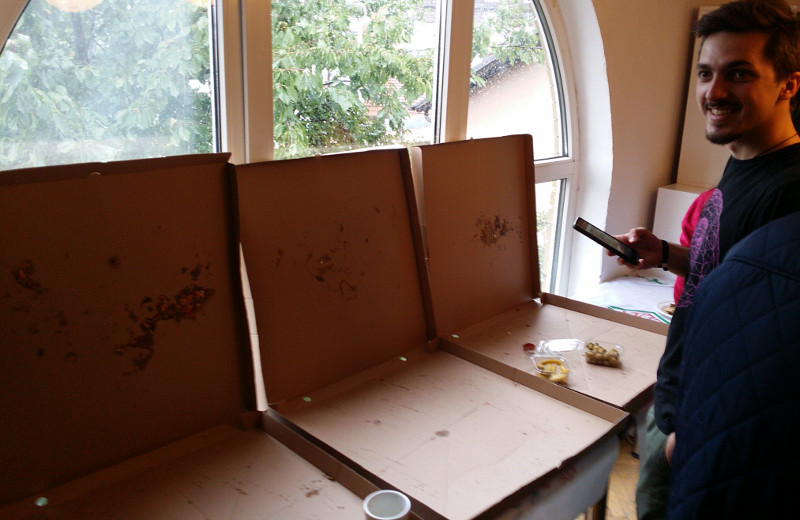
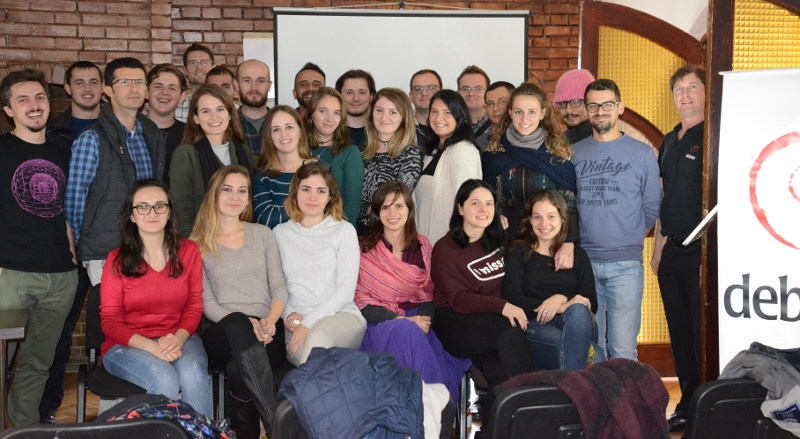 Watch out for future events in Prishtina, the pizzas are huge, but that didn't stop them disappearing before we finished the photos:
 One of the reasons which made me switch my old 17" BenQ monitor for a Dell U2413 three years ago was it had an integrated SD card reader. I find very convenient to take camera's card out, plug the card into the monitor and click on KDE device monitor's option Open with
 At work, I help maintain a

 Seems it is now almost a decade since I migrated from Thunderbird to
GNUS. And GNUS is an awesome mail program that I still rather
like. However GNUS is also heavily quirky. It's essentially
single-threaded and synchronous which means you either have to wait for
the "IMAP check for new mails" to finish or you have to C-g abort it
if you want the user interface to work; You have to wait for the "Move
mail" to complete (which can take a while -- especially with
dovecot-antispam training the filter) before you can continue
working. It has it's funny way around TLS and certificate
validation. And it seems to hang from time to time until it is C-g
interrupted.
So when I set up my new desktop machine I decided to try something
else. My first try was claws-mail which seems OK but totally fails in
the asynchronous area. While the GUI stays reactive, all actions that
require IMAP interactions become incredibly slow when a background
IMAP refresh is running. I do have quite some mailboxes and waiting
the 5+ minutes after opening claws or whenever it decides to do a
refresh is just to much.
Now my last try has been Kmail -- also driven by the idea of having a
more integrated setup with CalDAV and CardDAV around and similar
goodies. And Kmail really compares nicely to claws in many ways. After
all, I can use it while it's doing its things in the
background. However the KDE folks seem to have dropped all support for
the