Search Results: "dom"

14 November 2013

Russ Allbery: Small random haul

Paul Lockhart A Mathematician's Lament (non-fiction)
Alastair Reynolds Blue Remembered Earth (sff)
Donna Tartt The Goldfinch (mainstream)
Tor.com (ed.) Some of the Best from Tor.com 2013 (sff) Not very much in this set, but I wanted to post it before I forgot about it. The Reynolds was the only book I picked up on vacation this year, since I'm being good about not buying too many new books until I get back on the reading bandwagon. That said, I did just place another order since several new books came out that I want to have right now, most notably Nicola Griffith's Hild.

13 November 2013

Andrea Veri: Configuring DNSSEC on your personal domain

Today I ll be working out how to properly configure DNSSEC on a BIND9 installation, I ll also make sure to give you all the needed instructions to properly verify if a specific domain is being correctly covered by DNSSEC itself. In addition to that a few more details will be provided about adding the relevant SSHFP s entries on your DNS zone files to be able to automatically verify the authenticity of your domain when connecting to it with SSH avoiding any possible MITM attack. First of all, let s create the Zone Signing Key (ZSK) which is the key that will be responsible to sign any other record on the zone file which is not a DNSKEY record itself:
dnssec-keygen -a RSASHA1 -b 1024 -n ZONE gnome.org


Note: the dnssec-keygen binary file should be part of bind97 (RHEL 5) or bind (RHEL6) package according to yum whatprovides: RHEL 5:
32:bind97-9.7.0-17.P2.el5_9.2.x86_64 : The Berkeley Internet Name Domain (BIND) DNS (Domain Name System) server
Repo : rhel-x86_64-server-5
Matched from:
Filename : /usr/sbin/dnssec-keygen


RHEL 6:
32:bind-9.8.2-0.17.rc1.el6.3.x86_64 : The Berkeley Internet Name Domain (BIND) DNS (Domain Name System) server
Repo : rhel-x86_64-server-6
Matched from:
Filename : /usr/sbin/dnssec-keygen


Then, create the Key Signing Key (KSK), which will be used to sign all the DNSKEY records:
dnssec-keygen -a RSASHA1 -b 2048 -n ZONE -f KSK gnome.org


Creating the above keys can take several minutes, when done copy the public keys to the zone file this way:
cat Kgnome.org*.key >> gnome.org


When done you can clean out the useless bits from the zone file and just leave the DNSKEY records (which are not commented out as you will notice) An additional and cleaner way of accomplishing the above is to use the INCLUDE rule on the zone file itself as follows:
$INCLUDE /srv/dnssec-keys/Kgnome.org+005+12345.key
$INCLUDE /srv/dnssec-keys/Kgnome.org+005+67890.key


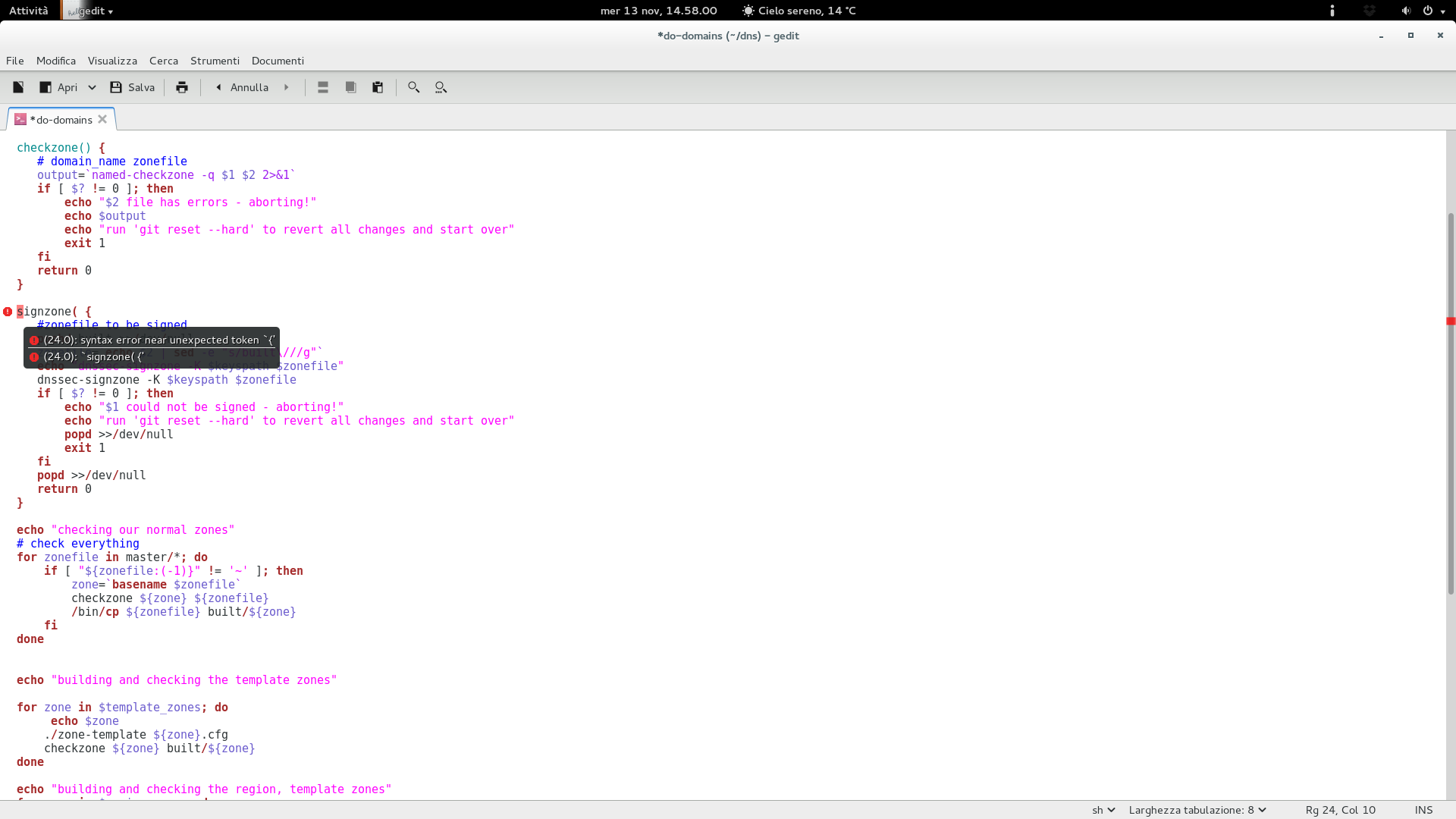
Choosing which method to use is really up to you. Once that is done you can go ahead and sign the zone file. As of myself I m making use of the do-domain script taken from the Fedora Infrastructure Team s repositories. If you are going to use it yourself, make sure to adjust all the relevant variables to match your setup, especially keyspath, region_zones, template_zone, signed_zones and AREA. The do-domain script also checks your zone file through named-checkzone before signing it.
/me while editing the do-domains script with the preview of gnome-code-assistance!

/me while editing the do-domains script with the preview of gnome-code-assistance!

If instead you don t want to use the script above, you can sign the zone file manually in the following way:
dnssec-signzone -K /path/to/your/dnssec/keys -e +3024000 -N INCREMENT gnome.org


By default, the above command will append .signed to the file name, you can modify that behaviour by appending the -f flag to the dnssec-signzone call. The -N INCREMENT will increment the serial number automatically making use of the RFC 1982 arithmetics while the -e flag will extend the zone signature end date from the default 30 days to 35. (this way we can safely run a monthly cron job that will sign the zone file automatically) You can make use of the following script to achieve the above:
#!/bin/sh
SIGNZONE="/usr/sbin/dnssec-signzone"
DNSSEC_KEYS="/srv/dnssec-keys"
NAMEDCHROOT="/var/named/chroot"
ZONEFILES="gnome.org"
cd $NAMEDCHROOT
for ZONE in $ZONEFILES; do
$SIGNZONE -K $DNSSEC_KEYS -e +3024000 -f $ZONE.signed -N INCREMENT $ZONE
done
/sbin/service named reload


Once the zone file has been signed just make sure to include it on named.conf and restart named:
zone "gnome.org"  
file "gnome.org.signed";
 ;


When you re done with that we should be moving ahead adding a DS record for our domain at our domain registrar. My example is taken from the known gandi.net registrar.
gandi

Gandi s DNSSEC interface

Select KSK (257) and (RSA/SHA-1) on the dropdown list and paste your public key on the box. You will find the public key you need on one of the Kgnome.org*.key files, you should look for the DNSKEY 257 entry as dig DNSKEY gnome.org shows:
;; ANSWER SECTION:
gnome.org. 888 IN DNSKEY 257 3 5 AwEAAbRD7AymDFuKc2iXta7HXZMleMkUMwjOZTsn4f75ZUp0of8TJdlU DtFtqifEBnFcGJU5r+ZVvkBKQ0qDTTjayL54Nz56XGGoIBj6XxbG8Es+ VbZCg0RsetDk5EsxLst0egrvOXga27jbsJ+7Me3D5Xp1bkBnQMrXEXQ9 C43QfO2KUWJVljo1Bii3fTfnHSLRUsbRn8Puz+orK71qxs3G9mgGR6rm n91brkpfmHKr3S9Rbxq8iDRWDPiCaWkI7qfASdFk4TLV0gSVlA3OxyW9 TCkPZStZ5r/WRW2jhUY/kjHERQd4qX5dHAuYrjJSV99P6FfCFXoJ3ty5 s3fl1RZaTo8=


Once that is done you should have a fully covered DNSSEC domain, you can verify that this way:
dig . DNSKEY   grep -Ev '^($ ;)' > root.keys
dig +sigchase +trusted-key=./root.keys gnome.org. A   cat -n


The result:
105 ;; WE HAVE MATERIAL, WE NOW DO VALIDATION
106 ;; VERIFYING DS RRset for org. with DNSKEY:59085: success
107 ;; OK We found DNSKEY (or more) to validate the RRset
108 ;; Ok, find a Trusted Key in the DNSKEY RRset: 19036
109 ;; VERIFYING DNSKEY RRset for . with DNSKEY:19036: success
110
111 ;; Ok this DNSKEY is a Trusted Key, DNSSEC validation is ok: SUCCESS

Bonus content: Adding SSHFP entries for your domain and verifying them You can retrieve the SSHFP entries for a specific host with the following command:
ssh-keygen -r $(hostname --fqdn) -f /etc/ssh/ssh_host_rsa_key.pub


When retrieved just add the SSHFP entry on the zone file for your domain and verify it:
ssh -oVerifyHostKeyDNS=yes -v subdomain.gnome.org


Or directly add the above parameter into your /etc/ssh/ssh_config file this way:
VerifyHostKeyDNS=yes


And run ssh -v subdomain.gnome.org , the result you should receive:
debug1: Server host key: RSA 00:39:fd:1a:a4:2c:6b:28:b8:2e:95:31:c2:90:72:03
debug1: found 1 secure fingerprints in DNS
debug1: matching host key fingerprint found in DNS
debug1: ssh_rsa_verify: signature correct

That s it! Enjoy!

Joachim Breitner: Constructing a list in a Monad

In Haskell, lists are ubiquitous. In real-world Haskell, monads are ubiquitous. So it should be an easy task to fill a list with values obtained in a monad, i.e. a list of n random numbers (in the Rand monad), or getting some input from the user, and storing it in a list, until the user chooses to finish the input. The task For now, assume a function getInput :: IO Int; we want to run it 10000 and then have the list of the values returned. Sounds simple and straight forward, but it is actually really hard to get the run-time behaviour that we naively and optimistically expect. The expectation In an imperative setting, we would have a simple counting loop. In the loop, we run getInput, allocate a new cell for the linked list, and append it to the list. Clearly, this
  • consumes no stack space and
  • at the end of the loop, the list is already fully evaluated in memory, ready to be used.
Can we achieve that with Haskell? Let s look at a few alternatives (complete code available)
Attempt 1: The accumulator I ll start with the probably worst attempt. Unfortunately, from what I have seen from correcting Haskell exams, this is what beginners would write, especially if they have the above imperative algorithm in mind, and know about the convert loops to recursion with accumulators approach to solving Haskell problems:
accumAppend :: Int -> IO [Int]
accumAppend n = go n []
  where
    go 0 l = return l
    go n l = do  x <- getInput; go (n-1) (l++[x]) 
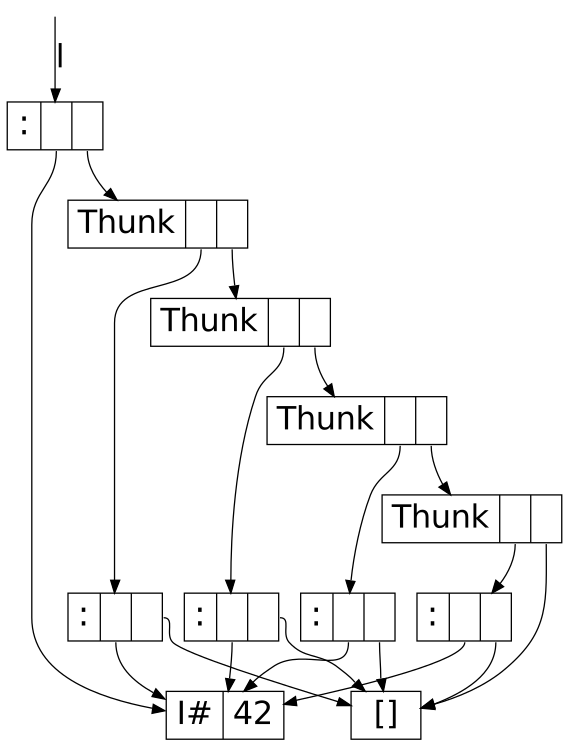
To check the space usage of this, I pass -Kn to the GHC runtime and see what limit is just enough to let this program calculate accumAppend 10000 and fully evaluate the resulting list. It turns out that we need 328336 bytes of stack space. So what about the second requirement; that the list is fully evaluated? Experienced Haskellers see it immediatelly: The accumulator is not used in the loop, so each iteration adds a thunk around the previous value, that would add the next entry to the end. Only when the list is actually used, these are run, each traversing the whole list, causing quadratic cost. We can verify this using ghc-vis:
Clearly (and not surprisingly) this is not the best solution. Attempt 2: The accumulator (forced) Lets try to fix the second issue, by making sure that the list is always fully evaluated. We import Control.DeepSeq and write
accumAppendSeq :: Int -> IO [Int]
accumAppendSeq n = go n []
  where
    go 0 l = return l
    go n l = do  x <- getInput ; go (n-1) $!! (l++[x]) 
As the accumulator gets fully evaluated before being passed to the next invocation of go, the result will not contain thunks. But note that this has also fixed the stack consumption: The code now runs the smallest setting for -K, 8 bytes. This works as both go and deepseq are tail-recursive. But this is still not the solution we are looking for, as the quadradic cost caused by using ++ is still there. Attempt 3: The accumulator (reversed) Since we know that l++[x] is expensive, but x:l is cheap, we can simply use this to update the accumulator. This has the slightly annoying consequence that the entries of the list are in the reverse order, but we can fix that in the base case:
accumReverse :: Int -> IO [Int]
accumReverse n = go n []
  where
    go 0 l = return (reverse l)
    go n l = do  x <- getInput ; go (n-1) (x:l) 
And indeed, we get noticably faster code that still runs in 8 bytes of stack. Unfortunately, we still don t construct the final list directly. Attempt 4: Naive recursion Maybe we can do without an accumulator. The most naive such code would be
listRecurse :: Int -> IO [Int]
listRecurse n = go n
  where
    go 0 = return []
    go n = do  x <- getInput; r <- go (n-1); return (x:r) 
and I d expect that most experienced Haskellers would write that code (if they are asked not to use a library function). And indeed, this code does create the final list directly. But it requires a large stack or 164616 bytes. The reason is that this is no longer tail recursive: After calling go again we need to take the result and prepend x Attempt 5: library functions Maybe we should simply not worry about the implementation, and use library functions? Clearly, the authors of such libraries have found the best solution. So how does
listReplicateM :: Int -> IO [Int]
listReplicateM n = Control.Monad.replicateM n getInput
fare? Unfortunately, not better than the naive recursion. In fact, the stack space requirement is the same 164616 bytes. The same holds when using special libraries for generating and consuming list, e.g. the Streams module from the vector package:
listStreams :: Int -> IO [Int]
listStreams n = MStream.toList $ MStream.replicateM n getInput
Attempt 6: Difference lists It is time to dig deeper into our box of tricks. What if we have lists with constant time Snoc (a.k.a. appending a new element)? Then Attempt 3 would not require reversing the list. Such lists are provided by difference lists; there are libraries for that, but we can simply implement them using lambdas:
accumDList :: Int -> IO [Int]
accumDList n = go n id
  where
    go 0 l = return (l [])
    go n l = do  x <- getInput; go (n-1) (l . (x:)) 
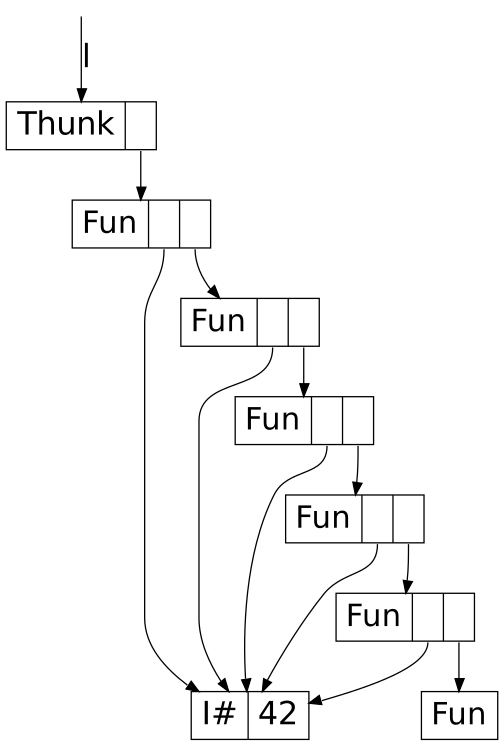
Indeed, no stack is required (8 bytes are enough). But we are cheating here: We are still not constructing the final list, but rather we combine functions that append elements to lists. So when accumDList returns, what we have in memory, is a thunk and sequence of partial function applications in the wrong order, and evaluating the thunk does basically the same thing as reverse in Attempt 3. It might be a bit faster, is still not satisfying enough:
Attempt 7: Unsafe functions Even deepter in the box of tricks, somewhere in the grit and dust where one usually should not reach, there is a function that can help us out here: unsafeInterleaveIO. This allow us to modify the naive recursion in a way that first creates the Cons-cell, and then continues the loop:
listUnsafeInterleave :: Int -> IO [Int]
listUnsafeInterleave n = do  l <- go n; return $!! l 
  where
    go 0 = return []
    go n = do x <- getInput
              r <- unsafeInterleaveIO (go (n-1))
              return (x:r)
The stack consumption is 8 bytes. It is worth noting that the all to deepseq (in $!!) will actually drive the evaluation of go. Also, it guarantees that the unsafe effects of unsafeInterleaveIO are confined to the execution of listUnsafeInterleave, i.e. are actually safe. Run time statistics I ran criterion over the functions (generating lists of length 1000), and found these results:
  • accumAppend: 6.5 ms
  • accumAppendSeq: 8.2 ms
  • accumReverse: 14.0 us
  • listRecurse: 8.0 us (same as listReplicateM and listStreams)
  • accumDList: 12.0 us
  • listUnsafeInterleave: 174.0 us
Conclusion There are many ways to write a list-constructing list in Haskell, none are perfect they either fill the heap, or do not construct the list directly (usually requiring a second pass through it), or rely on IO-specific unsafe functions. The naive recursion performs the best, but may cause a stack overflow (note, though that from GHC 7.8, the stack will be unlimited). The next best option seems to be the difference lists
I m still wondering: What would be required from Haskell, GHC or the monads in question to have a fully satisfactory solution here, i.e. one that is as fast as the naive recursion, as stack efficient as the difference list solution, and allocates no thunks, only list cells?

11 November 2013

Simon Josefsson: Using Replicant on Samsung Galaxy S III

For the last half-year I have used CyanogenMod on an Nexus 4 as my main phone. Recently the touch functionality stopped working on parts of the display, and the glass on the back has started to crack. It seems modern phones are not built to last. For comparison, before the N4 I used a Nokia N900 for around 3 years without any hardware damages (in my drawer now, still working). A few weeks ago I started looking for a replacement. My experience with CyanogenMod had been good, but the number of proprietary blobs on the N4 concerned me. Finding something better wasn t easy though, so I m documenting my experience here. My requirements were, briefly, that I wanted a phone that I could buy locally that had a free software community around it that produced a stable environment. I have modest requirements for things I wouldn t give up on: telephony, data connection (3G), email (IMAP+SMTP), chat (XMPP), and a web browser. I like the philosophy and openness around the Firefox OS but the more I have read about it, it seems unlikely that it would deliver what I need today. In particular none of the devices capable of running Firefox OS appealed to me, and the state of email reading seemed unclear. I m sure I ll revisit Firefox OS as an alternative for me in the future.

As I had been happy with CyanogenMod, but concerned about its freeness, it felt natural to move on and test the more free software friendly project Replicant. Replicant only supports a small number of devices. After talking with people in the #replicant IRC channel, it seemed the Samsung S3 would be a decent choice for me. The Samsung S2 would have worked as well, but it cost almost as much as the S3 where I looked. Despite the large number of Samsung S3 devices out there, it seems the prices even for used devices are high (around 2500 SEK in Sweden, ~380 USD). I ended up buying a brand new one for 3200 SEK (~500 USD) which felt expensive, especially after recalling the recent $199 sale for Nexus 4. Noticing that brand new Nexus 4 devices are still over 3000 SEK in Sweden comforted me a bit. I would have preferred a more robust phone, like the CAT B15, but the state of free software OSes on them seem unclear and I wanted something stable. So, enough about the background, let s get started. Building and installing Replicant on the device was straight forward. I followed the Replicant Samsung S3 Build instructions to build my own images. The only issue I had was that I had not set JAVA_HOME and the defaults were bad; make sure to set JAVA_HOME before building. I built everything on my Lenovo X201 running Debian Wheezy, with OpenJDK 6 as the Java implementation. Installing the newly built firmware was easy, I just followed the installation process documentation. I made sure to take a clockworkmod backup to an external SD card before wiping the old system. To get a really clean new device, I also re-formated /sdcard inside clockworkmod; I noticed there were some traces left of the old system there. I spent about one week testing various configurations before settling on something I could use daily. A fair amount of time was spent looking into backup and restore options for Android devices. My idea was that I would take a backup of the apps I ran on the N4 and transfer them to the S3. The Android Debug Bridge (adb) has a backup/restore command, however it (intentionally) ignores apps marked as allowBackup=false which a number of apps has. It doesn t seem possible to override that settings so much for the freedom to backup your own device. I then discovered oandbackup. It can backup your entire system, saving each app (together with associated data) into a separate directory, for simple review and inspection before restore. You can do batch backups and batch restore. I couldn t get it to automatically restore things, though, which would be neat for really automated re-installations (there is an open issue about this feature). After noticing that some apps did not like being moved from the N4 (running Android 4.2) to the S3 (running 4.0), I ended up installing most apps from scratch on a freshly installed Replicant. I use oandbackup to the external SD card so that I can quickly restore my phone. For backup/restore of SMS/MMS and Call Log, I use SMS Backup+ against my own IMAP server. Camera pictures are synced manually using adb when I am connected to my laptop. There is a number of apps that deserve to be mentioned because they are what I use on a daily basis. All of them come via the free software market F-Droid. For email (IMAP/SMTP), I use K-9 Mail which is feature rich but still easy to use. For chat, I use Xabber. I use NewsBlur s free software app to read RSS flows. For two-factor authentication, I use Google Authenticator. I haven t evaluated different PDF viewers, but the first one I tried (APV PDF Viewer) has worked fine so far. Handling a a synchronized address book and calendar deserve its own blog post because it is a challenging topic, but briefly, I m currently using a combination of aCal and DAVdroid. Finally, since Replicant is still work in progress, some words about stability and notes on what doesn t work. This is probably the most interesting part if you are considering running Replicant on an S3 yourself. Overall system stability is flawless, I hadn t had any crash or problem with the fundamental functionality (telephony, 3G, Camera). People have said graphics feels a bit laggy, but I cannot compare with the stock ROM and it doesn t get in the way of daily use. First some notes about non-free aspects:
  • Bluetooth doesn t work by default. After installing /system/vendor/firmware/bcm4334.hcd (MD5 b6207104da0ca4a0b1da66448af7ed4c) pairing and testing with a Bluetooth headset worked fine.
  • Front camera doesn t work by default. After installing /system/vendor/firmware/fimc_is_fw.bin (MD5 52eeaf0889bc9206860075cd9b7f80b9and) and /system/vendor/firmware/setfile.bin (MD5 0e6fdeb378fb154c39fd508ae28eaf2a) it works. The extensions are *.bin but I don t believe this code is executed on the main CPU.
  • GPS doesn t work by default. After installing /system/bin/gpsd (MD5 6757ed2e2a283259e67c62e6b2b9cfef), /system/lib/libsecril-client.so (MD5 a836df0f947d2aa2ef20dcb213317517), /system/lib/hw/gps.exynos4.so (MD5 1ea1d67f297dd52d59d40dbad9b02a0a) it works. This is code that runs on the main CPU, and even more alarming, it embeds a copy of OpenSSL and talks to various online servers for A-GPS, and is thus a likely (and probably not too challenging) attack vector for anyone wanting to remotely exploit any phone.
  • Wifi doesn t work, and I haven t gotten this to work. There is a list of non-free S3 firmware on the Replicant wiki however my stock ROM did not ship with those files. I don t believe any of the blobs run on the main CPU.
  • NFC doesn t work, and I haven t gotten it to work. It seems the infrastructure for NFC is missing in Replicant 4.0, it doesn t even expose the NFC hardware permission capability. This is quite unfortunate for me, since I daily work with YubiKey NEO and would have preferred to replace Google Authenticator with the YubiOATH that uses the NEO for OATH secret storage.
Some other observations:
  • Panorama mode in the Camera crashes; see issue about it.
  • There is a number of smaller graphical issues. I believe these are related to the EGL but haven t understood the details. What I ve noticed are the following issues. The task switcher doesn t show mini screenshots of all running apps (the screenshots are just black). ZXing is not able to QR decode images (I m told this is because Replicant uses a RGB color plane instead of the required YUV color plane). Video playback in the gallery is laggy to the point of being unusable. Video playback on Youtube in the default web browser works in full screen (not laggy), but not embedded in the webpage.
  • MTP has been a bit unreliable, my main laptop is able to import photos, but another laptop (also running Debian Wheezy) just stalls when talking to it. This may be a host issue, I have experience similar issues with a Nexus 7 2nd generation device.
I am quite happy with the setup so far, and I will continue to use it as my primary phone. flattr this!

10 November 2013

Jelmer Vernooij: Quantified Self

Dear lazyweb, I've been reading about what the rest of the world seems to be calling "quantified self". In essence, it is tracking of personal data like activity, usually with the goal of data-driven decision making. Or to take a less abstract common example: counting the number of steps you take each day to motivate yourself to take more. I wish it'd been given a less annoying woolly name but this one seems to have stuck. There are a couple of interesting devices available that track sleep, activity and overall health. Probably best known are the FitBit and the jazzed-up armband pedometers like the Jawbone UP and the Nike Fuelband. Unfortunately all existing devices seem to integrate with cloud services somehow, rather than giving the user direct access to their data. Apart from the usual privacy concerns, this means that it is hard to do your own data crunching or create a dashboard that contains data from multiple sources. Has anybody found any devices that don't integrate with the cloud and just provide raw data access?

Russell Coker: Aldi Changes, Cheap Telcos, and Estimating Costs

I ve been using Aldi as my mobile phone provider for two months now since Kogan was shut down [1]. Now Aldi have cut the transfer quota on their Unlimited plan from 5G per month to 2.5G per month. The most charitable interpretation of this would be that Aldi got a lot of former Kogan customers who needed the 6G per month that Kogan offered and that forced them to make changes to remain profitable. But the most likely possibility is that with less competition Aldi can just offer less for the same price. This isn t a huge problem for me, in two months on Aldi my biggest month involved almost exactly 2.5G of data transfer. But it s annoying to lose something and it s enough to make me consider other options. Also some of my relatives are looking for new plans so now is a good time to research the options. Other Pre-paid Options Lebara offers Unlimited plans that start at $30 per month and offer 1.5G of data [2], this compares well to the Unlimited plan of $35 per month from Aldi which has 2.5G of data (depending on whether 1.5G is enough). Amaysim has an Unlimited plan that includes 4G of data for $40 per month [3]. If you make lots of phone calls and transfer more than 2.5G of data per month then that would be a really good deal. Lebara uses the Vodafone network and Amaysim uses Optus. Neither of them compare to the Telstra 3G network if you want access outside major urban areas. I had Virgin (Optus network) work well for me for years and Three (their own network now part of Vodafone) work well for many years before that. But data transfer is becoming more important to me and the Telstra network is a major feature of Aldi. Lebara has one of the wost web sites I ve ever seen and Amaysim isn t much better. Aldi is great, they just provide all the key data in one page. Aldi and Amaysim have Android apps that can be used for recharging and viewing the balance, Aldi s app works well but I haven t been able to test the Amaysim app. Lebara doesn t even have an app. Generally Lebara doesn t seem to have anything going for it unless you want to make lots of calls to other Lebara customers, you want to make calls to certain other countries where Lebara has very low international rates, or unless you need a plan with unlimited calls but don t need more than 1.5G of data. The following table summarises the costs of the three pre-paid telcos.
Telco Flagfall Cost/min (Australia calls) SMS Data Cost/Meg Data Increment Credit Expiry and Minimum 30day Data Packs
Aldi 0 $0.12 $0.12 $0.05 1M 1 year $15 2G=$15
Lebara $0.29 $0.15 $0.15 $0.05 1K 90 days $10
Amaysim 0 $0.12 $0.12 $0.05 1M 90 days $5 1G=$10 2G=$20 4G=$30
Post-paid Options Virgin s cheapest offer is $20 per month for $200 of calls (at $0.98/min + $0.40 flagfall) and 200M of data [4], they currently have a special offer of an extra 1G if you sign up before the 18th of November. Virgin have a long history of periodically offering special deals so if you want to sign up with them some time in the next few months it s best to poll their web site and wait for a deal. The TeleChoice Global Liberty plan is a slightly better deal of $20 per month for $500 of calls (at $0.97/min + $0.40 flagfall) and 1G of data which also has free SMS [5]. TeleChoice Global Rebel Texter is a plan for $15 per month that includes $200 of calls and 200M of data and free SMS [6]. They also have a $10 per month plan which charges $0.22 per SMS, which would be bad value for anyone who sends 1 SMS per day. At Aldi rates if you spend $15 per month on 2G of data and $5 on calls then you will get 41 * one minute calls as opposed to $200/($0.98+$0.40)==145 * one minute calls with the cheapest Virgin plan. It seems to me that there is little possibility for those two $20 post-paid plans (which seem to be two of the best value plans currently available) to compete well with the pre-paid options from Aldi and Lebara. Even if you have the same usage pattern every month there are only particular patterns which make the Virgin or TeleChoice deals most appealing options, for example if you need to make more than 40 minutes of calls but less than 145 minutes of calls then Virgin will look good. TeleChoice Global Liberty looks good if you make between 40 and $500/($0.97+$0.40)==365 * one minute calls. If you only need a small amount of data transfer (less than 200M billed in 10K increments) then the TeleChoice Rebel Texter plan would look good as the Aldi 1M increments matter for small amounts of data transfer. But I don t think that many people are in that situation, even my mother in law can t easily stick within 200M of data transfer. Measuring Phone Use The first program I used for measuring phone calls is the Call & SMS Stats app from the Android Market [7]. I wouldn t recommend this to technical users as it demands a lot of access to the phone (including reading SMS, accessing the phone storage, and sending data to the Internet), but it s good for less technical users. For my use I prefer Call Meter 3G from the F-Droid repository [8]. I trust the Call Meter 3G program more because it s source is available under the GPL and it also has the convenient feature of adding up the costs of the calls, SMS, and data used. According to Call Meter 3G I m using less than $20 of calls and SMS per month, so if I continue my current use with a 2G data pack every month from Aldi instead of buying a $35 Unlimited pack and don t use more than 2G of data then I ll save at least a few dollars every month. My wife makes fewer calls so I ve already moved her phone away from the Unlimited plan and I ll move my phone later if it looks like it will save money she will now use my phone for making calls when we are together so the Unlimited plan may become good value when we share it. The Case for Aldi Aldi offers competitive options for phones for most levels of usage. While there are some post-paid plans which are better in some areas such as the ones from TeleChoice Aldi has the benefit of flexibility. A phone with Aldi can have it s plan scaled up or down easily with no penalty fees. For a phone to be usable for an entire year the cheapest option at the moment is Aldi which has a $15 recharge that lasts for a year. The next best option seems to be Amaysim with a $5 recharge that lasts for 90 days. Saving Money In the past I ve been used to SMS being significantly cheaper than phone calls. When I was on Virgin and calls just over $1 per minute ($0.98 per minute plus the flag-fall) and SMS were $0.28 which made a simple question and answer cheaper by SMS than calling. But with Aldi charging the same for a 1 minute call and sending an SMS a simple question and answer will cost half as much if it s done with a call so SMS isn t a good deal. Also I ve started using Google Hangouts to communicate with my wife instead of SMS as extra use of Hangouts is essentially free (we both have it running all the time for Ingress related communication anyway). The financial incentive now is to use Google Hangouts to replace some calls. One down-side to saving money in such ways is that it restricts usage of the phone. While moving from SMS to Google Hangouts (or any other instant-messaging system) isn t any great cost having to reduce the number of calls does. The ability to talk for as long as you want without bothering about cost is something that s worth paying for. I Hate Telcos For most things that I spend money on I wouldn t invest much effort to try and save $10 or $15 per month. Even when doing research that will help my friends and relatives and random people on the Internet I probably wouldn t take so much time for a small saving. But the Telcos seems to avoid competing as much as possible which is obvious from the way that they increase prices and decrease services at the same time. Also most Telcos seem to have a business model that is based around exploiting customers, they have confusing terms in the contracts that make it very likely for customers to go over the included usage and hit penalty rates and charge unreasonable prices for the phones that are bundled with a telephony contract. I want to reduce the amount of money I pay to Telcos as a matter of principle. Aldi is better than most Telcos, they have clear terms that are explained on a single web page [9], and they have an Android app to show the remaining credit that can reduce the risk of excessive fees if a 2G data block is used. Aldi sells phones in their stores at low prices, the phones that they sell aren t the highest quality but the customer gets what they pay for and the warranty return policy is good. But we still need to find the best options so that market forces will encourage Telcos to make more reasonable offers.

9 November 2013

Russ Allbery: Review: Fantasy & Science Fiction, July/August 2011

Review: Fantasy & Science Fiction, July/August 2011
Editor: Gordon van Gelder
Issue: Volume 121, No. 1 & 2
ISSN: 1095-8258
Pages: 258
Nothing of particular interest in the book reviews in this issue, although I was entertained to see Charles de Lint review a collection of the Prince Valiant strip. I have memories of that strip being one of the most boring works of art created by mankind. De Lint, of course, quite likes it. Our tastes seem to be very disjoint, although I have to admit that I've not read it collected and it may be more coherent and more interesting in that format. The science column in this issue, by Paul Doherty and Pat Murphy, deserves special mention. It's on roshambo (rock-paper-scissors), human difficulties with randomness, and strategy in roshambo competitions. It's also the first essay I've read that clearly explains how there can be strategy to roshambo, and why that strategy is worth studying. Even though the primary topic of the column is randomness, it's worth reading from the perspective of strategy in competitive human vs. human games. "Bronsky's Dates with Death" by Peter David: Anyone familiar with PAD's body of work will immediately expect a humorous story with some deeper thoughtful bits, and that's exactly what this is. Bronsky, the title character, is a man almost incapable of saying exactly what's on his mind, and what's on his mind is his eventual death. Not that it bothers him that much; he's just thinking a lot about it. But his incessant discussion of it certainly bothers the people around him. This leads to a few entertaining exchanges with his family, and then to more entertaining exchanges with Death. Or Deaths, as there appear to be several different kinds. I found the exact metaphysics a bit confused, but the ending was still touching and a bit funny. (7) "The Way It Works Out and All" by Peter S. Beagle: This is a reprint of a special fund-raising story about Avram Davidson, so a lot of it was lost on me given that I know almost nothing about Davidson and have yet to get to any of his novels I own. But even without that background, it's a diverting story of hidden and parallel worlds and unexpected explorations. There isn't all that much in the way of a plot, but it's a nice bit of characterization set against a fun SF twist. (6) "Less Stately Mansions" by Rob Chilson: This is a story about conservatism in life, about a farmer staying on his farm and resisting change, and about nostalgia, but I liked it much better than I normally like stories with those themes. It's set against a future world in which climate change is making life increasingly untenable. Humans are migrating into space colonies of various types, but Jacob refuses. This frustrates some parts of the family who want a piece of the substantial cash-out he's being offered for his farm, which of course makes Jacob even more stubborn. It's more of an elegy than a story, but I think it captures a particular stubborn mood, and a conscious decision to go with what one knows even if it doesn't have a long future, quite well. (7) "The Ants of Flanders" by Robert Reed: This is the novella of the issue, and, as you might expect from the author, it's thoughtful, meaty, and satisfying. At the start of the book, the planet is visited by an extraterrestrial ship (or ships it's not entirely clear at first). One of the people near one landing is Bloch, a huge teenager who has an odd lack of natural fear. He stays near the center of the story as Reed slowly develops a cosmology and a galactic political background that makes it clear humans may be incidental to everything that's happening. I liked this. It's a touch depressing in spots, and Bloch is a strange protagonist, but the cosmology is not the normal SF background and sparks some thoughts about how a status quo would be maintained by powers that don't care much about individual lives. The interlude with the leopard is nicely done, even if its significance is inobvious at first. (7) "Hair" by Joan Aiken: This is one of those weird Gothic horror stories about creepy families and half-explained supernatural events that some people love and that do nothing for me. (3) "The Witch of Corinth" by Steven Saylor: This is straight historical fantasy, featuring a Roman and his Greek tutor (heroes, apparently, of a series of historical mysteries) visiting the ruins of Corinth and encountering some bloody and dangerous local conflicts. It's slow and atmospheric, carried along by good characterization and description of ruins. It's not that much of a mystery the characters don't figure things out as much as stick around until the answer becomes obvious but it kept me entertained throughout a sizable story. Numerous elements of the story appear to be fantasy and then get other explanations, but there is a fantasy twist to the ending. (6) "Sir Morgravain Speaks of Night Dragons and Other Things" by Richard Bowes: This odd story is set among the knights of King Arthur on Avalon, where they sleep (mostly), awaiting their call to aid Britain again. Most of the story is told as one-sided dialogue from Morgravain, interspersed with some italic narration. Again, not much of a plot; the story, as such, is figuring out what Morgravain is doing and the point of his interactions with the other knights. I thought it was slight and oddly pointless, but I may have just missed the point. (4) "Someone Like You" by Michael Alexander: A time travel story, but one that's less about time travel per se than about examining and speculating about the alternate paths childhood could take and whether those changes produce different people. It takes some time to figure out what's going on, during which Alexander fills in the protagonist's past and the murder mystery that drives the tale. The time travel mechanism is blatantly hand-waved, making this more of a fantasy than an SF story, which matches the emphasis on emotion and psychology. It's not a bad story, and I think I see where the author was going with the slowly-constructed central conflict, but I still found it hard to take the conflict that seriously. One of the problems with time travel is that undermining of causality also undermines finality of decisions and consequences in ways that can rob stories of their punch. (6) "The Ramshead Algorithm" by KJ Kabza: The first-person protagonist is a well-respected and experienced fixer in a world of chaos and dimensional connection, a world with physics and inhabitants very much unlike ours. But the story doesn't spend much time there; his connection to his home earth is threatened, and he returns to try to stabilize it, which leads to the reader discovering that his family considers him a worthless appendage on a wealthy business family whose sole purpose in life is to stay out of their way. And his portal is rooted in a hedge maze that his father intends to demolish. This is one of those stories that gets more interestingly complex the deeper one gets into it. Ramshead's family is badly screwed up along multiple axes, but not without some hope of redemption. He's desperate and ineffective in his home universe, but more confident and capable when it comes to dealing with dimensional portal problems (although he still seems very young and relies on tools given to him by others). And there's always more going on than it first appears, and not as few obvious villains as it first appears. Good stuff, although I would have liked to understand more about Ramshead's world. (7) Rating: 7 out of 10

7 November 2013

Matt Zimmerman: Management: a rant

You keep using that word. I do not think it means what you think it means. -Inigo Montoya
Having worked in full-time management positions for some years now, I am increasingly convinced that management is widely misunderstood as a role, as a discipline and as a field, and that this makes a lot of lives more difficult and stressful than necessary. It is the subject of much speculation and misbelief, and I ve chosen a few of my favorite examples to deconstruct here. Misbelief #1: management is what managers do I ve noticed a trend among a certain class of companies, whose employees will tell anyone who will listen that there is no management in their organization, they never plan to have any, and neither should you. I think these statements are respectively a lie, a na ve belief, and a piece of bad advice. Usually, these companies are just a few years old and relatively small, most of the people in the company have been there for less than a year, and the speaker is trying to persuade us what a unique and innovative company they work for because nobody there is a manager . They invariably have not read The Tyranny of Structurelessness. Management is the practice of enabling people to effectively cooperate. A manager is someone whose job is to do that. It s that simple. It usually involves tasks such as sharing information, agreeing on a course of action, dividing up work, and figuring out what to do when there s a problem. They re things that every team needs to do, whether anyone is designated a manager or not. Teams can function without managers, but they can t function properly without management. Someone (or everyone) has to do the work to make cooperation possible. Modern management is a specialized discipline, which draws on a broad range of skills in communication, psychology, empathy, problem-solving, leadership, and more. These skills aren t unique to managers, but it often makes sense to designate certain people to do more of the management work, on behalf of the team. By devoting more of their time and attention to it, they free other members of the team to focus on other tasks. They can act as a coordinator to help the team stay in sync, and by focusing on this job, they may be able to do a better job of it, and acquire a higher level of skill through practice and study. But it remains an inherently collaborative practice. Misbelief #2: management is about telling people what to do There are many different varieties of management, each of which is oriented toward a particular type of team or organization. Factories are managed differently from design studios, large companies are managed differently from small companies, and every team has its own distinct management style which arises from the unique group of people involved. Some managers are specialists in a particular type of management, while others are more generalists. The telling people what to do style of management is called command and control . It s characterized by authority, hierarchy, and strict adherence to protocol. It s widely employed by military organizations, and by the managers we see in television and film. It has some advantages and disadvantages, which I won t discuss here. My point is that it is just one example, but this example is used to represent the general concept of management. Self-organization, where no one in particular is responsible for group decisions, is another, quite different, style of management. Small, self-organizing teams are capable of amazing feats of productivity. They re less difficult to manage because they re comparatively simple, and so simple tools and techniques work well. Everyone can be fully aware of what everyone else is doing, and new information propagates quickly throughout the team. But as the team or organization grows, it will often outgrow this way of working, and needs to adapt. There is no single management approach which works universally well. Misbelief #3: management is a promotion You know the story. When an employee is successful within their area of expertise, someone will eventually offer them a management role as a reward for their good work. This is utter nonsense. Management is not a promotion: it s a career change. It means starting over as a beginner in a new discipline and learning from the ground up. Domain expertise is important, as a manager needs to understand the work of the other people on their team, but it is no longer paramount. The team, the human system, becomes their focus. When organizations fail to provide career advancement within a discipline, people may turn to management as the only way to get promoted , only to discover that they are completely unprepared for this new field, and often their new job when they realize what they ve gotten into. If someone were promoted from a position as a financial analyst to a new job as a biochemist with no training or expertise, we would probably find this bizarre. But this is analogous to what happens to new managers all the time, and has become almost standard practice in many organizations and industries. So what? Management is misunderstood. So are science, engineering, and many other fields. What does it matter?
People leave managers not companies in the end, turnover is mostly a manager issue, - Marcus Buckingham & Curt Coffman, First, Break All the Rules
This mythology leads to massive organizational dysfunction, making it harder for everyone to do their jobs. It virtually guarantees incompetent management, which is a scourge on anyone who is exposed to it. It ruins days, weeks, jobs and careers. It leads talented people to leave companies, and it drives them out of their chosen professions. I recommend that we stop denigrating and ignoring management, and start doing a better job of it.

6 November 2013

Steve Kemp: Updating my backups

So I recently mentioned that I stopped myself from registering all the domains, but I did aquire rsync.io. Today I'll be moving my last few backups over to using it. In terms of backups I'm pretty well covered; I have dumps of databases and I have filesystem dumps too. The only niggles are the "random" directories I want to backup from my home desktop. My home desktop is too large to backup completely, but I do want to archive some of it:
  • ~/Images/ - My archive of photos.
  • ~/Books/ - My calibre library.
  • ~/.bigv/ - My BigV details.
  • etc.
In short I have a random assortment of directories I want to backup, with pretty much no rhyme or reason to it. I've scripted the backup right now, using SSH keys + rsync. But it feels like a mess. PS. Proving my inability to concentrate I couldn't even keep up with a daily blog for more than two days. Oops.

Olivier Berger: Generating WebID profiles for Debian project members

I ve been investigating the generation of WebID profiles for Debian project members for some time. After earlier experiments on webid.debian.net, in a static and very hackish manner, I ve investigated the use of Django. Django is no random choice, as it is being used in several ongoing efforts to rewrite some Debian Web services. Among these is a new LDAP UserDir, which could replace the current version which runs db.debian.org, started by Luca Filipozzi and Martin Zobel-Helas. I ve worked on integrating some of the LDAP querying code written by Luca together with the Django WebID provider app written by Ben Nomadic (both modified by me), and the result is a bit hackish for the moment. It s very early, but allows the generation of WebID profiles for Debian project members, using data queried in Debian s LDAP directory, and adding TLS certs to the profiles. The TLS certs could in principle be used later as a WebID + TLS authentication mechanism. There s plenty of work ahead, and this may never be deployed, but as an example see the kind of way such WebID profile documents may look (in Turtle format) :
@prefix cert: <http://www.w3.org/ns/auth/cert#> .
@prefix foaf: <http://xmlns.com/foaf/0.1/> .
@prefix rdf: <http://www.w3.org/1999/02/22-rdf-syntax-ns#> .
@prefix rdfs: <http://www.w3.org/2000/01/rdf-schema#> .
@prefix wot: <http://xmlns.com/wot/0.1/> .
@prefix xml: <http://www.w3.org/XML/1998/namespace> .
@prefix xsd: <http://www.w3.org/2001/XMLSchema#> .
<> a foaf:PersonalProfileDocument ;
    foaf:primaryTopic <http://db.debian.org/olivier#me> .
<#gpgkey> a wot:Pubkey ;
    wot:fingerprint "ACE46EBD89F6656D6642660BE941DEDA7C5BB6A5" ;
    wot:pubkeyAddress <ttps://db.debian.org/fetchkey.cgi?fingerprint=ACE46EBD89F6656D6642660BE941DEDA7C5BB6A5> .
<http://db.debian.org/olivier#me> a foaf:Person ;
    cert:key [ a cert:RSAPublicKey ;
            rdfs:label "key made on [...] on my laptop" ;
            cert:exponent 65537 ;
            cert:modulus "bb7d5735181c7687a09abf3c88a064513badfe351f14fc2d738978a7f573d12eb831140a7a02c579f31f4617c14145493aeff4009832ba7fd1c579d6da92f68cd4437072266b000451d6eb45c03cd00b20e1f2230d83bdc3caeebb317e6618dd38a3f53abbbb2b6495a893495d3df685a2f0f599be8a74ef88841ce283dd8f65"^^xsd:hexBinary ],
        [ a cert:RSAPublicKey ;
            rdfs:label "key made on [...] on my laptop" ;
            cert:exponent 65537 ;
            cert:modulus "b078dedb61d215348adaa3315f478eca803513a8750753255f50fd335e3b6afdafd385afb62878edc412bbbc0c125d1805abef2920cb3dccb94d818b4973435f4f312ddfad960db7b7ec4522036e5c1fb1e5d7154756a97e924075b301cdf95e97e3bb665a97cdf0187c2aa229939962b0e9975dfb97c71ea60384af465aa40726fe8a2a1dd504da6a168e7f80fc37a1363d5f583a1a8d4f8253af0e7e5c0f3d2fabb61dd9cde17aba328022fd4be4e0214f407d83a95ec06b2d70c61835bb78ba3b46e8b82be3a4d6d53d88a94123144ef9b7a7c97e9396767505f34995488c62bcd697180f92244c82147a71a5b86a25f2c8ddf0ea965fc8ced8d6b84cff97"^^xsd:hexBinary ] ;
    foaf:homepage <http://www.olivierberger.org/> ;
    foaf:mbox "mailto:obergix@debian.org" ;
    foaf:name "Olivier Berger" ;
    foaf:nick "obergix" ;
    wot:hasKey <#gpgkey> .
If you re interested in WebID in the frame of Debian project services, see the discussion list.

3 November 2013

Gregor Herrmann: RC bugs 2013/44

I'm getting the hang of the more or less daily RC bug fixing again. below you find what I did this week. as a side note: as you can see, quite a few of the patches are taken from ubuntu; it's great that someone over there already took the time to come up with a fix; thanks! not so great is that only one of them was in the BTS. guys, you have already been better at forwarding your patches to the debian BTS, please try to get back into this good habit :)
  • #709908 src:make-dfsg: "make-dfsg: FTBFS with automake1.13: automatic de-ANSI-fication support has been removed"
    change build dependency like done in Ubuntu by Colin Watson, upload to DELAYED/2
  • #710609 src:spring: "spring: FTBFS: CScopedTimer.h:39:31: error: expected unqualified-id before numeric constant"
    add Ubuntu patches (Colin Watson, Dmitrijs Ledkovs), upload to DELAYED/2
  • #711572 src:libhtml-widget-perl: "libhtml-widget-perl: FTBFS with perl 5.18: test failure"
    add patch to fix hash randomisation issue with perl 5.18 (pkg-perl)
  • #713159 src:jruby: "jruby: FTBFS: build.xml:313: The archive nailgun-0.7.1.jar doesn't exist"
    add modified patches from Ubuntu / Julian Taylor (pkg-java)
  • #713393 src:libzip: "libzip: FTBFS: dh_auto_test: make -j1 check returned exit code 2"
    add autotools patch from upstream via Ubuntu / Bjoern Michaelsen, upload to DELAYED/2
  • #713559 src:libfakekey: "libfakekey: FTBFS: ld: fakekey-test.o: undefined reference to symbol 'XOpenDisplay'"
    add fix from Ubuntu / Daniel T Chen (link against missing lib), upload to DELAYED/2
  • #713628 src:prelink: "prelink: FTBFS: (.text+0x1d8): undefined reference to pthread_atfork'"
    sponsor QA upload prepapred by Andreas Moog
  • #723964 src:devtodo: "devtodo: FTBFS: required file './compile' not found"
    prepare two alternative debdiffs
  • #728588 libhttp-async-perl: "libhttp-async-perl: FTBFS: test requires internet connectivity"
    skip test that requires internet access (pkg-perl)
  • #728646 src:libfilesys-smbclient-perl: "libfilesys-smbclient-perl: FTBFS: libsmbclient.h: No such file or directory"
    prepare patches (pkg-perl)

Russ Allbery: Review: The Walls of Westernfort

Review: The Walls of Westernfort, by Jane Fletcher
Series: Celaeno #2
Publisher: Bold Strokes
Copyright: 2004
Printing: March 2005
ISBN: 1-60282-349-9
Format: Kindle
Pages: 320
While this is the first book of the Celaeno series that I've read, it turns out to be the second book in the series. This is somewhat difficult to determine from sources on-line since the first three books in the series were published in the same year, but it's fairly obvious from reading synopses after having finished one of the books. I don't think it does any great damage to the story to read it out of order (indeed, it preserves the suspense around some plot elements), but you may want to seek out The Temple at Landfall first. Natasha Ionadis is a member of the Guard. The military services are divided into three parts in her world: the Rangers, who defend cities against bandits and others in the countryside; the Militia, who maintain law and order in the cities; and the Guard, who are responsible for guarding the temples and protecting the rituals and teachings of the state religion. She is a devout worshiper of Celaeno and delighted to be part of the Guard. But, as this book opens, she gets a very unexpected mission for a young private: a suicide mission into the heart of a heretic group in the wilds, heretics who have successfully defied the official religion and are in danger of setting up a self-sustaining community. The Walls of Westernfort has the surface trappings of a fantasy and does include some magic, but it slowly develops into more of a character story with a medieval (or, more accurately, medieval-inspired) backdrop. At the start, it appears that this mission will be an opportunity for Natasha to find the mentors and companions that she's never had before, but then her encounter with the heretics turns her world upside down. They're not the monsters that she had imagined, although their beliefs are still outrageous to her. One heretic in particular affects her deeply and introduces a strong lesbian romance element to the plot that dominates the rest of the book. I enjoyed the slow emergence of one aspect of the setting (that I'm about to spoil, so skip to the next paragraph if you don't want to hear it, although it would already be spoiled by reading the predecessor book or most of the blurbs). This is a world devoid of men; all the characters are women. This isn't part of the plot; it's just the unremarked normal. Fletcher tosses in a hand-waving explanation about halfway through, but it's only discussed in passing and never mentioned again. I really enjoy this technique, and enjoyed watching how long it took in the book before I noticed. There are so many books out there where men are the unremarked normal that it's a refreshing change to read the opposite (and notice how little it really matters), although it does require throwing in implausible magic to solve the problem of procreation. (That's apparently more the topic of The Temple at Landfall.) Plot-wise, The Walls of Westernfort is not complicated. The shape of the plot after Natasha's first encounter with the heretics is not likely to surprise any reader. But it's a simple plot well-executed, with distinct and fleshed-out characters and steady helpings of people being thoughtful and reasonable. The basic story carries plenty of natural conflict; Fletcher doesn't need to add much additional tension and wisely chooses not to, keeping the focus tightly on Natasha and her conflict between duty and conscience. I liked both of the people involved in the romance and could believe they'd fall in love, and I also liked that the romance was significant but not decisive. It's part of what helps Natasha expand her view of the world, but one could see how she would have made the right decision in the end even if the romance had not been present. The story does force some significant secret-keeping, but it doesn't draw cheap tension from mundane failure to communicate. All of the communication gaps here are believable and honest, driven by the characters' backgrounds, and absolutely necessary. I'm hypersensitive to romance plots based on communication failure, and I wasn't even grumbling. The series this book reminds me the most of is another lesbian romance in a fantasy-style setting: Catherine M. Wilson's When Women Were Warriors. The Walls of Westernfort is not as deep or philosophical, it's a bit more black and white in its morality, and I don't think it's quite as good of a book, but for me it had a similar tone of good people trying to do the right thing and finding one's way through ethical mazes. It's a bit slow to get started, but by the time Natasha's critical decision point arrived, I was fully invested in the story and had a hard time putting it down. Recommended if you're in the mood for a relatively light faux-medieval fantasy romance. I'm not rushing out to grab the other books in the series, but they went on my want list and I'll probably get them at some point. Followed by Rangers at Roadsend in the publication order sense, but apparently it's a prequel. Rating: 7 out of 10

2 November 2013

Dominique Dumont: About LWP::UserAgent, https and proxy setup

Hello The last few weeks, I ve been banging my head to use uscan, Pithub and JIRA::Client::Automated behind a corporate firewall. They are all written in Perl and use LWP::UserAgent to fetch information from Internet. At $work, using a proxy is mandatory to connect to Internet. But LWP::UserAgent https connection does not work through a proxy. This bug was reported 10 years ago but is still not fixed. Here s my plan to fix (or work-around) this issue, at least for Debian. Before going further, let s step back to explain briefly what is https and how proxies work. https is not a protocol by itself. https is plain http over a socket encrypted with SSL (aka TLS). To create a https connection, the agent must first setup the SSL socket with the server. Then the agent uses http protocol to communicate with the server. All the traffic is encrypted on agent side and decrypted on server side by the SSL layer. When creating a connection through a proxy, things get a little more complicated. Plain http requests (like GET, POST and so on ) are sent to the proxy as if the proxy was the http server. Then, the proxy forwards the request to the actual server. From what I ve read, most proxy servers refuse to plainly forward encrypted data to a web server. First a negotiation to create a tunnel towards the web server must be done by sending a http CONNECT request to the proxy server. The encrypted socket is then set up between the user and the web server through the proxy. Once this encrypted tunnel is set up, the usual http communication can be done. Let s go back to LWP::UserAgent. To create a connection over SSL, LWP::UserAgent will use a SSL library to setup the socket. This SSL library can be IO::Socket::SSL or Net::SSL. Direct https connection with LWP::UserAgent works fine with either library. When trying to setup a https connection through a proxy, LWP::UserAgent will try to use the proxy like a regular http proxy without going through the CONNECT phase. This does not work. Net::SSL is able to setup correctly an SSL socket through a proxy provided the proxy server is specified in an https_proxy environment variable. But LWP::UserAgent will also try to (badly) setup the proxy when this variable is set. One can find various work-around to play with %ENV to bypass LWP::UserAgent. So I ve proposed a patch to make LWP::UserAgent skip the https_proxy variable. Then Net::SSL can handle the connection to the proxy. I hope this blog will push upstream to either apply this path or tell me why it s a bad idea (which is possible, I ve some trouble to believe that a 10 years old bug can be fixed by such a simple patch) [ Edited ] I was right to worry. Turns out that relying on Net::SSL is a bad idea: SSL certificates are not checked correctly with this library. For more details, see https://github.com/libwww-perl/libwww-perl/pull/51 and https://bugzilla.redhat.com/show_bug.cgi?id=705044 . I m going to push JGMYERS set of patches on libwww-perl repositories Anyway, this patch works provided:
  • Net::SSL is loaded by the application
  • the proxy is setup with https_proxy environment variable
  • LWP user agent is created this way:
    my $ua = LWP::UserAgent->new(
        env_proxy => 1,
        ssl_opts =>   verify_hostname => 0 
    );
    The verify_hostname parameter is used by IO::Socket::SSL.
    LWP::UserAgent bails out if Net::SSL is used while this parameter is not set to 0.
Even though this patch is probably not ideal, it does fix issues with uscan so I ll push it to Debian. On the other hand, the patch does not work if https_proxy is specified by calling:
$ua->proxy( https => ...);
JGMYERS has proposed a set of patches to fix this problem. But these patches are more invasive and I do not dare to push them to Debian. Last but not least, this blog avoids the issue of host name verification or peer authentication. Net::SSL and Crypt::SSLeay are able to perform such a verification, but I did not verify this point. Next step is to provide simple patches to let uscan, Pithub and JIRA::Client::Automated correctly connect through proxies without jumping through hoops. All the best
Tagged: debian, https_proxy, Perl

31 October 2013

Steve Kemp: Expiration checking services?

Today I'm recuperating, and almost back to full health. Unfortunately I made the mistake of online-shopping, oops. Good job I stopped myself from registaring all the domains, but I did get two that I liked: spare.io & edinburgh.io. I've updated my database to record them, but I wonder what do other people use to remind them about expiration dates of domains, SSL-certificates, & etc? I googled and didn't find a definitive free/paid service, but it seems like something lots of people need to be reminded about.. Maybe people just rely on registrars sending strident emails. (Of course the redemption period for domains make it reasonably safe to forget for a day or two, until your customers complain and your emails start to bounce..)

Tanguy Ortolo: How to implement a Postfix spam trap?

Open envelope Spam trap Dear lazyweb, I am considering to implement spam traps and evaluate their efficiency. The idea as rather simple:
  1. publish some real-looking email addresses on websites, in ways that no human would use them to send legitimate mail, for instance in hidden texts, or in texts clearly stating they should not be used;
  2. when my mail server receives a message for one of these address, blacklist the originating server for some time so it cannot spam real recipients.
Practical implementation Now, I have to decide on how to implement that with my Postfix server. I am thinking of using fail2ban to simply detect attempts to send mail to my spam traps and blocking these spammers at iptables-level, but I do not think that will give me much tuning possibilities. Do you have other suggestions? Implementation details I also have to think about some specific details. Here is what I identified so far, do you think I am missing something that may be useful?
  • Blacklisting time: since no legitimate mail can ever be sent to an explicit spam trap address, everyone sending mail to these addresses is by definition a spammer, so I can block them for months, if not forever. There is, however, a risk of blocking large scale services mostly used by regular users but sometimes abused by spammers, like Hotmail or Gmail
  • Server response: a spam trap address is only efficient if it gets included in a spammer's address list and if it stays there, so I should make sure my server answers the first attempt in a way that does not make him think that address is problematic and should be removed from his list. Defining a /dev/null alias should do it.

Russell Coker: Links October 2013

Wired has an interesting article by David Samuels about the Skybox, a small satellite (about the size of a bar fridge) that is being developed to provide cheap photographs of the Earth from low orbit [1]. Governments of major countries will probably try to limit what they do, but if they can prove that it s viable then someone else from a different jurisdiction will build similar satellites. Alice Dreger gave an interesting TED talk about the various ways that people can fall outside the expected genetic sex binary [2]. The short film Love is All You Need has an interesting way of showing the way that non-straight kids are treated [3]. The Guardian has an interesting article by Ranjana Srivastava about doctors and depression [4]. Don Marti wrote an interesting post about believing bullshit as a way of demonstrating group loyalty [5]. Zacqart Adam Green wrote an interesting article for the Falkvinge blog about the way that the Ouya gaming console can teach children about free software and political freedom [6]. Read more at www.ouya.tv [7]. It s a pity that the Ouya is not conveniently sold outside the US and the UK, with shipping it would probably cost a lot more than $99 in Australia. Tim Chevalier wrote an interesting post for Geek Feminism about the unintended consequences of some codes of conduct [8]. Tim Chevalier wrote an interesting Geek Feminism post about Wikipedia describing how the Neutral Point Of View is a way of representing the views of people in power [9]. Ramin Shokrizade wrote an interesting article for Gamasutra about the Free 2 Play (F2P) techniques [10]. The concept of F2P games is that the game can be installed for free but requires regular small payments to make the game easier, apparently some people pay $3000 per year or more. The TED blog has an interesting interview with Jack Andraka, a teenager who invented a new test for pancreatic cancer (and also ovarian and lung cancer) that is cheaper, faster, and less invasive than other tests [11]. The blog post also has a link to Jack s TED talk.

30 October 2013

Daniel Kahn Gillmor: getting to TLS (STARTTLS HOWTO)

Many protocols today allow you to upgrade to TLS from within a cleartext version of the protocol. This often falls under the rubric of "STARTTLS", though different protocols have different ways of doing it. I often forget the exact steps, and when i'm debugging a TLS connection (e.g. with tools like gnutls-cli) i need to poke a remote peer into being ready for a TLS handshake. So i'm noting the different mechanisms here. lines starting with C: are from the client, lines starting with S: are from the server. many of these are (roughly) built into openssl s_client, using the -starttls option. Sometimes this doesn't work because the handshake needs tuning for a given server; other times you want to do this with a different TLS library. To use the techniques below with gnutls-cli from the gnutls-bin package, just provide the --starttls argument (and the appropriate --port XXX argument), and then hit Ctrl+D when you think it's ok to start the TLS negotiation. SMTP The polite SMTP handshake (on port 25 or port 587) that negotiates a TLS upgrade looks like:
C: EHLO myhostname.example
S: [...]
S: 250-STARTTLS
S: [...]
S: 250 [somefeature]
C: STARTTLS
S: 220 2.0.0 Ready to start TLS
<Client can begin TLS handshake>
IMAP The polite IMAP handshake (on port 143) that negotiates a TLS upgrade looks like:
S: OK [CAPABILITY IMAP4rev1 [...] STARTTLS [...]] [...]
C: A STARTTLS
S: A OK Begin TLS negotiation now
<Client can begin TLS handshake>
POP The polite POP handshake (on port 110) that negotiates a TLS upgrade looks like:
S: +OK POP3 ready
C: STLS
S: +OK Begin TLS 
<Client can begin TLS handshake>
XMPP The polite XMPP handshake (on port 5222 for client-to-server, or port 5269 for server-to-server) that negiotiates a TLS upgrade looks something like (note that the domain requested needs to be the right one):
C: <?xml version="1.0"?><stream:stream to="example.net"
C:  xmlns="jabber:client" xmlns:stream="http://etherx.jabber.org/streams" version="1.0">
S: <?xml version='1.0'?>
S: <stream:stream
S:  xmlns:db='jabber:server:dialback'
S:  xmlns:stream='http://etherx.jabber.org/streams'
S:  version='1.0'
S:  from='example.net'
S:  id='d34edc7c-22bd-44b3-9dba-8162da5b5e72'
S:  xml:lang='en'
S:  xmlns='jabber:server'>
S: <stream:features>
S: <dialback xmlns='urn:xmpp:features:dialback'/>
S: <starttls xmlns='urn:ietf:params:xml:ns:xmpp-tls'/>
S: </stream:features>
C: <starttls xmlns="urn:ietf:params:xml:ns:xmpp-tls" id="1"/>
S: <proceed xmlns='urn:ietf:params:xml:ns:xmpp-tls'/>
<Client can begin TLS handshake>
NNTP RogerBW (in the comments below) points out that NNTP has TLS support:
C: CAPABILITIES
S: [...]
S: STARTTLS
S: [...]
S: .
C: STARTTLS
S: 382 Continue with TLS negotiation
PostgreSQL I got mail from James Cloos suggesting how to negotiate an upgrade to TLS over the PostgreSQL RDBMS. He points to the protocol docs, and in particular, to multiple protocol flow documents, and SSLRequest and StartupMessage chunks of the protocol spec (and clarification that data is sent in network byte order). It won't work in a text-mode communication, but it's worth noting here anyway: The client starts by sending these eight octets:
0x00 0x00 0x00 0x08 0x04 0xD2 0x16 0x2F
and the server replies with 'S' for secure or 'N' for not. If the reply is S, TLS negotiation follows. The message represents int32(8) specifying that there are 8 octets and int16(1234),int16(5678). All sent in network order. (The non-TLS case starts with a similar message with int16(3),int16(0) for protocol version 3.0. Starttls is essentially pg protocol version 1234.5678.) what else? I don't know (but would like to) how to do:
  • mysql TLS negotiation
  • other reasonable network protocols capable of upgrade
  • other free TLS wrapping tools like openssl s_client or gnutls-cli that can start off in the clear and negotiate to TLS. I am trying to get libNSS's tstclnt into the libnss3-tools package, but that hasn't happened yet.
If you know other mechanisms, or see bugs with the simple handshakes i've posted above, please let me know either by e-mail or on the comments here. Other interesting notes: RFC 2817, a not-widely-supported mechanism for upgrading to TLS in the middle of a normal HTTP session.Tags: gnutls, imap, pop, postgresql, smtp, starttls, tls, xmpp

Tanguy Ortolo: Beware of symlinks when testing a file existence

A strange problem Yesterday, I was reported a funny problem with the dokuwiki Debian package's postinst script, which contains a piece of shell script similar to that:
# Check the destination does not already exist
if [ ! -e /the/destination ]
then
    ln -s /some/file /the/destination
fi
It was failing with that message: ln: failed to create symbolic link '/the/destination': File exists. Even though I had just tested it did not exist!
View of a comete colliding with the Earth

Collision detected

The explanation The reason of that failure is quite simple, but easy to forget: test(1), aka [, uses stat(2), which dereferences symlinks when testing for file existence! So, test ! -e /the/destination does not mean check there is no file there but rather check there is either no file or only a dead symlink . So, the correct way to write such a piece of code is:
# Check there is not already a file or a (dead) symlink
if [ ! -e /the/destination -a ! -h /the/destination ]
then
    ln -s /some/file /the/destination
fi

29 October 2013

Soeren Sonnenburg: Shogun Toolbox Version 3.0 released!

Dear all, we are proud to announce the 3.0 release of the Shogun Machine-Learning Toolbox. This release features the incredible projects of our 8 hard-working Google Summer of Code students. In addition, you get other cool new features as well as lots of internal improvements, bugfixes, and documentation improvements. To speak in numbers, we got more than 2000 commits changing almost 400000 lines in more than 7000 files and increased the number of unit tests from 50 to 600. This is the largest release that Shogun ever had! Please visit http://shogun-toolbox.org/ to obtain Shogun. News Here is a brief description of what is new, starting with the GSoC projects, which deserve most fame:
  • Gaussian Process classification by Roman Votjakov
  • Structured Output Learning of graph models by Shell Hu
  • Estimators for log-determinants of large sparse matrices by Soumyajit De
  • Feature Hashing and random kitchen sinks by Evangelos Anagnostopoulos
  • Independent Component Analysis by Kevin Hughes
  • A web-based demo framework by Liu Zhengyang
  • Metric learning with large margin nearest neighbours by Fernando Iglesias
  • Native support for various popular file formats by Evgeniy Andreev
Screenshots Everyone likes screenshots. Well, we have got something better! All of the above projects (and more) are now documented in the form of IPython notebooks, combining machine learning fundamentals, code, and plots. Those are a great looking way that we chose to document our framework from now on. Have a look at them and feel free to submit your use case as a notebook! FGM.html GMM.html HashedDocDotFeatures.html LMNN.html SupportVectorMachines.html Tapkee.html bss_audio.html bss_image.html ecg_sep.html gaussian_processes.html logdet.html mmd_two_sample_testing.html The web-demo framework has been integrated into our website, go check them out. Other changes We finally moved to the Shogun build process to CMake. Through GSoC, added a general clone and equals methods to all Shogun objects, and added automagic unit-testing for serialisation and clone/equals for all classes. Other new features include multiclass LDA, and probability outputs for multiclass SVMs. For the full list, see the NEWS. Workshop Videos and slides In case you missed the first Shogun workshop that we organised in Berlin last July, all of the talks have been put online. Shogun in the Cloud As setting up the right environment for shogun and installing it was always one of the biggest problems for the users (hence the switching to CMake), we have created a sandbox where you can try out shogun on your own without installing shogun on your system! Basically it's a web-service which give you access to your own ipython notebook server with all the shogun notebooks. Of course you are more than welcome to create and share your own notebooks using this service! *NOTE*: This is a courtesy service created by Shogun Toolbox developers, hence if you like it please consider some form of donation to the project so that we can keep up this service running for you. Try shogun in the cloud. Thanks The release has been made possible by the hard work of all of our GSoC students, see list above. Thanks also to Thoralf Klein and Bj rn Esser for the load of great contributions. Last but not least, thanks to all the people who use Shogun and provide feedback. S ren Sonnenburg on behalf of the Shogun team (+ Viktor Gal, Sergey Lisitsyn, Heiko Strathmann and Fernando Iglesias)

28 October 2013

Dirk Eddelbuettel: Kurt Elling at Dominican University

Some catchup blogging: Kurt Elling was back in town on October 19, and not just in Chicago but quite literally in our little 'burb as the headliner for this season's concerts at Domiminican University. They had done us the favour of inviting Dianne Reeves back in March 2009, but this was clearly going to be a real treat. And I managed to snatch four front row (!!) tickets as soon as I heard about it, and the show once again didn't disappoint. Elling was as usual accompanied by his long-time collaborator Laurence Hobgood on piano, as well as local heros Clark Sommers on bass and John McLean on guitar. This time, Quincy Davies was on drums. And this band is realiably excellent, as is Elling in any live setting. The set was dominated by pieces from his most recent record and augmented by a few other standout pieces. There is a pretty rich set of live music by Elling on YouTube, see for example On Broadway (which was part of the set in a wonderfully fast and funked-up variant), Golden Lady (from the previous album, and also played live this time) or for example this wonderful version of You Send Me (also part of the concert). I snatched a photo or two (while at least turning my flash off, unlike the weird gal to my left, but I digress) and posted one on Google+. Kurt Elling will be back in Chicago at the Green Mill in early January. Expect to me there, and I hope to see you too!

This post by Dirk Eddelbuettel originated on his Thinking inside the box blog. Please report excessive re-aggregation in third-party for-profit settings.

Next.

Previous.