Search Results: "bab"

15 June 2014

Iustin Pop: Edge of Tomorrow, book vs. movie

Warning: some spoilers ahead. A few months ago I saw the trailer for Edge of Tomorrow (film). Normally I don't look for trailers, probably this was shared on G+ by someone; but the basic idea behind the trailer was interesting enough I tried to look for more information about the (then upcoming) movie. To my surprise, I learned that this Hollywood movie is based on a Japanese novel - All You Need Is Kill. Since (broadly speaking) Japanese style is quite different from Hollywood style, I became even more interested. So I bought the book, and went through it quite quickly - I liked it a lot, and for the most part is has kept me reading and reading. I would say the book is quite straightforward, with a bitter-sweet ending that is what I (dreaded and) expected from it. Fast forward a few months, and yesterday I saw the movie. I had somewhat lower expectations for it compared to the book, but I was surprised at how they managed to morph the Japanese setting in the book into an European one and give a good introduction into the plot. The downside is that they had to make it somewhat melodramatic here and there, and that they added quite a bit of extra plot to fill in the time; on the other hand, it skipped a lot of background detail that the book brought and which explains the setting of the war. The biggest change however was to the overall plot line: the book is only about a single battle, and makes it clear at the end that the war is far from over. The movie, in grand Hollywood style, solves the entire war in one neat swipe, and has a quite happy ending. Which is not bad per se, but doesn't have the same emotional impact as the book. Oh, and they made the aliens scarier but in a strange way prettier (or better said less alien). Interesting that they felt the need to do it: the aliens in the book were (definitely) scary by their behaviour/abilities, yet they had to make them "look scary" in a way that connects to our visceral feelings, rather to the logical fear that a non-earth-like life form would bring. Speaking about the cast: I would still have preferred the Japanese setting of the book compared to the more western one in the movie, but at least one of the two main characters in the movie had a well-chosen person playing it. Overall, I'd give the book a 4/5 rating, and the movie (still) a 3/5. I enjoyed both, and the main plot idea is, if not new in SF, still appealing.

12 June 2014

Matthew Palmer: GPG key transition

I m probably the last person on the planet to get around to doing this, but I figure it s probably about time my venerable old 1024D key was put out to pasture. My transition statement (signed, as usual, by both the old and new keys) is available. If you signed my old key, and still trust that I am who I think I am, I d appreciate it if you could sign my new key and fling the signatures at me or the keyserver networks.

11 June 2014

Daniel Pocock: Protest or Uber marketing stunt?

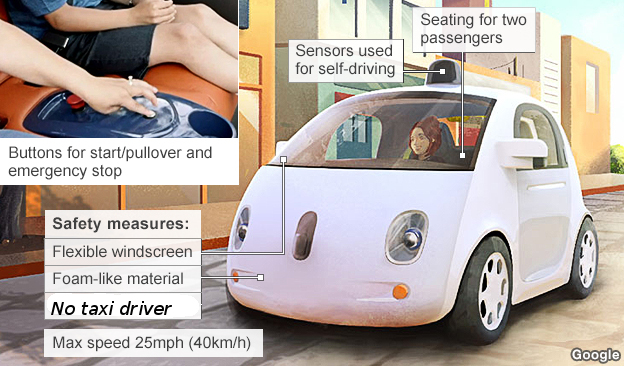
London's taxi "strike" today has been so successful that Uber claims to have had an 850% increase in new customer registrations this week. Well, that is a big success if you believe the strike may have been a guerrilla marketing tactic organised by Uber itself. No sympathy Personally, I have no sympathy for the taxi drivers. There is no city I have ever visited where I haven't encountered at least one taxi driver who tried to overcharge me. Honest drivers who give their customers value for money have less to fear from new technology than those who are unscrupulous. When I broke a leg a few years ago and was getting about on crutches for 6 weeks we decided to go out for dinner one night. This was the first time I went anywhere after having a long stint in hospital followed by a period of time I was confined to the house. The taxi driver deliberately skipped two turns leading directly to the restaurant, went another 1km past it and then followed a small street that winds back and forth and eventually demanded I pay him double what the fare should have been. This is exactly the type of abusive and despicable practice that is being eradicated by Uber's live GPS mapping technology. Although not every driver behaves so shamefully, this type of abuse of the weak or vulnerable is replicated in one way or another the world over. For example, in Melbourne, Australia, wheelchair taxis that have worked out they can make more money collecting families with suitcases at the airport leave genuine wheelchair users without a ride. Will Google be targeted next week? Google has just announced a step-change in plans to build their own self driving cars. Will Google offices around the world, including London be targetted by these crude blockades too? Political protest or anti-competitive mischief? Why were taxi drivers not arrested for their protest today? Given that the roads are the place where taxis and their competitors do business, can this blockade really be considered a political protest or is it an anti-competitive practice in blatant disregard of the law? Weapons of mass destruction Before even having breakfast you could probably find 10,000 cyclists in central London willing to sign a petition declaring taxis are a weapon of mass destruction. Once again, while there are honest drivers, there is a more than trivial number of taxi drivers who are a genuine danger to the lives of cyclists, scooters, motorcycles and occasionally pedestrians. I have personally experienced one of these thugs ramming my bicycle from behind (his hard-nosed insurer eventually paid up but without admitting liability). The police who attended the incident even told me they had seen so many accidents like this they wouldn't dare cycle themselves. The web is full of examples that appear to show malicious and criminal behavior by taxi drivers, thanks to Youtube and helmet cams: Will hotels protest about AirBNB? Now the taxi drivers have had their chance to cause mayhem, will hotel operators be next? What could they do though? Will they seek out AirBNB apartments and try to obstruct them somehow? Making mischief outside somebody's home is not a good way to make a point. Chances are, they would be prosecuted or served with restraining orders. So why do the taxi drivers get to jam up whole cities and get away with it? The Uber taxi meter loophole Will the courts decide that the Uber app is a taxi meter? This is actually a tough question. Even if courts rule against apps that perform live metering, Uber could simply remove all metering functions from the app itself and perform the metering calculations in the cloud. The app would just send start and finish locations to the cloud and the cloud would send a message back to the phone confirming the charge. The phone is then nothing more than a communication and positioning device. Remember the elevator man? When the automobile was first invented, laws were made requiring every car to be accompanied through public streets by a man carrying a flag. That job, like many others, no longer exists. elevator attendant In the good old days, every elevator had a man or woman who would sit on a stool and press buttons to operate the doors and motors. Some up-market department stores and hotels still have an elevator man to add a touch of nostalgia. The vast majority, however, have eliminated these jobs thanks to automatic elevators. Now, even aircraft can land automatically on a ship at sea. Look at all those people manning the deck in the video and contemplate how many of them might potentially be out of a job too in 50 years time as Terminator-style automated battleships patrol the seas. Technology, like the Terminator, is not going to stop.

10 June 2014

Russell Coker: Google Hardware Support

Ironically just 5 days after writing about how I choose Android devices for a long service life [1] my wife s Nexus 5 (with 32G of RAM (sorry Flash storage) to give it a long useful life) totally died. It reported itself as being fully charged and then 15 minutes later it was off and could not be revived. No combination of pushing the power button and connecting the power cable caused the screen to light up or any sound to be emitted. Google has a nice interactive support site for nexus devices that describes more ways of turning a phone on than any reasonable person could imagine. After trying to turn the phone on in various ways (plugged and unplugged etc) it gave me a link to get phone support. Clicking on that put me in the queue to RECEIVE a phone call and a minute later a lady who spoke English really well (which is unusual for telephone support) called me to talk me through the various options. Receiving a phone call is a much better experience than making a call. It meant that if the queue for phone support was long then I could do other things until the phone rings. It s impossible to be productive at other tasks while listening for hold music to stop and a person to start talking. The cost of doing this would be very tiny, while there would be some cost in hardware and software to have a web site that tells me how long I can expect to wait for a call a more basic implementation where I just submit my number and wait for a call would be very cheap to implement. The costs of calls from the US to Australia (and most places where people can afford a high end Android phone) are quite cheap for home users and are probably cheaper if you run a call center. If the average support call cost Google $1 and 3% of phones have support calls then that would be an extra cost of $0.03 per phone. I expect that almost everyone who buys a $450 phone would be happy to pay a lot more than $0.03 to avoid the possibility of listening to hold music! I received the phone call about a minute after requesting it, this was nice but I wonder how long I would have waited if I hadn t requested a call at 1AM Australian time (presumably during the day in a US call center). In any case getting a 1 minute response is great for any time of the day or night, lots of call centers can t do that. While the phone support is much better than most phone support, it would be nice if they added some extra options. I think it would be good to have webchat and SMS as options for support for the benefit of people who don t want to speak to strangers. This would be useful to a lot of people on the Autism Spectrum and probably others too. The phone call wasn t particularly productive, it merely confirmed that I had followed all the steps on the support website. Then I received an email telling me about the web site which was a waste of time as I d covered that in the phone call. I have just replied to their second email which asked for the IMEI of the phone to start the warranty return process. We could have saved more than 24 hours delay if this had been requested in the first email or the phone call. Google could have even requested the IMEI through the web site before starting the phone call. It would have been even easier if Google had included the device IMEI in the email they sent me to confirm the purchase as searching for old email is a lot easier than searching through my house for an old box. Another option for Google would be to just ask me for the Gmail account used for the purchase, as I only bought one Nexus 5 on that account they then have all the purchase details needed for a warranty claim. While the first call was a great experience the email support following that has been a waste of time. I m now wondering if they aim to delay the warranty process for a few days in the hope that the phone will just start working again.

6 June 2014

Robert Edmonds: BIND and GCC 4.9

ISC has issued an operational notification advising the use of the -fno-delete-null-pointer-checks flag when compiling current versions of BIND with GCC 4.9:
Beginning with GCC 4.9.0, code optimization in GCC now includes (by default) an optimization which is intended to eliminate unnecessary null pointer comparisons in compiled code. Unfortunately this optimization removes checks which are necessary in BIND and the demonstrated effect is to cause unpredictable assertion failures during execution of named, resulting in termination of the server process. Future versions of BIND will be modified so that the optimizer does not incorrectly remove necessary checks when building from source, and until those versions are available multiple immediate workarounds are available.
According to the GCC documentation, -fdelete-null-pointer-checks performs the following optimization, and is enabled by default even when compiling with -O0:
Assume that programs cannot safely dereference null pointers, and that no code or data element resides there. This enables simple constant folding optimizations at all optimization levels. In addition, other optimization passes in GCC use this flag to control global dataflow analyses that eliminate useless checks for null pointers; these assume that if a pointer is checked after it has already been dereferenced, it cannot be null.
This optimization dates back to 1999 but it recently became more aggressive in the GCC 4.9 release:
GCC might now optimize away the null pointer check in code like:
int copy (int* dest, int* src, size_t nbytes)  
  memmove (dest, src, nbytes);
  if (src != NULL)
    return *src;
  return 0;
 
The pointers passed to memmove (and similar functions in <string.h>) must be non-null even when nbytes==0, so GCC can use that information to remove the check after the memmove call. Calling copy(p, NULL, 0) can therefore deference a null pointer and crash. The example above needs to be fixed to avoid the invalid memmove call, for example:
if (nbytes != 0)
  memmove (dest, src, nbytes);
It's interesting that the ISC operational advisory labels this an "incorrect" optimization. I wonder if this is a similar case to the Glibc optimization which exposed incorrect usage of memcpy() in many applications, including BIND. Fortunately, few users should be affected by this bug, since GCC 4.9 is fairly new. (The upcoming Fedora 21 release will probably be the first mainstream distribution to ship with GCC 4.9 as the default compiler.) Update: Debian bug #750760 filed.

5 June 2014

Johannes Schauer: botch updates

My last update about ongoing development of botch, the bootstrap/build ordering tool chain, was four months ago and about several incremental updates. This post will be of similar nature. The most interesting news is probably the additional data that bootstrap.debian.net now provides. This is listed in the next section. All subsequent sections then list the changes under the hood that made the additions to bootstrap.debian.net possible.

bootstrap.debian.net The bootstrap.debian.net service used to have botch as a git submodule but now runs botch from its Debian package. This at least proves that the botch Debian package is mature enough to do useful stuff with it. In addition to the bootstrapping results by architecture, bootstrap.debian.net now also hosts the following additional services: Further improvements concern how dependency cycles are now presented in the html overviews. While before, vertices in a cycle where separated by commas as if they were simple package lists, vertices are now connected by unicode arrows. Dashed arrows indicate build dependencies while solid arrows indicate builds-from relationships. For what it's worth, installation set vertices now contain their installation set in their title attribute.

Debian package Botch has long depended on features of an unreleased version of dose3 which in turn depended on an unrelease version of libcudf. Both projects have recently made new releases so that I was now able to drop the dose3 git submodule and rely on the host system's dose3 version instead. This also made it possible to create a Debian package of botch which currently sits at Debian mentors. Writing the package also finally made me create a usable install target in the Makefile as well as adding stubs for the manpages of the 44 applications that botch currently ships. The actual content of these manpages still has to be written. The only documentation botch currently ships in the botch-doc package is an offline version of the wiki on gitorious. The new page ExamplesGraphs even includes pictures.

Cross By default, botch analyzes the native bootstrapping phase. That is, assume that the initial set of Essential:yes and build-essential packages magically exists and find out how to bootstrap the rest from there through native compilation. But part of the bootstrapping problem is also to create the set of Essential:yes and build-essential packages from nothing via cross compilation. Botch is unable to analyze the cross phase because too many packages cannot satisfy their crossbuild dependencies due to multiarch conflicts. This problem is only about the dependency metadata and not about whether a given source package actually crosscompiles fine in practice. Helmut Grohne has done great work with rebootstrap which is regularly run by jenkins.debian.net. He convinced me that we need an overview of what packages are blocking the analysis of the cross case and that it was useful to have a crossbuild order even if that was a fake order just to have a rough overview of the current situation in Debian Sid. I wrote a couple of scripts which would run dose-builddebcheck on a repository, analyze which packages fail to satisfy their crossbuild dependencies and why, fix those cases by adjusting package metadata accordingly and repeat until all relevant source packages satisfy their crossbuild dependencies. The result of this can then be used to identify the packages that need to be modified as well as to generate a crossbuild order. The fixes to the metadata are done in an automatic fashion and do not necessarily reflect the real fix that would solve the problem. Nevertheless, I ended up agreeing that it is better to have a slightly wrong overview than no overview at all.

Minimizing the dependency graph size Installation sets in the dependency graph are calculated independent from each other. If two binary packages provide A, then dependencies on A in different installation sets might choose different binary packages as providers of A. The same holds for disjunctive dependencies. If a package depends on A C and another package depends on C A then there is no coordination to choose C so to minimize the overall amount of vertices in the graph. I implemented two methods to minimize the impact of cases where the dependency solver has multiple options to satisfy a dependency through Provides and dependency disjunctions. The first method is inspired by Helmut Grohne. An algorithm goes through all disjunctive binary dependencies and removes all virtual packages, leaving only real packages. Of the remaining real packages, the first one is selected. For build dependencies, the algorithm drops all but the first package in every disjunction. This is also what sbuild does. Unfortunately this solution produces an unsatisfiable dependency situation in most cases. This is because oftentimes it is necessary to select the virtual disjunctive dependency because of a conflict relationship introduced by another package. The second method involves aspcud, a cudf solver which can optimize a solution by a criteria. This solution is based on an idea by Pietro Abate who implemented the basis for this idea back in 2012. In contrast to a usual cudf problem, binary packages now also depend on the source packages they build from. If we now ask aspcud to find an installation set for one of the base source packages (I chose src:build-essential) then it will return an installation set that includes source packages. As an optimization criteria the number of source packages in the installation set is minimized. This solution would be flawless if there were no conflicts between binary packages. Due to conflicts not all binary packages that must be coinstallable for this strategy to work can be coinstalled. The quick and dirty solution is to remove all conflicts before passing the cudf universe to aspcud. But this also means that the solution does sometimes not work in practice.

Test cases Botch now finally has a test target in its Makefile. The test target tests two code paths of the native.sh script and the cross.sh script. Running these two scripts covers testing most parts of botch. Given that I did lots of refactoring in the past weeks, the test cases greatly helped to assure that I didnt break anything in the process. I also added autopkgtests to the Debian packaging which test the same things as the test target but naturally run the installed version of botch instead. The autopkgtests were a great help in weeding out some lasts bugs which made botch depend on being executed from its source directory.

Python 3 Reading the suggestions in the Debian python policy I evaluated the possibility to use Python 3 for the Python scripts in botch. While I was at it I added transparent decompression for gzip, bz2 and xz based on the file magic, replaced python-apt with python-debian because of bug#748922 and added argparse argument parsing to all scripts. Unfortunately I had to find out that Python 3 support does not yet seem to be possible for botch for the following reasons:
  • no soap module for Python 3 in Debian (needed for bts access)
  • hash randomization is turned on by default in Python 3 and therefore the graph output of networkx is not deterministic anymore (bug#749710)
Thus I settled for changing the code such that it would be compatible with Python 2 as well as with Python 3. Because of the changed string handling and sys.stdout properties in Python 3 this proved to be tricky. On the other hand this showed me bugs in my code where I was wrongly relying on deterministic dictionary key traversal.

John Sullivan: GPG keysigning and government identification

Please stop recommending that checking government-issued ID is a good way to verify someone's identity before signing their GPG key. Have you been a US bartender before? Or held any other position where you've had to verify an ID? It's not an easy thing to do. People in those positions have books of valid IDs from different states. They have lights that show the security marks. They still get it wrong regularly. A very amateur fake ID, or borrowed real ID, will fool just about everyone in any informal context. What's even worse is that people have a habit of happily looking at passports from other countries than their own, and nodding knowingly. It's fun, but be honest, you have no idea what you're doing. How about just signing keys with people you would actually say you know well enough to trust? It's not the Web of Amateur ID Checking. ID checking is at best ineffective against the threats it's supposed to address, and is probably actually damaging to the Web of Trust because of the false sense of security. No idea what I'm talking about? Learn to encrypt your email by reading the FSF's new Email Self-Defense Guide, published in honor of today's Reset The Net effort.

4 June 2014

Russell Coker: Android Device Service Life

In recent years Android devices have been the most expensive things I ve purchased apart from airline tickets and other travel/holiday expenses. As they are expensive I d like to use them for as long as possible to get the most value for money. Also as I give my devices to relatives when they no longer work for me I d like to avoid having relatives hassling me about their phone not working as desired. So I ve been thinking about the features that I need to make it possible to use a phone or tablet for a long time. RAM The way Android works is that when an application in the foreground requests more memory background applications may be closed to free some memory. Android doesn t use swap by default, there is some documentation on how to enable it (and it s not difficult to figure out for anyone who has used Linux before) but generally it s not done. If you run a larger application the chances of apps closing in the background (causing delays when you switch back to them and possibly a loss of context if the app is buggy and doesn t preserve all state) are increased. As a general trend apps tend to get bigger to provide more features and also because users who own newer bigger devices don t complain as much about memory use. Also to make things worse new versions of Android tend to use more RAM. So a phone that runs well can suddenly start performing badly when you upgrade to a new version of Android (which incidentally usually can t be reversed) and upgrade to new versions of apps (which can t be reversed through the Google Play Store). The Sony Ericsson Xperia X10 was a very nice phone when it was released, it ran Android 2.1 very quickly. When I upgraded the Xperia X10s that my wife and I used to Android 2.3 (which was necessary to have the phone run as a Wifi access point) performance dropped considerably. The Android upgrade combined with newer larger apps means that those phones are barely usable now. 384M of RAM was plenty in early 2011 when I first used the Xperia X10 but it s not nearly enough now. Recently 2G of RAM has been the minimum for a mid-range or high-end phone. It seems difficult to imagine a new Android feature as compelling as the addition of Wifi access point support in Android 2.3 that would drive an upgrade to a future memory hogging version of the OS. It also seems difficult to imagine Android apps needing enough memory to destroy the performance of a phone with 2G of RAM. But then I couldn t imagine the 384M in an Xperia X10 becoming inadequate or the 512M in a Samsung Galaxy S becoming barely usable either. Storage Until fairly recently storage in an Android device was divided into USB attached storage (a VFAT filesystem that could be directly mounted on a PC) and a Linux filesystem that was used for all internal operations of the phone. On such devices it typically wasn t possible to change partition sizes without a lot more skill than most users possess and most of the storage space was reserved for USB attachment. If you only had a few Android apps and lots of photos, movies, etc then this worked well. But if you wanted to install larger Android apps then you would have big problems. Even with Android 4.x devices (which all seem to have a single filesystem) you can easily run out of space. Modern games often take several hundred megs of storage. Games that take 500M+ for the Android package install (which also requires the same amount of temporary space for installation and upgrade) are common. Sometimes games download data files after they have been installed for a total size approaching 2G (such as The Sims Freeplay). When I bought a Nexus 4 for my wife I got the version with 8G of storage because paying an extra $50 for the 16G version seemed unreasonable. 8G was fine for my wife, but when she got a new phone I gave the Nexus 4 to a relative who wanted to play The Sims and other big games. That relative isn t so happy about having a limited number of games on their phone and I have to fix it when storage space runs out and things start aborting (when storage runs out the Google App Store program aborts and uses lots of space for temporary files). I recently bought a tablet with 32G of storage and filled 16G on the first day (tablets are good for watching
TV and TV shows are big). Fortunately the tablet in question has a SD socket so that when space becomes a problem in a year or two I can buy an SD card and keep using it. An unfortunate recent decision by Google was to prevent apps from being run from a SD card. So even if you have a device with a SD socket you still need to have enough internal storage for all apps and their private data. At 500M+ for a modern game that means a device with 8G of storage (which includes space for the OS) will be lucky to get 8 games installed. If you want to use a phone to it s full capacity (playing various media files, games, etc) then it seems that the minimum storage capacity would be 8G of internal storage and a SD socket. For a device without an SD socket (such as the Nexus 5 with 16G or 32G of storage) your future use will be limited. 32G is probably enough for a phone given that you can recode movies to use less space (the FullHD screen on the Nexus 5 is nice but 720p movies will probably look good enough). But the larger screens of tablets demand better video quality so the Nexus tablets are probably a bad choice due to lack of storage space. Screen Size and Resolution I have previously written about the sizes of devices and how they may be used by people of various ages [1]. That should be of use for anyone who plans to use their old phone as an educational device for their children (which appears to be very common). But apart from that I can t think of any reason why size would suddenly make an old phone obsolete. Only young children will have their hands change size in any significant way. Resolution also shouldn t be a huge problem, the 480*854 screen on the Xperia X10 is fairly good for a 4 screen. While a higher resolution makes text more readable at a small size for most users the availability of a higher resolution screen isn t going to make their old phone obsolete. CPU The only Android devices I owned that appeared to develop CPU speed issues late in life were the Xperia X10 phones, and that might be more due to RAM limits and the OS upgrade. All the other devices were either obviously slow at purchase time or are still performing well now. CPU speed may make it difficult or impossible to play new games, but shouldn t affect other uses of a phone or tablet. Conclusion It seems to me that if you want to use an Android device for more than 2 years then storage capacity should be a major factor in choosing which device to purchase. It seems that lack of storage space is in many cases the main factor that makes older devices annoying or impossible to use.

3 June 2014

Vasudev Kamath: Using WSME with Flask microframework

After reading Julien Danjou's I found out WSME (Web Service Made Easy) a Python framework which allows us to easily create Web Services in Python. For SILPA we needed a REST like interface and I thought of giving it try as WSME readily advertised the Flask integration, and this post was born when I read the documentation for Flask integration. First of all Flask is a nice framework which will right way allow development of REST api for simple purposes, but my requirement was bit complicated where I had to expose function in a separate python modules through SILPA. I think detailed requirement can be part of another post, so let me explain how to use WSME with Flask app. WSME integration with Flask is done via decorator function wsmeext.flask.signature which expects you to provide it with signature of function to expose. And here is its documentation, basically signature of signature function is
wsmeext.flask.signature(return_type, *arg_types, **options)
Yeah thats all docs have sadly. So basically exposing is the only thing WSME handles for us here, routing and other stuffs need to be done by Flask itself. So lets consider a example, simple function to add as shown below.
def add(a, b):
    return a + b
For providing REST like service, all you need below code.
from flask import Flask
from wsmeext.flask import signature
app = Flask(__name__)
@app.route('/add')
@signature(int, int, int)
def add(a, b):
    return a + b
if __name__ == '__main__':
       app.run()
So first argument to signature is return type of function and rest arguments are the argument to function to be exposed. Now you can access the newly exposed service by visiting http://localhost:5000/add but don't forget to pass the arguments either via query string or through post. You can restrict methods of access via Flask's route. So what's the big deal of not having docs right?.. Well fun part began when we use bit more complex return type like dictionaries or lists . Below is modified code I'm using to demonstrate problem I faced during using dict as return type.
from flask import Flask
from wsmeext.flask import signature
app = Flask(__name__)
@app.route('/add')
@signature(dict, int, int)
def add(a, b):
    return  "result": a + b 
if __name__ == '__main__':
    app.run()
Basically I'm returning a dictionary containing result now, for demonstration purpose. When I run the application boom python barked at me with following message.
Traceback (most recent call last):
File "wsme_dummy.py", line 7, in <module>
 @signature(dict, int, int)
File "c:\Users\invakam2\.virtualenvs\wsmetest\lib\site-packages\wsmeext\flask.py", line 48, in decorator
 funcdef.resolve_types(wsme.types.registry)
File "c:\Users\invakam2\.virtualenvs\wsmetest\lib\site-packages\wsme\api.py", line 109, in resolve_types
 self.return_type = registry.resolve_type(self.return_type)
File "c:\Users\invakam2\.virtualenvs\wsmetest\lib\site-packages\wsme\types.py", line 739, in resolve_type
 type_ = self.register(type_)
File "c:\Users\invakam2\.virtualenvs\wsmetest\lib\site-packages\wsme\types.py", line 668, in register
 class_._wsme_attributes = None
TypeError: can't set attributes of built-in/extension type 'dict'
After going through code from files involved in above traces this is what I found
  1. wsmeext.flask.signature inturn uses wsme.signature which is just alias of wsme.api.signature.
  2. Link in documentation in sentence See @signature for parameter documentation is broken and should actually link to wsme.signature in docs.
  3. wsme.signature actually calls resolve_type to check on types of return and arguments. This function checks if types are instance of dict or list in such cases it creates instances of wsme.type.DictType and wsme.type.ArrayType respectively with values from the argument.
  4. When I just passed built-in type dict the control went to else part which just passed the type to wsme.type.Register.registry function which tries to set the attribute _wsme_attribute which actually raises TypeError as we can't set attribute for built-in types.
So by inspecting code of wsme.type.Registry.resolve_type and wsme.type.Registry.register its clear that what signature expects when arguments or return type is dictionary/list is instance of dictionary/list with type of value in it. May be sentence is bit vague but I'm not sure how to put it more clearly, as an example in our case add function returns dictioanry with key as string and value as int, so return type argument for signature will be str: int . Similarly if you return array with int values it will be [int]. With above understanding our add function now looks like below.
@signature( str: int , int, int)
def add(a, b):
   return  'result': a + b 
and now code worked just fine!. What I couldn't figure out here is there is no way to have tuple as return value or argument, but I guess that is not big deal. So immidiate task for me after finding this is fix the link in documentation to point to wsme.signature and probably put some note some where in documentation about above finding.

2 June 2014

Rapha&#235;l Hertzog: My Free Software Activities since January 2014

If you follow my blog closely, you noticed that I skipped all my usual monthly summaries in 2014. It s not that I stopped doing free software work, instead I was just too busy to be able to report about what I did. As an excuse, let me tell you that we just moved into a new house which was in construction since may last year. The lack of visible activity on my blog resulted in a steady decrease of the amount of donations received (January: 70.72 , February: 71.75 , March: 51.25 , April: 39.9 , May: 40.33 ). Special thanks to all the people who kept supporting my work even though I stopped reporting about it. So let s fix this. This report will be a bit less detailed since it covers the whole period since the start of the year. Debian France Preparations related to general assemblies. The year started with lots of work related to Debian France. First I took care of setting up limesurvey with Alexandre Delano to handle the vote to pick our new logo:
The new logo of Debian France I also helped Sylvestre Ledru to finalize and close the accounting books for 2013 in preparation for the general assembly that was due later in the month. I wrote the moral report of the president to be presented to the assembly. And last step, I collected vote mandates to ensure that we were going to meet the quorum for the extraordinary assembly that was planned just after the usual yearly assembly. The assemblies took place during a two days mini-debconf in Paris (January 17-18) where I was obviously present even though I gave no talk besides announcing the logo contest winner and thanking people for their participation.
Assembl e g n rale 2014 de Debian France

The Debian France members during the general assembly

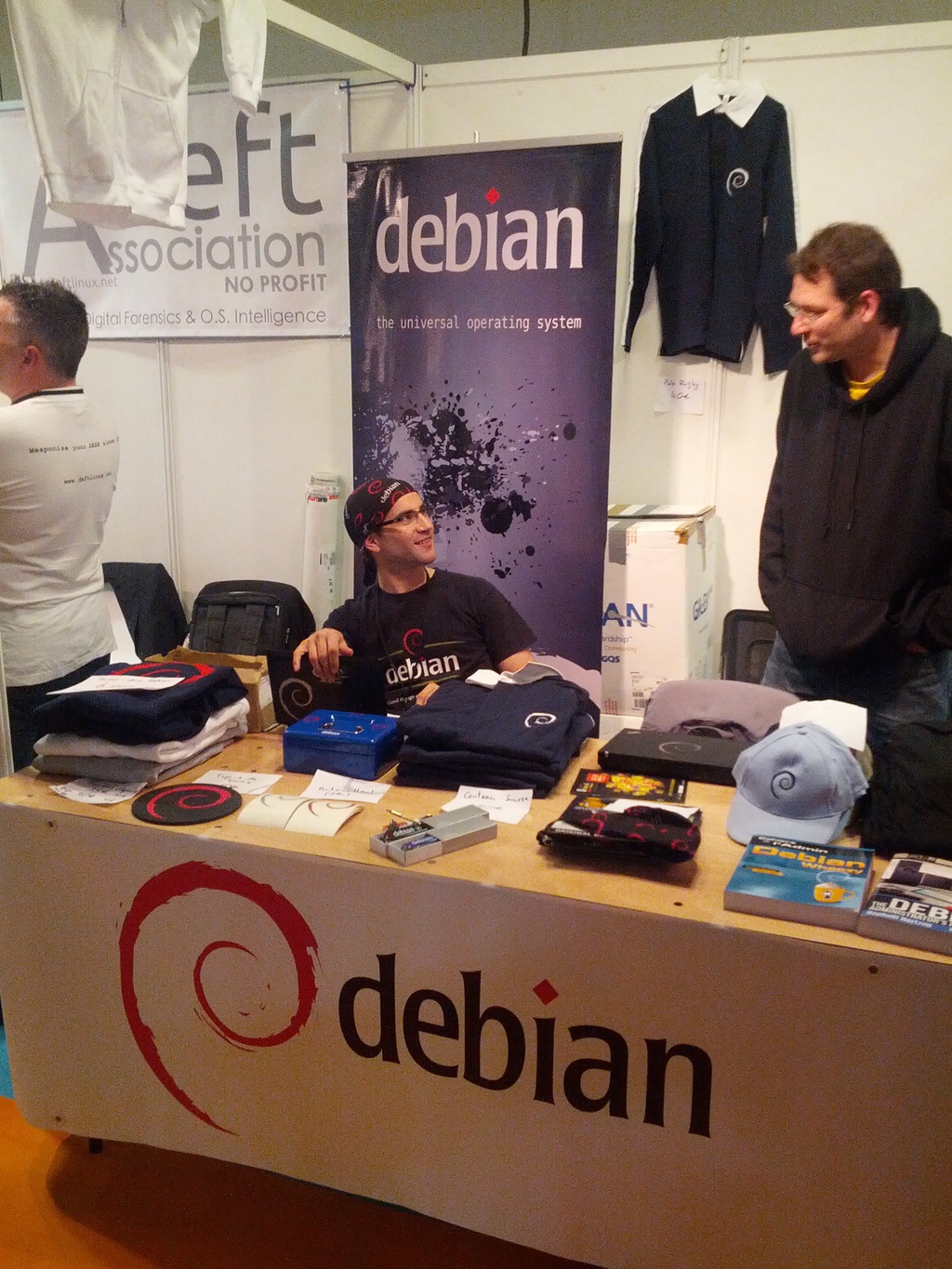
It s worth noting that the extraordinary assembly was meant primarily to enshrine in our bylaws the possibility to act as a trusted organization for Debian. This status should be officialized by the Debian project leader (Lucas Nussbaum) in the upcoming weeks since we answered satisfactorily to all questions. Our paypal donation form and the accounting tools behind it are ready. Galette packaging and members map. I managed to hand over the package maintenance of galette to Fran ois-R gis Vuillemin. I sponsored all his uploads and we packaged a new plugin that allows to create a map with all the members who accept to share their location. The idea was to let people meet each other when they don t live far away with the long term goal to have Debian France organized activities not only in Paris but everywhere in France. New contributor game. Last but not least, I organized a game to encourage people to do their first contribution to Debian by offering them a copy of my book if they managed to complete a small Debian project. We got many interesting projects but the result so far seem to be very mixed. Many people did not complete their project (yet) that said for the few that did substantial work, it was rather good and they seem to be interested to continue to contribute. Debian France booth at Solutions Linux in Paris. Like each year, I spent two days in Paris to help man the Debian France booth at Solutions Linux. We had lots of goodies on sale and we made more than 2000 EUR in earnings during the two days. I also used this opportunity to try to convince companies to support the new Debian LTS effort.
Debian France booth at Solutions Linux

Tanguy Ortolo and Fernando Lagrange behind the Debian France booth

The Debian Administrator s Handbook In the last days of 2013, we released the wheezy update of the book. Then I quickly organized everything needed so that the various translation teams can now focus their efforts on the latest release of the book. Later (in February) I announced the availability of the French and Spanish translations. Debian Squeeze LTS When the security team called for help to try to put in place long term support for Squeeze, I replied positively because I m convinced that it s very important if Debian wants to stay an acceptable choice in big deployments and because I knew that some of my customers would be interested Thus I followed all the discussions (on a semi-private list first and then on debian-lts@lists.debian.org) and contributed my own experience. I have also taken up the responsibility to coordinate with the Debian contributors who can be hired to work on Squeeze LTS so that we have a clear common offer for all the companies who have offered financial support towards Squeeze LTS. Expect further news on this front in the upcoming days/weeks. Tryton I have been a long time user of SQL-Ledger to manage the accounting of my company Freexian. But while the license is free software, the project is not. It s the work of a single developer who doesn t really accept help. I have thus been considering to move to something else for a long time but never did anything. This year, after some rough evaluation, I decided to switch to Tryton for my company. It s probably not a wise choice from a business perspective because that migration took me many hours of unpaid labor but from a free software perspective it s definitely better than everything else I saw. I contributed a lot of bug reports and a few patches already (#3596, #3631, #3633, #3665, #3667, #3694, #3695, #3696, #3697) mainly about problems found in the French chart of accounts but also about missing features for my use case. I also accepted to sponsor Matthias Berhle, who is maintaining the official Debian packages of Tryton. He s already a Debian maintainer so it s mainly a matter of reviewing new source packages and granting him the required rights. Misc Debian work Thanks See you next month for a new summary of my activities.

2 comments Liked this article? Click here. My blog is Flattr-enabled.

Francesca Ciceri: 100 bugs triaged: achievement unlocked

After two weeks working as OPW intern for Mozilla, it's time for a recap!
What exactly I've been doing in these two weeks? 100 bugs triaged: achievement unlocked! Yes, this is the thing I'm most proud of. I'm a bit cheating here, as strictly speaking, since the beginning of the internship I've triaged only 44 bugs.
But I've decided to count from the beginning of my activity on bugzilla, at the end of March, since I've started work on that as part of the small contribution required for applying to OPW.
Therefore, it's all OPW related :) Here's the grand total. Right now, I've decided to work on an average of 5 bugs a day: it's mostly triage and/or verification, which is quite fun.
It consists in trying to have a more complete and detailed bug report for the developers: asking the right questions to the reporter, ensuring that the bug is filed against the right product or component and all the information about platforms and version are correct. Or verifying that the bug isn't a duplicate, which involves doing some voodoo with Bugzilla quicksearch (I'm not so good with that yet, mostly because I'm not imaginative enough in the queries... but I'm getting better!) Sometimes triaging means reading lots of documentation (to be sure that something is a bug and not a feature) and checking meta-bugs and release notes to be able to pinpoint the time when something was introduced and the reasoning behind it.
That takes a lot of time, but it makes you discover some funny things, like the Mighty Bouncing Unicorn. And while I know it sounds a bit cruel, it's really good when you're verifying a fix and you find it's not totally ok, or that it triggered another bug.
I've been assured that feeling satisfied after that it's an essential part of the sadistic QA work. Writing FAQs for new triager This started as a personal project even before knowing I've been selected for OPW, and it's now part of my internship: I've been writing a first draft of FAQ for those who approach for the first time the Bug Triaging and Verifying work in Mozilla. It meant taking a whole lot of IRC logs and scan them for the most asked questions during bugdays, and you can find here my first draft. I'll send a RFC today about it on dev-quality mailing list and link it to the main Bugdays page. Lessons learned So, what I've learned in these two weeks? That I'm pretty good at figuring things alone, but I like to have feedback on what I'm working on.
That testing things is an art, and perfectionism is a big plus.
That there are such things as stupid questions, but you have to ask them nonetheless.
That people in the Mozilla community are quite friendly and not scary at all. Not even in video! :) Wishlist I've been thinking about this a lot, and I think I'd like to have They will probably become my next pet project.

Russ Allbery: Review: Debt

Review: Debt, by David Graeber
Publisher: Melville House
Copyright: 2011, 2012
Printing: October 2012
ISBN: 1-61219-129-0
Format: Trade paperback
Pages: 453
You probably remember this story from introductory economics. Originally, people exchanged things through barter. I needed grain but had a cow. You had a farm but needed milk. I gave you milk for your grain. But this was tedious and awkward, and required finding the right combination of people who needed something the other person had on hand. Then, people invented money: small objects with an agreed-upon value that you could keep and use later when you needed something else. In other words, both a medium of exchange and a store of value. And that improved matters for a long time, although war-torn societies or societies that collapsed (the supposed "Dark Ages" often raises its head) would sometimes "revert to barter" for some period of time until things were stable enough for currency to reappear. Following that story was usually some story about the emergence of money based on credit: goldsmith shops that started a side business in storing other people's coins and giving them receipts, leading to the receipts trading like the coins since the shops were trustworthy, and from there into the Bank of England and eventually the fractional reserve banking system, fiat money, and all the modern machinery of finance. All of this was dated from the early Enlightenment and the development of modern finance in Europe. It's a very neat story, and it makes a great deal of intuitive sense. That barter system does feel like what you'd have to do without money, but one can immediately see how obnoxious and limiting it would be. These stories play into our intuitive sense of history: people started with emergent properties of the physical world (different people have different goods and different skills and want to exchange them) and then develop layers of abstraction on top of them, eventually leading to the sophistication of modern societies. However, David Graeber is not an economist. He's an anthropologist: the profession devoted to understanding how people actually do things rather than how we've reconstructed our history based on our modern perspective. And, as he points out, engagingly and comprehensively, in chapter two of Debt, there is no evidence that this story about economic history has anything whatsoever to do with reality. And quite a bit of evidence that it does not. As best as we've been able to determine, not only is there no society in the world that deals with routine, day-to-day needs like grain and milk through barter, there never has been such a society in human history. Instead, history and anthropology shows that credit is, in a sense, older than currency: the earliest recorded economic transactions were built on a rich system of credit, but in the form of purchases from shopkeepers on credit, or credit clearinghouses through the local government or temple. Those credit records were often denominated in some standardized commodity so many cattle or bushels of grain that could create the impression that the economy worked on barter. But the anthropological evidence indicates that this was more an accounting technique than a practical currency. People rarely brought the named commodity to the temple to pay off some debt. Rather, there was an agreed conversion from various other goods to that standardized commodity, and its primary purpose was consistent bookkeeping. Specie minted coins appear to come later, and wax and wane throughout history depending on local circumstance. For example, Europe did not "revert to barter" after the collapse of the Roman Empire, but the inhabitants did stop using specie and returned to a system of credit and record-keeping... records that continued to be denominated in Roman currency, even though few people still used the actual coins. That's one fascinating observation with which Graeber begins this book. The other is the question of why we have such a strong social and moral belief that people must pay their debts. This moral belief is ever-present in discussions about the 2008 financial collapse, and more broadly in discussions about the modern economy, but it's not as obvious of a belief as it might appear on the surface. After all, the banking and investment system is founded on the principle that not everyone will repay their debts, and therefore lenders receive a risk premium based on the likelihood that the debt won't be repaid. But, despite building the possibility of non-repayment into the system, debt forgiveness or intentional default is almost unthinkable and considered a huge moral problem. To this, Graeber brings the perspective of historical anthropology: human societies have struggled with the problems of debt and repayment from the beginning of recorded history, and have attempted a wide variety of solutions to those problems, including massive debt forgiveness. The jubilee described in the Bible was not novel; rather, it reflected a common practice to keep abuses of debt under control in ancient Sumer. The subtitle of Debt is The First 5,000 Years, and this book is a historical survey. But Graeber puts off the history to first lay an intellectual groundwork for our understanding of debt, and I found that preliminary discussion extremely valuable. Most memorable was the way Graeber divides human economic relationships into communism (in the old sense, not the political sense), exchange, and hierarchy. Capitalism has consumed our economic analysis to such a degree that exchange is the only economic basis that gets much discussion, but the other two are both obvious and pervasive once Graeber points them out. Human civilization could not exist without all three. And Graeber also points out one aspect of exchange-based economics that had not previously occurred to me: it's the economic relationship that one creates with strangers. Debt has the unique characteristic that it can be discharged, at which point the relationship ceases. This has far more complex and far-reaching moral and social implications than one might initially realize, and Graeber did a wonderful job opening my eyes to some of the subtleties. Debt is clearly a scholarly work, but Graeber's writing is clear and engaging. I found most of this book to be surprisingly easy reading. The hardest going was Graeber's discussion of societies that use a form of currency to arrange relationships between people (marriages, births, and deaths, primarily), but not day-to-day economic transactions. I suspect this area is closer to Graeber's areas of personal research and field work, which resulted in more technical detail. I'm still not sure I completely grasp the principles that Graeber was trying to communicate. But I was struck by the observation of alienation's role in turning a human being into a commodity, and how that links with debt's role as the economic transaction one has with strangers. Graeber covers slavery only glancingly, but makes some memorable points about the use of violence to rip someone out of their social context, and how that is necessary in human cultures before humans can be reduced to a commodity. There's a lot here, and I've only scratched the surface. I haven't mentioned, for example, the fascinatingly elegant theory that coining money and then requiring taxes be paid in the same money is a simple and highly effective way of funding armies, an explanation for specie that is largely unproven but that I find more compelling than the ones I've previously heard. Approaching debt from an anthropological instead of economic perspective is surprisingly enlightening. Debt is primarily a historical and cultural discussion rather than a set of proposed solutions, but Graeber does effectively show that debt as a moral obligation is not an unquestionable moral stance, but rather has a long history as one side of a two-sided political debate. I also came away from this book more conscious of the social implications and costs of debt-structured interactions, and wanting to push more of the language of debt out of my day-to-day dealings. Graeber is well known as one of the supporters of Occupy Wall Street, and Debt, while a well-defended academic work, certainly does advocate a position. But the academic analysis is more prominent than the advocacy, and I found his positions well-defended and well-argued. I do need to give the caveat that I don't have the anthropological background to distinguish the statements from Graeber that are well-established common knowledge in anthropology from the ones that are more controversial, and I would be a bit leery of taking this book as the final word on the topic. But it fully deserves its popularity and reputation as a thought-provoking and valuable contribution to the conversation. It's another book that I want to re-read someday to digest further, and the sort of book whose observations keep occurring to me in subsequent discussions or news stories. If you're at all interested in the way in which we construct the morality around economics and debt, I think this is a book that you should read. It's thoughtful, challenging, and surprising, and it passes my acid test for books of this sort with flying colors: after reading it, you realize that many things are more complicated, more historical, and less novel than you had originally thought. Highly recommended. Rating: 9 out of 10

1 June 2014

Antonio Terceiro: An introduction to the Debian Continuous Integration project

Debian is a big system. At the time of writing, looking at my local package list caches tells me that the unstable suite contains 21306 source packages, and 42867 binary packages on amd64. Between these 42867 binary packages, there is an unthinkable number of inter-package dependencies. For example the dependency graph of the ruby packages contains other 20-something packages. A new version of any of these packages can potentially break some functionality in the ruby package. And that dependency graph is very small. Looking at the dependency graph for, say, the rails package will make your eyes bleed. I tried it here, and GraphViz needed a PNG image with 7653 10003 pixels to draw it. It ain t pretty. Installing rails on a clean Debian system will pull in another 109 packages as part of the dependency chain. Again, as new versions of those packages are uploaded the archive, there is a probability that a backwards-incompatible change, or even a bug fix which was being worked around, might make some funcionality in rails stop working. Even if that probability is low for each package in the dependency chain, with enough packages the probability of any of them causing problems for rails is quite high. And still the rails dependency chain is not that big. libreoffice will pull in another 264 packages. gnome will pull in 1311 dependencies, and kde-full 1320 (!). With a system this big, problems will arrive, and that s a fact of life. As developers, what we can do is try to spot these problems as early as possible, and fixing them in time to make a solid release with the high quality Debian is known for. While automated testing is not the proverbial Silver Bullet of Software Engineering, it is an effective way of finding regressions. Back in 2006, Ian Jackson started the development of autopkgtest as a tool to test Debian packages in their installed form (as opposed to testing packages using their source tree). In 2011, the autopkgtest test suite format was proposed as a standard for the Debian project, in what we now know as the DEP-8 specification. Since then, some maintainers such as myself started experimenting with DEP-8 tests in their packages. There was an expectation in the air that someday, someone would run those tests for the entire archive, and that would be a precious source of QA information. Durign the holiday break last year, I decided to give it a shot. I initially called the codebase dep8. Later I renamed it to debci, since it could potentially also run other other types of test suites in the future. Since early January, ci.debian.net run an instance of debci for the Debian Project. The Debian continuous Integration will trigger tests at most 4 times a day, 3 hours after each dinstall run. It will update a local APT cache and look for packages that declare a DEP-8 test suite. Each package with a test suite will then have its test suite executed if there was any change in its dependency chain since the last test run. Existing test results are published at ci.debian.net every hour, and at the end of each batch a global status is updated. Maintainers can subscribe to a per package Atom feed to keep up with their package test results. People interested in the overall status can subscribe to a global Atom feed of events. Since the introduction of Debian CI in mid-January 2014, we have seen an amazing increase in the number of packages with test suites. We had little less than 200 packages with test suites back then, against around 350 now (early June 2014). The ratio of packages passing passing their test suite has also improved a lot, going from less than 50% to more than 75%. There is documentation available, including a FAQ for package maintainers with further information about how the system works, how to declare test suites in their packages and how to reproduce test runs locally. Also available is development information about debci itself, to those inclined to help improve the system. This is just the beginning. debci is under a good rate of development, and you can expect to see a constant flux of improvements. In special, I would like to mention a few people who are giving amazing contributions to the project:

Andrew Cater: Not quite the last of the 32 bit machines ...

I've just got back my daughter's netbook. About 5 years old. Originally cost me 100 as part of a deal with my ISP.

1.6GHz Atom N270 processor, 2GB of memory, 120GB of Samsung hard disk.
It's a "Freedom" netbook - almost certainly made by Quanta. Atheros chipset for wifi. [A9285 for wifi, Realtek 8101E for Ethernet]

This is the sort of machine that is probably going into landfill round about now. It's been running XP and mostly used by my father, who has given up on it now it won't update.

I used the unofficial Debian 7.5 cd which includes firmware because I was going to be using wifi to install Debian and because I didn't know what wifi chipset was in there. I had previously tested and run a Debian live USB image but faced problems - the cursor wouldn't play although the KDE desktop appeared fine.

An expert install selecting KDE worked fine but produced immediate problems: cursor was erratic, the screen blacked out and I couldn't switch it off - I had to remove the mains power and battery to kill it.

A second install over the top of this, wiping out the first install but selecting LXDE worked perfectly and works well. It's possible that a full KDE desktop is stressing this litle 10 inch laptop's 2GB and display memory a bit too much.

I'm very pleased to have rescued this machine and got a Linux that "just works" albeit a bit more slowly than I'm used to. Even if it gets used just as a terminal for amateur radio / a spare emergency machine in a corner somewhere, it's better than being junked. Best of all, installing vrms shows that, although I enabled non-free in the initial install, this machine requires no non-free firmware so has saved me the cost of buying an FSF approved secondhand Thinkpad.


30 May 2014

Tiago Bortoletto Vaz: On losing contacts with old friends

In 2010 I decided to stop using my google account. In 2011 I decided to leave facebook, twitter and other $cool stuff. This was a hard decision. Not because email migration was annoying, nor because I liked to do social networking. It's hard because most of friends depend on either google or facebook to chat. Since I moved to another country, phone calls and presencial meetings have been substantially reduced. So we keep in contact by using IRC and XMPP. I have good friends who use IRC, mostly Debian people, which is great. I also have lots of friends and contacts not using IRC. In the past they used ICQ, then moved to MSN and now they are using google talk and facebook. I used to explain them that we could talk by using their google account and my Jabber account due to an open standard called XMPP. I enjoy having short conversations in random times, which sometimes takes hours and helps us to keep affectionately connected. It used to work so well. Now it seems to be gone. I've noticed that I can't connect anymore with contacts using google talk, probably because google has finally put into action their decision to abandon open standards for instant messaging. I'm not going to list here all the good things that happened in my life when I stopped using all this crap services. But I have to admit that it really hurts to see my contacts disappearing day by day, feeling like my friends are being devoured by these companies, with zero critical sense. You'll say that good friends won't disappear like that if they are good friends. I agree, but the convenience of having people from one-click distance in random hours a day makes a difference, mainly when physical distance is a blocker.

29 May 2014

Enrico Zini: wheezy-for-industrial-development

Wheezy for industrial software development I'm helping with setting up a wheezy-based toolchain for industrial automation. The basic requirements are: live-build, C++11, Qt 5.3, and a frozen internal wheezy mirror. debmirror A good part of a day's work was lost because of #749734 and possibly #628779. Mirror rebuild is still ongoing, and fingers crossed. This is Italy, and you can't simply download 21Gb of debs just to see how it goes. C++11 Stable toolchains for C++11 now exist and have gained fast adoption. It makes sense, since given what is in C++11 it is unthinkable to start a new C++ project with the old standard nowadays. C++11 is supported by g++ 4.8+ or clang 3.3+. None of them is available on wheezy or wheezy-backports. Backports exist of g++ 4.8 only for Ubuntu 12.04, but they are uninstallable on wheezy due at least to a different libc6. I tried rebuilding g++4.8 on wheezy but quickly gave up. clang 3.3 has a build dependency on g++ 4.8. LOL. However, LLVM provides an APT repository with their most recent compiler, and it works, too. C++11 problem solved! Qt 5.3 Qt 5.3 is needed because of the range of platforms it can target. There is no wheezy backport that I can find. I cannot simply get it from Qt's Download page and install it, since we need it packaged, to build live ISOs with it. I'm attempting to backport the packages from experimental to wheezy. Here are its build dependencies: libxcb-1.10 (needed by qt5) Building this is reasonably straightforward. libxkbcommon 0.4.0 (needed by qt5) The version from jessie builds fine on wheezy, provided you remove --fail-missing from the dh_install invocation. libicu 52.1 (needed by harfbuzz) The jessie packages build on wheezy, provided that mentions of clang are deleted from source/configure.ac, since it fails to build with clang 3.5 (the one currently available for wheezy on llvm.org). libharfbuzz-dev Backporting this is a bloodbath: the Debian packages from jessie depend on a forest of gobject hipsterisms of doom, all unavailable on wheezy. I gave up. qt 5.3 qtbase-opensource-src-5.3.0+dfsg can be made to build with an embedded version of harfbuzz, with just this change:
diff -Naur a/debian/control a/debian/control
--- a/debian/control    2014-05-20 18:48:27.000000000 +0200
+++ b/debian/control    2014-05-29 17:45:31.037215786 +0200
@@ -28,7 +28,6 @@
                libgstreamer-plugins-base0.10-dev,
                libgstreamer0.10-dev,
                libgtk2.0-dev,
-               libharfbuzz-dev,
                libicu-dev,
                libjpeg-dev,
                libmysqlclient-dev,
diff -Naur a/debian/rules b/debian/rules
--- a/debian/rules  2014-05-18 01:56:37.000000000 +0200
+++ b/debian/rules  2014-05-29 17:45:25.738634371 +0200
@@ -108,7 +108,6 @@
                -plugin-sql-tds \
                -system-sqlite \
                -platform $(platform_arg) \
-               -system-harfbuzz \
                -system-zlib \
                -system-libpng \
                -system-libjpeg \
(thanks Lisandro Dami n Nicanor P rez Meyer for helping me there!) There are probably going to be further steps in the Qt5 toolchain. Actually, let's try prebuilt binaries The next day with a fresh mind we realised that it is preferable to reduce our tampering with the original wheezy to a minimum. Our current plan is to use wheezy's original Qt and Qt-using packages, and use Qt's prebuilt binaries in /opt for all our custom software. We run Qt's installer, tarred the result, and wrapped it in a Debian package like this:
$ cat debian/rules
#!/usr/bin/make -f
QT_VERSION = 5.3
%:
    dh $@
override_dh_auto_build:
    dh_auto_build
    sed -re 's/@QT_VERSION@/$(QT_VERSION)/g' debian-rules.inc.in > debian-rules.inc
override_dh_auto_install:
    dh_auto_install
    # Download and untar the prebuild Qt5 binaries
    install -d -o root -g root -m 0755 debian/our-qt5-sdk/opt/Qt
    curl http://localserver/Qt$(QT_VERSION).tar.xz   xz -d   tar -C debian/our-qt5-sdk/opt -xf -
    # Move the runtime part to our-qt5
    install -d -o root -g root -m 0755 debian/our-qt5/opt/Qt
    mv debian/our-qt5-sdk/opt/Qt/$(QT_VERSION) debian/our-qt5/opt/Qt/
    # Makes dpkg-shlibdeps work on packages built with Qt from /opt
    # Hack. Don't try this at home. Don't ever do this unless you
    # know what you are doing. This voids your warranty. If you
    # know what you are doing, you won't do this.
    find debian/our-qt5/opt/Qt/$(QT_VERSION)/gcc_64/lib -maxdepth 1 -type f -name "lib*.so*" \
          sed -re 's,^.+/(lib[^.]+)\.so.+$$,\1 5 our-qt5 (>= $(QT_VERSION)),' > debian/our-qt5.shlibs
$ cat debian-rules.inc.in
export PATH := /opt/Qt/@QT_VERSION@/gcc_64/bin:$(PATH)
export QMAKESPEC=/opt/Qt/@QT_VERSION@/gcc_64/mkspecs/linux-clang/
To build one of our packages using Qt5.3 and clang, we just add this to its debian/rules:
include /usr/share/our-qt5/debian-rules.inc
Wrap up We got the dependencies sorted. Hopefully the mirror will rebuild itself tonight and tomorrow we can resume working on our custom live system.

27 May 2014

Jon Dowland: 2012 In Review

2013 is nearly all finished up and so I thought I'd spend a little time writing up what was noteable in the last twelve months. When I did so I found an unfinished draft from the year before. It would be a shame for it to go to waste, so here it is. 2012 was an interesting year in many respects with personal highs and lows. Every year I see a lots of "round-up"-style blog posts on the web, titled things like "2012 in music", which attempt to summarize the highlights of the year in that particular context. Here's JWZ's effort, for example. Often they are prefixed with statements like "2012 was a strong year for music" or whatever. For me, 2012 was not a particularly great year. I discovered quite a lot of stuff that I love that was new to me, but not new in any other sense. In Music, there were a bunch of come-back albums that made the headlines. I picked up both of Orbital's Wonky and Brian Eno's Lux (debatably a comeback: his first ambient record since 1983, his first solo effort since 2005, but his fourth collaborative effort on Warp in the naughties). I've enjoyed them both, but I've already forgotten Wonky and I still haven't fully embraced Lux (and On Land has not been knocked from the top spot when I want to listen to ambience.) There was also Throbbing Gristle's (or X-TG) final effort, a semi/post-TG, partly posthumous double-album swan song effort which, even more than Lux, I still haven't fully digested. In all honesty I think it was eclipsed by the surprise one-off release of a live recording of a TG side project featuring Nik Void of Factory Floor: Carter Tutti Void's Transverse, which is excellent. Ostensibly a four-track release, there's a studio excerpt V4 studio (Slap 1) which is available from (at least) Amazon. There's also a much more obscure fifth "unreleased" track cruX which I managed to "buy" from one of the web shops for zero cost. The other big musical surprise for me last year was Beth Jeans Houghton and the Hooves of Destiny: Yours Truly, Cellophane Nose. I knew nothing of BJH, although it turns out I've heard some of her singles repeatedly on Radio 6, but her band's guitarist Ed Blazey and his partner lived in the flat below me briefly. In that time I managed to get to the pub with him just once, but he kindly gave me a copy of their album on 12" afterwards. It reminds me a bit of Goldfrapp circa "Seventh Tree": I really like it and I'm looking forward to whatever they do next. Reznor's How To Destroy Angels squeezed out An Omen EP which failed to set my world on fire as a coherent collection, despite a few strong songs individually. In movies, sadly once again I'd say most of the things I recall seeing would be "also rans". Prometheus was a disappointment, although I will probably rewatch it in 2D at least once. The final Batman was fun although not groundbreaking to me and it didn't surpass Ledger's efforts in The Dark Knight. Inception remains my favourite Nolan by a long shot. Looper is perhaps the stand-out, not least because it came from nowhere and I managed to avoid any hype. In games, I moaned about having moaning about too many games, most of which are much older than 2012. I started Borderlands 2 after enjoying Borderlands (disqualified on age grounds) but to this day haven't persued it much further. I mostly played the two similar meta-games: The Playstation Plus download free games in a fixed time period and the more sporadic but bountiful humble bundle whack-a-mole. More on these another time. In reading, as is typical I mostly read stuff that was not written in 2012. Of that which was, Charles Stross's The Apocalypse Codex was an improvement over The Fuller Memorandum which I did not enjoy much, but in general I'm finding I much prefer Stross's older work to his newer; David Byrne's How Music Works was my first (and currently last) Google Books ebook purchase, and I read it entirely on a Nexus 7. I thoroughly enjoyed the book but the experience has not made a convert of me away from paper. He leans heavily on his own experiences which is inevitable but fortunately they are wide and numerous. Iain Banks' Stonemouth was an enjoyable romp around a fictional Scottish town (one which, I am reliably informed, is incredibly realistical rendered). One of his "mainstream" novels, It avoided a particular plot pattern that I've grown to dread with Banks, much to my suprise (and pleasure). Finally, the stand-out pleasant surprise novel of the year was Pratchett and Baxter's The Long Earth. With a plot device not unlike Banks' Transition or Stross's Family Trade series, the pair managed to write a journey-book capturing the sense-of-wonder that these multiverse plots are good for. (Or perhaps I have a weakness for them). It's hard to find the lines between Baxter and Pratchett's writing, but the debatably-reincarnated Tibetan Monk-cum-Artificial Intelligence 'Lobsang' must surely be Pratchett's. Pratchett managed to squeeze out another non-Discworld novel (Dodger) as well as a long-overdue short story collection, although I haven't read either of them yet. On to 2013's write-up...

25 May 2014

Luca Falavigna: Adventures in cross-chroot creations

I ve been playing with qemu-user-static a bit to create a set of porterboxes for my Deb-o-Matic build farm. After reading gregoa s post on how to create cross-chroot with qemu-debootstrap, I was immediately able to create armel, armhf and powerpc boxes with very little efforts. I tried to extend the number of porterboxes available by adding mips* and s390x, in order to have all the Linux-based architectures supported in Jessie, but with no luck. Here s a summary of my attempts. MIPS*
Chroot creation fails under both mips and mipsel trying to configure libuuid1. The problem is due to the fact libuuid1 s postinst script calls groupadd and useradd. Those two utilities rely on NETLINK sockets, which apparently are not handled by QEMU at the moment. I raised the question upstream to see whether it is possible to solve this problem. s390x
Chroot creation used to fail with a SIGSEGV. This particular bug has been fixed recently, but it seems it s not enough to have a working chroot. It fails with some gzip errors, probably because some portions of dpkg-deb are not fully covered by qemu-s390x-static. Preparing to unpack .../base-files_7.3_s390x.deb ...
Unpacking base-files (7.3) ...
dpkg-deb (subprocess): decompressing archive member: internal gzip read error: '<fd:5>: incorrect data check'
/bin/tar: Unexpected EOF in archive
/bin/tar: Error is not recoverable: exiting now
dpkg-deb: error: subprocess tar returned error exit status 2
dpkg: error processing archive /var/cache/apt/archives/base-passwd_3.5.33_s390x.deb (--install):
subprocess dpkg-deb --control returned error exit status 2

24 May 2014

Wouter Verhelst: kFreeBSD and ZFS

At one particular customer, increasing storage needs require that we add a large file server which should be as fast as possible. In that context, I'm currently evaluating using Debian GNU/kFreeBSD ("Debian," from now on) on ZFS. Not being hampered by a large degree of knowledge on the subject, here's a blog post with things I've learned so far. For context, the system on which we'll be installing will have 64 gigs of RAM, about two dozen SAS disks connected to a RAID controller of which I'm reasonably sure (though not 100% so) that it supports JBOD mode, and a PCIe-attached solid state storage device of several terabytes. If it turns out the RAID controller doesn't support JBOD mode, I'll probably create as many RAID0 devices as possible and hand those over to ZFS as "hard disks", instead; this wouldn't be an ideal solution, but I don't have much of a choice of hard disk attachment, unfortunately. That being said, the system on which I'm testing right now is the latest incantation of samba, an HP ProLiant ML115 server. A system with far more modest hardware specifications, it has 2G of RAM (which isn't really enough for ZFS), a single 160G SATA hard disk, and a dual-core AMD processor of about half a decade ago. And oh yes, no SSD. So for evaluating ZFS performance it's not ideal, but for evaluating Debian and ZFS features, it will do. Anyway, what I've found so far on samba: We'll see what else I learn.

Next.

Previous.